




Abstract
Background:
At the age of 18 years, jazz guitarist Django Reinhardt (1910–1953) sustained significant burns to his left-hand ring and little fingers; yet, subsequently, he relearned to play and achieved international fame, despite his injuries.
Case description and methods:
Archive film footage and novel motion analysis software were used to compare movements of Django’s fretting hand with that of six other guitarists of the same genre.
Findings and outcomes:
Django employed greater abduction of index and middle fingers (−9.11 ± 6.52° vs −5.78 ± 2.41°; p < 0.001) and more parallel alignment of fingers to the guitar neck (157.7 ± 3.37° vs 150.59 ± 2.67°; p < 0.001) compared to controls.
Conclusion:
In response to debilitating hand injury, Django developed quantifiable compensatory adaptation of function of his remaining functional fingers by developing an original playing technique.
Clinical relevance
Hand function following injury may be optimized by maximizing latent degrees of freedom in remaining digits, rather than through extensive surgical reconstruction or complex prostheses. Further study of adaptation strategies may inform prosthesis design.
Background
Jean-Baptiste “Django” Reinhardt (1910–1953) was the pioneering guitarist most responsible for the advent of the Gypsy Jazz genre. His first instrument was the violin, though he was a proficient guitarist by the age of 12. Django’s story is of exceptional clinical relevance on account of his attaining global acclaim for his technically masterful style of play, despite sustaining a debilitating burn injury to his fretting hand early in his career. Thus, Django provides a unique case study in high achievement despite disability. He remains an inspiration to both the international music community and to patients with compromised dexterity.
While Django’s biography and injury are well documented in the literature, 1 there is scant insight into how Django adapted his playing technique following his injury. Although we can no longer evaluate him in a modern clinical setting, some (albeit preciously limited) film footage of Django exists in circulation. Here, we analyze this film record frame by frame via an adapted two-dimensional (2D) motion tracking paradigm to measure the movement of the two active fingers on Django’s fretting hand during melodic play. Whereas there is no known film of Django pre-injury upon which to make comparisons, we make comparison to six other guitarists of similar skill and style. Here we ask, “how did Django do it?” We believe that the answer has implications for both clinical practice and prosthetic design.
Case description and methods
Case description
At the age of 18, Django suffered burns over 7%–15% of his body area following an accidental home fire. As a result of conservative wound management, he was left with an ovoid mass of scar tissue on the dorsum of his left (fretting) hand measuring approximately 30 × 20 mm2, overlying zone 6 of the tendons of the middle and little fingers. Two thick contractures extended from this area to the base of the proximal interphalangeal joints (PIPJs) of the little and ring fingers resulting in fixed hyperextension of the metacarpophalangeal joints (MCPJs) and flexion of the proximal and distal interphalangeal joints (DIPJs) of the ring and little fingers. An extended discussion of Django’s injuries is provided in a supplementary Appendix.
Video attainment and selection of comparison cohort
The video of Django in live play was found within a public content repository (YouTube) and acquired via Easy YouTube Downloader Mozilla Firefox extension (Version 6.7). This is the only known video depicting Django in live action play with synchronized audio to ensure veridical playing. No footage of Django playing prior to the injury exists; therefore, in order to contrast Django’s kinematics against a comparable cohort, videos of other guitarists skilled in the same genre were sought with the following criteria: (1) playing an acoustic guitar, (2) playing in an ensemble and not a solo setting, and (3) of a “right-hand” playing arrangement, that is, strum with the right hand, fret with the left. Videos were only analyzed during melodic—and not rhythmic—play, and where possible, videos were sought featuring the same song as played in the Django clip (J’Attendrai Swing). While the “goodness” of a given musician-as-comparator cannot be measured, candidate comparators were initially screened by the investigators for apparent skill; both investigators have >15 years’ experience in guitar playing, including training by professional musicians. This preliminary assessment was augmented by a survey of each candidate’s Web presence: a well-regarded acumen among the online community and/or estimable fan base suggest that the player may be professional or semiprofessional and thus would be tenable for use in comparison. The comparison cohort was intended to comprise a diverse sample of comparators (Table 1). No informed consent was obtained, as this study used videos existing in the public domain, and there was no direct involvement with human subjects.
List of videos acquired for use in this study.
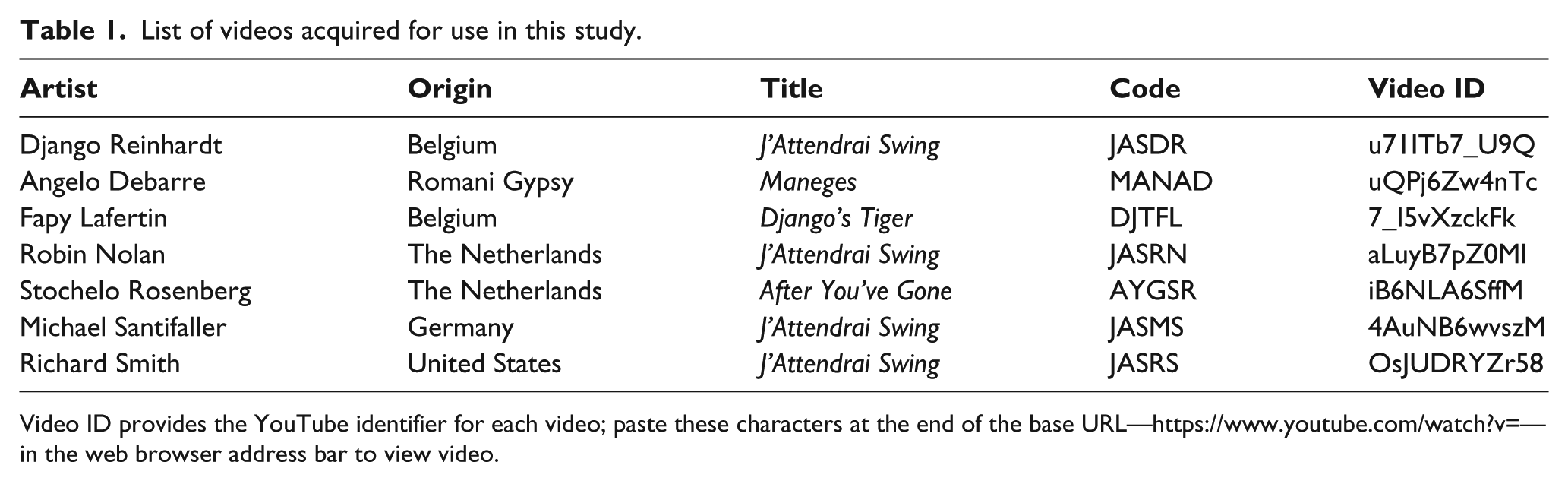
Video ID provides the YouTube identifier for each video; paste these characters at the end of the base URL—https://www.youtube.com/watch?v=—in the web browser address bar to view video.
Video processing and data extraction
Videos were processed into clips showing scenes with a clear view of the PIPJs and finger tips of the first two fingers on the fretting hand. Coordinates of the PIPJs and finger tips were extracted using a custom MATLAB (MathWorks, Natick, MA) graphic user interface that presented the raw image frames one at a time, and solicited four clicks from the investigator (one for each of two landmarks on two fingers). These coordinates were proofed for accuracy, that is, visual concordance with the anatomical landmarks.
Distortion of finger angles due to shift in reference frame was corrected via a three-step coordinate transformation, comprising two rotations and a translation. First, location and orientation of the guitar body were extracted, from which a three-dimensional (3D) coordinate rotation was constructed via an Eulerian transformation. The instrument perimeter coordinates were rotated into an orthonormal projection by optimizing the Eulerian rotation angles such that the area of the polygon defined by the guitar perimeter was maximized. This optimization was performed in MATLAB via the fminsearch routine for each frame in the film clip. Subsequently, all coordinates were rotated in 2D space so that the guitar neck axis was aligned with the horizon. Third, the coordinates were translated such that the coordinate where the guitar neck meets the guitar body (at the bottom edge) coincided with the origin. Finger coordinates were transformed identically prior to analysis (Figure 1). This approach is adapted from similar techniques with established validity in extracting finger position from video during stringed instrument play. Extended discussion of the methodology and its basis for validity are included in the supplementary Appendix.
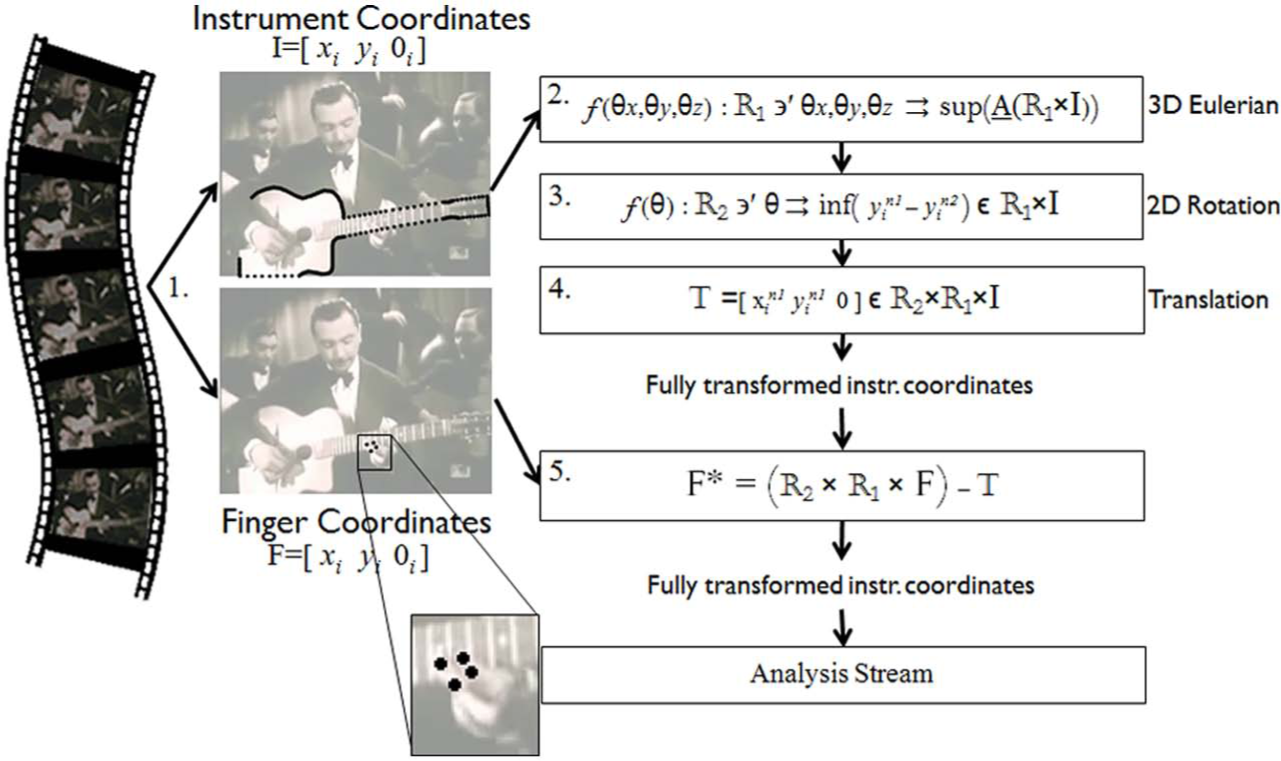
Workflow of finger coordinates rotation. In summary: (1) Movie clip is divided into individual frames; (2) instrument coordinates I are rotated into orthonormal projection via 3D Eulerian transformation matrix R1, found via functional optimization search for maximal polygonal area A of the instrument coordinate set; (3) orthonormally projected instrument coordinate set (R1 × I) is rotated via 2D rotation matrix R2 until the coordinates of the neck joint (meeting of the neck to the guitar body near the thin string, yn1, and meeting of the neck to the peg board near the thin string yn2) are at the same latitude, that is, the bottom edge of the neck is parallel to the horizon; and (4) coordinate translation of the projected and rotated coordinate set is (R2 × R1 × I) so that the neck–body interface coordinate yn1 is moved to the origin. (5) These three transformations are then imparted on the finger coordinate set (F* = (R2 × R1 × F) − T), yielding a registered data set suited for cross-image analysis. For extended discussion of analytical methods, including supplemental MATLAB code, see supplementary Appendix.
Analysis
We measured the angle of the index finger relative to the middle finger (i.e. the “interdigit angle”; Figure 2(a)), and the angle made by the fingers to the axis of the fretboard measured through the PIPJ and tip of each finger (Figure 2(b)). In order to maximize the specificity of this analysis, only the most extreme 10% of angles were retained for comparison. Our aim here was to uncover kinematical aberrations arising in moments of extraordinary play with minimal risk of obfuscation by the ostensibly homogenous hand postures of the guitarists in the bulk of their play, which we anticipated might “regress to the mean” de rigueur. An additional, exploratory analysis of the “violin-like playing” hypothesis 1 is described in the supplementary Appendix.
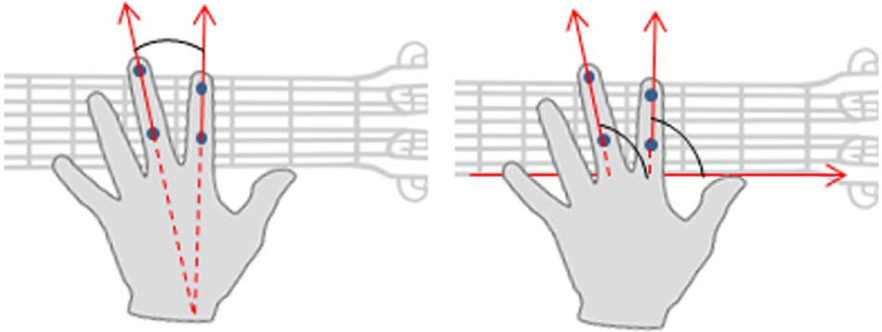
Diagrams of measurements taken from fretting hand. Interdigit angle between index and middle fingers (i.e. abduction, left), and angles of index and middle fingers relative to the long axis of the guitar neck (i.e. ulnar deviation, right).
Findings and outcomes
Within the 2 min and 20 s of film of Django playing J’Attendrai Swing, Django’s melodic play extends from 0:40:00 through 1:45:00; that is, approximately 65 s of the film met the basic criteria for inclusion. Of these frames, approximately one-third (20.5 s; 990 frames) showed Django at a sufficiently “orthonormal” (i.e. not overly oblique) angle with full view of the fretting hand. Among these 990 frames, more than half (N = 546) survived the quality-control screening on the basis of sufficiently clear vantage of all four landmarks (PIPJs and finger tips).
The primary objective of our investigation was to ascertain whether Django exhibited any unusual hand postures in the extreme-most 10% of frames, as compared to those postures observed of similarly skilled but fully fingered guitarists playing in a similar style. We note that neither the final subset of analyzed frames nor the frames within which a “very extreme” posture occurred represent a contiguous set of frames; these data subsets comprised frames from across the entire time span of usable film.
The results show that Django indeed showed a predilection toward more abducted finger postures: −9.11 ± 6.52°, with a maximum abduction of −14.5°, versus six comparison (−5.78 ± 2.41°). The effect on means was significant p < 0.001, and the effect was significant to p < 0.05 in a multiple comparisons pair-wise test against each other players’ data via Tukey’s honestly significant difference criterion (Figure 3(a)).
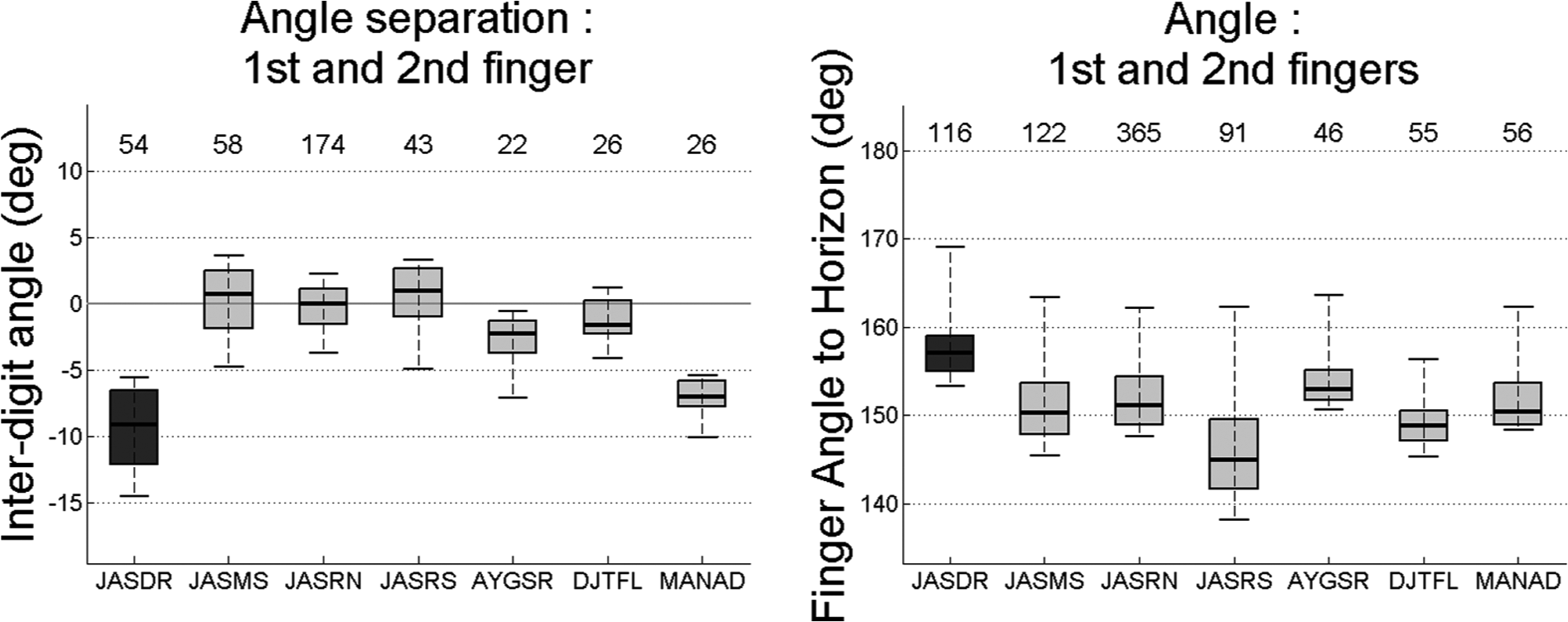
Box plots of study findings. Interdigit angle shows Django’s propensity for abduction between index and middle fingers (p < 0.05, left), and propensity for ulnar deviation (p < 0.05, right). Total number of frames analyzed is annotated above the box plots.
In a separate analysis of fretting finger orientation with respect to the long axis of the guitar neck, Django again showed a substantially more parallel hand orientation than all other comparison subjects: 157.71 ± 3.37° versus 150.59 ± 2.67°. Here again, the effect was significant at p < 0.001, and survived a multiple comparisons test at p < 0.05 (Figure 3(b)).
Discussion
Biomechanics of the hand during guitar play
The biomechanics of a guitarist’s hand are complex, and a thorough treatment of this topic would be beyond the scope of this article. However, we summarize that the left-hand finger movements can be described in three general ways: (1) position of the hand on the guitar neck, (2) finger span, and (3) speed of hand repositioning. 2 Hand size; hand width; wrist width; interdigit spans; flexion, extension, and rotational movements under passive movement and maximum voluntary effort; and MCPJ movement (both laterally at standard torque, and extension at low and high torques) are relevant considerations of anatomy and excursion in fretting activities. 3 Notably, Django’s apparent ulnar deviation contradicts the dogma of conventional guitar instruction, where music teachers often make the point that sustained, wide stretches of the hand should be avoided, and the posture of the hand should be such that the hand, wrist, and fingers are in a neutral orientation whenever possible. 3
Django, DOF, and device complexity
Our analysis suggests that Django expanded the range of a limited number of remaining degrees of freedom (DOFs) in a way that is significantly different from a cohort of comparators. While Django was not a candidate for upper-limb prosthesis, this observation may have implications for prosthetic design. For instance, it is conventionally thought that despite the mechanical elegance of many modern prosthetic devices, none of these methods permits the “natural” control of more than a very small number of DOF.4,5 While device complexity alone cannot explain device abandonment,6,7 our findings echo a question often asked among both roboticists and clinicians: would device acceptance increase with a reduction in end effector complexity?8,9
Several hands already in the research stream feature an abduction freedom, however, not necessarily in a way that exploits the DOF seen of Django: the Michelangelo Hand uses an underactuated abduction as the hand opens, and the i-limb ultra revolution has abduction at the thumb only. Several studies have investigated posture control via the Shadow Hand, highlighting abduction in grasping activities.10,11 In this light, we propose that it may be important not only to ask “how many DOFs are best?” but also “which DOF is best?”
While we report on a narrow set of hand postures in this study, previous research regarding postural synergies of the hand suggests that a simplified control paradigm with limited DOF may be tenable for executing many of the grasp types essential to the activities of daily living (ADLs). Indeed, the 16 postures of Cutkosky’s grasp taxonomy can theoretically be performed using only three different control strategies, 8 and among 15 joint angles measured in the fingers and thumb, two principal components account for the vast majority (up to 80% or more) of variance in dozens of grasp types. 12 Admittedly, a hand designed on this principle may be less likely to appeal cosmetically; however, this may not prove impactful in device adoption: among amputees rejecting upper-limb prostheses, “Just as or more functional without it,” is the most common reason for disuse (98%), where appearance of the prosthesis was only the 10th most frequently reported factor in the decision not to wear a prosthesis. 13 For both prosthetic replacement of missing hands—but also for surgical restoration of injured hands—even modest loss of function can prove to “interfere” with the use of the remaining healthy effectors, burdening the patient. 14
Rehabilitation, training, and hand study
Beyond prosthetic design, what wisdoms are reinforced or gained anew from this study? Perhaps the most accessible connection to clinical intervention is this study’s support of the existing research asserting the importance of focused therapy, retraining, and corrective devices, that is, splints and orthoses,15,16 and that any quality outcomes might be more likely to result from surgeries planned to yield functionality in a preferred activity, rather than cosmetic appearance or anatomical “position of function.” 14 Furthermore, Django evidences both the idiosyncrasy and the potentially unlimited power of neuroplasticity: recovery (reappearance of elemental motor patterns following injury) and compensation (appearance of new motor patterns via the adaptation of remaining motor elements) can be radical, particularly when ADL are integrated into the therapeutic regimen. 17
Finally, we propose that this methodology may be useful in a broader range of clinical researches. In order to analyze pre-existing raw video record of a subject with arbitrary film angles, we created a clickable graphical-user interface to extract joint coordinate data frame by frame, and performed a standard affine transformation to reconfigure the data into an orthonormal planar coordinate system. We believe that this paradigm could be applied easily to many different settings where it is preferred to capture movement data in a naturalistic setting with the absolute minimum of constraints on the actor, for example, anatomical markers that might compromise hand comfort. 18 While a two-camera method would be required in order to eliminate the presumption of planarity, proper lighting and subject framing would improve both the efficiency of our method, and may support more sophisticated image processing enterprises, for example, automatic identification of hand segments.
Conclusion
Unusually, this case study does not report on an anonymized living patient, but on a well-known individual of high historical importance. Here, we applied modern image processing and kinematic analysis in order to draw clinical conclusions from the very limited surviving film record of Django Reinhardt in live action play: only a few minutes of film exist, the footage is of only modest quality, and not all of the footage showed Django in a freestyle play where his kinematics could be assessed “in the raw.” Given these limitations, this report cannot be considered a definitive treatment on the subject of Django’s injury or his recovery. However, this is the first study to address the question of “how did Django do it?”—a matter of interest to many. Our preliminary conclusion is that Django appears to have adapted to debilitating injury by making use of latent, atypical DOF (finger abduction and ulnar deviation). Extended discussion of our methodologies and analyses is provided in the supplementary Appendix.
Footnotes
Acknowledgements
The authors would like to thank Troy Shinbrot, PhD for helpful commentary.
Conflict of interest
None.
Funding
This research received no specific grant from any funding agency in the public, commercial, or not-for-profit sectors.
References
Supplementary Material
Please find the following supplemental material available below.
For Open Access articles published under a Creative Commons License, all supplemental material carries the same license as the article it is associated with.
For non-Open Access articles published, all supplemental material carries a non-exclusive license, and permission requests for re-use of supplemental material or any part of supplemental material shall be sent directly to the copyright owner as specified in the copyright notice associated with the article.
