




Abstract
Musicians with physical disabilities who achieved stardom are part of the lore of popular music. Guitarist Django Reinhardt contrived alternate fingering patterns necessitated by burn contractures of his left hand. Les Paul, a legend in the development of the solid body electric guitar and multitrack recording, mangled his right arm in a car wreck so severely that his elbow was set permanently at 90° so he could continue to play guitar. Michel Petrucciani suffered from osteogenesis imperfecta, a condition that stunted his growth to the point where he used a special attachment to reach the sustaining pedals of his piano. Their stories show the force of human genius in music.
Django Reinhardt
Jean Baptiste “Django” Reinhardt (1910-1953; Figure 1) and Stéphane Grappelli were the feature performers of the Quintette du Hot Club de France, the seminal European jazz venue in Paris. Strongly influenced by American jazz performers who visited Europe in the 1920s, Grappelli’s violin and Reinhardt’s guitar were a creative break from the brass, reed, and percussion elements of African American jazz. According to jazz historian Ted Gioia, they “brought a specifically European perspective – drawing on gypsy music, classical composition, and local folk traditions – to bear on their jazz work.” Gioia cites “Dinah” (Ultraphone, 1935) as a prototype of Reinhardt’s fast-fingered improvisation and Grappelli’s lyricism.
1
William P. Gottlieb. Django Reinhardt at the Aquarium jazz club in New York, NY, ca. November 1946. Library of Congress.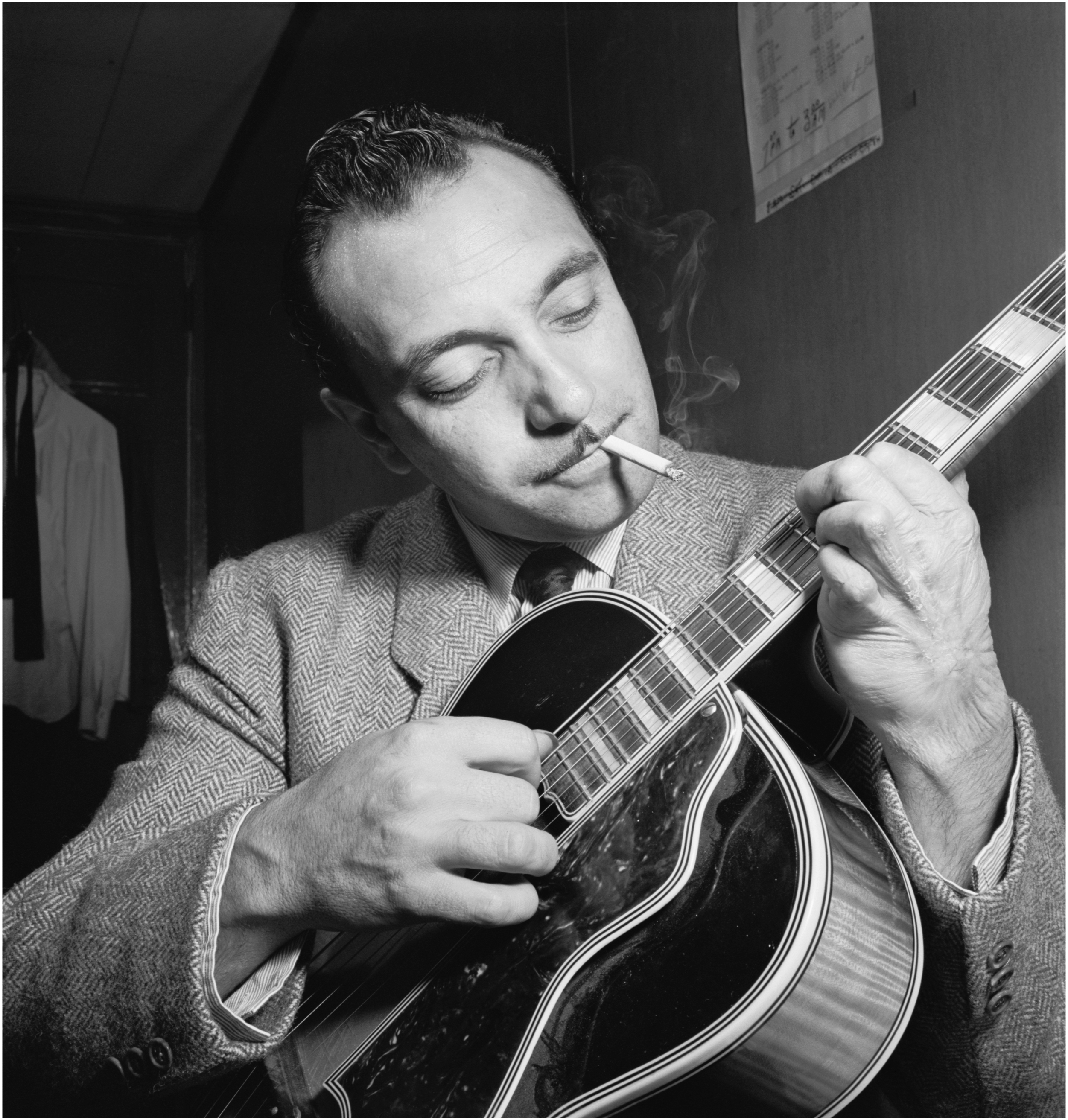
David Williams, a consultant anesthetist in Swansea, Wales, studied Reinhardt’s life and mechanics of his guitar playing. 2 Young Django grew up in gypsy settlements in Belgium and northern France. From childhood he contributed to family pocketbook playing popular musette waltzes on street corners. At 18 he married a woman who made sold flowers that she fashioned from celluloid and paper, a combustible inventory that led to a disaster.
Either a carelessly discarded cigarette or an overturned candle set their roulotte ablaze. Fleeing the conflagration Reinhardt badly burned the left side of his body, including his left hand and lower extremity. His surgeons considered amputating his leg. He refused. After a one-month hospitalization, he hobbled to his settlement where his wounds were treated with folk concoctions and salves. 2
He needed a cane to walk. Reinhardt went to Hôpital Saint-Louis months later with infected wounds that underwent cautery and debridement. Wounds slowly healed, but contractures froze the metacarpal-phalangeal joints of his ring and little fingers in hyperextension and the interphalangeal joints in flexion.
Painstakingly Reinhardt relearned to play the guitar. He used his thumb on the lower 2 strings and paired the immobile ring and little fingers on the upper strings as a single digit. Williams and Michael Wininger, a professor of kinesiology and prosthetics at the University of Hartford, conducted a kinematic analysis of Reinhardt’s fingering on the few filmed recordings that still exist of the artist’s performances (also this video on YouTube). 3 They noted that Reinhardt stretched his index and middle fingers apart farther than other expert guitarists during performances. He could reach a barre across the full length of the fret board using just the distal 2 phalanges of his index finger.
His adaptations led to a style based on sixths and ninths that became his musical trademark. 1 Some of Reinhardt’s fingering innovations were used later by jazz guitarist Wes Montgomery. 2
Les Paul
Born Lester Polsfuss in Waukesha, WI, in 1915, Les Paul (1915-2009; Figure 2) was associated with 2 innovations that revolutionized pop music, the solid body electric guitar and multitrack tape recording. A master guitarist, he was only 13 when he started performing country and western at local venues, billing himself first as “Red Hot Red,” then later, “Rhubarb Red.” Paul became an accomplished big band sideman in the 1930s and 1940s with such notables as Fred Waring, Bing Crosby, Judy Garland, and the Andrews Sisters.
4
William P. Gottlieb. Les Paul, ca. January 1947. Library of Congress.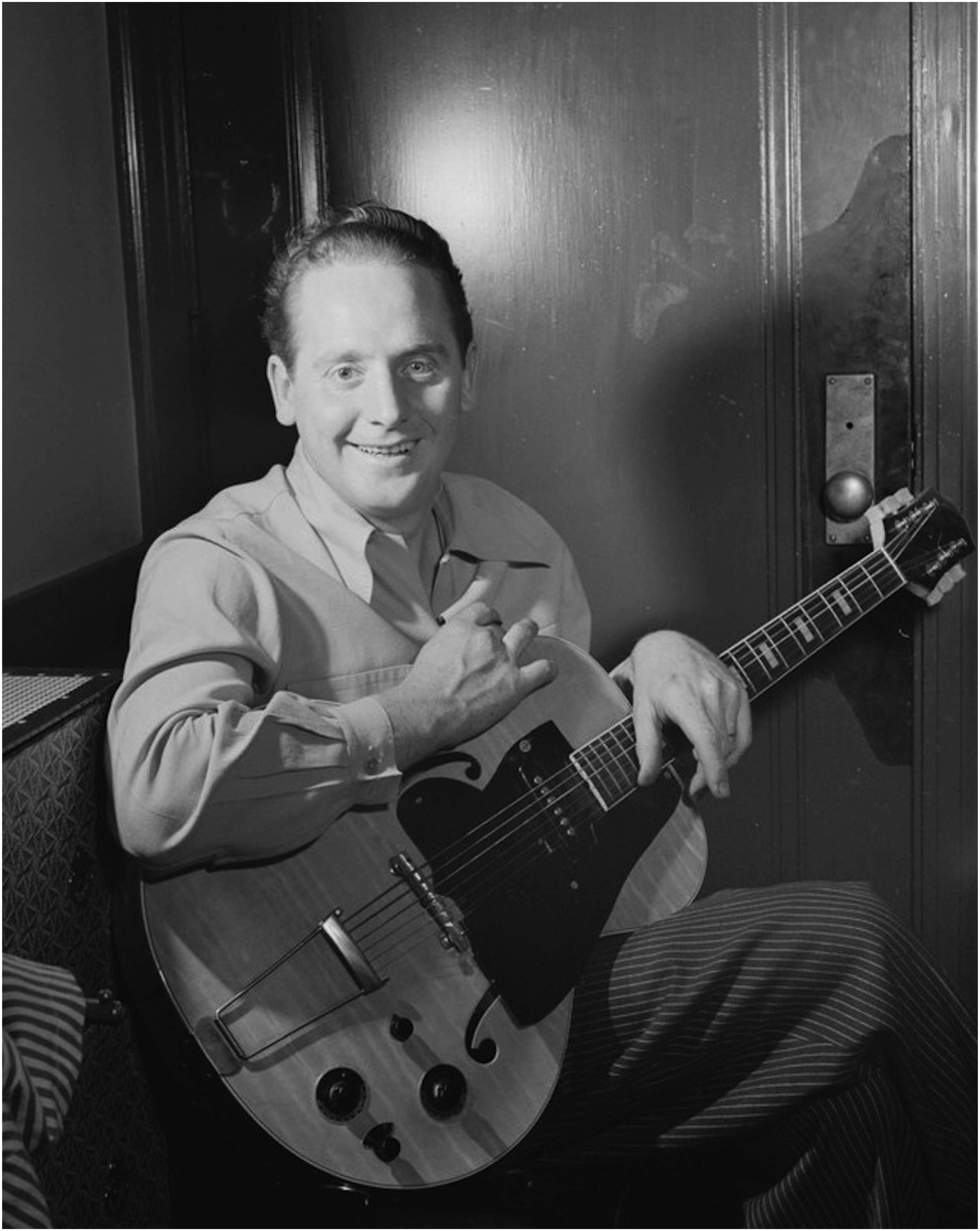
He showed his genius in electrical engineering as Rhubarb Red in local dives. To make himself heard over the din, he wedged a Victrola phonograph needle under the strings of his guitar and fashioned a loudspeaker using a radio and the remains of a telephone.
The ur-amplifier was Paul’s entry into the highly competitive world of perfecting the solid body electric steel guitar, dominated by Paul, Leo Fender, and Paul Bigsby. Ian Port, writer and music critic in New York, wrote a history on their respective contributions and rivalry in the development of the solid body electric guitar. “Each man brought a different strength,” he wrote. “Les was the only expert guitarist. Leo excelled at electronics. Bigsby was a master craftsman. 5 ” The men met at irregular intervals at Paul’s garage studio-workshop in the Los Angeles suburbs, scrutinizing the others’ prototypes and keeping their own secrets like misers, lest one of their advances would show up in a rival’s model.
Paul was also tinkering with overdubbing, the process of layers of soundtracks to create a single recording. He used 16-inch wax discs turned on a flywheel salvaged from a Cadillac and driven by belts from a dental drill. He recorded his first hit single, “Lover (When You’re Near Me)” (Capitol, 1948), a transformation of a sentimental Rodgers and Hart tune into a whirlwind of 8 multitracked, multispeed guitar lines weaving in and out of the chord progression in standard pitch. The recording was a revelation of Paul’s musical brilliance and overdubbing technology; in Port’s words, “a dizzying eddy of sound. 5 ”
At the zenith of his creativity in music and technology, he suffered a near-fatal car crash on an ice-covered section of Route 66. Port described the accident in detail. 5 His vocalist (and future wife) Mary Ford was at the wheel when their car skidded off an overpass and plunged 20 feet into a ravine. Neither were wearing seat belts. Their bodies flew out a tear in their convertible top, coming to rest in the snow and ice.
Authorities found them only because the crash had interrupted telephone lines between 2 rural towns in the area. Ford came away with a cracked pelvis and scratches, fortunate in comparison to Paul, who suffered a ruptured spleen and fractures to his clavicle, 6 ribs, and pelvis. He had been fighting off the flu, an illness that blossomed into pneumonia once he was hospitalized.
His right upper extremity was shattered above and below his elbow, so injured that surgeons considered amputation. “I’ll tell you what,” Paul said to his doctors. “Let’s not say we can’t save the arm until we prove we can’t. Okay?” 5
The alternative was to fix his elbow in a position where he could still pick a guitar. Paul told his surgeons that he wanted his hand to reach his navel, an orthopedic concept already long-established as the position of function for the elbow (90 degrees of flexion midway between supination and pronation). Paul’s elbow was fixed with a bone graft from his opposite fibula and fixation with plate and screws. Paul spent months in a long arm spica cast reinforced with a broomstick as he waited for feeling to return to his fingers. 5
He was still on crutches when he encountered tape recording, a German invention liberated by Jack Mullin, a US Army signal corps officer stationed in Luxembourg at VE Day. The Ampex Electric Manufacturing Company reverse engineered the technology to produce a marketable tape recorder. Crosby, frustrated with the rigid schedules and production requirements of live radio performances, recognized immediately the potential of prerecording broadcasts. In 1949 Crosby gave an Ampex tape recorder to Paul, his friend from their many shared live broadcasts. The sideman otherwise would not have been able to afford the device himself.
The tape recorder solved Paul’s goal of multitrack recording. He got Ampex engineers to fix an additional recording head that allowed overdubbing. As quoted by Buskin, Paul remembered the event. “Mary [Ford] said, ‘One, two, three, four, testing’, and I said, ‘Howdy, howdy, howdy’, and by God it came back. I threw my crutches in the air, and we danced around in the hallway. 4 ” From that point they used the altered machine to record their hits, including the jazz standard “How High the Moon” (Capitol, 1951), where Paul recorded all twelve string lines and the pair shared twelve vocal parts. 5
The electric guitar competition continued during Paul’s confinement and recuperation. In 1950 Fender introduced the iconic Fender Telecaster to country and western musicians, who as a group were the first to embrace the electric guitar. Paul had a different tack. Since the early 1940s, Paul urged Gibson guitar makers to make their own version of a solid body electric guitar.
Motivated by the popularity of electric guitars in country music and Paul and Ford’s hit singles Gibson had a prototype ready in 1951. It incorporated many of Paul’s concepts, but the electronics, design, and production were entirely those of company engineers and craftsmen. Gibson sought Paul’s endorsement to the point of encouraging the fiction that he had invented the instrument; in Port’s words, “capitalizing on his reputation for technological innovation. 5 ” Performing on the new Gibson Les Paul guitars and featuring overdubbing techniques Paul and Ford by the end of the summer held 4 spots on Billboard magazine’s bestselling pop singles chart. 5
The Gibson Les Paul electric guitar of the 1950s was played by a “who’s who” of pop musicians: B.B. King, John Lee Hooker, Eric Clapton, Keith Richards, Jeff Beck, Pete Townshend, Bob Marley, John McLaughlin, and Slash of Guns and Roses. Paul, fabulously wealthy from his inventions and sponsorship of the Gibson Les Paul, continued performing in public before sold-out Monday night shows at the Iridium Club in Manhattan well into his 90s. 6
Michel Petrucciani
Michel Petrucciani (1962-1999) overcame osteogenesis imperfecta to become an acclaimed jazz pianist in the 1980s and 1990s. Critics placed him in the tradition of such greats as Art Tatum and Bill Evans. Born in Orange, France, to a musical family, he became a fulltime musician at age 15, playing for Kenny Clarke. He was a regular on the European jazz circuit while still a teenager. Upon visiting New York at age 18, he was an immediate success. On the West Coast, he induced saxophonist Charles Lloyd to come out of retirement to form a quartet in 1981 that assured the pianist’s stardom at 19. He recorded 7 albums for Blue Note, including the classic Power of Three (1986) with Wayne Shorter and Jim Hall. Enormously popular in France, he was made a knight of the Legion of Honor in 1994. 7
Jazz chronicler Steve Voce, who began his career as a jazz critic based in Liverpool during the bebop era and who continued to write on pop music until his recent death in 2023, published Petrucciani’s obituary that gave the details for this section. 7 Petrucciani was raised in a jazz-filled home. His father was a jazz guitarist who made certain that his sons played music: Philippe took up his father’s instrument; Louis, the bass. With a congenital condition that led, in Petrucciani’s recollection, “hundreds of fractures,” the youngest son Michel was given a set of toy drums so he could play with the family band. 7
At age 4, Petrucciani watched a televised performance of Duke Ellington that fired a desire to learn piano. A toy piano appropriate for his size did not fool the lad, who immediately destroyed the counterfeit with a hammer. “It was not the sound I had heard on TV,” Petrucciani said. 7
His father lugged home a broken-down piano left behind by British soldiers at the military base where he worked. Even with the remains of spilled beer on the keyboard and hammers, Petrucciani remembered that “the piano sounded real. 7 ”
The decrepit instrument revealed a prodigy. A better piano was provided once the boy made the commitment to serious study at age 7. The elder Petrucciani made certain his son received classical training—no jazz—for years. Like most boys, young Michel chafed but his father understood the necessity of musical discipline. The boy watched Rubenstein and absorbed Bach, Debussy, Ravel, Mozart, and Bartok. “It paid off,” Petrucciani said. “Absolutely. Studying orthodox piano teaches discipline and develops technique. You learn to take your instrument seriously. 7 ”
The boy longed for jazz. At 10 he discovered Bill Evans, who was his earliest influence on the keyboard. He was just 13 when he made his professional debut at the annual jazz festival in Cliousclat. The year’s featured performer, Clark Terry, needed a substitute pianist for one of his sets. When one of the festival organizers sent Petrucciani, Terry thought someone played a practical joke.
His growth already severely stunted by his disease—he reached only 3 feet in height and weighed only 50 pounds as an adult—Petrucciani had to be carried on stage and placed on the piano bench. Special attachments allowed his feet to work the sustaining pedals of the piano.
Terry at first mocked the diminutive musician, playing mock bullfight music. Petrucciani challenged him to play a blues duet with him. “After I’d played for a minute,” Petrucciani remembered “he said, ‘Give me five!’ and gave me a hug, and that was it. 7 ”
Petrucciani had long-fingered hands that were spared from the worst of the growth-destroying effects of his disease. His style was “aggressive” (eg, “Take the A Train”), an unexpected approach for one whose idol was the more reflective Evans. Petrucciani’s approach to the piano instead resembled that of Oscar Peterson, a jazz master to which he was compared. 7
His reputation spread and he received invitations to play at jazz festivals throughout France and Europe. He moved to Paris at 16, and in 1980 at 18 he recorded his first album Flash (Paris, Bingow Records) in a combo that included his brother Louis. He went to the US for the first time that year (his father had to cover a bounced check for his ticket to New York). He easily found work.
He went on to California where he jammed with tenor saxophonist Charles Lloyd at the latter’s home in Big Sur. Lloyd, who had retired from a successful career 15 years previously, was so enthusiastic that he resumed concertizing to perform with Petrucciani. Their performances on the West Coast earned rave reviews. Their combo won the 1982 Prix d’Excellence at the 1982 Montreux Jazz Festival.
The Los Angeles Times named him the Jazz Man of 1983. He was recognized by both the French and Italian governments for his accomplishments in jazz. Freddie Hubbard invited him to be his pianist in his all-star band. He worked with the top rank of jazz musicians, including tenor saxophonists Joe Henderson and Wayne Shorter, and recording with Shorter and guitarist Jim Hall at Montreux in 1986.
His disability was progressive, ending with his death in 1999 from pneumonia at age 36. 7
Supplemental Material
Supplemental Material - Jazz Musicians and Their Disabilities: Django Reinhardt, Les Paul, and Michel Petrucciani
Supplemental Material for Jazz Musicians and Their Disabilities: Django Reinhardt, Les Paul, and Michel Petrucciani by Don K. Nakayama in The American Surgeon™.
Footnotes
Declaration of Conflicting Interests
The author(s) declared no potential conflicts of interest with respect to the research, authorship, and/or publication of this article.
Funding
The author(s) received no financial support for the research, authorship, and/or publication of this article.
Supplemental Material
Supplemental material for this article is available online
References
Supplementary Material
Please find the following supplemental material available below.
For Open Access articles published under a Creative Commons License, all supplemental material carries the same license as the article it is associated with.
For non-Open Access articles published, all supplemental material carries a non-exclusive license, and permission requests for re-use of supplemental material or any part of supplemental material shall be sent directly to the copyright owner as specified in the copyright notice associated with the article.
