




Abstract
Background:
The role of arm motion during the long jump has been well studied. The aim of this study was to quantify the effect of forearm mass on impulse and the kinematics of the flight phase in an upper limb amputee.
Case description and methods:
A world-record paralympic long jumper carried out jumps in three conditions: wearing his usual forearm prosthesis and with 0.3 and 0.4 kg added mass. A motion capture system including force plates was used to record the jump.
Findings and outcome:
At take-off, the addition of 0.4 kg to the prosthesis decreased the vertical velocity of the centre of mass but increased horizontal velocity. These modifications were associated with an increase in landing distance and an improvement of the synchronization between arms.
Conclusion:
Increasing forearm mass appears to improve long jump performance. Further studies need to evaluate the optimal prosthetic mass for both training and competition.
Clinical relevance
This biomechanical analysis of the long jump highlighted the effects of changing prosthesis mass on performance. This methodological approach may be useful in the context of sport and performance research.
Keywords
Introduction
Since Bob Beamon’s famous world record in Mexico in 1968, numerous studies have described the biomechanics of the long jump.1–3 These studies suggest that good long jump performance is determined by a high-velocity approach and the ability of the jumper to transform horizontal velocity into vertical velocity. With regard to paralympic athletes, only a few biomechanical analyses of the long jump have been carried out. Their aim was to better understand the technical characteristics of the techniques of lower limb amputee athletes.4,5 However, no studies have been carried out on arm movements and on the techniques used by upper limb amputees, despite the fact that it is known that arm movements play an important role in improving performance in horizontal jumps.6,7 Ashby and Delp 7 used a simulation approach and clearly showed the mechanisms of enhanced performance linked to arm movements. They found that improvements in performance of the free arm jump were due to a 15% increase in the take-off velocity of the centre of mass (COM). These results highlighted the role of arm mass on the trajectory of the whole body COM. Indeed, ancient Greek pentathletes were already aware of this and artificially increased forelimb mass during jumps through the use of barbels. 8 Minetti and Ardigó 8 suggested that a pair of halters, in the mass range of 5–6 kg, could improve performance by 5%−7%. More recently, Channon et al. 9 demonstrated that the exceptional leaping performance of the Gibbon (crossing gaps in the forest canopy exceeding 10 m) is probably related to the effectiveness of their forward arm-swing because their forelimb mass is greater than in other species. We believe that the analysis of long jump performance in subjects with upper limb amputation would deepen comprehension of this fast and complex task.
Thus, the purpose of this study was to test the effect of forearm prosthesis mass on the movement technique during the impulse and flight phases of a world-class long jump. We hypothesized that changing forearm prosthesis mass would have an impact on upper limb kinematics during the flight and could also be an important factor in determining long jump performance.
Materials and method
Subject
A world-record long jumper with a left forearm amputation (name: Arnaud Assoumani (AA); category: F46; height: 1.85 m; weight: 78 kg, best performance: 7.82 m) participated in this study. He jumped using the hitch-kick technique. AA fully agreed to take part in this study and provided written informed consent. All procedures complied with the recommendations of the Declaration of Helsinki and were approved by the local Ethics Committee (INSEP-FFH).
Procedure
Given that the long jump is an extremely demanding task for the musculoskeletal system and that this study was carried out during the preparation phase of the paralympics, only three long jumps were performed and analysed. The run-up was reduced to 7 steps (12 steps in competition), and each jump was separated by 15 min of recovery. The first ‘free’ jump (FJ) was carried out with the prosthesis without any additional mass. Then, two jumps (weighted jumps (WJs)) were carried out with an additional mass placed on the distal part of the prosthesis (fixed on the prosthetic wrist). The added mass on the prosthetic wrist was 0.3 kg (WJ_0.3) followed by 0.4 kg (WJ_0.4). The mass of the prosthetic segment in the WJ_0.3 condition was 65% of the right (non-amputee) forearm-hand mass, and was 70% in the WJ_0.4 condition. The mass of the right forearm-hand was measured using dual-energy X-ray absorptiometry (GE Lunar iDXA). This system allows measuring the whole body composition or only one part of the body. 10
Each jump was performed on an indoor track equipped with a force plate (60 cm × 120 cm; 500 Hz; Kistler) so that the kinetics of the impulse could be recorded. An optoelectronic Motion Analysis® system (Motion Analysis Corporation, Santa Rosa, CA, USA) consisting of 14 digital cameras was used to record the three-dimensional (3D) marker trajectories (100 Hz) during the flight phase (from take-off to landing). AA was equipped with 63 passive reflective markers. A total of 16 rigid segments were then reconstructed to model the entire body during the jumps.11,12
Data analysis
In order to analyse the movement technique, the long jump was divided into 3 phases (Figure 1): the impulse, flight and landing phases. The impulse phase represents the last foot contact before take-off. During this phase, the three force components of the impulse (vertical: Iz; horizontal: Ix; lateral: Iy) and the contact time (Tc) were calculated. In addition, the vertical and horizontal velocities of the COM during take-off (Vz_TO; Vx_TO) were calculated from the kinematic data. These velocities were used to calculate the angle of the velocity vector at take-off (θTO) and as integration constants to calculate the vertical and horizontal velocities of the COM when the foot hit the force plate (Vz_HIT; Vx_HIT).
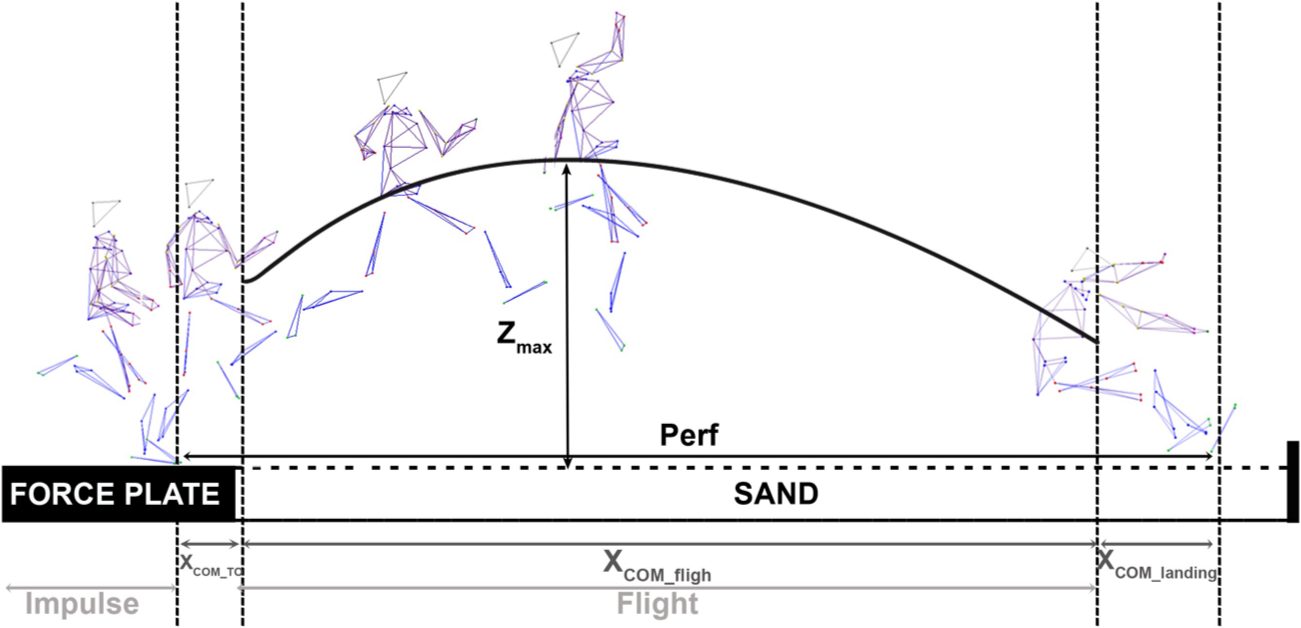
Different parameters measured during the impulse and flight phases.
During the flight phase, the maximal vertical position of the COM (Zmax) was measured. The right and left shoulder angles (humerus relative to the thorax) for the 3 degrees of freedom, namely, flex/ext, ele/dep and rot int/ext, were calculated. In order to characterize the synchronization between arms, the average value of right and left shoulder angles for each degree of freedom (Figure 2) were calculated (MSAflex/ext; MSAele/dep; MSAint/ext).
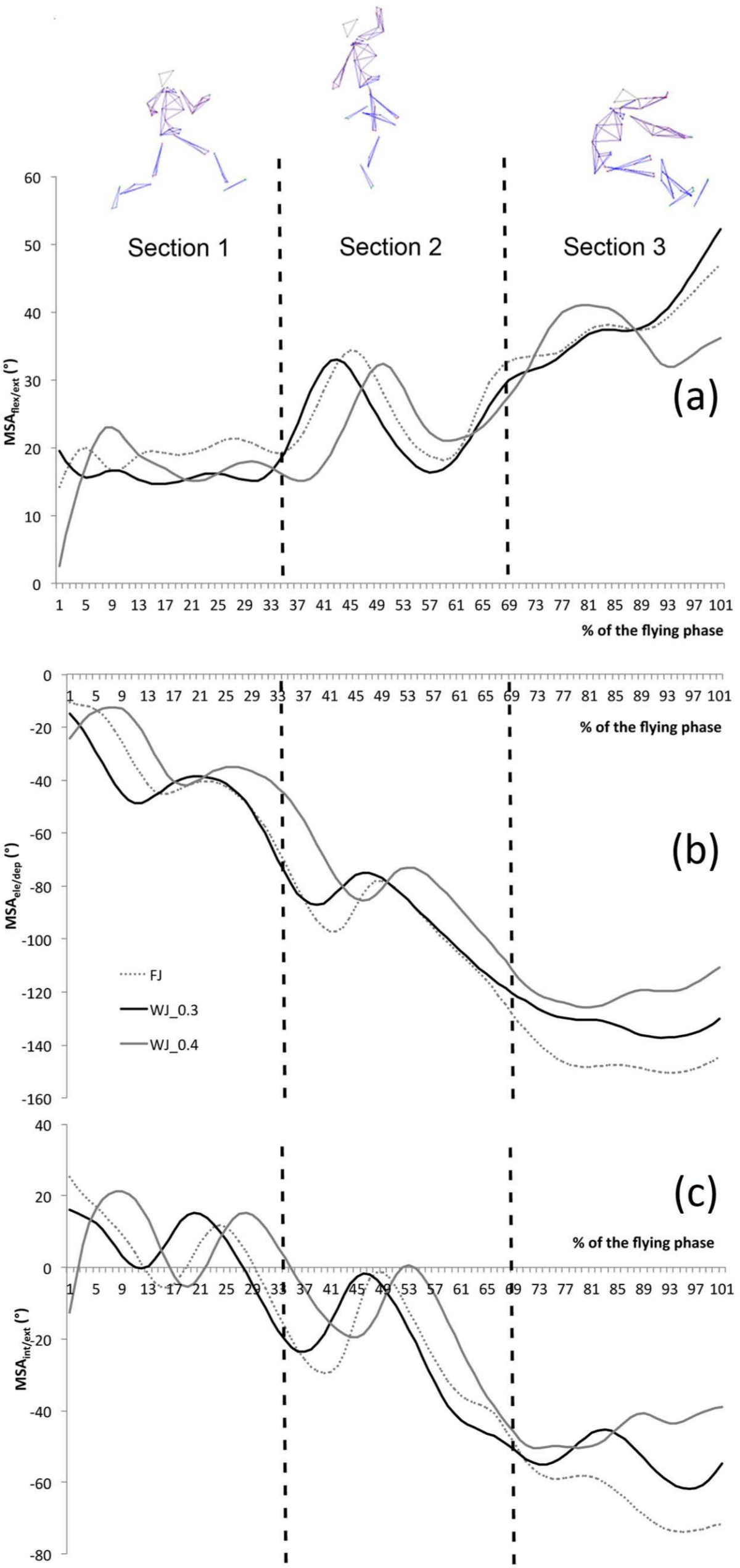
Evolution of the average value of right and left shoulder’s angle during the flight phase for (a) the flexion/extension (MSAflex/ext), (b) the elevation/depression (MSAele/dep) and (c) the internal/external rotation (MSAint/ext). The flight phase has been decomposed into 3 sections.
In addition, performance (Perf) was evaluated by the jumping distance from the take-off point to the landing pit with a measuring tape. Perf was divided into three distances: XCOM_TO, the distance between the foot and the COM at take-off on the horizontal axis; XCOM_flight, the horizontal distance travelled by the COM during the flight; and XCOM_landing, the distance between the COM and the heels at landing on the horizontal axis (Figure 1).
Results
Effect of mass during the impulse phase
Iz, Iy, Vz_TO and θTO were lower in the WJ_0.4 condition compared with WJ_0.3 and FJ (Table 1). Ix and Vx_TO were higher in WJ_0.4 than in WJ_0.3 and FJ. Tc, Vz_HIT and Vx_HIT were similar in the three conditions.
Kinetic and kinematic data obtained for the three jumps: the free jump (FJ), the weighted jump with 0.3 kg (WJ_0.3) and the weighted jump with 0.4 kg (WJ_0.4).
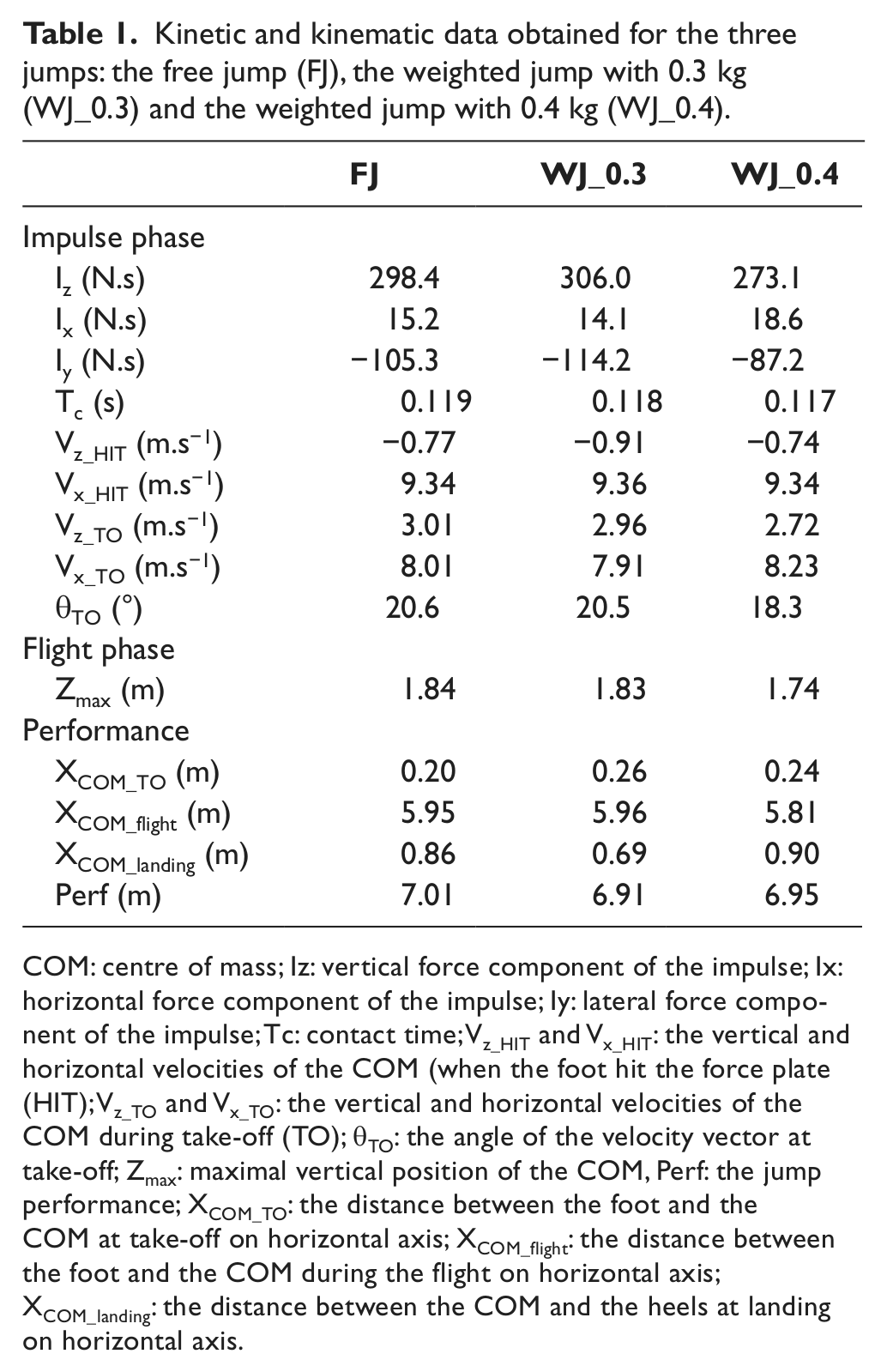
COM: centre of mass; Iz: vertical force component of the impulse; Ix: horizontal force component of the impulse; Iy: lateral force component of the impulse; Tc: contact time; Vz_HIT and Vx_HIT: the vertical and horizontal velocities of the COM (when the foot hit the force plate (HIT); Vz_TO and Vx_TO: the vertical and horizontal velocities of the COM during take-off (TO); θTO: the angle of the velocity vector at take-off; Zmax: maximal vertical position of the COM, Perf: the jump performance; XCOM_TO: the distance between the foot and the COM at take-off on horizontal axis; XCOM_flight: the distance between the foot and the COM during the flight on horizontal axis; XCOM_landing: the distance between the COM and the heels at landing on horizontal axis.
Effect of mass during flight
The maximal vertical position of the COM (Zmax) was lower for WJ_0.4 compared to WJ_0.3 and FJ (Table 1). With regard to shoulder kinematics, MSAflex/ext, MSAele/dep and MSAint/ext were similar across the three conditions for the first two one-thirds of the flight phase (Figure 2). During the last one-third, there was a decrease in elevation and internal rotation of the shoulder compared to the WJ_0.3 and WJ_0.4 conditions.
Mass effect on jump performance
There were no differences in XCOM_TO between conditions. XCOM_flight was lower in WJ_0.4 compared to WJ_0.3 and FJ. Inversely, XCOM_landing was higher in WJ_0.4 than in the two other conditions. Finally, the best performance was obtained with no additional mass, in the FJ condition (Table 1).
Discussion
Long jump performance depends on the quality of the impulse and the velocity of the run-up. The aim of this study was to evaluate the effects of upper limb mass on different parameters of the long jump. Our results show that altering the mass does not affect the horizontal velocity of the run-up (no change in Vx_HIT; Table 1). However, analysis of the impulse showed that Ix was greater and Iz was lower for WJ_0.4 than for the other conditions. These changes in impulse lead to a decrease of Vz_TO and an increase of Vx_TO in WJ_0.4. This is surprising since the quality of the impulse in the long jump depends on the mechanism that permits the athlete to gain vertical velocity and lose horizontal velocity. The fact that θTO increased showed the ability of the athlete to transform the horizontal velocity of the COM to vertical velocity. 13 All the results obtained suggest that the addition of a mass of 0.4 kg to the prosthesis greatly perturbed AA during the impulse. In contrast, the addition of a mass of 0.3 kg did not degrade the parameters of the impulse phase.
During the first two one-thirds of the flight phase, the analysis of MSAflex/ext, MSAele/dep and MSAint/ext suggested that despite the alteration of arm mass, the synchronization of right and left shoulders was not modified. Indeed, the curves of Figure 2 were similar (shape and temporal patterns) for the three degrees of freedom in the different conditions. There were some differences during the last one-third of flight, during which the curves followed different patterns depending on the condition. This was particularly the case for flex/ext (Figure 2(a)) for which the pattern of the MSAflex/ext curve was different for the WJ_0.4 condition compared with WJ_0.3 and FJ. These differences between conditions could explain why the XCOM_landing was greater for WJ_0.4. Indeed, the modification of the synchronization between arms could increase XCOM_landing. With regard to the MSAele/dep and MSAint/ext during the last one-third of the flight, there was a decrease in extension and internal rotation. Compared to FJ, this modification was greater for WJ_0.4 than WJ_0.3. The asymmetry of mass between the two arms requires the athlete to find a solution of coordination in order to reduce the imbalance during landing and improve XCOM_landing. After discussion with the coach and the athlete, they chose to retain an additional mass of 0.3 to preserve the impulsion quality and improve the landing phase.
Limitations
This study has two major limitations. The first is the small number of jumps analysed, and the second concerns the lack of a period of adaptation to the mass. However, in order to reduce the effects of fatigue, it was necessary to reduce the number of jumps and the complexity of the protocol. Because this study was carried out during preparation for the Paralympic Games, we were unable to repeat the experiment after training with the new prosthesis.
Conclusion
Increasing prosthetic mass could be an interesting strategy to improve long jump performance. Although the impulse phase was perturbed, performance during the flight phase was equivalent to WJ_0.3. However, caution must be taken in the interpretation of the results because the WJ_0.4 condition may have been affected by the WJ_0.3 condition carried out 15 min earlier, perhaps allowing the athlete to anticipate postural perturbations during the flight phase. It is interesting to note that since this study, AA trains and competes with an additional mass of 0.4 kg on his prosthesis, and his trainers have oriented the technical work towards the impulse phase.
Footnotes
Acknowledgements
We thank Johanna Roberston for revising the English language in this article.
Conflict of interest
The authors report no conflicts of interest. The authors alone are responsible for the content and writing of the article.
Funding
This research received no specific grant from any funding agency in the public, commercial, or not-for-profit sectors.