




Abstract
In the last 25 years, the continuous evolution in the design of prostheses for individuals with transfemoral and transtibial amputations has been remarkable. Mirroring this development is the dependency and expectancy of the prosthesis technology by the athletes, coaches and other personnel involved in creating Paralympians of today and the future. Össur is recognised as a leader in designing innovative prosthetic products that have contributed worldwide to developing leading Paralympians. The opening section of this article presents an overview of the new Össur products for 2012. Discussion is also focussed on how Össur’s high-function prosthetic products are integrated into an athlete’s training regime. With involvement of the clinical team discussion is also expanded to recognise the important contribution coaching staff has on optimising performance of a Paralympian’s training regime. The dialogue continues with a viewpoint on whether Oscar Pistorius, the face of Össur who wears Flex-Foot Cheetah blades, should participate in the Olympics and Paralympics. While the conclusion of this article may leave more questions than answers, the technology and products offered by Össur provide for a credible foundation and preparation for future challenges beyond the London 2012 Paralympic Games.
Clinical relevance
Prosthetic technology continues to evolve and the possibilities for individuals with transfemoral and transtibial amputation to participate in high levels of sport increase. Clinicians should be aware of the demands and issues related to the use of such technology within sport.
Össur is renowned for its award winning technology and has played an important contribution to the development, training and performance of Paralympians. In 200 words, can you sum up the evolution and success of Össur’s technology?
The pioneers of the first Flex-Foot realised that something had to change and that design convention of prosthetic feet needed to be expanded. Like many products, if they work and people like them, they will use them more and therefore experience greater function. Our philosophy is to provide innovative products that enable people to live their lives without limitation. And that means pushing the boundaries of our conventional thinking. The Iceross liner, for example, was a game changer, as was the original Flex-Foot. It is concepts like these that help unlock a user’s potential, rather than provide them with a performance gain. I remember as a younger clinician when these were first introduced; a moment of absolute clarity yet questioning if this was really possible, so extreme a concept and a huge step away from conventional thinking, Again, when I joined Össur, the original ICEX was in development, and in my eye the purest expression of socket-fitting technology that challenged many except those who wore them. The same is happening now with Bionic prostheses, pushing boundaries on many levels. In Össur, we work in a free thinking environment and our values and vision guide us to improve people’s mobility.
What new Össur sport-related products are available for 2012 and how do they differ from previous products?
We have recently redesigned one of our most popular sports feet. In addition to a more aggressive c-shape and longer toe lever, the new Flex-Run also features an interchangeable sole designed in collaboration with the global sportswear giant Nike. Team Össur athlete Sarah Reinertsen helped develop the sole, identifying the need to have an appropriate and interchangeable interface between the prosthesis and the ground in the same way that any runner or person enjoying sport will have a range of footwear fit for purpose. It is a significant development, but no more so than having a simple ability to change footwear. There will also be a new range of Flex-Foot Cheetah, as a direct consequence of becoming more involved in our Team Össur programme, further refining the needs of those engaged in differing sports.
What advice do you give to an athlete learning to wear an Össur extreme impact level prosthesis?
As a provider of specialist high-function equipment, we work closely with the host clinical team who are responsible for providing prosthetic service for those who request it. Provision of equipment does not convert a person into an athlete, or a mountaineer, for example. Usually, we find that people will approach a service provider who is already involved in sport or a hobby, where use of a regular everyday prosthesis could be deemed inappropriate or even present an unacceptable risk. In the case of athletics, they may already have a coach or be part of sporting regime or club. A prosthesis fit for purpose is essentially another piece of equipment that needs to be used correctly. We can provide that early level of tuition, assist the clinical team to provide optimum specification and alignment criteria and then let the user enjoy their sport at a new level.
Do you perform gait analysis to assist in determining optimal function and fit?
We regularly use gait analysis in the design and testing of our products, but in the field, this is not always available, especially when working with elite athletes, due to the speeds involved and the environment where their activities take place. What we always do advise though is that there is no substitute for getting down to the track. Without doubt, there is much trial and error, but as a process of formal evaluation and assessment of the many variables involved, it is important to get out and support your athletes in their domain.
Which is the most popular Össur prosthesis for elite level amputee athletes? How does this differ from the ‘everyday’ prosthesis?
Perhaps the most well-known is the Flex-Foot Cheetah. This is specifically for high impact, short duration sport events such as sprinting or jumping. Although these off-the-shelf items come in different configurations to suit athletes’ weight and activity, they principally work best at higher loads and are compliant enough to minimise asymmetry. An everyday prosthesis would be operating beyond its design criteria at these levels of load. In fact, they probably could not be accelerated to the speeds required due to the inefficient connection of a prosthesis to the body and the lack of muscular structures that an otherwise intact healthy leg would have.
What do you think are the key challenges faced by Paralympians you are currently working with?
As I write this, right now ‘focus’. To them, in some respects we are no different from their other equipment providers, clothing suppliers and brand sponsors. Our work is done! For them, many professional athletes, they are now hard at work with full commitment to their rigorous schedule. Yet I also know that because disability sport has been brought into the limelight, many of our athletes have become household names, and as such they are in huge demand. As much as they have to learn to overcome the many aspects of being involved in competitive sport at the highest level, they also have the world’s media, including our own professions media, looking over their shoulder, questioning them, their sport and their right to be there. We are all part of this story and I believe have a responsibility to acknowledge that what we are witnessing here is an unprecedented awareness of disability sport, which is providing a huge inspiration for the community which we serve.
How critical is ‘biomechanics’ to a Paralympian’s training and performance programme?
It is as critical, if not more so, for any sport, Paralympic or otherwise. However, what I have found very refreshing in my experience is to watch professional coaching staff working with our athletes to almost completely disregard the prosthesis. We clinicians tend to obsess over the prosthesis, but these coaching professionals see the whole, making the athlete work the prosthesis, not the other way round. Some coaching staff will use super slow motion video analysis to assist with their development programmes. Objective analysis is certainly part of current coaching regimes, but so too is experience, mentoring and leadership. Periodic review and assessment with all parties is also significant.
How does the knowledge and skills learned at Össur from training Paralympians assist the everyday/recreational athlete?
Perhaps the first and most obvious effect we have seen is a huge increase and awareness in sport for people with amputations. As a general population, we are encouraged to lead healthy lives and engage in exercise. This includes amputees also. And what we see are many ambassadors, Para-athletes demonstrating to the world a competitive spirit, exciting sport and a belief that others, like in any sport, can also participate. Sport is a great motivator and in some cases a key component in rehabilitation. The products seen on television used by elite athletes are the same as those in our catalogue and enabling many more people with amputations to engage with sport at any level. I speak as a runner myself, and it is the ambition of many amputees, where appropriate and realistic, to run again. To help someone take their first shaky steps with a prosthesis that will minimise the discomfort and reduce the ‘dead’ feeling of a normal daily-use prosthesis is liberating.
Oscar Pistorius who wears Össur Flex-Foot Cheetah prosthesis is inspiring amputees all over the world. While debate continues on whether Oscar should compete in the Olympics and Paralympics, a critical question relates to the use of technology of the prosthesis used. What are your thoughts on this?
My first reaction is that the debate is good and healthy. It brings the story to the kitchen table of every household not only of the tremendous efforts and achievements of our elite athletes, but also of some of the broader aspects of what life is really like for any amputee who wears a prosthesis and the challenges it brings. Let us not forget that there is a depth of evidence acknowledging that in using a prosthesis, an amputee will expend more energy to perform the same daily tasks as someone who does not. A prosthesis is designed to minimise these disadvantages and like shoes, some are optimised for specific functions. We would no more expect to see an able-bodied athlete standing on the start line wearing a pair of dress shoes than we would expect to see a Para-athlete wearing a prosthesis that is designed for day-to-day activities. Although the physiological foot and ankle is able to configure and be optimised over a wide range of constantly changing performance criteria, a prosthetic foot does not. Also much is made about the energy return these prostheses provide and how this compares with tendon elasticity or energy generation of specific muscle groups, but there is little discussion about the energy absorption. In the early phases of stance, it is this relatively prolonged period of energy absorption that enables the soft tissues of the residual limb to tolerate the high shear forces generated in the prosthetic socket experienced in some sports, and therefore enable a Para-athlete to compete. In a standard daily-use prosthesis, even a sophisticated example like some of the other models we manufacture, the soft tissues of the residual limb could be at risk of breakdown and possibly also the structural integrity of the components themselves. In natural running terms, this is quite similar to discussing heel striking versus toe striking. In this respect, simply to raise the question on the use of technology in a prostheses as an athlete stands on the start line of a race on the world’s greatest stage is somewhat overlooking the issues that affect these people and all the other amputees on a daily basis.
Competitive sport is governed by rules and regulations. These are often challenged and on occasion modified or updated to meet a change in circumstances, essentially to ensure fair competition in an environment that is appropriate for that sport. The answer to the question of whether or not Para-athletes have an advantage should be found in the rules and regulations, in my opinion. Much testing has been performed on and with Oscar to see if he fits the rules. That research highlights, in broad terms, his and therefore others’ unique circumstances in an event that features myriad biomechanical conditions, but captures only a small component of the data required to fully satisfy an overly simplified and very general question. Whether there is advantage or not, and in my opinion, this is yet to be fully explored and debated, looking at the wider aspects of amputee physiology, energy costs, emotional considerations and within sprinting specifically, all critical phases of sprint running, there needs to be a holistic and inclusive view to bring parity in this sport and celebrate the athletes for their achievements.
There are other ways we can also look at this debate on technology and its use in sport. In Paralympic sport it seems we are discussing something that is visible, tangible, something we all feel we have a view on. Take any start line of an elite athletics competition and discuss the technology used to help people get there. Training regimes, diet, coaching, footwear and so on; there is technology in use that is far beyond what we see, but because of our prejudices and ignorance, we point at Oscar and question advantage, disadvantage, fair or unfair? In fact, the use of blades is possibly one of the greatest fixed variables in this discussion, it is not all about carbon fibre feet! (Figure 1).
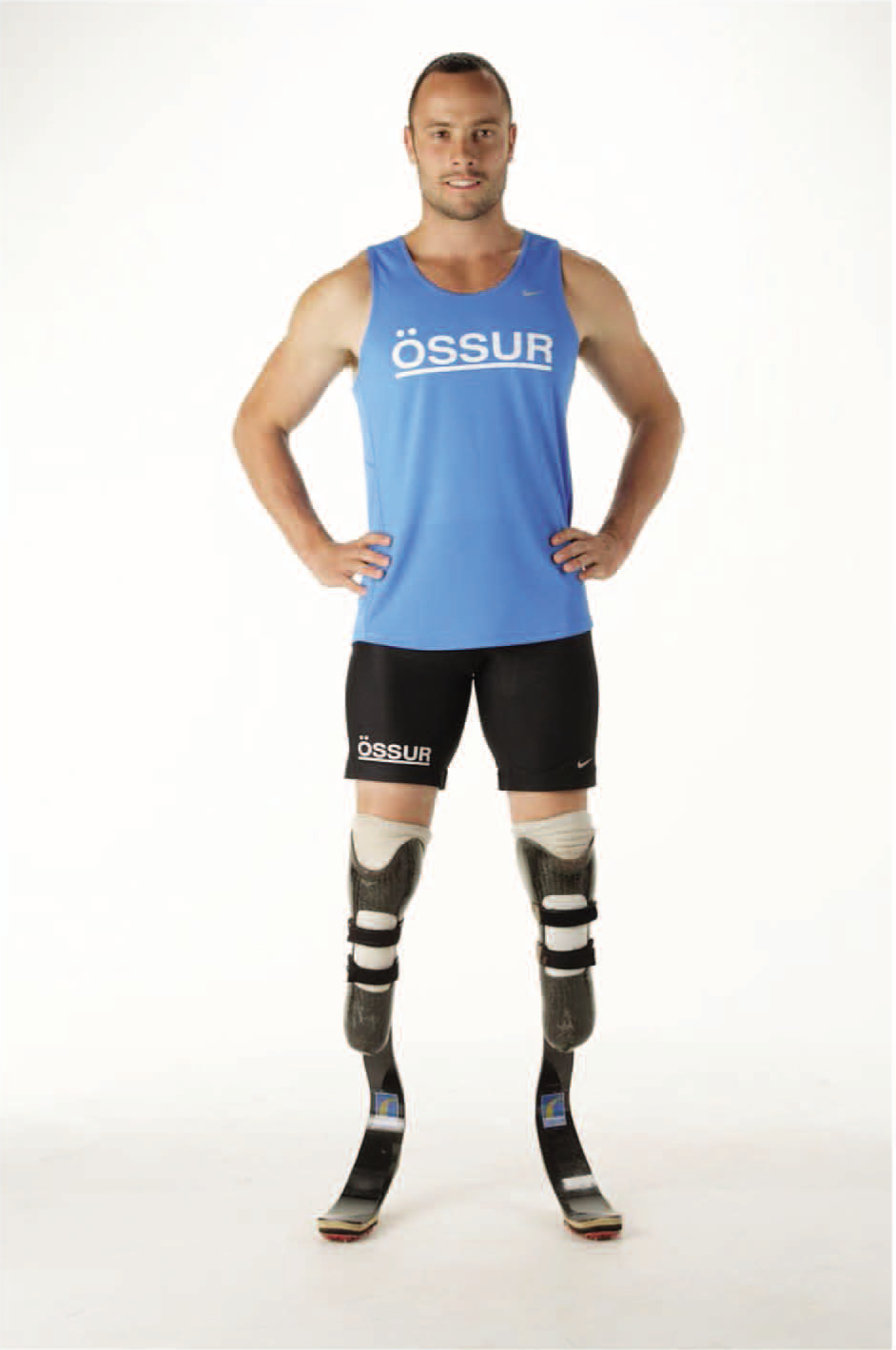
The face of Össur – Oscar Pistorius in his Flex-Foot Cheetah blades.
It is known that double limb amputees are unable to generate power at the start of race, but compared to unilateral amputees, do you think they possess an overall advantage, especially with an Össur product?
The statement is not quite accurate. No passive prosthesis generates power, and in the context of energy storing prosthetic feet, only a proportion of the energy stored during deflection of the component is released. Any movement is initiated by the amputee and depending on the activity, site of amputation and the phase of locomotion, the compensatory mechanisms will differ. However, there is good discussion to be had regarding comparison of unilateral and bilateral amputees. Does a bilateral amputee have double the advantage or double the disadvantage?
Footnotes
Acknowledgements

Funding
This research received no specific grant from any funding agency in the public, commercial or not-for-profit sectors.