




Abstract
Background: Prosthetics and orthotics is a relatively recent addition to the suite of undergraduate professional preparation programmes. There has been limited publication regarding international patterns of curriculum development, particularly concerning how objectives differ across global regions.
Objectives: This paper compares current prosthetics and orthotics curricula from a range of regions and identifies both common and distinctive objectives.
Study Design: Mixed method: document analysis followed by modified Delphi process.
Methods: Documents were analysed qualitatively to compare various curricula and emergent features were evaluated by a group of expert prosthetics and orthotics instructors.
Results: There was substantial agreement that programmes should improve student knowledge and understanding. They should establish and extend student fabrication, communication skills and professional co-operation. However, there appeared to be regional differences in the priority given to critical thinking and clinical reasoning; integration of theory and practice and particular approaches to teaching prosthetics and orthotics.
Conclusions: This study revealed substantial consensus regarding the importance of clear programme objectives dealing with student abilities, professional skills and contemporary understanding. However, this study also revealed regional differences that may well reward further investigation.
Clinical relevance
This study provides data on the objectives of a number of international prosthetics and orthotics programmes that will contribute to ongoing curricular development in different contexts.
Background
‘Curriculum’ is an investigative process that forms the basis of educational programmes. It happens in the light of student, patient and societal needs in the health care context. 1 This paper compares the stated objectives of prosthetics and orthotics curricula in various regions of the world. There appear to be around 26 universities offering undergraduate level professional preparation (ISPO categories I and II), most of which were established within the last few decades. 2 The geographical dispersion, relatively recent institutional establishment and small number of programmes all contribute to the potential isolation and consequent repetition of ineffective curricular development, providing one reason for the value of this study.
There has been some work aimed at improving the quality of such programmes, but it has focused on the more developed regions. In 1993, Barringer and colleagues discussed the evaluative criteria prepared by the Educational Accreditation Commission (EAC) for comparison of orthotics and prosthetics curricula in the United States. 3 In 2002, Ford and colleagues emphasized the importance of curriculum development, and Holtkamp compared bachelor-level prosthetics and orthotics curricula in the Netherlands with programmes in other parts of Europe.4,5 In 2005, the International Society of Prosthetics and Orthotics (ISPO) suggested widely accepted education and training programmes appropriate for different categories of prosthetics and orthotics professionals.6 In 2006, the Commission on Accreditation of Allied Health Education programmes provided minimum standards for development, evaluation and self-analysis of prosthetics and orthotics programmes in the United States. 7
As yet, however, no wider international comparison of curriculum practice in prosthetics and orthotics has been published. Such a wider approach to international developments would be helpful, given that around 80% of the world’s disabled people live beyond the developed world. Rising populations in these regions mean that up to 30 million people may need prosthetic and orthotic devices, requiring the training of up to 180,000 prosthetists and orthotists. 6 Ideally, the programmes developed to meet this need should be based on a clear understanding of international developments.
The existing literature indicates national differences between preferred objectives: Lukkarinen and Lahtinen contrasted Finnish and British rehabilitation curricula and Raschke and Ford contrasted management/business skills and manufacturing within Canadian prosthetics and orthotics programmes.8,9 Knowledge and understanding of different cultures is apparently necessary for successful internationalization, and curricular comparison beyond the developed world may therefore be of use. 10 However, as ‘curriculum’ is too broad a category for a paper of this length, its scope is restricted to the objectives of prosthetic and orthotics courses from different regions. Later work will explore the curriculum development process within our discipline, emergent issues regarding approaches to teaching and learning, and international perceptions of the appropriate balance between recognized components of effective prosthetic and orthotic curricula.
Curriculum documents in medical and health science programmes increasingly take an objectives/outcomes based approach to curriculum development. This approach suggests that the objectives of any curriculum should be clearly defined before instruction and should then determine the shape of the curriculum developed from them. Walsh’s application of Biggs’ notion of constructive alignment to work-based learning seems to reflect such developments in our field,11,12 where curriculum developers seem to develop aims, objectives and content in ways that match Ralph Tyler’s 1949 suggestions. 13 The continuing controversy surrounding Tyler’s advocacy of behavioural objectives needs to be acknowledged,14,15,16 but has little bearing on the description and discussion that follows.
This study intends to compare the objectives of current curricula from a range of regions and to identify both common and distinctive objectives of various orthotics and prosthetic programmes.
Method
The study began with a qualitative analysis of curriculum documents, which informed the development of a survey instrument that provided the basis for the first of several Delphi rounds.17,18,19 The Delphi method consists of expert group discussion to achieve a reliable consensus by successive rounds of interaction. This investigation used a modified form of a method that takes advantage of the Internet to allow asynchronous discussion among dispersed experts. The project was approved by the University of Newcastle’s Human Research Ethics Committee (approval number H-350-1206). Participants received details of the study as a whole and explicitly consented to research involvement.
The initial phase of the qualitative analysis rested on an Internet survey of six prosthetic and orthotics programmes whose institutional websites provided enough detail for description. Three of these institutions were in North America, two in northern Europe and one in Asia. The results of this initial analysis were sent to those of the 26 institutions offering bachelor-level prosthetics and orthotics programmes for which a contact person was identifiable. Such persons were asked to send back more detailed information regarding their programmes.
Ten institutions from various regions of the world (including Oceania, southern Asia, the Middle East, northern Europe and North America) returned further details or permitted deeper website access to their curricula. The understanding that emerged from more detailed responses to interrogation of initial issues formed the basis of a survey that was distributed to experienced instructors worldwide. Responses to this survey were analysed to yield the statements that comprised the initial Delphi instrument, which was sent electronically19,20 to a panel of fourteen experts, whose expertise was defined by possessing at least a bachelor’s degree or higher with ten years teaching experience in prosthetics and orthotics. The panel members, half of whom were working in developed regions and half beyond these regions, came from seven institutions. This first Delphi round was followed by two further rounds, with the instrument being refined following each use to reflect expert opinion.
The instruments used in the Delphi rounds elicited responses through six-point Likert scales, where ‘1’ represented rejection and ‘6’ strong agreement. The research literature is ambivalent regarding which measure of central tendency should be used in such cases.18,21 The response percentage for each pair of Likert responses (1-2, 3-4 and 5-6) was also calculated. 22 These metrics allowed expert ‘acceptance’, ‘agreement’ and ‘consensus’ to be derived from the data emerging from successive rounds.
A median of between three and four was interpreted as a very low level of acceptance of a statement by the expert panel; between four and five was interpreted as low acceptance; between five and five-and-a-half as moderate acceptance, and above five-and-a-half as high acceptance.
High agreement was considered to be reached if 80% of respondents specified a particular response pair. For example, where eleven of the fourteen experts selected either 3 or 4 (from the 6-point Likert scale), this was interpreted as high agreement that the item was not acceptable. Choice of a particular response pair by 60–80% of the expert panel was interpreted as moderate agreement, 50–60% as low agreement and below 50% as no agreement.
The degree of expert consensus was indicated by the interaction of agreement and acceptance. A prompt which achieved both high acceptance and high agreement represents a high degree of consensus that something matters: most expert respondents strongly agreed with the statement representing it.
Results
Almost all curricula analysed included objectives relating to student ability, professional skills and knowledge. The expert prosthetics and orthotics instructor panel supported these objectives, implicitly endorsing the movement towards specific learning outcomes.
Ability
Almost all of the ten programmes analysed specified objectives dealing with the cognitive, behavioural and essential abilities of students, and such objectives achieved substantial consensus in the Delphi process.
Cognitive abilities were important objectives for programmes from all regions, with seven of the ten programmes for which detailed documentation was available explicitly emphasizing student abilities such as the capacity to comprehend, memorize, analyse, evaluate, interpret and synthesize theoretical material and develop reasoning and decision-making skills for professional work. This emphasis was confirmed by the expert panel, which reached a moderate consensus regarding student abilities.
The expert panel strongly held comprehension, analysis, evaluation, interpretation and synthesis of theoretical material to be important in the development of student cognitive ability. However, there was some doubt regarding the effect of medical and prosthetics and orthotics theoretical courses on the development of critical thinking, despite substantial agreement that student reasoning, decision making and critical thinking should be developed throughout all prosthetics and orthotics courses. This consensus echoes the emphasis on critical thinking for problem-based learning in recent prosthetics and orthotics literature. 23 The documentation included three programmes (one each from the Middle East, Oceania and northern Europe) in which the integration of medical and engineering knowledge as well as theoretical knowledge and practical skills, were important explicit objectives, encouraging students to better understand the principles of manufacture of different devices. Such integration emerged, perhaps unsurprisingly, as a characteristic feature of courses in prosthetics and orthotics. There was later strong consensus among the expert group that students’ theoretical learning and professional work may also be improved by developing critical thinking, intellectual curiosity and critical appraisal. However, a minority of experts believed that teaching and assessment methods for theoretical courses in medical and prosthetics and orthotics may encourage only certain types of cognitive ability, and that individual students themselves were responsible for their own learning.
Programme documentation for seven programmes from North America, Europe, Oceania and southern Asia (but not the Middle East, interestingly) included objectives dealing with student professional behaviour. These included various aspects of ethics and professional values in prosthetics and orthotics in an explicit attempt to place the patients and their families at the centre of attention in all treatment programmes. The expert group also emphasized ethics and professional values. Although only three programmes (from Europe) directly specified client-centred practice, the wider expert panel urged consideration of all aspects of a person’s life as a major responsibility of prosthetics and orthotics practitioners in prescribing the most appropriate devices.
Six out of the ten programmes identified essential abilities for graduates of prosthetics and orthotics programmes. Three programmes from northern Europe included objectives dealing with the analysis and evaluation of people and environments to remove constraints and obstacles for patients, and the fabrication of orthopaedic devices to improve patient function and quality of life. The Delphi panel later strongly agreed that consideration of and care for patients in their environment was an important part of the preparation of prosthetists and orthotists, but expressed doubt that clinicians would be able to remove all patient constraints and obstacles. However, later in the process, the same panel strongly agreed that consideration of all aspects of a person’s life to allow prescription of the most appropriate devices was a major professional responsibility. Other programmes from northern Europe and one from the Middle East considered internationalization and globalization to be a significant part of their task as educators. Internationalization included activities such as working in other countries within the same region student exchange and communication with colleagues in other parts of the world. However, the majority of expert instructors emphasized work in their home country to meet national demands and standards.
Professional skills
Programme objectives from all regions dealt with issues such as technical skills, communication and inter-specialist co-operation.
Technical objectives regarding the fabrication of assistive devices comprised a significant part of all programme documentation. Three northern European and Oceanic programmes for which detailed documentation was available also included objectives indicating that students should emerge as professional and innovative experts within their profession, society and health care system.
Almost all programmes included communication objectives, recognizing that graduates need to move beyond a purely technical role and listen skilfully to patients and their families and be sensitive to cultural differences in facilitating accurate exchange of information regarding patient status. There was complete agreement within the expert group regarding this issue.
Programmes from the Middle East and southern Asia (three out of the ten for which programme documents were available) included objectives suggesting that graduates should be able to manage and supervise workshops and support staff. However, the Delphi phase of this study did not reflect complete consensus regarding preparation for such roles within bachelor-level prosthetics and orthotics programmes. The expert group suggested a need for graduates to gain additional experience before taking on a supervisory position. One Oceanic programme stressed the ability of students to adopt current information technology in order to identify, analyse, interpret and present information, and the expert group also achieved high consensus regarding this issue.
Knowledge
All prosthetics and orthotics programme documents included objectives concerning knowledge of medical and engineering sciences, with priority given to prosthetics and orthotics. Unsurprisingly, this was confirmed by the Delphi study.
Various prosthetics and orthotics programmes included objectives dealing with the development of professional and scientific attitudes. Many programmes specified methods for encouraging students to develop and update their knowledge. Half of the programme documents (drawn from the Middle East and North America) included explanations of changing teaching methods as students moved through the program and the other half (northern Europe, Oceania and southern Asia) included the engagement of students in research in prosthetics and orthotics science. The Delphi study revealed substantial consensus on the role of problem-based learning, which may be linked to the rise of evidence-based practice in professional work. 24 However, there was disagreement regarding direct engagement of students in prosthetics and orthotics science research, with those in favour of student research also agreeing that the preparation of prosthetic and orthotic students needs to extend to postgraduate level.
Discussion
Biggs’ work suggests that the objectives of any curriculum should be provided as clear directions that determine its foundation and can be traced through content selection and teaching strategy to guide certification.12 It is apparent that each of the curriculum documents analysed was based on these principles, revealing apparent consensus on the principles of objective based curriculum development.
Most of the programmes analysed in the first phases of this study shared common objectives dealing with developing student knowledge of the medical and engineering sciences, encouraging professional behaviour, expanding technical expertise, increasing communication skills and building co-operation in multi-professional teams. Such agreement regarding the objectives of an undergraduate programme in prosthetics and orthotics is not surprising in the light of the ISPO guidelines.
Table 1 shows the less common explicit objectives that distinguish particular international regions. It should be noted that entries in this table identify explicit objectives that appeared in a minority of curriculum documents available for analysis whereas, in many cases, the subsequent Delphi phase of the investigation revealed substantial expert agreement regarding the importance of most of the issues reflected by these objectives. Such less common objectives appear to characterize programmes from Europe and North America, and subsequent panel support for their importance may reflect this.
Distinctive explicit objectives of programmes from particular regions.
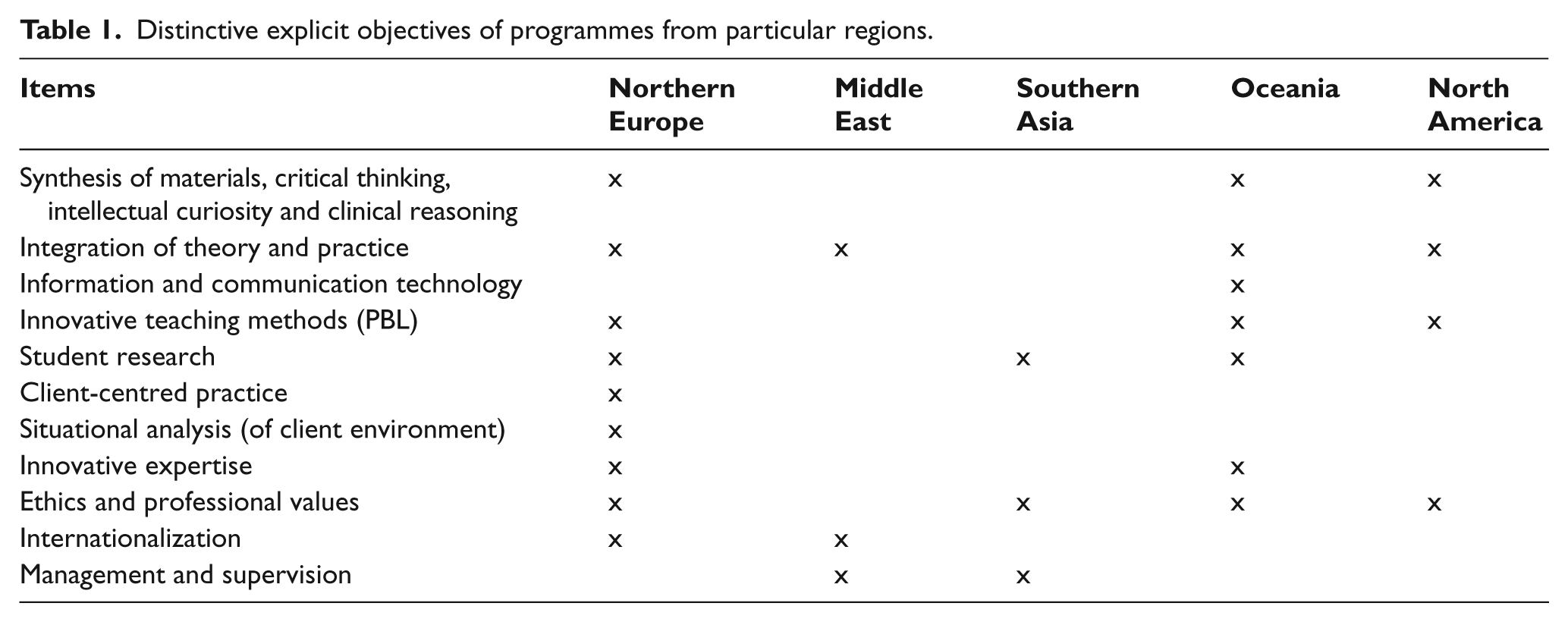
The relative lack of ‘distinctive’ North American objectives probably reflects the ‘default’ nature of programmes from this region. Prosthetics and orthotics programmes at the bachelor level were first developed there and so it is reasonable to assume that subsequent curriculum development within the profession would be based on documentation from this region. However, this makes the contemporary explicit recognition of critical thinking, ethics and teaching methods at the objectives level particularly interesting.
At the other extreme, the greater number of European distinctive objectives may well reflect a greater degree of specificity in their objective statements, in turn arising from a more regulated professional context in a converging society. The fact that client-centred practice only surfaced explicitly in European programme objectives may be a source of concern. Prosthetists and orthotists, like other medical professionals, have direct contact with clients and their families, and thus consideration of client care issues is necessary for improving the quality of services. Therefore, most programmes paid significant attention to communication and professional relationships with clients and their families. A few programmes from northern Europe go further and directly specify client-centred practice. Such explicit focus may reflect the later development (2006–7) of these curricula, a greater recognition of social context 25 or closer co-operation with other professionals in rehabilitation teams. 26
The shared emphasis on management and supervision that characterizes southern Asia and the Middle East is likely to reflect a similar contextual factor, confirmed and explained by the Professional profile for ISPO category (I) programmes.
The combination of integrative, professional practice that seems to characterize Oceanic programmes probably helps to explain the presence of objectives dealing explicitly with innovation, ICT and student research.
The ISPO guidelines provide an external standard with which various programmes can be compared. This study has revealed various regional points of comparison where, within differing cultures and local requirements, designers have attempted to lay out a framework for recommended instructional strategies, such as synthesis of materials, critical thinking, intellectual curiosity and clinical reasoning.
Conclusions
The common use of an objectives based approach to curriculum documentation in prosthetics and orthotics makes the objectives of various prosthetics and orthotics programmes an obvious first step in any investigation of international developments in preparation for the profession. Programmes contain much more than their objectives, but it is reasonable to expect that the aspects considered most important will surface in the programme objectives.
There is consensus regarding the importance of clear programme objectives, and substantial agreement about what those objectives should be. However, there are some regional differences that may be illuminative as curriculum development for professional practice continues.
Programmes commonly include objectives indicating a desire to establish, extend and update student knowledge, but there is some regional variation in programme objectives dealing with the following: critical thinking and clinical reasoning; integration of theory and practice; teaching methods that go beyond the traditional pattern of lecture, tutorial and workshop; the use of information and communication technology; student research; and problem-based learning. This variation should prompt reflection on the priority of such aspects in prosthetic and orthotics bachelor programmes. The variation may represent significant and legitimate differences in social context, but curriculum practice in one region may inform development in another. Thus, there may be cause to compare the knowledge, attitudes and skills of students and current practitioners nationally and internationally. This may expose further differences which could be used by curriculum designers to reformulate appropriate objectives within existing programmes and suggest fruitful teaching and learning approaches. However, such deeper investigation of educational issues is beyond the scope of this project.
Most programmes included objectives dealing with the professional development of students, specifically in the areas of student communication and cross-disciplinary co-operation. However, not all programmes included objectives dealing specifically with ethics, client-centred practice, internationalization, regulatory frameworks or preparation for management and supervisory roles. Some of these variations may reflect local context but all seem worthy of wider consideration.
One of the most potentially interesting aspects of this investigation was mentioned in passing. The survey of curriculum documents indicated variation in teaching methods, and the Delphi rounds revealed disagreement among the expert panel regarding the effectiveness of various approaches to teaching undergraduate prosthetic and orthotics students. More significantly, they expressed concern as to whether the approaches now being followed worked against the objectives of the programmes. This merits further analysis, and future publications are planned that will deal with patterns of concern regarding varying educational issues and use of particular teaching strategies.
Footnotes
Acknowledgements
We would like to thank the institutions and expert instructors whose participation made this study possible.
Conflict of interest
The authors report no conflicts of interest. They are alone responsible for the content and writing of this paper.
Funding
This research received no specific grant from any funding agency in the public, commercial or not-for-profit sectors.