




Abstract
Eduard Suess’s invention of the word ‘biosphere’ sparked a trend of coining sphere-words, which has since evolved into something of a craze. Some of these words, such as atmosphere and hydrosphere, are simply name tags for their respective Earth spheres. Others, such as geosphere, are also used mainly as names but they carry more than one meaning. However, many sphere-words, including pedosphere, biosphere, ecosphere, anthroposphere, sociosphere, and technosphere, are far more than just names, bearing as they do, weighty conceptual connotations that fuel considerable debate. At a time when Earth and life scientists are attempting to understand the workings of the planet as a whole by modelling the interaction of its component spheres, and when they are collaborating with sociologists, anthropologists, and members of other human sciences to tackle current environmental challenges, it seems an opportune moment to probe the origin and meaning of words for the Earth spheres they investigate. To be sure, Earth System modelling is helping understand changes resulting from the interaction of all the Earth’s spheres, including the anthroposphere, over various time and space scales, while multidisciplinary, interdisciplinary, and transdisciplinary research is helping to address such global problems as sustainable development, climate change, water supply, and biodiversity loss. An awareness of the origin, development, and disputed meanings of many sphere-words that these approaches employ should prove salutary for their multifarious practitioners.
Keywords
Introduction
The concept of Earth ‘spheres’ was first introduced by Austrian geologist Suess (1875) in the last and most general chapter of a slim volume entitled Die Entstehung der Alpen (The Origin of the Alps). In his book, Suess invented the eminently helpful terms hydrosphere, lithosphere, and biosphere. Before that, the only sphere given a special name was the atmosphere. However, the idea of Earthly spheres can be traced to around 450 BC and Empedocles, the Greek philosopher, who, in recognizing four basic terrestrial elements – air, water, earth, and fire – identified, without naming them, the chief spheres of the planet: the gaseous sphere, or atmosphere; the watery sphere, or hydrosphere; and the solid sphere, or lithosphere. Fire, the fourth element, has no modern counterpart, but it was originally conceived, not as a zone around the atmosphere that burns brightly but as a region where fire has a propensity to break out, as when the sky appears to burn when lightning flashes and when meteors enter the atmosphere and explode as fireballs.
Earth’s chief spheres.
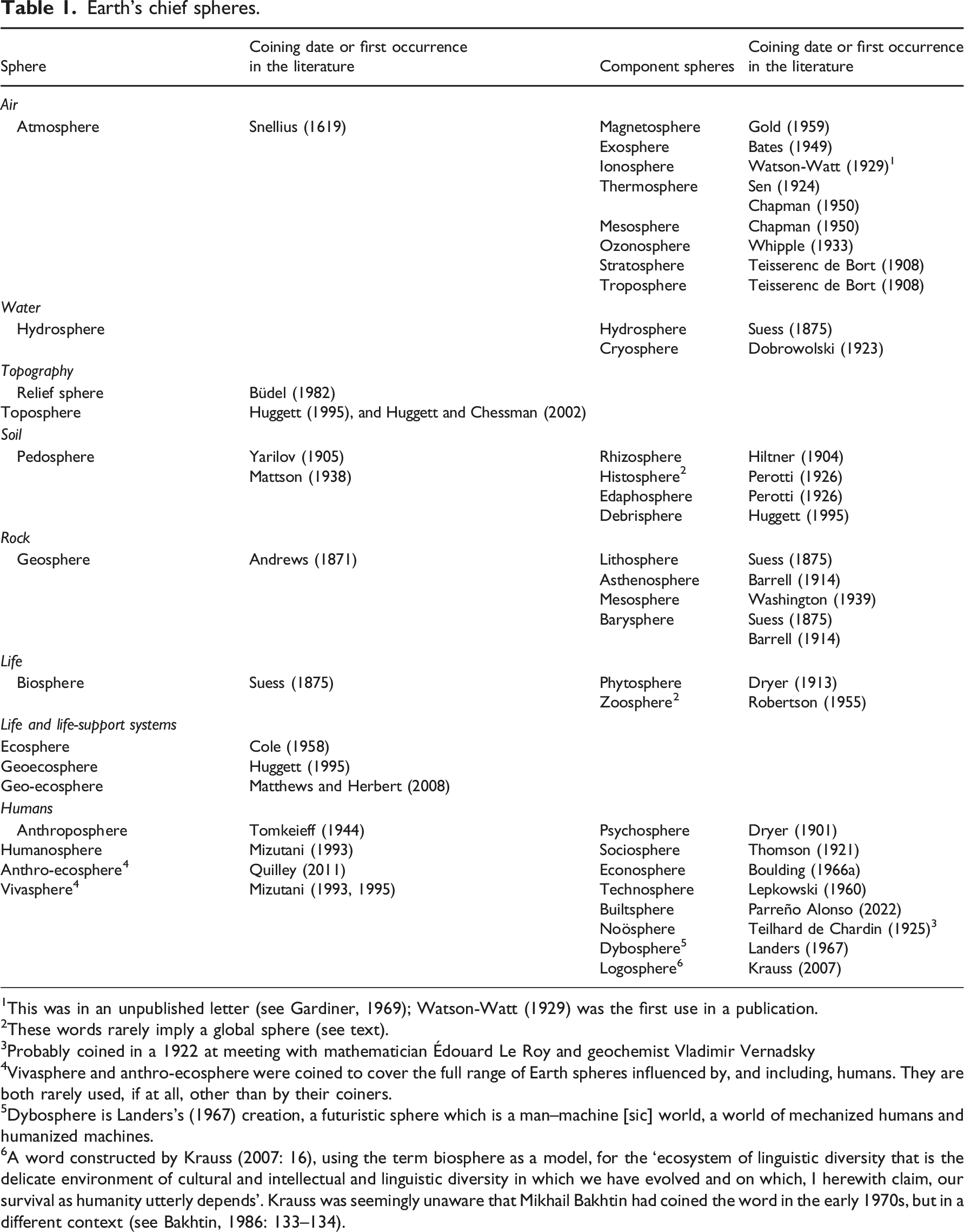
1This was in an unpublished letter (see Gardiner, 1969); Watson-Watt (1929) was the first use in a publication.
2These words rarely imply a global sphere (see text).
3Probably coined in a 1922 at meeting with mathematician Édouard Le Roy and geochemist Vladimir Vernadsky
4Vivasphere and anthro-ecosphere were coined to cover the full range of Earth spheres influenced by, and including, humans. They are both rarely used, if at all, other than by their coiners.
5Dybosphere is Landers’s (1967) creation, a futuristic sphere which is a man–machine [sic] world, a world of mechanized humans and humanized machines.
6A word constructed by Krauss (2007: 16), using the term biosphere as a model, for the ‘ecosystem of linguistic diversity that is the delicate environment of cultural and intellectual and linguistic diversity in which we have evolved and on which, I herewith claim, our survival as humanity utterly depends’. Krauss was seemingly unaware that Mikhail Bakhtin had coined the word in the early 1970s, but in a different context (see Bakhtin, 1986: 133–134).
Humans possess a fondness for recognizing and naming objects in Nature. Perhaps the word ‘sphere’ has proved so serviceable because, in combination with suitable prefixes, it provides memorable and punchy terms for parts of the Earth. But are the terms more than just names? This paper will argue that, although they were once used mainly as name tags, some of them have, over the last 150 years, come to acquire conceptual connotations, as seen in the debate over the use of such terms as biosphere, noösphere, and ecosphere that started in the 1920s, and in the current debate surrounding the terms anthroposphere, technosphere, and builtsphere. Indeed, all the ‘spheres’ discussed are mental constructs, sets of interrelated parts assumed to have some structural and functional coherence in the real world, but some are more abstract than others. What we call these constructs matters. As López-Corona and Magallanes-Guijón (2020) put it: ‘We do not understand what we see but see what we understand. Words shape the comprehension of our environment and set the space of possibilities we can access when decision making’.
Air
The atmosphere was the first sphere to be given a special name. The neologism appeared initially at the beginning of the seventeenth century in the Netherlands in a Latin translation of Stevin’s (1608) book by Willebrord Snel van Royen, or Snellius (1619), who translated the Dutch dampcloot as atmosphaera. Transformed into Latin, the word atmosphaera spread rapidly through Europe’s networks of learned culture and by the middle of the seventeenth century cognate words appeared in English, French, and Italian (Martin, 2015). In England, for example, Bishop John Wilkins, in his book The Discovery of a World in the Moone (1638), wrote ‘There is an Atmo-sphæra, or an orbe of grosse vaporous aire, immediately encompassing the body of the Moone’. Ironically, the Moon has almost no atmosphere, but the term became widely applied to the Earth’s dusty, gaseous, low-density fluid envelope.
The subdivisions of the atmosphere, also labelled as neologisms with ‘sphere’ as component, followed as and when the structure and composition of the atmosphere were revealed by progressively sophisticated observations (Figure 1). French meteorologist Léon Teisserenc de Bort introduced the terms ‘troposphere’ and ‘stratosphere’ in a paper read to a German meteorological society in Hamburg on September 30, 1908. The paper was unpublished, but Kassner (1909) gave a summary. Several other atmospheric layers acquired names during the first half of the twentieth century. Watson-Watt (1929) coined the word ‘ionosphere’ for ionized regions within the atmosphere’s layers. Sen (1924) proposed the word ‘thermosphere’ for the layer in the atmosphere, from ground level to around 8 km, where air density is controlled largely by temperature; however, Sydney Chapman (1950) redefined the thermosphere for the layer of upward increasing temperature above the mesosphere. Whipple (1933) coined the term ‘ozonosphere’ for the region of the atmosphere containing large concentrations of ozone. The idea of the ‘exosphere’ as the outer atmosphere was suggested by Stoney (1867). Subsequently well researched, the outer or upper atmosphere appears not to have acquired the name exosphere before the mid-twentieth century when Bates (1949: 227), and in the following year Chapman (1950) and Flohn and Penndorf (1950), used the moniker, after which time it became widely adopted. The term ‘magnetosphere’ was introduced by the Austrian-born physicist Gold (1959) for the region around the Earth dominated by the Earth’s magnetic field. Layers or spheres of the atmosphere. For interpretation of the references to colours in this figure legend, refer to the online version of this article.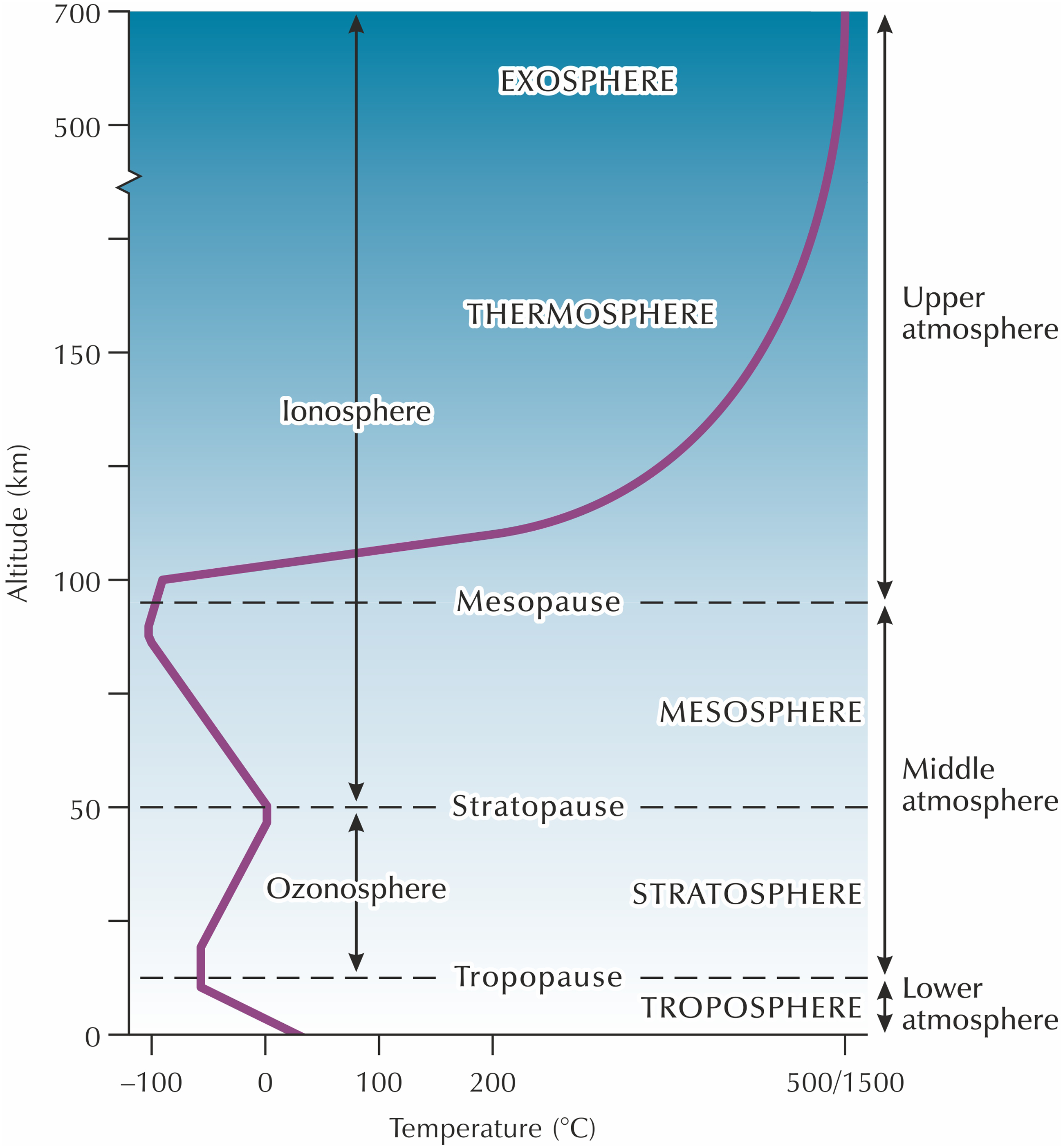
These divisions of the atmosphere are no longer disputed; their interactions and connections with the Earth System, although reasonably well understood, are the subject of continuing research.
Water
Suess (1875) coined the term ‘hydrosphere’, that is, the entirety of the waters of the Earth. It includes liquid water, water vapour, ice, and snow. Waters in the oceans, in rivers, in lakes and ponds, in ice sheets, glaciers, and snow fields, in the saturated and unsaturated zones below ground, and in the air above ground are all part of the hydrosphere. The definition of the hydrosphere is uncontentious, although some people set the ambits of the hydrosphere to exclude the waters of the atmosphere. And also, Polish geophysicist and meteorologist Dobrowolski (1923, ii) singled out the global envelope of ice, coining the word ‘cryosphere’ to describe it (Polish kryosfera) and stressing its close relationship with the hydrosphere, lithosphere, and atmosphere.
Topography
The German geomorphologist Büdel (1982) invented the term ‘relief sphere’ to describe the totality of the Earth’s topography. The present author (Huggett 1995) offered the term ‘toposphere’ as a more euphonic substitute, although it should be noted that Swiss geographer Winkler (1953) also used the term ‘Toposphäre’ in the context of human settlements.
The toposphere is more than just the ground surface, more than the planet’s physical relief features. It includes all the surface features of the globe – ground surface, ocean floor, vegetation and human-made objects; even animals may be regarded as moving parts within the toposphere. And it is not a two-dimensional surface; in many places, it has a vertical dimension. Its lower boundary is usually the ground surface, with the height of vegetation (the vegetation canopy) or buildings (the urban canopy) setting its upper boundary. But caverns, grottoes, and tunnels (made by burrowing animals and humans) extend the lower boundary into the ground, often through a network of complex passages. Where vegetation is absent, as in large tracts of sand seas and the deep ocean floor, the toposphere is restricted to the ground surface.
Soil
Several names have been applied to soil ‘spheres’. The ‘rhizosphere’, introduced by Hiltner (1904), is that region inside which the soil is subject to the specific influence of plant roots. It was the first sphere-word associated with the soil. ‘Edaphosphere’ and ‘histosphere’ were coined by Perotti (1926) when trying to set boundaries to the rhizosphere: one side it is bounded by the general soil region, or edaphosphere, and on the other side, by the root tissues or histosphere, the latter term being little used today in a pedological context. Yarilov (1905) was the first person to use the word ‘педосфера’ (pedosfera), although ‘pedosphere’, the English equivalent, is commonly attributed to Mattson (1938). Mattson employed it for the ‘sphere of spheres’ in which the lithosphere, the hydrosphere, the atmosphere, and the biosphere interact chemically and mechanically to produce soil – a dispersed system involving material from the four spheres alternating as dispersed phase and dispersion medium. The term has persisted. In 1991, a journal called Pedosphere was founded.
A question remains over what constitutes the pedosphere. It is usually taken as ‘that shell or layer of the Earth in which soil-forming processes occur’ (Bates and Jackson 1987: 488). But what then is the material lying above that lithosphere that is not affected in a substantial way by soil-forming processes? Huggett (1995) suggested that it might be useful to distinguish the edaphosphere, where soil processes are especially active – the solum (A and B horizons) – from what he called the ‘debrisphere’, where they are not. The debrisphere is the portion of the pedosphere lying beneath the edaphosphere and above unweathered bedrock or other subsurface materials; it includes all weathered materials at the Earth’s surface and at the bottom of rivers, lakes, and oceans that are not materially affected by climate or by animals, plants, fungi, and microorganisms. The debrisphere is approximately equivalent to what Büdel (1982) styled the ‘decomposition sphere’ but includes detritus created by mechanical disintegration as well as the products of chemical weathering. The debate over the difference between soil and regolith adds another dimension to this argument. Regolith includes ‘fractured and weathered basement rocks, saprolites, soils, organic accumulations, volcanic material, glacial deposits, colluvium, alluvium, evaporitic sediments, aeolian deposits and ground water’; in short, the entire weathering mantle, ‘Everything from fresh rock to fresh air’ (Eggleton 2001). Huggett (2023) put forward a strong case, building on recent studies elucidating the role of the deeper substratum in soil processes, for extending the concept of soil to cover all weathered rock and rock debris (see also Richter et al., 2020). That done, soil and regolith are one and the same, an idea championed by advocates of whole-regolith pedology and pedo-weathering profiles, and implicitly by Critical Zone scientists. A corollary of this idea is that soil and regolith are not independent objects of study in their own right: the object of study is the pedosphere (which could equally be called the ‘regosphere’ – the terms are commutable), that is, the entire weathering mantle, from the ground surface to the weathering front. The edaphosphere and debrisphere would then be spheres within the pedosphere/regosphere.
Contrary to that suggestion, Herreño and his colleagues (2023) contended that the edaphosphere encompasses all soils and that the edaphosphere and pedosphere are not equivalent and cannot be used interchangeably. They proposed that all soils are included in the term ‘edaphosphere’ and that the A horizons form the rhizosphere, the B horizons a sphere of biogeochemical interactions, and the C horizons the pedosphere. This view flouts the original use of the various soil ‘spheres’ and appears to rely on a definition of soil that stresses the fact that soil is at once part of the biosphere and part of the geosphere. Plainly, soil is rich in organisms which belong to the biosphere (if the biosphere is taken as the totality of life on Earth, see below); it is also rich in the products derived from the chemical and physical weathering of lithospheric material. Surely, the main thing here is that the soil is produced by the interaction of the biosphere and lithosphere, tempered by the action of the atmosphere, hydrosphere, and toposphere. The boundaries between the Earth’s spheres are not all sharp. The atmosphere exists within the soil and in other subterranean settings but that does not mean that soils and caves are classed as part of the atmosphere. Likewise, the hydrosphere is hugely rich in living things that form part of the biosphere, but the hydrosphere cannot be equated with the biosphere. As discussed later, the problem is resolved if, instead of biosphere, the word ‘ecosphere’ is used to describe the global ecosystem. Soil is a component of the ecosphere, along with the biosphere and parts of the hydrosphere, atmosphere, lithosphere, and toposphere.
Rock
Geosphere
The term ‘geosphere’ was first used to describe the solid portion of the planet Earth in a book by Andrews (1871: 145), who noted that Doherty (1864: 42) had come up with the term ‘geospheric realm’ as one of six realms of the terrestrial globe, the others being atmospheric, oceanic, pluvial, reliquial, and elemental. Today, ‘geosphere’ has at least six meanings: (1) the lithosphere (in the narrow sense of the hard, rocky crust, as discussed below; see Figure 2); (2) the lithosphere, hydrosphere, and atmosphere combined; (3) the lithosphere, hydrosphere, atmosphere, plus the solid Earth below the lithosphere; (4) any of the terrestrial spheres or shells; (5) all the Earth’s spheres, including the biosphere and anthroposphere; (6) the solid Earth. It is difficult to gauge which of these meanings is the most commonly used. Certainly, the fourth and fifth meanings are uncommon. Murray (1913) supplied an example of the fourth meaning when he applied the term ‘geosphere’ to the individual Earth spheres, rather than to the Earth spheres as a whole; Carol (1956) suggested that the geosphere comprises all Earth spheres, and although this is not a meaning adopted today, it has echoes in current arguments concerning the use of terms for the global ecosystem (see below). Several definitions tend to be variations on the second and third meanings, that is, some combination of the Earth’s abiotic spheres. Möller (2023) favoured the sixth meaning: ‘geosphere refers to the solid parts of the earth’. Evidently, it is not possible to use the term ‘geosphere’ without some explanation as to the intended meaning. Layers or spheres of the solid Earth. For interpretation of the references to colours in this figure legend, refer to the online version of this article.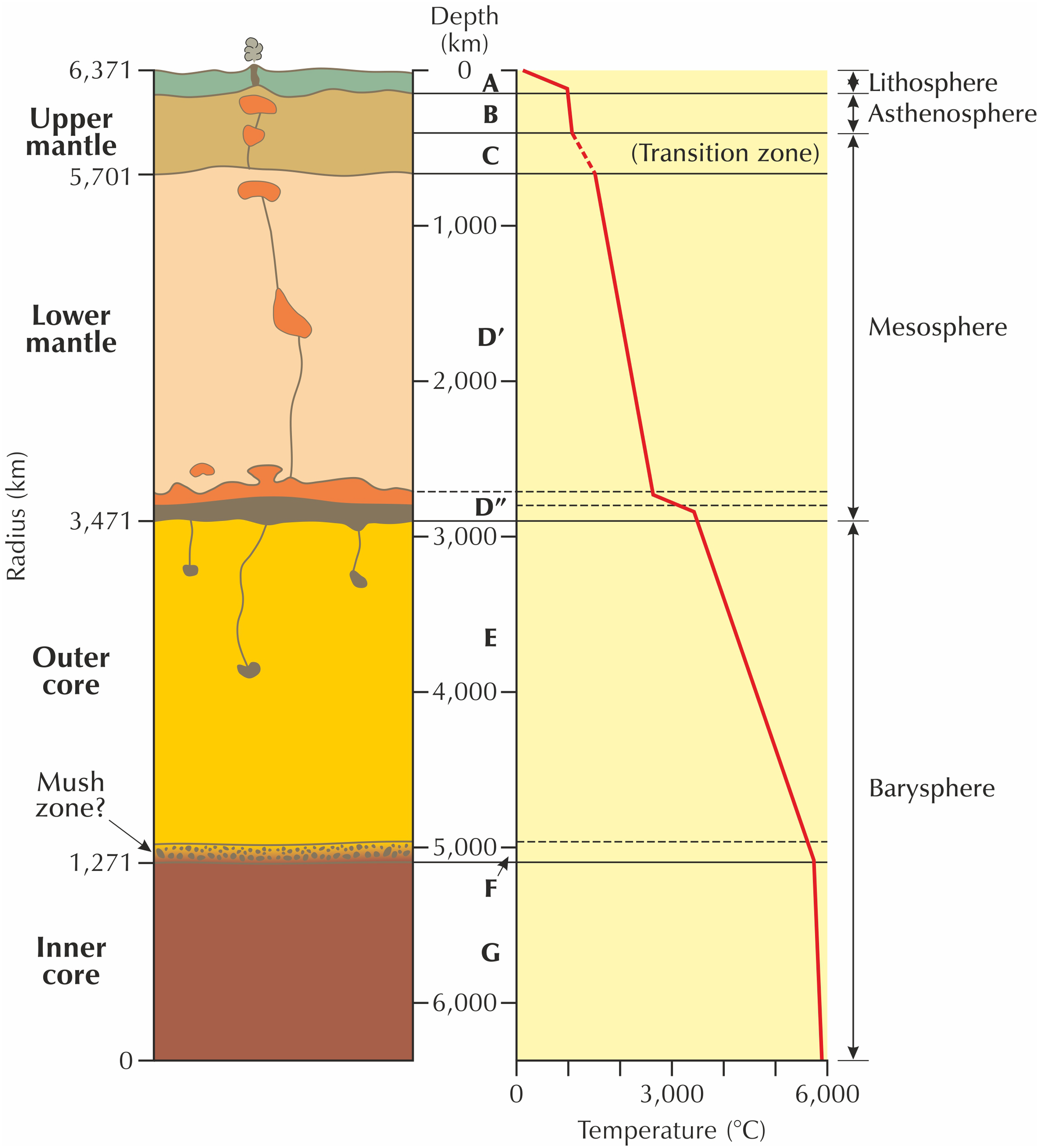
Lithosphere and asthenosphere
Suess (1875) used the term ‘lithosphere’ to describe the solid Earth above the then relatively unknown deeper parts of the planet, which he called the barysphere (from the Greek βαρύς, meaning heavy + sphere). Since then, the lithosphere has acquired two meanings. In a general sense, it is the solid portion of the Earth – the rocks. Many geologists writing before the advent of plate tectonics adhered to this meaning. Thus, in Lake and Rastall’s Textbook of Geology, it states that: From the geological point of view the earth may be regarded as consisting of two concentric shells and a central sphere, of very different natures. As a matter of convenience the two shells may also be called spheres, though that is not strictly correct: the three components are then the atmosphere, the hydrosphere and the lithosphere. . . The third of these spheres, the lithosphere, is the solid earth, and it is essentially the province of geology to study its structures and history (Rastall, 1941: 2).
On the other hand, some writers opt for a narrower definition, limiting the lithosphere to the outer shell of the solid Earth, usually the crust and upper mantle, where the rocks are more or less similar to those exposed at the surface (Oguchi, 2020). A zone within or just beneath the lithosphere, recognized as a source of igneous activity and lava formation, is sometimes referred to as the pyrosphere (or less commonly the magmosphere), a word first used by Lorenzo Burge (1887).
Since the coming of plate tectonics, the practice of defining the lithosphere more narrowly to mean the relatively strong surficial layer of the solid Earth lying above the relatively weaker asthenosphere is commonplace, the term ‘asthenosphere’ being first introduced by the American geologist Joseph Barrell (1914).
Mesosphere and barysphere
Washington (1939) came up with the word ‘mesosphere’ (not to be confused with mesosphere in the atmosphere). Daly preferred the term ‘mesospheric shell’, coined by Daly (1940), who suggested that the outer solid Earth consisted of three spherical layers: the lithosphere, which includes the crust, the asthenosphere, and the mesospheric shell.
Although coined by Suess in 1875, the term ‘barysphere’ did not appear in the geological literature until the last decade of the nineteenth century, where it was mentioned in connection with the source of ore deposits, first by Prošepny̒ (1894: 206) and later by Hise (1900). Today, it is used as a general term for the dense interior of the Earth, including the mantle and core and constituting about 99.6% of the planetary mass, encased by the lithosphere. It is synonymous with the ‘centrosphere’, a word first used by Powell (1898), which has fallen out of use. The barysphere may sometimes refer either to the mantle or to the core.
As with other Earth spheres, continuing research throws up new details of the structure and functioning of the spheres comprising the solid Earth, including the finding that there may be an innermost inner core (Phạm and Tkalčić, 2023).
Life
Biosphere
Speaking of the Earth, Suess (1875: 159) wrote: ‘One thing seems strange on this large celestial body made up of spheres, namely, organic life. But this life is limited to a particular zone, to the surface of the lithosphere. The plant, whose roots sink into the ground in search of food, and at the same time rises into the air to breathe, is a good illustration of organic life’s location in the region of interaction between the upper spheres and the lithosphere, and on the surface of continents it is possible to identify an independent biosphere’ (translated from the German original).
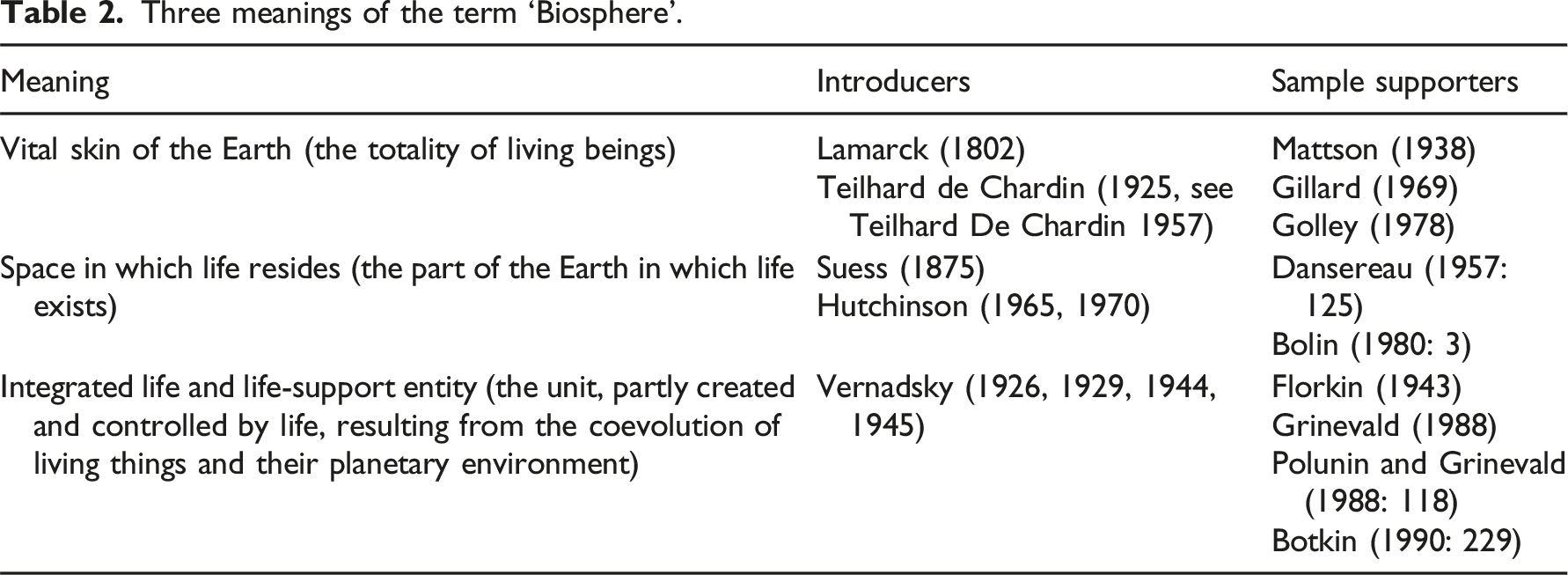
Three meanings of the term ‘Biosphere’.
For completeness’s sake, the use of the terms ‘phytosphere’ and ‘zoosphere’ is noted. Dryer (1913) wrote of a ‘vegetative cover of the earth, a true phytosphere with some holes in it. . .’. When used today, the word usually refers to the outside and inside of plants considered as an ecosystem. Roberston (1955) wrote of the ‘soil zoosphere’. The word is not common and where used tends to refer to the immediate surroundings of organisms rather than the totality of animal life on Earth.
Ecosphere
If the biosphere is restricted to the totality of all living things, then another word is needed to describe all life and the inorganic environment that sustains it. To that end, Cole (1958) coined the term ‘ecosphere’. He apologized for using a coined word like ecosphere, but it seemed to him nicely to describe just what he wanted to discuss. His intention was to combine two concepts: the biosphere and the ecosystem. The biosphere he took to mean the totality of living creatures on the Earth (Teilhard de Chardin’s biosphere). The ecosystem he took as a self-sustaining community of organisms (animals, plants, fungi, and microorganisms) together with their inorganic environment. This notion was clearly inspired by Tansley’s (1935) image of an ecosystem: a self-sustaining community of organisms together with their physical environment. To Cole, the ecosphere is the global ecosystem, ‘the sum total of life on earth together with the global environment and the earth’s total resources’ (1958: 84). Cole’s term was reinvented by Gillard (1969), who thought it useful for describing ‘that part of our sphere in which there is life together with the living organisms it contains’. As he explained, ‘In the same way as the “biosphere” is the rough total of all living organisms, the “ecosphere” is the rough total of all ecosystems (of the hydro-ecosphere, the litho-ecosphere and the atmo-ecosphere)’.
The term ‘ecosphere’ has been used by ecologists and biogeographers. Joy Tivy employed it in Biogeography: A Study of Plants in the Ecosphere (1982: 459). Barry Commoner, in The Closing Circle (1972: 336), used the idea of the ecosphere as a framework in which to consider the ‘environmental crisis’. However, he also spoke of the ecosphere as ‘the home that life has built for itself on the planet’s outer surface’ (1972: 11), a definition redolent of Hutchinson’s biosphere (Table 2). It is evident that the term ‘biosphere’, as originally used by Vernadsky, is equivalent to the term ‘ecosphere’ as coined by Cole (and independently by Gillard). The obvious conclusion is that Cole and Gillard’s ecosphere is redundant. However, the word ‘ecosphere’ seems to capture Vernadsky’s conception of life and life-support systems better than does the word ‘biosphere’.
However, the notion of an ecosphere has an older claim to fame. In 1953, Hubertus Strughold wrote a book called The Green and Red Planet: A Physiological Study of the Possibility of Life on Mars. In this book, he used the term ‘ecosphere’ to define the zones in the universe that would be habitable by living organisms: Only a small zone about 75 million miles wide – out of the 4,300 million that stretch between the sun and Pluto at its farthest point – provides a planetary environment well-suited to the existence of life. We might call this zone the thermal ecosphere of the sun. Other stars may have such ecospheres of their own, with planets in them that are capable of supporting life similar to ours (Strughold, 1953: 43).
Astronomers have subsequently used the word ‘ecosphere’ to mean regions in space where conditions would allow living things to exist (at least, living things as we know them). And it is Strughold’s idea of an ecosphere, not Cole’s, that is found in dictionaries. In the 1972 Supplement to the Oxford English Dictionary, it is defined as ‘The region of space including planets whose conditions are not incompatible with the existence of living things’. In the Glossary of Geology, it is described as ‘Portions of the universe favorable for the existence of living organisms’ (Bates and Jackson, 1987: 734). This definition has much to commend it – and it would not invalidate Cole’s definition.
Plainly, the terms ‘biosphere’ and ‘ecosphere’ mean different things to different people. The present author subscribes to the view that the biosphere is best confined to the totality of living things, and the ecosphere the global sum of life and life-support systems, but that is not a view universally held.
Geoecosphere
Huggett (1995) coined the word ‘geoecosphere’ to capture the idea of the landscape sphere as a system, in which parts of the biosphere, toposphere, atmosphere, pedosphere, and hydrosphere, together with the biological, geomorphological, climatological, pedological, and hydrological processes that create them, are seen as a unitary whole. Matthews and his colleagues (2013: 2) employed the term ‘geo-ecosphere’ (they used the hyphenated form) differently: they saw it as a better alternative to ecosphere ‘because it gives greater weight to the physical systems in their own right, rather than merely the non-living components that interact with the biosphere. . .’. However, the global landscape sphere (geoecosphere) is not as extensive as the ecosphere (geo-ecosphere in Matthews et al.’s sense), so the two meanings are not the same. It also seems reasonable to ask if the ‘geo’ in geo-ecosphere is necessary because, by definition, the ecosphere includes those portions of the geosphere with which life interacts. Moreover, there are large parts of the geosphere (in the sense of the solid Earth), and to a lesser extent the atmosphere, that lie outside the ecosphere. Combining the two terms as geo-ecosphere provides an alternative word for the Earth System, and not for the ecosphere.
Humans
Anthroposphere and humanosphere
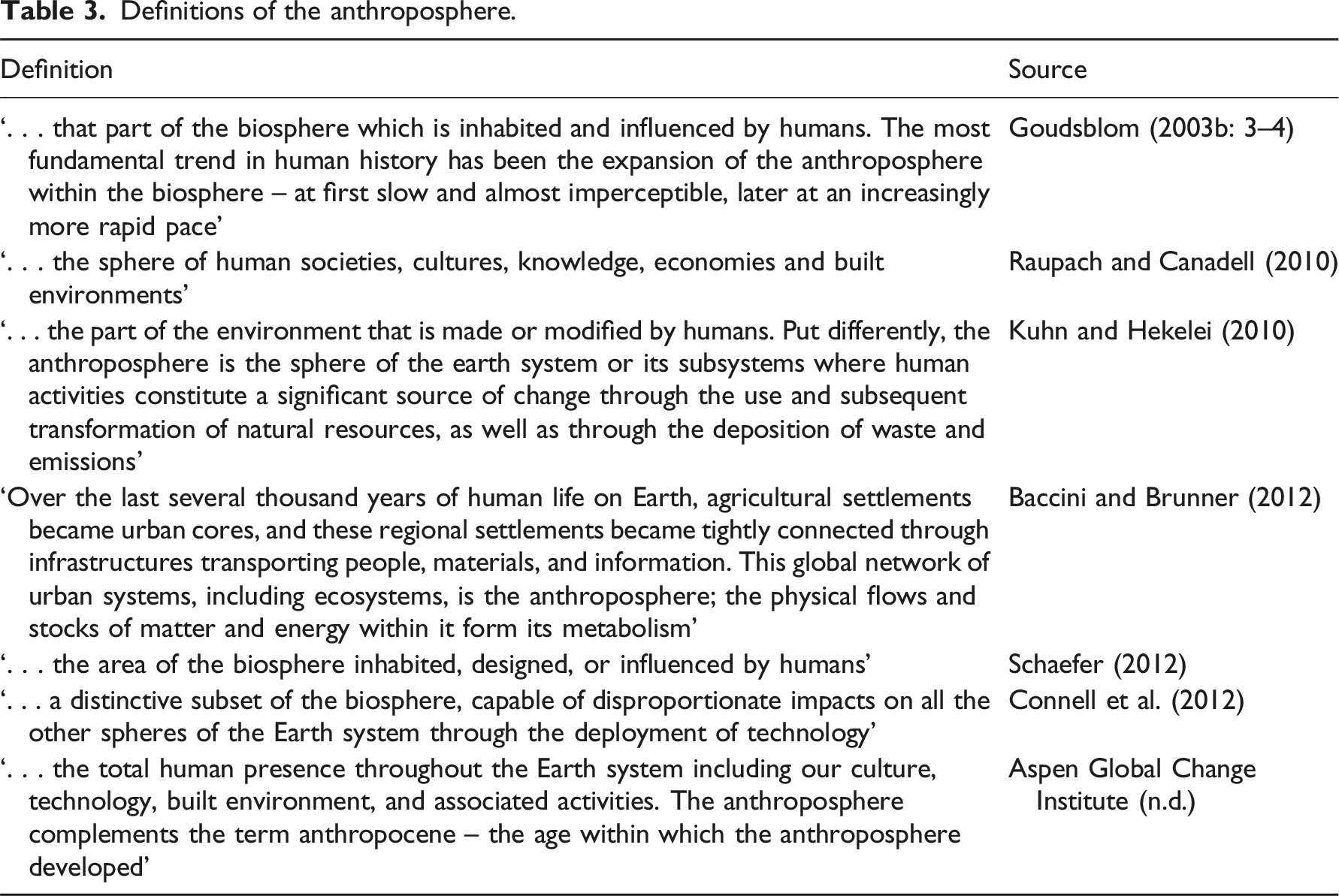
Some researchers attribute the word ‘anthroposphere’ to Eduard Suess. However, the first record of anthroposphere that I can find is in a paper by geologist Tomkeieff (1944: 816), who wrote: ‘The concentration of gold in the hands of man (anthroposphere) is estimated to be of the order of 0.001 per cent of the total amount in the earth’. This was followed by occasional mentions of the term over the next decade. Geographer James (1948: 272), in discussing three kinds of studies which have a geographical nature, said: ‘First, such studies have to do with the surface of the earth – with the zone of overlapping spheres where the lithosphere, the hydrosphere, the biosphere, and the atmosphere are intermingled, and where mankind develops out of the materials of the other spheres, those myriad forms and patterns which we describe as the anthroposphere’.
Arrhenius (1954) appeared to reinvent the term: ‘The geochemical processes within the various parts of the cycle of the earth are so intimately related to each other that it is hardly possible to say whether an action takes place in the lithosphere or in, for instance, the hydrosphere. This applies above all to the part played by water in weathering. This action also greatly affects conditions within the biosphere, so greatly, in fact, that one is justified in saying that organic life is wholly dependent upon the direction weathering takes. An occurrence to which little attention is paid is that which takes place within that part of the biosphere which might be called the anthroposphere. Human beings interfere with and regulate nature, and their activities have become so potent that in certain cases the results may be compared with geological events’.
Swiss geographer Carol (1956) listed the anthroposphere as a fifth essential terrestrial sphere along with atmosphere, lithosphere, hydrosphere, and biosphere, the five-part set, in his view, forming the geosphere.
The literal meaning of anthroposphere is ‘human sphere’, which term is sometimes used, as is humanosphere. Matsui (1998), a Japanese geophysicist, coined the term ‘ningen-ken’ in Japanese, meaning ‘human sphere’ in English. He was deeply involved in the study of the Earth System, focussing on energy and material flows and stocks, and deemed the human sphere as a subsystem of the Earth System. Himiyama (2020: 47) asserted that the human sphere is that part of the Earth comprising humans and their various products and environments, both artificial and natural, that are either used or impacted by the human species.
Mizutani (1993, 1995) used the term ‘humanosphere’ without defining it, but from his context, it was a neologism for human sphere. Sato et al. (2016) equated humanosphere with a definition of ‘environment’ that includes humans, so encompassing all the abiotic (physical and chemical), biotic (other organisms), and societary factors that influence each other; in short, the humanosphere is built from the geosphere, biosphere, and human society. Or, as Wiktionary has it, it is ‘That part of the Earth inhabited by, or influenced by, humans’.
Definitions of the anthroposphere.
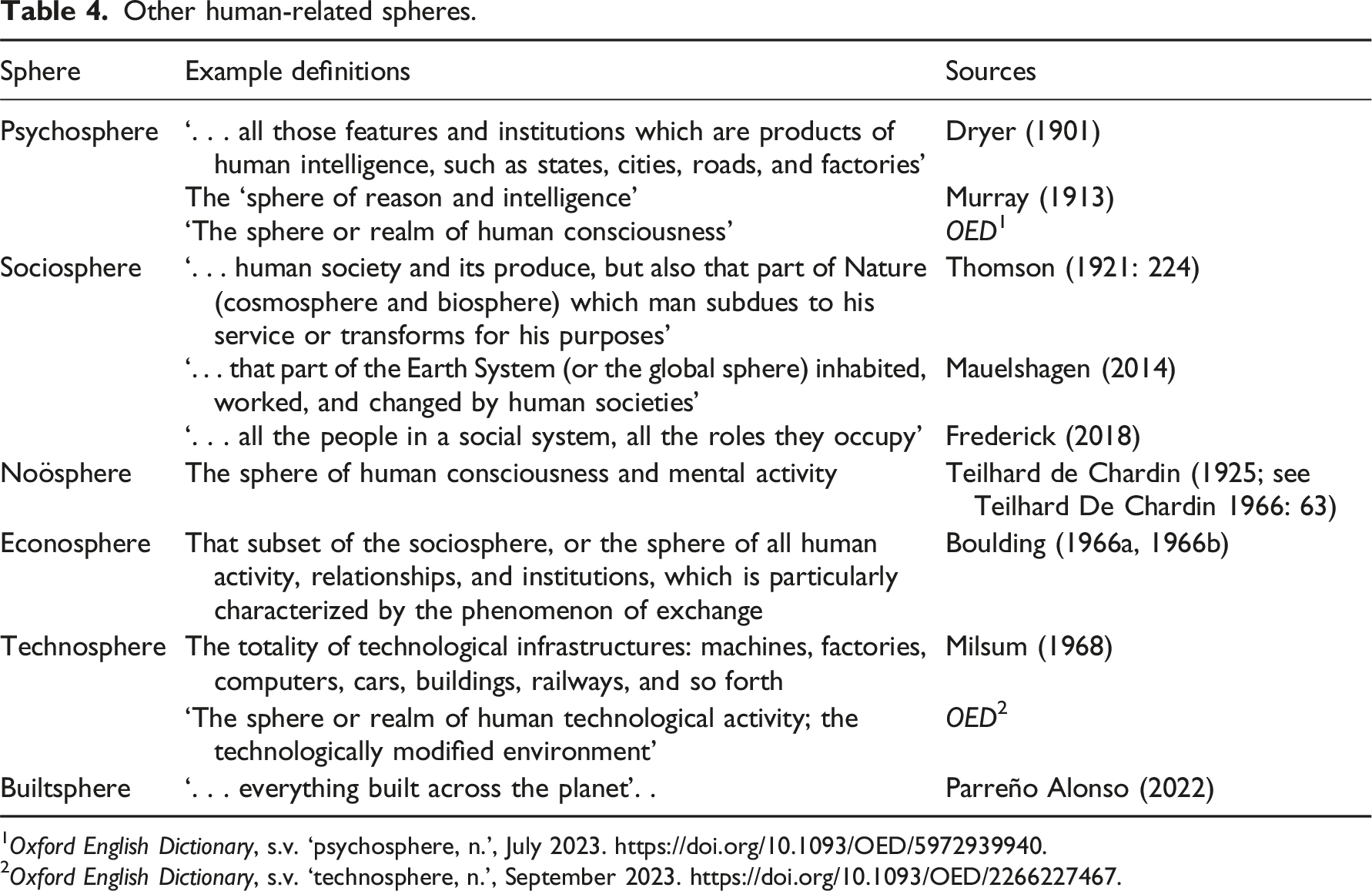
Other human-related spheres.
1Oxford English Dictionary, s.v. ‘psychosphere, n.’, July 2023. https://doi.org/10.1093/OED/5972939940.
2Oxford English Dictionary, s.v. ‘technosphere, n.’, September 2023. https://doi.org/10.1093/OED/2266227467.
Psychosphere, sociosphere, and noösphere
Dryer (1901, 26) talked of the ‘mind sphere’ or ‘psychosphere’, describing it as ‘all those features and institutions which are products of human intelligence, such as states, cities, roads, and factories’. The Scottish naturalist Thomson (1921: 248) first identified the ‘sociosphere’, regarding it as a component sphere of the biosphere within the all-encompassing cosmosphere. By the early 1920s, sociosphere and psychosphere were established in scientific literature (e.g. Mumford, 1922), but since then their meaning has shifted, especially in the case of psychosphere, which by 1913 John Murray took as the ‘sphere of reason and intelligence’ housed within the biosphere (Murray, 1913, 228), a meaning that aligns with the modern definition given by the Oxford English Dictionary: ‘the sphere or realm of human consciousness’. In another shift, Boulding (1966a) liberated the sociosphere from the biosphere, treating it as synonymous with what he called the social system: The social system consists of all human beings on the planet and all their interrelationships, such as kinship, friendship, hostility, status, exchange, money flows, conversation, information outputs and inputs, and so on. It includes likewise the contents of every person’s mind and the physical surroundings, both natural and artificial, to which he relates. This social system clings to the surface of the earth, so that it may appropriately be called the sociosphere, even though small fragments of it are now going out into space. The sociosphere thus takes its place with the lithosphere, the hydrosphere, the atmosphere, the biosphere, and so on as one of the systems which enwrap this little globe. It has strong interrelations with the other spheres with which it is mingled and without which it could not survive. Nevertheless, it has a dynamic and an integrity of its own (Boulding, 1966a: 5–6).
Today, the sociosphere is ‘all the people in a social system, all the roles they occupy’ (Frederick, 2018).
The Oxford English Dictionary defines the ‘noösphere’ as ‘The part of the biosphere occupied by thinking humanity’. The term was coined by Pierre Teilhard de Chardin in the early 1920s. Discussing the place of humans in Nature, he wrote: ‘And this amounts to imagining, in one way or another, above the animal biosphere a human sphere, the sphere of reflexion, of conscious invention, of the conscious unity of souls (the Noosphere, if you will) and to conceiving, at the origin of this new entity, a phenomenon of special transformation affecting pre-existent life: hominization’ (Teilhard De Chardin, 1966: 63).
Psychosphere, sociosphere, and noösphere have related, but not identical, meanings. Bastardas-Boada (2013) neatly illustrated the differences in terms of language. He argued that language has three dimensions or levels: (1) the level of representations and emotions – the psychosphere; (2) the level of language use – the sociosphere; and (3) the level of code (a formal, logical organization or system of meaning) – the noösphere.
Econosphere
Boulding (1966a, 1966b) coined the word ‘econosphere’. In his words: ‘Here again I will be fairly ruthless and define economics as the study of the “econosphere” with a view of gaining knowledge about it, and I will go on to define the econosphere as that subset of the sociosphere, or the sphere of all human activity, relationships, and institutions, which is particularly characterized by the phenomenon of exchange’. As Frederick (2018) explained, Boulding (1966b) defined three entrepreneurial activity spheres: ‘At the outside is the biosphere, which consists of all of the living and non-living things on Earth. Within the biosphere, the sociosphere is composed of all the people in a social system, all the roles they occupy. In Boulding’s view, this was the realm of human information, knowledge, society, norms, social allocation, and culture. Finally, at the centre of this framework, we see the econosphere as all objects, people, and organisations involved in the system of exchange’ (Italics in original).
These three terms and the conceptual ideas underpinning them have been shown to possess the theoretical power to seize the ecological dynamics, or ecodynamics as Boulding (1978) called it, of societies (for a discussion in the context of climate change, see Mauelshagen, 2014). As an example, the notion of the econosphere, in conjunction with those of the sociosphere and biosphere, is proving useful in studying biosphere entrepreneurship in a conversion towards a more socially and environmentally sustainable world (e.g. Frederick, 2018).
Technosphere
According to the Oxford English Dictionary, the word ‘technosphere’ first appeared in an article by technology writer Wil Lepkowski, who wrote that ‘modern man has become a goalless, lonely prisoner of his technosphere’ (Lepkowski, 1960: 1822). Then in 1969, biologist Julian Huxley and environmentalist Max Nicholson, in short opinion piece, reflected on how space flight and the first moon landing had transformed human perceptions of the Earth, saying: ‘The most striking change which it has brought is to create out of a mass of economic, social and technical developments, an entire semi-autonomous new system, which we may call the technosphere, with its own structure and anatomy, its own programmed inputs and outputs, and its accidental or deliberate releases into the biosphere’ (Huxley and Nicholson, 1969).
Since its inception, the use of the term ‘technosphere’ has ballooned, especially so within the disciplines of Earth System science, ecology, and economics. Turner (2011) described the technosphere as ‘the globe-girdling web of human artefacts including buildings, machines, roads, and electronic devices’, going on to invent the word ‘technobiosphere’ as a contemporary fusion of the biosphere and the technosphere. But, as Otter (2022) opined, the fullest and most cogent definition of the technosphere was given by American geologist and engineer Haff (2013), who described it as: ‘the set of large-scale networked technologies that underlie and make possible rapid extraction from the Earth of large quantities of free energy and subsequent power generation, long-distance, nearly instantaneous communication, rapid long-distance energy and mass transport’, signposting ‘the existence and operation of modern governmental and other bureaucracies, high-intensity industrial and manufacturing operations including regional, continental and global distribution of food and other goods, and a myriad additional “artificial” or “non-natural” processes without which modern civilization and its present 7 × 10⁹ human constituents could not exist’. More recently, Zalasiewicz et al. (2017) recognized several divisions of the technosphere: urban, rural, subterranean, marine, and aerial. Haff’s definition of the technosphere is not without its critics. Omodeo (2022) objected to the fact that it sees the technosphere as an independent system which subsumes all economic, political, social, and cultural elements; instead, he argued that humans, not technology, transform the planet, and endorsed Renn (2022: 375) use of the term geoanthropology, in place of geotechnology, for the domain of research that investigates human–Earth interactions within an Earth system perspective. Renn (2020: 382) conjured the concept of the ‘ergosphere’ (the sphere of human work), to join with, or perhaps replace, the term ‘technosphere’, although the term ‘ergosphere’ had in fact been coined by Ruffini and Archibald Wheeler (1971) to describe a region located outside a rotating black hole’s outer event horizon. Renn’s ergosphere captures the transformative power of human labour, both with regard to the global environment and humanity itself, and restores human endeavour to a key position at the intersection between culture and the environment. Humans are the basis of technology, and not the reverse.
Builtsphere
Spanish architect and designer, Parreño Alonso (2022), proposed the word builtsphere for ‘the proliferation of everything built across the planet’. This paralleled Haff’s conception of the technosphere as ‘the proliferation of technology across the globe’. In addition, she contended that the builtsphere and the technosphere are subsystems of the anthroposphere. Haff did not regard the technosphere as part of the anthroposphere but a more accurate description of the same thing.
The importance of human-related spheres
The anthroposphere and its many component spheres are studied individually. But it is their interaction with other Earth spheres that has become a feature of current multidisciplinary, interdisciplinary, and transdisciplinary research concerning the Earth System, with much effort being expended in trying to answer such current environmental challenges as sustainable development, climate change, water supply, and biodiversity loss. Mathematical models of the Earth System are becoming increasingly sophisticated, but adding in the human factor has proved problematic. Certainly, there are models that investigate material and energy flows in and between the anthroposphere and other Earth spheres, often referred to as metabolism models (e.g. Baccini and Brunner, 2012; Giampietro, 2023; Liao et al., 2012). Models of a non-mathematical ilk, such as those built to study the possibilities for sustainable development, usually have a conceptual flavour, with different approaches often characterized by the overlap of two or more spheres. As an example, Figure 3 shows Frederick’s (2018) illustration of the triple bottom line (TBL), a modern version of Boulding’s three spheres, which includes the planet as a stakeholder, the TBL performance measures examining all three spheres by analysing the three Ps: planet (biosphere), people (sociosphere), and profits (econosphere). Triple bottom line (TBL) performance framework that includes the planet, represented by the biosphere (in the sense of ecosphere), as a stakeholder. Source: Redrawn from Frederick (2018), Creative Commons CC BY 4.0 DEED. For interpretation of the references to colours in this figure legend, refer to the online version of this article.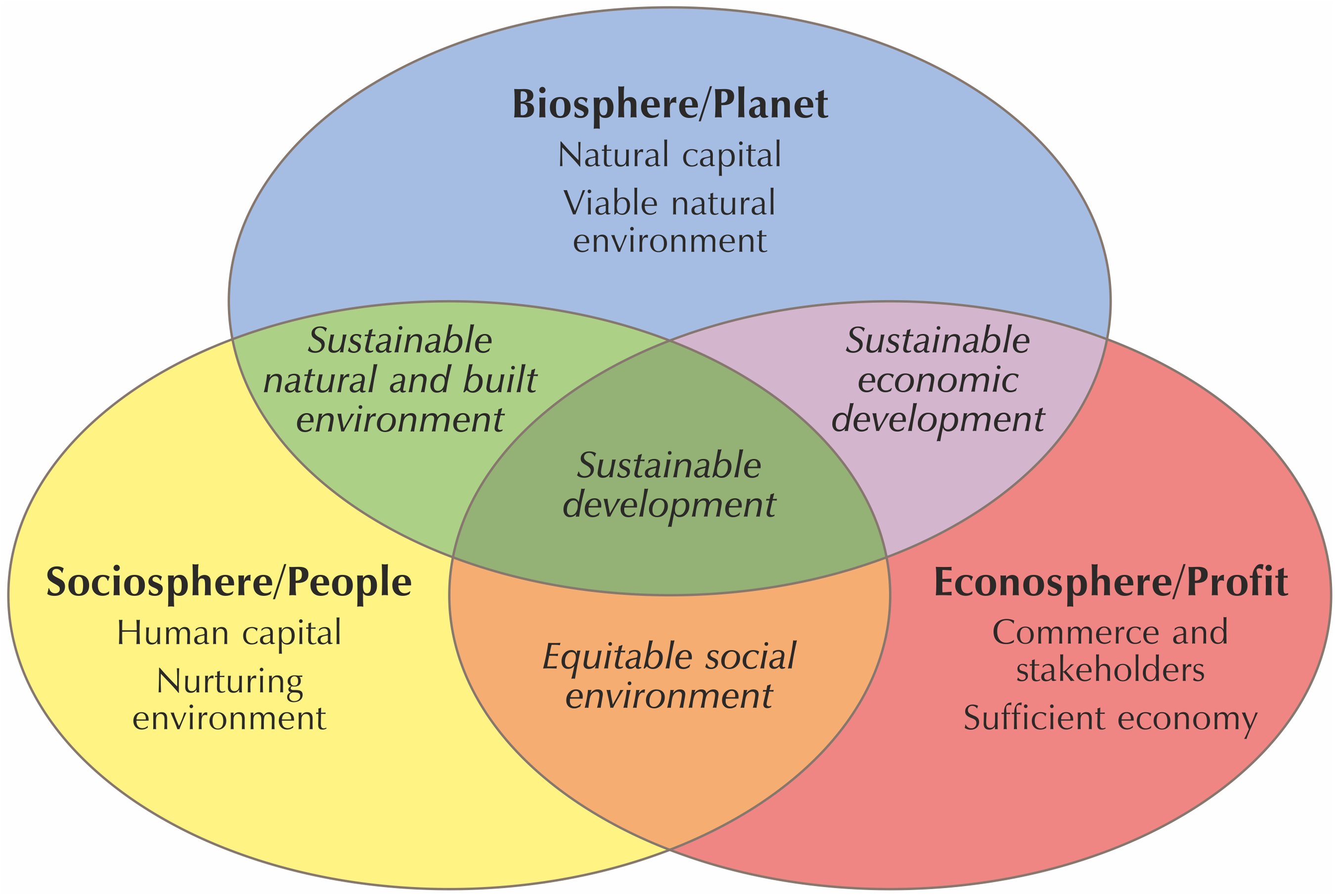
Concluding thoughts
When Eduard Suess invented the word ‘biosphere’, he started a craze for coining sphere-words that began slowly, mushroomed during the twentieth century, and continues today. Many such words are name tags for the various Earth spheres, have little conceptual content (although they are mental constructs), and are not the subject of debate, as exemplified by the atmosphere and its component spheres and the geosphere and its component spheres. That is not to say that the nature of the atmospheric and geospheric component spheres is fully understood, but their basic structure, composition, and properties are largely settled. Other sphere-words, although name tags, have deep conceptual, and in some cases contentious, connotations that remain unresolved. The terms ‘biosphere’ and ‘ecosphere’ are a prime case; the term ‘pedosphere’ is another. Perhaps even more controversial are the terms involving the human sphere, and especially so when they are linked to the other Earth spheres to provide blueprints for addressing such current environmental challenges as sustainable development, climate change, and biodiversity loss.
Today, much research focuses on the interactions between the Earth’s spheres. Concepts of such interactions, usually couched in the context of the holistic unity of Nature, have a long and rich history, starting with such Greek philosophers as Herodotus and Plato. Earth System science is a modern manifestation of such concepts that, in tandem with the rise of mathematical modelling, has allowed the interaction and interdependence of the spheres to be probed far more deeply than was previously possible. Earth System modelling is helping to comprehend changes that result from the interaction of all the Earth’s spheres, including the anthroposphere, over a range of time and space scales, in the past, present, and future. Likewise, multidisciplinary, interdisciplinary, and transdisciplinary research is helping to address such global problems as sustainable development, climate change, water supply, and biodiversity loss. Interactions between the anthroposphere and the other Earth spheres are especially challenging, in part because they raise many philosophical issues concerned with the relationship between humans and the natural world (e.g. Rispoli, 2022). Nonetheless, research in this area is growing. An example is the Integrated History and future of People on Earth (IHOPE) initiative, which comprises a global network of researchers and research projects that investigates the extent to which past changes in the Earth system were associated with changes in the coupled human–environment system, by integrating knowledge and resources from the biophysical, social, and human sciences to address analytical and interpretive issues associated with coupled human–Earth system dynamics (Costanza et al., 2012; see https://ihopenet.org/).
In this paper, the examination of the sphere-words suggests that there has been what might be seen as an overzealousness in naming them, and that while some are non-controversial, others have contested meanings. I would also suggest that some are underemployed, an example being the word toposphere, which, among other things, could serve to link humans and their near-surface environment. Also, in the context of current multidisciplinary, interdisciplinary, and transdisciplinary research, where the interactions between two or more of the Earth’s spheres are commonly the focus of study, the examination shows that it is important be clear how the spheres under investigation are defined, especially in cases where they have disputed meanings. By bringing together the origin, development, and disputed meanings of the many sphere-words that practitioners of these integrative approaches employ in their everyday vocabulary, the hope is that it will encourage them to consider carefully the terms they use, selecting the most appropriate for their particular purposes.
Footnotes
Acknowledgements
I should like to thank the anonymous reviewers for their perceptive comments, and Nick Scarle for drawing the diagrams.
Declaration of conflicting interests
The author(s) declared no potential conflicts of interest with respect to the research, authorship, and/or publication of this article.
Funding
The author(s) received no financial support for the research, authorship, and/or publication of this article.
