




Abstract
The idea that soil or the pedosphere is connected to the other terrestrial spheres dates back at least to 1880. Some 26 years later, the interdependency of the terrestrial spheres was established, but a fully integrative approach to addressing the interdependence of the biosphere, pedosphere, atmosphere, hydrosphere, geosphere, and toposphere did not emerge until the advent of Earth Systems Science during the 1980s. A significant development within the Earth Systems approach was a re-evaluation of the pedosphere’s role in the global system, the outcome of which is at least twofold: first, an appraisal of the pedosphere as a two-way interactor with the other terrestrial spheres, the study of which has given rise to some “new” pedologies—biopedology, geopedology, topopedology, hydropedology, and anthropopedology; and second, the pedosphere as a key component of what has become known as the Earth’s Critical Zone. The background, current status, and prospects of these hybrid pedologies and the extent to which they truly deal with interdependencies within the environment are the focus of this article.
Introduction: the interdependency of soil and other Earth systems
Like all sciences, soil science has evolved. As a discipline in its own right, soil science arose and grew during the 1880s following the publication of Vasilii V. Dokuchaev’s Russian Chernozem (1883). In that seminal work, Dokuchaev expressed the view that soil is an independent object and not simply a geological formation; it is a surficial body of mineral and organic substances produced by the combined activity of animals and plants, parent material, climate, and relief (Dokuchaev 1880, 1883). Hans Jenny (1941) adopted Dokuchaev’s approach and developed the clorpt equation, which expressed any soil or soil property, s, as a function of soil-forming factors:

The work of Dokuchaev and Jenny set soil in its wider environmental context, but it did not make explicit the interdependence of all environmental factors. Admittedly, Dokuchaev (1899) did emphasize the importance of interactions between the zones of the Earth, arguing that a special discipline was needed to study the integrity of the natural sciences (geology, orography, climatology, botany, zoology) and offering genetic soil science (pedology) as a candidate for such a role (Bockheim and Gennadiyev 2010). And, to be sure, his categorical statement of the factors of soil formation provided a basis for exploring in a formal way the connections between soils and their environmental influences. It did not explicitly mention the terrestrial spheres, but they are there by implication: climate involves the atmosphere and hydrosphere; animals and plants (plus the three kingdoms of microorganisms) are the biosphere; parent material is connected to the lithosphere; and relief is part of the toposphere.
It was Vladimir I. Vernadsky, a follower of Dokuchaev, who first made clear the interconnectedness of the terrestrial spheres in his concept of the biosphere, a term he adopted from Eduard Suess after having read Die Antlitz der Erde (Suess, 1883–1909). Vernadsky (1926, 1929, 1998) developed original ideas on biogeochemistry and promulgated his own take on the biosphere, suggesting that all life and life-support systems—living organisms and their planetary environment—evolve together and form the media in which they live (air, water, soil, sediment). Some later workers argued that the biosphere should be confined to living things and the totality of life and life-support systems be called the ecosphere (Cole 1958; Gillard 1969), a view to which the present author subscribes (see Huggett 1999). It should be noted that Reinhold Tüxen, a German botanist (1931–2), recognized that the elements of the environment—rocks, water, climate, relief, soils, plants, animals, and humans—form a complex of interacting factors. Later, Sante Mattson (1938), a Swedish soil scientist and chemist, considered all possible interactions between the lithosphere, atmosphere, hydrosphere, pedosphere, and biosphere. Three years later, Jenny listed the components of the ecosphere in his clorpt equation, but his focus was the influence of environmental factors on soils and ecosystem properties rather than on the interrelationships between the environmental factors themselves.
With the advent of Earth Systems Science, given its name in 1983 (see Steffen et al. 2020), an innovative and integrative approach emerged for addressing the interdependence of life, soils, climate, rocks, and relief; in doing so, it built on and bolstered the earlier views concerning the interdependencies of environmental factors and a growing consensus that Earth systems should be viewed as a unitary whole. An important offshoot of this holistic approach was an evaluation of the pedosphere’s role in the Earth system, both as a two-way interactor with the other terrestrial spheres, the study of which has given rise to some “new” pedologies—biopedology, geopedology, topopedology, hydropedology, and anthropopedology (Figure 1)—and as a key component of what has become known as the Earth’s Critical Zone. These topics are discussed below. The new pedologies involving interaction between the pedosphere and other Earth systems. Source: After Huggett (2021).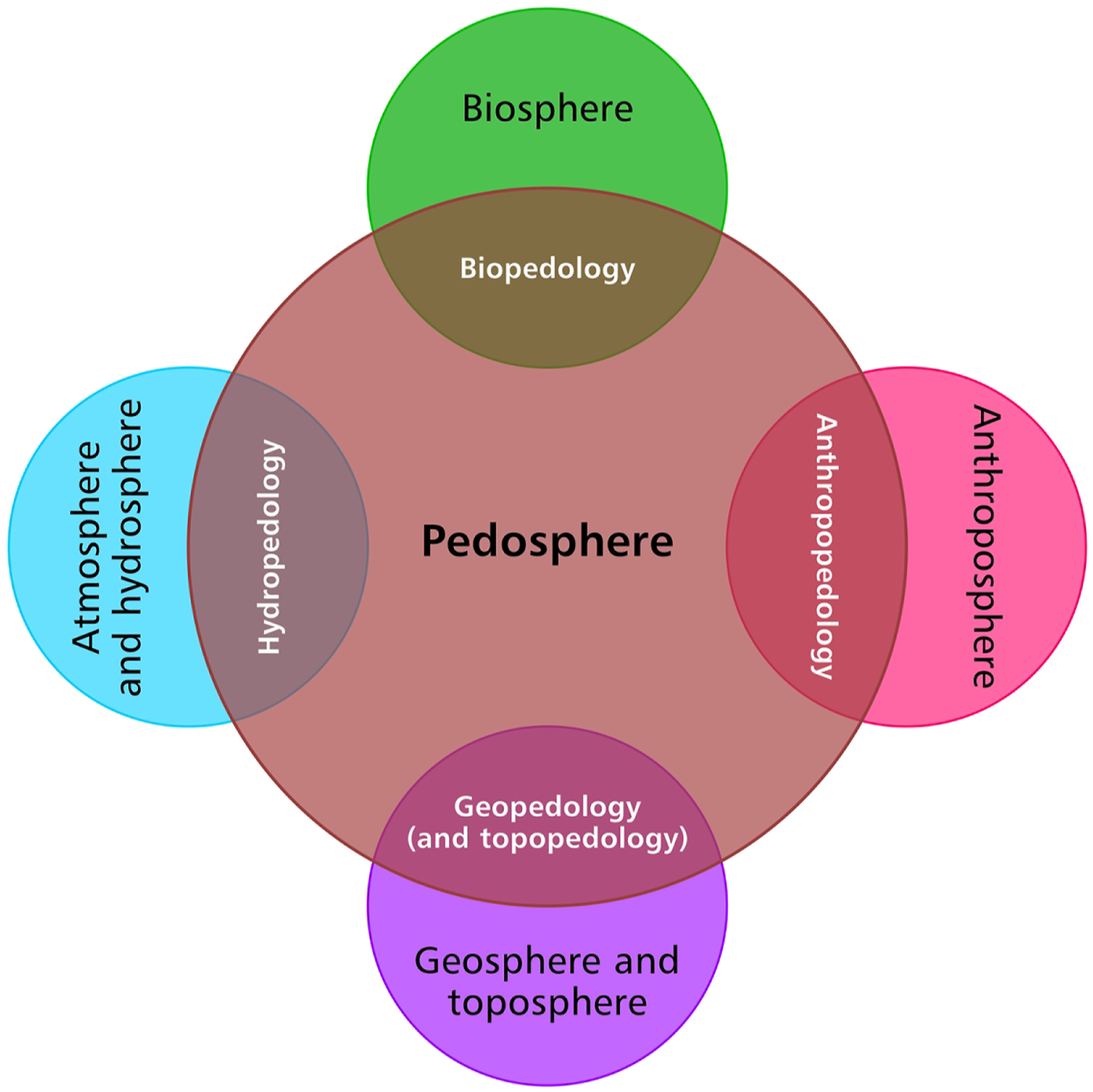
Biopedology
Biopedology, the oldest of the “new” pedologies, considers interactions between soils and life. An early conception of soil as a medium for plant growth probably arose when, starting around 12,000 years ago (but perhaps as long ago as 23,000 years), humans switched from food-gathering to food-growing during the Neolithic Revolution (cf. Simonson 1968). Today, emphasis is given on soil as a medium for plant growth, which is the subject matter of edaphology, where the prime concern is soil fertility and where the physical and chemical soil attributes important for plant growth are considered without much regard for conditions external to the rooting medium (Bockheim et al. 2005). However, a newer biopedology has emerged that focusses sharply on the two-way interaction of soil with animals, plants, fungi, and microorganisms. Its origins lie with Charles Darwin and his work on earthworms (Darwin 1881) and then developed over a century later by Donald Lee Johnson (1993a, 1993b) and David R. Butler (1995), whose ideas began the rediscovery of life as a major factor in soil evolution, aided in part by studies in biogeomorphology (e.g. Johnson 1993b; Butler 1995; Verboom and Pate 2013; Pawlik and Šamonil 2018).
One line of this newer biopedology investigates the role of soil microorganisms in nutrient cycling through decomposing organic matter and transforming inorganic compounds (e.g. Ko et al. 2017; Dellagi et al. 2020). Another line is the recognition of faunal mixing in soil formation and the textural sorting it can produce, as first demonstrated by Darwin (1881). It is now accepted that the topmost portion of the weathered mantle is subject to mixing by organisms that live in the soil. This mixing, known as bioturbation (Hole 1961), is mainly caused by the activities of animals (faunal turbation). In soils, earthworms are the most effective bioturbator, followed in order by ants and termites, small burrowing mammals, rodents, and invertebrates. Bioturbation is vigorous enough in almost all environments for the near-surface soil to be described as a bioturbated mantle or biomantle (Johnson 1990). Indeed, Johnson (1993a, 1993b, 2002; Johnson et al. 2005a, 2005b) argued that soil A horizons are a biomantle created by biomechanical processes, while B horizons are created by epimorphic processes (weathering, leaching, and new mineral formation) acting upon rock material. This means that the textural contrast between A and B horizons results primarily from the action of animals and plants, rather than from the eluviation and illuviation of fine materials. Furthermore, some processes of bioturbation produce mounds of bare soil on the ground surface, and these little piles of sediment are susceptible to erosion by rain splash and wash processes; the cumulative effect of wash on surface material is a gradual winnowing of fines from the biomantle and a concomitant coarsening of texture. Bioturbation and biomantle studies have flourished in the last two decades (e.g. Peacock and Fant 2002; Johnson et al. 2005a, 2005b; Saco and Moreno-de las Hera, 2013; Gabet et al. 2014; Fleming et al. 2014; Johnson and Schaetzl 2015).
Geopedology
The particularly strong links between geomorphology (including underlying substrate and parent material), soils, and hydrology form the subject matter of geomorphopedology, usually shortened to geopedology, which investigates the joint development of soilscapes and landscapes. The argument is that soilscapes seldom develop in static geomorphological and geological environments: the landscapes in which soilscapes develop normally change. Thus, the pedological development of soilscapes and the geomorphological development of landscapes take place at the same time and influence one another. Pedologists were alerted to this fact by Charles F. Shaw (1930), Gilbert Wooding Robinson (1936), and Geoffrey Milne (1936), who discussed the role of erosion and deposition in soil evolution. Indeed, soil geomorphology began in the USA in the 1930s with a spate of soil erosion studies made under the auspices of the USDA (Effland and Effland 1992). In 1952, the USDA set up a Soil–Geomorphology Group that included Robert V. Ruhe, who championed the process dimension of Milne’s catena concept (e.g. Ruhe 1960), arguing that it is the clearest general systems statement about soil geomorphology, integrating the factors in explaining soil differences while focusing on past history of the land surface, geohydrology, erosion, sediment transport, and pedogenic processes (Ruhe 1975; Birkeland 1990, 1999; Johnson and Hole 1994).
Starting in the 1960s, pedologists with a geomorphological leaning and geomorphologists with a keen interest in soils proposed several geopedological models designed to link pedologic and geomorphic processes in landscapes (e.g. Ruhe and Walker 1968; Conacher and Dalrymple 1977; Gerrard 1981). Research in the closing decades to the 20th century further probed the relationships between soils and geomorphology (for useful overviews see Gerrard 1992, 1993; Daniels and Hammer 1992; Birkeland 1999). It was in this period that the sophistication of soil–landscape system models began to increase. An early example is the model of the soil–landscape continuum built by McSweeney and his colleagues (1994) that benefitted from technical advances made through linking hydrology and land-surface form for terrain-based modeling of hydrological processes. In their model of soil–landscape systems, various sources of spatial data (e.g. vegetation and geological substrate) and attribute data (e.g. soil organic-matter content and particle-size distribution) are integrated through GIS technology. Four interrelated and iterative stages are applied in the model: physiographic domain characterization; geomorphometric characterization; soil horizon characterization; and soil property characterization. Many subsequent models have appeared, each with its own focus (e.g. Heimsath et al. 1997; Sommer 2006; Viaud et al. 2010; Vanwalleghem et al. 2013), a recent example of which is Willgoose’s (2018) sophisticated soilscape–landscape deterministic model (see also Welivitiya et al. 2019, 2021). Owing to the construction of such models, and to other integrated studies and soils and landscapes, geopedology has blossomed over the last couple of decades (see Schaetzl and Anderson 2005; Zinck et al. 2016; Richter et al. 2020).
Topopedology
In keeping with the names of the other new pedologies, it seems reasonable to use the word topopedology for soil–topography interactions (see Huggett 2021). Research in this field began with the realization that, as well as having a one-dimensional profile, soil has geographical or spatial dimensions. The two-dimensional sequence of soils from hilltop to valley bottom is a soil catena, in which hill soils may be thought of as the A horizons for the valley soil B horizons; this was first recognized by Geoffrey Milne in the 1930s. Land-surface form also influences soil development in three dimensions. In moving down slopes, soil materials (water, solutes, colloids, and some solids) tend to move at right angles to land-surface contours. Flowlines of material converge and diverge according to contour curvature: they diverge over nose slopes, converge over headslopes, and run parallel on sideslopes. The pattern of vergency influences the amounts of soil materials held in store at different landscape positions. For this reason, soil developed operates in three-dimensions within a framework dictated in large measure by the drainage network. The term soil landscape, sometimes shortened to soilscape (Walker et al. 1968), captures the three-dimensional nature of the soil body, while the idea of soil–landscape systems (Huggett 1975) emphasizes the dynamic links between soilscapes and other Earth systems. In short, soil is more than a three-dimensional veneer: it is an interdependent body linked to the other terrestrial spheres; or as Wysocki and his colleagues (2011) put it, ‘soils, landscapes, and surficial sediments or rocks together form 3D systems that coevolve through the interaction and balance of physical and chemical weathering versus erosion and deposition.’
A wide range of studies fall under the heading topopedology. Much geopedological research, as discussed in the previous section, has a topographic element. Similarly, research into soil and slope hydrology, soil geochemistry in a landscape setting, soil mapping, and human–soil interactions all commonly involve a consideration of topography (cf. Lisetskii and Pichura 2020). The surface and near-surface component of the hydrological cycle is organized largely in the framework of drainage networks, with topography exerting a strong control. This is evident in studies of soils and hydrology along catenas (e.g. Jacobs et al. 2009) and within soilscapes (e.g. Srivastava et al. 2021). Topography also influences soil geochemistry, both along catenas and within the soil landscapes. A host of studies demonstrate the influence of catenary position on soil chemistry (e.g. Gennadiev and Kasimov 2004). Other studies identify the impact of landscape position on soil chemistry, the first to do so being the work of Boris B. Polynov (1935, 1937) who believed in the integrity of the landscape in producing, transporting, and removing rock debris. From Polynov’s pioneering studies have evolved several conceptual schemes of geochemical landscapes, with notable contributions coming from Viktor Abramovich Kovda and Mariya Al’fredovna Glazovskaya (1963, 1968) (see Gennadiev et al. 2013).
The idea of the soil catena was originally devised for soil mapping, a use that still persists (e.g. Grealish and Fitzpatrick 2014), although changes caused by management history may raise problems when using them for that purpose (Richter and Burras 2017). However, since the turn of the 21st century, three-dimensional aspects of landscapes have greatly aided the mapping of soils (e.g. Iticha and Takele, 2018). This development was given massive boost by several things: the increased availability of spatial data in digital elevation models and satellite imagery; the increase in computing power necessary for processing spatial data; the development of data-mining tools and GIS; and numerous applications beyond geostatistics (Minasny and McBratney, 2016; see Brevik et al. 2016 for an overview).
Hydropedology
The term hydropedology was first used by Russian hydrologist Viktor Grigor’yevich Glushkov in 1915 (see Glushkov 1961) to cover studies that involve water and soil interactions (e.g. Rétháti 1983, 18). As one of the latest and integrative new pedologies, it has come into its own over the last two decades as “an emerging intertwined branch of soil science and hydrology that studies interactive pedologic and hydrologic processes and properties in the Earth’s Critical Zone”. . . (and that). . . “aims to bridge disciplines, scales, and data, connect soils with the landscape, link fast and slow processes, and integrate mapping with monitoring and modeling to provide a holistic understanding of the interactions between the pedosphere and the hydrosphere” (Ma et al. 2017). Unlike conventional soil science, it emphasizes in situ soils in the landscape, which have distinct pedogenic features and varying environmental settings (Lin 2012). In doing so, it yields a more realistic and integrated understanding of real-world soil and hydrological processes. It appeared with the blooming of hydrogeological science. In this spirit, hydropedology has emerged in recent years as an intertwined branch of soil science and hydrology that addresses the interface between the pedosphere and the hydrosphere, with an emphasis on in situ soils in the landscape setting (Lin 2003; Lin et al. 2006). As Li et al. (2018) explain, ‘Hydropedology pursues a holistic understanding of the interactions between the pedosphere and the hydrosphere, with an emphasis on in situ soils in diverse real-world landscapes, where distinct pedogenic features (e.g., structure, macropores, and horizonation), environmental variables (e.g., climate, landforms, and organisms), and anthropogenic impacts (e.g., land use and management) interact and dictate fluxes and pathways of energy and mass flow in the landscape.’ (Li et al., 2018).
Hydropedology is starting to produce interesting findings. A study of soils at the boreal–prairie interface, central Alberta, Canada, sought to establish how hydrology influences soil development at slope positions where shallow water tables influence both wetland and adjacent uplands (Whiston 2020). Hydrological data gathered from instrumented wells and piezometers showed that the infrequency of eluvial and illuvial soil features in depressions was consistent with their flow-through hydrology, while the higher frequency of eluvial and illuvial soil features at toeslopes was consistent with their recharge hydrology.
Anthropopedology
Anthropopedology is the study of the human impact on soils and, since the interaction is two-way, the impact of soils on humans. It has a long history. Yaalon and Yaron (1966) used the term metapedogenesis to cover human-made soil changes; Amundson and Jenny considered the place of the human species in the state-factor theory of ecosystems (Amundson and Jenny 1991). Human-impacted and human-created soils go by various names, with anthropogenic soils being the best catch-all term, and urban anthropogenic soils when narrowing the field to urban areas (Howard 2017, 2021).
Owing to their making or modification by human activity, anthropogenic soils have their own classification, distinct from that of natural soils. In the World Reference Base (IUSS Working Group, 2015), most anthropogenic soils are either Anthrosols or Technosols. Anthrosols are soils modified greatly by human activities, including the addition of organic or mineral material, the addition of charcoal or household wastes, and irrigation and cultivation; they occur where people have observed these practices for generations, often for centuries or even millennia. Technosols contain a significant number of artefacts, or are sealed by human-made hard material with properties unlike natural rock (technic hard material), or contain a geomembrane; they include soils from urban, industrial, and mining wastes, soils sealed beneath asphalt and concrete, and soils on urban rooftops. Broadly speaking, Anthrosols develop in human-altered material (that is, intentional in situ additions to natural soil) and Technosols in human-transported material (that is, organic or mineral matter taken from a source located away from a natural soil and dumped on it, as in building rubble), although the long-term addition of earthy manure, compost, mud, or sand creates Terric Anthrosols (Soil Survey Staff, 2014).
The two-way interactions between soils and the anthroposphere have been the subject of increased research over the last few decades, in large part owing to the recognition of soil as an indispensable resource (e.g. Richter and Yaalon, 2011). Topics investigated include coupled human–natural landscapes (e.g. Barton et al., 2016) and the evolution of Technosols (e.g. Leguédois et al., 2016). Research on these lines can play a vital part in understanding several environmental problems, including soil and water pollution. Research is also directed at soil and food security (e.g. Pozza and Field, 2020; Bagnall et al., 2021).
Soils are important for human health in a number of ways, some beneficial and some detrimental (Brevik and Burgess, 2014). On the positive side, around 78% of the average per capita calorie consumption worldwide comes from crops grown directly in soil, and another almost 20% comes from terrestrial food sources that rely indirectly on soil (Brevik 2013); and soils are a major source of nutrients for humans. In addition, soils act as natural filters which remove contaminants from water. On the negative side, soils may contain heavy metals, chemicals, or pathogens, all of which are potentially harmful to human health; they are also a major source of airborne dust, which presents serious risks to human health. Research into soil and human health is a growth area of anthropopedology.
The pedosphere and the Critical Zone
Each of the new pedologies has become a vibrant area of research. As their names suggest, they focus on the interactions between the pedosphere and each of the other Earth systems. There is, of course, considerable overlap between the different brands. Geopedology can involve aspects of hydrogeology, topopedology, and so on. But is there a body of soil research that attempts a full integration of the brands? On the face of it, research associated with the idea of the critical zone fills that role.
Gail Ashley (1998) was the first to apply the term Critical Zone to the thin terrestrial layer where the vegetation canopy connects to the soil, the soil connects to weathered materials, weathered materials connect to bedrock, and bedrock provides a connection to an aquifer. As defined by the National Research Council (2001, 2), the Critical Zone is: ‘… the heterogeneous, near-surface environment in which complex interactions involving rock, soil, water, air and living organisms regulate the natural habitat and determine availability of life sustaining resources.’
And in more detail, it is: ‘. . . a dynamic interface between the solid Earth and its fluid envelopes, governed by complex linkages and feedbacks among a vast range of physical, chemical, and biological processes. These processes can be organized into four main categories: (1) tectonics driven by energy in the mantle, which modifies the surface by magmatism, faulting, uplift, and subsidence; (2) weathering driven by the dynamics of the atmosphere and hydrosphere, which controls soil development, erosion, and the chemical mobilization of near-surface rocks; (3) fluid transport driven by pressure gradients, which shapes landscapes and redistributes materials; and (4) biological activity driven by the need for nutrients, which controls many aspects of the chemical cycling among soil, rock, air, and water.’ National Research Council (2001, 37) (italics in original)
Later refinements to this original definition recognize the upper and lower limits of the Critical Zone as being the top of the canopy layer down and the bottom of the groundwater system, respectively (Giordino and Houser, 2015).
Critical Zone research tackles the interdependencies of Earth’s systems at and near the planetary surface. It is interdisciplinary and transdisciplinary (Aguilar et al., 2022). Plainly, soil is a critical component in these systems and widely regarded as the unifying thread of the Critical Zone (Lin, 2011; Wilding and Lin, 2006). However, Giardino and Houser (2015, 9) make a strong case for water as the unifying thread: ‘It is easy to understand that the soil profile does connect the vegetation canopy to the soil; the soil connects to the weathered materials and the weathered materials connect to bedrock, and bedrock provides the connection to the aquifer. These pathways facilitate flows (i.e., energy, mass, biogeochemical) from the top to the bottom and vice versa. But, none of these energy and material flows would be possible without water.’
Furthermore, studies suggest that hydrological processes (water residence times and fluid flow rates) are the primary control of soil chemical weathering (Maher, 2010); and recent modeling and comparison with field results showed that chemical weathering, both from bedrock and unconsolidated material, is usually the chief limiter of soil formation rates (Egli et al., 2018). Even in the polar desert environment of the McMurdo dry valleys, Antarctica, weathering results almost solely from the melting of subsurface ice and in the hyporheic zone of meltwater streams (Lyons et al., 2021).
Regardless whether or not it is the unifying thread, the soil’s role in the Critical Zone is immensely important. Indeed, the pedosphere is the only terrestrial sphere totally encompassed by the critical zone, sitting as it does in the middle of the zone and acting as a sort of geomembrane “across which water and solutes, as well as energy, gases, solids, and organisms are actively exchanged with the atmosphere, biosphere, hydrosphere, and lithosphere, thereby creating a life-sustaining environment” (Lin, 2010). Indeed, research in anthropopedology becomes ever-more pressing as human security comes to rely increasingly on Earth’s diverse soil resources. As Amundson, et al. (2015) pointed out: ‘Soil is the living epidermis of the planet. Globally, soil is the medium through which a number of atmospheric gases are biologically cycled and through which waters are filtered and stored as they pass through the global hydrological cycle. Soil is a large and dynamic reservoir of carbon and the physical substrate for most of our food production. Profound changes are on the horizon for these interconnected functions—particularly sparked by changes to climate and food production—that will likely reverberate through society this century.’
Pedologists have much to offer Critical Zone research, but they also carry out their own research on the form and function of the soil system, some of which is aided by findings of Critical Zone scientists. It is evident that many of the factors in the soil system call for contributions from such varied disciplines as biology, ecology, hydrology, hydrogeology, geology, as well as soil science. This is simply an upshot of the soil being an interdependent system. But does any purely pedological research attempt a full integration of the soil system, in the same way that Critical Zone researchers strive to do for the Critical Zone? The new pedologies are a step in this direction, even if a comprehensive model of soil system dynamics over all space and time scales is as yet unforthcoming. Recent publications point to the value of integrative modeling of the Critical Zone, showing its value to soil studies (e.g. Banwart et al., 2017); they also stress the need for models developed across a range of temporal and spatial scales, from seconds to millennia (or even longer) and from molecules to continents (e.g. Brantley et al., 2007; Sullivan et al., 2022). In agricultural settings, models that use three-dimensional representations of landscape components offer an integrated method of studying such topics as soil organic matter dynamics in agroecosystems, the understanding of which is vital to mitigating soil degradation, ensuring food security, and improving the global environment (Viaud et al., 2010), and as sustainable food production (e.g. Coleman et al,. 2017; Milne et al., 2020).
Hunt and his colleagues (2021) argue that viewing soil as a nexus within interacting Earth systems necessitated a fresh definition of soil based on its spatial and temporal position within the process of soil formation and erosion, rather than on the history of its constituents, which may move into and out of the soil. They suggest such a definition should include the entire soil catena, from ridge to water channel, and all material located between the parent material and the atmosphere (but excluding, to varying degrees, such purely organic material as plants and leaf litter). The definition they offered runs as follows: ‘Most simply put, soil is the layer at the solid Earth surface, which is derived from, and distinct from, its source material, sediment, rock, or plant matter, through a wealth of chemical, biological, and physical processes, and what is not yet displaced from its catena by fluvial processes, which effectively convert the soil to sediment’ (Hunt et al., 2021, 254).
Seen in this light, soil forms part of the Earth’s “weathering engine,” a system that involves crustal rock being carried into the “surface reactor,” wherein a complex assortment of chemical, biological, and physical processes work hand-in-hand to create the machinery that transforms bedrock into regolith and soil, and through a combination of mechanical and chemical means, manufactures particles susceptible to removal by erosive processes (Anderson et al., 2004; Anderson, 2019). In essence, the system is one of soil production and soil destruction. The soil production side has received much attention of late, building on Grove K. Gilbert’s little known but valuable work on the topic (Richter et al., 2020). The soil and landscape models mentioned in the geopedology section are part of this research. Other recent landscape models incorporate changing land use. The HydroLorica model of soil–landscape evolution has been used to simulate soil development by modeling explicitly the spatial water balance, a driver of soil- and landscape-forming processes, under scenarios for different rainfall inputs and changes of agricultural land use (Van der Meij et al., 2020). Models of this kind become increasingly sophisticated and offer a truly integrative approach to studying soil and its interdependence with other Earth systems. They provide a deeper understanding of the structure and function of the soil system, as well as practical guidance to real-world problems associated with the soil.
Conclusions
This paper demonstrates that the adoption of an Earth Systems approach has led to a re-evaluation of the pedosphere’s role in the global system, from which stem two main developments. The first development is research into the pedosphere as a two-way interactor with the other terrestrial spheres, which has created several “new” pedologies—biopedology, geopedology, topopedology, hydropedology, and anthropopedology. The second development is research into the pedosphere as a key component of the Earth’s Critical Zone. Both developments are providing a rich source of fresh ideas that address interdependencies within the environment and, in some cases, offer possible solutions to current environmental problems.
Footnotes
Acknowledgements
I should like to thank the two anonymous reviewers for their helpful comments.
Declaration of conflicting interests
The author declared no potential conflicts of interest with respect to the research, authorship, and/or publication of this article.
Funding
The author received no financial support for the research, authorship, and/or publication of this article.
