



Abstract
The Earth and life sciences are replete with portmanteau (blended) words and neologisms. Researchers at the interfaces between the traditional disciplines within the Earth and life sciences have coined dual titles for ‘new’ disciplines, such as geobiology/biogeology and ecohydrology/hydroecology. An upsurge in such coinage over the last few decades reflects a healthy willingness of many researchers to cross traditional disciplinary boundaries and to include the human sphere within their domains. However, some of the titles cause confusion because their meanings are not self-evident; rather, they sometimes demand extra research to reveal their meanings, thus rendering science less ‘open’ at a time when Open Science is being vigorously encouraged. After discussing the question of disciplinary neologisms, the paper probes the interchangeability of 15 dual ‘new’ discipline titles and concludes that six are more-or-less synonymous, three are nonsynonymous, and six are indeterminate for varying reasons. We question the usefulness of some, but by no means all, disciplinary neologisms, given that their meanings are not immediately apparent. Looking beyond portmanteau titles and other neologisms, the paper discusses the rise of interdisciplinary and transdisciplinary research, as seen in the concepts of the Critical Zone, multifunctional landscapes, and Earth System Science, the last of which supports a conceptual model of the planet as an interdependent set of spheres from global to local scales that has the advantages of combining the biotic, abiotic, and human spheres.
Keywords
Introduction
The emergence of new disciplines created by the fusion of existing fields of research has been a feature of Earth sciences, primarily over the last few decades. These new disciplines, along with changing fashions in styles of scientific communication, have been responsible for an upsurge in the creation of new words or neologisms. Scientific neologisms are made by blending words, clipping words, or by forming acronyms and initialisms. They are designed to make easier verbal and written communication and learning. Blended words, also called portmanteaux, are words (or parts of words) created by combining the spellings and meanings of two or more other words or word parts, as in metaverse from meta and universe, and cyborg from cybernetic and organism. A portmanteau originally meant a large travelling bag that opened into two equal parts. Lewis Caroll was the first to use the idea linguistically: in Through the Looking Glass, Alice asks Humpty Dumpty to explain words from the nonsense poem ‘Jabberwocky’ and is told that ‘slithy’ means ‘lithe [active] and slimy’, that it is ‘like a portmanteau – there are two meanings packed up into one word’. In general, the two parts of the word carry equal weight and are packed in compactly, rather than simply being placed side by side. But portmanteaux may also be constructed from three or more words, some involving truncations (total blends), as in smog (smoke and fog), whereas others are combination of whole and truncated words (partial blends), as in hydrogeology (hydrology and geology). The Earth and life sciences are replete with two-part (e.g. biochemistry and geochemistry), three-part (e.g. biogeochemistry), and even four-part (e.g. hydrobiogeochemistry) portmanteau words.
The coining of these portmanteau titles has gone hand in hand with the escalating creation of acronyms, which are words made up of parts of the phrase they stand for and pronounced as a word, as in laser (light amplification by stimulated emission of radiation); initialisms, which are acronyms pronounced as individual letters, as in DNA (deoxyribonucleic acid) and ITCZ (Intertropical Convergence Zone); and other neologisms made by combining two ideas, as in cyberspace, or by clipping two words, as in data viz (data visualization). In general, these neologisms are created either for convenience, as in DNA and ITCZ, or for branding purposes, as in NASA. All types of neologisms are found increasingly in the scientific literature. Examples include ecogeology, a blend of ecology and geology, CZNet, short for Critical Zone Collaborative Network, ‘CZ science’ for ‘Critical Zone science’, and ‘scicomm’ for ‘science communication’. Some of the portmanteau titles and acronyms are useful and widely understood, but a recent study showed that many of the acronyms used in scientific papers hinder understanding and contribute to the increasing fragmentation of science (Barnett and Doubleday, 2020). The book Origins of NASA Names contains six pages of abbreviations and acronyms (Wells et al., 1976), as does Civil Society and Peacebuilding in Sub-Saharan Africa in the Anthropocene: An Overview (Kiyala and Harris, 2022).
An important question to ask is: Why coin neologisms? In general, it is to simplify expressions by combining long words, so reducing confusion, and thereby improving communication. Biogeochemistry is more succinct and catchier than ‘biological and geological chemistry’. In many cases, neologisms are invented for a specific reason. Take the example of ‘ecosphere’. Cole (1958) coined this term to combine two concepts – the biosphere and the ecosystem, the biosphere being the totality of life on Earth and an ecosystem being a self-sustaining community of organisms, both plants and animals, taken together with its inorganic environment. Cole wanted to discuss the biosphere and ecosystem as a single entity and offered ecosphere as a suitable appellation. The word ecosystem is itself an enduring portmanteau that was coined by Tansley (1935) to integrate organisms and their abiotic environment into one physical system (see Richter and Billings, 2015). Tansley did not actually state that the word ecosystem is a blending of ecological and system, but that is probably what he had in mind. Another example is biogeomorphology, a subfield of geomorphology, coined by Viles (1988; see also Viles, 2022) to make explicit the role of organisms in fashioning landscapes.
Not all neologisms are new and they sometimes take time to become established. Take the example of groundwater. This word took about one hundred years to change from its root form, ground water (or sometimes groundwater), to its compound form, groundwater (Diefendorf, 1995). Even today, hydrogeologists tend to focus on the geological system as it pertains to the properties and behaviour of ground water; on the other hand, geohydrologists, with a professed interest in engineering hydrology, focus on the hydraulics of groundwater as it relates to Earth materials. In the case of groundwater, confusion is less likely to arise because of the established conventions of the root, hyphenated, and compound forms, but this is not the case with all neologisms.
Recently coined neologisms are often designed to fit the character-length constraints of modern social media, as in X (formerly known as Twitter) handles and hashtags, or to be catchy and memorable for science marketing and promotional purposes, as in ‘HydroProcesses’, which is the X handle for the journal Hydrological Processes shortened to a portmanteau, (https://twitter.com/HydroProcesses[twitter.com]), and in ‘Ecolog’, the X handle for the listserv for the Ecological Society of America (https://twitter.com/EcoLog_L[twitter.com]).
A problem with neologisms, and especially with portmanteau titles, is their propensity to cause confusion. Take the case of hydrogeology. Do the component words carry equal weight, or is the geology part more important than the hydrology part? Confusion about how words are combined in the portmanteau name of a discipline reflects a confusion in how methods and philosophies are combined by practitioners when conducting science within that new discipline. And portmanteau titles take on a different meaning, adding more confusion, when people identify themselves as practitioners of the portmanteau discipline. It is unclear if, for instance, a hydrobiogeochemist is someone knowledgeable in all of those disciplines or only parts of all of those disciplines. Interdisciplinary research covers a huge storehouse of material, knowledge, and expertise, and uncertainty arises when, to work in these interdisciplinary areas, scientists make claims about their knowledge, legitimacy, status, and so forth. What, for example, is the difference in status between a hydrologist, hydrogeologist, and a hydrobiogeochemist? Another problem with some such current common portmanteau titles as hydrogeology and geohydrology is that they ignore those scientists who specialize in niche topics, such as experts in mercury cycling, because of ‘missing’ portmanteau titles; consequently, there are existing groups of disciplines that work together but lack distinguishing appellations. For another example, take the broader case of hydrology, which has its roots in engineering (Koutsoyiannis and Mamassis, 2021). The discipline of environmental engineering preserves this heritage, but there is currently no portmanteau title for environmental engineering. Koutsoyiannis (2014) argued that research trends in the discipline of hydrology are straying farther from its engineering roots. What does ‘hydrology’ mean if its research trends are changing? If people are associating themselves with regular disciplines, such as hydrology, and portmanteau disciplines, such as hydrogeology, then what of those hydrologists who work in engineering?
This paper will explore some of the neologisms commonly used in Earth and life sciences, with particular emphasis on the portmanteau titles of the new disciplines, discussing their advantages, disadvantages, and prospects; it will then discuss the use of neologisms in the age of interdisciplinary and transdisciplinary research.
The proliferation of portmanteau titles
The Earth and life sciences are full of neologisms. Some are widely accepted, bear unambiguous meanings, and have proved to be highly serviceable. They often arise when research leads to a new way of looking at relationships between components of the Earth system. Examples include biogeomorphology, as mentioned above, which stresses the interaction between life and landscapes; zoogeomorphology, a subfield of biogeomorphology that focuses specifically on the geomorphic effects of animals, excluding humans (Butler, 1992); and phytogeomorphology, a term used for the study of the interactions between geomorphic processes and plants (Howard and Mitchell, 1985). Another example is hydromorphology, a relatively new subfield of hydrology that deals with the structure and evolution of Earth’s water resources, addressing the ‘dynamic morphology of water resource systems caused by both natural and anthropogenic influences’ (Vogel, 2011).
Portmanteau titles of selected ‘new’ disciplines at the interfaces of subjects within the Earth and life sciences.
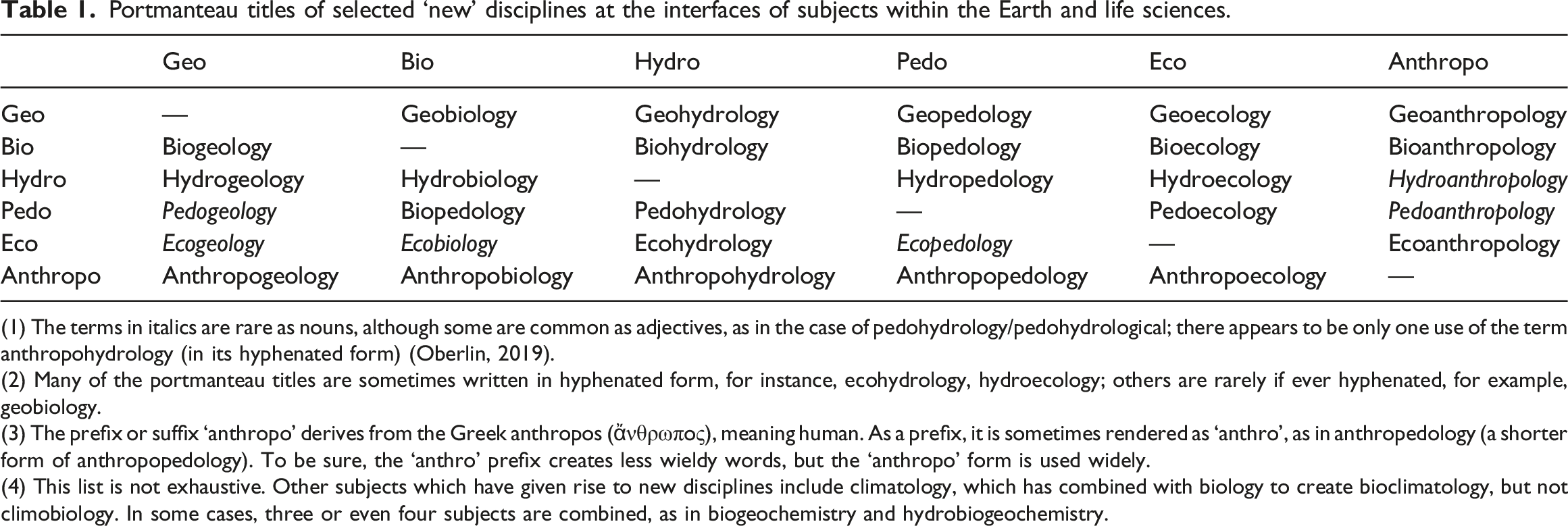
(1) The terms in italics are rare as nouns, although some are common as adjectives, as in the case of pedohydrology/pedohydrological; there appears to be only one use of the term anthropohydrology (in its hyphenated form) (Oberlin, 2019).
(2) Many of the portmanteau titles are sometimes written in hyphenated form, for instance, ecohydrology, hydroecology; others are rarely if ever hyphenated, for example, geobiology.
(3) The prefix or suffix ‘anthropo’ derives from the Greek anthropos (ἄνθρωπος), meaning human. As a prefix, it is sometimes rendered as ‘anthro’, as in anthropedology (a shorter form of anthropopedology). To be sure, the ‘anthro’ prefix creates less wieldy words, but the ‘anthropo’ form is used widely.
(4) This list is not exhaustive. Other subjects which have given rise to new disciplines include climatology, which has combined with biology to create bioclimatology, but not climobiology. In some cases, three or even four subjects are combined, as in biogeochemistry and hydrobiogeochemistry.
The proliferation of terms is not necessarily a bad thing, but it is important to be clear as to what the terms mean, and in particular, if dual portmanteau terms are interchangeable. A helpful starting point is Kundzewicz’s (2002) discussion of the key issues involved with the terms ecohydrology and hydroecology. In the term ecohydrology, the prefix ‘eco’ is a modifier of the basic word ‘hydrology’, which would suggest that the subject is more about hydrology than ecology, or perhaps focusses on impacts of ecology on hydrology. Does this logic extend to, say, geobiology, implying that biology is the parent discipline, the subject focussing on geology’s connections with biology, while biogeology considers the relevance of biological processes to geology? Similarly, in the term hydroecology, ‘hydro’ modifies the basic word ‘ecology’, suggesting that the subject investigates hydrological impacts on ecology. But, as Kundzewicz (2002) recognized, this logic does not necessarily hold in other compound names of scientific disciplines that are not ‘fully convertible’, so while the terms ‘biophysics’ and ‘biochemistry’ exist, ‘physicobiology’ and ‘chemobiology’ do not. Indeed, even new discipline titles that are fully convertible linguistically, such as geoecology and ecogeology, do not necessarily relate to the same subject matter. Part of the reason for this lies in the fact that some ‘new’ discipline titles are not so new. A few were coined before the mid-twentieth century, but most have been coined over the last 50 years.
To complicate matters even more, the prefix ‘eco’ is often used colloquially when referring to the environment – as in ecofreak, ecofriendly, ecotourist, eco-warrior – with only vague links to the scientific discipline of ecology. Another caveat is necessary here as some blended or portmanteau words serve other purposes. For instance, Clements coined the term bioecology – in its hyphenated form presumably to avoid the awkward doubling of vowels, but often used as a closed compound word today – to redress the emphasis at the time given to plant ecology and stress the equal importance of animal ecology, with bioecology combining the two (Clements et al., 1922; Clements and Shelford, 1939; see also Cooper, 1926; Allen, 1940).
This analysis will begin by discussing the paired portmanteau titles of the ‘new’ disciplines shown in Table 1 in an attempt to pin down their meaning, interchangeability, and underlying logic. The portmanteau titles will be grouped into three categories: those that mean more or less the same thing; those that do not mean the same thing, although they are not antonyms; and those that defy categorization.
Synonymous portmanteaux
Hydrogeology/geohydrology
The word hydrogeology was coined by Jean-Baptiste Lamarck (1802), although to be strictly correct, he used the term hydrogéologie. However, the word is misleading to modern readers because, although Lamarck's book does consider the action of terrestrial waters on the Earth’s surface, it tackles such topics as the origin of mountains, the significance of fossils, the formation of the Earth’s crust, the immensity of geological time, and other topics all of which were regularly discussed in ‘theories of the Earth’ around that time. As used today, hydrogeology is, according to The International Association of Hydrogeologists (iah.org, 2023), the study of groundwater. Robins (2020) described it as ‘an important and vibrant sub-set of geology’ dealing with the distribution and movement of groundwater in soil and rocks. The subject has its own journal: Hydrogeology Journal. Alternatively, hydrogeology is sometimes called geohydrology. Certainly, the term geohydrology also has a long history of use in describing the science of underground water (e.g. Fuller, 1906; Meinzer, 1939). Diefendorf (1995) claimed that geohydrologists tend to consider groundwater from an engineering perspective. Be that as it may, geohydrologists and hydrogeologists both consider subsurface water movement, the water-bearing properties of Earth materials, and the geological relationships between surface and subsurface water (Yuretich, 1999). The terms are in common use and regarded as synonyms by most researchers. McCurley and Jawitz (2017) offer a revealing discussion of several hybrid hydrology disciplines.
Hydrobiology/biohydrology
Hydrobiology is the science of life and life processes in bodies of water. It has journals devoted to it, including Hydrobiologia and The International Review of Hydrobiology. According to Lichner et al., (2008), biohydrology investigates the impact of biological factors on hydrological processes in the unsaturated zone of soil (vadose zone), especially the downward, upward, and lateral movements of water, as well as the distribution of infiltration and soil surface runoff. On the other hand, Baveye (2011) stated that biohydrology is usually defined as the interactions between water, plants, and animals, including the effects of water on biota as well as the physical and chemical changes in water or its environment produced by biota. Strange et al.’s (1999) study of biohydrology and ecosystem processes in the South Platte River Basin, USA, is an example of biohydrological research. As portmanteau titles, then, biohydrology and hydrobiology are interchangeable, although some researchers might not agree.
Hydroecology/ecohydrology
Wood et al. (2008) noted that towards the end of the twentieth and into the twenty-first century the terms ecohydrology and hydroecology were being used increasingly by the international scientific community, but that the terms lacked precise definition, with disagreement among their users. The terms imply that they deal with research at the interface between the hydrological and biological (ecological) sciences. And following the logic given above, the prefixes ‘hydro’ and ‘eco’ should modify the words ‘ecology’ and ‘hydrology’, respectively, and thus the disciplines should be more about ecology than hydrology (and vice versa) (cf. Hannah et al., 2004). However, in practice, this rubric has not been applied, as many ecologists refer to ecohydrology (e.g. Zalewski, 2000) and hydrologists refer to hydroecology (e.g. Dunbar and Acreman, 2001). Ecohydrology has much in common with biohydrology. Hallett et al. (2010) noted that biohydrologists tend to adopt a reductionist approach, whereas ecohydrologists lean towards a systems approach. However, both disciplines (and indeed hydrobiology) share a common interdisciplinary approach with the ultimate goal of understanding the interactions between living organisms and hydrology.
Geoanthropology/anthropogeology
As a word, geoanthropology began to appear in the 1960s, mainly in archaeological literature. Winkler (1970) defined it as a branch of physical anthropology. Barker and Barker (1988) offered a wider definition, describing it as an interdisciplinary approach to the study of the interactions between Earth processes and humans. Research couched within this wider definition has developed in the last decades. Founded in 1993, The Max Planck Institute for Geoanthropology in Jena, Germany, exemplifies this work, tackling human-induced destabilization of the Earth system and possible tipping points within it, as well as the interactions between the natural Earth systems and the technosphere. In a similar vein, Renn (2022) put the case for geoanthropology as a new transdisciplinary, transformative science equipped to understand the techno–Earth system from an integrative perspective, bringing together scientist from different disciplinary backgrounds to study the technosphere as part of the techno–Earth system by integrating different disciplinary perspectives.
The term anthropogeology was coined by Häusler (1959), adopted by Jäckli (1972), and introduced independently by Hohl (1974). All three geologists used the term to describe an applied geology that brought together strands of the geosciences, geography, as well as economic, engineering, juridical, and political sciences (Häusler, 2018). Kasig (1979) had a different take on anthropogeology, restricting it to the study of human dependency on geologic conditions, with a focus on building stone, aggregates, groundwater, and mineral resources.
Given that the terms geoanthropology and anthropogeology have different origins, it is difficult to claim that they are interchangeable. However, in their modern usage, at least where they refer to interactions of humans with the Earth system, they appear to share common ground.
Bioanthropology/anthropobiology
These two terms do appear to refer to the same science, but with subtle differences of emphasis. Anthropobiology means the biology of human beings. The differences occur in what is included within ‘biology’, some considering it variation in the phenotype and genotype (see Hiernaux, 1985), but in more recent years it includes sociology. Bioanthropology was spawned by biological (physical) anthropology and, like anthropobiology, deals with the biology and sociology of the human species.
Ecoanthropology/anthropoecology
Ecoanthropology is short for ecological anthropology, practitioners of which explore the interconnections between human society and culture and the natural environment. Kruglova (2021) argued that these elements – humans, society, culture, and nature – form a single ecosystem, the structure, function, and evolution of which should be the studied by a new ecological discipline, which she styled sociocultural anthropoecology; she divided this new discipline into social ecology (the interaction of society and the environment), social anthropoecology (the interaction of individual humans and society), and cultural anthropoecology (the interaction of individual humans and culture). Hrdina and Romportl (2023) mapped the components of this ‘single ecosystem’ by developing a ‘multivariate anthropoecological classification’ of what they called global environmental systems. The classification identified 169 classes of such systems, each class with its own range of abiotic (e.g. temperature, precipitation, and altitude), biotic (e.g. mammal species richness), and anthropogenic (e.g. human density, livestock density, accessibility, and landcover) factors. This complex classification provides a useful spatial framework for the comparison and analysis of human, ecological, and environmental processes in diverse and heterogeneous regions.
Ferdinand W. Haasis (1935) coined the word anthropoecology (in hyphenated form) in a book review, assessing the book as a successful attempt to relate the development of a people to the factors of the environment, both physical and human. Anthropoecology is just that: the study of human–ecological interactions (cf. Naveh, 2007, 36). Škopek and Váchal (1991) provide an example of its use in a study of landscapes in South Bohemia. However, as a term, anthropoecology is rarely used and its shorter form, anthroecology, the more established. Ellis (2015) used the term anthroecology to couple ‘ecology with society across evolutionary time through integrative scientific frameworks, including anthroecosystems, anthrosequences, anthrobiogeography, anthroecological guilds and anthroecological succession’. He saw anthroecology as a general causal theory of long-term anthropogenic ecological change that connects ecology and society. Ellis is director of the Anthroecology Lab, which investigates the ecology and sustainable management of landscapes towards sustainable stewardship of the biosphere.
Nonsynonymous portmanteaux
Geobiology/biogeology
Finding hard-and-fast rules for portmanteaux titles is not easy, but as explained above, in cases such as the new disciplines, it seems reasonable to argue with Kundzewicz (2002) that the second element of the portmanteau, which is not itself a contracted form, carries more weight than the first. Thus, in geobiology, biology is the root of the coined word, the implication being that geobiology is a brand of biology, rather than of geology, and tackles the geological aspects of biology. Likewise, biogeology is a brand of geology, rather than of biology, and deals with the biological aspects of geology. But in practice, the distinction is fuzzy and the terms are not fully convertible.
Dutch microbiologist Lourens Baas-Becking (1934) coined the term geobiology to describe the interactions between organisms and environment at the chemical level. The subject now has its own journal, Geobiology, first launched in 2003, the aims of which state: ‘The field of geobiology explores the relationship between life and the Earth’s physical and chemical environment . . . and aims to provide a natural home for geobiological research, allowing the cross-fertilization of critical ideas, and promoting cooperation and advancement in this emerging field’. However, Yin et al. (2008) noted a lack of consensus over the difference between geobiology and biogeology. They opined that, in general, when used as prefix, as in geoscience, ‘geo’ implies what they styled a first-order interdisciplinary study exploring the domain of geoscience and another domain, physics in the case of geophysics and chemistry in the case of geochemistry; but if ‘geology’ is used as a subject, as in biogeology, it means what they styled a second-order interdisciplinary study involving the first-order discipline, geology, and another discipline, biology in the example.
Not all researchers adopt this line of thinking. In talking about palaeontology, Goodwin (2006) observed a change in the subject from geobiological perspective to a biogeological one, with the focus of research shifting from using fossils to address essentially geological questions, which he called geobiology, to using the fossilized remains of plants, animals, and microbes to investigate ancient biological phenomena, which he called biogeology. That is the reverse of the argument above in which geobiology uses geology to address biological problems, and vice versa. Likewise, Knoll et al. (2012) define geobiology as ‘a scientific discipline in which the principles and tools of biology are applied to studies of the Earth’, whereas according to Yin et al. (2008), that would be biogeology. To further complicate matters, the Geobiology Working Group at the Senckenberg Naturmuseum, Frankfurt, takes biogeology to involve investigating biological questions in the framework of geological time, adopting a long timescale perspective to focus on biological processes and how organisms lived in the past. These examples show that coming up with single definitions of geobiology and biogeology acceptable to all researchers, and more importantly, discerning the logic to interpret and create such terms, is no easy task.
Geoecology/ecogeology
These two terms are not interchangeable, mainly because geoecology, at least as originally defined, is a contraction of geographical (or landscape) ecology and not geological ecology. The term ‘landscape ecology’ was devised by Carl Troll (1939) to marry geography (the landscape) with ecology; later, he coined the word ‘geoecology’ to describe the same field of study (Troll, 1939, 1971, 1972). To complicate matters, geoecology is also the study of the interactions between the biosphere and the other Earth spheres – geosphere, hydrosphere, pedosphere, cryosphere, atmosphere, anthroposphere – that create geoecosystems (Huggett, 1995). In contrast, some writers opt for a narrower definition in which geoecology is a study of the multifaceted relationships between substrate and biota (Rajakaruna and Boyd, 2014).
Unlike geoecology, ecogeology, which is a contraction of ecology and geology, is not a widely used term, although it appears in the guise of ecological geology in some Russian and Chinese papers, and is applied when the focus is on the interactions between ecosystems and the lithosphere (e.g. Trofimov, 2008, 2022; Vartanyan, 2006). However, several researchers use the term ecogeological investigations when investigating the status of particular environments. For instance, Huang et al. (2023), in a study of the quality of ecogeological environment quality of Hunjiang District, Baishan City, China, used a total of 15 geological, ecological, and social indicators.
Environmental geology adds a further complication. It deals with the interaction between humans and their geological environment, where the environment consists of the constituents of the Earth itself (rocks, sediments, and fluids), as well as its surface processes (Doyle, 2021). In this, it covers much the same ground as ecogeology.
Bioecology/ecobiology
As mentioned above, bioecology was coined by Frederick E. Clements to extend the plant-focused conception of ecology in the early twentieth century to include animals (Clements et al., 1922; Clements and Shelford, 1939; see also Cooper, 1926). According to Tandarić (2015), bioecology today represents a branch of ecology that studies the interactions between organisms and their biotic and abiotic environments, but does not embrace human ecology; in this, he follows Naveh’s (2007, 369) argument that classical ecology bestowed a legacy of a concern with living things that ignores the human species and that shied away from studying the complex relationships between organisms, society, and their shared environment. Today, bioecology is defined the ecology dealing with the interrelation of plants, animals, and their common environment (cf. https://www.merriam-webster.com/dictionary/bioecology); in other words, it is tantamount to ecology. The place of humans in bioecology is still debated in long-running arguments surrounding nature–culture relations. Interestingly, it is not commonly used in its adjectival form, apart from in the bioecological model of human development (e.g. Bronfenbrenner and Morris, 2006).
Ecobiology, a subject focussing on the ecological aspects of biology, is in relatively common use, especially as an adjective. Ecobiological studies tend to focus on the interactions between specific organisms and their environment, so they differ from bioecological studies, which usually have a broader perspective. Examples are López et al.’s (2015) investigation into the ecobiology of European seas bass (Dicentrarchus labrax), and Wijaya et al.’s (2021) research into the ecobiology of horseshoe crab in the Brebes estuary, on the Northern Coast of Java. Interestingly, the term ecobiological is also used in some skin care products that take account of the human skin ecosystem (e.g. https://naos.com/en/our-approach/ecobiology/).
Indeterminate portmanteaux
Geopedology/pedogeology
Geopedology was first used as a noun, but without a definition offered, in Winkler’s (1970) classification of the geosciences in the 1960s, and then in Pouquet’s (1968: 9) technical note on the remote sensing of Earth resources in semi-arid lands. However, it appeared in adjectival form – geopedological – a decade earlier (Cate, 1960; Hofmann, 1960), and has been subsequently used increasingly in both forms. Tandarich et al. (1988) defined geopedology as the integrated portion of the disciplines of geography, geology, and soil science. In a book called Geopedology, Zinck (2016: 1) saw it as the study of the relations between geomorphology and pedology, with emphasis on the contribution of the former to the latter. Pedogeology (pedo-geology) appears to be used only as an adjective, as in Silva et al.’s (2019) paper looking at micronutrient contents in soils and sugar cane in different pedogeological contexts in northeastern Brazil. Given the relatively infrequent use of pedogeology/pedogeological, it is difficult to distinguish the term from geopedology, other than to say that geopedology has far broader connotations, whereas pedogeological studies tend to focus more on the effects of rock mineral contents and their weathering on soils and plants.
Biopedology/pedobiology
Huggett (2023) used the word biopedology to encapsulate studies that consider interactions between soils and life, which include such topics as the role of soil microorganisms in nutrient cycling and the role of bioturbation in soil formation. However, the term biopedological was in use during the twentieth century. An example is Ugolini and Mann’s (1979) investigation of the biopedological origin of peatlands in southeast Alaska, focussing on the process of paludification (the accumulation of organic matter over time) and finding that pedogenic processes had a greater role than previously thought.
As a word, pedobiology is older than its sister term biopedology. The journal Pedobiologia was first published in 1961 as an outlet for research in the field of soil ecology, including the study of soil organisms and their interactions with factors in their biotic and abiotic environments. For instance, Lobry De Bruyn (1999) studied the importance of ants in ecosystem functioning, and in particular their ability to maintain or restore soil fertility, in rural environments, which she described as pedobiological.
Hydropedology/pedohydrology
The term hydropedology was first used by Russian hydrologist Viktor Grigor’yevich Glushkov in 1915 (see Glushkov, 1961) to cover studies that involve water and soil interactions (e.g. Rétháti, 1983, 18). As one of the latest and integrative new pedologies, it has come into its own over the last two decades as ‘an emerging intertwined branch of soil science and hydrology that studies interactive pedologic and hydrologic processes and properties in the Earth’s Critical Zone’ . . . (and that) . . . ‘aims to bridge disciplines, scales, and data, connect soils with the landscape, link fast and slow processes, and integrate mapping with monitoring and modelling to provide a holistic understanding of the interactions between the pedosphere and the hydrosphere’ (Ma et al., 2017). Unlike conventional soil science, hydropedology emphasizes in situ soils in the landscape, which have distinct pedogenic features and structure in varying environmental settings (Lin, 2012; Lin et al., 2015). Its counterpart, pedohydrology, is seldom used as a noun; it is more common as an adjective, for example, in a pedohydrological investigation of the effects of soil characteristics on irrigation water dynamics in two apple-growing areas in the South Tyrol, Italy (Grashey-Jansen, 2010).
Hydroanthropology/anthroprophydrology
Neither of these terms is used in the scientific literature. Indeed, there appears to be only one use of the term anthropohydrology (in its hyphenated form) (Oberlin, 2019); its nearest equivalent would be applied hydrology or, more recently, sociohydrology (see Wesselink et al., 2017). Some researchers do talk about the anthropology of water, exploring water in social and cultural life (Krause, 2019; Raju and Manasi, 2017).
Pedoecology/ecopedology
Neither of these terms is widely used, ecopedology rarely so. Where used, both terms are usually in adjectival form and refer to relationships between soil and environmental factors. For instance, Kõlli et al. (2010) investigated pedoecological regularities of organic carbon retention in Estonian mineral soils and identified water regime (determined largely by climate), land use, and land-use change as key environmental factors. Perrino et al. (2021) include the term ecopedology (and geopedology) in a study of the composition of essential oils from two wild plant species (Satureja cuneifolia and Thymus spinulosus) from Apulia, Italy.
Pedoanthropology/anthropopedology
Pedoanthropology has one mention in the literature, in a book review by Gordillo (2017). In contrast, anthropopedology (and anthropo-pedology) is established in the soil literature, usually in the shortened form – anthropedology. Richter (2020) called anthropedology a game changer, arguing that it marked the science of pedology (how soils form in nature) repositioning itself to accommodate the ever-increasing human role in soil formation and movement. Similarly, Richter and Yaalon (2011) used the term anthropedogenesis to describe human-induced soil formation, a term adopted by several other researchers, although anthropopedogenesis is also used (e.g. Acksel et al., 2019).
Beyond portmanteau titles
Disciplinarity, multidisciplinarity, interdisciplinarity, and transdisciplinarity.
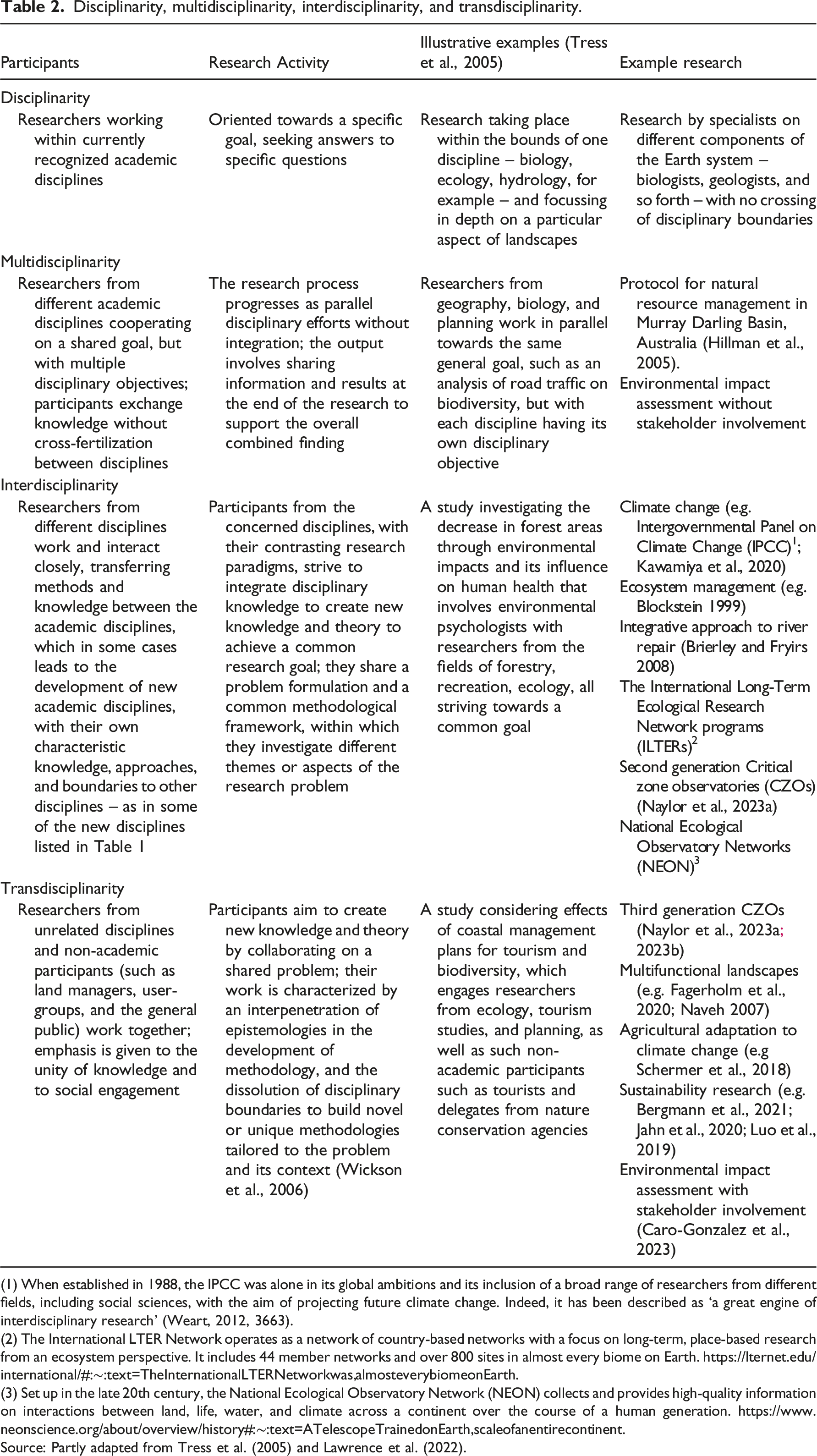
(1) When established in 1988, the IPCC was alone in its global ambitions and its inclusion of a broad range of researchers from different fields, including social sciences, with the aim of projecting future climate change. Indeed, it has been described as ‘a great engine of interdisciplinary research’ (Weart, 2012, 3663).
(2) The International LTER Network operates as a network of country-based networks with a focus on long-term, place-based research from an ecosystem perspective. It includes 44 member networks and over 800 sites in almost every biome on Earth. https://lternet.edu/international/#:∼:text=TheInternationalLTERNetworkwas,almosteverybiomeonEarth.
(3) Set up in the late 20th century, the National Ecological Observatory Network (NEON) collects and provides high-quality information on interactions between land, life, water, and climate across a continent over the course of a human generation. https://www.neonscience.org/about/overview/history#:∼:text=ATelescopeTrainedonEarth,scaleofanentirecontinent.
Source: Partly adapted from Tress et al. (2005) and Lawrence et al. (2022).
That is not to say that all portmanteau titles, and indeed many other neologisms, whether made for convenience or branding, are without their problems. To be sure, their meanings are not always self-evident and demand significant research to unearth them. Therefore, it could be argued that, in an era of Open Science (see Wilkinson et al., 2016), when the hope is that scientific research, data, and their dissemination are available to any interested party, from professionals to citizens, is actually becoming less ‘open’ by creating highly specialist practitioners with a knowledge of their limited disciplines and familiar with jargon that means little or nothing to outsiders. Moreover, these neologisms can make the scientific lexicon muddier, making science less, not more, communicable. It is also the case that portmanteau titles have not become traditional university disciplines, such as geology, biology, physics, anthropology have. This is borne out in ‘maps of science’ created by citation analysis (see Klavans and Boyack, 2009; Small, 1999) and in journal indexing products, such as Scopus and Web of Science, which are also made with citation analysis (see Wang and Waltman, 2016). In these formal indices, the disciplines are broken down to irreducible parts, then multiple parts/tags are assigned to a given paper. So, in Scopus, a paper on the subject of hydrogeology might have multiple tags of ‘hydrology’ and ‘geology’, rather than a single tag of ‘hydrogeology’ or ‘geohydrology’. Despite these potential drawbacks, most dual portmanteau titles, even those that are nonsynonymous, are convenient descriptors of particular areas of research. Indeed, some of them, ecohydrology and hydrogeology for example, have their own journals and are the subject of books, such as Porporato and Yin’s (2022) Ecohydrology: Dynamics of Life and Water in the Critical Zone.
An interesting question is the status of disciplinary neologisms at a time when researchers from a range of disciplines often work together in an effort to resolve ‘the grand challenges and wicked problems of the Anthropocene’ that demand the skilful blending of ‘a broad range of knowledge and understandings – both scientific and non-scientific – of Earth systems and human societies’ (Lawrence et al., 2022). With some exceptions, scientists have resisted the temptation to invent triple, quadruple, or even quintuple neologisms to describe their multidisciplinary, interdisciplinary, or transdisciplinary fields of research. Instead, these fields have acquired such names as multifunctional landscape research, Critical Zone research, and Earth system research. As shown in Table 2, they have evolved from traditional disciplinary beginnings, through collaboration in multidisciplinary research, through integration in interdisciplinary research, to integration and new theory creation with social engagement in transdisciplinary research.
The notion of multifunctional landscapes evolved from landscape ecology and other sciences dealing with landscapes. It was first proposed at the International Conference of Multifunctional Landscapes in Roskilde, Denmark, in October 2000 (Brandt et al., 2000), and recognizes that many landscapes bear a diverse land use, a complex structure, and are of interest to varied groups people (Naveh, 2001). For this reason, Naveh (2007, 368) argued that landscape ecology and restoration ecology should merge to form a mission-driven transdisciplinary landscape science. Luo et al. (2019) make a case of merging Critical Zone science and multifunctional landscape science to meet the challenge of sustainable development and human well-being in the twenty-first century.
Coined at the close of the twentieth century by Gail Ashley (1998), the Critical Zone is the ‘dynamic interface between the solid Earth and its fluid envelopes, governed by complex linkages and feedbacks among a vast range of physical, chemical, and biological processes (National Research Council, 2001, 37); it is so-named because it is critical to life. Although Critical Zone research deals with a nexus in many of the Earth’s spheres, including the anthroposphere, it does not bear a portmanteau title, although it is often rendered as an initialism – CZ. It has sparked the imagination of scientists worldwide and is throwing up many new interdisciplinary and transdisciplinary ideas (e.g. Dawson et al., 2020; Naylor et al., 2023a; Waldron, 2020). On the other hand, it is not without its problems. For instance, it has become unclear to what it refers, whether it is the entire terrestrial surface of the planet or just part of it, and is meanings have proliferated. Lee et al. (2023) recognized three tiers of meanings: (1) the Earth’s spatial interface of the geochemical and biological; (2) scientific knowledge of the geophysical functionality of the CZ, as represented in an ever-growing library of data or by a single feature as proxy, such as the soil; (3) a planetary home vulnerable to human disruption. Tiers 1 and 2 are interdisciplinary while Tier 3 is transdisciplinary and, in conjunction with the first two, makes CZ ‘a uniquely valuable concept for navigating the socio-ecological challenges of the Anthropocene’ (Lee et al., 2023). Tier 3 is exemplified by incorporating human behaviour in Critical Zone research, as advocated by Latour (2014, 2021), to model and attain sustainable Earth futures by aligning research with the ‘practical needs of communities in stressed environments and their governments’ (Naylor et al., 2023a; see also Naylor et al., 2023b).
The roots of Earth System Science were established in the late eighteenth and early nineteenth centuries by Johann Reinhold Forster, James Hutton, Jean-Baptiste Lamarck, Alexander von Humboldt, and others. Vladimir Ivanovic Vernadsky’s (1926, 1929) notion of the biosphere was a forerunner of the subject. But Earth System Science did not begin to take firm shape until the mid-twentieth century when international science emerged, initially with the International Geophysical Year, 1957–1958, in a research programme that involved 67 countries with the aim of obtaining an integrated understanding of the geosphere, and especially particularly glaciology, oceanography, and meteorology (see Steffen et al., 2020). The subject was given its name by the NASA Earth System Science Committee in 1983 (Conway, 2008). Since then, it has bloomed rapidly into a transdisciplinary endeavour aimed at understanding the structure and functioning of the Earth as an inherently complex, adaptive, and evolving system (cf. Steffen et al., 2020). To Earth system scientists, the Earth system involves a huge number of interacting, interconnected, integrated components made of materials in solid, liquid, colloidal, and gaseous states, as well as various forms of energy, including potential, kinetic, thermal, electrical, chemical, and nuclear, all suspended in an ever-changing cosmic environment. This Earth system comprises several planetary subsystems, or spheres (the chief of which are the atmosphere, biosphere, cryosphere, ecosphere, geosphere, hydrosphere, pedosphere, anthroposphere, sociosphere, and technosphere), separated by the thermodynamically meaningful and visually clear boundaries between the solid Earth, the oceans, and the air, and between the ill-defined but all-important boundary separating organic, living entities from their inorganic, non-living surroundings. There is debate surrounding the definition of some of these spheres. The term geosphere has acquired at least six meanings: the lithosphere (in the narrow sense of the hard, rocky crust); the lithosphere, hydrosphere, and atmosphere combined; the lithosphere, hydrosphere, atmosphere, plus the solid Earth below the lithosphere; any of the terrestrial spheres or shells; all the Earth’s spheres, including the biosphere and anthroposphere; the solid Earth. Likewise, biosphere and ecosphere have more than one meaning (Huggett, 1999): biosphere can mean the totality of living things residing on the Earth (its literal and, we would argue, most logical definition), or the space occupied by living things, or life and life-support systems (atmosphere, hydrosphere, lithosphere, and pedosphere); ecosphere is often used as a synonym of biosphere in the sense of life and life-support systems taken together, in other words, the global ecosystem. It should be noted that the notion of Earth System Science is not without its critics, chiefly because of a perception by some that it does not take account of social and political factors (see Wesselink et al., 2017).
Regardless of such definitional problems, the idea of the planet as an interdependent set of spheres does lay a firm foundation for studying interactions of energy and materials within the whole Earth system and its components across a full range of spatial and temporal scales (see Steffen et al., 2020). Such a model has several advantages: it is additive, so that, for example, adding ‘bio’ to ‘geo’, as in biogeochemistry, does not cause ambiguity, and nor does adding other or new ‘-sphere’ words such as ‘toposphere’ and ‘anthroposphere’; it can combine the biotic, abiotic, and human realms, as in anthrogeomorphology/anthropogeomorphology and sociogeomorphology; it is easily understood by scientists and non-scientists alike; and it has ancient roots and persistence through time to the present day (e.g. Carroll, 1927; Richter et al., 2015; Shoshitaishvili, 2020).
Concluding thoughts
The proliferation of ‘new’ disciplines, identified by portmanteaux titles, reflects a willingness of many researchers to seek out and connect traditional disciplines, and to include the human sphere within their domains, both of which developments should be applauded. However, the meanings of several portmanteau titles and many other neologisms, whether made for convenience or branding, are not self-evident and demand substantial research to unearth their meanings. This tends to render science less ‘open’ at a time when Open Science is the watchword. Nor have the portmanteau titles established themselves as university disciplines; rather they sit within the traditional subject divisions, a fact reinforced by ‘maps of science’ created by citation analysis and in journal indexing products. But on balance, the utility of many portmanteau titles outweighs the inappropriateness of a few. The advent of non-portmanteau neologisms has helped to encourage the emergence of fully transdisciplinary studies that avoid the use of blended words, instead employing such terms as Earth System Science, Critical Zone research and multifunctional landscape research. Perhaps the most promising line of research for inter- and transdisciplinary research is the idea of the planet as an interdependent set of spheres. Such a model has the advantage of being additive, of combining the biotic, abiotic, and human realms. Even so, it seems unlikely that existing portmanteau titles will be disregarded: Earth and life scientists will still need to probe questions within their individual and joint disciplines in order to improve Earth system models.
Footnotes
Acknowledgements
The authors would like to thank the reviewers of the paper for their helpful and insightful comments which have helped us to strengthen our argument.
Declaration of conflicting interests
The authors declared no potential conflicts of interest with respect to the research, authorship, and/or publication of this article.
Funding
The author(s) received no financial support for the research, authorship, and/or publication of this article.
