



Abstract
Across geography there has been variable engagement with the use of simulation and agent-based modelling. We argue that agent-based simulation provides a complementary method to investigate geographical issues which need not be used in ways that are epistemologically different in kind from some other approaches in contemporary geography. We propose mixed qualitative-simulation methods that iterate back-and-forth between ‘thick’ (qualitative) and ‘thin’ (simulation) approaches and between the theory and data they produce. These mixed methods accept simulation modelling as process and practice; a way of using computers with concepts and data to ensure social theory remains embedded in day-to-day geographical thinking.
It is important to change perspectives so that different methods are seen to be complementary, emphasising the additive rather than divisive attributes of quantitative methods, qualitative methods and visualisation (mainly GIS and cartography). For example, modelling and simulation would benefit by incorporating behavioural rules, values, norms and perceptions in models. Agent-based modelling provides a point of departure. (ESRC, 2013: 16)
I Introduction
Identifying appropriate methods and tools has long been a central challenge for understanding and representing geography. Whereas in some sub-disciplines and countries technical and quantitative methods have been embraced (such as in the USA), in others qualitative and quantitative approaches have become divorced (such as in the UK). For example, a recent benchmarking report applauded human geography in the UK for being conceptually innovative and diverse, but at the same time noted low rates of use and training in quantitative and technical methods and tools (ESRC, 2013). That same report went on to argue that to counter a growing methodological divide between human and physical geography, the additive attributes of multiple methods (qualitative, quantitative, visualization) should be emphasized so that they are seen as complementary, including the use of modelling and simulation (see quote above). The potential value of these newer approaches may not be immediately apparent for those whose initial encounters have been couched in terms of technical possibilities or which seem to lack a complementary perspective or epistemology of their own. Consequently, here we examine how one approach in geography that uses currently available computer-simulation methods can play a number of epistemic roles similar to many epistemic frameworks in common use elsewhere in the discipline. This approach is a form of computer simulation known as agent-based modelling, the tools of which are known as agent-based models (ABM).
It is important to highlight that our concern here is not specifically with ‘models’ but about representation, understanding and practice in geography. If contemporary forms of modelling and simulation are to be useful (and used) for understanding and representing geography, it is important that we recognize how they can be used in ways that are complementary to existing interpretative, heuristic and dialogic approaches. Looking to the future in the late 1980s, Macmillan (1989: 310) suggested that if a conference on models in geography were to be held in 2007: ‘there can be little doubt that the subjects under discussion will be computer models, although the adjective will be regarded as superfluous’. Here, in the future, part of our argument is that far from being superfluous, it is important that we distinguish between our theories and conceptual models on the one hand and the tools used to implement, investigate and explore them on the other. For example, in computer-simulation modelling, a conceptualization of some target phenomenon (i.e. a conceptual model) is specified in code (i.e. as a formal model) that can be iteratively executed by a computer (i.e. simulated) to produce output that can be examined to understand the logical consequences of the conceptualization. Although conceptual model (generated in our minds) and formal model (computer code) might be conflated as ‘computer model’, their distinction is key for identifying roles computer-simulation modelling can play in understanding (at least some) geographical questions. Distinguishing conceptual and formal models in this way highlights the important distinction between simulations in the computer and what modellers learn through the process and practice of modelling. Understanding comes from elucidating the fundamental qualitative features of the target phenomena, identifying which computer outputs are artefacts of the simulation and which are a trustworthy representation, thereby enabling creation, development and evaluation of theory, identification of new data needs and improvements in understanding as the practice of modelling proceeds.
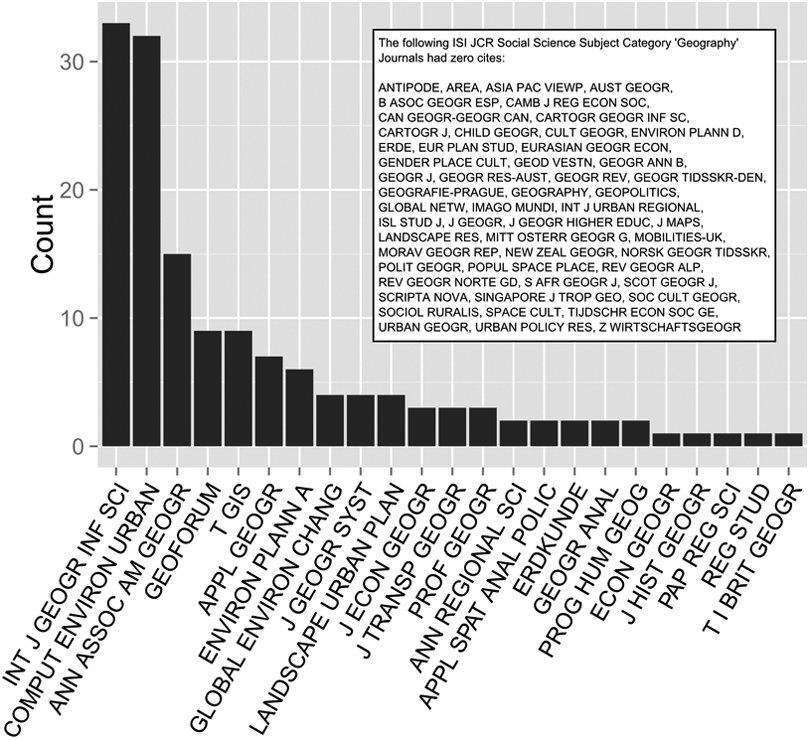
We argue here that agent-based simulation provides a complementary method to investigate geographical issues but which need not be used and understood in ways that are epistemologically different in kind from some other approaches in contemporary geography. However, a review of the literature shows that in geography (as defined by ISI Web of Knowledge Journal Citation Reports) papers discussing agent-based simulation approaches are concentrated in a few technically-orientated and North American journals (Figure 1), with more than 50 per cent of papers in only three journals (International Journal of Geographical Information Science, Computers Environment and Urban Systems, and Annals of the Association of American Geographers). To consider how and why simulation might become more widely used across (human 1 ) geography, we discuss its heuristic and dialogic attributes and suggest greatest additive benefits will come from mixed methods that combine both qualitative and simulation approaches.
II Representations of geography
Agent-based simulation is one computer-simulation framework some geographers have used to explore the intermediate complexity of the world (Bithell et al., 2008). The agent-based framework can flexibly represent (our conceptual models of) multiple, discrete, multi-faceted, heterogeneous actors (human or otherwise) and their relationships and interactions between one another and their environment, through time and space. At their most basic, an agent in this simulation framework is an individuated object with unique defined attributes (e.g. location, age, wealth, political leaning, aspirations for children) capable of executing context-dependent functions that may change the attributes of themselves and others (e.g. move house or not depending on whether you like your current neighbourhood, chop down a tree or not depending on whether you need fuelwood, get married or stay single depending on your preference or social circumstances). Thus, the properties of these simulation frameworks permit us to represent the world as being constituted by autonomous individuated objects with causal powers that may (or may not) be activated depending on the particular circumstances of the object. In this way, these objects, known as ‘agents’, can be thought of providing a means to represent our abstracted understandings of human agency. The combination of an agent-based conceptual model and the computer code used to specify that conceptual model for simulation is frequently known as an agent-based model (ABM).
There is not space here, and neither is it our desire, to provide a thorough review of the literature on ABM (several reviews of which already exist and to which we refer below). However, it is useful to consider how the potential representational flexibility of ABMs is often highlighted by invoking a typology that characterizes them across a spectrum from highly simplified, data-independent and place-neutral to intricate, data-dependent and place-specific (e.g. O’Sullivan, 2008; Gilbert, 2008). Models at the simple end of the spectrum are usually not intended to represent any specific empirical target but instead are used to demonstrate or explore some essential or ideal properties of it (Gilbert, 2008). The roots of this approach using agent-based simulation are in the exploration of complexity theory, emergence and complex adaptive systems (Holland, 1995; Miller and Page, 2009). A prime example that many geographers may be familiar with is Thomas Schelling’s model of segregation (Schelling, 1969). Although originally a conceptual model implemented on a draughts board using black and white draughts, the conceptual model can be readily implemented in computer code as a formal model for fast iteration with many variations in rules and assumptions (e.g. Grauwin et al., 2012; Portugali et al., 1997).
Schelling wanted to examine how and why racial segregation in US cities might occur as the result of individuals’ preferences for living in neighbourhoods with a given proportion of people of the same racial identity. With a highly simplified model he began to understand how races might become extremely segregated if agents’ tolerances are biased only slightly towards their own racial identity and even if the population as a whole prefers some level of racial diversity in their local neighbourhood. Disregarding many potential influences on where people might want or are able to live (e.g. wealth, class, aspiration, mobility), Schelling’s model simply assumed individuals have a sole goal to live in a location with a specified proportion of neighbours of the same race and that individuals keep moving until their desired neighbourhood is realized. In other words, it is an emergent property of the Schelling model that there need not be significant bias in agents’ preferences to produce a highly segregated pattern of settlement. This interpretation does not close off other possible interpretations, but does provide the basis for further investigation of the question that would not have occurred without the development of the model.
In contrast, intricate models aim to be more realistic-looking (e.g. simulating specific places) or are developed with instrumental or predictive motivations, but even these intricate models are far from reaching the rich detail of the world. Many examples in geography at this more detailed end of the spectrum include those that represent the interactions of humans with their physical environment (e.g. Deadman et al., 2004; Evans and Kelley, 2008). The aim at this end of the representational spectrum is not necessarily to build on concepts of complexity theory as above, but to use the flexible representation that ABM affords to represent human-environment interactions. In one prominent example, An et al. (2005) explored how interactions of household dynamics and energy demands influence panda habitat in the Woolong Nature Reserve, China, using an ABM that combined remotely sensed satellite data, stated preference survey data about willingness to pay for new energy sources (i.e. switching to electricity from fuelwood), and demographic data about household composition and change. Satellite imagery was used to define the physical environment spatially, stated preference data were used to define household decisions about energy-source choices, and demographic data were used to represent changes in household composition through time. Thus, the ABM represented actors at two organizational levels (individual people and the households they combine to compose), situating these representations, their simulated decisions (e.g. where to search for fuelwood), and (changing) compositions within a spatially explicit representation of a heterogeneous forest landscape (complete with forest-growth model). This representation allowed the authors to identify counter-intuitive effects of individuals’ decisions about location of fuelwood collection on panda habitat and enabled understanding of the roles of socioeconomic and demographic factors important for conservation policies.
Examples such as this have led to optimistic views about the possibilities of agent-based simulation for understanding and representing geography. Several reviews and commentaries have examined how ABM may be useful as a framework for integrating geographical understanding, touching on several of the points we make here (e.g. Bithell et al., 2008; Clifford, 2008; O’Sullivan, 2004, 2008; Wainwright, 2008; Wainwright and Millington, 2010). Although the view has been optimistic, adoption has been focused in a few particular areas of geographical study (Figure 1). Despite interest in some quarters (e.g. studies of land-use change), many geographers have been cautious about exploring the use of agent-based simulation for examining more interpretive social, political and cultural questions. These questions include, for example, how people understand their (social) world, how those understandings are constrained by their spatial, social and/or environmental contexts, and how partial understandings may influence social dynamics. The reasons for this reticence are likely numerous; as Waldherr and Wijermans (2013) have found, criticisms of ABM range from models being too simple to being too complex and from suffering insufficient theory to suffering insufficient empirical data (also see Miller and Page, 2009, for possible criticisms of computational approaches). In geography it may also be, on the one hand, because the distinction between simulation and (statistical, empirical) quantitative approaches has not been clearly articulated, but nor, on the other hand, has there been a sufficient counter to criticisms of simulation’s simplified representation relative to (interpretive, ethnographic) qualitative approaches. Before moving on to discuss the epistemological complementarities of simulation to qualitative approaches, we address these points.
Incomplete representations
The disaggregated representation of ABM described above can be distinct from the aggregating and generalizing tendencies of many statistical or analytical models (Epstein, 1999; Miller and Page, 2009; but contrast this with developments in microsimulation, e.g. Ballas et al., 2007). Statistical models, fitted to data that enumerate measured variables, allow general inferences about populations based on samples. However, these inferences are dependent on what data are, or can be, collected and subsequently the determination of what the measured variables represent. Thus in quantitative approaches, data often determine what models can be investigated and come to dominate the ideas or conceptualizations of how the world is structured (Sayer, 1982). In contrast, because agent-based-simulation frameworks use software objects with multiple attributes and methods they provide an opportunity to shift the focus from quantitative generalization to abstracted concepts. This is not to argue that quantitative data and generalization are not used in ABM (many ABM are strongly data-driven and do use statistical methods to set their initial conditions and parameterize relationships), nor that there are no barriers to representing some conceptual models in the computer. Rather, we wish to emphasize how alternative representations can be produced that start from concepts and not from measurements. Such representations help to negotiate criticisms aimed at proponents of approaches that were advocated during Geography’s Quantitative Revolution (e.g. Harvey, 1972) and share more in common with ideas that emerged from complexity theory (Holland, 1995). For example, agent-based simulation enables a move beyond considering only quantitative differences between actors with identical goals (e.g. perfect economic rationality) to representing qualitative behavioural differences between actors, not only in terms of goals (e.g. social justice or environmental sustainability) but also in terms of the need to balance multiple goals. Actors with qualitatively ‘imperfect’ behaviour that accounts for individual fallibility (e.g. destructive or error-prone), variation in perspectives (e.g. ‘satisficing’ rather than optimizing; Simon, 1957) and numerous other socially mediated behaviours (e.g. cooperative, altruistic, imitative) can be represented (e.g. see Macy and Willer, 2002). Agents need not necessarily correspond to individual humans and within the same simulation the behaviours and interactions between collectives such as families, households, firms or other institutions can be represented (e.g. as used by An et al., 2005).
To continue to build on Sayer (1992), ABMs are abstract in the sense that they are ‘distinct from generalizations’; they can be representations of autonomous individuated objects with causal power. Now, it is clear that simulation modellers’ abstractions in this sense (whether ABM or otherwise) are ‘thinner’ than many other qualitative approaches (e.g. ethnographic) in geography that often aim to produce ‘thicker’, richer descriptions of empirical events and relationships. Simulation models are simplified and incomplete representations of the world, and are thin in the sense that the characteristics and attributes of their abstracted objects do not account for all possible corresponding characteristics and attributes in the real world, nor all possible interactions, reactions and changes. 2 ABM lack much of the detail that makes understanding their targets so difficult in the real (social) world through more traditional qualitative, interpretive approaches. But the difference in detail and completeness between ABM and representations that an intensive qualitative study might produce is in degree rather than in kind; epistemologically modellers’ abstractions can still be useful because simulated representation of interactions between abstracted objects can produce their own contextual circumstances. For example, in Schelling’s model the movement of agents changes the racial composition of other agents’ neighbourhoods (possibly causing them to move), and in the Chinese human-environment model agents modify the environment spatially with subsequent effects on other agents (e.g. they have to walk further to harvest firewood). From a realist perspective (Sayer, 1992), such abstractions are vital for scientific understanding and useful for improving understanding about objects and their relations (i.e. structures) which, when activated as mechanisms in particular circumstances, produce observable events. Thus in this realist sense, abstractions implemented in an agent-based simulation can be useful to explore the implications of (social) structures for when and where events will occur, which events are necessary consequences of the structures of objects or their relationships, and which events are contingent on circumstances (as discussed in an example below). As long as the model can be defended as a representation of the real world of social interaction, this approach allows ‘thicker’ understandings about the emergence or production of behaviours and patterns from simulated individuated objects and their relationships that are not different in kind from the way ethnographic thick descriptions of many individual behaviours promotes understanding of culture through written representation of a conceptual model.
Some uses of ABM do make it difficult to see how these thicker understandings might emerge. For example, recently Epstein (2013) has produced a series of models based on the Rescorla-Wagner model of conditioning (associative learning). His simple ‘Agent_Zero’ can apparently produce a set of behaviours interpreted as corresponding to retaliatory behaviours in conflict, capital flight in economic crises or even the role of social media in the Arab Spring of 2011. Although Epstein presents these examples as ‘parables’ or ‘fables’ rather than as strict explanations, the argument that all these examples can be explained through basic Pavlovian conditioning does seem to close off further, thicker explanation. We would argue that, although thin, Schelling’s model offers better opportunities for thicker understanding to later emerge; while it will never be an accurate representation of real world urban segregation, it does show what sorts of local interactions and behaviours are needed to explain the more general pattern, and from which more contextual understanding can come. By making clear abstractions to represent specific social structures Schelling’s model enables us to begin to learn more about the necessities and contingencies of a particular phenomenon in question which in turn can lead to thicker explanation. The abstractions in Epstein’s Agent_Zero are more ambiguous; the model’s representation of individual but universal psychology seems to make thicker understanding difficult because it poorly differentiates what is socially important. 3
To those negotiating the difficulties of understanding empirical social and cultural phenomena this line may be too thin to tread, and all ABM may seem too abstract (in the sense of ‘removed from reality’) and uncoupled from substantive experience of the world to be relevant. Those preferring ‘concrete’, empirical approaches that deliberately explore the importance and meaning of contextual details may see little value in simulation approaches that require clear abstractions. We do not mean to criticize such a preference, but to argue that, preferences aside, any aversion to simulation should not be because the representation it provides is fundamentally different from representations based on empirical observations of activities (it is not). For example, some have argued that the incompleteness of the representations that simulation models offer will never allow us to distinguish contingent consequences (whether events in time or spatial patterns) from necessary ones: As for computer simulations, they are impoverished models of reality, several orders of magnitude less complex than reality itself (Clifford, 2008; Parker, 2008). Since contingency is about changes in tiny little details, and since simulations leave most of the world outside their compass, one cannot tell apart a contingent eventuation from a necessary one from simulating history alone. More technically, and following Pollock’s logic of defeasible reasoning (Pollock, 2008), any verdict of any computer simulation can always be undermined with the undercutting defeater that what it left outside would have been crucial in the respective chains of causation, and hence, in its final output. (Simandan, 2010: 394)
This passage highlights, we think, misconceptions about what simulation modelling is for and what it can ultimately achieve. Modellers are usually well-aware that their creations are incomplete representations of the world. For example, the issue of ‘model closure’ – the need to place boundaries on real-world ‘open’ systems so that they can be conceptually ‘closed’ for analysis – has been well discussed in geography (e.g. Brown, 2004, Lane, 2001). Simandan’s (2010) argument (via Pollock) is ultimately (epistemologically) correct and simulations can always be undercut by criticisms of being incomplete representations. However, as the passage above implies, taking the logic of defeasible reasoning to its (logical) extreme, so can any other way of representing observed events. The ultimate basis of this argument can also be linked to Gödel’s theorem, which states that formal (mathematical/logical) systems are inherently undecidable within their own terms (Gödel, 1962 [1931]). In other words, it is not possible to use a system of logic to demonstrate that all logical components of that system are true or false (even if some of them may be). Tarski extended this idea into a general theory of truth (Hodges, 2013). Thus, other interpretative and qualitative approaches to representing geography may provide thick, rich descriptions of the world, but even the most detailed may have left out something important for understanding events (or for creating meaning).
The recognition of (all) models as being incomplete leads to the identification of models as being more or less useful (Box, 1979) or reliable (Winsberg, 2010) for understanding the world. Whether a model is useful or reliable depends on how it is constructed and used. Although quantitative generalization is not necessary, (agent-based) simulation does demand some kind of logical symbolization to convert information or natural language models (including conceptual models) into a formal model encoded in a computer programming language (which is subsequently executed to provide an inference; Edmonds, 2001). The choices made about how this is done, about what concepts, entities or relationships are represented, how they are coded, analysed and interpreted – and together which constitute the practice of modelling – must of course be argued and justified. Use of agent-based simulation to date has generally emphasized the representation of individual actors and their interaction (a legacy of roots in complexity theory), but examples of representing collectives do exist (as discussed below) and an emphasis on agent-interaction is not needed (although the importance of interactions is sometimes taken as an indicator that an agent-based approach is valuable; O’Sullivan et al., 2012).
There are numerous examples of modellers trying to make transparent the potential black box of their simulated computer representations and how they were produced (e.g. Grimm et al., 2006, 2010; Müller et al., 2014; Schmolke et al., 2010), despite the tendency for publication practice to hide these steps in the final article. 4 Furthermore, transparency to enable evaluation of conceptual models and their implied consequences is important beyond computer simulation; qualitative research frameworks (such as grounded theory) require that theory, data, and the research process linking one to the other be clearly reported to allow appropriate evaluation of findings (Bailey et al., 1999). Despite differences in detail and approach – differences in the thickness of representation – we see no fundamental reason to more or less trust geographical representations based on interpretive understandings written in ordinary language than conceptual models written in computer code and executed to explore their potential implications (as in simulation). All models are incomplete, and although simulation models themselves may be thinner (fewer details, less context) than other approaches, there are deeper epistemological benefits for geographers, as we now discuss.
III Understanding geography through agent-based modelling
As highlighted above, original uses of agent-based simulation were rooted in complexity theory and concepts such as emergence, thresholds and feedbacks (Holland, 1995; Miller and Page; 2009; Portugali, 2006). After Schelling’s early (pre-complexity) model of racial segregation – showing how thresholds in preferences of individual agents can produce ‘emergent’ patterns at a higher level – later work more rigorously examined complex systems dynamics using ABM. Epstein and Axtell’s ‘sugarscape’, presented in a book entitled Growing Artificial Societies (Epstein and Axtell, 1996), provides possibly the archetypal example of the computational exploration of how simple rules of interaction between individuated agents can produce emergent patterns and behaviour at higher levels of organization. Epstein has coined the term ‘generative’ to describe the use of simulation models that represent interactions between individual objects (agents) to generate emergent patterns, thereby explaining those patterns from the bottom up (Epstein, 1999). Taking this further, a proposed Generative Social Science (Epstein, 2006) uses generative simulation to attempt to understand the mechanisms that produce emergent social patterns. The bottom-up approach, espousing use of ABM to explore concepts in complexity and essential system properties, is a perspective that may not chime well with many human geographers whose interest is in the importance of social structures and phenomena for understanding the world (O’Sullivan, 2004). But while the roots of ABM are in complexity theory and the desire to explain from the bottom-up, and although there are still epistemological benefits for using ABM in this generative mode, future use of ABM for understanding in human geography need not be framed that way.
The various epistemological roles of ABMs and the practice of their development and use (i.e. agent-based modelling) have been discussed elsewhere by authors in numerous disciplines. Many reasons have been suggested for carrying out simulation modelling (e.g. Epstein, 2008; Van der Leeuw, 2004). The epistemological roles of agent-based models and modelling we wish to emphasize here can be broadly defined as heuristic and dialogic and echo previous suggestions (O’Sullivan, 2004). Agent-based modelling is heuristic in that it provides a means to better understand the world via abstraction, not make predictions about it via (statistical) generalization. Agent-based modelling can be dialogic in that it can be used to open up debate about how the world should or could be, not simply describing and understanding its current state. Ultimately, the value of these ways of using ABM may only be properly realized by mixing the advantages of simulation with other approaches in geography in new mixed methods, but before addressing that point we outline our view of the heuristic and dialogic roles in geography.
1 Heuristic roles
The first heuristic use of ABM as a tool to think with builds on the generative approach outlined above to assist the identification of (social) structures and interactions that generate observed patterns and changes. In the ‘generative mode’ of using ABM, multiple alternative premises (theories, hypotheses) can be represented by multiple different model implementations which are then examined to investigate what structures, powers or relationships are necessary to produce observed empirical patterns or events. However, rather than being content with the idea that all we need do to explain social phenomena is represent the interactions of individuals, ABM could be used in geography to move beyond the individualist perspective and evaluate the importance of structure versus agency in social phenomena. The recursive nature of social phenomena (Giddens, 1984), in which individuals’ agency and social structures reciprocally reproduce one another, is a topic that agent-based simulation models are particularly well suited for investigating. Over a decade ago O’Sullivan and Haklay (2000) highlighted that an individualist bias already existed in the use of ABMs, in part stemming from ideas of complexity and the goal of generating emergent patterns from the bottom-up, using simple rules of agent interactions. Despite early calls to avoid an infatuation for emergence (e.g. Halpin, 1999) and the more metaphorical elements of complexity theory (Thrift, 1999), since the turn of the 21st century the bottom-up approach has prevailed in agent-based simulation. Although the one-way, bottom-up approach provides a useful means to understand how patterns are generated, it need not be the only means to understand complex processes. Two-way approaches that examine the recursive interactions of individuated objects and the structures and patterns they produce should be equally fruitful. Research beyond geography has already pursued this recursive approach to use ABMs for investigating behavioural norms (e.g. Hollander and Wu, 2011) and deviations from them (e.g. Agar, 2003). Much of this research is being conducted by researchers in computer science and artificial intelligence, detached from social theory and understandings of how individuals reproduce, for example, institutions or cultural groupings. There is scope here for geographers to contribute, not only by way of their perspectives on the functioning of society but also by way of the importance of space on the duality of structure (and agency).
More recently, DeLanda (2002, 2006, 2011) has developed a realist perspective on simulation based on the philosophy of Gilles Deleuze that may help to move beyond the bottom-up bias and provide a means of using ABM in ‘thicker’ ways. DeLanda argues that a Deleuzian assemblage approach can be used to interpret the ways its elements interact differently in different contexts. Context-dependent behaviour of agents in an ABM allows a representation of how elements of an assemblage might behave differently in different settings, thereby overcoming issues of linear causality and micro- or macro-reductionism that are inherent in essentialist interpretations of realism (DeLanda, 2006). For example, consider the well-known ABM study of Long House Valley in Arizona (Axtell et al., 2002) which used multiple simulations of households, environment and food supplies to better understand the population growth and collapse of the Kayenta Anasazi. The multiple simulations could be considered as bounded (territorialized) assemblages of contingencies that may have occurred in 15th-century Arizona. Comparing these possible assemblages with archaeological assemblages (in both senses) provides us with a means of interpreting possible and necessary conditions for the development and collapse of settlement here. From these perspectives, we might consider ABMs as not so much hyperreal (sensu Baudrillard, 1983) in which simulation is used to replace lived experience, but hyporeal, where the generative approach of ABM is used to emphasize the underpinning mechanisms of explanation. Those underpinning mechanisms highlight the importance of contingency in the emergence of specific forms of assemblage, not individuals (DeLanda, 2006). Furthermore, the concept of assemblage can be used to understand the overall practice of modelling. As discussed above, the decisions of what to put into and leave out of a model can be highly individual (e.g. Cross and Moscardini, 1985, suggest modelling is as much an art as a science) and different styles of programming can be very personal (e.g. Turkle, 1984), even if they produce similar end results. The outputs of simulation can be considered the artefacts of the assemblage – some specifically sought, others selected from a much larger collection – used to build narratives that work towards explanation.
A second heuristic use of computational approaches like agent-based simulation (beyond ‘generative’) is in what we might term the ‘consequential’ mode: the ability to explore the multiple possible outcomes implied by the premises of a single conceptual model. The disaggregated representation and potential use of conditional statements and rules that operate in dynamic contexts during a simulation means that ABMs allow the investigation of what will always happen, what may possibly happen, and what will likely never happen in different conditions. For instance, Millington et al. (2014) took a generative approach to examine the importance of geography for access to the state school system in the UK. The ABM represents ‘school’ and ‘parent’ agents, with parents’ aspiration to send their child to the best school (as defined by examination results) represented as the primary motivation of parent agents. The location and movement of parent agents within the modelled environment is also constrained by their level of aspiration. 5 Using the model, Millington et al. (2014) found that although constraints on parental mobility always produced the same general pattern of performance across all schools (i.e. a necessary outcome), the performance of an individual school varied between simulations depending on initial conditions (i.e. a contingent outcome). These types of analyses are possible because ABMs provide the means to ‘replay the tape’ of the simulated system multiple times, enabling the production of a probabilistic or general account of systems behaviours and tendencies (O’Sullivan et al., 2012). Multiple simulations provide the means to assess the frequency of the conditions that arise and which lead to certain events (e.g. the frequencies of contexts in which agents make their decisions).
However, such statistical (nomothetic) portraits of system-level generalizations merely touch the surface of the dynamics represented by agent-based approaches. The disaggregated representational framework of ABMs adds further value for understanding by allowing idiographic descriptions and, importantly, explanations (via interpretation) of sequences of simulated events and interactions. Hence, ABMs could be considered as being fundamentally event-driven (e.g. Weiss, 2013); heterogeneous interactions between potentially unique elements produce context-dependent and unique events that change the state of the simulated world, setting the context for other interactions (events) in time and space. From this idiographic perspective, the examination of recorded events from multiple simulations allows an exploration of the combinations of necessary and contingent interactions that produce patterns (see Millington et al., 2012). It is not only the search for when simulated events produce patterns observed in the real world that should be of interest; identifying when we do not see expected events and patterns can be equally enlightening. In the same way as alternative or counter-factual historical analysis may shed light on the reasons for what actually happened (e.g. what if Nazi Germany had won the Second World War?; Warf, 2002), ABMs can be useful for identifying what is plausible and realistic but unlikely to happen. Looking forward, ABM could be better used for exploring social structures and relations and how they might change in future. For example, in the reflections and conclusions of their edited volume on Agent-Based Models of Geographical Systems, Heppenstall et al. (2012: 744) argue that agent-based simulation models can address pieces of many contemporary ‘grand challenges’ faced globally (e.g. aging and demography, urbanization and migration, climate change, poverty security and conflict, etc.) by focusing on behavioural change. These behavioural changes could be abrupt rather than gradual and based on novel ideas, causal powers and social structures not previously seen. The use of techniques that make generalizations of quantitative data (no matter how ‘big’) about past behaviour or social activity is of little help in this situation, first because the same causal powers and relationships operating in different (future) contexts will produce different outcomes, and second because causal powers and relationships may change in future. In contrast, ABM representing abstractions of human cognition and social relationships could be used to understand better how the context in which they operate leads to alternative consequences.
2 Dialogic roles
Beyond (and allied to) these heuristic benefits, a strength of computer simulation is that the representation of a conceptualization or theory must be logically consistent and that, once coded in a computer language, it is a formal expression of that conceptualization or theory. Whether the process of developing a simulation model is useful or reliable depends on whether the enterprise is sanctioned by the user (whomever that is), in just the same way as the publication of this paper is sanctioned (by the reviewers/editor). It is a challenge for us to order our thoughts into a coherent (we hope!) argument in this paper, but once it is set down in print it is there to be thought about, critiqued, debated and ultimately sanctioned as a worthwhile (or otherwise) contribution to knowledge or understanding. The same is true of computer-simulation modelling; once a conceptualization is written down in code, executed in the computer, the data or output produced, interpreted and presented (in print and elsewhere) it is ready to be thought about, critiqued, debated and ultimately sanctioned as a worthwhile (or otherwise) contribution to knowledge or understanding. As with the construction of a model, the choice of what is presented and how it is presented may be highly individual. For example, Turkle (2009) discusses the example of a protein crystallographer who deliberately degrades the outputs of simulations to avoid audiences at conferences from over-interpreting the precision of the results. The contribution to knowledge or understanding is part of the dialogic role of agent-based simulation modelling; ‘putting your model where your mouth is’ (Bedau, 2009) and presenting your conceptual understanding as a formal model allows others to clearly see your understanding of the structure of the world, investigate its implications (via simulation), discuss and interpret it. This is a useful aspect of critical reflection that modellers can build on to engage with non-modellers in participatory forms of modelling.
Accompanying the participatory turn in geography (Chilvers, 2009), modellers have begun to move in this direction to explore environmental knowledge controversies (Landström et al., 2011, Lane et al., 2011; Carabine et al., 2014). Lane et al. (2011) and Landström et al. (2011) showed how knowledge can be created from computer-simulation models and modelling through discussion and constructive argument, examining how different actors perceived physical environmental phenomena in different ways. Their research engaged the local community in Ryedale, UK, to create a research group for the co-production of knowledge for flood-risk management. Initially the modellers had expected to use an existing hydrological model to explore flood-risk issues. However, early discussion in workshops about the model and its structure revealed that members of the local community were unhappy with the representation of upstream water-storage processes. By confronting the modellers’ understanding with their own, participatory research group members negotiated the legitimacy of the modelling and began to contribute to the actual construction of the computational model (via the assumptions it represented). Although this particular modelling example did not use ABM, it demonstrates how presenting geographical understanding and theory in a formal (simulation) model allowed participants to negotiate the creation of new knowledge and open up debate about alternative futures, how they are arrived at and which are preferable. Although promising, the adoption of participatory ABM approaches has been slow (e.g. for land use studies; O’Sullivan et al., 2015), but examples do exist of use for engaging local planners in a continuous dialogue through model development (Zellner, 2008) and to challenge stakeholders’ assumptions about planning policies and the impact of regulations (Zellner et al., 2012).
A similar approach utilizing an agent-based perspective is exemplified by the companion modelling approach of the CIRAD research group (Barreteau, 2003). This approach uses high levels of participation by non-modellers in the development and use of ABMs for investigating natural resource management issues. Role-playing games are used to identify appropriate model structures (e.g. Barreteau et al., 2001; Castella et al., 2005); actors in the game correspond to agents represented in the simulation and the rules of the game are translated into the simulation-model code to represent real-world interactions and decision-making. Hence the role-playing game and simulation model are complementary and their development is iterative as stakeholders and modellers learn about (their) actions and interactions. For example, Souchère et al. (2010) used a combined approach to facilitate negotiations on the future management of soil erosion in France. Local farmers, government officials and scientific advisors participated in a combined role-playing, agent-based simulation to explore the consequences of five scenarios in hypothetical a agricultural watershed, finding that by negotiating and coordinating land-use actions they could reduce environmental degradation. In this manner, agent-based simulation modelling can act as a mediating object between stakeholders, providing an extra channel for interaction which can be administered with agreed procedures, facilitating communication and negotiation of a common understanding of the issues at stake (e.g. Zellner, 2008). For instance, epistemic barriers may exist between agricultural stakeholders because some results of actions are directly observable (like weed-free rows of crops) but others are not (such as decreases in rates of soil and nutrient loss, as Carolan, 2006, discusses). Simulation approaches could assist all parties to understand in this context, breaking down epistemic barriers, by providing a common framework that helps to illustrate the likely results of dynamic processes and feedbacks that are not immediately observable on the ground. Of course, use of simulation is not the only means to negotiate understanding between various stakeholders, and if stakeholder participation is not embedded within the practice of model development itself, there may be barriers to identifying what insights simulation can bring (e.g. Millington et al., 2011).
IV Mixed qualitative-simulation methods
In The Hitchhiker’s Guide to the Galaxy (Adams, 1979), the supercomputer Deep Thought computes The Answer to the Ultimate Question of Life, The Universe, and Everything to be 42 – a seemingly meaningless answer produced by a seemingly untrustworthy computer. It turns out that the answer is incomprehensible because those asking the question did not know what they were asking, nor had they done the hard work of trying to find the meaning for themselves. There are parallels here, we feel, for agent-based simulation modelling. Advances in computing have provided flexible ways of representing spatio-temporal variation and change in the world, but this new power should and (does) not mean that we are relieved of work nor that answers will simply present themselves in the piles of numbers produced. The goal is not piles of numbers (let alone a single number!), but improved understanding via multiple facets of the simulation-modelling process (Winsberg, 2010). Although (multiple) general patterns may be predicted by simulation models, accurate point-predictions of specific empirical events produced in complex systems of mind and society are likely impossible (Hayek, 1974).
The Deep Thought allegory highlights that the most important issue when working with computer-simulation tools for understanding geographical systems is not about getting definitive answers, but about asking the right questions. Acknowledging that modellers may not be the right people to identify the right questions is an important driver of the dialogic approach to modelling. But the allegory also highlights the problems of ignoring the process of gaining knowledge through simulation modelling, the practice of working back and forth between theory and data (observations) to update or create theory, identify new data needs and improve understanding. Although modellers have developed ways for themselves to maintain standards in their modelling practice (e.g. through protocols such as ODD; Grimm et al., 2006), ensuring appropriate questions, representations and evaluations of simulation output would benefit from increased collaboration and researchers taking different approaches to understand the world. Furthermore, the epistemological roles of modelling we outlined above will likely only reach full potential for those researchers not directly developing the simulation model if there is engagement throughout the modelling process. Consequently, in the remainder of the paper we suggest how new forms of mixed methods – qualitative-simulation mixed methods that iterate back-and-forth between ‘thick’ (qualitative) and ‘thin’ (simulation) approaches and between the theory and data they produce or suggest – might enable synergies within geography. Importantly, these mixed methods are based on the notion of simulation modelling as a process – a way of using computers with concepts and data to ensure social theory remains embedded in the practice of day-to-day geographical thinking.
Across the social sciences generally, previous mixed methods have focused on the use of quantitative and qualitative approaches (Creswell and Plano Clark, 2011). To consider how mixed qualitative-simulation approaches might proceed in geography we first reflect on the five categories of mixed quantitative-qualitative approaches discussed by Greene et al. (1989): triangulation, complementarity, development, initiation and expansion (Table 1). Triangulation through mixed qualitative-simulation research would mean corroboration of appropriately identified structures and relationships and their contingent or necessary consequences. Complementary use of the approaches for analysis would allow, for example, richer (qualitative) or longer (simulation) illustrations of dynamics compared to the other. Development of theory, understanding and data can be achieved through qualitative and simulation approaches by continued iterative use of both, building on the different epistemological roles of ABM outlined above. This development also has the potential to initiate questions and new research directions, for example by revealing unexpected results. Finally, expansion of inquiry through mixed qualitative-simulation methods could be achieved by extrapolating methods across scales (simulation) or transferring general understanding to new subject areas (qualitative; but also vice versa). Simulation approaches may emphasize simple questions which provide focus to direct qualitative accounts or analyses (Gomm and Hammersley, 2001), data collection (Cheong et al., 2012) and theory building (Tubaro and Casilli, 2010). In turn, understanding gained from thicker interpretive approaches and analyses should be able to help simulation modellers to ask the right questions and refine their thinner representations of behaviours, structures and relationships. Both may identify new questions for the other. 6
Comparison of alternative mixed method approaches.
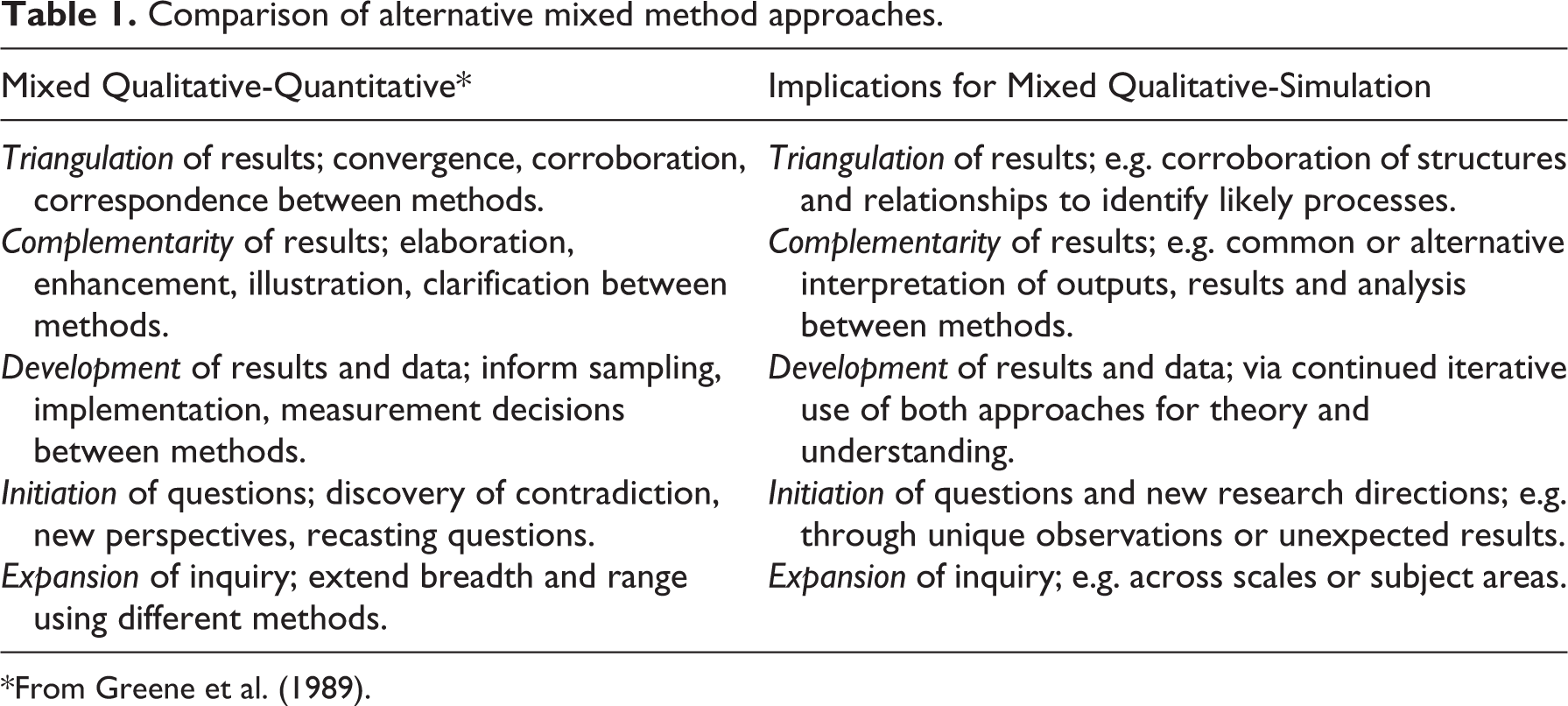
*From Greene et al. (1989).
Similar iterative approaches between qualitative and simulation methods have recently been proposed in sociology (Tubaro and Casilli, 2010; Chattoe-Brown, 2013). Geography has yet to substantially engage with mixed qualitative-simulation methods, but it has a strong foundation in other forms of mixed methods on which it can draw, both regarding its practice and epistemology (e.g. Phillip, 1998; Elwood, 2010). A primary area of work on which mixed qualitative-simulation methods in geography can build is Qualitative GIS (e.g. Pavlovskaya, 2006; Cope and Elwood, 2009). Qualitative GIS has developed after initial criticism about the productive role GIS could play for furthering human geography because of a lack of reflection on the epistemological implications of the technical approach and its perceived service to corporations over the disenfranchised (Schuurman, 2006). More recently, the criticism has turned positive as human geographers have developed approaches using GIS mixed with other methods to produce valuable insights and understanding that would not otherwise have been possible. A prime example is the approach of grounded visualization (Knigge and Cope, 2006), an iterative process of data collection, display, analysis and critical reflection which combines grounded theory with visualization (based on quantitative GIS) to find meaning and build knowledge.
A similar iterative approach taking the outline from above might be developed to produce a kind of ‘grounded simulation modelling’ which ensures that conceptual models encoded formally for simulation are held accountable to empirical data that reflect everyday experiences and actions of individuals and groups. Grounding in this sense is a form of model confrontation (e.g. Hilborn and Mangel, 1997) and demands an iterative approach to examining and comparing theories (i.e. model structures) through exploration of data. As an iterative approach this would mean not only grounding the modelling during conceptualization stages of the process, but also in later analysis and reflection leading to modifications in model structure. One way to ensure this reflection is by building it into the practice of modelling, making visible all the decisions and interpretations made at various points throughout the practice of modelling. Although, as we highlighted above, efforts to ensure such transparency are being advanced, these have been based in other disciplines (e.g. ecology; Schmolke et al., 2010) and the practice of modelling in geography could be better revealed by building on such efforts to make modelling transparent. This means, for example, moving beyond a static presentation of the final model to describing the modelling process, but also reflecting on and analysing the nature of the subjectivities in the process, the inherent assumptions and positionalities of decisions that were made. Such reflection seldom is presented for others to see, such is the negative heuristic of modern peer-review publication, diverting modellers from discussing those elements of their practice that they may be well aware of (e.g. Turkle, 2009) but which would make it difficult for their manuscript to be published were they too open about them.
Mixed methods in geography often challenge the separation of distinct epistemologies and partiality of knowledge (e.g. Elwood, 2010), and if qualitative-simulation mixed methods are to be iterative they will draw on different aspects of the epistemological attributes of ABM at different points in the research process. For example, taking the school-access modelling example used above, whereas Millington et al. (2014) were content to use a generative approach to compare model output to spatial patterns of access (i.e. distance from home to school), a next step in empirical grounding might mean returning to the field to examine how representations of parents’ experiences of success or failure in the simulation correspond to the individuals’ lived experience of these, or how their own interpretation of the model influences their personal understanding of the system. This later stage in the modelling might then shift from building on the generative possibilities of ABM to the dialogic. Furthermore, each of the modes outlined above (generative, consequential, dialogic) implies a different perspective on how important it is to identify a universally ‘accepted’ representation of the world (resonating with issues of the ‘fixity’ of code space in GIS; Schuurman, 2006). In the generative mode of simulation the search is for possible structures of the world for explaining observations. Depending on what grounded observations we wish to relate to (but also dependent on who is doing the relating), different model structures will be more or less useful for reproducing observations and therefore producing understanding. A dialogic approach need not acknowledge any single model as being the ‘right one’ (i.e. fixed) but can offer up alternatives, explore understandings of others’ (conceptual) models, and/or debate the desirability of different (social) structures. In contrast, the consequential mode demands that a single model is considered valid (i.e. fixed), at least temporarily, while its consequences are explored. It may be that the consequences of alternative models are investigated, but each model structure being examined must be accepted if the consequences are to be trusted and found useful for understanding how simulated events might play out.
Thus, at various points through the process of modelling we will either need to doubt or trust these thin representations of the world. On examining how simulations are used practically in design and science, Turkle (2009) discusses how the use of simulation demands immersion and the difficulty practitioners of simulation face to both do and doubt simultaneously when immersed. That is, immersion in a simulation demands suspension of doubt. Simulation modelling in geography is useful to the extent that we trust a model as a closed representation of an open system (as discussed above), but ‘the price of the employment of models is eternal vigilance’ (Braithwaite, 1953). Braithwaite’s discussion pre-dates simulation and, to reiterate our discussion above, the same argument about trust could be levelled at any model framework in geography, and even the thickest interpretative model will be incomplete. In a mixed qualitative-simulation approach, working across the different epistemological modes and using empirical data to ground the investigation, issues of trust and doubt in the representations in the computer will likely be raised but hopefully also eased through better understanding of the underlying representation (i.e. conceptual models). This is currently a hope, both because geographers have yet to properly engage with such mixed qualitative-simulation methods but also because engagement between researchers with different epistemological perspectives can be both risky (Demeritt, 2009) and intellectually uncomfortable (Chattoe-Brown, 2013). One of the most difficult aspects of this approach may be finding ways of suspending doubt for long enough to explore consequences of others’ conceptions, but while remaining sufficiently critical to question outcomes.
Before any new cohort of researchers with this interactional expertise (sensu Collins and Evans, 2002) between qualitative and simulation methods emerges, there will be interaction costs. Such costs are unavoidable, but if research capability is about relations and relational thinking (Le Heron et al., 2011), additive value is gained as conceptual modes of thinking are bridged. Common themes on which these bridges can be founded have been provided above, through the heuristic and dialogic roles we have argued ABM can play in understanding and representing geography. Projects that aim to identify how ABM can be used in generative, consequential and dialogic modes for furthering social, political and cultural geography might be pursued to address a variety of questions. How can geographers use ABM to help reveal the role of social context in generating observed patterns of activity (such as the reproduction of inequality or flows of consumption)? Given current understandings of trajectories of political, economic and cultural change, how might geographers use agent-based simulation as a means to confront expectations by suggesting alternative futures, due to changes in social structures and/or behaviour of individuals not previously seen? In participatory research settings, what are the opportunities and challenges for ABM to help individuals and groups to understand the impact of their local agency on dynamics and change of broader social systems and structures? Furthermore, if agency is considered more collectively, arising from the process of participatory modelling (as in projects like the Ryedale flood-modelling example above), what would that mean for the nature of the heuristic and dialogic ideas presented above? Alternatively, how might new-found understandings by individuals about their agency be turned back to geographers to understand the role of agent-based simulation modelling itself as an agent of social change? We offer these questions to inspire new projects that iterate through qualitative and simulation approaches in a recursive way. Importantly, this exploration should see the process of (agent-based) simulation modelling as a practice, an assemblage of ideas, experiences, results and narratives – a way of fostering geographical understanding through thick and thin representations.
Footnotes
Acknowledgements
We are grateful for discussions with David Demeritt, Nick Clifford and George Adamson at King’s College London, David O’Sullivan at UC Berkeley and George Perry and others at the University of Auckland which helped improve the paper. We would also like to thank the editor and the anonymous reviewers (of this and previous versions) for their useful and productive comments. Any errors, ambiguities or other defects (including opinions) that undoubtedly remain are the responsibility of the authors.
Declaration of conflicting interests
The author(s) declared no potential conflicts of interest with respect to the research, authorship, and/or publication of this article.
Funding
The author(s) disclosed receipt of the following financial support for the research, authorship, and/or publication of this article: This paper was initiated in part by the authors’ coincidental attendance at the Epistemology of Modeling and Simulation National Conference in Pittsburgh, PA in 2011. JM is grateful for the support of an Early Career Fellowship from The Leverhulme Trust [ECF/2010/0378] that supported his attendance at the conference and his time working on the arguments and other material presented here (including time spent at the University of Auckland). JW was supported in part by the University of Sheffield Learned Societies’ Fund, and would like to thank Continental Airlines for setting in process an erratic (but hopefully productive) train of thought.