



Abstract
In biblical studies, a growing interest in metaphors as the conceptual key to the ancient mind has arisen. However, in contrast with the popularity of metaphor, other tropes have received little attention. This article sheds light on another rhetorical feature: ‘cumulative part-whole relations,’ which construct a new whole by compounding disparate body parts, a textual and visual strategy deliberately used to cross boundaries of individual parts, to integrate the parts into a larger whole, and to demonstrate superiority and supernatural powers. Through examining visual and textual examples from the ancient Near East, including Song 7.1–6 and the composite creatures (Mischwesen) from the Levant, this article reveals that the rhetorical mechanism of the cumulation of part-whole relations follows the logic that the whole is more than the sum of its parts, while that whole remains a single one no matter how many parts are compounded.
Keywords
1. Introduction
Corresponding with the twentieth century’s “rhetorical turn” – the modern revival of interest in rhetoric – George Lakoff and Mark Johnson’s Metaphors We Live By (1980: 3) popularized the notion that “our ordinary conceptual system, in terms of which we both think and act, is fundamentally metaphorical in nature.” Scholars of the Hebrew Bible have also been fascinated by this idea, hoping to uncover the conceptual thought world of the ancient Israelites through the study of these Israelites’ metaphors. Accordingly, scholarly interest has largely been limited to metaphors, whereas other figures of speech are rarely mentioned. 1
To rectify this, I focus here on another feature widely used across the ancient Near East: cumulative part-whole relations. The part-whole relationship is another approach to the “figuration of meaning,” 2 by rendering a part standing for the whole or a whole standing for the part.
The part-whole relationship has generally been attributed to metonymy or synecdoche, although their definitions are in flux. Traditionally, synecdoche was defined by part-whole relations and metonymy by contiguity (e.g., Burke, 1974: 507–509). However, because of the ambiguity of the term “contiguity” when it is a part of a physical whole – such as mucus in the expression “a runny nose” (is it a part of the nose, or is it contiguous with the nose?) – some scholars divide partonomical (physical) and taxonomical (categorical) part-wholes and ascribe the former to metonymy and the latter to synecdoche (e.g., Seto, 1999: 91–96, 116). For others, the part-whole relations are regarded as the subordinate features of both metonymy and synecdoche, with metonymy referring to the spatial, physical, or functional part-whole relations and synecdoche used to refer to both the metonymic part-whole relations and metaphoric similarities. 3 As there is no general agreement, I choose not to attribute the part-whole relations either to metonymy or to synecdoche but to use the term “part-whole relation” itself.
The part-whole relation as a figuration of meaning has been manifested verbally and visually, often in interaction with other rhetorical strategies to achieve certain rhetorical effects. One of the most common effects is that of “integration,” which is the most essential aspect of the part-whole relation: the part stands for the whole, while integrating the other parts of the whole. The significance of the part-whole relation extends further, through aspects of interrelationship, interstitiality, creation of a larger whole, and the microcosmic-macrocosmic relationship. 4 These terms point to the interrelationship facilitated by integrating different parts into a newly created and qualitatively different greater whole. It can be said that dynamic part-whole relations have been thought to evoke senses of integration, creation, superiority, and interrelationship.
Cumulative part-whole relations, indicating the visual and verbal phenomenon in which two or more part-whole relations are compounded together, is a strategy beloved by ancient Near Eastern people for describing an object in the superlative, which exceeds its previous boundaries, and for integrating discrete objects and concepts together in a single body. By focusing on examples from the southern Levant – the visual forms of composite beings and the verbal description of the Shulamite in Song 7.1–6 – I discuss below both how cumulative part-whole relations were manifested visually and verbally as well as the effects on their audiences. The southern Levantine examples of composite beings are collected from various time periods before the Hellenistic era, during which major iconographic changes took place. Song of Songs 7.1–6 demonstrates how cumulative part-whole relations may also be textually manifested in the corresponding cultural area. 5 In order to give a broad picture of how this rhetorical device is used in neighboring cultures, ancient Near Eastern visual and verbal examples are also mentioned across diverse regions and periods.
The part-whole relations in the composite beings and in Song 7.1–6 have not yet been given appropriate attention. In the case of the female descriptions in the Song of Songs, it has been mentioned that the body parts compose the whole body or half of the body, 6 but its mechanisms and principles have not been studied in detail. The situation is similar in the case of the studies of composite beings in the ancient Near East. The part-whole relations are touched upon, but the focus of scholarly discourse has been the metaphor: how anharmonic elements are “transferred” across the boundaries of their original “domains.” 7 By focusing on the part-whole relations in composite beings and in the description of the female lover, this article discusses the detailed mechanism and effect of part-whole relations.
2. Cumulative Part-Whole Relations in Images: Composite Beings
Often also called “Mischwesen” (a German term for “mixed being”) or “hybrid creatures,” composite beings refer to fantastic – from the modern point of view – creatures such as sphinxes or griffins, whose bodies are made up of parts from distinct entities. It seems there was no generic term for composite beings in the ancient Near East, 8 nor did hybridity form a distinct category separate from other animals or anthropomorphic figures. Some composite beings were the attribute animals of deities like lions or bulls, ridden by deities and guarding sacred places, 9 whereas some represented the chaotic power to be defeated just like other theriomorphic and anthropomorphic figures. 10 Thus, as Anthony Green (1993: 247) noted, “the distinction between ‘natural’ and ‘hybrid’ is modern and somewhat artificial.”
Nevertheless, ancient people felt the need to visualize some creatures in a composite way. Why were such creatures necessary? And what would be the reason they chose the specific approach of mixing parts of different flora, fauna, and inanimate forms? These are the main questions of this section.
Although terms like “hybrid creatures,” “composite beings,” and “Mischwesen” might not have existed in the minds of ancient Near Eastern people as referring to a distinct category, I use such terms to discuss the visual and verbal strategies of cumulative part-whole relations for the sake of modern analysis and discussion. It might seem anachronistic to use such a term, but it is impossible to understand some aspects of ancient cultures without applying modern concepts and terminology. 11 Therefore, in this section, I use the term “composite beings” but confine it to visually composite beings that are physically unnatural from the modern point of view. The discussion herein includes all composite beings whose body parts originate from animals, humans, fishes, plants, and/or inanimate objects. 12
Composite Beings in Their Ancient Near Eastern Context
Composite beings were present throughout the ancient Near East, but they performed different roles and functions in each culture. In ancient Egypt, deities could manifest themselves in human, animal, hybrid, and object forms without any hierarchical differences between them. For example, the goddess Hathor could be manifested in forms of not only a woman, a cow, a pillar, a human body with the head of a cow, or the head of a cow with a human face, but also of “a lioness, a snake (the Uraeus), a hippopotamus, and a tree nymph” (Hornung, 1983: 110–113). According to Erik Hornung (1983: 109–110), by the end of the 2nd Dynasty, hybrid forms of deities coexisted with the preexisting theriomorphic and anthropomorphic forms, as equally effective ways of visualizing the manifestation of deities.
The composite form of deities in ancient Egypt was one way of representing the nature of an individual divinity. 13 For the composite forms of demons, guards, and servants of deities, such as sphinxes or ba-birds, their hybrid forms (especially with anthropomorphic parts) also reflect their basic essence alongside their human-like conception. A pharaoh could also be depicted as a hybrid (e.g., as a sphinx), representing the king’s sacred, powerful, and intellectual aspects, or depicted in animal forms (usually a lion), or as anthropomorphic deities. Visual hybrid forms were available not only for major and minor deities but also for demons, monsters, guards, and servants of deities, regardless of “the way in which the two [human and other forms] are combined” (Hornung, 1983: 123). Although the various composite beings in ancient Egypt did not share a common role or status, they did all possess magical powers beyond the earthly realm, or so-called supernatural powers, 14 communicating with the realms of deities, spirits, living humans, and the underworld.
In Mesopotamian studies, composite beings are discussed more or less synonymously with monsters/demons. 15 They fufill the intermediate role between high deities and humans, whereas major deities are usually depicted anthropomorphically. The composite form, or any anomalous form, 16 is regarded as a mark of their liminal, “in-between” status as a Zwischenwesen. 17 They can appear both with and without a horned crown or divine determinative (Fig. 1). 18 The presence of a divine property does not automatically mean that they rank as high as major deities; it indicates that the Mesopotamian concept of “DINGIR” is broader than the modern Western concept of “divine” and includes not only deities but also monsters, demons, cultic objects, and diseases (Porter, 2009: 158). Thus, it seems fair to say that the composite beings in Mesopotamia were generally positioned below major deities, while some areas could also overlap. 19
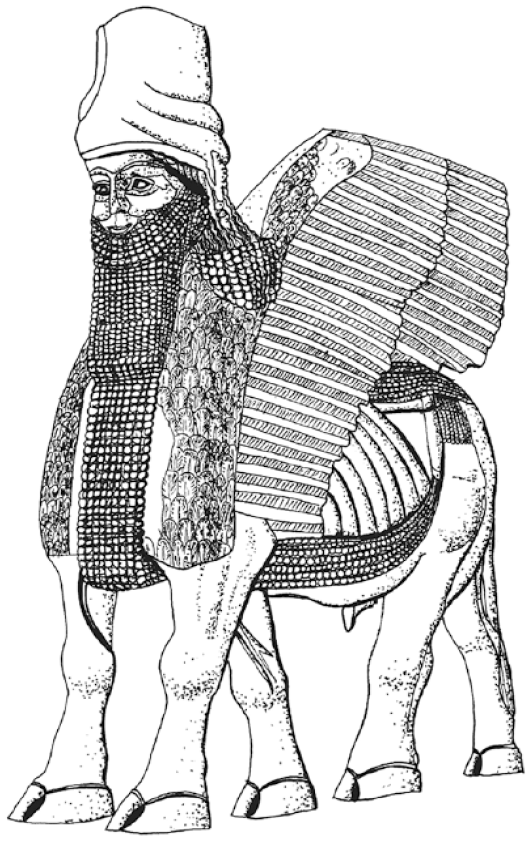
A striding human-headed winged bovine with a horned crown. Ḫorsabad, Sargon II.
Bearing in mind that the boundaries between “natural” and “composite” are not clearly definable, it is still possible to infer some roles the composite beings traditionally played in Mesopotamia. Karen Sonik emphasizes their ability to mediate between the divine and mortal realms and their beneficent or harmful actions to humans. 20 According to Wiggermann (1993: 224–231), their various functions can be classified into five categories: (1) “purifying and exorcising” roles, (2) “servants” of deities, (3) “defeated enemies” of deities, (4) “Atlantids,” and (5) only in visual representations, “master of animals.” All of these roles existed within the mythical sphere and somehow involved magic.
The composite beings in Mesopotamia show signs of a close interrelationship with political situations. For example, in the Neo-Babylonian period, mušḫuššu, the attribute animal of Marduk (Fig. 2), appeared much more frequently than in the other periods, replacing typical Neo-Assyrian composite beings such as the striding human-headed winged bovine (Fig. 1) (Gane, 2012: 87–88). The Mesopotamian composite beings mediated between and synchronized different realms – e.g., realms of deities, human politics, natural abundance, the dead and demons – with their magical powers.
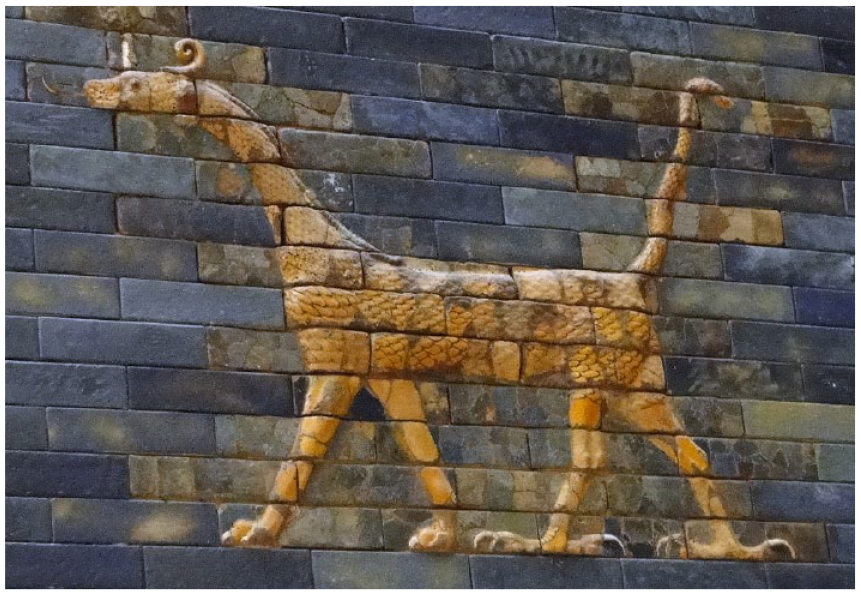
Mušḫuššu. Part of Ishtar Gate (Neo-Babylonian). Pergamon Museum, Berlin.
Composite Beings in the Southern Levant
The ancient southern Levant witnessed numerous visual representations of composite beings, such as sphinxes, griffins, the winged Uraeus, Lamashtu, Pazuzu, Sachmet, Horus, Seth, winged genii, the winged sun disk, winged scarabs, bird-men, and ba-birds, which were found on media such as stamp seals, ivory plaques, amulets, cylinder seals, cultic stands, figurines, handles, and furniture. Situated between Egyptian and Mesopotamian cultures, the ancient Levant had various composite beings from both regions. Therefore, although creatures originating in Mesopotamia appeared mostly as demons and servants of higher deities, the statuses of the ones originating in Egypt were much more diverse, ranging from demons to main deities, protectors, and servants. The composite beings represent (1) major deities such as Horus, Seth, Sachmet (Fig. 3), and the winged sun disk (mostly from Egypt); (2) chaotic demons and apotropaic figures such as Lamashtu and Pazuzu from Mesopotamia (Fig. 4) and the Bes or Taweret type of composite beings; and (3) servants and guardians deities, such as sphinxes from Egypt, and winged genii from Mesopotamia. In the Hebrew Bible, though the identity of the cherubim and seraphim are still a matter of dispute, 21 it is clear they are composite in form. They appear as guardians and markers of sacred places (e.g., Gen. 3.24; Ezek. 28.14; Isa. 6), servants of YHWH (e.g., 2 Sam. 22.11; 2 Kgs 19.15; Ps. 99.1; Isa. 6; Ezek. 1, 10), and/or representations of chaotic powers (e.g., Num. 21.6–8; Deut. 8.15), mediating between the earthly and spiritual (including divine) realms.
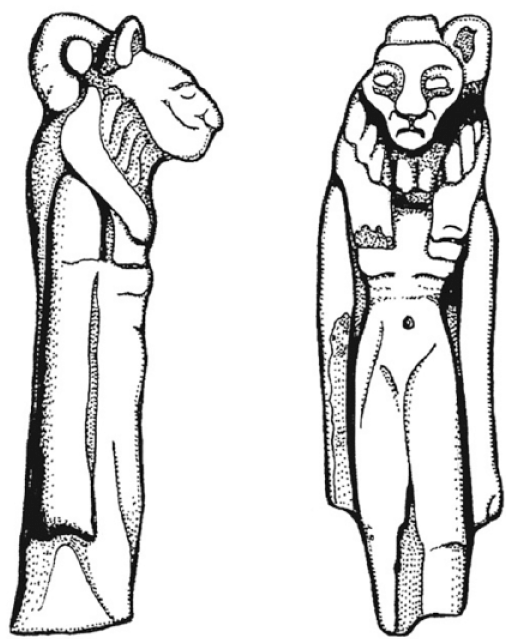
Sachmet. Amulet. Lachish, 840-800 BCE.
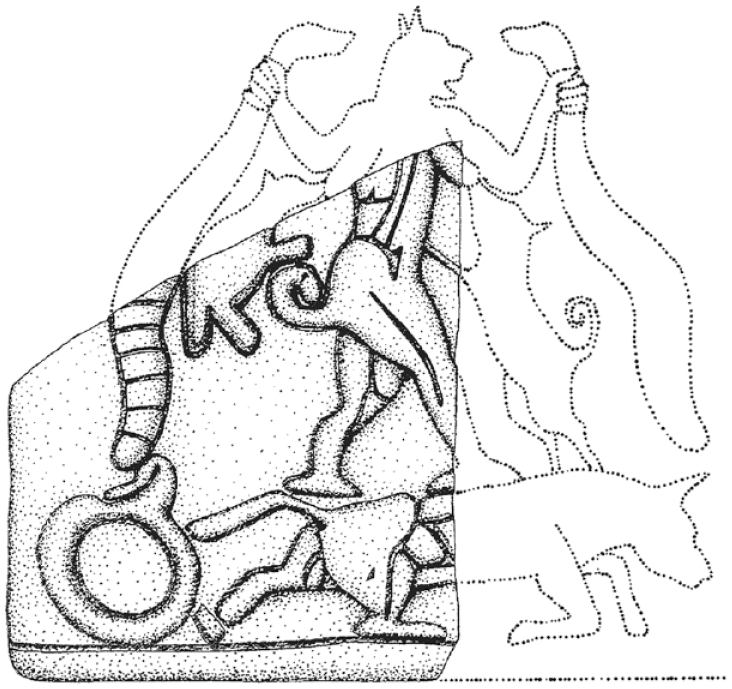
Lamashtu. Stone plaque. Near Tel Burna. Ca. 700 BCE.
The way that the creature was composed, that is, whether as a biped or quadruped, whether with a human head or body or with an animal head, did not seem to have a significant correlation to their roles and functions. Because the southern Levant adapted iconography of both Egyptian and Mesopotamian composite beings, such as sphinxes, the winged Uraeus, and Sachmet from Egypt, and Lamashtu, Pazuzu, and winged genii from Mesopotamia, the ancient Levant must have had conceptions of composite beings both as major deities (e.g., Sachmet), as liminal beings (i.e., sphinxes and winged genii), and as demons (e.g., Lamashtu). There is also no need to distinguish between imported and local composite beings, as cultural hybridization was deeply rooted in southern Levantine cultures. 22 Only in the worldview(s) of the Hebrew Bible, as the highest deity, the God of Israel, is never described as a composite being, did the composite beings possess an exclusively liminal status, serving as guardians, servants, divine mounts, and chaotic forces. Nevertheless, as there is an abundance of iconographic sources indicating the presence of various composite beings that were conceived as major deities in the southern Levant under the influence of Egyptian iconography, they cannot be limited to liminal status. Again, all of the composite beings, along with some anthropomorphic and theriomorphic figures, possessed magical powers and brought supernatural forces to bear on people’s everyday lives.
Thus, though there are differences, the composite beings in Mesopotamia, Egypt, and the southern Levant share several properties with one another, specifically their association with supernatural powers and their ability to communicate with different realms, whether divine, earthly, or netherworldly. Certainly, anthropomorphic and theriomorphic figures could also play supernatural roles in their visual forms. 23 Yet, why would they then need another way of visualizing such powers, besides their “natural” anthropomorphic or theriomorphic forms? The answer is in the specific messages communicated by the visually combined form.
Messages of the Composite Form
Scholars studying composite beings in the ancient Near East have inferred certain messages from the mixed form. According to Sonik (2013: 113), the message of the visual mixture (i.e., the “anomalous body”) 24 would “signal […] their fundamental alterity, their binding to the savage wilderness and their severance from the civilized world and its norms.”
Hornung (1983: 125), in his study of the composite forms of Egyptian gods, argued that there would have been an “anthropomorphization of the powers,” 25 in creating composite beings in ancient Egypt. This term refers to the primordial tendency of conceiving and expressing abstract powers as humans, that is, in terms of anthropomorphic forms and human-like cognition and behaviors. In this process, abstract divine powers represented by a deity take “anthropomorphic” forms, and their distinguishable natures are visualized through an animal head or an inanimate object and fused together (Hornung, 1983: 105, 124). Thus, Hornung interprets the mixed form as conveying the idea that individual deities, which can be represented by an animal or an object, are able to think, act, and communicate like humans.
For Green (1993: 246), “the idea behind introducing elements of different animals was probably to combine the most awesome or powerful features of a number of predominant creatures so that the resulting amalgam would be the more effective in challenging malevolent forces.” Thus, in Green’s interpretation, the message of the hybrid form would be its great power against “malevolent forces.”
All of these scholars agree that the composite form somehow points beyond the physical realm, connecting the spiritual/divine realms to the physical world. Yet, how exactly does a hybrid form point beyond the physical world, outside of modern conceptions of the form’s physical impossibility? And what exactly does the vague message of “beyond the physical world” mean?
Part-Whole Relations in Composite Beings
Composite beings bear body parts of humans, animals, plants, or objects and can be a hybrid of two, three, four, or more different aspects. As Brett E. Maiden (2020: 140–141) pointed out, these individual body parts are not foreign to human cognition. For example, they originate from forms that were already familiar within the cultures, such as humans and certain common animals, whether from everyday life or in artwork, such as birds or lions. The animals chosen are typically the ones that are the most symbolic, which make them appear more frequently in the verbal/visual repertoire.
When such animal and human forms are fused into a single figure, they each bring their symbolism with them. At first glance, this symbolism seems to construct a one-to-one relationship with the visualized part, such as “wings” – “ability to fly.” In many cases, however, it is not easy to find such simple one-to-one matching relations between the body part and its symbolism. For example, if the symbolism of the human body of Sachmet is confined to the body trunk and limbs, as it is visually expressed, the lion head of Sachmet should not be able to speak human languages or to communicate with her human worshippers. Likewise, the symbolism of the sphinx’s human head – the representation of human cognition, intellect, and the faculties of communication (whether verbal, visual or spiritual) with humans – is not confined to the head itself but applies to the whole body, because the seat of the mind and intellect was not the head but the heart, 26 and knowledge could be stored in the stomach. 27 These examples show that the symbolism of a hybrid animal is not to be limited to the aforementioned body parts but applied to the whole of the composite being. Thus, for example, a pair of wings stands for a whole bird, and the ability to fly is a common property of both the part (wings) and the whole (bird).
Therefore, a single body part of a composite being stands for the whole animal or human the part represents. For example, the human head of a sphinx stands for an entire human – including symbolic meanings and powers – and its lion body stands for the whole of a lion, together constructing a new larger whole (sphinx) integrating both wholes (human and lion). A sphinx is then an integration of all powers and symbols represented by the concepts human and lion.
Cumulative Part-Whole Relations in Composite Beings
When these two or more hybrid wholes (e.g., a lion, a human, an eagle) are compounded together, each whole is concurrently brought together into a newer whole—a larger category integrating the previously distinct categories of each individual being. For example, the two wholes of the lion-like features and the human-like features (including powers, symbolic values, and physical features) are intertwined into a newly created whole, which is rendered as a sphinx. The sum of the addition of the two wholes (a lion and a human) results not in two entities but rather in one, a new hybrid creature. It requires one to think creatively concerning how, when two wholes – or more – are added together, the result may also be a new, singular whole. No matter how many parts are added, the result is a single body integrating all the previously separate categories. For example, compounding features of a lion, human, and bird results in a new creature we call a “winged sphinx.”
Such cumulative part-whole relations have another effect. When each whole is added together into a new, greater whole, the resulting power is more than just the combination of, for example, the powers of the lion, the bird, and the human. A composite being is not just a combination of the lion’s strength, the bird’s ability to fly, and human cognition. Were it so, a winged sphinx would not become a servant of deities, crossing boundaries between the physical and spiritual realms. Simple addition does not make a composite being divine or semi-divine, possessing markers of divinity. Rather, it must be the effect of cumulative part-whole relations that allows for the leap from the physical world to the divine or spiritual realm. As discussed above, such dynamic part-whole relations have been conceived as having the power to create a new, bigger, and greater whole and as integrating differences, paradoxes and conflicting domains. The leap from the mere addition of physical, mortal beings to a composite being with magical powers is likely to have stemmed from the power of the part-whole relationship, resulting in a greater effect from being compounded together. This process can be expressed by the oft-quoted axiom, “The whole is something over and above its parts, and not just the sum of them all.” 28
The messages of the hybrid form that scholars have intuitively detected as magical or supernatural, something beyond the earthly realm, are therefore the intended effects of the visual strategy of cumulative part-whole relations, used to depict something beyond the typical power, capacity, or status of its constituent entities. Gathering them together, fusing them into a larger, unified whole, and compounding their parts together to reinforce the effect, produces a composite being. This being mediates between the chaotic and ordered realms, both divine and earthly, and is a being of great power that can serve deities and protect people and emphasizes the greatness of the hero. 29 The ancient Near Eastern people knew these effects of cumulative part-whole relations and used them as a strategy for visualizing such power.
3. Cumulative Part-Whole Relations in Texts: The Description of the Female Lover in Song of Songs 7
Interpretation of Song 7.1–6
Cumulative part-whole relations can be found not only in images but also in texts. Both relate the parts with their whole, each part standing for the whole and the whole being more than the mere sum of its parts. However, this way of figuring meaning manifests itself differently in images and texts. Although the visual expression of the cumulative part-whole displays the patchwork of different parts in a hybrid, the textual manifestation shows how each part is gradually layered over the whole, as one reads or hears word by word. Therefore, in texts, the cumulative part-whole does not end in a hybrid form but in a renewed whole with higher status and abilities.
Examples of textual manifestation can be found in the descriptions of the lovers in Song of Songs (4.1–7, 5.10–16, 6.4–9, 7.1–6). These descriptions render a female or male body part by part, combined with metaphors and similes. Most commentators agree that this unique form of description is the “description song,” which is to praise the lover’s body, supported by the descriptions’ literary contexts and other comparable Egyptian and ancient Near Eastern songs. 30 Fiona Black’s reader-oriented approach (2009: 62–64, 227-229), however, cautions against uncritical reception of the complimentary character of Song and encourages recognition of its grotesque aspect, which embraces multifaceted sides of love. Gillis Gerleman (1965: 68–71) asserts that these descriptions are modeled after ancient Egyptian anthropomorphic sculptures. Certainly, some parts of the description may be inspired by the art traditions of its surrounding cultures, 31 but a formal one-to-one match between the description and Egyptian sculptures does not explain all the metaphors and similes, and it furthermore ignores the profound connotations and symbolic significations layered in the description. Scott B. Noegel and Gary A. Rendsburg (2009: 129–169) argue that the part-by-part body descriptions in Song were intended as invectives given their funny and bizarre metaphors, on analogy with Arabic medieval invective poems. Although their claim is provocative, one cannot depend on much later poems to determine genres within Song.
In this article, I propose that these descriptions not only praise the body but also construct the whole body as superlative, perfect and almost divine-like, using the rhetorical device of cumulative part-whole relations. Because a close examination of each description song in Song would be beyond the scope of this paper, I limit discussion to one of these descriptions, 7.1–6, and provide a brief interpretation of it.
v. 1aα Turn, turn, O Shulamite, v. 1aβ Turn, turn, and let us see you! v. 1bα What would you see from the Shulamite? v. 1bβ [Something] like the dance of the two camps! v. 2a How beautiful are your steps
32
in sandals, young noble lady! v. 2b The curves of your thighs are like jewelry, work by an artisan’s hands. v. 3a Your navel is the round cup, which shall not lack its mixed wine. v. 3b Your belly is a mound of wheat, surrounded with lotuses. v. 4 Your two breasts are like two fawns, twins of a gazelle. v. 5a Your neck is like the ivory tower. v. 5bα Your eyes are pools in Heshbon, near the gate ‘Daughter of the Great’. v. 5bβγ Your nose is like the tower of Lebanon, watching over Damascus. v. 6aα Your head, upon you, is like the Carmel. v. 6aβ And the hair of your head is like purple [cloth]. v. 6b [The] King is captured in the tresses. [My translation].
In this description, the woman’s body is described part by part from her feet up to her head and hair. Each body part is compared to an object, flora, fauna, or landscape via a metaphor or simile. Verse 1 introduces the intent behind the description, and v. 6 concludes the listing of body parts by showing how the Shulamite has captured the king, her male lover, by her attractiveness. 33
In v. 2b, the Shulamite’s thighs are likened to jewelry, connoting beauty, wealth, and high social status. Commentators suggest that the round form or the smoothness of her thighs inspired the jewelry-thigh simile, as the semantic range of the Hebrew word for “thigh” (ירך) also includes hips. 34 As the jewels are thought to be made by an artisan, the connotation of “perfection” is suggested by this simile. 35
In verse 3a, the Shulamite’s navel is compared to a round cup filled with abundant wine. Although some commentators have suggested the roundness of the cup and navel as the tertium comparationis, 36 this metaphor works not only on the formal level but also on the conceptual level: the female body was widely conceptualized and visualized as a liquid container throughout the ancient Near East, including the Levant (Kipfer and Schroer, 2004). The imagery of a cup with overflowing liquid, a famous symbol of abundance in Mesopotamia and Syria, might also be relevant here. 37 If “navel” is understood as a euphemism for “vagina,” as some commentators have proposed, 38 the wine cup metaphor accords with the amorous and sexual connotations of wine elsewhere in Song (1.2, 4, 4.10, 7.9). Whether understood as a navel or vagina, its imagery of containing the joyous, ever-flowing wine connotes joy and abundance.
The belly-wheat metaphor in v. 3b connotes abundance and prosperity through the scale of the wheat pile. The translation of שושנים as “lotuses” (rather than lilies) has convincingly been suggested by Othmar Keel. 39 The meaning of the metaphor is disputed. One proposal suggests that this implies flower decorations around the woman’s belly. 40 Some suppose this imagery reflects a scene of harvested wheat piled on a threshing floor and fenced by thorns for protection, while the flower replaces the thorns to connote beauty or sexual accessibility in this metaphor. 41 However, this picture – flowers “protecting” a mound of harvested wheat – lacks support in the visual or verbal tradition of the host culture and is thus unacceptable. 42 Finally, Keel (1994: 233–235) argued this metaphor evokes ancient Egyptian or Levantine images of a bowl or dish with lotus decorations around its rim. This is convincing not only because it is supported by archaeological findings but also because it suits the cultural perception of a female body as a container. 43 The lotus was a well-known symbol of life, regeneration, and vitality in ancient Egypt and the Levant. 44 In the Levant in particular, the lotus was a royal symbol and also appeared with deities. 45 Therefore, the symbolism of the belly – including the womb 46 – and lotus flowers has connotations of vitality and life force.
The gazelle simile for the Shulamite’s breasts in v. 4 repeats Song 4.5 verbatim, except for one phrase: “that graze on lotuses” (4.5). This verbatim repetition assumes these two verses share the same imagery, while part of it could be omitted for reasons of meter and rhythm. Commentators mostly focus on the similarity in symmetry, color, shape, or movement between twin fawns and female breasts. 47 Although symmetry undoubtedly links the breasts with twin fawns, this simile becomes clearer when approached through ancient Levantine iconography. In this realm, gazelles were a symbol of life and power, also frequently appearing as an attribute animal of Levantine goddesses. 48 The visual representation of two symmetrical gazelle fawns grazing on a plant is a famous “tree with caprids” motif in the ancient Near East, connoting vitality, abundance, and a source of life. These connotations are strengthened when a lotus flower, a symbol of regeneration and life force, is added to the tree at the center. The picture of gazelles grazing on lotus flowers, though unrealistic in nature, follows a long-established artistic tradition in the ancient Near East and Egypt, and this motif sometimes signified divinity in the Levant. 49 Because female breasts in the Hebrew Bible often point to fertility and the source of primary nutrition, 50 it can be said that the gazelle fawns and the breasts share the connotation of a source of life.
The tower similes appear for the Shulamite’s neck and nose in v. 5. In the Hebrew Bible, towers connote height, strength, protection, pride, and greatness. 51 The ivory tower in v. 5a might have been named after the ivory decorations inside the tower. 52 A neck connotes beauty and protection (as a place of ornaments and amulets), strength (to support yokes and burdens), and arrogance, according to various contexts in the Hebrew Bible. 53 For the tertium comparationis of neck and ivory tower, scholars have suggested the color (ivory skin), smoothness, height, beauty, dignity, elegance, pride, craftsmanship, or an ivory necklace around the woman’s neck. 54 Although all these suggestions are possible, their overlapping connotations supported by the Hebrew Bible are strength, pride, and protection, and the connotations of beauty, dignity, wealth, and high social status are supplied by the luxurious ivory decorations.
The nose-tower simile in v. 5bβγ likewise reinforces the connotation of pride, as noses in the Hebrew Bible connote beauty, pride, and arrogance. 55 As the tower stands atop the Lebanon, a famous symbol of height, strength, beauty, glory, abundance, and holiness (esp. its cedars) in the Hebrew Bible, 56 this simile is enriched with the connotations of superiority, glory, beauty, and divinity. As some commentators have noted, the conical shape of a nose and a tower would have also inspired this simile, along with the olfactory (nose) wordplay between “Lebanon” (לבנון) and “frankincense” (לבונה). 57
For the eyes-pools metaphor in v. 5bα, most commentators have pointed out the Hebrew wordplay between “spring” and “eye” (עין), which would automatically link the eye with sources of water. 58 The gleaming, reflection, moisture, and depth of the water have also been suggested as the tertium comparationis. 59 When the pools are near the gate named “Daughter of the Great,” these pools connote not only the abundance of a life source (water) but also great influence on the multitude of people, as do the eyes of the Shulamite. 60
The head of the Shulamite is likened to Mount Carmel in v. 6aα. The general interpretation of the simile is that the height of the mountain is likened to the elevated quality of the woman’s pride, beauty, and majesty. 61 Mount Carmel was not only known as a mountain of height, beauty, abundance, and fertility in the Hebrew Bible 62 but, more importantly, as a holy place of YHWH. 63 Because the head in the Hebrew Bible indicates “top” or “best,” 64 Mount Carmel’s rich connotations of beauty, height, majesty, and sanctity suggest her head as the pinnacle of her pride, beauty, and majesty and therefore almost sacred.
In v. 6aβ, the Shulamite’s hair is likened to a purple cloth. For the tertium comparationis of the simile, commentators have suggested the color, gleaming aspect, or luxuriousness. 65 Because it is a simile, the color of her hair need not be purple. The purple cloth, a luxurious item, is used in the Hebrew Bible for the tabernacle (e.g., Exod. 26.1), divine statues (Jer. 10.9), decoration of palaces (Esther 1.6), and Solomon’s palanquin (Song 3.10) and has connotations of beauty, wealth, sanctity, and high social status.
In v. 6b, the male lover is depicted as a captured king. By reversing the common ancient Near Eastern motif of the king who takes captives, 66 this verse depicts the Shulamite as not only the most beautiful woman but also the most powerful woman, able to defeat even a king. Her exceedingly great power may be postulated based on the connotations inferred in the previous metaphors and similes: powers of beauty, wealth, abundance, protection, strength, high social status, vitality, a source of life, regeneration, majesty, and sanctity.
In summary, Song 7.1–6 describes the Shulamite as the ideal of femininity, with everything that may be desired of a female body: she displays beauty (jewelry, ivory, and purple cloth), and she serves as a container (bowl and cup) for an abundance of joyous food (a pile of wheat) and drink (mixed wine); she protects herself and her loved ones (as a tower); she is the source of water and life (pools, lotuses and gazelle fawns); and she is high, majestic, and sacred, like Mount Carmel.
Cumulative Part-Whole Relations in Song 7.1–6
Dynamic part-whole relations are evident throughout this description. First, each body part in the metaphors and similes stands for the whole body. If “your thighs” “your navel,” or “your belly,” is replaced by “you” or “your whole body,” the metaphors still work: “you are like jewelry,” “you are a wine cup,” “you are like a pile of wheat,” and so on. Second, adding each description of each body parts on top of the previous ones, from her feet to her head, reinforces each body part’s reference to the body as a whole. Third, as each body part stands for the whole body, the metaphoric descriptors – jewelry, a wine cup, a pile of wheat, lotus flowers, gazelle fawns, towers, pools, Mount Carmel, and purple cloth – may also be applied to the whole, unified body of the Shulamite. When these descriptors are added together, they designate a whole world comprising food and drink, flora and fauna, architecture, mountains, water sources, and beautiful and luxurious goods. Together, they constitute an ideal world.
In this way, each body part stands for the whole body, and each descriptor stands for a whole ideal world. As these part-whole relations are compounded from head to toe, a new metaphor is constructed: the whole body of the Shulamite is (like) the whole ideal world.
In this new metaphor, the grounds of the comparison are the shared connotations between the Shulamite and the ideal world, found in the above discussions: beauty, abundance, wealth, luxury, high social status, vitality, life force, a source of life, pride, strength, protection, majesty, and sanctity. When these properties are bestowed upon the Shulamite, the Shulamite is described as a goddess-like woman who is not only beautiful and attractive but also elevated in status; full of pride, wealth, strength, and vitality, and the protector and the giver of life. Because metaphors “assert seriously something that is beyond literal truth,” 67 she is rhetorically seen as a sort of demigoddess who does not display attributes of major divinity but still possesses divine powers of abundance, protection, and the giving of life. Ideality – to which the Shulamite is likened – is not realistic and belongs instead to the divine realm. Some descriptors of the Shulamite’s body also imply her semi-divinity. The cup of ever-flowing drink alludes to the mythical ḫegallu vase of Syria and Mesopotamia. 68 Lotus flowers and gazelles were attributes of Levantine goddesses, 69 and they also signified divinity when associated with the “tree and caprids” motif. 70 Mountains were typical abodes of deities, and Mount Carmel was a sacred cultic place in the Hebrew Bible. 71 The Shulamite is ultimately described as a demigoddess, forming a new, integrating metaphor through the verbal strategy of cumulative part-whole relations.
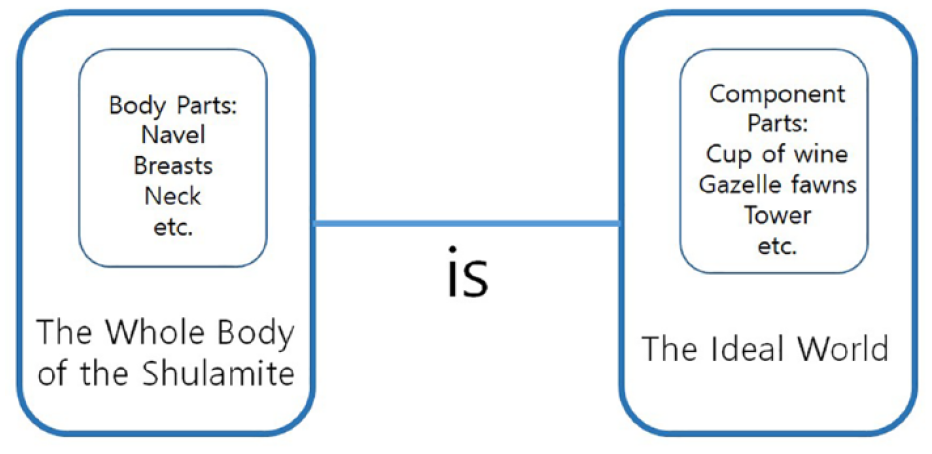
The new metaphor of the whole of the Shulamite.
The other descriptions of the lovers in the Song of Songs (4.1–7, 5.10–16, 6.4–9) bear witness to similar part-whole relations. In the description of the female lover in Song 4.1–7, the depiction begins with her face and head and ends with her breasts. Even though the part-whole relation does not involve the lower parts of the body, the description results in a perfect, flawless woman (4.7). The mountains (4.6) and the “tree (lotus) and caprid” motif (4.5) imply her near-divinity, as discussed above, 72 and the doves, compared to her eyes (4.1), were also the attribute animal of the goddesses of love in the ancient Near East. 73 In 6.5–7, which repeats 4.1–3 with some variation, she is superior to numerous other women, including queens (6.8), and she is likened to two cities (6.4). Scholars have noticed that the part-by-part description of the male lover in 5.10–16 alludes to divine statues from across the ancient Near East. 74 The descriptions of the lovers in Song of Songs all point to the described lover’s superiority and divine-like perfection through cumulative part-whole relations, as has been seen in the example of the Shulamite description in Song 7.
Cumulative Part-Whole Relations in Ancient Near Eastern Texts
If Song 7.1–6 deliberately uses cumulative part-whole relations to describe the Shulamite as a demigoddess, it is necessary to examine other instances of this strategy in the ancient Near East. Cumulative part-whole relations, textually manifested as metaphoric part-by-part descriptions, can also be found in ancient Egyptian and Mesopotamian texts. It should be noted that the Greek part-by-part descriptions of a lover do not use metaphors in ways similar to Egyptian, Mesopotamian, or Hebrew texts. 75
In ancient Egypt, cumulative part-whole relations have appeared since the Pyramid Texts of the Old Kingdom and deified the dead pharaoh:
Your head as Horus of the Duat – an Imperishable Star; Your face as Eyes-Forward – an Imperishable Star; Your ears Atum’s twins – an Imperishable Star […]
76
The Middle Kingdom hymn to Amon metaphorically describes the divine body, part by part:
His heart is Sia (knowledge), His lips are Hu (word of power) … His right eye is the day, His left eye is the night… His boy is the Nun (primal sea), Its contents, the Nile…
77
Such formulae were also used in the Middle Kingdom period to describe the body of a pharaoh
78
and to magically protect a child.
79
In New Kingdom love poetry, cumulative part-whole relations are used to describe the body of a lover, although without strictly following the formula of listing “body part compared to something else”:
Behold her, like Sothis rising at the beginning of a good year: shining, precious, white of skin, lovely of eyes when gazing. Sweet her lips <when> speaking: she has no excess of words. Long of neck, white of breast, her hair true lapis lazuli. Her arms surpass gold, her fingers are like lotuses. Full(?) (her) derrière, narrow(?) (her) waist, her thighs carry on her beauties. Lovely of <walk> when she strides on the ground, she has captured my heart in her embrace.
80
In Mesopotamian literature, cumulative part-whole relations appear in describing the bodies of deities. The Syncretic Hymn to Ninurta, dated to the Middle Assyrian period, describes the deity’s body part by part, with each part being compared to a deity or a celestial body:
O lord, your face is Shamash, your lock [Nisaba], Your eyes, O lord, are Enlil and [Ninlil], Your eyeballs are Gula and Belet-il[i], Your eyelids, O lord, are the twins Sin [and Shamash]. Your eyebrows are the corona of the sun which […] Your mouth’s shape, O lord, is the evening star. (Foster, 1996: 619)
The description continues to the neck, throat, chest, back, fingers and navel, but the lower parts are missing due to the fragmentary state of the text (Foster, 1996: 619–620).
The first millennium Body Description Texts describe the body of the great adversary, Anzu, using cumulative part-whole relations:
[…] Tamarisk is his topknot. […] The palm frond is [his] whiskers. [Cedar] is his [kne]es. The apple is his ankle bones. The snake is his penis. The harp is his hand. (Livingstone, 1989: 99)
The description continues, albeit without following any clear order. The Late Babylonian version describes not only the adversary’s body but also the victor’s body (Ninurta) in a similar manner (Pongratz-Leisten, 2015: 137). According to Beate Pongratz-Leisten (2015: 123), such integration of various deities, objects, flora and fauna into a single body is “maximizing the potential” of the described one and “demonstrating his [its] supremacy.” If it is the enemy’s body, the might of the enemy raises the reputation of the victor, who will take the control of the entire material world represented by the body of the defeated (Pongratz-Leisten, 2015: 136–137).
This strategy was used in the context of deity romance in the Neo-Assyrian period. The love poetry of Nabû and Tašmetu describes the body metaphorically, part by part:
Ditto, [whose] thighs are like a gazelle in the plain! [Refrain]. Ditto, [whose] ankle bones are an apple of Siman! [Refrain] Ditto, whose heels are obsidian! [Refrain] (Livingstone, 1989: 36)
In summary, the textual strategy of cumulative part-whole relations was used throughout the ancient Near East to describe a body that surpasses natural capabilities – mostly for deities and kings but also in wishing for the magical protection of a baby – and for a lover being compared to a deity. It seems that such part-by-part metaphoric body descriptions were initially used mainly for deities or kings but were democratized in later periods (Keel, 1994: 24) and used for ordinary people, who were thus elevated or likened to deities or kings.
All of these instances, including Song 7.1–6, signify that cumulative part-whole relations raise the status of their subject to another level (from a king to a real god; from mortal woman to a goddess), making them superior to others (the superior deity among other gods) or endowing them with magical powers (the power of protection for the baby, divine powers attributed to a king or to a lover). Therefore, cumulative part-whole relations in texts, like their visual counterparts, incorporate separate wholes or aspects together into a single unity, having a greater effect than the mere sum of its parts, and exceeding ontological limits and boundaries.
4. Conclusion
This article focuses on cumulative part-whole relations in ancient Near Eastern, particularly Levantine, images and texts. Ancient people used dynamic part-whole relations as a rhetorical tool, often in cooperation with other tropes, such as metaphor. Compounding more than two part-whole relations creates a special effect by crossing the boundaries of the individual parts, integrating differences in a larger whole, and endowing the subject with magical powers. Examined through the composite beings and the descriptive texts of the ancient Levant, Egypt, and Mesopotamia, the visual and textual strategy of cumulative part-whole relations reveals the logic of “the sum of two or more wholes equals a new single whole” and “the whole is more than the sum of its parts.” No matter how many parts are added together, it results in a newly created single body that is more than the sum of parts.
It should be noted that such cumulative part-whole relations do not manifest themselves in images in the same way as in texts. 81 The body of the Shulamite described in Song 7.1–6 was not to be visualized as a hybrid being. 82 Visual and verbal sign systems have their own ways of manifestation, but there are common grounds for comparison. 83 Cumulative part-whole relations “traveled” between visual and verbal sign systems of ancient people 84 and were expressed differently in images and texts but point to the same concept: the creation of a superior whole, having (supernatural) powers of liminality.
The mechanism of adding together various parts that stand for distinct wholes ultimately builds a larger, newer whole, integrating all previously disparate wholes into a single body. This process affords superiority, supernatural powers, and liminality to their subjects and composite beings.
Footnotes
Funding
This research has been funded by the Jean et Bluette Nordmann Foundation.
1.
See for example, de Hulster, 2009: 105–118; van Hecke, 2005:1–4; Verde, 2016: 45–46.
2.
“Figuration of meaning” is an expression used by Mieke Bal in her argument that various tropes shape and figure meanings visually as well as verbally. See Bal, 1991: 69.
3.
E.g., Turner, 1991: 147–148; Ohnuki-Tierney, 1991: 181, 187–188. See also Nerlich, 2010: 315–316; White, 1973: 33–36.
4.
For Ohnuki-Tierney, the synecdochic part-whole relation is interstitial, processual, and interpenetrational. It is a dynamic movement between metaphor and metonymy that creates a new category (Ohnuki-Tierney, 1991: 181, 187–188). For Turner, the synecdochic part-whole relation represents a whole hierarchically superior level, which embeds and integrates everything underneath it. It also has a creational value, the creation of a new higher level of the whole (Turner, 1991: 148, 154–155). See also White, 1973: 35–36.
5.
I assume this song has pre-Hellenistic origins, mainly because its unique part-by-part description combined with metaphors and similes cannot be found in early Greek literature, while there are comparable and older examples from Egypt and Mesopotamia. See footnote 75 below.
6.
E.g., Keel, 1994: 230–231. Francis Landy states that “the parts of the body are metonymous with the woman herself,” in discussing the formal features of the female description in Song 4.1–5 (2011: 66).  : 317) also note that “the parts indisputably make up a whole” in the male body description in Song 5.10–16.
7.
E.g., Maiden, 2020: 139–140. This approach is metaphoric because the basic understanding of metaphor assumes two “domains” – target and source domains or tenor and vehicle domains – and explores how these two domains are compared and merged in a metaphor. See Verde, 2016: 60–62.
8.
Green, 1993: 247; Sonik, 2013: 105; Wiggermann, 1993: 231. Whether such a conceptual category of “mixed creatures” existed in the ancient Levant is doubtful. See Eichler, 2015: 36–37. In Egypt, composite beings were created in a hieroglyph-like way regardless of ontological categories and were thus not given a generic name encompassing all hybrid beings. See Fischer HG, 1987: 13–14, 26.
9.
A famous example would be the guardian animals on the Ishtar Gate and the rock relief at Maltai depicting the scene of divine figures processing on attribute animals. For more examples, see also Schroer, 2018: nos. 1197, 1198, 1644, 1645, 1658.
10.
For example, Schroer, 2018: nos. 1635, 1636, 1010, 1011, 1706.
11.
Just as a work of translation is “creative treason” (Escarpit, 1965: 84–85) but facilitates basic access to its content for the readers of other languages, modern concepts are unavoidable and sometimes helpful in the early stage of understanding a specific aspect of an ancient culture.
12.
See Green, 1993: 246–262; Wiggermann, 1993: 242–245, for examples of composite beings drawing elements from fish, plants, and inanimate objects. A famous example of a plant + plant hybrid, also popular in the Levant, is the voluted palmette, a composite of a palmette and a lotus, papyrus, or lily. For examples, see Feldman, 2006: 82–85. See also Schroer, 2018: nos. 1408, 1441, 1658–1661, 1705, 1922, 1964.
13.
Hornung (1983: 114) argues that “pictures of gods should not be understood as illustrations or descriptions of appearances, but rather as allusions to essential parts of the nature and function of deities.” These visual forms served only to “allude,” never to be the true form of the divinity. See Hornung, 1983: 117, 124; Wilkinson, 2003: 29.
14.
Although it is disputed whether the term “supernatural” is an adequate adjective to use in the context of the ancient Near East (e.g., Renfrew, 1985: 12; Avalos, 1995: 151), this term is needed for us to refer to the powers defying the “modern” physical laws. Nevertheless, it should be noted that such magical powers were probably considered a part of the world’s “natural” forces.
15.
Green, 1993: 247–248; Sonik, 2013: 107; Wiggermann, 1993: 222–244. For Sonik, see also footnote 16 below.
16.
For : 110–111), who divides the supernatural entities of Zwischenwesen (“daimons” according to her; see footnote 17 below) into dangerous “demons” and protective “genii,” not all daimons are composite beings. However, they all have some type of anomalous physical appearance, such as being oversized or distorted, which represents the chaotic features beyond the ordered world (2013: 107).
17.
A German term for “interstitial beings with supernatural qualities or capacities” (Sonik, 2013: 103). Wiggermann divides the figures mentioned in the “Göttertypentext” into four hierarchical groups, with the two higher groups (major deities) taking the anthropomorphic form and the two lower groups (minor deities and monster spirits) having hybrid forms (: 367–368).
18.
Wiggermann, 1993: 231. See also Maiden, 2020: 146.
19.
Such overlap can be seen as, e.g., when high deities were first depicted with horns growing out of their heads. See Wiggermann, 1993: 233.
20.
21.
Although scholars have not yet reached a consensus regarding the identification of cherubim – whether winged sphinxes, griffins, winged humans or a generic term for any composite being – seraphim are generally accepted as winged serpents, similar to the winged Uraeus famous in Egyptian and Levantine iconography (Keel, 1977: 70–124). For the general discussion of different identifications of cherubim and seraphim, see Eichler, 2015: 26–38; Hartenstein, 2007: 155–181.
22.
The degree of cultural hybridization constantly changes. What was regarded as hybrid could become the local norm in another period. Feldman, 2006: 62. See also Staubli, 2016a for his argument for the cultural koine of Egypt and the southern Levant.
23.
See p. 3 above.
24.
See footnote 16 above.
25.
26.
See Wolff, 1974: 46–51. See, e.g., Gen. 24.45; 1 Sam. 27.1; Isa. 42.25; Job 8.10; Prov. 15.14, 18.15, 24.30. See also Maiden, 2020: 158–159.
27.
E.g., Ezek. 3.3; Prov. 22.18; Job 32.18. The stomach represented the “inner person,” storing knowledge, thoughts, and the spirit, which may also come out from the stomach; see Freedman and Lundbom, 1977: 96–97. Such an understanding can also be found in Egyptian texts; see Shupak, 2005: 209-210.
28.
Aristotle, Metaphysics, Book H, Chapter 6, 1045a 8–10, translation in Bostock, 1994: 39.
29.
In mythology, some composite beings serve to highlight the greatness of the hero who defeats them. It should also be noted that an increased number of hybridized parts does not indicate an increase in power. Whether a composite of two, three, or four different entities, the hierarchy between the composite beings is not determined by the hybridization but by their mythological correlation, i.e., the figure to which it is ascribed: a composite being taking the role of a hero will be stronger than a composite being ascribed to its defeated counterpart. Egyptian gods stand higher in the hierarchy than the winged sphinx, although both are composite figures. Thus, composite beings’ individual abilities, powers, and status must be different from each other, e.g., on the basis of flight, physical strength, swiftness, horrification, or protection.
30.
E.g., Barbiero, 2001: 13–14; Fox, 1985: 271–272; Keel, 1994: 24. See also Black, 2009: 23–24, 32 for a summary of such approaches.
31.
See, e.g., my discussion of v. 3b, 4 below.
32.
פעם can mean both “foot” and “step” (“פַּעַם,” Ges18 4:1068; “פַּעַם,” DCH 6:731; “פַּעַם,” NIDOTTE 3:650–651).
33.
Barbiero, 2011: 388; Garrett, 2004: 237; Keel, 1994: 231.
34.
Gerleman 1965: 196–197; Keel, 1994: 234; Murphy, 1990: 185; Zakovitch, 2004: 245.
35.
Barbiero 2001: 372, 374; Exum, 2005: 233; Zakovitch, 2004: 245.
36.
E.g., Fox, 1985: 159; Garrett, 2001: 239; Gerleman, 1965: 197; Murphy, 1990: 182.
37.
For the visual and verbal imagery of this symbol, the ḫegallu vase, see Black and Green, 1992: 184.
38.
See Keel, 1994: 234; Pope, 1977: 617-618.
39.
Keel understands this word as an Egyptian loan word for lotus (ššn). His argument is based on the following: (1) this word is used to describe cups and column capitals (e.g., 1 Kgs 7.19, 22, 7.26), and there have been related archaeological findings; (2) the Septuagint translates the word as κρίνον, the word used by Herodotus for “lotus”; (3) the lotus was a famous symbol of vitality and regeneration in ancient Egypt and the Levant. Keel, 1994: 78–79.
40.
Delitzsch, 1875: 112; Garrett, 2001: 239; Gerleman, 1965: 198; Murphy, 1990: 182; Pope, 1977: 622; Stoop-van Paridon, 2005: 371.
41.
Delitzsch, 1875: 112; Exum, 2005: 234; Fischer, 2019: 5; Fox, 1985: 159.
42.
In artistic traditions, unrealistic sceneries are allowed to produce meanings by combining various symbols. For an example, see the next paragraph and footnote 49.
43.
The comparison of the female body with a container was a famous artistic tradition in the ancient Levant (Kipfer and Schroer, 2015). Furthermore, the connection between the lower female abdomen and the lotus flower is clear: a pottery drawing from Lachish represents the famous lotus-with-caprids motif – a variant of the tree-with-caprids motif – but its lotus flower is replaced by a rendering of a pubic triangle. See Keel and Uehlinger, 1998: fig. 80. For the tree-with-caprids motif, see the next paragraph.
44.
Brunner-Traut, 1980: 1092–1094; Schroer, 1996: 670.
45.
Cornelius, 2008: 98–99; Ornan, 2011: 265–266, 269–271; Ziffer, 2005: 153.
46.
A belly (בטן) in the Hebrew Bible appears not only as the place of food digestion (e.g., Job 20.14–15) but also as the location of fetuses (e.g., Ps. 139.13).
47.
Barbiero, 2001: 189-190; Gerleman, 1965: 150; Murphy, 1990: 155; Pope, 1977: 470; Zakovitch, 2004: 189.
48.
Barbiero, 2011: 191; Keel, 1994: 92–94, 150; Schroer, 2010: 110–111.
49.
Keel, 1994: 150–151; Ornan, 2011: 265–271; Staubli, 2016b: 84–85. See also Keel and Schroer, 2004: 30–31, 38.
50.
E.g., Gen. 49.25; Isa. 28.9; Hos. 9.14; Joel 2.16; Ps. 22.10; Job 3.12.
51.
E.g., Gen. 11.4–5 ; Isa. 2.15 ; Pss. 61.4, 48.14 ; Prov. 18.10.
52.
Barbiero, 2001: 379; Keel, 1994: 235; Pope, 1977: 625.
53.
E.g., Gen. 27.40, 41.42; Deut. 28.48; Judg. 5.30; Isa. 10.27; Jer. 27.8; Ps. 75.6; Job 15.26; Song 1.10, 4.4, 7.5, 8.21; Neh. 3.5.
54.
Barbiero, 2001: 379; Exum, 2005: 234; Fox, 1985: 160; Garrett, 2001: 241; Gerleman, 1965: 198; Keel, 1994: 235; Murphy, 1990: 186; Pope, 1977: 625; Zakovitch, 2004: 246-247.
55.
E.g., Isa. 3.21; Ezek. 6.12; Ps. 10.4, 115.6; Song 7.9, 1.16.
56.
E.g., 1 Kgs 5; Isa. 10.33–34, 40.16, 35.2, 60.13; Jer. 22.6, 20; Ezek. 31.3, 8–9, 16; Pss. 72.16, 92.13, 104.16-17; Song 4.8, 5.15; Ezra 3.7.
57.
Barbiero, 2001: 384; Exum, 2005: 236; Fox, 1985: 160.
58.
Barbiero, 2001: 380; Exum, 2005: 235; Fox, 1985: 160; Murphy, 1990: 186; Pope, 1977: 625; Zakovitch, 2004: 247. Although the word for “pools” in Hebrew (ברכות) denotes artificial reservoirs rather than natural springs (e.g., 2 Kgs 20.20; Isa. 7.3, 36.2; Qoh. 2.6; Neh. 3.15–16), this wordplay still connects an eye with a water source.
59.
Garret, 2001: 242; Keel, 1994: 69, 236; Pope, 1977: 625; Zakovitch, 2004: 247.
60.
For the eyes in the Hebrew Bible reflecting a person’s radiance and influence, see Keel, 1984: 55-56; 1994: 69, 236.
61.
Barbiero, 2001: 385; Exum, 2005: 236-237; Fox, 1985: 160; Garrett, 2001: 242; Keel, 1994: 236–238; Murphy, 1990: 183, 186; Pope, 1977: 629-630; Zakovitch, 2004: 248.
62.
E.g., Isa. 35.2; Jer. 50.19; Amos 9.3.
63.
E.g., 1 Kgs 18.20-46; 2 Kgs 4.25; Jer. 46.18.
64.
“ראֹשׁ I,” DCH 7:365b–376b; “ראֹשׁ,” NIDOTTE 3:1015–1020; “ראֹשׁ I,” Ges18 5:1207a–1208b.
65.
Barbiero, 2001: 387; Exum, 2005: 237; Fox, 1985: 161; Garrett, 2001: 243; Keel, 1994: 46–49, 238; Murphy, 1990: 183, 186; Pope, 1977: 629-630; Zakovitch, 2004: 248.
66.
E.g., Schroer, 2018: 136–149, 866–867.
67.
Eco, 1984: 89. Emphasis in original.
68.
The ḫegallu vase symbolizes abundance. See Black and Green, 1992: 184.
69.
See footnotes 45 and 48 above.
70.
See footnote 49 above.
71.
Cf. 1 Kgs 18.20–40; Isa. 35.2; Jer. 46.18.
72.
See the previous paragraph and page 13 above.
73.
Keel, 1984: 60–62; Keel, 1994: 69–71; Schroer, 2010: 78–79.
74.
Dobbs-Allsopp and James, 2019: 319–320; Gerleman, 1965: 69; Schroer, 1987: 226–227.
75.
Philodemus’s part-by-part description of a woman is the first appearance of this in Greek love literature (1st century BCE) but it does not employ metaphors for each body part. The contemporaneous Genesis Apocryphon describes the beauty of Sarai part by part without using metaphors, merely repeating “how lovely” or “how beautiful.” Shaye JD Cohen asserts that the description of the body parts of a lover in Greek literature is “the result of Semitic influence” (Cohen, 1981: 49). One exception is Joseph and Aseneth 18.9, which dates sometime between 100 BCE and the 2nd century AD and is undoubtedly “reminiscent of the Song of Songs” (Burchard, 1985: 232).
76.
From the Pyramid Texts of Unis (ca. 2353–2323 BCE). Allen, 2005: 32.
77.
J. Assmann, Ägyptische Hymnen und Gebete, BAW (Zurich and Munich: Artemis, 1975), 320–321 quoted in Keel, 1994: 23.
78.
Keel, 1994: 21.
79.
A. Erman, Zaubersprüche für Mutter und Kind: Aus dem Papyrus 3027 des Berliner Museums, AKPAW.PH (Berlin: Königliche Akademie der Wissenschaften, 1901), 48–49, quoted in Keel, 1994: 23.
80.
Papyrus Chester Beatty I, no. 31, stiches B–D, in Fox, 1985: 52.
81.
See, page 10 above.
82.
Although Black envisions the Shulamite as a kind of grotesque hybrid creature, she is not arguing that the Shulamite was originally intended as a hybrid being; rather, she uses it as a hermeneutic tool for resolving controversies and paradoxes. See Black, 2009: 4.
83.
See, e.g., Bal, 1991: 19, 127–128; Mitchell, 2003: 51, 56–60.
84.
I use here the metaphor of travel for interdisciplinary concepts such as tropes or narrative, as used by Bal. See Bal, 2002.