




Abstract
Foster care children are at a higher risk of experiencing social or health problems in their lives (Sariaslan et al., 2022). Nevertheless, some youth show high adaptiveness when engaged in work, schooling and forming family relationships (Jones, 2011). The present study focuses on agency in the developmental paths of 18 young adults (14 females, four males, aged 18–32 years old) with family foster care backgrounds. Four main narratives emerged from analyses of individual interviews with these participants: (1) Relational agency; (2) Restricted agency; (3) Accommodated agency; and (4) Independent agency. The young people’s narratives involved affordances and constraints with respect to the manifestation and development of agency at different phases of their lives. This study is part of a larger project that examines factors contributing to the resilience of these young people; family foster care is the most common form of care in Finland, but there is scant literature highlighting the experiences of the young people affected. The findings can help both those working within care to understand the factors that facilitate resilience and the young people themselves to reflect on the potential to influence their lives. The findings can deepen our understanding of the support that fostered youth need to cope with their early experiences and to develop their own agency.
Plain Language Summary
The present study focuses on agency in the developmental paths of 18 young adults (14 females, four males, aged 18–32 years old) with a family foster care background. Four main narratives emerged from analyses of individual interviews with this group: (1) Relational agency; (2) Restricted agency; (3) Accommodated agency; and (4) Independent agency. The young people’s narratives involved affordances and constraints with respect to the manifestation and development of agency at different phases of their lives. The study is part of a larger project examining the factors that contribute to the resilience of young people affected by family foster care – the most common form of care in Finland. Foster care children are at a higher risk of social or health problems in their lives (Sariaslan et al., 2022). Nevertheless, some young people show high adaptiveness when engaged in work, schooling and forming family relationships (Jones, 2011). The findings of this article can help people working within foster care to understand the factors that facilitate resilience and the young people themselves to reflect on the influence they can have in their own lives. The findings can deepen an understanding of the support foster youth need to cope with their experiences and to develop agency.
Introduction
Children and adolescents in foster care encounter various challenges and difficulties, including early traumas, before and while they are uprooted from their birth homes and social networks as part of the fostering process. Such experiences are likely to impact their life course and development of agency in different ways to their peers. The youth in foster care referred to here have been placed in out-of-home care due to adversities that have endangered their health and development (Child Welfare Act 417/2007), such as exposure to family violence, childhood maltreatment, parental substance abuse or other traumatic experiences (Harden, 2004). The adverse experiences may have various consequences for their wellbeing and functioning, such as difficulty in forming attachments and a higher-than-average prevalence of mental health complications, which can impact the development of an individual’s agency (Jankowski et al., 2019; Mitchell, 2018).
The present study views agency within sociocultural conceptualisations as encompassing an individual’s capacity and power to take action, make choices and impact their own life by having access to various internal and external resources and being empowered to engage in purposeful action (Eteläpelto et al., 2013; Giddens, 1984; Hökkä et al., 2017; Jääskelä et al., 2017). In addition to their own capacity, an individual’s social, cultural and relational contexts play a central role in their exercising of agency (Edwards and D’Arcy, 2004; Sairanen and Kumpulainen, 2014). The power of social structures to constrain and channel the deployment of an individual’s actions (Sorbring and Kuczynski, 2018) may be especially critical during child and adolescent developmental stages for those with vulnerabilities.
Children and youth in foster care encounter specific hardships, which may restrict their agentic actions and resources, for instance due to the loss of primary attachment bonds (Cicchetti and Rogosch, 1997; Howe et al., 1999) and insufficient social support (Perry, 2006; Rebbe et al., 2017). Life events or risk factors that seem similar can be experienced differently by different individuals and thus can effectively function as restrictions for one child and resources for another, and even for the same individual at different stages (Gundersen, 2020). According to Elder’s (1994) life course theory, the timing of life events and relationships with close ones influence an individual’s development. Thus, attention should be given to individuals’ perceptions of critical events and resources over the life course to generate an understanding of the manifestation of agency and its changes over time. Currently, knowledge is scarce on the agentic experiences of young adults with foster care backgrounds. In the present study, we examine the developmental paths of agency revealed in the narratives of young adults with experiences of family foster care. The aim is to gain an understanding of the various experiences of agency of foster care youth, and the restrictions and resources for agency at different phases of their lives.
Agency In Developmental Paths Of Children And Youth
Approaches to conceptualisations of agency are manifold, reflecting various epistemological and ontological bases. In the social sciences, agency is construed with reference to both the individual’s capacity to act consciously and autonomously and the constraints set in place by power relations and contextual factors (Archer, 2003; Calhoun, 2002; Ci, 2011; Eteläpelto et al., 2013; Giddens, 1984). Views of agency drawing from the life course perspective (Biesta and Tedder, 2007; Elder, 1994; Emirbayer and Mische, 1998) maintain that agency is intertwined with the past, present and future, suggesting a dynamic where previous experiences affect current agency and the ability to cope in the present and orientate to the future (Emirbayer and Mische, 1998). Elder (1994) considers agency as one of four principles affecting an individual’s life course. Accordingly, individuals shape their life courses through their choices and actions at historical and social times. Other principles include the effect of a specific historical time and place on an individual’s development, interdependence of people due to personal life courses being linked together via relationships, and the influence of the timing of life events and transitions in an individual’s life.
Based on the synthesis of previous literature, our view of agency stresses the importance of resources and constraints for agency such as relational resources (Edwards, 2005) as well as the person’s own resources, including their belief in their capacity to act (Bandura, 1989, 2006). Our conceptualisation aligns with the assertion of Biesta and Tedder (2007) that an actor always acts by means of an environment rather than simply in an environment, and the argument that agency should instead be defined as the power to do something rather than the power over something or someone (Hökkä et al., 2017). Agency thus implies individuals having control over their lives rather than reacting to externally regulated situations (Biesta and Tedder, 2007; Collin et al., 2011). To gain an understanding of the development and changes in agency and its restrictions and resources, agency needs to be examined through the perspective of an individual’s life course (Biesta and Tedder, 2007; Elder, 1994).
The supports and restrictions for the agency of children and young people are seen to be influenced by their role as a social group in society (Wyness, 1999). This role can vary with respect to the historical time and place in an individual’s life course (Elder, 1994) and the relational contexts in question (Wyness, 1999). Adults play a central role in either supporting or restricting the agentic attempts of children and young people (Vandenbroeck and Bouwerne-De Bie, 2010). Foster care children and youth represent a special group due to the multitude of family relations, changes in their living environment and atypical early experiences of care, which may affect the development of their agency and factors restricting and resourcing it.
Restrictions And Resources In The Lives Of Foster Care Children And Youth
The challenges involved in the lives of foster care children and youth may arise prior to their foster placement, during their time in care or after ageing out of care. These challenges may work as restrictions to their agency or create them concurrently or later in their lives. Removal from the birth home is, generally, linked to unsafe circumstances that endanger a child’s health and development (Barber and Delfabbro, 2009). Children placed into care have more often than not been exposed to traumatic experiences in their homes, such as physical, emotional or sexual abuse, either as an observer or a target (Riebschleger et al., 2015). The placement itself can also be traumatic (Leathers, 2006). Adverse childhood experiences before entering care and the loss of a primary attachment relationship may hinder forming new relationships (Andersson, 2005; Schofield and Beek, 2005), and relationships with birth family members may continue to involve tensions (Lundström and Sallnäs, 2009; McWey et al., 2010; Tahkola et al., 2020). Adverse childhood experiences can cause toxic stress, contributing to lifelong impairments in learning, behaviour, and physical and mental health (Rebbe et al., 2017). Children and young people who have been in care may also lack access to sufficient social supports due to experiencing several placements or school changes (Perry, 2006; Rebbe et al., 2017).
Relationships with foster family members can function as new attachments (Cole, 2005; Dozier et al., 2001; Stovall-McClough and Dozier, 2004), helping children and youth in care to form meaningful relationships (Howes, 1999; Lindén, 1998; Schofield et al., 2000; Wilson, 2006). In some cases, birth parents (Andersson, 2009) and important non-parental adults outside the home (Duke et al., 2017) provide support to the children and young people. The role of peers is also important (Gundersen, 2020). Research on agency with respect to vulnerable children and young people has been carried out among children with backgrounds of parental divorce (Haugen, 2010; Smart et al., 2001), poverty (Redmond, 2008) and refugee status (Chatty, 2009; Eide and Hjern, 2013), and research on children in foster care has mainly focused on their educational (Berridge, 2017; Brady and Gilligan, 2020) and interactional experiences (Gundersen, 2020). The present study aims to fill a gap in the literature by examining the narratives of young adults with histories of foster care with respect to agency, and the affordances and constraints for agency in the past and future. These young adults are seen in the present study as active agents who seek to affect their lives and decisions.
The study seeks, firstly, to gain an understanding of the ways in which young adults with foster care backgrounds are agentic in their life narratives and, secondly, to identify the kinds of resources and restrictions to agency that have supported or limited an individual’s capacity and opportunities to exercise agency in their life course.
Method
Participants And Data Collection
The data consisted of 18 individual interviews with Finnish young adults who had experienced family foster care. In Finland, children or adolescents can be taken into care by child protection authorities, and substitute care must be provided if their health or development is seriously endangered by a lack of care or if they seriously endanger their own development or health through substance abuse, committing an illegal act or anything other than a minor offence, or by any comparable behaviour (Child Welfare Act 2007/417). There are three main forms of substitute care – foster care (with a foster family), care in residential institutions and care in professional family foster homes – of which foster care is the most commonly used form of placement (National Institute for Health and Welfare, 2022).
The first author employed purposeful sampling to recruit participants who had experienced family foster care. This was done as part of a broader research initiative to investigate their familial relationships and factors that contribute to the resilience of children and adolescents in family foster care. The recruitment was mainly executed via social media. The author posted a public invitation to take part in the study on her Facebook page, and members of the public and foster care organisations shared the invitation on their own pages. Twelve participants contacted the first author directly. Six participants were reached via contacts among their friends or family members. The mean age of the interviewees was 25.4 years old (ranging from 18 to 32 years old), and the majority of them (14 out of 18) were female. Seventeen participants were living on their own, and one was still living in a foster family. Most of the participants were currently employed, and a few participants were studying or on paternal leave. Three interviewees had their own children.
The interviews were conducted by the first author between March and June 2018 in different parts of Finland. The interview locations were chosen according to the wishes of interviewees, and the interviews were audio-recorded. Prior to the data collection, a pilot study consisting of two interviews was conducted in February 2018. Both pilot interviews were included in the data and the analyses, as there were only minor changes, such as the use of a question battery in some interviews, after the first two interviews. Participation was voluntary, and informed written consent was obtained from each participant before data collection. In order to protect the participants’ anonymity, descriptive details were either changed or deleted from the quotations.
Data were collected using a narrative approach, focusing on the interviewees’ narration of their life experiences. A timeline method (Adriansen, 2012; Sugarman, 1986) was utilised in which the interviewees were asked to describe their life course from their early experiences to the present and into the future. At the beginning of the interviews, prompts were given to the interviewees for their free use in order to encourage them to talk about their life experiences and the things that had helped them cope with adversities and challenges (Gaskell, 2000). The prompts included items related to their relationships (e.g., birth parents, friends, partner), life contexts and events (e.g., parenting, school, relocation), feelings (e.g., anger, love, disappointment) and perceptions of themselves (e.g., self-esteem, resources). A list of questions was utilised, selected from a battery of questions previously used in interviews with people who had extreme life experiences (Ylöstalo, 2018). These questions were mainly used when the participant talked about adverse experiences, such as: ‘How did you react?’ and ‘Did someone else treat you in a way that gave you hope?’ The interviews lasted from 40 minutes to two hours 19 minutes (mean 81 min 50s; standard deviation 24 min 59s), and they were transcribed verbatim, constituting a total of 430 pages of transcribed text. 1
The first author planned the data collection together with a psychologist from a child welfare organisation and discussed this with the other authors before and after the data collection and during the analytical process. The discussions helped the first author to reflect on and analyse the interview data. They also made visible the first author’s own thinking process, brought into focus her self-awareness and understanding of the topic and helped to clarify the meanings in the data to enable a thoughtful engagement with the lived experiences of the study participants. The research data had previously been used by the same authors in articles examining different concepts. Thus, the first author was familiar with the data before the present study. Presenting the research project at various seminars and conferences also gave the first author new insights into the research theme.
Data Analysis
The data were analysed using a narrative approach adapted from Polkinghorne (1995, 1996). The analysis was based on the idea that through narratives people create unified wholes of their life events and themselves. The stories people tell indicate the meaning they attribute to their experiences (Bamberg, 2016; Burr, 2003). The goal of narrative analysis is to configure data elements into a story, which gives meaning to the data (Polkinghorne, 1995). The data were then organised and themes were created from the narratives (Polkinghorne, 1995, 1996). The data analysis was carried out through four stages in total (Figure 1).
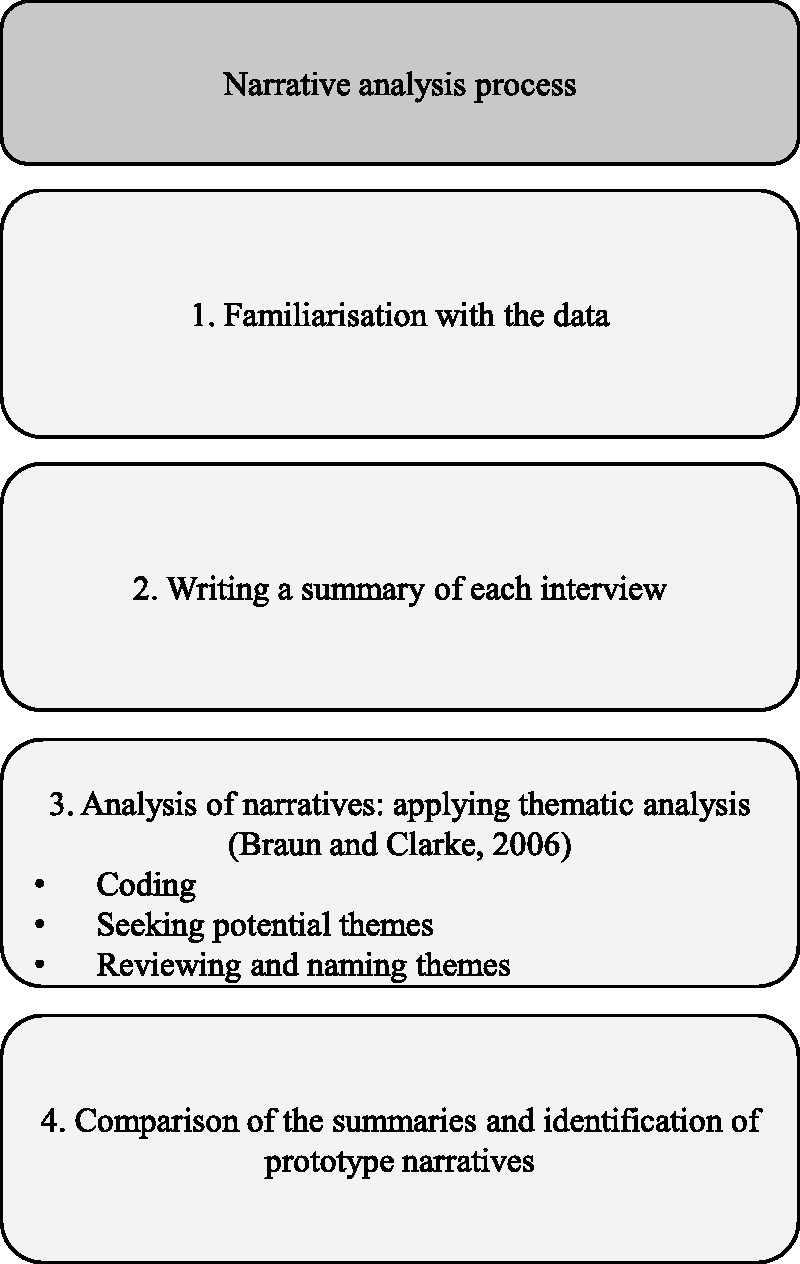
Data analysis process adapted from Polkinghorne, 1995, 1996.
In the first stage of analysis, the first author read the transcripts many times to gain an understanding of the ways in which the interviewees talked about their agency. In the second stage of analysis, summaries of all the interviews were written, concentrating on episodes where participants talked about their agency or its resources or restrictions. The goal was to generate descriptions and, at the next step, formulate coherent narratives of the participants’ agency from early childhood to the present and their views for the future. To identify manifestations of agency and resources for agency, attention was paid, for example, to the interviewees’ accounts of: exercising their own will to choose ways of coping with or changing their circumstances; experiences of being able or not being able to voice their views and make decisions for themselves; receiving support or not receiving support for agentic action; perceptions of having or not having the power to affect their circumstances; and engaging in actions to help cope with challenges or increase one’s sense of efficacy. In writing the summaries, an attempt was made to preserve the expressions used by the participants and to use a linear order of their life events.
At the third stage, ‘analysis of narratives’ was conducted applying the thematic analysis by Braun and Clarke (2006). In the analysis of narratives, researchers collect stories as data and analyse them with a paradigmatic process that results in descriptions of themes that hold across the stories or in taxonomies of types of stories, characters or settings (Polkinghorne, 1996). In the current study, summaries of episodes in which the participants talked about their agency or its resources and restrictions were complemented by participants’ verbatim comments specifying and describing the meanings they gave to their experiences. These meanings worked as codes and guided creation of the themes. Next, the first author generated potential themes by seeking recurrent codes and topics. The potential themes included, for example: building a safe place; rebellious norm-breaking behaviour; and approval seeking. The themes were found to vary at different phases of life. Thus, the analysis and the identification of recurrent themes were conducted separately for the following phases of life: (1) early childhood (ages three to six); (2) school age (middle school years, i.e., ages seven to 12); (3) later adolescence (years of lower and upper secondary schooling, i.e., ages 13 to 17); (4) after turning 18 years of age; (5) the present; and (6) the future. Next, the first author reviewed the recurrent themes. The main themes were identified, and the previously identified themes worked mainly as subthemes for them. The main themes represented different manifestations of agency such as maladaptive agency and seeking support from adults.
At the last stage of analysis, summaries were examined and compared with each other and, finally, four different narratives of agency were identified. Our aim was not to assign individuals to a certain agency narrative type but to identify prototypical narratives in participants’ accounts. Finally, the analysis was completed by exploring each prototypical narrative of agency to identify the themes of resources and restrictions and to examine them at different phases of life.
The four agency narratives differed from each other, especially those regarding the sense of agency typical for middle school age and later adolescence, those concerning the period after turning 18 years of age, as well as future prospects of agency. When presenting the findings in the Results section below, we will not focus on the agency of the two phases of life where differences were non-existent or minor, i.e., early childhood and agency at the present moment.
Results
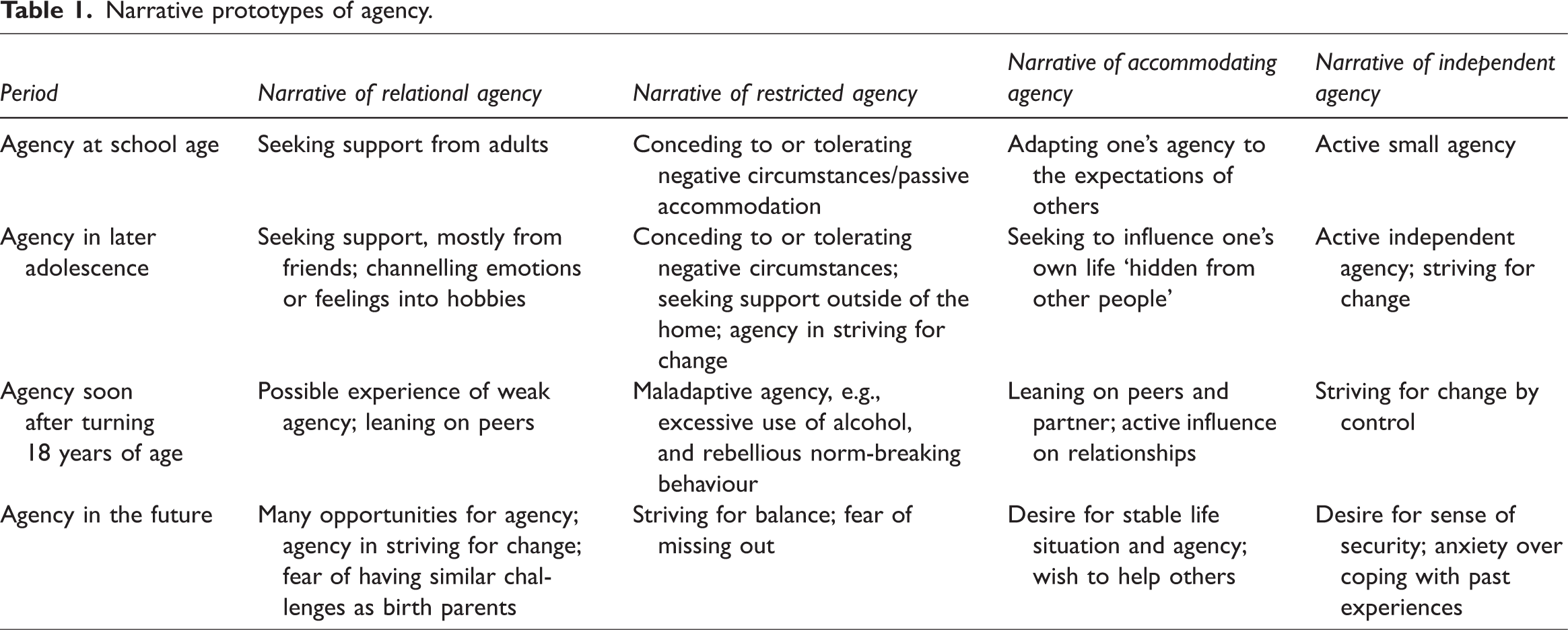
The participants’ accounts of their agency and its resources and restrictions showed differences across different phases of life. Four major agency narratives were identified: (1) Relational agency; (2) Restrictive agency; (3) Accommodating agency; and (4) Independent agency (Table 1). In the following sections, each narrative is presented in turn, and the resources and restrictions are discussed.
Narrative prototypes of agency.
Narrative Of Relational Agency
The narrative of relational agency was the most common (i.e., typically occurring) narrative prototype in the interviewees’ life stories as seven of the participants contributed to it. Relational agency manifested as active efforts to seek support from other people and lean on trustworthy members of their networks. The accounts indicated a perception of the social environment as being responsive to the individuals’ needs. At school age, agency was expressed by seeking social support mainly from adults such as (foster) parents, teachers or social workers. In other words, the participants contributing to this narrative had safe adults around them to lean on, and these adults functioned as resources for their agency. Constraints for agency typically took the form of challenges in interacting with birth parents and bullying by schoolmates. One participant described an incident of being bullied and solving the situation by talking to a trustworthy adult: It was not terribly serious bullying but something that you are sure to remember. It was like, you know, jeering and small name-calling … Not sure what I thought about it. I guess I was thinking whether I had done something wrong myself … But I understood already then and there that I had not done anything. The problem was that … that I do not … I do not go along with the crowd. Instead, I focus more on the school work … Finally, I told my mother about it at some point when she really pestered, dug up what was going on with me. Suddenly, ‘boohoo’. Then I told [the school] about it, and they reported it to the parents [of the bully] there. It stopped; he never apologised for it, but it came to a sudden end.
In later adolescence, the narrative accounts that exemplified relational agency revealed that individuals actively sought support from their peers or expressed and coped with negative emotions via hobbies. An example of the latter was an account of going to the stables to be with horses to get through difficult times: When there were difficult times, I went to the stables. There you can focus only on what you are doing right then and there … It is like a black hole where you can go and be in a bubble.
Agency of some participants of this prototype narrative were restricted by bullying, which limited their opportunities for participation and likely contributed to a diminished sense of being accepted by their birth parents and peers. Many interviewees also still had a difficult time communicating with their birth parents. One of them described how she decided to break off any contact with her birth parent after the parent repeatedly cancelled their meetings: It [the relationship] broke down here, as she, when there were appointments, she began to cancel even at a short notice. So we said with my siblings that now there are so many other things to do in one’s life that one does not need to wait for her to come for a visit … It has been in a way a good solution as there has not been any more waiting. But, of course, I have been in pain as the meetings stopped totally. We have not talked with her even by phone at this time [adolescence] other than supervised as she used to call us when she was drunk.
After ageing out of care, the typical way of showing agency in this narrative was seeking peer support, and some participants had successfully established responsive reciprocal peer relations. A few of the participants said that they were still having problems in relationships with a birth parent, and their agency was also restricted by the stress linked to difficulties in their studies or work or from a weak economic situation, which created fear and a sense of narrowing future prospects: … [I realised] That I have to take care of everything by myself. The money business and all … Suddenly, it was like, wait a minute, I am not getting on in the same way as before. It was an enormous change for me. Combining the tight economic situation with the cold fact that I did not do well at school because I did not have any energy to do any work there, and because it did not interest me at all. Bad grades and a tight economic situation … It becomes a stress ball … I was in bad shape physically … A friend of mine came to say ‘I am worried about you’ … But I had like a clear plan that in February, I’d get myself into shape, like in pretty good physical shape. Then I also decided that now I will now take care of the bills, I want the previous job back. Then I got them all worked out.
The participants saw possibilities for their future, many of them wanting just ‘an ordinary life’: I could summarise that into two words, ‘My future’. An ordinary life. I do not care if I have a lot of money … I hope I have people around with whom I can be myself, loved ones. And that basic needs are taken care of. Like just an ordinary life. I do not need anything more from life.
Some described striving for a change, which involved processing their childhood experiences or their relationship with a birth parent. This can be interpreted as reflecting on a sense of agency to transform their understanding of their past life and familial bonds. A couple of participants, however, feared that they would develop similar problems as their birth parents.
Narrative Of Restricted Agency
The narrative of restricted agency was the second most common prototype in the data as six of the participants contributed to it. Life stories reflecting this narrative indicated restricted capacities and resources to act, make changes or decisions, and affect one’s own life at both school age and later in adolescence and, in particular, being subject to strict rules or control in the school years. Two participants spoke about experiences of abuse at school age. Some indicated that they had conceded to or tolerated difficult conditions because they felt they had no choice: All the outsiders thought that I am safe there. And as late as when I was a fifth or sixth grader, I did not realise that this is not quite okay. There were a lot of acts of negligence and like mental abuse … In a place like that I did not even dare to think of anything self-destructive, or I did not dare to be angry or anything like that. There was such a stifling atmosphere.
In later adolescence, tolerating the prevailing living conditions was still typical as well as the experience that the possibility to direct one’s own life and make decisions, i.e., agency, was restricted. Support was sought from outside the home from friends. One interviewee sought to change the place of residence by applying to school in another city: When, after lower secondary school, everyone had to decide what to do, the only option in that small municipality was a certain upper secondary school. And it is not such a very good school. I started to work my way out of it tactically, and I said that I want to go to the city to upper secondary school. And it was a damn big effort to say that I will leave. It was accepted, but in a couple of months, the message was ‘Let’s move all of us there’.
After ageing out of care, many experienced a period of maladaptive agency. In this study, ‘maladaptive agency’ refers to activities or behaviours that prevent an individual from attaining constructive adaptation in various aspects of life. An activity or behaviour that is maladaptive for the individual represents an attempt to regulate affect and relieve or avoid stress, but it can be disruptive and rather increase distress or anxiety over time (Swerdlow et al., 2020; Ullman et al., 2013) and may be detrimental to both the individual’s health and relationships (Munson and McMillen, 2010). Maladaptive agency of the young adults in this study involved seeking acceptance from the wrong people and engaging in excessive use of alcohol and rebellious norm-breaking behaviours. Tense or even abusive relationships with people close to oneself or the loss of family members were also typical, which brought up difficult feelings regardless of the quality of the relationship: I am, like, you could maybe say codependent. And my dependence was directed to the people who utilised it without any shame. In a way, I knew what they were doing, but I did not have anything better. Or staying alone would have been so hellish that it was somehow better that there was at least someone, although that person hurt me … But I was quite lonely, and I went to work but I also drank quite a lot and went to parties and did many absurd trips.
Some views of the future within this narrative were hopeful but some involved fears: I am on a good way towards peace and a good feeling, but as all these things are always present in my life, I hope that I become more familiar with myself. And I hope that I will get rid of this bitterness. I am a bit afraid of the future as lately, in addition to my dead family member, there are two serious diseases among my relatives … future losses of my close ones scare me.
The desire for mental balance was highlighted in the future views, as the participants described past adverse experiences as still strongly affecting their agency. Notwithstanding their worries and fears, the young adults were hopeful and looked forward to their future.
Narrative Of Accommodating Agency
The third narrative was ‘accommodating agency’, which was contributed to by five of the participants. This narrative prototype was characterised by participants’ accounts of accommodating their actions to the wishes of others especially in middle childhood and adolescence. At school age, this meant striving to satisfy others’ expectations, such as pleasing others by putting their needs ahead of one’s own or by over-performing at school. Some participants spoke of challenges in communication with birth parents, which were related to disappointments regarding cancelled meetings due to the substance use of the birth parents, or too much or too little communication with them. Some participants expressed that the fear of being forced to leave the foster family created pressure to behave well and not be unkind to anyone: I have had, especially as a little child, a strong need to please others. But I have not had any adult whom I would have trusted in a way that I would have been able to tell everything to him or her.
In later adolescence, the narrative of accommodating agency was linked to a need to keep personal feelings or experiences to themselves, not share them with others and still accommodate others’ expectations. Agency in the form of making personal choices affecting one’s life could be expressed, for instance, through writing a diary or using bodily control, such as dieting or exercise: I have been keeping a diary so that now I am on the 18th diary. Almost a book per year. The first ones I may not want to read yet. It is not processing of life as such, but writing has just become the thing for me. For many years, I could not talk about things [that happened] after the placement into foster care, but I wrote [about them].
After ageing out of care, life stories characteristic of this narrative involved seeking relational support from one’s partner and peers, who also had histories of foster care. A major decision at this phase concerned whether and how to be in contact with a parent towards whom the relationship carried tensions. The narrative of accommodating agency also involved a stated wish for permanence of the current life situation and a desire to help others who were dealing with similar issues: I would just like our life to stay like this so that nothing bigger would come. And sometimes I have thought that it would be nice to be a support person for someone [who is in foster care] or to somehow be involved in the process.
Narrative Of Independent Agency
We named the fourth narrative ‘independent agency’. In this agency prototype, the participants showed independence and self-reliance from an early age, whereas leaning on other people was not as typical as in the other three narratives. At school age, this narrative involved active small agency, meaning actively seeking to leave unsafe situations, building a safe place in the midst of mayhem or venting feelings through creative work. A couple of the participants had factors constraining agency, however, such as experiences of abuse. For all the participants of this narrative, the possibility to do something alone, such as going to the forest or immersing oneself in writing, functioned as a coping resource. One participant described her typical way of escaping unsafe situations: As a little child, I had a habit that every time when I was scared, I built a hut under the table . . Until later … when father found out about it, I could not keep it anymore. But I usually built it for a while anyway, and later I learned to keep it only for a little while.
In later adolescence, active independent agency was manifested by striving to consciously affect one’s own behaviour and wellbeing, for instance, by going to therapy. Actually, all four participants who contributed to this narrative had sought professional support as a means of facilitating agency in enabling personal development and change. One of the participants also told of purchasing a book with her father, which helped her to affect her unwanted behaviour: I remembered when I asked my father if I could go and buy a book. I had checked that there was such a shop … It said there that you can open whatever section you want and keep it as a quote of the day. I took more than one sentence and wrote them down and set the notes on the door of my wardrobe. I decided that I will read one each day and the next day another one. When the next grade began, I was clearly calmer.
In adolescence, a couple of participants still experienced violence, which possibly brought about instability, constrained development and an inability to maintain close relationships.
After turning 18 years of age, the participants typically sought to bring about changes by creating routines, regulating their use of alcohol or making decisions according to their resources: I did not apply for any school in the first year as in that life situation I could not go to the entrance exam, so I went there the next year. And I got in the first time to the higher education institution … I totally refused to take, for example, alcohol … And I am still very strict with regard to it; if I have a rough patch, I do not drink alcohol.
Some participants said that they had only small supportive networks, which had not been able to provide sufficient support in times of crisis. Daily routines such as studying or going to work provided predictability, certainty and a sense of control supporting their agency. Future views of the participants involved wishes for security and balance. They expressed concerns about how past experiences would affect their relationships, wellbeing and capabilities to steer their lives in meaningful directions in the future: I do have this thing [uncertainty] about whether I can ever build long-lasting relationships because of experiences of being abandoned, and it has a strong influence … And as I am kind of an introvert, I have been thinking of how to be with other people. I do also think if I ever want to have my own family.
Discussion
This study examined the narratives of agency of 18 young adults with histories of family foster care. Four narrative prototypes were identified, which included different resources and restrictions for agency at different phases of life.
The young adults who represented the narrative of relational agency typically had access to and utilised social resources for agency. They had safe adults and peers around them throughout their life course, which had made it possible to trust and lean on others who were responsive to their needs. Similar results were found in Gundersen’s (2020) research, where the agency of foster care youth was strongly interactionally shaped, and they were active in asking other people to help them, for instance, in relationships or in more practical matters, such as asking caregivers to help them work out a study plan. For the young adults of this narrative, foster family relationships were likely to work as new attachments for them, which helped them to trust other people, such as their friends (Cole, 2005; Dozier et al., 2001; Stovall-McClough and Dozier, 2004). Some young adults experienced weak agency after ageing out of care, which may stem from their early adverse experiences (Barber and Delfabbro, 2009; Riebschleger et al., 2015) or their challenges with stress management (Gundersen, 2020). In addition to early adverse experiences, a tense relationship with a birth parent may have caused them to fear having similar challenges such as alcohol abuse or violent behaviour (Lundström and Sallnäs, 2009; McWey et al., 2010; Tahkola et al., 2020). The future views of the narrative of relational agency were mainly positive, as it could be interpreted that these youth probably had sufficient social resources supporting their agency. These findings underscore the idea of linked lives (Elder, 1994), which emphasises the crucial role of the social relationship networks in which one’s life is embedded.
The young adults representing the accommodating narrative showed their agency by adapting to others’ wishes, especially in their childhood and youth. According to attachment theory (Ainsworth et al., 1978; Sinkkonen, 2004), pleasing others and suppressing emotions and needs to gain acceptance and feel safe may stem from insecure attachments. Suppressing emotions and needs can also work as a coping strategy (Phanichrat and Townshend, 2010). Crittenden (2001) points out that mistreated children can react to their parents’ violence with this kind of compulsive adapting, such as by pleasing or withdrawing. In addition, children who have been placed several times may be afraid of leaving the current placement and, thus, try to adapt and behave as well as possible. These young adults brought their own voices out gradually, first by showing agency, which other people may not have seen, and then by leaning on a peer or partner. Early adverse experiences influence later relationships, and for these youth, trusting others may have taken time (see Ainsworth et al., 1978; Bowlby, 1973, 1982; Howe et al., 1999; Sroufe et al., 2005). The future views of these young adults included a desire for permanence of their current life situation and agency. Several changes and the time needed to build confidence with close ones may also affect the wishes for permanence and predictability.
The young adults who represented the narrative of restricted agency had minor possibilities to show agency, especially in childhood and youth, mainly due to restrictions set by their close adults. Honkasalo (2013) brings out the concept of ‘small agency’, which refers to this kind of ‘silent’ but active agency, such as waiting or tolerating. Some of these participants utilised the agency of striving for change in youth, but their agency strivings were often suppressed inside the home where they had a tense relationship with a foster parent (Andersson, 2005; Tahkola et al., 2020). A period of maladaptive agency was typical for the young adults who represented restricted agency. In their research, Rebbe and colleagues (2017) identified that adversity experienced within the home combined with environmental adversities led to problem behaviour in early adulthood, which stemmed from a lack of self-regulation due to an accumulation of stressors. According to Haravuori and colleagues (2013), behind the maladaptive behaviour of foster youth is often a sense of insecurity and a need to provoke and defy expected and socially accepted behaviours and conduct. Edmond (2003) and her colleagues found that foster care youth who had been sexually abused had significantly more mental health and behavioural problems than other youth in care, which may explain the maladaptive agency of those who had experienced sexual abuse. The young adults of this narrative may have been missing feelings of being accepted or loved, and their previous experiences, and perhaps their insecure attachments, may have affected their need to seek acceptance from people who were unsafe for them (Magai et al., 2000).
The young adults representing the narrative of independent agency utilised forms of agency that did not include leaning on other people. Some of these participants had experienced violence or abuse caused by close adults, thereby restricting their agency. Independent agency strivings of this narrative may stem from situations in which the young adults had no safe adults to trust as resources for their agency. On the contrary, most of them had acted as young carers at an early age, taking care of their siblings or parents (Aldridge, 2006; Howe et al., 1999). Utilising independent forms of agency may also reflect these young adults’ difficulties in forming meaningful relationships. The influence of past experiences on agency in the future (Emirbayer and Mische, 1998) is evident in the views of this narrative. The young adults desired a sense of security, and they feared the effect of past experiences on their future agency.
Taken together, the findings of this study show young adults with foster care backgrounds as active agents in exercising agency in their childhood and youth. Nevertheless, these children and young people had difficulties in constructing their agency in constraining circumstances. The young adults encountered challenges differently, and this was affected by both their individual resources and restrictions (Bandura, 1989, 2006) and those of their environment (Edwards, 2005; Eteläpelto et al., 2013; Hökkä et al., 2017; Vähäsantanen, 2015). Agency seems to be a prerequisite for constructing resilience (Cicchetti and Garmezy, 1993; Masten et al., 1990; Rutter, 1987; Werner and Smith, 1982), as besides support from the environment (Ungar, 2011), resilience seems to require the individual’s own activity. In the present study, young adults’ activities and efforts to be resilient were visible in all the narratives of agency and in all life circumstances. Thus, support should be constructed in such a way that children and youth have possibilities to actively influence their lives and decisions. Nevertheless, while not all forms of agency, such as aggressive behaviour, may strengthen resilience, they can work as coping strategies for the individual in that moment (Tahkola et al., 2021). Individual agency resources are also important because even a responsive and supportive environment is not always able to sufficiently help the child or young person if they make choices that do not support their wellbeing. The future views of young adults showed the influence of past experiences on agency in the future (Emirbayer and Mische, 1998); for example, past adverse experiences caused concern about their influence on future relationships and wellbeing. In the findings of the present study, it is visible as in Elder’s (1994) life course theory that young adults with foster care backgrounds are active agents in influencing their life and agency, and their agency is linked with other people through relationships. In future research, it would be interesting to see if the timing of life events, such as entering care, affects agency, as in the present study most of the participants who had entered care in early childhood represented the relational agency narrative prototype.
This study has a few limitations, which are important to take into consideration. Firstly, all of the participants in this study had some experience of family foster care, and so the results could possibly be different among young adults with different placement backgrounds. Secondly, the young adults represented different ages, the youngest being 18 and the oldest 32 years of age. Being at different phases of life may have affected how the participants narrated and reflected on their experiences and views of agency in the past, present and future. Thirdly, we acknowledge the potential bias in the narrative due to more females than males volunteering to be interviewed. However, no obvious gender differences were identified regarding the ways in which young adults talked about their agency. Fourthly, reflecting on early experiences in an interview may be difficult for some individuals, and recounting experiences retrospectively after a long time may affect the narrative. Fifthly, all the participants of this study were willing to tell their stories on a voluntary basis. The results may have been different if data had been collected from young adults, for instance in the context of social protection and foster care services. Research evidence indicates that children and young people in foster care are at greater risk of dropping out of school and being socially excluded (Jahnukainen, 2007; Lee and Ballew, 2018; Pecora et al., 2006). All participants in this study were either studying, at work or on parental leave, however, indicating that they possessed at least some degree of access to social networks, education, and employment-related resources and opportunities. To gain a better understanding of the agency of children and young people in foster care, future research will need to include broader samples to allow an analysis of potential gendered and cultural differences in the ways in which they exercise agency as well as the resources and restrictions that affect it.
In conclusion, the contribution of the present study is that it explored agency and its resources and restrictions among individuals with foster care backgrounds. We identified four agency narratives typical to foster care children and youth, which may inform caregivers and professionals to help them understand opportunities and constraints for agency and the behaviour of these children and young people at different phases of their lives. This knowledge can help them to be responsive to the needs of foster care children and youth and to better support them in striving for agency. Furthermore, fostered youth and older people with foster care backgrounds may also become more aware of and reflect on their own experiences of agency, which may be important for them in dealing with their childhood experiences.
Footnotes
Declaration of conflicting interests
The author(s) declared no potential conflicts of interest with respect to the research, authorship, and/or publication of this article.
Funding
The author(s) disclosed receipt of the following financial support for the research, authorship, and/or publication of this article: Alli Paasikiven Säätiö; Emil Aaltosen Säätiö 180 246; University of Jyväskylä.
