




Abstract
A growing body of literature has consistently shown how adopted children often have previous history of trauma and neglect, and in turn develop negative representations of the self and others. This study assesses the internal representations of three groups of children, as measured by the Story Stem Assessment Profile (SSAP). These were: (1) a maltreated, late-adopted (MLA) sample (n = 63); (2) a non-maltreated, early-adopted (EA) sample (n = 48); and (3) a non-maltreated community sample (COMM) (n = 80). In addition, it examined whether MLA and EA adopted children’s attachment and internal representations changed over time. Results showed that children in the MLA sample significantly displayed more disorganised, avoidant and negative representations and fewer representations characteristic of ‘secure’ attachment when compared with EA and, especially, COMM children. Longitudinal follow-up of both MLA and EA samples demonstrated significant changes over a two-year period in SSAP representation; secure representations increased while the avoidant and disorganised ones diminished. These findings are discussed and the limitations and implications of the study presented.
Introduction
While it is not surprising that the early experiences of adopted children have been found to affect their ability to form relationships with carers, the process of adoption itself has been linked to increased psychological vulnerability (Lindholm and Touliatos, 1980). Pertinent to understanding this relationship is Bowlby’s evolutionary theory of attachment (1980; 1982) as it incorporates the nature of childhood early experiences and subsequent relational patterns. It argues that children come into the world biologically pre-programmed to form close affectional bonds that become a fundamental platform for the child’s emerging self-concept and view of the social world. Thus, attachment leads to internalised representations of the ‘self’, ‘other’ and the ‘relationship’ based on a child’s interactions with the main caregiver.
Accordingly, securely attached children use the attachment figure as a safe base to explore the environment and are reassured and comforted by the caregiver in times of distress (Main and Cassidy, 1988). Insecure-avoidant children show lack of confidence in the caregiver’s availability. Anxious-resistant infants manifest poor exploration and play, display high levels of distress when separated from the caregiver and are not easily comforted by the reunion. Resistant attachment has been linked with caregivers who inconsistently respond to the infant’s needs and signals of distress. Finally, disorganised-disoriented infants do not have a consistent strategy; they may exhibit a mix of avoidant and resistant behaviours, but the main theme is one of confusion and anxiety (Main and Solomon, 1990).
Research has consistently provided evidence that children who experience abusive or insensitive caregiving are likely to develop insecure attachments (Stronach, et al., 2011) and negative representations of themselves (Toth, et al., 1997) and of their parents (Grych, Wachsmuth-Schaefer and Klockow, 2002; Page, et al., 2011). Attachment theorists have suggested that for these children, there exists an ‘irresolvable paradox’ in their internal representations, leading to the child exhibiting bizarre and disorganised attachment behaviours (Ensink, et al., 2019; Hildyard and Wolfe, 2002; Vasileva and Petermann, 2018).
One of the most frequently examined risk factors in the field of adoption research concerns the child’s age at placement. Several studies have found late adoption to be associated with a greater likelihood of socio-emotional, behavioural and adjustment problems (Hornfeck, et al., 2019; Rushton, Treseder and Quinton, 1995), but it is difficult to decide how much of this is due to the ‘lateness’ of the adoption or the enduring effects of earlier adversity. Many late-adopted children developed a previous attachment bond with their birth family and some older ones have experienced disrupted foster care placements or failed family reunions, both of which seem likely to limit their ability to form new relationships with adoptive parents (Singer, et al., 1985). 1
There has been much variation across studies in the parameters for what cut-off age constitutes a late placement adoption; often it is 12 months but many studies have used much older ages (e.g. > 4 years). Research has shown that the age at placement is an important predictor for adoption outcomes. In cases where separation is necessary, it is considered to be less harmful if it occurs in the first 12 (or even better six) months of a child's life. Barth and Berry (1988) found that only one percent of infant adoptions disrupt, while adoptions of children aged three to five are 10 to 12 times more likely to do so. Some researchers use the criterion of either side of the age of 12 months as an indicator of increased risk for more pronounced developmental impairments, particularly in terms of social, behavioural and emotional development (e.g. Stams, et al., 2000).
Contemporary research has consistently provided evidence for the benefits of using narratives as a gateway into children’s internal working models. Studies have demonstrated that there is a connection between the quality of relationships in a child’s life and the nature of their narratives (e.g. Dubois-Comtois and Moss, 2008). They appear to reflect attachment relationships and provide insight into children’s capacities for emotional regulation (Appelman and Wolf, 2003).
Story stem research has explored a diverse range of areas, including attachment (Granot and Mayseless, 2001; Green, et al., 2000; Hodges, et al., 2003; Oppenheim and Waters, 1995) and family functioning (Bretherton, Prentiss and Ridgeway, 1990; Poehlmann and Huennekens, 2003).
However, until recently, there have been few studies using story narratives on clinical populations. Yet, the story stem paradigm has been found to be particularly promising in research involving maltreated children (e.g. Shields, Ryan and Cicchetti, 2001). Interestingly, some researchers have found that abused children sometimes hold grandiose representations of the self and have explained these as a defence against the caregiver’s emphasis on their negative attributes (Toth, et al., 2000). Studies have also found that maltreated children display more avoidant behaviour in their narratives when compared to non-maltreated ones (Grych, et al., 2002; Hodges, et al., 2003). In addition, there is often a failure to acknowledge the conflicts presented in the story stem, as well as a lack of resolution or reparation of the dilemma (Buchsbaum, et al., 1992). Toth and colleagues (2000) also noted that maltreated children tend to be less responsive and more controlling towards the individual presenting the stories.
As Crittenden (1988) pointed out, attachment models may be adaptive in one situation, but maladaptive in others if conditions change. Children arrive at their new adoptive families with their scripts – what Bowlby defined in his trilogy Attachment and Loss (Bowlby, 1980; 1982) as ‘internal working models’ – and may initially perceive other attachment figures as repeating past experiences, thus confirming and strengthening the child’s current model
Although there is now quite a lot of research evidence about attachment generally, much less is known about the effect of adoption on children’s attachment representations. Only a few studies have assessed their attachment across time. The few that are available show that once removed from an adverse environment, many early- and late-adopted children are able to benefit from the ‘good-enough environment’ of their new homes and make developmental progress (Barone and Lionetti, 2012; van IJzendoorn and Juffer, 2006). Similarly, Hodges and colleagues (2003) explored children’s representations in a sample with a history of serious maltreatment, following them longitudinally over the first two years of placement. The narrative assessment provided a detailed picture of the impact of the earlier abuse and discontinuity of care. They found that the children showed more negative representations of parents and children, lower security and greater disorganisation and avoidance than non-maltreated children adopted in the first year of life. A similar pattern was observed in the children’s trajectories (Pace, Zavattini and D'Alessio, 2012). The security and positive themes increased over the course of two years in placement, partly reflecting the attachment organisation of the adoptive parents; however, other effects of earlier adversity persisted.
The current study
The discussion of the background literature confirms the value of using narrative approaches to assess children’s attachment styles and internal representations but identifies a dearth of research that compares those adopted early and late and those living with their birth families. This study aims to fill this gap and has the following two aims:
to explore whether there are differences in attachment and internal representations between (a) late-adopted children (MLA) with known previous adversity, (b) early-adopted children (EA) with no known experience of maltreatment and (c) a community sample of children (COMM) raised with their birth parents and with no known maltreatment; to assess whether adopted children’s attachment and internal representations change over time. This aim examines both the MLA and EA samples; for the MLA sample, it explores whether the Story Stem Assessment Profile (SSAP) representations change following the progression of the stable new placement, while for the EA sample, it explores whether any change occurs after adoption.
Hypotheses
The study seeks to use the information gathered to test the two hypotheses:
Children in the COMM sample would have higher scores on the Security SSAP construct and lower scores on Defensive-Avoidance, Insecurity and Disorganisation, compared to EA and especially MLA children. It is expected that children in the EA sample will have scores that lie in between the MLA and COMM samples. Children in both adopted samples (MLA and EA) will be expected to increase Security scores and decrease levels on the Defensive-Avoidance, Insecurity and Disorganised constructs over the three time points.
The late-adopted definition in this study is aligned with that of Rushton and Dance (2006) who investigated the adoption outcomes for children who were late placed (between 5 and 11 years old). This was modified for the study in order to capture children over the age of four years who would be able to manage the SSAP while nine years was the upper age parameter for such an assessment to be carried out.
Method
Setting
This study reports on 191 children from three different samples: a maltreated, late-placed sample (MLA, n = 63), a non-maltreated, early-placed sample (EA, n = 48) and a non-maltreated, non-adopted sample (COMM, n = 80). The MLA and EA samples formed part of the Adoption and Attachment Study (Coram Family/Anna Freud Centre). The COMM sample is a closely matched subsample from the SSAP Standardisation Study (as reported in Hillman, 2011).
Eligibility
Due to the exploratory nature of the project, inclusion criteria for each of the samples were kept broad and are as follows:
MLA sample: (a) children aged between four to nine years at the time of placement; (b) with previous experience of adversity; or (c) having been placed in an adoptive family for no longer than three months at the time of assessments. EA sample: (a) children aged four to nine years; (b) no previous experience of maltreatment or neglect; (c) children adopted in infancy (<12 months). COMM sample: (a) children aged four to nine years; (b) living with their birth family; (c) no previous reports of adoption, discontinuity and maltreatment.
Recruitment
The adopted children (EA and MLA) were recruited through five adoption agencies and two social services departments in the UK. Prospective and current adoptive families were approached by the respective agencies once both parents had been approved and asked whether they wished to participate. Non-adopted children (COMM) were recruited through local primary schools across five boroughs in Greater London. Following initial agreement from the families to participate, the families were given consent forms accompanied by written information about the nature of the study.
Data collection
The COMM sample was only assessed at one time point, while after the first assessment (T1) adopted children from both MLA and EA were assessed on two more occasions – one year (T2) and two years after the first assessment (T3).
The first assessment time point (T1) took place after recruitment for the COMM and EA samples, provided the child was in the age bracket (4–9 years) and, for the MLA children, when he or she had been in placement with his/her adoptive family for approximately three months. This time period seemed a realistic baseline of the child’s internal world given that it would not always have been appropriate to carry out the assessment immediately after the placement.
Measure
The SSAP (Hodges and Hillman, 2007) is a narrative approach that not only provides information about children’s attachments, but also allows the assessment of children’s perceptions and expectations of family roles and relationships. Children are given the beginning of a ‘story’ highlighting everyday scenarios with an inherent dilemma, and then are asked to tell what happens next. They are not asked direct questions about their family as this might cause them conflict or anxiety. The SSAP comprises a total of 13 stories, administered to each child individually. The first five were developed by the second author (Hodges, 1992) while the remaining eight stories were selected from the Macarthur Story Stem Battery (MSSB; Bretherton, et al., 1990).
The SSAP coding requires assigning a score (0, 1 or 2) on 39 different codes (themes) across the 13 different stories. These codes are associated with four conceptually derived constructs: Security, Insecurity, Defensive-Avoidance and Disorganisation. Security is a composite of all the individual positive child and adult representation codes (e.g. adults providing help, siblings/peers helping). Insecurity is a composite of all the individual negative child and adult representation codes (e.g. adults actively rejecting, child endangered). Disorganisation is a composite of all the more extreme responses, often more present in ‘at-risk’ populations (e.g. extreme aggression, bizarre/atypical responses). Defensive-Avoidance is a composite of all the different strategies that children may adopt when struggling to manage the stories or task itself (e.g. disengaging, premature foreclosure). Scores on constructs are formed by summing the relevant codes that make up the constructs divided by the number of stories (13). Security is made up of nine codes, Insecurity of seven codes, Defensive-Avoidance of eight codes and Disorganisation of seven codes. Higher scores on the construct indicate a stronger amount of codes that make up that construct.
The SSAP has proved to be a valuable and non-intrusive tool for examining young children’s mental representations of attachment and relationships, both in research and clinical practice. The constructs display satisfactory internal reliability (k = 0.72, 0.60 < 0.79), suggesting that the codes were internally consistent across the stories (Hillman, 2011).
The SSAP assessments took place either in a quiet space in the family home or at the Anna Freud Centre. They were carried out by the author and two postgraduate researchers who then transcribed the videotapes of the sessions. Inter-rater reliability (IRR) was also established between the author and two postgraduate researchers on a random sample of 25 children’s sets of 13 stories. The reliability set of cases was across the three samples and each coder rated them ‘blind’. IRR between author and both researchers was satisfactory (k = 0.81, 0.66 < k < 1.00) (Hillman, 2011).
Ethical approval
Ethical approval was obtained from the Institute of Child Health Ethics Committee and the Joint Ethical Committee of University College London. Participating adoptive parents gave consent after being informed about the study. Separate, age-appropriate information sheets were given to the children. Children’s story stems were video-recorded and complied with data protection laws. Although the SSAP did not involve questions to children about themselves, precautions were in place should any specific story stem cause them discomfort.
Data analysis
Initially, descriptive statistical analyses were carried out on all three samples (MLA, EA, COMM) charting both basic demographic variables and SSAP construct scores. Since participants in the study were not randomised, further analysis was undertaken to see if there were any differences in the age and gender distributions across the samples and to see whether these variables needed to be controlled for in subsequent analyses. To assess whether there were any differences in the rate of each SSAP constructs (Security, Insecurity, Disorganisation, Defensive-Avoidance) across sample, a series of four one-way ANOVAs were conducted for each construct separately. Furthermore, to examine whether adopted children’s internal representations changed over time, a series of mixed measures ANOVAs were run on the four constructs for the two adopted samples (MLA and EA). While the SSAP transcripts were not qualitatively analysed, some examples from them are reported to illustrate and complement the quantitative findings.
Results
Descriptive
The MLA sample consisted of 63 children aged between four and nine. According to social work records of each child’s pre-placement history, they had experienced a wide range of maltreatments: 46% had been physically abused, 91% neglected, 89% emotionally abused, 30% rejected, 26% suspected sexually abused and 68% had witnessed domestic violence. Furthermore, they had experienced an average of 4.92 (sd = 2.61, range 1 to 18) changes in caregiving prior to adoption.
The EA sample comprised 48 children, aged between four and nine years old, adopted within the first 12 months of life and with no known experience of adversity or maltreatment. The community sample (COMM) consisted of 80 children within the same (4–9) age bracket and who were living with their birth parents. They had no known experience of maltreatment, discontinuities or contact with either clinical or social services. Demographic information for all samples is displayed in Table 1.
Sample demographics.
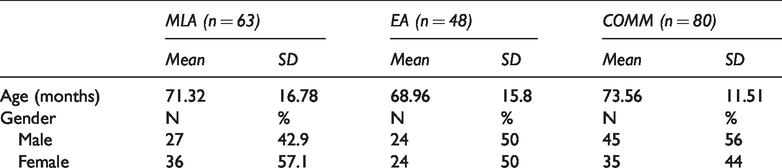
A Chi-square test was conducted to determine whether an equal number of males and females were recruited across the three samples. This showed that the distributions of boys and girls were even across them (χ2 (20) = 2.531, p = 0.331). In addition, a one-way ANOVA was conducted on age at T1, which again displayed no significant differences between the three samples (F = 1.503, 2, p = 0.469). Therefore, age and gender were not controlled for in subsequent analyses.
Hypothesis 1: SSAP differences between three samples
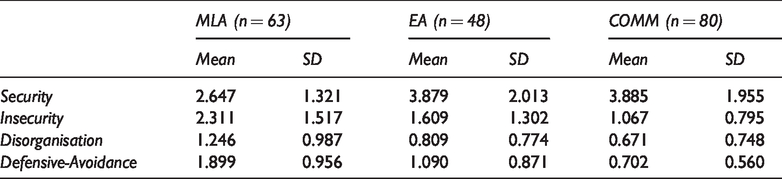
Table 2 displays construct mean scores for the three samples. On average, children in the MLA sample showed the lowest scores on Security and highest on Insecurity, Disorganisation and Defensive-Avoidance. Conversely, the COMM sample had the highest scores on Security and the lowest scores on Insecurity, Disorganisation and Defensive-Avoidance. The EA sample mostly presented scores that lay in between those for the MLA and COMM samples.
Mean and standard deviation (SD) for each of the SSAP constructs across the MLA, EA and COMM samples.
One-way ANOVA was carried out on each SSAP construct separately in order to examine whether there were any meaningful differences in the internal representations of children across the MLA, EA and COMM samples. As shown in Table 3, differences between the samples for each of the SSAP constructs were found to be statistically significant.
SSAP construct differences between MLA, EA and COMM samples.

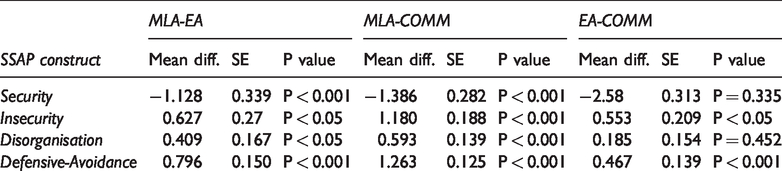
Bonferroni post-hoc analysis (see Table 4) revealed that the representations of children in the MLA sample were significantly different on all four constructs to the representation of children in both the EA and COMM samples. Specifically, they showed significantly higher scores in the Insecurity, Disorganisation and Defensive-Avoidance constructs and significantly lower ones on Security. Children in the COMM sample had the reverse constellation of scores. Children in the EA sample remained somewhere in between the MLA and COMM. However, while the differences in the rate of Insecurity and Defensive-Avoidance were statistically significant, the differences in the rate of Disorganisation and Security between the EA and COMM samples were not.
Post hoc differences between samples on SSAP constructs.
SSAP vignettes
As the Security construct reflects positive representations of both the self and ‘other’, it is not surprising that the children from maltreated backgrounds were more readily using less in the way of Security representations when responding to the conflicts in the various stories. A more qualitative illustration of the sample differences can be found in the stem ‘Picture from School’, in which a child brings home from school a picture they are pleased with.
A five-year-old girl in the MLA sample responded to this by saying: ‘No one was at home when Lucy came in.’ Interviewer: ‘So what happened?’ ‘They all played a game and threw the sofa.’ Interviewer: ‘So what about the picture Lucy did at school?’ ‘Don’t know.’ Interviewer: ‘Did anyone say anything about it?’ ‘No, they were too busy watching telly.’ Interviewer: ‘So what happened then?’ ‘Daddy threw it away and thought it was rubbish.’
Interviewer: ‘What happened then?’ ‘Later, she went back to school and did another drawing and brought it home and the little sister found it and ripped it. Their mother told off both girls and they both created new drawings.’ ‘Wow, Lucy, that’s beautiful, can we put it up on the wall?’ They put the picture on the wall and thought it was so good that they entered a competition.
Furthermore, both the Insecurity and Disorganisation constructs were statistically significant between the three samples. Perhaps, this is best illustrated in the stem ‘Lost Pig’, in which a little pig goes for a walk away from its family and all the other animals and gets lost.
A seven-year-old boy in the MLA sample responded to this by saying: ‘The little pig never got lost as he flew home – look, he’s home. Then the crocodile is shown grabbing all the baby animals (piglets, calves, camels) and killed them. The big pigs came to look for them but the crocodile gave them back to him but they were already dead.’ The crocodile chased him all over and the pig got even more lost and no one knew where he was. Then, he shows the other little animals (one by one) going out to look for the pig but getting lost and chased by the crocodile. In the end, the big pigs and cows went out looking and rescued them. ‘The little pig then was lost but he saw the camels and followed their footprints there … He asked them how to get back to his pig family. They told him to go this way … then he saw the footprints and found his way back home.’
Hypothesis 2: Longitudinal stability of the children’s attachment and internal representations
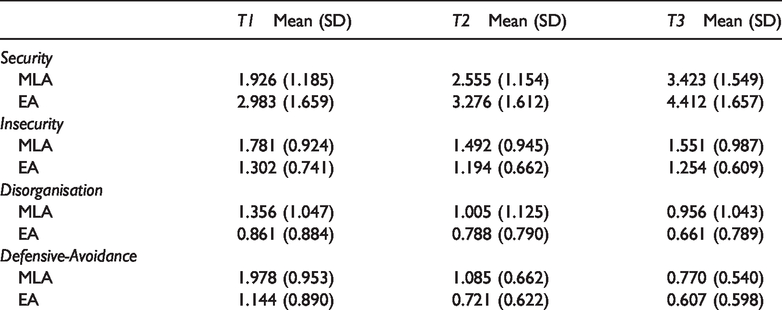
Table 5 displays the mean and standard deviation on each of the four SSAP constructs at the three time points for both MLA and EA samples separately. In both samples, the mean score on the Security construct showed an increase over time, while both Disorganisation and Defensive-Avoidance mean scores decreased. In both samples, the mean score on the Insecurity construct decreased from T1 to T2 but showed a slight increase from T2 to T3.
SSAP construct descriptive for MLA and EA at T1, T2 and T3.
A series of mixed ANOVAs was carried out on the two adopted samples (MLA and EA) to determine whether the changes in the children’s internal representation were statistically significant. For this analysis, ‘sample’ was used as a grouping factor. As shown in Table 6, there was a statistically significant effect of ‘time’ in three out of four SSAP constructs. Here, children across both samples increased Security and reduced both Defensive-Avoidance and Disorganisation. There was, however, no interaction of ‘sample’ and ‘time’, meaning that any changes in the four constructs were consistent and not significantly different in both the MLA and EA samples.
Differences in SSAP constructs in MLA and EA samples at three time points.
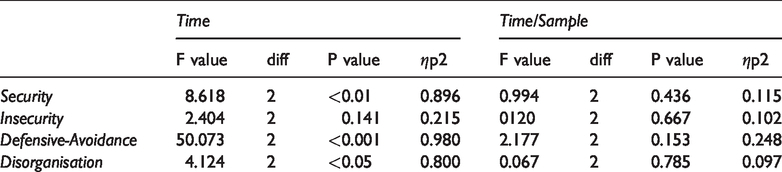
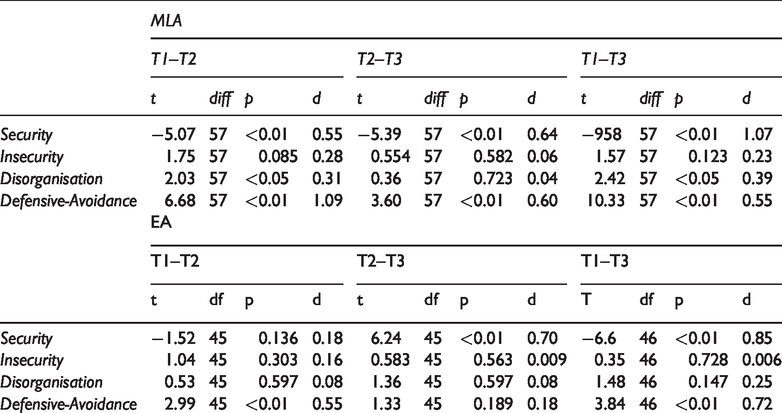
A further set of paired samples t tests were conducted on the four constructs to examine in both MLA and EA samples separately whether these differences occurred from T1 to T2, from T2 to T3, and from T1 to T3.
Table 7 displays that from T1 to T2, the MLA sample showed a statistically significant finding in three out of the four constructs (Security, Defensive-Avoidance, Disorganisation) while only Defensive-Avoidance diminished significantly in the EA sample. From T2 to T3, in the MLA sample Security significantly increased while Defensive-Avoidance reduced. The remaining constructs did not significantly change. Within the EA sample, only Security demonstrated a significant increase. Finally, changes over two years from T1 to T3 were strongly significant for Security (increasing) and Defensive-Avoidance (decreasing), and less so for Disorganisation. In the EA sample, changes were present for just Security (increasing) and Defensive-Avoidance (decreasing).
Post hoc differences in SSAP constructs at three time points in MLA and EA samples.
It is useful to illustrate these changes with further SSAP vignettes. In the following example, a child in the MLA sample demonstrated a more coherent improvement across all dimensions with reduced Avoidance and Disorganisation representations and increased Security representations.
In the story, ‘Mum’s Headache’, a child is sitting with his or her mother when she says that she has a headache and asks the child to turn off the television so that she can lie down. Then, there is a ring at the door and it is the child’s friend who asks to watch a programme on the television.
At T1 (within 3 months of adoption), a five-year-old girl in the MLA sample responded to this by saying: ‘Yeah, you can come in and watch.’ They went in and watched TV and it was really loud. Interviewer [prompting as Mum figure): ‘Oh, I told you I had a headache, I wanted some quiet!’ They take Mum and carry her into the bedroom and she’s okay now. They watch the rest of the programme. ‘No, I don’t think I can watch the programme as my Mummy has a headache but maybe we can watch it in my room.’ So, the girls go upstairs and watch it in their room and then Mummy gets up and she’s better now and tells the girls that they can come downstairs to watch the programme.
Discussion
This study has explored how children’s internal representations, as measured through the SSAP, differed in three samples: (a) a normative community sample (COMM) of children who were living with their birth parents and who had not been referred to clinical services; (b) an early-adopted, non-maltreated (EA) sample of children who were living with their adoptive parents (who had been placed at less than 12 months); and (c) a late-adopted (MLA) sample of children who had experience of maltreatment and had spent the first four to eight years of their lives living in multiple care placements before being placed with new adoptive parents. Overall the findings support the study’s first hypothesis: MLA children showed significantly less positive and prosocial representations and far more negative and insecure, avoidant and disorganised representations compared with the COMM and EA samples. The COMM sample had the lowest Defensive-Avoidance, Insecurity and Disorganisation representations while having the highest numbers of Secure ones. The EA sample fell between the COMM and MLA samples, as illustrated by the SSAP extracts.
The fact that children from maltreated backgrounds were more readily using a range of different avoidance strategies when confronted with the different stem conflicts suggests that early experience of abuse leads to the avoidance of contact with the attachment figure and this can be seen as a defensive strategy to protect the self from the possibility of further abuse (Kaufman and Cicchetti, 1989; Riggs, 2010). These results support previous research that has used story stems and found that maltreated children tend to display avoidance and defensive manoeuvres (e.g. Grych, et al., 2002; Hodges, et al., 2003; Macfie, et al., 1999). But although such behaviours are adaptive in an abusive environment, they are likely to cause complications in the formation of new relationships, particularly with regard to the major changes involved in adoption (Barone, Lionetti and Green, 2017; Waldinger, Toth and Gerber, 2001).
In addition to this, maltreated children tend not to address the interpersonal issues in the narrative by digressing and focusing on irrelevant details and avoiding important story themes; they are often constricted in their storytelling, producing incoherent, contradictory, disorganised or chaotic stories (Shields, Ryan and Cicchetti, 2001). Hence, the study findings are in line with previous research and suggest the deleterious effects of maltreatment on young children’s attachment patterns (Chesmore, et al., 2017; Davis, et al., 2014; Toth and Manly, 2018). They confirm the relationship between early experience of relational trauma and lost and insecure attachments (Raby and Dozier, 2019; Stronach, et al., 2013), typically of the disorganised-disoriented type response (Barnett, Vondra and Schonk, 1996).
Disorganised attachment (Main and Solomon, 1990) can be conceptualised as the lack of a coherent ‘organised’ behavioural strategy and children with this condition may experience their caregivers as frightening or frightened. The high levels of disorganisation in the MLA sample, in comparison to the other two, evidence the extent of their extreme and contradictory internal representations. Further SSAP research is needed to look at how, for example, the MLA sample compares against a sample of non-adopted institutionalised children who had experienced maltreatment. Only then would it be possible to evaluate the unique impact of maltreatment and adoption per se.
The study findings also support previous research showing how late adoption, as opposed to adoption at birth or within the first six to 12 months, is often associated with greater likelihood of socio-emotional, behavioural and adjustment problems (e.g. Fagan, 2011; Rushton, Treseder and Quinton, 1995). Adoption at an earlier age seems to act as a protective factor against maltreatment, with an increase in emotional stress occurring during separation over the age of six months (Rutter, 1985). Here, the specific difference in attachment representations between the two adoption samples (MLA and EA) is of particular interest. The findings from this study show that EA children had more positive representation than those in the MLA group. From a theoretical perspective, this is unsurprising given the additional impact of maltreatment and greater discontinuity in the lives of MLA children. Although the EA sample were identified as not having experienced maltreatment, neglect or discontinuity, the age of adoption (ranging from a few weeks to nine months) would still represent some early interruption in their development that might have included some discontinuity and challenging experiences, factors that might explain why this sample had less positive representations than COMM children. We are also mindful that the infancy data collected regarding the history of the children in the EA sample (then aged 4 to 8 years) might not be reliable or accurate in all places. The findings from this study, however, do clearly suggest that the children who have always lived with their biological parents are faring the best.
The second hypothesis was to evaluate longitudinal changes over two years in children’s internal representations in the two adopted samples. Three out of four constructs showed significant changes across time. Both the MLA and EA samples showed a decrease in the use of Defensive-Avoidance strategies and an increase in positive representations (Security). While Disorganisation decreased significantly, there was no statistical decrease in Insecurity. This suggests that adoption as an intervention, irrespective of the age at which a child is placed, is positive and allows for a more coherent set of representations with more positive and less negative representations of ‘self’ and ‘other’. Unfortunately, it was not possible to include longitudinal data on the COMM sample, which would present a benchmark for stability in attachment representations over time.
When ‘sample’ was used as a grouping factor, all these differences did not exist, suggesting that overall there was no effect over the three years of being late or early placed in terms of how much these constructs changed. At face value, this finding might initially feel counter-intuitive in that one would expect the MLA sample with far greater adversity to make greater and more immediate strides when placed in a new adoptive home. However, it is perhaps more compelling to accept that a child with more trauma and discontinuity will find it more difficult to unlearn negative patterns and harness more positive ones. Nevertheless, this does not detract from the general conclusion that a stable adoptive placement itself allows a child to develop more positive internal representations.
Nevertheless, the final set of inferential tests do allow a more concentrated examination of where these yearly changes occur within the two samples. It is here, when isolating the yearly intervals (T1 to T2, T2 to T3, T1 to T3) that a slightly different picture emerges of the MLA sample displaying greater change. From T1 to T2, three out of the four constructs (Security, Disorganisation, Defensive-Avoidance) significantly change in the expected direction while only one construct changes significantly in the EA sample. A similar pattern is evident from T2 to T3, while the full change from T1 to T3 again confirms that although both samples display an improved internal world, this is more apparent in the MLA sample.
These findings also support previous longitudinal research on a smaller sub-sample from the same study showing how a maltreated population’s internal representations can improve over time (e.g. Hodges, et al., 2003
The finding that children’s attachment representations can change if they are placed in a safer environment is promising. The results that new positive representations can exist alongside older negative ones that diminish at a slower rate is consistent with the findings of other adoption studies (Quinton, et al., 1998; Rushton, Treseder and Quinton, 1995). There is unequivocal evidence demonstrating that children from challenging earlier experiences thrive very well in adoptive families (Brodzinsky, Smith and Brodzinsky, 1998; Hodges, et al., 2003). The longitudinal strand of this study supports the notion that the experience of children within nurturing and reparative adoptive families will be remedying some of the previous adversity from their earlier experiences (Hodges and Tizard, 1989; Howe, 1998), even in cases of severe trauma associated with loss and maltreatment. Though change is apparent within both the MLA and EA samples, it is not surprising that the multiple pre-placement factors of adversity (i.e. placed at an older age, abuse and neglect, discontinuities) in the MLA sample impeded an even more positive trajectory.
Most longitudinal studies on adoption have used outcome measures around children’s behaviour, family functioning, self-esteem and cognitive development (e.g. Hodges and Tizard, 1989; Quinton, et al., 1998; Rushton, Treseder and Quinton, 1995). Although attachment was not the focus of these studies, the pattern of change they identified is not so dissimilar from that found in this research. David Quinton's study followed up 61 children and showed that one year after placement there was little change in emotional or behavioural symptomology (Quinton, et al., 1998). As with this study, while children showed some positive developments, the more difficult negative behaviours and representations were still present. Similarly, Rushton and colleagues (1995) followed up 18 late-adopted boys for over eight years and found that despite improved relationships with their adoptive parents and some aspects of their behaviour, some negative behaviour endured.
Strengths and limitations
This study fills a void in expanding the limited research that has examined children’s mental representations of attachment relationships using a story stem methodology. Further, it draws upon one of the most ‘at-risk’ samples, i.e. late-adopted children with prior experience of maltreatment, and compares their responses to those of children who were adopted in infancy, and those who lived throughout with their birth parents. For this reason, this study addresses both the impact of adoption at a later age (in relation to early adoption) and compares the results with a non-adopted benchmark sample. A further strength of the study is its longitudinal component, which enables a detailed exploration of specific changes in attachment.
This study also utilised the SSAP, which is a rigorous story stem task requiring training/accreditation in application, transcribing and the use of a detailed coding system. Although this is time-consuming, we feel that this study supports the view that the tool is an accurate window into a child’s internal world. Given that previous assessments with this age group have tended to depend upon observation and adult report, this semi-projective methodology is the only realistic technique of eliciting the child’s perceptions, particularly given the unsuitability of more interview-based tools.
There are, however, limitations to this study, the first of which relates to its naturalistic nature. Since the adoption samples (MLA and EA) were opportunistic in that they were compiled from referrals, a matched case research design was not possible. However, the three samples all had similar parameters for age and gender, even though it was not possible to control for other variables such as ethnicity or socio-economic status. Also, the two non-maltreated samples (EA and COMM) might have experienced adversity unknown to the researchers. With the EA sample, social workers retrospectively filled in a proforma that related to adversity in the child’s pre-placement history, but this was often done five to eight years after the adoption and so depended on the reliability and willingness of social workers. Therefore, some of the later-placed children in the EA sample (before six months) might have experienced unreported discontinuities in care, neglect or maltreatment. Similarly, the COMM sample was screened for not receiving clinical treatment or care, but may well have included some who had unreported or undetected problems.
Future research would benefit from investigating the stability of attachment and internal representations (SSAP data at yearly time points) in a community sample of children who live with their biological parents and who have not had any adversity or known psychological or neurodevelopmental difficulties. This would allow us to be more definitive about the meaning of the respective trajectories of children in the MLA and EA samples. The long-term stability of children’s internal representations is also of great interest, even if the SSAP would not be an age-appropriate tool to utilise. It would then be possible to examine whether some of these negative representations, which are still present two years after placement, diminish further in early adolescence and beyond. Furthermore, the nature of the SSAP is that it is a narrative-based tool that transposes children’s verbal responses to quantitative scores based on a coding manual. The results of the study suggest that development of this method is likely to be fruitful for a deeper understanding of children's attachments and internal representations.
Conclusion
This article provides evidence that the SSAP is an effective instrument for assessing children's attachment and representations of self and others and is able to differentiate the nature of these in different groups of children. It scrutinised three groups: a maltreated late-adopted group (MLA), a non-maltreated early-adopted group (EA) and a non-maltreated community sample (COMM). The results show that children in the COMM sample had the most Security and least Defensive-Avoidance, Disorganisation and Insecurity representations, whereas children in the MLA sample had the least and most of these, respectively. In the EA sample, children’s mental representations lay somewhere in the middle between the other two populations, suggesting that although their adoption in infancy might not have been preceded by maltreatment and other adversities, it is likely to have involved some disturbance and loss. Finally, the article also provides evidence that adoption as an intervention is positive in both the MLA and EA samples with regard to increased Security and decreased Defensive-Avoidance and Disorganisation.
Footnotes
Declaration of conflicting interests
The author(s) declared no potential conflicts of interest with respect to the research, authorship, and/or publication of this article.
Funding
The author(s) received no financial support for the research, authorship, and/or publication of this article.