




Abstract
This paper develops Antonio Gramsci’s distinction between organic and conjunctural terrains to delineate the relationship between imperialism and the polity in Pakistan. A political-economic analysis of the mechanisms and magnitude of unequal exchange and economic drain over the last three and a half decades is carried out through domestic and international data sources. This imperial-economic mooring is then brought into conversation with Pakistan’s contemporary history. It is through this intersection of structure and history that the specific structuring of the political terrain in Pakistan may be elucidated. A Gramscian understanding of passive revolution, conjunctures and their articulation of organic processes helps understand how imperialism conditions punctual shifts in the polity. Such a Gramscian framework also helps move beyond some of the polarised debates in critical social theory when it comes to understanding imperialism and its internality to peripheral social formations.
The ‘crisis’ is none other than the quantitative intensification of certain elements, neither new nor original, but in particular the intensification of certain phenomena, while others that were there before and operated simultaneously with the first, sterilising them, have now become inoperative or have completely dissipated. . . At a certain point in this movement, some elements have gained predominance and others have disappeared or become irrelevant. . . Events that go under the specific name of crisis have then burst onto the scene.
In December 2022, while coming towards the end of its term, the Pakistani parliament passed the Foreign Investment (Promotion and Protection) Bill, 2022. The bill, passed in response to a long-standing dispute with international mining conglomerates, shields ‘qualified’ foreign investments over $500m from ‘unnecessary court proceedings and other hassles’, including a host of taxes and provincial labour and social laws (Khan, 2022a). Initially restricted to the Reko Diq mining dispute in Pakistan’s highly brutalised Balochistan province, the bill’s provisions leave it open for generalisation to any ‘qualified’ foreign investments, even those less than $500m. Moreover, once an investment is designated as ‘qualified’, neither federal nor provincial governments can reverse this status.
In one stroke, therefore, the foreign investment bill effectively reversed constitutionally-enshrined guarantees around provincial autonomy and (limited) federalism. It bears remembering that in Pakistan’s colonially-inflected and deeply uneven social formation, struggles for provincial autonomy have a long history and culminated in the much-celebrated 18th Constitutional Amendment in 2010 that devolved substantial powers to the federating units (Ahmed, 1998; Mallick, 2020). Following this Bill, a Special Investment Facilitation Council (SIFC) headed by the army chief was instituted, with the aim of attracting Gulf foreign investment and which has since been functioning as a shadow government and bureaucracy (Jamal, 2023).
These moves towards domestic centralisation and international facilitation, including the passage of the Foreign Investment Bill 2022, raise pertinent questions. How is it that a law such as this, which effectively cancels constitutional guarantees around federalism expressing decades of popular struggle, gets passed through parliament and the courts with such swift ease? What does the accelerated facilitation of international capital at this moment, tell us about dependency, imperialism and their internality to Pakistan specifically and peripheral social formations generally? It is these questions around imperial dependency and its relation to peripheral polities that this paper aims to answer through a focus on Pakistan and a detour through Antonio Gramsci.
Imperialism and peripheral formations: The view from Pakistan
Theories of imperialism have seen an upsurge of interest over the last two decades (Gürcan, 2022). The reassertion of US military power and failed aspirations to a New American Century have been met by debates over the crisis of world hegemony. Relatedly, there is a budding debate in critical circles on the (tentative) emergence of multi-polarity with respect to China specifically and its political potentials (cf Buxton, 2025).
Viewed from the global South, these renewed reflections join a long-standing interest in understanding imperialism and its relation to peripheral social formations (cf Cope, 2022; Samson, 2009; Ziemann and Lanzendijrfer, 1977). Such interest has been articulated through a range of intellectual strands from heterodox political economy and its concern with the developmental state, to the more radical concerns of postcolonial state theory and dependency and world-systems theory. Here, the exact modality of imperialism’s influence in peripheral polities has provided a rich source of debate, from liberal denials of imperialism in toto (e.g. modernisation theory) to the sometimes determinist/functionalist schemas of the dependistas. 1 Indeed, recent updates to dependency theory have explicitly aimed to tackle criticisms regarding its ‘relative absence of agency’ which ‘leaves little room for action by the state or social groups. . . [thus] failing to draw together the general and the particular’ (Kvangraven, 2021: 92–93; cf Reis and de Oliveira, 2023).
Debates over imperialism’s internality to peripheral formations have a particular political salience. In Pakistan, when the right-populist Prime Minister Imran Khan was ousted from power in 2022, his claims over being the victim of a US-regime change operation elicited sympathy from parts of the international left (cf Ali, 2024). This is even while such critical voices showed little engagement with the concrete shifts in Pakistan’s polity and political economy, including the social history and character of Khan’s movement. Relatedly, in the establishment media, much has been made of the Chinese role in peripheral formations, most recently during the Sri Lankan debt crisis. Hyperbolic proclamations of ‘debt traps’ abound, some even declaring Chinese investments in Africa and South Asia as heralding a new ‘East India Company’ (Anderlini, 2018). There are also, in parts of the international left, more hopeful narratives about (emergent) multi-polarity and its progressive potentials for peoples of the Tricontinent (Desai, 2015).
However, moving beyond abstract proclamations, often based more on hope than reality, it is crucial to have a sober discussion on imperialism and peripheral formations and to set these debates on concrete and historicised grounds. Indeed, this becomes even more important for Pakistan where the issue of imperialism and its structuring of the polity and political economy has been inadequately understood. Thus, for example, the seminal contributions of Hamza Alavi focused primarily on US imperialism’s fostering of Pakistan’s military-bureaucratic apparatus (Alavi, 1998; Alavi and Khusro, 1961). Indeed, this military-centred focus in Pakistan stood in contrast to Alavi’s other work detailing neo-imperialist workings in newly-independent postcolonial formations through core countries’ technological and financial control, along with conditionalities on economic ‘aid’ (Alavi, 1964).
More recently, Aasim Sajjad Akhtar, Syed Azeem, and Danish Khan have elaborated on the role of imperialism in Pakistan. Azeem (2020) brings attention to shifting condensations of class forces and the role of imperialism therein at least theoretically. However, he is unable to demonstrate this empirically and conjuncturally – for example, by stating but not explaining recent attempts by the Pakistani ruling bloc at securing Chinese patronage (Azeem, 2020: 1678–1679). Azeem’s argument therefore tends towards mechanical determination and empirical under-specification. Akhtar (2008) and Khan (2022b) deploy Harvey’s conceptualisation of imperialism’s ‘territorial logic’ – as opposed to its capitalistic (i.e. accumulation) logic – for situating US fostering of the Pakistani military. Khan, to theorise the room for manoeuvre for local elites, characterises the Pakistani ruling bloc’s engagement with imperialism as an ‘articulation’ of ‘strategic’ and ‘dependency’ fixes. However, this does not locate Pakistan’s dependency in the wider rhythms of the former’s political economy. Representing a missed opportunity, the term ‘articulation’ also does not do much conceptual work (as in the tradition of Althusser, Gramsci, Hall, and Hart) for understanding the hierarchical but non-mechanical determination of different moments of the social formation (Hart, 2024; Koivisto and Lahtinen, 2012). Khan’s account of ‘articulated imperialism’ and Pakistan’s polity therefore falls into a narrowly descriptive one. Indeed, the last concrete elucidation of Pakistan’s political-economic dependency was carried out by Feroz Ahmed (1976). However here, Ahmed was focused narrowly on Pakistan’s budding relationship with Gulf dictatorships and its furthering of disarticulated development.
Our intervention therefore has two aims. First, this paper aims to elucidate the imperial coordinates of Pakistan’s social formation and polity through elaboration of its economic dependency. Therefore, it is an initial foray into quantifying the mechanisms and magnitudes of economic drain from Pakistan over the last three and a half decades. Traditionally in the dependency and world-systems traditions, unequal exchange has been understood through a focus on technological and financial monopoly, (falling) terms of trade, and differences in labour productivity and prices (i.e. wages; Amin, 2017). For our initial purposes, we have analysed Pakistan’s foreign debt, patterns of foreign investment, and its labour terms of trade. 2 To delineate concretely the gain/loss accrued to Pakistan through insertion into the neoliberal world-system (and where possible according to data availability), we have traced these changing relations from 1988/89 when Pakistan signed its first Structural Adjustment Facility with the International Monetary Fund (IMF; Husain, 2015).
Secondly, a dynamic understanding of Pakistan’s economic dependency will help elucidate how imperialism concretely structures the political domain. Thus, patterns of dependency will be related, in a programmatic manner, to shifts in the polity. For this, the paper will develop Antonio Gramsci’s distinction between ‘organic’ and ‘conjunctural’ terrains for further specifying the concept of passive revolution and delineating the Pakistani ruling bloc’s imperial moorings. While said imperial moorings and organic terrain also work through political and ideological moments, here we discuss the long-durée, economic dependency of the ruling bloc. This (so-to-speak) bending of the stick the other way is to bring focus onto the neglected economic mechanisms of Pakistan’s dependency. 3 While the final section provides a mapping of the political terrain in relation to imperial dependency, this remains an area for further investigation and specification.
The Gramscian conceptual constellation developed here feeds into on-going geographical debates around conjunctural analysis. The Gramscian constellation also furthers the development of an integral dependency theory which elucidates the national-international dialectic in non-linear ways. This will not only help understand the internality of imperialism to Pakistan (and other peripheral formations) in a concrete manner, but also moves beyond polarised critical debates coded as ‘space’ versus ‘time’ and ‘dependency’ versus ‘mode of production’ analysis (cf Chilcote and Johnson, 1983). Before elaborating Pakistan’s political-economic dependency, however, it is these Gramscian moorings that we elaborate in the next section.
Gramscian Moorings: Organic and conjunctural terrains
Reading off politics from economics in a one-to-one determination is, as Gramsci (1971: 407) reminds us, a ‘primitive infantilism’ (Q7 §24). The warning against this mechanical temptation behoves our purpose of relating economic dependency to shifts in the Pakistani polity well. Here, Gramsci’s elaboration of long-term historical-structural processes as the ‘organic’ terrain on which social forces emerge and of the conjunctural terrain on which struggle takes place is useful for moving beyond one-sided understandings of the economic-political and, relatedly, the national-international dialectic.
In a famous note from the Prison Notebooks, Gramsci emphasises the distinction between ‘organic’ and ‘conjunctural’ processes in the analysis of situations and political strategy (Q13 §17 (1971: 177–180)). ‘Organic’ processes are ‘relatively permanent’ whose ‘subject is wider social groupings’, while ‘conjunctural’ processes are more ‘immediate’, even day-to-day, and occasional. Importantly, Gramsci does not relegate the conjuncture to a surface-level epiphenomenon of the ‘organic’. While ‘conjunctural phenomena too depend on organic movements’, their relationship not mechanical. In fact, ‘the terrain of the conjunctural’ is where ‘political forces which are struggling to conserve and defend the existing structure. . . [and] forces of the opposition organize’. The ‘conjuncture’ is where forces of diverse spatio-temporalities act, seeking to either preserve the reigning organic terrain or transition to a new organicity. The ‘conjuncture’ is therefore an index of the complex formation of a historical moment and ‘articulate[s] the punctual temporality of the event with longer-term forms of historical duration’ (Kipfer, 2013: 86). It is the ‘concrete’ terrain of socio-political organisation and action because it ‘is the concentration of many determinations, hence unity of the diverse’ (Marx, 1973 [1857]: 42).
Distinguishing between conjunctural and organic terrains, and elucidating the articulations between them, is crucial to avoid errors in social-historiographical analysis and political strategy. Overemphasis on either can lead to economism, ‘the overestimation of mechanical causes’ or, conversely, an ‘excess of ideologism’ or voluntarism. Gramsci recognises that ‘the dialectical nexus between the two categories of movement, and therefore of research, is hard to establish precisely’ (Q13 §17 (1971: 177)). Through looking at the short- and medium-term rhythms of the French Revolutionary process through to the Paris Commune, he posits that ‘the study of intervals [for example, between socio-political upsurges]’ can help ‘reconstruct the relations on the one hand between structure and superstructure, and on the other between the development of organic movement and conjunctural movement in the structure’ (Q13 §17 (1971: 180); also Q11 §58 (1971: 373)). Thus, the study of medium-to-long term temporal processes is crucial for specifying organic and conjunctural terrains in a social formation.
Key Gramscian concepts are integrally related to the organic-conjunctural distinction. For example, the well-known delineation of three ‘moments’ of the ‘relation of forces’ (i.e. socio-economic, political, and military) is an ‘aspect of the same problem’, further specifying the differentiated organisation of social forces on the ‘terrain of the conjunctural’ (Q13 §17 (1971: 180–182)). Relatedly, Gramsci’s conceptualisation of ‘passive revolution’ is of a political strategy which preserves the organic terrain and perpetuates reigning ruling blocs through molecular changes and limited concessions to subordinate groups. In late bourgeois modernity, passive revolution is the pre-eminent modality of (regressive) mediation between organic and conjunctural terrains (Thomas, 2020). Indeed, the study of ‘diverse, interconnected, and changing forms of passive revolution in different parts of Europe.. . .form[s] the focus of his [i.e. Gramsci’s] conjunctural analysis’ (Hart, 2024: 149).
Gramsci’s conception of passive revolution helps us move beyond polarised debates coded variously as space/time, synchronic/diachronic, international/national, and dependency/modes of production analysis. 4 The timing and character of a social formation’s insertion into the world-system, along with the differentiated balance of social forces at multiple levels, determines the crystallisation of the ‘node’ of the ‘nation’ (Morton, 2007a; cf Friedmann and Wayne, 1977). For example, Gramsci sees the ascendancy of Fordism and fascism in different inter-war contexts as distinct but related instantiations of the passive revolutionary character of post-WWI bourgeois hegemony. Passive revolution here becomes a ‘historico-political criterion’ of interpretation, which instead of taking state territoriality as given (as in methodological nationalism), understands ‘the nation’ and the ‘integral state’ as a produced-condensed ‘node’ in the unevenly developing geography of capitalism (Ives and Short, 2013). As Gramsci puts it, ‘the international situation should be considered in its national aspect. In reality, the internal relations of any nation are the result of a combination which is “original” and (in a certain sense) unique. . .It is in the concept of hegemony that those exigencies which are national in character are knotted together’ (Q14 §68 (1971: 180–182)).
A Gramscian conception of passive revolution and its constitution-contestation through organic-conjunctural terrains offers a valuable addition to recent geographical debates on conjunctural analysis. In his programmatic elaboration of conjunctural methodologies, Peck (2024: 469) has called for the development of ‘midlevel conceptual frameworks predicated on relational readings of mutual constitution and contingent causation’. Instead of one-sidedly assigning causality to the (pre-given) ‘national’ or ‘international’, a Gramscian conceptualisation of passive revolution working through connected and differentiated organic-conjunctural rhythms moves us to a non-reductive understanding of the production of the national node in relation to its global-imperial moorings. It helps us understand how subordinated incorporation into the world-system and shifts in imperial dependency conditions hegemonic projects in peripheral formations, without determining these straightforwardly. The focus is on how ‘pressures of uneven development are clearly mediated through different forms of state as nodal points of nationally specific configurations of class fractions and struggles over hegemony and/or passive revolution within accumulation conditions on a world scale’ (Morton, 2007b: 613, emphasis added). Passive revolution is thus the mode of pacification-incorporation of subordinate groups, while also being the mode of articulation of ‘national-popular’ hegemonic projects with the unevenly developing territoriality of capitalism (Mallick, 2017). Nationally-nodal hegemonic projects and passive revolutions work through building articulations between organic and conjunctural terrains, while these terrains themselves are constituted by forces of diverse spatio-temporalities. Thus, the framework of passive revolution ‘stretched’ through attention to organic-conjunctural terrains offers the kind of ‘midlevel’ conceptual map called for by Peck. Its horizon of ‘theoretically open and political contestable situations’ encourages careful empirical accounts of multi-level constitution, concrete analyses of concrete situations which ‘refuse to let go of the so-called structural. . . while pulling them to Earth and the domain of the political’ (Peck, 2024: 469, 478),
This ‘stretching’ of passive revolution through organic-conjunctural terrains finds resonance with other Gramscian analyses of the national-international dialectic in peripheral formations. These include Morton’s (2003) analysis of transnational structures and shifting forms of state and class strategies in Mexico and Gort and Brooks’ (2023) relational-conjunctural elaboration of African indebtedness. Here, dependency is not an external/static fact, but national forces and forms of state are themselves ‘actively and passively implicated in transnational structures of the global political economy’ (Morton, 2003: 649). Subordinated insertion within the global system shapes possibilities for constructing hegemony through material concessions. Dependency is therefore a matrix of action and dynamic historical process, which conditions social formations constituted through multiple, distinct-yet-related mediations. An understanding of dependency as working through organic-conjunctural terrains also has key points of contact with the ‘global-conjunctural frame’ recently proposed by Hart (2024). Conceptualising dependency as a ‘material force cemented in [domestic, national] spaces’ (Gort and Brooks, 2023: 846) brings focus onto the practical production and mutual constitution of multiple, interconnected spatio-temporalities. Therefore, it moves beyond the twin poles of mechanical determination and denials of imperial influence in toto, in turn predicated on a methodological nationalism that takes ‘global/local’ and ‘external/internal’ domains as given. In this, the Gramscian constellation of passive revolution and organic-conjunctural domains also furthers the expanded dependency programme proposed by Kvangraven (2021). Thus, a differentiated and mutually articulated conception of organic-conjunctural terrains will help us concretely understand the internality of imperialism in the Pakistani social formation and its determinate but mediated structuring of the polity. The conceptual constellation of a dynamic and historicised conception of dependency, organic-conjunctural terrains and passive revolutions, also helps us avoid the dualistic character of debates coded as production versus exchange, time versus space, and dependency/world-systems versus mode of production analysis.
The political economy of dependency
Basic coordinates
It will be useful to provide basic coordinates of Pakistan’s political economy before delving into our analysis of modes of dependency. Like many peripheral countries, Pakistan is reliant on exports of primary and low value-added commodities (such as textiles). Over the last five decades, it has also become reliant on remittances from labour export to Western and Gulf countries (which often exceed export earnings). However, it remains an import- and consumption-based economy, and thus faces perennial balance of payments crises. Consequently, Pakistan has signed onto over a dozen IMF programmes in the last three decades (more than all other countries in the region combined) and is currently the IMF’s fifth largest debtor (Mackenzie and Sahay, 2024). A low productivity and low-absorption economy has been repeatedly rescued by bilateral and multilateral donors, and most importantly through the ruling bloc’s historical role as local gendarmes for US imperialism’s regional wars – Pakistan has historically been among the biggest beneficiaries of US military aid (alongside Israel and Egypt) and received over $30bn in aid during the so-called War on Terror alone (CGD, 2013; Rana, 2017).
There is also a permanent fiscal deficit due to elite tax avoidance, unproductive expenditures and concessions to domestic monopolies: almost 80% of state revenue is spent on debt servicing and defence, close to two-thirds of taxation is through indirect means, the tax-to-GDP ratio is among the lowest in the region, and a recent UNDP (2021) report put state subsidies for elite fractions at almost $18b per year. The amount spent by the Pakistani state on debt interest payments alone is double that of total investment and quadruple the amount spent on health (UNCTAD, 2023) Additionally, there is premature deindustrialisation and secular stagnation in agriculture, not least due to IMF-induced deregulation and privatisation, with increasing reliance on service sector growth (Munir and Naqvi, 2017). The social structure is one with acute, colonially-inflected uneven development, extremely high inequality in land and other factors of production (in both urban and rural areas), where elites engage in intermediate, consumptive and low-productivity activities, with minimal concessions to subordinate groups. These low-/un-productive activities include state-mediated capture of (limited) domestic markets along with increasing resort to real-estate and financial speculation – for example, Pakistanis are now the third largest foreign investors in Dubai’s real estate, with close to $12.5bn invested in the emirate’s property market (Alstadsæter et al., 2022; Rehman and Ali, 2024).
A narrow social structure, low absorptive capacity and structural heterogeneity condition resort to a coercion-heavy polity (cf Fanon, 1967; Ziemann and Lanzendijrfer, 1977). Passive revolutionary modes of rule in combination with (sub-)imperial patronage set up a military-centred ruling bloc (Khan, 2014). 5 Militarisation of the polity here serves to provide coercive coherence to internal disjunctures and limited hegemonic projects. The military-centred polity is thus concretely related to the narrow social structure and to the specific historical modes of Pakistan’s peripheral incorporation into the world-system.
With this overview, and keeping with a Gramscian delineation of organic and conjunctural terrains through studying wider temporal durations, we will now look at the shifts in Pakistan’s international political-economic linkages over the last three and a half decades. As mentioned earlier, we will focus on Pakistan’s external debt, foreign investment relations, and unequal exchange through net labour transfers. All figures here were computed through data from publicly available sources: mainly the IMF, the World Bank (WB), UNCTAD, and the State Bank of Pakistan (SBP).
Foreign debt and creditors
Between 1988 and 2022 – that is, since signing onto its first Structural Adjustment Program – Pakistan took up $203.6 billion 6 of foreign debt from various bilateral, multilateral, and private commercial lenders. Over this period, Pakistan also paid back a total of $152.9 billion in debt servicing. However, in 2022, over $126 billion were still owed to various foreign donors. This compounding nature of foreign debt and service payments is, of course, not unique to Pakistan. The external debt of Sub-Saharan African countries stood at over $625 billion at the end of the last decade, even while they paid over $4 trillion in interest payments alone to the global North since the 1980s (Zajontz, 2022: 175–176).
Crucial to note here is the changing profile of Pakistan’s public and publicly-guaranteed foreign debt. Not only has it risen dramatically over the last three and a half decades, but there is a substantial rise in debt from private commercial lenders (see Figure 1). While major part of the debt is still from bilateral and multilateral donors (close to 40% each), there has been a dramatic increase in debt taken from private lenders which is now over 20% of total foreign debt. 7 As we will see, this has major implications for debt servicing.
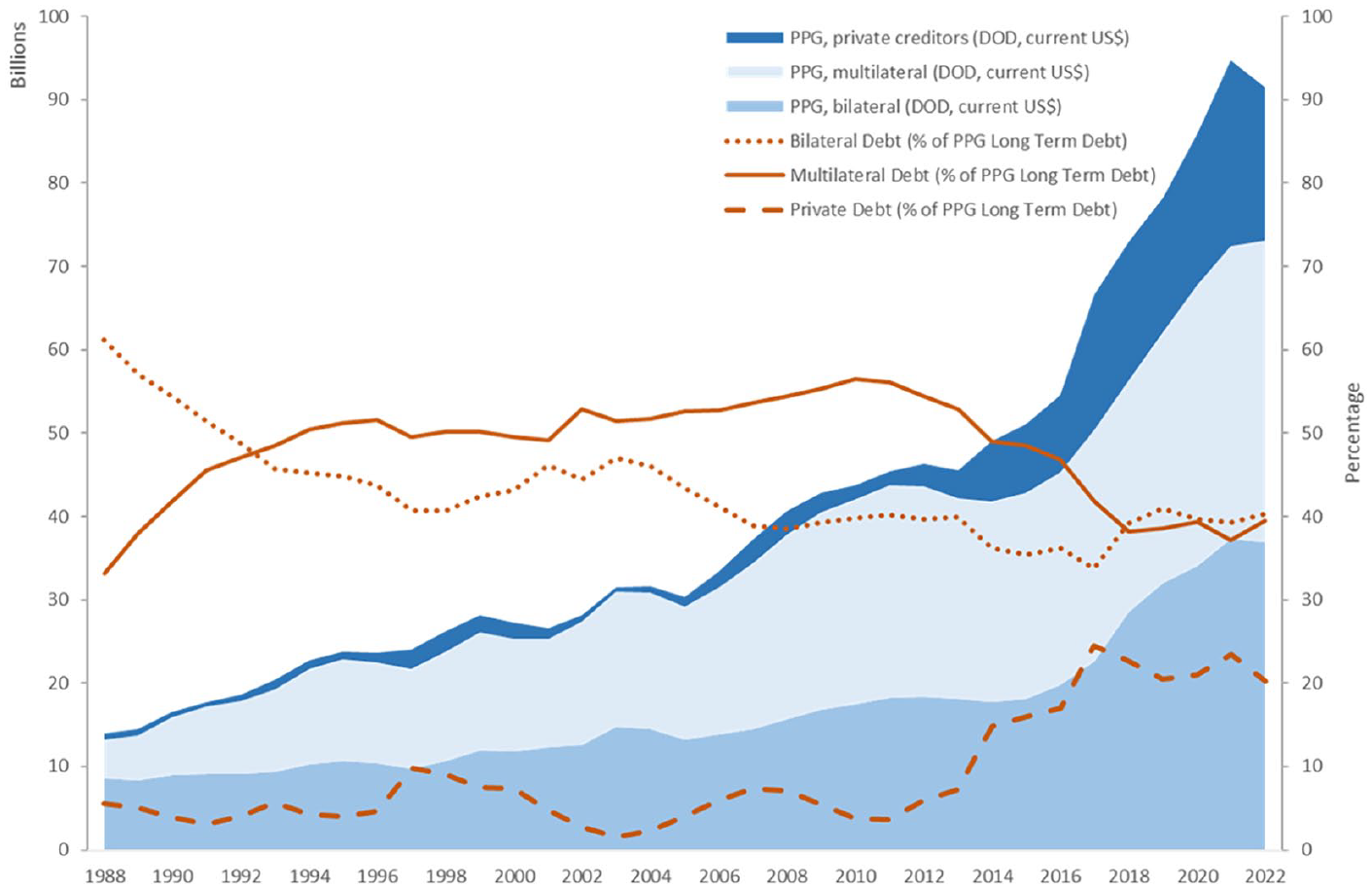
Public and publicly guaranteed external debt by source (bilateral, multilateral, and private commercial creditors). Area chart is foreign debt in total magnitude (LH axis). Line chart is percentage-wise breakdown of foreign debt (RH axis). Data Source: WB International Debt Statistic (IDS).
Pakistan has historically received imperial patronage for facilitating US wars in the region. Figure 2 shows an upsurge in foreign grants and concessionary debt with the ruling bloc’s entry into the US-led War on Terror (WoT) in neighbouring Afghanistan in 2001. However, grants and concessional loans reduced to less than half their peak levels as US occupation of Afghanistan wound down mid-2010s onwards (from $4.1bn in 2011 to $1.3bn in 2022). This reduction has come even while debt servicing costs have quintupled in the last decade, from $3bn in 2011 to $16.6bn in 2022 (Figure 3).
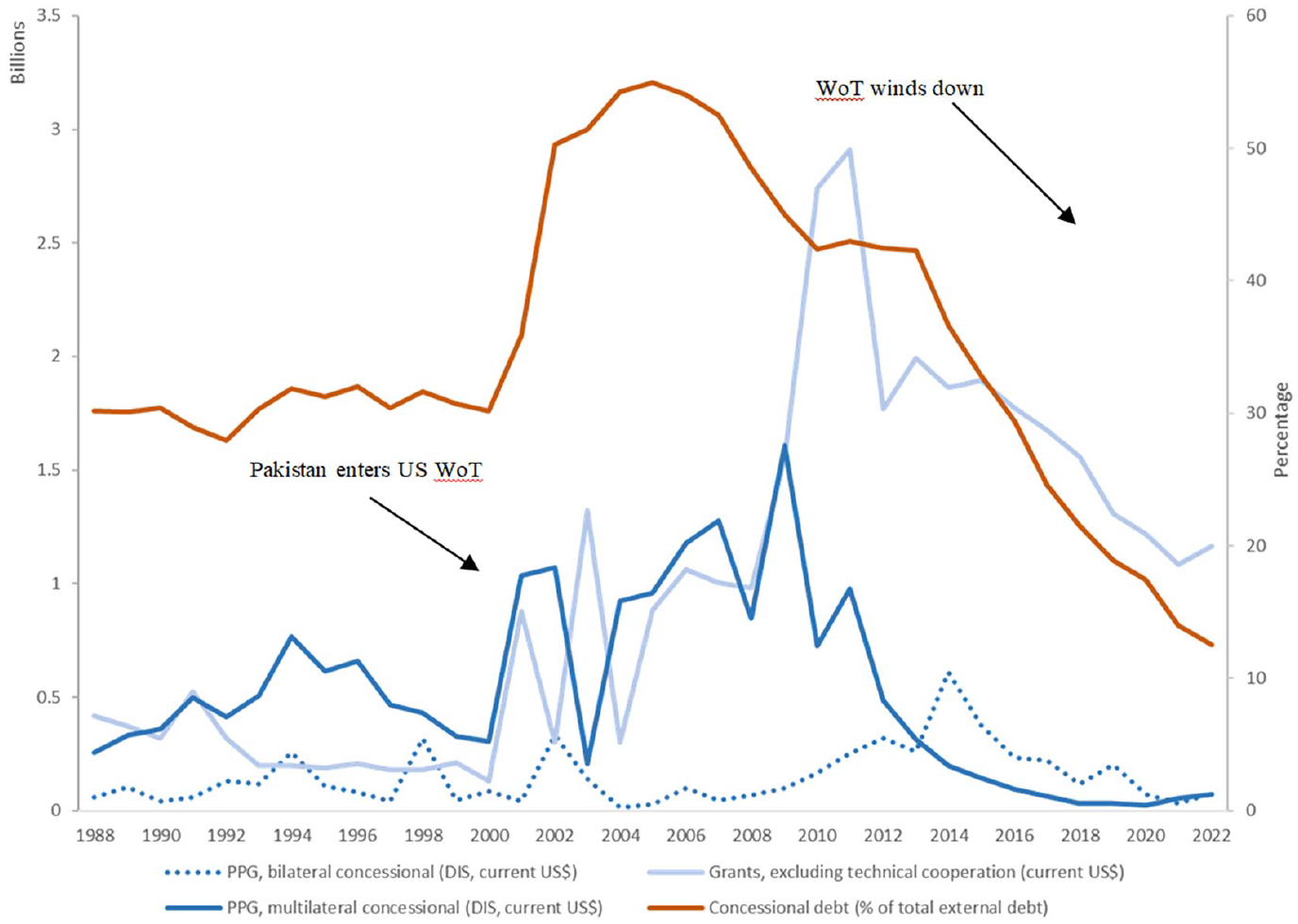
Foreign Grants and Concessionary Debt Receipts. Line chart in orange gives the percentage of grants and concessional loans in total foreign debt acquired (RH axis). Line charts in blue give the total magnitude of grants and concessional debt (LH axis). Data Source: WB IDS.
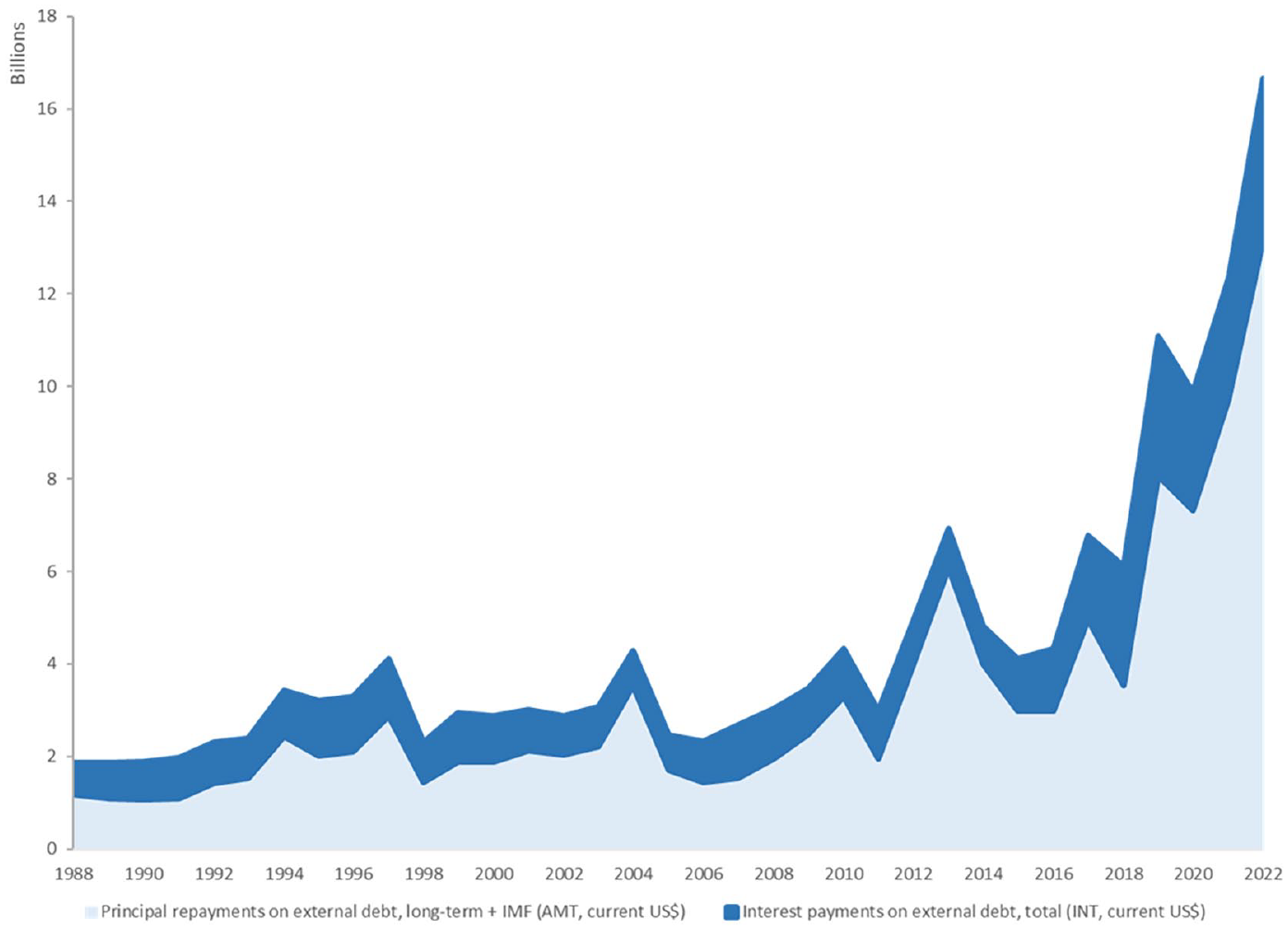
Composition of Pakistan’s external debt servicing, disaggregated between principal and interest payments. Data Source: WB IDS.
China is now the largest bilateral creditor to Pakistan holding just above 20% of the long-term foreign debt (Figure 4). However, its share is still less than Western-dominated multi-laterals (such as the WB, IMF, and Asian Development Bank) whose share, while having decreased, is still about 30% of Pakistan’s foreign debt. The same holds true for historical core countries 8 whose share now stands around 10%. Most importantly, debt from private commercial lenders has increased dramatically over the last decade or so, and is now greater in magnitude than core countries’ debt and closer in proportion to Chinese debt (about 20% of total foreign debt). Seventy percent of private commercial debt is from Western institutions (Sial et al., 2023: 1237).
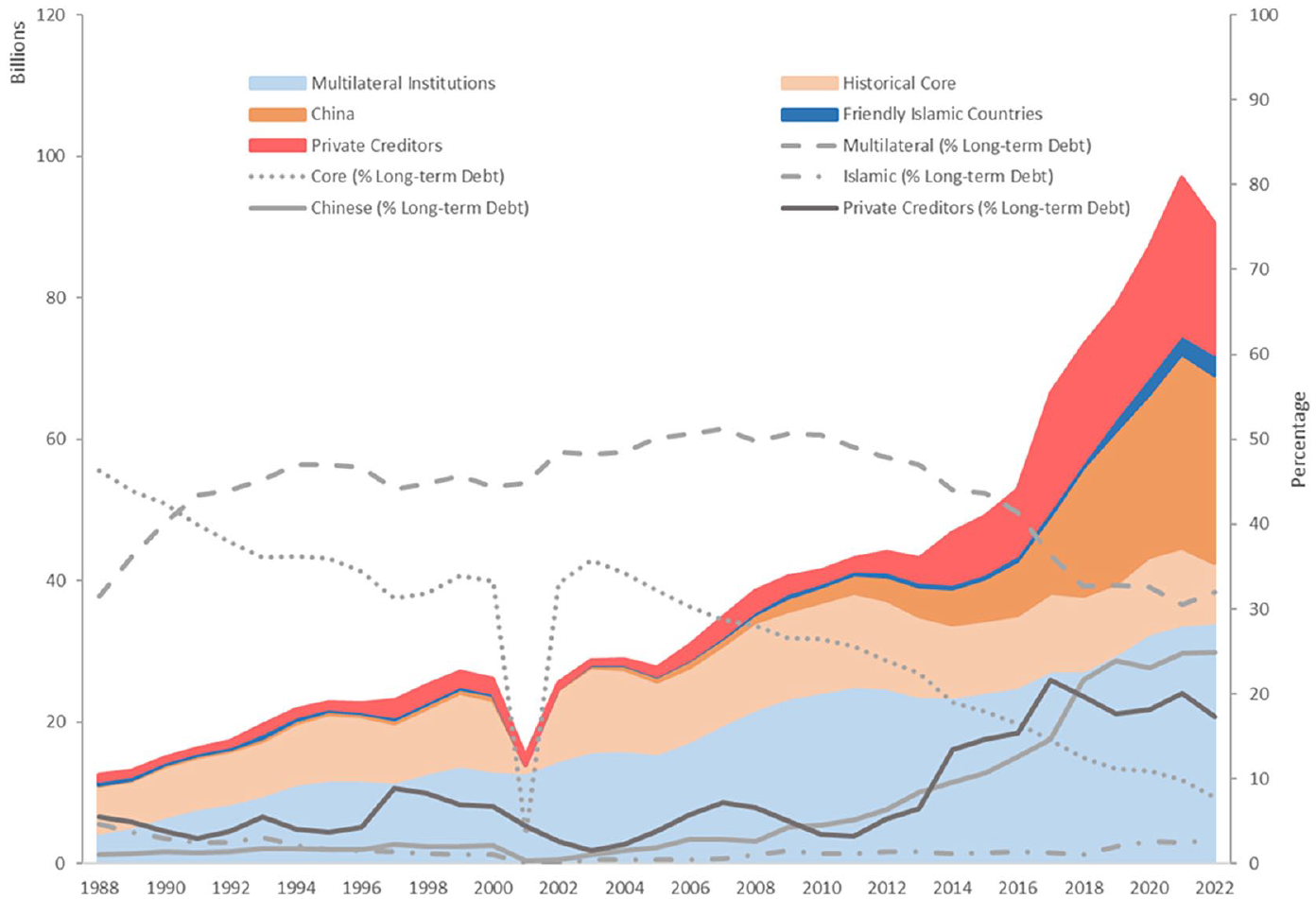
Composition of Pakistan’s external debt stock, disaggregated by countries/regional blocs, multilateral institutions and private creditors. Area chart is disaggregated foreign debt in magnitude (LH axis). Line chart is percentage breakdown of foreign debt (RH axis). Data Source: WB IDS.
The changing debt profile has serious implications for economic drain (Figure 5). Among bilateral creditors, the largest outflow of debt servicing is now to China (38.1% of total debt servicing in 2022). However, the biggest drain overall is to private commercial lenders accounting for over half the debt servicing payments. A snapshot comparison of this between 2011 and 2021 is illustrative (Figure 6). In this period, Pakistan’s private debt stock increased from 4% to 23% of total foreign debt, while its weight in debt servicing was disproportionately higher (from 5% to 58% of total debt servicing; also see Taylor and Zajontz, 2020: 289). Such disproportion is due to the difference between bilateral/multilateral donors and private lenders’ loan tenures (20–30 years vs 1–3 years) and interest rates (1%–3% vs 6%–9%; Khaliq, 2023 Rana, 2023). For example, the Pakistani government recently obtained a loan of $600m at an interest rate of 11% – the highest in the country’s history – with Standard Chartered London to qualify for an IMF bailout (Rana, 2024).
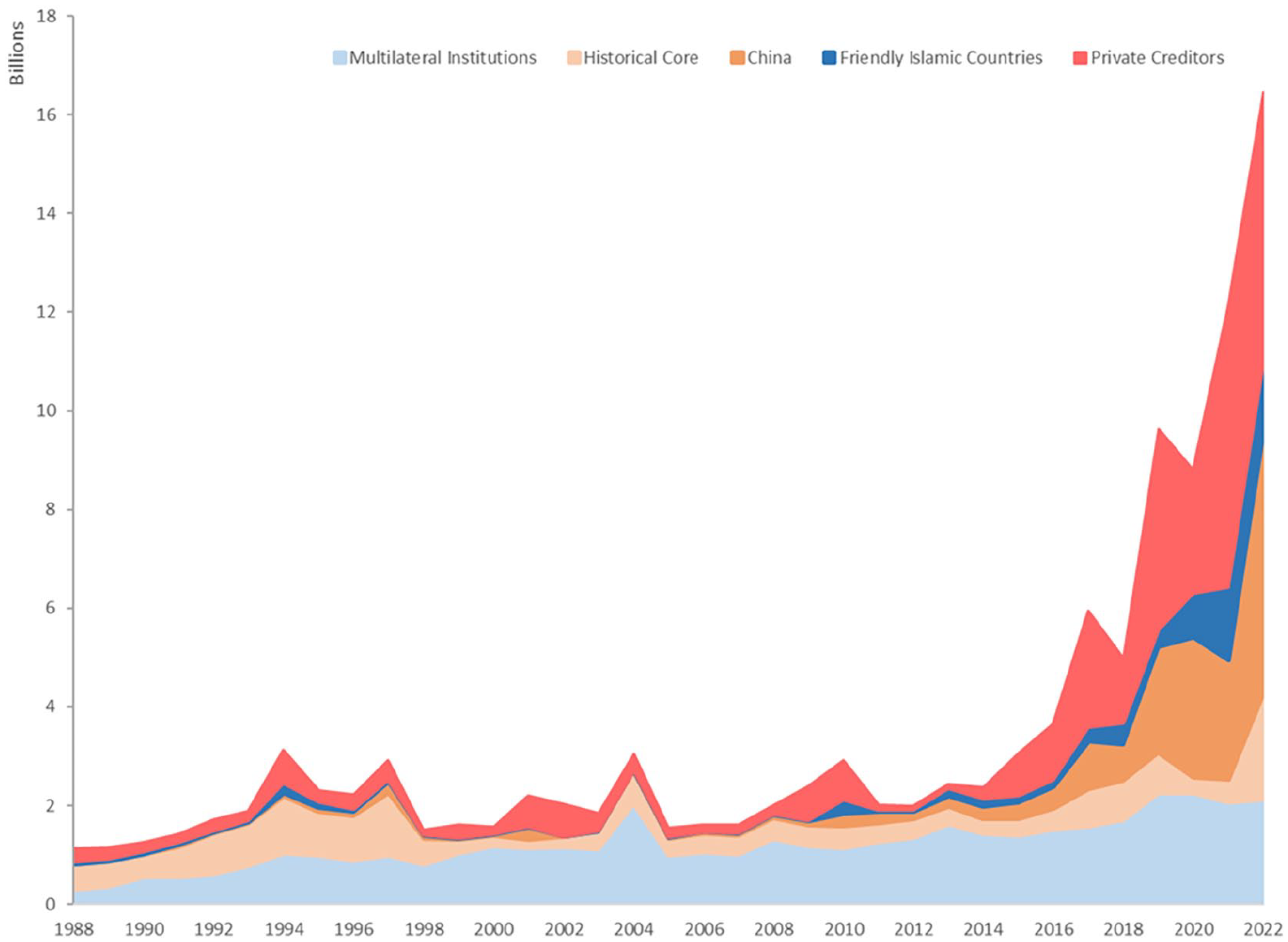
Pakistan’s external debt servicing composition, disaggregated by countries/regional blocs, multilateral institutions and private creditors. Data Source: WB IDS.
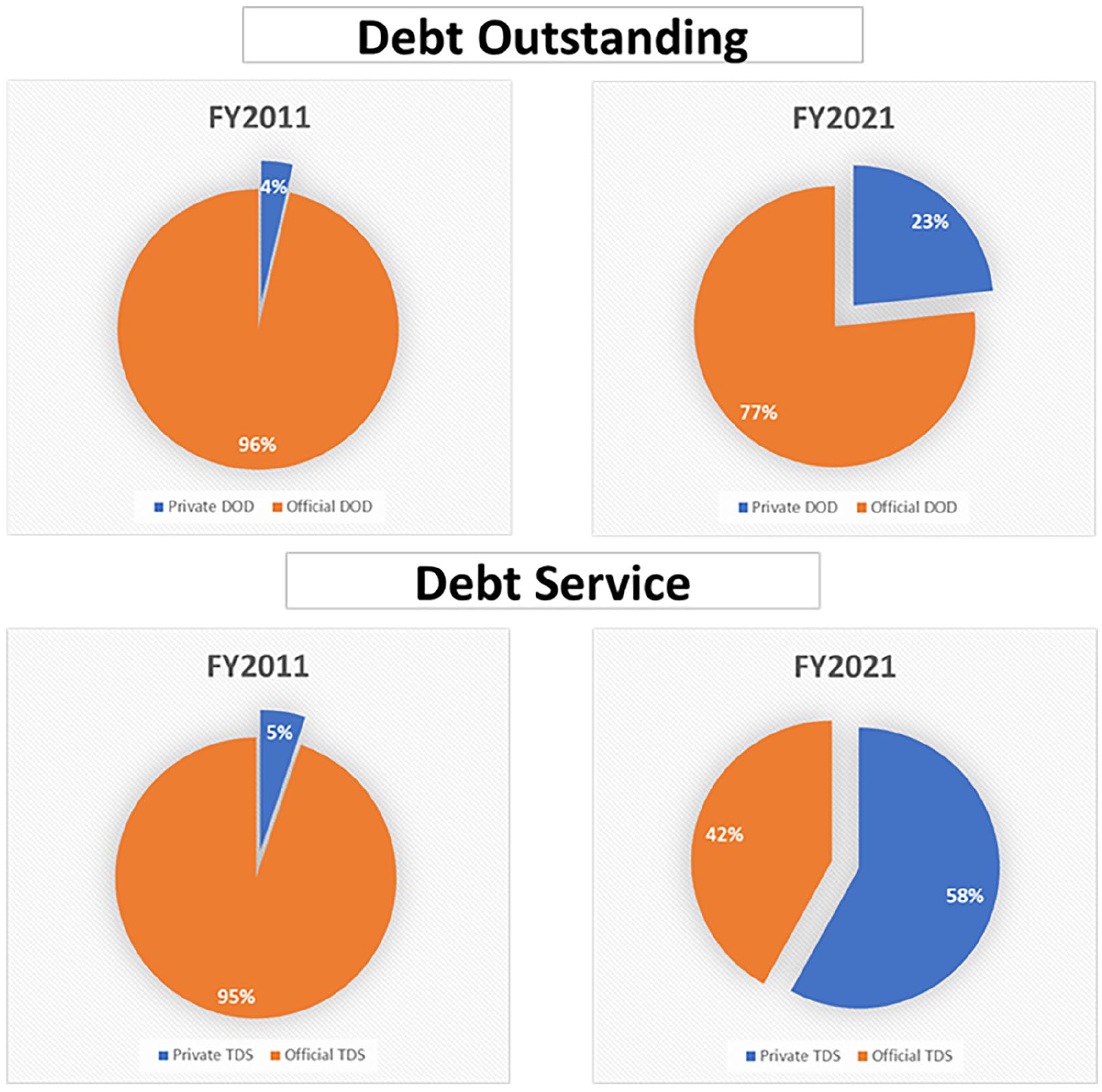
Ten-year comparison between debt stock and servicing to official and private creditors. Data Source: WB IDS.
Overall, in the 2020s, Pakistan has been paying upwards of $10 billion each year in debt servicing to foreign lenders. This represents about 35% of export earnings and will double over the next 3 years as debt servicing requirements increase to over $25 billion each year (Rana, 2025). This is even while, according to the previously-mentioned UNDP report, the state provides almost $18 billion in subsidies every year to corporate and financial monopolies, military-linked enterprises, and big landowners. Effectively, Pakistan’s foreign debt subsidises elites while subordinate classes are squeezed through various means (such as dispossession and indirect taxation) to pay lenders at increasingly onerous rates (cf Reis and de Oliviera, 2023). Economic drain through debt is, ultimately, a class relation.
The worst of all worlds: Foreign investment patterns
Pakistan’s political-economic dependency is also manifested in patterns of foreign investment. This may be analysed through looking at (direct and hidden) profit repatriation and the sectoral spread of foreign investment. To contextualise this analysis, it is helpful to refer to Figure 7 from Amin (1974), which schematically illustrates characteristic modes of dependency and sectoral disarticulation in peripheral formations. In core countries, there are strong linkages between sectors 2 and 4 that is, production of capital goods and consumption goods is linked to mass consumption and a wide domestic market. Conversely, peripheral economies are based on sector 1 (exports of mostly primary and low-value added products) and, at most, the consumption and production of limited/luxury consumer goods (sector 3). Sector 4 (capital goods i.e. the means of production), along with finance, is still produced in or majorly controlled by core countries/monopolies. Relatedly, there is a narrow domestic market and low effective demand in peripheries due to, for example, lack of land reforms, low labour productivity, and/or high levels of labour exploitation (i.e. low general wage levels). Consequently, patterns of dependency cannot be identified with a simple industry/agriculture divide between core and periphery. Dependency works primarily through perpetuating sectoral disarticulation (e.g. concentration of sector 4 in core countries), even while manufacturing may ostensibly be located in peripheral countries.
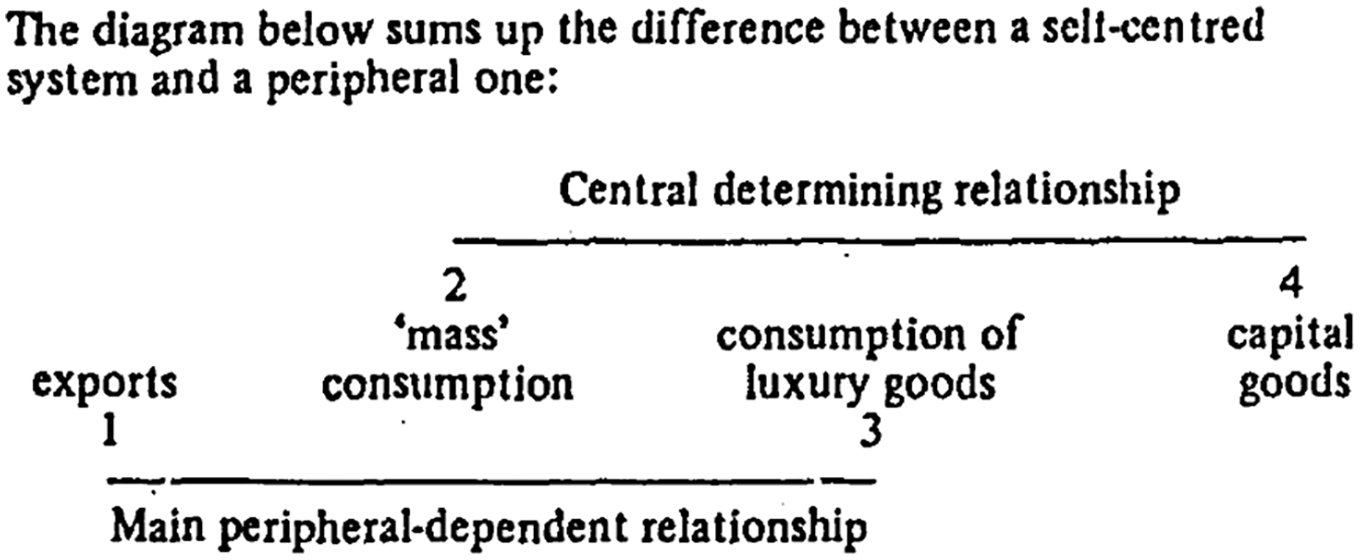
Dependency and Sectoral Disarticulation (Amin, 1974).
Foreign investment in Pakistan perpetuates such sectoral disarticulation. As shown in Figure 8, foreign direct investment (FDI) levels in Pakistan have historically remained on the lower side (below 1% of GDP), which is less than half of other regional countries such as India and China. FDI spikes are related to one-time inflows due to privatisation of the energy sector in mid-1990s and banking and telecommunications in mid-2000s (Munir and Naqvi, 2013). Importantly, foreign investment in Pakistan is disproportionately in the tertiary sector such as in information and communications technology, finance and insurance, and power generation (Figures 9 and 10). Unlike manufacturing, investment in the tertiary sector does not create sustainable, labour-absorbing forms of employment.
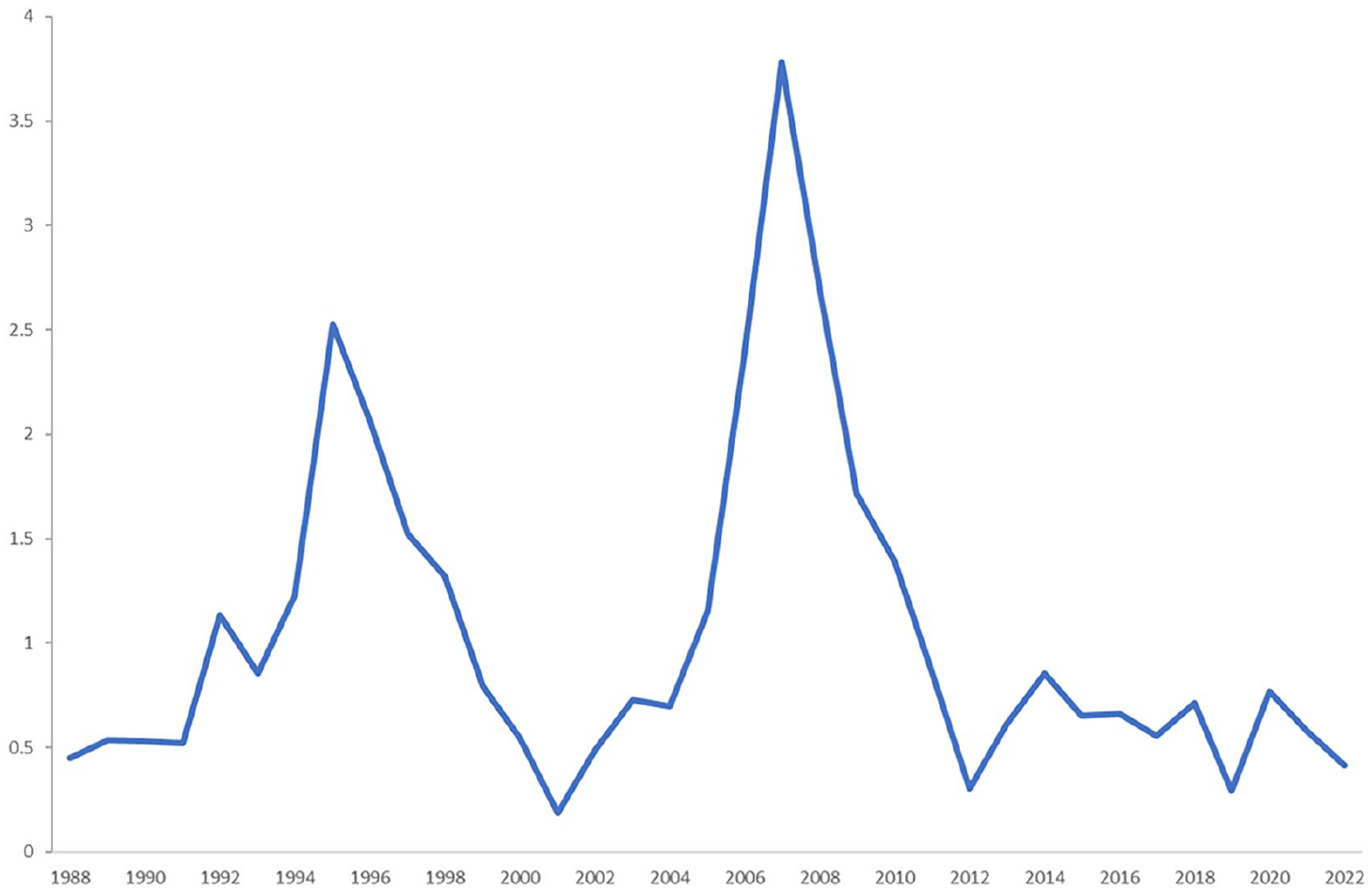
Total Foreign Private Investment as % of GDP. Data Source: SBP and WB World Development Indicators.
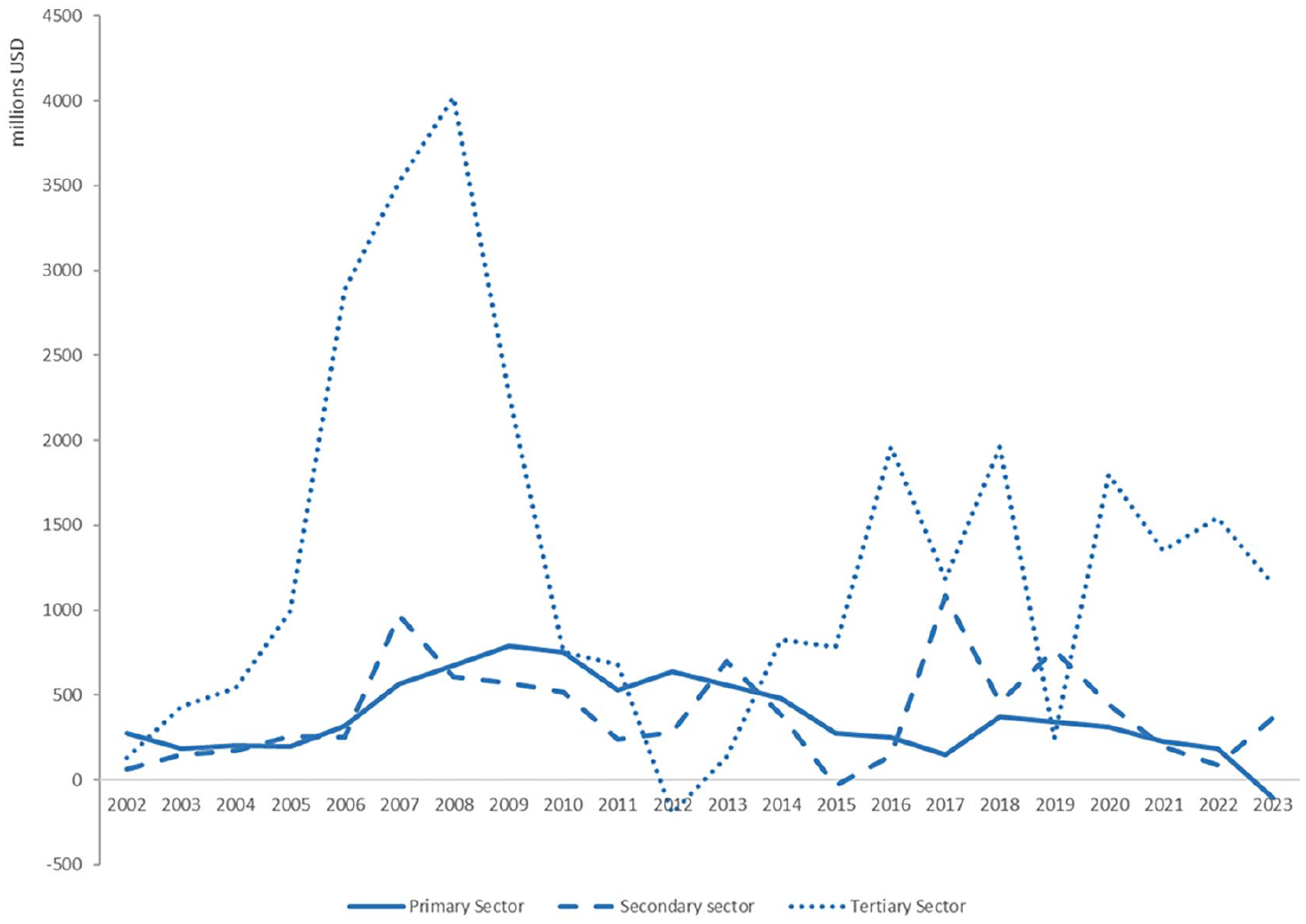
Sector-wise Foreign Direct Investment (FDI). Data and Classification: SBP and International Trade Center (ITC) UNCTAD.
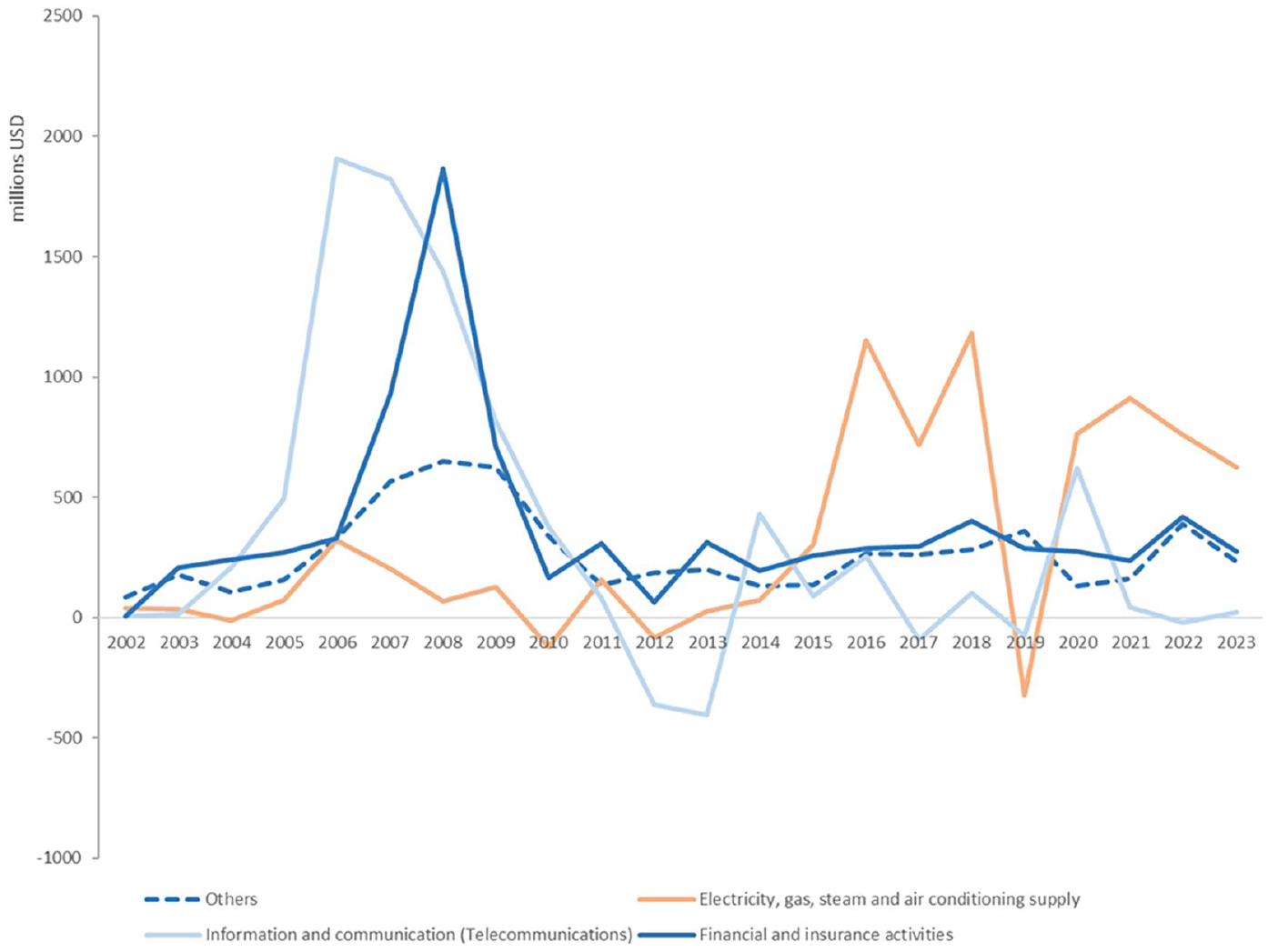
FDI Distribution in Tertiary Sector. Data Source: SBP.
A fine-grained analysis of FDI in the secondary sector (that includes manufacturing) shows its concentration in consumer goods (Figure 11). Indeed, there is minimal investment even in Pakistan’s ‘dynamic’ export sectors such as textile and leather, which account for more than half of total exports, despite Pakistan having one of the most liberal investment policies in the world, with foreign investors allowed 100% equity in all sectors (Safdar, 2024: 24). In fact, the share of exports in GDP fell from 12% in 2000 to 10% in 2021 (Safdar, 2024: 18). Such sectoral disarticulation also holds if we look at investment from core countries (e.g. the US) and recent inflows from the Gulf and China (Figure 12). Analysis from a former Federal Planning Commission member has shown that almost 100% of Chinese investment until 2022 went into the energy sector and in physical and digital infrastructure (Kakar, 2024: 95–96). Therefore, there is minimal investment in manufacturing and especially in capital goods which can (potentially) become nodes of sustainable industrialisation and labour absorption. Foreign investment in Pakistan seeks the limited domestic market as opposed to enhancing productivity. With reference to Amin’s model, it is focused on sector 3 (consumer goods) over sector 4 (production goods) and, at most, creates a form of ‘dependency industrialisation’ which does not create inter-sectoral linkages (cf Shivji, 2009: 61–63).
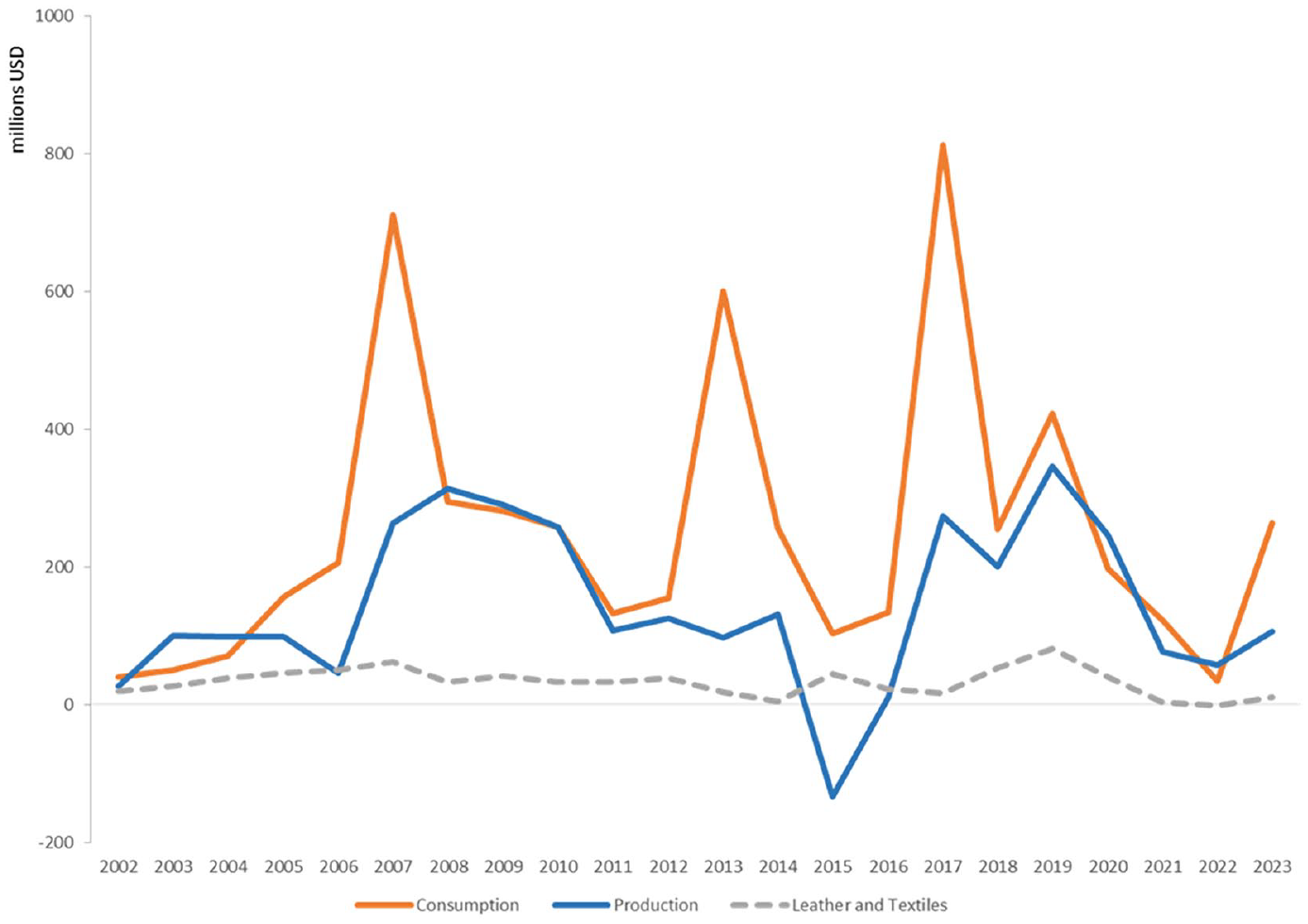
FDI Distribution in Secondary Sector, with investment in ‘dynamic’ export sectors of textile and leather for comparison. Data Source: SBP.
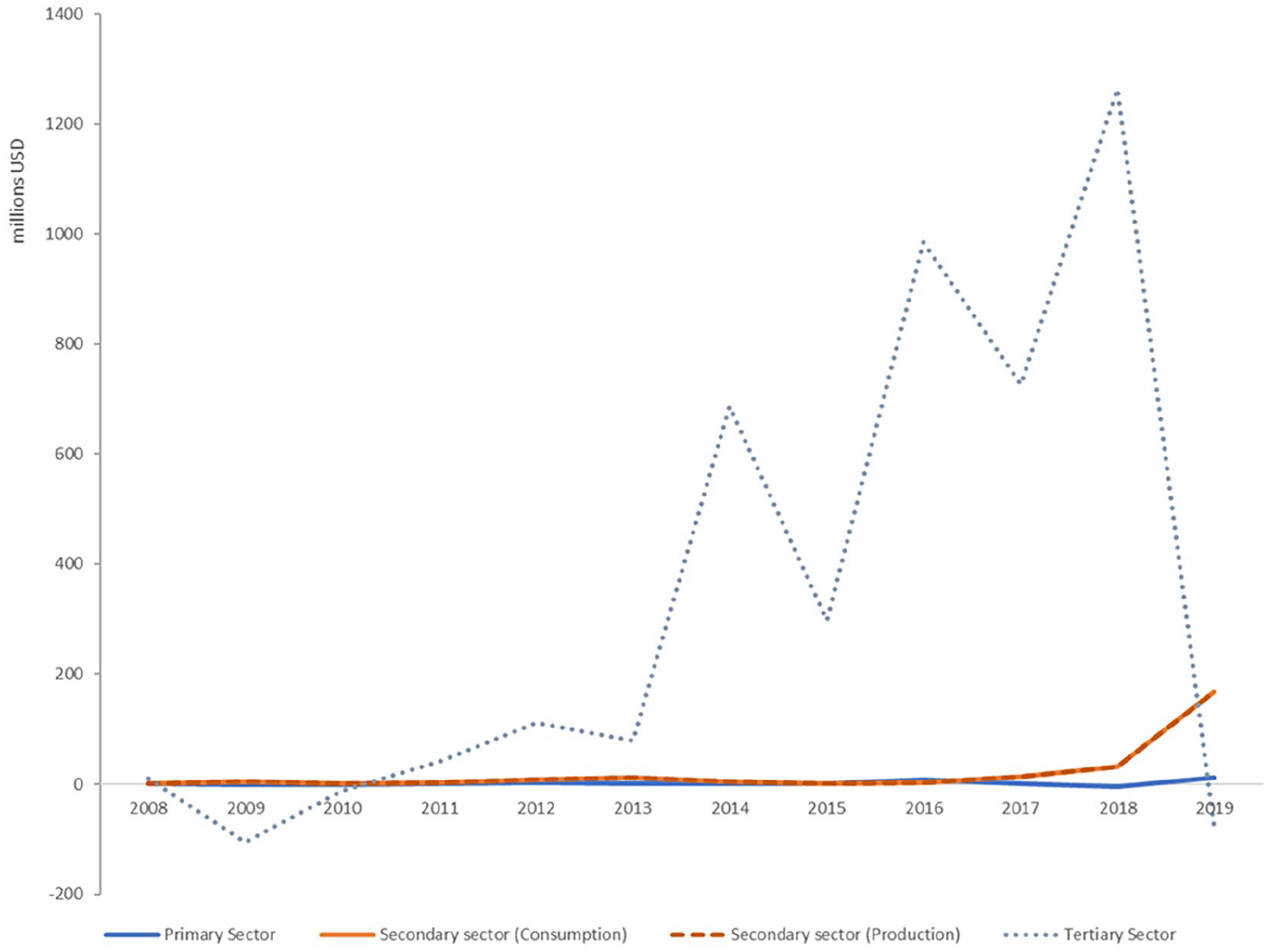
Sector-wise FDI from China. Data Source: ITC UNCTAD.
Additionally, the benefits of foreign investment even in narrowly monetary terms are overstated by neoliberal advocates (Patnaik, 2023). Thus, if we account for profit repatriation and profit shifting (e.g. through transfer pricing and tax evasion) by multinational corporations, the amount of value Pakistan loses each year far outstrips the capital coming in (Figure 13; cf Parnreiter et al., 2024). For example, between 2015 and 2020, for each dollar of foreign investment received, almost three dollars were lost through profit repatriation and shifting.
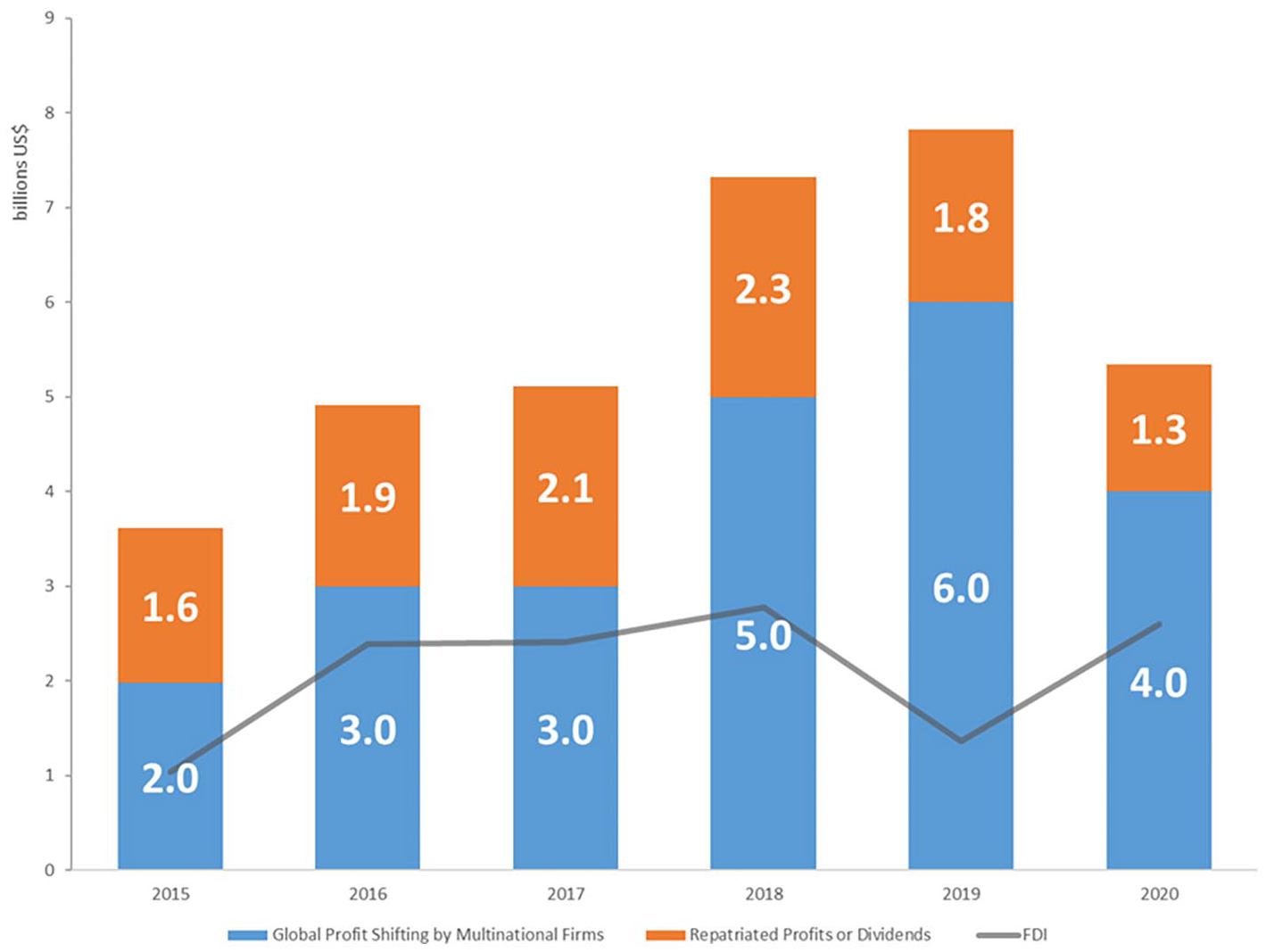
Profit shifting and repatriation from Pakistan, 2015–20. Data Source: SBP and Atlas of the Offshore World. 9
Overall patterns of foreign investment in Pakistan are thus the worst of all worlds. Investment levels are very low in magnitude and result in a net drain of value. Moreover, the sectoral distribution neither creates global linkages through investment in relatively ‘dynamic’ export sectors (as in ‘normal’ neoliberal terms), nor does it increase production capacity or backward-forward linkages between different economic sectors for potentially sustainable, inward-focused development.
Labour terms of trade and unequal exchange
As the unequal exchange literature has shown extensively, with the current architecture of the world-system, the much-touted panacea of foreign investment and export-oriented growth is anything but. Like other peripheral countries, Pakistan loses a large proportion of its internally created value through mechanisms of (hidden and open) unequal exchange (cf Hickel et al., 2021). Where differences in productivity and wage levels 10 remain, the global law of value operates to transfer value from peripheral to core countries. There are debates among dependency theorists and critical political economists whether productivity or wage levels are more important in value transfer (cf Carchedi and Roberts, 2021; Féliz, 2021). We will focus on differential labour productivity levels that lead to net labour power transfers out of Pakistan.
One way of measuring this unequal exchange is through ‘Labour Terms of Trade’ (cf Bettelheim, 1972; Li, 2015). Labour terms of trade (LToT) are defined as ‘the units of foreign labour that can be exchanged for one unit of domestic labour through trade of exported goods and imported goods of equal market value’ (Li, 2021: 55). This is calculated through a country’s (or region’s) labour productivity and its balance of total labour embodied in goods exported compared to goods imported. For example, Minqi Li has recently shown that at its peak in 2007, the great success story of globalisation and export-led growth, China was losing a magnitude of labour power to core countries equivalent to almost 50% of its entire industrial labour force (Li, 2021: 57).
We calculated Pakistan’s LToT with respect to the world and to major countries/blocs, such as the historical core, US and China (Figures 14 and 15). In all measures, Pakistan’s LToT is in a dire and worsening situation: one unit of average world labour is equivalent to almost 10 units of Pakistani labour, while this ratio is now about 1-to-30 for the US-Pakistan and 1-to-10 for China-Pakistan. Therefore, beyond trade balances measured in dollar terms, Pakistan ends up transferring a substantial part of its labour power to these countries/blocs (Figure 16). While Pakistan’s net labour transfer has become negative with China, the biggest labour transfer still happens to historical core countries (2.64 million worker-years in 2022) due to the high magnitude of Pakistan’s exports to these and the enormous difference in LToT.
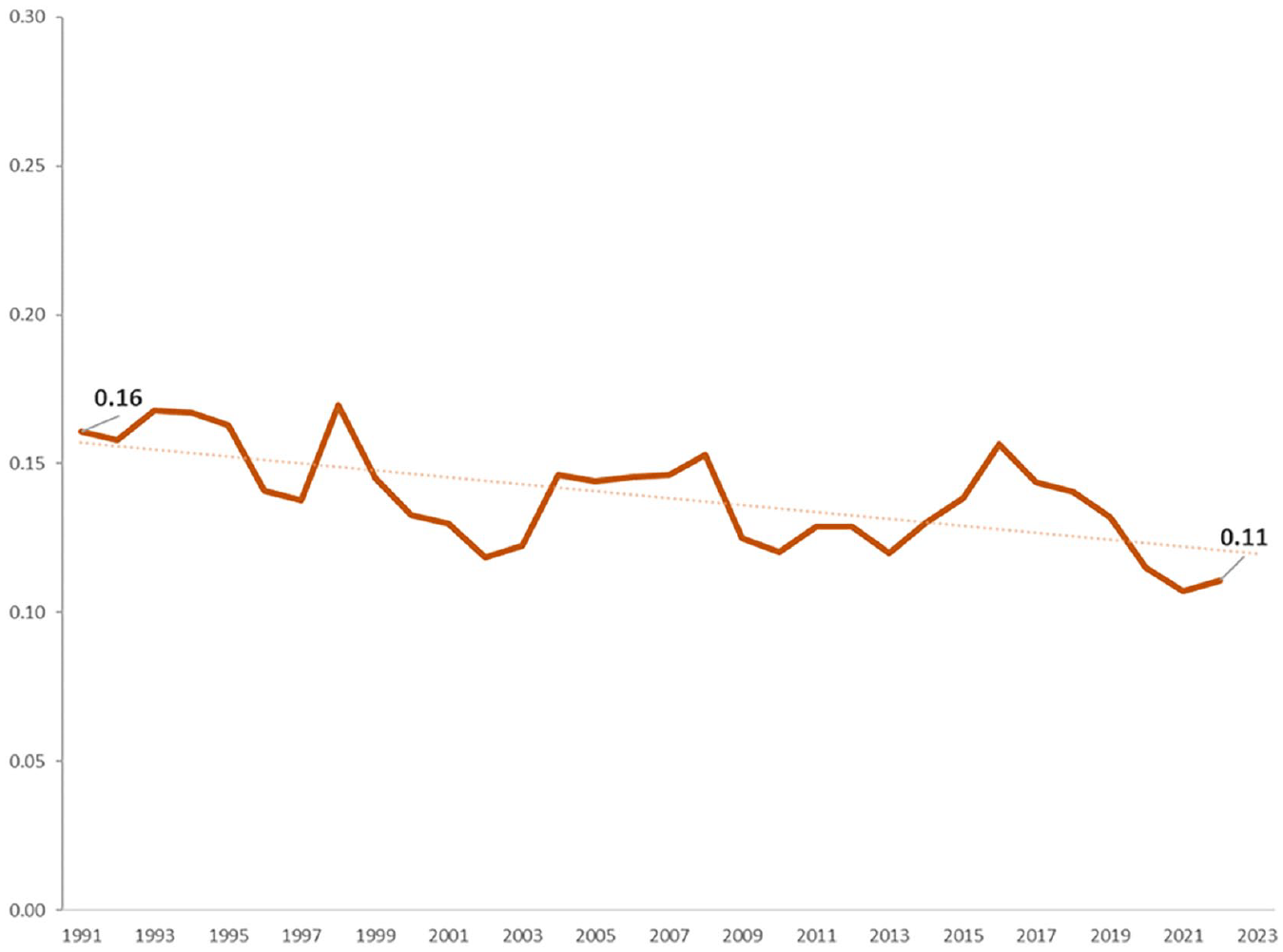
Pakistan’s average labour terms of trade with the world, 1989–2023. Data Source: WB World Development Indicators. 11
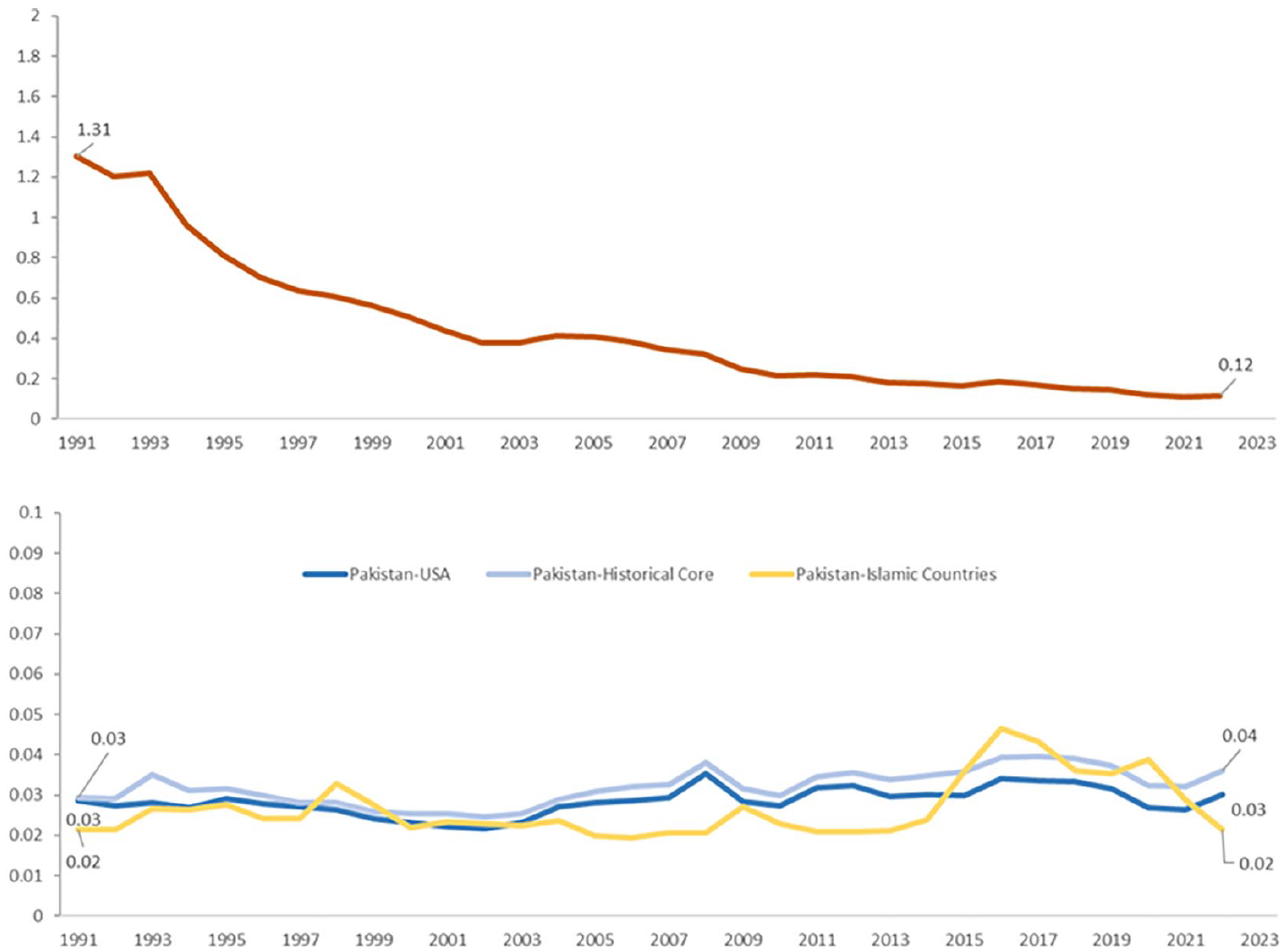
Pakistan’s bilateral labour terms of trade with China (top) and other countries/regional blocs (below), 1989–2023. Data Source: WB World Development Indicators.
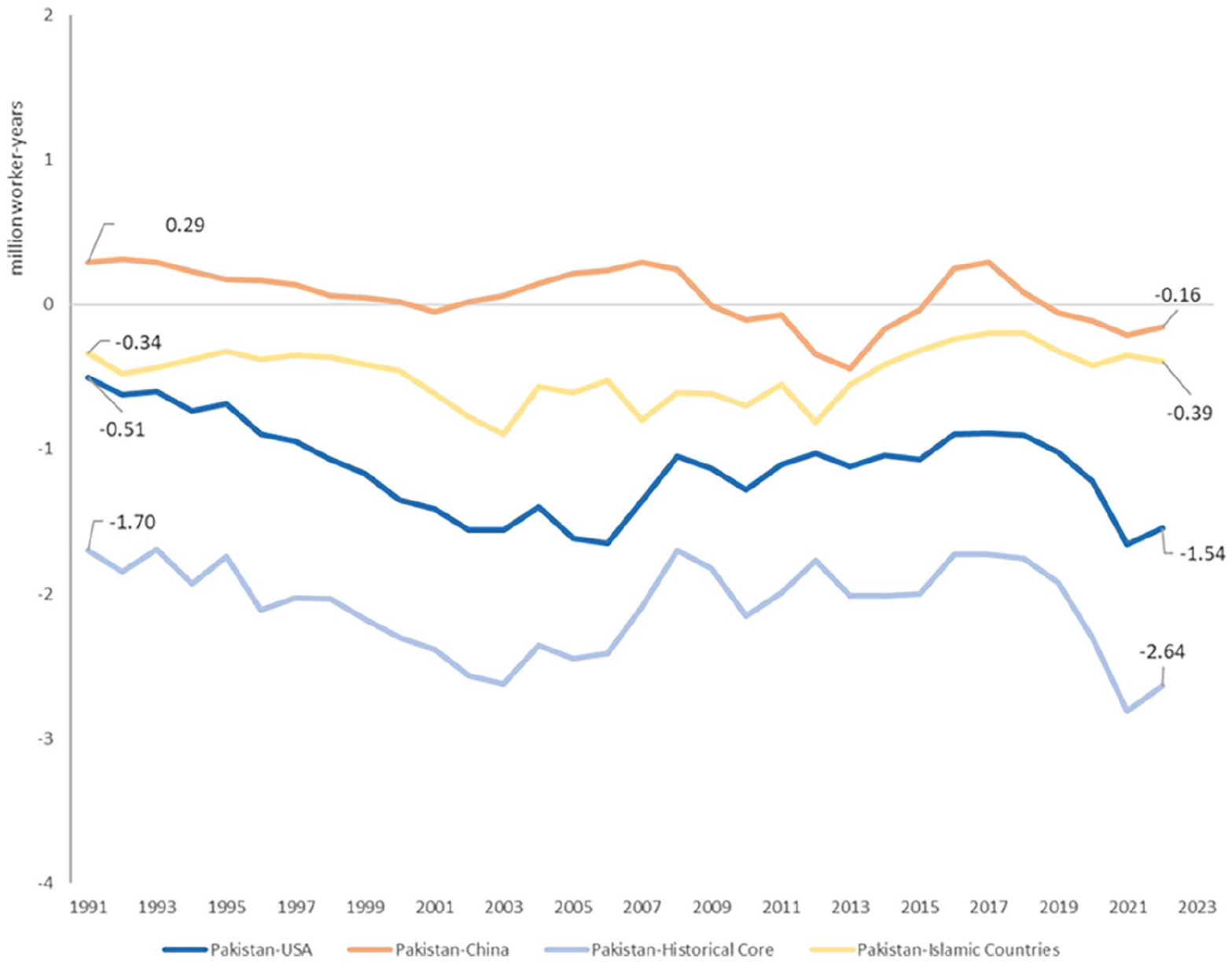
Pakistan’s bilateral net labour transfer of trade with China, USA and other regional blocs, 1989–2023. Data Source: WB World Development Indicators. 12
In fact, these figures are underestimates as they do not account for vast labour emigration from Pakistan. Therefore, net labour transfers through international trade must be supplemented with labour years lost due to emigration. For illustrative purposes, we estimated the number of Pakistani workers employed overseas in 2021 by keeping their employment rate equivalent to Pakistan 13 (Figure 17). If we add this conservative estimate of workers employed abroad (3.1 million) to Pakistan’s net labour transfer (5.8 million worker years) this comes to an aggregate labour transfer of 8.9 million worker years in 2021. Thus, in 2021, Pakistan’s aggregate labour transfer amounted to almost half (47.1%) of its industrial labour force.
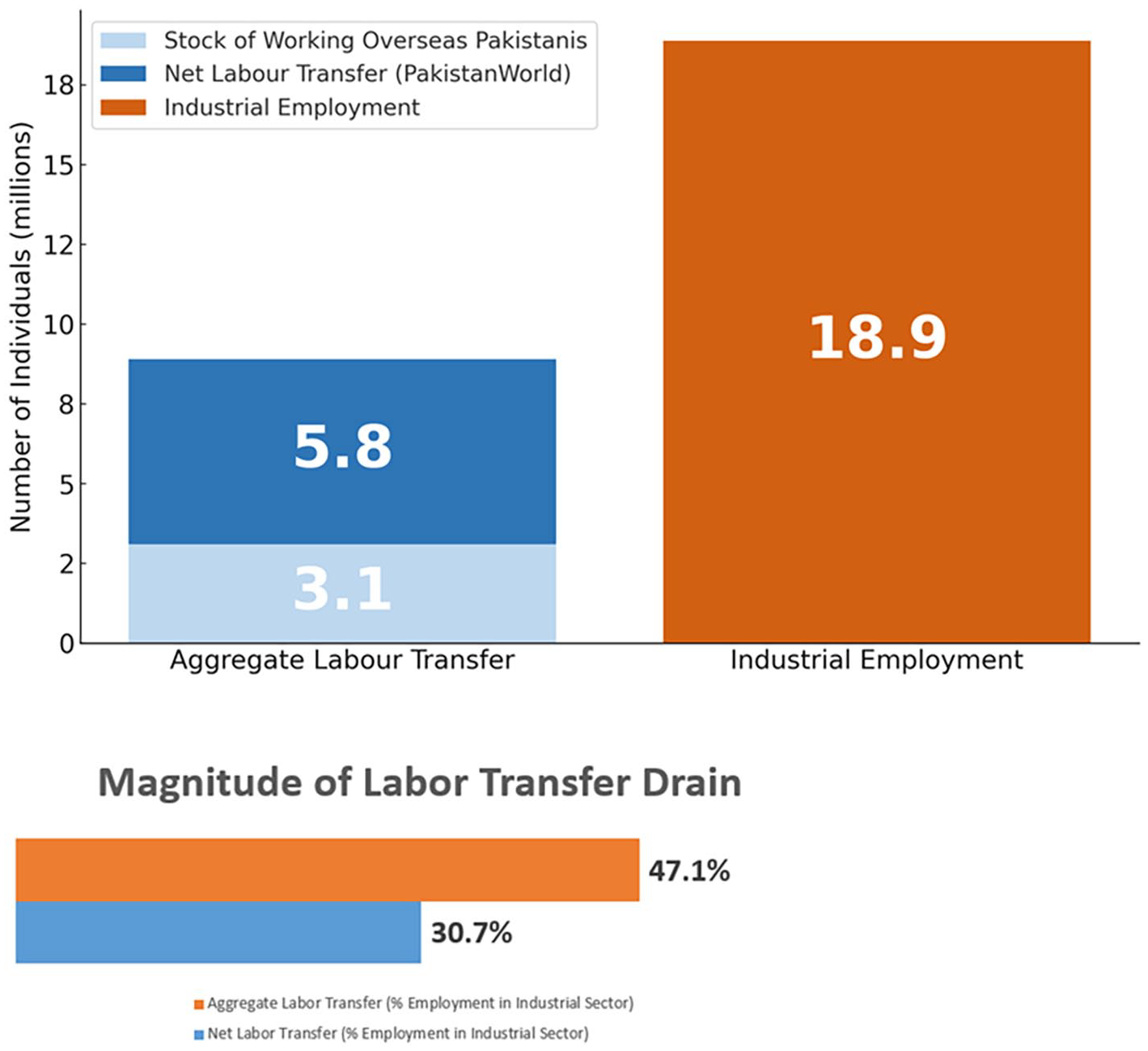
Pakistan’s aggregate labour transfer in million worker-years after taking migrant workers into account, 2021. Data Source: WB World Development Indicators and Migration Data Portal.
Pakistan therefore remains a peripheral country in the world-system with increasing loss of its labour power due to unequal exchange. Here, while Pakistan loses major part of its labour power to core countries, it is also developing unfavourable labour terms of trade with emerging powers such as China. Far from the panacea it is made out by neoliberal advocates, export-oriented growth furthers peripheralisation through open and hidden mechanisms of unequal exchange, such as profit shifting, repatriation and net labour transfers due to differential labour productivity and emigration.
Reading conjunctures: Imperial dependency as organic terrain
We have demonstrated that Pakistan’s patterns of dependency and unequal exchange remain intact and indeed worsening in many respects. There have been shifts in debt and investment patterns with increasing Chinese capital, even while Western-dominated multilaterals remain the single largest creditors. Importantly, the largest drain on foreign exchange is of private commercial loans. Concomitantly, there are decreasing grants and concessional debts from Western countries as the WoT has wound down.
These shifting patterns of grants/concessions, debt and debt servicing are related in a mediated manner (i.e. in conjunction with other processes of different spatio-temporal rhythms) to conjunctural shifts in the Pakistani polity. Shifts in modes and magnitudes of imperial dependency do not lead directly to punctual changes. To conceptualise the relationship in such a direct manner would be ‘the overestimation of mechanical causes’ that Gramsci warned against. However, there are mutual coherences between these that can be observed in the medium-to-long term, and which give indication of the organic terrain (and crisis) of the Pakistani ruling bloc.
For example, the substantial inflow of Western aid post-2001 (Figure 2) coincides with the temporary stabilisation of military rule in Pakistan in the 2000s. Conversely, the decrease in foreign grants and concessionary debt along with the sharp increase in debt servicing costs through the late-2010s is intimately related to contemporary crises of the polity. Similarly, there was temporary ‘prosperity’ due to upsurge in Chinese Belt and Road Initiative (BRI) investment post-2013 (Figure 12). However, this was not investment in productive or labour-absorbing sectors (Figures 9–12) and a fall in its magnitude has conditioned the current, deep political and economic crisis in Pakistan. In fact, contention over the share of spoils from BRI investment was a major factor (along with faultlines over foreign policy and internal security) in intra-ruling bloc conflicts in the post-2013 period, resulting in the ouster of Nawaz Sharif as Prime Minister in 2017 (Ghumman, 2016). The current post-Nawaz and post-Imran Khan crisis too is integrally related to the dramatic increase in debt servicing requirements and the substantial fall in foreign grants and concessional loans (Figures 2 and 3). This has conditioned intra-ruling bloc squabbles over a shrinking economic base, a resultant lack of fiscal space to paper over already-thin hegemonic capacities, and flux at the political level. Thus, throughout the late 2010s, important sections of the ruling bloc expressed dissatisfaction with the aforementioned 18th Constitutional Amendment and a desire to rollback fiscal federalism, expressed in the army chief’s so-called ‘Bajwa Doctrine’ (Warraich, 2018). The ‘Bajwa Doctrine’ was a major impetus behind the military’s support to Khan and increasing centralisation of the polity. However, the Khan government’s limited social capacity and lack of amelioration of the fiscal-financial crisis conditioned its eventual falling out with the military, and a resultant radicalisation of the crisis (Mallick, 2025). Thus, shifts in foreign inflows and dependence lead to changes in the polity only in articulation through other processes of different temporal rhythms.
Relatedly, the current deep crisis of the Pakistani ruling bloc, while mediated by the shifting contours of imperial dependency, is also related to the emergence of petty bourgeoisie and professional middle classes centred in core, urban(ising) areas that have gained prominence in the wake of economic liberalisation and remittance inflows from Gulf and Western countries (Akhtar, 2008). It is the articulation of emergent middle-class fractions, with technological, generational and spatial shifts in modes of politics, and the fraying hegemonic capacities of the ruling bloc that is expressing itself through the Imran Khan-centred populist upsurge (Malik and Tudor, 2024). Indeed, the middle classes’ ideational ambivalences – drawing upon determinate understandings of Islam and (the unfinished business) of decolonisation – also link to older, colonial lineages of social and ideological incoherences (Akhtar, 2022). The ‘double-edged character of [the conjuncture’s] articulation’ (Ekers et al., 2020: 1581–1582) – its practical conjunction of meaning and materiality – lends the middle-class populism an ambivalent character, potentially open to different kinds of class alliances and projects (Mallick, 2025). Therefore, processes of distinct but inter-related spatio-temporalities are combining with the flux in long-term imperial dependency to produce conjunctural shifts and crises. The conjuncture here is a ‘node’ bringing together multiple spatio-temporalities and diverse domains of social practice (economic, ideological etc.), and as a space for critical (and organised) intellectual-political intervention.
The fact that these vagaries of foreign aid, debt and investment mediate proximate shifts in the polity points to the long-durée, organic terrain in Pakistan and the permanent crisis of the ruling bloc therein. As Gramsci reminds us, ‘a crisis occurs, sometimes lasting for decades. This exceptional duration means that incurable structural contradictions have revealed themselves’ (Q13 §17 (1971: 177–180)). Gramsci’s processual conception of crisis here connects to the note in our epigraph. Crisis is conceptualised not simply as a punctual event, but as a long-term process and the ‘intensification of certain elements, neither new nor original’, while other phenomena which had been conjuncturally ‘sterilising’ these elements ‘have now become inoperative or have completely dissipated’ (Q5 §15 (1995: 220)). With such conjunctural salves falling through, ‘events that go under the specific name of crisis. . . burst onto the scene’.
In Pakistan’s case, this permanent or organic crisis of the ruling is the lack of an integral hegemonic project, with its necessary but insufficient political-economic core, and thus its reliance on imperial dependency for coherence, a structural disposition for resolving domestic contradictions through internationalisation. 14 It is these weak sutures and shallow hegemonic capacity that express themselves in conjunctural conflicts of varying depths and more recently in a situation of intense flux whereby the conjunctural crisis has opened questions around the organic terrain itself 15 i.e. the narrow social bases and consequentially congenital imperial dependency of the ruling bloc. Since the 1970s, relationships of dependency through participation in US imperial wars and, more recently, Chinese BRI served to perpetuate the Pakistani ruling bloc’s passive revolutions i.e. their survival through ‘molecular changes’ and limited concessions (Mallick, 2017). However, shifts in dependency are now translating into a situation where even the material ground of passive revolutions has given way. The flux in the polity is integrally conditioned by this failing imperial salve and open emergence of the ‘neither new nor original’ organic crisis of the ruling bloc.
Here, the conjuncture becomes a confluence of longer spatio-historical rhythms with more proximate processes. The conjuncture is the terrain on which social forces act on general and proximate determinations to preserve or transform the organic terrain that is, to effect passive or permanent revolutions (Burgio, 2020). Conceptualising the conjuncture as a practically articulated node of multiple spatio-temporal determinations, ‘allows us to see the present differently’ both in analysis and possible political interventions (Hart, 2024: 150; Koivisto and Lahtinen, 2012). The organic terrain sets limits to the terms of manoeuvre of different domains of practice (such as the polity) and is expressed not directly, but through the concrete terrain of the conjunctural that is, in mediation with forces of multiple spatio-temporal rhythms. The organic thus provides the long-durée historical embeddedness within which social forces face off conjuncturally.
It is in this perspective of organic-conjunctural terrains and crises that we can revisit our opening anecdote on the passage of the ostensibly mundane parliamentary bill on foreign investment in 2022. The passage of this bill was preceded by high-level negotiations between the Pakistani government, Supreme Court and international mining conglomerates to settle a long-standing dispute over the Reko Diq mining project (Iqbal, 2022; Rana, 2022). These manoeuvres built upon a longer lineage of open and coercive facilitation of Western and Chinese capital by the ruling bloc in peripheral regions. For example, concerns raised by the Balochistan provincial government over control of the strategic Gwadar port, have been repeatedly bulldozed through central fiat in favour of Chinese companies and allied Pakistani military enterprises. Indeed, this dispute was one factor feeding into the dismissal of Aslam Raisani’s provincial government and institution of governor rule in 2013 (Kakar, 2024: 105). The ruling regime has recently given clandestine approval for China to build a military base in Gwadar (Hussain and Grim, 2024). Moves are also afoot for ‘anti-terrorism’ military operations in the Pak-Afghan border regions to entice the US’s financial largesse back to Pakistan (Roy et al., 2025). The logics of limited (and militarised) hegemony, as Fanon reminded us, stand bare in the peripheries. The parliamentary manoeuvres and negotiations between international and domestic parties around the 2022 Bill, the search for commercial-military patrons in Gwadar (and beyond) and moves towards (re)centralisation and rollback of federal reforms 16 thus serve as indexes of the ruling bloc’s imperial dependency in this moment of openly emergent organic crisis.
The organic terrain in Pakistan has thus been anchored through multiple spatiotemporal mediations: (most importantly) imperial dependency and also internal relations of ethnic-geographical differentiation. 17 It is due to the ‘breakdown of its constitutive relationships, namely the rupturing [or flux] of spatial linkages’, and especially of crucial relations of imperial patronage, that the organic crisis has emerged into the open with such intensity (Tirmizey, 2024: 854). De jure and threadbare mechanisms of democratic inclusion are being sacrificed at the altar of the ruling bloc’s de facto dependence and search for renewed imperial moorings – and thus, the attempt to initiate a new round of passive revolution and anaemic preservation of the organic terrain of limited hegemony and imperial dependency.
The conceptual point we emphasise is that there is neither autonomy from imperialism nor mechanical/functionalist determination of peripheral polities by the former. Instead, dependency and imperialism serve to organise the matrix of action for peripheral historical blocs. As such we conceptualise imperial dependency in peripheral formations such as Pakistan as the organic terrain, the long-durée historical medium in which social forces act and organise. Understanding the articulated nature of organic-conjunctural terrains can help specify both the imperial coordinates of peripheral polities and the content and form of social forces and struggles therein.
The delineation of passive revolution and organic-conjunctural terrains as structured through imperial dependency bring us to the programmatic aspects of this intervention. In case of Pakistan, our analysis emphasises that it is only by understanding the organic terrain of dependency and the multiple mediations through which it is articulated on the terrain of the conjuncture, that we can concretely understand the relation of imperialism to punctual shifts and openings in the polity. Here, we have made a foray into understanding the Pakistani social formation’s imperial moorings via its political-economic dependency. Contrary to mainstream advocacy of liberalisation and export-oriented growth, Pakistan’s integration into the neoliberal world-system has resulted in further peripheralization, such as through exploitative foreign debt, sectorally-disarticulated foreign investment, and drain of labour power through trade-mediated unequal exchange. Elucidation of mechanisms of imperial dependency, in mediation with other processes of diverse spatio-temporal rhythms, then led into our mapping of punctual shifts in the polity. There is room here for further specification. For example, Reis and de Oliveira (2023) have recently proposed a generative chronology of overlapping but shifting modes of dependency, whereby peripheral formations post-2008 crisis are trapped in ‘financialised dependency’. Thus, where older forms of industrial-technological dependency are still operative, these are compounded by (and being subordinated to) ‘the economic and social power of debt [which] has turned into a crucial mechanism for the reproduction of super-exploitation’ (p. 526). Our analysis of Pakistan’s deteriorating labour terms of trade and onerous debt servicing points in these directions and will benefit from further investigation on the changing profile of public debt and how this been mediated by shifting class formations, accumulation strategies and regimes of labour exploitation. In turn, the aim for a critical intellectual-political practice becomes the organisation of forces to overcome the reigning (and regressive) organic terrain of dependency, while effecting the transition to a new organicity of sovereign development qua delinking (Amin, 2017). Instead of a focus on this or that personality (such as Imran Khan or Nawaz Sharif), this would entail a mapping of social groups, their programmatic capacity and organisation, and the nodes of common sense mobilised for articulating said social forces through a party or personality.
At a conceptual level, the Gramscian constellation of passive revolution and organic-conjunctural terrains responds to Peck’s (2024) call for mid-level conceptual guides for conjunctural analyses oriented towards ‘theoretically open and politically contestable’ horizons. By ‘seeking to both historicize and situate in spatial-relational terms’ (Peck, 2024: 469), such a theorisation helps us move beyond polarised debates in critical theory organised along lines of class/space and modes of production/dependency analyses. By focusing on the multi-level articulations through which conjunctural situations are produced (and contested), the constellation helps conceptualise how imperialism is concretely internalised in peripheral formations. Thus, it opens up avenues for the empirical specification of organic and conjunctural terrains in different contexts through investigation of processes of varied spatio-temporal rhythms. Moreover, through its focus on the mutual constitution of varied spatio-temporal rhythms, it furthers the project of an integral dependency theory (Kvangraven, 2021) – indeed, to moot, it provides signposts for the future development of a Gramscian dependency theory, one that conceptualises and investigates the general-particular and national-international relation in a non-mechanical and mutually constitutive manner.
Footnotes
Acknowledgements
We are grateful to Jamie Peck and the anonymous EPA reviewers for their feedback on this paper. We also thank Stefan Kipfer, Tayyaba Jiwani, Sara Kazmi, Dave Featherstone and colleagues from the Power, Space, and Cultural Change Cluster at Liverpool Geography whose feedback and encouragement was crucial for the preparation of this paper. Earlier versions of this paper were presented at the Historical Materialism Conference 2023 in London and to the Socialist Theory and Movements Research Network at the University of Glasgow.
Declaration of conflicting interests
The author(s) declared no potential conflicts of interest with respect to the research, authorship, and/or publication of this article.
Funding
The author(s) disclosed receipt of the following financial support for the research, authorship, and/or publication of this article: The author(s) received financial support from University of Liverpool’s Start-Up Budget for the research for this article.
