




Abstract
This article examines the formation and collapse of the first global food regime of capital, focusing on the impact of tropical colonies like India. It also explores the role of anti-imperialist movements in this transition. While the literature on food regimes has shed light on the evolution of a worldwide food system, it has overlooked the contribution of South Asia to the first food regime or its struggles against colonialism. This study analyses the Ghadar Party in Punjab, British India, in the context of changes in the global wheat market. By incorporating a Gramscian conjunctural analysis, this article offers a refined understanding of transitional moments. It investigates why Punjab shifted from being a significant wheat exporter to Britain in the 1870s to primarily producing for the Indian domestic market by the 1920s. The article concludes that the colonial state implemented targeted policies to mitigate resistance from anti-imperialist movements, such as the Ghadar Party. These policies aimed to delink domestic wheat production from the global market due to subsistence crises related to the global food system. Lastly, the article outlines a method to analyse the link between place-based struggles and structural crises in a global food regime.
Introduction
The food regime literature is recognised for making significant contributions to our understanding of the relationship between capitalist accumulation at a world scale and agricultural production, exchange and consumption (Friedmann and McMichael, 1989; McMichael, 2009). Food regime analysis explained the transition from the first global food regime (1870–1930) centred on British world hegemony to the US-centred second global food regime (1947–1973) as entailing the restructuring of agriculture in temperate settler colonies (Friedmann and McMichael, 1989; McMichael, 2009). In the first food regime, the literature shows that temperate settler agriculture played a crucial role in supplying cheap wage foods to industrialising Britain. At the same time, tropical colonies had a similar but less significant role in comparison. Yet, there is an underestimation of the significance of tropical and semi-tropical colonies like India in the first global food regime and the role there of anti-colonialism in its destabilisation.
This reassessment requires revisiting theoretical frameworks on imperialism and crisis. First, I theorise food regimes to be fundamentally characterised by imperialism rather than being ‘global’ per se. By building upon the work of Utsa and Prabhat Patnaik, I redraw the ‘geometry of imperialism’ 1 during the late 19th and early 20th century to connect the tropical colonies of conquest with temperate settler colonies to emphasise the integral role that India had in the first food regime. Second, there is a need to develop further the mechanism involved in food regime crisis and transition to appreciate the significance of anti-colonial resistance in places like India. I build upon emerging scholarship in food regime literature that calls for a shift towards a Gramscian framework (Brown, 2020; Jakobsen, 2018). I demonstrate the utility of a conjunctural analysis for studying food regime transitions. Using this approach, we can effectively consider the multiple places, spaces and scales involved in (re)producing and contesting food regimes. It further reveals the timescales of transformation: food regimes are epochal but are made and unmade conjuncturally. This approach unpacks the role of the political agency of anti-colonial movements within the dynamics that underwrite global relations of food production, circulation and consumption.
To concretise this analysis, I then apply the framework to the role of anti-imperialist movements in transforming the first global food regime. While there is increasing acknowledgement within the literature of the role of social and political movements as critical actors in the transition from one food regime to another (Friedmann, 2005: 229; McMichael, 2009), few empirical case studies foreground the role of anti-colonial or anti-imperialist struggles in this process. I analyse how anti-imperialism played a crucial role in food regime transition. I employ the refined food regime analytical framework noted above to achieve three objectives. First, I situate Punjab and India’s role in forming the first global food regime. Second, I situate the emergence of the Ghadar Party, an anti-imperialist movement, in the first global food regime. Third, I outline the connections between their anti-imperialism and the restructuring of the global grain market, showing how targeted struggles in one location had global impacts.
The imperial geometry of food regimes
The food regime literature has provided an important contribution to assessing the role of agriculture in global capitalism and world hegemony. The first global food regime has been framed as being centred on British hegemony from 1870 to 1930 and based on cheap wage foods produced by family farms in settler states in temperate zones. Tropical and semi-tropical colonies of conquest have been recognised as integrated in this regime by similarly providing cheap wage foods, but this region is not theorised to have a constitutive role in the regime. Similarly, the transition to the second global food regime centred on US hegemony is theorised as simultaneous, but not necessary, with decolonisation in the (semi)tropics. I draw on Prabhat and Utsa Patnaik for re-evaluating the role of tropical colonies of conquest in imperialism in the late 19th and early 20th centuries. I further build on emerging literature in food regime analyses that employ Gramscian and geographical frameworks. I make two contributions to food regime analysis. First, the first food regime was underwritten by a ‘triangular pattern of trade’ (Patnaik and Patnaik, 2021: 59) that connected Britain with the settler colony of the United States and tropical colonies of conquest like India. Second, the first food regime was destabilised because of the unravelling of Britain’s ‘colonial arrangement’ (Patnaik and Patnaik, 2021: 173), partly due to anti-imperialist struggles. I use a spatial reading of Antonio Gramsci’s conjunctural analysis to analyse food regime disruption.
Imperialism’s food regime
In an earlier formulation, the first global food regime is a stable period from 1870 to 1914 when food commodities were traded between European imperial states and settler states in North America and Australasia (Friedmann and McMichael, 1989; Magnan, 2012). The British Empire dominated a disparate set of places integrated through various political arrangements, from settler states with semi-autonomy, regions under free trade agreements, protectorates and colonies with direct administration of territories. Temperate and tropical colonies and semi-colonies were part of an global division of labour, whereby these regions provided wage foods and raw materials for industrialising Europe. Temperate colonies mainly exchanged wheat and meat for manufactured goods and capital. Tropical colonies were forced through various mechanisms to shift agricultural production towards export-led products of cash crops like cotton, tea, sugar, tobacco, coffee and wheat (Magnan, 2012). 2 However, despite the contribution of tropical colonies, the first food regime is conceived as being ‘centred on European imports of wheat and meat from the settler states’ (Friedmann and McMichael, 1989: 95). Namely, export-oriented family farms in the temperate United States are the most significant social force exchanging cheap wage foods to industrial Britain.
The food regime literature has gone from being ‘a rather stylised periodisation of moments of hegemony in the global order’ to a method of analysis to unpack the agrarian and food dimensions of capitalism and as an optic for examining various historical conjunctures (McMichael, 2009: 163). This shift has included accounting for political agency and ecological limits. Social movements have historically been key political forces that stabilise a regime, precipitate crisis and transition to a new food regime (Friedmann, 2005: 229). The earlier food regime formulation emphasised how settler farming cheapened agricultural commodity production through colonial land appropriation, mechanised agriculture, specialised commodity production, land and immigration policy and social infrastructure like railways and credit facilities (Friedmann and McMichael, 1989). Later food regime analysis argued that the rise of settler farms in the United States resulted from European countries encouraging migration in response to labour organising and unrest and a need to provide cheap food for European workers who stayed behind (Friedmann, 2005). The collapse of the first global food regime is documented through the internal social and ecological tensions that developed into a regime crisis. British world hegemony pivoted around control over a world currency via the gold standard. The decline of the gold standard after World War I, the fall of grain prices in the mid-1920s, the generalised economic collapse with the Depression, the ecological failure with the Dust Bowl in the U.S. Midwest and the subsequent destitution of farming households in the United States contributed to the unravelling of the first global food regime (Friedmann, 2005; Magnan, 2012).
By accounting for the Great Depression as a signal that the first food regime had ended, Friedmann (2005) re-diagnosed the end of this regime to 1930. She located a crisis of British world hegemony internal to Europe and the temperate settler colonies. Friedmann discussed the crisis of the first food regime as the collapse and reconstitution of settler agriculture in the United States. This builds upon Friedmann and McMichael’s (1989) earlier assessment that the first food regime was centrally about temperate settler agricultural exports to Europe.
The transition from the first to second global food regime co-evolved with the shift from empire-states to nation-states, colonial economies to national economies and British to US world hegemony (Friedmann and McMichael, 1989). Friedmann and McMichael (1989) briefly mention how anti-colonial nationalism in the peripheries broke colonial trading blocs. However, decolonisation in the tropical colonies is not treated as constitutive in the unmaking of the first food regime but rather is the context through which US hegemony responds agriculturally and politically in the second global food regime. The United States responded to the crisis of the 1930s by providing price support to their farmers. This promoted food production and consequently developed a surplus beyond domestic consumption. The United States’ role in the first global food regime in exporting cheap wage foods to Europe shifted in the mid-20th century to providing politically generated agricultural surpluses as ‘food aid’ to post-war Europe and the Third World (Friedmann and McMichael, 1989).
Food regime analysis has so far underappreciated the role of (semi)tropical colonies of conquest in global capitalism. While tropical colonies are acknowledged as complementing temperate settler colonies in producing and exchanging wage foods, the former is not seen as quantitatively and qualitatively as significant as the latter. European imperial states are described as having ‘exclusive trading monopolies’ with their tropical colonies (Friedmann and McMichael, 1989: 96), but this omits central processes at play. The trade between Britain and India wasn’t solely exclusive. Moreover, viewing imperialism as a core-periphery relationship of exploitation fails to comprehend its more elaborate geometry: tropical colonies helped Britain balance its trade deficit with continental Europe and North America.
Imperial powers satisfied their growing appetite for commodities that could only be produced from tropical zones through processes of income deflation in the peripheries (Patnaik and Patnaik, 2021). For instance, Britain imposed a land tax in India. Colonial taxation was a drain on native society in how this state revenue was used in the budget for ‘expenditure abroad’; taxes extracted from landowners were then used to purchase their agricultural production for export. This led to income deflation and underconsumption among direct producers in India. It allowed the British to acquire cheap commodities like wheat for consumption by their proletariat and traded with temperate settler colonies with whom they had deficits. British world hegemony was supported by a ‘triangular pattern of trade’ that linked the imperial metropole, temperate settler colonies and (semi)tropical colonies (Patnaik and Patnaik, 2021: 59).
The first food regime’s emergence is usually attributed to settler agriculture’s expansion in the temperate zone, especially in the US, from the 1870s. This included infrastructure development like railways and roads. Yet, in 1880, Britain paid a third of its deficits with continental Europe and the US through exports from India (Patnaik and Patnaik, 2021: 159). The conceptualisation of the first food regime needs to include tropical colonies of conquest as a necessary component of the system. Doing so requires shifting the temporal and spatial dimensions of the first food regime away from temperate settler colonies and the emergence of a world food staples market to the expansion of export surplus from tropical colonies. Then, the emergence of the first food regime should be better seen with Britain’s repeal of the Corn Laws in 1846, which was not the beginning of the region’s shift towards a net importer of wheat as this began from the 1790s and accelerated from the 1830s, but was pivotal in being increasingly more reliant on worldwide agricultural production (Patnaik and Patnaik, 2021: 112; Rioux, 2018). Britain’s increasing import dependence on food commodities, fuelled by industrialisation, was financed by appropriating surplus from its tropical colonies.
Just as tropical colonies were defining features in the formation and maintenance of imperialism’s food regime from the mid-1800s and for financing the expansion of settler agriculture in the temperate zone, the ‘exhaustion of the colonial arrangement’ was pivotal in leading to the Great Depression of the 1930s (Patnaik and Patnaik, 2021: 88). In the Indian context, the colonial arrangement began to unravel with the loss of colonial markets with the emergence of a domestic bourgeoisie and newly emerging powers like Japan that encroached on these markets, and given a reduction in the fall in agricultural prices that made it harder for landowners to meet their land tax payments (Patnaik and Patnaik, 2021). As a result, Britain’s ability to fund its deficit through the colonial arrangement was decreased. In this article, I argue that this breakdown was not just an accumulation crisis but was also connected to a legitimacy crisis brought forth by anti-imperialist resistance. To accomplish this, I look towards a Gramscian food regime analysis.
Gramscian food regime framework
Gramsci provides a method of inquiry to go beyond economic determinism and examine the role of politics and subaltern struggles in understanding crises relevant to studying food regimes. Jakobsen (2018) and Brown (2020) have developed a Gramscian food regime analysis for similar reasons.
‘Hegemony’ is a key concept in food regime analysis, though its use is often limited to the world scale. Gramsci conceptualised ‘hegemony’ as a political practice that relied more on the consent of the masses but also employed some degree of coercion. Brown (2020) calls for scholarship on how subaltern groups consent to food regimes to explain the more frequent state of stability rather than the exceptional case of resistance. He examined hegemonic processes in colonial and post-colonial India in the various food regimes. The collaboration of Indian landed elites, serving as a comprador class, played a crucial role in the success of the colonial government during the first food regime. Jakobsen (2018) employs Gramsci to examine how smallholders have been integral to consolidating capitalist hegemony. The consent of smallholders explains why they haven’t built a sustained social movement in contemporary India. Yet, the existence of processes of consent does not necessarily characterise a situation as hegemony.
Gramsci contrasted ‘hegemony’ with its related concept of ‘dominance’, where the latter was a political practice that overwhelmingly relied on coercion. In a colonial context where the state relied substantively on coercion and the consent of a comprador class, this would be better understood as a limited hegemony or ‘minimal hegemony’ (Ali, 2015: 244). I would add that minimal hegemony also includes state violence inhibiting autonomous political organising among subaltern classes, a form of coerced consent. These distinctions are not about being pedantic but help understand moments of political crisis.
Gramsci’s non-economic determinist conceptualisation of crisis can help theorise food regime destabilisation. Jakobsen’s (2018) discussion of hegemony in food regimes was situated in Gramsci’s understanding of crisis as the interconnection between economic and political dimensions, accumulation crisis and legitimacy crisis. Jakobsen argued in the contemporary conjuncture that an accumulation and legitimacy crisis existed in India. Still, these were insufficient to bring an organic crisis where the potential for a new political, economic and cultural terrain would be possible. My concern is to understand how conjunctural phenomena can lead to structural transformations. I expand on how Gramsci conceptualised the organic and conjunctural to accomplish this.
Gramsci provides a mode of inquiry for analysing the temporal processes that produce social structures. He differentiated between two types of transformations: organic (‘relatively permanent’) and conjunctural (‘which appear as occasional, immediate, almost accidental’) (Gramsci, 1971: 177). These two processes are not distinct but operate in a dialectical relationship. In one sense, Gramsci discussed their differences regarding large (epoch) and small (day-to-day events) timescales. Still, he also distinguished it in the relationship between ephemeral phenomena and those which produce internal tensions and crises, and where we can discuss a new social reality. Gramsci called for historical analysis to examine the relationship between conjunctural and organic phenomena. The concrete terrain of struggle is that of the conjuncture. He framed the study of a conjuncture as a ‘relation of force’ through three dimensions: social, political and military. In this framework, Gramsci avoids seeing one individual policy or strike action as transforming the social structure but rather discerns how these phenomena are emerging through and re-aligning the relations of force.
Gramsci understood crisis not as some inevitable dimension of capitalism but as generated from the actions of the subaltern. He linked the Great Depression of 1873–1896 to Marx’s ‘law of the tendential fall in the rate of profit’. Gramsci explained how this was a ‘tendential law’ rather than a necessity of capitalism: ‘there is nothing automatic and even less imminent about it’ (Gramsci, 2001: 591). Instead, it is a contradictory aspect of the law of production of relative surplus value. Gramsci (2001: 588) further writes: When can one imagine the contradiction reaching a Gordian knot, a normally insoluble pass requiring the intervention of Alexander with his sword? When the whole world economy has become capitalist and reached a certain level of development, i.e. when the ‘mobile frontier’ of the capitalist economic world has reached its pillars of Hercules. The counteracting forces of the tendential law, which are summed up in the production of ever greater relative surplus value, have limits that are given, for example, technically by the extension of the elastic resistance of matter and socially by the level of unemployment that a given society can stand. That is to say, the economic contradiction becomes a political contradiction and is resolved politically by overthrowing praxis.
Gramsci asserts that an accumulation crisis provides conditions for a legitimacy crisis, and its resolution is political. While the political resolution is connected to economic contradictions, it is open and not deterministic. The quote above references the links between European colonialism, limits to accumulation and political contradictions. This connects with his prison notes on Italian national unification (Risorgimento), where Gramsci discusses the ‘law of the tendential fall in the rate of profit’ to how European countries resolved the Great Depression of the late 19th century spatially by expanding the capitalist frontier through the colonisation of Africa. Gramsci (1971) further elaborates how the Italian Prime Minister Crispi unsuccessfully attempted to address the grievances of southern Italian agrarian classes through offers of colonised lands in Ethiopia (p. 68). Absent in Gramsci’s notebooks is how Italy retreated a year after occupying the Ethiopian province of Tigray in 1895 in the face of anti-colonial resistance. Italy tried to address a crisis of accumulation and authority through settler colonial dispossession, but this strategy encountered limits in the shape of anti-colonialism.
A conjunctural analysis of crisis can unpack spatial relations of connection. Gramsci understood the ‘law of the tendential fall in the rate of profit’ not through economic determinism but rather as ‘a dialectical term in a vaster organic process’ (quoted in Fusaro, 2019: 66; Gramsci, 2001: 591). The law of the tendential fall in the rate of profit explains long phases of capitalist accumulation followed by a reduced rate of profit and crisis. An economic determinist and methodologically nationalist interpretation of the law would say that a decelerating rate of profit in a national economy is the outcome of the limits of labour-saving devices and reduction of unit production costs to provide endless increases in profit that would eventually lead to a crisis. In Gramsci’s reading, rather than an inevitability, as this is a ‘tendential law’, it operates among contradictory tendencies in a totality (Gramsci, 2001: 587). World crisis is a historical process with the rupturing of various nodal points of the ‘social ensemble’ (Gramsci, 2001: 591), from relations between civil society and state, production and consumption, to capital and labour. An organic crisis brings the multiple contradictions in a social totality to a head (Fusaro, 2019). We can extend this to include how a crisis of imperialism can be framed as being generated by the breakdown of its constitutive relationships, namely the rupturing of spatial linkages between colony and metropole. Fixes for maintaining increasing profits are not deterministic but an outcome of a balance of forces and actions that entail reorganising socio-spatial relations.
Recent calls to theorise space in food regime analysis have called for not only examining food relations in a global field (Jakobsen, 2021; Rioux, 2018). These authors call for ‘descaling’ food regime analysis to consider multiscalar dynamics. Gramsci’s conjunctural analysis opens opportunities to operationalise this insight by connecting place-based phenomena to dynamics at a world scale. I draw upon this idea to investigate linkages between anti-imperialist resistance and food regime destabilisation.
Punjab and a global wheat market
The formation of a global wheat market was spatially uneven and contradictory. Multiple violent processes enabled Punjab to provide ‘cheap food’ (Patel and Moore, 2017) for British capital: the East India Company occupied Punjab in 1849, extensive irrigation projects transformed the landscape of western Punjab from pastoral nomadism to settled agriculture, extensive railway networks and market towns were constructed that provided the means to transport cash crops quickly, and the development of a port in Karachi facilitated export. The British also secured alliances with some pastoral tribes and landed elites and worked towards the coerced consent of other native groups.
The colonial state imagined the pastoral highlands as a vast ‘wasteland’ that could be made productive by subordinating pastoral life-worlds with a new society based on settled agriculture via massive perennial irrigation projects (Ali, 1988; Bhattacharya, 2019). Before British occupation of Punjab, the mode of life west of the Beas-Sutlej and east of the Jhelum rivers was predominately centred on nomadic pastoralism, and some agriculture occurred along the riverbanks and in the highlands using well-irrigation (Morris, 1860). The colonial state in Punjab envisioned that developing perennial irrigation canals would open the possibility of making the landscape productive. The development of canal colonies in western Punjab included evicting and criminalising nomadic pastoralists, constructing canal irrigation and settling the region with large landowners, peasants and tenant farmers. The first canal colony was constructed in Multan in 1886. A further eight canal colonies were established till the end of colonial rule in Punjab. Together these projects made it possible to convert 4 million acres of pastoral land into agrarian settlements (Ali, 1988). With the development of perennial irrigation, the colonial state partitioned the pastoral land for agrarian settlements. Peasants from central and eastern Punjab were enticed to migrate to the canal colonies through land grants for military service or loyalty, or through purchase. The new proprietors and their labourers had the land cleared, enclosed, fenced, ploughed and planted. The colonial state had strict ownership designations, with clear distinctions between proprietors and tenants. Nomadic pastoralists rebelled against the new property regime by having their cattle trespass onto the agricultural land and destroy crops (Bhattacharya, 2019; Fagan, 1899).
The colonial state controlled the settlement process to reproduce social relations of property and production along the caste hierarchy. Land in the newly established canal colonies was distributed through grants based on specific caste criteria and often came with conditions on land use. The landed aristocracy was given large land grants in various colonies for their political, administrative or military services and loyalty (Ali, 1988). Landless labouring castes were generally not given land grants but became either subtenants or labourers in the canal colonies. A highly uneven land distribution favoured sharecropping in the area (Islam, 1997). Caste became recast in the new property regime, whereby such distinctions were materially solidified by designating groups that were landowners, tenants and labourers.
From the 1860s, Britain sought to expand wheat and cotton production to be less dependent on American supplies. Western Punjab provided a frontier for expanding cash crops like wheat and cotton production (Bhattacharya, 2019). The opening of the Suez Canal in 1870 made it possible to open the wheat fields of northern India for imperial consumption. Now, wheat only took 30 days to arrive in England. The construction and expansion of a railway network in Punjab enabled the opening up of the countryside for agricultural exports and to compete with the United States in the global grain market (Connell, 1885; Fowler, 1877). In 1873, removing export duties led to the expansion of wheat exports (Fowler, 1877). Building the railway in Punjab connected the rural hinterlands with the port of Karachi to allow for the faster movement of agricultural goods onto steamships bound for the ports of England (Andrews, 1857). With construction beginning in 1859, a circuit between Amritsar and Lahore connected to Karachi via Multan and followed the Indus River. With a railway connection between the commercial city of Amritsar and the port of Karachi, transporting commodities was faster than sending goods via the eastern port of Calcutta, thus reducing the maritime journey to Europe (Andrews, 1857).
The lived experience of the first global food regime depended very much on one’s class, caste, race and geographical location. In contrast to white family farmers in the Midwest in the United States or the Prairies of Canada, as Punjabi smallholders and sharecroppers were increasingly embedded into a global grain market they felt greater constraints through the rising cost of living, indebtedness, land alienation and famines. With the introduction of land revenue payments in cash and private property in land, smallholders were increasingly mortgaging their land to leverage enough money to pay their dues (Thorburn, 1886). This resulted in increasing instances of alienation of land to Hindu Bania (moneylender caste) from the 1870s, such that a good number of smallholders became tenants-at-will or agricultural landless labour. Between 1872–73 and 1902–03, the number of tenants-at-will increased by 360% (Puri, 1993). The drought in 1905–1907 caused epidemics of malaria and plague, with 2 million dead (Puri, 1993). Droughts more frequently resulted in famines during British rule because pre-colonial famine relief systems were dismantled, and new measures were underfunded. The colonial state’s Malthusian policy was not to intervene during moments of grain scarcity (Bagchi, 1979; Davis, 2001). Despite famines, the silver-based domestic currency system left export trade unaffected. The famines of 1878–79 killed 1.2 million people in Punjab. Another famine occurred in Punjab in 1896–97. While the peasants of the Indian subcontinent were going hungry, British workers benefited from the situation. During the Great Depression of 1873–1896, Britain saw a drop in food prices; thus, real wages rose significantly. While there was a rise in unemployment, this was insufficient to affect the overall gains made by British workers as a class. In India, the standard of living dropped as rising food prices were not matched by rising wages (Bagchi, 1979). While Punjab’s integration into the global food regime led to underconsumption, the surplus extracted from there contributed to capital exports in the settler colonies of the United States and Canada.
It was an open question of how agrarian classes in Punjab would respond to this reality. Some Punjabi smallholders sought a better livelihood via migration to North America and other outposts across the British Empire. The Punjabi diaspora quickly dismissed any notion of poverty as geographically determined when they experienced racial exclusion in settlement. The following section examines how some Punjabis reacted to the conditions of the first food regime of capital by turning to a politics of anti-imperialism.
The Ghadar Party and the first food regime
With rising food prices and an impending subsistence crisis in Punjab during the winter of 1914–1915, peasants and mutinous soldiers prepared for an insurrection across different sites in the province. On the 19th of February, police raided a home in Gawal Mandi, Lahore, suspected by the government of being occupied by revolutionaries. One pamphlet that was found at the house read: Dear Indians: Just think a little, you and your country’s state, what is happening to them. This country, which of all countries was considered the greatest, today is being destroyed under the feet of foreigners. Which country is the most fruitful in the world? This country’s children today are dying of starvation. What is the reason for this? Why are you in this state? Does your grain in your country become less? Certainly not. Much more grain is being produced now than used to be produced, but this is all going to foreign lands. The grain produced in your country you are not allowed to eat (quoted in Punjab Government, 1915: 193).
The authors of the text above attribute hunger in the Indian subcontinent to an imperialist appropriation of food, which connected Punjabi wheat fields to European tables and hinted at a global food system – the first food regime.
The Ghadar Party, an anti-imperialist movement, wrote the pamphlet. This police raid was part of a larger operation by the British Indian state to repress rising anti-colonialism. While the government successfully prevented the Ghadar Party’s planned mutiny among British Indian Army soldiers, the political movement pushed the British Empire further into a crisis. The anti-imperialist significance of the Ghadar Party must be discerned in how they effectively reshaped the imperial political economy for the needs of the hungry. This article inquires into the formation and actions of the Ghadar Party to unpack various conjunctures of the first food regime.
The Ghadar Party was founded among Punjabis with small to medium-sized landholdings – including Muslims, Sikhs and Hindus – in the diaspora along the Pacific Coast of North America in 1913. The party emerged with the imperialist transformation of social-spatial relations in Punjab and beyond. Emigration from India to USA and Canada increased at the turn of the 20th century. Following agrarian distress with incorporation in the first food regime, waves of Punjabi peasants emigrated to the Pacific coast of North America, between California and British Columbia (Ramnath, 2011). Most were Punjabi landowners from the central districts of Jullundur and Hoshiarpur, but many had previously migrated to the canal colonies in western Punjab (Puri, 1993). The Punjabi labourers and Bengali students forming the Ghadar Party in 1913 developed their political consciousness through their shared experiences of exploitation and exclusion in North America.
With the beginning of World War I, the Ghadar Party called upon their members to return to Punjab and start a mutiny among the soldiers of the British Indian Army. This call for a ghadar – mutiny or rebellion in Urdu – among Indian sepoy echoed an earlier anti-colonial moment – the 1857 mutiny. Many Punjabi diaspora heeded their calls in the winter of 1914–1915 and organised an insurrection for February 1915. However, the party had a major setback when the colonial state discovered their plans and arrested and hanged many ghadaris.
The Ghadar Party’s call for emancipation from the British Empire was unique for its time. It preceded Indian nationalist calls for independence: the Indian National Congress would only demand complete sovereignty in the early 1930s. Indian communism only emerged after the Russian Revolution in 1917. Friedmann and McMichael (1989) and mention that ‘the intensification of colonial labour encouraged nationalist politics that began to call into question notions of natural complementarity between temperate metropoles and tropical colonial relationships’ (p. 101). Though, not all anti-colonial nationalists made critiques of colonial labour exploitation. From 1913, the Ghadar Party described the British Empire as a tyranny and likened the condition of its subjects to that of slavery. They emphasised how poverty in India resulted from ‘plundering’, and the appropriation of grain and other agricultural goods by the British (quoted in Sareen, 1994: 174). The Ghadar Party repeatedly articulated how the British Empire was a ‘drain’ on India, leading to the population’s deprivation and hunger. Lala Har Dayal, Stanford professor and a founding member of the Ghadar Party, called the British Empire along parasitic terms as the ‘British Vampire’ (quoted in Isemonger and Slattery, 1919: 14). The economic analysis of the Ghadar Party on the question of food developed from the theories of Indian nationalist Naoroji (1901), specifically his ‘drain theory’. 3
The Ghadar Party saw Great Britain’s declaration of war on Germany in 1914 as an opportunity to take anti-colonial rebellion from talk to action. The Ghadar Party issued a declaration of war through their party organ in an article titled The Bugle of War: Indians were called to mobilise for national liberation (Isemonger and Slattery, 1919: 17). The Ghadar Party rallied their branches along the Pacific Coast through their party organ and in meetings to get Punjabi labour to return to their homeland to ignite an insurrection. The first goal upon their return was to raise funds through dacoity (banditry) and to bring peasants, workers and soldiers into their fold.
The Ghadar Party’s use of dacoity was more than a convenient means for raising funds. Dacoity was one of the ways smallholders, large landowners and agrarian labourers struggled against the influence of rural moneylenders, dominated by the Hindu Bania caste. Dacoity was one of the manifestations of the contradictions in the first food regime. Synchronous with the Ghadar Party organised dacoity in central Punjab was the banditry as grain riots in southwestern Punjab (Tirmizey, 2018).
In February of 1915, food prices and tensions were rising across the whole of the province (O’Dwyer, 1925; Punjab Government, 1915; Sohan et al., 1915). These antagonisms developed into grain riots and dacoity in southwestern Punjab for 2 months across multiple villages in different districts. Muslim zamindars (large landowners), sharecroppers and landless labouring castes responded to the extremely high food price by rioting against Hindu Bania, who had taken advantage of the relative scarcity. Inflation resulted from a war economy that prioritised grain export to feed troops on the Western front. While Muslim zamindars from so-called martial castes benefited from military postings and land grants, the war economy showed how Bania practices – hoarding grain for speculation, high-interest rates and alienating land due to unpaid debts – led to vulnerability among multiple agrarian classes. In 1915, the popular understanding of why food prices were rising was connected to Hindu Bania hoarding and that food was being exported (Punjab Government, 1915). Rioting by agrarian Muslim classes was a common tactic to take relative control over subsistence and land against Hindu Bania. From the 1880s onwards, riots between indebted Muslim landowners and Hindu Bania creditors were usual during food scarcity that was becoming more frequent with increasing regional connectivity with the global wheat market. The burning of debt logs by Muslim landowning classes was a mechanism to reorganise existing hierarchies based on class, caste and religion embedded in the food regime.
The Ghadar Party was another response to the contradictions of British imperialism’s food regime. They connected the subsistence crisis to the imperial economy. To this effect, the Ghadar Party worked to conspire against the colonial state and the beneficiaries of the imperial economy, like the Hindu Bania. While the politics of the grain riots were limited to the scale of the village, there was a general consciousness among agrarian classes that the rising food prices were linked to wheat being exported (Punjab Government, 1915). Despite the variations in the praxis between the grain riots and the Ghadar Party, the colonial state’s response indicated the limits of the hegemonising strategies that made food cheap for Empire.
Anti-imperialism
While India was an important source of cheap wage foods for its colonial masters from the 1880s, exports dramatically decreased from 1915 onwards. How do we explain this development? Making food cheap for the English working class was a hegemonic process. It involved a series of violent processes, from the occupation of Punjab, the repression of nomadic pastoralists that opposed the new property regime, the surveillance of the native population, and the execution of anti-colonial militants like the Ghadar Party. It was also made possible through the selective consent of local intermediaries through land grants and titles. If anything, we can describe British colonialism as operating through minimal hegemony, where consent was mostly limited to a comprador class and autonomous political organising among subaltern classes was repressed. Even then, there were limits on the colonial state’s capacity to make wheat cheap for the needs of Empire. Agrarian anti-colonial militancy created obstacles for the Empire’s capacity to acquire food cheap. The colonial state was increasingly concerned about the connection between rising domestic food prices caused by exporting wheat and anti-colonialism. The state responded to the Ghadar Party’s attempted mutiny and the grain riots of 1915 by undertaking transformations in the colonial economy and state structure. I outline how the colonial state worked to relatively disassociate domestic wheat production from the global grain market as a response to the conjunctural force of anti-colonialism – the spectre of mutiny.
Wheat exports in India began to take off in the mid-1870s. They became quite significant in the 1880s with a combination of developments: the British control of the Suez Canal in 1869, the removal of the export tariff in 1873, canal irrigation development in Punjab and the development of railway lines. Droughts in 1876–1878, 1888–1891 and 1896–1902 reduced yields and exports. In 1908 there was a crop failure that also significantly decreased exports. Another meaningful reduction of wheat export from 1915 onwards resulted from state interventions to limit wheat exports to control domestic wheat prices (Food Research Institute, 1927: 319).
The war context led to a rise in food prices that provoked the colonial government to limit exports. With increasing prices in the fall of 1914, the government initially blamed exporting firms in India for buying stocks for speculation rather than actual demand (Gubbay, 1916). With a pending subsistence crisis, given that food was reaching ‘famine rates’ by November of that year in Punjab, the Lieutenant-Governor of Punjab requested the intervention of the colonial government ‘to mitigate a situation which threatened to become dangerous’ in the words of the Wheat Commissioner of India (which included Punjab), who was an officer appointed explicitly by the colonial government to coordinate wheat exchange from India to the United Kingdom (Gubbay, 1916: 3–4). By the end of December, the government capped wheat exports to regions outside the British Dominions at 100,000 tons till the end of March 1915 in light of the impending ‘danger’ (Gubbay, 1916). Moses Mordecai Simeon Gubbay, the Wheat Commissioner for India, described this state intervention as unprecedented in British colonial history (Gubbay, 1916).
The colonial state understood that food prices in India were linked to the global wheat market, and limiting export was a means of preventing a rise in prices. On February 26, 1915, the government extended the prohibition of wheat and wheat flour exports to the end of the year. The government wrote in a communique: ‘The sole object of the Government is to control local prices, which would otherwise rise in sympathy with prices all over the world, and produce distress in India in spite of an excellent harvest’ (Gubbay, 1916: 6–7).
Yet, what was the imagined ‘dangerous’ scenario? London was worried about the Government of India’s move to limit exports. The Secretary of State wrote to the Viceroy in February of 1915 concerning the initiative to limit exports: ‘Government at home [England] are apprehensive that [there will be a] prohibition of export of wheat from India. [. . .] They point out that, whereas in England a market crisis is imminent, in India there are anticipations of a record crop and a surplus of two million tons’ (quoted in Acland, 1918: 17).
There were enough reasons for England to maintain exports from India: the war economy made demands for a secure supply of wheat, there was a surplus harvest in India to feed the local population, India was an important supplier of wheat to Great Britain in the months from April to July before the American crop arrived, and Russian wheat exports were limited since the war as the Strait of Çanakkale was closed. The Secretary of State cited that the move was meant to ‘bring prices in India below world prices’ (quoted in Acland, 1918: 17). Further, the Secretary of State made note that otherwise there was worry that if local prices matched world prices then ‘distress would ensue’ (Acland, 1918). Yet, a humanitarian concern of ensuring the food security of the native population was historically never a part of the colonial state’s calculations, given previous responses to famines (Davis, 2001). So, repeated references by important figures in the colonial state bureaucracy to prevent ‘distress’ (Acland, 1918; Gubbay, 1916) of the local population from high food prices needs to be read against the grain.
In an extensive study on wheat production in India published in 1927 by the Food Research Institute (1927) at Stanford University, the authors commented on the region’s shift away from production for export as linked to preventing protests (p. 354): The food supplies of the Indian masses are so small that the exportation of wheat arouses many protests, and the proposal is often made that the Indian Government should prevent this drain of valuable food by imposing an export tax on wheat.
Further, the specific decision at the end of February 1915 to extend the prohibition of wheat exports was directly linked to the potential and real threat posed by radical anti-colonialism in Punjab. The Wheat Commissioner of India described the rationale for the measure (Gubbay, 1916: 6): The position in the middle of February made it clear that unrestricted export could not be permitted after the 31st March. Famine prices were causing acute distress among the poorer classes of the population and had already led in the Punjab to a considerable increase in dacoities and other serious attacks on property and to an increasing spirit of lawlessness over a large part of the province. Agitators also were taking advantage of the distress caused by high prices to arouse dangerous political feeling. About this time serious incidents occurred at Lahore, grain riots were anticipated not only in the Punjab but at Peshawar, and the necessity for further remedial measures was being urged on the Government in the Press and at public meetings by the representatives of all classes and interests. Immediate action was clearly called for.
The significance of this statement cannot be overstated: the most important bureaucrat in the colonial government regulating wheat exports stated the need to limit exports because of a fear of rebellion. The Wheat Commissioner isn’t explicit on who the dacoities and agitators are. I have carefully studied this period through an analysis of weekly colonial intelligence reports from Punjab and the context Gubbay provides makes it clear the movements he describes. The widespread dacoities that were of concern to the colonial administration were the cases of Muslim agrarian classes rioting against Hindu moneylenders in southwestern Punjab. The ‘agitators’ taking advantage of people’s ‘distress’ and the ‘serious incidents [that] occurred at Lahore’ are references to the Ghadar Party and their attempted mutiny at the military cantonment there in February of 1915. The colonial state feared that the seemingly spontaneous energies of riotous sharecroppers and landowners spreading from one village to another could be translated by groups like the Ghadar Party into radical anti-colonialism (Tirmizey, 2018). In other words, an accumulation crisis – that is, the inability of Empire to secure cheap food for its workers and soldiers – was leading to a legitimacy crisis, whereby subaltern classes in the colony were framing their political activities outside the colonial structure.
The colonial administration issued the Punjab Ordinance in December 1914 to provide an institutional framework for repressing the Ghadar Party’s political mobilisation. Further, the 1915 grain riots and the Ghadar Party’s attempted mutiny provided the rationale for the colonial state to extend the provisions in Punjab to the whole of British India through the Defence of India Act in March 1915. When the colonial fear of non-seditious large-scale destruction against property became reality in February and March of 1915 with the grain riots in southwestern Punjab, the provisions in the Defence of India Act were employed to suppress the movement. The military was brought in, and the show of force itself quelled the grain riots. Four thousand peasants were arrested and faced special tribunals. About 400 were convicted and placed in a concentration camp in Multan district (O’Dwyer, 1925; Sohan et al., 1915). A punitive police force was stationed in this region for 1 year to prevent another revolt. The grain riots were not considered as ‘seditious’ but as a ‘general contagion of lawlessness’ (Sedition Committee, 1918: 109). The colonial state viewed them as a threat that had the potential of turning into anti-colonial politics. Two strategies were used to prevent the spread of radical anti-colonialism: repression and controlling food prices via delinking wheat production in India from the global market.
The colonial strategy of price control via limiting exports from 1915 onwards had the intended effect of disassociating local production from the global grain market. Figure 1 shows a graph of wheat prices in Karachi and Liverpool. The graph demonstrates how local wheat prices in India are closely aligned with the market rate in Liverpool if there is an export-oriented wheat economy. The divergence between Liverpool and Karachi prices from 1915 corresponds to intentional colonial policies for disassociating those markets.
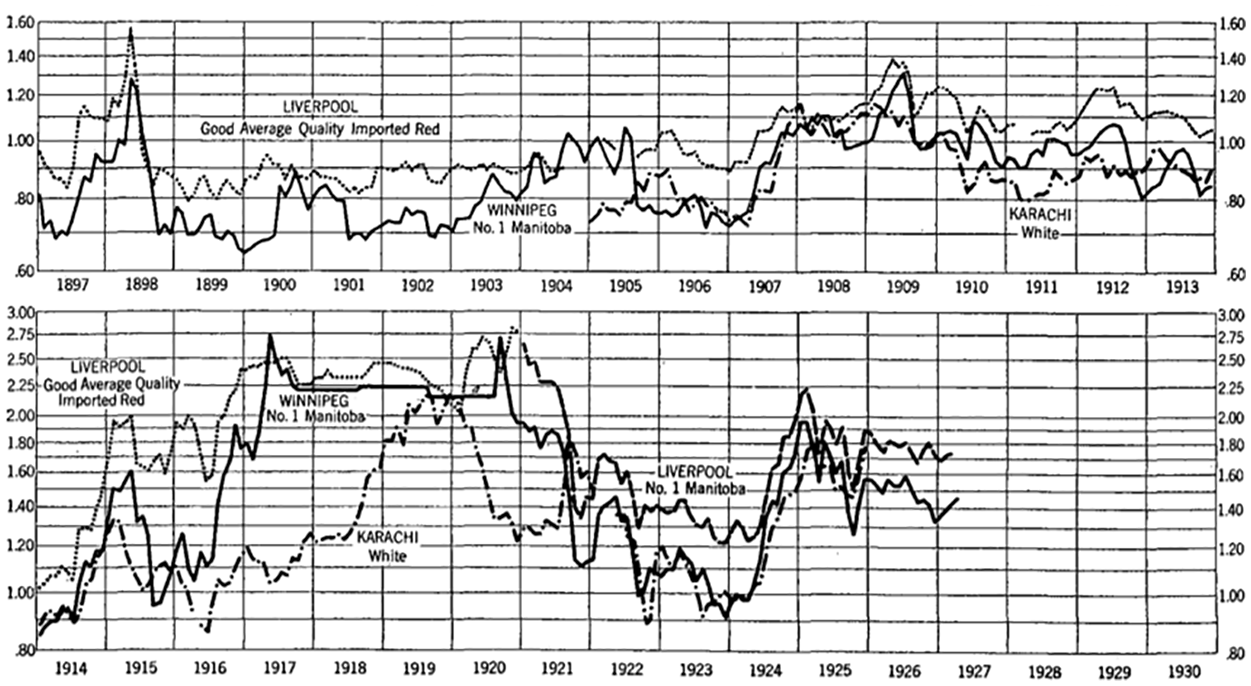
Wheat prices in Liverpool, Winnipeg and Karachi, India, 1897–1927 (dollars per bushel; logarithmic vertical scale) (Food Research Institute, 1927: 386).
The government controlled prices through various mechanisms, including limiting exports. In 1916, the colonial government set a maximum price for wheat to address high prices. In that year, the newly established Wheat Committee appointed nine firms in British India to act as export agents for wheat trade from India to UK. The British government would oscillate from buying wheat from importing firms in 1916, and then in 1917 via the Wheat Commissioner (Acland, 1918). The 1918 Influenza flu pandemic resulted in millions of deaths in the Indian subcontinent that affected harvesting that year’s kharif (autumn) crops and sowing and harvesting of the rabi (winter) crops of 1919. Colonial officials were not principally concerned about feeding the local population but closely control the domestic price of food as this maintained social and political stability. As a result, they imported wheat from Australia. The colonial government continued to actively limit the export of wheat – even when there was a good harvest – to control domestic food prices till 1923. In subsequent years, India would not provide significant wheat exports (Food Research Institute, 1927).
The political organising of agrarian classes in the form of the Ghadar Party and grain riots shifted the balance of forces that put up obstacles to making Indian wheat cheap in England. Indeed, the price of the Indian wheat that arrived at the ports of England was lower than that of the American crop. For instance, wheat from Punjab and shipped from Karachi cost 64 shillings per 480 lb in Liverpool, while wheat from the USA was almost double at 100 shillings (Wilson, 1921). Yet, if Indian wheat were exported, its price would come to be coordinated with Liverpool. Making Indian wheat cheap had less to do with the region’s agrarian productivity but more to do with how the colonial state exacted violence: the removal of native sovereignty after colonisation of Indian territory, turning land into private property, demonetising the rupee, repressing pastoralism, surveillance of the population, creating canal colonies and imposing a land tax to purchase Indian exports. Yet, there were limits to how British rule could dominate without the chickens coming home to roost. Providing cheap wage foods to Western Europe resulted in subsistence crises that increasingly were being translated into anti-colonialism. While British hegemony at the world scale was being threatened by inter-imperialist rivalries and competition from the likes of the United States and Germany, protests inside Britain’s tropical colonial territories were equally threatening to tear the Empire apart. The colonial state made calculations to forgo cheap food from the Indian subcontinent to maintain its minimal hegemony in the colony. What appeared to be a series of immediate, conjunctural policies limiting wheat export would contribute to an organic transformation and weakening of the colonial arrangement that underpinned the global food regime of capital.
Conclusion
Food regime analysis as formulated by Friedmann and McMichael, and reassessed and refined by them and other scholars, has provided an important contribution in conceptualising food relations in global capitalism. This article presents four critical interventions in this literature. First, whereas the food regime literature has argued that the first food regime was centred on family farms in temperate settler colonies, principally the United States, in providing the industrialising Britain with cheap wage foods (Friedmann, 2005; Friedmann and McMichael, 1989; Magnan, 2012), I argue for redrawing the significant vertexes in the geometry of imperialism to include the imperial metropole, temperate settler colonies and tropical colonies of conquest. I build on Patnaik and Patnaik (2021) to reconstruct the economic geography of an imperialist food regime from 1846 to 1930. In doing so, I highlight the constitutive dimension of India in the first imperialist food regime: the colonial imposition of a land tax provided the means for Britain to pay for Indian exports (including cash crops and wage foods) and pay off its deficits with continental Europe and the United States. From the 1870s, settler agriculture in the region grew with the help of capital exported from Britain to the United States. This was made possible through surplus extraction from India.
Second, I argue that anti-imperialism in India destabilised the first food regime. Whereas existing arguments about the demise of the first food regime are centred on a crisis in temperate settler colonies (Friedmann, 2005), I call for a focus on tropical colonies. A new understanding of the first food regime can be gained by examining the political actions of the Ghadar Party in the context of global food production and circulation, alongside attendant tensions. However, Patnaik and Patnaik’s analysis of imperialism showcases some economic determinist tendencies. They argue that the decline of the British colonial arrangement was marked by the loss of colonial markets to the Indian national bourgeoisie and emerging powers like Japan. This and decreased agricultural prices, made it more difficult for landowners to pay their land taxes (Patnaik and Patnaik, 2021). I reconsidered how imperial flows of cheap food from Punjab to England were the product of relations of social, political and military force. The British Empire in India was confronted with increasing riots and rebellions. Agrarian classes responded to the subsistence crisis politically by going beyond the confines of coerced consent. The colonial state made a political choice to control domestic prices by disassociating wheat production from the global grain market. The British Indian government feared that subsistence crises connected to the vagaries of the global grain market could be translated into radical anti-colonialism (Tirmizey, 2018). The Ghadar Party’s anti-imperialist politics hindered the dominant processes that established and maintained the imperialist food system. The Ghadar Party did not dismantle the first imperialist food regime alone, nor was it necessarily the dominant force. After all, the wheat fields of Punjab were one nodal point that made the dynamic geometry of the first global food regime.
Third, this argument employs a Gramscian conjunctural analysis for food regimes. Recent work has argued for further politicising food regime analysis by drawing on the writings of the Italian communist. Brown (2020) and Jakobsen (2018) argue for using a Gramscian framework to better understand food regime stability through processes of consent. I specified the need to theorise British colonialism in India during the first food regime as a context of minimal hegemony that shaped subaltern resistance.
Fourth, another contribution concerns an analysis of food regimes from a spatial perspective. Connected to calls to go beyond a focus on the global scale in food regime analysis (Jakobsen, 2021; Rioux, 2018), this article outlines a method for examining the interconnection between place-based conjunctural struggles and organic transformations at the world scale. The Ghadar Party’s attempted mutiny was one moment in the broader unravelling, crisis and eventual collapse of the first imperialist food regime. Further research is needed to examine the multiple moments and spaces of contention that shape food regimes.
Though it is beyond the limits of this paper to analyse the post-1930 period, it does invite new lines of inquiry to reconsider (post/neo)colonies as constitutive spaces in global food relations and political struggles therein. The global food regime of capital can be seen to be in retreat till 1973 if socialist revolutions (Russia, China, Cuba), national liberation struggles (the Ghadar Party included) and Third World (inter)nationalism are accounted for, and a second (neoliberal post/neocolonial) food regime re-emerges only after that (Araghi, 2010: 120). However, more case studies are needed to examine how place-based struggles have destabilised, held back or reconstituted the global food regime of capital.
Footnotes
Acknowledgements
This article has been improved through feedback on earlier versions from Marcus Taylor, Stefan Kipfer, Noaman Ali, Hadia Akhtar, Shozab Raza and Harriet Friedmann. I am grateful towards the anonymous peer-reviewers and Jennifer Bair who provided comments that were generative in refining the argument of the article. This piece is dedicated to the memory of Aziz Choudry, friend and mentor, who provided unwavering support and encouragement in my scholarly pursuits, particularly in relation to the Ghadar Party.
Declaration of conflicting interests
The author declared no potential conflicts of interest with respect to the research, authorship, and/or publication of this article.
Funding
The author received no financial support for the research, authorship, and/or publication of this article.
