




Abstract
Digital work that takes place exclusively online is often presented as spatially unbound, with workers able to work flexibly whenever and wherever they wish to do so, resulting – it is claimed – in the emergence of a ‘planetary labour market’ for online labour. Recent analyses have shown that fully remote work still clusters in geographical concentrations and is unevenly distributed across the globe. Drawing on an original data set of in-depth interviews with 67 adult webcam performers, we argue that spatially embedded, nationally scaled institutions, cultural norms and infrastructures such as regulatory, welfare and linguistic regimes have enduring salience in shaping the labour markets and labour processes of remote digital workers. We illustrate these through case studies with workers in three European countries (The United Kingdom, The Netherlands and Romania). We propose a novel theorisation of digital work and digital labour markets which understands them – even when purely online – as embedded and constituted by specific and pre-existing spatial, institutional and cultural arrangements largely at scale of the nation-state. The wider significance is that in identifying contextually specific labour processes, we argue that labour is often sold as part of discrete supply chains and bounded markets. We retheorise such labour as immanently constituted by nation-scale cultural and infrastructural norms and practices such as regulation and gender-regimes and show how these remain salient to online-only digital work.
At Lush Models, we give you the freedom to work from anywhere you like. Most of our models choose to work from the comfort of their own homes with hours that suit them.
1
Introduction
Digital labour platforms often represent the income generating opportunities they host as aspatial and atemporal. According to this logic (promoted by webcamming agencies like Lush Models through taglines as ‘the freedom to work from anywhere you like’), digital work appears as placeless and disembedded from existing spatial arrangements. These platforms host remote digital labour ‘carried out online from initial instruction through to completion and evaluation’, which differs from the platform labour of gig work which is ‘managed and mediated digitally (often via an app) but carried out offline’ (Howcroft and Bergvall-Kåreborn, 2019: 23). The image of digital work as unbound and completely flexible is supported by the idea that the location of this labour is ‘digital space’ (Graham, 2015: 870). Scholarly attention to remote digital work has shown how this specific online-only type of platform labour gives rise to ‘planetary labour markets’ (Anwar et al., 2024; Graham and Anwar, 2019; Howson et al., 2022).
Similar to other remote digital labour, webcamming is platform-mediated labour in which performers, as independent contractors, only receive compensation when clients pay for certain digitally delivered services (Rand and Stegeman, 2023). This type of labour – in which workers engage in (sexual) conversation and performances with audiences for compensation (Jones, 2020) – sees similar claims about its border-crossing potential as online only work. Existing research frames the webcamming market as ‘global’ (Stuart, 2016; van Doorn and Velthuis, 2018), dovetailing with other representations of ‘planetary labour markets’ (Graham and Anwar, 2019).
Even within planetary labour markets, scholars have drawn on theories of uneven development, to demonstrate that digital labour markets are not distributed evenly across the world (Anwar et al., 2024). These theorisations of remote digital work have largely engaged with theories of uneven geographical development to explain how and why the supply and demand of certain remote digital labour industries vary spatially and are distributed between countries and regions (Anwar et al., 2024; Howson et al., 2022).
In what follows, we theoretically advance analyses which have demonstrated spatial differentiation of these labour markets in terms of the distribution of labour markets (Kässi and Lehdonvirta, 2018; Van Slageren et al., 2022) by attending to the ways in which labour processes and conditions also differ qualitatively across places even in solely online labour in ‘digital space’. Moreover, while existing discussions have pointed out how existing economic relations are reproduced in geographies of digital work (Anwar et al., 2024), they have not yet extensively theorised the role played by national level institutions and cultural infrastructures in qualitatively shaping labour experiences. As such, we retheorise such labour as immanently constituted by national scale cultural and infrastructural norms and practices such as regulation and gender-regimes and show how these remain salient to remote digital work. In doing so, we argue for the enduring relevance of the nation-state in shaping digital labour and labour markets.
To examine the differential constitution of remote digital labour processes within one single industry, namely adult webcamming, we draw from a multiple embedded case studies of three countries: the Netherlands, Romania and the United Kingdom. Multiple-case study approaches can be explanatory (Yin, 1993), helping to clarify ‘the causes and consequences of combined and uneven differential developments’ (van der Linden, 2013: 57) and are useful for developing understandings of spatial variation in digital work. These three cases were selected for their geographic proximity, relationality and similarity, which enables emphasis on variation between them (Yin, 1993). The core research questions we seek to answer are: how and why does the labour of webcam workers vary? What does this mean for our theorisations of the ways in which digital labour is constituted?
Remote platform labour, sex work, and combined and uneven development
Webcam labour is generally conceptualised as contrasting with other forms of sex work due its lack of physical co-presence. As such, much like other forms of digital work, it is useful to establish an analytical ‘distinction between online sex work and digitally mediated direct sex work (which is delivered intercorporeally, in place)’ (Hardy and Barbagallo, 2021: 534). The ‘online-ness’ of this work is characterised by the absence of physical interactions between worker and clients (Henry and Farvid, 2017) with the platform as the primary space of work, rather than the any concrete physical place (Nayar, 2021). As a result of the construction of webcamming as purely online labour, research on webcamming has paid little attention to the geographic context of this work. Discussions which do attend to space in online sex work tend to emphasise the home, from which most workers are assumed to be streaming (Reece, 2015), despite the fact that many webcam workers work from studios (Ruberg and Lark, 2020; Vlase and Preoteasa, 2021).
Extant literature has tended to focus on how digital platforms regulate and shape webcam labour through the affordances and technological infrastructure including algorithms (Caminhas, 2022; Jones, 2015), chat functionalities (Hernández, 2019; Martins, 2019), categorization systems (Stegeman et al., 2023), or advertising functionalities (Stuart, 2022). As such, this literature reflects concerns about other platform design choices on workers’ labour experiences and income in a variety of industries (e.g. Stark and Pais, 2020; Wood et al., 2019). Webcamming indeed shares many of its features with other types of platform labour (Rand, 2019). It is also marked by precarity, algorithmically driven competition and misclassification of workers (Rand and Stegeman, 2023). Unlike other platform labour, webcamming is however also impacted through its intense stigmatization as sex work. This compounds the precarity online sex workers experience, for instance through financial discrimination which deepens workers’ reliance on platforms (Easterbrook-Smith, 2022). As feminized, stigmatized work webcamming is an especially illustrative example of the inequalities of platform work (Jones, 2020).
Analyses of more generalised forms of platform labour have been attendant to spatiality. Studies of platform labour have primarily focused on the entanglement of platforms, cities and nations in gig work delivered in a certain places on the one hand, and the unequal distribution of remote industries across the globe on the other. In sum, these have shown that platforms reshape the space of economic activity and have a significant impact on the spatial organisation of labour markets (Kenney and Zysman, 2020), including ‘platform urbanism’ which scrutinises the effects of platforms at the urban scale (Leszczynski, 2020; Cirolia et al., 2023; Orth, 2024). At the other end of the scale, authors have focused on the production of ‘planetary labour markets’, created through the affordances and mechanisms of platforms. Such examinations focus on the ways in which platforms enable ‘the potential coming together of employers and workers on a global scale’ (Graham and Anwar, 2019: 9; Lehdonvirta et al., 2019). A global marketplace for labour is shown to increase competition can lead to a race to the bottom in wages and labour conditions (Agrawal et al., 2015; Anwar and Graham, 2020).
In such global markets it could be assumed that location might lessen in relevance. However, research has already shown that there are still stark spatial divisions of digital labour (Anwar et al., 2024) in which the buyers and suppliers of certain services are located (e.g. Kässi and Lehdonvirta, 2018; Van Slageren et al., 2022), as platforms take advantage of and reinforce existing geographies and inequalities (Anwar and Graham, 2020). For platform labour this has meant that labour is outsourced to and concentrated in low-wage countries in order to cut costs for capital (Agrawal et al., 2015; Kässi and Lehdonvirta, 2018; Lehdonvirta et al., 2019; Van Slageren et al., 2022).
Platforms replicate how previously offline types of industries and labour choose and (dis)advantage various locations over others in ‘spatial divisions of labour’ (Massey, 1995: 14). Such uneven development might take place on a variety of scales from regional, national to local (Peck and Tickell, 1992). In remote industries, for example, the United States mainly accounts for demand for digital labour, and low-to-middle income countries such as India and Egypt provide the lion share of supply (Anwar et al., 2024). Existing research demonstrates that some of the factors shaping remote work are organised geographically, including (1) technological availability and (2) linguistic geographies. First, the availability of technology and internet connections, and data centres shape what localities are connected to what extent and at what speed (Starosielski, 2015), in turn shaping how and in what space digital labour is carried out. Second, linguistic characteristics also shape where and how certain types of digital labour emerge. Since the consumption market for remote digital labour is primarily located in anglophone Global North countries (Kässi and Lehdonvirta, 2018), local languages and English language skills become relevant. For remote digital labourers, communication with customers in English is central to how work relations are formed (Howson et al., 2022). These spatially embedded features both shape who does digital labour and how it is done. As we discuss through the platform labour of webcamming, such geographical and cultural factors do not just shape where industries are concentrated but also qualitatively shape diverging labour experiences in these industries.
While place and location have been given increasing attention within the literature on planetary labour markets more widely, they have been underexamined in webcamming work. This is somewhat surprising, considering there is a significant body of literature on the geographies of sex work, but – reflecting the emphasis on gig work taking place in cities – these have largely concerned themselves with in-person work. Geographic accounts of sex work have similarly tended to focus on urban areas (Bernstein, 2007; Calderaro and Giametta, 2019; Hubbard, 2006), showing how city-planning and policing displace sex workers (Bernstein, 2007) or the spatial division of sexual labour in sex tourism, demonstrating how international flows of capital shape sexual services through tourism (Phillips, 2008). Geography clearly matters to how and where sex workers can do their work, yet attention to spatiality is largely missing when it comes to purely online sexual labour.
Since connecting into online networks is not distributed equally, neither is access to digital work (Jones, 2020). This seems to have been an important factor in development of Romania, Colombia, Canada, the UK and US as webcamming hubs (Jones, 2020: 63), yet analysis of the impact of national context remains underexplored, with the exceptions of places in which webcamming is outlawed (Mathews, 2017; Lee, 2021), such as South Korea and The Philippines. Most jurisdictions in Europe do not regulate sex work, either at a national or regional scale and as such, the relevance of existing spatial arrangements has been ignored, even in the case the global ‘hubs’ which appear to have concentrations of webcamming work.
To address both the lack of discussion of geographies in online sex work scholarship and to contribute further to theoretical understandings of ‘uneven geographical developments in the gig economy’ (Anwar et al., 2024: 5) we draw on a study of webcamming across three European countries. We add insights by theorising the ways in which seemingly identical concrete digital labour (webcamming) when distributed across space, can produce widely differing labour conditions. In doing so, we demonstrate that remote digital work is not a monolithic global experience. Instead, just as ‘the internet as a meaningful phenomenon only exists in a particular place’ (Miller and Slater, 2001: 1), we argue that digital work also only exists as a meaningful and material phenomenon in a particular place. Specifically, in response to scholarly attention to the urban scale on the one hand and the planetary on the other, we emphasise the national embeddedness of platforms. We draw attention to the important role of nation state in shaping not just the distribution of industries, but also differences in labour processes and conditions.
Methodology
In contrast to existing comparative research on remote digital labour distribution, which has primarily drawn on quantitative data (Anwar et al., 2024; van Slageren et al., 2022), our discussion of the geographical embeddedness of digital work draws on interviews and ethnographic data. Semi-structured online and offline interviews were gathered between summer 2021 and autumn 2022 in the Netherlands, Romania and the United Kingdom. An interview guide, focussing on labour opportunities, challenges and experiences was constructed on the basis of previous literature (e.g. Jones, 2020; van Doorn and Velthuis, 2018; Vlase and Preoteasa, 2021). The guide was piloted and discussed at various stages of the research process with three experienced online sex workers in paid advisory roles, as such ‘dialogic collaboration’ reflects best practice in sex work research (Gillespie and Hardy, 2021).
Different recruitment methods were used in each country shaped by national norms in relation to online sex work. In all three countries a call for participants was shared over (then) Twitter. Sex workers are usually regarded as a ‘hard-to-reach’ population (Shaver, 2005), this motivated the use of personal networks, online recruitment and snowball-sampling. Online recruitment presented specific challenges in Romania as many Romanian performers did not disclose nationality on social media, or did not manage their accounts themselves. Instead, a set of key gatekeepers (webmasters, webcamming consultants and conference organisers) helped introduce the researcher to the scene there in-person. Attending parties and webcamming conferences (or ‘shows’) proved the most effective way to find potential participants and it was often necessary to meet with performers multiple times before actually being able to schedule an interview, following a process of trust building.
In the Netherlands and UK compensation for interviewees’ time was an important commitment with respect to both reach, representativeness and the valuing workers’ time (Bloomquist, n.d.). It became evident through fieldwork, payment for interviews was usually not seen as culturally appropriate in Romania. Local informants explained this often felt as a uncomfortable commodification of something participants were doing mainly as a favour to the researcher as a person. Some participants did receive payment, however many other participants in Romania refused direct compensation for interviews.
Initial analysis of interview transcripts, ethnographic notes, a fieldwork diary and drawings took the form of emergent or open coding (Blair, 2015). This process, which already started taking place after the first set of interviews in the Netherlands, added an iterative layer to the research process. Based on the particularities of webcamming work that emerged in the Netherlands, it was already clear that assumptions of a ‘global digital sex market’ were being contradicted by this data. Coding the subsequent data in Romania and the UK further confirmed this. Through intimate familiarity with the entire dataset, the first author described the most distinctive and representative experiences of webcam work in composite vignettes of each of the three countries. To protect anonymity, and summarise national difference, these vignettes follow guidelines of ethical fabrication, bringing together multiple participants’ experiences in single accounts (Markham, 2012) . Through these vignettes the central factors shaping webcam labour in the Netherlands, Romania and the UK were established: the role of workspaces, intermediaries, the client market and regulation. Interviewees discussions of these factors are used to explain the observed uneven development of digital labour conditions across these three countries.
The relational comparison presented here allows us to understand these three contexts as connected (Ward, 2010: 480; Gillespie and Hardy, 2021), not least in that their labour markets are related through the movement of workers and clients between these countries (Vasile, 2014: 739). We seek not only to contrast and describe different cases, but to ‘to tease out and explain cross-national similarities and differences rather than simply present a number of additive or parallel national case studies’ (Kirk, 2011: 21). Our cases are insightful in because they use a ‘most similar systems approach’, which tries to identify causes of differentiation in cases which share a number of similarities (Przeworski and Teune, 1970: 34). This approach is used to ‘understand why difference or similarity persists’ amongst cases (Tilly, 1984; Ward, 2010: 475).
While the similarities, relations and differences between the Netherlands, Romania and the UK could never be discussed comprehensively, some of their characteristics have especially informed this case selection. Each case study is a European country and culturally similar, in that they are majority ‘white’, historically Christian, with strong technological infrastructure currently. These countries are also similar, for instance when it comes to welfare provision and the unregulated nature of online sex work (Stuart, 2022), when compared globally. Their differences present when analysed at an intra-European scale. These differences, sex work regulation; gendered labour market inequality; technological infrastructure; social protection; and language, inform the case selection and analysis (see Table 1).
Comparative case studies: Relevant diverging factors.
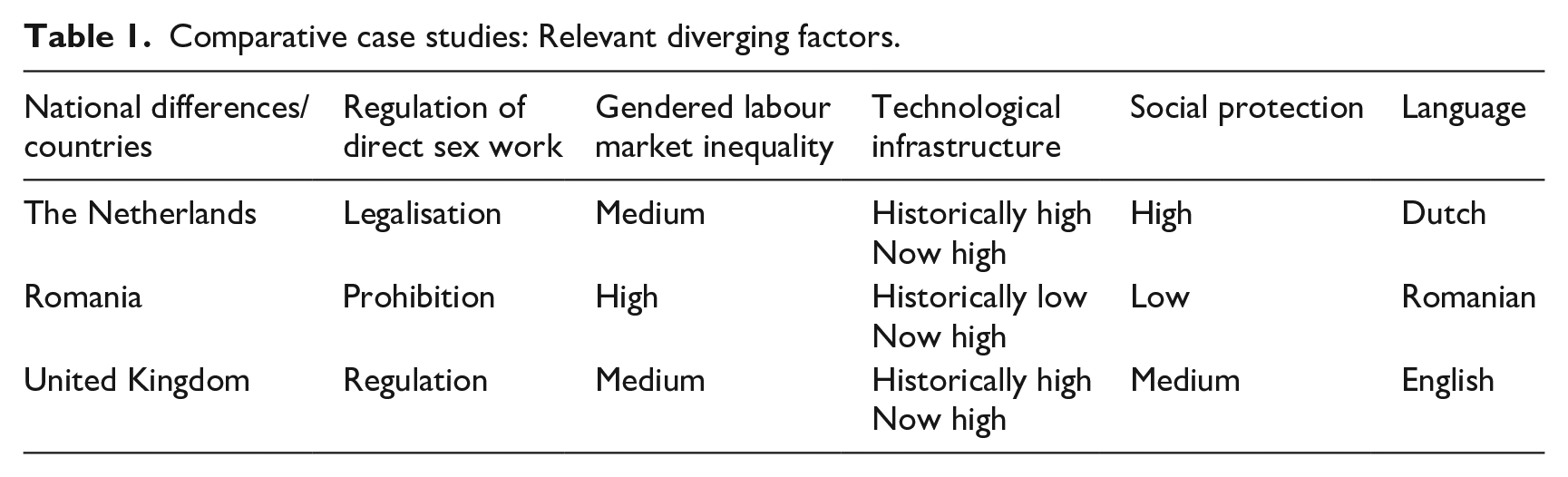
The Netherlands has historically had a more progressive (though still restrictive) stance on sex work using a legalisation approach, this contrasts with the UK which is seeing increased push for Nordic model regulation and Romania’s complete prohibition of all in person sex work (Scoular and Carline, 2014; van Stempvoort and Janssen, 2022; Vlase and Grasso, 2021). High speed internet access has been largely accessible within the home in the UK and The Netherlands for a number of decades, while home internet access was slow to rise in Romania for much of this century (Ţiţan et al., 2014). In Romania women face higher levels of labour market discrimination comparison to the other case (Vlase and Preoteasa, 2021: 7). In all three these European countries (child) care responsibilities primarily fall on women (Sikirić, 2021). Despite better labour market access in the Netherlands and the UK policies and cultural attitudes and prohibitive costs (van Breeschoten and Evertsson, 2019; Yerkes and Javornik, 2019) motivate women to work from home to be able to take this responsibility. Finally, social protections vary between these countries with, for example, benefits being accessible for 60% of unemployed people in the UK, 23% in Romania and 73% in the Netherlands (World Social Protection Report 2017–19, 2017).
Since the three cases presented here are all European, the conclusions here certainly do not empirically capture the diverse ways webcam labour is organised in places around the world. Further research should raise the specificities of webcam labour in contexts outside Europe, for example addressing the labour processes of webcam performers in industry hubs such as the Philippines and Colombia in greater depth (Mathews, 2017; Jones, 2020). At the same time, the differences observed between these three cases are generative of theory about the ways in which digital labour processes are shaped, with potential applicability and significance well beyond the European context.
Webcam labour across space: Same work, different experiences
In the Netherlands, Kimi (33, cis woman) sits alone in her bedroom. Her bed has blue covers and a few pillows. Through the webcam you can see the rough contours of her room, the wooden beams on her ceiling, and some neutral walls. Most visible and striking on the screen is Kimi’s body. Any customer who wants to ‘cam’ with Kimi can click on the image of her body in a livestream, they however cannot see her face which remains outside the frame. The webcamming sites Kimi uses both cater almost exclusively to Dutch customers and as a result, she wants to avoid being recognised. Maybe more importantly, with her face invisible, she doesn’t have to worry about having to look happy all the time. Meanwhile, in the UK, Molly (28, cis woman) works via a ‘model’ agency. The agency’s website states that the services they provide (verifying and mentoring webcammers) means that they ‘do all the hard work so [webcammers] don’t have to’. Accompanying text stresses how flexible this work is: you can work anytime and anywhere. Earnings are collected by the agency, who then distribute them to performers each week, taking a cut of around 20% each time. Despite the fact that you can start webcamming on your own on adult platforms in the UK, ‘agencies’ do well here. Molly started with online sex work after she got an advert for the agency. These agencies present themselves as the key to easy money. The reality is that the veneer of success that these agencies project doesn’t hold up: many of them haven’t posted on their social media for over a year, and the money hardly dribbles, let alone rolls in. Standing on one of the main squares of Bucharest, it is hard to imagine this is the ‘headquarters’ of the Romanian webcamming industry. No sexual imagery, no ‘red-lights’, or anything that would indicate the pervasiveness of adult camming here. The traffic is busy and hordes of people are exiting the metro. International stores, restaurant chains and their massive ads surround the square, alongside government buildings and apartment entryways. One building – at least 10 stories high – takes up one entire side of the square. It’s large and white, reminiscent of many of the other communist era apartment blocks in the city, but in better condition. Young women finish their cigarettes, put them out and enter the building. Multiple webcamming studios are located here, with over 200 models working in the building at any one time.
The vignettes above gesture towards the differences in webcamming labour as it is experienced by digital workers working in The Netherlands, Romania and the UK. In what follows we analyse the role played by five variables outlined above: sex work regulation; gendered labour market inequality; technological infrastructure; social protection; and language. We apply these variables as lenses to analyse three levels which shape and influence the working conditions, labour processes and labour relations that workers encounter: (1) workplaces, (2) intermediaries and (3) markets. We then finally examine how all three of these are shaped by intersecting legal regulations. This analytical framework to explicate the divergent labour practices within webcamming across the case studies.
Workplaces
A central difference in the labour of webcam performers in the Netherlands, UK and Romania is the location in which their work is generally performed. In Romania, the ‘bedroom’ that performers work from is often not within their home. As illustrated in the vignette, in the Romanian ‘videochat’ industry large numbers of workers perform from large office-like buildings. Most Romanian cities house webcamming studios. Of the 15 performers interviewed in Romania, 13 had worked from a studio at some point during their career. These spaces allow workers to adhere to webcam platforms’ requirements for high-quality well-connected streams as they are fully equipped with ‘proper lights, good webcams, good computers’ (Brian, Romanian performer). Platforms encourage and enable the mediation of webcamming by studios, as their terms of service can, for instance, be entered into by studios on behalf of a group of performers. Workers stated that they appreciate the social aspect of working with others and the work-life separation these workspaces create. This is the case for Mia (Romanian performer) who has worked from studios consistently for the last nine years: ‘I want to have a schedule, I want to know that I am waking up and I am getting dressed and I am going to work and I meet my colleagues’. In exchange for providing the means of production in this way, studios often take upwards of 50% of the pay-out performers receive from webcamming platforms. Studio managers, support staff (so-called ‘admins’ or ‘trainers’) also exercise considerable control over webcam performers’ work (see below).
In stark contrast, in the Netherlands not a single performer worked outside their personal domestic space, with all of them working from home. Similarly, in the UK only 2 out of 18 performers had worked from studios. As studios in the UK are rare, going into such a workplace was more complicated than in Romania: ‘I would go to the studio like four times a week, which now actually thinking about it is like crazy because it’s a three hour commute’ (Kimmy, UK performer). Performers in these countries stated working from home was specifically an appealing aspect of remote digital work. As Sharon (Dutch performer) explained: ‘it’s nice and easy to just be home’. Working from one’s own space was also described to increase autonomy in work: ‘I liked the freedom [. . .] I was earning money from home, I could potter around and do housework, do literally anything I wanted’ (Rachel, UK performer). This was especially useful as many performers (over half in the Netherlands) also had childcare responsibilities. Though challenging, those could be balanced more easily with the work ‘yes you’re stuck with the kids, but you also have that freedom’ (Merel, Dutch performer). While working from home means taking care of your own equipment and space, blurring of work-life boundaries and sometimes loneliness many performers in the UK and the Netherlands appreciated the flexibility, comfort and opportunity to multitask with other domestic labour it afforded them, reflecting findings from other workers undertaking remote digital work from home (Gerber, 2022).
The uneven prevalence of studios in Romania on the one hand and their near absence Netherlands and UK on the other can be explained by historical national access to technologies and the subsequent evolution of industries. When the webcamming industry emerged about three decades ago (e.g. Senft, 2008), many people did not have home internet access. While in Western Europe this situation did not endure, home internet access is a more recent phenomenon in Romania (Ţiţan et al., 2014). Industry insiders shared that all three countries housed webcamming studios in the 1990s to enable streaming, but while they declined in the Netherlands and UK, in Romania, studios consolidated their monopolisation of the industry. Additionally, the wealth inequalities between these three countries mean that the initial investment (laptop/webcam) to start camming can be harder to make for starting Romanian performers (Jones, 2020). Paradoxically, internet-connectivity in Romania is now of some of the highest quality in Europe, often given as a reason for this country’s status as a webcamming ‘hub’ (Vlase and Preoteasa, 2021: 7). Over time, through their early prolonged necessity Romanian studios became especially prevalent and accessible and therefore an industry norm, particularly for performers starting their careers.
The gendered nature of online sex work also reflects women’s access to work out and inside the home, shaping the preference for working for home for women. In Romania, webcamming is one of the few industries where women are instead at an advantage (Jones, 2020) and more easily hired through studios for a relatively well-paying type of work. Despite formal better labour market opportunities in The Netherlands and the UK, a lack of access to childcare and enduring cultural attitudes encourage women who are parents to both work part time and seek strategies that enable them to combine work and care from their own homes.
Intermediaries
In addition to the location in which work takes place, intermediaries or ‘third parties’ (Brouwers, 2022) are central to shaping the delivery, labour process and employment relations that webcammers encounter. In the webcamming industry these intermediaries are often either the aforementioned studios or online studios known as ‘agencies’ (Jones, 2020: 87). Studios and agencies add an additional layer of intermediation between the worker and the platform.
In the Netherlands none of the 34 performers worked with an intermediaries to access platforms. Performers instead worked independently, sometimes officially registered as a single-person business with the Dutch chamber of commerce. A couple of especially prominent performers had exclusive contracts with webcamming platforms ‘so I can’t work for others’ (Eline, Dutch performer). While platforms, for instance through their terms of service (Stegeman, 2021), do shape how work can be performed by prohibiting certain acts, without other intermediaries Dutch performers felt more autonomous within their work. A seasoned Dutch performer, Niki, states ‘I don’t have to do anything I don’t want to’. This autonomy also fed into Dutch performers’ flexible and part-time working hours. The Dutch platforms on which many performers worked in The Netherlands offered relatively low, but consistent rates of pay. This seemed to encourage workers to treat webcamming as secondary income. More than half of the interviewed performers here had another job outside of sex work and often also combined the work with childcare. Most Dutch performers describe working 10–20 hours a week. Performers here often describe a less financial dependence on platforms, as this is ‘extra money, for a day out or towards a holiday’ (Wendy, Dutch performer).
In contrast, webcammers in Romania tended to have webcamming as their full time, main job, as on average interviewees described working at least 40-hour weeks. Models contracted by studios work according to a full-time schedule, with studios structuring 8-hour shifts ‘morning, day and night shift’ (Mihaela, Romanian performer). Studio owners have significant control over working practices, ‘you do not leave until your shift is over’, with some studios applying penalties for missed or shorter shifts (Sasha, Romanian performer), reflecting practices in other forms of sex work such as stripping (Sanders and Hardy, 2014). Studios and platforms here emphasize the importance of making ‘hours, hours, hours’. Managers described how platforms encouraged them to push performers to work more. Alice (Romanian performer) exemplifies this: ‘eight hours is the minimum, you need to be there every day’. In this sense platforms, through studios, are able to stimulate certain labour practices, such as spending a lot of time online. Studio managers also strongly shape and instruct the contents of the performers’ work, Roxanne (Romanian performer) explains how one of her old managers was ‘always yelling at me: get naked, cause otherwise they will close your account!’ Studios impose ‘systems and rules’ (Monica, Romanian performers) which instruct models on how to interact with clients. Studios, as intermediaries, therefore limit some of the autonomy sometimes associated with remote digital labour. As such, more rigid and traditional employment conditions were apparent in the Romanian webcamming industry.
Occupying a somewhat middle space, UK performers sometimes work through intermediaries as well as independently. About half (7 out of 18) of the performers had at some point worked through a studio, a manager, a group or an agency. Unlike the physical location and means of production offered by actual studios, online intermediaries simply connect performer and platform without providing any further means of production. As outlined in the vignette above, these intermediaries offer relatively little in terms of support and to some degree, simply collect rent from workers. The prominence of agencies can to some degree be explained in the UK, because a popular platform in the UK allows performers to receive their pay on shorter notice when working through agencies. Additionally, agencies are pervasive in other creative industries in the UK (e.g. music) even after an increased role taken up by platforms (Umney, 2017). Most performers who had worked with this type of intermediary agreed that they did little at high costs: ‘the help that I actually got wasn’t that much, and they took like 20% of my money’ (Becky, UK performer). Agencies often did help performers set up accounts. As Danielle (UK performer) explains this limits performers’ control over their working identity: ‘they create your profile for you, they create your brand and you have very little control over it’, presenting issues for account and content ownership.
Both physical studies and online agencies held ownership over performers’ profiles. Molly (UK performer) explains that once she left the agency, she lost access to the profile on which she had built a following: ‘when I left, they kept my account and I had to like start from scratch’. Romanian workers reported similar issues. One performer, who is currently trying to leave the studio she has worked with for years, describes: ‘it’s possible only to make a new account [. . .] the thing is that I cannot use my old pictures the studio made, it’s in the contract. I’m not allowed to use what they have created’ (Monica, Romanian performer). While performers can leave studios or agencies to work independently this is discouraged by maintaining control over worker content and as such, limiting their labour mobility.
The varying roles played by various types of intermediaries (or lack thereof) strongly influence performers’ labour processes. The variation between a Dutch performer working a few hours a week directly on a webcamming platform, to a performer in the UK being encouraged to work a specific niche by an agency manager, to the more than full-time work week Romanian studio performers engage in, attests to the differentiation of the labour relations of this type of seemingly identical work which is delivered online.
Markets
Webcamming work is a form of ‘on-demand’ labour (Howcroft and Bergvall-Kåreborn, 2019: 21). Available 24 hours a day, from anywhere, technically, webcamming has a possibility to cross borders (Stuart, 2016; van Doorn and Velthuis, 2018) and time-zones. Despite that, in both the UK and the Netherlands markets are partly oriented and scaled nationally. In the UK, this in part explicable by the fact that one of the most popular camming platforms also offers space to advertise in-person sex work such as escorting (Hardy and Barbagallo, 2021). In-person work is more obviously spatially bound, due the necessity of co-presence. Robyn (UK performer), who works on this platform shows how this brings the national context into play: ‘it’s also a site for advertising like escorting and [the clients] will be like oh where are you from and they will be like, okay, do you travel [. . .] and then I’m like, oh I’m sorry babe but I only do camming’. In the UK sample many webcam performers also report engaging in in-person sex work, either in the past or currently at higher rates than in the other country case studies. Compared to the Netherlands (11 out of 34) or Romania (1 out of 15) a much larger portion, 13 out of 18 participants reported engaging both on and offline sex work in the UK. Some clients also seemed to prefer cultural recognisability as well. Robyn, despite not selling geographically bound in-person services, notes that most of her customers are from the UK because ‘British people seem to go onto camsites and hate the fact that it’s filled with American girls so they filter it by British girls, because they don’t want like Eastern European girls and they don’t want the American girls’. The crude and at times discriminatory categorization systems used by many webcam platforms (Stegeman et al., 2023) enable customers to specifically seek out performers from certain regions. These customer preferences, the overlap with in-person sex work, and the status of English language as a key global language meant that UK performers described predominantly UK-based clients with some from other global contexts.
In the Dutch context, culture and language also play a role in scaling the webcamming market at a national scale. Performers explain that Dutch clients like to communicate in their mother tongue. This also featured in performers’ decision to work on more national sites: ‘I can speak English, but then I feel like the conversation is far more forced, you can’t express everything you want to say’ (Alexandra, Dutch performer). Of the 34 performers spoken to in the Netherlands, all but 3 had worked on Dutch platforms. These Dutch platforms are orientated towards Dutch performers and clients, shaping expectations, interactions and prices. On these platforms, too, categories are used by clients to uphold a racist constructions of what it means to be ‘Dutch’. Phoenix (Dutch perfomer) noted ‘most of the men on this sites are not looking for women who aren’t white’. The specific national orientation and design of Dutch platforms, which until recently had a category for ‘exotic’ performers, construct a certain (exclusionary) standard for performers premised on white supremacy and ‘Dutchness’.
Performers also observe different customer expectations on Dutch sites as Nikkie (Dutch performer) explains: ‘I don’t always feel like being there completely dolled up, and [Dutch site] is more a chatty chat-site than those American ones [. . .] there they expect you to show everything’. Working with Dutch customers appears to require less work for performers, as it involves more conversation and less focus on appearance: ‘in the Netherlands, the men actually just like to watch a woman who looks groomed, of course, but natural’ (Eline, Dutch performer). It is noteworthy that these platforms also offer significantly lower pay-out than more internationally orientated platforms. Globally focused platforms allow for flexible compensation often between 1 and 10 dollars (96 eurocents to 9.60 euros) per minute, with Dutch platform compensation being fixed around 0.40 eurocents per minute for private shows.
Performers in Romania, whether working at studios or independently, often interact mostly with international and especially American clients. This is reflected in the temporal structure of shifts, which are designed to align with different time zones: ‘it was hard because I’m not a morning person, but it had results because it’s a lot of guys from America’ (where it is late at night) (Mihaela, Romanian performers). Many performers in Romania also stressed the importance of speaking English for this reason. A big factor in Sasha’s (Romanian performer) success was her excellent English: ‘I just sound very American’. This also disadvantages those with fewer English language skills in this market: ‘it was the language barrier for me and I don’t understand what they want from me and I don’t understand what to do’ (Antonella, Romanian performer). Studios can intervene by providing English language assistance to performers either through training in English or outsourcing the communication to an ‘admin’. Roxanne (Romanian performer), who also owned a studio in the past, described that she would teach performers English. Oana, previously a model herself and now a ‘admin’ at a studio, even outlines how she will type for performers who do not speak English themselves: ‘if the girls don’t know how to speak English, I can help them with the replies, like what to tell them’. Temporal work patterns, language skills, and the introduction of ‘admins’ into performers’ labour process were it shaped by the Romanian webcammers orientation to the US market.
Webcam workers in these three countries have different sets of clients and are operating in somewhat distinct markets. This factors into their experience of the work, as client expectations and requests shape performances, standards, working times, languages spoken and income. As in other digital labour, (English) language ability is important for creating earning opportunities (e.g. Howson et al., 2022). Furthermore, the Romanian case seems to reflect trends in uneven distributions of digital work in which demand largely stems from the USA (Anwar et al., 2024) and supply occurs in peripheral or semi-peripheral states. Webcammers in the UK and the Netherlands, however, do not appear to be engaging in planetary markets for remote digital sex work. Especially in the Netherlands, biases for same nationality workers, known in other cultural industries (e.g. Velthuis, 2013), are replicated. While it is in principle possible that workers in the Netherlands and the UK could also engage with customers on a planetary scale, a multiplicity of factors including the platform affordances, language preferences and racialised consumption of sexual labour constitutes this market at a national scale.
Regulating international platforms and national labour processes
As mentioned previously, webcamming is not specifically regulated as either a type of sex work or a type of digital labour in any of these three countries. Instead, emerging legislation impacting online sex work focusses on the protection of users who might (not) want to consumer sexual content. The Online Safety Act in the UK, or the Digital Services Act (DSA) in the EU both aim to protect users, and especially children, from harmful content – which they do by classing sex work and sexual content as harmful (McGlynn et al., 2024). These pieces of legislation are relatively new and their full effects cannot be assessed until they have been fully implemented, but sex workers rightfully worry about the possibility of increased censorship and decreased access to online workspaces. 2 Similarly, the situation in the Netherlands and Romania can be impacted by novel EU legislation such as the Platform Work Directive, although as for the DSA, online sex workers were not considered or consulted for this piece of legislation. Legislation of platforms on the EU and the UK level already show how challenging online workspaces are to regulate, with the Online Safety Act, DSA, and Platform Work Directive all going through long and laborious processes of consultation, construction and implementation. All the while, workers on platforms, such as webcam performers also still deal with their specific national circumstances, including national level laws. Despite increased attention to platform legislation, it also important to attend to these national contexts.
It is evident that this work is shaped by and intersects with differing national regulatory and welfare regimes (e.g. Hall and Soskice, 2001). For example, Dutch parental leave and labour policy has mainly supported men as breadwinners for families, encouraging the high level of parttime work undertaken by mothers (83% of mothers and 16% of fathers work parttime) in this country (van Breeschoten and Evertsson, 2019). This could shape the flexible, independent more incidental engagement workers show with webcam work here. Such social policy, as the inaccessibility of benefits in Romania or the extreme costs of childcare in the UK shape how and why workers engage in webcamming, with divergent results.
Criminal law and the national variation in how sex work is legislated can also impact webcam workers. For example, the UK fully prohibits working together with colleagues in the same space when it comes to sex work (Brouwers, 2022). Despite webcam performers not explicitly being included in such legislation, this might explain the prominence of online agencies over in-person studios here, since in a studio multiple online sex workers often work at the same time. In Romania all in-person sex work is completely prohibited (Vlase and Grasso, 2021), which in turn can explain why studios here instead try and present themselves as media enterprises. Webcam performers in interviews in Romania most of the time did not identify as sex workers and actively distanced themselves from sex workers who had physical contact with clients. The structuring and presentation of the webcamming industry, is impacted by how offline sex work is regulated too.
Finally, the labour regulations and tax systems also play into how webcam workers can make money on platforms. Romanian webcam performers, for example, can be contracted as creative contractors by studios, which helps authorities here claim tax on this large industry without having to provide much support. The Romanian financial administration seems reluctant to speak about this stigmatised industry, but recently disclosed there are 400,000 individuals known to them as active in industry (Bellu, 2023). Romania’s contracting system allows studios control where performers work, with what intermediaries and for what audiences without many obligations and at the same time ensure the state can tax these workers without acknowledging them.
While not comprehensive, in terms of the multiple intersecting forms of regulation that shape this work, these examples of policy, criminal law, and taxation systems are suggestive of the ways in which these nationally scaled regimes remain important in shaping work that appears to primarily be governed by platforms.
Conclusion
Webcam labour is often assumed to be conducted in a ‘global’ industry with markets for webcam labour constituted at the planetary scale and the work itself occurring in ‘online’ space. Yet, the variation of webcam performers’ employment relations and labour processes in Romania, the Netherlands and the UK suggests that digital labour within a purely online industry nonetheless has a ‘territorial expression’ (Smith, 1984), adopting different forms in different places. Places – and specifically – national-scale institutions and cultural norms persist in geographically tethering digital workers to certain national formations and arrangements. Most notably, we argue the scale of the nation-state still matters. National-scale factors such as the regulation of sex work, gendered labour market inequalities, technological infrastructures, social protections and language continue to shape work conducted purely online, with divergent outcomes. Theoretically, then, we contribute to existing accounts of purely online remote labour by insisting on the ongoing geographic tethering of digital work and the enduring relevance of the nation-state for shaping employment experiences and outcomes within it.
Existing regulation and institutions which pre-date digital work give rise to national variation of working practices in online sex work. Efforts to improve the working conditions of digital workers often focus on calls for increased governmental regulation of platforms (Anwar et al., 2024; Englert et al., 2021). While this is certainly important, we demonstrate here that it is not just the digital space of the platform that influences labour standards in digital work. As the regulation of labour platforms is shaped by existing wider labour and welfare regimes (Thelen, 2018), this is suggestive of new avenues for improving digital labour conditions. Rather than just focusing only on cross-national regulation of labour platforms (Fabo et al., 2017), it is possible to intervene in the place-specific conditions in which people undertake digital work. Where webcamming is concerned, changes to the national regulation of offline sex work, social security access, care policies and the regulation of contracting practices, all significantly impact how performers might do their labour. Historic campaigns of sex worker activists have long argued that increased regulation of their industry is at best not particularly helpful, but can even be counter-productive (Mac and Smith, 2020). Instead, sex worker activists have focused their effort to campaign for more equitable social provisions through increased and less punitive access to benefits for all. Regulating platforms then, is a necessary, but not sufficient measure for improving labour standards within webcamming, which instead requires much wider interventions and structural change. Much like other forms of sex work, it is apparent that in fully remote digital work, social measures, rather than platform legislation, may have more meaningful impact for workers.
Webcamming shares many characteristics with other types of digital labour (e.g. Rand, 2019; Rand and Stegeman, 2023) and as such, these findings have significance far beyond sex work. Recognising the continuing role of the nation-state in shaping online-only digital work is vital in other forms of fully remote digital work, for example coding, translation services, or completing microtasks. While our analysis focusses on the specific differentiation of workspaces, intermediaries, markets and regulations in the European webcamming industry, because of the webcamming’s many similarities with other digital labour analyses of these factors can be useful in other industries too. This also raises the question of which national scale regulations remain relevant for shaping of digital labour more broadly and how they might be used in practice or policy to provide greater protections for these ‘new’ forms of work which are frequently represented as escaping existing forms of regulation and legislation. While digital space may indeed be ‘untethered’, digital workers log in to global platforms from specific places, which are shaped by national cultures, institutions and infrastructures, which in turn determine the ways in which those workers experience their labour and employment relations. In the case of webcamming, labour is often sold as part of discrete supply chains and bounded markets, rather than generalised planetary markets for online labour. As such, we offer a theorisation of remote online labour which is suggestive of ways in which research can better account for the structuring influence of existing national infrastructural and institutional and cultural regimes in the variation of labour markets and processes experienced by digital labourers across space. We propose a theorisation of digital work and digital labour markets which understands them – even when purely online – as embedded and constituted by specific and pre-existing spatial, institutional and cultural arrangements largely at scale of the nation-state. As such, theorisations of remote online labour need to consider existing national infrastructural, institutional and cultural regimes to account for the variation in the labour processes experienced by digital labourers across space.
Footnotes
Acknowledgements
The collaboration this article was based on was made possible through a Marie Jahoda Fellowship hosted at the Centre for Employment Relations, Innovation and Change (CERIC) at the Leeds University Business School and supported by DIGIT. The authors are grateful to the anonymous reviewers for their helpful suggestions and reviews. Additionally, we want to thank Tom Gillespie, Simon Joyce, Olav Velthuis. Thomas Poell, and Charles Umney for their encouraging feedback.
Declaration of conflicting interests
The author(s) declared no potential conflicts of interest with respect to the research, authorship, and/or publication of this article.
Funding
The author(s) disclosed receipt of the following financial support for the research, authorship and/or publication of this article: This work was supported by the Nederlandse Organisatie voor Wetenschappelijk Onderzoek (406.DI.19.035), and the UKRI Economic and Social Research Council through a DIGIT Marie Jahoda Fellowship (ES/S012532/1).
