




Abstract
In this article, we examine how remote gig workers in Africa exercise agency to earn and sustain their livelihoods in the gig economy. In addition to the rewards reaped by gig workers, they also face significant risks, such as precarious working conditions and algorithmic workplace monitoring, thus constraining workers’ autonomy and bargaining power. Gig workers, as a result, are expected to have fewer opportunities to exert their agency – particularly so for workers in Africa, where the high proportion of informal economy and a lack of employment opportunities in local labour markets already constrain workers’ ability to earn livelihoods. Instead, we demonstrate how remote workers in Africa manage various constraints on one of the world’s biggest gig economy platforms through their diverse everyday resilience, reworking and resistance practices (after Katz, 2004). Drawing from a rich labour geography tradition, which considers workers to ‘actively produce economic spaces and scales’, our main theoretical contribution is to offer a reformulation of Katz’s notions of ‘resistance’, ‘resilience’ and ‘reworking’ as everyday practices of gig workers best understood as ‘hidden transcripts’ of the gig economy (Scott, 1990). The article draws on in-depth interviews (N=65) conducted with remote workers during the fieldwork in five selected African countries.
Introduction
In this article, we examine how remote gig workers in Africa exercise agency to earn and sustain their livelihoods in the gig economy. The gig economy can be commonly understood as a system of economic exchange where organisations and individuals come together to get a variety of work done via digital platforms as intermediaries. 1 In addition to the rewards reaped by gig workers (Kuek et al., 2015; D’Cruz and Noronha, 2016), they also face significant risks, such as precarious working conditions and discrimination (De Stefano, 2016). A number of studies have recently shown that platforms and clients/employers by design exert control over labour power and labour process through the mechanisms of ratings, feedback, payment methods, user profile registrations and algorithmic workplace monitoring, thus constraining workers’ autonomy and bargaining power (Gandini, 2019). In fact, some have argued that the prospects for worker actions in the gig economy is apparently weaker than in so-called ‘Fordist’ workplaces (Tassinari and Maccarrone, 2019). Gig workers, as a result, are expected to have fewer opportunities to exert their agency – particularly so for workers in Africa, where the high proportion of informal economy and a lack of employment opportunities in local labour markets already constrain workers’ ability to earn livelihoods (Anwar and Graham, Forthcoming; Graham et al., 2017). Further, in comparison to European workers, African workers have less state welfare support to fall back upon, which can also limit their agency. Instead, we demonstrate how remote workers in Africa manage various constraints on one of the world’s biggest gig economy platforms and its technological controls over labour processes through their diverse everyday resilience, reworking and resistance practices (after Katz, 2004).
Drawing from a rich labour geography tradition, which considers workers to ‘actively produce economic spaces and scales’ (Herod, 2001: 46), our main theoretical contribution is to offer a reformulation of Katz’s (2004) notions of ‘resistance’, ‘resilience’ and ‘reworking’ as everyday practices of gig workers best understood as ‘hidden transcripts’ of the gig economy (Scott, 1990). We documented these ‘hidden transcripts’ – that is, acts and practices of workers that do not confront employers – among gig workers in Africa, both on and off the platform, to reveal the limits to the intertwined nature of their resilience, reworking and resistance, and how the socio-technical structures of platforms influence labour agency in the gig economy. In doing so, we contribute to the labour geography research in the following ways.
First, a growing body of work exists on the well-being of gig economy workers, but mainly concerning high-income countries (Berg, 2016; Huws et al., 2016) – though recent interventions by Wood et al. (2019) are welcome additions to the gig economy debates from low- and middle-income countries. Yet, a discussion of labour agency in the gig economy has been generally absent to date, although gig workers’ communication and labour organising have been gaining some traction (Posada, 2019), but primarily in the place-based work, e.g. delivery couriers and taxi drivers who form communities at or near restaurants and traffic junctions (Tassinari and Maccarrone, 2019). Hence, our article expands the scope of labour geography research by examining labour agency in the remote gig economy, in the context of African workers and its impact on their working conditions.
Second, whereas labour agency is generally understood through labour unions and collective bargaining, workers’ individual actions are also equally important (Rogaly, 2009). The gig economy is largely made possible due to the commodification of work into bite-sized small tasks performed by an atomised workforce. Hence, individual actions are more feasible in remote gig work. In this paper, we discuss African gig workers’ individual everyday practices of resilience, reworking and resistance (Katz, 2004), and their consequences for working conditions. Cataloguing how these practices are performed at various scales and in various places helps us understand how the gig economy is negotiated, challenged and rejected by workers in low- and middle-income income regions. In studying African gig workers, we advance the idea of ‘hidden transcripts’ (Scott, 1990) of the gig economy, which are attentive to the spatiality of work, socio-economic conditions of labour, and the labour processes guided by the technological structures of platforms.
Third, there is a long history of scholarship on labour studies in Africa (Freund, 1984; Beckman et al., 2010). Much of this literature is still rooted in the mining-agricultural-industry complex (on mining and farm labour, see Hilson, 2016), but we focus on gig work in Africa, which is largely informal. While a body of work on the informal economy in Africa suggests that informal workers do have various sources of power (Lindell, 2013; von Holdt and Webster, 2008), the spatially non-proximate nature of the remote work means that coalitional and associational power are hardly available for these workers. In this paper, we outline how remote workers use their structural power to compensate for their weak associational power.
Conceptualising agency in gig work
Labour geography as a sub-discipline emerged in response to the Marxian-inspired economic geography literature of the 1970s and other social science disciplines that neglected the agency of workers in their analyses of political-economic structures (see Herod, 1997, 2001). The basic premise in this labour geographies turn is that workers can also create and shape economic geographies through their own spatial fixes, just like capital. But worker actions are constrained and enabled by the social, cultural and political structures around them (Williams et al., 2017). In other words, agency and structures are intertwined and often influence each other (Coe and Jordhus-Lier, 2011).
Within the labour geography tradition, literature has emerged that asks how worker actions are determined by their positions in production networks, and also the political systems (state, society and labour markets) (Carswell and De Neve, 2013). The labour geography literature has also expanded to include new information economy non-standard employment relations (Benner, 2002), new modes of worker organisation (Lier and Stokke, 2006, on community unionism) and new geographical spaces (Lambert and Webster, 2001). Others have documented the influence of identity and intersectionality (gender, migrant status and race) on agency (Batnitzky and McDowell, 2011). Further works exploring agency in the workplace and beyond it (Hastings and MacKinnon, 2017; Dutta, 2016), as well as individual agency (Rogaly, 2009), have emerged alongside the literature on the agency of unionised workers (Cumbers et al., 2010) and non-unionised workers (Benner and Dean, 2000). But the world of work is changing rapidly.
Work has always been tethered to a place, e.g. factory, farm or home. However, the information-based economy is altering the meanings of employment, work and workplaces, and how the labour process is organised (Gandini, 2019), as a significant amount of work is now being done on digital work platforms (Graham and Anwar, 2019a, 2019b, 2018). These digital workplaces now boast of an estimated 70 million workers doing a variety of tasks (Heeks, 2017). The gig economy is now characterised by short-term and contractual employment relations, workers are atomised and the labour process is controlled remotely (Gandini, 2019). Workers in the global gig economy are also engaging in new forms of communication and organisation (Cant, 2019). Thus, worker actions need to be examined in relation to the changing work practices and unequal power relations in the gig economy, and how that influences platform structures and labour processes. Put differently, labour agency entails power and how effectively that power is used by gig workers in the context of the new digital workplaces and the technological structures that both enable and constrain it. 2
In studying gig workers in Africa, our point of departure will be how labour agency is influenced by the relationship between labour and platforms as ‘socio-technical systems’ through which workers are brought under the control of capital for productive purposes. 3 Concretely, we show how worker actions are conditioned by platforms’ technological controls such as ratings, feedback and monitoring systems, along with workers’ socio-economic and cultural backgrounds. Finally, we provide a discussion on how the gig economy is changing the spatial dynamics of labour agency by including social media interaction of gig workers as a useful space of agency, and considering the extent to which this influences their working conditions.
Practices and spaces of labour agency
We understand agency as a multi-faceted concept that refers to both the intention and practice of taking action for one’s self-interest or the interest of others (Rogaly, 2009: 1975; also Castree et al., 2004). A helpful way to understand labour agency in the gig economy is through Katz’s (2004: 240–241) distinction between ‘resilience’, ‘reworking’ and ‘resistance’ strategies as three everyday practices of workers which emerge as responses to the changing world of work, and political-economic transformations in their surroundings. In a way, Katz’s conceptual distinction was informed by the early debates on resistance found in James Scott’s work on Malay peasants (1985, 1990).
Scott (1985) argues that both oppression and resistance go hand in hand, and by only focusing on visible actions and events, the subtle but powerful everyday forms of resistance get neglected. Scott characterised a wide variety of low-profile resistance practices that are not collective defiance of powerful groups, but instead are often cryptic and opaque, and largely geared to the subordinated group’s safety (Scott, 1990: 19). He distinguished two groups of actions by the subordinated groups. One is the ‘public transcript’, i.e. open action in front of the other party in the power relationship (Scott, 1990: 2) and the other is ‘hidden transcript’ – the discourse (both verbal and non-verbal actions) that takes place ‘offstage’ so that powerholders cannot see (Scott, 1990: 4). Our concern in this paper is with the hidden transcript, given that remote gig workers in Africa rarely come face to face with their employers, unlike place-based work such as food delivery and taxi service. Scott’s notion of the ‘hidden transcript’ adds a useful dimension to examine agency beyond observable actions by looking into gig workers’ daily lives to explore practices that are not considered to be meaningful strategies for survival. For Katz (2004), every autonomous act is not an act of resistance, because there exist a variety of oppositional practices. It is here that Katz’s (2004) categorisation of resistance, resilience and reworking comes into play to understand labour agency in the gig economy.
Resistance, according to Katz (2004: 251), requires ‘a critical consciousness to confront and redress historically and geographically specific conditions of oppression and exploitation’. For Ackroyd and Thompson (1999), resistance can also include misbehaviour and counterproductive practices towards work itself and the use of work material for non-work purposes. Thus, resistance can be seen as both the direct and indirect confrontation of workers, including challenging and subverting exploitative production regimes. Worker actions such as strikes and demonstrations are more direct forms of resistance, while indirect confrontations include wage negotiations. As employment relations become more contingent, and the workforce becomes unorganised, workers complement resistance with reworking and resilience to maximise their chances of survival (Katz, 2004).
Resilience refers to small acts of ‘getting by’ or coping with everyday realities without necessarily changing existing social relations (Katz, 2004: 244). 4 These acts include autonomous initiatives like education, training and taking care of community members and, therefore, may be neither progressive nor transformative. Workers also complement these with reworking efforts in an attempt to redistribute resources and power by recalibrating oppressive and unequal power relations to improve their material conditions. Katz understood reworking as focussed and pragmatic responses to problematic conditions faced by people. For example, the residents of kampongs, in North Jakarta, facing eviction use their local environmental knowledge and communal scavenging to rebuild their residences at an elevated site to avoid flooding (Betteridge and Webber, 2019).
Moreover, both Scott’s and Katz’s analysis also points to an important consideration of ‘space’. Space is considered a key element in labour geography research – in particular, a key factor in the organisation of production, collective mobilisation of workers, institutional and regulational practices at multiple scales and labour mobility (Herod, 2001; Peck, 1996). But emerging spaces of digital work are both digitally distinct and digitally augmented (Graham and Anwar, 2019a). 5 The understanding of these digital spaces of production provides us with a way to think about how workers can produce their labour geographies. Since a large part of the productive activities in the digital economy take place on these digital spaces of work, digital channels have become central to production and reproduction, as well as to worker communications (Gray and Suri, 2019).
The proliferation of the Internet (more than half of the world’s population is connected to the Internet in 2019) has coincided with the rise of social media (Facebook has about two billion registered users) and new communication channels (e.g. WhatsApp and Skype). 6 These digital tools of communication have given rise to various social movements (Aouragh, 2012) and have the potential to strengthen worker mobilisation as well. In the age of platform capitalism, digital communication channels are fast becoming central to collective organisation among workers (Wood et al., 2018), and as a way to reduce overhead costs, perform work and develop social bonds and support to make work manageable (Gray and Suri, 2019).
We characterised remote gig workers’ actions as ‘hidden transcripts’ (after Scott, 1990: 4). We understand these as ‘hidden’ because workers and employers are rarely in the same location and hence do not confront each other. Also, many of the worker actions are not necessarily direct ‘resistance’ in the sense of openly confronting employers, but are hidden from the them, e.g. the use of closed Facebook groups and WhatsApp messages. 7 For Silver, analysing ‘anonymous or hidden forms of struggle… where strikes are illegal and open confrontation difficult or impossible’, are just as important as open resistance (Silver, 2003: 35). We catalogue here a variety of socio-material practices of resilience and reworking, which are intended by workers to get by in their daily lives to survive and reproduce and help others survive. We also show some resistance practices of gig workers that are aimed at employers on the platforms without actually becoming the full-fledged strikes, as used by factory or shop floor workers.
Katz’s categorisation further opens up the possibility to produce a revolutionary imagination in the minds of gig workers, who are often fragmented and individualised (Graham and Anwar, 2018), and whose power is under continuous threat through the commodification of work and the dismantling of labour unions. Though Africa has a long history of trade union movements (both the militant and progressive fronts) against both the colonial and apartheid regimes, recently there has been a decline in trade union movements across the continent (Beckman et al., 2010; see Andrae and Beckman, 1999, on the emergence of union-based labour regime in the Nigerian textile industry). Therefore, thinking about worker power in the gig economy that can complement labour unions is of the utmost importance. The question here is what types and sources of power do workers have in the gig economy?
Types of worker power
Here it is important to think about different types of worker power and workers’ ability to exert agency vis-à-vis employers through a variety of acts (Schmalz, et al., 2018). Structural power (Silver, 2003; Wright, 2000) can be used individually and collectively to improve labour’s working conditions. Structural power is further divided into marketplace bargaining power (power derived by workers due to tight labour markets and shortage of skills) and workplace bargaining power (power derived through the position of workers in the production process), which can disrupt production due to workers’ collective action (Silver, 2003). Where workers’ structural power has been weakened, symbolic power in combination with associational power has been a useful means for workers to articulate moral issues as social claims and build wider public pressure (Chun, 2009; von Holdt and Webster, 2008). Similarly, associational power by workers is attained by being part of organisations; typically trade unions that can serve as a front for collective action, which can take place at multiple levels (Schmalz et al., 2018). A strategic combination of these worker powers is critical to for workers’ demands being met for better working conditions (Webster et al., 2009; Mashayamombe, 2019). We focus on autonomy at work and bargaining power since these are recognised as two of the most critical elements of job quality, and they are both causally linked to higher wages, fewer redundancies and class compromise with employers (Green, 2006).
In the near absence of institutionalised labour unions in the remote gig economy, it is crucial to explore how workers exert power in different spaces through individual practices that are informal, unorganised and subtle, but which can nevertheless lead to positive outcomes. We show how workers’ everyday resilience, reworking and resistance practices are built out of their structural power. We examine both the productive and reproductive spaces, given that workers’ daily practices also extend into the realm of social reproduction (Kelly, 2012). 8 Digital communication channels such as Facebook offer them a chance to forge community relations and build collective identity. Social media is also a space where the interaction between markets, workers, civil society and the state have come to be made and remade daily, and hence are useful spaces to examine worker actions and labour market outcomes (Fuchs, 2014). Thus, gig workers’ use of social media is an important aspect to broaden the perspective of labour agency.
Methodology
Platforms, like Upwork, connect workers and clients globally to complete for a variety of remote digital tasks. 9 Some tasks can be completed in few minutes (e.g. image tagging) while others have longer-term contracts (e.g. virtual assistance). Registered workers on the platform place bids on job adverts posted by clients (i.e. employers) on Upwork. Because of the geographically untethered nature of digital tasks, workers from different parts of the world can potentially compete, thus creating a planetary market for digital labour (Graham and Anwar, 2019b).
Gig work can be broadly grouped under six categories and its worker distribution is given in Figure 1. The latest estimates suggest that Africa accounts for just around 4.5 per cent of the global gig economy workers (Kässi and Lehdonvirta, 2018). Insight2impact (2019) found in their sample of gig workers in Africa that 1.3 per cent earned money through a variety of platforms. African remote workers primarily do creative and multimedia, followed by writing and translation work and software development (Figure 1). That said, workers tend not to limit themselves to any one of these categories, and usually undertake a combination of activities.
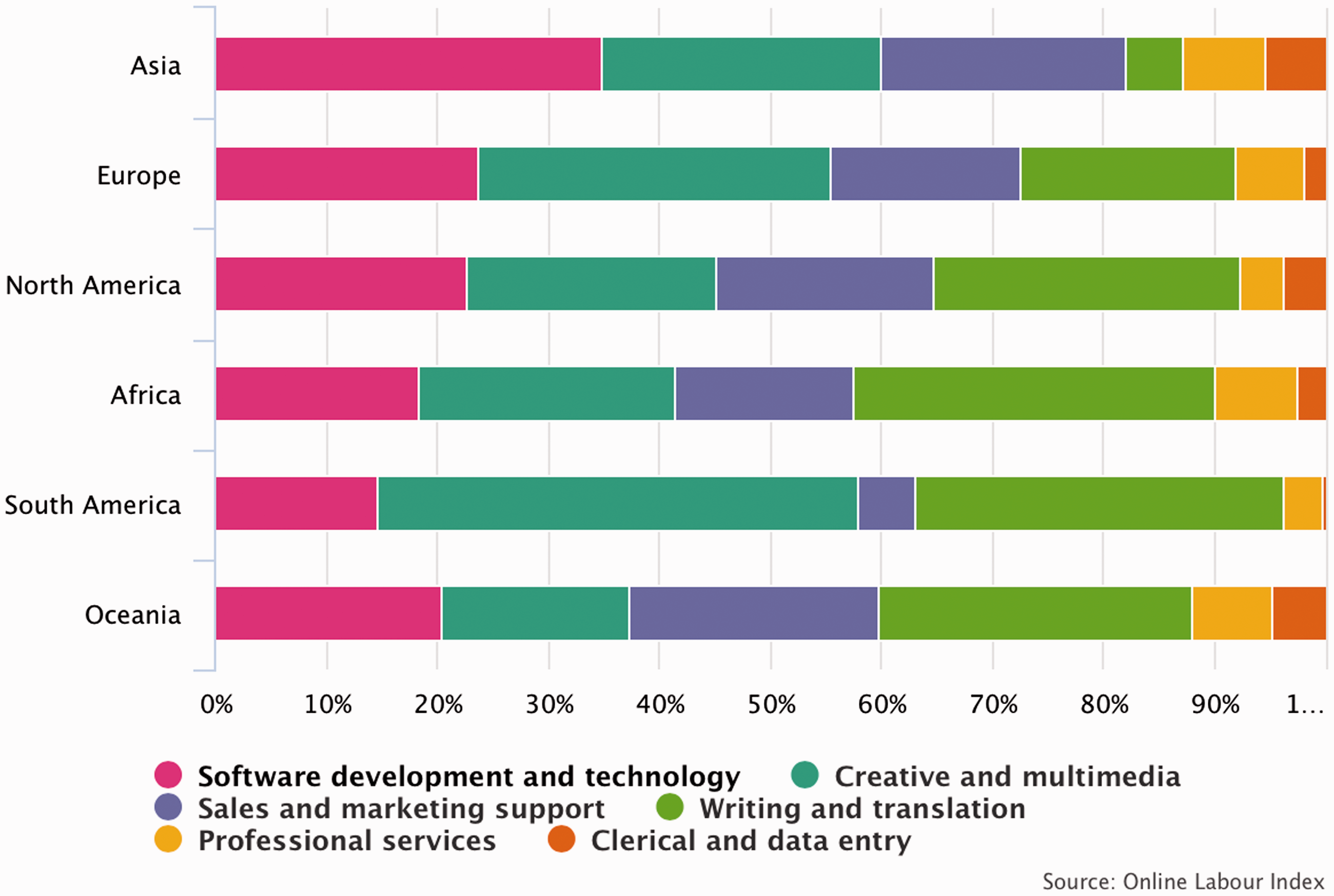
Types of gig worker distribution across world regions, 2019.
We conducted in-depth interviews with 65 remote workers in South Africa, Kenya, Nigeria, Ghana and Uganda, on one of the world’s biggest digital work platforms, Upwork. These countries are some of the biggest suppliers of labour from Africa on the gig economy platforms, including Upwork. We recruited participants with the aim to include a diversity of experiences of work on the platform, including types of work performed, education, number of hours worked, income earned, hourly rates and gender (Table 1).
Characteristics of workers interviewed.
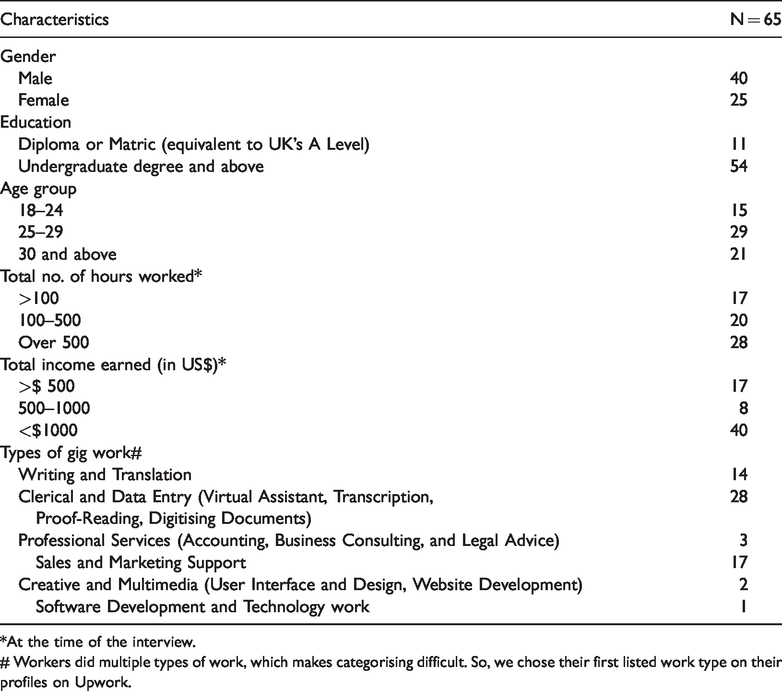
*At the time of the interview.
# Workers did multiple types of work, which makes categorising difficult. So, we chose their first listed work type on their profiles on Upwork.
We used a number of techniques to recruit workers (Table 1). 10 We sent invitations via the platform and reached out to workers through social media, since workers were more comfortable speaking when contacted through Facebook and LinkedIn. We also undertook snowball sampling. This helped us examine the kinds of networks emerging among gig workers and how these networks might affect labour agency. Interviews were primarily geared to understand: the nature and types of work done by these workers; challenges of livelihoods; worker–worker and worker–client interaction; strategies to win bids, stay competitive and negotiate wages and working hours; and mitigating risks embedded in gig work. We also enquired about workers’ use of social media to identify the Facebook groups they actively participate in and how they see this participation affecting their work. They gave us examples of Facebook posts related to the sharing of jobs, filtering of jobs and advising fellow freelancers. Some of the groups have well over 10,000 members. We do not name these Facebook groups, in order to protect workers’ identities, nor do we quote any text from the Facebook group posts in this paper since they can be easily searched and link back to workers. All worker names have been changed for privacy reasons.
Interviews were transcribed and uploaded to NVivo for analysis. The data were initially sorted into broad categories based on key agency practices such as resilience, reworking and resistance, and also the spaces in which these exist, both ‘on’ and ‘off’ the platform. We then coded the transcripts along these themes.
The variegated landscape of agency in the gig economy and its impacts
On Upwork, bidding is determined by a worker’s subjective perception of their marketplace bargaining power, which tends to be influenced by their awareness of the labour market competition. For example, newcomers tend to place more bids compared to experienced workers, who prefer to filter jobs. New workers are also likely to bid at lower wages to win contracts. Contrastingly, experienced workers rely on their skills or reputation to command a higher price. Workers with positive reviews and a top-rated status often do not even bid for jobs, since they get invited directly by clients through Upwork.
We therefore examined the factors which enable African workers to succeed on platforms. Upwork categorises successful workers in the form of ‘Top Rated’ workers, who maintain a job success score of at least 90 per cent, which is calculated based on both private and public feedback given to workers by clients. Workers with a Top Rated status often get more work from employers. Upwork also helps employers find potential successful workers based on the requirements of the job (a point made to us by several workers with Top Rated status). At the time of writing, there were 2,121 workers listed as Top Rated from Africa on Upwork. As we show below, the already existing inequalities ‘off’ the platform (e.g. workers’ education, economic status and access to the Internet) impact and influence who finds success on Upwork and who does not. We further follow Carswell and De Neve’s (2013) ‘horizontal’ approach to examine how workers’ socio-economic status, identities and livelihood strategies influence their agency.
Significantly different life goals among gig workers reflect the level of importance they give to such work and hence shape their agency practices. For example, workers who are already in regular jobs are more likely to use gig work to earn extra income, and self-employed, or simply to do something they are passionate about. Hence, they are also likely to filter jobs and select clients carefully, even if it takes a few weeks to get their first contract. Educated workers tend to do complicated and highly skilled work such as article writing or creative and multimedia activities. They are also more successful in setting up their profiles on multiple platforms, applying for jobs and writing bids compared with less-educated workers.
Workers who were from poor backgrounds, did not complete higher education and lacked the necessary training were often found to be struggling to find jobs on the platform. In the African contexts, this is crucial since a significant proportion of the workforce is in the informal economy and/or comes from an impoverished background (Meagher, 2016). Contrastingly, workers who came from affluent socio-economic backgrounds and had completed higher education, enjoyed success in winning bids on platforms. For example, Katy, a white migrant living in South Africa, explained that her privileged background, education and material affordances had a direct bearing on her success as a gig worker. She explained, Yes, I have an advanced degree. I have the kind of life where I’ve always been able to go after something. I did not face racism and substandard education and I have had access to a computer. Whenever I’ve needed a computer and you know I have a network of friends who if my internet went down I could pick up and go to their houses and use it.
We therefore examined a range of everyday individual practices and strategies of African gig workers through which they exert their agency both on and off the platform (Table 2). Workers often resorted to resilience and reworking strategies when they first joined Upwork. Those who find success on Upwork were then able to use more resistance strategies. Workers tended to exhibit similar agency ‘off the platform’, since the participation of workers on social media is less constrained by a platform’s control mechanisms.
Heuristic framework for agency in the gig economy and its impacts.
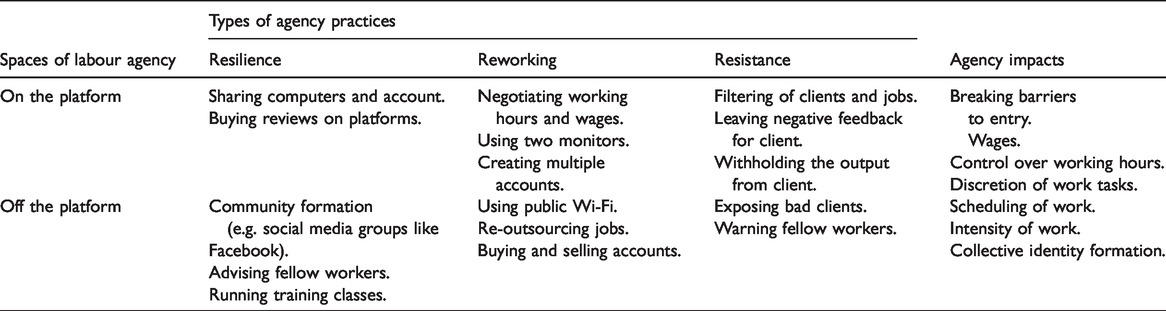
Gig workers’ use of everyday reworking, resilience and resistance strategies help workers achieve autonomy at work and better bargaining power. Here, autonomy at work is understood as the ability of workers to control work intensity and working hours. Bargaining power includes a worker’s capacity to negotiate their wages, withdraw from work at will and control their employment conditions. Now we discuss these everyday practices and their limits in the gig economy.
Everyday resilience and reworking
The most common everyday practices African gig workers have at their disposal are resilience and reworking, particularly among the new and less-educated workforce. These groups’ practices are often subtle and less confrontational than experienced workers or those already employed in their local labour markets. Often less-educated workers come from a low-income background, and did insecure and low-paid work in the informal local labour markets. Gig work is seen by them as an attractive substitute to the dysfunctional and informal labour markets and a significant livelihood opportunity. Hence, they were less involved in resistance acts such as declining jobs or cancelling contracts. The importance of gig work for African labour’s subsistence is underlined in both the Research ICT Africa’s After Access survey (Insight2impact, 2019) and Wood et al.’s (2019) survey of workers in six countries in South East Asia and sub-Saharan Africa, with a majority considering it crucial for their daily survival. Therefore, workers’ key target is to break the barrier to entry on Upwork and find their first job, which is crucial for gig work: it helps workers get their first review score which, in turn, enables them to win further contracts. But, finding the first job is one of the biggest hurdles for workers.
In our sample a majority of the workers (over 50 per cent) revealed that they spent anywhere from one month to a year of constant searching without winning any contracts on Upwork. However, they can circumvent this problem. Newcomers, who are just starting out on the platform, can buy feedback and reviews from clients on the platforms. The client posts a fake job on platforms which involves no real work, but workers have to pay the client and in return get good feedback and a five-star rating. Workers also resort to sharing accounts with their friends and family members or look to buy highly rated pre-approved accounts with locations set for the European Union (EU) and the United States (US). These tend to be especially useful for African workers since it improves their chances of winning a bid (a few workers reported that some clients seemed reluctant to outsource work to Africa). Workers told us that this type of business transaction is done primarily in local and personal networks and is often dependent upon seeking financial help for this through friends and family members to either buy accounts or feedback and ratings. Additionally, workers would set up multiple accounts using the names of their family members and friends, thus giving them more ‘connects’ per month for job bidding. One Kenyan worker, Isa, was using 10 different Upwork accounts to increase the number of jobs he could bid for per month.
Workers also articulated how some clients often prey on newcomers with no feedback by demanding that they do free work in return for excellent reviews. Thus, workers prefer jobs involving tasks that require less formal training and skill sets such as image tagging, which is easier than digital marketing, translation and transcription work. A Nigerian worker, Ifeki, who is an online training instructor and has a university degree in public relations, spent one year bidding on Upwork. His first job was fixing the overheating problem on a laptop for an American client. A Ghanaian worker, Quinn, who primarily does editing and proofreading tasks, started on Upwork by finding the contact details of a South African businesswoman for a client. Both Ifeki and Quinn got paid and five-star ratings for their work, which led them to winning further bids and deriving several thousand dollars’ worth of income through the platform.
Another issue among gig workers is that the gig economy is inherently dependent on internet access and computers, which tend to be costly in much of Africa. Most workers reported the use of public internet hotspots such as coffee shops, libraries and universities to avoid paying Internet access fees. Entry-level workers who could not afford a laptop worked at internet cafes, while others took out loans to buy a second-hand laptop and some even shared laptops in their non-work social networks (i.e. friends and family). For example, Jess and Kenny are two friends from Ghana and both have undergraduate degrees. Upwork closed Kenny’s account and told him that he is placing too many bids without actually winning any contracts. Kenny could not open a new account. Hence, he decided to work with Jess using his account and they now share both an account and a desktop to do data entry and article-writing work. This practice has enable them to overcome both the entry barrier and the technological barriers of the platform work. Gig workers’ problems are further compounded by the high levels of work monitoring on platforms.
Employment relations have always required a system of control (Granovetter, 2005). New digital technologies are enabling employers to exert authoritarian management practices remotely, which some have labelled ‘Digital Taylorism’ (The Economist, 2015). This form of control is also is very much evident in the gig economy (Gandini, 2019). Gig workers in our sample reported regular tracking of time and capturing of time-stamped screenshots of their laptops, which leads to long working hours due to the fear of non-payment of wages (Figure 2). Figure 2a is a time-tracker on Upwork which records working hours regularly, and Figure 2b is the work diary of a remote worker showing screenshots of their computer captured by Upwork. If a worker’s screenshot is captured while they are playing games or using social media, they may not get paid. Workers felt that their client/employer and the platform are always watching them – a modern-day version of Jeremy Bentham’s Panopticon (Semple, 1993). 11 That said, some workers preferred capturing of screenshots, as this allowed regular payment of wages and protection against non-payment, as reported by Wood et al. (2019).
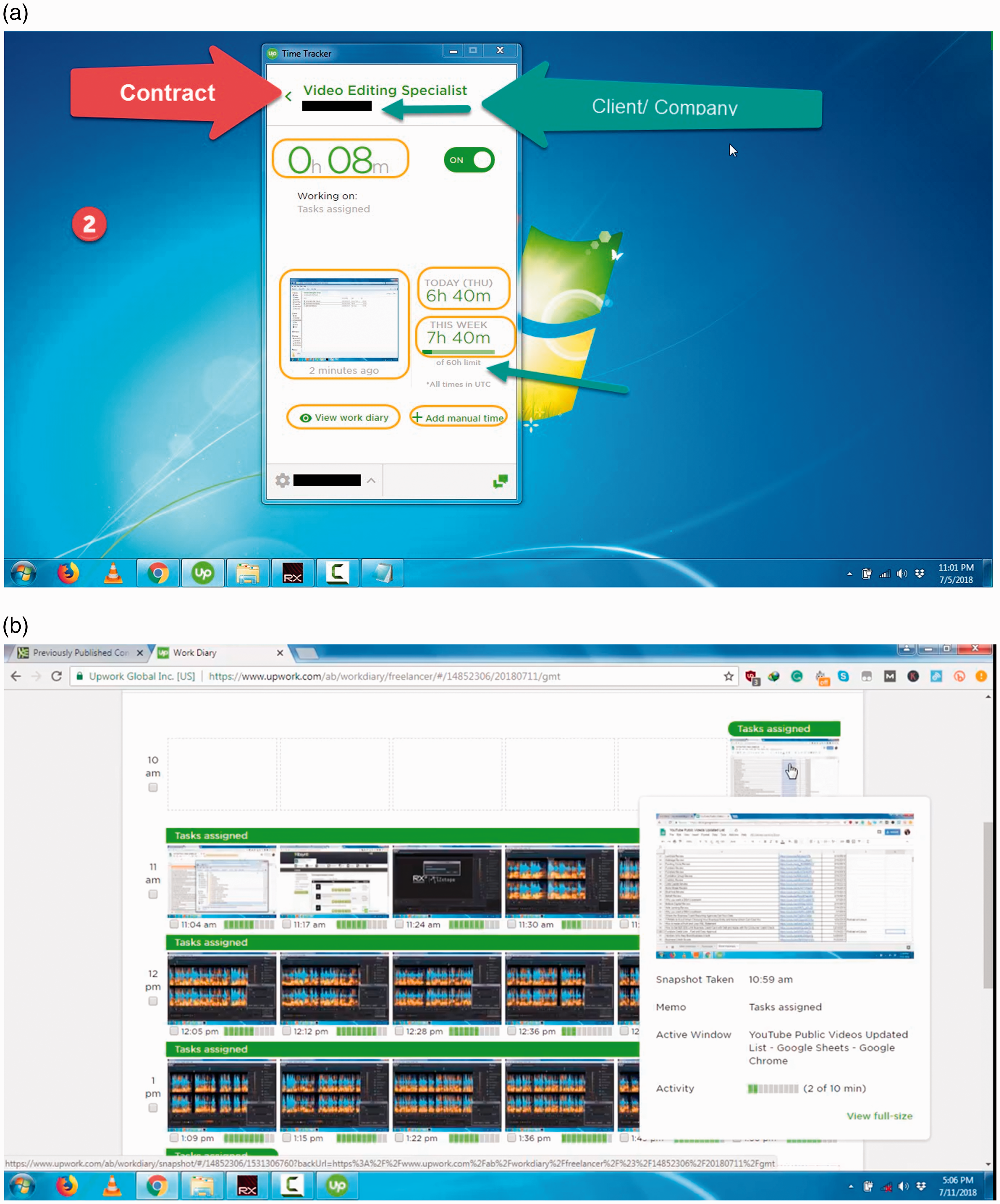
Upwork’s time tracker (a) and screenshot capture (b).
To prevent such monitoring of non-work activities, some workers add a second display screen. This act can be thought of as both ‘reworking’ and ‘resistance’. Reworking in a sense that workers tactically avoid monitoring of their work, and resistance because of the counterproductive work practices they do during working hours (Ackroyd and Thompson, 1999). It also provides workers with control over their pace of work and working hours, a key aspect of autonomy at work. While clients would often resort to regular monitoring of work early in the contract, experienced gig workers told us that once trust had been established, clients no longer tracked their time.
Another form of reworking strategy is to negotiate wages. While negotiation of wages is understood by Ackroyd and Thompson (1999) as an indirect form of resistance, Mann (2007) has argued that settlement of wage disputes is the working class’s attempt to alter socio-economic relations from within the capitalist system, rather than by engaging in full-scale resistance. In the context of gig work, wage negotiations are often done by workers to extract higher wages from the client, thus constituting an element of reworking. This is largely possible due to certain workers’ marketplace bargaining power. Kelly, a transcriber from Uganda who has a ‘96% Job Success’ on Upwork, described how she uses a client’s payment history to negotiate wages. She explained, If I go to a client’s page and it says his average is $20 an hour, even if my profile states $15, I can confidently apply with a $20 an hour rate because that’s what he pays… Sometimes you negotiate, he says your profile says $15, you are applying for $20. I tell him your page says you pay 20, so why do you want to pay me 15? And he says we compromise at 18, and I can work for 18.
Workers’ reliance on many non-work networks is critical to building the community and social relationships necessary for their own survival in the context of the precarious and informal work common in Africa (Lindell, 2013). For example, dockworkers in Durban, South Africa, combined wage labour with informal small-scale entrepreneurialism, pilferage and petty trade in consumables for their livelihoods (Callebert, 2017). A similar account is given in Cooper (1987) of Mombasa dockers and their reliance on the nearby rural economy within the wider context of family, village and regional life. These social-economic networks on which informal workers depend are now extending into digital spheres. For example, social media networks are critical to the formation of collective identity and associational power, and ultimately in developing revolutionary consciousness (Aouragh, 2012). Most workers that we spoke to expressed a strong desire for a worker union to collectively mobilise, but noted that it would be challenging for workers to organise since they are too divided to create support for a significant collective action. Therefore, heeding Selwyn’s call for identifying sources of worker’s structural power that might be turned into associational power (Selwyn, 2012), we explore how African gig workers used their structural power to develop ‘webs of care’ (Katz, 2004: 246).
African gig workers’ community relations exist both in the digital sphere (social media networks) and their immediate locality, i.e. personal networks. Much of the exercise of labour agency in these networks can be characterised as resilience, since these practices are intended to help workers cope with adverse outcomes of remote work such as low wages, exploitative clients and the uncertainty of jobs. Social media networks among gig workers have become spaces where the buying and selling of accounts, sharing strategies on bidding, the reoutsourcing of jobs, running skills-training classes, and the discussion of a variety of interpersonal and work-related issues such as life, fair employment relationships, trust and dealing with bad clients, are common. Our respondents have stressed the importance of Facebook groups for worker interactions, where they can actually interact and communicate about their work and personal lives. Dabiku is a successful remote worker from Kenya and a member of a Facebook group in which he would often offer tips for securing contracts, and also uses that group to reoutsource some of his work to locals, thus allowing him to manage a large number of contracts.
Moving beyond social media networks, the non-digitally mediated personal networks and friendship circles of workers are also crucial for their survival. During our fieldwork, we met several workers who often helped each other in their local personal networks such as friends and family. The case of two Kenyan gig workers, Jumapili and Seghen, from a small town about 100 km west of Nairobi, is a good illustration of such relationships. Jumapili used to be a teacher, but after her husband passed away she started doing blog writing and social media marketing through gig work platforms. She later trained Seghen, who had a Matric certificate but could not go to the university. She often reoutsources work to him and other workers in the town. In fact, in the north-eastern parts of Nairobi along the Thika Road, there is a small cluster of gig workers emerging who often collaborate with one another (Melia et al., 2019). Besides these important webs of care and support, targeted actions to disrupt the production process through acts of everyday resistance remain critical in altering the capitalist social relations found in the gig economy.
Everyday resistance
Gig economy platforms exercise ‘techno-normative control’ driven by algorithms to control labour processes and workers (Gandini, 2019: 1041). Workers’ use of resilience and reworking practices of survival go hand in hand with a variety of everyday resistance practices. For example, gig workers rely on personal networks to get by in their daily lives while also attempting to resist unscrupulous clients and platforms’ system of control through unique resistance strategies. First, certain workers regularly use their new-found marketplace bargaining power on platforms to filter jobs and exclude clients and decline jobs, although this is mostly confined to workers who have gained some experience on platforms. This is illustrated by Onochie, a Top Rated virtual assistant and internet researcher in Nigeria with ‘100% Job Success’, who used to rent a place of his own and who told us he moved in with his family since work made him lonely and he needed social interaction. He scrutinises whether the prospective client has a verified payment method, reads reviews on Upwork to filter employers he wants to work with and declines jobs that have unsociable working hours or pay very little. This enables him to eliminate exploitative and unscrupulous clients.
The second strategy of resistance is gig workers’ use of their mobility power (Thompson and Smith, 2010). In remote gig work, this relates to workers’ threat of cancelling the contracts and exiting the work arrangements (see Kiil and Knutsen, 2016). Ben, a virtual assistant in Nairobi, for example, considers himself as belonging to a ‘middle-class’ family. He was educated in a private school and has an undergraduate degree in business studies. His first job was posting ads on Facebook for US$3 an hour. His first major contract was for a Canadian client as a virtual assistant. He gained the trust of his Canadian client over a year by handling his diary and appointments well. His client refused to increase his hourly wage. So, on two occasions Ben cancelled the contract with this client. Both times, the client hired him back on higher wages, a key aspect of workers’ enhanced bargaining power – though his hourly wage rate was only increased by half a dollar an hour. Similarly, a Lagos-based virtual assistant, Debare, informed his EU-based client about his intention to leave if wages were not raised, and the client agreed to increase his salary from US$400 a month to US$550, an increase of US$150. 12
Third, gig workers also withhold finished goods from clients due to non-payment of wages. While workers have some forms of protection from non-payment of wages by clients on Upwork, payment is only guaranteed if clients are satisfied with the work. But workers can push back against this practice as demonstrated by Zain in Ghana. Zain only finished Matric (UK’s GCSE) education and was doing odd jobs such as carpentry, selling clothes and working in a salon. He sold some of his belonging to buy a second-hand laptop and learnt programming languages such as Java through donated books and YouTube. He began working on user interface designs for local clients (e.g. mobile apps for banks) before looking for work on platforms. One of his platform-based clients refused payment after Zain submitted the first batch of completed files through Dropbox. Zain, therefore, removed the remaining files from Dropbox, preventing the client from accessing them. The client then quickly moved to pay him to access the work files. The parallels can be drawn from the structural power of daladala (minibus) drivers in Dar es Salam, Tanzania, and their ability to bring the city’s transport to a halt, which eventually resulted in them gaining necessary labour rights (Rizzo, 2013).
There are also other forms of resistance among gig workers that affect employers’ reputation on the platform. For example, gig workers can leave negative feedback and give low ratings if clients harass them. Workers regularly share information on social media networks about certain clients that offer extremely low-paying jobs or that are harassing them, signalling that others should avoid working for that client. That said, negative feedback given by clients hurts the workers more, since it affects their ability to win further contracts. Some of the individual resistance acts reviewed here are possible in the gig economy due to workers’ structural power. But worker agency is also influenced by their socio-cultural identities.
Identities and agency in gig work
Socio-cultural identities can lead to the exclusion of certain segments from the local labour markets, such as women and migrants (Maume, 1999). We met eight international migrant workers (all in South Africa), most of whom were excluded from accessing jobs in the local labour market due to policy regulations. Most migrants in the country face underpaid work, and hence gig work becomes an attractive option because it pays relatively better than informal jobs, although unregulated, migrant identities are less relevant to sourcing work on platforms. Platforms eliminate some of these identity barriers for workers, since their system of exchange depends primarily on ratings and feedback (Anwar and Graham, Forthcoming). For most migrants in our sample, income from remote work is critical for their household livelihoods. Thus, their agency acts were also limited to resilience and reworking strategies. They share computers and user accounts with family and friends and join online communities to find jobs and share best practices. Also, migrants’ personal networks are critical for their work and livelihoods. 13 Tiffany, a customer support agent from Johannesburg, would seek regular help from her husband with her transcription work. Not only did this helps ease the workload but also reduced the risk of losing contracts and income.
Similarly, gender influences the actions of workers. For example, Carswell and De Neve (2013: 67) show that female workers’ opportunities in the textile industry in Tiruppur, India, are structured by gendered norms which constrain their spatial mobility. While in the gig economy, spatial mobility is less relevant, and gig work provides women with economic independence from patriarchal figures in the family through the income generated. The importance of gig work’s income was underscored by all women workers in our sample, along with developing new skills and future career prospects. As Kelly, who has ten siblings and economically supports her parents, explained, This work has helped me see the world differently and gain new skills (e.g. subtitling videos, annotating data for machine learning). I feel like there are many possibilities. Now I feel like I don’t have to sit home and mourn about not having a job. I know there are thousand and one places online where I can possibly look and get a job tomorrow. Skills, however small or big they may be, the ones you pick along the way gives you the confidence to apply for new jobs as they come.
Nonetheless, a woman’s agency potential is particularly impacted if she is a migrant and less educated. For example, Adele, a data entry worker who migrated from Cameroon to South Africa along with her husband in 2007, could not find a job in Johannesburg. She therefore decided to work on platforms. However, given her lack of education, she resorted to doing menial tasks (e.g. document conversion) to earn a living, which she described as ‘not complicated’. Adele is also a mother of two and despite the simple nature of her digital jobs, she said it is challenging for her to look after her two children, do housework and be able to maintain enough motivation and focus to deliver quality work consistently.
We have showcased the fact that despite the lack of opportunities for collective action, remote gig workers are able to exercise individual agency to influence their working conditions. But a fragmented workforce can also be easily stripped of its agency by capital. The high level of fragmentation of tasks in the gig economy is particularly worrying. Some gig jobs are one-time and short-term projects and often lack detailed descriptions of the tasks involved, which makes them risky and volatile from the workers’ agency perspective (Figure 3).
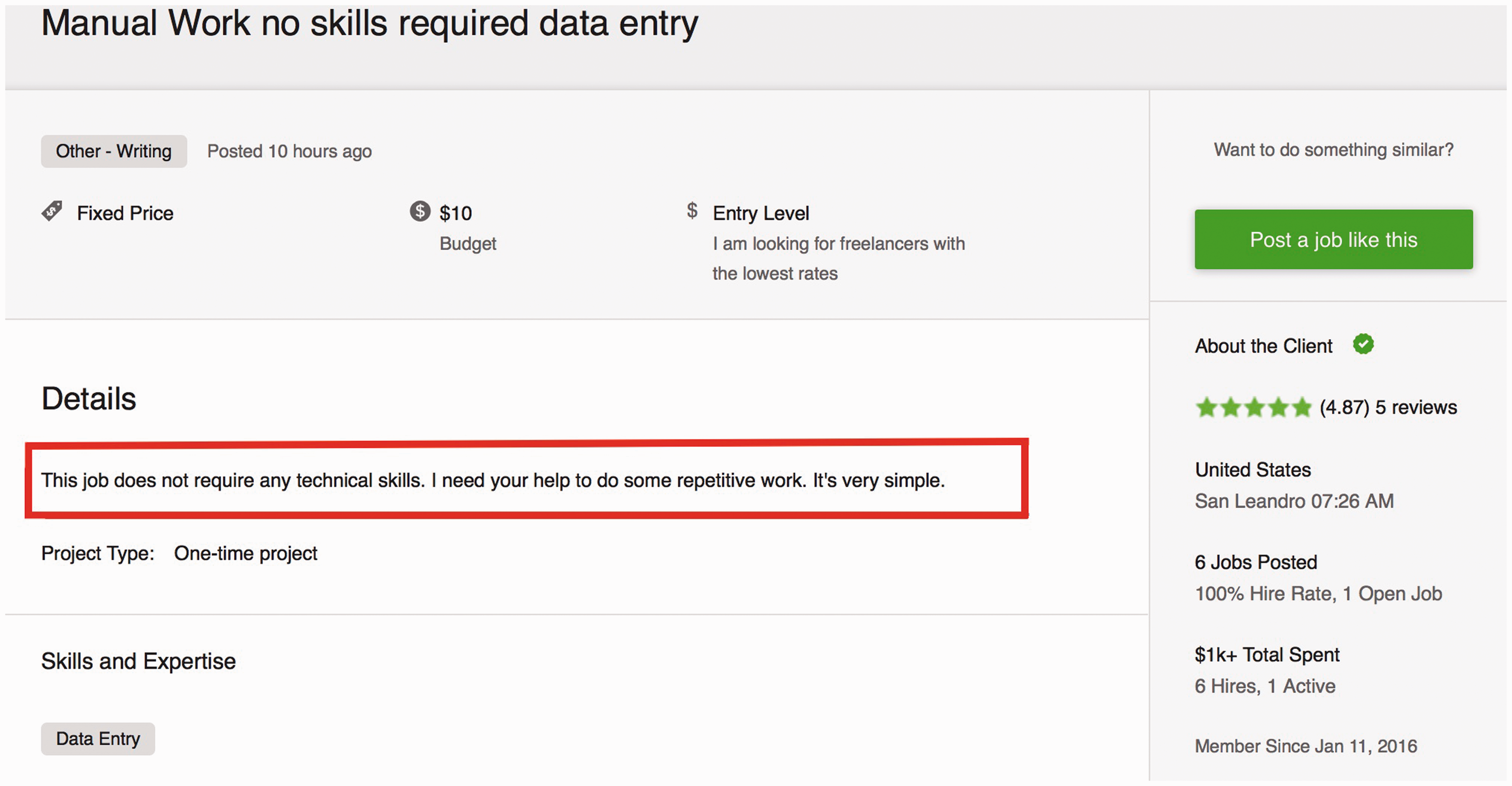
Commoditised nature of jobs lacking details on Upwork.
Conclusions
The global gig economy has intensified the commodification of labour, presenting a challenge to labour agency. In fact, many observers would not expect workers in some of the world’s economically marginalised regions to have much agency on platforms. However, through an examination of gig work in Africa, this article has examined the variegated landscape of agency among gig workers. We show how different types of gig workers create their own labour geographies through everyday individual practices that are informal, subtle and unorganised. This resonates with Rogaly’s (2009) assertion that the ‘everyday micro-struggles’ of workers are critical for understanding labour agency. More importantly, many of the practices we have discussed in this paper are performed offstage and hence could be understood as ‘the hidden transcripts of the gig economy’, because they rarely challenge or confront employers openly, unlike strikes, demonstrations and protests. By contrast, in place-based work such as food delivery and taxis, there is an element of ‘public transcript’ as gig workers have mobilised to stage strikes and demonstrations (Cant, 2019).
It is here that this article makes an important intervention by showing that individual agency in the gig economy can influence development outcomes. By applying Katz’s (2004) distinction between resilience, reworking and resistance as forms of everyday practices, we have explored how gig workers use these strategies to influence their working conditions. Both resilience and reworking strategies were common among workers in our sample. Resistance acts seemed to be largely the domain of those workers who found success on platforms. Through these everyday practices, gig workers were able to avoid excessive workplace monitoring, representing a form of job autonomy. As gig workers gain experience on Upwork, they also begin to choose their jobs and clients, and are able to get flexible working hours and even demand higher wages. However, the agency of gig workers is constrained by two key factors.
One is the socio-economic and cultural contexts in which workers are embedded. A female worker can find her productive and reproductive labour intensified as a result of unsocial working hours. A migrant worker can gain employment through gig economy platforms. But the kind of platform jobs they can do are largely dependent on their education and family background. A migrant who did not gain higher education and who comes from a poor family will generally only be able to do low-paid and low-skilled jobs such as data entry, image tagging and transcription. Hence, they are less likely to have the same agency as an educated worker who performs complex platform jobs such as article writing, web research, digital marketing and software development.
The second factor is the capital’s own agency, which encroaches on the class power of workers. Both clients and platforms have devised various mechanisms to develop the employment relations that suit them. Workplace control and monitoring, the short-term and fragmented nature of platform jobs and the lack of job detail, are attempts to curtail workers’ autonomy and bargaining power which create various insecurities among workers (see Anwar and Graham, Forthcoming). Thus, what opportunities do gig workers have to mobilise and organise themselves?
We are attentive to the fact that the untethered nature of remote work and a fragmented and geographically dispersed labour force makes collective action in the form of strikes or ‘logging off’ platforms nearly impossible. Yet, this article has showed that worker-led informal organising can be done. There is scope for developing more than just the ideological and materialist grounds for labour movements in the remote gig economy. Unions could engage in the politics of precarity, which speaks to the fragmented workers experiencing precarious life situations (Paret, 2016). The existing trade unions in Africa could also utilise new spaces of recruitment for organising and mobilising gig workers. The networks of remote gig workers both in their localities and on social media are key to mobilising workers and developing consciousness for collective action. Facebook and WhatsApp groups here offer a useful digital space for informal organising and also as tools for new forms of labour movement in Africa. Social media not only have the advantage of enhancing member numbers but can also be used by the local unions to tap into new occupational identities to organise workers (see Schradie, 2015), e.g. based on work types such as writers, data entry workers, Uber drivers and delivery workers. There are already Facebook groups in various African countries for writers and drivers, each with thousands of members.
In the end, we want to stress the centrality of human labour to the global gig economy. The evidence of gig workers’ everyday actions presented here is one component of a new class struggle of workers pitted against highly mobile capital. This class struggle must be fought in multiple spaces (production and reproduction) and various scales (local, regional and global) for workers to be able to create their own labour geographies. We ultimately wish to emphasise that there is an urgent need to put the development of workers first. It is here that we want to renew Mario Tronti’s call to bring back the role of workers into the mainstream analysis of capitalism: We too have worked with a concept that puts capitalist development first, and workers second. This is a mistake. And now we have to turn the problem on its head, reverse the polarity, and start again from the beginning: and the beginning is the class struggle of the working class. (Tronti, 1966): 1)
Footnotes
Acknowledgements
The authors would like to thank Jamie Woodcock, Alex Wood, Padraig Carmody, and David Sutcliffe for their extensive feedback on earlier drafts and anonymous referees for their comments. Versions of this paper were presented at the International Labour Process Conference (ILPC) Buenos Aires 2018 and Regulating Decent Work Conference at the ILO 2019.
Declaration of conflicting interests
The author(s) declared no potential conflicts of interest with respect to the research, authorship, and/or publication of this article.
Funding
The author(s) disclosed receipt of the following financial support for the research, authorship and/or publication of this article: We are grateful to the European Research Council-Grant Agreement no. 335716, The Alan Turing Institute (EPSRC grant EP/N510129/1), and the ESRC (ES/S00081X/1) for funding our research.
