




Abstract
Digital technologies enable the dispersal of office work from physical office buildings. The same technologies involve a counter tendency of concentration where offices are shared by different businesses, often for short periods, via the ‘space as service’ model. These opposing tendencies of workspace dispersal and concentration indicate the contingencies of technologies of work, in which their operations are mutually shaped by workplaces. Understanding what a technology of work is requires examining its situated actions and spaces of activity, like the office. Yet, the spatial characteristics of the present-day office demonstrate that ‘situatedness’ is by no means a straightforward vehicle for understanding contemporary technologies of work. Digital technologies tend less to divide space according to a specific function (i.e. work–life division), and more to create spaces of coordination that can adjust the definition of purposeful activity. Such spaces of coordination constitute the platformization of work with digital technologies in which spatial and temporal processes for instituting work extend beyond a single organization. Including but exceeding the ‘gig economy’ and ‘platform labour’, platformization indicates a wider reorganization of work through technologies that produces flexible arrangements of space and time, creating forms of independence, interdependence and dependency that challenge orders of work–life division.
Introduction
Digital technology has changed and continues to change the constitution of varied workplaces, from the automation of certain tasks to the possibilities for flexible working (Autor, 2015; Bissell, 2018; Richardson, 2018). These technologies have altered not only how work is undertaken at a given location but also work’s spatial form itself, often resulting in shifting and disjointed space–times of interaction and relation (Gregg, 2011; Wajcman and Rose, 2011). In undermining a division of ‘work’ from ‘non-work’ (or ‘life’), these spatial changes throw into relief the role of technology in fabricating any work–life separation. Technologies of work, whether digital or not, are productive of the shifting parameters of work–life division: a division that despite its invention is real in its consequences for social organization. As space has so often been a necessary component in contriving the separation of work and life, contemporary alterations to the spatial form of work through digital technologies therefore have significant implications for the normative organization of society. The office, 1 and its associated digital technologies for office work in the UK, is one example of this. Offices are revealing spaces for understanding social relations in a digital era because at base their purpose is the production, storage and communication of information. The spatial parameters of offices have therefore seen significant modification during the shift from primarily paper to increasingly digitized information and communication from the 1980s onwards. This change was often articulated through the spatial analytic of the network, whose non-hierarchical structure was heralded as enabling ‘post-bureaucratic’ organizational forms that, through more rapid telecommunications, enabled workers to self-organize their business activities, thus potentially freeing them from working in a single physical office building (Kellogg et al., 2006).
However, despite digital ICTs enabling dispersed office work (Datchary, 2008), over the past decade the same technologies have been implicated in a counter tendency of worker return to the office. Offices are increasingly shared by multiple businesses and teams who are engaged in the space for short periods of time, via what is labelled in the real estate industry the ‘space as service’ model (Knight Frank, 2018). This model, of which ‘co-working’ is a variant (Gregg and Lodato, 2018; Richardson, 2017), is distinctive because it assembles different actors with varying interests, meaning that the office is a flexible space that serves disparate purposes for those involved in its constitution. The opposing tendencies of dispersal and concentration comprising the contemporary office indicate that the relationship between technology and space is neither uniform nor unidirectional in its impact on modes of social organization such as work–life division. Not only can a technology be implicated in different socio-spatial forms, but its operations are themselves materially changed and given meaning according to the spatial arrangements through which they take place.Research on workplace technologies has long emphasized this mutual shaping of technology and socio-spatial relations (Luff et al., 2000; Orlikowski, 2007; Wajcman, 2006), demonstrating that technologies are not only reflective of existing workplace norms – for example in encoding organizational ideologies into technology design (Taylor and Van Every, 1993) – but also that technologies should be understood through their operations at work, that is in their material situations of use (Suchman, 1987). From this perspective, the question of what a technology is must be answered through a focus on situated actions and spaces of activity, like the office. Yet, the spatial characteristics of the present-day office demonstrate that ‘situatedness’ is by no means a straightforward vehicle for understanding contemporary technologies of work.
Although physical office spaces remain important for qualifying the operations of technologies as work, the same operations may occur beyond the physical confines of the office building, thus apparently escaping their defining situation. Therefore, the material division of space as a place for work or not, now can hold less significance for social organization than the capacity to define as work the operations of technology. So by synthesizing these technological changes to office workplaces with the role of working space in defining office technologies, the article argues that the tendency of contemporary technologies of work is less to divide space according to a specific function, and more to create spaces of coordination that can adjust the definition of purposeful activity. The dispersal and concentration of activities constituting present-day office work demonstrates how contemporary technologies coordinate working spaces that define as collectively productive a combination of otherwise often diffuse actors, where the conditions of arrangement are standardized and formatted by the technology. The article further proposes that these spaces of coordination constitute the platformization of work with digital technologies in which (spatial) processes for instituting work extend beyond a single organization. These platformizing technologies produce flexible spatial arrangements that are redefining working agency through complex webs of socio-technical (inter)dependencies upon which any capacity to act relies. To develop these points, the article proceeds by setting out the technological changes to contemporary office space epitomized by the space as service office, followed by a discussion of how workspace has been vital to understanding the contingencies of technologies of work. The final section combines these strands to discuss how the contemporary office indicates that functional division of space is giving way to different means of spatial definition of work through platformizing technologies.
Digital technologies and workplace change: The space as service office
Digital technologies have changed office workplaces over the past few decades, gradually enabling more mobile ‘telework’ through ICTs that allow office business to be dispersed from its nominal office building (Johnson et al., 2007; Messenger and Gschwind, 2016). The use of social media
2
in particular for office activities has created working rhythms in which the place and schedule of the office is not so easily separated from other sites (Broadbent, 2015; Gregg, 2011). Given that workers may potentially work in any number of locations, and that real estate is a costly overhead for business, contemporary office space must be adapted to suit a more mobile workforce. Rather than businesses owning their offices, many lease them from a landlord,
3
meaning that the product of workspace must remain attractive to the customer in light of contemporary technologies. Symptomatic of these changes to the product of the office is the model of ‘space as service’ that combines changes to the terms of access with cultures of hospitality. The thrust of this tendency is described by real estate consultants Knight Frank (2018): The workplace is becoming a flexible business service that can actively support growth, rather than a fixed and often (to the occupier) financially onerous physical product. This repositioning is alluring to the occupier and will become the demand default. Traditional landlords have little choice but to adapt to this new dynamic and adopt the approach taken by the co-working ‘upstarts’. They must extend their innovation beyond the design of the physical product and towards the provision of soft-services, community and well-being. (1)
To set out in more detail the characteristics of the space as service office, what follows draws on ethnographic research of such offices in English cities that occurred in two phases across three years (2015–18). The first phase involved interviews with office users and providers, together with short observations in 15 offices across Manchester, Cambridge and London, with the purpose being to gain an understanding of different models and their rationales. The second phase comprised a one year participant observation of a single co-working office in Newcastle, called Campus North, which closed in September 2018. The participant observation included roughly weekly visits to the space where day-to-day work activities were observed. The objective of the second phase was to develop an in depth understanding of how office space was formatted and used. These empirics illustrate how, with digital technologies, the physical infrastructure of the office becomes a space of coordination for the work of differing actors, through arrangements that create flexible rather than fixed definitions of purposeful activity. This is achieved first in the standardization of access to office real estate through flexible leasing that determines the terms of engagement with office space; and second through the formatting of office occupancy via practices of hospitality that facilitate the presence of different businesses in the office, together with driving their return or repeat visits. The remainder of this section describes in more detail these two changes to office workplaces with digital technologies that create spaces of coordination.
Standardizing office real estate: Enabling a flexible space
Attention to real estate products is vital to understanding how the office workplace is changing with contemporary digital technologies. Whilst previously commercial real estate markets were premised upon longer term leases for larger companies, there has been a move towards the standardization of flexible leasing, a process that changes the material basis of access through which business occupancy occurs, acting as a prerequisite for their gathering and dispersal. Although there is no single model for this flexibility, universally included in definitions are modes of tenure that at base share a deviation from owner occupation, and from the requirements for a business to take out a long term lease. For example, in their 2018 report on flexible workspace in the UK, the Instant Group outlines three different types of occupancy (‘serviced’, ‘co-working’ and ‘hybrid’), whilst CBRE in their 2017 report on the European flexible office market identifies five categories (‘serviced’, ‘managed’, ‘coworking’, ‘accelerators’ and ‘incubators’). Although there is variation across each of these, together they mean that real estate now combines hospitality services with alterations to the terms of access, both of which make it easier for businesses to set up in (and to leave) the space. Flexible leasing occurs as part of a longer shift in the valuation of space as a physical asset for business. At the turn of the millennium, the role of real estate, or physical assets, for large corporations was coming under question as technology enabled, and business competitiveness demanded, flexibility (Gibler et al., 2002). A key question was whether there was a direct link between flexibility of property – in terms of financial contracts, physical layout and functional opportunities – and flexibility of staff, realized through contracts, time and location elements (Gibson, 2003). Thus, flexibility at this time was a vector of corporate management strategies in the workplace, and so can be differentiated from flexible leasing as a commodity in the contemporary shifts in real estate markets.
Contemporary suppliers of office real estate have altered their business models so that a growing proportion of their stock is now ‘flex’ space as opposed to conventional leases, meanwhile older serviced office suppliers such as Regus 6 have also expanded their offer to include a diversified range of flexible access options. The shifts in leasing have been most apparent through the new real estate actors that have entered into the supply of office space. One that has attracted a significant amount of media attention is WeWork, an American company established in 2010, that opened its first office space in the UK in London in 2014. At the time of writing, WeWork was operating at least one office in 31 countries across Europe, Asia, North and South America, with Africa and the Middle East (except for Israel) so far remaining untouched by their expansion. WeWork has garnered attention partly because of this rapid expansion but also for the business model 7 underpinning such growth. It is this business model and the ludicrous valuation for Initial Public Offering that nearly bankrupted the company in 2019 (Business Insider, 2019). Whether or not WeWork survives, the company is significant because it exemplifies a model of office operation that is likely to continue, whereby flexible space (and services) are provided by an external operator (Knight Frank, 2018). WeWork buys long term leases (10 or 15 years) from real estate owners, and sells off short term ones at a profit (i.e. on a per month and per desk basis). To increase their customer base, WeWork provides a variety of options that are suited to different sizes of business, from ‘shared workspace’ and ‘private offices’, to office suites and the ‘HQ’, which are designed for larger companies or teams from larger companies.
Although WeWork is currently the largest occupier by area of commercial real estate in London, their size detracts attention from other operators both in England’s capital and elsewhere. London is the city in the UK with the highest number of flexible office operators, with 661 counted in 2017, of which 77% were ‘small’ (The Instant Group, 2018). In other cities, dedicated operators with a similar intermediary function also tend to be smaller companies, often with only one space. For example in Cambridge, Cambridge Business Lounge (CBL) is a single operator with a capacity of 20 desks in the co-working space, together with a further two private offices. CBL offers a suite of different options for use of the co-working space, with a greater focus than WeWork on a market of workers who might use the space regularly but not every day. Meanwhile, TusPark Newcastle, owned by a Chinese developer of science parks, provides a no frills offer, with only one option for access available. Unlike London (and Cambridge), in Newcastle supply is plentiful and demand is limited for (shared) office space, meaning that there is little requirement for different packages of access. Table 1 provides a small illustration of these different offers and prices. TusPark Newcastle also houses an incubator for small businesses, Barclays Eagle Lab, which is one of 22 such labs nationally, supported by the UK high street bank (Barclays) with the aim of developing ‘FinTech’ companies in part through the provision of short term office space. As well as these intermediary operators, an equally important trend is the shift by existing global commercial real estate providers, regardless of location, to include flexible models of provision as part of their portfolio, for example indicated by the differentiated leasing structure of CBRE’s imagined ‘office building of the future’ (see Figure 1).
Type and cost of office access packages in three English cities.
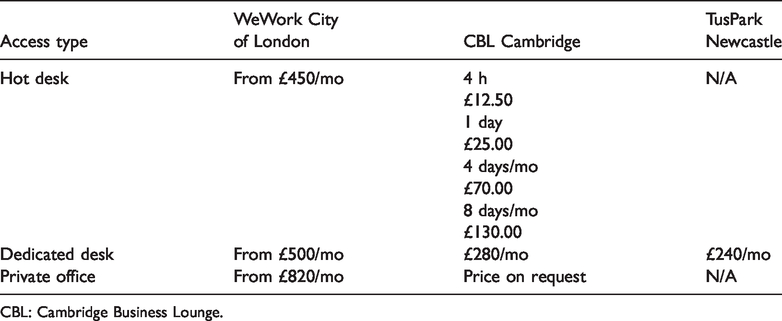
CBL: Cambridge Business Lounge.
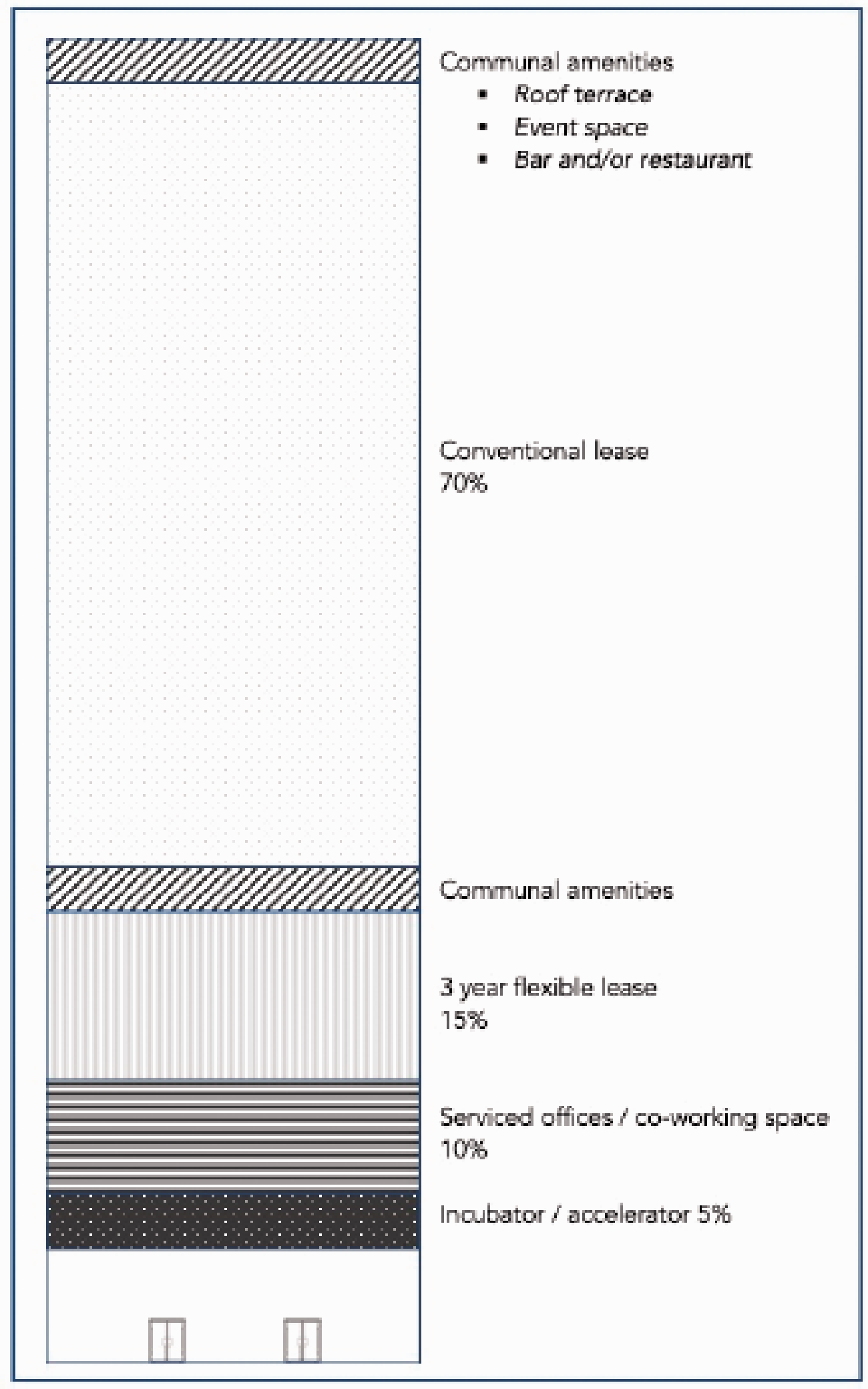
Future office usage. Source: Adapted from CBRE (2017).
Although thus geographically differentiated in terms of market structure and produced by very different types of office operators, a unifying point in the shift to flexible leasing is that space cannot be regarded as an inert geometric unit, somehow in the background of work and workplace organization. The long noted use of workspace beyond the office through ICTs (Clark, 2000; Felstead et al., 2005; Laurier, 2004) is altering how offices are valued in real estate markets, with a new emphasis on their performative qualities. The novel model of valuation is based not on a fixed geometry of the office, but rather on the elements of the space in use and its capacities for change. Office space is sold using a different lexicon of measure, with spatial parameters of occupancy given not by area, but in terms of ‘numbers of desks’, and duration of access arranged on a monthly, daily or even hourly basis, often using the vocabulary of ‘membership’. The office is thus valued as a performative space that, through what it can do, renders collectively visible the otherwise often ephemeral work of different business networks. Crucially though, for these performative qualities to be enacted, the visible arrangement of businesses occupying the space must be organized through processes of formatting. Formatting allows the display of different networks in such a way that provides the possibility for these networks to disperse from the office but, equally importantly, encourages their return. A combination of receiving and animating techniques – known as hospitality – are central to formatting, so that companies accept first that their business can be presented in a space that is not branded their own (and indeed is populated by different networks); and further second, that their presence in the office may be used to entice other business, as elaborated below.
Formatting office occupancy: Displaying different actors and driving return
The formatting of office space is vital to the display and change of different networks of business comprising work in the space as service office. Formatting enables workers to operate almost immediately from such offices, and equally importantly, to leave again. The objective of formatting is not to manage content production (i.e. work ‘itself’) but rather to qualify as work different networked activities through their presentation. In short, formatting is not simply the overall appearance of office space but the infrastructures (or services) that mean the space presents as a workplace. As noted, the serviced office has been in existence for some 30 or so years as a site where certain business features – primarily ICT infrastructures – are provided by a third-party operator (Dabson and McAllister, 2014). Space as service formats therefore to a degree replicate this model, with the management of office space not the provenance of the real estate owner nor the leasing company but rather of a third-party operator, such as WeWork, CBL or Tus Park. In formatting for more short term and temporary occupiers, these operators engage techniques of hospitality, which are often complemented by amenable office design. Crucial for hospitality are the actions of a new occupation, that of ‘community manager’ (Gregg and Lodato, 2018). These actions involve meeting and greeting members and guests, as well as familiarizing them with the office and its codes, which means that the role is frequently held by individuals with training from the hospitality sector.
The purpose of such hospitality is to organize the smooth transition of multiple different businesses into and out of an office. Arranging such movement explicitly decentres a chronological fixed time for organization, and instead operates through a flexible kairotic time, governed by the needs of an individual business network at a given moment (Czarniawska, 2004). Therefore, such business requirements may extend beyond what might strictly have been understood as business activities – and ‘office hours’ – as is indicated by operator The Office Group in their internal publication The Fold (2015): With all of us working harder and longer hours, that element of play at work also needs addressing, be it a meet with neighbouring businesses, or meeting your true love. The point is, we have to enjoy the work we do; we spend so much time there so how the space looks and how it flows is crucial. But so is the ability to use that space to work, meet and have fun.
The dispersal of these businesses to carry out the activities of their work elsewhere and so bring back new content is vital to augmenting this generalized experience of business upon their return. Thus, traffic of all kinds – from paying occupiers to interested first time observers – is necessary for space as service, as Knight Frank (2018) detail: The aim is to increase productivity via a strengthening of the interaction between people and property. Corporate real estate initiatives must seek to bolster productivity by increasing the attraction of the workplace and, via that attraction, raise the utilisation and occupancy of the space rather than simply taking space away. Productive work derives from the creation of a positive, well-serviced and well-supported workplace environment. “Build it and they will come” has shifted to “service it and they will work”. (9)
Another important format is the staging of events that work to heighten the performance of the office and are thus vital for attracting different businesses to the space. This includes companies who do not have office access packages, meaning events provide a means of enticing future users. Events are another hospitality duty of community managers and can be tailored to an activity or sector but also to stage a particular business. For example, ‘pitching’ and ‘showcasing’ nights are common, in which businesses present their offer to a live audience with varying degrees of interaction. To ensure ease of display of different office business sometimes during, but mainly beyond events, communication formats are established. Such communication is predominantly online and, even when it does involve physical representation through devices such as ‘What’s On’ boards, it is not intended for individual business objectives (i.e. not work ‘itself’). Instead the purpose is to communicate across the boundaries of individual organizations (Barley, 2015), sometimes through a provider-owned online space, as in the case of WeWork, but more commonly through existing third-party software platforms such as Slack. Communication through these ‘social tools’ 8 is thus publically visible (although private messaging is possible) to those using the office, even if they are not physically present in the office at the time (Gibbs et al., 2013). In combination, these hospitality formats ensure the coordinated display of activity in the office as work, whilst also enabling circulation beyond office space that keeps these arrangements of work flexible rather than fixed. In setting out the parameters of the space as service office then, this section has shown how digital technologies create spaces of coordination in which flexible arrangements of work can occur. However, these technologies produce such spatial arrangements contingently, through opposing tendencies of concentration and dispersal that require more nuanced engagement with what a workplace technology is, discussed next.
Office space: Understanding technologies through their workplace situations
If the space as service office demonstrates the role of digital technologies in changing workplaces and by extension the broader socio-spatial rhythms of work, it also provides a caution against any understanding of technology as linear or uniform in its impacts on modes of social organization such as work–life division. The opposing tendencies of dispersal and concentration of workers constituting contemporary office space highlight that technology can be implicated in different and sometimes divergent socio-spatial forms, and further, that its operations are materially changed and given meaning according to the spatial arrangements through which they take place (Pfaffenberger, 1988). Indeed, previous studies of a variety of workplaces have illustrated this contingency to technology, in which both their design and operations are shaped by existing socio-spatial relations rather than inevitable or automatically occurring (Boyer and England, 2008; Davies, 1982; Gardey, 2001; Leonardi and Barley, 2008; Luff et al., 2000; Orr, 1996). Offices are particularly significant workplaces in this regard because – given their purpose as spaces for making sense of information – they have been archetypal situations for the definition of ICTs in at least three ways. First, the layout of office space prior to the digital computer has had significant impact on the design of subsequent information and communication technology. Second, the ideologies of organization constituting offices have been vital to the imaginary of what technological agency is. Third, the situations of the office have provided a means to make sense of technologies in action. This section will elaborate on each these, demonstrating how the contingency of technologies of work can be addressed through what they do at specific sites, such as the office.
Reflecting office space in technology design
Far from being a break from the past, the space as service office carries forward elements of office design that predate the widespread use of digitized information and communication technologies, and indeed were incorporated into their design. Most notably, these include arrangements that facilitate worker movement and communication, associated with the ‘open plan’ office (Oldham and Brass, 1979). Open plan is a generic term that came into common parlance in the USA in the late 1960s and early 1970s, prefiguring the interest in flexibility and circulation associated with contemporary offices. It refers to a rough amalgamation of two office design concepts, one European and one North American (Kaufmann-Buhler, 2016). Bürolandschaft (‘office landscape’) was developed by the German Schnelle brothers in the 1950s for Quickborner in Hamburg, and arranged office furniture according to patterns of communication amongst workers, as opposed to rank (Abercrombie, 2001). Meanwhile, Herman Miller’s Action Office comprised sets of office furniture designed in the USA and orientated around the mobile ergonomic needs of a worker so that the set up could to be tailored to the different tasks that they might be undertaking. Significantly pre-existing the emphasis on flexibility in the present-day space as service model, these design concepts combined in open plan were challenges to the office orthodoxy in two ways. First, open plan was founded on the rejection of the organizational chart as a means to order office space and instead used ‘real patterns of communication’ as the basis for arrangement, moving away from a ‘top-down bureaucracy’ towards ‘a flat or “organic” system of interdependent elements’ (Kaufmann-Buhler, 2016: 212). The promotion of such ‘spatial flexibility’ by architects of offices in the 1960s and 1970s (Martin, 2003: 93), it should be noted, also worked to the advantage of office real estate developers who were able to cheaply construct buildings as empty shells to allow their flexible furnishing by the companies leasing them (Duffy, 1997).
Second, the open plan office concretized a change to office work, one that moved away from routine administrative tasks towards more thought-based and collaborative activity associated with the new ‘knowledge worker’ (Drucker, 1966). This new way of working also emphasized the value of giving certain workers (namely those not engaged in clerical tasks) greater responsibility and autonomy in work time and space. Despite these revolutionary possibilities, for many workers open plan paradoxically resulted in the standardization of office space through ‘the cubicle’ (Hunter, 2003; Saval, 2014); the cell-like partitions that became iconic in the USA for isolating workers despite initially being intended to positively support communication and reduce ambient office noise (Kaufmann-Buhler, 2016). Nonetheless, open plan did establish the decoupling of worker function from worker position in the office, and helped to integrate more mobile working practices into understandings of knowledge work that have been significant for the subsequent design of digital ICTs. Drawing on the principles of open plan, the desktop computer, electronic mail and most recently mobile handheld devices have further enabled the communication of information that is no longer so reliant on fixed paper trails and thus worker position in a given office (Nolan, 2000). Although this has not resulted in an eradication of paper (Sellen and Harper, 2002), it has allowed communication to be even less dependent on location, encouraging the intermittent office occupancy associated with the ‘club organization of knowledge work’ and now epitomized in flexible leasing (Duffy, 1997: 65). Thus, the early material design and arrangement of office information and its communication have informed the later design of technologies, including cementing the organizational forms of the office in the structure and vocabulary of digital ICTs (e.g. files, inbox, trash, etc.) (Gitelman, 2014; Harper, 1998).
Organizational ideologies and imagining technological agency
As well as the plans of designers, offices are shaped by organizational theories or ideologies that often advocate the use of technology, and in so doing have informed conceptions of technological agency in workplace organization (Harwood, 2016; Taylor and Van Every, 1993). Over time, workplace management ideologies have shifted from a primarily deterministic approach to technology, to a growing emphasis on aspects of technological contingency. Initial theories of office organization in the early 20th century drew on the ideology of scientific management that was originally developed for the factory floor in the USA, and when applied in offices, similarly aimed to achieve efficiency of information production through a clear division of clerical roles established via the physical arrangement of the office that enabled paper to move as quickly as possible (Barley and Kunda, 1992; Davies, 1982). This was accomplished sometimes via the design of modern office buildings in 1920s and 1930s, which were an interpretation of scientific management ideology in ‘aesthetic terms’ (Guillén, 2006), but also in new techniques for systematizing the recording, copying, storage and retrieval of information (Yates, 2000). Scientific management thus went hand-in-hand with an industrial production system that provided little room for the contingent agency of individual elements, 9 but rather designed a technology that could determine the conversion of fixed inputs into equally fixed outputs (Leonardi and Barley, 2008: 162). By the 1950s and 1960s though, certain management ideologies began to incorporate understandings of technological autonomy and, to a degree contingency, into conceptions of workplace organization.
Of particular early significance was cybernetic thinking, in which organizations were understood as systems comprising increasingly horizontal networks of communication (Martin, 2003). Although occurring largely prior to digital ICTs, the office architectures imagined during this period were prescient of what was to come. Just as digital ICTs promised a virtual reality ‘that one can enter or leave at will’ (Grosz, 2001: 83), the offices housing these new ‘organizational complexes’ were held not to ‘possess the traditional spatial properties that divided inside from outside in any meaningful sense’ (Martin, 2003: 7). Here, as with the later open plan office, space was designed to be flexible, partitioned according to furniture ‘modules’ set out on the basis of individual choice, in line with principles of self-organization present in cybernetic thinking (Martin, 2003: 4). So whilst there was insufficient know-how to realize self-organization and its contingencies through early digital ICTs during this period, cybernetic thinking nonetheless provided a distinct antecedent to contemporary approaches to technological agency. For much of the mid-20th century though, offices were organized according to rather more deterministic rules of ‘systems rationalism’, involving ‘universal principles’ that drew on concepts from computer science and electrical engineering 10 (Barley and Kunda, 1992: 379). It was only from the 1980s onwards that theories of ‘organisational culture’ were propagated that privileged worker autonomy (Barley and Kunda, 1992), an autonomy which was possible through new digital ICTs that enabled novel forms of self-management of office work. Through their communicative and interactive capacities, such ICTs required more contingent conceptions of technological agency, contingencies that became clearer when focusing on day-to-day workplace actions with technology.
Situated actions and contingent technologies
Office space has been central to understanding how technological operations emerge through the sense made of their practical work, processes that became all the more important with the widespread diffusion of digital ICTs (Borzeix and Cochoy, 2008). In comparison to the Office Automation movement of the 1970s and 1980s that relied upon a hierarchical model of organization, the personal desktop computers of the 1990s created ‘electronic social fields’ that would not be visible to management, and thus resulted in different possibilities for worker-technology agency in organizations (Perin, 1991). An alternative understanding of technology was therefore necessary, one that was less ‘top-down’ and instead could account for the contingencies of technologies in their (workplace) situations of action (Brown and Duguid, 2000). Such an approach was developed in part from the late 1980s via Computer Supported Collaborative Work (Grudin, 1994), and taken a step further in the field of ‘workplace studies’ that modestly attempted to ‘respecify technology with regard to human and social organisation’ (Luff et al., 2000). Workplace studies involved naturalistic ethnographic investigation of human conduct and cooperation in complex technological environments, with ‘control centres’ (e.g. air traffic) being prime examples. Methodologically, this often meant video recording and analysis that could direct attention towards moment-by-moment collaborative accomplishment of visual, vocal and material conduct. In some respects, although using different media, this was a similar approach to documenting work that was pioneered in the time-motion studies of scientific management in the early 20th century (Barley and Kunda, 2001). However, whilst both methods were seeking an in depth understanding of how work activities were carried out, their broad purposes and ontological underpinnings were very different.
Studies for scientific management were intended to standardize and rationalize work practices in advance, whilst the more contemporary workplace studies have aimed to challenge this perspective by foregrounding the contingencies of human interaction in and with their material environment. This means that the operations of technology – and by extension the essence of a technology itself – can be made sense of only through situated actions (Suchman, 1987). Instead of the purpose and programming of a technology being separate from practical activity, such ‘situated plans’ should be considered part of the subject matter for investigation in a study of purposeful action. Plans and all manner of ‘Representations are not taken as proxies for some independently existent organizational processes but as part of the fabric of meanings within and out of which all working practices – our own and others’ – are made’ (Suchman, 1995: 58).
The work of a technology is thus given through the processes via which its actions are interpreted and made sense of by those engaging with it. Far from being transparent, such collective sense-making often demonstrates the opaque qualities of technical operations in the workplace in which ‘the whole machine never quite appears’ (Orr, 1996: 89). The role of workplace technologies is thus more ‘voluntaristic’ than ‘deterministic’ (Leonardi and Barley, 2008), so that a technology and its operations are contingently given through their performance in a specific office situation. Together then, this section has demonstrated that the workplace situations of technologies are vital to understanding their contingent operations, and it is this insight that is brought forward to the next section, which returns to the present-day office to ask what space as service implies for the constitution of contemporary technologies of work.
Platformization and contemporary technologies of work
So far this essay has illustrated how technologies of work shape workplaces – such as the office – but do so contingently, in ways that require examining how technologies are defined through what they do in specific situations. This section will combine these threads to show how the space as service office provides a means of understanding the ‘platformizing’ (Mackenzie, 2018) tendencies of technologies of work. To do this, it is necessary to foreground how contemporary office space is not the exclusive site for situating office activity but is rather one situation in which the operations of digital technologies may be defined as work. This is apparent perhaps most obviously in the easy movement of workers into and out of office space made possible through flexible leasing. It is also enshrined in ideologies of ‘chameleonic’ organization that have been in circulation for several decades, which propose that survival in a rapidly changing environment requires enacting the context of actions as they are taking place, instead of maintaining fixed organizational parameters for office business (Baldwin and Woodard, 2008; Ciborra, 1996; Thomas et al., 2014). Such flexibility is all the whilst supported by office software that engages not so much in work itself but in defining ‘productive activity’ through its representation, via various productivity and social tools (Mackenzie, 2008). This creates an ‘aesthetics of activity’ in which the representation of work has moved closer to the work itself (perhaps following Suchman’s (1987, 1995) observations), emphasizing the ‘how as opposed to the where or what work gets done’ such that ‘software provides an accommodating infrastructure for activity’ (Gregg, 2018: 79, emphasis in original).
Thus, rather than a fixed site for examining technologies of work that is premised upon a functional division of space as a place for work or not, contemporary office environments indicate that now of greater importance is the capacity to define the operations of technology as work, potentially regardless of static location. The implication is that technologies of work today operate less in fixed divisions of space according to specific function, and more through spaces of coordination that can adjust the definition of purposeful activity. This is achieved through the creation of flexible arrangements that can define as collectively productive a combination of otherwise often diffuse activities, where the conditions of this arrangement are standardized and formatted by the technology (Richardson, 2020a). Such technologies therefore establish novel ways of instituting work that extend beyond a single company, flexibly combining ‘different organizational arrangements such as the network, the matrix and even the hierarchy’ through which: ‘the platform emerges as an exciting mixture of ready-made arrangements and interpretations, and of half-realized, not-yet-made solutions and visions’ (Ciborra, 1996: 104).
The implications of platforms for work, though, have been seen in a rather less positive light, with critical perspectives focusing on the sometimes novel and often problematic forms of valuation and conditions of labour associated with particular platform companies (Graham et al., 2017; Howcroft and Bergvall-Kåreborn, 2019; Van Doorn, 2017). However, such research on platform labour has paid limited attention to the processes of ‘platformization’ (Helmond, 2015) of work that occur through the ‘technological architectures and infrastructural forms and arrangements’ of platforms (Barns, 2019; Bratton, 2016; Leszczynski, 2019: 209; Plantin et al., 2018).
Platformization is central to understanding how contemporary technologies precariously institute work, creating spaces of coordination that extend beyond worker and wage-paying organization. These are technologies that operate through distributed forms of agency – or ‘flexible spatial arrangements’ (Richardson, 2020b) – that occur by ‘placing people and things into specific kinds of relations’ (Mackenzie, 2018: 37) that include but exceed existing formal organizations of work. The space as service office is one example of such an arrangement, another is the delivered meal achieved in the coordination of riders, restaurants and customers via the software of the UK food delivery company Deliveroo (Richardson, 2020a). Platformization is therefore a process of spatial definition of work through technology that does not necessarily fix location but rather creates space (and time) for coordination that arranges different (more or less) territorialized actors and their networks. These arrangements are realized through what Helmond (2015) terms a ‘programmable space’ that coordinates the possibility for work, allowing structured access from external actors to undertake and alter the productive activity it defines. To maintain the flexibility of these arrangements, the actors involved at times ‘decentralise’, and at others ‘recentralise’, in a dynamic of dispersal and concentration that dissolves, or at least renders fluid, the distinction between working and non-working space. This fluidity is significant because it suggests that the platformizing tendencies of technologies of work are just as likely to culminate in subtle mechanisms of control or coercion as they are to result in greater individual worker independence. Flexible spatial arrangements facilitate the obfuscation of agency as actors and their networks have temporary relations, shifting and so potentially gaining or losing their capacities to act . As is indicated by the different actors constituting the space as service office, the platformization of work through contemporary technologies means that working space comprises complex webs and concentrations of socio-technical dependencies upon which any capacity to act relies.
Conclusion
Perhaps because of their prevalence, offices are not particularly remarkable sites for work and its technologies, and indeed when they do feature in research, often serve as a setting or background for what are conceived to be more important political or economic concerns. Yet, as this essay has illustrated, the office is an active space that is both produced by and producer of technological changes to working activity, so that examination of transformations to the office provides significant insight into the constitution of technologies of work and their social role. This builds on previous workplace studies that have shown not only how office technology has reflected existing workplace norms but also that the contingencies of technology should be understood through their operations at work, that is via their situated actions and spaces of activity. The problem of the present-day office though, as exemplified by the space as service model, is that it is by no means a contained situation for understanding contemporary technologies of work. Indeed, such office organization indicates that a different approach to working space is required, one that is orientated less around the material division of space as a place for work or not, and more towards the capacity to define as work the operations of technology. Contemporary technologies of work, then, operate less in the division of space according to a specific function, and more in spaces of coordination, through flexible arrangements, that can adjust the definition of purposeful activity. Although these technologies build on previous tendencies towards flexibility in corporate workplaces as is indicated by the office and its histories, they now point to modes of instituting work beyond a single company.
Platformization describes such processes of work through digital technologies, indicating the necessity for future research to examine first the changes to agency arising through contemporary technologies of work that second occur through spatial processes that disturb work–life division as a foundation for social organization. In creating flexible arrangements that define as collectively productive a combination of otherwise often diffuse actors and activities, the platformization of technologies of work means that agency is distributed, to differing degrees, between the variety of actors engaging in the productive process. This distribution of agency is significant because it cannot easily be separated into labour versus employer (Shapiro, 2018), but rather requires attention to the changing roles and capacities constituting a given arrangement. Examinations of (technological) agency in work must therefore not only account for these more diffuse capacities, but also consider the emerging concentration of power that occurs through the control – through standards and formats – of the collective definition of productive activity rather than necessarily the activity itself. Thus, instead of limiting platformization to the ‘gig economy’ and ‘platform labour’, the changes to the present-day office indicate that this reorganization of work through flexible arrangements and associated ‘strategies of organization outside the Organization’ (Gregg, 2018: 48) extends more broadly. Technologies of work are now less concerned with delimiting collective schedules and places for work that are distinct from other forms of activity and more engaged in disclosing individualized uses of time and space that create new forms of independence, interdependence and dependency that extend beyond any work–life division.
Footnotes
Acknowledgements
Lizzie would like to thank Noortje Marres for her patient and extremely helpful prompts, together with attendees at a seminar at the Centre of Interdisciplinary Methods at the University of Warwick. She also acknowledges the participants in a workshop on Platform Urbanism organized by the Sheffield Urban Institute, together with Franck Cochoy and Caroline Datchary at the University of Toulouse, Jean Jaurès. Lizzie is grateful to Nicky Gregson for reading various iterations on offices and their technologies, and to other colleagues at Durham University who thoughtfully commented an earlier version of this paper in progress. Finally, the three annoymous reviewers and the editor provided astute suggestions and provocations that significantly sharpened the argument.
Declaration of conflicting interests
The author(s) declared no potential conflicts of interest with respect to the research, authorship, and/or publication of this article.
Funding
The author(s) disclosed receipt of the following financial support for the research, authorship, and/or publication of this article: The research was supported by a Leverhulme Early Career Fellowship and a Small Research Grant from the RGS-IBG.