




Abstract
Non-metropolitan regions are considered more exposed to external shocks than their metropolitan counterparts, while having lower capacities to change. However, there is considerable variation among non-metropolitan regions. We argue that this variation can be captured theoretically by modelling the dynamic interplay between perceived and real opportunity spaces and agency. We empirically analyse regional change processes in 12 regions in the Nordics over a period of 30 years with a unique dataset. We find patterns of opportunity spaces and agency, which allow theoretical reflections about conditions and drivers for change, and has implications for place-based regional policy.
Keywords
Introduction
A growing concern about the possibility of non-metropolitan regions to provide decent work opportunities and livelihoods has invigorated research on such territorial contexts. Non-metropolitan regions are often viewed to be more exposed to global competition while having lower capacity to change (Rodríguez-Pose, 2018; Feldman et al., 2019; McCann, 2020), when compared to metropolitan city regions (Elmqvist et al., 2019; Marvin et al., 2018). Such broad-brush arguments have, however, been criticized for overlooking the vast variety of development trajectories of non-metropolitan regions (Nilsen et al., 2023; Pugh and Dubois, 2021).
The recent revival of agency-oriented studies in regional development investigates the shaping of development trajectories in different territorial contexts, offering the potential to unpack this variety. Agency is understood as a ‘temporally embedded process of social engagement’ (Emirbayer and Mische, 1998: 963) and captures ‘intentional, purposive and meaningful actions, and the intended and unintended consequences of such actions’ (Grillitsch and Sotarauta, 2020: 707). The growing stream of literature contributes to an understanding of, among other things, why and how new paths are created or existing ones change direction, why regions develop differently despite apparently similar preconditions, or why and how different sets of actors engage in regional change processes, and why and how this engagement leads to variegated outcomes (Grillitsch and Sotarauta, 2024).
However, a great deal of agency-oriented research today rests on in-depth and predominantly qualitative case studies of single or a small number of comparative cases. Their excellent contributions notwithstanding, the nature of this empirical material presents scientific challenges in terms of aggregation, pattern identification and generalization beyond the investigated empirical contexts. Despite the valuable theoretical advancements, the absence of a wider evidence-base stands in the way of knowledge accumulation that is needed to make persuasive claims regarding when, how and why what kind of agency shapes regional development trajectories. Grillitsch et al. (2023b) explored the use of Qualitative Comparative Analysis (QCA) as a methodological innovation to address this challenge and explain when, how and why new regional development paths are formed. The present paper also provides a methodological innovation, moving from the meso-level (analysis of the formation of new regional development paths) to the micro-level, where we aim to explain the formation of the agentic events that were important in shaping regional development paths. To this end, the paper provides a theoretical, methodological and empirical contribution addressing the following question: How and why do opportunity spaces and agency patterns differ across non-metropolitan regions?
Theoretically, this paper further develops the notion of opportunity spaces capturing the sets of circumstances in concrete geographic and temporal contexts, which make certain agentic events possible (Grillitsch and Sotarauta, 2020). We take into account the multi-layered nature of opportunity spaces, integrating the importance of organizational and system agency (Blažek and Květoň, 2023; Isaksen et al., 2019), the role of expectations and perceived opportunity spaces (Garud et al., 2010; Kurikka et al., 2022; Steen, 2016), and the possibilities to develop opportunity spaces over time (Berglund et al., 2020; Engel et al., 2017). Based on this, we suggest a general dynamic model of how real and perceived opportunity spaces condition and are reproduced and transformed by human agency (Bækkelund, 2021; Jolly et al., 2020). This paper’s main contribution then is to understand how variation between regions affect opportunity spaces and agency patterns. For this purpose, the paper links to existing literature differentiating regions for instance by regional innovation systems, governance patterns or innovation and transformation failures (Cooke, 1998; Isaksen and Trippl, 2016; Nilsen et al., 2023; Tödtling and Trippl, 2005).
Methodologically, we move from a meso- to a micro-level analysis where we adopt a flexible thematic analysis to aggregate and compare empirical material across a set of twelve regional case studies, made possible by a consistent research design. In total, we analyse 182 key events of importance for regional development identified across the in-depth case study regions, based on qualitative material comprised of more than 200 interviews and supporting documents. We asked local actors about the enabling and hindering conditions for their engagement in these events, which allows for unveiling the structures actors had mobilized or had to work against. This gives insights into the role and importance of different layers of opportunity spaces for agency. By extracting data from the rich qualitative material in a systematic and structured manner, we are able to identify similarities and differences in opportunity spaces and agency patterns across different non-metropolitan regions.
Empirically, the research covers 30 years of regional development in three Nordic countries: Norway, Sweden and Finland. The Nordics provide a good ground for studying regional development in non-metropolitan regions, and the agency involved. Non-metropolitan regions in the Nordics benefit from relatively good preconditions for local agency in terms of quality of governance, public services and spending power of local authorities related to the model of the Nordic welfare state. Yet, the non-metropolitan regions in the Nordics exhibit distinct socio-economic and industrial preconditions and are geographically far away from each other, which reduces spillover effects with neighbouring regions. We can, therefore, expect to observe differences in patterns of opportunity spaces and agency that relate to specific characteristics of non-metropolitan regions.
Theoretical framework
Opportunity spaces and agency in regional development
We build on the theoretical framework proposed by Grillitsch and Sotarauta (2020). It links three types of change agency to structure by using the notion of opportunity space, which captures the possibilities for human intervention (agency) in a given time or set of circumstances. Hence, an opportunity space encompasses not only the possibilities that have actually happened, but also the many possibilities that might, could or ought to happen. In studying human agency in regional development, Grillitsch and Sotarauta (2020: 714) suggest that opportunity spaces are layered:
• Time-specific opportunity space: Delineates what is possible given the global stock of knowledge, institutions, and resources at any moment in time.
• Region-specific opportunity space: Defines what is possible considering regional preconditions.
• Agent-specific opportunity space: Captures perceived opportunities and capabilities of individual agents to make a change.
The layered conception of opportunity spaces points to an implicit ontology, where causal powers can be attached to different structures: properties of the actors, properties of the regional system that actors are embedded in, and a particular time-specific context. Additionally, we distinguish between real opportunity spaces 1 and what is known about or how human actors perceive opportunity spaces. The real opportunity spaces must exist as a result of the real properties of things and their real causal powers, regardless of the knowledge actors possess and regardless of the perceptions actors have about them. Knowledge of the real structures and causal powers is always incomplete and fallible, and awareness of all possibilities that exist through the countless combinations of causal powers is unreachable. However, through the social production of knowledge (scientific and non-scientific), human actors develop an idea of what opportunity spaces may be like. They act upon this under conditions of uncertainty. Actors may also misjudge real opportunity spaces. For example, entrepreneurial failures occur when something was not possible in a particular time-space context that the entrepreneur (and the financiers) thought to be possible.
How actors perceive opportunities depend on their visions and expectations of the future (Garud et al., 2010; Steen, 2016). Kurikka et al. (2022) elaborate on the notion of perceived opportunity spaces and suggest linkages between how actors perceive opportunities (actor-specific opportunity spaces) and local cultures, social filters and regional imaginaries. The latter tend to influence local actors’ worldview. On the aggregate level, this creates development differences between innovation prone and innovation averse regions ( Rodríguez-Pose, 1999). Regional imaginaries consist of ‘fundamental perceptions, conventions, mental representations and world views [. . .] ingrained at a very fundamental level of the regional innovation systems’ (Miörner, 2022: 595). Recent studies go further and suggest that local cultures are linked with the propensity of certain personality traits, which affect human behaviour and the likelihood of entrepreneurial action (Fritsch et al., 2019; Huggins and Thompson, 2019, 2022). Whereas this resonates with the idea of regional lock-ins (Grabher, 1993; Hassink, 2010), Kurikka et al. (2022) remind us that even within the same local context, actors differ in how they perceive opportunities. What Garud and Karnøe (2001) call mindful deviations from the norm are therefore also possible in locked-in regions where the dominant narrative leaves little room for change.
The distinction between real and perceived opportunity spaces does not mean, however, that opportunities are ‘exogenous’, out there to be discovered and exploited. Berglund et al. (2020) argue that such an exogenous view on opportunities is the norm but does not reflect the way entrepreneurs engage in developing opportunities. Entrepreneurship is not only about ‘pushing back the boundaries of sheer ignorance’, as traditional economists might say (Kirzner, 1997: 62). It also involves developing opportunities in iteration as entrepreneurs engage with and shape their environment (Berglund et al., 2020; Engel et al., 2017). Contrary to the natural sciences, where laws of nature exist independently of human knowledge, in social sciences the study object (such as knowledge, networks or institutions) is socially produced (constructed) and evolves with actors’ engagement (Sayer, 1992). Considering real opportunity spaces as exogenous is essentially a static perspective, freezing time and space and ignoring human agency. Moreover, it is mainly through shaping opportunity spaces that directionality in change processes can be exercised (Grillitsch et al., 2023a).
A dynamic perspective of opportunity spaces calls for attention to the continuous interaction between what is possible (real opportunity spaces) and what is perceived as possible (perceived opportunity spaces). These interactions influence the actions and interventions that actors decide to pursue, and the potential outcomes of them. While opportunity spaces define what human agency is possible in a particular actor-space-time context, human agency is the mechanism through which opportunity spaces are socially reproduced and transformed. We can further distinguish between change agency (or transformative agency), which is directed at changing opportunity spaces (or structures), and reproductive (or structural maintenance) agency, which leads (not necessarily intentionally) to the reproduction of social structures (Bækkelund, 2021; Coe and Jordhus-Lier, 2011; Jolly et al., 2020).
Grillitsch and Sotarauta (2020) suggest that change agency takes different forms in regional development processes, proposing the ‘Trinity of Change Agency’: First, place-based leadership captures human engagement to coordinate and collectively mobilize resources and competences and is an important form of change agency (Gibney et al., 2009; Sotarauta et al., 2017). The possibility of collective agency depends on the power of human beings to coordinate action (cf. Fehr and Gächter, 2002). Second, innovative entrepreneurship refers to the introduction of new or improved products, processes or business models through novel combinations of knowledge or resources (Grillitsch, 2018; Schumpeter, 1911; Shane and Venkataraman, 2000). Morisson and Mayer (2021), for example, show with their case of a frontier unicorn blockchain start-up that innovative entrepreneurship is possible despite unfavourable regional preconditions and can heavily affect regional development. Third, institutional entrepreneurship aims at changing existing or introducing new formal or informal institutions (Battilana et al., 2009; Garud et al., 2007). Institutional entrepreneurship can help challenge shared worldviews, collective cultures and regional narratives, which may be necessary to change directions in regional development (Döringer, 2020; Sotarauta, 2017; Stihl, 2022). Grillitsch and Sotarauta (2020: 718) put forward the proposition that ‘(a) some regions grow more than others with similar structural preconditions because of the successful construction and exploitation of opportunity spaces; and (b) the trinity of change agency explains why some regions are more successful than others in their efforts to construct and exploit such opportunity spaces’. While evidence provides support for this two-fold proposition (Grillitsch et al., 2023b), moving from such a rather generic to a place-based understanding of how opportunity spaces and agency patterns differ between regions remains relatively unexplored.
From a generic to a place-based understanding of opportunity spaces and agency
We can summarize the above arguments in a dynamic model linking opportunity spaces and human agency, as illustrated in Figure 1. Real opportunity spaces capture what would be possible because of the nature of things and their causal powers. They thus relate to the intransitive dimension of knowledge according to a critical realist perspective. The perceived opportunity space refers in contrast to the transitive dimension of knowledge and captures what individuals think to be possible. Human agency is necessary to learn about and construct perceptions of opportunity spaces, for instance through entrepreneurial experimentation. However, human agency is also necessary to reproduce or transform the real opportunity spaces, because many relevant structures for human development in general and regional development in particular are socially produced (such as knowledge or institutions).
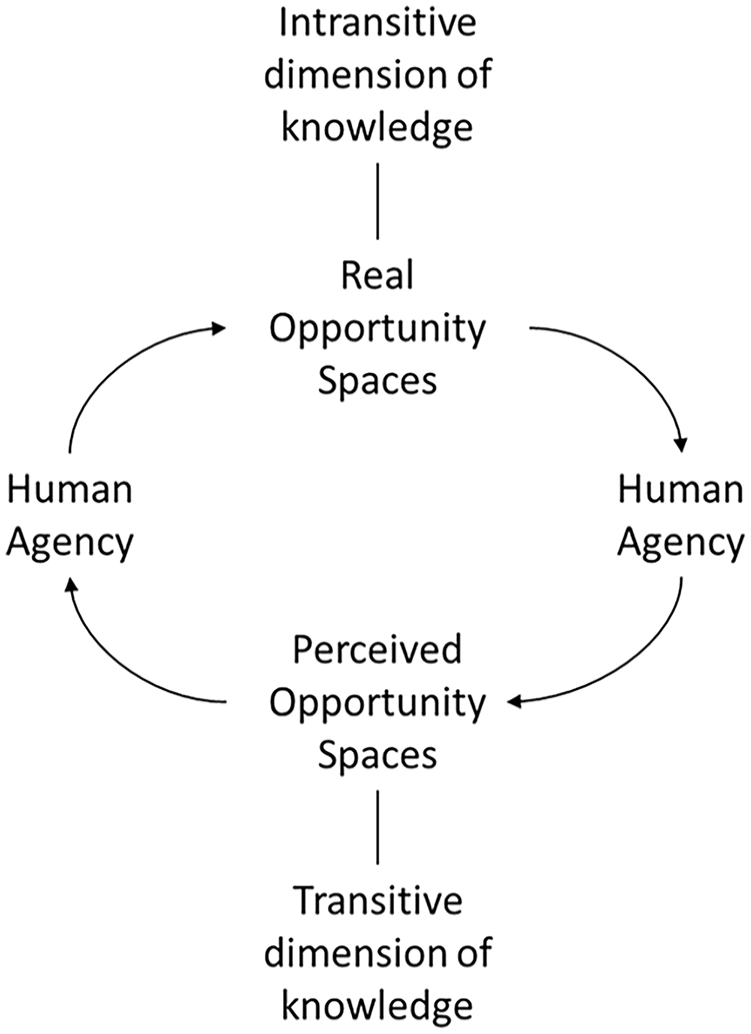
Dynamic model linking opportunity spaces and human agency.
Following contextual approaches in economic geography (Asheim, 2020; Gong and Hassink, 2020; Sunley, 1996), this general model needs to be specified for particular contexts and identify (i) which layers (structures) of opportunity spaces play a role in shaping the change process of interest and (ii) which types of human agency in turn shape these layers, thus unveiling the causal mechanism at work. Through the specification of the general model for particular contexts, middle-range theories can be developed (Chu and Hassink, 2023; Yeung, 2019). Middle-range theories define which structures have causal power and how these structures are reproduced and transformed through human agency within defined spatial and temporal boundaries. Within the defined boundaries (also referred to as scope conditions), middle-range theories make claims of demi-regularities (Lawson, 1997), which means that all places where the scope conditions apply, should exhibit similar agentic tendencies. We contribute by investigating how opportunity spaces and agency patterns differ across different types of non-metropolitan regions. Regions belonging to the same type would be similar, that is, have the same set of scope conditions, and thus the claim (to be validated in future studies) would be that the opportunity spaces and agency patterns should exhibit the same tendencies for all regions of a particular type.
This ties into the long-standing debate on place-based regional development (Barca, 2009) and studies that have aimed to identify types of regions based on key actors or governance structures (Asheim and Isaksen, 2002; Cooke, 1998) or innovation failures (Isaksen, 2001; Tödtling and Trippl, 2005). Tödtling and Trippl (2005) in their seminal paper on ‘one size fits all’ differentiate between three regional types by failures that hinder learning and innovation. Accordingly, the most prominent failure in metropolitan areas is the fragmentation between sectors because of which the potential of diverse knowledge sources cannot be exploited. In contrast, old industrial regions suffer most frequently from lock-in, where local actors share a common world-view, have a homogeneous knowledge base, and where local elites aim to maintain the status quo (Grabher, 1993; Hassink, 2010). Finally, peripheral regions often suffer from organizational thinness, which refers to a lack of potential local knowledge spillovers because few knowledge-intensive organizations are located in these regions. This strong link to failures was later removed in a similar classification focussing more on the structural properties in organisationally thick and diversified (metropolitan regions), organisationally thick and specialized (not necessarily with the ‘negative’ connotation of old industrial regions), and organisationally thin regions (Isaksen and Trippl, 2016; Trippl et al., 2018).
These regional typologies are directly linked to the dynamics between place-based opportunity spaces and agency. For instance, the nature of organisationally thick and specialized regions is that the place-based opportunity space is rather narrow, related to the existing capabilities and influenced by dominant actors. The prosperity of such regions will depend heavily on the time-specific opportunity space, this is to say the global demand for the industrial specialization. Innovation that diversifies the industrial base based on the existing capabilities to new markets may be a promising pathway of change. However, institutional entrepreneurship may be required to break existing institutional lock-ins before diversification strategies can be initiated (Hassink, 2010; Rekers and Stihl, 2021). Yet, there are also examples where this typology has its limitations. An example is peripheral regions dominated by a strong firm in nature- or bio-based industries such as mining or forestry (Görmar et al., 2022; Morales and Atienza, 2022). In such cases, we would expect to observe that actors struggle with a high degree of lock-in even though the region would overall be described by organisationally-thin (and should thus have a low degree of lock-in).
To advance on this regional typology, Nilsen et al. (2023) argue that it is necessary to introduce a local agency perspective to capture the varieties of non-metropolitan regions, and they suggest two dimensions for this: (i) the actor composition and (ii) power relations. The actor composition differs substantially in non-metropolitan regions from regional service centres hosting higher education institutes, different levels of government, a broad foundational economy, and a relatively high degree of industrial diversity (differentiated actor composition) to regions that have none of these characteristics (undifferentiated actor composition). Furthermore, regions differ in the power relations. Balanced power relations would capture regions where power is distributed between a range of actors and where it is not possible for a single actor or actor group to monopolize decision making processes. When such monopolizing is possible, however, the region would be characterized by skewed power relations.
Speaking to the research question, this suggests that distinct differences in opportunity spaces and agency patterns could be attributed to the particularities of regional types. For instance, Nilsen et al. (2023) stipulate that, in theory, opportunity spaces tend to be relatively broad in regions with a differentiated actor composition and balanced power relations whereas specialization of actors and skewness of power relations tend to imply a narrowing of opportunity spaces. The authors also argue that different regional preconditions require local actors to engage in change agency in different ways. For instance, it could be expected that in small peripheral regions, agency tends to rely on few individuals. Meanwhile in regions with a more differentiated actor composition, agency is expected to be of a more systemic and collective nature. Another proposition could be that institutional entrepreneurship tends to play an important role in specialized and locked-in regions, which require shifts in mindsets to embark in a change process (cf. Grillitsch et al., 2023b; Hassink, 2010). Turning to our empirical study, we aim to systematically uncover how opportunity spaces and agency patterns differ across non-metropolitan regions in the Nordics, and through substantive interpretation explain why this is so.
Empirical study
Method
The research design consists of twelve comparative case studies across three Nordic countries (Norway, Sweden and Finland). For each of the case study regions, we traced their development over approximately t decades (1990–2020) through triangulation using semi-structured interviews and supporting documents. From this material, we constructed a so-called event timeline for each region, in which we identified all the events that are important in explaining the region’s development. These events were identified as significant by several interviewees, and their details were corroborated using written sources such as official reports and newspaper articles. These event timelines (also confirmed by interviewees) therefore include the complete set of events significant for the region’s development over the time period. In total, we identified 182 events across our twelve case study regions. For each event, we have detailed information about how and why a set of actors engaged in the event, and how contextual situations enabled and/or hindered the event and its outcomes.
The compilation of qualitative empirical material across twelve in-depth case study regions in three Nordic countries was made possible by a unified research design, applied systematically across all cases, specifying research instruments as well as standardized protocols used to record and report findings. The size and scope of the resulting dataset is unique for studies of regional development, and it thereby offers a rare opportunity to investigate the nature and interplay of opportunity spaces and agency across regional contexts. Below, we document how this dataset was constructed by specifying case selection, data collection and analysis.
Case selection: Figure 2 identifies the twelve case study regions included in the dataset. These regions, four in each country, were selected theoretically for their ability to illuminate the nature of, and interplay between, opportunity spaces and agency in regional development. In a first step, we identified all regions that exhibited consistent and persistent deviations in growth paths, for instance from below-expectations growth performance to above-expectations growth performance, or vice versa (Grillitsch et al., 2021). Our regional growth model was based on standard indicators 2 that are commonly used to predict regional performance in terms of job growth, and we focused on regions that were persistent (over min. 4 years) outliers. This long-list was therefore composed of regions where the indicators showed changes in regional development over time, which could not be explained by structural preconditions, suggesting a good opportunity for us to study why and how this change happened, and the role agency played.
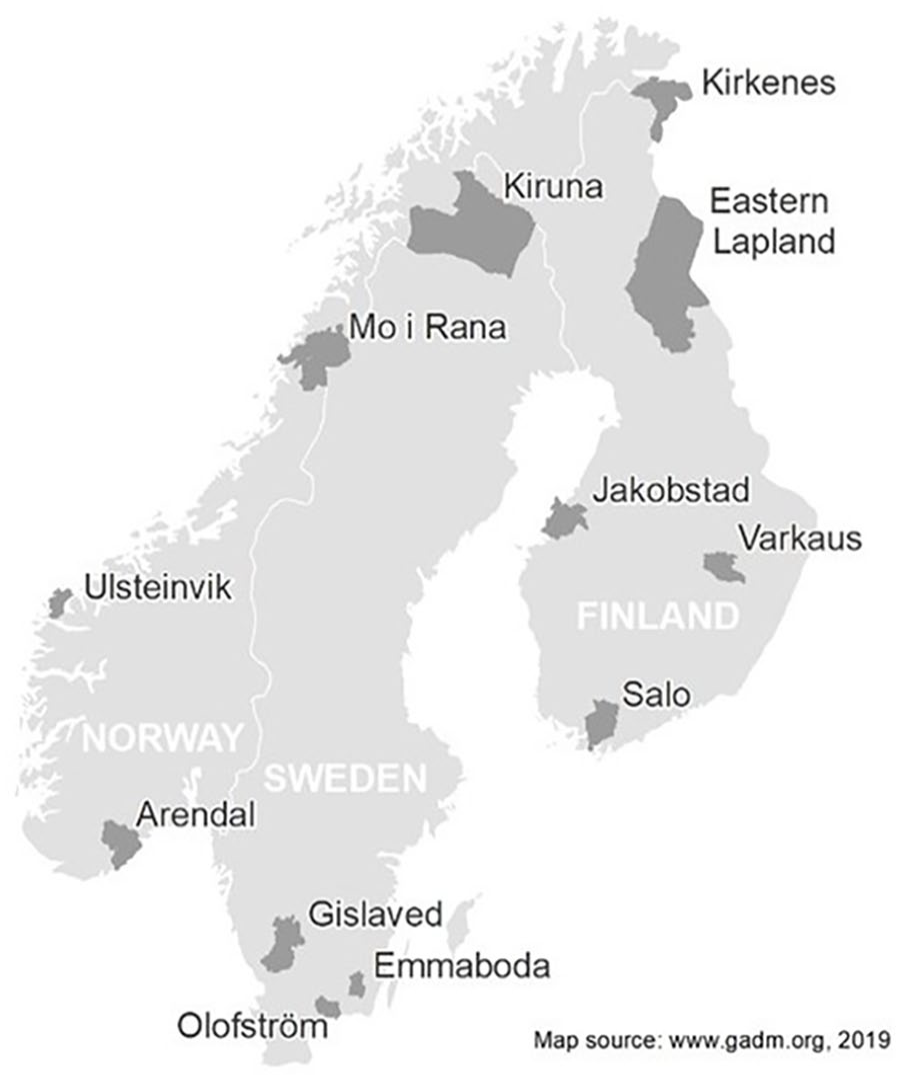
Case study regions.
In a second step, we selected twelve case study regions from the set of outliers (including over- and underperformers as well as regions that experienced both such episodes during the study period) based on a sampling strategy that combined variation with comparability. We have done this by first developing regional profiles for each outlier region and identifying key dimensions by which the regions differed (resource-based, manufacturing, small-peripheral, regional centre and cross-border 3 ). Then, we aimed at having variation in each country but comparability between countries, meaning that similar types of regions are observed in each country. The different types of regions and cases are described in Section ‘Types of regions’. Following this theoretical sampling strategy, we consider these twelve selected case studies to be well suited to comprehensively study the relationship between opportunity spaces and agency in different non-metropolitan contexts.
Data collection: For each of these case studies, we carried out an in-depth analysis of the role of opportunity spaces and agency in shaping regional development. Desktop research of documents and local newspaper archives generated a preliminary timeline of key events and list of potential interviewees. Combined with background statistics on population and employment and their changes over time, this event timeline yielded a detailed picture of what the development path of the region looked like over three decades. This timeline also suggested so-called critical junctures – episodes between two phases, when regional (structural) conditions could be identified as different from the phase preceding the critical juncture. During these episodes, we usually witness a higher number of events. These critical junctures became the locus of the fieldwork to identify why and how changes happened. We asked who did what, why, with whom, how they were enabled and/or constrained, and with what outcome?
The main data source consisted of 207 semi-structured interviews with regional leaders in industry, universities/research and support organizations, civil society and government that were participating and/or witness to events during the study period (see Table A1). The interview data about events (e.g. intentions, calculated reasoning, failed attempts) is unavailable from other sources and contributes a granular account of how opportunity spaces relate to change agency and vice versa. We supplemented these interviews with policy documents, strategies and official records on funding, meeting minutes and the composition of formal committees and networks. Triangulation within and between these sources strengthened our confidence that we identified all important events. Triangulation also addressed potential informant bias and memory lapses. As this is a retrospective study, we risk confirmation bias towards ‘successful’ actions that led to outcomes, and thereby overlooking actions and alternative strategies that did not come to fruition. To address this bias, we used archival research to prompt interviewees to talk about missed opportunities and strategies that fell short, although admittedly it is more difficult to get candid accounts of failures.
Data Analysis: We recorded and reported the events (see Research Data presented in the online appendix) for each study region in interview protocols, event timelines and case reports. The analysis of this paper is based on the aggregation of the twelve event timelines into a single dataset, after which it was cleaned for consistency, and finally coded. The codebook is based on the conceptual framework, where actions were classified by type of change agency (innovative entrepreneurship, institutional entrepreneurship, place-based leadership) based on the actor’s intention, and layers of opportunity spaces were analysed based on the enablers and hindrances identified in the empirical material. To ensure accuracy, we discussed definitions at project meetings to ensure consistency across the research teams and to avoid definitional drift over time. During the analysis, a second researcher from the same country-team made an independent assessment of the coding. Table 1 presents the codes per layer of opportunity space.
Codes of different layers of opportunity spaces.
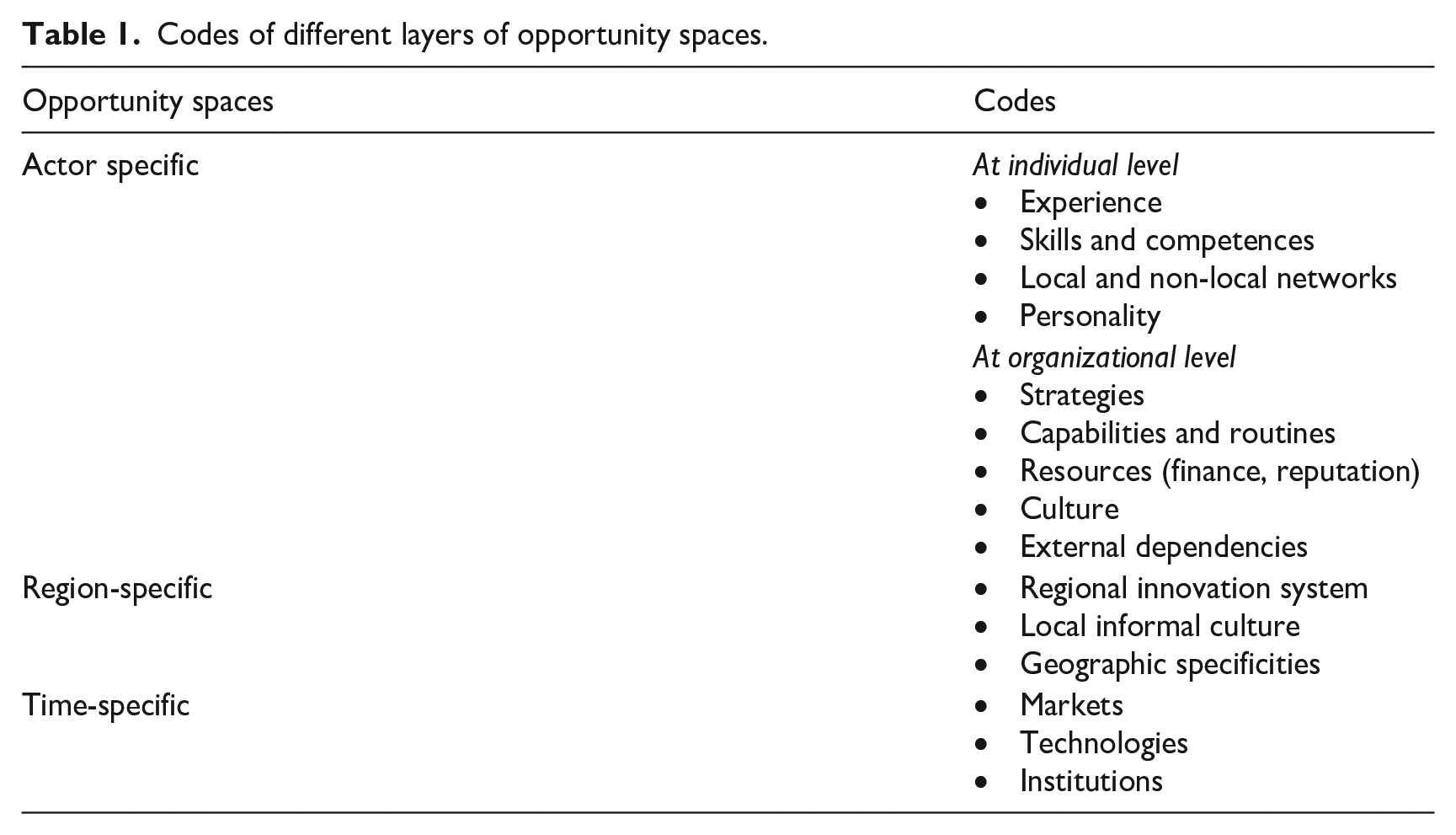
As our focus was on explaining the change in regional paths during critical junctures, we focused on the relationship between opportunity spaces and change agency as conceptualized by Grillitsch and Sotarauta (2020). Coding the empirical material organized as event timelines allows us to identify patterns across a large number of comparative cases. These patterns are, however, based on very detailed accounts. In order to give the reader a flavour of the detailed account (of events and the associated enablers and hindrances) that underlies the coded patterns, we present five vignettes (see Section ‘Illustrative vignettes’).
Types of regions
In order to investigate how and why opportunity spaces and agency patterns differ across regions, we took inspiration from the regional typology by Nilsen et al. (2023) because it was developed with the aim to differentiate non-metropolitan regions based on dimensions that affect regional opportunity spaces and agency patterns. Specifically, we differentiate between the following four groups (details on each of the case studies can be found in Table A2).
The first group are rural regions, which are small and peripheral without a strong industrial basis and with a thin organizational structure. This group includes Emmaboda in Sweden, Eastern Lapland in Finland and Kirkenes in Norway, all with a tendency of losing population. Emmaboda and Kirkenes have approximately 10,000 inhabitants whereas Eastern Lapland is larger with approximately 15,700 inhabitants. Eastern Lapland has lost 43% of its population since 1990 and is composed of a number of very small municipalities of which the biggest has approximately 7400 inhabitants. The three cases depend on few employers and suffered closure or decline in dominant local industries such as glass manufacturing (Emmaboda), forestry (Eastern Lapland) and mining (Kirkenes). Efforts have been made to develop alternative economic activities such as tourism.
The second group are rural industrial regions. Like the rural regions, they are relatively small and peripheral, but they have a stronger industrial base, in which single large firms have been dominating. This group of regions include Kiruna, a mining region in the very north of Sweden with LKAB as main employer and with approximately 22,700 inhabitants. Olofström is a small municipality in southern Sweden with approximately 13,300 inhabitants and Volvo Cars as the dominant firm. The Olofström labour market includes the neighbouring municipality Karlshamn. However, as the industrial dynamics of the two are very different, with Olofström being dominated by a large firm and Karlshamn having transformed from manufacturing to knowledge intensive services, we treat them separately (Karlshamn as regional centre). The third region in this group is Varkaus in Finland, which is dominated by the forestry industry and related mechanical engineering and has Stora Enso as the key firm. Varkaus is larger with approximately 29,700 inhabitants, about 22% less than in 1990. Varkaus includes two municipalities, with the bigger one (the City of Varkaus) having approximately 20,000 inhabitants. These regions have experienced fluctuations in employment of the lead firms over the three decades, exposing their vulnerability. Yet, as compared to the rural regions, the main industry/firm still had a relatively strong presence at the end of the observation period. This did not, however, improve the population statistics significantly as compared to the rural regions.
The third group of regions is labelled medium-sized manufacturing regions. They are less peripheral and larger than the rural industrial regions. In contrast to rural industrial regions, the fate of the medium-sized manufacturing regions is less dependent on a single firm. Rather, a structure of small and medium-sized manufacturing companies constitute a local entrepreneurial ecosystem. This is particularly pronounced for Gislaved/Gnosjö in Sweden (39,200 inhabitants), Ulsteinvik in Norway (28,100 inhabitants) and Jakobstad in Finland (59,700 inhabitants), which are all known in their countries for their entrepreneurial spirit or business culture. Gislaved/Gnosjö and Jakobstad are more diversified in terms of industry structure than Ulsteinvik, which has a strong cluster in the maritime industry. This reflects in the overall development pattern where the first two case regions are characterized more by a continuous transformation while Ulsteinvik exhibited stronger growth and decline phases following global demand for the specialization in the maritime industry. The fourth region in this group is Mo i Rana in Norway (32,000 inhabitants), which in the past was dominated by one firm (Norsk Jernverk) but that over the last 30 years has developed a more differentiated structure. In contrast to the rural and rural industrial regions, these medium-sized manufacturing regions exhibited some population growth.
The fourth group are regional/sub-regional centres, which have a more differentiated actor composition, hosting a higher education institution or at least some higher education programmes, and a more diversified labour market with an increasingly important share of the tertiary sector. These include Karlshamn in Sweden, Salo in Finland and Arendal in Norway with approximately 32,400, 60,200 and 85,000 inhabitants respectively. Karlshamn is a single municipality in contrast to Salo and Arendal. Salo region consists of two municipalities with the City of Salo having approximately 52,000 inhabitants. Arendal region covers six municipalities, of which Arendal is the largest with approximately 45,000 inhabitants. Karlshamn succeeded in replacing the previously dominant, but strongly declining, food industry with a new industrial path in information technologies, and thereby also diversified its economic basis, which was strongly supported by anchoring a higher education institute. Arendal has a strong tradition in oil and gas and electronics, and, during the observation period, could renew these industrial sectors making them more knowledge-intensive and diversifying in other sectors such as e-health, AI, and robotics. Also, the regional innovation system, including the local university, strengthened over the time period. Salo witnessed both an epic growth and decline of Nokia, which led to a restructuring towards a more diversified economy pivoting around the Internet of things by reusing some of the vacant facilities and talents after Nokia’s fall. Overall, these regions show, similarly to the medium-sized manufacturing regions, a small growth in population.
Empirical results
Illustrative vignettes
Each of the 182 events investigated in this study is an example of how the social engagement of local actors to realize some change is conditioned by different levels of opportunity spaces, and how this social engagement in turn affects both actor- and region-specific opportunity spaces. To provide deeper insights into these relations, we present a selection of vignettes. These vignettes illustrate the empirical material on which the following analysis is built.
The first selection of vignettes provides insights about the interplay between different levels of opportunity spaces, and how opportunity spaces change over time.
Vignette 1: One colourful example showcasing the importance of the actor-specific opportunity space is the case of the establishment of the Icehotel in the arctic town of Kiruna (Event Number 4). Kiruna, a resource-based small industrial region, has a long tradition of iron ore mining. When a new entrepreneur, who moved here in the 1980s, launched the idea of establishing a high-end, exclusive hotel made of snow and ice, he was actively resisted and ridiculed by local actors as it did not align with local traditions and values. Summer tourism (hiking, camping and river rafting) was already present, but the new entrepreneur’s vision targeted a higher-end segment of the market and perceived an opportunity to prolong the tourism season. Inspired by an ice-sculpture festival in Japan, his risk-taking, persistent and innovative personality enabled him to break local norms and pursue his vision. Over time, this led to a change in mindset of the local community and triggered other events engaging more local actors, such as the launch of a destination management organization (Event Number 5). This widened the perceived region-specific opportunity space encouraging other individuals to develop new exclusive products and firms within the industry. Today, winter tourism in Kiruna is flourishing and attracting international visitors (for more details, see Stihl, 2022).
Vignette 2: Another example that illustrates the relevance of the actor-specific opportunity space is the development of conference facilities and the organization of the annual ‘Arendalsuka’ in Arendal, Norway (Event Number 50). Arendalsuka is Norway’s largest political discussion platform and festival where different organizations, HEIs, industries and top politicians meet for a week in August. The initiation of the process leading up to the event could be traced back to a new leader in the municipal administration who was recruited from outside the region and introduced the idea (a perceived opportunity) of pushing the conference market. At the time, Arendal municipality, a regional centre, had big financial deficits, was not perceived as very innovative, and a recent state driven merger of five small municipalities had left people resistant to collaboration. This called for a new way of working and the new administrative leadership felt free to open opportunities for change. Hence, working with the conference market was a way to overcome regional challenges (characteristics of the region-specific opportunity space). Smaller conferences were organized to start with, and based on their success, local actors aimed bigger, including TEDxArendal events and Arendalsuka. Working with the conference market diversified the local economy, encouraged collaboration and network building, and shaped the perception of Arendal in Norway, thus transforming the region-specific opportunity space.
Vignette 3: An illustration of the importance of the region-specific opportunity space is the development of national services in the specialized region of Mo i Rana, Norway, in the 1990s (Event Number 74). During a deep crisis in steel- and heavy industries, the Norwegian state decided to discontinue state ownership of Norsk Jernverk and initiated a comprehensive reorganization of the firm in 1988. Norsk Jernverk was divided in different units and sold to private actors. Unemployment rose dramatically, despite a large national restructuring package that included moving some national government functions to Mo i Rana, such as NAV – the labour and welfare administration, the national library (digitalization of analogue material), and the Norwegian tax administration. These organizations started as small units but as they were the first to offer digitalized services at the national level in Norway, they gradually grew into large organizations that employ many in a more balanced and diverse local labour market. Leadership, innovation and investments in training, place these organizations at the core of the digitalization of public services and e-governance. One regional enabling factor was the built-up competences from the digital department of Norsk Jernverk. A second regional enabling factor was an industrial culture where labour was used to shift work: this facilitated the development of new public services that responded to calls after office hours (for more details, see Grillitsch et al., 2022).
The three presented vignettes show how the social engagement of local actors contribute to regional change processes. They provide evidence of the importance of actor-specific characteristics of the opportunity space, such as individual visions, experiences, competences and networks. The vignettes illustrate that certain events may be driven by few actors against the backdrop of unfavourable regional preconditions. Here, these actors perceive opportunities that go against the dominant narrative of what is possible in the region. When the pursuit of the perceived opportunity succeeds, this generates new knowledge about the real regional opportunity space, previously obscured by the dominant narrative, and might trigger further local actions to develop the hitherto ignored opportunity. However, in some cases, regional preconditions also enable change processes in unforeseen ways, such as the industrial culture in Mo i Rana. Each of the events studied thus provides insights into how regional change is effectuated by local agency. We find that such change is triggered by different types of change agency, and often requires a sequence of different types of change agency as illustrated in the following two vignettes.
Vignette 4: A common script of regional change is driven by innovative entrepreneurship. A case in point is the automotive industry in the company town Olofström. After decades of shaping and stamping metals using traditional press-lines, corporate leadership at Volvo Cars decided to deepen their investment by locating their latest technological innovation (warm presses to stamp thinner metal for electric vehicles) at this local plant in 2011 (Event Number 109). This investment extended their long tradition of engagement and technological leadership in the local supply chain that also included skill and competence development. The 2008 financial crisis and subsequential local job loss exposed the vulnerability of a local supply chain tightly tied to the automotive industry. This initiated stronger local collaborations between a wider set of actors (place-based leadership) (Event Number 110), and in consequence the establishment of a cluster organization to strengthen local collaboration and competence development further (Event Number 111). The investment, in combination with developed local collaborations, led to a widening of the region-specific opportunity space (for more details, see Rekers and Stihl, 2021).
Vignette 5: The Finnish case of Salo highlights the importance of both institutional entrepreneurship and place-based leadership. After a period of gradual decline, Nokia closed its mobile phone factory in 2012 and the successor Microsoft left the region in 2015. The empty facilities were disproportionately large for the smallish city and it was very improbable that a sole actor could take over. A new concept needed to be created in order to make good use of the facilities. This process was initiated by the city mayor in collaboration with the CEO of a local bank, who saw potential in buying the premises if local investors would be interested. The mayor contacted different public organizations (e.g. ministries) and the CEO of the local bank contacted local business actors and investors. Eventually, the project consortium consisted of the city, the city’s development company, the local bank, the local telecommunication service provider and private investors. The new concept was to shift the focus from a single large multinational company to a more diversified set of businesses. Building on the ICT legacy, they created a science park around the ‘Internet of things’, where businesses not only rent premises, but also benefit from a platform for start-ups, business co-operation and knowledge transmission (Event Number 172). The establishment of the science park initiated new public-private partnerships to the region. The city also underwent major institutional change, most notably in terms of its ‘development paradigm’: from a passive provider of basic services to being a more entrepreneurial and business-oriented actor (for more details, see Sotarauta et al., 2022).
The vignettes illustrate how the agency present in the studied events induced change in real region-specific opportunity spaces, which manifested in new support structures, collaborations and competences to develop new economic activities. The described agency also affected the dominant narrative about the possible regional futures, and how these could be achieved. Furthermore, the vignettes show that a change process can be initiated by different types of change agency but typically requires a combination of change agency types over time. Moreover, the vignettes provide evidence that the social engagement in a change process is always situated in a regional context. In the next section, we explore these regional patterns, based on the aggregate analysis of 182 events.
Regional patterns
Table 2 shows our analysis of all events, differentiating between different layers of opportunity space as well as different types of agency. Before discussing the differences between regional types, one commonality across nearly all of the 182 events is the importance of actor-specific opportunity spaces. Our findings show that actor-specific characteristics were highlighted in over 90% of the investigated events. Change agents could build on experiences, skills, local- and non-local networks and personality. In regard to networks, actors referred to embedding in global value chains, to collaborations with universities and research organizations, or to networks connecting directly to political leadership nationally. Thus, their networks were often extra-regional. In addition, interviews foregrounded personal attributes such as the energy and enthusiasm, foresight and persistence, as well as attachment to a particular place, which have recently received more attention in the literature (Atta-Owusu and Fitjar, 2022; Fritsch et al., 2019; Huggins and Thompson, 2019, 2022). To be sure, such personal attributes are not sufficient to bring about change agency events, but they are important to explain why certain actors perceive opportunities that other actors overlook, and have the capacity to develop these perceived opportunities. Organizational characteristics surfaced mainly as mediating conditions for change agency. Organizational capabilities, financial resources and reputation were the most frequently mentioned enabling conditions. The former included a wide range of technical, legal, market and business model capabilities, as well as the capability to manage change processes. We also found that the particular mandate, or change of mandate, of support organizations sometimes contributed to change agency. All these actor-specific characteristics influence the perception of opportunities and the capability to act on them. Due to their very nature, they are not equally available to everyone.
Varieties of opportunity spaces and agency patterns by regional type.
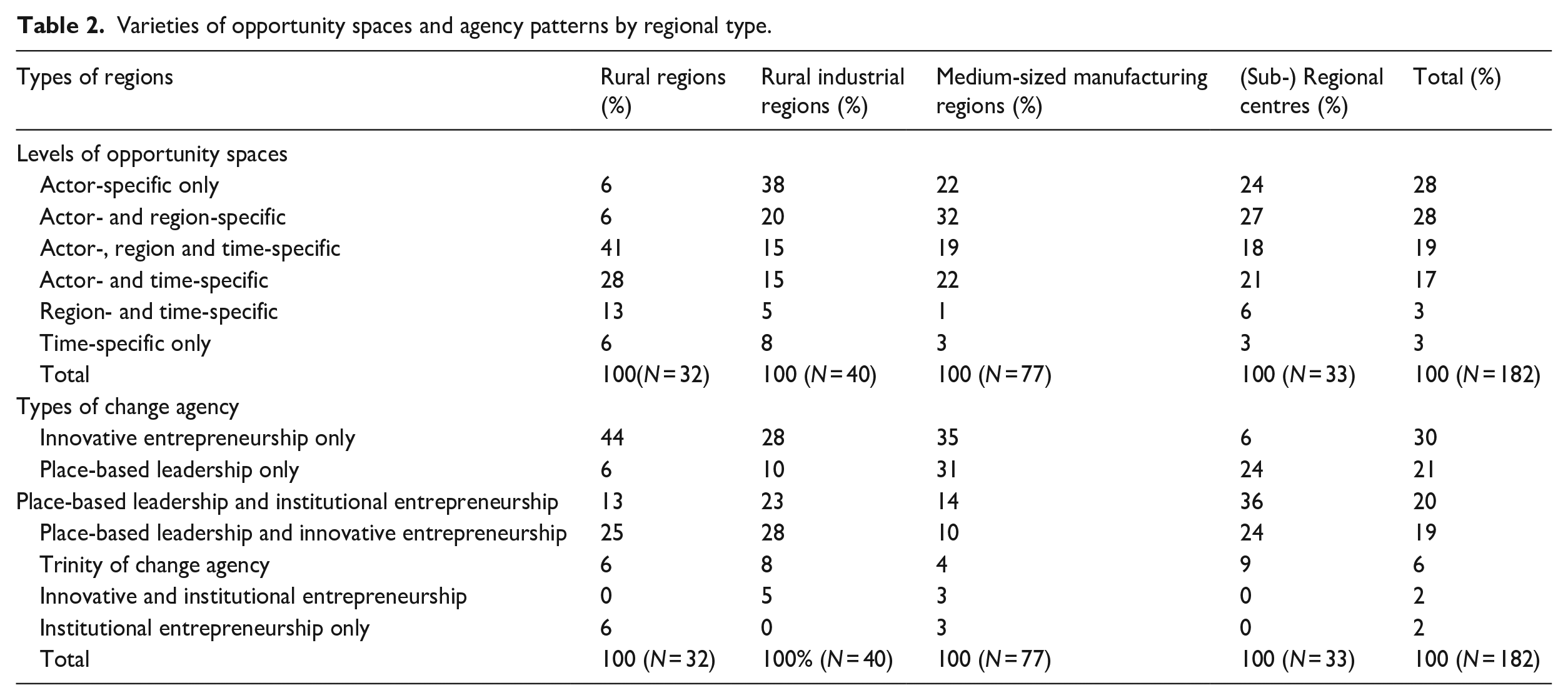
Next, we discuss the relative importance of the various levels of opportunity spaces. In medium-sized manufacturing regions and regional centres we find that combinations of actor- and region-specific opportunity spaces have often been instrumental for agency. A typical example is the development of national services in Mo i Rana, where region-specific capabilities and culture were mobilized by innovative entrepreneurs to make change happen (Event Number 74, see Vignette 3). We can explain the relative importance of the combination of actor- and region-specific properties for change agency in medium-sized manufacturing regions and regional centres as a consequence of the more differentiated actor composition and better developed regional support structures as compared to the rural regions.
In rural industrial regions (mining in Kiruna, manufacturing in Olofström, pulp and paper in Varkaus), the studied events are more often than in other regions tied to actor-specific opportunity spaces. This holds both for firm-level innovation activities (e.g. production processes of iron by LKAB in Kiruna, Sweden (Event Number 1), or the establishment of a customer service company (Call Waves Solutions) in Varkaus, Finland (Event Number 155)) and for collective action to improve the regional preconditions (e.g. regional collaboration after the downsizing of Volvo Cars in Olofström, Sweden (Event Number 110)). An explanation for this can be that individual actors (large firms) are dominating these regions, such as LKAB in Kiruna, Volvo Cars in Olofström and Stora Enso in Varkaus.
In contrast, in rural regions, time-specific opportunity spaces have been identified as relevant in almost all investigated events. This refers to events that are explicitly related to a change in extra-regional conditions like market conditions (crisis or boom), a regulatory change, or a funding opportunity. This can be exemplified with initiatives of local entrepreneurs in Kirkenes, Norway to establish new businesses building on collaborations with Russia. The background is the region’s proximity to Russia and good relationship with the Russian community, the change of the geopolitical situation after the fall of the Soviet Union in 1991, and the opportunity provided by a restructuring package of NOK 400 million in 1990 (Event Number 112). However, even in rural regions, the region-specific opportunity spaces are often important. This suggest that rural regions are not simply ‘deprived’ of opportunities. Rather, change agency in such contexts often involves valorizing existing resources and conditions, as suggested in recent literature (Eder and Trippl, 2019; Glückler et al., 2022).
In terms of change agency, we observe events purely driven by innovative entrepreneurship (nearly 1 in 3) or place-based leadership (1 in 5), but rarely do we observe institutional entrepreneurship in isolation. Instead, institutional entrepreneurship occurs most often together with place-based leadership (1 in 5 events). Interestingly, these patterns show marked differences across different types of regions. Innovative entrepreneurship in its pure form accounts for nearly half of the events observed in rural regions, but almost none of the events in regional centres. Place-based leadership on its own plays a more important role in regional centres and medium-sized manufacturing regions (roughly 1 in 4 events) than it does in rural regions. Institutional change combined with place-based leadership plays a noteworthy role in regional centres (more than 1 out of every 3 events); about double of what we observed in the other types of regions.
If we consider which types of change agency are prevalent in different types of regions, we find that among the observed events in rural regions, innovative entrepreneurship is quite frequent. On its own and in combination with place-based leadership, this accounts for more than 2/3 of all observed events. For instance, in Kirkenes, numerous innovative entrepreneurs aimed to diversify the economy to reduce reliance on the mining sector. However, these initiatives failed to create strong momentum, which can be partly explained by a relative absence of place-based leadership. Centralized patterns of decision-making, dependency relationship with the state-owned mining company and a weak local governance structure, where the mine carried out municipal responsibilities for a very long time, provided unfavourable conditions for strengthening collective agency.
Changing development paths of regional centres, on the other hand, relies almost entirely on place-based leadership. On its own, it accounts for nearly half the observed events, and in combination with innovative entrepreneurship, it covers 85%. An example of the combination of place-based leadership and institutional entrepreneurship is the change processes in Salo, Finland, after the departure of Nokia and Microsoft (Event Number 172, see Vignette 5). The relative importance of institutional entrepreneurship (in combination with place-based leadership) as compared to medium-sized manufacturing regions is related to the regional preconditions. The medium-sized manufacturing regions in this study tend to be relatively entrepreneurial. In particular, Ulsteinvik in Norway, Gislaved/Gnösjö in Sweden and Jakobstad in Finland are known for their entrepreneurial spirit. Even if such regions face a crisis, they do not necessarily need to work with institutional change locally because the local culture is conducive to innovation and change. This local cultural characteristic may also explain why innovative entrepreneurship has often driven change in medium-sized manufacturing regions.
Rural industrial regions share with rural regions the feature of a low differentiation of the local actor composition. In addition, however, they are locked-in due to their industrial specialization and dominance by one firm. The combination of a low differentiation of the local actor composition combined with lock-in is suggestive of the relatively minor importance of place-based leadership on its own. Change is often driven by innovative entrepreneurship alone or in combination with place-based leadership, or institutional entrepreneurship in combination with place-based leadership. It is this combination that has the potential to break the lock-ins in this type of region.
Caveats and analysis of robustness
The presented findings attempt to generalize from micro-events observed in 12 regions in the Nordics. Even though we carefully selected these case studies, such generalization needs to be treated with caution. One caveat is that there might be important nuances to regional types that are not covered in our categorization. We do not claim completeness in this sense. Yet, we do claim a relatively broad and encompassing coverage of the variety of non-metropolitan regions in the Nordics that exhibited unexpected growth paths, which is covered in our case selection process (see Section ‘Method’).
A second caveat is that the classification of regions into four types is crude and broad brush-stroked. Essentially, no region is identical to another and there is considerable heterogeneity within each regional type. When assigning the case regions to regional types, we aimed at a high similarity between regions of the same type and a high dissimilarity between regions across types. However, we acknowledge that this categorizing was more difficult for some regions than for others. The categorization was most problematic for Varkaus, Mo i Rana, and Salo, three regions that changed substantially over time. Varkaus had been dominated by a single firm but over time has developed a more diversified industry structure being more similar to medium-sized manufacturing regions. Like Varkaus, also Mo i Rana is situated between medium-sized manufacturing regions and rural industrial regions. As compared to the other three medium-sized manufacturing regions, Mo i Rana lacks the entrepreneurial culture, which is characteristic for Ulsteinvik, Gnosjö/Gislaved and Jakobstad. Finally, Salo has gone through quite dramatic changes from being highly specialized and dominated by Nokia to a more diversified economic structure.
As regards the second caveat, we can study the robustness of the results identifying the relative importance of different levels of opportunity spaces and agency types if we exclude these three regions (see Table A3). What we find is that the patterns observed above become even more distinct, corroborating our findings. The importance of actor-specific opportunity spaces increases for rural industrial regions, which are the ones dominated by single large firms. Here, also the role of innovative entrepreneurship as well as the combination of place-based leadership and institutional entrepreneurship becomes more pronounced. In medium-sized manufacturing regions, the agency patterns are very distinct, with innovative entrepreneurship and place-based leadership sticking out as the most frequent. This resonates well with Ulsteinvik, Gnosjö/Gislaved and Jakobstad, which are known for their entrepreneurial culture and engagement of businesses in community building. Finally, as regards the regional centres, the role of place-based leadership often in combination with institutional or innovative entrepreneurship stick out. Confirming previous results, the combination of actor- and region-specific opportunity spaces frequently underpin the events in medium-sized manufacturing regions and regional centres.
A third caveat concerns the ‘quantification’ of qualitative data of events, which are grounded in the specific regional contexts. Here, it is important to note that our claims are not made based on a straight reading of percentages, but rather based on a substantial interpretation where we connect our in-depth knowledge about the various non-metropolitan regions with our theoretical understanding, in order to explain the larger differences in patterns of opportunity spaces and agency across regional contexts. While it is important to recognize the particularities of each region, we have confidence in our findings in connecting characteristics of opportunity spaces to agency in different regional contexts.
Conclusions
In this paper, we have developed a theoretical model capturing the interplay between perceived and real opportunity spaces and agency. We also propose a novel methodological approach that allows for aggregation and comparative analysis of large amounts of qualitative data to investigate how and why opportunity spaces and agency patterns vary across non-metropolitan regions. We differentiate between four types of regions: (i) rural regions, which are small and peripheral, (ii) rural industrial regions, which are also small and peripheral but have a strong industrial profile dominated by single firms, (iii) medium-sized manufacturing regions, which exhibit a more differentiated industrial structure with linkages between small and medium-sized firms and (iv) regional centres, which have a differentiated actor composition, hosting also higher educational institutions and an increasing importance of the tertiary sector.
The study showed similarities and differences across these regional types. As regards to similarities, the importance of the actor-specific opportunity spaces stands out for the perception of opportunities and capabilities to act upon them, which also manifested in visions of individual actors very often being identified as a trigger for action. Actor-specific opportunity spaces were pointed out as relevant and important in nearly all the observed events across all regional types. As regards to the differences, we found that regional preconditions, such as the differentiation of the actor composition (and with that the regional size), the dominance of a single firm versus networks of small and medium-sized firms, the industrial specialization, and soft institutions such as an entrepreneurial culture, affected the structure of opportunity spaces, the perception and engagement of local actors in change processes, as well as the outcomes of such change processes. Hence, the results show that, on the one hand, opportunity spaces are place-based, this is to say context-specific. On the other hand, we find a large variance in how individual actors and actor groups engage in change processes, and that it is this variance that allows for mindful deviations and changes in regional development paths that could not be predicted from regional structural preconditions. The variance in turn is related to actor-specific opportunity spaces, that is, differences in actor experience, competences, networks and personality, which in turn manifest in different visions and capabilities to pursue change.
Furthermore, the investigated events show how sets of actors engage in different forms over time in regional development processes, and how conditionalities situated in time and space influence the processes and outcomes. It tends to be the more complex combinations of actors and agency types that affect the directionality in regional development. For instance, place-based leadership may build and strengthen regional support structures. Yet, it is only in combination with institutional or innovative entrepreneurship that established mindsets or development paths are questioned and challenged. Also, innovative entrepreneurship, which was a common form of change agency captured with the regional development events, was often continuous and incremental, contributing to the renewal and upgrading of existing development paths. The fewer but more radical cases of innovative entrepreneurship aimed at developing markets for new products and were therefore combined with institutional entrepreneurship challenging mindsets regionally or in the industrial context, or working towards changed national and European rules and procurement regulations.
Pushing this a bit further, these results suggest that more attention needs to be given to the interplay between real and perceived opportunity spaces, and the agency involved in constructing perceived opportunity spaces and changing real ones. Concretely, the analysis showcases that individual actors often engaged in change processes because they perceived an opportunity, which was outside the dominant narratives of what development would be possible in the region, or how such development could be achieved. This provides empirical evidence that dominant imaginations about regional futures are always an incomplete picture of what could be possible, and that change agency is often a process of challenging dominat narratives. Furthermore, we provide some evidence that the real region-specific opportunity space also changes with the engagement of actors, for instance, in the form of a change in direction of development, building of competences and support structures, and new economic activities.
In addition, this paper also provides some evidence about the limitations of local agency. Rural regions in our sample stand out in particular, with a high share of events that only include innovative entrepreneurship. This may be symptomatic of lower possibilities to mobilize collective and potentially more effective forms of agency. This resonates with the argument of the innovation paradox, suggesting that the regions that would need innovation the most have the least favourable conditions (Oughton et al., 2002).
We consider that this research has important policy implications. First, while the currently dominating regional policy rationale in Europe, smart specialization, focuses on the role of entrepreneurial discovery for regions to diversify into new areas of economic activities within the framework of the European Green Deal (Foray, 2017, 2023), this paper shows that regional change processes cannot be captured by focussing on entrepreneurial discovery alone. Very often, it needs a combination of agency-types to achieve transformative change in regions. Second, the results relate to the idea of place-based regional policy considering the different opportunities and challenges regions face (Barca, 2009; Tödtling and Trippl, 2005) because the structure of opportunity spaces and agency patterns varies across regions. However, the results also show how important actor-specific opportunity spaces are in all types of regions, which suggests attention to more people-based and bottom-up initiatives, harnessing the variation of actor-specific opportunity spaces within regions.
Moving forward, a number of propositions can be developed from this study that may inform further research as well as local actors’ change strategies. Embarking from a differentiation between more incremental change that constitutes a continuation along existing paths and more transformative change, which entails a change in the direction of development, the first proposition is that more transformative change emerges from the interplay between a collectively perceived, dominant narrative of the regional opportunity space, and a deviating perception of what is possible by a set of actors who engage in challenging and changing the dominant narrative. The second proposition is that, opposed to a continuation along existing paths, the set of actors having an alternative perception of the opportunity space will need to mobilize and activate different types of change agency in order to effectuate a change in the real opportunity space. This change would entail a change in the collectively perceived, dominant narrative about the regional opportunity space, as well as a change in the material conditions in favour of the alterantive opportunity space, for instance, through a pooling of resources and capabilities in the region in pursuit of the new direction. Here, a change in the collectively perceived opportunity space will enable such pooling. As a consequence, it would be necessary to investigate the conditions that, in a first stage, make the emergence of alternative perceptions of opportunity spaces possible, and the conditions that, in a second stage, enable the mobilization of different types of agency in the pursuit of these alternatives. The third proposition is that this depends both on region-specific and actor-specific characteristics. This is evident in the findings where we observed differences between for instance actor composition (e.g. small rural regions versus medium-sized manufacturing regions and regionanl centres) and power relations (e.g. related to the industrial structure). An important unexplored question relates to the governance of change. From this study, we find a large variety of actors engaging in driving (or opposing) change who sometimes, but not necessarily, have democratic legitimacy. The fourth proposition thus leads back to the idea of place-based development and suggests that to secure desirable outcomes, it is required to combine the empowerment of change agency in regions with directionality towards sustainability from above and good governance in a multi-level context.
Research Data
sj-docx-1-epn-10.1177_0308518X241303636 – Supplemental material for Patterns of opportunity spaces and agency across regional contexts: Conditions and drivers for change
Supplemental material, sj-docx-1-epn-10.1177_0308518X241303636 for Patterns of opportunity spaces and agency across regional contexts: Conditions and drivers for change by Markus Grillitsch, Josephine Rekers, Björn Asheim, Rune Dahl Fitjar, Silje Haus-Reve, Jari Kolehmainen, Heli Kurikka, Karl-Johan Lundquist, Mikhail Martynovich, Skirmante Monteilhet, Hjalti Nielsen, Magnus Nilsson, Sami Sopanen, Markku Sotarauta and Linda Stihl in Environment and Planning A: Economy and Space
Footnotes
Appendices
Varieties of opportunity spaces and agency patterns by regional type (excluding Varkaus, Mo i Rana, and Salo).
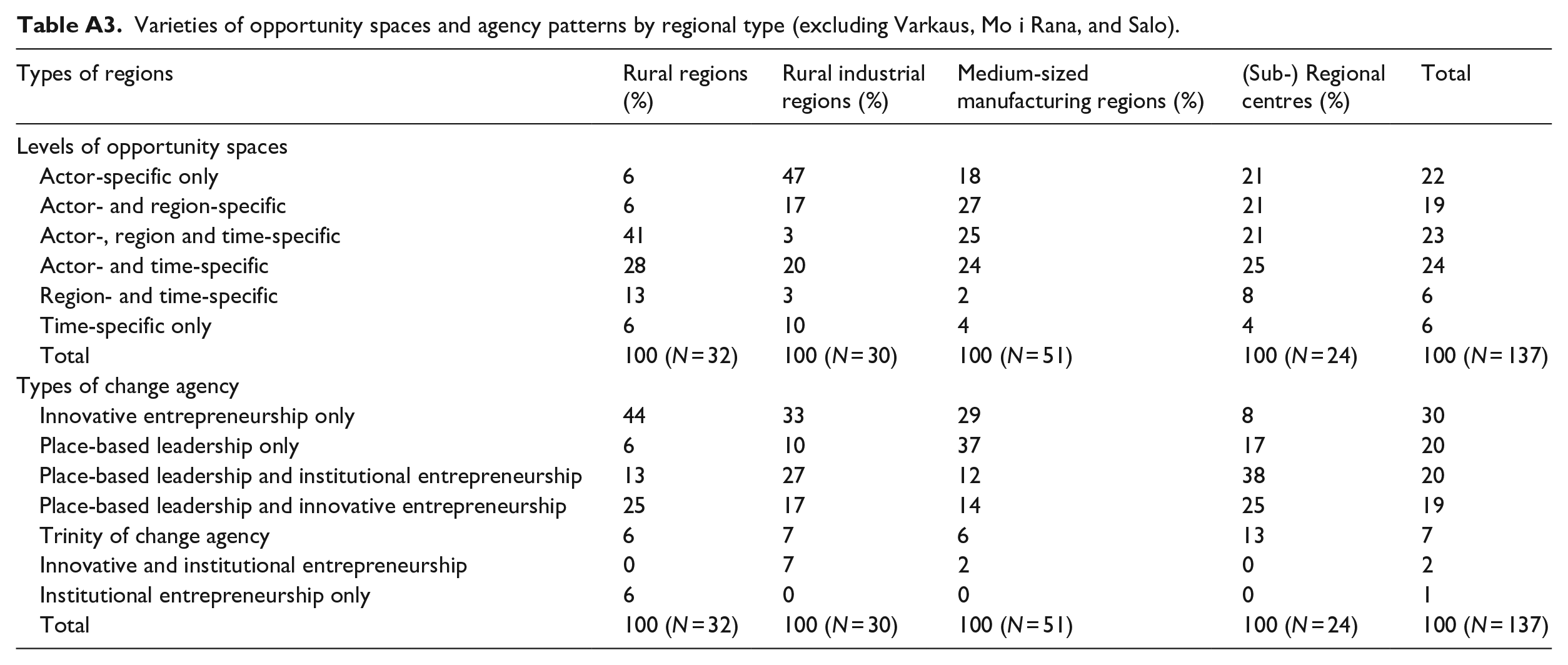
| Types of regions | Rural regions (%) | Rural industrial regions (%) | Medium-sized manufacturing regions (%) | (Sub-) Regional centres (%) | Total |
|---|---|---|---|---|---|
| Levels of opportunity spaces | |||||
| Actor-specific only | 6 | 47 | 18 | 21 | 22 |
| Actor- and region-specific | 6 | 17 | 27 | 21 | 19 |
| Actor-, region and time-specific | 41 | 3 | 25 | 21 | 23 |
| Actor- and time-specific | 28 | 20 | 24 | 25 | 24 |
| Region- and time-specific | 13 | 3 | 2 | 8 | 6 |
| Time-specific only | 6 | 10 | 4 | 4 | 6 |
| Total | 100 (N = 32) | 100 (N = 30) | 100 (N = 51) | 100 (N = 24) | 100 (N = 137) |
| Types of change agency | |||||
| Innovative entrepreneurship only | 44 | 33 | 29 | 8 | 30 |
| Place-based leadership only | 6 | 10 | 37 | 17 | 20 |
| Place-based leadership and institutional entrepreneurship | 13 | 27 | 12 | 38 | 20 |
| Place-based leadership and innovative entrepreneurship | 25 | 17 | 14 | 25 | 19 |
| Trinity of change agency | 6 | 7 | 6 | 13 | 7 |
| Innovative and institutional entrepreneurship | 0 | 7 | 2 | 0 | 2 |
| Institutional entrepreneurship only | 6 | 0 | 0 | 0 | 1 |
| Total | 100 (N = 32) | 100 (N = 30) | 100 (N = 51) | 100 (N = 24) | 100 (N = 137) |
Declaration of conflicting interests
The author(s) declared no potential conflicts of interest with respect to the research, authorship and/or publication of this article.
Funding
The author(s) disclosed receipt of the following financial support for the research, authorship and/or publication of this article: This research was supported by a grant from Länsförsäkringar Alliance Research Foundation, Sweden (Grant Number: 2017/01/011).
ORCID iDs

Supplemental material
Supplemental material for this article is available online.
Notes
References
Supplementary Material
Please find the following supplemental material available below.
For Open Access articles published under a Creative Commons License, all supplemental material carries the same license as the article it is associated with.
For non-Open Access articles published, all supplemental material carries a non-exclusive license, and permission requests for re-use of supplemental material or any part of supplemental material shall be sent directly to the copyright owner as specified in the copyright notice associated with the article.
