




Abstract
Regional governance has received growing attention, not only from researchers, but also from politicians and practitioners of regional development. The understanding and usage of the concept, however, are highly heterogeneous: sometimes regional governance is described or explained in terms of its characteristics, processes and impacts, while at other times, it is framed as a tool for regional development. This article develops a definition and framework for a systematic assessment of various regional governance forms. For this purpose, it draws on material from a three-round Delphi survey among practitioners and researchers who are experts of regional governance. On this basis, a consolidated definition of regional governance is proposed as ‘the vertical and horizontal coordination of regional transformation processes beyond administrative boundaries by state and non-state actors’. Furthermore, the framework identifies five dimensions of regional governance: (a) participation, (b) bindingness, (c) formalisation, (d) regional autonomy and (e) power relations. These dimensions are disaggregated into a total of 21 indicators to systematically describe and analyse different regional governance forms.
Introduction
Regional governance has become a major concept for practitioners and researchers of regional development alike. At its most basic level, it refers to complex mechanisms of development processes which are coordinated by private and public actors that represent different political levels, jurisdictions and economic sectors (Fürst, 2010; Jordan, 2008). But even such a broad definition of regional governance is not shared across the literature. Instead, we observe various usages, applications and understandings of the concept in academia and in practice, and the concept appears to be fragmented in terms of contexts, perspectives and interests.
Researchers from various disciplines, ranging from geography to political science and sociology, have used the concept of regional governance in at least three different ways: first, to describe and analyse complex regional coordination processes between actors with different backgrounds and agendas (e.g. Bevir, 2011; Fürst, 2014; Kleinfeld, 2006; Mose et al., 2014; Tolkki et al., 2011); second, to describe and analyse the redistribution and re-scaling of state responsibilities to the regional level (e.g. Bulkeley, 2005; Jessop, 2005; Rhodes, 2007; Swyngedouw, 2005; Zimmermann, 2009); and third, in a more normative fashion, to strengthen sustainable development and enhance the performance of regions (e.g. Jordan, 2008; Lu and Jacobs, 2013; Meadowcroft, 2007; Morrison, 2014). In practice, regional governance is commonly understood as a tool to foster sustainable development, strengthen collective decision-making processes and meet policy goals (OECD, 2006; UNDP, 2013).
More often than not, the concept and its characteristics are not clearly defined. It is rare to find operationalisations of regional governance that would allow a more constructive dialogue about its features and distinctiveness (Fürst et al., 2005; Panebianco, 2013). In the few cases where authors have developed integrative frameworks, they are deductive and disregard the expertise of practitioners (e.g. Foster and Barnes, 2012), examine a narrow range of specific regional governance forms (Deppisch, 2012; Mose et al., 2014) or have explicit normative underpinnings (Morrison, 2014).
We aim to address this threefold gap by developing a definition and framework that would be (a) inductive (i.e. emerge from empirical research rather than from the literature); (b) cross-functional (i.e. integrate the perspectives of both practitioners and researchers); and (c) versatile (i.e. applicable to a wide range of regional governance forms). Acknowledging competing conceptualisations of what a ‘region’ is, we refer to regions as social constructs produced through social practices (Paasi, 1991; Paasi and Metzger, 2017). Regions can be as diverse as water supply management regions covering several municipalities or regions, where development programmes are implemented across nations (e.g. LEADER+). Our goal is to develop an adaptive framework that systematises rather than determines regional governance. The framework should provide key dimensions of regional governance with which to analyse the various forms of regional governance. Therefore, its key aim is analytical, not normative.
For this purpose, we conducted a Delphi survey among practitioners and researchers of regional governance in Switzerland and Germany. The iterative, multistage process of the Delphi method allows for controlled discussions to be structured and stimulated among experts on a specific topic. The purpose of the survey was two-fold: First, we investigated the different understandings and usages of regional governance and used these findings to build a consolidated definition based on a consensus among experts from practice and academia. Second, we developed a versatile and multidimensional framework for regional governance which can be applied to a variety of different regional governance forms.
Regional governance: A variety of understandings and attempts at systematisation
The concepts of governance and regional governance share some similarities. Both refer to the continuous interactions of interdependent actors across different levels and sectors which are based on informal and formal rules and varying degrees of self-regulation (Rhodes, 1996, 2007). But unlike governance, which does not refer to a certain geographical scale (Jordan, 2008), regional governance does. Regional governance encompasses a wide array of spatial modes of governance, such as urban (Pradel-Miquel, 2015), territorial (Schmitt and Van Well, 2016), rural (Lu and Jacobs, 2013), cross-border (Deppisch, 2012; Zäch and Pütz, 2014) or landscape (Görg, 2007; Pütz et al., 2017) governance.
Three distinct but related understandings of regional governance emerge from the academic literature. First, regional governance as a theoretical concept is used to emphasise the multiplicity of stakeholders involved in coordinating regional development processes; these stakeholders represent state and non-state realms and have varying backgrounds, interests and agendas (Bevir, 2011; Fürst, 2014; Kleinfeld, 2006; Mose et al., 2014; Tolkki et al., 2011). Here, regional governance is understood as a research perspective to observe the complexity of different actors contributing to regional development processes and the variety of corresponding collective actions. According to Fürst (2010: 49), regional governance can thus be understood as regional self-regulation which emerges in complex situations, calling for collaboration between state and non-state actors. The patterns of coordination are manifold and vary from bottom-up self-regulation to top-down hierarchical steering.
Second, regional governance as an empirical descriptor reflects the growing importance of non-state actors for regional development, indicated by the redistribution of state responsibilities, whereby tasks and duties are passed to non-state actors at different levels (Bulkeley, 2005; Jessop, 2005; Rhodes, 2007; Swyngedouw, 2005; Wilkes-Allemann et al., 2015; Zimmermann, 2009). This shift allows non-state actors to become more involved and play more important roles in shaping regional development processes. As new non-state actors, such as consultancies, business associations, non-governmental organisations or social movements, become involved in policy making, the constellation of actors and the balance of power change. As a consequence, formerly clearly defined spheres of responsibilities become blurred, leading to a change or expansion in the spatial scope of politics (Arts et al., 2014; Fung, 2015; Klijn and Edelenbos, 2013).
Third, some scholars understand regional governance as a tool to strengthen regional performance and enhance sustainable development (Böcher, 2008; Jordan, 2008; Lu and Jacobs, 2013; Meadowcroft, 2007; Morrison, 2014) or to promote more flexible decision-making processes (Hughes and Pincetl, 2014). For example, Lu and Jacobs (2013) find that ‘the utility in regional governance […] is that it provides a mechanism through which local communities can satisfy the dictates of national and state policy while maintaining their autonomy’ (p. 95). This third understanding is the closest to how this concept is used in the practice of regional development whereby regional governance is often understood as an effective tool to strengthen sustainable development in regional communities and to foster integrative decision-making processes (OECD, 2006; UNDP, 2013).
Facing this variety of understandings, authors have noted the need for further specification of the concept of regional governance and the need for empirical research. Fürst et al., (2005: 33) noted that ‘concrete operationalisation is missing in theory’. Similarly, Panebianco (2013: 78) criticised that, in most cases, operationalisation is limited to ‘a mere list of characteristics’ (Panebianco, 2013).
Some authors have sought to make regional governance measurable by defining quantitative indicators. For example, Morrison (2014) defined ‘indicator metrics’ using numerical thresholds in an attempt to quantify the dimensions of regional governance. Although it appears to be an interesting step in the right direction, it remains doubtful as to whether the developed metrics do justice to the complex and multifaceted dimensions proposed by the author. For example, the dimension of ‘level of engagement in regional networks’ is measured by the ‘number of key regional networks x level of key actor engagement’ (p. 105). In our view, this formula only partly sheds light on the ‘level of engagement in regional networks’, as it neglects the opportunities for other actors to engage in the networks as well as the permanence and quality of engagement. Furthermore, Morrison’s framework also exhibits normative underpinnings, as it seeks to enhance regional performance and to foster effective regional governance forms.
In contrast to the quantitative approach, other authors have placed an emphasis on defining qualitative indicators to describe dimensions of regional governance (e.g. Ansell and Gash, 2007; Deppisch, 2012; Foster and Barnes, 2012; Mose et al., 2014). To develop these frameworks, several authors have applied a deductive approach (e.g. Foster and Barnes, 2012; Mose et al., 2014). In only some cases is the deductive approach complemented with some inductive elements, such as incorporating the findings of pilot interviews (Deppisch, 2012) or conducting a meta-case study of academic literature (Ansell and Gash, 2007).
A further distinction can be made between generic frameworks (Ansell and Gash, 2007; Foster and Barnes, 2012) and other frameworks that are concerned with particular thematic and regional contexts. Thematic frameworks cover a wide range of different topics, from environmental governance (Bulkeley, 2005; Jordan et al., 2015; Wallington et al., 2008) to the role of regional development agencies in state rescaling (Ayres and Stafford, 2014; MacKinnon and Shaw, 2010; MacLeavy and Harrison, 2010; Pape et al., 2015; Pearce and Ayres, 2009). Also, several authors have proposed frameworks for diverse regional contexts, such as urban (Lackowska and Zimmermann, 2011; Pradel-Miquel, 2015) and cross-border governance (Deppisch, 2012; Nelles and Durand, 2014; Zäch and Pütz, 2014) or for comparing protected areas (Pütz and Job, 2016; Pütz et al., 2017) or different LEADER networks in rural regions across European countries in order to identify different governance styles (Mose et al., 2014).
What is common to these frameworks is that they incorporate at least three similar pillars. First, their conceptualisations of regional governance focus on the behaviours of actors or actor groups, such as the orientation of actors (Mose et al., 2014), the relationship among actors (Deppisch, 2012) and the commitment of actors (Foster and Barnes, 2012; Morrison, 2014). Second, the frameworks try to capture the institutional framework, either by looking at constitutive organs (Mose et al., 2014), institutional design (Ansell and Gash, 2007) or the internal institutional framework (Deppisch, 2012; Morrison, 2014). Third, the frameworks encompass the aspect of legitimacy, either by looking at the selection process and representative nature of actors (Mose et al., 2014), the legitimacy to act (Foster and Barnes, 2012) or the power–resource–knowledge asymmetries (Ansell and Gash, 2007).
Research design
Our research design allowed us to develop a definition and framework for regional governance based on inductively derived knowledge and to draw from the perspectives of both practice and academia, therefore developing expert-based dimensions and indicators of regional governance. The Delphi method is the core of our research design. We chose this method because it allowed us to structure and stimulate a controlled debate among a large group of practitioners and researchers with expertise in regional governance and regional development. The Delphi method involves written, anonymous surveys completed by a selected expert panel in an iterative, multistage process (Hasson et al., 2000; Hsu and Sandford, 2007). It can be applied to policy investigation, goal setting (Hsu and Sandford, 2007) or framework development (Okoli and Pawlowski, 2004). Its strength is that it enables a wide range of experts to take part in a discussion, as it consists of multiple rounds that allow for feedback loops, selective deepening of themes, and further exploration of diverging assessments.
As is common when using the Delphi method, the participating individuals were selected based on their deep understanding of and interest in the research topic (Hasson et al., 2000). This purposive selection approach ensured that the topic was addressed with profound expertise; however, as the participants were not selected randomly, representativeness could not be achieved.
For our Delphi survey, we selected experts from both practice and academia with deep understanding of, expertise in and long-standing commitment to regional governance and development. First, half of the experts had worked with regional development and regional governance issues for between 10 and 20 years, and 21 percent had worked in that field more than 20 years. Second, all the experts had acquired leading positions within their workplace and, thus, often worked at the heart of governance structures and processes. Third, the vocational and academic backgrounds of the participants were quite varied. Of the 52 experts who participated in the 1st round, 33 were practitioners, and 19 were researchers. The majority of the practitioners worked in public administration (total 21 percent) – 9 percent at the national level, 10 percent at the provincial level and 2 percent at the municipal level – followed by practitioners working in regional development agencies (19 percent), consulting offices (17 percent) and national associations (6 percent). The most common background among the 19 researchers was in planning studies (11 percent), followed by human geography (8 percent), political science (6 percent), regional development studies (6 percent), business and economics (4 percent) and sociology (2 percent). A high return rate was achieved throughout the Delphi survey. Of the original 57 participants, 52 experts (33 practitioners, 19 researchers) returned the questionnaires after the 1st round (91 percent response rate). After the 2nd Delphi round, 46 experts (30 practitioners, 16 researchers) returned them (88 percent response rate). The survey was carried out between February and November 2015.
Although the experts’ professional backgrounds were quite diverse in terms of their specialisations, functions and competences, geographically, the experts were limited to two countries: Switzerland and Germany. The practitioners were from three language regions in Switzerland whereas the researchers were drawn from Swiss (61 percent) and German (39 percent) universities and research institutes. The main language used in the Delphi survey was German, although French questionnaires and a short summary of the extended German feedback material were provided for the francophone and bilingual Swiss practitioners. To meet our selection criteria, we limited our search to experts from Switzerland and Germany, where we were best able to assess their vocational backgrounds and professional reputations and to ensure their strong expertise in regional governance.
Due to the distinct federal structures of Germany and Switzerland, there exist not only a large number but also a high diversity of regional governance forms. In Switzerland, a three-tier political system is in place that encompasses the national, provincial and municipal levels. A small population of about 8 million inhabitants is dispersed across 26 cantons (provincial levels) and more than 2000 municipalities. In Germany, the 80 million inhabitants live in 16 smaller states, which have between three and five political levels. This complexity, as well as the decentralised structure of the political systems in the two countries, demand a high degree of coordination. As a result, numerous regional governance forms can be observed both in Germany and Switzerland. By choosing Delphi experts from Germany and Switzerland, we can likely cover all regional governance forms that are prevalent in Western European countries with similar institutional structures, such as a strong civil society, direct democratic processes and an independent judiciary.
Our Delphi survey encompassed three rounds (see Figure 1). The 1st Delphi round included open and multiple-choice questions and an assessment of ten features of regional governance and their operationalisations most commonly found in the academic literature (see Table 1). We compiled this list based on an extensive review of academic papers on regional governance and regional development issues. The review included early and pioneering contributions, such as Kooiman (1993), Rhodes (1996) and Goodwin (1998), as well as their contemporary counterparts, such as Perkmann (2007), Bevir (2011) and Bulkeley (2012).
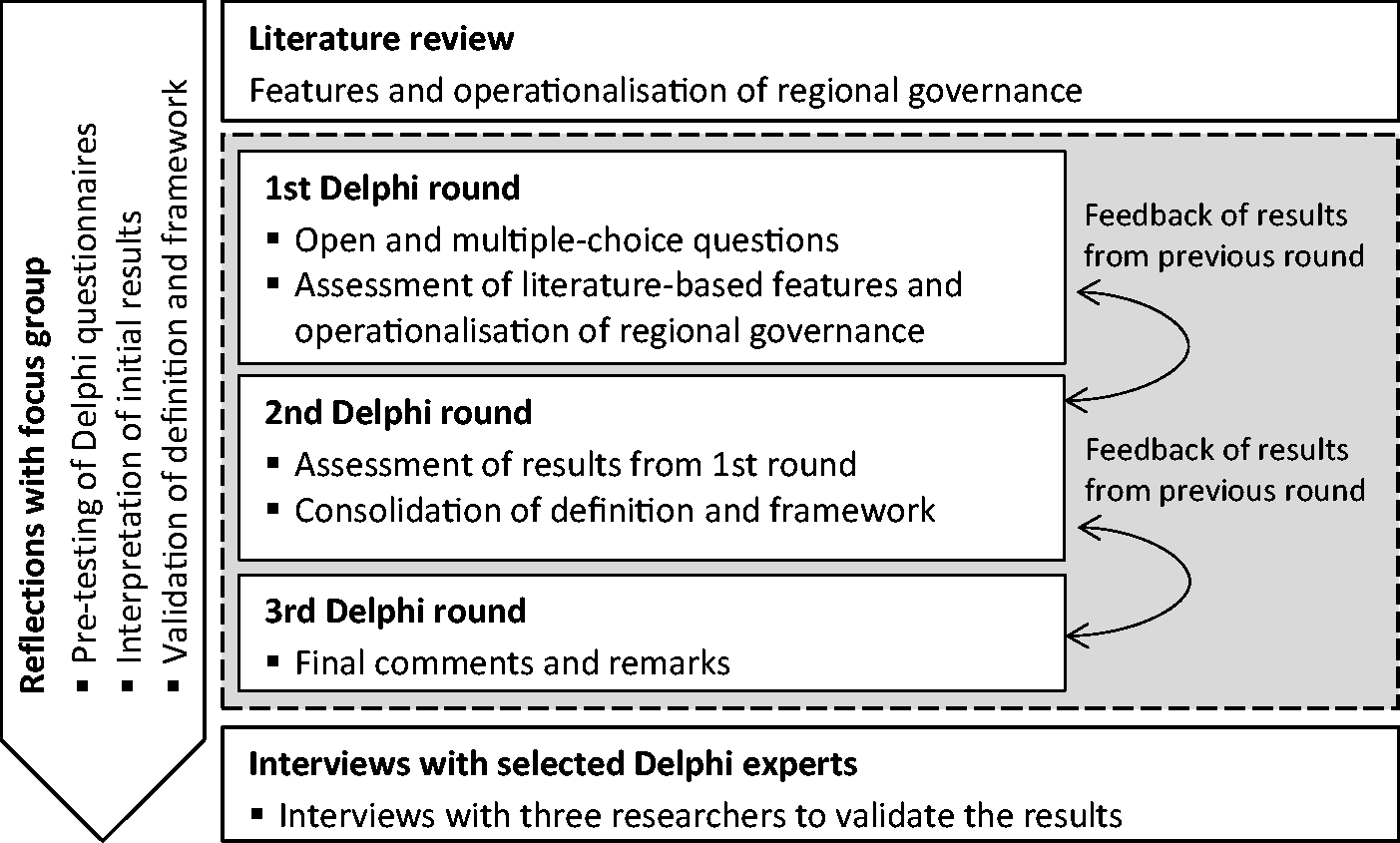
Research design.
Features of regional governance and operationalisations (own compilation based on literature review).
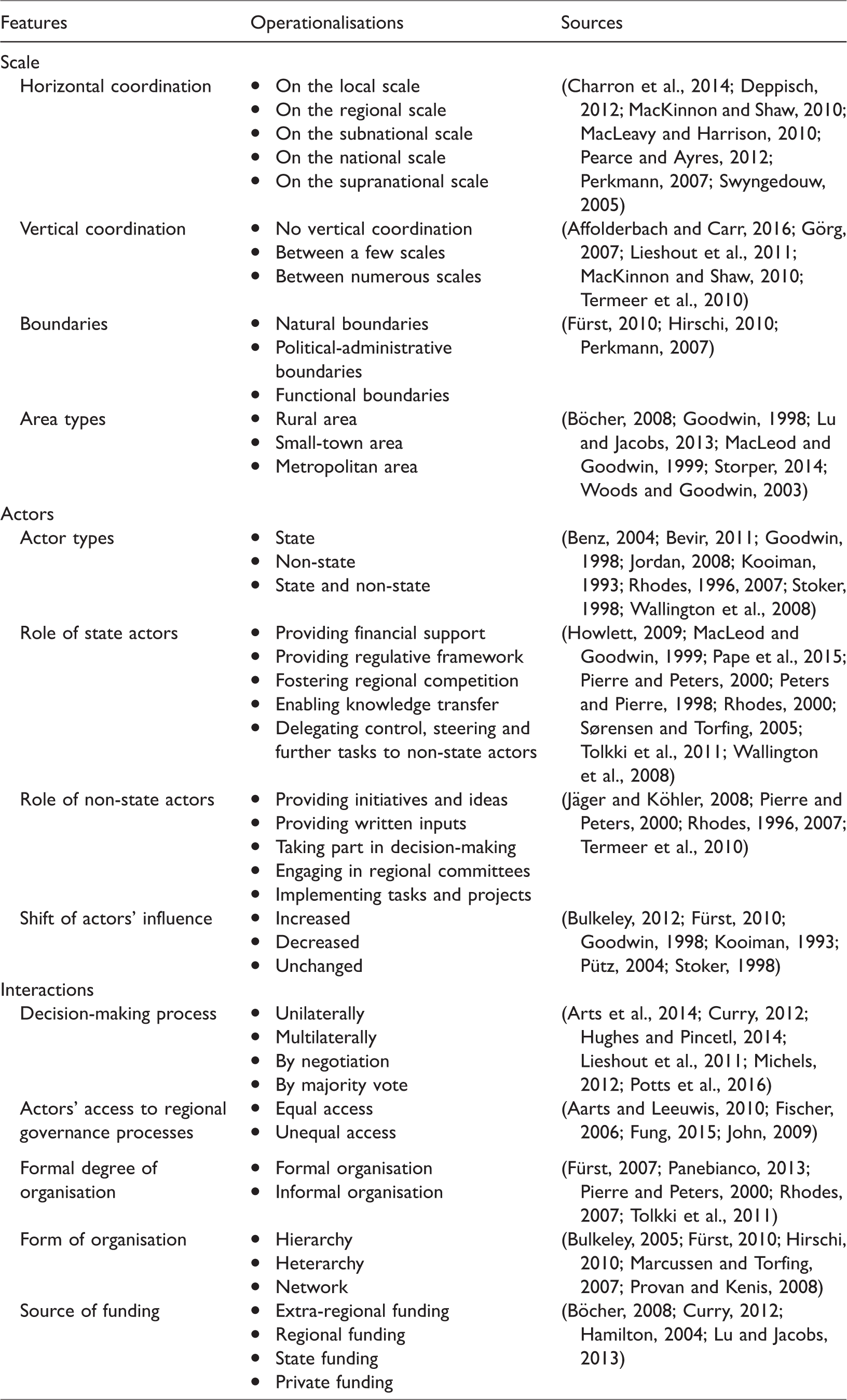
As shown in Table 1, different operationalisations of regional governance features can be found in the academic literature. Thus, to identify the key characteristics of regional governance, we requested that the experts agree or disagree with the inclusion of each of the proposed operationalisations during the 1st Delphi round. The experts were asked to express their levels of agreement or disagreement by using a four-point Likert scale (1 = completely agree, 2 = slightly agree, 3 = slightly disagree, 4 = completely disagree) in addition to the ‘I don’t know’ option. As a threshold for identifying a key characteristic of regional governance, we defined that in both groups – practice and academia – at least 50 percent of the experts had to ‘completely agree’ and an additional 25 percent of all experts had to ‘slightly agree’ with the inclusion of an operationalised feature.
The 2nd Delphi round built upon the results of the 1st round. First, based on the key characteristics of regional governance identified during the 1st Delphi round, we developed a working definition of regional governance, which we presented to the experts for critical review during the 2nd round. Second, we developed – again based on the findings from the 1st round – five dimensions of regional governance and asked the experts for feedback. Third, to measure the proposed dimensions’ differing degrees of prevalence within different regional governance forms, we asked the experts to propose indicators for each dimension.
In the 3rd Delphi round, the experts again received the results of the 2nd Delphi round, as well as summarised feedback. The experts could comment critically and address the outcome, but we did not raise any new questions in the 3rd round. Because we had already gathered sufficient data to consolidate our definition and develop a multidimensional and versatile framework, we ended the Delphi survey after the 3rd round. We then analysed the collected data using descriptive statistics and qualitative content analysis.
To ensure the validity and the relevance of the Delphi survey, we undertook two supporting measures which considered both the practical and academic perspectives. First, we organised two focus groups with practitioners, which took place prior to and during the Delphi survey. The practitioners were selected based on their long-standing work experience in the field of regional development in Switzerland and were not part of the Delphi panel. They provided useful advice on the content of the questionnaires and on the interpretation of the results. In addition, they reviewed the definition and framework we had developed and assessed their respective usefulness and relevance for practice.
Second, upon completion of the Delphi survey, we conducted expert interviews with three researchers from the expert panel. Based on these interviews, we reflected on our interpretation of the findings of the Delphi survey, reviewed the definition and refined the resultant framework. We especially checked the framework for completeness and discussed its applicability to empirical research.
Towards a definition of regional governance
Varied understandings of regional governance
Most practitioners and researchers agreed that regional governance involves a multiplicity of actors from both the state and non-state realms. One researcher summarised this as follows: I understand regional governance as the cooperation of different regional actors to achieve specific goals, which would not be possible without cooperation. It is characterised by the cooperation of state and non-state actors who engage across different scales, not only locally. (Researcher, 1st Delphi round)
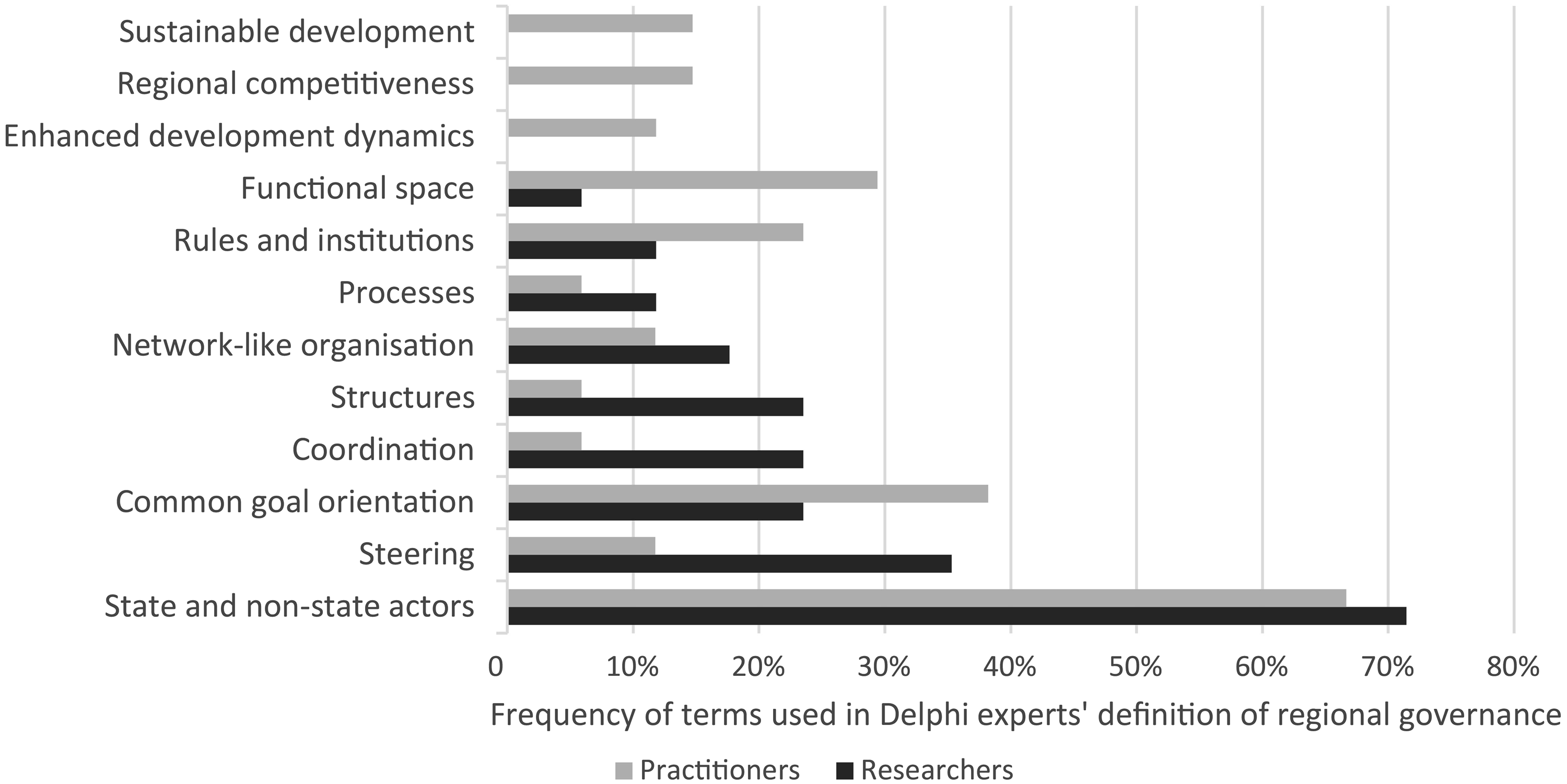
Terms used by the Delphi experts to define regional governance.
But there were also significant differences within the two groups. Among the researchers, one group pointed out the coordination of regional development processes, such as described in the following quote: Regional governance aims at an integrated policy through strategic coordination of interdependent processes. It is about coordinating plans and measures of different organisations and actors, from both the public and private domain. (Researcher, 1st Delphi round) Forms of regional steering structures and processes characterised by strong networks, as a form of steering, and the cooperation of actors across different sectors. (Researcher, 1st Delphi round) a cross-sector and cross-level planning policy [that is] principally implemented by spatial planning and economic policy, but involves further sectors. (Researcher, 1st Delphi round) Regional governance is a collective term for all forms of steering and mechanisms of regional development. It involves state, economic and civil society actors. (Practitioner, 1st Delphi round) [Regional governance is about the] support of the existent regional structures through a higher-level state authority in order to achieve economic, societal and ecological goals. [It’s about] cooperation of the regional and superior authority to generate macroeconomic (including societal and ecologic) added value in accordance with a binding legal basis. (Practitioner, 1st Delphi round) In contrast to government, governance is about the collective actions of a community to find solutions to different problems. [These are] accepted solutions, because they are tailor-made for every situation. Therefore, it does not require a legal framework and is not dependent on binding commitments to cooperation. (Practitioner, 1st Delphi round) The strengthening of municipalities, and the promotion of competitiveness and attractiveness of a region. The top goal is to increase the well-being of the people living and working in a region. (Practitioner, 1st Delphi round)
Experts’ assessment of the literature-based and operationalised features of regional governance
Next, we analysed how the Delphi experts assessed the literature-based and operationalised features of regional governance in Table 1 by applying the threshold for identifying the key characteristics of regional governance, which we have presented in the research design section.
By these standards, four key characteristics of regional governance were identified by the experts in both groups. First, 74 percent of the practitioners and 72 percent of the researchers picked the ‘regional level’ as the main level of regional governance. Second, 62 percent of the practitioners and 61 percent of the researchers agreed that regional governance involves at least three different vertical levels, such as the municipal, regional and provincial levels. Third, experts highlighted the horizontality of regional governance, as 82 percent of the practitioners and 67 percent of the researchers agreed that both state and non-state actors participate in regional governance. Fourth, 56 percent of the practitioners and 50 percent of the researchers agreed that regional governance refers to functional entities as opposed to entities defined by natural or political-administrative boundaries. In sum, all the experts identified four key characteristics of regional governance: the horizontal coordination on the regional level, the vertical coordination across several scales and the involvement of state and non-state actors within functional boundaries (Figure 3).
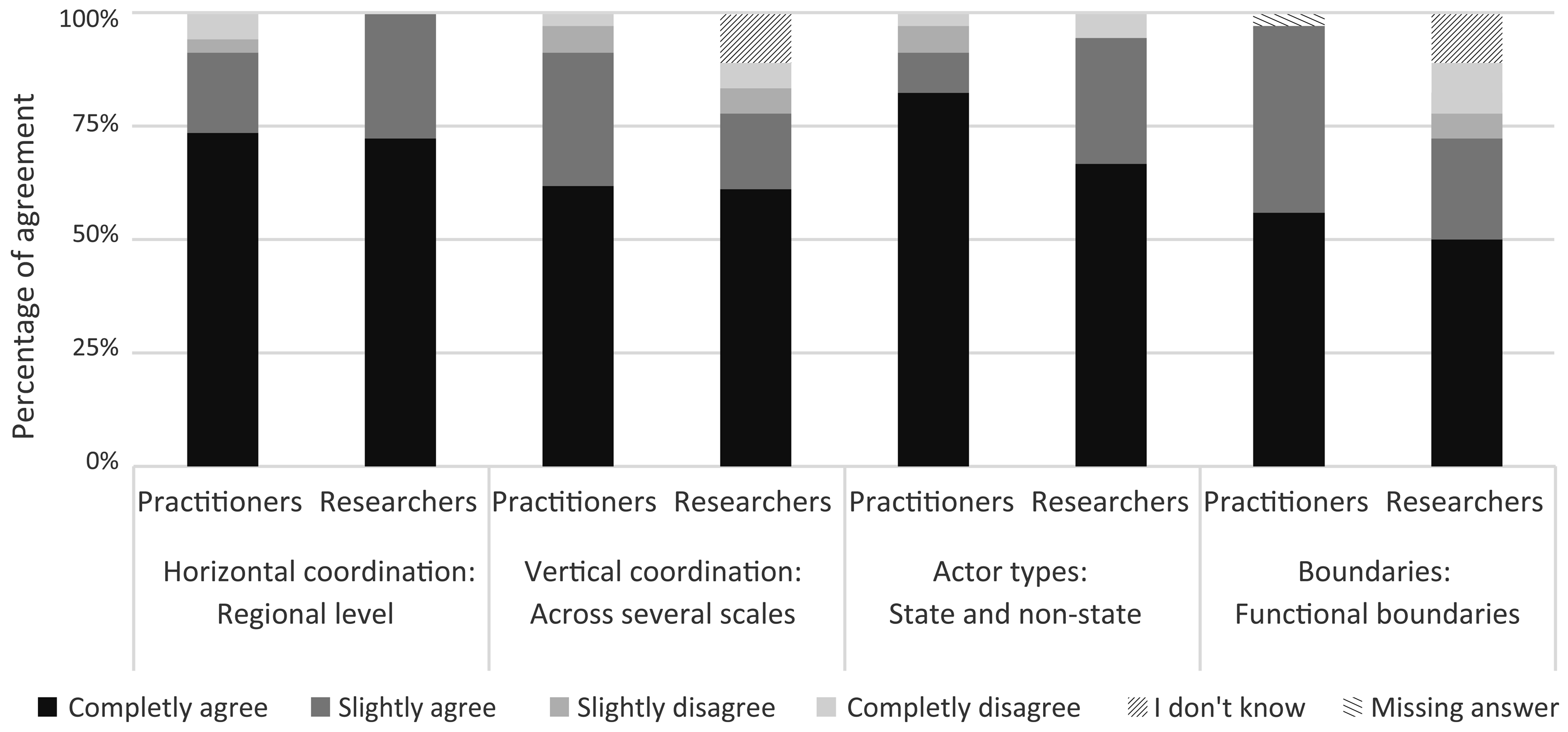
Key characteristics of regional governance as identified by the Delphi experts.
Neither group strongly agreed with any of the remaining operationalised features. Instead, some features were only agreed upon strongly in one group, including the following: that regional governance forms are organised network-like (practitioners: 59 percent; researchers: 33 percent), that all actors are involved equally (practitioners: 50 percent; researchers: 41 percent) and that actors on the regional level increase their influence on regional development (practitioners: 59 percent; researchers 28 percent).
Finally, neither group strongly agreed with any of the following operationalised features: the role of state and non-state actors, the influence of different actors, the decision-making process, the form of organisation and financing. The experts acknowledged that these features are useful to describe various regional governance forms but could not agree on specific operationalisations.
Taking the feature ‘organisation’ as an example, one practitioner pointed out that ‘all forms of organisation are possible’ (Practitioner, 1st Delphi round), while another researcher stated that: regional governance can be organised differently, both strongly and weakly [e.g. legally binding associations vs. spontaneous meetings of loosely organised interest groups], as well as network-like and hierarchically. It depends on the specific context during the creation, on the actor composition, as well as their desired action. (Researcher, 1st Delphi round)
Developing a consolidated definition of regional governance
We developed the following working definition based on the key characteristics of regional governance, which were identified by the Delphi experts after the 1st round: Regional governance describes network-like coordination of regional development processes and comprises vertical and horizontal cooperation of state and non-state actors in a functional space. Regional governance describes the vertical and horizontal coordination of regional transformation processes beyond administrative boundaries by state and non-state actors.
Towards a versatile and multidimensional framework
Dimensions of regional governance
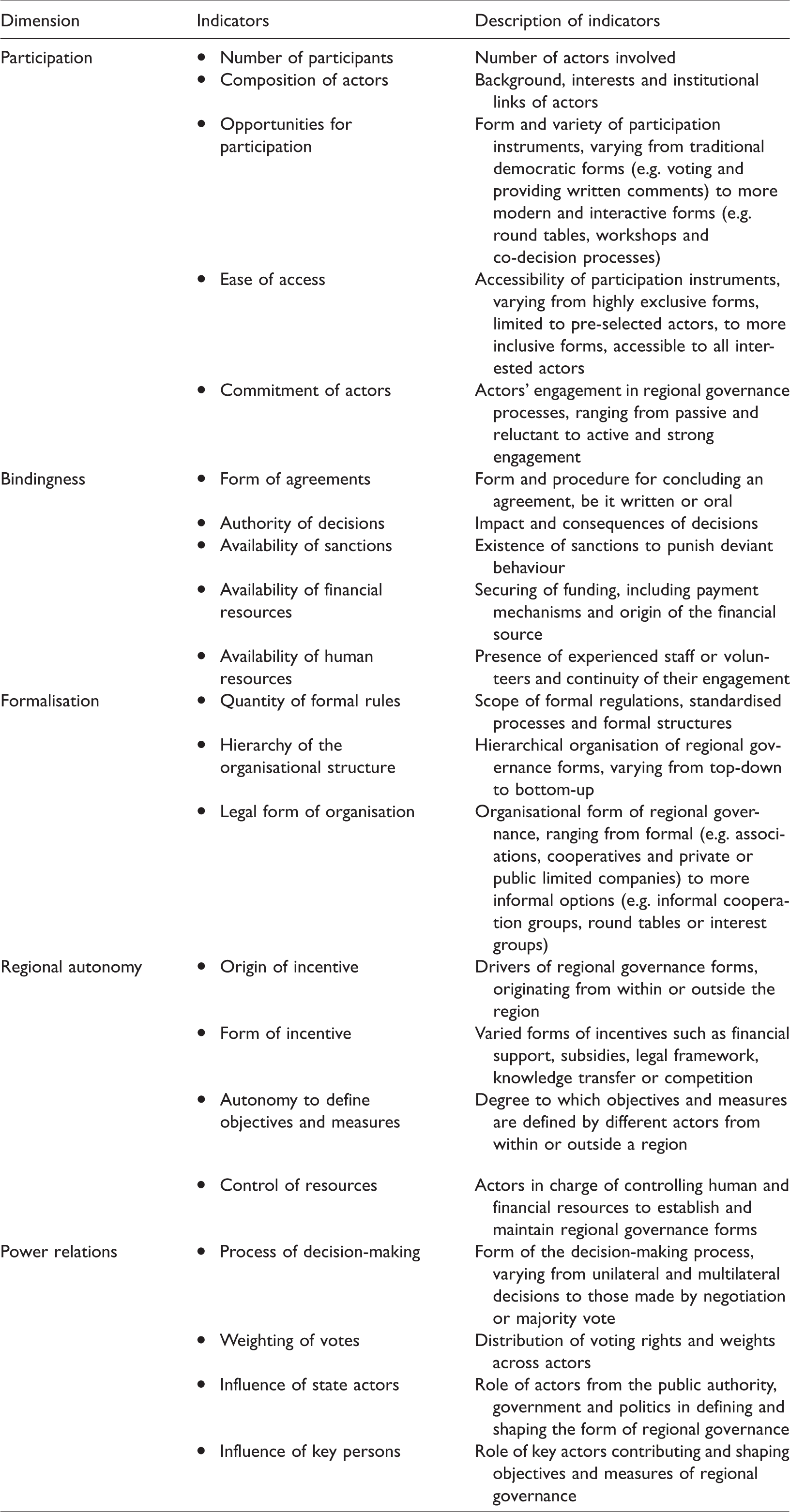
Based on the findings of the 1st Delphi round, we developed the following five preliminary dimensions of regional governance and proposed them to the Delphi experts in the 2nd round: (a) participation, (b) bindingness, (c) formalisation, (d) autonomy and (e) distribution of power (each dimension is explained in detail below). The dimensions were well received, as 77 percent of the practitioners and 81 percent of the researchers approved them. A few experts doubted if distribution of power, bindingness or autonomy were truly suitable for capturing regional governance. Alternatively, they proposed to replace these terms with actor resources, decision-making process or political legitimation. Additionally, the Delphi experts suggested an array of different dimensions which concerned the spectrum of actors and their behaviours (proposed dimensions: ‘actor integration’, ‘distribution of responsibilities among actors’ and ‘actor composition’), the transparency of processes and structures (proposed dimensions: ‘openness to different actors’ and ‘legitimation of decision-makers’), the availability of resources (proposed dimensions: ‘availability of financial resources’, ‘financial autonomy’ and ‘distribution and control of resources’) or the goal setting of regional development agencies (proposed dimensions: ‘defining the content of processes’, ‘developing strategic objectives’ and ‘thematic focus’). We agree that these suggestions are important for understanding and describing regional governance. We understand them, however, as descriptors of the dimensions rather than dimensions of regional governance themselves. Thus, based on the high agreement rates and on the critical feedback, we slightly adapted the preliminary dimensions to arrive at the final list of the five dimensions of regional governance:
Participation Bindingness Formalisation Regional autonomy Power relations
The dimension of Participation is strong if non-state actors are actively engaged in the different stages of a regional development process (e.g. conceptualisation, implementation, problem-solving). Participation is weak if these actors are only informed about the direction of a regional development process. (Practitioner, 2nd Delphi round) [Bindingness is strong] if there is a long-standing cooperation on the strategic level, not only on the project level. Normally, this requires a written contract of the cooperation and/or financial support. [Bindingness is weak] if cooperation is restricted to ad-hoc cooperation. (Practitioner, 2nd Delphi round) Regional governance is formalised if numerous rules and norms have to be met if projects or strategies for regional development are established. Informal regional governance is characterised by casual, non-conforming means of cooperation. (Researcher, 2nd Delphi round) Regional governance tends to be externally determined if activities and structures, and/or financing, are defined by a higher governmental level. […]. A region’s degree of self-determination is the higher extent to which, or the more independently that, a region can choose its [development] goals, the form of organisation and the sources of funding by itself. (Practitioner, 2nd Delphi round) Power relations depend on the origin and amount of resources as well as on the representation of actors and institutions in central decision-making bodies. Who is involved, and who has a right to dictate these decisions? (Researcher, 2nd Delphi round)
Indicators of the versatile and multidimensional framework of regional governance
Based on the results from the Delphi survey, we developed a set of indicators for each dimension. Taking the dimension of participation as an example, we asked the experts to define indicators which allow measuring different degrees of participation, such as regional governance forms with strong or weak participation. We repeated this procedure for all five dimensions and afterwards conducted a qualitative content analysis. We used the experts’ answers to inductively derive codes for possible indicators and to count their frequency. In the beginning, this resulted in 28 indicators, which we successively reduced to 21 – with 3–5 indicators for each dimension – by continuously adapting and refining the coding system. The final versatile and multidimensional framework to analyse regional governance is presented in Table 2.
Versatile and multidimensional framework to analyse regional governance.
Conclusion
In this paper, we have proposed a definition and framework for regional governance in an inductive fashion, incorporating the perspectives of practitioners and researchers. Through our research, we have arrived at a consolidated definition of regional governance as ‘the vertical and horizontal coordination of regional transformation processes beyond administrative boundaries by state and non-state actors’. Additionally, we have developed an analytical framework of regional governance comprising five key dimensions with 21 indicators.
Our framework differs in three main points from most other frameworks on regional governance (e.g. Deppisch, 2012; Foster and Barnes, 2012; Morrison, 2014; Mose et al., 2014). First, it exhibits a high degree of detail, as it proposes 21 specific indicators which have been operationalised for empirical research. In this regard, it goes beyond frameworks that offer fewer indicators to define dimensions of regional governance (Deppisch, 2012; Mose et al., 2014), develop quantitative indicators (Morrison, 2014) or propose a less detailed list of indicators (Ansell and Gash, 2007; Foster and Barnes, 2012). Second, unlike other frameworks, the incorporation of practical knowledge played an important role in our framework. This practical expertise helped us to balance academic reflections on regional governance and provided us with more pragmatic input on how regional governance structures and processes function in practice. As a consequence, our third distinction from other frameworks is the emphasis on dimensions and indicators, which is different from those frameworks relying on a deductive approach and predominantly on academic expertise (e.g. Foster and Barnes, 2012; Morrison, 2014). As a result, our framework exhibits dimensions and indicators which are practice-oriented and consider the reality of managing regional development processes on a daily basis. For example, our framework introduces the dimension of ‘regional autonomy’, reflecting the need to consider the level of autonomy of regional actors to define goals, strategies and measures of regional development processes, thus underlining the importance of being in control of resources. Similarly, the indicator ‘availability of sanctions’ reflects the practitioners’ experiences with unsatisfactory coordination processes when deviant behaviour cannot be penalised.
We identify three applications for our proposed framework: comparison, monitoring and the development of typologies. As for comparison, our framework can be used to compare regional governance forms in three ways. One way is to compare different regional governance forms across regions. Our multidimensional framework allows the complex, multilevel and multi-actor coordination of regional transformation to be empirically addressed by means of indicators; this allows the dimensions of regional governance and their interplay to be explored. The framework could be used to analyse in what respect regional development programmes (e.g. LEADER+) shape regional governance in different regions and how the emerging forms affect regional development. A second way of comparison is to select a single dimension and examine it across different regions and over time. For example, one could analyse the ways in which regional governance forms differ regarding their degrees of formalisation and how the different degrees correspond to their bindingness. It might be assumed that the more rules there are in force, the more binding the resulting cooperation. However, there might also be cases in which formal rules exist but their bindingness is considerably limited (e.g. countries with weak state institutions). A third means of comparison might be to focus on regions within federal states; this line of research has been developed based on the expertise of practitioners and researchers from the federal states of Switzerland and Germany.
Second, some of the 21 indicators could be used for monitoring and evaluation purposes, such as the indicators of ‘composition of actors’, the ‘availability of financial resources’ or the ‘legal form of organisation’. Typically, these indicators are available in mission reports, agreements or statutes of regional development agencies and, thus, can be gathered easily. Other indicators, such as the ‘commitment of actors’ or the ‘influence of state actors’, are more difficult to measure as they have to be acquired with the help of actors familiar with a region and its development and framework conditions. Furthermore, some of the proposed indicators could serve as a basis for developing the criteria for good regional governance, such as the indicators ‘ease of access’, ‘weighting of votes’ or ‘process of decision-making’, which could be utilised to address the inclusiveness of regional governance.
Third, future research should test our framework in a wider range of institutional contexts and government regimes. This could lead to the development of a typology of regional governance forms and their prevalence in different countries, with a much wider empirical base than we were able to provide in this article. The following research questions could be addressed: What types of regional governance seem to occur more often in what kinds of contexts? What are the strengths and weaknesses of these types of regional governance? How do different types of regional governance affect the outcomes of regional development? How can regional policy support ideal types of regional governance? The answers to these questions would provide deeper insight into the versatility and multidimensionality of regional governance and help to better understand the functions and mechanisms behind it.
Footnotes
Acknowledgements
An earlier version of this paper has been presented at the Regional Studies Association Annual Conference 2016 in Graz and we are grateful to the valuable comments of the participants. Also, we would like to thank the participants of the Delphi survey and of the focus group for their essential contribution. Finally, we thank Christoph Oberlack for his helpful comments on an early draft of the manuscript.
Declaration of conflicting interests
The author(s) declared no potential conflicts of interest with respect to the research, authorship, and/or publication of this article.
Funding
The author(s) disclosed receipt of the following financial support for the research, authorship, and/or publication of this article: Funding for this article has been received from the Swiss National Science Foundation (SNSF) under Grant number 10001A_152942/1.