




Abstract
While there is evidence that commons have the potential to counteract socio-spatial injustices unleashed by neoliberal and capitalist forms of urbanisation, less is known about how commons lead to emancipatory change. Anchored in dialectical social theory, this article explains commoning as a mechanism through which people reproduce/transform their structural context and agency, arguing that the potential for emancipation through commoning lies in the commoners’ ability to induce processes of structural/agential transformation. Empirically grounded in interviews with urban community gardeners in the City of Stockholm, Sweden, we show that collective gardening conceptualised as practice of commoning contributes to structural change in that female volunteer labour collectivises the mandate over municipally managed public space, transforming socio-spatial relations. Yet, garden commoning proves to reproduce structural whiteness and middle-class agency in public space, fails to establish autonomy from waged-labour relations, and is unable to abolish the separation from the sources of reproduction and subsistence.
Keywords
Introduction to dialectical theory, emancipation, and the new urban commons
Within the context of neoliberal and exchange value focused urbanisation, the urban commons are more and more discussed as contributing to just and democratic forms of social organisation (Dellenbaugh et al., 2015). The commons are advocated as a panacea for the ramifications of contemporary neoliberal and capitalist urbanism in which privatisation and enclosure of public land increasingly take place (Caffentzis, 2004; Caffentzis and Federici, 2014; Dardot and Laval, 2019; Hodkinson, 2012). As such, the commons are postulated to bring about emancipatory change, and a transformative relief from the social, material and cultural structures that cause oppressive urbanism. At the same time, urban commoning produces contradictions (cf. Bergame, N., forthcoming), such as the exacerbation of injustices (Barron, 2017; Ernwein, 2017; McClintock, 2014) and enclosures (Corbin, 2019; Ginn and Ascensão, 2018; Jeffrey et al., 2012).
One increasingly popular form of urban commoning is urban gardening (Camps-Calvet et al., 2015; Cangelosi, 2015; Ginn and Ascensão, 2018; Pikner et al., 2020; Rogge and Theesfeld, 2018; Thompson, 2015). As such, urban gardening receives attention as an emancipatory practice that ‘prepares the ground’ for claiming the right to the city (Follmann and Viehoff, 2015; Purcell and Tyman, 2015; Staeheli et al., 2002). This perspective suggests that gardening, as collective commoning practice, emancipates (Cumbers et al., 2018) and support urban residents’ claims to space (Ergenç and Çelik, 2021), democracy (De Angelis, 2017), participation, autonomy and appropriation of the urban (Ginn and Ascensão, 2018).
However, despite there being evidence that commons in the form of urban gardens work against socio-spatial injustices and for emancipatory change, less is known about how commoning does so. While the commons’ power to transform is described as arising from an “entangled process” (Apostolopoulou and Kotsila, 2021: 6), that acts as “assemblages of formal-informal practices […] bringing together resources, commoners and institutions” (Pikner et al., 2020: 714), or “ongoing practices of inventing and reinventing relational processes to govern the distribution of benefit and care between people, land and nature” (Ginn and Ascensão, 2018: 932), we find that explanations of how such structural and agential transformations arise from commoning remain underdeveloped. We agree here with Varvarousis (2018) that the academic debate on the commons is dominated by discussions around the normative aspects of the common (how the common should be), focussing less on the analytical and explanatory engagement with commons which would suggest explanations for how the common works to transform. With this, we aim to contribute to the subject of urban commons through an analysis framed “in the structure-agency debate” (Tornaghi, 2014: 562).
Against a deterministic view of the commons as a social form of organisation that by default generates progressive outcomes, this article asks how the emancipatory quality of commoning, and the practice's power to contribute to structural transformation and emancipation of agency, can be explained. In the quest for an answer, this article is grounded in the dialectical social theory by Archer (1995). Deployed in this research, we suggest that the commons’ outcome and emancipatory quality is contingent upon its conditioning structural environment as well as the agency of its actors (the commoners). This dialectical view on the commons acknowledges that emancipation depends upon the capacity of commoners to transform their structural environment to their benefit, while their structural environment is recognised as conditioning their agency in doing so. This means for example that for the practice of commoning to exist, it needs to be possible for people to reproduce collective social relations. The argument for a dialectical perspective is built on the assumption that affordances to action are linked to their structural context. “[I]gnoring these structures and acting in a voluntaristic way – that is, acting as though a dysfunctional society can be immediately changed into a utopian one simply by changing our present human activity – leads to failure” (Price, 2020: 208). This is also reflected in Marx's popular quote that “[m]en make their own history, but they do not make it as they please; they do not make it under circumstances chosen by themselves, but under circumstances directly encountered, given and transmitted from the past” (Marx, 1852: 9), hinting at the structural impediment agency encounters. But importantly, while structures are relevant for conditioning social action, it is through social action and practice that structural context is reproduced or transformed, and social change takes place (Archer, 1995; Castells, 1983).
To illustrate the explanatory power of a dialectical method, this article analyses seven cases of urban gardening, a practice that, in its new and collectivised form located in public space is experiencing an upswing in the City of Stockholm over the past decade. The collective practice of urban gardening will be understood as a concrete example of the practice of commoning, a practice able to change social relations whose result is not only the spatial appropriation of a commoned garden space in public space but a community of commoners too. Herein, in the conceptualisation of the commons and its practice the commoning as a mechanism for transforming social (Caffentzis and Federici, 2014) and socio-spatial relations (Bresnihan and Byrne, 2015; Jeffrey et al., 2012; Noterman, 2016; Rosol, 2012), this article develops its argument.
A dialectical perspective to explain the emancipatory capacity of commoning
Moving away from an understanding of the commons as something that can be found ‘out there’ (e.g. natural ‘resources’ such as the air, oceans and land) more recent commons theory asks instead for a conceptualisation of the commons as a product of its relations and the practice of commoning underlying them (Bollier, 2014; Caffentzis and Federici, 2014; Dardot and Laval, 2019; Fournier, 2013; Harvey, 2012; Linebaugh, 2008; Turner, 2017). Dardot and Laval (2019) suggest re-conceptualising the term commons itself, moving from the indefinite ‘commons’ in the plural form to the definite ‘common’ in the singular, where the focus of the latter lies on the processes and relations producing the common. This turn in commons theory has arguably opened up for analysing power relations (Dardot and Laval, 2019; Euler, 2018) as the focus is shifted on the relations underlying the common.
If power is the ability to affect change and achieve a purpose, using Martin Luther King's definition of power, then research on emancipation and the transformation of power must be able to analyse how a change in power relations comes about. A change in social relations, such as power relations, is an outcome that according to sociologist Archer (1995) comes about through the dialectic between structures and agency. In geographical research too, the causal locus of social change has been explained by the relation between structure and agency (Chouinard, 1997). Their dialectic and mutual determination or primacy over each other have since long caused disagreement (ibid), not the least in the literature on critical urban geography (Tornaghi, 2014). From Archer's perspective, a critique of Giddens structuration theory, neither structure nor agency is granted ultimate causal primacy (it is not only agency or not only structures that determine the outcome of the other), but rather, both condition each other. Where more recent theorisation on change dissolves the binary of structure and agency (such as Actor-Network Theory), Archer's theory of the morphogenetic approach (1995) is based on the analytical separation of structures from agency to understand their conditioning effects upon each other over time. The analytical separation is relevant also for the study of power as structures affect people and their actions differently: while some structures may be elaborated by a social group for increasing their own privilege, the same structures can affect another social group in detrimental ways (Jessop, 2005). Meaning, the ability to affect change in a certain situation is different for different people, depending on their position in the structural context and their agency to change this context to their interests and chances in life (Archer, 1995).
Based on the argument by Dardot and Laval (2019) and Euler (2018), that the newer focus of commons theory on the practice of commoning allows for the inquiry of relations, we argue that research on the outcome or effect of the common for those involved (and those excluded) needs to link the structural context in which the commoning takes place with the commoners’ agency and ability to take action within that structural context.
Structural conditioning
In their function as socially-produced structures, space (Massey, 1994; Soja, 1989), commons (Helfrich and Bollier, 2015) or community as a “system of human relations among social positions” (Porpora, 1989), “emerge from the actions of individuals” (Finn, 2020: 29). This perspective is different from a view on structures such as space as a “passive backdrop for mediating social relations” (Cumbers et al., 2018). Together with social structures that are socially dependent, material structures such as the material characteristics of urban space (e.g. soil quality), impose “restrictions, opportunities, and incentives” (Finn, 2020: 29) “upon the projects to be conceived, entertained and sustained within a given social environment” (Archer, 1995: 200). The sustenance of a commoned garden is thus conditioned by its structural context, shaped by its time and geography. Already existing structures such as the socio-cultural concept of public space, gender and class relations imbued in the current zeitgeist, therefore, impinge on the agential leeway available for people. Also within feminist theory, the efficacy of practices through which structures are elaborated and possibly transformed is understood as being conditioned by a “context of wider social forces” (Holloway et al., 2019: 464; cf. Massey, 1994). Yet, at the same time, material and social structures can be transformed through local and spatial practices such as commoning. Through the agency of people, structural relations are elaborated – reproduced or transformed – whose result again functions as a conditioning structure to further action. The socio-spatial structures impinging upon collective use-value based projects such as urban gardening as commoning practice are often contradicting structures (cf. Bergame, N., forthcoming) as for example the neoliberal and capitalist development of urban space in which privatisation and commercialisation are in focus. Those systems affect social organising in that they for example withdraw temporal resources from people (due to focus on waged exchanged-value based labour) for collective use-value based labour (cf. Follmann and Viehoff, 2015; Rosol, 2010), or decrease social cohesion and kinship and increase class antagonisms (cf. Polanyi, 1944: 171).
Agential elaboration
Based on the assumption that “structure necessarily predates the action(s) which transform it” (Archer, 1995: 138), practice as an expression of agency is the mechanism through which structures can be transformed or reproduced (Archer, 1995). In this research, gardening in common is conceptualised as the mechanism through which the agential elaboration of structures takes place. From a dialectical perspective, it is by that very process of agential elaboration that we not only change or reproduce structures but at the same time “we change ourselves by changing our world and vice versa” (Harvey, 2003: 939 on Marx). This research conceptualises urban gardens as spaces in which residents enact collective agency, as “context for social transformation” (Holloway et al., 2019: 466), where residents elaborate on social relations such as property, class and gender relations imbued in public green space, and become. De Angelis (2017) and Stavrides (2016) claim for example that through the practice of commoning that works counter to capitalist structures, those engaged in the commoning take on commoner subjectivities (Barron, 2017; Jeffrey et al., 2012; Noterman, 2016) while they at the same time transform capitalist relations.
Due to the structural conditioning of people, such as class and gender relations, people have “differential capacities […] to change different structures by acting in one way rather than another” (Jessop, 2005: 45). The same practice of gardening, as a mechanism for enacting one's agency, will thus have different outcomes for different people and different places.
While acknowledging that also non-human processes act as a mechanism through which structural elaboration can take place, this article focuses on the interpretation and engagement of human agency of structures through the practice of commoning.
Emancipatory or not? Normative engagements
Based on the preceding paragraphs, this article suggests that a dialectical perspective between structure and agency provides an explanatory framework for how change, transformation, or for that matter the reproduction of status quo, in society take place. Nevertheless, while dialectics offer a way of thinking about the process of change or stasis, aiming to bring “into focus the full range of changes and interactions that occur in the world” (Ollman, 2003: 12), dialectics lack normative grounds for the analysis of the quality of changes. This means that only through normative analytical engagements can questions be answered about for whose benefit structures are transformed, who in the process gains power, and whose agency is oppressed.
The research project of making judgements of the quality of change brought through commoning to different groups in society and the effects on their agency comes with the risk of only judging qualitative changes from the perspective of us researchers with our particular positionalities. Thus, this article makes use of normative aspects that are considered emancipatory by a greater intellectual canon on emancipation, commons and justice, while being cognisant of the ignorance of marginalised voices that are excluded from the canon. Thereby, this article leans on a range of normative aspects used by researchers to explain the power of the commons: Scholars suggest for example that the common works in an emancipatory way because it establishes collective social relations as opposed to increasing neoliberal individualisation (Caffentzis and Federici, 2014; Castells, 1983) beyond state and private institutions (Dardot and Laval, 2019). Furthermore, scholars argue that commons develop institutional autonomy from private and state institutions (Bollier and Helfrich, 2012; Ginn and Ascensão, 2018), closely linked to the concept of self-determination and autonomy (Euler, 2016). And, commoning is a mechanism to reverse the separation of people from their means of production (Fournier, 2013), such as land on which people regain the “means and capacity to reproduce ourselves from natural resources” (ibid: 450).
Due to the limited scope of this article, and based on the above, in the following we will engage in firstly, (i) a discussion on the ability of people to unite in a common cause and build collective social relations, secondly, (ii) an inquiry into the extent to which commoners can act in autonomy or develop autonomy alongside state-related institutions and thirdly, (iii) explore the commons’ power to contribute to the distribution of spatial resources. Those will frame the analysis and divide the result chapter into the sections (i) collectivity, (ii) autonomy and (iii) (re)distribution of spatial resources.
The new urban gardening in the City of Stockholm
Similar to most cities, gardening has always been part of the mosaic of land uses in the City of Stockholm, with vegetable gardens as part of the former royal parks and more than 100 years of allotment gardening, which has its foundation in working-class culture (Barthel et al., 2010; Nolin, 2003). Despite the incredibly strong interest and long queues (up to decades) to secure a plot (around 10,000 people are on waiting lists), the most recent allotment garden establishment in the City of Stockholm dates back to 2002 and since then very little has been done at the city level for developing allotment gardens (Tonström, 2020). At the same time, urbanisation by infill densification reduces the number and size of public green spaces (Colding et al., 2020; Furberg, 2019) and the remaining land becomes increasingly the centre of debate for meeting the diverse needs and claims from different interests, including those of gardening.
As a case, the Swedish context proves to be interesting because of its extremely decentralised governance system, with localised land-use decision processes (Nilsson and Forsell, 2013) and its long-term tradition of civic engagement in the form of associations that represent the people in participatory processes (von Essen et al., 2015), such as land-use planning. In Sweden, there has also been a strong focus on integrating ‘democracy’ albeit variegated in its meaning and actual realisation (Zakhour, 2020). In this context, the City of Stockholm is following the trend seen in many other cities around the world, with the establishment of new forms of urban gardening (Bonow and Normark, 2017), such as community-based and resident managed gardening in public green spaces. Since the late 2010s, upon the commission of politicians, Stockholm's City District Administrations (CDA henceforth) have been encouraging resident-managed and non-commercial urban gardening in public spaces, predominantly on public green spaces, and under a precarious tenure agreement free of charge. While the CDAs reserve themselves the right to revoke the agreement with one month's notice, the historical allotment garden associations enjoy tenure agreements of around 25 years.
The geographical (available public space) and socio-demographic conditions differ in the different districts, as well as the inclination of the different CDAs to take initiative and make an effort to encourage and support urban gardening (Bonow et al., 2020) – such as providing the associations with a “starter kit”, including raised beds in wooden boxes and organically certified soil. While the official requirement from the City of Stockholm has been that interested residents need to organise collectively to tenure public land, a recently introduced bill by the City of Stockholm, valid during the summer of 2021, opened up for the possibility to tenure up to 6 square metres of public land for the cultivation of edibles, without the need to act as an association (Dagens Nyheter, 2021). To the surprise of many, this offer was not taken up by a single resident in 2021 (ibid).
Among those engaged, certain class, gender and race aspects are overrepresented. As expressed by those interviewed in this study, the middle class are in the majority of those partaking in gardening, even in districts with a lower average income. When asked about the socio-demographics of their members, the garden associations’ board members replied that they comprise “mostly [of people from the] middle class”, “more people from the inner city districts and middle class“, “last year we had mostly people from the middle class”, “I guess middle class and maybe some from the working class”. Those replies reflect the situation in both high income and lower-income city districts, with average incomes varying between 250,000 SEK–410,000 SEK/year (City of Stockholm, 2018, 2020) in a city where the average income of all city districts is 390,000 SEK/year (City of Stockholm, 2018, 2020).
Additionally, associations showed to represent very few non-whites: Board members replied to the question of the whiteness of their gardens that “in the past years we did not have so many non-whites [in the association]” (among 40 members), “one person from Bangladesh.” (of 5 active members), “White women born in Sweden are entirely predominating [the members of the association] […] one BIPOC [Black, Indigenous, and People of Colour]” (among 43 members), “only a few individuals who can classify other than Caucasian” (among 7 members), “Most members are Swedes, but also many Europeans and one American. […] one Chinese family” (among 35 members). One interviewed board member described that they had made efforts “for a collaboration with newly immigrated people within the district, to welcome them into our association, they visited a few times, but nobody ended up being a member”. Other board members expressed that they too had tried to engage immigrants but without success in the long term. One gardener explained that “one of our oldest members who technically is the only non-white, thought that it was quite troublesome that there were all these [white] people taking up a lot of space and talking all the time […] [inviting this non-white gardener into their space only on the basis that this gardener] will come and play by our rules”, pointing out the ways in which others’ agency conditions social structures in which not everybody felt comfortable and empowered to take action. According to the critical work by Arora-Jonsson and Ågren (2019) on Swedish environmental organisations, “being non-white [out of doors] in nature” is an act that “disrupts mainstream ideas” of Swedes about nature in Sweden, a context in which “nature is bound inextricably with a particular understanding of (white) Swedishness.” (Arora-Jonsson and Ågren, 2019: 891).
Inquiry of structural and agential changes through semi-structured interviews
For this study, seven urban gardening initiatives based in the thirteen different administrative districts of the City of Stockholm were selected. The selection was based on the grounds of several aspects: the non-commodified/non-commercial and use-value based form of the initiatives, based on the labour and management of local volunteering residents organised in associations forming communities, the gardens being located on public land, and the initiatives’ start of operation between 2008 and 2018 and continuous cultivation efforts during the study period March 2020 – February 2021. Official statistical documents and digital maps were consulted to collect data on garden size and location, as well as socio-demographics such as average income and countries of origin, aiding the selection of the initiatives. While the selected initiatives differ as regards their physical size, the number of members, and type of cultivation (in soil, in raised wooden boxes), the selected gardens include both well-known (to the public and researchers) and less well-known examples. Additionally, they are located both in the more built-up, higher income and more central city districts with less public green space and those city districts that offer relatively more green space, located in the outskirts, representing residents with lesser income. This selection aimed to represent the different configurations of urban community gardens in the City of Stockholm.
To study commoning in the form of urban gardening and its capacity for structural transformation, a mixed methodology featuring predominantly semi-structured interviews was chosen. In total, 18 interviews were conducted with gardeners from the selected gardening initiatives as well as key informants with experience from this type of gardening initiatives in the City of Stockholm. Additionally, five out of seven gardens were visited during mid-day on weekdays for on-site observations that served to increase an understanding of the physical surroundings and the spaces’ actual uses by passersby.
The semi-structured interviews were conducted with active board members of the gardening initiatives and asked about the circumstances and conditions under which gardeners operate, as well as the changes in social and material structures that took or take place through their actions. Due to the onset of the corona pandemic, every interview, apart from one, took place online, lasted between 60–150 min and was recorded and subsequently transcribed. The aim was to gain an understanding of their particular garden as well as how they as community gardeners had established collective social relations and had taken part in the distribution of power over spatial resources such as public land. The interviews also covered aspects of gardeners’ agency for autonomous action, related to the mandate they received when they signed the tenancy agreement for public land. Despite the interviews asking about a wider set of aspects of emancipation (such as those mentioned in the section on emancipatory ideals above), the aspects of collectivity, autonomy, as well as access to the public space were recurring themes, reinforcing their relevance as analytical axioms for the analysis in this article.
Results from analysing dialectical relationships: collectivity, autonomy, and redistribution of resources through gardening in common
Collectivity through association-based gardening
Residents in the City of Stockholm who want to tenure public land for gardening purposes are typically asked by the City District Administration to form an official civic association. Albeit this official requirement, findings from interviews showed that not all initiatives are organised as an officially registered association any longer; while they started as an association, some do meanwhile organise themselves as a community through their respective (open or closed to the public) Facebook groups solely, without following formal rules of keeping protocols during their meetings. Yet, all of them described being in good contact with their respective City District Administrations.
As other scholars have described in their studies on community gardens (Cumbers et al., 2018), the urban gardeners in the City of Stockholm draw upon resources collectively to different extents. Using the categorisation of collectivity in urban garden communities by Rogge and Theesfeld (2018), interviews and observations showed that gardeners use collectively the ‘resource system’ of public spaces as well as beds and plants, the ‘infrastructure’ of a common tool shed, furniture and water connection, the ‘resource units’ of tools, soil, compost, seeds, financial means, the labour (‘work’) of planting and weeding, watering, organisation and cleaning-up, as well as the time spent together (‘social time’) where they consume the harvest collectively or organise cultural events.
Those initiatives that use the beds or soil collectively meet once to twice a week for collective gardening activities (planting, weeding, watering), workshops, or harvesting, while members at the same time also frequent the gardens on their own to do some weeding or harvest greens by themselves. One gardener mentioned that they choose plants that are easily shared, excluding for example pumpkin or cabbage as they are more difficult to be shared by many. On-site observations gave additional insights about the collectivity of the garden: some gardens had plants of the same sort occupying whole (raised) beds, such as kale, leading one to the assumption that the kale is of communal nature – presuming that one person would not be interested in only cultivating kale.
Where single beds featured several varieties of plants, often crammed, one could assume that the bed belongs to one single individual or household, aiming to maximise the variety of plants that can be cultivated in the small space. Nonetheless, gardeners who cultivated, organised and weeded ‘their’ plants in their individually allocated raised beds were still connected to the group of gardeners, using common tools, tool-shed, furniture (garden chairs, tables), and paying fees to purchase water from a nearby water source, or taking part in a harvest gathering or clean-up day. In those more individualised garden spaces, gardeners explained that members remain in their individual spaces albeit they garden in shared spaces, questioning the extent to which collective social relations are formed in this particular garden. This, they explained, is among others due to the different lifestyles of the members making it difficult to gather as a collective at the same time of the day or week. Gardeners from the individualised gardens reported nonetheless that the social relations from the gardening go beyond the actual site (the garden), with gardeners becoming better connected in their neighbourhood, transforming individual social relations into collective ones even beyond the site of the garden. One gardener mentioned that they recognised members now when doing groceries, leading to a feeling of belonging to the neighbourhood. Another gardener mentioned that they had designed their association documents in such a way that they can be shared and distributed to other associations who are in the start-up phase.
As interviews showed, networking with other commoned gardens remained rather the exemption: one commoned garden established sister gardens in other city districts, carrying the same name and also to some extent engaging the same members. Albeit many interviewees said that it would be interesting to meet other gardeners from other gardens in Stockholm, the majority of the gardens remain disconnected, without the gardeners from different initiatives having contact with each other. Ghose and Pettygrove (2014: 94) might offer an explanation for the lack of networks of gardens by claiming that “[n]etwork development is a strategy often employed by marginalised actors, or actors experiencing barriers, to navigate constraints and leverage power”, features that might not be prevailing among the middle-class.
Gardening in common in public space seems to attract a certain type of people, namely, as one gardener stated, “those that are engaged [in the gardening] do it with a collective ambition”, reflecting what other gardeners expressed during interviews. The collective character of urban gardening was described by the interviewees as advantageous for several different reasons: interviewees expressed that being part of a collective allows them to be engaged to different extents in the community, benefit from other members’ gardening knowledge and technical skills as well as time and effort. One interviewee noted: “It makes it [gardening] easier. It [the collective character of the garden] makes it possible for many more to cultivate food because one does not need to be present throughout the whole season […] So there is always someone who can water [the plants]. And one can be part of [everyone's] knowledge because everyone knows different things.”. The practical relevance of being a ‘We’ was also mentioned by one gardener who claimed that “It's good to be [organised as]an association because it is a familiar type [of organisation] in negotiation processes” in Sweden, adding that it works “exactly like an architecture qualification, it opens doors”. In that sense, independent of the extent to which collective social relations are formed in the different associations, the associational foundation of the practice provides “a platform” of spatial and social character as one interviewee claimed. This structure, the platform of the garden, conditions the actions of those in relation to it and through this structure, goals can be pursued and collective power enacted.
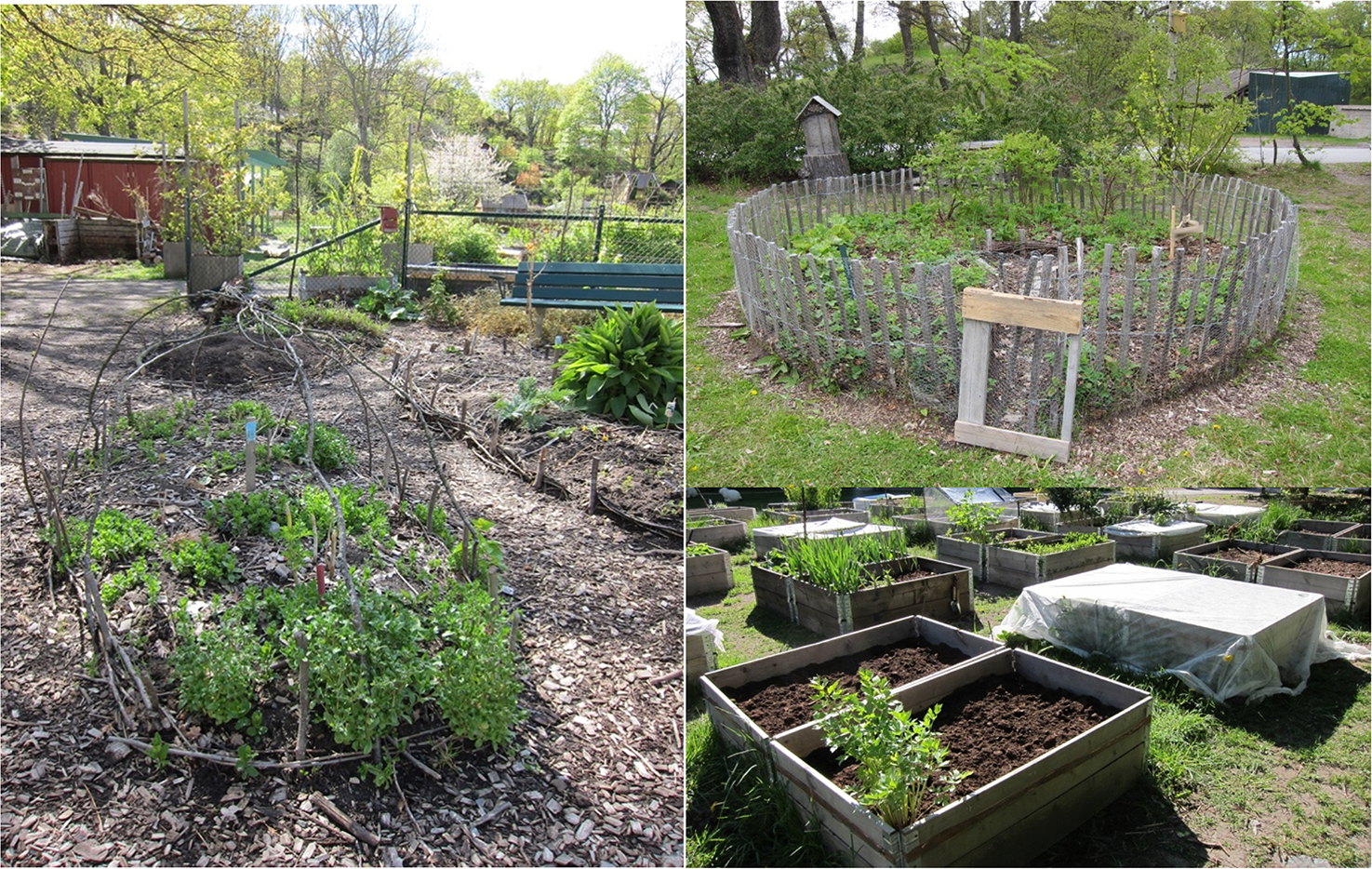 Different configurations of urban gardening in the public realm in the City of Stockholm. left: in soil cultivation; upper right: in soil cultivation; right below: heightened beds in wooden boxes. Source: Authors own pictures from 2020.
Through the collective efforts of the gardeners, the fruits are thus not only edible produce but also the socially produced structure of a commoned garden, a platform which, as Federici (2010: 288) holds, provides the “material means of reproduction […] by which collective interest and mutual bonds are created”. The collective efforts produce thus what officials from the City District Administrations described as “a social organisation […] the social part is big in these gardens”. Despite the commoned urban gardens acting as social organisations and association-based spaces, interviews with gardeners showed that collective relations are not formed automatically. Among others, gardeners mentioned that it takes a lot of effort to maintain collective social relations. These efforts are not only of physical and temporal nature but arise also due to the differences of perspectives, experiences and motivations of the gardeners. In that vein, Blaser and De La Cadena (2017) refer to the concept of the ‘uncommons’ that undergird the commons, referring to among others the differences and divergences of those engaged, and the challenges of gathering them in common action. De Angelis (2017) sees the commons as particularly able to maintain social complexity and difference, leading to the democratic representation of differences. Gardeners in this research mentioned that the ‘uncommon’ of their work was because “some people are intense”, that “we people misunderstand each other, especially when we have not had the chance to get to know each other so well”, or that it is a challenge to “synchronise different expectations. Cooperation, who is doing what, when and how.”. If Massey (1994) is right when saying that “[w]e can only build unity if we have the confidence to face diversity” (142), the quality of the commons depends also upon the capacity of those involved in overcoming differences and live with conflict and contradiction, and, possibly instil a transformation of their subjectivity, becoming a “common subject” (Federici, 2014: 229).
Beyond the group of middle-class and white people being overrepresented in these new urban gardens, this study showed also that it is mostly women that are drawn to take part in commoning efforts, pointing at the intersectionality of urban gardening in the City of Stockholm: among the associations, interviewees responded that their members comprise of “predominantly middle-aged women”, “almost only women”, “17 men and 36 women”, or “we are 99% women”. This pattern was reflected among board members of the associations as well. Not only seem social collective relations to be promoted among particularly women on public land, but the strong presence of them in these initiatives suggests that women contribute relatively more to the transformation of urban public space, their agency and related social structures. In this context, women's bodily labour in urban public space seems to establish socio-spatial relations that in the context of Stockholm transforms the gender structure of public space, from a historically male domain focused on exchange-value and processes of production (cf. Gillian, 1993; Massey, 1994; Wilson, 1991) to a realm of use-value, and reproduction; bringing social reproduction and care from the private to the public realm. Even though gender relations are ever-changing and women have since long been able to “entry into another, public, world – ‘a life not defined by family and husband’” (Massey, 1994: 180), the collective nature of practices of cultivating food and community in the public reminds of historical gender relations before the witch-hunt in the Middle Ages, a time during which as Federici (2004) holds, the structure of the ‘common woman’ existed.
The autonomy of gardeners on public land
Because emancipation is not only linked to the individual's “capacity to realise collective action” (Archer, 2004: 11), as analysed above, but also to people's “capacity for autonomous action” (Alsop et al., 2006: 50) this section analyses how gardening in common leads to structures of autonomy.
A theme that reccurred in questions on autonomy in interviews was the gardeners’ precarious tenure agreements and their consequences on their operations. Gardeners expressed that they hoped to remain on-site as long as possible without knowing how long they really would be able to stay. Even though one could readily assume and concur with the finding by Ghose and Pettygrove (2014: 101) that “groups must maintain positive relationships with the city because a community on a vacant lot has no tenure security”, many interviewed gardeners expressed that it is easy to maintain a positive relationship to the CDA and no one was overly concerned about the case in which their garden would have to move. The interviewed gardeners expressed that they felt that they contributed to the city in that they planted edibles and flowers and that their garden is a valuable infrastructure that they believed the CDA would find worthwhile keeping. However, in two particular cases of gardens based on raised beds in the City of Stockholm, the interviewed gardeners reported that they had to move around several times over recent years. In one case this was caused by a change of plans for the area and in the other case, the garden was moved to make room for a public toilet.
Although the gardeners are technically dependent upon the doings and approval of the CDAs, the CDAs themselves appear to have little capacity for overseeing the gardeners’ activities in practice. As one city official mentioned, supporting the gardens “is a very small part of our operations […] there is not much money [in the budget for supporting the urban gardening initiatives] […] there is so much other [work to do] in the parks. […] it is difficult to have time”. Meaning, while gardeners need to abide by the requirements and rules set by the CDA, “there is no one that really cares [about what we do on the garden plot] for better or worse” one gardener claimed. The gardeners stated that they had contact with their CDA relatively seldomly, especially when the garden has been existing for several years. On the other hand, gardeners make use of financial, technical, and infrastructural support from the CDA and this leads to a situation that one gardener described as “a balance between one wanting to have support and security from the city district but also wanting to be able to do as one likes”. Other commonly mentioned examples were that the CDA took care of (expensive) toxicological testing of the soil prior to the establishment of the gardening associations and that the CDA helped them with providing soil or raised wooden boxes. Through the tenure of public land, associations seem to assume a position in the City of Stockholm that awards them the duty to manage public spaces for the urban populace similar to the managing role of the CDA albeit without the same political power and responsibility, and therefore ultimately epitomising contemporary rollback public management (cf. Rosol, 2012).
During the global covid-19 pandemic the power the CDA holds became evident: The CDA revoked tenure agreements from all collective gardens within one city district not part of this study, due to lack of distance between the raised beds which made it impossible to safely keep a distance of at least two metres. This revealed the power and responsibility the CDAs hold despite their ambitions to “develop democracy in some way […][where] it becomes us together […] so that it is not us and them […] the parks are undeniably ours and … one [the residents] can be part of taking care of them” as one CDA official put it.
Despite the fact that the studied associations in this research are affected by the power the CDA hold through their mandate as public space administrators and managers, the interviews showed also that the garden associations deal with conflicts within the collective or related to it to a great extent autonomously. As one gardener explained, their association had excluded one member whose actions resulted in too much of an unsafe environment or as one interviewee put it, “created too much insecurity”. Another interviewee discussed a situation where their association decided to demarcate their commoned garden with stones to respond to the experienced trespassing by guerrilla gardeners who placed wooden boxes adjacent to the garden as well as people, non-members of the garden, who parked their bicycles in the garden. At the same time, both interviewees referred to the importance of keeping the gardens open for everyone, recognising the responsibility and public role they assume when tenuring public land. And yet another gardener described the dilemma faced when saying that “we know that it is stated in the tenure agreement that we are not allowed to enclose [and fence public land]. […] [at the same time] this can suck sometimes when children run right over [the plant bed]”. As such, the activities of the gardeners involved in gardening and their agency are conditioned according to ‘official rules of conduct’ and present thus an ordered way of allowing residents to use public land.
Beyond the autonomy in relation to the CDA, interviews showed that urban gardening can in its current form not be used to provide subsistence (food and financial resources) for those engaged. This is different to the role commons played historically; arable land and forest which were used for subsistence, particularly by the unlanded class amongst which many women and the poor resided (Federici, 2004). Among those interviewed, no one but one person could make a living out of their collective gardening efforts. Gardening in this context becomes thus not a practice that re-establishes access to factors of production and reproduction, but rather, as gardeners and key informants said, the majority of those engaged are fully employed and do the gardening as their leisure time activity. And, when asked how much of the food consumed by the gardeners comprises of the produce cultivated in the commoned gardens, the response by the gardeners was always that it is a very marginal part of their food consumption. Gardeners thus depend still heavily on an agri-food system located outside of the urban realm. At the same time, gardeners showed increased interest in cultivating heirloom varieties that cannot be bought at the local supermarket or planted varieties that were expensive to buy, assuming autonomy from the perils of industrial food norms and its standardised crops to some extent.
Also, for autonomous gardening activities to take place, gardeners would need to engage in composting and processes of cultivating soil, as well as harvest and reproduce seeds for future cultivation. Observations showed that albeit the CDAs officially do not allow composting on-site, most gardens have some kind of composting space in their gardens, reducing the need for the import and purchase of new soil from outside of the garden. Among those interviewed, seeds for annual plants were purchased while many gardens feature perennials (like herbs, flowers, rhubarb and berry bushes), plants that can be cultivated for many years or as long as the garden exists, increasing autonomy from seed companies.
Redistribution of spatial resources
Analysing the distribution of resources more generally is according to Archer (1995) “of greatest importance [… ] since all methods for promoting change or protecting stability, depend upon the use of resources” Archer (1995: 298). This means that those that have access to resources can take part in the processes of change and emancipation, or ensuring the maintenance of the status quo, or staying in power (Archer, 1995). Those that have little access to the resources needed to emancipate themselves “will be in the weakest bargaining position” while those “with high access to all resources will be in the best bargaining position. Therefore, it is groups in the latter position who will tend to be responsible for the majority of changes”, that is those that already hold power in society (Archer, 1995: 300). Space and its distribution are according to Dikeç (2015: 3) the vantage points from which people seek “alternative distributions or organisations”. Changes in the distribution of spatial resources, such as green spaces, or power over them, have been and are the matter of the subject of analyses of environmental justice (e.g. Rawls, 1971). According to Tornaghi (2014: 553), the “analysis of the specific geography of urban food cultivation and its relations with the politics of space is still a neglected field of human and urban geography” which this section aims at giving attention to.
Premised upon the material grounding of urban space in land, space as a resource is not only made scarce within capitalism, physical urban space is also finite. Therefore, space takes on a special role in society: as Rancière (2003: 201) remarks, “[i]n the end, everything in politics turns on the distribution of spaces. […] Who can occupy them?” Space is however not only material, but it is also “a product of social relations, rather than an inert background for them […] a product of interrelationships always in the making” (Dikeç, 2015: 3). In this vein, this research conceptualises commoned gardens, as “articulation of social relations which necessarily have a spatial form in their interactions with one another “ (Massey, 1994: 120), thereby concurring with Barron (2017) and Nettle (2010) who view commoned gardens as “social product” (Barron, 2017: 1143) based on “a form of social action tied to the production of space” (Nettle, 2010: 104).
Officials from the CDAs explained in interviews that this new form of urban gardening provides citizens “with the opportunity to … develop […] parks and be part of contributing to them. […] that one feels responsible for their closest environment”. Through the tenure, gardening associations come closer to a position in which they have deciding power over public space, and ultimately the right to enclose that space and transform its spatial relations. The spatial character of commoning land for cultivating food is also relevant in the face of the sentiment of one gardener who, as an urban resident within a modern society based on industrial capitalism and the international division of labour, expressed that “I am technically landless”. Transferring rights to land for the cultivation of food changes then also the relations of production, giving access to factors of production to those that can gain access to the land through tenure agreements.
As mentioned in the introduction of the case of urban gardening in the City of Stockholm, the agential capacity to tenure urban land for food cultivation purposes is not distributed equally among the urban populace. And, the extent to which property relations are transformed through gardening is rather marginal: our calculations based on data from the CDA and statements by CDA officials showed that less than 2% of the total available public park space in the City of Stockholm is redistributed through the tenure agreements. As of 2020, approximately 140 urban gardening initiatives in the City of Stockholm are organised in public space, deploying the labour of between 2 and 50 people per initiative on a voluntary basis.
Demailly and Darly (2017: 339) stress in their study on Paris that “the right to access and use permanently the land is on the top of the list of requests claimed by gardeners”. Among the studied gardens, all associations enjoy extended tenure agreements for public space lasting more than two years and in three cases over ten years. One of the studied associations had to move in the past and has today reduced its size and relocated to a spot in close proximity to the original location. This suggests that the gardeners transform property relations of urban spaces on a relatively long-term basis from formerly public, municipally-managed to collectively managed, use-value based space. Taking into account the efforts and labour hours used for organising the gardening activities, some gardeners stated that they would defend that right in the event that the CDA revoked their contract: one interviewee from an association whose garden had not, as of now, needed to move, responded that they would ask for an alternative garden space if the CDA requested back the land the garden association is currently cultivating food on.
While interviews showed that a change in ownership of public land from the CDA to civic associations through the tenure did not take place, the responsibility to manage public urban space evoked in many gardeners a sense of pride; some talked about the gardens as their second homes outdoors, their little paradise in the middle of the city. At the same time, some gardeners reflected critically upon their right to be the one among those in society who gets the right to use public space for the cultivation and consumption of produce. A right that, as one gardener stated, might have probably better served a homeless person. But the transferral of rights to use has also led to negative feelings among other locals who, as one gardener described, “were very upset over the fact that we took over this piece of land”. Another interviewee reported that “there is a problem with this possibility to affect one's local environment and that is [the question of who is] to decide about [what should be done with] it”.
Access to this local decision-making power, through the platform of the gardening association, comes through membership which is connected to membership fees. Members pay a yearly fee (between 100 and 300 SEK, approximately 11–33 US$) which is used to purchase seeds and other materials needed for the garden. In this sense, gardening in public spaces can transform the relations to space from a non-membership use of public space (as access to public space is intended to be open to everyone) to a membership-based public space. This can contribute to a process of clubification of the public realm (cf. de Magalhaes and Freire Trigo, 2017), transforming the structure of public space into one that requires a different agential capacity from residents, one that attracts people who are capable of gardening collectively. A few interviewees strongly felt that because of the public nature of the garden it was not only access to the garden that should be free to non-members, harvesting by passersby should also be welcomed, regardless of membership status. This opinion was not shared by all gardeners, some of whom argued that the labour and effort exerted earned them the right to ‘their’ produce, even though they use public land.
The agency of those with the means to provide free labour are through the possibility to tenure public space bolstered in their agency and position to appropriate public spatial resources, albeit for insecure tenure only. On the other hand, it can also be questioned to what degree unpaid labour really is empowering, when the investment of time and effort does not lead to the recognition that those residents are managing public space for free without receiving any formal security or sovereignty in the form of permanent and long-lasting tenure contracts.
Suggestions for a dialectical perspective of emancipation
Based on the empirical insights gained through the study of seven urban gardens managed by residents, we show that commoning is a mechanism through which subjects with agency can elaborate, that is, reproduce and transform, social structures over time and space. This group of residents transforms individual alienated local structures into place-related structures of community and kinship; shift parts of the management of urban public space from municipal to resident-based; and distribute spaces otherwise used for different leisure activities to designated groups using those spaces specifically for the cultivation of food.
We argue that those residents elaborate structures through their agency and that to understand how the emancipatory quality of commoning, and the practice's power to contribute to structural transformation and emancipation of agency can be explained, analytical focus needs to lie on the practice of agency – the commoning. We argue that a dialectical conception of commoning – as the mediating mechanism of the process of structural elaboration – allows for the analytical acknowledgement of both the role that structure plays in conditioning agency (such as structures of whiteness in public space affecting non-whites, or the international division of labour and the alienation of factors of production from people affecting the landless), as well as the differences in the agential capacity of residents to make use of the structural conditions for emancipation.
Against post-structuralist reasoning, which denies the influence of the physical and spatial context on people's action (Næss, 2015), a dialectical perspective considers both, structures’ conditioning effect on agency and agency's conditioning effect on structures. The dialectical conception is also different from an essentialist understanding of the common, where focus is on the result and the common as an object, static as it were, instead of comprehending the common as structure, as social relation always in the making. This is especially salient in those cases where commons evidently reproduce or exacerbate injustices (Barron, 2017; Ernwein, 2017; McClintock, 2014) and where an essentialist conception of the common even effectively delegitimises commoning as a strategy for redressing justice. That is because an essentialist understanding directs attention to the common itself, in this case, the garden, as a locus of injustice, as opposed to fathoming the relations underlying the practices of structural elaboration to cause injustices. A dialectical structure-agency perspective, that looks at the relations between structures and agency, acknowledges also that local practices and agency of people is conditioned by related global systems or places afar (as in the production of food through global agri-food businesses). This is because even though the gardens are concrete local entities, Massey (1994: 120) reminds us that “any locality must precisely draw on the links beyond its boundaries”.
Acknowledging the influence of both structure and agency, without one having causal primacy over the other, helps also to understand that commoning as a mechanism of structural elaboration is not a viable practice for everyone: As we could see in the study of urban gardens in the City of Stockholm, simply providing the structures that allow for the uptake of gardening on public land is not sufficient for the transformation of structures to occur; interviews showed that many times gardens were set up by what one CDA official called people who “are very interested, full of initiative, and very capable … have many ideas”. The initiator(s) often either had a professional background as architects or artists, or had prior experience of being part of an association, or were well versed in or at ease with navigating the political landscape through previous experience of associational organisations. Combined with an overrepresentation of residents from the white, middle-class, our finding stands in opposition to scholarly findings that suggest that gardens function as spaces for those marginalised based on race and economic factors (Staeheli et al., 2002).
By acknowledging that the agency of people depends on their capability to elaborate (transform or reproduce) structures (as in the capabilities approach by Amartya Sen, cf. Anguelovski et al., 2020; Robeyns, 2005), a dialectical structure-agency perspective challenges the belief that if the right and empowering structures are provided, emancipation is ensured. Rather, for emancipation to take place, both sides of the dialectic, agential elaboration of structures and ultimately their transformation, as well as an increase in agential power, need to be involved. Commoning is thus not an emancipatory agential practice per se but depends on the changes in agency and structures that can be reached through it.
As a dialectical perspective cannot make normative claims about the emancipatory quality of changes reached through structural elaboration by agency, our study used three qualitative axioms related to the practice of commoning: collectivity, autonomy and redistribution of spatial resources.
Through the tenure, we saw that gardeners on the one hand all received access to land close to where they live, allowing them to cultivate food and thus lay the foundation for “break[ing] our dependence on capitalist market relations” (Fournier, 2013: 450). Yet, on the other hand, the amount of food that could be generated on the tenured plots of land are very marginal, making it impossible for gardeners to reproduce themselves based on their harvest. From a perspective of commons as emancipatory and progressive practice, our study shows that the new urban gardening practice based on commoning gardens is unable to break with gardeners’ dependence on waged labour and alienation from the factors of production, making urban gardening in the City of Stockholm currently not a force capable to transform social systems gardeners are linked to.
At the same time, residents experience new ways of being together in public spaces and become commoner subjects in their collective encounters. In an urban structural environment that otherwise is focussed on the production of exchange-value (Zakhour, 2020), commoned gardens function as platforms through which a commoner subjectivity and the creation of use-value can manifest. Sentiments of interviewed gardeners, who expressed that they through gardening in common learned new ways of being with others and living their life, suggest that while still being dependent on capitalist relations of production, subjects experience an emancipation of the mind. And, even though not all gardens can live up to what it takes to transform structural relations that keep people dependent upon systems alienating them from factors that would allow them an autonomous life, the gardens allow those engaged to not only dream but also practice different ways of living. Based on those insights, If commoning is, as Fournier (2013: 450) writes, “about reconciling what the social division of labour within capitalism has separated […] about the production of ourselves as common subjects, in a material sense (having access to land and resources), in a knowledge sense (having the means and capacity to reproduce ourselves from natural resources), and in a relational sense (Federici, 2010)” then our study showed that the new urban gardening practices in the City of Stockholm are de facto practices of commoning but to different extents.
In which ways such practices of commoning shape subjectivities and how commoning not only makes the city, “[b]ut [how specifically], in return, the city makes us.” (Harvey, 2003: 939) is subject for further investigation.
Highlights
centres on urban gardening, arguably one of the few spatial practices to spark structural and agential change from below
positions associational gardening as ‘commoning’ practice
analyses commoning practices, the relations formed through it and the potential for social transformation
shines light on the structural conditioning and elaboration of structural contexts of collective practices
introduces dialectical social theory to the field of urban commons
Footnotes
Acknowledgements
We wish to thank all interviewees that took part in this study, Per Gunnar Røe for supportive encouragement and critical advice as well as those, and particularly Marikken Wullf-Wathne, that partook in discussing the paper at an earlier draft stage. Thanks also to the anonymous reviewer whose vigilant eye and careful reading added value to the paper.
Declaration of conflicting interests
The author(s) declared no potential conflicts of interest with respect to the research, authorship, and/or publication of this article.
Funding
The author(s) disclosed receipt of the following financial support for the research, authorship, and/or publication of this article: This work was supported by the Green Access project funded through the Svenska Forskningsrådet Formas, School of Architecture and Built Environment at KTH, the Royal Institute of Technology, Sweden (grant number 2016-00331). The contributions of Nathalie Bergame, Sara Borgström, and Rebecka Milestad were financially supported by the School of Architecture and Built Environment at KTH, the Royal Institute of Technology, Sweden.
