




Abstract
This paper explores the global political economy of the relationship between energy, ground rent, and the state. In its role as the ‘nation’s landlord’, the state is widely acknowledged to have a central role in the political economy of energy, either as the enabler and guarantor for private rent extraction or by itself controlling the extraction and redistribution of rents engendered by national energy resources. This paper broadens the geographical purview of research on the landlord state by aiming attention at the rise in recent decades of the state as a major rentier in the world market. More than asserting ownership over land and its appurtenances within territorial borders, landlord states have become significant owners and profiteers of extraterritorial energy resources. Taking the historical geography of the Norwegian energy industry as an empirical point of departure, the paper explores how the landlord state that was built in the 20th century by taking public control over national energy resources since the turn of the millennium has become a considerable owner of energy resources abroad, effectively positioning itself as a major global rentier.
Introduction
As part of a growing interest in Marxist value theory in examining the political economy of nature (Christophers, 2018), geographers are bringing new life to the concept of ground rent. Denoting how capital is ‘incorporated into the earth’ or simply constituted as ‘La terre capital’ (Marx, 1992: 756), Marx’s theorisation of ground rent at the close of the three volumes of Capital brought nature in as a constitutive element in the dynamics of capital accumulation. ‘Landed property demands its tribute’, Marx (1992) argued, from its right ‘to exploit the earth’s surface, the bowels of the earth, the air and thereby the maintenance and development of life’ (p. 909). For long a neglected moment of Marx’s work, early critical spatial theory brought the valorisation of nature back to the heart of the critique of capitalist development, insisting that capitalism’s survival depends on extending its reach over nature. ‘Space in its entirety enters the modernised capitalist mode of production’, Lefebvre (1992: 347) argued, referring to how ‘the earth, underground resources, the air and light above the ground – all are part of the forces of production and part of the products of those forces’. Half a century later, as the contradictions of capital’s reach over nature are becoming undeniably explosive, this legacy is now reinvigorated as ground rent is brought back to the table as ‘a crucial concept in reviving our interest in the class dynamics of capitalist resource geographies’(Huber, 2022: 1102).
One of the elements of nature which is increasingly studied from the vantage point of rent theory is energy – the ‘central nervous system’ of capitalist economies (Bridge et al., 2018). To be sure, rent theory has for some time been applied in studying the political economy of petroleum, which ‘more than any other commodity, illustrates both the importance and the mystification of natural resources in the modern world’ (Coronil, 1997: 47), and the ownership of which can give rise to ‘resource revenue in the form of ground rent’ (Purcell and Martinez, 2018: 13). More recently, and feeding into a burgeoning research agenda that takes forward the political economy of ‘electricity capital’ (Baker, 2015, 2022; Christophers, 2022; Luke and Huber, 2022), rent theory has been mobilised to also raise ‘questions around the ownership of the resources powering the low-carbon transition’ (Wade and Ellis, 2022: 2; see also Alonso Serna, 2022). Crucial questions that are brought forward in this literature include ‘who is now developing, financing, and owning renewable energy across different contexts? . . . [And] with what distributional outcomes?’ (Knuth, 2023: 1551). In this literature the state has unavoidably taken a front seat. As the ‘nation’s landlord’ which in most national contexts owns the subsurface and oversees the access to land and its appurtenances within its national territory (Purcell and Martinez, 2018: 13), the ‘primary rentier under capitalism today is undoubtedly the state’ (Huber, 2022: 1099).
In this paper, I seek to broaden the geographical purview of research on the relationship between energy, ground rent and the state. I take issue with what I see as a territorialising tendency in the existing literature which, by equating the landlord state with the assertion of sovereign control over national land, has overlooked a defining feature of the contemporary ownership structure of global energy: The rise in recent decades of the landlord state as a major global energy rentier. Complementing the historical project of asserting ownership over land and its appurtenances within territorial borders, landlord states have recently become significant owners of extraterritorial energy resources. In developing my argument, I take inspiration from recent calls in this journal to engage the concept of state capitalism in interrogating ‘the current aggregate expansion of the state’s role as promoter, supervisor, and owner of capital across the spaces of the world capitalist economy’ (Alami and Dixon, 2021: 4). Specifically, I revisit Bukharin’s (1917, 1925) thesis of the simultaneous ‘nationalisation’ and ‘internationalisation’ of capital, theorising the contradictory role of the state in the world market as both a protector of national energy resources and a promoter of state-controlled energy capital abroad.
Taking the historical geography of the Norwegian energy industry as my empirical point of departure, I explore how the landlord state that was built in the 20th century by taking public control over the domestic energy resources since the turn of the 21st century has expanded abroad to capture energy rents in the world market. Endowed with an abundance of energy resources, particularly hydropower and petroleum, ‘the ground rent country’ Norway (Fuglestad and Almås, 2021) has for more than a century built a national imaginary that ‘fuses nature and nation’ (Bridge et al., 2018: 5) by construing energy as a resource belonging to ‘society as a whole’. In Norway the energy resources are widely perceived as distinct economic goods that because of their scarcity give rise to ground rent, and securing public control over this rent stands out as ‘a key element in the story of the creation of an independent and modern Norway’ and ‘a reflection on the development of the Norwegian welfare state’ (Skjold, 2015: 18). However, when limitations in the national resource base and the generally small domestic market created problems of overaccumulation in the Norwegian energy sector in the 1990s (Heiret, 2024), the state emerged as an ‘internationalisation activist’ supporting the international expansion of state-controlled energy capital (Ryggvik, 2000). I interrogate how, by internationalising over-accumulated energy rents, the Norwegian landlord state has gone abroad to capitalise on the privatisation of energy resources elsewhere, effectively becoming a global rentier.
The paper builds on extensive archival research, primarily on the public archives of the Norwegian Parliament but also non-public material from the Ministry of Oil and Energy and the Ministry of Foreign Affairs which has been accessed through my informants in the Ministries. Archival material has been complemented by interviews with state officials and bureaucrats which for the purpose of this paper first and foremost have been used to access documents and verify and contextualize my document analysis, as well as reading of corporate annual reports and media sources which are more actively cited in the paper. In what follows I first outline a theoretical strategy for studying the global political economy of energy rentierism and the state. I then make a deep dive into the historical geography of the Norwegian landlord state and its contradictions, before I conclude by taking forward my main arguments and situating my case study within the broader political economy of energy.
Energy rentierism and the state
The recent proliferation of political economic scholarship that mobilises rent theory in diagnosing contemporary capitalism has led to a certain confusion about the concept’s content and analytical purchase (Christophers, 2020; Mazzucato, 2018; Sayer, 2014; Standing, 2021). Cox (2022: 289) argues that the booming contemporary critique of rentierism ‘returns us to the fallacies of approaches which emphasise capital as an exchange relation and not as a production relation’, while Morozov (2022: 104) equates it to a ‘techno-feudal reason’ in which the ‘the capitalist class appears to be simply reaping rents and enjoying a life of luxury, much like the landlords of the feudal era’. While pinpointing the ambiguity of some neo-Ricardian moral economic critiques of ‘property’ versus ‘improperty’ (Sayer, 2020), the rejection of rent theory altogether risks neglecting crucial power dynamics in today’s capitalism, among which those that make up the global ownership structures of energy.
Classical political economy distinguished between three classes in modern economies; the landowner, the capitalist and the worker. According to Ricardo (1817: i) ‘the whole produce of the earth will be allotted to each of these classes, under the names of rent, profit and wages . . . To determine the laws which regulate this distribution, is the principal problem in Political Economy’. Ricardo understood rent essentially as ‘differential rent’, or the value distributed to the landowner as monopoly earnings from her exclusive control over especially fertile land. By possessing land that yields more products or is better located in relation to the market than marginal land, differential rent arises from differences in fertility or location of different plots of land. The disagreement today around the usefulness of the concept of ground rent arises partly from different readings of Marx’s contribution to this theory. According to one influential reading, ‘Marx’s rent was essentially everyone else’s rent. It was payment to monopoly control of land’ (Christophers, 2023: 1441). I argue, on the contrary, that Marx moved beyond Ricardo’s notion of rent as a category of pure distribution by outlining an agenda for investigation that brings history into the analysis of renterism, thus focussing attention at historical processes of enclosure of nature and its valorisation through capital investments upon the land.
Opposing economists that treat ‘the capitalist mode of production on the land and the form of landed property corresponding to it not as historical categories, but as eternal ones’, Marx (1992) emphasises the importance of studying landed property in its ‘specific historic form, a form transformed by the intervention of capital and the capitalist mode of production’ (p. 751 original italics). Under feudalism the possession of land was a condition of production for the immediate producer, who cultivated the land to satisfy her own needs. The specifically capitalist form of landed property, on the other hand, ‘presupposes that certain persons enjoy the monopoly of disposing of particular portions of the globe as exclusive spheres of their private will to the exclusion of all others’ (Marx, 1992: 752). Primitive accumulation does not only give rise to the industrial proletariat, but also to the specifically capitalist form of landed property which monopolises land to put it to profitable use. Marx thus unlocked the ‘open secret’ that ‘rentierism rests essentially on the enclosure and expropriation of the commons’ (Karakilic, 2022: 423 original italics). Rather than assuming private ownership of the earth as natural and thereby confining political economy to the study of redistribution of value among pre-given classes, Marx directs our attention towards the historical process through which nature is monopolised.
But enclosing the land does not suffice to appropriate ground rent. Once this is given, Marx (1992: 752–753) argues, ‘it is a question of developing the economic value of this monopoly, that is, valorising it, on the basis of capitalist production’. Whereas Ricardo (1817: 50) assumed that differential rent was payment for the ‘original and indestructible powers of the soil’, that is, emerging exclusively from the land’s natural endowments, Marx (1992: 843) argued that the landowners’ power to extract ground rent depended as much on improvements on the land, insisting that ‘no land yields any product without a capital investment’. He thus distinguished between differential rent 1 (DR1), engendered by the productivity attributable to an existing feature of the land; and differential rent 2 (DR2), engendered by investment upon that land (Ward and Aalbers, 2016). By introducing DR2 to rent theory, Marx accounted for how, for example, the energy rentier depends on large infrastructural investments in oil platforms, hydropower plants or wind turbines to convert natural resources into energy for human use and, importantly, to marketize them. Assets will have to be put to work, implying that the rentier is defined not by deriving the totality of her incomes from rents, but a substantial part (Christophers, 2023). In many cases, then, ground rent ‘helps co-ordinating the production of surplus value’ (Harvey, 2006: 331). Beyond Ricardian rent theory which confines itself to questions of redistribution, then, the historical materialist critique focuses attention at the processes through which nature is constituted as the property of some at the exclusion of others, and how this property is valorised on the basis of capital investments.
Defining energy rents
By land Marx meant ‘every power of nature’ (Coronil, 1997: 47), and he used power generation from waterfalls as an example when theorising ground rent: ‘capital cannot create a waterfall from its own resources. The surplus profit that arises from this use of the waterfall thus arises not from the capital but rather from the use by capital of a monopolisable and monopolised natural force’ (Marx, 1992: 787 original italics). Because they are ‘chained to the earth’ and ‘found in nature only at certain places’ waterfalls are easily monopolisable, implying that ‘those manufacturers who possess waterfalls exclude those who do not possess them from employing this natural force, because land is limited, and still more so land endowed with water-power’ (Marx, 1992: 784). Although the waterfall has no value because no labour goes into its creation, its natural scarcity enables its owner to give a price to and marketize the energy generated by its natural force, and thus pocket ground rent by participating in the competition for the ‘pool of surplus value generated in capitalist production’ (Foley, 2013: 260).
Marx’s analysis of the valorisation of waterfalls can readily be applied to other energy sources such as petroleum, solar radiation or wind. Indeed, as a subsoil resource whose extraction is intrinsically fixed to the soil, Marxists have for decades studied how the political economy of petroleum gives rise to ‘differential energy rents’ (Bina, 1989). More recently, Wade and Ellis (2022) have situated land ownership at the heart of the political economy of wind energy. As they explain, the basic materiality of current mainstream wind turbine technology makes ownership of land essential for the harvesting of the wind resource. Land ownership becomes particularly important as a result of the low power density of renewable energy technologies, implying that their expansion has extensive land requirements. Consequently, they argue, landowners’ ‘exclusive rights to access, manage, exclude and alienate the wind resource’ are pivotal for the ongoing process of ‘enclosing the “windy commons” to extract “wind rents” from monopoly property rights’ (Wade and Ellis, 2022: 2 & 1). In her empirical analysis of wind power development in Mexico, Alonso Serna (2022: 496) similarly shows how wind companies’ ability to commodify and extract rents from wind is predicated on ‘instituting land as private property . . . [and] turning land into a rent-bearing asset’. The same dynamic applies to photovoltaic technologies which require vast amounts of land to transform solar radiation into energy for human use.
The state of energy rentierism
So, what role does the state play in the monopolisation and valorisation of energy resources? Marx (1992: 927) relegated social formations in which ‘the state is the supreme landlord’ to the past; in his account rentierism is essentially related to the privatisation of land. In his landmark study of the circulation of oil rents and state formation in Venezuela, Coronil (1997: 64) presented a different view, interrogating how the state ‘as the sovereign authority over a national territory . . . plays the role of an abstract landlord’. Coronil (1997: 64) demonstrated how the Venezuelan state, by asserting ownership over the oil-rich subsoil, was turned into a major landlord and consequently how, in addition to capital and profits, ‘states also depend on land and rents’. Parenti (2015: 8) has more recently contended that ‘the ultimate “landlord” is the state; it controls non-human nature’s use values, and delivers these rents to capital’. The institutions that ultimately control the surface of the earth, Parenti (2015: 1) argues, are ‘territorially defined national states’ which seize the surface of the earth and open it up for capital to extract rents. Where Coronil drew attention to the landlord state’s struggle for a portion of the oil rent, Parenti underscores the landlord state’s instrumental role in facilitating private rent-extraction. By defining the landlord state in terms of sovereign authority over national territory, however, they share a territorialising assumption that is characteristic for the broader literature on the landlord state. This is particularly evident in Parenti (2015: 3 original italics) who in contending that ‘the state is territory’ falls prey to Agnew’s (1994: 53) territorial trap by constructing a ‘clear spatial demarcation of the territory within which the state exercises its power’.
That this methodological territorialism (Brenner, 2004) is inadequate for analysing the relationship between energy rents and the state is underlined by the empirical reality of the global geographies of petroleum and electricity, where state-controlled multinationals stand out as major players. In the petroleum sector, the rise of a ‘third wave of state capitalism’ has recently been propelled by the rise of major state-controlled oil multinationals from the BRICs. The resource nationalism that swept the world in the 1960s transferred part of the control over the world’s oil production to the hands of state-owned national oil companies, integrating ‘the resource-owning or resource-administering state as another faction of capital’ (Labban, 2008: 8). In recent decades these national oil companies have expanded abroad, with the global petroleum industry undergoing a ‘transnationalization process that increasingly transcends national borders on the one hand, and a re-pronunciation of state power and of territorial and national borders on the other’ (de Graaff, 2012: 533).
The power sector, on the other hand, has after liberalisation began to be rolled out in the 1980s has become an increasingly consolidated global industry in which ‘subsidiaries of foreign companies from countries in which their own state is the majority shareholder (e.g. France’s EDF and Italy’s Enel Green Power) operate as private investors in . . . renewable energy projects elsewhere’ (Baker, 2022: 1758). As measured by revenue, the top five electric utilities in the world in 2021 are either wholly or partially state-owned. 1 While the state-controlled multinationals in the oil sector are mainly headquartered in the Global South where resource nationalism stood strongest in the 1960s and 70s, in the power industry they are, with the exception of State Grid Corporation of China, largely European. These state-controlled power giants arose from the ‘merger battle’ that was unleashed as European governments responded to EU-imposed power sector reform in the early 2000s by promoting mergers between formerly protected national utilities that gave them the sufficient strength to both resist hostile takeovers by foreigners and to go abroad to reap the benefits of liberalisation elsewhere (Clifton et al., 2010; Durand, 2006). Backed by their respective governments, ‘national champions’ became ‘international champions’, many of which today stand out as among the world’s leaders (Bulfone, 2017; Chari, 2015). The international expansion of the major European power companies has recently been accompanied by a process of ‘creeping renationalization’ (Clercq, 2014). In 2022 the French government re-nationalised EDF to regain ‘full control over our electricity production and performance. We must ensure our sovereignty in the face of the consequences of the war [in Ukraine] and the colossal challenges to come’ (Chrisafis, 2022). In 2023 the state of Bavaria nationalised the German multinational Uniper, asserting that ‘the Uniper hydropower plants must be permanently owned by the public sector’ to create ‘a public welfare-oriented, ecologically sustainable and reliable use of hydropower’ (Clean Energy Wire, 2023).
Classical Marxist theorising about state capitalism provides a fruitful point of departure for studying the contradictions of global energy geographies where states simultaneously protect national resources and promote the international expansion of state-controlled energy capital. Writing during WW1, the most influential early Marxist theory of the state, Bukharin (1925), theorised how the state, in the context of increasing economic concentration and centralisation, had emerged as ‘a direct exploiter, organising and directing production as a collective, joint capitalist’. Coordinating and increasingly controlling national monopolies, the state stood at the heart of a ‘process of “national” intertwining of capital, a process of “nationalising” capital’ (Bukharin, 1917: 80). In this process of nationalisation, however, the national market became a barrier for further growth, and across the advanced capitalist world states had taken a leading role in promoting the international expansion of national monopolies. In Bukharin’s analysis, then, state capitalism stood at the centre of a process of simultaneous nationalisation and internationalisation of capital in which ‘the centre of gravity in the competitive struggle is carried over into the world market, whereas within the country competition dies out’ (Bukharin, 1917: 74, 1925). There are obvious differences between the world economy Bukharin analysed more than a century ago and today’s global energy industry, but his theorisation of the dynamics simultaneous nationalisation and internationalisation of capital can productively be mobilised to study how landlord states that throughout the 20th century took control over the nation’s energy resources in recent decades have promoted the internationalisation of nationalised energy capital, thus moving the centre of gravity of rent-seeking into the world market.
Consolidating public control over the domestic energy rents
Norway’s political independence from Sweden in 1905 coincided with the growth of an international Georgist movement which, inspired by the American political economist Henry George’s (1882) best selling manifesto against the rentier, Progress and Poverty, had brought taxation of ground rent to the forefront of progressive politics. George’s proposal that the rent emanating from land and natural resources should belong to society as a whole resonated in newly independent and resource-rich Norway, where it became pivotal for a project to turn political independence into true economic independence. As the Norwegian Minister of Finance, Trygve Slagsvold Vedum, recently proclaimed, ‘for all the thinking about how society as a whole can receive incomes from the use of our vast natural resources, Henry George has been the main inspirational source’. 2
The question of ground rent first became a national concern with the proliferation at the turn of the 20th century of what became known in popular speech as ‘waterfall speculants’ – private, often foreign capitalists who roamed the countryside in search for ownership rights to potentially profitable waterfalls. George’s Progress and Poverty had been translated to Norwegian in 1886 by Viggo Ullmann, a leading figure in the country’s biggest political party at the time, Venstre (the Liberal Party), and the idea that land was a special good the revenue of which should accrue to society and not capital, was embraced by prominent policy makers such as Gunnar Knudsen (Prime Minister for the Liberal Party in the periods 1908–1910 and 1913–1920), and Johan Castberg (Minister of Justice in Knudsen’s governments), who would translate George’s general critique of landed property to concrete policies for taking public control over Norwegian hydropower resources (Thue, 2003). As Castberg laid out in a law proposition from 1909, ‘The waterfalls exhibit certain national-economic peculiarities . . . and the mechanical power contained in them cannot be increased beyond the limits set by the natural conditions themselves. The hydropower a country possesses, is in the same way as usable land or ground a limited size and therefore belongs to the class of monopoly goods’ (Ministry of Justice, 1909b: 19)
Conceiving of waterfalls as a monopoly good, Castberg and Knudsen expanded the regulatory reach of the so-called Panic Act which had been introduced in 1906 to temporarily limit foreign capital’s acquisitions of Norwegian waterfalls. In 1909 they introduced the Right of Reversion which set a time limitation for concessions for the private right to use waterfalls of 40–70 years, after which the water rights together with installations would be transferred to the state free of charge. The Right of Reversion was initially thought to ‘limit foreign capital’s future rights over our waterfalls’ and ‘prevent this capital’s monopolisation or in time unlimited acquisitions of our natural riches’ (Ministry of Justice, 1909a: 45), but on Castberg’s initiative also private Norwegian capitals were subdued to the regulation to ‘assert the interests of the general public, the state and the districts in the exploitation of the natural riches’ (Ministry of Justice, 1909a: 47).
These early regulations favoured municipal ownership and the creation of municipal power companies. The Labour Party’s assumption of power in 1935 led to a considerable centralisation of that control and a massive expansion of hydropower in the hands of the state. For the Labour Party, which would remain almost uninterruptedly in government until 1965, the aim of state-led hydropower development was two-fold; to expand the provision of cheap electricity to energy intensive large-scale industry and to gradually replace private property with ‘social property over the natural riches and the means of production’ (Colbjørnsen and Sømme, 1933: 129). When oil was discovered on the Norwegian continental shelf in 1969, the logic underpinning the Concession Acts and the later state-led expansion of hydropower would function as a blueprint for the regulation of the new petroleum industry (Ryggvik, 2000). In addition to Norway’s own history of resource nationalism, the development of the Norwegian oil policy in the 1970s was helped by a global wave of rising resource nationalism, and the creation of OPEC in 1960 as a ‘cartel of landowners’ in the Third World which had significantly altered the power relations between private oil companies and landlord states in the pursuit of control over the world’s oil resources (Coronil, 1997: 54–55; see also Ryggvik, 2010). In 1971, the Ten Oil Commandments were passed in Parliament, declaring that the petroleum resources would ‘benefit the whole nation’ by ensuring that ‘the state involves itself at all reasonable levels [and] contributes to coordinating Norwegian interests within the Norwegian petroleum industry’, thus establishing ‘national supervision and control of all activity on the Norwegian continental shelf’. The principal means with which to safeguard national dominion over the petroleum resources was to establish Statoil, a state-owned petroleum company that would ‘safeguard the state’s commercial interests’ (Ministry of Oil and Energy, 2011). In addition, in 1975 the Petroleum Tax Act was introduced, subjecting the oil companies to a special tax of 56% that comes on top of the ordinary company tax rate with the rationale that ‘the petroleum resources are valuable and give rise to a particularly high return on extraction, a ground rent. The special tax shall . . . ensure that a large part of the ground rent accrues to society as a whole’ (Ministry of Finance, 2022: 5).
A similar ground rent tax was introduced in the hydropower industry after its liberalisation in 1991. According to the Ministry of Finance, ‘power production is the administration of a limited resource [with] potential for returns beyond what corresponds to normal wages to labour and normal returns on capital. The extra return (ground rent) can be seen as a rental income from the natural resource’ (Ministry of Finance, 1996: 8). The Ministry estimated that with liberalisation ‘there is reason to assume that the ground rent to a larger extent will express itself as surpluses in the power companies’ accounts’ (Ministry of Finance, 1996: 111). A special tax was therefore introduced to ensure that ‘the ground rent in the power sector . . . mainly accrues to the state’ (Ministry of Finance, 1996: 8). The tax on ground rent in the power sector was initially set at 30%, but increased to 45% in 2022 as ‘the Government believes it is reasonable for a larger share of the return on hydropower to accrue to society as a whole’. 3 As wind power has been propping up in Norway in recent years, special taxation has followed suit in this industry as well. January 1 2024 a 25% ‘Resource rent tax on onshore wind power’ was introduced on the grounds that ‘the wind power industry has exclusive access to valuable land for commercial activities. By utilising a location-specific natural resource, the wind power industry can generate a resource rent, partly because wind conditions in Norway are favourable and partly because resource access is limited by the licencing system’ (Ministry of Finance, 2023).
In recent decades, supranational institutions have tried, without success, to challenge the Norwegian energy property regime. In 2007 the EFTA court declared that the Norwegian Right of Reversion discriminates against private investors and infringes the EEA agreement’s principle of freedom of establishment on equal terms across the EEA countries. Norwegian authorities refused to comply with the EFTA court’s decision, declaring that ‘the government wants our energy resources to be owned by the people’ (Ministry of Oil and Energy, 2008). Rejecting the EFTA court’s decision, the government instead introduced what it called the ‘consolidation model’, with which it sought to ‘tighten today’s rules’ by ‘strengthening the public ownership over the hydropower resources . . . The model is thus seen as the consolidation of the process that started in 1906 of bringing hydropower under public ownership’ (Ministry of Oil and Energy, 2008: 33). Since the implementation of the in 2008, public ownership over Norwegian hydropower production has increased from 88% to 93.3% (NOU 2019:16, 2019).
Foreign ownership has to a larger extent been allowed in the petroleum sector, but also the Norwegian petroleum resources are heavily controlled by the state. The state-controlled petroleum company Equnior (previously Statoil), in which the state today holds a controlling 67% ownership share, is today the operator of approximately 70% of oil and gas production on the continental shelf, and in addition to Equinor’s dominant position on the shelf, the state holds the rights to roughly one-third of Norwegian oil and gas reserves through the State’s Direct Financial Interests (SDFI), administered by the state-owned company Petoro. As the government asserted in 2001, ‘the petroleum activities are of great importance for the Norwegian economy and our common welfare. It must therefore be under clear political control and management. . . It is an overarching goal for the government’s oil policy that the largest possible share of value creation from oil and gas activities accrues to society as a whole’ (Ministry of Oil and Energy, 2001: 6).
The landlord state goes abroad
But Norway’s century-long struggle against foreign ‘waterfall speculants’ has not prevented the Norwegian landlord state from itself speculating in energy resources outside its own territorial borders. In June 2022, a car transporting workers to the state-owned Norwegian power company Statkraft’s (literally ‘State Power’) hydropower plant in the Pilmaiquén river in Southern Chile was met by an armed group of Mapuche comuneros who, after having ordered the workers to get out, set fire to the car. Beside the burnt car, the group left a banner saying ‘War on Norway. Statkraft out of Pilmaiquén’. 4 Statkraft has a small police contingent permanently stationed at one of its fenced-in plants in the river, and when a group of protestors trespassed Statkraft property in February 2023, the police contingent opened fire with pellet shotguns, hospitalising one comunero with severe eye traumas. 5 While Statkraft has been struggling to keep Mapuche comuneros at bay in Chile, Equinor has been facing similar troubles across the Argentinian border. Equinor’s activities in the Vaca Muerta region have recently been suspended by Mapuche organisations occupying the fracking sites Equinor controls together with the Argentinian company YPF, while thousands of people have taken to the beaches of Mar del Plata with banners saying ‘the sea is ours’ alongside plackyards demanding ‘Equinor out of Argentina’. Even in the imperial core, a group of activists stepped up at the Norwegian embassy in London in February 2023 protesting Equinor’s ownership over UK’s biggest undeveloped oil field, highlighting Equinor’s role in ‘both the climate and cost of living crises’. 6
This section outlines how, as Norway was entering the new millennium, the growth of the motor of the Norwegian economy – Statoil – and Norway’s third largest company and the biggest onshore taxpayer – Statkraft – were about to stagnate. And how, to maintain growth despite stagnating outlooks in the domestic market, the nationalised Norwegian energy industry internationalised under the auspices of the landlord state.
Surplus capacity in the Norwegian hydropower industry
In the 1960s the massive state-led expansion of hydropower became contested by a coalition between the Sami and the environmental movements, and by the mid 1980s increasingly militant opposition pressured the state to permanently protect most remaining watercourses from the hydropower industry to avoid ‘considerable conflicts of interest with further hydropower development’, leaving few possibilities for new large plant constructions in Norway (Ministry of Oil and Energy, 1985). During his new years speech in 2000, Prime Minister Jens Stoltenberg put a final nail in the coffin, declaring that ‘we have reached a limit . . . the era of new large hydropower development in Norway is over’. As a result, the Ministry of Oil and Energy announced that ‘the Ministry sees it as important to strengthen the promotion of Norwegian hydropower expertise internationally because of among other things the gradual decline of hydropower development in Norway’ (Ministry of Oil and Energy, 1988). (For a more detailed account of this process, see Heiret (2024)).
The wish to internationalise the Norwegian power industry was reinforced with the implementation of power sector reform, which in 1991 subsumed the industry to market mechanisms and thus profit maximisation. At the same time – somewhat paradoxically – liberalisation further strengthened the state’s ownership over Norwegian hydropower resources. Liberalisation had been accepted on the condition that it would not entail privatisation (Moen and Sivertsen, 2007), but towards the second half of the 1990s municipalities began to proffer their municipal power companies for sale. At this point, newly corporatized European incumbents were internationalising, signalling their interest in Norwegian hydropower assets. Thus, in 1997 Prime Minister for the Labour Party, Thorbjørn Jagland, argued that ‘we find ourselves in a situation in which large and important Norwegian companies can be acquired [by foreign companies] and headquarters moved out of the country together with competence, expertise and management’. Seeking to avoid this, over the next few years the state granted Statkraft two equity supplies totalling NOK 6.8 billion with a clear message to the Statkraft board to step in and acquire the municipal companies that were proffered for sale. At the same time, liberalisation in Europe opened up potential new markets, and the government wanted to provide the company with sufficient capital to make acquisitions in neighbouring countries and become a ‘leading Northern European energy company’ (Ministry of Oil and Energy, 1997: 2).
Statkraft’s simultaneous consolidation in the Norwegian market and initial acquisitions abroad was an important background for a news report in Aftenposten in 1997, in which a smiling Jens Stoltenberg, then Minister of Finance, appeared under the title ‘the profit king at the stock exchange’. The state’s extensive ownership portfolio had cashed in record high dividends, totalling NOK 40 billion that year. One of the biggest items of income came from Statkraft’s recently acquired shares in the privatised Swedish power company Sydkraft, which just 1 year after acquisition brought Statkraft a dividend of NOK 2.4 billion, a significant amount of which flowed in from Sydkraft’s hydropower plants in southern Sweden. Such foreign acquisitions would become increasingly important after 2002, when the Norwegian Competition Authority intervened in Statkraft’s domestic acquisitions arguing that the ‘limit has been reached for how big Statkraft can become in Norway without significantly curtailing competition’ (Norwegian Competition Authority, 2003: 2). The nationalisation of the Norwegian hydropower industry had reached a limit, and over the coming years Statkraft would turn to the world market in pursuit for control and valorisation of renewable energy resources.
The maturation of the continental shelf
Also the petroleum sector entered the 1990s with growing unrest over limited available energy resources within Norwegian borders. The size and location of the new discoveries made them less profitable to develop, and geologists were arguing that the continental shelf was reaching a point of maturity (Ryggvik, 2000).
Confronting the expected decline of growth opportunities on the Continental Shelf, internationalisation quickly became a preferred growth strategy also in the petroleum industry. In 1990 Statoil entered a strategic alliance with British Petroleum (BP) to take advantage of the ‘big opening’ of new oil fields that came with privatisation in former Soviet countries, Latin America, West-Africa and Vietnam (Ryggvik, 2010). While it was the company which first proposed to go abroad, the Ministry of Oil and Energy quickly rose to the occasion as an ‘internationalisation activist’ actively promoting Statoil’s international venture (Ryggvik, 2000). As the Ministry stated in 1994: ‘It is important for the Norwegian companies to establish international activities also when production on the Norwegian continental shelf decreases. This will contribute to making the Norwegian petroleum industry less dependent on the Norwegian resource base, and thereby also reduce the dependency in the Norwegian economy in general. The strong competence that has been built within the companies will form the basis for a situation in which significant value creating activities within the oil and gas industry embedded in Norway can be continued, independent of the resource situation on the continental shelf’ (Ministry of Oil and Energy, 1994: 17).
2 years after having outlined this strategy for decoupling Statoil’s growth from the Continental shelf, a news report featured Jens Stoltenberg visiting an Azerbaijan oil platform declaring to the Norwegian public that ‘if this goes well here, it means that part of the money that will go to the state coffers after the turn of the century to pay for the national insurance scheme and the kindergartens and the hospitals, that money will come from the Caspian Sea’. 7 Figure 1, which reproduces a map produced by the Ministry of Oil and Energy accentuating in dark colours the areas that were opened for private actors in petroleum exploration in the period 1989–1999, visualises how the Norwegian state began to think extraterritorially of ownership of petroleum resources. Alongside Norway’s century-long Georgist resource policy, ‘Statoil’s activities would to a much stronger extent now be directed towards an attempt at securing the largest possible share of other countries` ground rent’ (Ryggvik, 2010: 15 original italics, my translation)
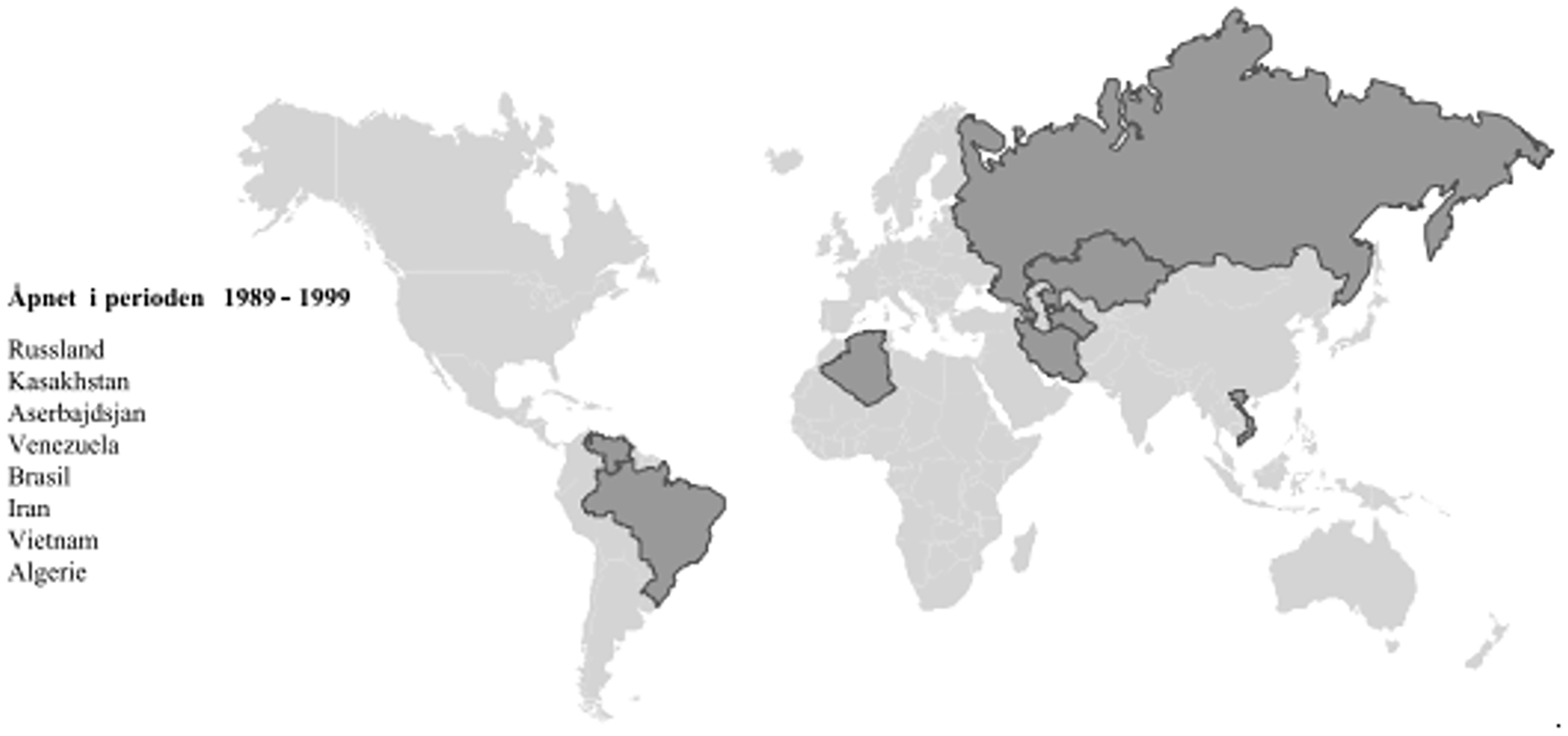
Areas that had been opened up for private interests in the petroleum sector in the period 1989–1999. Source: Ministry of Oil and Energy (2001: 5).
An industrial reorientation
The turn of the millennium saw a proliferation of research projects and publications theorising how to ‘vitalise’ the ‘Norwegian energy nation’, the majority of which took inspiration from Porter’s (1990) contention that globalisation was making Ricardo’s classical theory of comparative advantage redundant. Ricardo’s theory posits that nations can gain comparative advantage in the world market by focussing their industrial development on intensive use of the factors (inputs necessary for production) the nation is naturally endowed with. With globalisation, Porter argued, the firm was decoupled from the factor endowments of particular nations, as raw materials, machinery, services and so on were becoming available globally. Rather than seeking factor-based comparative advantage, nations should now develop their competitive advantage by becoming the home base for competitive firms with global activities. Factor-driven activities could be outsourced; what was important now was for nations to have successful firms establishing headquarters within their borders, thus developing competitive clusters concentrating the most productive jobs, core technologies and the most advanced skills.
In Norway, Porter’s theory would be converted into strategies for global rent-seeking. Adapting Porter’s analysis to the specific challenges of the Norwegian energy industry, economists argued that Norway should engage in an industrial reorientation aimed at detaching the growth and development of large state-controlled energy firms from Norwegian factor endowments. In a book summing up the so-called ‘Porter project’, a research project funded by among others the Ministry of Trade and Industry, the Ministry of Oil and Energy, the Confederation of Norwegian Enterprise and the Norwegian Confederation of Trade Unions, economist Reve et al. (1992: 293) argued that ‘what we need is a core of international companies that choose to operate from a Norwegian home base’. Paying particular attention to the petroleum sector, they argued that ‘the next step is to make this industrial cluster international, and gradually liberate operations from the North Sea’ (Reve et al., 1992: 35). In a later book titled Energy-Norway’s Future: Harvesting or Competence-Based Growth?, which Reve co-edited with Kjell Roland, the advisor of Jens Stoltenberg (Prime Minister in the periods 2000–2001 and 2005–2013), Norway was presented as standing at a crossroads, in which the government had to decide between two alternative strategies for managing the energy industries. On the one hand, the state could adopt a ‘harvesting strategy’, maintaining its high ownership shares and milking revenue from the largely publicly owned energy resources as a ‘cash cow’ (Reve and Roland, 2003: 168). While this harvesting strategy would generate high dividends for the state for a considerable period, the energy industry would suffer from low investment opportunities and consequently lead to a drastic reduction of employment in the sector. Alternatively, the state could opt for what Reve and Roland called a ‘vitalising strategy’ whereby ‘Norwegian actors use a larger share of their investment capacity outside the country’s borders’ and thus ‘make the value creation gradually less dependent on the exploitation of the natural resources in Norway’ (Reve and Roland, 2003: 32–33). While Reve and Roland’s harvesting strategy would entail continued strong public ownership over the energy resources, their vitalising strategy included opening up the domestic market for international competition and to significantly reduce the ownership in the energy companies, preferably to one-third.
Reve’s engagement with the Norwegian energy industry grew out of his worry that Norwegian industrial policy would limit itself to merely ‘manage the petroleum fortune’, and that Norway would thus ‘become a sort of rentier nation that looks after its inherited fortune, rather than a business nation that creates the foundation for new knowledge-based growth’ (Reve & Jakobsen 2001: 331). Reve’s conception of the ‘rentier nation’ was, however, geographically anaemic (Christophers, 2012), disregarding a fundamental contemporary feature of what Christophers (2020: 108) calls ‘natural-resource rentierism’: ‘Essentially, there is a constellation of giant capitalist firms headquartered in Europe extracting both natural resources and the rents they afford primarily from other parts of the world’. In reality, the kernel of Reve’s strategy was to reinvigorate Norwegian industry at home by shifting the locus of rent-seeking activities to the world market, reinforcing what Coronil (1997: 31) calls ‘the international division of nature’ which divides the world into areas ‘where capitalism develops, promoting new technologies and products, and regions where it expands, controlling labour, markets and nature’.
Harvesting at home, vitalising abroad
Reve gained ‘a high standing’ in the Ministry of Oil and Energy (Interview with a civil servant in the Ministry, 12.12.23), and over the 2000s his strategy for shifting the locus of rent extraction to the world market became a central task for the Norwegian landlord state. But whereas the economists suggested that a vitalisation of the energy industry would have to entail a significant reduction of the state’s ownership, ideally to around 30%, the state would to a large extent seek to support the international expansion of its energy companies while retaining a high share of public ownership over the Norwegian resources, thus combining the harvesting of the domestic ground rent with rent extraction in the world market.
Statkraft has remained fully state-owned, but the Competition Authority’s intervention in national mergers in 2003 forced Statkraft to focus most of its new investments abroad (Skjold, 2015). State support for Statkraft’s internationalisation has taken many forms, the most obvious of which has been several big equity increases to leverage international investments, totalling NOK 28 billion in the period 2003–2014. As the Northern European market grew increasingly concentrated, Statkraft began directing its investments outside Europe in the 2000s, for which state support to alleviate risk has been crucial. Risk alleviation has primarily been granted by mobilising risk capital through the budget of development aid. Across the Global North, development aid has increasingly become a tool to ‘create investment opportunities in “frontier” economies’ (Mawdsley, 2018: 193). In accordance with this shift to ‘development as de-risking’ (Gabor, 2021), Norwegian development aid has since the 1990s been strategically committed to ‘prioritise areas where Norway has distinct competence: Renewable energy and long-term administration of natural resources’ (Ministry of Foreign Affairs, 2011).
The state-owned Development Finance Institution Norfund, which was created in 1997 to provide equity capital to catalyse private investments in developing economies, has been especially important for Statkraft’s international expansion (Heiret, 2020). In 2002 Statkraft and Norfund established the joint venture SN Power, which set its ambition to ‘actively pursue opportunities arising out of privatisation processes’ in the Global South (SN Power, 2005: 5). In the Philippines, for example, SN Power made one of its greatest financial successes by acquiring large public power plants that the state had to sell to service its public debt, thus taking ‘advantage of the on-going privatisation process which will lead to several 100 MW of state-controlled generation assets being sold off to the private sector’ (SN Power, 2006: 3). In Peru the company quickly emerged as the fifth largest power generator through a combination of acquisitions of already existing, mainly public hydropower plants and development of greenfield projects. The company has also acquired and built hydropower in Chile, Brazil and India, and has in recent years begun to diversify its portfolio with wind and solar power. In this way, the Norwegian landlord state has seized parts of the surface of the earth beyond its national territory where this has become available by the withdrawal of landlord states’ territorial sovereignty elsewhere. This process is planned to continue with renewed strength in the years to come, as Statkraft (2022: 35) has recently set ‘significantly higher ambitions across geographies’ and plans 60% of its investment by 2025 outside the Nordic region.
In 2001 the government listed Statoil on the stock exchange, reducing its ownership to 67%, with the argument that the company needed equity to be able to compete in the increasingly concentrated global market dominated by fewer and considerably larger corporations, and that the infusion of private capital would take some of the risk away from the state. In addition to floating shares, the government transferred 20% of SDFI to Statoil to give the company a ‘solid resource base and a strong financial position to further develop the international commitment’ and thereby enable the state to ‘realise a bigger value on the totality of its ownership interests, that is to say increase its fortune’ (Ministry of Oil and Energy, 2001: 46 & 25). With the SDFI transfer, Statoil now presided over ‘large amounts of ground rent that could be used for speculation’ in the world market (Ryggvik, 2010: 298). Furthermore, to give Statoil ‘more fire power for international expansion’, in 2007 the government approved two major national mergers that left Norway with ‘one totally dominating operator’ (Ryggvik, 2015: 32). The mergers were approved in Parliament on the basis that ‘the benefits of the merger in relation to internationalisation must be weighed up against the disadvantages of lost diversity and competition on the Norwegian Continental Shelf’ (Standing Committee on Energy and the Environment, 2007: 4).
Curtailing competition at home, the state thus set the stage for carrying Statoil’s search for ground rent to the world market. Every year since 2007, the company’s international investments in exploration and construction have superseded national investments, and operating oil and gas fields in 13 countries across six continents today it ranks as the world’s 18th largest energy company on the Fortune 500 list. Having suffered severe losses in controversial fracking investments in the US (approximately NOK 200 billion), the overall results from international investments have so far not been particularly profitable. However, while the profitability of Equinor’s international operations have been put in question, the creation in 1990 of the Government Pension Fund Global (GPFG) has become an effective vehicle for putting over-accumulated petroleum rents to profitable use. Created to avoid the so-called ‘resource curse’ which is believed to degrade political and economic institutions in countries too dependent on rent extraction (for critical engagements, see Le Billon, 2001; Watts, 2004), the GPFG is an example of a ‘commodity fund’, a form of Sovereign Wealth Fund (SWF) which has proliferated in recent decades to ‘help countries to manage rents’ emanating from natural resource extraction (Monk, 2011: 1818; see also Dixon et al., 2022). Crucially, the GPFG manages surplus oil rents by channelling them out of Norway and into global financial markets. In 2016 returns from the fund’s financial investments for the first time surpassed returns from the Continental Shelf, and by 2021 returns from international financial investments comprised two-thirds of the fund’s capital growth (Norges Bank, 2022). Currently worth over NOK 16.000 billion and controlling approximately 1,5 percent of all listed stocks in the world, it is the world’s largest SWF. By financializing surplus energy rents, the Norwegian landlord state has thus broken the chains of domestic resource dependency by positioning itself at the cutting edge of global finance – the ‘leading rentier sector’ (Christophers, 2023: 1439). Importantly, the financialization of energy rents has reinforced the Norwegian state’s position as a global energy rentier: The GPFG invests heavily in the energy industry, and appears among the largest shareholders in nearly every major energy company headquartered in Europe and the US. To list some of the top ‘Western’ based energy and utilities companies on Fortune 500’s ranking, the GPFG is the second largest shareholder of Shell (3.362%), BP (2.937%), Enel (2.189%) and Iberdrola (3.620%), the third largest of Engie (2.001%), the fourth largest of Total Energies (3.011%) and the sixth largest of Exxon (1.18%) and Phillips 66 (0.785). 8 Through the GPFG, the Norwegian landlord state has financialized surplus energy rents and at the same time energised its growing financial fortune, effectively making a global rentier out of the traditional Norwegian ‘energy nation’.
Conclusion
This paper has taken the historical geography of the Norwegian energy industry as a point of departure for exploring the global political economy of the relationship between energy, rentierism and the state. Petroleum, hydropower, wind and solar power represent what Marx called ‘natural forces’ which, by virtue of how their exploitation is tied to the land on which they appear, can engender ground rent to those who enclose that land and put it to work by harvesting the energy resource. As the ‘nation’s landlord’, or the primary owner of the subsurface and overseer of concessions to access land and its appurtenances, the state stands at the heart of energy rentierism. But whereas the landlord state’s relationship to energy rents is often assumed to be confined to owning and overseeing the exploitation of energy resources within its national territory, this paper has mobilised Bukharin’s notion of the contradictory process of simultaneous ‘nationalisation’ and ‘internationalisation’ of capital to analyse how landlord states in recent decades have become considerable owners of energy resources beyond their own territorial borders. The paper has explored how this contradiction has played out in the recent development of the ‘Norwegian energy nation’, whose entire history of political independence has been marked by a concerted effort to take public control over the country’s vast hydropower and petroleum resources and distribute the ground rent engendered in energy production to society as a whole. Since the 1990s, however, the Norwegian energy industry has been troubled by limited investment opportunities at home together with a growing surplus of oil rents, the solution for which has been to relocate investments to the world market by taking ownership and control over privatised energy assets in the world market. Through the internationalisation of the nationalised energy industry, the Norwegian landlord state that was built throughout the 20th century by taking control over the domestic energy resources has positioned itself in the world market as a leading global rentier.
The Norwegian case is somewhat an outlier in the global petroleum industry, where most state-controlled companies and commodity funds that financialize surplus oil rents are headquartered in the Global South. The history of the simultaneous nationalisation and internationalisation of the Norwegian power industry is, on the other hand, illustrative of how major European electric utilities with considerable state backing have arisen as beneficiaries of global power sector liberalisation. Looking ahead, these sectoral differences in the geographies of the landlord state can have implications for future trajectories of ownership and control over the world’s energy resources. If the energy transition proceeds within the current political-economic framework, its progression will inevitably entail a transition of power from petroleum companies to electricity capital as the provider of energy for processes vital for everyday life and the economy at large that today rely on fossil fuels as either a feedstock or fuel (Luke and Huber, 2022). Considering the different geographies of the landlord state in the two industries, the shift of power from petroleum to electricity capital is likely to entail a significant transfer of ownership and control over global energy from Southern to European landlord states – repositioning European states such as Norway, France and Germany (together with China) at the commanding heights of the international division of nature. In this light, further research is warranted on the global political economy of the landlord state and its role in the energy transition, more specifically the role of the state in protecting domestic energy resources while developing, owning and profiting from renewable energy elsewhere, and the distributional and geopolitical outcomes of these processes.
Footnotes
Acknowledgements
The author would like to thank David Jordhus-Lier, Don Mitchell, Jostein Jakobsen, Jan Heiret, Maria Cariola Eriksson and three anonymous reviewers for their generous and constructive suggestions on earlier versions of this article.
Declaration of conflicting interests
The author declared no potential conflicts of interest with respect to the research, authorship, and/or publication of this article.
Funding
The author received no financial support for the research, authorship, and/or publication of this article.
