




Abstract
This article contributes to the development of state capitalism as a reflexively critical project focusing on the morphology of present-day capitalism, and particularly on the changing role of the state. We bring analytical clarity to state capitalism studies by offering a rigorous definition of its object of investigation, and by demonstrating how the category state capitalism can be productively construed as a means of problematising the current aggregate expansion of the state’s role as promoter, supervisor and owner of capital across the world economy. Noting some of the geographical shortcomings of the field, we outline an alternative research agenda ‘uneven and combined state capitalist development’ which aims at spatialising the study of state capitalism and revitalising systemic explanations of the phenomenon. Rather than the negation of an abstract model of free-market capitalism, or the rise of a nationally scaled variant of capitalism, we posit contemporary state capitalism as a global process of restructuring of the capitalist state (including in its liberal form) underpinned by secular transformations in the materiality of surplus-value production, such as the consolidation of new international divisions of labour driven by automation and labour-saving technologies. The political mediation of these transformations results in the combined expansion of state-capital hybrids and of muscular forms of statism, which develop in inter-referential and cumulative forms across territory, producing further state capitalist modalities. This is a particularly potent dynamic in contemporary state capitalism, and its tendency to develop in a spiral that both shapes and is shaped by world capitalist development.
Introduction: State capitalism resurrected?
As the world stumbles from crisis to crisis, Leviathan is back. Among financial analysts, business journalists, liberal commentators and other pundits, the state is touted as both the saviour and the gravedigger of the capitalist economy. 1 It is simultaneously portrayed as all-powerful, encroaching on private property and sacrificing personal liberty, and too weak, lacking capacity to even secure the freedom of individuals and the wellbeing of populations. The source of this ambivalence may well reside in the contradictory role of the state in capitalist society. As Mann puts it: ‘Capitalist modernity, in fact, is and always has been Keynesian on the inside, as it were – the call for the state when disorder looms or revolution threatens has always been an option, one that, like a panic button, is essential even when we never use it’ (Mann, 2017: 11). The reassuring presence of state intervention is not only required in crisis conditions. More generally, the state embodies ‘market police’, ‘a market constituting and preserving power’ which enables and facilitates the economy (Bonefeld, 2017: 50–51).
For political economy in all its variants from classical liberalism to statist political economy and neoliberalism, the question is therefore not whether the state should intervene or not. Rather, ‘the issue is the purpose and method, the objective and aim of intervention’ (Bonefeld, 2017: 22). Indeed, state intervention is never unproblematic, inasmuch as capitalism, at least in its liberal form, is predicated upon a formal and institutionalised separation of economic and political power. The recent ambivalence concerning the ‘return’ of the state, may well be an acute but all-in-all univocal manifestation of this deep, congenital anxiety at the heart of liberal capitalist modernity concerning the scope and modalities of state power.
Yet there may be more to this quandary at the current historical moment. Indeed, liberal circles are agitated by another sort of angst which compounds hesitations and concerns regarding the current extent of state intervention. There are recurring calls for governments in Western Europe, North America, and Australia to expand support to business activity in order to compete with Asian rivals where states intervene extensively in favour of ‘their’ firms. Emulating these state-led models of capitalism is thus depicted as a matter of economic necessity. It is, however, simultaneously portrayed as setting Western liberal capitalist economies on a dangerous path, one that leads away from the free-market doctrine that has allegedly defined their activity and economic success for decades. 2 We therefore find ourselves in the paradoxical situation where insistent demands for expanded state action are accompanied by laments that creeping statism (due to the policy response to the coronavirus disease 2019 (COVID-19) pandemic and heightened competition with Asian contenders) is already leading us to the perilous path of state capitalism. 3
It is tempting to dismiss altogether these contradictory arguments on the basis of their evident misreading of economic history and misunderstanding of the role of the state in capitalist society. This is a mistake. We submit that this cognitive dissonance expresses a particular set of contradictions characteristic of our current capitalist epoch. In particular, these contradictory demands about the extension of state prerogatives at home in response to the perceived threat of increasing foreign state-supported economic activities reveal a great deal about the competitive mechanisms of emulation through which the state's role as promoter, supervisor and owner of capital is currently rapidly expanding across the world economy. They point to interconnections, inter-referentiality, and combination in the emergence of new repertoires of state intervention. They also suggest that this global process of reconfiguration in the forms and modalities of state action is fraught with geopolitical tensions and accompanied by a profound crisis of liberal reason. In other words, they tell us something fundamental about our current global state capitalist predicament.
In this article, we treat these anxieties as highly suggestive of a set of processes, interconnections and relations, which have been underappreciated in the literature on ‘state capitalism’, a rubric which has gained increasing purchase across the social sciences as well as in business and political commentary to register the more visible role of the state in capitalist economy and society. The label state capitalism indexes an extremely wide constellation of political and institutional forms, including sovereign wealth funds, state enterprises, national development banks, models of post-developmentalism, post-neoliberalism and resource-nationalism, capitalism(s) in emerging economies such as China, Russia, Turkey, Indonesia, Singapore or Hungary, the renewal of industrial and neo-mercantilist policies, and many more. Yet, the nature of the phenomenon continues to be the object of intense debates (cf. Alami and Dixon, 2020a; Wright et al., 2021).
State capitalism as a categorical label is far from perfect. The extant literature has met a number of significant theoretical and methodological difficulties. Despite these limitations, an extremely lively and promising pluri-disciplinary research agenda has coalesced around the rubric state capitalism, demonstrating its potential for focusing scholarly efforts on an important set of transformations in the morphology of present-day capitalism, and particularly on the changing role of the state. As such, state capitalism deserves the attention of geographers. While we are fully aware that, as Clover eloquently puts it, ‘only at one's peril does one make strong claims about a historical period while still within it’ (2016: 130), state capitalism is one of the defining features of contemporary capitalism, one that requires reinvigorating systemic explanations for its rise and significance across the spaces of the global economy. Our wager is that economic geography and geographical political economy hold great potential in redressing some of the shortcomings of state capitalism studies and in pushing this field of inquiry in novel directions. This article contributes to this task, and to broader debates on state capitalism, by offering a theoretically oriented and programmatic intervention. Specifically, we deliver four contributions which unfold across four sections.
Our first contribution consists of bringing in analytical clarity to the field of state capitalism studies by offering a rigorous definition of its object of investigation. There may be virtue to the capaciousness of the term state capitalism and to the field's eclecticism in the theories and methods it employs. Both can be a source of generative tension. However, we argue that state capitalism cannot develop as a relatively coherent and structured field of inquiry (and become something more than a buzzword) without some common understanding of the object(s) of inquiry at the core of its research efforts: what are the ‘real-world’ phenomena and associated set of empirically observable facts that state capitalism studies aim to render amenable to analysis and critique? As already mentioned, the rubric new state capitalism has been deployed in research on a range of political and institutional forms, from state-supported investment funds to new modalities of industrial policy. It is not always clear what labelling these as state capitalist brings to the table. Indeed, there are already rigorous terms and bundles of concepts which have been specifically developed for the study of these individual political and institutional forms. Why add a nebulous category to the mix? Our response is that the added value of the category state capitalism resides precisely in that it calls for an understanding of the recent upward trajectory of these various political and institutional forms (including sovereign wealth funds, policy and development banks, state enterprises, techno-industrial policy, spatial development strategies, and economic nationalism) together and in relation to each other in a co-constitutive movement. In short, state capitalism concerns the aggregate expansion of these political and institutional forms as a historical totality. We carefully document this historic arc in the trajectories of state intervention in ‘The new state capitalism as research object and analytical construct’ section.
Our second contribution consists of identifying the immediate theoretical and political problems raised by the advent of state capitalism. Here we make an important distinction between, on the one hand, state capitalism as a set of real-world processes, and on the other, state capitalism as an analytical construct to capture and ‘reproduce in thought’ (to use an illustrious expression) these capitalist realities. Some confusion in the literature has resulted from the conflation of these two acceptations of the term. Our key contention regarding the latter is that state capitalism, rather than a fully formed concept, can most productively be construed as a means of problematising and critically interrogating the current aggregate expansion of the state's role as promoter, supervisor, and owner of capital across the spaces of the world capitalist economy, and particularly the expansion of state-controlled capital and the concomitant development of muscular forms of statism.
Our third contribution (‘Spatialising the problématique of the new state capitalism’ section), is more specifically concerned with the ‘anaemic geographies’ of state capitalism studies. 4 Here our argument is that state capitalism studies can be revitalised by redressing some of their geographical shortcomings, including methodological nationalism and other forms of territorial traps, and a certain underappreciation of the multiple spatialities and temporalities at the core of the contemporary rise of state capitalism. We highlight the productive potential (from an epistemological and methodological perspective) of bringing the concept of uneven and combined development (UCD) front and centre to studies of state capitalism. Our argument is that UCD is essential to grasping the inner nature of the new state capitalism as a variegated, world-historical phenomenon. Drawing upon recent geographical elaborations of UCD (e.g. Peck, 2019a), we propose a relational perspective to the study of state capitalism, one that aims at capturing the dialectical and cumulative unfolding of different modalities of state intervention across space, scale and time, by tracing the various forms of interconnections between them. If, as argued earlier, state capitalism concerns the aggregate expansion of state-controlled capital and muscular forms of statism in a co-constitutive movement and as part of a historical totality, then this calls for modes of analysis which foreground their interrelations and situate them within broader capitalist dynamics. We call this re-orientation in the study of state capitalism ‘uneven and combined state capitalist development’.
Our fourth contribution (‘Towards a geographic reconstruction of the advent of state capitalism’ section) consists of gesturing towards a geographic reconstruction of the contemporary advent of state capitalism. Here our argument is two-fold. On the one hand, we identify the determinate processes and relations pertaining to the historical development and geographical remaking of late capitalism that underpin the recent aggregate expansion of the state's role as promoter, supervisor and owner of capital. Such processes include: the accelerating unfolding of the new international division of labour; technological modernisation and industrial upgrading culminating in the fourth industrial revolution; a historically unprecedented concentration and centralisation of capital; a secular shift in the centre of gravity of the global economy from the North Atlantic to the Pacific rim; and the extension of financial relations. On the other, we argue that the various repertoires of intervention that states have developed in order to politically mediate the above processes have developed in dynamic, inter-referential, and combinatorial forms, resulting in cumulative effects and producing further state capitalist modalities. This combinatory, ‘multiplier’ effect (to use Peck's expression, 2019a) is a particularly potent dynamic in contemporary state capitalism, and its tendency to develop in a spiral that both shapes and is shaped by world capitalist development. What obtains is a sort of competitive (but not convergent) emulation, where state capitalism begets state capitalism.
The new state capitalism as research object and analytical construct
The rubric ‘state capitalism’ is gaining traction across the social sciences to register the more visible role of the state in economy and society. If the 1990s and 2000s were the decades of ‘globalisation’ and ‘neoliberalism/financialisation’ (respectively), state capitalism may well be emerging as one of the most popular social-scientific signifiers of the 2010-??. Yet it is certainly not devoid of problems. State capitalism seems to be turning into the shorthand-du-jour for anything involving the intervention of the state, raising concerns about the analytical power of the term. Hence, its capaciousness has been negotiated at the expense of its analytical expedience (Alami and Dixon, 2020a). Of course, this is not specific to state capitalism. Many popular buzzwords like globalisation, neoliberalism and financialisation have exhibited similar problems. There are, however, specificities to state capitalism which may render its validity as a representational category even more dubious. For one, it is at least 120 years old. Indeed, Sperber (2019: 101) locates ‘the origins of the notion in the closing years of the 19th century’. This is potentially problematic inasmuch as understanding political economic transformation – particularly as they unfold – through old vocabularies poses inevitable risks and limitations, such as making it hard to see what is new and specific about the present era.
These risks are compounded by the fact that the term, throughout its long history, has been associated with a great diversity of political-economic configurations, from Nazi Germany to East Asian developmentalism, post-independence Algeria, Brazil and Turkey under military dictatorship, the USSR, and many more. Through these associations, it has acquired a certain geopolitical and ideological flavour, so to speak, particularly within liberal circles. Ironically, despite (or perhaps due to) the fact that the remarkable intellectual trajectory of the term and the richness of the debates it has sparked throughout the 20th century have been almost entirely neglected by contemporary scholarly discussions on state capitalism (Sperber, 2019), some of these negative connotations have stuck. This is apparent in the current rhetorical weaponisation of the term by western business and state actors. Indeed, as we have shown elsewhere, state capitalism is increasingly deployed in business and policymaking spheres as a form of geopolitical discourse: castigating a ‘rogue’ state capitalism (typically associated with emerging economies such as China and Russia) discursively enables western business and state elites to justify tougher policy stances in areas such as foreign policy, trade, technology, and investment regulation towards increasingly capable and assertive non-western contenders (Alami and Dixon, 2020b).
The category state capitalism is far from being perfect, which may explain why a great deal of confusion continues to cloud the debates as to the nature and implications of the phenomenon. Addressing the category’s shortcomings, which is arguably necessary for the field of state capitalism studies to move forward, is not easy. We contend that establishing a clearer understanding of the object(s) of inquiry at the core of its research efforts may go a long way towards providing the field with some structure and coherence. The simple question which must be answered (yet rarely is) is the following: what are the ‘real-world’ phenomena and associated set of empirically observable facts that state capitalism studies aim to render amenable to analysis and critique? By attempting to answer this question, we do not aim to bring an end to definitional debates, which are often highly productive. Rather, our hope is that, equipped with this common, basic understanding of the main objective of its research efforts, the field’s eclecticism in the theories and methods it employs can be leveraged as a source of generative tension and channelled towards a cumulative and collective theory-building endeavour. Simply put, state capitalism cannot be adequately problematised, rigorously characterised, and robustly explained, without the necessary preliminary step of clarifying what exactly is its object(s) of inquiry.
We start from a simple heuristic: state capitalism refers to configurations of capitalism where the state plays a particularly strong role as promoter, supervisor and owner of capital. This, however, can mean significantly different things across time periods and contexts. Indeed, what may be considered state capitalism in one historical-geographical context may pass as ordinary and inconspicuous in another. Furthermore, historic instances of state capitalism have taken highly diverse political, institutional and organisational forms. This is reflected in the fact that the various rounds of debates about state capitalism since the end of the 19th century have been concerned with very different subject areas and objects of inquiry, from war planning and the interaction between the state and large private monopolies to development strategies in the Third World (Sperber, 2019). Our simple heuristic, then, will be useful in helping us establish a clearer understanding of the object(s) of inquiry at the core of contemporary state capitalism studies, insofar as it encourages us to identify the concrete political, organisational and institutional forms through which states have increased their role as promoter, supervisor, and owner of capital at the current historical juncture. It also encourages us to critically reflect upon why such political and institutional form would deserve the moniker state capitalism. This will then provide the basis for refining our definition of state capitalism, from the simple heuristic offered here to a more sophisticated conceptualisation capable of rendering contemporary state transformations amenable to analysis and critique.
The new state capitalism as an object of inquiry
As suggested earlier, there has been a proliferation in the usage of the rubric state capitalism. In a recent critical survey of the field, we concluded that it has been used in contemporary scholarship to refer to an ‘extremely wide array of practices, policy instruments, institutional forms and governance arrangements that involve the state to different degrees and at a variety of levels, time frames and geographical scales’ (Alami and Dixon, 2020a: 90), from state enterprises and state-supported investment funds to dense networks of state-business relations, national and regional varieties of capitalism, state-led models of development, ‘patrimonial’ and ‘predatory’ forms of accumulation, particular types of institutional arrangements or modalities of state intervention, and so on. This diversity in the usages of the term notwithstanding, contemporary state capitalism studies have been fundamentally about coming to grips with the expansion of the state's role as promoter, supervisor and owner of capital, which we have witnessed since the early 2000s, and particularly after the 2008 global financial crisis. While we are wary that ‘measuring’ state activism is a notoriously difficult task (Peck, 2021), a few key data points may be useful to illustrate the magnitude of this expansion.
First, we have seen a multiplication and expansion of state-owned corporate entities, or what we call ‘state-capital hybrids’. According to the Sovereign Wealth Fund Institute, there are now 127 sovereign funds, which is more than six times as many as there were 20 years ago. 5 The assets controlled by these funds ballooned from <$1 trillion in 2000 to >$8.6 trillion in 2020, which is more than hedge funds and private equity firms combined. State-owned enterprises have experienced a concomitant expansion. With assets worth $45 trillion (equivalent to half of global GDP), ‘the share of state-owned enterprises among the world’s 2000 largest firms doubled to 20% over the last two decades’ (IMF, 2020: 5–6). National development and policy banks have also returned to fashion (there are now >900 worldwide), vastly expanding their loan portfolio and financial capacities in both developed and developing economies. They control assets worth $49 trillion (Marois, 2021). While there is no doubt that China weighs heavily in these statistics, a vast body of academic- and policy-oriented scholarship shows that this expansion is irreducible to the rise of China. These various state-capital hybrids originate from countries across the income spectrum and from diverse types of political regimes, and are increasingly integrated into global circuits of capital, including global networks of production, trade, finance, infrastructure and corporate ownership, and actively participate in foreign listing, international portfolio investment, and overseas mergers and acquisitions (Alami et al., 2021b; Babic et al., 2020; IMF, 2020; Lim, 2018; Werner, 2021).
Over the same period, the number of states adopting national industrial policies has massively increased, with ‘[t]he rate of adoption of both formal industrial policies and individual policy measures targeted at industrial sectors appears to be at an all-time high’ (UNCTAD, 2018: 128–129). This proliferation of industrial policies has coincided with a renewal of interest in state-led spatial planning and the state-coordinated expansion of infrastructure, both of which had lost legitimacy during the 1980s–1990 s (Schindler and Kanai, 2021). The increasing prevalence of these various modalities of state ownership and state activism is all the more significant when considered in the context of the rise of ‘economic nationalism’, a general policy orientation where appeals to national identity fundamentally frame economic policymaking (Helleiner, 2021; Helleiner and Pickel, 2005). Economic nationalism encompasses a wide diversity of doctrines, practices, and policies, which, as a whole, have gained in political salience since the 2000s, and particularly in the aftermath of the 2008 global financial crisis.
In sum, what we have seen is, on the one hand, a multiplication of state-capital hybrids (including sovereign wealth funds, state enterprises, policy and development banks) and a geographical expansion of their control over resources and markets, and on the other, the concomitant development of muscular forms of statism (encompassing industrial policy, spatial development strategies, and economic nationalism). 6 This combined movement has unfolded across extremely diverse geographical contexts, and it has been deeply implicated in various political economic projects, including (but not limited to): the rise of Chinese capitalism under the aegis of its party state; in Central Asia, the development of patrimonial forms of capitalism dependent on rents from oil and gas exports in Russia and Kazakhstan; in Central and Eastern Europe, the emergence of state-led illiberal regimes in countries like Hungary, Serbia, and Poland; in the Middle East and North Africa, the reconfiguration of the Arab Gulf economies and their particularly entangled combinations of state and capital, the large state-owned sectors of countries like Egypt, Jordan, Algeria, the development of an authoritarian form of state capitalism in Turkey and of an ‘innovation’ state in Israel; the precarious consolidation of extractivist-redistributive regimes in Latin America (Brazil during the Workers’ Party period, Ecuador, Bolivia, and Venezuela) and in Africa (Zambia, Rwanda, or Ethiopia); in Western Europe, the revival of techno-nationalism, extensive support to national champions, and development banking; in the United States, a newfound appetite for state intervention and financial sanctions in the context of the ‘new Cold War’ with China. In other words, the recent upward trajectory of state-capital hybrids and muscular forms of statism is a global phenomenon. Let us clarify at the outset that by global, we certainly do not mean that the rise of state capitalism is undifferentiated, nor that every country or region is equally concerned or affected. In fact, we argue at length below that these transformations in the repertoires of state action have happened unevenly across territorial borders, depending on a state's position in the international division of labour and in a world market characterised by highly unequal geopolitical relations. Our point is that the recent upward trajectory of state-capital hybrids and muscular forms of statism testifies to the aggregate expansion of the state's role as promoter, supervisor, and owner of capital across the spaces of the world capitalist economy. This expansion must therefore be explained and theorised as a process which is global in scope (and, as we will see, global in nature), which is precisely the objective of our programmatic reorientation of state capitalism studies.
For now, this raises the following questions: (a) why would any of these various political and institutional forms deserve the moniker state capitalism? (b) What is the added value of labelling them as state capitalist? These questions are important insofar as there are already rigorous terms and bundles of concepts which have been specifically developed for the study of these individual political and institutional forms.
The use of qualifiers such as ‘new’ or ‘return’ (e.g. ‘the return of state capitalism’, ‘the rise of the new state capitalism’ and so on), which is common in the literature, further complicates matters. Indeed, one may argue that these political and institutional forms have a very long history (perhaps as old as capitalism itself), and in fact have never left. What is more visible now, for whatever reason, might have been there, more or less under the radar, all along. Things like sovereign funds, often presented as paradigmatic of the new state capitalism, have many historical antecedents (Braunstein, 2014). Succinctly put, the new state capitalism may not be so new after all.
What is both new and significant is not necessarily the increasing prevalence (or at least growing visibility) of these institutional forms and state transformations taken individually, but their joint and concurrent expansion. To the first question above, we submit that the ‘real-world’ phenomenon and associated set of empirically observable facts that state capitalism studies must aim to render amenable to analysis is the aggregate expansion of these political and institutional forms as a totality. This is the specific phenomenon that warrants explanation. In response to the second question, we contend that the added value of the category state capitalism resides precisely in that it calls for an understanding of the recent upward trajectory of these various political and institutional forms together and in relation to each other in a co-constitutive movement, and in particular the co-development of muscular forms of statism and the expansion of state-capital hybrids.
A number of objections can be raised at this point: can a single label actually contain such a great diversity of political and institutional forms? Does this not pose a risk of misreading a wide range of state transformations across geographical and political contexts as state capitalism, as some superficial readings have done? Are we not succumbing to the illusion that there must be some single unifying meaning or logic underpinning these complex, messy and heterogenous mutations in the forms and repertoires of state intervention? These questions boil down to the issue of conceptual reification, which we must now address. For that, we must establish an important distinction: on the one hand, there is state capitalism as a set of real-world processes and phenomena (which we already discussed), and on the other, state capitalism as an analytical construct to grasp these capitalist realities and render them amenable to analysis and critique. To tackle the risk of conceptual reification, it is necessary to further reflect on the relation between these two acceptations of the term, which is a thorny question of epistemology.
The new state capitalism as an analytical construct
One may argue that much ambiguousness in state capitalism studies stems from a tendency to conflate these two meanings, such that state capitalism is used as a self-explanatory category, resulting in circulatory forms of reasoning. For instance, the vast presence of state enterprises has been explained by the alleged dominance of the logic of state capitalism in a particular space of accumulation, while the very presence of these state enterprises has been said to signal the prevalence of a state capitalist logic in such space. This confusion of state capitalism as explanandum and explanans results in assuming away what needs explaining. This can be observed particularly in some (but not all) strategic management, international business, and international political economy writings on state capitalism.
Commentators writing in the comparative capitalisms tradition have often adopted a more self-reflexive understanding of the relation between analytical construct and empirical object, although one not devoid of limitations. Here the main epistemological strategy has consisted in analytically constructing one or several models of state-led varieties of capitalism (cf. Nölke et al., 2019 for one of the finest proposals). ‘Real’ cases (read, national political economies) are then confronted with these analytical constructs, in order to gain a deeper understanding of capitalist diversity. Despite considerable diversity in how the models are constructed (based on inductive or deductive methods), the epistemological strategy remains essentially the same, which is that the models of state capitalism are set in contradistinction to other national varieties of (non ‘state-led’) capitalism.
There are two substantive limits to this approach. Not only is it inadequately equipped to capture the various forms of interconnections, inter-referentiality, and combination between repertoires of state intervention across the territorial borders of nation-states (as discussed at length below), it also almost invariably leads to rigid analytical constructs. There is of course room for debates surrounding the exact institutional contours of state capitalism(s), just like there is scope for considering hybridity (i.e. real cases exhibiting features of both state-led and other variants of capitalism). Nonetheless, this approach is largely a double exercise in boundary-making, consisting in drawing lines of distinction between types of capitalisms, and in placing real cases within the confines of thereby established ideal-types. Setting aside for now the question of the frame of reference used for the construction of varieties of state capitalism (or what is considered the norm against which such varieties are derived), our point here is that such an approach necessarily relies upon rigid and static analytical constructs of state capitalism as a set of specific institutions, modalities of state intervention, governance arrangements or combination thereof. This restricts discussions of state capitalism in two ways: what to include (or not) in this list, and the extent to which nation-states fit ideal-type varieties of state capitalism (or not). As we argue elsewhere, it is virtually impossible to answer such questions without ‘fetishising some specific institutions and forms of intervention at the expense of others that might be less visible but equally important’ (Alami and Dixon, 2020a: 84). This also forecloses the possibility that the manifest institutional and political forms of state capitalism in one place could be significantly different than in another.
As a whole, the two dominant ways in which the extant literature addresses the epistemological relation between analytical construct and object of inquiry render the field of state capitalism studies particularly prone to conceptual reification. To avoid these pitfalls, we propose an altogether different approach, one that construes state capitalism as a problématique more than a fully formed concept or model.
Spatialising the problématique of the new state capitalism
Our construction of state capitalism as a problématique draws inspiration from Peck's reflections on the nature of conceptual categories such as neoliberalism and capitalism (2013, 2019b). In particular, we heed Peck's advice that creative theory-building ‘demands that we mobilise relatively plastic categories of analysis, not rigid ones that beg binary answers ([state] capitalism, yes or no); plastic categories held in constant dialogue (and tension) with empirical inquiries that call upon them as sensitising devices (or maps) and not as a source of foreclosed conclusions’ (2019b: 1194). Hence, we construe state capitalism not as a static categorical construct or rigidly defined model, but as a flexible means of problematising the object of inquiry which we have delineated earlier, that is, the current aggregate expansion of the state's role as promoter, supervisor and owner of capital across the spaces of the world capitalist economy, characterised by the combined expansion of state-capital hybrids and of muscular forms of statism. In other words, we see state capitalism as a ‘sensitizing device’ to help us address the series of theoretical, political and, as we will see, geographical conundrums raised by this upward trajectory in the repertoires of state intervention as a totality. This is what we call the problématique of the new state capitalism.
We have explained at some length elsewhere how treating state capitalism as a set of critical interrogations concerning the changing role of the state (rather than a rigid category) allows introducing a degree of plasticity and greater self-reflexivity in the use of the rubric (Alami et al., forthcoming). These include interrogating the re-articulation of state-capital relations and the multiplicity of political, institutional, organisational and spatial forms they take, the role that these play in the (geo)political re-organisation of global capitalism, but also reflecting on what passes as the ordinary separation between the state qua public and the private spheres. In a nutshell, wrestling with these interrogations while avoiding some of the problematic familiar dichotomies which have entrapped the field of state capitalism studies (such as state vs. markets, political vs. commercial logics, rent-seeking vs. profit-seeking objectives, and so on) is precisely what makes the problématique of state capitalism both challenging and generative. Our argument so far is represented visually in Figure 1.
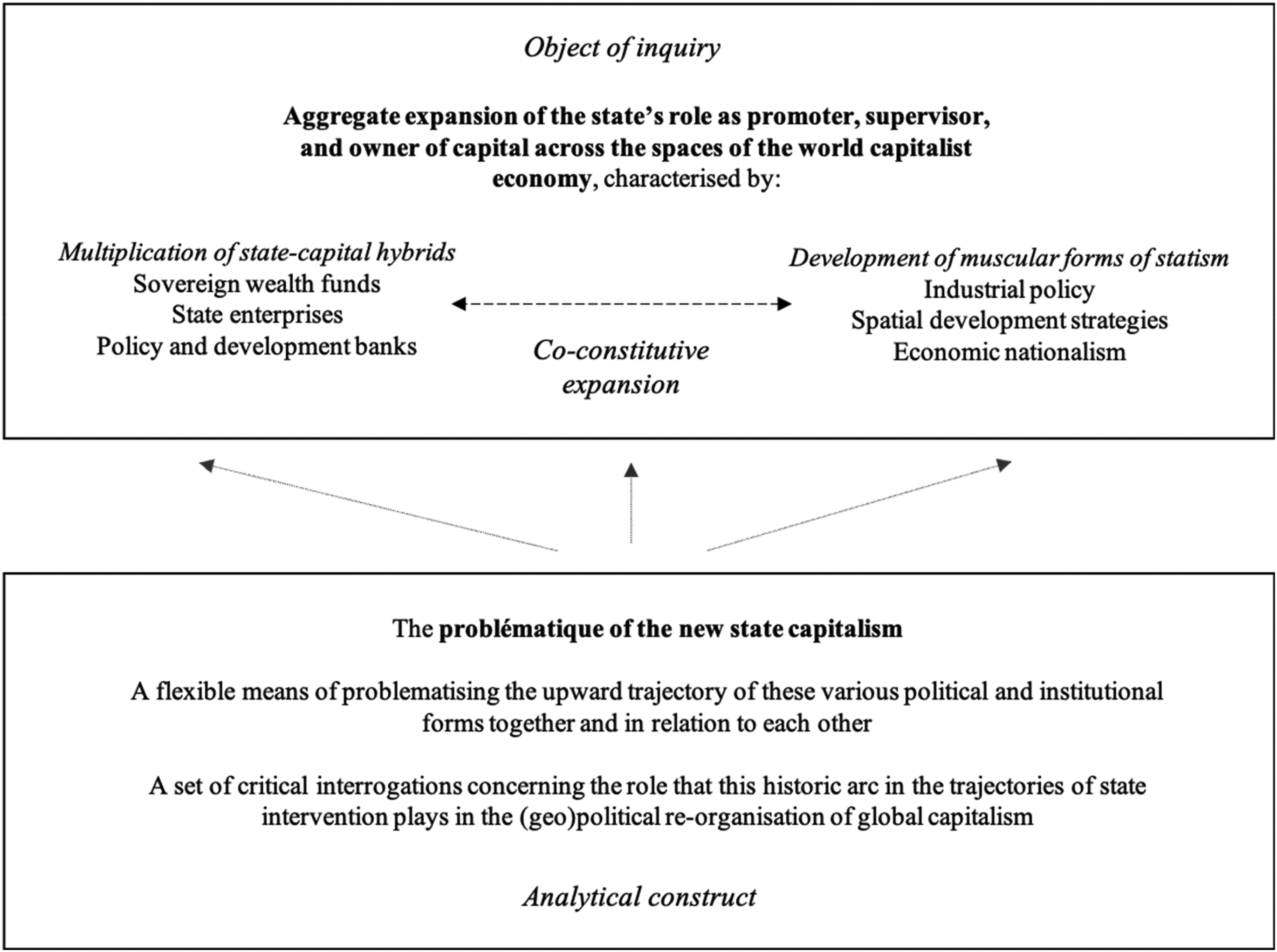
The new state capitalism as object of inquiry and analytical construct.
In what follows, and as a prelude to a geographic reconstruction of the ascent of state capitalism, we build upon and extend this argument in order to frame the problématique of the new state capitalism in explicitly geographical terms. Our objective is not to merely add a geographical twist to state capitalism studies. Rather, we aim to show that answering the theoretical and political problems raised by the contemporary advent of state capitalism (i.e. why does state capitalism ascend? how does it ascend? why now? with what implications? how to explain its institutional diversity?) necessitates a keen attention to the spatialities and temporalities of the phenomenon. This, however, requires unsettling the ‘metageographical unconscious’ than underpins much of the field of contemporary state capitalism studies, that is, the more-or-less explicit framework of assumptions regarding the spatial organisation of state capitalism. 7
The metageographical unconscious of the new state capitalism
Baltz (2021) identifies two general approaches to the problem of state capitalism. On the one hand, there are ‘systemic’ approaches to state capitalism, and on the other, ‘organisational’ ones. ‘Systemic’ approaches tend to dominate in the comparative capitalisms literature, which, as previously discussed, consists in outlining the institutional contours of state capitalism. Entire nation-states or blocs of nation-states are then positioned in this category, such as China, East Asia, or emerging economies. Here the framework of assumptions concerning spatial organisation is that state capitalism is primarily contained within neatly demarcated national territories. State capitalism exists, including in the geographical sense, alongside other varieties of (non-state) capitalism (e.g. Fainshmidt et al., 2018; Nölke et al., 2019). It may make incursions in other territories, such as when it exports state-owned capital or competes abroad over access to markets or sources of raw materials, but it is primarily a national creature and a product of domestic forces. For example, in an influential book on contemporary state capitalism, Kurlantzick contends that ‘the most autocratic and powerful state capitalists will use their state companies as de facto weapons of war, creating serious conflict in some of the most strategically important places on earth’ (2016: 25).
‘Organisational’ approaches, which tend to dominate in international business, strategic management, and international political economy, examine specific organisational forms and institutional arrangements, such as sovereign wealth funds, state enterprises, national champions, or industrial policy. The focus is not on entire nation-states, but these organisational forms are nonetheless seen as the causal result of domestic structures and conflicts (e.g. Braunstein, 2019). In fact, even when the analytical focus is on strategic decisions, economic performance, and governance outcome at the level of a sovereign wealth fund or state enterprise, organisational approaches often rely on methods and arguments developed within the Comparative Capitalisms tradition in examining the role of domestic institutions, interest groups, and other national factors in the creation, or internationalisation, of state capitalist organisational forms (e.g. Li et al., 2014; Nölke, 2014). For instance, Musacchio et al. (2015) argue that the effect of state ownership and control on firm performance is a function of ‘country-level institutional features’. State-owned firms may well be taking centre stage in global markets, but they remain creatures of their ‘home countries’.
Both approaches evidence a form of methodological nationalism, where state capitalism is seen as primarily determined at the national level. This has profound implications, including a tendency in systemic approaches to see geographic space as a mere container of relatively coherent models of state capitalism, or as a passive terrain of competition between such models and other forms of state capitalism. This geographic ‘anaemia’ (a term we further discuss below) can take different forms. Spechler et al. (2017), for example, contend that ‘the obvious contrast to state-capitalism is free-market capitalism’ (p. 2), with either of these models prevailing in discrete geographic spaces. Organisational approaches to state capitalism inspired by the developmental state literature tend to fall in a similar territorial trap, whereby the national territory is reified as a container of state capitalist models and construed as the main unit of analysis. For instance, in their study of emerging markets state enterprises, Nem Singh and Chen (2018: 1091) argue that the decision to retain them and support their developmental roles is influenced by ‘a country's model of development based on state capitalism’. The organisational approaches to state capitalism prevalent in the international business and strategic management literature likewise exhibit an underdeveloped sense of space. According to prominent contributors to this literature, the geographic nature and spatial variegation of state enterprises have been systematically understudied, leading to a neglect of place-based contextual elements and spatial relations in structuring strategic decisions and firm operations across territorial borders (Deng et al., 2020).
As a result of these geographical assumptions concerning the nature and scale of state capitalism, both systemic and organisational approaches offer a restricted and potentially misleading reading of its contemporary advent. To be clear, this is not to say that national-domestic factors do not matter in the rise of state capitalism. They obviously do. This is also not to say that these approaches have been entirely unable to look at scales beyond the national. Our argument is rather that they are ‘geographically anaemic’, meaning ‘firstly, that they are framed at an inappropriate geographical scale; and secondly, that in conjunction with this framing, they conspicuously disregard certain vital geographical trends in recent capitalist history’ (Christophers, 2012: 272). 8
Consider for instance the question why does state capitalism ascend? The metageographical unconscious of the literature has restricted responses to this question: the development of state capitalism has been largely interpreted as the rise of a nationally scaled and a relatively coherent variant of capitalism. As it grows in significance on the international stage (via the internationalisation of its firms, extending loans and investing abroad, etc.), it increasingly competes with other varieties of capitalism, both for access to global markets and as a model, distinct from (neo)liberal capitalism, for other countries to emulate. Politically, what is at stake is the sustainability of the new models of state capitalism (Nölke et al., 2019), or the extent to which these constitute a threat for the smooth functioning of markets and the liberal world order (Bremmer, 2010). Anaemic geographical imaginaries are evident in the narratives of a confrontation between rival political-economic models which pervade the literature. For example, Kurlantzick (2016: 23) argues that ‘state capitalism usually offers a vision of the future that is more protectionist, more dangerous to global security and global prosperity, and more threatening to political freedom than the alternative of free-market capitalism’ (see also Bremmer, 2010). The problem with such geographical imaginaries is not only that they misleadingly reduce the question of contemporary state capitalism to a geopolitical clash between two easily identifiable protagonists – (Western) democratic free-market capitalism and its deviant state capitalist ‘other’ (a warlike discursive frame which we have criticised at length elsewhere). They are also poorly equipped to grasp the extent of current state transformations unfolding across the spaces of the world capitalist economy, including in states which assume liberal forms (Alami et al., 2021a).
These assumptions about the spatialities of the new state capitalism are inseparable from assumptions about its temporalities, thereby also restricting answers to the ‘why now’ question. There are broadly two types of temporalities considered in the literature. The first one is that of catch-up development: the contemporary wave of state capitalism is explained by attempts from a number of developing countries – ‘Hobbesian contender states’ or neo-developmental states –to catch up (by means of state) with more advanced capitalist economies (Nölke, 2014; van der Pijl, 2012). The second one is that of the 2008 global financial crisis: the new state capitalism is here interpreted as a Polanyian countermovement against ‘too much’ neoliberal globalisation and its crises (Dolfsma and Grosman, 2019). For instance, in a recent book, Boyer (2020) sees the current rise of what he calls capitalisme à impulsion étatique (capitalism with a state impulse) as a state-led attempt at reasserting national sovereignty against the forces of transnational capitalist globalisation.
Finally, consider also the question of the polymorphism of the new state capitalism. The remarkable diversity in the institutional landscapes of state capitalism is of course acknowledged in the literature, but largely seen as a product of national-domestic political economic contingent factors (e.g. Fainshmidt et al., 2018) Not only does this leave little appreciation for the various forms of interconnections, inter-referentiality, and combination that may exist between repertoires of state intervention across the territorial borders of nation-states, this also means that uneven development is seen as external to (or as a mere consequence of) state capitalism, rather than constitutive of it, as we will see below.
This does not mean that these arguments are weak. Our contention, rather, is that the anaemic geographies of the literature restrict readings of the rise and significance of contemporary state capitalism. Importantly, they preclude a reflection on the historic development and self-transformation of global capitalism, such as planetary mutations in the spheres of production, circulation, distribution of value, the continuation of accumulation in the face of market saturation and overproduction, and geographical trends such as the unfolding of a new international division of labour and the unprecedented centralisation and concentration of capital on a planetary scale. As argued below, these questions are fundamental for understanding contemporary state capitalism. This points to the need for an explicitly geographical approach, one that allows probing into the multiple spatialities (beyond nation-state centric territoriality) and temporalities (beyond that of catch-up development and crises) at the core of contemporary state capitalism.
Uneven and combined state capitalist development
We propose to spatialise the problématique of state capitalism by bringing it into conversation with the notion of UCD, which we conceive as a research agenda and a methodological predisposition (rather than a unified theory or approach) drawing attention to the unstable and multi-scalar geographical remaking of capitalism (Peck, 2019a). Importantly, in bringing this notion into the study of state capitalism, we are careful not to conflate ‘the fact of UCD as a theory of UCD’ (Charnock and Starosta, 2018: 325, Rioux, 2015: 508). This means that we do not attribute explanatory power to UCD. UCD is not the answer to the question of ‘why and how state capitalist development is uneven and combined’. Rather, the fact of uneven and combined state capitalism is precisely what must be elucidated: why and how has there been an aggregate expansion of the state's role as promoter, supervisor, and owner of capital across the spaces of the world capitalist economy, characterised by the combined expansion of state-capital hybrids and of muscular forms of statism? How does this result from the historical developmental trajectory and geographical remaking of global capitalism?
In developing the notion of uneven and combined state capitalist development, we follow Charnock and Starosta (2018: 326–327) who conceive of the substantive social content of uneven geographical capitalist development as the real subsumption of labour to capital. This means that the determinants of the expansion of present-day state capitalism must be sought in the historical-geographical transformations in the material forms of production of (relative) surplus-value on a world scale. 9 Accordingly, our unit of analysis cannot be any of the ones conventionally used in the state capitalism literature, i.e. a specific type of state-capital hybrids, (say, Brazilian state enterprises or Singaporean sovereign funds), an individual country (e.g. France or Indonesia), or a state-led national variety of capitalism. Rather, we start from the accumulation of capital as a global process and locate the role of the combined expansion of state-capital hybrids and of muscular forms of statism therein. As such, we offer an alternative to the methodological nationalism of the literature. We put this approach to work and illustrate its generative potential in ‘Towards a geographic reconstruction of the advent of state capitalism’ section.
Our key argument is, however, not simply that UCD provides an antidote to the anaemic geographies of state capitalism. We contend that the notion of UCD (and the set of critical interrogations which it raises concerning the how and why of UCD) enable a major geographical reorientation in the study of the new state capitalism in at least four ways.
First, UCD allows a redefinition of efforts at characterising state capitalism. As previously discussed, such efforts have tended to rely on rigid models of state capitalism constructed in static opposition to other varieties of capitalism. We have explored earlier some of the analytical impasses associated with such approaches, including in terms of conceptual reification and a problematic metageographical unconscious. Another significant problem here is that by constructing the alterity (if not abnormality) of state capitalism in reference to varieties of liberal market-based capitalism (presumed to be more ordinary), these approaches tend to exceptionalise state capitalism (Alami and Dixon, 2020b). Yet, we know that the perimeter, depth, and modalities of state action have varied considerably throughout the historical geographies of capitalism. This historical record is evidence of the capitalist state's remarkable ability to reinvent its modalities of intervention, at times greatly expanding its prerogatives. As mentioned earlier, we also know that what may be considered state capitalism in one historical-geographical context may pass as ordinary and inconspicuous in another. Consequently, for us, exceptionalising state capitalism, whether in historical or ontological terms, is problematic. Efforts at characterising state capitalism must break with this tendency. This requires establishing a clear conceptual distinction between state capitalism and the capitalist state. For this, a brief detour via materialist state theory is necessary.
We argue that the capitalist state must be seen as logically prior to state capitalism. This means that the two categories do not operate at the same level of abstraction. 10 While the state appears as an independent political form, formally separated from the economic sphere, standing ‘above’ civil society, and acting as the neutral guarantor of general societal interest, the state is in fact the political form of capitalist social relations (Bonefeld, 2017; Clarke, 1991). As such, its material reproduction is bound up with the expanded reproduction of capitalist social relations. The state therefore strives to secure the conditions for capital accumulation. The exact modalities according to which it does so are always historically and geographically specific. Indeed, the capitalist state cannot be defined in the abstract as a set of functions or basic acts of economic coordination that it must perform (Clarke, 1991). Doing so would imply a lapse into the type of fetishism of certain state prerogatives which we criticised earlier. What we can do, however, is define the role of the state in an essentially ‘negative’ manner: the state strives to overcome the obstacles and blockages to capital accumulation, including by attempting to manage its crisis-ridden dynamics and by trying to contain the antagonism of capitalist class relations (Burnham, 1996). As the state aims to do so, it may very well drastically bolster its geographies of intervention into social and economic processes. It may deepen and extend its influence over non-state economic actors and entities. It may also directly acquire and control capitalist production and accumulation or broaden the geographical reach of the capital it owns (Sperber, 2019). In sum, it may very well expand its role as promoter, supervisor, and direct owner of capital. This means that state capitalism must not be seen as an anomaly or a deviance from liberal, market-based capitalism (capitalism without the ‘state’ qualifier), but as a particular modality of expression of the capitalist state, including in its liberal form. State capitalism is an immanent potentiality, an impulse which is contained in the form of the capitalist state and built into its DNA. 11
This also allows us redirecting characterisation efforts away from constructing ideal-typical models of state capitalism juxtaposed to other (conventional) varieties of capitalism, and towards identifying the circumstances and conditions in which this potentiality is actualised as well as its concrete temporal and spatial parameters. Indeed, if, as argued earlier, the state is the political form of capitalist social relations, then it follows that its transformations (including the state capitalist impulse) must be grasped as a moment of the dynamic process of capital valorisation, a process which unfolds unevenly in time and space. As Brenner et al., remind us, ‘state spatial strategies must be viewed as historically specific practices through which state institutions attempt to adjust to the constantly changing geoeconomic and geopolitical conditions in which they operate: their modalities, targets, and effects evolve qualitatively during the history of capitalist development’ (2003: 10). Characterisation efforts must therefore be focused on both the spatiality and temporality of the capitalist transformations politically mediated by the state, and on the reconfiguration of the patterns of state spatial regulation that such process of political mediation involves (Alami, 2021). In other words, our programmatic reorientation suggests that there can be no analytically useful definition of state capitalism in logical abstraction from the determinate material process of uneven capitalist development. State capitalism must always be defined, characterised, and explained with reference to concrete historical-geographical capitalist transformations, and in relation to inherited geographies of state intervention into social and economic processes.
This leads us to our second point. The coming into being of state capitalism must not be explained by resorting to mechanical-abstract metaphors, such as the negation of an abstract model of free-market capitalism, a Polanyian pendulum (i.e. a counter-movement of the state somehow automatically following a period of market expansion), a Smithian seesawing motion (i.e. the rhythms of state intervention inexorably accompanying the geographical ebb and flow of capital), or axiomatic and historically indeterminate laws of peripheral catch-up development. What is required instead, is a characterisation of state capitalism's rise in its concrete historical and geographical fullness, by locating it in the historical developmental trajectory and geographical remaking of global capitalism (as we gesture towards in the next section). That said, this need not involve a form of periodisation which conceives of capitalist history as a succession of neatly demarcated ‘blocs’ of time, with, for instance, state capitalism succeeding previous stages of capitalism (such as liberal, Keynesian, developmental, or neoliberal capitalisms, each corresponding to paradigmatic particular modalities of state intervention or institutional forms), or with the ‘new’ state capitalism replacing previous waves of state capitalism. Rather, we mean locating contemporary state capitalist impulses (notably the combined expansion of state-capital hybrids and of muscular forms of statism) within a set of determinate processes and social relations pertaining to the historical development and geographical remaking of global capitalism. Importantly, these determinate processes and social relations can have multiple and overlapping temporalities. Besides, while they may unfold at a multiplicity of scales, we must conceive of their geographical horizon as global. From the perspective of our research agenda, then, what is at stake in the contemporary rise of state capitalism is not so much the growing assertiveness of a nationally scaled and relatively coherent variant of capitalism. Rather, what is at stake is the (geo)political re-organisation of global capitalism, and the changing role of state power in the territorial organisation of the planetary circuits of capital (we take up both themes in the next section).
Our third point is that our proposed research agenda also reframes the question of political and institutional diversity. As noted earlier, the contemporary landscapes of state capitalism are characterised by great diversity in at least two respects. On the one hand, both state-capital hybrids and muscular modalities of statism have developed under a wide range of forms. For instance, far from constituting the rise of a single organisational form, contemporary state-owned enterprises feature highly diverse structures of ownership, governance, and management. They also significantly differ in terms of size, complexity, sector of operation, and the functions they perform for ‘their’ government (Musacchio et al., 2015). Similarly, sovereign funds are diverse in terms of the institutional, organisational, and legal arrangements that underpin them, including different missions, mandates, and investment objectives. Economic nationalism encompasses a wide diversity of doctrines, practices, and policies, from neo-mercantilism and neo-developmentalism to trade wars. We also witness considerable variety in industrial and planning policies. On the other hand, these landscapes of state capitalism are also diverse in the sense that they have unfolded across highly varied political economic contexts, with their own national, regional, or local specificities, and which are underpinned by diverse material bases and class forces. This heterogeneity seems to have led state capitalism studies to eschew systemic explanations of the global character of state capitalism. However, barring such explanation, we are left with the idea that these joint and concurrent trajectories in the landscapes of state capitalism are largely coincidental. We propose a different approach, which consists in seeing state capitalism as not merely heterogenous or diverse but as ‘variegated’ (Brenner et al., 2010), meaning that geo-institutional differentiation is not merely derivative but systemically produced and constitutive of state capitalism. Our argument here is that acknowledging the multiplicity of the political economic projects, modalities of intervention and institutional forms which compose contemporary state capitalism must be complemented with an account of the development and entanglement of their trajectories together and in relation to each other in a co-constitutive movement. Their heterogeneity is not merely contingent, it is relational and dialectical, as we illustrate in the next section.
This leads us to our fourth point, which is that our proposed agenda redefines the nature of comparative work away from an exercise in identifying the institutional contours of neatly demarcated territories categorised as state capitalist, and towards relational-comparative work consisting in tracing difference in connection, interdependencies, and co-evolution between different instantiations and repertoires of state action, and in particular, between state-capital hybrids (including sovereign wealth funds, state enterprises, policy and development banks) and muscular forms of statism (encompassing industrial policy, spatial development strategies, and economic nationalism) (Hart, 2018; Sparke, 2020). It becomes less a question of accounting for national varieties of state capitalism as one of grasping the inner relational nature of contemporary state capitalism as a variegated, world-historical totality. This calls for a relational social ontology, where the various repertoires of state action are not seen as relatively autonomous ‘building blocs’ of state capitalism, but as part and parcel of a relational whole. The relations between the parts, and between the parts and the whole, are seen as intrinsic to the various repertoires of state intervention, with the whole greater than the sum of its parts. Relationality is therefore key to understanding the structure, modality of each repertoire of state intervention. To paraphrase Massey (1995: 3), what constructs these repertoires as relational are the spatialised and ‘power-filled’ social relations on which these repertoires depend and ‘which link them together (or not) in their mutual constitution’. Accordingly, by better understanding the interweaving of spatialised social relations underpinning and connecting the various repertoires of state action, we may be able to reveal something qualitatively new about state capitalism as a totality.
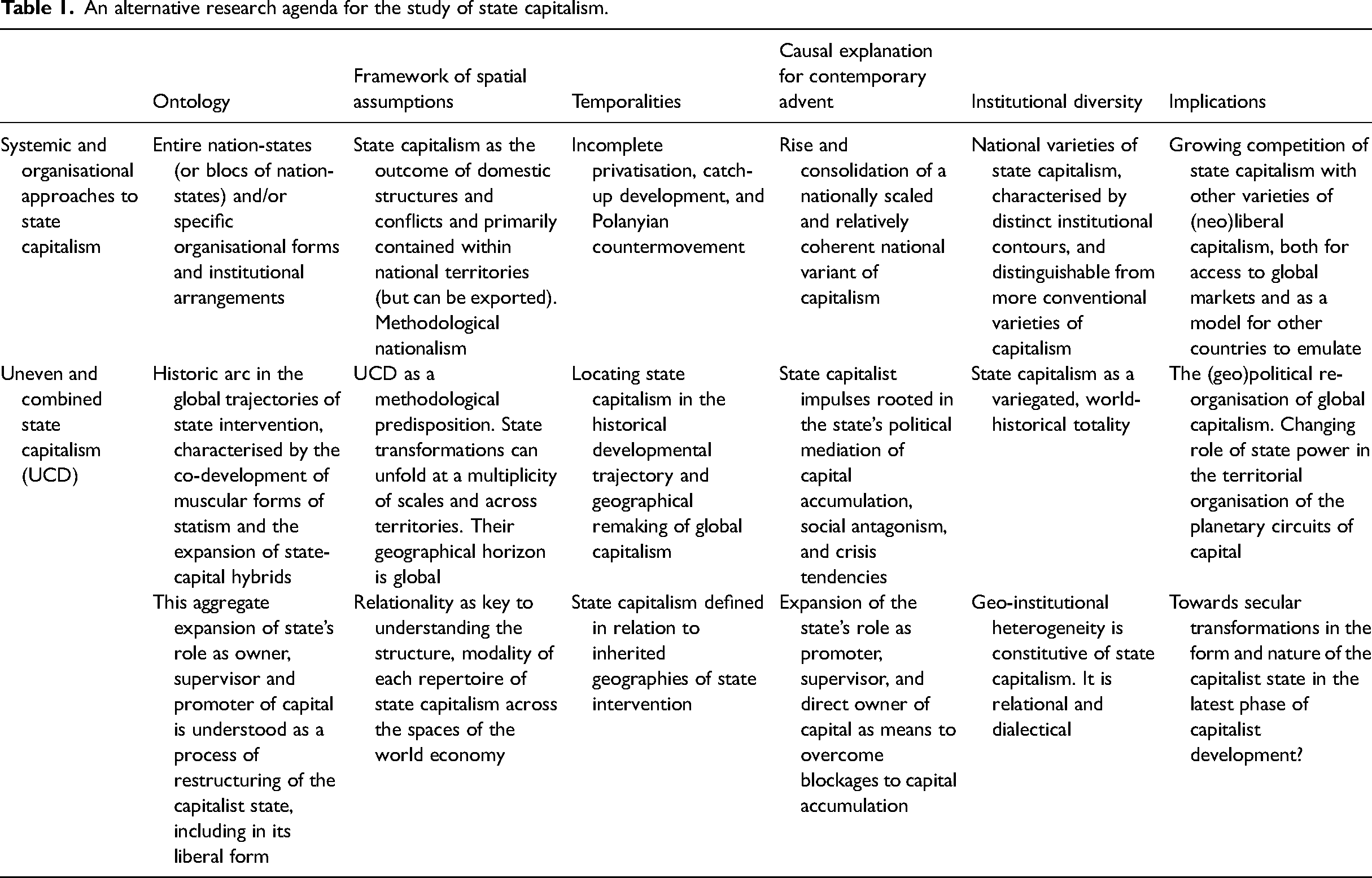
In the next section, we tackle this in concrete terms. We scrutinise the interweaving of spatialised social relations connecting the landscapes of state capitalism at two levels. First, we shed light on some of the deep-seated capitalist transformations which have fundamentally underpinned the historic arc in the trajectories of state intervention on a global scale, and especially the combined expansion of state-capital hybrids and of muscular forms of statism. Second, we draw attention to connections at the level of political relations between states and repertoires of state intervention. We identify three types of connections which have contributed to the relational and cumulative unfolding of the landscapes of state capitalism: competitive emulation, mimetic behaviour, and mutual reinforcement. In sum, the key features of our programmatic reorientation are presented in Table 1.
An alternative research agenda for the study of state capitalism.
Towards a geographic reconstruction of the advent of state capitalism
What are, as such, the determinate processes and relations pertaining to the historical development and geographical remaking of late capitalism which underpin the aggregate expansion of the state's role as promoter, supervisor, and owner of capital at the current historical juncture? Comprehensively explaining this historic arc in the trajectories of state intervention would be an enormously complex effort. Our twofold objective is more modest: this section aims to both illustrate the generative potential of the research agenda outlined earlier, and to draw attention to a number of secular capitalist transformations which are fundamental to recent state capitalist impulses. As such, they deserve further investigation in state capitalism studies.
As argued in the previous section, we start from the idea that the determinants of the expansion of present-day state capitalism must be sought in the historical-geographical transformations in the material forms of production of (relative) surplus-value on a world scale. One such transformation of particular significance for our purpose is the automation, robotisation and digitalisation of large-scale industry, resulting from the capitalist compulsion to increase labour productivity via technological change and revolutions in communication and transportation methods. This enabled a drastic acceleration and deepening in the 1990s–2000s of the ‘new’ international division of labour which had started in the 1960s, and its extension into more complex sectors, including high-tech sectors characterised by technological dynamism and a high intensity of intellectual labour (Charnock and Starosta, 2018). This led to industrial upgrading in East Asian late-industrialising countries, to the concentration of low-skilled labour-intensive manufacturing activities in China and Southeast Asia, as well as the emergence of a new global pattern of extraction, production, and consumption, characterised by a secular shift in the centre of gravity of the global economy from the North Atlantic to the Pacific rim (Arboleda, 2020). This, however, did not signal the demise of the ‘classic’ or ‘old’ international division of labour, where a number of countries are integrated into the world market as exporters of primary commodities, notably in Latin America, Africa, and the Arab states of the Persian Gulf. On the contrary, rapid industrialisation and urbanisation in East and Southeast Asia fuelled massive demand for raw materials, food staples and energy products, creating a boom in the prices of these commodities from the early 2000s to the mid-2010. What we see, rather, is a constellation of old and new international divisions of labour (Charnock and Starosta, 2018).
It is important to underline that this world-historical transformation has happened against the backdrop of another secular development in global capitalism, which mainstream economists and policymakers call ‘secular stagnation’ (cf. Baldwin and Teulings, 2014). This notion gained popularity since the 2010s and refers to the idea that advanced capitalist economies appear to have entered a period of long-term economic malaise whose roots predate the 2008 global financial crisis by decades, with no prospect of a return to ‘normal’. This manifests as slow growth, low investment, and a savings glut. Following economic historians Robert Brenner, Aaron Benanav, and others, we locate the sources of secular stagnation in the ‘long downturn’ – the generalised capitalist crisis of overproduction which started in the 1970s and led to a chronic situation of industrial overcapacity, saturation in global product markets, intensification of international competition for industrial capitals, resulting in low manufacturing-output growth, low labour-productivity gains, and a slowing pace of investment (Benanav, 2020; Brenner, 2004). Importantly, although it has unevenly affected various spaces across the world capitalist economy (as evidenced by differential rates of accumulation), this trend has been global. It has fuelled, on the one hand, a massive round of concentration and centralisation of capital (as firms seek to grow and increase profitability through the transfer of ownership in the sphere of circulation instead of investing in production), and on the other, the extension of credit and speculative financial activities, as is well documented in financialisation studies. Both trends have accelerated in the decade leading to the 2008 global financial crisis as well as in its aftermath.
So where does contemporary state capitalism fit in this narrative? Our first key argument is that the political mediation of these capitalist transformations and their crisis tendencies has both been predicated upon, and has resulted in, the restructuring of geographies of state intervention across the spaces of the world capitalist economy. Since the early 2000s, and particularly after the 2008 crisis, this restructuring has involved an aggregate expansion of the state's role as promoter, supervisor, and owner of capital, and particularly, a combined expansion of state-capital hybrids and of muscular forms of statism. We identify four tendencies towards state capitalist impulses.
Four tendencies towards state capitalist impulses
The first tendency that we identify is what we call the ‘productivist’ state capitalist impulse, insofar as it is geared towards directly intervening in production arrangements and the competitive dynamics of productive capital. The current constellation of old and new international divisions of labour has taken the paradigmatic organisational form of the global value chain, which has prompted states to develop new forms of intervention and modalities of government-business cooperation. What is at stake is fostering the ‘strategic coupling’ of domestic firms with global value chains (Lim, 2018; Werner, 2021). The coordination and integration of the various stages of production along those chains, which is necessary for securing market power and value capture, fundamentally requires monopoly control of intangible assets, such as trademarks and patents but also digital technologies to generate data, codify knowledge, and monitor bodies, workflows, and inventory fluctuations (Chua et al., 2018; Durand and Milberg, 2020). The reconfiguration of industrial and innovation policy (including the use of policy banks, the creation of digital champions, and other forms of strategic support to industry) in advanced capitalist economies and in East Asia has therefore not only been about competing in sectors at the technological and productivity frontier (5G technology, big data, the internet of things, artificial intelligence and robotics), but also about ensuring the favourable participation of firms in global value chains (Thurbon and Weiss, 2021). In resource-rich developing economies, vast rents from primary commodity exports provided the material basis for the re-incorporation of state enterprises in the design of new developmental-redistributive strategies, whereby they acted as tools to maximise rent capture, and channel some of these rents to industrial sectors in order to catalyse structural transformation (Kim and Sumner, 2019; Nem Singh and Chen, 2018). In both the developed and developing world, states have expanded their role as owner and provider of capital in the form of money, often at a low cost and with long time-horizons, to support specific segments of capital or sectors (Marois, 2021; Mertens et al., 2021). This includes the provision of subsidised credit, but also so-called patient capital, equity participation, capital transfers, and financial products such as insurance and state guarantees, via organisational forms as diverse as development banks, state-owned commercial banks, development financial institutions, sovereign investment funds, and state asset holding companies (Kim and Sumner, 2019). Governments have also used state enterprises and policy banks to facilitate the concentration, centralisation, and internationalisation of capital in strategic sectors, such as agro-chemicals, minerals and hydrocarbons (Lim, 2018; Werner, 2021), including via mergers and acquisition abroad, which have become particularly significant given the generalised context of overcapacity and acute international competition previously mentioned.
These strategies have a crucial territorial dimension. The current pattern of uneven geographical development requires a dense network of connective infrastructure to integrate distant territories and to facilitate the flow of capital, commodities, money, people, information, standards, and technical know-how along value chains. Hence, we witness not only a re-emergence of spatial planning strategies in order to ‘constitute functional territories that can be “plugged in” to global value chains’, and an ‘infrastructure race’, where states compete to finance and control infrastructure-led connectivity and integrate territories of resource extraction, value chains, and global markets in ways that benefit their capitalist firms both at home and abroad (Schindler and Kanai, 2021: 44). In the ‘logistics age’, states have played a central role in the complex reconfiguration of networks of production and distribution in order to optimise circulation, notably by expanding their roles as providers of finance and capital, via state enterprises, policy banks, or international development agencies, and as producers of flexible territorial regimes, via tools such as new zoning strategies (special economic zones, economic corridors) and large-scale state-supported investment in transportation infrastructures, like ports, canals, railways, and integrated systems of logistical connectivity (Arboleda, 2020; Chua et al., 2018; Lee et al., 2018).
The second tendency that we identify is what we call the ‘absorptive’ state capitalist impulse. The international division of labour has led to the consolidation of a highly uneven planetary distribution of surplus, which has provided the material basis for an enlargement of the state's role as owner of capital. The accumulation of vast amounts of surpluses (from commodity export revenues to balance-of-payments surpluses and the build-up of foreign exchange reserves) due to the consolidation of export-oriented models in East Asian economies and the ‘re-primarisation’ of many developing economies in Latin America and Africa, have fuelled the multiplication of sovereign wealth funds and a massive expansion of the assets they control globally. Sovereign wealth funds and other state-capital hybrids have allowed states to absorb and recycle surpluses, by putting them into motion as financial capital. While some of these funds invest their resources following a conventional portfolio diversification strategy, others serve national industrial strategy by investing in key firms, technologies, assets, and infrastructure (Dixon and Monk, 2012), pointing to overlap between productivist and absorptive state capitalist impulses. At the macro-level, this led to the growing presence of state-owned or state-controlled capital in the global corporate network and the global financial system, and generally the growing significance of states as investor-shareholder (Haberly and Wójcik, 2017). State-capital hybrids like state asset management companies have also been used to absorb over-accumulated capital and centralise geographically diverse financial risk, thereby ridding firms of ‘bad’ debt (non-performing loans) and allowing them to expand (Ho and Marois, 2019). Central banks in advanced capitalist economies, although rarely considered to be state capitalist institutions, play an increasingly important role in this respect. Indeed, practices such as quantitative easing and the backstopping of securities market liquidity (Gabor, 2016), as well as the fiscal role that central banks increasingly play in the post-COVID-19 context, respond to similar logics of absorption of risks and over-accumulated capital.
The third tendency is what we term, following Carney (2018), the ‘stabilising’ state capitalist impulse. The above capitalist transformations catalysed turbulent disarticulations which have heightened the tension between the global character of capital accumulation and the national form of the state, resulting in what Mezzadra and Neilson call a partial ‘explosion’ of the national scale (2019: 130). Here the state capitalist impulse must be understood as an attempt by the state to produce new scales and geographies of intervention in order to retain sovereignty and preserve domestic political orders in the face of these transformations, particularly those associated with the high mobility of money-capital and speculative finance. Sovereign wealth funds, state-owned holding companies, state enterprises, capital controls, and various forms of intervention in foreign exchange markets have been deployed to mitigate financial volatility and facilitate macroeconomic management in a context of acute financial instability (Alami, 2019; Carney, 2018). Development banks have been used as counter-cyclical tools to offset private credit crunches. Central bank interventions, as previously mentioned, have propped up the value of financial assets. State-supported bailouts in the aftermath of financial crises have aimed at politically controlling the devalorisation of capital and the distribution of the costs associated with it across specific sections of capital and labour. However, notwithstanding the relative success of some of these modalities of intervention, in no way have states escaped what Copley and Moraitis aptly call ‘the politics of governing alienation (2021)’, that is, the contradictory imperative of disciplining domestic social relations in line with the competitive imperatives of global capitalism, so as to maintain the national economy's viability, and simultaneously postponing these competitive pressures to ensure domestic social stability.
This leads us to the fourth tendency, or what we call the ‘disciplinary’ state capitalist impulse. The politics of governing alienation have become harder to reconcile due to the multiplication of the surplus population relative to the needs of capital for formal waged labour (Bernards and Soederberg, 2021; Charnock and Starosta, 2018). The growth of relative surplus populations is not simply due to the impacts of economic crises. It is also a product of the new constellation of international divisions of labour (driven by automation and labour-saving technologies) combined with the worsening economic stagnation of the ‘long downturn’, which has depressed the global demand for labour (Benanav, 2020). This manifests in advanced capitalist economies as deindustrialisation, with the pace of job creation lagging behind that of job destruction, jobless recoveries after recessions, high structural unemployment, persistent underemployment, and falling labour shares of income. In developing economies, ‘premature’ deindustrialisation, the worsening impacts of ecological degradation, expulsions from non-capitalist livelihoods, and other forms of dispossession have led to the increasing integration of impoverished populations into capitalist social relations not as wage labourers, but as consumers and debtors, swelling the ranks of surplus populations and amplifying forms of displacement and migratory flows (Bernards and Soederberg, 2021). Across the North/South divide, disciplining and governing these populations rendered surplus, particularly in contexts of enduring austerity, has involved transformations in state power, from aggressive border militarisation, the development of systems of mass surveillance, incarceration and social control, the criminalisation and brutal repression of social movements, to the suspension of the rule of law and civil liberties. These increasing difficulties for the capitalist state to sustain its liberal form, and the development of increasingly coercive and repressive forms of rule, have been captured by, amongst others, notions of ‘global police state’ (Robinson, 2020), ‘planetary illiberalism’ (Sparke, 2020), ‘authoritarian neoliberalism’ (Bruff and Tansel, 2019), ‘neo-illiberalism’ (Hendrikse, 2018). Although neglected by the near entire literature on state capitalism, we see these transformations in the technologies of labour containment, and particularly of surplus populations, as fundamental to contemporary state capitalism. The literature has extensively commented on how trade wars, neo-mercantilism, and other forms of beggar-thy-neighbour policies are about disciplining and shifting the burden of adjustment to other states. However, it has so far said little concerning the ways in which state capitalism may also be about the disciplining of a state's own domestic social relations in line with the competitive imperatives of global capitalism. We see the ‘disciplinary’ state capitalist impulse as encompassing both aspects. Our argument so far is presented visually in Figure 2.
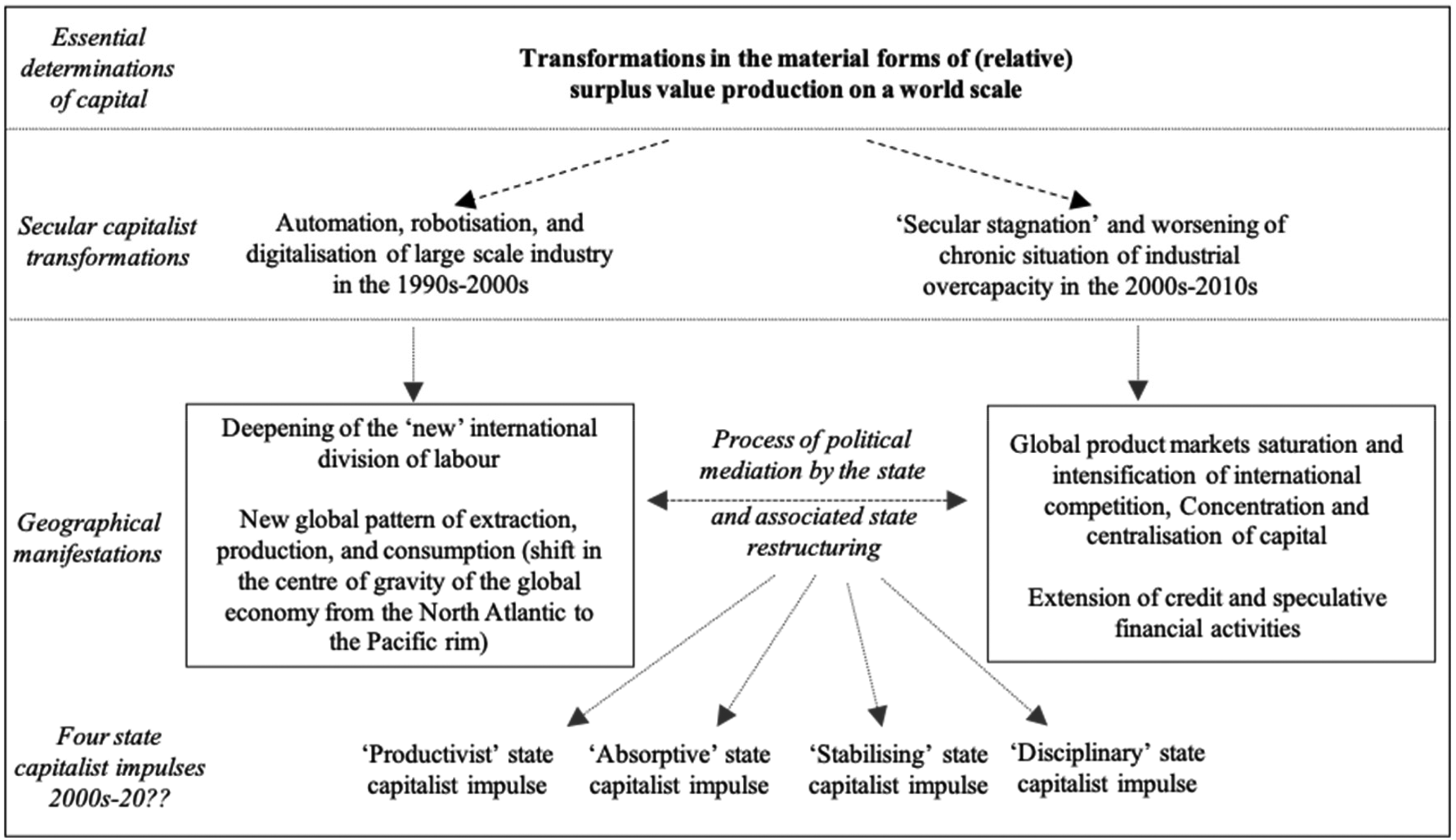
Contemporary state capitalism and its roots in secular capitalist transformations.
Inter-referentiality, combination, and ‘multiplier effect’
These transformations in the repertoires of state action and state capitalist impulses have happened unevenly across territorial borders, depending on a state's position in the international division of labour. Furthermore, they have been shaped by direct political relations between states. Hence, the second aspect of our argument about uneven and combined state capitalism: understanding the rise of contemporary state capitalism also requires examining the various forms of interdependence and co-development between repertoires of state intervention.
As noted in the introduction, recent calls to extend state prerogatives in the West are often explicitly articulated in explicit reference to the extended state prerogatives elsewhere, notably in East Asia. Witness, for instance, Margrethe Vestager, executive vice president of the European Commission: ‘One thing we could learn [from China] is to make a strategy and stick to it’. 12 The ongoing European project to relax rules limiting state aid in a bid to spur the creation of digital champions is a direct response to successes of China and the United States in nurturing the activities of their own brand of platform capitalism. Similarly, efforts to strengthen the EU-wide capacity to regulate inward foreign investments, such as Regulation EU 2019/425, have been justified by the need to monitor foreign state-sponsored entities operating in the European Union. 13 Another telling example is that of the United States, and the current re-articulation of state power which is happening in the context of the ‘new’ Cold War happening with China (Baltz, 2021; van Apeldoorn and de Graaff, 2021). Calls for a stronger industrial policy in the United States have been a response to initiatives such as the Made in China 2025 and other modalities of industrial policy in China.
What these brief examples show is that the landscapes of contemporary state capitalism develop through various forms of conflict and confrontation, cooperation and collaboration, hierarchical subordination and other modalities of unequal articulation. To theorise these relations, it is useful to foreground the notion of ‘combination’ (the C in UCD). As Peck (2019a: 54) notes, combination ‘presents as a potentially boundless source of “multiplier” effects in both socioeconomic and explanatory terms’. This means that the expansion of states’ roles as promoter, supervisor, and owner of capital develops in dynamic, inter-referential, combinatorial forms, resulting in cumulative effects and producing further expansion in state prerogatives across scale and territory. Our argument here is that this combinatory, ‘multiplier’ effect is a particularly potent source of dynamism in contemporary state capitalism, and its tendency to develop in a spiral that both shapes and is shaped by world capitalist development. For the sake of illustration, we provide examples of three types of multiplier effect which have contributed to the cumulative unfolding of the landscapes of state capitalism: competitive emulation, mimetic behaviour, and mutual reinforcement.
Let us first consider an example of competitive emulation. The America LEADS act, which, if passed and signed into law, will extend the prerogatives and budget of the recently created US International Development Finance Corporation (IDFC) to compete more effectively with China's Belt and Road Initiative by co-funding infrastructure projects in developing countries (Schindler et al., 2021). In January 2021, the Financial Times reported that the IDFC struck a deal with Ecuador that will help the country repay billions of dollars in loans to China, in exchange for excluding Chinese telecoms services and equipment providers as they build out their high-speed 5G mobile networks. The chief executive of the IDFC and the American administration have been reported to say that this could be a ‘novel model’, or ‘template that will encourage other nations to wean themselves off Chinese debt and remove Chinese telecoms companies from their networks’. 14 The EU, too, is pushing for co-operation on international infrastructure projects to counter the Belt and Road Initiative. It has signed a partnership in the matter with Japan in 2019 and a global infrastructure deal is expected to be signed with India in 2021. 15
Landscapes of state capitalism also unfold following patterns of mimetic behaviour. For instance, Singapore's and Malaysia's strategic investment funds, Temasek and Khazanah (respectively), have been models for the creation of funds in other developing countries, such as Kazakhstan's Samruk-Kazyna (Dixon, 2020). More recently, witnessing the expansion of East Asian and Middle Eastern sovereign wealth funds, many states across the African continent have created their own state-sponsored funds. Africa now counts 22 sovereign funds, and 7 are in project. Another example of mimetic behavior is that of industrial policy, where successful industrial policy intervention in East and Southeast Asia has ‘inspired low-and middle-income economies to build on their experience and push industrial development through greater participation in global value chains’ (UNCTAD, 2018: 129).
Finally, relations of mutual reinforcement can have a catalysing effect in the landscapes of contemporary state capitalism. Rogers (2021) writes on the mutually beneficial relation currently developing between state-led illiberal regimes in Central and Easter Europe, especially Hungary and Serbia, and Chinese state-capital hybrids. The surveillance technologies and infrastructure projects provided by the latter are instrumental in the consolidation of the hegemony of these illiberal regimes. Similarly, Chinese ‘patient’ sovereign lending has provided debtor states across Latin America with policy space to engage in various forms of statism (Kaplan, 2021). Another example is that of smaller states such as Laos and Nepal who have been able to hedge between the US, China, and powerful regional actors such as India and Vietnam (who compete to finance and control infrastructure-led connectivity and integrate regional value chains), in order to mobilise foreign capital in support of ambitious state-led spatial planning strategies (Schindler et al., 2021).
Conclusion
In this article, we contributed to the development of state capitalism as a reflexively critical project focusing on the morphology of present-day capitalism, and particularly on the changing role of the state. We bring analytical clarity to the field of state capitalism studies by offering a rigorous definition of its object of investigation, and by demonstrating how the category state capitalism can be productively construed as a means of problematising and critically interrogating the current aggregate expansion of the state's role as promoter, supervisor, and owner of capital across the spaces of the world capitalist economy. Noting some of the geographical shortcomings of the field and their analytical implications, we outlined an alternative research agenda – uneven and combined state capitalist development – which aims at spatialising the study of state capitalism as well as revitalising systemic explanations of the phenomenon. Moreover, we asked: what would a geographically informed theory of state capitalism look like? We shed light on the secular capitalist transformations which have underpinned the historic arc in the trajectories of state intervention on a global scale, and especially the combined expansion of state-capital hybrids and of muscular forms of statism. We provided a simple typology of these transformations: the ‘productivist’, ‘absorptive’, ‘stabilising’, and ‘disciplinary’ state capitalist impulses, and argued that these must be grasped as moments of the dynamic process of capital valorisation. We also drew attention to connections at the level of direct political relations between states and repertoires of state intervention. We identified three types of connections which have contributed to the combined expansion of state capitalist impulses: competitive emulation, mimetic behaviour, and mutual reinforcement.
By way of conclusion, let us flesh out the relevance of our programmatic reorientation in theoretical, analytical, and (geo)political terms. Theoretically, we bring the historic development and geographical remaking of capitalism front and centre of state capitalism studies, and we develop the category state capitalism by firmly locating it within a set of logical relations with other fundamental political economic categories, such as the capitalist state and capital accumulation, instead of juxtaposing it to other (conventional) varieties of capitalism. Drawing upon materialist state theory, we argue that state capitalism is an immanent potentiality, an impulse which is contained in the form of the capitalist state and built into its genetic code. This invites reflection as to what factors lead to the actualisation of this potentiality at the current historical juncture. This double theoretical move allows understanding the current advent of state capitalism as a process of self-transformation of the state as it politically mediates the historical-geographical mutations in the material forms of production of (relative) surplus-value on a world scale. Simply put, rather than the negation of an abstract model of free-market capitalism, or the rise of a nationally scaled and relatively coherent variant of capitalism, we posit contemporary state capitalism as a process of restructuring of the capitalist state, including in its liberal form. Importantly, we have shown that this process of state restructuring is not merely a historically contingent form of reconstruction of the capitalist state. It is determined by secular transformations in the materiality of surplus-value production. Characterising the nature of this process of restructuring at the present historical juncture not only allows substantiating claims that the new state capitalism is qualitatively different from previous modalities of state capitalism, it also opens up space for a theoretical reflection concerning the relation between present-day state capitalist impulses and other forms of statecraft (such as neoliberalism), as well as concerning the general place and role of the state in contemporary capitalism: What if contemporary state capitalism signals a permanent transformation in the form and nature of the capitalist state, or the beginning of a phase of capitalist development where states centralise and concentrate increasing amounts of capital?
Analytically, and while much remains to be done to fully reconstruct a geographic theory of the contemporary advent of state capitalism, we hope to have demonstrated the value of integrating the category state capitalism into the theoretical and conceptual grammar of economic geography and geographical political economy, which are uniquely positioned to dissect the spatialities and temporalities of the phenomenon. Uneven and combined state capitalism unsettles the ‘metageographical unconscious’ than undergirds much of the field of contemporary state capitalism studies and focuses our analytical attention on the interweaving of spatialised social relations underpinning and connecting the various repertoires of state action, as a means to scrutinise contemporary state capitalism as a variegated and dynamic world-historical totality. Our programmatic agenda also holds implications for research engaged in the comparison of different instantiations of state capitalism, which it reorients from a focus on analytical model-building towards greater self-reflexivity with respect to methodological and theoretical choices and their irreducibly political nature. This in turn opens space for greater emphasis on what Bruff calls ‘the politics rather than merely the analytics of comparison’ (2021: 7). For instance, it encourages us to make explicit and legible the political-geographical imaginaries that underpin the act of comparison (Alami and Dixon, 2020b); it pushes us to reflect on (what passes as) the normal separation between the state qua public and the private sphere in capitalism (without the ‘state’ qualifier), and on the normative orientations of these assumptions; it also encourages us to become more attuned to some of the blindspots of state capitalism studies, interrogating, for example, the absence of class in contemporary debates (e.g. Sperber, 2019) and the invisibilisation of working class struggles.
Our argument has implications for how we understand the (geo)political repercussions of state capitalism. Uneven and combined state capitalism is unlikely to lead to patterns of institutional and political convergence or divergence, which have been central lenses in state capitalism studies and discussions of changing world orders (Boyer, 2020; Milanovic, 2019). State capitalism may well beget state capitalism, but the future of the global political economy will not be one where a ‘model’ has prevailed over another. Such future is more likely to be characterised a sort of ‘polycentric restructuring’ (Peck, 2019a) of the landscapes of state capitalism, catalysed by the dialectical and cumulative unfolding of more muscular state prerogatives and the proliferation of state-capital hybrids across territory and scale, via recombinant and contradictory pathways fraught with class, geopolitical, and ideological tensions.
Finally, future research may further scrutinise the imbrication of contemporary state capitalism in processes of capitalist restructuring and geographical remaking in the post-COVID-19 environment. An important issue, not covered in this paper, is the extent to which various forms of struggle and resistance from workers and populations rendered surplus will shape the future of state capitalism. For instance, labour and civil society organisations are increasingly calling for governments to expand their role as owners of capital. This includes calls for Green New Deals, vast democratic state ownership, or the creation of social wealth funds. Will these demands push state capitalism in a more progressive direction?
Footnotes
Acknowledgements
This research was supported by the European Research Council (ERC) under the European Union's Horizon 2020 research and innovation programme (grant agreement no. 758430). Thanks are due to Greig Charnock, Imogen Liu, Milan Babic, and two anonymous reviewers for useful comments and suggestions on a previous version of the manuscript, and to Heather Whiteside and Jamie Peck for excellent editorial guidance.
Declaration of conflicting interests
The authors declared no potential conflicts of interest with respect to the research, authorship, and/or publication of this article.
Funding
The authors disclosed receipt of the following financial support for the research, authorship, and/or publication of this article: This work was supported by the H2020 European Research Council (grant number 758430).
