




Abstract
The agency of casualized and spatially isolated workers has recently received increased research attention. This paper extends this line of research to seafarers, a traditional but also casualized and spatially isolated workforce. More specifically, it examines cases of collective action by Chinese seafarers on WeChat, a social media platform, in response to problems and grievances caused by COVID-19 control measures during the pandemic. It shows that seafarers, building on the WeChat platform and together with other maritime stakeholders, have established a socio-technological infrastructure that enables them to mobilize their peers to take action when they experience injustice at work. Their mobilization is morally charged, involving a frame of injustice that evokes moral sentiments in the participants and compels them to act to provide moral support to the distressed seafarers and to exert moral pressure on the authorities. These agency practices on WeChat thus highlight the moral dimension of collective action and reflect what can be called moral mobilization.
Introduction
Seafaring is an age-old profession. Currently there are some 1.9 million seafarers operating a global merchant fleet of 74,000 ships carrying 80% of international trade (UNCTAD, 2022). Economic globalization has made it a common practice for ship owners/managers to register ships in flag of convenience countries (e.g. Panama and Liberia) and source seafarers from relatively cheap labour supply countries (e.g. the Philippines and China) on short-term employment contracts (Tang and Zhang, 2021). This practice results in a largely outsourced, casualized, and supplied just-in-time multinational seafaring workforce. In addition, the workplace on-board is mobile and isolated, with typically 10–20 crew members. It is also a fluid workplace as seafarers on a ship are only a temporary team – they come and go, perhaps joining another ship or even another shipping company next time. When taking leaves ashore, they are scattered in different towns or cities, making it difficult for seafarers to socialize with former shipmates. As such, the seafaring workforce today is not only casualized but also spatially dispersed and individualized, which limits the prospects for collective action (Bloor, 2005).
Casualized and spatially isolated workers include not only seafarers but also many other occupational groups, such as those working in the platform economy, a relatively new sector. Recently, the agency of platform economy workers has received increased research attention and the literature shows that these workers make use of social media to overcome isolation and exercise agency in various spaces and a range of ways depending on the work and employment context (Anwar and Graham, 2020; Johnston, 2020; Morales-Muñoz and Roca, 2022; Wells et al., 2021). Against this backdrop, Anwar and Graham (2020) point out that workers’ use of social media provides a new perspective for understanding labour agency. Unlike platform workers, seafarers do not rely on the internet to do their jobs, but they do use social media to stay in touch with each other nowadays. However, little research has been done to examine seafarers’ use of social media to exercise agency. Seafarers also differ from platform workers in that although they are spatially isolated, they nevertheless work in small, albeit fluid, teams at sea. The differences warrant an examination of seafarers’ use of social media from a labour agency perspective.
During the COVID-19 pandemic, Chinese seafarers engaged in collective action on social media in response to China’s zero-COVID measures. This paper examines such actions, guided by the research question: how Chinese seafarers used social media to exercise agency during the COVID-19 pandemic. In the process, this paper theoretically proposes and empirically demonstrates the concept of moral mobilization. It makes a contribution by drawing attention to the moral dimension of collective action in digital spaces. More specifically, by focusing on a hitherto under-recognized occupational group, this paper contributes to the debate on labour agency related to casualized and isolated workers.
Labour agency and spatially dispersed workers
Labour agency is a core theme of labour geography (Coe, 2013), broadly understood as the ability to act in and on space to protect and advance one’s self-interest in work and employment (Anwar and Graham, 2020; Carswell and De Neve, 2013). It is a ‘socio-spatial process’ that is never-ending and ever-changing (Wells et al., 2021: 318). While recognizing that labour agency is embedded in and constrained by social structures (Coe and Jordhus-Lier, 2011), labour geographers have also demonstrated that workers are able to create and manipulate socio-economic landscapes to reflect their interests (Herod, 1997; Herod et al., 2007).
With the expansion of the platform economy, the question of how casually employed and spatially isolated workers exercise agency has received increased research attention. De Stefano (2016) distinguishes between two types of platform work: crowdwork and work-on-demand via apps. In the former, workers complete work tasks remotely through online platforms, while in the latter, work activities such as transportation are organized online but performed in the physical world and locally. Crowdwork platforms delocalize workers (Lehdonvirta, 2016) – as crowdworkers perform micro-work online and can be recruited from anywhere in the world, this type of work minimizes the opportunities for workers to meet, dis-embeds workers from local institutions, and distances them from their employers. In contrast, work-on-demand via apps is place-based and is therefore also known as place-based platform work (Johnston, 2020). Nevertheless, place-based platforms also isolate and disempower workers by putting them ‘just-in-place’ where and when the services are needed (Wells et al., 2021).
Research evidence shows that platform workers have identified and created social spaces for agency practices but with marked differences between the two groups (Johnston, 2020). Place-based workers may not have a formal workplace, but they often encounter each other in airport parking lots, food joints, and on street corners, and also make connections through social media. These informal meeting points not only allow workers to overcome isolation, but also provide spaces for them to share information, discuss common concerns and provide mutual support (Chen, 2018; Lei, 2021; Parth et al., 2023; Tassinari and Maccarrone, 2020; Wells et al., 2021). Furthermore, a collective frame of injustice can be developed through discussing common problems and grievances, which together with frequent interactions create and reinforce solidarity (Maffie, 2020). The injustice frame and solidarity can in turn lead to collective mobilization, mobilizing workers to make collective protests and demand justice in public spaces (Lei, 2021; Parth et al., 2023; Tassinari and Maccarrone, 2020).
In contrast, being not place-based, crowdworkers largely connect through social media in digital spaces where they exercise agency in the form of everyday individual, unorganized and low-key practices (Anwar and Graham, 2020; Lehdonvirta, 2016; Wood et al., 2018). Building on Katz’s (2004) typology, Anwar and Graham (2020) group these agency practices into resilience (coping strategies, such as forming online communities and providing mutual support, information and advice), reworking (efforts to improve working conditions, such as negotiating working hours and wages) and resistance (e.g. exposing, boycotting and leaving negative reviews for bad clients, withholding the output from clients). Anwar and Graham (2020) following Scott (1990) use the term ‘hidden transcripts’ to describe these low-key agency practices, highlighting that they take place on the backstage and do not directly confront employers.
Despite the differences, the above discussion suggests that digital spaces have become an integral part of the landscape of labour geography, especially for casually employed and isolated workers. Nevertheless, whether they exercise agency individually or collectively, online or offline, as hidden or public transcripts, depends on the work and employment context. In line with Anwar and Graham (2020), it can be argued that examining how individualized and isolated workers exercise agency in digital spaces and different contexts broadens the understanding of labour agency.
This paper extends the debate to the maritime front by focusing on a more traditional but also casualized and isolated occupational group, seafarers. While the lack of research into seafarers’ agency in digital spaces is notable, the maritime literature has demonstrated that seafarers exercise agency in a variety of ways, from small acts of disobedience to collective political organizing, and in different spaces, from the confined space of ships at sea to ports (Griffin, 2022). Historically, while small acts were common, large-scale protests also took place, particularly in the processes of anti-racist and/or anti-colonial struggles undertaken by seafarers of colour (Featherstone, 2022; Griffin, 2022). As mentioned earlier, today’s shipping industry has been transformed into a globalized industry with an individualized multinational workforce that is suited to the mobile and flexible working environment on ships and helps reduce operational costs (see also Borovnik, 2022). While not directly discussing agency, research indicates that seafarers’ agency in the workplace today is characterized by everyday resilience and low-key resistance activities under the radar of management (e.g. protecting colleagues by not reporting small incidents or withholding information from management; secretly divulging shipboard safety-related concerns to external inspectors who can press managers to take action) (Bhattacharya and Tang, 2013; Bloor, 2005; Sampson et al., 2019; Tang and Bhattacharya, 2018). A common theme in this literature is seafarers’ fear of being punished and even losing their jobs, as they can be easily replaced by other seafarers at any time and in any port (Tang and Zhang, 2021). It is therefore not surprising that they avoid confrontation with managers. It is envisaged that organized labour would counterbalance the power of management and allow seafarers to voice and address workplace concerns collectively and effectively (Walters and Bailey, 2013). However, the mobile and fluid shipboard workplace and the casualized and flexible workforce limit the prospects for collective action (Bhattacharya and Tang, 2013; Bloor, 2005).
This is not to imply that seafarers no longer have collective agency. Seafarers internationally are represented by the International Transport Workers’ Federation which negotiates with maritime employers to improve seafarers’ working and employment conditions (Campling and Colás, 2021; Lillie, 2013). However, this bargaining power does not derive from the solidarity of seafarers but relies on dock workers who could threaten to boycott ships in port in support of seafarers (Lillie, 2013).
The recent COVID-19 pandemic posed significant challenges to the wellbeing of seafarers. It forced many countries to close their borders and restrict international travel, which led to a crew change crisis. At its peak, the crisis left 400,000 seafarers stranded on ships and forced to work beyond their contracts (IMO, 2020). Furthermore, seafarers were denied shore leave, and in some instances, access to healthcare facilities on shore. The situation resulted in seafarers suffering from anxiety, depression, and frustration (Borovnik, 2022; Brooks and Greenberg, 2022). Devereux and Wadsworth (2022) observed that even when repatriation was possible, some shipping companies were reluctant to conduct crew changes due to the high costs involved. This was particularly the case for casually employed seafarers.
Compared to their foreign colleagues, Chinese seafarers experienced more difficulties during the pandemic. China adopted a zero-COVID policy, and to achieve its goals, the Chinese health and maritime authorities put up various obstacles to discourage or, in numerous cases, disallow crew changes between Chinese seafarers in Chinese ports (Zhao et al., 2023), which led to frustration and grievances. Some of them voiced their grievances on WeChat, the most popular social media platform in China, and their complaints triggered collective action in the WeChat maritime community. This paper examines seafarers’ agency manifested in these events with the concept of moral mobilization, the theoretical underpinnings of which are outlined below.
Moral mobilization
Collective action presupposes collective mobilization, that is, mobilizing a group of people to take action together. In other words, collective mobilization can be seen as a process that leads to collective action. Collective mobilization implies solidarity, a form of social identification that depends on a distinction between ‘us’ and ‘them’ (Morgan and Pulignano, 2020). While acknowledging that solidarity is often called for by collective action organizers as a pragmatic means of defending and improving group interests, this paper draws attention to its moral dimension – it goes beyond the calculation of self-interest and involves feelings of reciprocity and mutual responsibility (Lei, 2021; Morgan and Pulignano, 2020; Wilde, 2007). As Crow (2010: 58) puts it, ‘people participate in solidaristic behaviour because it is the right thing to do’. More specifically, the moral dimension can be reflected in several aspects of mobilization. First, a sense of injustice (inflicted on workers) is an essential condition for mobilization (Kelly, 1998). 1 It involves the belief that a situation or event is morally wrong and unjust because established moral principles are violated and should be redressed (Gamson, 1995). Moral principles reflect what Durkheim (1984) called ‘collective conscience’, which can shape the conduct and behaviour of social actors towards social goods. Thus, in the next stage, the sense of injustice evokes moral feelings of indignation among participants, and such feelings move people and can spur them into collective action, either online or offline (Eyerman, 2007; Wilde, 2007; Yang, 2007). Finally, collective action exerts moral pressure on those who have committed the violation.
Based on the above discussion, moral mobilization can be understood as a process in which moral transgression acts perpetrated by the powerful evoke indignation among those who identify with the victims and galvanize them to partake in solidaristic action demanding redress for the injustice. It is a special type of collective mobilization that feeds on moral power in the process. Following Durkheim (1912), Crow (2010) and Morgan and Pulignano (2020) further emphasize that while solidarity may remain latent and relatively dormant most of the time, it can be awakened by acts of extreme injustice by sitting powers and burst into intense expressions of indignation. Durkheim used the term ‘collective effervescence’ to capture the intensity of such outbursts and to highlight the speed with which participants are drawn in to take part in collective action.
Collective action online has been widely studied. Castells (2007) argues that digital communication networks enable ‘mass self-communication’, highlighting that ordinary internet users can generate content and disseminate it through digital networks. Furthermore, in digital spaces, people can easily find others with similar professions or interests and form online groups. Wellman (2001) refers to these groups as ‘specialized communities’, emphasizing that members relate to each other through shared identities. These features are seen to facilitate collective mobilization by promoting collective identity and helping labour organizations disseminate messages, reach and influence possible alliances, and draw in more participants (e.g. Garrett, 2006; Geelan, 2021; Heckscher and McCarthy, 2014; Pasquier et al., 2020). Moreover, Bennett and Segerberg (2012) note that the ease of generating and spreading messages online has given rise to ‘connective action’, a new and special type of collective action that takes place online. Unlike traditional collective action which is mobilized and coordinated by resourceful organizations around a collective frame, connective action is characterized by spontaneous activity in the form of producing and sharing personally expressive content around a common issue via social media. In connective action, the act of producing and sharing serves to mobilize others to take similar action. Thus, action and mobilization collapse into one. This body of literature on online mobilization, however, pays little attention to the power of moral expressions, even though psychologists have noted that moral sentiments could significantly enhance the diffusion of messages on Twitter (Brady et al., 2017). By bringing to the fore the moral dimension of collective action, this paper addresses this gap.
Research context and method
WeChat is a smartphone application launched in 2011. It has become the main way for people to stay in touch in China. Furthermore, it allows users to share news and information online and has become a major source of information for many people. The same is true for Chinese seafarers: since it is easier to carry a mobile phone which provides access to the Internet in port (and at sea if the ship has Wi-Fi), WeChat is the main channel connecting them to the outside world.
WeChat supports three types of social networks (Harwit, 2017; Tang, 2022a; Tu, 2016): WeChat friends networks, WeChat groups and WeChat public accounts. A friend network consists of bilateral relationships that a user maintains on WeChat. A WeChat group is set up by an individual who then invites people from their friend network to join the group to discuss topics of common interest. Both these types of networks are private. The ‘moments’ (text-based status updates, pictures, videos and links) one posts on their WeChat wall can only be seen and commented on by their WeChat friends, and chats between two friends or within a group are private conversations.
This paper focuses more on WeChat public accounts, which function as media outlets and aim to attract followers. When a public account makes/publishes a new post/story, its followers automatically receive the update, and can read and comment on the post. In addition, the followers can share the post in their WeChat friends networks and groups so that their friends can also read the post and share it. In this way, a public account is open to any WeChat users and its posts can be shared across WeChat networks. Furthermore, public accounts and their posts can be searched using WeChat search, while normal user accounts and their related information are private and not searchable. In China, many maritime-related public accounts have been created on WeChat. The followers are largely industry stakeholders, including seafarers, seafarers’ family members, ship managers and other maritime professionals. Seafarers have also created numerous WeChat groups. The interconnectedness of friends networks, seafarer groups and maritime public accounts enables the formation of a large community of maritime professionals, the main function of which is to share maritime information and news.
During the pandemic, some seafarers experiencing problems resorted to staging workplace protests and sharing their grievances and demands through WeChat networks. When such events began to emerge in April 2020, they caught my attention because according to my observations over the past five years, similar events had never happened. I started to follow the development of the crisis and archived (by downloading) some related reports from maritime WeChat public accounts that I followed.
In October 2022, I decided to systematically examine seafarers’ actions in this regard. In this systematic approach, I chose CNSeaman and Shipping-Online, two WeChat public accounts, as the two focal sites for data collection for a few reasons. Firstly, they were two well-established maritime public accounts with a large number of followers. CNSeaman boasted 50,000 followers, and Shipping-Online had more (as their posts tend to receive far more views than CNSeaman’s). Secondly, I had been following them for over 5 years and was familiar with them. Finally and more importantly, to my knowledge, they were the two most active and most influential accounts involved in helping seafarers make pleas for crew change facilitation.
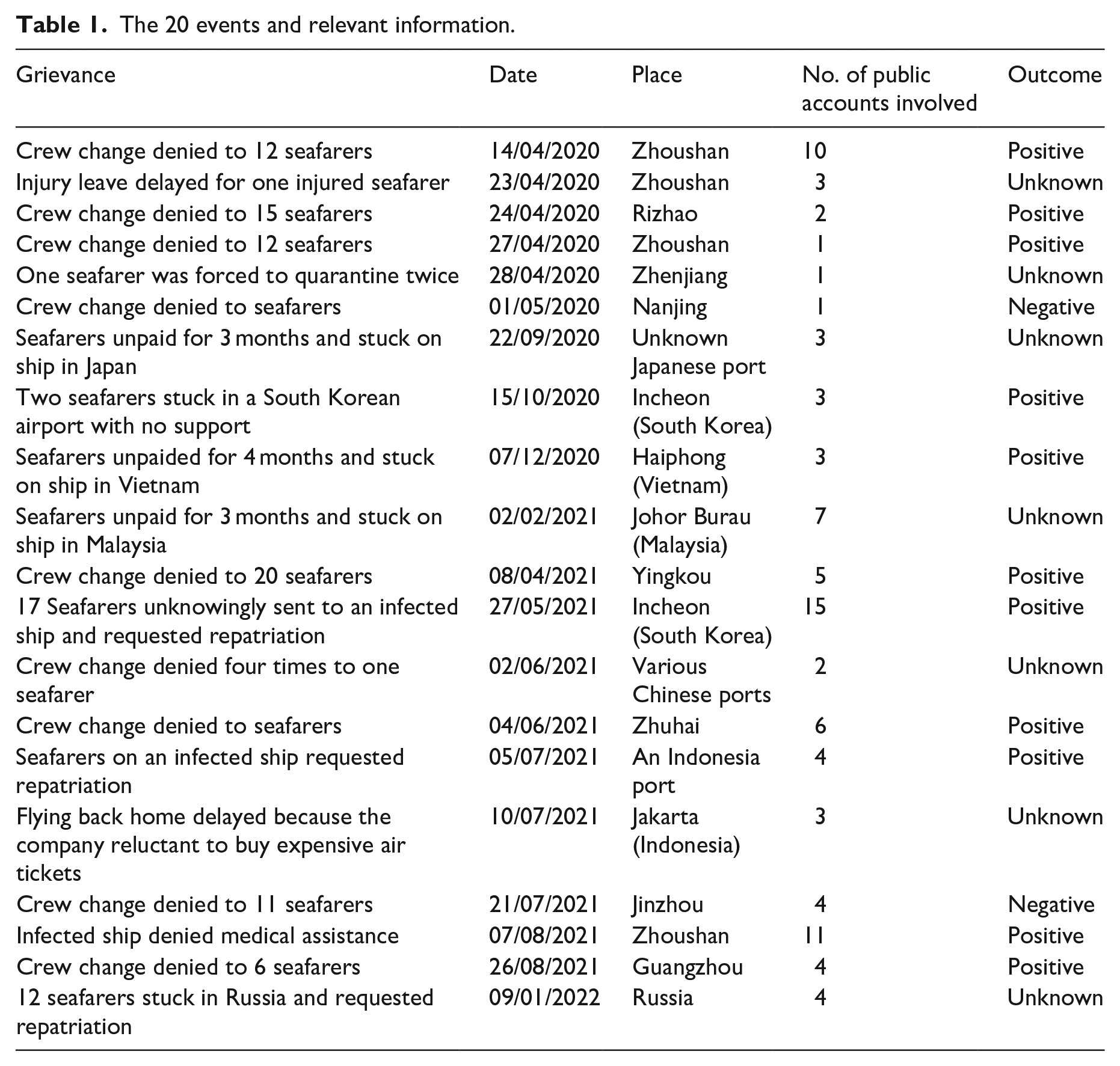
This systematic approach consisted of three steps. First, I went back to check all the posts that the two accounts published between March 2020 to October 2022 and archived all the stories (along with the comments) in which seafarers voiced their grievances. During this period, CNSeaman covered 10 stories of seafarers seeking help with 23 posts (including 10 initial and 13 follow-up posts), and Shipping-Online did 15 stories with 32 posts. Together they covered 20 stories (5 stories were covered by both accounts). As social media is part of a ‘messy web’ where various sites and platforms are interconnected, it is recommended that researchers crisscross a range of platforms, sites and hyperlinks to track the needed information (Postill and Pink, 2012; Yang, 2009). Thus, in the second step, I searched on WeChat using relevant keywords to identify other public accounts that also covered these 20 stories (see Table 1 for the list of stories and the number of public accounts involved). In the final step, Google searches on these stories were conducted to find out if they were followed up by traditional news media. The searches revealed that two cases were covered by traditional news media.
The 20 events and relevant information.
Due to space limitations, this paper focuses on two cases. A case has many dimensions, including the cause of the event, its location, its outcome, and the actors involved. It is unlikely to find a case that is representative in all dimensions. Nevertheless, it is argued that case studies aim to extend theory rather than seek representativeness (Burawoy, 1998), and as such theoretical salience should be considered when selecting cases (Tavory and Timmermans, 2009). Following this guiding principle, this paper chooses the two cases that were reported by traditional media organizations and involved a large number of public accounts. They contain richer information and activate more actors, and are therefore more likely to illuminate the underpinning factors and mechanisms in the process and allow for in-depth analysis (Flyvbjerg, 2006; Thomas, 2011). In addition, they differ in terms of causes, and as such allow for comparisons that can contribute to a deeper understanding. The second case was covered by Shipping-Online, but not by CNSeaman. However, it was the most influential case – it was reported by numerous news media and Google searches showed that its presence on the wider internet was much more visible than other cases. As such, it has more potential to provide theoretical insights.
The two cases were analysed from two perspectives. First, the development of the cases was reconstructed using the information collected in the three-step approach mentioned above. Second, the comments on the two stories posted on WeChat public accounts were thematically analysed to shed light on the feelings and reactions of the participants.
The two cases of seafarer rights violation
The first case concerned a group of 12 Chinese seafarers on board a ship that were denied crew changes in the Chinese port of Zhoushan. The ship arrived at a shipyard in Zhoushan on 1 April 2020 for dry-docking. The 12 seafarers had been working on the ship for more than 10 months, in excess of their contracts. In addition, three of them had to return home urgently to deal with family emergencies – death or hospitalization of family members. They expected to be relieved from the ship at Zhoushan. In preparation for the crew change, they underwent polymerase chain reaction (PCR) testing on 10 April, with negative results returned 2 days later. They also agreed to self-isolate in a local quarantine hotel for a further 2 weeks before returning home. However, on 13 April, the local authorities refused the crew change request, citing limited quarantine hotel capacity as the reason.
The second was the Grand Progress incident, in which the COVID-19 infected crew were denied medical assistance in Zhoushan waters. The Grand Progress was a ship manned by Chinese seafarers. It left a Philippine port on the morning of 30 July 2021 for the Chinese port of Nantong. Later that day, the chief officer developed a fever, and soon four other crew members developed fever symptoms. The captain informed the company and the ship’s agent. The agent later informed the crew that Nantong had refused the ship to enter the port due to local pandemic control measures. On 3 August, while the ship was sailing near Zhoushan, the main engine developed problems and the crew dropped anchor to repair it. By this time, the entire engine crew had fallen ill. They managed to repair the engine but were unable to continue working. They requested emergency medical assistance from the Zhoushan Port Authority, which refused on the grounds that such a request had to be made through the ship’s agent. The agent, however, resigned. The company called the Zhoushan municipal government for help and was again told to go through an agent, but there was no agent in Zhoushan willing to work for the company. At the same time, the seafarers informed their families of the situation, and the family members also tried to get help from the local government through various channels. However, no help was forthcoming from the authorities for the next four days.
Both cases involved violations of seafarers’ rights. In the first case, the seafarers had the right to be repatriated at the end of their contract, both as a common practice and as a legal requirement under the Maritime Labour Convention. In the second case, the right to life is a fundamental human right and as such emergency requests for medical attention should be attended urgently. What made the violations even more unacceptable was that these were Chinese seafarers whose reasonable requests were denied by the Chinese local authorities in a Chinese port.
Moral mobilization on WeChat
The crew change case
On 14 April 2020, at the request of the 12 frustrated seafarers, Shipping-Online posted a report entitled, ‘I’m a Chinese seafarer; my mother passed away, but I cannot get off the ship’. The report began with a 15-second video of two seafarers holding a Chinese flag and behind them eight other seafarers holding a giant white banner on the ship with the red words ‘We are Chinese seafarers; we are healthy and request to go home’; and they chanted several times, ‘We are Chinese seafarers; we request to go home’. The report also included an open letter collectively written by 12 seafarers to the local authorities reiterating their situation and crew change request.
The 12 seafarers thus produced their frame of injustice with the flag, the banner, the video and the open letter. The flag and banner emphasized the injustice of being refused entry at the door of their home country. The open letter clarified that it was their right to sign off the ship and also stressed family emergencies, which added more moral weight to their reasoning. Together, they presented a strong case of injustice – it was not only wrong and a violation of their rights but also immoral and inhumane to refuse their request.
Flags, banners and slogans are traditional cultural artefacts used in public protests to enact solidarity and attract attention (Morgan and Pulignano, 2020). Confined to the enclosed and isolated workplace, however, the seafarers could only engage in agency practices by performing the protest rituals in front of a mobile phone camera. They hoped that their performance could be re-enacted repeatedly in virtual space by digitally transmitting the recording and the message. To this end, the WeChat networks were instrumental in spreading the message in two dimensions. Horizontally, the story spread quickly among maritime-related public accounts. On the same day, the post was reposted by at least another seven public accounts, including CNSeaman. Vertically, these public accounts disseminated the story to their followers. Many followers responded to it in several ways: reading it, leaving a comment on the story on the public account page, and sharing it with their WeChat friends, in WeChat groups and on WeChat walls which spread the story horizontally to the people connected to them. While in this case, it was impossible to know how far the followers spread the story in their personal WeChat networks because the latter were private and closed, the information provided on public account pages showed that the story was widely read: Shipping-Online recorded 22,300 views and 86 comments, and CNSeaman did 8452 views and 68 comments.
As the high volume of reposting, reading, commenting and sharing involved a large number of people, such concerted and concentrated online actions are often seen as an online form of collective action (Bennett and Segerberg, 2012; Wilkins et al., 2019), which is common in China where unauthorized public demonstrations are banned (Yang, 2009). Since these actions were spontaneous and revolved around sharing a particular story through WeChat networks, they could be understood as connective action (Bennett and Segerberg, 2012). Bennett and Segerberg (2012) argued that connective actions rely on social media technologies as the organizing agent. This argument has merit in this case since the WeChat technological structure facilitated the transmission of the message. However, it should be added that moral sentiments also play an important role.
Moral outrage and indignation are visible in the comments on the public account pages. These comments revolve around four themes. The first two themes are most common, each accounting for 45% of comments, while the remaining two themes account for about 10%. The first theme is criticism of the local authorities for lazy governance and abuse of power. For example, two commentators wrote: For the sake of so-called political achievements, it is better to do nothing than to do something and make mistakes. That is outright lazy governance. Pandemic prevention and control measures are understandable, but why deny healthy seafarers the right and freedom to go home? Who gives the port authorities the power to do this?
The second theme is related to expressing anger at the mistreatment of seafarers and lamenting the marginalized status of seafarers: Why is there no future for Chinese seafarers? Is is because the government does not care about them, coupled with the various difficulties and restrictions imposed on them by the authorities . . .
The third theme is also to express anger but at the same time to call for strikes or solidarity: Students studying in pandemic-stricken countries are allowed to fly back to China. Why are healthy Chinese seafarers who have already arrived in a Chinese port not allowed to go home? Let’s strike! Strike to get back our human rights!
Finally, some commentators called on the authorities to respect the human rights of seafarers.
These comments indicate indignation at the authorities and sympathy for the victims. Indignation and sympathy are two sides of the same coin in this case, and both reflect the moral principle of justice. They are moral feelings. These sentiments facilitated and accompanied collective mobilization. They galvanized a large number of community members to read, share and comment on the story, as moral emotions move people and compel them into action (Brady et al., 2017; Eyerman, 2007; Yang, 2007). Commenting and sharing can be seen as moral support since the participants were aware that increased attention to the event could mount pressure on the authorities.
In addition to the moral sentiments and the technological structure of WeChat networks, the existing WeChat maritime community is also crucial for mobilization. The community consists of three types of networks – friends networks, seafarer groups and maritime public accounts – interlinked together. Given that about half a million Chinese seafarers work at sea each year (Tang, 2022b), it is reasonable to assume that the WeChat maritime community on WeChat is huge. As a professional community, the members could easily identify with each other (Garrett, 2006). Seafarers tend to see themselves as a marginalized, drifting and vulnerable workforce often subject to abuse of power and exploitation by local port officials (Sampson et al., 2016). The comments discussed above (particularly the second and third themes) clearly reflect this collective identity, which compelled them to empathize with the grieved seafarers, to feel outraged and to act on that feeling.
Within the community, public accounts played a leading role in the mobilization process, determining whether a post will be put online. The 12 seafarers understood that they needed to mobilize the influential public accounts first, who could then help mobilize the community. In other words, the public account holders/editors acted as both the mobilizer and the mobilized. There were many similar cases at the time, but to have maximum influence, the public account holders chose to publish harrowing stories that reflected common problems faced by seafarers (Tang, 2022a), as reporting too many cases at once would dilute attention. Thus, as Table 1 shows, only a limited number of cases were covered over the 3 years.
It should be noted that ‘influence’ has two dimensions – the influence of the story and the influence of the public account. As these public accounts focused on seafarer welfare issues, they hoped that the story could mobilize (or influence) as many people in the community as possible, which in turn meant that their accounts also gained influence in the process. From the perspective of ordinary participants, participation in the form of reading required little effort compared to leaving a comment and was risk-free as they did not leave personal opinions. 2 Nevertheless, from the perspective of the public accounts, every click counted as an influence. The same could be said for the grieved seafarers, and influence brought hope.
The community consists of not only seafarers, but also other stakeholders of the industry, such as ship managers, maritime traders and maritime media workers, who are in the community to gather and disseminate maritime information. They were likely to sympathize with the seafarers, especially since some of them were ex-seafarers. More importantly, they could disseminate the story out of the seafarer circle and scale up the mobilization to the traditional media and offline spaces. Thus, on 15 April, China Shipping Gazette, a weekly maritime news magazine, and China Business Network, a national news organization, followed up and reported the story by interviewing the seafarers, the local port authorities and Ministry of Transport officials, and analysing the problem. The moral mobilization generated mounting pressure on the Zhoushan authorities. On 17 April, they reverted their former decision and allowed the 12 seafarers to sign off the ship. Later, CNSeaman posted a message revealing that they had received a phone call from the Zhoushan maritime authority. During the call, while the authority stressed that they were under immense pressure to balance pandemic control with numerous crew change requests, they assured that they were taking all necessary steps to facilitate crew changes by expanding quarantine capacity and simplifying procedures. This message indicates that in response to the moral pressure, the authorities felt the need to explain their situation and efforts, reassure the maritime community and minimize further reputational damage.
The Grand Progress incident
With the health situation deteriorating, on the morning of 7 August, the Grand Progress crew turned to a few maritime public accounts for help and produced their frame of injustice. In addition to a text message explaining their situation, the crew also enacted the rituals of a protest and sent the photo and a video recording to the public accounts. The photo featured the crew in front of a giant white banner, which read, ‘We have seafarers on board with fever and request urgent medical assistance’. In the video, a crew member holding his identity card tearfully explains the dire situation and makes an emotional plea for help.
Unsurprisingly, this story quickly circulated in the maritime community through horizontal and vertical ties. It was initially posted by three public accounts, Seamen’s Friend, Maritime World, and Maritime Elite. Within hours, it was reposted by at least another eight public accounts, including Shipping-Online. Vertical transmission disseminated the story widely. Shipping-Online’s post, for example, received 50,900 views, twice as many as the crew change story.
A closer examination suggests that the two sets of public accounts that circulated the two stories are not identical, although they overlap. Three public accounts – Shipping-Online, Maritime Elite, and Good Seamen – (re)posted both stories. The remaining accounts in each set covered only one story– CNSeman for example posted the first story, but not the second. This divergence indicates that each story mobilized a section of the community. Comparatively, the Grand Progress incident mobilized a larger part of the community – not only more public accounts but also more ordinary WeChat users participated as the story received more views. This could be partly explained by the nature and severity of the grievance and injustice – the health and even lives of the Grand Progress seafarers were in imminent danger and yet the authorities refused to provide any assistance. Such irresponsible and inhumane behaviour caused stronger indignation and mobilized more people. This further indicated the power of strong moral sentiments to mobilize people.
The story on Shipping-Online received 80 comments around five themes. Calls for the authorities to take rescue action and criticism of the local authorities for lazy governance are the two most common themes, each accounting for about 30% of comments. Regarding the former, one participant commented: There will be more such cases in the future. The government must take action and come up with a practical solution that puts human life first rather than shirking its responsibility
A further 20% of comments urged the Grand Progress crew to take extreme measures, such as beaching the ship or taking the lifeboat ashore to force the authorities to take action. For example, one comment reads: I recommend that the captain make the decision to abandon the ship, take the lifeboat ashore with the crew, and then make a 999 emergency call telling them that there are 20 COVID-19 patients to be treated.
Clearly, comments like these were not made to provide practical suggestions, but to express their indignation.
The fourth theme is lamenting the marginalized status of seafarers, which accounts for 13% of comments. Finally, the remaining few comments offered more practical suggestions, such as leaving an SOS message on the State Council’s website and providing some folk remedies. Taken together, these themes again reflect sympathy for the crew and indignation at the authorities.
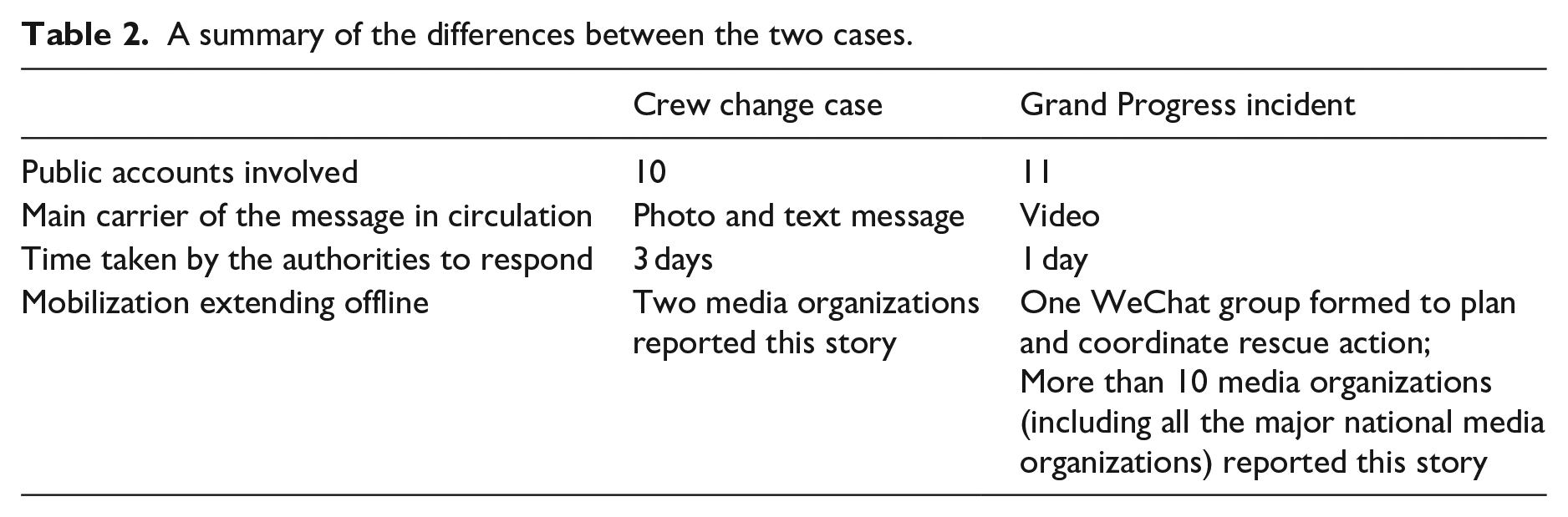
The video also played an important role in effective mobilization. In the crew change case, although there was also a video, it was short (15 s) and contained little information. For this reason, it was the text message with the photo that circulated in the community. In the Grand Progress case, a seafarer explained their plight in detail (almost 2 min) and in the middle of the video, he could not help but sob. Research has shown that video is more powerful in engaging the viewers and can evoke emotions more effectively than text because it provides more physical cues (Yadav et al., 2011). As such, it was not surprising that the video mobilized more people in the community than the text and became the main carrier of the message in circulation. One news report (Zhang and Chen, 2021) recounts the reaction of a Chinese captain whose ship was sailing in Chinese coastal waters at the time. The captain saw the video from one of his WeChat groups and wanted to do something to help, but as he was at sea there was nothing practical he could do. Therefore he quickly provided moral support by sharing the video on his social media accounts to spread the word. Within an hour, he noted that it had been viewed more than 10,000 times and that many of his WeChat friends had shared it on their WeChat wall.
At the same time, mobilization extended offline. A few seafarers teamed up with local health workers and professional rescuers to form a WeChat group, aiming to coordinate and provide practical help (Zhang and Chen, 2021). They devised a plan to use a drone to drop medicine onto the ship. Before the plan was implemented, however, the Zhoushan authorities responded to pressure. In the early hours of the second day, as mainstream media outlets picked up on the story and began to follow it, the authorities initiated emergency assistance procedures. Given the attention that it had received and the urgency of the matter, the speedy response was not surprising. Overall, while the two cases followed a similar mobilization process, the Grand Progress incident resulted in a faster and wider mobilization and exerted greater moral pressure on the local authorities. Table 2 summarizes the main differences between the two cases.
A summary of the differences between the two cases.
Concluding discussion
The Internet allows individuals to produce and disseminate content quickly and widely and to connect with others with similar identities to form specialized communities (Castells, 2007; Wellman, 2001). These features facilitate collective identification and mobilization (Bennett and Segerberg, 2012; Garrett, 2006; Heckscher and McCarthy, 2014; Pasquier et al., 2020). These findings are applicable to the Chinese seafarer cases as well. A WeChat maritime community has been established, enabling isolated seafarers to stay in touch, and the WeChat network structure enables quick and wide information transmission. The technological structure facilitates the formation of the WeChat community. Taken together, they can be seen as a socio-technological infrastructure that plays an important role in the mobilization process.
However, the socio-technological infrastructure alone does not fully explain seafarers’ mobilizations during the pandemic. It has been in place for many years, but as mentioned earlier such seafarer mobilization never took place in the WeChat community before the pandemic. There must be other factors in play during the pandemic, and the analysis of the cases points to moral mobilization. Due to China’s draconian zero-COVID policy, Chinese seafarers’ basic rights were often violated, causing unbearable suffering to the victims. In response, the distressed seafarers staged workplace protest rituals to present a case of injustice and plead for redress, and shared the recording with the community. The injustice offended the ‘collective conscience’ (Durkheim, 1984) and thus arousing moral outrage among the community members and compelling them to leave comments and share the story further. As Crow (2010) and Morgan and Pulignano (2020) have stressed that solidarity can be awakened by acts of extreme injustice by the powerful and erupt into vehement expressions. Thus, the moral element should be brought to the fore in the seafarer cases; it fuelled the mobilization. It is reasonable to say that in these cases, seafarers were united by moral sentiments.
Seafarers’ moral mobilization expands the landscape of labour agency related to casualized and spatially isolated workers. In the platform economy literature, Tassinari and Maccarrone (2020) identify three forms of solidarity, ranging from 1) mutual support such as sharing resources and providing practical assistance, to 2) low-key participation in collective action such as online protests, and 3) organization and participation in public protests and strikes. While all of these have been observed in place-based platform work (Chen, 2018; Lei, 2021; Parth et al., 2023; Wells et al., 2021), crowdworkers largely engage in the first form, that is, everyday individual, unorganized and low-key practices (Anwar and Graham, 2020; Wood et al., 2018). In the case of seafarers, previous research has also shown that due to their structural vulnerabilities, seafarers manage workplace constraints and challenges through resilience and individual resistance activities hidden from management (Bhattacharya and Tang, 2013; Bloor, 2005; Tang and Bhattacharya, 2018). Nevertheless, during the pandemic, distressed seafarers leveraged the socio-technological infrastructure to ask for help, and other seafarers used the infrastructure to provide moral support in the form of reading, commenting on and spreading the distressed seafarers’ messages. Furthermore, when it was possible, they also provided practical support. Though simple, these agency practices were performed by a large number of people in a short and concentrated period and thus constitute collective action. Its intensity put pressure on the authorities. It is worth noting that seafarers’ collective actions differ from those of place-based workers. In the latter, platform workers develop a collective frame of grievances and organize protests to defend collective interests, that is, ‘our’ rights and wellbeing (Lei, 2021; Parth et al., 2023; Tassinari and Maccarrone, 2020). In the case of seafarers, the frame of injustice was produced by a small group of distressed seafarers. This frame mobilized others to provide moral support and demand redress for the injustice suffered by the few distressed. In short, the participants took action to help the distressed seafarers. Thus, it can be said that such solidarity goes beyond the calculation of self-interest (Lei, 2021; Morgan and Pulignano, 2020; Wilde, 2007). This distinction further highlights the moral dimension of seafarers’ collective mobilization. It also broadens the horizon of agency practices of casualized and isolated workers.
While initially the mobilization exerted moral pressure on the local authorities and helped redress the wrong done to the grieved seafarers, it nevertheless served to protect the welfare of Chinese seafarers as a whole in the long run. On 22 April 2022, after the first case, six Chinese central government agencies jointly issued a policy statement, pledging to solve the crew change crisis and urging local authorities to cooperate and facilitate the changeover of Chinese seafarers (Shen, 2020). By the end of 2021 and after the Grand Progress incident, the Chinese Ministry of Transport set up a task force to coordinate and facilitate crew change processes together with Chinese shipping companies and local port authorities. Although the two measures did not eliminate all the problems, they improved the situation. Needless to say, moral mobilization is a process and does not guarantee redress for injustice. Thus, not all of the cases listed in Table 1 resulted in a positive outcome.
It is also important to mention that as seafarers’ agency on WeChat relies on the socio-technological infrastructure, it is also constrained. China is notorious for internet control. It is not surprising that WeChat, especially public accounts, is subject to surveillance and control (Harwit, 2017; Tu, 2016). As the central government has issued a few policy statements calling for the facilitation of Chinese crew changes in domestic ports (Shen, 2020), the space remains partially open for the discussion of crew change related issues and the public accounts use these policies to justify their support for the grieved seafarers. Nevertheless, this space is not free from control. It is common for sensitive posts from public accounts to be blocked or deleted, or for public accounts to be closed (Harwit, 2017; Tang, 2022a).
This paper focuses on seafarers, an occupational group that has been largely overlooked in the literature on labour agency. It proposes and demonstrates the usefulness of the concept of moral mobilization to explain seafarers’ collective action. In doing so, it extends the debates on collective action and labour agency by showing that, leveraging moral resources in the digital space, seafarers’ agency practices broaden the landscape of labour agency. So far, this type of mobilization manifested itself during the pandemic. Whether it can be employed to improve seafarers’ working and employment conditions in the future remains to be seen. Furthermore, seafarers worldwide experience various forms of abuse, hardships, and rights violations, especially during the pandemic (Borovnik, 2022; Brooks and Greenberg, 2022; Devereux and Wadsworth, 2022). Investigations into how seafarers of other nationalities engage in agency practices on social media could further expand the understanding of labour agency. More broadly, the concept of moral mobilization may also provide a new perspective for examining labour agency and collective action in other occupational groups.
Footnotes
Declaration of conflicting interests
The author declared no potential conflicts of interest with respect to the research, authorship, and/or publication of this article.
Funding
The author received no financial support for the research, authorship, and/or publication of this article.
