




Abstract
This article develops the concept of collective unpredictability as a socio-geographic gathering and sensibility for redescribing territories of urban habitation. It describes in detail the databases, privacy protocols, call centres, inventory and queue flow management systems, spatial surveys, food supply chains, transport operations, credit and voucher economies, and financial accounting systems designed by community organizations during the COVID-19 pandemic across six neighbourhoods in Madrid. It demonstrates how these various systems of attention, logistical geographies and ecologies of habitation threw into question the ceteris paribus assumptions underpinning the geographical epistemologies of biopolitical models. The emphasis on collective unpredictabilities aims not to confront expert factuals against community counterfactuals, but to insist on the urban liveliness of otherwisefactuals.
The challenge is not to ascribe a generalized state of resilience to volatile urban conditions and populations. Rather, the challenge is how to re-describe the specificities through which they collectively constitute themselves. (AbdouMaliq Simone and Edgar Pieterse, 2017, New Urban Worlds, 110–111)
When the pandemic hit hardest in Madrid, during the spring of 2020, the parish priest of Nuestra Señora de los Desamparados, in the peripheral neighbourhood of San Cristóbal, reached out to his long-term friend, Amparo, the owner of the Black Cat restaurant. San Cristóbal is one of Madrid’s most historically disadvantaged and vulnerable neighbourhoods, where the declaration of the state of emergency and subsequent lockdown on 14 March 2020 left thousands of families suddenly unemployed and without earnings. The priest and Amparo agreed to transform the restaurant’s facilities into a popular kitchen to cater for families in need. But there was a small problem: the restaurant had filed for a Temporary Regulation of Employment (ERTE, in its Spanish acronym) that entitled its staff to unemployment benefits during lockdown, and reopening the restaurant would infringe the conditions of the ERTE. Eventually, however, they found a way around. In the priest’s words: We found a solution. I took over the bar and all food supplies. Amparo agreed to refunction and equip the kitchen, and her staff would sign volunteer agreements. It was all legal. Some lawyer friends drafted the paperwork. I took over temporary legal ownership of the restaurant and the staff were all legally covered. They were safe, Amparo was safe, and I was safe, except of course if the restaurant caught fire! (laughs). (Interview, priest, Nuestra Señora de los Desamparados, San Cristóbal, 29 December 2021)
This article develops the concept of collective unpredictability as a socio-geographic gathering and sensibility for redescribing territories of urban habitation. It is well known that urban processes have long been tended by circumscriptive intelligences devoted to mapping quantitative flows and volumetric densities, where scalar thought and geometric projections diagrammatize systems of action and congregation, from neighbourly concentrations to metropolitan regions, global cities or planetary structures. Whilst there has certainly been no shortage of counter-geographical imaginations—from the tradition of “counter-projects” that flourished in the late 1960s and 1970s, where architects, often in tandem with sociologists and neighbourhood activists, developed alternative proposals to scheduled urban transformation projects (Doucet, 2013), including, famously, William Bunge’s abandonment of spatial science for the community-driven exploration of Detroit’s slum urbanism (Bunge, 2011), to the more recent tradition of “counter-cartographies”, where radical geographers, militant researchers and indigenous activist groups engage in counter-mapping territories under struggle (Counter Cartographies Collective et al., 2012; Wainwright and Bryan, 2009)—the case remains that, as AbdouMaliq Simone has recently put it, “to establish real possibilities for spaces without capture [one must also acknowledge] full well that capture, right now, remains omnipresent” (Simone, 2022: 22). Epistemological machines of capture and computational individuation are predicting and programming the world down to its granular (in)consequentialities.
Arguably, the advent of pandemic urbanism has only entrenched the dominions of capture ever more pervasively. Notwithstanding important work on urban solidarities and mutual aid networks (Fernández de Casadevante et al., 2022; Firth, 2020; Mould et al., 2022; Travlou, 2021), there is ample consensus that the pandemic has further sanctioned certain conceptions about the biopolitical governance of emergency, such as the association of preparedness with proactive technological surveillance, the management of crowds and densities (Das and Zhang, 2021; Joiner et al., 2022) or the use of spatial epidemiological models for redescribing geographies of inequality (Cuadros et al., 2021; for a general overview of these and other COVID-related urban accelerations, see Marvin et al., 2023).
Indeed, at the outset of the pandemic, public health experts anticipated that disadvantaged neighbourhoods would be the worst hit due to the compounded effect of health and socioeconomic inequalities, such as overcrowded housing, precarious employment or local demographics of floating populations (Bambra et al., 2020). In the case of Madrid, it is unclear if this was the case. In a recent comparative study of socio-economic inequality in European capitals, Madrid ranks first amongst the continent’s capital cities with the highest spatial segregation (Tammaru et al., 2016). Historically, such segregation has followed a north-western to south-eastern direction (see Figure 1), with wealthy neighbourhoods concentrating in the northwest quadrant and poorer neighbourhoods in the southeast quadrant (Ariza de la Cruz, 2022). However, over the course of the pandemic, the geography of COVID-19 cases did not map onto such a socio-spatial distribution in any straightforward way. Whilst south-eastern districts certainly reported some of the highest COVID-19 infection rates in the months following the lifting of lockdown restrictions, epidemiologists were also quick to point out that exceptions during lockdown were too significant to be obviated (Díaz Olalla et al., 2021). The district of Villaverde—and the neighbourhood of San Cristóbal in particular—was amongst the most noticeable of these exceptions (see Figure 2). As a group of public health experts and biostatisticians working for the municipality noted in one of the earliest analyses of the pandemic’s impact in Madrid, “the urban condition and modes of inhabitation appear to have played a more prominent role in COVID-19’s infection rates than social vulnerability” (Esteban y Peña et al., 2021: 7).
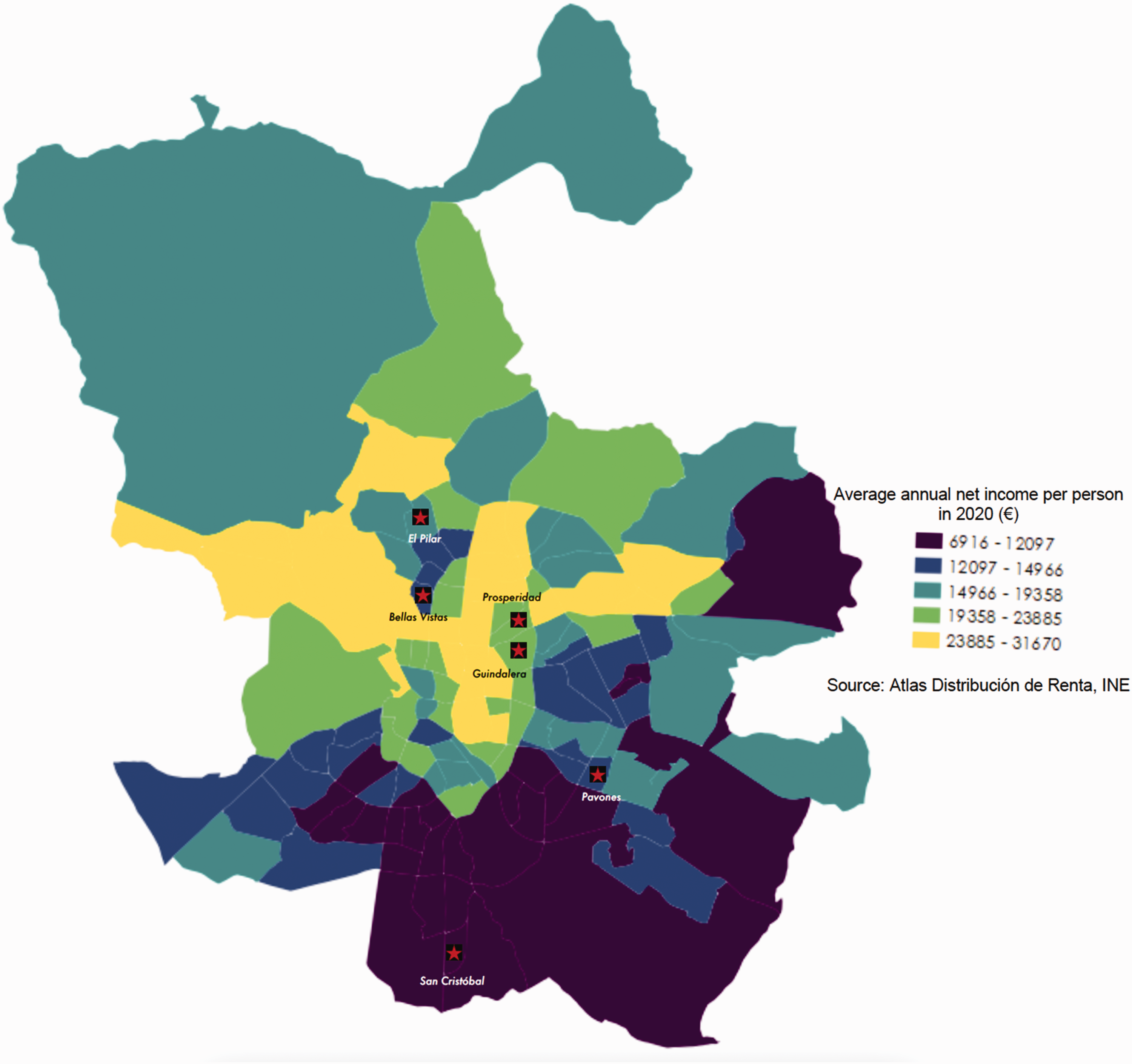
Average annual net income per person in 2020 (€) by neighbourhoods. Source: Atlas Nacional de España, http://atlasnacional.ign.es/wane/Madrid_y_comunidad_autonoma.
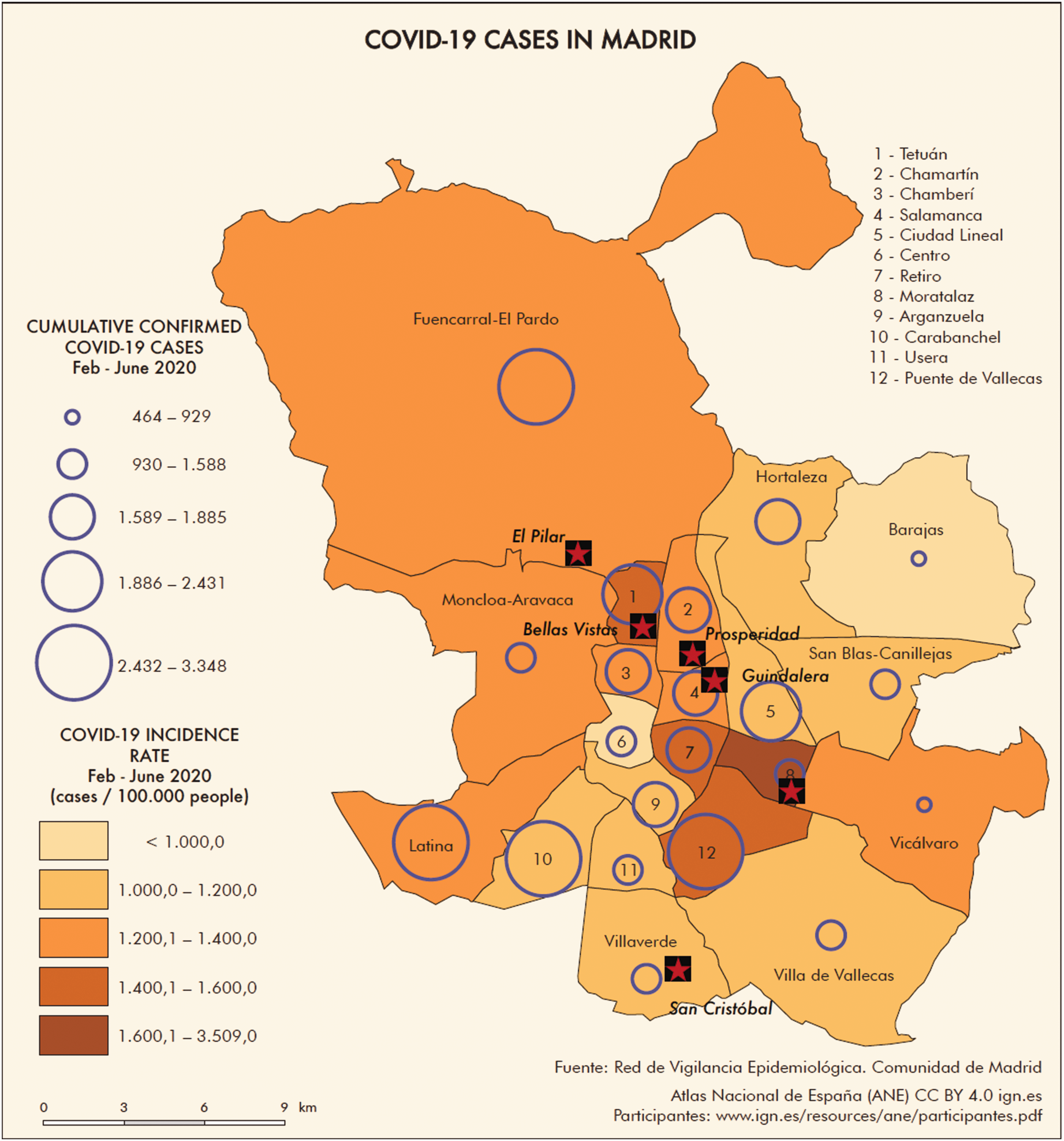
COVID-19 cumulative confirmed cases and incidence rates by neighbourhoods. Atlas Distribución de Renta, Instituto Nacional de Estadística.
My aim in this article is to introduce a different sensibility for inchoating a post-pandemic urban condition, one that attends not to the logics of prediction and capture—or their exceptions, which remain trapped in the logic—but that flourishes as a collective organon for un-predictions instead. Importantly, the term unpredictability, as I use it here, does not refer to a cognitive or epistemic function. Unpredictability is not an effect or dimension of an epistemological operation. It is not a position of knowledge or unknowledge (Simone and Castán Broto, 2022), and as such it is not a claim on, or a disavowal of, epistemological correlations or correspondences—for example, between epidemiological factors and social variables. Rather, I seek to “de-epistemologize” the futural underpinnings of un/predictability by calling attention to its geo-organizational affordances instead (Latour, 2010: 38).
Epistemological approaches to un/predictability are founded on declinations of the adventitious: temporal and spatial assemblages of the probable, the plausible or the unforeseeable. They are expressions of futural agnosticisms or indeterminacies; curated hermeneutics of calculative or empirical unknowables. Contra the epistemological, I use unpredictability to describe a mode of collective habitation, a surplus of movement, whose surge rearranges the city differently. Echoing Michel Serres’ words, “to exist is already an excess or an exception” (Serres, 2007: 149), collective unpredictabilities gather and fold excesses to their advantage.
The unpredictable rushes therefore as a collectively manoeuvred shift and rearrangement of how grounds and territories anchor outlooks, movements and congregations—a designed disturbance of the equations holding geographies and effects together, and aspirations and places apart. Collective unpredictabilities delineate paths and planes of habitation where geographical correspondences are suddenly jolted out of joint, leaving way for the appearance of new logistical grids, corridors and theatres of operation. The city that gains ground in this manner is one that no longer functions as a mirror of or canvas for statistical projections and correlations, because its geographical epistemologies have been partially “dephenomenalized” (Wagner, 1978: 34). What is at stake now is other phenomena, a different city, one that has been collectively unpredicted into existence.
The urban society thus conjured up is obviously not born ex nihilo. But it is one that is not straightforwardly legible from a dashboard of metrics and predictions. Pandemic analyses have made this patently evident. Madrid recorded the highest excess mortality rate of any European capital during the first wave of the pandemic (Rodríguez-Pose and Burlina, 2021). Yet whereas epidemiologists have noted that life expectancy in 2020 dropped in correlation with the city’s geography of social determinants of health, the distribution of such correlations was anything but linear or patterned. Some districts managed to mitigate not just the social and economic consequences of the pandemic, but its impact on health too—with Villaverde, again, being a case in point (Díaz-Olalla et al., 2022).
With this in mind, let me clarify that I am not arguing against overwhelming evidence in public health and urban sociology that establishes an association between health disparities and area-level deprivation or socioeconomic status (Fiscella and Williams, 2004; for Madrid, see Rivera Navarro et al., 2020). I have no qualms about the argument that social inequalities deepen health inequalities because these are correlations that presuppose a geographical ceteris paribus, one that was most definitely not upheld during lockdown. There has been a tendency in policy circles and certain academic quarters to take-as-given representations of urban geographies during lockdown as immobile and congealed, with people largely confined to their homes, staying put and in place. As we shall see, this was not the case in Madrid, where people and territories shifted and realigned along unexpected axes of exchange and congregation.
It is these emergent and improbable geographies that I seek to describe in detail in this article. Specifically, I offer a situated inquiry into the geographical volatilities upending predictable epistemologies at moments of crisis, and about the importance of attending to how collective unpredictabilities reassemble and reshuffle urban landscapes instead. If I resort to the language of unpredictability, I do so in an attempt to slant the attention paid to theories of solidarity or organizational resourcefulness by tending also to the geographical surpluses—food, volunteers, networks, databases, infrastructures—through which cartographies of collective action regathered the city’s affordances. This, then, is not a story of epidemiological factuals against community counterfactuals, but an account of the urban liveliness of otherwisefactuals.
The account of collective unpredictabilities that I present here builds on the findings of a two-year collaborative research project enlisting epidemiologists and public health specialists, urban sociologists and anthropologists of science and technology to understand the relations between COVID-19 infection rates, socioeconomic inequalities and community responses in Madrid. Whilst my analysis of popular logistics draws on the empirical materials of the larger research effort, I put forward a theoretical proposition that interrogates extant geographical epistemologies of public health.
During our project, we carried out comparative research on six neighbourhoods (two high-, two middle- and two low-income neighbourhoods) paying particular attention to neighbourhood dynamics during the March–June 2020 lockdown: Bellas Vistas and San Cristóbal (low-income), El Pilar and Pavones (middle-income) and Guindalera and Prosperidad (high-income) (see Figure 1). We conducted 30 in-depth interviews, including 5 triangular interviews with two or three participants per group. We met with parish priests and social workers, nurses and social educators, doctors, neighbors and community activists. We carried out research in parishes, health centres, public charities and foundations, intersectoral roundtables, community development centres, professional social work conferences, neighbourhood associations, social autonomous centres, non-governmental organizations, solidarity pantries, mutual aid networks and different instances of the Social Services of the city. We also carried out data analyses of Social Services’ annual reports in the period 2019–2022 to understand how social assistance fluctuated over time across the city’s neighbourhoods.
During our fieldwork, it became clear to us that there was a relation between socioeconomic context and community responses in each neighbourhood. Initially, we had ourselves predicted that long-standing activist and community networks in vulnerable neighbourhoods would be better equipped and prepared for emergency responses. But this prediction also proved partially wrong.
As it turned out, with the exception of Guindalera, all neighbourhoods had thickly-textured community ecosystems, although their histories and conformations varied. In San Cristóbal and Bellas Vistas, municipal agencies had worked in the past decade to develop robust community programmes with strong ties to associations, local NGOs and activist groups. However, when the pandemic hit, their responses were markedly different. In Bellas Vistas, a newly elected cohort of political officers (of an ideological persuasion contrary to community activism) decided a few days ahead of the declaration of the state of emergency to break ties with community networks, a decision that caused a commotion among neighbours and paralyzed important activist work. In contrast, San Cristóbal was able to redeploy quickly and effectively its communitarian intelligence, skills and resources.
El Pilar, Pavones and Prosperidad showcase lively activist networks whose origins hark back to the historic struggles of neighbourhood associations during Spain’s dictatorship in the 1970s. But whereas the community response in El Pilar was stretched to its limits by servicing the city’s largest district, in Prosperidad, a similar overstraining was a consequence of activists having to coordinate the provision of aid across the city’s wealthiest district, where the absence of long-standing solidarity structures suddenly and unexpectedly made visible the vulnerability of (for example) elderly people or housemaids. In Pavones, an ongoing conflict between activist networks and the district’s Social Services escalated during the pandemic and impeded any form of collaboration. In sum, sociodemographic structures, population densities, administrative catchment areas, pre-existing community programmes, political tensions among local stakeholders, and the histories and capacities of activist networks all played a role in configuring how solidarity initiatives measured up to local geographical emergencies. But no one factor was predominant, and they interacted in ways that, in the last instance, most participants found overpowering and unfathomable.
Whereas the political, activist and socioeconomic histories of each neighbourhood therefore played a role in shaping how communities first responded in the wake of lockdown, over time their organizational rhythms, tensions and affordances gradually assumed similar transformational itineraries. To begin with, responders were quick to organize into mutual aid networks or redes de reparto (networks of errands), where activist organizations took out to the streets through the intensification of their systems of attention. These systems sounded out the depths of affliction, struggle and precarity that were gradually taking hold of neighbourhoods, and figured out ways to tune into and care for them. They folded neighbourhoods with what I have elsewhere called “climates of methods” (Corsín Jiménez and Estalella, 2023). By mid-April 2020, many such initiatives had mutated into solidarity pantries (despensas solidarias) and food distribution networks, where community assemblages scaled-up their setups into logistical geographies. As we shall see, these geographies rewired the territorial capabilities of neighbourhoods, laying out matrices and pathways where financial and data flows, transport operations, distribution networks or ideological frameworks variously intersected, pressurized or facilitated the consilience of resources and needs. Finally, in some cases, community assemblages transformed yet again into networks of referrals (redes de derivaciones), where the flow of solidarities operated a wholesale reorientation of a neighbourhood’s ecologies of habitation. Let us look at each in detail.
Systems of attention
Throughout the city, first responders generally included neighbourhood associations, autonomous and squatted social centres, and local community projects (involving parishes, non-governmental organizations, local shops and markets, health centres and schools’ family associations). Within days of lockdown, members of one or various organizations resorted to WhatsApp and Telegram to set up mutual aid networks. Numerous organizations turned to Google Forms for building online surveys where local neighbors could register either as volunteers or file requests for aid. For over a month, these networks enabled volunteers to shop and transport groceries and medicines to people unable to leave their homes. In a few neighbourhoods, networks established support structures for dependent relatives or set up emergency phonelines, which processed aid request as well as providing advice on unemployment or social security benefits. Sometimes, volunteers and beneficiaries were paired by age, proximity or special needs categories. One organization created a digital map clustering the addresses of volunteers and beneficiaries, in the hope that it would facilitate matchmaking between them, but since not all people were available at all times, it fell into disuse.
In the neighbourhood of El Pilar, the mutual aid network grew out of the feminist assembly in La Piluka, a social autonomous centre. In Madrid, schools closed on 12 March, two days ahead of the declaration of the state of emergency, and members of the assembly were quick to put together a childcare group to support parents who were unable to work from home. In Bellas Vistas, the network was first convened by a group of people who had been running an annual community carnival for the past four years. By mid-April the network of volunteers had grown to 170 people. In Prosperidad, the mutual aid network was set up by members of La Escuela Popular de Prosperidad, the oldest social autonomous centre in the city, founded in 1973 as a grassroots school of liberation pedagogy. Given the school’s extraordinary history of neighbourhood activism, it proved relatively easy to recruit volunteers for the network, which by April had already reached 200 participants.
The appearance of mutual aid networks during the pandemic has often been remarked by scholars as expressive of the infrastructures of solidarity, systems of “anarchist preparedness” and commons initiatives that surface amidst the ruins of urban capitalist breakdowns (Firth, 2020). To this, I would like to add how in Madrid networks took out to the streets as intensifications of already-existing systems of attention. In Bellas Vistas, El Pilar and Prosperidad, networks amplified and redeployed systems of awareness and mattering (feminist assemblies, carnival committees, liberation pedagogies) whose presence was felt and imbricated in every neighbourhood. In this fashion, mutual aid networks expanded the registers and organons for paying attention. The fact that all networks listed one or more phonelines for taking and placing emergency requests enabled such a mode of response. We often heard from activists how the phonelines “helped make visible zones of fragility we didn’t know they existed”: for example, domestic workers who were left to their own devices when their employers fled Madrid to spend lockdown at vacation homes (Guindalera and Prosperidad), or an exacerbation of cases of loneliness among the elderly.
In fact, the amount of time that people spent on the phone, the way listening and attending became central experiences of community activists’ exchanges with one another, was something people constantly referred to during our interviews. Volunteers, neighbourhood activists or social workers spent hours on the phone taking calls or simply listening to people’s concerns, anxieties and troubles. Let me offer a brief sample of the pervasiveness of this culture of attention: For a number of weeks after the declaration of the state of emergency we had no access to our databases. We knew we couldn’t just stay put waiting for access, so we sent a couple of social workers to our paper archives to retrieve all the files we had on elderly people. 2346 files. We divided them up amongst ourselves and agreed to spend at least 15 minutes on the phone with each and every person once a week. We had ears all over the neighbourhood, and it became an invaluable resource for sensing people’s fears, anxieties, situations of violence or abandonment, depression or mourning, etc. (Interview, community-based social worker, Moratalaz, 1 March 2022) When we first posted the news of the mutual aid network, it was my own personal phone number that was listed. People said to me, “You’re crazy, don’t make your phone number publicly available!” And true enough, the phone would start ringing at 9am and wouldn’t stop until well past midnight. But it helped me understand what was going on. In the beginning, I’d be getting lots of requests for errands. Later, people called in asking for information on unemployment and other social benefits. But then, somewhat unexpectedly, I also started getting calls from elderly people in situations of unwanted loneliness. That came as a shock. So in time we decided to set up dedicated phonelines for elderly people. (Interview, President, neighbourhood association, Moratalaz, 13 January 2022)
Logistical geographies
By the end of April 2020, it had become clear to all mutual aid networks that the city was undergoing a massive food insecurity crisis. People were no longer calling emergency neighbourhood phonelines with requests for small errands; they were calling directly and unabashedly for food. Across the city, mutual aid networks thus took a decision to reinvent themselves as solidarity pantries. The following description of the creation of a solidarity pantry at Bellas Vistas blends accounts by a community leader, a parish priest and a local activist to convey something of the transformational energy and momentum reported by similar projects elsewhere in the city: The first thing we did was to have the neighbourhood association open a bank account for the pantry. We then organized ourselves into five groups: a coordination group, a purchasing team, a team responsible for putting together food baskets, a family reception team and a delivery team. We began with 15 people but soon grew to 40. To process applications for food baskets, we classified families according to the size and number of dependents. By the end of June, the pantry was already serving about 500 families, around 1,500 people, that is, 5% of the population of the neighbourhood. By some accounts, however, there were moments were the pantry reached almost 3,000 people, 10% of the neighbourhood’s population. We first set up the pantry inside the parish’s premises, in a small building next to the church. We managed to get hold of refrigerators and chest freezers to store frozen foods. We reached agreements with a number of local markets and shops, including a Pakistani greengrocery store and some butcher friends, who would either donate produce to us or we’d buy it from them at special discounts. We also set up partnerships with a Church and an NGO food bank to bulk buy together and exchange surplus stocks. On a weekly basis, thousands of kilograms of food came in and out of the pantry. One of the pantry’s volunteers worked as an inventory manager for a department store, so he put his knowledge of logistics at the service of the pantry. A couple of people who worked in film productions, with extensive experience in the assembly and disassembly of sets and materials, helped with the installation and transport of equipment and infrastructure. Together they designed a system of shelves and pallets to facilitate the classification, flow and distribution of food. And the pantry worked like clockwork. In September 2020, with the resumption of parish activity, we had to look for a new locale for the pantry. Finally, after some searching, twelve of us agreed to rent together the premises of an old carpentry shop. For over a month we worked to reform the space, laying floors, raising walls, painting. We moved the chests, shelves, boxes and food. And shortly before we reopened we agreed to change the way the pantry was managed, shifting from a model of beneficence to an autonomous model, where the families receiving the food baskets are now running the place.
Logistics were central to all pantries. In the neighbourhood of El Pilar, the social autonomous centre of La Piluka set up a trilateral pantry across the neighbourhood’s catchment area. The district where La Piluka is located is Madrid’s largest, and its population density and demographics shift abruptly between neighbourhoods. For this reason, activists at La Piluka agreed to have the centre’s pantry dispatch to three different distribution locales, one for each of the food insecurity hot spots they knew existed in the district. The audacity and complexity of such a multilateral system was considerable. For a start, finding and setting up three locales proved anything but easy. Activists scouted the district’s built environment for temporary leases, vacant spaces or abandoned premises. One of the distribution points had to move sites three times over the course of the year: from the premises of a local neighbourhood association to an activist’s garage and, finally, to an occupied social autonomous centre. With every move, activists and volunteers packed and unpacked goods, materials and infrastructures, organized transport and delivery, and had to set up the distribution logistics all over again. Moreover, organizing cycles of inventory management and distribution to three locales demanded considerable skills in operations management, logistical inventiveness and financial auditing.
In general terms, the everyday management of pantries called for making decisions on numerous, often controversial matters. The following list thematizes some of the main issues reported by the pantries we worked with:
All pantries had to make decisions regarding how to prioritize the families that arrived at their doorstep. A dedicated “welcome team” would often ask families basic questions about the number of dependents in the family and whether they were already receiving food aid or income support from other organizations (state or charity). At the solidarity pantry of the social autonomous centre of La Atenea, in the neighbourhood of Guindalera, activists organized rapport sessions with every family to better understand their specific circumstances. They used these sessions to ask about food allergies or dietary requirements (say, for religious or ideological reasons), but also to offer guidance regarding alternative or supplementary aid and emergency benefits available from other state or charitable agencies. Pantries had to decide how to record and store the information provided by families. Across Madrid, all mutual aid networks and solidarity pantries became extremely self-conscious about data management and storage processes, and the extent to which their practices might be violating data privacy laws. This had a massive impact on how activists organized their technological routines and collaborative processes. But perhaps most importantly, it was one of the issues that created most controversy and antagonism when working with the municipality’s Social Services agencies.
The Excel sheets and databases prepared by activist organizations were consistently challenged and undermined by Social Services. On July 2020, for example, the solidarity pantry of Bellas Vistas and the district’s Social Services department agreed to transfer the former’s list of beneficiaries to the latter, who would thereon take responsibility for delivering food aid to families. In October, however, the families told the pantry’s activists that they had not been contacted by Social Services yet. When representatives from the pantry finally met with Social Services to inquire about what was happening, they were told that they had got it all wrong: Social Services could not accept the pantry’s Excel sheet at face value, for they had no way to assess the criteria that had gone into its making and therefore the data’s trustworthiness and robustness. What Social Services had offered to do, they argued, was to prioritize the families on the Excel sheet for an assessment interview. Similar fallouts between activist organizations and state agencies regarding the robustness and verifiability of data took place all over the city.
(iii) Another delicate matter referred to the composition of food baskets. Pantries did their best to prepare baskets to suit the dietary, age or socioeconomic needs of specific families, but this sometimes proved logistically unmanageable. The composition of food baskets was a place where matters of logistics and ideological matters sometimes got entangled, with effects that reverberated across a neighbourhood. For example, on one occasion the solidarity pantry at Bellas Vistas received a massive shipment of frozen chicken, which they could only store in part in their chest freezers. Therefore, they reached out to the neighboring pantry of La Enredadera, in the hope that they would take the surplus up. However, La Enredadera had defined itself as a vegan pantry and declined the offer. This generated a small commotion in the neighbourhood, with activists from both pantries engaged in a fraught exchange about the ideology of logistics: whether the convictions of veganism applied to cultures of consumption or should be extended to matters of storage and distribution too. In the end, La Enredadera agreed to store and make available non-vegan supplies, although they would not incorporate them into their own food baskets. (iv) The periodicity of handouts was also something that obliged pantries to make some difficult decisions. Whereas some pantries had the capacity to hand out food baskets twice a week, others could only manage twice a month, depending on the number of volunteers working in the pantry, its storage facilities, supply economics and the pantry’s catchment area. The solidarity pantry and mutual aid network of Prosperidad, for example, the only one serving the wealthy district of Chamartín, covered a perimeter that stretched for 10 km and a surface area of 6 km2.
Every pantry had to establish an equation of sorts between its catchment area and its distributive and economic capacities, which impacted on specific logistical matters. For example, when organizing handouts, almost every pantry we spoke with explained they had devised their own queue flow management system, for public health reasons (to keep social distance), but also to avoid the poverty porn associated with seeing people queuing outside pantries. Furthermore, every activist we spoke with acknowledged they were tacitly operating with a cognitive map of hot spots and infrastructural pressure-points that redrew the neighbourhood’s geography. Importantly, these geographies never represented administrative or residential criteria. Rather, matters regarding the logistics of flows, stoppages, shortages, queues, chokepoints, frictions, exchanges, overloads or concentrations (to name but a few) were perceived as topological qualities of a territory. When people spoke of “neighbourhoods” in this context, then, they were not referring to a spatial or demographic entity, but to an ecology of logistical pressures and affordances.
(v) The origin and criteria for sourcing food were also factored into pantries’ decision-making processes. There are at least two issues to be considered here. On the one hand, pantries had to decide on the means for securing food and other resources (monetary and non-monetary). There were three channels for obtaining resources: donations, food-raising and money-raising campaigns. The geographical location of pantries and their social networking skills were particularly important in every case. In San Cristóbal, the neighbourhood’s food security network (it was not a pantry proper; we shall be hearing more about its peculiar configuration later) could hardly expect financial contributions from local donors, given the neighbourhood’s vulnerability. However, the parish priest, who was a key community leader, was incredibly well connected to a variety of Church and charity organizations, and from April to November 2020 raised €115,000 for the network.
A related matter refers to the securitization of financial resources. Some autonomous groups (including social autonomous centres and solidarity pantries formed before the pandemic) had to decide whether to legally incorporate and register as formal associations in order to be able to open bank accounts and accept sizeable money transfers. For a variety of principled and ideological reasons, a majority decided not to, and sought instead to seek partnerships and alliances with locally existing neighbourhood associations who could process such payments. An oft-given reason for this was that pantries should avoid by all means falling into a “welfarist trap” and take upon themselves a duty that was the state’s to perform. As a rule, monetary donations faded with time, and by the fall of 2020 solidarity pantries were receiving hardly any financial contributions.
On the other hand, pantries also set up food procurement systems by tapping into a variety of food supply chains, including the food distribution networks of supermarkets, charity organizations and NGO food banks. There was a city-wide WhatsApp group where pantries posted alerts and news of sudden and forthcoming supply surges in depots, warehouses or market exchanges throughout the city. Not infrequently, neighboring pantries would pool resources for driving together to these distribution centres or would augment their logistical capacities by sharing lorries, pallets, racks or lifting dollies.
Another choice faced by pantries referred to the types of consciousness-raising campaigns they embarked upon. Again, these shifted over time. Whereas at the peak of the emergency, pantries were generally keen to receive donations regardless of their origin, over time some pantries felt increasingly uncomfortable organizing food-raising campaigns at supermarkets and shops, favoring instead the organization of festivals and parties for money-raising purposes. The rationales at play here echoed the arguments about welfarism noted above, insofar as pantries often went to great lengths to avoid being labelled or perceived as charitable organizations. In line with calls for “solidarity, not charity” rehearsed by mutual aid networks and anarchist groups across the globe (Chevée, 2022; Gravante and Poma, 2022), the aim here was to refunction pantries as radical systems of inhabitation, where, as Oli Mould et al. have put it, “vulnerability [becomes] a constitutive and emancipatory process, and not a reductive and confining one … a state of social possibility; of latent connectivity with others to create more just ways of organising communities” (Mould et al., 2022: 874).
As I have already noted, some pantries made agreements with neighbourhood shops to support local commerce, whereas others preferred to bulk buy from large supermarkets at discount prices, and yet others sought to establish distribution partnerships with cooperative and ecological producers, including local urban community orchards. These different visions responded to different conjugations of territorial autonomy, emergency, resourcefulness and historical solidarities. For example, across Madrid, numerous pantries designed voucher systems that built neighbourhood-wide gift economies upon pre-existing local food production and infrastructural capabilities. There were important differences between systems, however, and not all worked well. In the neighbourhood of El Pilar, for example, the system encouraged shoppers to buy vouchers at local stores, the proceeds of which were transferred to the solidarity pantry. But as activists openly recognized, volunteers were overtasked and often burned-out (remember, this was the pantry that was running three distribution networks) and the scheme was somewhat neglected. In Guindalera, the pantry made agreements with local stores to have vouchers used as payment systems. But this too proved difficult to manage for, as the pantry convenors explained, “store owners kept saying that it brought too much uncertainty to their inventory management.” Finally, in Pavones, the neighbourhood association’s pantry designed a voucher system whereby beneficiaries redeemed food produce from local stores that had previously agreed to selling vouchers to other clients as gift tokens. Perhaps inevitably, in the last instance, every voucher system was tapping into a reservoir of trustworthiness, complicity and financial dependencies that more often than not was commensurate with pre-pandemic commitments and solidarities in the neighbourhood.
(vi) Last but not least, all pantries faced very difficult decisions regarding the financial management and auditing of their monies and accounts. As noted, some pantries refused to financialize their operations by using bank accounts and resorted to cajas de resistencia (so-called strike funds) instead, whereas others made no qualms about receiving donations from corporate sponsors. In all cases, the people doing the accounts recognized that bookkeeping had proven a challenge, not because of evidence or risk of financial mishandling or misconduct, but because the actual flow of assets was muddled and confusing. Pantries’ financial accounting and inventory management required them keeping records of manifold transactions and dealings, including voucher payments, charitable donations, monetary transfers, stock exchanges, bulk purchases, etc. Except where cash and financial transactions were involved, in which case most activists were adamant about keeping records and receipts, concerns about auditing expressed a wider concern for the sustainability of the pantry as a neighbourhood project. The pantry’s accounts and inventory management were believed to reflect on its social responsibility, where a penny unspent or a rice bag ungiven was taken as evidence of solidarity unfulfilled.
The blooming of solidarity and mutuality movements during the pandemic has been amply documented. Social movement scholars have drawn attention to the informal economies and radical infrastructures enabling communities to self-navigate the devastating food insecurity crisis triggered by the pandemic (Arampatzi et al., 2022; Desmaison et al., 2022). Public health and policy scholars have emphasized the crucial role played by community-based organizations as first responders in the face of breakdowns in governance (Carter and Cordero, 2022; Roels et al., 2022).
My account of Madrid’s mutual aid and solidarity networks rehearses many of these themes. Yet I would like to draw attention to the specific role played by popular logistics in the reterritorialization of urban forms. The work of solidarity pantries and mutual aid networks swayed and conjugated bodies, infrastructures, spaces, transport operations, data systems and financial flows into vertiginous and improbable geographies of urgency, mutualism and effect. These choreographies of often unwieldy yet admittedly prodigious improvisations shifted known landscapes and venues into corridors, grids and methods for collaborative urbanizations, and in so doing unveiled viable openings for otherwise unpredictable and improbable geographies.
Leandro Minuchin and Julieta Maino have recently described how social movements and public agencies in Rosario, Argentina, collaborated during the pandemic to develop a municipalist counter-logistical geography designed to promote neighbourhood economies and the commoning of supply-chain infrastructures (Minuchin and Maino, 2023). Whilst their study focuses on initiatives that either predated the pandemic or had preexisting scalar capacities (government agencies, political parties, cooperative firms), their argument rightly draws attention to the inventive uncoupling of “territories” and “logistics” that these projects dared to reconceptualize and redeploy. As they lucidly explain, the pandemic made visible the appropriation of logistical operations to organise and frame novel forms of collective action, a repertoire that linked the unfolding of politics with the integration of material resources, procurements lists, means of transport, the availability of mobile data and spreadsheets of activists, volunteers and critical contacts. (Minuchin and Maino, 2023: 2075)
Not unimportantly, these fugitive geographies, whilst rushed and transitory, were also deeply layered and reflexive. Whilst the systems of logistical circulation designed by prophetic organizations aimed not for frictionless transparency or cohesiveness (Aung, 2021), they accomplished pragmatic efficacy nonetheless. Whilst their geographical pursuits did not seek confrontation, they did not shy away from friction and complexity either. For this reason, I believe it is important to move beyond their theorization as grassroots solidarities or caring infrastructures and zoom-in on the collective unpredictability of their geographical manoeuvres. Thus, whilst communities certainly showcased different attitudes and responses to the persuasions of charity, the dangers of “welfarist traps” or the financial securitization of voucher or credit systems, in all cases they circumvented potential frictions by destabilizing and dephenomenalizing their own territorial givens.
Ecologies of habitation
At the height of the pandemic in 2020, Madrid’s municipality barely managed to increase social assistance to vulnerable populations by a meagre 17%. In contrast, referrals to community organizations for carrying out that very same assistance increased by 142% (Maldita, 2021). The pandemic overwhelmed and paralyzed the municipality’s administrative architecture for processing and delivering aid, which was thenceforth subcontracted to food banks, neighbourhood associations and solidarity networks.
During our fieldwork, people spoke often about “referrals” (derivaciones) when explaining the work of solidarity networks, but only in one case did they describe it systematically and repeatedly in terms of a “network of referrals” (red de derivaciones). That case was San Cristóbal. We shall be hearing more about it shortly, but let me explain first why referrals were important and how they worked.
When people spoke of “referrals”, they were describing an administrative procedure whereby responsibility for delivering food or economic aid (say, to a vulnerable family) was transferred from one organization to another. Referrals were common and recurrent all over the city. Whilst during fieldwork we recorded some cases of referrals between food pantries or solidarity networks, most referrals involved a reallocation of responsibility from the municipality’s Social Services to community organizations.
The reasons for referrals were manifold, but they all involved some sort of logistical friction or technological incapacity on the part of the municipality. In particular, social workers quickly came to the realization that the data-processing and digital certification tools that the municipality had in place for registering and dispatching new aid requests were ill-suited for coping with the massive surge in demand provoked by the pandemic. To be clear, the audacity and ingenuity with which social workers improvised an emergency response was nothing if not impressive. For example, given that many of the people seeking aid had no access to digital certification tools from home, social workers in Guindalera resorted to using WhatsApp videoconferencing for holding assessment interviews, and took screen captures of such meetings as proof of identification. Notwithstanding, the paperwork and bureaucratic procedures they had to comply with were cumbersome and, sooner rather than later, the system simply collapsed. Therefore, it quickly became obvious to social workers that the responsiveness of community organizations was much more agile and efficient, and they swiftly turned to them for help.
With the exception of San Cristóbal, whose ecosystem of referrals was unique, referrals were generally ad-hoc affairs. In these situations, social workers, conscious of the municipality’s bureaucratic paralysis, would call an activist acquaintance or friend from a local solidarity network and, as a personal favor, ask for the pantry to take over from Social Services. These informal transfers generally involved no paperwork so they were very agile. Not infrequently, the number of such ad-hoc transfers quickly piled up. When that happened, social workers agreed to speed-up grant awards to local organizations to formalize the nature of the exchange.
These shifts in assistance, from ad-hoc and informal to scaled-and-formal, generally took place where social movements had built deep-rooted, trusting and expedient relations with municipal workers. For example, the solidarity network of Prosperidad, whose origins hark back to an autonomous and liberation pedagogy centre founded in 1973, has weaved over the years a thickly textured tapestry of community and institutional relationships. One of the community services that the network improvised during lockdown involved a ridesharing service for hospital discharges. The nearby Hospital de la Princesa had reached out to the network asking for help with the transportation home of COVID-19 patients who had been discharged from the centre. The hospital was running low on ambulances and not all patients could afford private transportation back home. In response, activists from Prosperidad organized a transportation service run by volunteers that catered to the needs of the hospital.
As this example shows, setting up systems of referrals very often required setting up an underlying infrastructure of two or more information-processing systems, which either brought to the fore or cajoled into existence a particular depth and density of relations and habitations. Prosperidad’s “taxi service”, as activists called it, required coordinating an information exchange (hospital→network→drivers→patients) alongside a geographic information system (pairing patients and drivers by residential proximity). No doubt, the historical density of Prosperidad’s tentacular activist ramifications facilitated organizing such a nested system.
Let me further illustrate this idea about densities and modes of habitation by turning to San Cristóbal, whose community response, as I have repeatedly noted, was unlike any other in the city. 1
When the pandemic broke out, San Cristóbal was one of only two neighbourhoods in Madrid with a consolidated community intervention program in place (Bellas Vistas being the other). First set up in 2014 under the auspices of a private foundation, the program (known as ICI, Intervención Comunitaria Intercultural) was widely embraced by the community and quickly became a reference for social workers all over the city. I shall not dwell on the history of the program, but do wish to note that its overall architecture rehearsed structural elements of community engagement—including youth and family roundtables or special educational and reproductive health subprograms (Giménez Romero et al., 2015; Marchioni et al., 2015)—that have become paradigmatic of twentieth-century epistemologies of democratic participation (Kelty, 2019).
Whatever else the ICI program might have accomplished during its six-year run, when we started fieldwork in San Cristóbal in December 2021 everybody spoke fervently, but also with profound reflexivity, about the community’s response. A phrase often said in reference to the ICI process was that the neighbourhood had become “over-diagnosed” (sobrediagnosticado). Initially, I took this as an ironic commentary on the theoretical exoticization of San Cristóbal by academic outsiders (such as myself). But soon I realized that it was also an observation about the internalization of analytical capacities by the community itself. Two social workers who were part of both the ICI project and the community’s pandemic response explained as much: The pandemic allowed us to repurpose and exfoliate community capacities that we had been quietly building up for years. We had all these community fora [youth, family, reproductive roundtables, etc.] that were already in place, enabling people to reach out to one another and set in motion specific neighbourhood-wide interventions. But perhaps more importantly, every one of these spaces had built its own network over the years, branching out into separate subgroups, taskforces, committees, etc. So when the pandemic broke out these different clusters all set up their own WhatsApp groups, nesting into a complex network that … Well, it’s not easy to explain, how these nested system worked together. I’m quite enjoying having to explain it to you (laughs). (Social worker, Plan Integral de Convivencia, 24 February 2022) Villaverde has a very strong community network. It’s been so for many years now. But it’s true that within Villaverde, the case of San Cristóbal is somewhat exceptional. No doubt the ICI program is to be credited at least in part for that, because there are just so many networks in place, so many community-led spaces, with so much theoretical work on their shoulders, that, well, I guess they are different somehow. (Social worker, Junta de Distrito de Villaverde, 2 March 2022) Shortly after the declaration of the state of emergency, Madrid’s International Fair and Congress Centre (IFEMA) was refurbished into a field hospital. Nurses and doctors from all over the region were transferred to the hospital as temporary staff to attend the massive surge in patients. Sarah, a nurse in San Cristóbal’s local health centre, was reassigned to IFEMA from the end of March until the hospital’s dismantling at the end of May. Towards the end of her stay in IFEMA, Sarah unexpectedly phoned Mary, a social worker long involved in San Cristóbal’s community projects: Sarah: My time at IFEMA is coming to an end, they’re shutting down the hospital. I should be back in San Cristóbal soon. But most importantly: they’re throwing away most of the materials and supplies used to equip the hospital. They’re throwing away hundreds of beds, with their mattresses, bed bases and all … Mary: What? Are you serious? Sarah: Yes, and my supervisor says we can keep them if we can arrange transportation and storage … For years, San Cristóbal has confronted a pest of bedbugs that peaks in the summer months, when hundreds of people, who cannot afford pest control or bedbug treatments, throw their mattresses away on the streets, making matters worse. When Sarah and Mary heard they could get their hands on a massive supply of unused beds as part of IFEMA’s dismantling, they didn’t think twice. “I started making hundreds of call,” Mary explained, “trying to figure out how to transport all these beds, and where to store them. Seriously, these were amazing mattresses, this size [signals height], premium brands. We spend months every summer working on bedbug-awareness campaigns, trying to get funds for fighting infestations, etc. Not in a lifetime I would have dreamt about getting our hands on this kind of stock.” “This is one of the benefits of working as a network”, a community activist added: “someone out there is maneuvering a shift, pulling some strings, nudging or luring a friend or acquaintance into an improbable deal … And all of a sudden the unimaginable comes true.” With urchin, mischievous eyes, and a proud grin on her face, one of San Cristóbal’s historic community leaders settled the story for us: “I remember getting a phone call one day—“look out the window”, they said—and there I saw it: military trucks driving down San Cristóbal’s narrow streets, transporting a shipment of hundreds of mattresses. You had to see it to believe it!”. The mattresses were finally stored in a number of locations, including the meeting rooms and basement of two Social Services buildings in the district, and the main hall in the neighbourhood’s social community centre.
Coordinating the space was a “technical team” (equipo técnico), staffed by the same parish priest from my opening vignette, a municipal social worker, a social worker employed at a local NGO, a psychologist and one of San Cristóbal historic community leaders—four women and one man. The technical team took responsibility for importing and consolidating data on food security and aid programs from a variety of community-support networks: religious charity foundations, Social Services, local food banks and solidarity pantries, neighbourhood NGOs and community associations, and an online Google Form designed ad hoc by the technical team (which registered over 800 requests). The team merged all such information into a single database, checking for redundancies and mistakes, and designing a protocol for securing data privacy. And it decided how referrals would be assigned within the neighbourhood’s ecosystem: some cases were assigned to Social Services, others to charity food banks, or to an NGO’s food truck, etc.
The importance of the database put together by the technical team cannot be overemphasized. As I noted earlier, the robustness and verifiability of data became the main source of antagonism and confrontation between Social Services and community projects all over the city. The data compiled by solidarity pantries and mutual aid networks were undoubtedly the closest thing to “real-time” community emergency data: bottom-up, immediate and with little lag-time to response. Yet everyone was acutely aware that such data contained numerous inconsistencies and redundancies, that it sometimes missed key data points, and, most importantly, that it risked exposing vulnerable families to privacy violations. The data-processing capabilities of Social Services, on the other hand, were exactly the opposite: data-robust yet bureaucratically cumbersome and slow, and soon enough dramatically detached from the explosive surge in emergency requests.
But there was more. We have seen how as part of their emergency responses community organizations across the city set up emergency phonelines. San Cristóbal, however, went one step further. They organized a call centre, staffed with local volunteers who were provided with fast-track training in social assistance by the technical team. As part of their training, volunteers were explained what types of information they should be after, including the caller’s ID, number of dependents, whether they were already recipients of aid from other agencies, if they were registered with Social Services, etc. Volunteers were also trained to handle distress calls and told when and how to prioritize some calls over others. “We worked with a cloud-based Excel sheet,” a member of the technical team explained, which we edited whilst on the phone. We color-coded the data: people who had already been contacted, blue; people who were waiting to be contacted, red; people who had been contacted and cleared for assistance, and whose needs had been passed on to the food bank, green. (Interview, social worker, San Cristóbal, 2 March 2022)
These two initiatives—the call centre and the centralized data-processing centre—allowed San Cristóbal to move into a plane of intervention that was incommensurable with community responses elsewhere in Madrid. Yes, there were food banks, logistical infrastructures and distribution centres, but these were assembled into an ecosystem that enabled the parts and the whole to work separately and together at the same time. For this reason, I hesitate to describe San Cristóbal’s community response as a “system of attention” or a “logistical geography”, because its mode of operation was not so much unfolding or branching out across a territory, as overhauling the territorial itself. Said differently, these were not externalizations of a network as much as internalizations of a habitat.
Conclusion
In 2020, the year of the pandemic, Madrid’s municipal Social Services barely managed to increase social assistance by 17% (Maldita, 2021). Whilst new and existing funds were certainly made available and redirected to attend the emergency, the municipality’s administrative capacity for processing the sudden surge in demand was constrained by prevalent bureaucratic rigidities. As a result, every effort concentrated on the alarming food insecurity crisis. Whereas before the pandemic, applications to food insecurity programs were negligible (compared to applications for housing, work or disability benefits), in 2020, they rocketed, with the municipality processing 494% more requests for emergency food aid than in 2019 (Ayuntamiento de Madrid, 2023a).
That effort paled when compared with San Cristóbal’s. Here, the work of the “technical-communitarian coordination space” enabled San Cristóbal’s Social Services to process 9200% more emergency food aid applications in 2020 than in 2019. During lockdown alone, the coordination space attended 1303 people (439 homes) and provided direct food emergency aid to 1695 people, nothing short of 10% of San Cristóbal’s population. Moreover, throughout the pandemic, referrals from the coordination space to Social Services amounted to 582 families, whereas referrals from Social Services to the coordination space amounted to 213 families (Aguilar et al., 2020). Popular logistics mattered.
Correction: Popular logistics did not just matter. They mattered, otherwise. Databases, privacy protocols, call centres, inventory and queue flow management systems, spatial surveys, food supply chains, transport systems, credit and voucher economies, financial accounting systems: the technical, material and infrastructural operations designed by community projects responded not only to an ethos of solidarity or care, but reflected also a profound understanding of the complex layering of vectorial geographies shaping and tending the organization of urban territories. In this sense, the architectures, apparatuses and circuits deployed by solidarity networks proved unique in their capacity to tune into the sensory and affective climates of neighbourhoods, shifting and reorienting the circulation of people, assets and resources, and, in some cases, disentangling the very fabrics of biopolitical governance—datasets, distribution centres, technical and expert systems—by reweaving them into prophetic organizations instead. In doing so, the work of community organizations further taught us about the fragile epistemological foundations of certain public health and biostatistical projections, whose designs under ceteris paribus conditions, when exposed to the overwhelming and lively geographies of the pandemic, quickly proved adventitious and unstable.
“The conventionally prescribed tasks of everyday life,” the anthropologist Roy Wagner once noted, “are guided by a vast, continually changing and constantly augmented set of differentiating controls, all held together and ‘cued in’ by the conventional ‘society’ that their use precipitates.” (Wagner, 1981: 66) However, if one pays close attention, Wagner cautioned, these “differentiating controls” are rarely if ever used in prescribed or standardized forms, but are mobilized instead “as the basis of inventive improvisation … as a continual adventure in ‘unpredicting’ the world” (Wagner, 1981: 66–67).
This is what popular logistics accomplished. They captivated “society” into its own dephenomenalization, conjuring systems of attention, orientation and habitation that, humbly and almost inadvertently, collectively unpredicted the world.
Footnotes
Acknowledgements
This article builds on a two-year collaborative research project enlisting epidemiologists and public health specialists, urban sociologists and anthropologists of science and technology to understand the relations between COVID-19 infection rates, socioeconomic inequalities and community responses in Madrid. My thanks to Myriam Aarab, Ángel Cisneros, Teresa Tiburcio, Manuel Franco, Mario Fontán Vela and Carlos López Carrasco for their support and intellectual companionship. Special thanks to José Ariza de la Cruz for his help with  . Warm thanks to AbdouMaliq Simone for reading an earlier version of this article and inspiring it with unrelenting poetic support.
Declaration of conflicting interests
The author(s) declared no potential conflicts of interest with respect to the research, authorship, and/or publication of this article.
Funding
The author(s) disclosed receipt of the following financial support for the research, authorship, and/or publication of this article: This research was funded by the European Commission – NextGenerationEU (Regulation EU 2020/2094), through CSIC's Global Health Platform (PTI Salud Global), Social Forum (Foro Social) ref SGL2104001.