




Abstract
How do social movements develop and sustain their territoriality within large-scale organisations? This study explores the emergence of resistive movements in organisations counteracting a new administrative regime with a relational approach to territoriality in the physical and virtual environments. Drawing, maintaining, and changing boundaries in physical and virtual spaces are crucial in organisational resistance. However, the extant literature mostly overlooks these topics. This paper shows how collective actors form a resistive movement in organisations through territoriality with a qualitative study conducted in two Turkish Universities. The study findings show territoriality provides more than a space of isolation and this space has no fixed resistive boundaries. Territorialisation within and out of organisational spaces, covering physical and virtual environments, supports the development of a resistive identity. Our comparative analysis of two movements in universities shows that territoriality in the physical world is essential. However, territorialisation in the virtual environment helps resistive identities in organisations to last even their physical activities fade. Moreover, territorialisation in physical and virtual spaces communicating the movement’s message to mobilise others varies according to the different stages of the movement’s lifespan. In addition, this study indicates how the activities of social movements of organisational actors in physical and virtual environments interrelate.
Introduction
Higher education has increasingly become a private domain in Turkey. State universities’ employment regimes for assistants started shifting from regular/open-ended to temporary/fixed-term contracts. This policy change has created a significant shift in the field. It has triggered different responses, eventually becoming a social movement distributed and loosely connected across universities called the Assistants’ Solidarity (AS). Over several years, the movement has developed on different campuses and the Internet, calling for actions to draw, maintain, and change territorial boundaries.
Mass movements can emerge in organisations to protest and resist change (Zald and Berger, 1978). These collective attempts employ various tactics to organise resistance, such as exploiting organisational spaces (Briscoe and Gupta, 2016). Few studies examined the role of organisational spaces by conceptualising them as free spaces (Kellogg, 2009; Courpasson et al., 2017). Accessible spaces as bordered places of organisations provide room to isolate the resistive collectives from the powerful.
However, the circumscription of space is not a fixed, historically defined phenomenon that solely provides physical boundaries to the opposition. Moreover, attempts to draw, maintain and enlarge borders help communicate and mobilise organisational resistance. Research has mostly overlooked the role of such spatial dynamics in organisational resistance (Panayiotou and Kafiris, 2011 as one of the exceptions). Literature needs further research into how spatial actions of collectives in an organisation participate in their resistance. This inquiry is crucial to understanding the nature of resistance where interactions between organisational actors with high physical and digital mobilisation bring fluidity to spatial boundaries.
The territoriality concept provides a fruitful vocabulary for studying the spatial actions of drawing borders and has long received geographers’ attention. It is a dynamic process relying on ongoing actions over a geographic area (Sack, 1983, 1986; Altman, 1975; Newman and Paasi, 1998; Johnston, 2001; Paasi, 2003). In this regard, scholars treat the concept of territoriality as deliberate actions to affect, influence, or control resources and people over spatial boundaries (Sack, 1986). This territoriality concept has been brought from geography to organisation studies more recently (e.g., Brown et al., 2005; Panayiotou and Kafiris, 2011; Shortt, 2014; Hughes et al., 2020).
Furthermore, pervasive digitalisation has questioned the roles of different activities in virtual spaces’ and their participation in controlling resources and people. According to Sack (1983), someone’s physical being in a territory is unnecessary to assert control over it. This argument avoids the dependence on territorial control for physicality and opens for virtual. Virtual spaces are digital environments facilitating interactions through virtual objects (Bainbridge, 2007), and virtual spaces are “bounded spaces imbued with the meaning” (Saunders et al., 2011:1080). Meanings and identities are socially constructed (Berger and Luckmann, 1967) through interactions within virtual spaces (Diani, 2000). Moreover, the identities and meanings that emerged through collective action in these spaces have essential reflections on offline-world territorial behaviours (Thom-Santelli, 2010).
How do collective actors form a resistive movement in organisations through territoriality? The AS Movement’s territorialisation of university campuses and on the Internet allows for examining the above question. For this purpose, the study embraced a social movement approach to examine the collective resistance in organisations. Moreover, following Sack (1986) and Brown et al. (2005), the study treats territoriality as drawing, maintaining, and restoring territories in physical and virtual bounded spaces to organise a mass movement resisting organisational change. The study acknowledges that territories are flexible and not limited to tangible objects. Instead, territoriality also covers social bodies such as individuals and groups. Thus, territorialisation helps to exert control over resources and people.
This paper examines the AS Movement groups’ territorialisation in two prominent universities in Turkey. These two resistive groups interrelate their physical and virtual spaces, connect themselves with broader political contexts, and initiate or participate in a social movement.
We believe this paper has several contributions. First, discursive forms of resistance (Laine and Vaara, 2007) have been studied extensively in the literature. However, more research is needed on the territorial nature of resistance in organisations (Panayiotou and Kafiris, 2011). Moreover, collective actors’ territorial resistance in organisations needs further investigation. So, this study contributes to understanding the territoriality of organisational mass movements resisting intended changes.
Second, considering physical and virtual spaces’ activities helps understand digital technologies’ role in organisational resistance. Studies examine how people use virtual spaces to resist organisational change (e.g., Cunha and Orlikowski, 2008). However, the knowledge about the relationship between activities in physical and virtual spaces is limited. The study shows the interconnected nature of territorialisation in physical and virtual spaces.
Third, scholars have examined territoriality at a micro-scale in bounded spaces such as offices and in-office objects (Taylor and Spicer 2007). However, this paper has studied them on a larger scale on university campuses. Accordingly, the study identifies how organisational members resist exploiting physical and virtual territories in larger organisational spaces. This result is valuable as many organisations locate their headquarters in suburban campus-like settings. The number of home-office and gig workers not using regular office spaces is also increasing. Therefore, organisational territoriality should cover more than an in-office space.
This paper is structured as follows: in the next section, the paper reviews the literature about bounded spaces’ roles in resistance. The description of the research method follows the literature section, including the analytic approach to empirical data. The paper then introduces and presents the case study, followed by comparative results and discussion. The conclusion section outlines the theoretical and practical implications, including the contributions of this study.
Territoriality, collective actors in organisations, and the Internet
Territoriality and social movements
Relational thinking bringing mobility and fluidity frees the concept of territory from being closed and static (Jones, 2009). Accordingly, the territory is more than a container and beyond a spatial concept (Painter, 2010). In this view, Raffestin (1986) draws analytical distinctions between territory (appropriated, enacted space), territoriality (the sum of relations between subjects belonging to a collectivity with the environment), and territorialisation (the process through which these relations establish) (Philo and Söderström, 2004). Therefore, territoriality counts on ongoing actions that draw boundaries to different spaces (Agnew et al., 2000). As a result of these actions, power accrued within parties enables them to influence or enforce others (Sack, 1983). Moreover, dominant and resistive actors (re)territorialise to maintain or change an existing order (Dochartaigh and Bosi, 2010).
Social movements challenge authority systems and structures with some degree of organisation. Resistance is central in social movements involving conflict and contradiction with existing authority schemes and imposed/arbitrary changes (Hollander and Einwohner, 2004). Contentious politics can be organised and mobilised through territories (Martin and Miller, 2003) to respond to activities maintaining the dominant social order. Social movements build relations within territories to acquire and control resources, such as networking, gaining members, or collecting material resources (Nicholls et al., 2013). Moreover, social movements develop resistive identities through territorialisation, such as occupying places and spaces, setting up protest camps, and barricading streets (Soja, 1989). Therefore, territorialisation and relations in and out of the territory are essential for social movements.
As contradictory relations can emerge, territoriality and related dynamics are critical in determining “what activists can and cannot do” (Nicholls, 2009: 79). For example, Halvorsen (2017) presents how the territories of a social movement support its subjectivity. It also draws a border restricting the mobilisation capacities of the movement. Moreover, Halvorsen et al. (2019) conceptualised and analysed two social movements in Brazil and Argentina as socio-territorial movements that treat the territory of the movement as its existential feature. Social movements emerge through relations in territorialisation, deterritorialisation, and reterritorialisation. After the macro-level studies of Halvorsen (2017) and Halvorsen et al. (2019), this paper aims to contribute to the literature by analysing more meso-level social movements taking space and place inside large-scale organisations, such as universities.
Territoriality in organisations
Insurgencies and collective resistance can emerge as social movements in organisations. However, researchers mostly overlooked this phenomenon in the literature (Zald and Berger, 1978; Zald, 2005). These social movements employ similar practices reflecting the more significant trends at the macro levels of society and represent a strong analogy (Zald and Berger, 1978). Accordingly, territoriality is essential for social movements in organisations, a relatively new conceptual lens in organisation studies.
Brown et al. (2005) introduced one of the early studies of territoriality in organisation studies. Counting on the works of Sack and Altman, they defined territoriality as the behavioural expression of the ownership of a physical or social object. Territoriality covers “constructing, communicating, maintaining, and restoring territories around those objects” (Brown et al., 2005: 578). Therefore, the process of territorialisation for organisational actors counts on actions building relations.
Following this line of inquiry, for example, various studies examined territorial behaviours arising from the psychological ownership of various organisational resources such as physical objects, ideas, roles (Brown and Robinson, 2011), and other employees (Gardner et al., 2018). More recently, researchers studied territoriality with power relations within organisations. For instance, Hughes et al. (2020) explored how fitness professionals exercise power in a shared workspace. This study considers territoriality a social action, drawing symbolic and physical spaces. The authors highlight how social-power control behaviour exploits resources and examines actions to gather resources. They find that professionals with power can undermine territorial organisational norms, and powerless ones need to negotiate for or resign from territories. So, they show that actors exercise power to draw spatial boundaries in organisations.
Territoriality is part of conflicts and resistance and is pervasive in organisations (Brown et al., 2005). However, the literature has scant knowledge regarding territoriality participating in the emergence of resistance to change, especially for collective organisational actors. Applying the conceptual lens developed for territoriality for social movements to organisational settings brings a new perspective to capture the resistive actions of collective actors to an organisational change.
The spatial politics of university spaces and academic labour also have broad literature (Zeilig and Ansell, 2008; Bailey and Freedman, 2011; Hopkins, 2011; Guzman-Concha, 2012; Belina et al., 2013; Pusey and Sealey-Huggins, 2013; Kleibert, 2021; Maringira and Gukurume, 2021; Lim and Sziarto, 2022). For example, Zeilig and Ansell (2008) studied spaces and the scale of student activism in the universities of Senegal and Zimbabwe. There is solid political activism on campuses, engaging in protests with highly specialised strategies significantly influencing national-level politics. They identified four activism phases mobilising distinctive relational spatialities in response to spatial expressions of political actors. They also criticise the scalar framing of activism in the literature, suggesting how spatial strategies confront changing political situations. Like this study, Belina et al. (2013) analysed how a university in Frankfurt, Germany, responded to students’ building occupation and protests on two campuses, toleration in one and intense oppression in another. The study reconstructed how the university, as a state apparatus, has built “two campuses as particular places that are bound up in and expressions of the national and local condensations of forces of Fordism and neoliberalism, respectively” (Belina et al., 2013: 738).
Territoriality and the Internet
As the Internet becomes one of the dominant mediums of global interaction, one may claim that no urban space is left unaffected by the online world. Nearly every space and place has an online presence. People use the Internet, take pictures, and use their smartphones to create metadata, even without awareness. Furthermore, the experience of urban spaces and the physical presence are affected by online experiences. Therefore, online spaces remain as extensions of and relational to territories constituted by physical spaces.
According to Burrell (2009), online space is a disconnected and independent environment (e.g., Cova and Pace, 2006). However, one may consider them connected, networked, hybridised environments with the physical space through nodes and connections (e.g., Fisher and Smith, 2011; Fielding, 2010; Rokka and Moisander, 2009). This perspective creates a combined and intertwined understanding of online and physical aspects in terms of spatial possibilities (Howard, 2002). So, territoriality may cover activities in online spaces that are “anchored in offline contexts” (Van den Bos and Nell, 2006: 216). In parallel to this, Ward (1999: 96) describes the online space of a community as necessarily intertwined with its physical space: “The physical, despite its apparent morphing with the virtual, continues to place restrictions on people’s lives, and so a community that exists entirely in text-based virtual space is implausible.”
Online spaces create different opportunities for interaction through co-presence with links, activities, communities, and worlds. Territorial behaviours within online spaces express ownership and communicate the ability to control an online space marked, personalised, and defended by a social group (Thom-Santelli, 2010). Moreover, virtual territories on the Internet enable the communication and interaction of their inhabitants and support new identities and meanings. Therefore, as it is required to escape from authority with submerged/covert action (Scott, 1990), the Internet provides a suitable environment to organise resistance against powerful actors (Diani, 2000).
Furthermore, virtual territories on the Internet reduce the cost of communication and encourage interaction. So, the Internet supports the development and spreading of collective identities even in distinct locations (Diani, 2000). It has become integral to social mobilisation, enabling people to access social movements’ political agendas (Langman, 2005), even within organisations.
Conceptualising territorial actions of collectives in organisations
The study considers territorial action as constructing, communicating, maintaining, and restoring territories around tangible, intangible, and social objects that provide an existential being to collective actors in organisations. It follows relational perspectives to territoriality (Clare et al., 2018) and integrates with digitalisation and organisational perspectives.
This definition covers online forms of territories. The territorial activities within virtual spaces on the Internet, such as blogs and social media accounts, are examined under social movements’ territoriality in organisations. They are an indispensable constituent of overall territorial actions. These two distinct physical environments foster the expression of territorial behaviours toward each other in line with the fluid nature of the relational approach to territoriality (Clare et al., 2018). While examining collectives in the digital age, capturing physical and virtual activities is essential. Following this definition, the study examined territoriality as an action-based social process that helps collectives within organisations to (re)draw boundaries.
Method
We have developed two interrelated qualitative case studies (Abercrombie et al., 2000) as the primary method of investigation. The study gathered empirical data from environments with fieldwork, interviews, participant observation, and similar methods (Willis, 2007).
The approach has helped analyse the meso-level dynamics (McAdam, 2003) with contextual richness (Dyer and Wilkins, 1991). Although the AS had spread to different universities, researchers had chosen to study those groups at ITU (Istanbul Technical University) and METU (Middle East Technical University) because they were the most persistent groups in the movement. Moreover, both universities have been two leading universities in Turkey, acting as models for others. As ITU members, researchers have working relationships with many group members, including one key member. This relationship provided and secured contacts for the researchers. Some key faculty members in METU and ITU in the researchers’ network helped the study access the data in both universities.
Data collection
The research collected data through participant observations (DeWalt and DeWalt, 2011), interviews, and online ethnography (Kozinets, 2010) between October 2013 and May 2014. While one of the authors had participated in the meetings, forums, and protests organised by these groups, he did not become a full member. Researchers have tried to maintain a distance from the phenomena to keep researchers at the boundary (Tuncalp and Le, 2014). While the experience with these groups necessarily influenced the data analysis, this research does not claim pure objectivity or explicitly seek subjective evaluations. Instead, researchers have tried to be “critically intersubjective” (Fay, 1996).
The research supplemented collected data with in-depth interviews and focus groups. All interviews were recorded with permission (over 20 h) and transcribed verbatim. The first author also took detailed notes containing short quotes from informants during or after the interview. Towards the end of the data collection, the first author performed in-depth interviews with different university administrations to fully reflect on the dialectical nature and their counterparts’ responses.
In the interactions with the informants, researchers questioned these groups’ emergence, earlier development periods, and the university administrations’ counter-responses. The first author asked retrospective questions to multiple informants and searched their answers from other sources to triangulate these accounts with interviews and secondary data to construct validity (Yin, 1994). The study has collected an extensive online data archive, including blog posts, newsletters, letters, announcements, flyers, forum discussions, and online protest videos.
The first author’s participation in these groups was not covert. The research team told all interview informants and key group members about the identity and this research’s objectives before gaining access, performing interviews, and focus group meetings. The first author performed participant observations in these groups’ meetings, protests, and forums online and offline. The longitudinal data collection strategy helped develop insights into dialectic mechanisms of power and resistance over time.
Data analysis
Data collection has resulted in a large variety of written materials. To analyse them, the researchers first sorted them according to their temporal occurrence. After this, they read, reread, and coded all field notes, memos, website texts, social media messages, and researcher reflections to generate further data and ideas. Accordingly, the study categorised, compared, and contrasted codes to locate patterns in the grounded data (Eisenhardt, 1989) and created the narrative of the case studies (Suddaby, 2006).
Based on the above process, the research also extracted and classified data about spatial contention concerning two main dimensions. The first step of the analysis is about the type of territory: physical or virtual. Physical represents activities in the physical environment, and virtual regarding activities in the virtual environment. The study also examined the relationships between these two environments. The second dimension of the analysis relies on territorialisation and its relationship with the rise of social movements in two organisations. The results mainly explain the development and the communication of identities through territorialisation. They focus on the physical and virtual spaces and the territorial interrelationships.
Sociohistorical context and assistants’ solidarity movement in two universities
Contentious politics in Turkey
From labour strikes to student protests and ethnic uprisings to feminist activism, various contentious politics have emerged throughout Turkey’s history and have been a recurrent feature of Turkey’s political landscape. The rise of neoliberalism and the consolidation of political power have intensified the tensions between the state and civil society. This tendency led to various waves of contentious politics and progressive politicisation (Dönmez, 2021). Understanding Turkey’s contentious politics and progressive politicisation is crucial for analysing its political trajectory and prospects for social change.
For instance, labour strikes and union activism have a long and rich history in Turkey, dating back to the late 19th century (Dönmez, 2021). Intense labour struggles marked the late 1970s and early 1980s, primarily repressed by the military coup of 1980. However, labour activism re-emerged in the 1990s and 2000s. Workers in various sectors, from textile factories to automotive plants, travelled the streets to demand better working conditions, higher wages, and job security (Bekmen et al., 2020).
Student activism has also been a significant force in Turkey’s contentious politics. Students are often at the forefront of protests against the state’s authoritarian policies. In the 1960s and 1970s, university students critically challenged the military’s grip on power. In the 1980s, they mobilised against the education policies of the military regime (Türkoğlu, 2019). More recently, student protests have focused on academic freedom, campus autonomy, and the privatisation of education (Gencoglu and Yarkin, 2019).
Other contentious politics in Turkey include the Kurdish ethnic uprisings, feminist activism, and LGBTQ + movements. Feminist activism, for instance, has challenged patriarchal norms and practices, demanding gender equality and ending violence against women (Çağatay et al., 2022). LGBTQ + movements have also emerged in Turkey relatively recently, challenging conservative social policies and demanding recognition (Birdal, 2015).
One example of such politics was the Gezi Park protests in 2013, coinciding with the empirical cases of this paper. Gezi protests emerged as a response to the Justice and Development Party’s (Adalet ve Kalkınma Partisi - AKP) neoliberal urban transformation policies and its heavy-handed countering of environmental activism. However, viewing Gezi as an isolated event would be a mistake. Instead, its contention for common space is part of Turkey’s broader pattern of contentious politics, shaped by its unique historical, social, and political contexts (Öncü, 2013).
The common spaces are produced by people to establish and maintain a community, representing spatial nodes through which a social movement may reclaim and re-appropriate a city or a campus (Stavrides, 2015). The Gezi Park protests represent an attempt to redefine public space for citizens and the state, collectively choosing to ‘disperse power’ rather than attempting centralised power accumulation (Zibechi, 2010). The continuous dialectic between the open assembly decisions and dispersed smaller action groups keeps a struggling community alive. This dialectic also makes the community open for everyone, recreating the community around the struggle and the territoriality in a shared space (Zibechi, 2010). However, these groups refrain from formulating institutionalised, formalised organisational structures opening the movements to potential fractures and cooptation (Zibechi, 2012: 82). However, having a “territoriality of resistance” is vital for securing a certain autonomy as they are “beyond the control of the powerful” (Zibechi, 2012: 67).
The broader context of higher education and two universities
Turkey witnessed a shift towards neoliberal economic policies, especially after the military coup on 12 September 1980. This transition gained momentum following AKP came into power in 2002 (Öncü, 2013). While Turkey is under a neoliberal transformation, teachers and education workers are one of the most organised civil servants resisting new policies through protests and strikes (Dönmez, 2021). The Education and Science Labourers Union (Eğitim-Sen) is one of the powerful trade unions supporting education workers at universities in contributing to the construction of identities claiming labour and workplace rights (Dönmez, 2021).
Regarding the sociohistorical context of universities, ITU and METU are state universities that strongly identify with engineering and architectural education in Turkey. Following the military coup in 1980, the regime introduced YÖK (Council of Higher Education) as a central control unit of the higher education system. The policy has forced uniformity and aspired for greater marketisation (Üsdiken et al., 2013). Since then, YÖK has pushed for US-type university governance as a model for Turkish universities. As one of the first examples of such governance, METU has become a reference form. ITU has remained a distinct model within Turkish higher education (Üsdiken et al., 2013). However, it also adopted an American model over time following its path (Erden, 2005).
These two well-established universities in Turkey have alums of high-level public administrators and some famous political figures. For example, three well-known Turkish prime ministers took charge after 1980 and graduated from ITU. On the other hand, the METU campus accommodates political groups, mainly from the left wing. Moreover, compared to ITU’s city-scattered campuses, METU has a single campus with the legendary “Revolution Stadium”.
The emergence of the resistive movements
The diffusion of a market-oriented approach has influenced university governance policies. Referring to the negative impacts of inbreeding, administrators have stopped recruiting their graduating assistants with permanent contracts. With the order dated February 2011, universities have advised cancelling the employment contracts of those assistants who could not complete their degree within the - maximum period. The period was 3 years for an MSc and 6 years for a PhD. However, not all universities have taken action right after this call. Therefore, in June 2012, YÖK ordered the enforcement of this regulation. Eğitim-Sen has appealed the court decision and received an interpretation providing some legal grounding for not implementing the order. However, ITU and METU administrations have started to follow the order triggering the emergence of the AS Movement first in ITU and then in METU in 2012.
Firstly, ITU solidarity members announced themselves to other assistants with emails and face-to-face office visits. They also launched a petition drive and regularly held meetings on different university campuses. On the other hand, they have started defining their virtual space with a blog site and Facebook and Twitter accounts.
The AS in METU emerged after ITU. At METU, academics organised an association called the Instructors’ Association (Öğretim Elemanları Derneği - ÖED). ÖED has been holding regular meetings every month. One of them discussed assistants’ employment problems from the new policy. At the end of that meeting, assistant representatives participating in the ÖED meeting decided to start the AS in METU. They decided to “come together to defend their rights.” Although ÖED and Eğitim-Sen may defend these assistants’ rights, they did not focus on recently emerged problems. Therefore, assistant representatives have emailed all assistants to join the solidarity. Those assistants responding to the call have attended several meetings, decided on a road map, and established the group.
While the ITU and METU groups’ structure and decision-making processes were very similar, they were independent entities. They employed different territorial actions in physical and virtual spaces.
Territorial actions
The AS movement first announced its demands at ITU’s public declaration in September 2012. They were mainly requesting that the Rector withdraw the time limitations for program completion and stop dismissing the assistants. The group also created social media accounts and a blog to draw its virtual territory. These virtual territories were mediums for online interaction. The blog post called for group activities and communicated messages. The group then started protest marches across the campus, from the cafeteria to the Rector’s office. These marches’ initial points were territories where the students, academics, and other people mostly visited. The rally ended at the territories of the university administration. These activities attracted publicity at the university, and the group grew (Figure 1). Protest marches ending in front of the Rectorate building in ITU.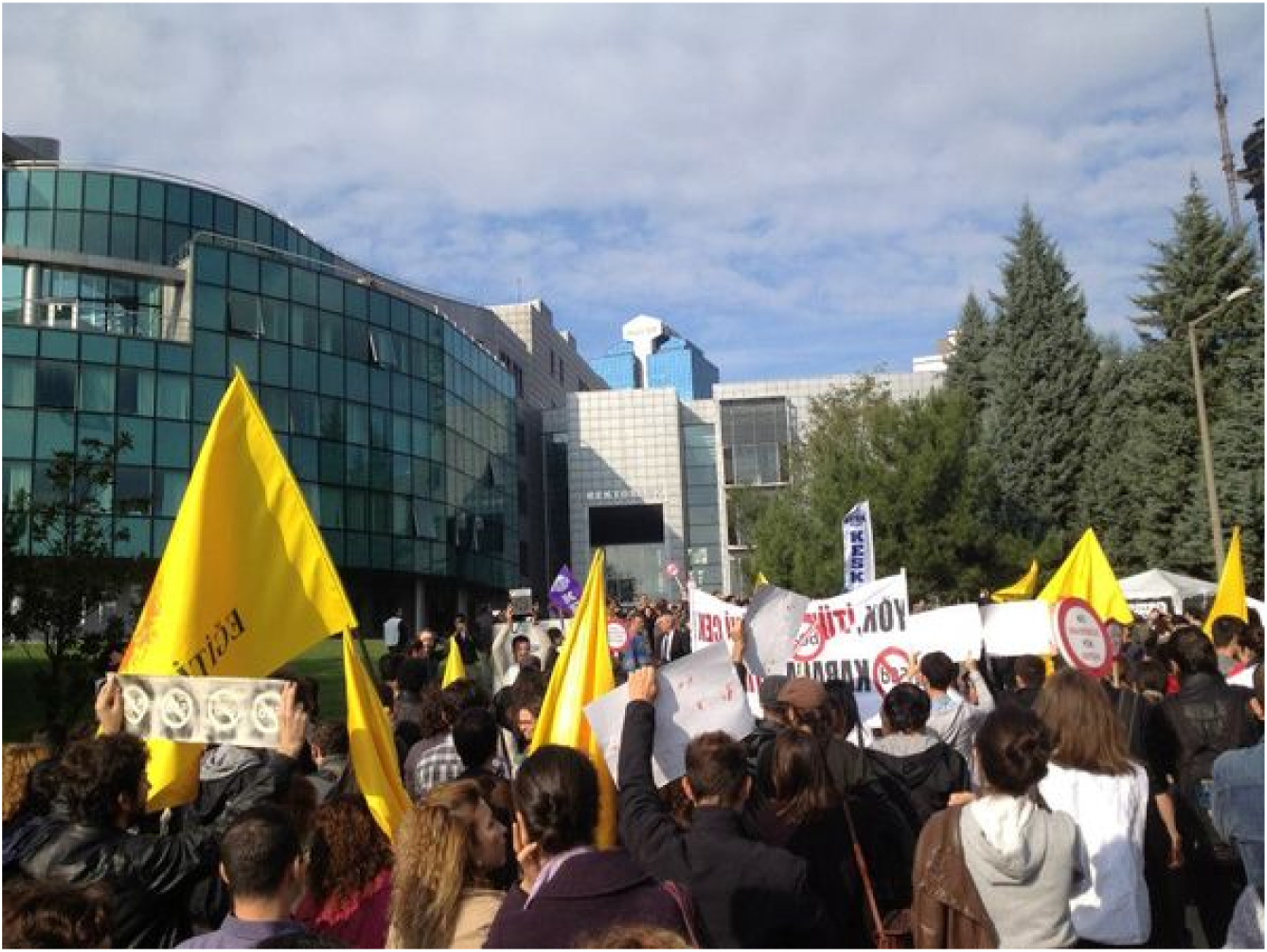
When the assistant dismissals had started in Mechanical Engineering Faculty on the Gümüşsuyu campus, the group organised another march from Taksim Square to that campus. After a short festival with a small concert and some theatrical performances, the group stayed in the night’s campus territories signing ownership of the Gümüşsuyu campus.
As the main square of Istanbul, Taksim, attracting all political rallies and marches, had linked the ITU AS to broader political and social disputes. This action was also the first protest in mainstream media, putting the AS on the national news.
As the struggle unfolded, it started taking part in virtual territories. The Facebook account of the university began posting explanations regarding new legislation and rules. The group members responded by writing their objections and comments. However, the university deleted these comments shortly after. In response, the AS group used their account to post, “You cannot be part of a solution by deleting our comments from the ITU official site.”
When the struggle expanded to virtual territories, the group started publishing online newsletters and email announcements, distributing them to university members with email messages. Like the struggle in social media, the university banned sender addresses from servers. Then, the group started sending every announcement to a different address or sending the same declaration to multiple addresses to avoid the ban. So, space occupation and transgression also happened in the parties’ virtual territories.
The assistants’ problem in METU differs slightly from ITU at the group’s emergence. METU Rectorate officially defined a master’s program’s standard duration as 2 years and a PhD 4 years before dismissal, imposing stricter requirements than ITU and YÖK. Due to this difference, METU assistants requested applying the limitations of YÖK and relaxing rules strictly applied by METU. In addition, METU started this practice a few years before ITU without much resistance. METU’s assistants had considered this new employment regime normal until the AS emerged in ITU.
Like the ITU group, METU Assistants had territorialised the virtual space by establishing a Facebook group and an official blog site. The study also observed that ITU assistants’ virtual territorial actions had a significantly higher frequency than the METU virtual territory. METU assistants also sent email messages to people on campus and held meetings to popularise them. However, they could not spread the group to the engineering faculty in the southern part of the campus. Most attendants were from the humanities, social sciences, and architecture faculties. Informants argued that the engineering students’ apolitical standing and the physical distance are two main reasons for the limited diffusion of the AS to the Faculty of Engineering. While relatively apolitical might hold, the co-location of engineering faculties at a distant part of the campus causes a territorial distance that reduces the group’s control. For a long time, the group in METU could not perform any march or protest activity; instead, they organised meetings at different faculties to mobilise people.
At ITU, the group performed different protests on campus to build physical territories, attract attention and gain community support. After a university senate meeting discussing the assistant’s issues, the group set up a tent in front of the Rectorate building. However, the group was not satisfied with the decisions, as one of the informants explained: “Like in other worker strikes, we set up a tent and say, you push out us, but we are staying here. We want to perform a protest that does not begin and end like protest marches. We want something ongoing”.
Every morning the tent was set up and removed every night and stayed in front of the Rectorate building for nearly 2 months. Later, the group moved the tent to a central square between the cafeteria and the library. The area was renamed the “Solidarity Square” by the group. The group moved the tent because the Rectorate building’s location was not that central. A while after, administrators, security personnel, and other people get used to the tent. “Rectorate building is out-of-the-way in Maslak campus and away from all faculties, the social centre, and the cafeteria. Because of that, we decide to place it in a central position.”
In addition to changing the tent’s place, the group stayed on campus at night to increase their protest’s influence and visibility. However, a tent was inappropriate for the winter due to weather conditions. Therefore, they decided to find a caravan stationed at solidarity square (Figure 2). One informant has described the importance of this as follows: “We stay for 24 hours to show everyone we are here. In addition, staying on the square during cold nights may touch the people’s hearts, and we hoped it might increase the pressure on the Rectorate.” Caravan located at the “Solidarity Square” at ITU.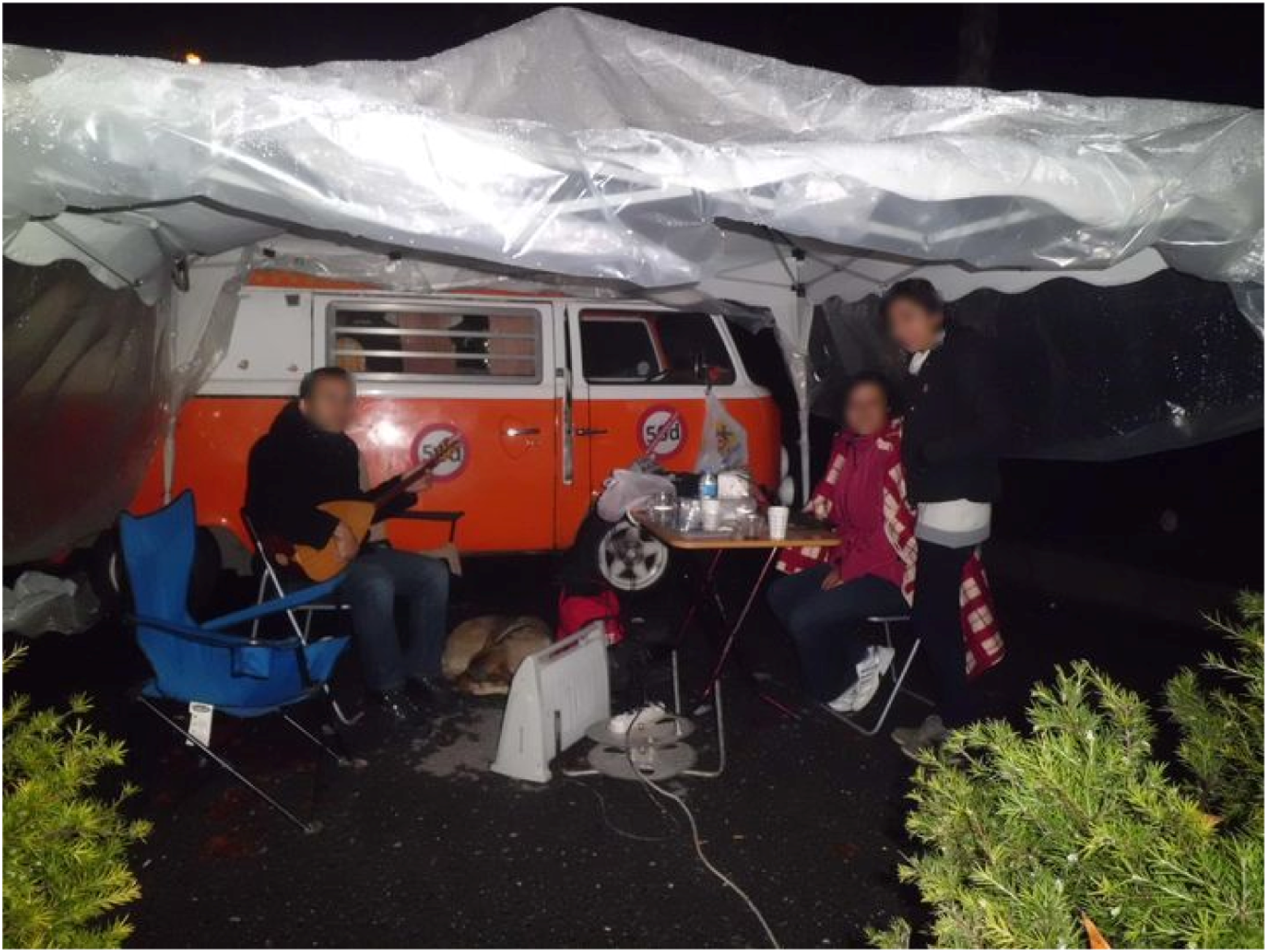
The group organised an opening ceremony for the caravan on the same day as the protest march to call more attention to their new activity. After that, the caravan and its territory became a centre of interest for students, instructors, and other university staff until its campus security removal. All protest marches had started from around the caravan.
At the end of January 2013, there was a regular meeting of YÖK in Ankara. The ITU AS organised a meeting in front of the YÖK building on the anniversary of the legislation. Assistants from METU and other assistant groups from different universities supported this protest. Assistants stayed in front of the building for 2 days. They waited for the YÖK meeting results to create pressure on university administrations: “University administration is always saying that the responsibility belongs to YÖK. Also, we cannot gain anything by showing resistance inside ITU. So, we have decided to attend the YÖK meeting in Ankara.”
The protest was not the only one performed outside the campus’ territories to increase university administrations’ external pressure. After the YÖK gathering, the ITU AS organised protests outside the meeting of the European Universities Association on the ITU campus. This protest served its purpose and attracted attention. The president of YÖK chatted with the assistants outside the meeting.
The group in METU organised its most important protest meeting to get an appointment from the Rector and became successful (Figure 3). Like territorial reasons for location selection at ITU, the protest in METU began from the Faculty of Education, inviting people from other faculties. As one informant explained: “Protest marches mostly begin before the English preparatory school in METU. However, many assistants of the Faculty of Education wanted to attend the protest. Therefore, we had begun from there.” Protest march organised in METU to talk with the Rectorate.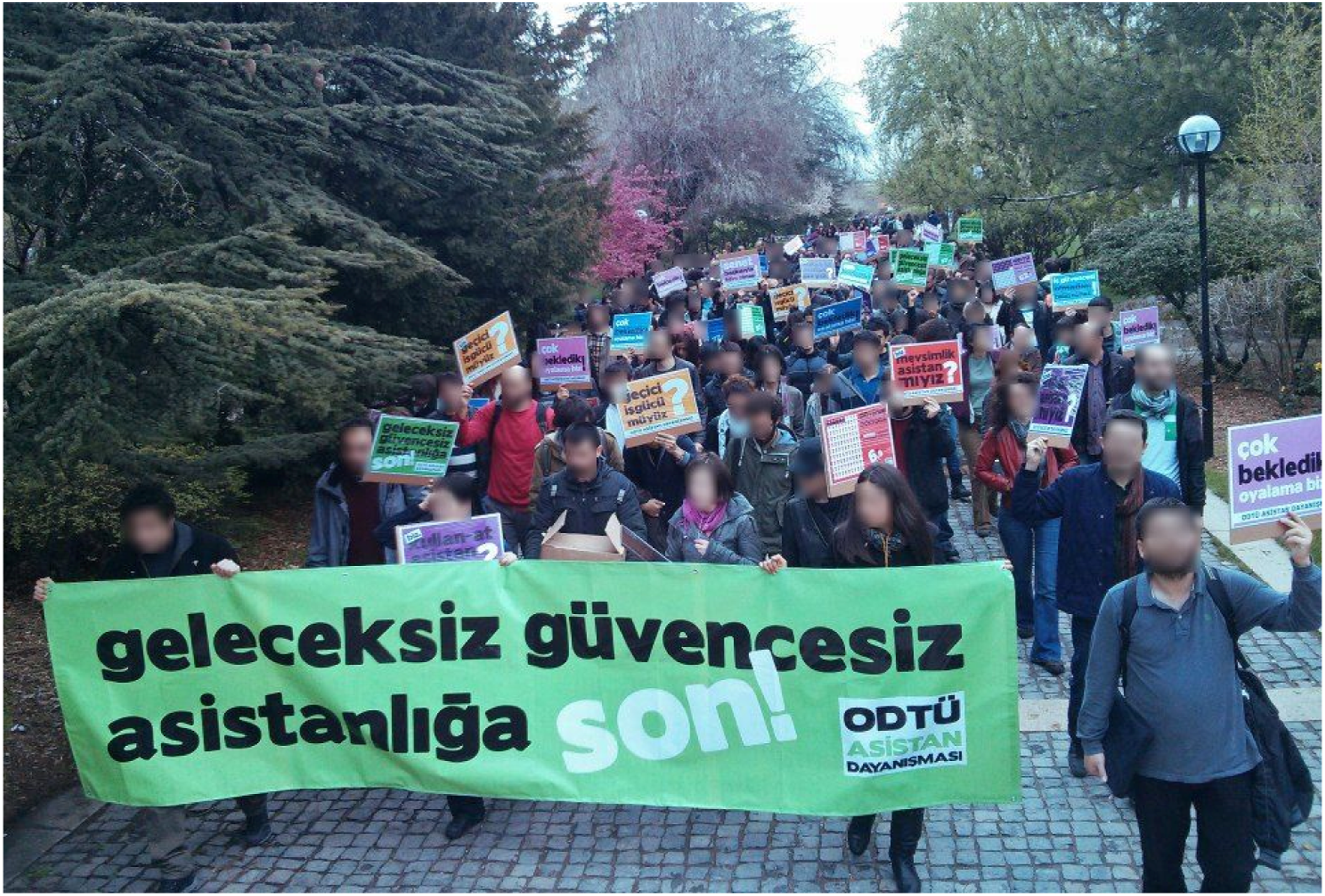
On the other hand, ITU’s group was also trying to get an appointment with the Rector to show their legitimacy and representative status. However, they could not become successful after several attempts. One of the most known protests of the ITU group appeared spontaneously at the end of a protest march. When the group reached the Rectorate building, they requested to talk with the Rector, and representatives of the group began to negotiate this issue with security officers waiting at the door of the Rectorate building. While negotiations were going on with these representatives, the crowd waiting behind went ahead. Following that, squabbling began with the security officers. After a scuffle, the group entered the Rectorate building and occupied the lobby (Figure 4). AS group in ITU occupied Rectorate’s building.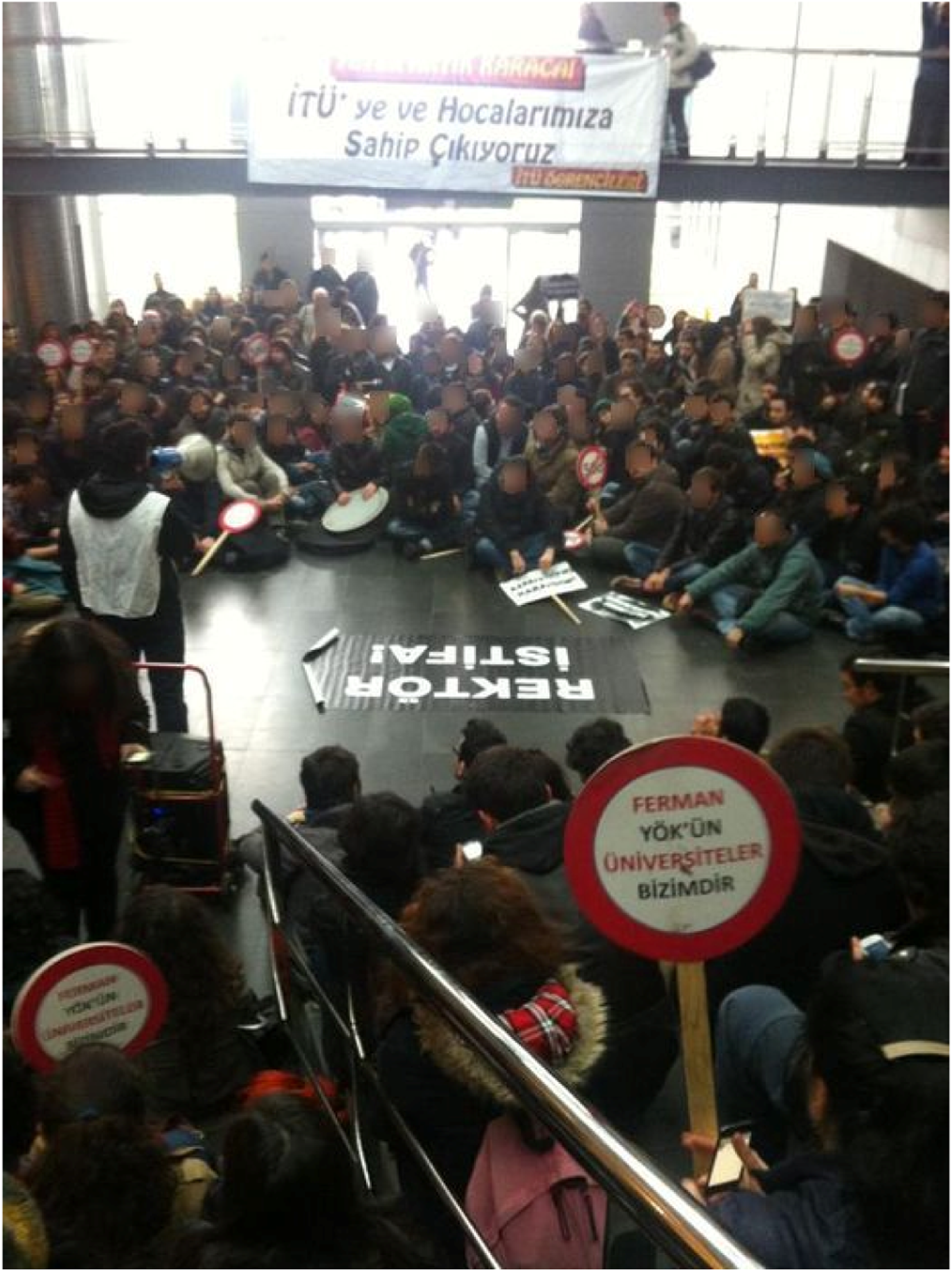
The AS later organised small festivals on the main and the other ITU campuses to expand their territories, where different singers and artists visited to support the group. On the other hand, the METU group organised a large festival, including several concerts and forum meetings where assistants and students discuss subcontracted staff problems. However, most of the interviewees from METU mentioned that they could not gather sufficient attention: “Attendance to the concerts was high, but few people were in discussion forums. The group was not strong enough to organise such a fest during those days. It was early for us.”
The ITU and METU groups also had a tree-planting ceremony on campus. They dedicated the event to an assistant at another university who committed suicide. The person left a note stating, “I do not enjoy life. I am not happy at work either. I do not think I am successful” (Figure 5). Although it was an emotionally charged event, both universities’ attendance did not reach the intended scale. Tree-planting in the memory of suicide assistant from METU.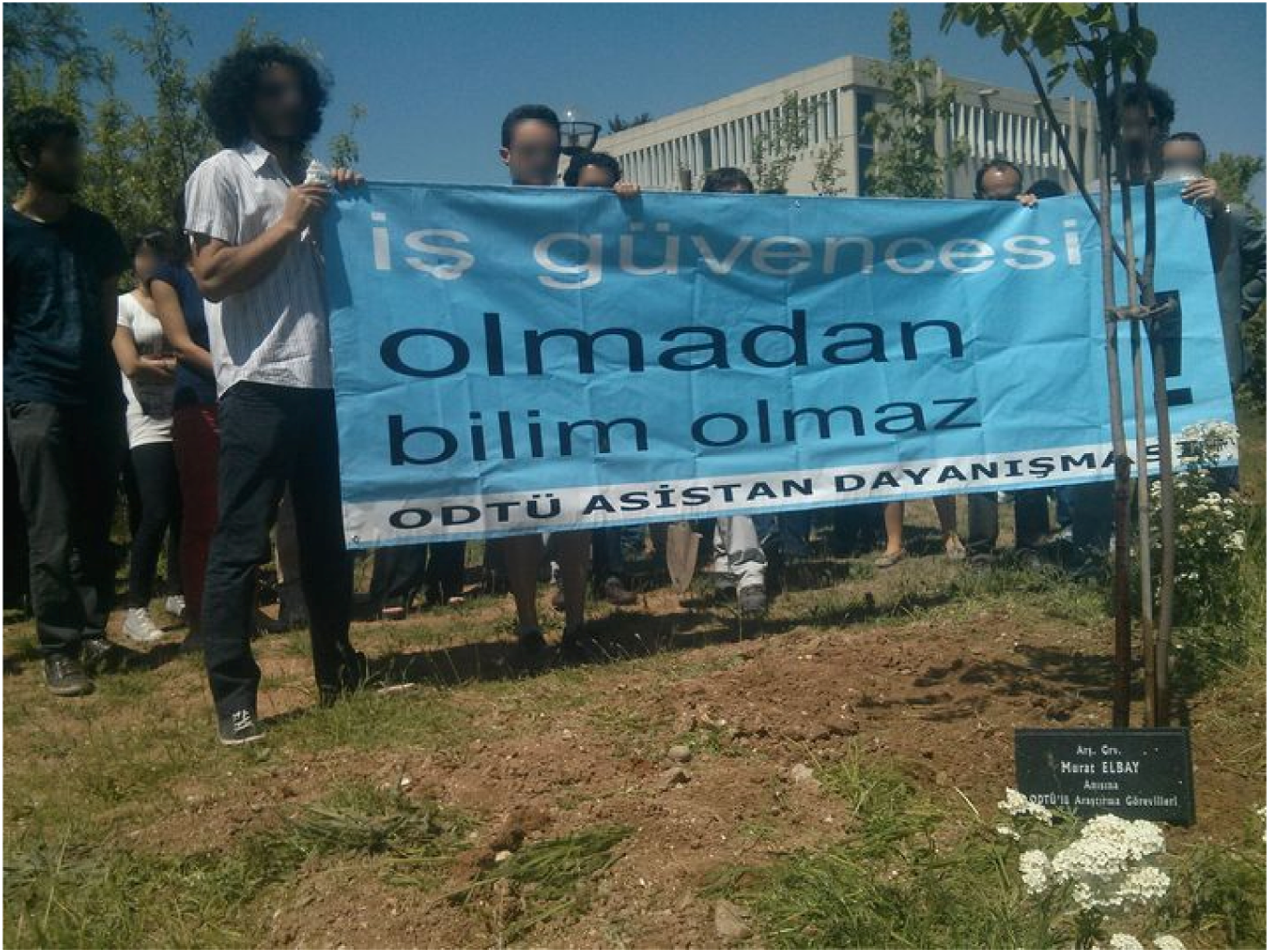
At the end of the spring semester in 2013, the Gezi Park protests began in Istanbul and later spread throughout Turkey. The AS group in ITU also attended these protests and set up their tent near others in Gezi Park (Figure 6), a medium-sized centrally located park in Taksim Square in Istanbul (Göle, 2013). It had become one of the visible groups of the resistance and related forum meetings at different Istanbul parks. In this way, the group also promoted its message and the group’s objectives outside the ITU campus. However, the METU group did not attend to Gezi Park protests with their name. People in this group participated in these protests individually or in other organisations. One of the assistants explained it as: “Most politically active members of the movement are already members of other political organisations. Because of that, they do not have enough energy to attend the protests on behalf of us.” Tent of AS group in ITU in Gezi Park Protests.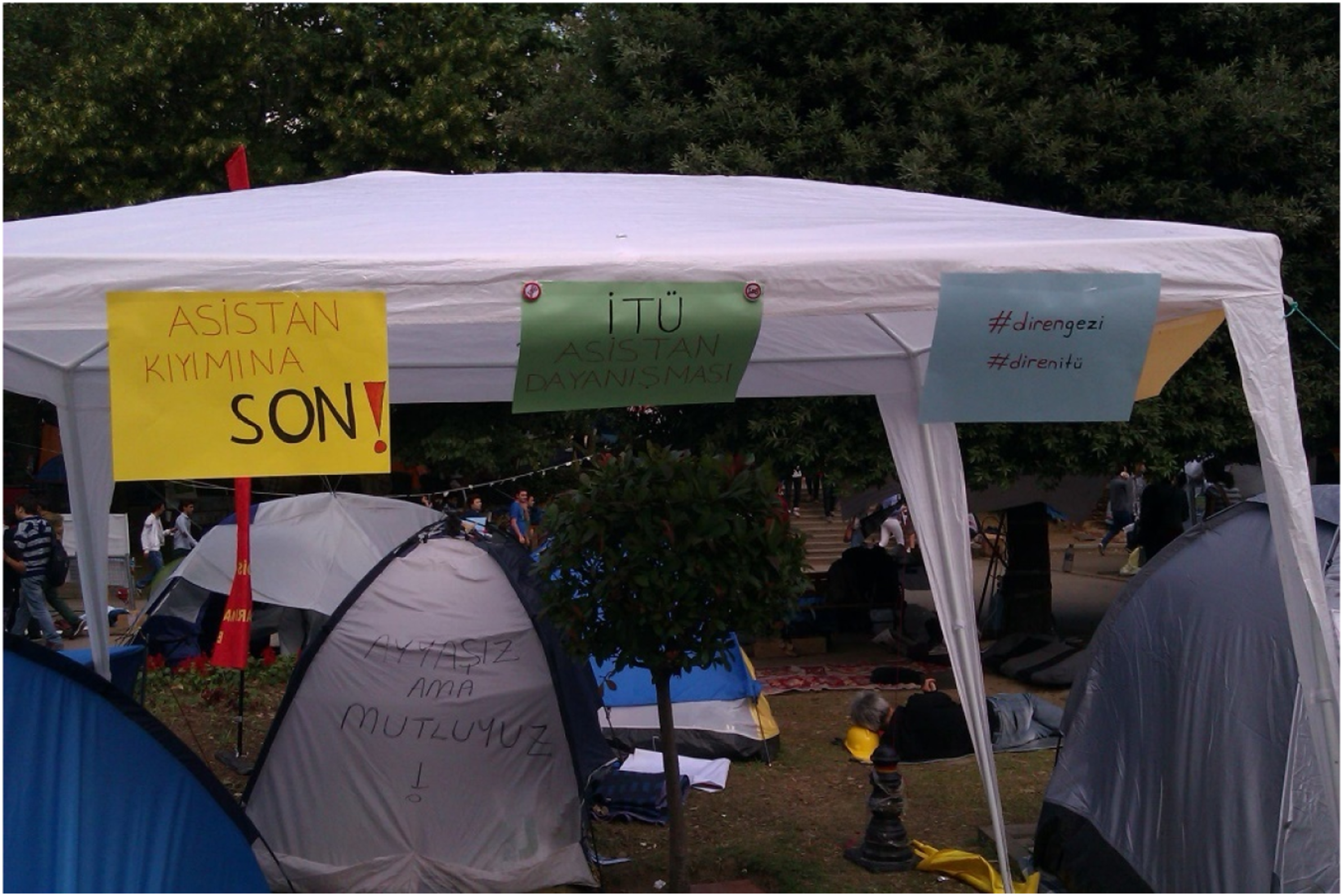
In June 2013, the METU arranged a festival for high school students to promote the university. The group has requested a forum meeting during the festival from the organisers. However, they were not allowed to organise such a session. Despite this rejection, they set up their tent and had their posters. The group selected this place to attract public attention as much as possible. This protest was the last known protest of the group in METU, and they have not performed any activities since then. The regular meetings have stopped, as increasingly fewer assistants were attending them. Some other remaining group members are now active in Eğitim-Sen and ÖED. Eğitim-Sen (union) updates the group’s Facebook page with the news. Whatever remains from the group has been divided between these two active organisations of the METU campus, and other identities territorialise those spaces.
METU and ITU dismissed all of the overdue assistants. Therefore, both groups seem to be unsuccessful in reaching their objective. However, the ITU group is still alive after the data collection. They organise protests, marches, and meetings; update their blog and Facebook pages. As the university had terminated the employment of overdue assistants, the group is less potent than in the dispute’s high times.
Results and discussion
Physical and virtual territoriality and the identity of resistive collectives in organisations
As identities and meanings are socially constructed (Berger and Luckmann, 1967), territoriality is essential to building and expressing identity for collective action (Martin, 2003; Paasi, 2009). Social movements can use and change the symbolic meanings of territories (Wolford, 2004) to subsume other identities under their collective identity. So, similar to the macro scale social movements in society (Zald and Berger, 1978), the resistive movements in organisations strengthen their identity through territorialisation and associating their existence with territories.
The case study has two significant contributions to the literature, drawing the relationship between territoriality and developing the identity of resistive collectives in organisations. The first is the link between identity and territorialisation in physical and virtual environments. The second concerns the diffusion and dilution of resistive identity through territorialisation in organisations.
Regarding the first one, both groups engaged in actions for territorialisation that supported the development of their identity in physical and virtual environments. However, the resistive movement in ITU was more successful in forging its identity. As symbolic meanings help to develop resistive identities (Nicholls et al., 2013), both movements preferred symbolic routes for their protest march. For example, during protests, people marched from the cafeteria to the Rectorate building in ITU. On the METU side, the biggest protest march of the movement began at the faculty of education, where many of the participating members work, and ended at the Rectorate building. Beginning and end points define a meaningful space, materialise the power struggle, and describe the opposing sides. The cafeteria square in ITU was where the students occupied, and the group was powerful.
Similarly, the faculty of education at METU was the workplace of many participating assistants. The rectorate building on both campuses symbolises the other side of the struggle. The protest march represents the flow from the groups’ dominated space towards the boundaries of, and sometimes inside, the rectorate building.
Whereas both movements used the symbolic power of territories, the ITU group was more active in organising various spatial activities. They had located a tent in front of the rectorate building and moved it to a more central location. Moreover, they had changed the tent with a caravan to stay at the campus at night. These activities denoted their commitment to their plan and unity. Furthermore, they had named the caravan area “the solidarity square.” They interacted with the broader context in that symbolic space. The ITU group was also active in territorial actions in the public sphere. They attended labour strikes at different companies in Istanbul and organised a sit-down protest in Ankara. The METU group supported this protest activity, but the organiser and the core group were from ITU. Moreover, the ITU group also took part in the Gezi protests. All these territorial actions in the physical environment have been reflected in internet media and allowed the group to publicise.
Moreover, both movements territorialise in the virtual environment through their blogs and social media accounts. In these virtual territories, they could seek the group’s legitimacy without the restrictions of their organisation’s administration. However, unlike the METU group, the ITU group struggled with the university by posting comments and replies on the university’s official social media accounts. They developed tactics to overcome the server restrictions banning their e-mailings. Accordingly, territorial visibility and struggles in virtual and physical environments supported the ITU group in developing a stronger resistive identity.
These results support the early research highlighting the relationship between territoriality and identity development. However, the organisational affiliation of resistive actors in the case and territorialisation in a virtual environment bring novel contributions to the literature. For example, the METU group persisted for some time because of the assistants enduring affiliation with the university and their activities in virtual territories, despite the group’s few territorial activities. Therefore, organisational resistive identities appearing in virtual environments are not solely dependent on territorialisation in the physical environment, like socio-territorial movements (Halvorsen et al., 2019).
The second contribution concerns territorialisation’s contradictory consequences regarding the diffusion and dilution of resistive identity. Actors’ relational ties within and across territories facilitate the spread of resistive movements (Nicholls, 2009; Nicholls et al., 2013). In this case, expanding territories through existing and new ties supported the movement’s identity in ITU. For example, assistants of ITU found support from students and other academics with their territorialisation in the university. They also extended their links by participating in out-campus protests like the Gezi protests. However, expanding their territories with new links in METU diluted the identity of AS Movement in this university. In METU, most opposing organisational actors were pre-existing members of organisations such as Eğitim-Sen and ÖED. The METU group’s attempts to extend their territories by linking themselves with the other opposing organisations impeded constructing an identity bringing solidarity forefront and covering all assistants affiliated with other collective bodies. Eğitim-Sen and ÖED appeared at the forefront of the protests and territorialisation in the virtual channels of the METU group. As this study covers social movements in organisations, results show that territorialisation and linking with other opposing organisational identities can dilute the identity and may have unexpected consequences. The other collective identities can be perceived as more legitimate foundations while defending the rights of the organisational actors.
Contingent territoriality in communicating activities of resistive collectives in organisations
Territoriality is essential for communication (Sack, 1983) and mobilising others to support the resistive movement. Interactions among existing members occur within territories, and they communicate their resistive identity to others with territorialisation. While territorialisation in the physical environment is essential for communication, the Internet provides opportunities to mobilise more people and expand collective action (e.g., Bennett and Segerberg, 2012; Kim and Lim, 2020). This study reveals the contingent territorialisation in physical and virtual environments that communicates social movement activities.
Both groups employed territorial actions in physical and virtual environments that mostly complemented each other. In line with the rise of political mobilisation through virtual territories (Dodge and Robert, 2001), both groups engaged in territorial actions on the Internet. The level of control in these semi-public territories varies depending on the features of the online setting. For instance, movement members can post something on social media or write comments on their opponents’ posts. The social media account owner can delete its post comments for later use. Both groups had a blog, Facebook, and Twitter accounts to communicate messages and interact with online visitors. They used the Internet to promote their cause. The groups also sent emails to their members and others. Those virtual channels allowed groups to escape from the dominant order in their organisations (Scott, 1990) and mobilise others to support their movement. They supported their protests in physical territories via communication on social media accounts and blogs as territorialisation in the virtual environment.
As the Internet has reduced the cost of coordination and participation (Diani, 2000), the groups mainly announced their protests first online. They also published visuals and documents on virtual territories when they occupied a physical territory, developing their identity and attracting public attention. This observation represents typical behaviour in both groups except for the kept-secret actions until the protest day. For instance, the ITU group kept its protests confidential during the European University Association Meeting. Similarly, the METU group set up a tent during the high-school promotion week of METU without any announcement to avoid counteraction. Both movements developed tactics regarding territorialisation in physical and virtual environments over time. Sometimes, they begin posting their announcements online and organising their activities. In contrast, sometimes, they perform physical activities and post information regarding these activities on online channels to call others’ attention.
Interrelating territoriality in physical and virtual environments
Resistive activities and territorialisation solely in physical and virtual environments lead to the emergence of opposing identities. In this study, two movements engaged in both environments, as territorialities in these environments mutually supported each other and were relational. The study argues that physical activity is still more crucial than virtual territories for developing a robust resistive identity. In this case, both groups enjoyed their blog page and social media accounts on the virtual side. However, the online engagements of the METU group were weak compared to the ITU group.
Both movements’ social media accounts include posts like announcements, support messages to other resistive identities, and sharing posts in different social media accounts. Another critical content is the posts covering the territorialisation of movements in the physical environment. So, more territorialisation in the physical environment means more content in the virtual environment, increasing engagement and strengthening the resistive identity. Unlike the ITU group, the METU group’s spatial activities and struggles with the university’s administration were relatively few. Therefore, their blog and social media posts were more about declarations and sharing online content from other sources. The METU movement has weaker territorialisation in the virtual environment because of its passive stance on the physical side. For example, a tree-planting ceremony was organised in both ITU and METU and shared on their social media accounts. The total number of “likes” on ITU’s site was 130, and METU’s was 58.
So, while the movement had performed complementary activities between physical and virtual environments in ITU, the METU group could not accompany their virtual and physical territorialisation. The METU group was weaker in resisting the university administration and the other political identities. They could not territorialise a part of the physical campus space and create a primary physical territory for themselves.
Furthermore, virtual territories provide a capacity that a physical territory cannot offer to its dwellers (Schwedler and King, 2014). As the resistive groups in this study were members of a hierarchy in an organisation, territorialisation in a space controlled by administrators was not easy. So, movements’ territorialisation in the virtual environment was fast, less questioned, and more legitimate in the initial phases of their emergence. In the later stages of their emergence, both groups preferred territorialisation in both sites to attract attention and publicity. Thus, territorialisation has a different temporal structure regarding the lifespan of a collective in different environments.
Moreover, the study identified the two-way concurrent relationships between virtual and physical territories. Hybrid territorialisation provides various opportunities to resistive organisation actors in particular cases. For example, the movements broadcast their protests from their social media accounts. Acknowledging the online broadcast, the security guards and the university administrators noticing their public visibility limited their actions. Therefore, hybrid uses of territories essentially exert power on the respective parties.
Universities and organisational territories
The case study has illustrated that organisational boundaries are both stable and fluid. The processes of organising and resisting can occur within and outside organisations. This approach shatters the “container metaphor” (Ashcraft, 2007: 11). While territories are social constructions, some boundaries are always relatively fixed or fluid. Actors can make, challenge, and disrupt these territories by territorialising and reclaiming physical and virtual environments.
Moreover, when territoriality in organisations is studied, the physical environment mainly covers indoor objects such as equipment, furniture, and accessories. Their arrangements enable and constrain interaction in organisational activities (e.g., Elsbach and Pratt, 2007; Brown and Robinson, 2011). The study examining university campuses helped analyse the territoriality of outdoor organisational spaces that support collective actions. As these groups extend their territorial actions to virtual environments, the study could analyse territorial interrelation in physical and virtual environments.
In this case, the study observed various resistive activities challenging pre-existing organisational territories in different environments. For example, video recording a transgression and making it publicly available on social media has caused resistive actions in both physical and virtual territories. Therefore, the pre-existing organisational territories had seen as natural and fixed. However, they could be disrupted and changed through the resisting collectives’ territorial action. Thus, the physical territories drawing the borders of a university are not solely its actual territories. Virtual territories also have affordances for resistance to confront, provoke, and evoke a reaction or promote their causes.
At this point, it is essential to note that both campuses’ Assistants’ Solidarity Movement attained different territorial strategies online and offline. Neither university administrations nor the state (in the protests around the Higher Education Council) had consistently responded with counter-territorial tactics. The story on both campuses never turned into a solid spatial struggle. While the conflict remained at different online and offline locations, spatial contestation has not risen to a level that feeds the existing conflict. These movements’ survival never wholly depended on the territoriality they could create. Therefore, this topic remains a limitation of this research’s cases. In future, researchers may address other cases where territorial actions of movements and counter-responses trigger various spatial struggles. Such cases may identify how spatial struggles impact resistive identities and the longevity of respective movements residing in organisations.
While this paper has taken a territorial approach to the spatial dynamics of two “solidarity” movements residing in two universities, aspects of solidarity are worth further analysis (Tormos, 2017; Wilde, 2013; Wilson, 2017). Recent work on the geographies of solidarity provides approaches that may unsettle existing territorial approaches (Mott, 2016; Negrín da Silva, 2018). Geographical studies relating to class and labour movements and debates around race and colonialism (Bressey, 2014; Land, 2015; Koensler, 2016; Kelliher, 2018) may greatly expand the perspectives into spatial contestations and social movements in and around organisations. Future studies may look closer at the geographies of solidarity on university campuses to explore the research problem from a vantage point.
The dynamics of the decline and demise of territorial struggles
In this study, territoriality covers dynamic boundaries drawn around tangible, intangible, and social objects providing existential being to collective actors in organisations. Unlike the informal governance mechanism of social movements emerging due to social unrest, resistive collectives in organisations are tied to their organisations with more formal governance mechanisms (McAdam and Scott, 2005). These actors are essential for the territoriality of collective resistance in organisations. As all overdue assistants in both universities were dismissed, resistive collectives deterritorialised and lost momentum due to this organisational decision.
Territoriality is essential to form resistive identities (Soja, 1989; Nicholls et al., 2013) and mobilise resources to maintain social movements (Martin and Miller, 2003). In this case, the deterritorialisation of resistive collectives in both universities was the primary reason for dissolving resistive identities and their decline. This study contributes to the literature to develop our understanding of the deterritorialisation of resistive organisational actors bound up to an organisation with a more formal structure.
When we completed data collection, the territorial activities of METU were demised, and the ITU group’s activities faded out in the physical environment. Compared to the offline world, both movements can be considered active in virtual spaces; however, the social media accounts of the METU group were kept active by other resistive identities in the university, such as Eğitim-Sen. Social identity complexity could explain this territorial transformation of a resistive identity (Roccas and Brewer, 2002). This approach allows distinct social identities to be reconciled through various mechanisms. One of these mechanisms is adopting a primary group identity covering other subordinated identities. As Eğitim-Sen had been more active in METU as an opposing identity, the remaining members of the METU group continued their territorial activities under that identity, converting this group’s virtual territories. Territorial dynamics and territorial transformations of collectives with complex identities can be examined with further studies.
Conclusion
The emergence of the AS Movement in Turkish universities represents a struggle for the rights and recognition of academic assistants affected by implementing new policies related to inbreeding and employment contracts. The movement has been characterised by forming independent entities in different universities. These entities employed territorial actions in physical and virtual spaces to mobilise assistants and defend their rights. These struggles highlight the importance of collective action and solidarity among academic assistants and the need for universities to address these professionals’ challenges. Understanding the AS Movement, which advocates for their rights and raises awareness of their problems, is essential to gain insights into Turkish universities’ ongoing development and reform.
This paper has joined the research stream that challenges the traditional understanding of territories, which considers territories as neutral contexts. It also helps understand how social movements in organisations engage in territorial actions in physical and virtual territories. They take organisational spaces, inhabit organisational places, and enable collective movements to balance power inequalities and respond during collective struggles. Moreover, studying the relationship between territoriality and resistance emphasises these concepts’ crucial role in social movements’ emergence and potential demise.
Based on the analysis, power asymmetry and inequalities between two sides of a workplace struggle make it essential for weaker movements to exercise different territorial tactics for spatial occupation and transgression. In this case, the groups aim to extend their territories by gaining visibility, attracting attention, and influencing the community. In this way, the groups have tried to balance power inequalities and resist policy implementation.
Besides the physical territoriality, the study considers actions in the virtual environment to increase their territorial capacities. All actions and interactions in physical and virtual environments support groups’ communication and develop a resistive identity. Moreover, the comparative analysis helps identify these actions’ contributions.
The results from these case studies are naturally invalid for every context and organisation. However, the case describes interpretative realities perceived by organisational participants about these settings (Suddaby, 2006). It makes the results and observations useful for organisations in similar contexts.
The political situation presents challenges not only for university employment but also for doing critical research in Turkey and worldwide. Academic institutions and scholars who expressed dissenting opinions or engaged in critical research on politically sensitive topics have been in turmoil. It limits the scope and depth of critical research conducted across countries. It could have also implicitly impacted our treatment of the research problem in this study. Researchers must maintain their independence and integrity while also being mindful of potential risks to themselves and their research participants. In this study, we maintained our independence and integrity as part of a reflexive research practice (Johnson and Duberley, 2003; Pillow, 2003).
The study concludes that scholars must expand current approaches to organisational resistance with new forms of resistance emerging from territorial actions in physical and virtual environments. It argues that researchers should focus on both environments’ territorial actions as active and contested fields for organisational resistance. While the study is constrained to generalise from these cases, the territorial actions in varying spatiality of the workplace may enrich the understanding of organisational resistance.
Footnotes
Declaration of conflicting interests
The author(s) declared no potential conflicts of interest with respect to the research, authorship, and/or publication of this article.
Funding
The author(s) received no financial support for the research, authorship, and/or publication of this article.
