




Abstract
State entrepreneurialism in response to external market stimuli has a state intrapreneurialism counterpart – the entrepreneurialism found within public institutions. In moving beyond the case of Singapore from which the idea was proposed, this paper develops the concept of state intrapreneurialism by injecting a greater sense of the political and territorial heterogeneity of, and competition within, national states that fracture the identification of needs, the crafting of policy narratives, and the forging of domestic and international networks. With reference to the case of South Korea, this paper illustrates how state intrapreneurialism has generated domestic and international markets and reputation in the ICT-assisted city management domain despite elements of competition among public agencies. The case raises broader questions for future research on the relational geographies of politics and bureaucracy in stimulating or stifling state intrapreneurialism.
Introduction
Harvey (1989) drew attention to the pressures external to local states driving urban entrepreneurialism. Commentators have since observed the centrality of national and local states to entrepreneurial processes (Mazzucato, 2016; Wilson, 2016) with Miao and Phelps (2019a) highlighting the intrapreneurialism – innovation from within state bureaucracies – specifically.
Combining the features of developmental and entrepreneurial states, the idea of state intrapreneurialism provides a useful and widely applicable framework in not only synthesizing the fragmented anecdotes on public innovations, as noted by Styhre (2007) in the Anglo-American context, but also reinterpreting post-developmental transformations across East Asia. Drawing on an idea that had emanated from business studies in the 1980s, the concept of state intrapreneurialism was defined as ‘the latent or actually existing entrepreneurialism apparent within public sector bureaucracies’ (Miao and Phelps, 2019a: 5) and reflects primarily the commercialization of opportunities saleable to other businesses or large organizations rather than directly to customers or citizens (Parker, 2011). The innovation or intrapreneurship of states can be associated both with bureaucrats but also political leaders since political leadership is defined as ‘the impact on decision-making and political outcomes that results from action by the holder of political office’ (Wineroither, 2013: 1455). Indeed, Wineroither (2013: 1460) goes on to argue that, while radically innovative political leadership in general remains highly constrained, entrepreneurial leadership in politics has flourished as a result of transformations in economy, society and media.
However, the state intrapreneurialism concept was formulated against the de facto continuous single party-political control found in the Singapore case (Miao and Phelps, 2019a). First, then, the concept of state intrapreneurialism was silent on how domestic politics – including political leadership – plays into the balancing of a variety of state objectives and even intrapreneurialism itself where politics and political change can adversely affect continuity embodied in, and coordination across, state bureaucracies.
Second, where accounts of the strategic (Jessop, 1990) and spatial selectivity (Jones, 1997) and rescaling (Brenner, 1998) of the state and its entrepreneurialism drew attention to the domestic challenges of territorial management facing nation states in the origination, design and implementation of policy (Keating, 1997), the concept of state intrapreneurialism, derived from the city-state case of Singapore, was silent on these same challenges. The literature on state entrepreneurialism has sought to consider more fully the territoriality of states (Brenner, 2004; Jonas et al., 2019; Phelps and Miao, 2020). Notably, this literature has highlighted the ‘rescaling’ of national states with devolution and decentralization of power and competencies to local and regional states to promote subnational economic development (Brenner, 2004) and the extraterritorial influences on, and reach of, states’ policy (Lauermann, 2018) when moving beyond the trap of viewing the exercise of state sovereignty in exclusively territorial terms (Agnew, 1994). This in turn gives weight to the non-territorial means of exerting state power in a markedly more integrated international economy (Ruggie, 1993). The concept of state intrapreneurialism might, then, usefully be developed to consider how these three – subnational, national and international (including extraterritorial) – dimensions of the state come together in policy innovation.
This paper validates and further develops the state intrapreneurialism framework as it has been mobilized extraterritorially when tracing the ‘export’ of the South Korean ICT-enabled urbanization experience. Two research questions arise: (1) How has South Korea emerged in the smart city field? (2) What are the public agencies associated with state intrapreneurialism, and how do they cooperate? Our empirical evidence speaks to elements of competition among intrapreneurial public agencies. The paper offers an alternative reading of South Korea's emergence in the field of smart cities to those of Park et al. (2020), Shin and Kim (2012), Shwayri (2013), Yigitcanlar and Lee (2013) and Shin (2016) and one that emphasizes the interrelationships between domestic politics and the national and international (including extraterritorial) dimensions of state intrapreneurialism with regard to urban expertise.
In what follows, the state intrapreneurialism framework is developed by incorporating a greater sense of the party-political and territorial heterogeneity of states. The following section describes the methods used in retracing stories of South Korea's rise in the smart city field. We then examine the different actors involved in exporting South Korean urban expertise in a way that makes clear the effects of domestic party-political change and territorially based challenges of competition and coordination as they have affected these intrapreneurial efforts. The conclusion highlights the relevance of this expanded idea of state intrapreneurialism and the politics surrounding it beyond the (post)developmental states of East Asia.
The political and territorial heterogeneity of state intrapreneurialism
Dissatisfied with the neoliberal reading of the state as an obstacle to innovation and the unitary description of the state in urban entrepreneurship literature, Miao and Phelps (2019a) proposed ‘state intrapreneurship’ as an alternative interpretation of the modern state's role in socio-economic development. They argue that innovative forms of stateness could ‘come as much from within (as important legacies of the intrasocietal functions of the developmental state) as from without (as a reflection of the extrasocietal pressures of globalization in particular)’ (ibid., p320). Specific features of state intrapreneurship were derived from the intersections between state developmentalism and entrepreneurialism, including continued leadership in the setting of industrial priorities, the leadership and action power present in partnership and the outcome-oriented decision-making process. There are advantages to employing the state intrapreneurship framework in an analysis of public interventions and economic transformation. While extant literature on urban entrepreneurship speaks at length on the partnerships through which policies are innovated and funded across private–public divides (McGuirk et al., 2021), the state intrapreneurship perspective further highlights the role of the public sector in the origins and extent of societal innovation.
That said, the original state intrapreneurialism framework is arguably narrowly framed out of the unique context of Singapore. First, Singapore is notable for extreme policy continuity under de facto single political party control of the state. As a result, the concept of state intrapreneurialism did not consider how the balancing of state objectives beyond economic development and how innovation from within the state apparatus might be affected by changes in political control. Second, the Singapore state has no conspicuous challenges of internal territorial management. Thus, the concept of state intrapreneurialism ignored the subnational scale in the articulation of the subnational, national and international (extraterritoriality) of the state in intrapreneurship. As a result, the original formulation of state intrapreneurialism presented an overly orderly and linear sense of the relationships between industrial priorities, actions and outcomes. An extension of the original framework (Figure 1) can include a sense of the extraterritorial aspirations of states and the territorial management dilemmas internal to nation states. Intrapreneurial opportunities with respect to the international economy and relations feed into leadership. However, competition among agencies, while feeding into industrial priorities, also breaks the linearity and feedback loop between outcomes and leadership in ways that likely proliferate analyses of needs, the setting of priorities, the framing of narratives and the allocation of resources towards industrial priorities and decisively undermines the developmental state legacy within intrapreneurial state policymaking. In Figure 1, there are dashed lines from national and subnational leadership to coordination compared to the likely stronger (solid lines) to competition to underline the increased challenges of coordination as a result not only of intra-territorial divisions but also the intra-agency divisions (between bureaucratic and political) of intrapreneurship. To the extent that coordination remains possible and is achieved, then this strong linearity in policymaking may remain.
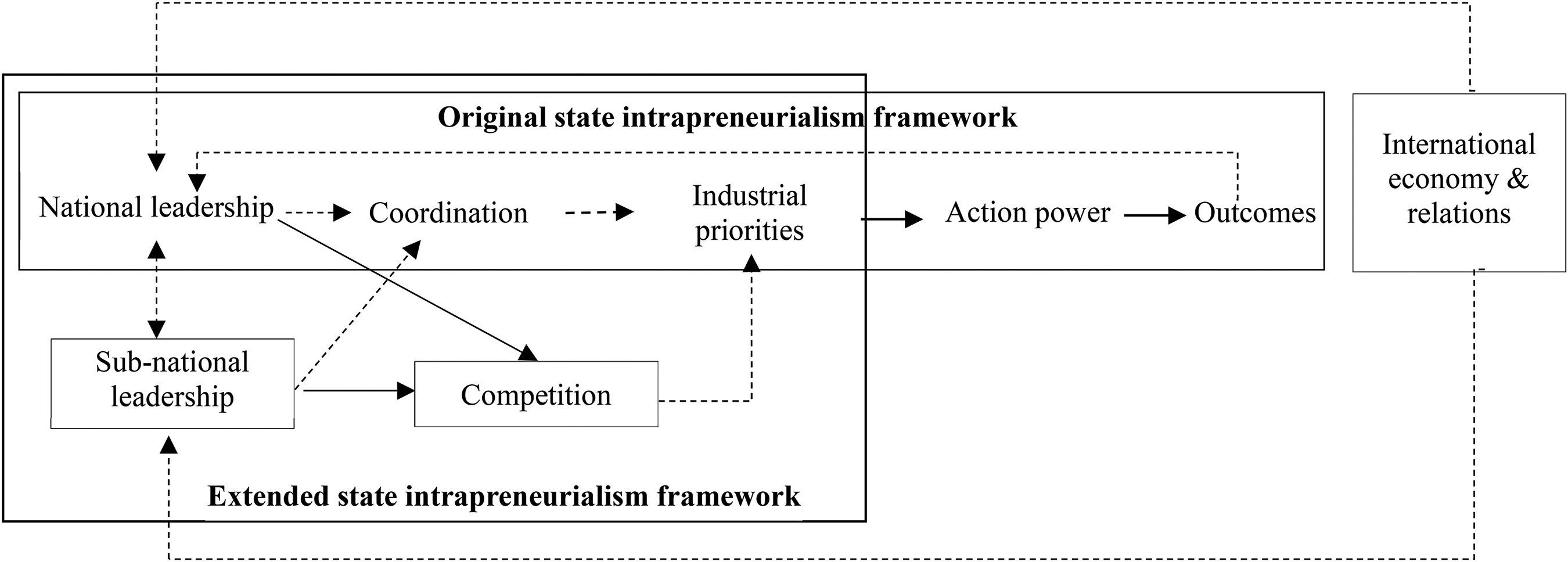
The original and extended state intrapreneurialism framework
Political leadership and intrapreneurialism
Hall (1980) noted how uncertainty in planning stemmed mainly from decisions in the political sphere and, in the face of that, state bureaucracies provided a strong measure of continuity in policy. A parallel question arises as to how party-political control might affect state intrapreneurship?
Public bureaucrats are able to function as entrepreneurs in cultivating emerging markets by proactively anticipating economic changes and embryonic needs (Mazzucato, 2016). This in turn, requires in-house analytical resources, a long-term commitment and a risk-taking attitude (Miao and Maclennan, 2019) extending to public investment in ‘futuristic’ sectors needed where private capital is not forthcoming (Mazzucato and Penna, 2016). Before we too readily render such innovation as purely ‘technical’ (Li, 2007), ‘invisible’ (Doucette and Müller, 2016) or post-political, we can note that state intrapreneurialism both relies on, and can fall prey to, political leadership.
A first challenge for political leadership of national and local states in democratic systems is that policy priorities can rarely be reduced to a single economic objective as they can be in business (Lindblom, 1977), as they were in the history of developmental states and as was assumed in the original intrapreneurial state idea. Instead, states must balance a mix of societal objectives as these play into convincing policy narratives, resourcing of and coordination among agencies. Nationally, for example, while finance, trade and industry ministries and boards have objectives that align most closely with private corporations to generate exports and profits from the likes of smart city expertise, ministries of domestic and foreign affairs balance economic with political or diplomatic objectives, and yet other ministries may have purely scientific or technology-focused objectives. Meanwhile local states may have objectives that directly compete with those of national ones – especially where there are contrasts in party-political control between the two.
Choosing policy priorities is arguably the most challenging task facing political leaders. Political biases can distort priority settings (Hofmann, 2020) where judicious selection of past experiences of, and strategizing with respect to, policy is required (Mazzucato, 2016: 150). Consistent tilting of the playing field is difficult when multiple agencies are competing as leaders and when their sponsorship by political parties is coming into and out of control over time. Formulating a seductive and persuasive narrative is important to consolidate domestic support and leverage public buy-in (Shin, 2016) and exert the soft power of national state extraterritorially (Miao, 2021; Phelps, 2007). Although narratives reflect the ruling party's vision, they also must recognize the distributed sources of intrapreneurialism embodied in (re)branding processes, especially when these connect to domestic strengths (Pow, 2014). Doucette and Müller (2016, p32) noticed that the apolitical, idealized framing of the narrative around South Korea's Saemaul international knowledge-sharing program prompted contestation from rural communities. Miao and Phelps (2019b) noted that narratives could be diluted in contexts where there is competition among state agencies and a lack of coordination among them. Resources are crucial to the implementation of innovative policies (Doucette and Müller, 2016). Developmental states such as South Korea have long demonstrated a strong capacity to mobilize resources under the aegis of the state (Mason, 1980, p485) for whom concentrating limited resources to achieve key development objectives was a rational choice. For developed nations with diversified economic bases, while there continue to be laments over a lack of coordination, a measure of redundancy across institutions and the resources they are able to mobilize has been suggested as important to system resilience (Biggs et al., 2015).
Innovation in, and the efficacy of, policymaking in all of the above respects is underpinned by coordination between the multiple stakeholders involved. There are multiple choices at governments’ disposal. These include (often informal) networking among key civil servants, collaboration on reaching an agreeable definition of the problem and the means of addressing it and setting up hierarchical authority from the centre of government. The latter was common among developmental states exercising administrative fiat through cabinet dictate and the authority of central agencies and ‘super-ministries’ (Woo-Cumings, 1999) but is less possible as these same states have transitioned towards post-developmentalism where the creation of negotiated procedures to enhance coordination and devolve responsibility has been part of the challenge of national territorial management (Peters, 2018).
The territoriality of state intrapreneurialism
If there is a sense in which innovative leadership ‘signals capabilities that exceed bureaucratic management and embrace the intrasocietal-facing skills of coordinating the competing interests of different social classes and designing appropriate institutional infrastructures’ (Miao and Phelps, 2019a: 318), then we need to direct analytical attention away from political and bureaucratic decision-making elites in peak agencies towards the dynamics and struggles of reaching consensus among a variety of national and local agencies with different interests (Meseguer, 2005). Political leadership and bureaucratic innovation are likely more distributed across a range of state agencies – nationally among different sectors and subnationally across the territory – than anticipated in the original intrapreneurial state formulation.
European states have long struggled with issues of internal territorial management (Keating, 1997) due to national–local state contrasts in political leadership. In the largest of nations, single-party state intrapreneurialism is far from trouble free (Miao and Phelps, 2022). However, in democratic systems, problems of innovating and coordinating national priorities locally or universalizing local initiatives nationally are apparent in the (dis)continuity of, and (mis)alignment in, political leadership between these two tiers. Indeed, change in national and local political leadership is itself seen to reflect polyvalent bargaining over, and contestation of, policy (John, 2013). Moreover, the domestic territoriality of the state is further complicated regarding the relationship between political leadership and bureaucratic innovation, not least because both national and local governments and agencies may have extraterritorial aspirations in an era when both urban entrepreneurialism and diplomacy have taken on a distinctly international reach (Lauermann, 2018; Phelps and Miao, 2020). The traditional geopolitics of nation states are now joined both by a greater recognition and focus on the part of nation states on the geoeconomic opportunities to be mobilized well beyond national borders and by the increased extraterritorial geopolitical and geoeconomic interest evident among local states.
Extraterritorial ambitions in this regard have their recursive effects when generating critical issues of domestic competition and coordination of policy. Economic development policies are a case in point. The attraction of inward investment as a staple of state entrepreneurialism, for example, continues to be plagued by issues of intra-national competition and attempts to coordinate within subnational territories let alone among them (Phelps et al., 1998; Phelps and Raines, 2003; Tewdwr-Jones and Phelps, 2000; Thomas, 2000). One implication of the now extensive policy mobility literature (McCann and Ward, 2011) is that local governments worldwide have developed expertise with regard to urban regeneration, housing, planning and environmental policies that may be commercially exploitable. We know little about whether and to what extent (through coordinated efforts) local state intrapreneurialism is evident in the exploitation of this expertise.
Moreover, issues of territorial competition and coordination as these affect state intrapreneurialism extend beyond those surrounding policy objectives, as determined by politics, to implement the longer-standing national territorial architecture of fiscal redistribution and decentralization and devolution of powers that can form a bureaucratic counterpart to political leadership in state intrapreneurialism. In the aggregate, the relationship between government decentralization and devolution and subnational economic performance is far from clear (Rodríguez-Pose and Muštra, 2022). In detail, policy coordination is hampered at the subnational scale by something as simple as a lack of consistency in data availability and collection for the analysis of needs and priorities as well as the monitoring and evaluation of outcomes (Miao and Maclennan, 2019).
Research methods
This paper draws on qualitative methods to develop the state intrapreneurship framework. As a case, South Korea provides an important example of state intrapreneurship that can be suitably counterposed to and help extend (Burawoy, 1998) it from the possibly peculiar city-state Singapore case to a wider category of small states (Cooper and Shaw, 2009).
Desktop research conducted between 2019 and 2021 focused on a wide array of documents dating back to the 1980s concerning the promotion of ICT and then smart cities. The key central agencies overseeing the development and implementation of these policies are (1) the Ministry of Information and Communication (MIC) and later the four decentralized agencies that are responsible for the development of the ICT industry; (2) the Ministry of Land, Infrastructure and Transport (MOLIT) which promotes exporting the South Korean smart cities; (3) the Ministry of Economy and Finance which shepherds the Korea Knowledge Sharing Program (KSP); and (4) the Korean Development Institute that assists the government's strategic economic plans. These documents, complemented by published scholarly literature, government press releases, promotional literature, site visits, popular press and trade journals, provide the background information on the industrial, urban development and international aid policies that underpinned South Korea's emergence in the smart city field.
We were also able to identify the most relevant and proactive agencies and institutions involved in promoting South Korea's smart city development, urban planning and foreign aid programmes through this secondary data analysis. A total of 22 face-to-face interviews were then conducted prior to the recent COVID-19 pandemic between May and July 2019 using a targeted sampling method and a snow-balling technique to recruit informants from relevant institutions (Table 1). For each institution, we first scanned through their organization chart to identify the most relevant branches and personnel before approaching them via emails for interview appointment. Each interview lasted for at least 1 hour. In several cases, a second meeting was set up to explore issues in more detail. Interviews were semi-structured, and questions covered the activities of institutions in promoting and internationalizing South Korean urban management expertise, cooperation with other agencies and the challenges faced.
Summary of interviewee profiles.
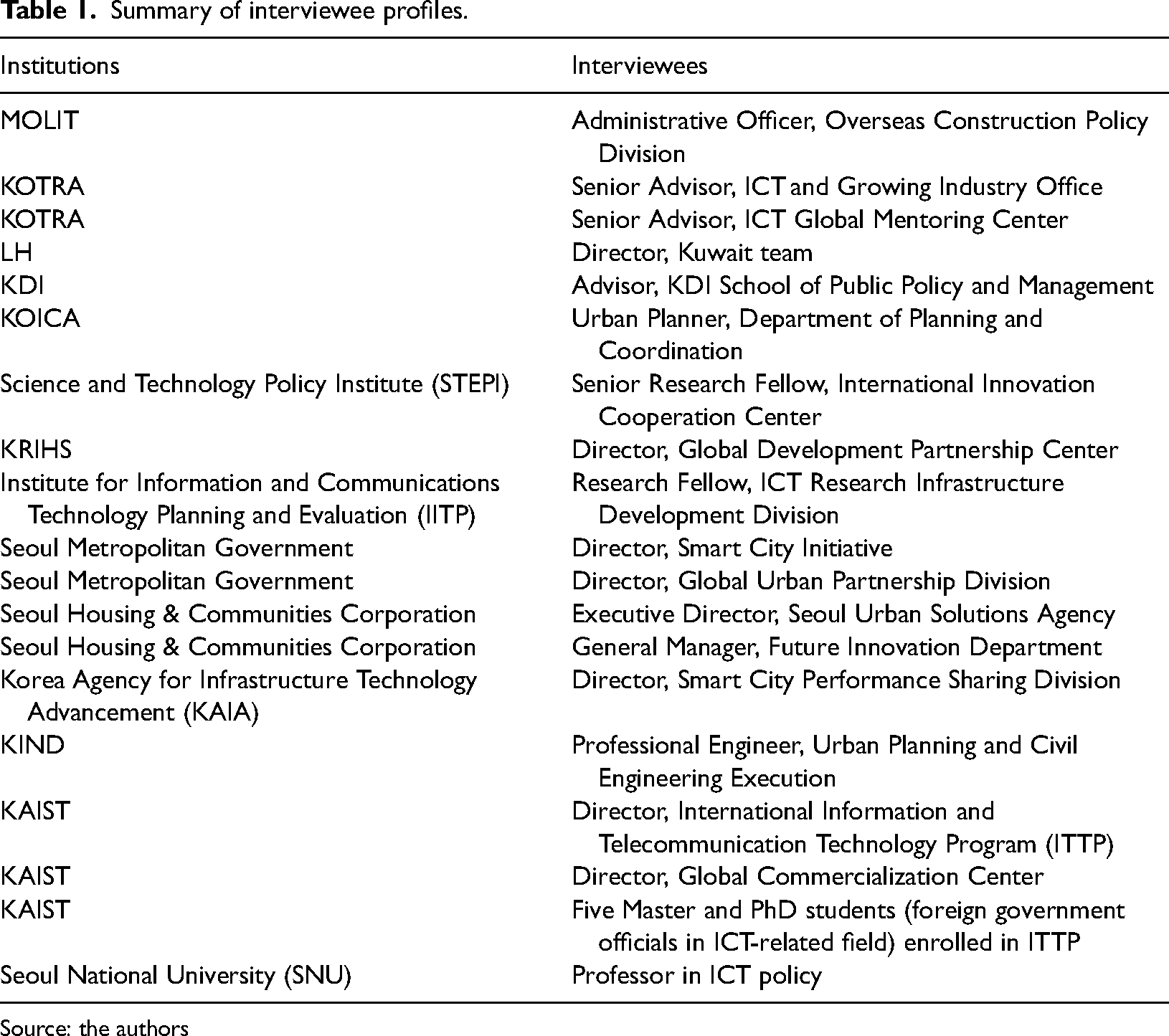
Source: the authors
Policy documents, interview materials and meeting notes were analysed based on a three-stage procedure suggested by Braun and Clarke (2006), including data familiarization, coding and theme development and revision. In the first step, data familiarization was achieved through transcription and translation of the documents. One of the authors is a native Korean speaker who led this process. In the second step, the transcripts were imported into the NVivo for data coding, which took a combination of research question-driven and data-driven approaches. Specifically, the beginning of the coding process was guided by the extended state intrapreneurialism framework on the political and territorial heterogeneity. When satisfied that the codes generated from five of the transcripts were aligned with the research questions and hence fit for purpose, the data-driven process followed with an inductive epistemology to generate a rich node and sub-node pool. In the third step, themes that capture the key ideas of the data in relation to the research question and represent some level of patterned response (Braun and Clarke, 2006, p.82) were developed by the authors reading and re-reading the codes. Frequency counting in NVivo helped to generate five key themes at the end, including ‘The mission of the South Korean state and its changes’, ‘Strength of the State and its public agencies’, ‘Korea going abroad initiatives’, ‘Coordination’ and ‘Constraints’.
South Korean intrapreneurship in the export of smart city expertise
A historical account of South Korea's recent emergence in the smart city field is needed to unpack its intrapreneurial state quality. As a representative developmental state in the post-war era, South Korea's development exhibited the typical ‘high stateness’ scenario of prioritizing economic growth, selective industrial policies and managed trade policy (Wade, 2018). This enabled a leap-forward industrial policy in the 1980s, when information technology was identified as a national priority (Shin and Timberlake, 2006). In Korean industrial and economic development policies, manufacturing and exports have been key strategies to overcome the national weakness – the deficiency of natural resources. In the 1960s and 1970s, light and heavy manufacturing was prioritized by national economic growth policies taking advantage of low labour costs. Then, with the advancement of technological skills, the focus has evolved to knowledge-intensive export-oriented manufacturing such as computers and semiconductors since the 1990s (Kim and Han, 2012).
This series of national strategies helped to transfer South Korea into a leading international force in the ICT sector, with a demand-based development focus that has shifted from hardware to e-governance to ubiquitous urban infrastructure and then to smart cities (interview: Korea Advanced Institute of Science and Technology (KAIST), 1 July 2019). As we describe elsewhere, intrapreneurial national state actions to promote South Korea's urban expertise through novel university education and training programmes at the likes of KAIST nevertheless have been greatly shaped and reshaped by changes in political control and leadership of national government in the transition to post-developmentalism (Miao et al., 2023). It is to some of these shifts we now turn to better understand the territorial politics of state intrapreneurialism.
With the advance of ICT technologies and infrastructure in the following decade, the Korean MIC, under the Roh Moo-hyun government (2003–2008) realized that only promoting the virtual world had limited returns on public investment (interview and workshop discussions with Korea Research Institute for Human Settlements (KRIHS)). The need to generate concrete socio-economic values and to develop a new urban model (Shin and Kim, 2012) had pushed MIC to shift its focus to ‘U-City’ since 2003 (Yigitcanlar and Lee, 2014). It also called for a new governance structure, and the Ministry of Construction and Transportation (MCT; former name of MOLIT) was brought on board (Lee et al., 2007). The two ministries cooperated on a series of matters including, for example, developing and certifying U-City models and carrying out trial projects. To further leverage public resources and enthusiasm, a U-City taskforce was established by MIC and MCT in 2006. Using ‘integration’ and ‘localization’ as the new narratives, this taskforce incorporated local governments, industry leaders and experts (Shin, 2009: 520). Territorial governance featured strongly here as the State tried to bring on board municipal governments with Seoul being the first municipality to join forces (Shin and Kim, 2012). Despite the difference in ruling parties between the central government (of left-wing President Roh) and the Seoul Metropolitan Government (SMG) (of right-wing Mayor Lee Myung-bak), the making of U-City became a shared goal.
Although there was an awareness of local politics and autonomy and the South Korean State had sought to partner with localities, its top-down push for U-City and in particular the centralized power of MIC had undermined the sustainability of the project. As it turned out, MIC was merged with the former Korean Broadcasting Commission in 2008 during the Lee Myung-bak regime (2008–2013) to form the Korea Communications Commission. The shifting party politics from turbulent liberalism to conservatism reinserted a stronger state control (Min, 2013).
The disappearance of MIC dampened the enthusiasm for U-City. The global financial crisis also cut-back public investment significantly (Shin, 2009). Recognizing the needs to redeploy many U-City projects and to catch the global trend in eco-city investment led by the two consecutive right-wing governments of Lee Myung-bak government and Park Geun-hye government (2013–2017), the Ministry of Land, Transport and Maritime Affairs (MLTM, renamed as MOLIT in 2013) and the Ministry of Public Administration and Security (MOPAS) coordinated the development of ‘U-Eco-City’ since 2008, mainly through re-branding the stalled U-City projects. In September 2017, the Promotion of Smart City Development and Industry Act was enforced under the left-wing Moon Jae-in government (2017–2022), who emphasized the fourth industrial revolution and revived ICT-centred urban development under the smart city banner (Choi and Kim, 2021). This Act explicitly asked for not only domestic but also a proactive ‘export’ of the South Korean model overseas (Choi and Kim, 2021), hence highlighting the multisclar nature of state intrapreneurialism we noted above.
Along with other historical accounts (Choi et al., 2020; Choi and Kim, 2021; Kwak and Lee, 2021), we argue that South Korea's rise in the smart city field has a noticeable trait of state intrapreneurialism, as reflected in its role of identifying the needs, forming the narratives and pooling the resources (Table 2). A hierarchical domestic territorial management mechanism had been working satisfactorily to this point in establishing South Korea's domestic expertise. Yet more recent efforts to export smart city expertise expose the growing competition among national and subnational agencies, the distributed nature of state intrapreneurialism found within the nation as well as an increasingly heterogenous set of export opportunities and international relationships. Here the associated need for the coordination of state intrapreneurialism belies any simple thoughts that developmentalism could continue as a model unchanged, pointing up the role of intrapreneurialism and its territoriality within successful transition to a post-developmental state model.
Features of South Korean state intrapreneurialism.
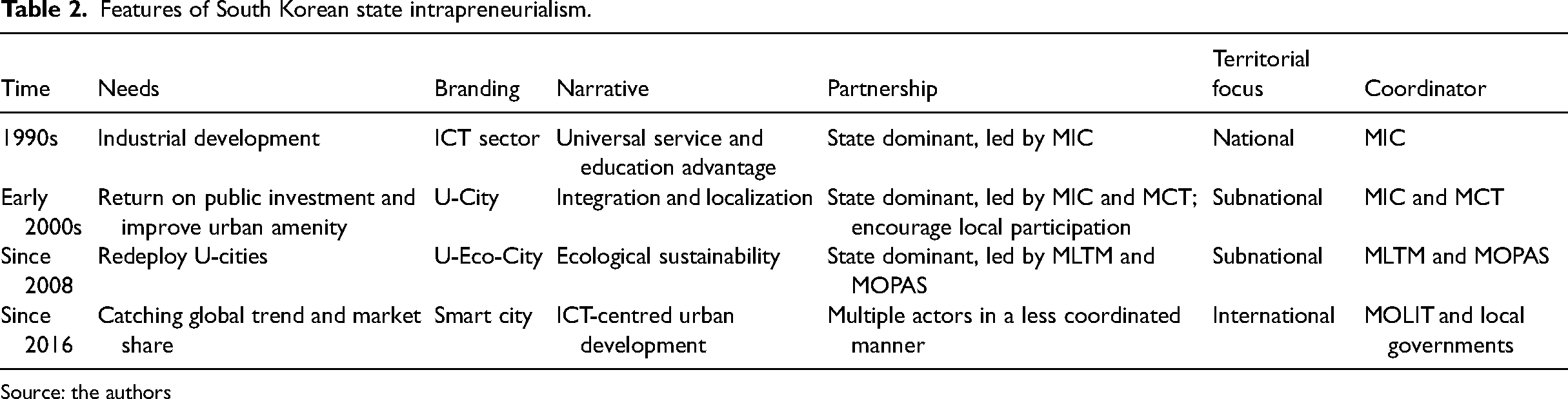
Source: the authors
The territoriality of state intrapreneurialism in the export of smart city expertise
If South Korea's urban politics used to centre on domestic territorial economic development, its recent promotion of smart city ideas in particular and its urban development expertise in general have sparked a deep interest among multiple public agencies in seeking opportunities abroad, partially because of the economic returns implied (interview: KAIA, 2 July 2019). Here we see a web of national and subnational stakeholders within the state from the aid, education, industry and urban development sectors collaborate and compete when mediating between domestic and international economic opportunities and geopolitical concerns.
Nationally, the state, under the leadership of President Moon Jae-in, published a National Cooperation Strategy which identifies 26 countries and seven broad areas as its international cooperation priorities (interview: KOICA, 5 July 2019). Yet this top-down bureaucratic coordination has found its limitation in post-developmental South Korea (Park et al., 2020), especially with respect to extraterritorial initiatives, hence exceeding the political and territorial traps of state intrapreneurism. In our fieldwork, we were able to record over 30 different agencies from aid, urban development, technology, trade, research and education that are involved in formulating and promoting South Korean smart cities internationally. Multiple interpretations of its urban experience have proliferated, and none of our interviewees could summarize the key features of South Korean smart cities or the ‘Korean development model’ in general.
The national in smart city-state-related intrapreneurialism
Nationally, then, the various ministries all have begun to display extraterritorial ambition in exploring global markets for urban expertise but with different strength and/or focus. Their relations are arguably loaded with political conflicts and compromise when an overarching coordination body is missing (Shwayri, 2013; Yeo et al., 2014). The Ministry of Economy and Finance, for example, sponsors a KSP through the Korea Development Institute (KDI) since 2004 and expanded its scale and geographical reach since 2009 (interview: KDI, 27 June 2019). It boasts an ‘evidence-based’ growth model as an alternative to the ‘theory-oriented policy recommendations from advanced countries’ (Doucette, 2020). The expanded KSP has around 150 modularized studies (later renamed context studies) drawing up the key policy initiatives launched in South Korea, including its new town construction and e-government initiatives (KSP, 2021). One key criterion of deciding the modular topics, according to our interviewee, is the potential of linking the experience to the foreign entry of South Korean firms. Yet it is argued that the KSP has failed to make a good model of ‘exporting Korea’ because the Ministry of Economy and Finance is charged with high-level economic planning. It has a less direct contact with urban development issues on the ground (Interview: ITTP, 1 July 2019).
The Korea International Cooperation Agency (KOICA) is another key institution established by the Ministry of Foreign Affairs in 1991 for official development assistance. Its objective is to build bilateral or multilateral relationships, but it tries to materialize aid in the urban sectors, as an interview with an urban planner there recalled that, in 1999, KOICA won its first project: It was to revise the outdated master plan of Hanoi in Vietnam. A year later, a project called ‘Star Lake’ was launched in Tay ho. KOICA carried out a feasibility study for that project, which is now a testbed for smart city technologies. (interview: KOICA, 5 July 2019)
In fact, Hanoi is home to foreign direct investment led by South Korean high-tech manufacturing firms with Samsung being an outstanding example (Kim, 2020), and Star Lake is a large-scale urban development project, developed by a conglomerate Daewoo. KOICA has also diversified its offers to include training programmes for those who are keen to learn Korean policies. This organization subcontracts many of these city-building tasks to other public agencies as ‘there are limited urban planners at KOICA. So KOICA outsources to external project management companies (PMC) and private companies’ (interview: KOICA, 5 July 2019). Yet this agency fails to act as an overarching institution given its aid (hence non-commercial) focus and the fact that urban sectors have been de-emphasized in its priority (Kim et al., 2021).
Comparatively, the Korea Land and Housing Corporation (LH), primarily owned by the MOLIT, has the relevant expertise in-house, but its global expansion has been hindered by the domestic politics until recently. LH was re-established in 2009 incorporating a national land development agency and a national housing agency that were established in the 1960s. According to our interviewee, LH is one of the largest Korean public institutions to go abroad for urban development projects…As the Korean government regime changes, the scope of LH changes as well. In the past, LH did investment projects, but its focus changed to consultation…[because] there was a lot of loss when public agencies invested overseas. The Korean government then [the Lee Myung-bak government] was very conservative in investing in foreign urban development projects. From the last government [Park government], LH has been seeking urban development projects proactively, as now we have tools to prevent losses in foreign projects…In the past, LH did a lot of sole projects. Since the size of projects got bigger, it couldn’t help but engage private firms as co-founders, especially after the global financial crisis when Korean government became less proactive. (interview: LH, 7 July 2019)
The South Saad Al-Abdullah Smart City (SSAA) project in Kuwait is a case in point. SSAA is regarded as ‘the first export of Korean-style smart cities’ (Jung, 2019: 15). It is an outcome of government-to-government negotiations as the Kuwait government wanted to accelerate housing supply for newly married couples. LH is the leading and coordinating agency for SSAA and is in charge of all sorts of urban development processes including project design, planning, implementation, investment, tender and management. About 10 years ago LH started providing training and consultation internationally. LH set up Kuwait's land use plan and drafted its national development strategies. The Kuwait agencies have already known LH, so we are chosen for this project…There is a required technology transfer programme with SSAA. Kuwait technicians could visit LH for 1–2 weeks for training. (interview: LH, 7 July 2019)
SSAA also provides LH a testing bed for its leadership in the smart city field. Ultimately it is our goal to export smart cities. Before that, one of the key strategies of the Moon government is to build smart cities and smart city technologies domestically and then, we can export overseas. (interview: LH, 7 July 2019)
Interestingly, a ‘Team Korea’ is consolidated for SSAA with over 30 private firms, signalling a coordinating role of LH. However, this team approach is very much restricted to individual projects. It offers the South Korean public agencies an extraterritorial flexibility to reconfigure their capacity and even reputation when venturing abroad. But the question of ‘who should lead this team?’ has been left at the prey of domestic politics.
The establishment of the Korea Overseas Infrastructure & Urban Development Corporation (KIND) in 2018, for example, indicates another ‘public invention’ negotiated between the MOLIT as its governor and the Ministry of Economy and Finance as its largest shareholder to spearhead ‘Team Korea’. Public enterprises related to construction and finance, including LH, Construction Guarantee, Korea Eximbank, Korean Railroad Corporation, Korean Expressway Corporation, K-Water, Incheon International Airport Corporation, Korean Airports Corporation and Korea Rail Network Authority, all have a shareholding in KIND (KIND, 2021), indicating its ‘super-ministry’ nature (Hong, 2020), but also cast the question of internal compromise and conflicts. As of August 2020, KIND has carried out 17 projects, nine in feasibility study phrase, four in construction phrase and four in operation phrase. Yet emerging evidence (Hong, 2020; Kwak and Kim, 2019) suggests that ‘Team Korea’ cherry-picks participants instead of nurturing long-term and strategic partnerships in South Korea's extraterritorial expansion. It is also positioned as a corporate club where medium and small companies have limited access. Moreover, KIND is essentially an investment vehicle and often leverages public money by issuing financial products to bid for projects internationally. This means that financial returns are the primary concern of KIND which might render the coordination capacity of ‘Team Korea’ less effective where different parties hold different interests and might prioritize different targets.
Besides KIND, the Korea Trade-Investment Promotion Agency (KOTRA), established in 1962 under the Ministry of Trade, Industry and Energy, has also been proactive in promoting domestic companies going abroad. An interview with a senior advisor in its ICT and Growing Industry Office revealed that supporting domestic companies in the urban development field, especially in the smart city domain, was a more recent phenomenon. Instead of attributing the leadership to KIND or KOICA, this interviewee believed that: Actually, many public agencies have the goal of exporting Korean expertise… “Team Korea” was a generalised term coined to signal a joint approach between the government, public agencies and private firms. (interview: KOTRA, 4 July 2019)
The way KOTRA helps is through its international branch network. By December 2021, KOTRA has 10 local head offices and 127 business centres in 84 countries (KOTRA, 2021). These branches are allocated a project quota each year by the headquarters. The number of targeted projects varies depending on the countries: On average it is about 10 to 15 projects per year. East Asia has the highest number of projects. In Europe, it is not easy for Korean companies to penetrate, so the goal is smaller…Once local branches find information about a project, they will register it on the KOTRA project management system. Then an evaluation will be conducted to check whether this is feasible. We will do this by calling the branch office and asking detailed questions, and then match with our domestic expertise. If it is feasible, we will try to find Korean public or private companies or consortia to catch the project. (Interview: KOTRA, 4 July 2021)
Here, then, a plethora of national state agencies hardly could be said to be aligned rigidly and consistently, which is commonly projected in accounts of the developmental state, and more or less apparent in the Singapore city-state example of state intrapreneurialism – not least as a result of changes in national political leadership. The issue of competition and coordination among state agencies only becomes more pronounced when we consider the burgeoning extraterritorial intrapreneurialism of subnational organizations.
The subnational in smart city-state-related intrapreneurialism
Besides these national players, subnational actors are also eager to ride on this ‘city exporting’ bandwagon, filling the gaps left by, or sometime directly competing with, the national ‘big brothers’. SMG is no doubt the leader here. Within SMG, a Global Urban Partnership Division (GUPD) was initiated by the then mayor Park Won-soon from left wing (2011–2020) in 2014. 74 projects with total aggregated costs of KRW 792 billion (approximately USD 653 million) had been carried out overseas by July 2019. While the majority of these projects were consultation-only, the GUPD has accelerated its involvement in tangible projects, such as a smart transport card system in Bogota, Colombia (2011–2015), and Athens, Greece (2014–2016). These large-scale infrastructure projects leveraged aid money through KOICA by linking the request from the recipient countries with the expertise of South Korean private firms (interview: GUPD, 26 June 2019).
SMG's effort has been further strengthened in 2015 by the establishment of the Seoul Urban Solutions Agency (SUSA) within Seoul Housing and Communities Corporation (SH). SH is a local counterpart to LH and fully financed by SMG. It was initially set up as a solution to Seoul's fast urbanization pressure and now functions as a public developer for policy sharing, knowledge exchange, capacity building and the ‘export’ of Seoul. According to SH officials, Especially after 2018, the SMG has received many requests from foreign cities asking for knowledge sharing and cooperation. That's why SMG decided to establish SUSA focusing on policy exchange. (interview: SH, 3 July 2019)
A high-profile strategy called ‘Seoul's Policy Sharing Initiative’ was published by SUSA in 2017 (SUSA, 2017), which highlighted Seoul's expertise in the domains of urban planning and housing, transportation and environment, safety and administrative services. The advantages and disadvantages of two versions of the state intrapreneurialism framework – of centralized and distributed intrapreneurship – as described above, were perfectly illustrated in our interviews with officials in SMG who believed that the brand of Seoul in the urban development field is far more recognizable than that of South Korea as a whole. In particular, Seoul's fast urbanization in the past 30 years offers an attractive model for other developing countries. SMG runs similar international official training programmes to those of KOICA and LH on topics such as smart city, sustainable mobility and climate change. Yet officials from SH admitted that: Actually we are so behind Singapore [in exporting urban solutions]. Singapore works for efficiency in a pragmatic way. But in Korea, we don’t have that kind of consistency because different eras and different parties bring different policies… Seoul has witnessed many dramatic changes. It is not sustainable compared to Singapore. (interview: SH, 3 July 2019)
Here we have direct acknowledgement of the differences between the state intrapreneurialism possible in a city-state such as Singapore compared to even a small nation such as South Korea. While gaining international fame, these interviewees acknowledged that there was no well-established South Korean or Seoul Model. Partially responding to this and, more explicitly, to the political conflict and distrust resulting from the changing SMG government from left-wing Park Won-soon to right-wing Oh Se-hoon (2006–2011 and 2021–present), SMG had a major restructuring in July 2021, and the GUPD was merged into the City Branding Division within Seoul Solution – a new platform built by the SMG to catch the trend of smart city and to augment its going abroad initiatives (Seoul Solution, 2021). In this sense, Seoul is trying to coordinate the export of Korea on the city scale.
The Korea Agency for Infrastructure Technology Advancement (KAIA) is another active player at the subnational level. KAIA was rebranded from the Korea Institute of Construction and Transportation Technology Evaluation and Planning in 2013, which was established in 2002 as an incorporated foundation, turned into a government-affiliated organization in 2006, but re-designated as a quasi-governmental organization a year later (CORFA, 2022). Financially self-reliant, KAIA broadened its services and responsibilities by launching a Smart City Initiative in 2017. A separate organizational structure composed of three dedicated offices for Smart City was set up, overseen by the President and Vice President (interview: KAIA, 5 July 2019).
Under its leadership, a Korea Smart City Alliance was launched in 2019, incorporating over 100 private companies and 20 public institutions. This alliance aims to promote technological cooperation, build business models, improve regulations and disseminate Korean experience at home and abroad. By May 2019, this alliance had expanded to 387 members including 37 big companies, 154 SMEs, 153 start-ups and 36 public/research institutions. According to its coordinator, The Alliance is a very informally organised company… Our focus now is to support the pilot smart city projects of the Korean government. But it doesn’t mean our purpose is confined to these projects…The first strategic direction of our alliance is to build and support smart city related technologies and companies. The second one is to create a smart city business model. The third one is to improve the smart city systems and institutions, and the fourth one is to share our experience internationally … At the city level, the smart city project is being implemented as an oasis in South Korea. We try to put everything, every technology, service, planning and governance model there [as a trial and demonstration]. We have Songdo, Busan and Sejong as master-planned green smart city pilots…different cities have different smart city models and each one is doing their own thing. (interview: KAIA, 5 July 2019)
The indicated duplication also applies to the Alliance as it overlaps with other similar initiatives including the Smart City Association of Local Autonomous Entities and the Korea Smart City Association. The MOLIT also has a Smart City Korea online platform, which provides services on laws and systems of smart city, Korea case studies and international cooperation (Smart City Korea, 2021).
Conclusion
In this paper, we further developed the original state intrapreneurialism framework. We argued that the assessing of needs, setting of priorities, formulating of narratives and mobilizing of resources for the successful export of urban expertise are activities for which political continuity and alignment and inter-institutional coordination are not guaranteed.
We drew upon the case of South Korea's emergence in the ICT sector and its most recent smart city construction and exporting initiatives to illustrate this expanded framework. Answering the two research questions posed in the introduction, we argue that South Korea's emergence in ICT and smart cities could, to a significant extent, be attributed to its state intrapreneurialism. However, top-down coordination mechanisms have often been hampered by political changes. South Korea's latest effort in smart city exporting rubs up against more complex institutional and geopolitical settings domestically and internationally. The delivery of ‘Korea Going Abroad’, therefore, is characterized by fragmentation and competition, and a consensus on the ‘Korean development model’ is yet to emerge. Questions remain, therefore, regarding the efficacy of fragmented and diffuse leadership for processes of state intrapreneurialism (Kim et al., 2021).
Yet, the evidence presented here on the impressive array of institutions and actions involved in the export of South Korea's urban expertise suggests that this former developmental state may indeed have transitioned to strategies of post-developmentalism in which some of the dispersed leadership and institutional redundancy more apparent in liberal market economies are evident. One key challenge, faced by policymakers and bureaucrats going forward therefore, is to find the appropriate coordination mechanism among public agencies and between public, private and civic organizations. We also see other factors influencing state intrapreneurialism in South Korea that might usefully be explored in future research. These include the impact of policy churn, the quality of the political and bureaucratic elites, lobbying by powerful Chaebols, rising expectations for democracy among the public and civil society groups and competition from Asian neighbours including China and Japan.
The development of the concept in this paper and these avenues for future research on South Korea indicate the wider salience of the state intrapreneurism framework within the urban, political and economic geography subdisciplines. First, while city-making knowledges have been valorized and exported in the modern era more than sometimes appreciated (King, 2003; Ward, 2005), urban entrepreneurialism more than ever appears to valorize such knowledges as they have been developed within central or local states. Second, efforts to valorize city-making and managing knowledges raise questions of the renewed contributions of cities to nation states. Where city-making was integral to nation-building in the past (King, 2003), the way in which cities stand for or against nations appears more complexly poised in the present (Lauermann, 2018) including the extent to which nation states have been able to orchestrate the relationality of their domestic geographies to effect policy innovation (Miao and Phelps, 2022). Third, our extension of the state intrapreneurialism framework with respect to the small nation state of South Korea begs the question of whether small states have unique advantages in valorizing and exporting urban knowledge (Cooper and Shaw, 2009). While the framework's applicability to a yet broader set of national state capitalisms is unclear, it provides an important window onto the statist techno-industrial policy seen to be one ingredient of the combined and uneven development of states’ intimate association with capitalism (Alami et al., 2021).
Footnotes
Acknowledgements
The authors are grateful to Jamie Peck and referees for their thoughtful comments and to the Academy of Korean Studies for funding this research (grant no. AKS-2019-R35).
Declaration of Conflicting Interests
The author(s) declared no potential conflicts of interest with respect to the research, authorship, and/or publication of this article.
Funding
The author(s) disclosed receipt of the following financial support for the research, authorship, and/or publication of this article: This work was supported by the the Academy of Korean Studies, (grant number AKS-2019-R35).
