



Abstract
The commons concept has evolved in multiple ways after the publication of Ostrom’s seminal work in 1990, which emphasized the evolution of resource management institutions and the usefulness of self-governance. As we move into the 21st century, one of the institutional transformations is catalyzed by the emergence of Information and Communication Technology (ICT) as a techno-economic paradigm shift and the epochal creation of a new online social structure. However, there is a lack of understanding about the impact of ICT on common resource management, particularly in urban settings, that is urban commons. This study presents a systematic literature review of ICT-enabled urban commons with particular attention to its application to climate-related issues such as climate mitigation/adaptation in order to improve our collective ability to leverage ICT for building a more sustainable and resilient city. A total of 66 pieces of literature were included in our qualitative synthesis. We analyzed the geographical, categorical, and climate relevance. Subsequently, we used the coupled infrastructure system framework as a system thinking approach to dissect distinct usefulness of ICT-enabled commons in the building of relationships between resource system, resource user, infrastructure, and infrastructure provider to tackle climate-related issues. Our findings identified three key contributions of ICT to innovate climate-resilient solutions: 1) to redefine role of resource user as co-producer, co-designer, and co-monitor; 2) to enable real-time data-driven urban planning; 3) to improve resource efficiency and effectiveness. In other words, in a time of insufficient and limited public resources, the public sector can leverage the power of technology to harness public support and engage non-traditional stakeholders to make cities more sustainable and resilient while allowing policy-making to be big data-driven to tackle new urban problems that cannot be otherwise uncovered without the aid of ICT. The results provide directions to rethink the city based on collective action to diversity modes to govern common resources.
Introduction
In the Global Trends to 2030 Report, experts of the European Union chose to quote the former Mayor of New York, Michael Bloomberg—“Cities have played a more important role in shaping the world than empires” (European Strategy and Policy Analysis System, 2019). Other scientists also place increasingly greater importance on studying how urban space suffers from natural disasters such as urban extreme rainfall (UER) due to rapid urbanization during the past three decades in China (Zhang, 2020) or how to rethink the city based on collective action to diversity modes to govern common resources (Borch and Kornberger, 2015). In other words, although cities are the venues for creating problems, they can offer myriad solutions, and there are still rooms to “shift” the city by renegotiating the urban commons (Ferguson, 2014). Consequently, while Harvey (2011) stated unequivocally that private property destroys lands and labor resources, he emphasized the importance of looking for collective labor to address the issue of the commons. Esopi (2018), in particular, proposed that urban commons or social resilience and community-based phenomena can improve the quality of the urban system by addressing traditional urban challenges such as inefficiency, poor city system functioning, or societal misuse/underuse of spaces and services.
Beyond that, according to the theory of techno-economic paradigm shifts (TEPS), the age of information and communication technology (ICT) began in the 1970s from the USA (Kostakis, 2013). Its revolutionary intervention reshapes urban life in the 21st century with a new sharing paradigm that enables the discovery of new opportunities for sustainable and resilient societies (Ryu et al., 2019) while redefining what urban commons are capable of (Iaione, 2016). Despite the increasing attention on the new ICT-enabled urban commons, this emerging phenomenon still lacks a comprehensive understanding of varied applications, practices, and contributions to equip cities for better climate mitigation/adaptation or resilient solutions. This study focuses on a research question to bridge this gap: how does ICT facilitate or impede the governance of urban commons as a climate-resilient solution? We intend to provide a literature map that systematically delineates the potentials and barriers of ICT to “shift” the governance of urban commons to build more climate-resilient cities. To examine all included cases, we use a novel representation of the common resource governance systems thinking approach—the robustness of the coupled infrastructure system (CIS) framework (Anderies et al., 2019). Our aim is to survey the various opportunities and challenges associated with ICT-enabled urban commons to change the relationship between resource users, resource systems, public infrastructure, and public infrastructure providers. Then, based on our results, we make suggestions for future research agendas and produce statements to guide future decision-making regarding how to better leverage urban commons for building a more sustainable and resilient society.
Relation between technological development and urban commons
After the industrial revolution, technology and infrastructure innovation have incrementally removed the limits that constrain the growth of a city and greatly improved the accessibility of resources to the urban population, particularly with the introduction of the large technical system (LTS) (Hughes, 1987); this refers to massive technological structures linking and supporting scientific practices in developed countries, when networked infrastructures began to shape and be shaped by society. The expansion of physical infrastructure, such as water pipes, sewage treatment plants, and highways, not only creates opportunities but also challenges for urban planning and collaborative management of the urban commons (Parker and Johansson, 2012). Researchers specifically state that these infrastructures can be the root causes of a plethora of environmental problems and resource scarcity (Monstadt, 2009). Furthermore, isolated technological solutions are insufficient to address issues that arise from complex and interdependent systems, known as human-technology-environment systems (Pahl-Wostl, 2007).
In the previous decade, a growing number of researchers advocated the requirement to treat resource management as an important factor for sustainable urban planning (Agudelo-Vera et al., 2011). These studies built on the governing of the traditional commons (Ostrom, 1990) but stressed the requirement to examine the urban political ecology (Keil, 2005), where ecological conditions do not separately operate from the social process and technological innovation. For instance, Susser and Tonnelat (2013) examined contemporary urban social movements to reflect three specific types of urban commons: labor, consumption, and public service; public space; and art. In Dong et al. (2018), emerging ICT technologies were specifically identified to have the potential to provide innovation on more flexible, efficient, and real-time management on infrastructures and related resource and energy flows. In a similar vein, Batool et al. (2019) examined the role of ICT in resource management yet again with a focus on energy consumption, carbon emissions, and economic growth. To summarize, our collective knowledge of the potential of ICT as a 21st century emerging technology in resource management is still fragmented and should go beyond the energy and carbon abatement sectors. For instance, how to leverage the power of ICT to support water resource management (Ssozi-Mugarura et al., 2015) is at its experimental stage. Therefore, we require a comprehensive review to prepare our mental mapping for a more comprehensive understanding of ICT in urban commons governance for future research directions and sustainable urban policy-making.
Methodology
Bibliometric data collection and screening
This research aims to identify theoretical studies or those offering practical and innovative implementation of ICT-enabled urban commons or urban resources as climate-resilient solutions in cities worldwide. We, therefore, include peer-reviewed journal articles and book chapters, conference proceedings, dissertations, and gray literature such as industrial, technical, or government reports. In terms of databases, Scopus, Web of Science, Science Direct, and ProQuest were used to obtain the bibliometric data (Table S1). Based on a preliminary search conducted in December 2020, additional results were reported using the following three ICT-related keywords—ICT, social media, and app combined with “urban commons” or “urban resources.” However, ICT-related keywords such as 5G yielded significantly fewer or zero results (e.g., Scopus search with “urban commons” AND “5G” = 0). For example, the search result is 2 in Science Direct with “urban commons” AND “5G” compared to 13 with “ICT” or 23 with “social media.” Therefore, the final keyword search strings included: (“urban commons” AND “ICT”); (“urban commons” AND “social media”); (“urban commons” AND “app”); (“urban resources” AND “ICT”); (“urban resources” AND “social media”); (“urban resources” AND “social media”); (“urban resources” AND “app”). The final inclusion of the literature was conducted in January 2021 to include English-only literature from the year 2000 to 2020 by excluding studies published in 2021. The reasons for these selections and the analysis on the first screening the data are provided in S1 of the Supplementary Material.
To ensure the search consistency, we follow the systematic review guidelines listed in Preferred Reporting Items for Systematic Reviews and Meta-Analysis (PRISMA) (Moher et al., 2009) with a four-phase flow diagram (Figure 1). At the “identification” phase, Scopus yielded 13 results, Web of Science yielded 2 results, Science Direct yielded 96 results, and ProQuest yielded 621 results for a total literature record of 732. Excluding 205 repeated records at the “screening” phase, we conducted an inclusion and exclusion analysis on the full text of the reminding 527 records. Exclusion criteria included: irrelevant to climate issues (346), restricted access to full text (57), and non-English language (2) (“eligibility” phase). Excluding 56 papers that were irrelevant to ICT applications, our final inclusion (“included” phase) of the literature is 66 (see a list of literature ID and type in Table S2). Overiew of the systematic literature inclusion process. Note: This figure is constructed in reference to Preferred Reporting Items for Systematic Reviews and Meta-Analyses (PRISMA); see more in prisma-statement.org.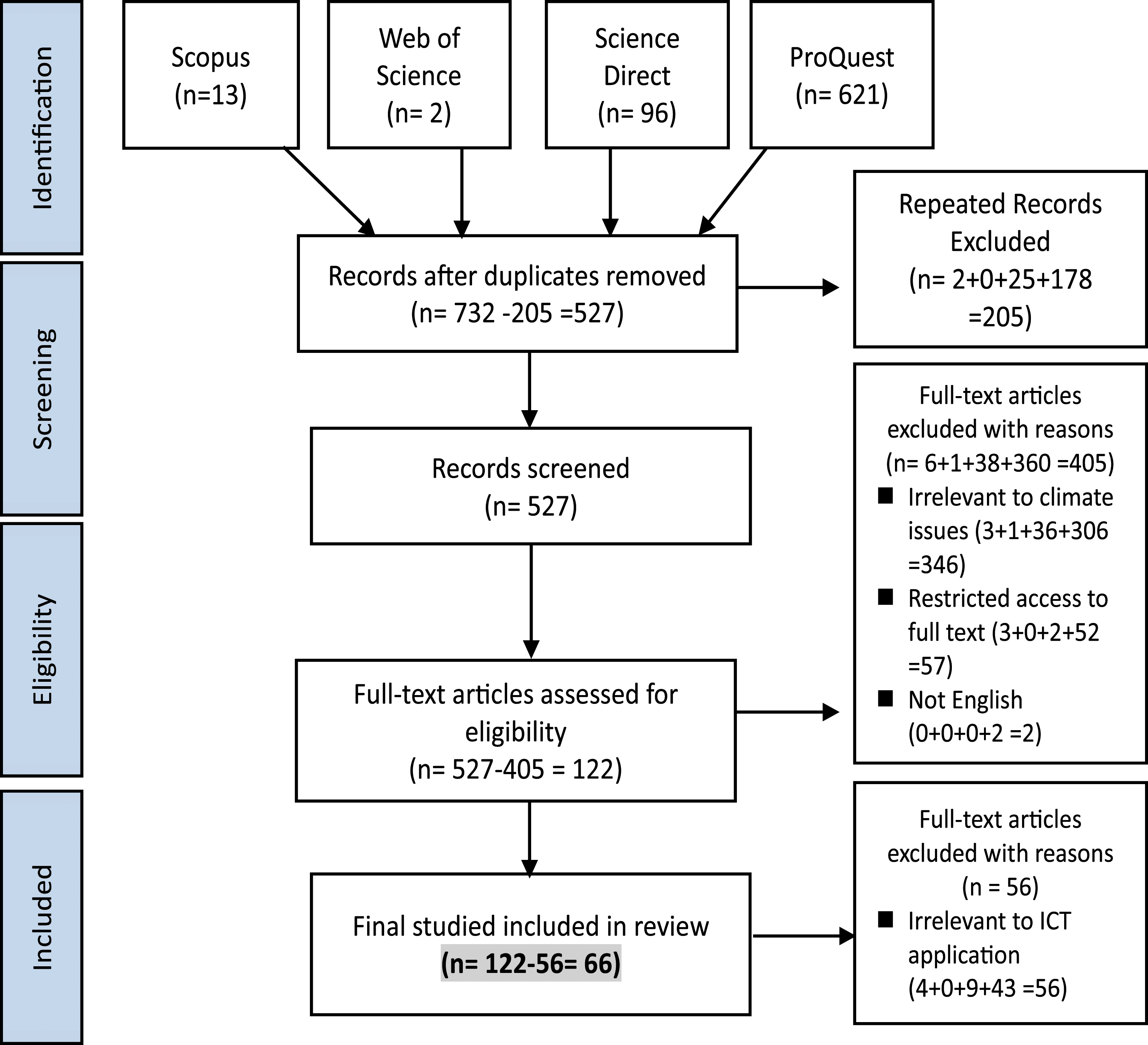
Mapping of the role of information and communication technology in the robustness of the coupled infrastructure system framework
Since common resource management is a dynamic process subject to both internal and external drivers, to systematically evaluate the dynamics of ICT-mediated urban commons governance, our study adopted the newly emerged systems thinking approach-robustness analysis of coupled infrastructure system framework (Anderies et al., 2016). The CIS framework encourages researchers to examine four major building blocks in any resource management model: the resource system (RS), the resource user (RU)/natural infrastructure (NI), the public infrastructure (PI), and the public infrastructure provider (PIP). In the context of an ICT-enabled urban commons review, PI can refer to both hard and soft infrastructure for providing public services, such as sensors attached to energy production facilities or transportation monitoring systems installed by a private company contracted with the local government using ICT as well as a legal framework that facilitates the incorporation of citizen science into urban policy-making. NI can refer to nature-based solutions such as artificial wetlands or detention ponds to help cities purify urban rivers or avoid flooding damage. PIP is not limited to the traditional public service provider—the public sector—in this new era of “shifting” of renegotiating urban commons governance (Ferguson, 2014), particularly in austerity urbanism scenarios (Tonkiss, 2013). PIP may include private companies, social groups, communities, or individual citizens who are both resource users and alternative actors in delivering public services (Waddington et al., 2019).
The refined version of the robustness analysis (Anderies et al., 2019) was proposed to be equipped with a list of verbs to capture the action and interaction between the main building blocks (Figure 2)—Verbs 1–6 were regarded as variables for describing dynamic feedback networks based on “subjectivity,” indicating the intention behind the action, such as the goal to restrict, collect, or enable. For instance, “ICT” as a PI “enable” (5a) the collection of informal data from social media users to understand the spread of urban agriculture in cities. Figure 2 also reminds researchers to pay attention to the effects of exogenous drivers on human, social, natural, and artificial infrastructures. Governance of shared resource archetype CIS representation sample* Source: Graph drawn by authors in reference to Figure 1, Figure 2, example 3 in Anderies et al. (2019) *For other SES cases that are the basis of more archetypal models, see System Representation in http://seslibrary.asu.edu.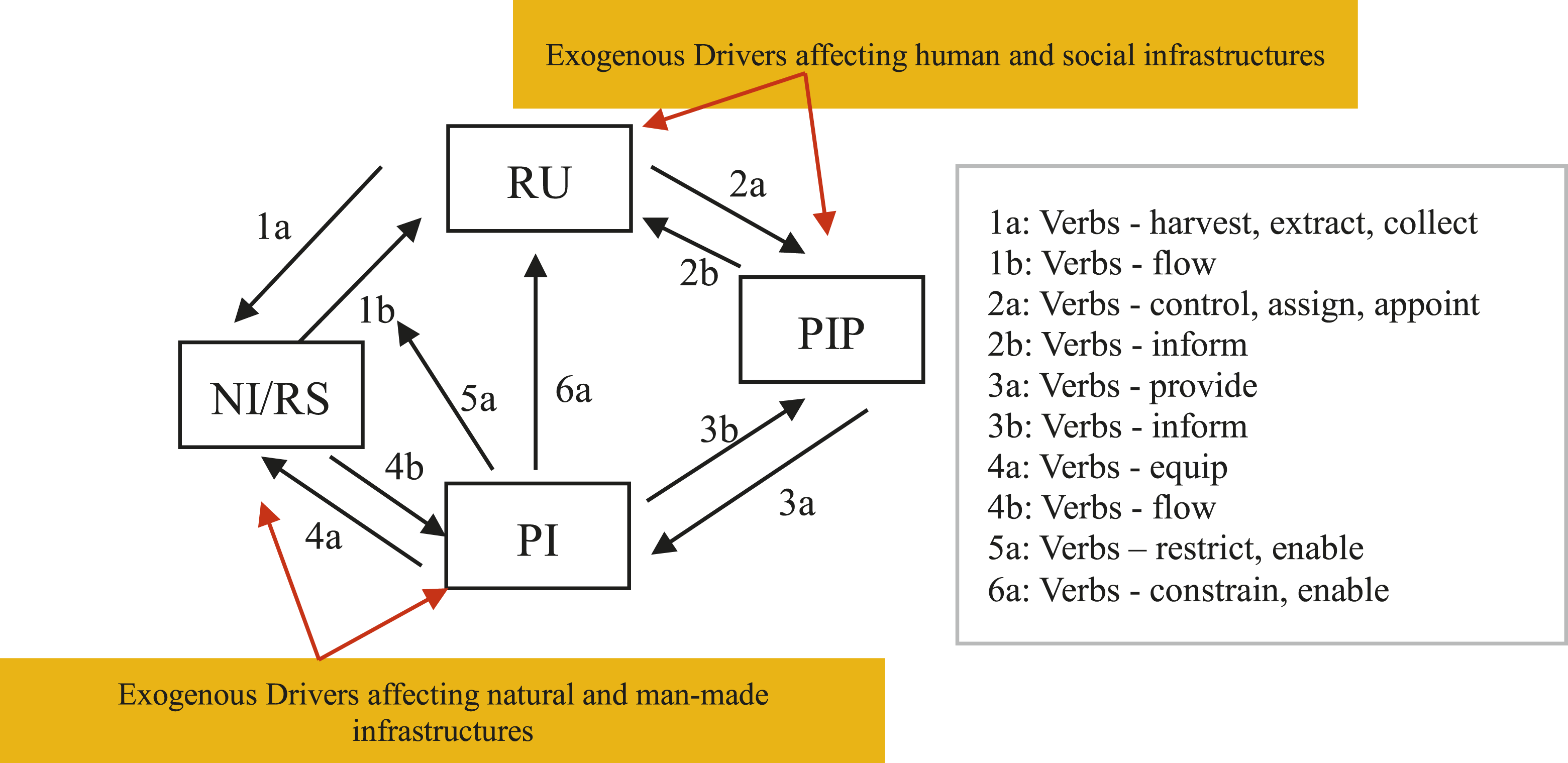
In the following analysis (Bibliometric analysis) on the role of ICT to facilitate (opportunity) or impede (challenge) action and interaction between different building blocks listed in the CIS framework, we first qualitatively scrutinized all 66 pieces included in the literature. Then we categorized their associated opportunities and challenges discussed in the papers and mapped each in the most relevant relationship line 1a to 6a to reveal the opportunities or challenges identified in the included literature while exposing any deficiencies.
Bibliometric analysis
Geographical analysis
Among the 66 pieces included for qualitative synthesis (Table S3), 33% of studies discussed ICT-enabled urban commons cases in Europe, with five cases in the United Kingdom and three in Italy. For example, paper W2 (Perrotti et al., 2020) investigated the recently restored Geoffrey Jellicoe’s Water Gardens in Hemel Hempstead, England, as urban water commons and argued that social media is an important tool for improving communication among various stakeholder groups on water-related activities. The dynamics of local self-organization can be catalyzed by community-building through knowledge sharing via social media in the context of Italy, where a long tradition of cultural heritage poses a challenge to its sustainability in the event of a natural disaster. Paper ID P1-19 (Pica, 2018) advocated for developing protocols and peer-to-peer urbanism platforms to capitalize on the benefits of ICT for disaster risk governance. P1-22 described how the City of Bologna initiated pilot actions using web platform tools to encourage stakeholders’ active participation in Bologna Living Lab projects. Such an endeavor is part of the overall urban innovations in the Bologna Collaborative City program (Co-Bologna) under the scientific coordination of The Laboratory for the Governance of the Commons (LabGov). In a similar vein to preserve cultural heritage in Europe, P4-17 (Angelidou and Stylianidis, 2020) discussed the inclusion of a heritage-related smart city application in three European cities: Tarragona (Spain), Budapest (Hungary), and Karlsruhe (Germany).
The continents of North/South America also received scholarly attention (15 studies) in applying ICT to governing various urban resources. In particular, there were case studies of 13 papers in American cities, including Philadelphia (Wiig, 2014), San Francisco and New York (Schindler, 2018), Minnesota (Davey, 2015), etc. Outside the United States, we found one study in Chile (P6-33) and another one in Jamaica (P6-36). However, the former emphasized the important involvement of the private sector in providing an integrated information system to make a “Resilient Santiago” (Svitková, 2018), the latter argued that in a small island developing state (SIDS) such as Jamaica, where the effects of climate change pose a greater threat, social media is useful to construct an ethical and socially aware 21st century ecological citizen to sustain the local environment (Mullings et al., 2017). In Asia, China and India have experienced rapid social and economic transformation, which was included in three studies to examine the application of ICT in improving the efficiency of urban resource usage. As the third new special economic zones (SEZs), novel world-class metropolises such as Xiong’an New Area have posed challenges for the Chinese government in using ICT for transportation or energy monitoring to cope with population-dense living patterns (Liu et al., 2020). Lake conservation in Bengaluru, India, served as a case study for local community engagement and environmental placemaking using a digital forum and social media to connect with other lake visitors (Sen and Nagendra, 2020).
Apart from continent-specific case studies, we also included 13 studies that discussed ICT-enabled urban resources in general. Gomez (2017), in particular, is concerned with the upper limits of the size of cities by examining the implication of ICT to expand the global megalopolis or what the author named a Pangaean City. Beyond academic research, since urban commons are an emerging concept, their multifaceted practices were best presented by organizations promoting or implementing these innovative urban solutions worldwide. Sharing Cities: Activating the Urban Commons, written by a team of 15 fellows from 18 organizations worldwide, documented over a hundred sharing-related case studies from more than 80 cities in 35 countries (Gorenflo, 2017).
Categorical analysis
Typology of ICT-enabled urban commons from the literature.
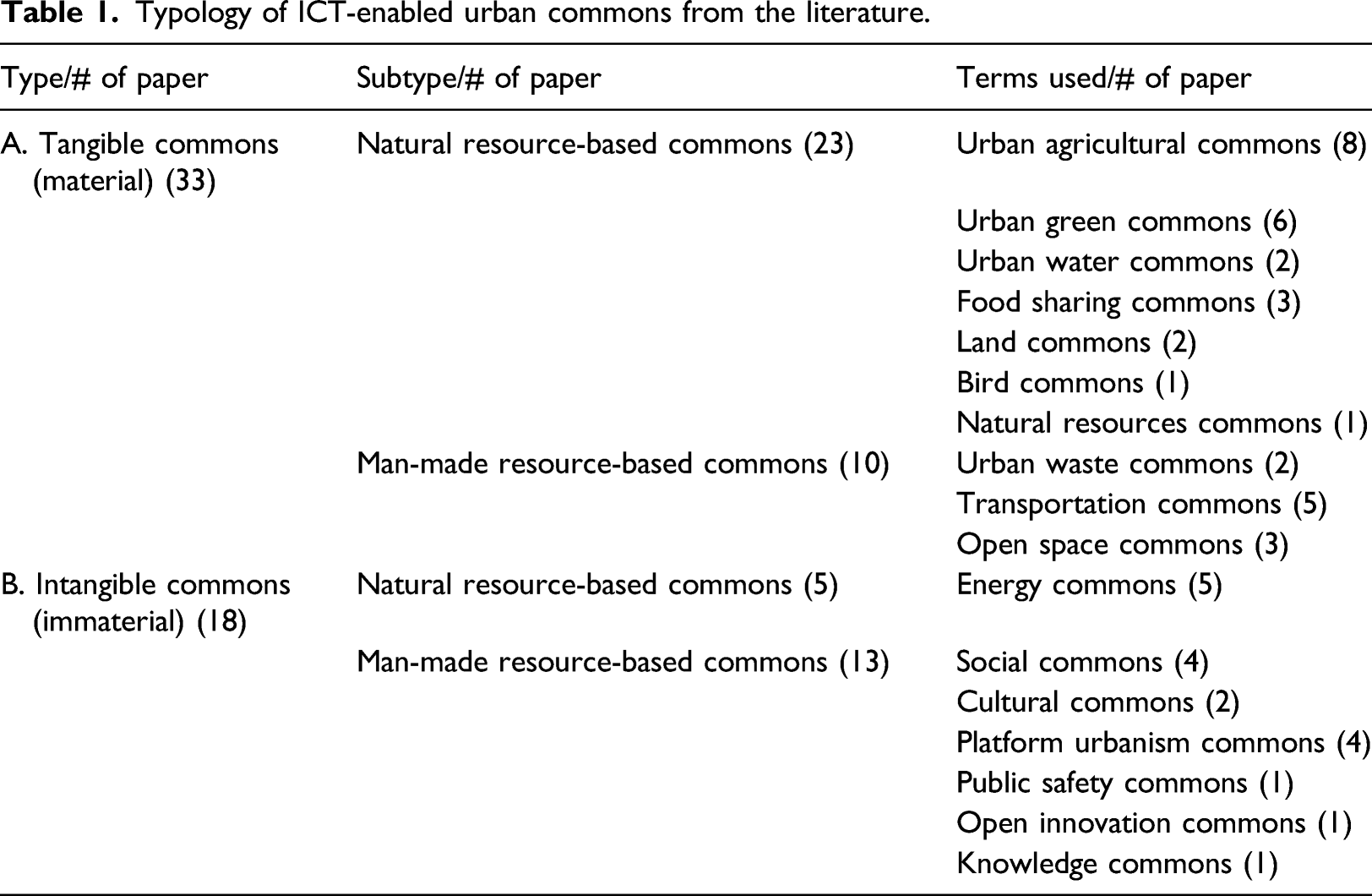
The application of ICT in urban agriculture commons was discussed by the greatest number of papers (8), followed by urban green commons (6), transportation commons (5), energy commons (5), social commons (4), and platform urbanism commons (4). Relevant to the application of ICT in governing urban agriculture commons, P2-105 outlined the use of social media to promote the Home Garden program (Lowell, 2018); P5-46 studied how the app was applied to connect farmers with environmental and nutrient conditions (Houtman, 2015); SD5-8 demonstrated the utilization of an app to facilitate urban farm supply and demand delivery (Weidner et al., 2019). In the category of urban green commons, we grouped studies investigating the use of social media to check individual waters in the collective action of co-creating urban green commons (Mincey, 2012); the application of an app to form an e-community for sharing knowledge about wild food (Buijs et al., 2019) or even the use of an RFID plant for a smart city to manage urban green commons together (Luvisi and Lorenzini, 2014).
Then, to improve our understanding of the typology of these urban resources mentioned in the literature, we re-categorized them into two major types based on the nature of the commons—A. tangible commons, which refers to the material commons; B. intangible commons as an immaterial type. Furthermore, type A urban commons are subdivided into natural resource-based commons such as urban agricultural commons or urban water commons and artificial resource-based commons such as urban waste commons and transportation commons. The same categories apply to intangible type B.
From Table 1, with the number of papers as a note next to each type of urban commons, we can see that tangible commons (33 papers), especially its subtype of natural resource-based commons (23 papers), occupies more than 63% of the scholarly interest in this area. The immaterial type of urban commons is also catching the attention of scholars, yet is at an emergent stage.
Climate-resilience relevance analysis
In terms of which kind of climate-resilient problem the ICT-enabled urban commons can assist in solving, more than one-third of the studies (24) did not differentiate but mixed the mitigation, adaptation, and resilience effects of ICT-enabled urban commons in urban planning. Beyond that, only 3 papers discussed climate change applications in general, while 11 studies specifically emphasized the mitigation effect, 13 studies focused on the climate adaptation effect, and 15 on the resilience effect.
Furthermore, in the literature of ICT-enabled energy and transportation commons or mobility as a climate-resilience relevant solution, researchers mostly reported the “mitigation” or “transition” purpose of monitoring energy usage rather than the number of studies in each urban commons type. In terms of mitigation purposes, Moraci et al. (2018) gave several examples of ICT implications in improving the city-energy relationship (paper ID P4-45). The mitigation mechanism is primarily achieved through enhanced monitoring and control of urban energy needs/consumption, in addition to the production of alternative energy and the implementation of energy-saving measures such as the European Smart Cities project launched by Energy Commissioner Oettinger in 2011 (Climate Group, 2011) and the district heating and cooling grid (DHC-grid) project in Heerlen (Construction 21 International, 2019)
As for a “transition” purpose, paper ID P1-13 introduced how sustainable energy technologies that are ICT-based, distributed and modular systems to enable a collective gathering and distribution of information play a pivotal role in sustainable transition (Seo, 2018). In particular, in the Deep, Equitable, and Democratic Energy Transition or so-called “DEDET” model, Seo framed “energy-as-a-commons” as part of the democratic governance movement calling for citizen engagement not only in policy-making but also citizen control of energy production and consumption to enable a decarbonization transition. P4-58, however, stated that the key to enabling the transition of cities to sustainable ones is to improve our knowledge discovery using Big Data, ICT, and social media data analysis (Momtazpour, 2016) for sustainable urban mobility (SUM).
In creating a social commons, the role that ICT primarily plays is in “resilience” formation, where citizens use social media to promote feedback between social and natural systems or as a way to express and share urban resilience ideas (Frantzeskaki et al., 2016). For instance, P6-77 calls for action-based ecological research that encourages an inclusive and creative process to increase feedback between social and natural systems to advance climate change resilience in cities. One example is the Building Healthy Communities (BHC) site in Sacramento, CA, USA, and it is the home of more than 65,000 residents (Childers et al., 2015). The authors argue that to start and promote the collective grassroots advocacy led by Ubuntu Green to address their local environmental and social-economic problems, the use of social media and internet-based surveys is indispensable.
Lastly, platform urbanism commons is discussed in four studies (SD3-5, P4-93, P4-15, and P6-33) that have introduced various types of ICT to enable City 4.0 to integrate real-time data for integrating urban science and urban policy-making in climate mitigation/adaptation or resilience capability building. In P4-93, Cullingworth and Nadin (2006) raised the point that there was insufficient investment in ICT infrastructure in the Planning Delivery Grant (PDG), in the context of town and country planning in the UK, with the resulting problem of inefficient planning. They stated the need for a strong commitment to leverage the power of ICT and to enable public services to be delivered online while modernizing the E-planning agenda sponsored by the Office of the Deputy Prime Minister (ODPM). In SD 3–5, it was described how the “Internet of Things” has exponentially increased the data footprint of city populations, as well as the proclivity to connect different technical platforms (Keith et al., 2020).
Coupled infrastructure system framework analysis
Opportunities/challenges of information and communication technology in robustness of coupled infrastructure system framework
The ICT-enabled urban commons is highly relevant to concepts such as the sensor city (Batty, 2012), the digital city (Colding et al., 2020), the ubiquitous city (Lee et al., 2008), the intelligent city (Liugailaitė-Radzvickienė and Jucevičius, 2014), the techno-centric city (Willis and Aurigi, 2017), etc., as a response to rapid urbanization and datafication. To uncover and summarize the opportunities discussed in the literature, we read each paper thoroughly and extracted the main opportunities or challenges presented by the authors in order to improve our understanding of the specific role of ICT in mediating urban resource management as climate-resilient solutions. Our study adopted a robustness analysis of the CIS framework to systematically evaluate the intervening capability or challenge generated by such disruptive technologies.
In short, the opportunities and challenges identified in the literature were categorized into the four original building blocks–resource system (RS)/natural infrastructure (NI), resource user (RU), public infrastructure (PI), and public infrastructure provider (PIP) (Figure 3). We additionally created a new semantic relation within the RU building block to describe the role of co-producer (RcP), co-designer (RcD), and co-monitor (RcM) in the included literature and determined their relationship with the RU. In Figure 3, the green line represents opportunities for ICT to intervene as climate-resilient solutions, while the red line refers to challenges. Based on the mapping, our literature has far more opportunities for ICT (a total of 104 opportunities were identified), particularly in renegotiating the relationship between RU and RS (7a, suggested by 30 studies) and between public infrastructure provider and public infrastructure (3b, suggested by 24 studies), with challenges or barriers of ICT in implementing a smart city for climate change as unknown (in only 24 studies) and which remain the focus of future research. Because one study may discuss more than one opportunity or simultaneously present both an opportunity and a challenge, the number of opportunities or challenges identified is greater than the sum of the original 66 papers. Role of ICT in robustness of the CIS framework. *RcP = resource co-producer; RcD = resource co-designer; RcM = resource co-monitor. Note: the number in opportunities/challenges refer to the number of studies; the thicker the line refers to higher number of studies recommended such feedback, ex. 7a; green feedback = opportunities; red feedback = challenges.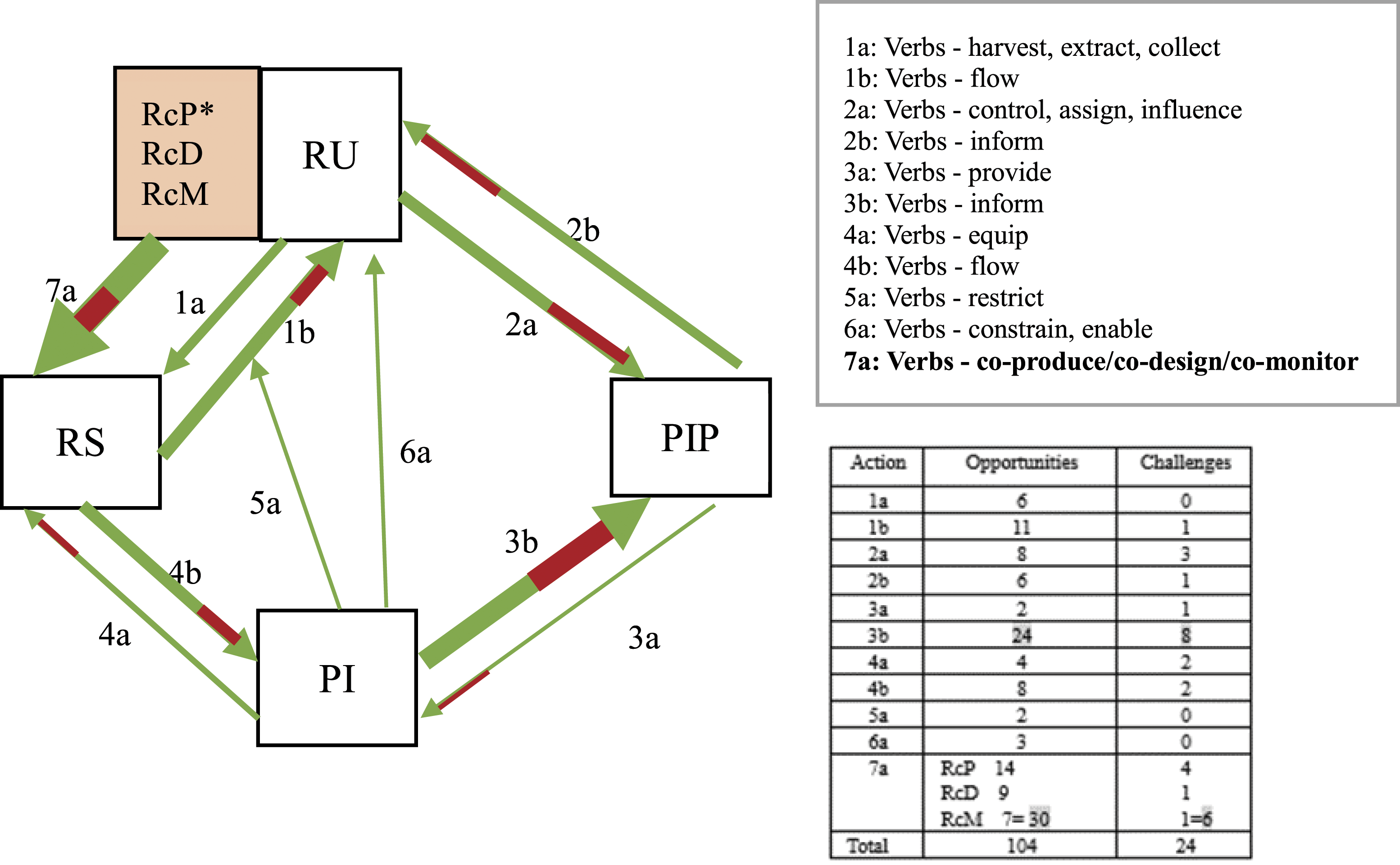
Table S4 detailed all the identified opportunities and challenges with the corresponding article ID. For instance, in the relationship of 1a from RS to RU, we grouped six opportunities of ICT to intervene in their relationship under this category. For example, P2-115 discussed ICT as a tool to “extract” knowledge commons from the library to users. P4-17 introduced how AR/VR apps can enable tourists to “gain” access to cultural commons in historical sites. P6-15 demonstrated the use of social media by farmers for education and training to “extract” more goods from nature. As for the challenge, we found no challenge identified by the literature that can be grouped into this 1a category. In relationship 1b (from RS to RU), we again include P2-115 in which ICT allows the “flow” of knowledge from the library to readers and we found 10 other similar cases to exemplify the improved efficiency and effectiveness of resource flow from RS to RU with a facilitation of ICT technology. One challenge in 1b was identified by the article P1-29, suggesting that digital and infrastructure inequality in a particular area, namely, the inability of RU to extract resources from RS, might create economic inequality.
In relationship 2a and 2b, P2-105 exemplified the opportunity of ICT to enable RU to “influence” what kind of future they want and convey this message to public infrastructure providers in the former relationship, whereas P2-107 showed how the local government used social media as a tool to “inform” users of urban green space, including the location and status of the green coverage in cities in the latter. The literature identified the inequitable access of ICT for RU as a challenge to create a homophily problem (SD3-5), unsustainable urban investment (SD3-5), and to constrain the extent to which a city can develop (SD4-10). However, only one challenge proposed by P4-42 was grouped under 2b: because the smart city landscape is still fragmented on both the policy and technical levels, there may be unexplored opportunities in which the PIP can inform RU in the future.
Regarding the relationship between the PIP and PI, there are far more opportunities identified for 3b than 3a. However, the former dealt mostly with big data collection of urban resources by smart devices attached to public infrastructure such as energy demand and supply meters, tracking units in cars or RFID wired to trees to “provide” information to the PIP to make or adjust data-driven public policy, we only found two cases in the latter showcasing the use of ICT by the government to facilitate flexible management of public infrastructure (SD4-11) and to improve the efficiency of public service provided by public infrastructure (P4-93). A similar trend was observed—more challenges in 3b than 3a, such as individual privacy (P6-65), the underuse of new data such as privately held transaction data (S6-3), preference of one set of data usage over the others (SD3-5) or going beyond traditional mobile computing scenarios with a smart phone (SD4-12).
In the 4b-4a relationship, we found the doubling of opportunities (8 for 4b vs 4 for 4a) for ICT to be part of the RS to enable the efficient “flow” of urban resources such as health care and energy to PI. For instance, P4-56 showed the use of IoT to optimize water utilization by preventing loss with smart meters. In the discussion of SD1-10, food banks utilized ICT-mediated platforms to create logistics solutions for moving surplus food to where it is most needed to prevent food waste and food insecurity problems. As for challenges, there are two challenges identified respectively for interactions between the RS and PI: the unexplored technical channel to optimize resource provisioning (P4-42), contracting and corruption problems (P4-84), and surveillance problems as public infrastructure is collecting data from the RS (P6-65).
In the 5a and 6a relationship, we only summarized 5 opportunities, and no challenge was identified. For instance, P4-45 provided a case study when the smart grid as PI is used to “indirectly” restrict energy resource usage by users to conserve the energy commons to promote the concept of the renewable city. The same study also informed us of the ability of ICT-mediated infrastructure to “directly” constrain options of RU.
Lastly, the most pronounced results from this review are the redefined role of RU to become co-producer, co-designer, and co-monitor of the urban commons. In the midst of 30 new opportunities identified for 7a, 14 cases are co-production of urban commons related such as tree commons co-created by the effort of the community to use an app for watering activities to improve their survival rate (P2-100); a community land trust co-produced with the aid of social media to promote its reputation and community ownership (P2-118); non-commercial carsharing commons facilitated by ICT (P2-14); an energy co-production model in Vehicle2Grid for the household to use the battery in their electric car to store the locally produced energy (P4-56), etc. Another nine opportunities were co-design activities such as using social media to co-design commons-based solutions for environmental restoration (P2-121), citizen participation in e-governance for co-designing new services through collaboration between the government and local communities (P4-35), and citizen engagement in the design-ecology nexus to increase city sustainability and promote feedback (P4-35) (P6-77). As for co-monitoring activities, 7 opportunities were identified for citizen or multi-stakeholders to co-monitor urban resources (P3-21, P4-35, P4-42, P4-56, P6-66, SD1-8, SD4-10).
Having reported plentiful opportunities, the redefining of RU is not challenge-free. In the present landscape, four studies remind us of the barriers to integrate ICT for public service co-delivery. Three of them are associated with the co-production of the urban commons, such as the antithetical problem of individual liability (SD1-10), perception of risk (SD1-10), or the mismatch between laws and regulations with innovative peer-to-peer marketplaces (SD1-11). Only one challenge is identified as linked to all three new roles of RU in P4-42 since the researchers considered the smart city landscape to be extremely fragmented. Furthermore, there are still many unknowns to be explored, including how stakeholders can better understand co-produce, co-design, and co-monitor.
Key contributions of information and communication technology-enabled climate resilient solutions from coupled infrastructure system approach
Based on our review results, this study found that it remains theoretically and empirically ambiguous in the literature to distinguish different contributions manifesting in the specific function of climate change mitigation or adaptation especially when their effects are often interconnected from a system thinking perspective. Nevertheless, our coupled infrastructure system oriented analysis provides an alternative view to dissect distinct usefulness of ICT-enabled commons in the building of relationships between resource system, resource user, infrastructure and infrastructure provider to improve the cities’ resilience in general. Our analysis therefore strengthens the idea that infrastructure development, both hard (e.g. the build environment) and soft (e.g. regulations and social relations), is pivotal to the processes that abate and produce vulnerability in cities (Tellman et al., 2018).
By using coupled infrastructure system framework as analytical lens, this paper argues that we need a system thinking to understand the interconnected contributions of ICT-enabled solutions to climate change mitigation and adaptation. In other words, no single ICT-enabled commons solution is sufficient to ensure the resilience of cities as shown by the variety of ICT used to improve seven relationships between the four building blocks in Figure 3. Moreover, while ICT as an emerging technology offers diverse opportunities to craft resilient cities, it is no panacea and it can generate additional challenges that we need to tackle with further.
Having said that, based on the CIS analysis (Figure 3), the top three key contributions of ICT-enabled solutions to climate change mitigation and adaptation discussed in the included literature can be recapitulated as the following: 1. To transform role of resource user into co-producer, co-designer and co-monitor of urban commons with intervention of ICT tools (7a). 2. To enable desktop resource management that is critical for making climate adaptive decision and resilience planning based on real-time data (3b). 3. To improve efficiency and effectiveness of resource by resource user (1b).
Summary and recommendations for future studies and climate resilient planning
There are two main objectives to this literature review—one is to provide a comprehensive understanding of varied applications, practices, and contributions of ICT-enabled urban commons to equip cities for climate mitigation/adaptation or resilient solutions; the other is to provide a direction for future studies and strategies to guide future policymakers or city planners to leverage the benefit of an ICT-enabled urban commons and tackle the challenges to build a more sustainable and resilient society.
The first aim is met with the full-text synthesis of 66 pieces from the literature, by demonstrating that scholars in developed countries (Geographical analysis), especially in Europe (33% of the cases) or the United States (22% of the cases) have devoted considerably more attention to the application of ICT to manage better or even co-produce the urban commons collaboratively, while China and India have only begun to consider how ICT can help to improve the efficiency of resource usage and monitoring. In the categorical analysis (Categorical analysis), we summarized 18 different terms of urban commons referred to directly in the literature before re-categorizing them into two major types—A. tangible commons and B. intangible commons and their subtypes. Based on our recategorization, we found that most ICT applications are used for intangible commons (63%), especially nature resource-based urban commons such as urban green or water commons. This finding implies that there is room for intangible or action-based commons, which involves a more social aspect of sustainability to develop further in a future research agenda and practice. In terms of climate-resilience relevance of the included literature (Climate-resilience relevance analysis), we found that more than 1/3 of the studies did not distinguish benefits of ICT in mitigation, adaptation or resilient effect and these concepts remain ambiguous in the scholarly discussion without clear definitions. Meanwhile, scholars tend to add the concept of “transition” (e.g., energy transition, transition of cities) when reporting the “mitigation” effect of using ICT to improve the desktop monitoring and controlling of resource circulation. And when the literature discusses the role of ICT in “resilience”, it often refers to its fuction to promote flow between social and natural system or to improve the social resilience of the system.
Lastly, our qualitative synthesis (Opportunities/challenges of information and communication technology in robustness of coupled infrastructure system framework) analyzed the opportunities and challenges of ICT discussed in the identified literature by mapping them to the robustness of CIS framework. Figure 3 provides a visualization to reveal the specific usefulness and barriers of ICT while reminding readers the importance of a robust coupled infrastructure system for crafting resilient cities. Based on the CIS framework, our analysis identified three key contributions (Key contributions of information and communication technology-enabled climate resilient solutions from coupled infrastructure system approach) of ICT to innovate climate-resilient solutions: 1) to redefine role of resource user (7a); 2) to enable real-time data-driven urban planning (3b); 3) to improve efficiency and effectiveness of resource used by resource user (1b).
The second aim of this paper is to provide directions for future research and planning. As for recommendations for future research, two areas of focus can be prioritized: R1) the enabling effect of ICT tools to empower resource users to become additional resource management co-designers, co-monitors, and co-producers as demonstrated by 7a in Figure 3 receiving the most scholar attention. In specific, future research should investigate its potential beyond what is commonly discussed in energy and carbon abatement as climate mitigation solutions and reconsider ICT’s application in co-managing other types of commons either is tangible or intangible (see typology in Table 1). R2) more academic outputs should be produced in investigating existing or potential hazards (Figure 3) and additional social, economic, or legal complications caused by the intervention of ICT in climate-resilient solutions. For instance, related complex issues emerging from the ICT-enabled urban commons such as how public versus private land can be legally used collaboratively or how to manage open-source data or references both require additional empirical studies. To date, compared to the opportunities of an ICT-enabled urban commons solution, our knowledge of these empirical or theoretical challenges is insufficient.
Recommendation for future planners are equally twofold: P1) introduction of ICT in existing climate-resilient innovation schemes can have the potential to engage non-traditional stakeholders such as citizens as resource users (7a in Figure 3) in policy-making, resulting in the widening of public support and public engagement and bringing a diversity of views and voices to policy decisions. P2) in the event of insufficient and limited public resources and manpower, the private sector should be allowed to become collaborative partners in co-producing new ICT infrastructure (3a in Figure 3 between PIP-PI) to co-monitor a myriad of city data, to uncover new urban patterns as sustainability problems, to be flexible and adaptable to data-driven decisions, and to transform the business-as-usual urban resource management scheme into an alternative scheme that is useful for tackling climate-related issues. To summarize, this literature review provides different directions for rethinking the city based on collective action to diversify modes of governing common resources for more sustainable urban planning.
Supplemental Material
sj-pdf-1-epb-10.1177_23998083211066324 – Supplemental Material for Urban commons in the techno-economic paradigm shift: An information and communication technology-enabled climate-resilient solutions review
Supplemental Material, sj-pdf-1-epb-10.1177_23998083211066324 for Urban commons in the techno-economic paradigm shift: An information and communication technology-enabled climate-resilient solutions review by Herlin Chien, Keiko Hori and Osamu Saito in Environment and Planning B: Urban Analytics and City Science
Footnotes
Declaration of conflicting interests
The author(s) declared no potential conflicts of interest with respect to the research, authorship, and/or publication of this article.
Funding
The author(s) disclosed receipt of the following financial support for the research, authorship, and/or publication of this article: This publication was supported by the research project “Sustainable management of commons in socio-ecological production landscapes in Slovenia and Japan” granted by Japan Society for the Promotion of Science (JSPS) from FY20ik19 to 2021.

Supplemental Material
Supplemental material for this article is available online.
References
Supplementary Material
Please find the following supplemental material available below.
For Open Access articles published under a Creative Commons License, all supplemental material carries the same license as the article it is associated with.
For non-Open Access articles published, all supplemental material carries a non-exclusive license, and permission requests for re-use of supplemental material or any part of supplemental material shall be sent directly to the copyright owner as specified in the copyright notice associated with the article.
