




Abstract
Constructed from scratch on land reclaimed from the sea, Songdo was planned to embody new ‘smart city’ life. In reality, it has come to exemplify enclave urbanism that commodifies securitised living for upwardly mobile middle classes. While the political economy of this urban project is by now well studied, the sociological ethnography of the resultant space and its experiential correlates remains less developed and imperfectly contextualised. One needs to connect the dots of power and space. The present paper aims to do that and thematises the ‘design of everyday life’ which rests on (1) the intensification of privatised digital surveillance of mass housing compounds which in turn occasions (2) the remaking of spatial markers and symbolic boundaries between private/public, inclusive/exclusive, inside/outside. As such it is a combination of two different registers of visibility that gets jointly orchestrated by the public–private partnership of Korean state and corporate actors. In order to recognise these regimes as strategic visions of controlled social life we extend James Scott’s notion of ‘seeing like a state’ to include the corresponding regime that we call ‘seeing like a corporation’. This allows us to show that they are mutually elaborative in Songdo through a hybridised fabrication of its lived environment, particularly in the case of one branded housing typology located in the city’s centre called International Business District. This elucidates not only the local entrepreneurial urbanism that gave rise to the controlled environment of Songdo but also more general logics of the ‘compressed modernisation’ in the region which sets a global mode for production of space and re-territorialisation of power.
Introduction
Sondgo in South Korea was built to become the showcase of one of the first holistically planned ‘smart cities’ in the world. It was perceived as an ‘ideal site for experimentation that provides unambiguous limits to scope and ambition’ (Grydehøj and Kelman, 2016: 6) . However, while initially promoted as the ‘experimental prototype’ of the global ‘city of tomorrow’, in practice it has amounted to an ambiguous industrial profit-making endeavour, marketed through the international discourses of sustainable urbanism and the ubiquity of techno-environments (Rugkhapan and Murray, 2019). The ‘smart’ aspects of Songdo did act as progressive signifiers in the promotion of the city but mostly in early days and beyond the borders of South Korea, and hardly ever as the key tool to distinguish the city within the country. Because Songdo had failed to grow big enough to attract international investors and residents in the wake of the financial crisis of 2008 (Mullins, 2017), the developmental focus has shifted. Still, it was pointed out that ‘even if a modern utopia could be built overnight, sceptics questioned whether the quality of life would be enough to persuade to move to the future city over alternatives such as Shanghai, Hong Kong, Tokyo and Seoul’ (Segel, 2006: 1). Indeed, Songdo began to be viewed as a local effect of complex South Korean public–private partnerships (Im, 2018; Shin et al., 2015; Sonn et al., 2017), and, more globally, as a ‘disturbing harbinger’ of the 21st century corporate urban paradigm (Murray, 2018), and a ‘hermetic’ and rigidly ‘self-referential’ system of control (Amin and Thrift, 2017; Sennett, 2018, respectively). It is said to be a strong indication that programs of ‘smart cities’ built from scratch often correlate with large-scale land acquisition and their utopian, quasi-futuristic discourse conceals the often inequitable socio-spatial effects (Bunnell, 2015). In the South Korean context, the top-down effort of the state to ‘manufacture the urban middle class’ is reported (Yang, 2018), one that is critically linked to normalisation of ‘enclave urbanism’ which typically mobilises the ‘globalisation’ discourse in order to more efficiently cater to local middle class desires for individual safety and collective distinction (Murray, 2017). These critiques fitted the discourse of ‘smartmentality’, that is, a new governmentality of disciplinary smartification (Vanolo, 2014) realised through strategies of ‘enterpreneurial urbanism’ (Shin, 2016) which has become widespread in the context of East Asian ‘compressed modernity’ (Kyung-Sup, 1999; Ochiai, 2014).
In short, Songdo has predictably become an iconic object of critical political analysis of ‘governing the city’ (Kornberger, 2012) and especially the ‘scripted design of public space’ (Schuilenburg and Peeters, 2018). But what does this scripted performance of production of space consist of ‘on the ground’? What are its actual and potential sociological ramifications? These are the general questions that animated the present project. While the complex political economy behind Songdo is widely discussed, the sociological ethnography of the resultant space remains much less developed and the aforementioned questions unanswered. We know the macro institutional and multi-scalar dynamics of planning and governing this city (e.g. Shin et al., 2015) as well as typical shortcomings of smart cities of its kind (e.g. Kitchin, 2015). However, the corresponding micro-sociological patterns of this ‘design of everyday life’ are not equally well explored. This is a problem not only in itself, that is, as a lacuna in empirical knowledge, but also as a missing conceptual link which is necessary to relate space and power, that is, to more systematically understand how everyday life patterns are implicated in and affected by top-down urban design. To the extent that the design of Songdo is predicated on intensified securitisation, managerial legibility of space and logistical oversight, this missing link constitutes a challenge for studies of the so-called ‘citizen-focussed smart cities’ (Cardullo and Kitchin, 2019) and more generally for urban design, especially in times of unprecedented measures of social control such as social distancing and pandemic lockdowns.
The effort to provide this missing link responds to two important more generalisable calls, namely (1) the call for ‘augmented concepts and research methods to comprehend hybrid urban governance reconfigurations that benefit market actors but eschews competition in favour of deal making between elite state and private actors’ (Gibson et al., 2022: 1), and (2) the call for better understanding ‘how humans inhabit their “ecological niches”’ (Rose et al., 2022:1), that is, delineating pathways between altered types of the everyday and new types of governmentality (Rose, 1996; Vanolo, 2014). In particular, we argue that the notion of ‘re-figuration of space’ (Löw and Knoblauch, 2021) helps to close the gap in research and offers a working solution to two aforementioned tasks. Insofar as Songdo instantiates how the smart city ‘re-figures’ ‘the architecture of security’ (Schuilenburg and Peeters, 2018), it can be seen as ‘re-figuring the territory of government’ by deploying strategies for the management of expert authority (Rose, 1996: 327), and as re-spatialising the private and the public through new forms of security and control (Rose, 2017). This necessitates broader, historically more grounded contextualisation as well as specific research questions.
Questions, contexts and methods
The present paper recognises the sociological validity of these observations while also acknowledging a need to consolidate a renewed vocabulary that eschews both the utopian celebration of the ‘smart city’ and its dystopian critique (Rugkhapan and Murray, 2019). Not unlike Rose (1996: 353), we argue that analysis of refiguration of space can benefit from suspending the language of praise and blame, trying instead to ‘diagnose’ the situation and its partially ‘non-linear’ development. For this reason we formulate two new analytical tasks that remain unfinished in the extant literature on smart cities or require corrective specification. We aim to (1) document ethnographically the spatial indications of Songdo’s everyday design, that is, to examine how it is constituted in specific territorial and material forms as ‘architectural modes of collective existence’ (Delitz, 2018: 37); and (2) to elucidate these new partly digitally enabled forms as shifting spatial re-figurations that have generalisable functions. Each task galvanises its own set of questions that we narrow down here to the following issues. First, we ask how does Songdo look and feel as a residential space, and how does it work as everyday built environment? Second, we investigate how this urban space performs the aforementioned roles of concealing inequitable socio-spatial effects and catering to social desires for safety and collective distinction, and what we can infer from it in sociological terms?
Methodologically speaking, we go about these tasks by following Simone and Pieterse (2017: xvii) who recommend an ‘unromantic engagement with technological change as digital platforms become increasingly pervasive, enabling and predatory’, and ‘walking the street to re-describe the affective dynamics of everyday’. This ethnographic engagement with space recognises walking as an indispensable practice of ‘sensing urban space’ without which participant observation of city life may fail to capture the role of ‘design concerned with placemaking’ (Wunderlich, 2008: 125). It is possible because ‘environment provides sensory cues’ (Larkham, 2018: 275). But to perform such a redescription in the context of the design of everyday life one must identify the ‘elementary forms of practices organising space’ ibidem(de Certeau 1988: 116). Among most relevant forms, de Certeau includes ‘the procedures of delimitation or marking boundaries’, and ‘enunciative focalisations (that is, the indication of the body within discourse)’. Delineating both of these aspects in their space-related specificity structures the empirical discussion below and allows us to discover the subtle workings of power as it inscribes itself in space and its everyday valuations. In order to reconstruct the discourses that have accompanied both the designing of and the living in Songdo, we conducted 43 semi-structured narrative interviews that prioritised open questions. We interviewed 24 residents and 19 experts on three different field trips in 2018–2019 to elicit data about both the professional development of Songdo and subjective perception of living there. In short, we considered both certain emplaced political effects and specific social affects in their reciprocal conditionality.
We employed de Certeau’s directive in the case of Songdo because this is what the theory of ‘city as experiential space of shared meanings’ (Löw, 2013) expects to matter in situations of spatial re-figuration. Moreover, we adopted the hypothesis that the defining features of the ‘smart’ design of everyday life ‘may have less to do with the technologies it deploys than in the cumulative effect they have on the bodies they organise’ (Adams, 2017: n.p.). This seems particularly important in cases like ours when ‘exploring human inhabitation’ is concerned with how inequities and distinctions are ‘inscribed’ into bodies and sites they inhabit (Rose et al., 2022: 121). Due to article format restrictions we limit our analysis to selected spatial refigurations that are (1) implicated in shaping social routines, and (2) generating new delimitations in urban ‘spacing’ understood as ‘positioning of primary symbolic markers that enable social goods to be recognisable as such’ (Löw, 2001: 158). This ethnographic technique allows us to discern various, sometimes subtle remaking of symbolic boundaries that – as we shall show below – are symptomatic of the continued significance of ‘seeing like a state’ understood both as a kind of aesthetic and epistemic social regime with powerful regulatory desire (Scott, 1998). The usefulness of this notion as both concept and method invites a parallel focus on ‘seeing like a corporation’. Together they forge a significant hybrid field, one marked by high-level coordination between ‘narrow constellation’ of powers ‘at the intersection of neoliberalism and Asia-Pacific state-capitalism’ (Gibson et al., 2022: 1). What these authors call a new public–private hybridisation ‘exerts a force’ which is sociologically observable in ‘the way it attracts people, draws them in, coalesces and expends their capacities’ (Simone, 2013: 243). To stabilise such sociological observations we have found it useful to combine the interview data with ‘unobstrusive’ visual methods (Emmison and Smith, 2000: 110), that is, combining dispositional and situationist approaches to ethnographic social research (Jerolmack and Kahn, 2018; Jerolmack and Khan, 2014). This in turn corresponds with the current recognition of urban scholars that ‘the separation of notions of material infrastructure from those of the social or cultural sphere can no longer be usefully maintained’ (Bishop and Phillips, 2014: 121). Studying urban design requires a simultaneous focus on materiality and the meaning of its symbolic structure (Bartmanski and Fuller, 2018). The city seems a spatial master paradigm of this dynamic, inspiring conceptual extensions such as ‘seeing like a city’ (Glass, 2018; Amin and Thrift, 2017: 236). These new analytic lenses help advance the methodological and conceptual fusion of the present paper as it responds directly to the vital call for the ‘yet to be written history’ of how certain modes of government are called into existence and justified ‘while simultaneously suggesting ideal ways to organise spaces of the world’ (Adams, 2017: n.p.).
Drawing on this set of methods, the paper zeroes in on the fact that Songdo has at its heart a regimented spatial design that consists of a series of ‘soft’ or semi-gated communities (Odrowaz-Coates, 2015; Schaber and Stollmann, 2001). This specific refiguration is meaningful and can be seen as a topological instantiation of Rose’s (1996: 327) claim that ‘community has become a new spatialisation of government’. Importantly, in Songdo the new semi-gated communities’ relatively extensive spatial porosity is both enabled by and amenable to intensive ‘smart’ surveillance, which is what we mean by saying that this built environment and the digital ‘smart’ infrastructures are ‘mutually elaborative’. We find that this urban figuration has manifest and latent functions (Merton, 1999). In particular, it evinces the manifest role of securitising the communities which crave safety and distinction, and the latent role of normalising the oversight and privatisation of the public for greater social control. It performs the latter by re-articulating the compound’s symbolic boundaries in an ostensibly more relaxed key. Here the desire for unobtrusive modes of a quasi-panoptic supervision of space and people meets the desire for conspicuously branded commodification of these modes and the social prestige they promise. The former is the classic desire of the state, while the latter is the familiar desire of the corporation. They are mutually elaborative in the context of what we explain to be the hybridised ‘fabrication’ of Songdo’s residential areas.
At present the state and corporate powers can accomplish their strategic socio-economic goals only in tandem. In order to tap the generalised social desires for safety and status they also need to design everyday life in symbolically effective and positively affective ways. In the process, certain distinctions between the effects of the public/state agency and private/corporate agency can get symptomatically blurred, to the point that ‘it is becoming almost impossible to say what is public and what is private’, a kind of ‘gradual fusion of public and private power that does not have a name yet’ (Graeber, 2015: 14, 17). In the context of the sociology of space (Löw, 2013), this gradual fusion is conducive to the paradoxical proliferation of ‘privately owned public spaces’, sometimes referred to as POPS (Minton, 2016: 25). Although it represents a new complex hybridisation, we show that the public–private partnerships that gave rise to Songdo, and which have become the dominant organisational template behind smart cities (Halegoua, 2020), instantiate a fateful mix of what Scott (1998) calls ‘seeing like a state’ and what we by analogy call ‘seeing like a corporation’. Approached this way, the hybrid constellation of state and corporate power in the design of space of Songdo appears neither entirely unprecedented nor functionally unparallelled. On the one hand, by focussing our ethnographic attention on one emblematic housing community in central Songdo, we reveal it to be a refiguration of the dominant South Korean residential typology called ‘apatu tanji’ – a high rise housing compound (Gelézeau, 2007). On the other hand, by extending Scott’s notion of ‘seeing like a state’ to its corresponding regime of ‘seeing like a corporation’, the paper shows how the latter converges with and fleshes out the former in the context of technology-driven and profit-oriented spatial ‘design of everyday life’ (Greenfield, 2017). This theoretical move represents a kind of ‘augmented conceptualisation’ that is beneficial for two intertwined reasons. First, it recasts in distinctly spatio-cultural terms one of Rose’s (1996) observations that neoliberal governmentality re-figures itself as a novel territorialised vision of security and control. Second, it underscores the continued significance of the state’s power in growing ever more comprehensive by hybridising its executive and spatial applications. As Greenfield (2017: 275) emphasised, because ‘no human institution, state or private, is yet of a scale that it can develop bespoke applications, devices and services for every last end’, this fusion of two regimes of ‘seeing’ and planning appeared pragmatically necessary. Ultimately, the spatial re-figurations implicated in these processes are re-figurations of power as a mode of seeing and defining the ‘good life’.
The housing area under empirical scrutiny tellingly called ‘First World’ is an exemplary product of the fusion of South Korean state and late modern corporate imagination. Among other things, it indicates that despite the official marketing scheme promoting ‘smartness’, what counts at the level of everyday life in Songdo is not digitalisation itself. Rather, the locally embraced values of convenience and safety as well as branded status symbols take precedence. This has complex intertwined political, material and symbolic reasons we explore below. In the next section of the paper we reconstruct the historical process that has conditioned this development and consolidated the meaning of apatu tanji along the dual track of strong regulation of layered state powers and comprehensive execution of hierarchical corporate powers. We argue that this duality was not only a politico-economic process but also a socio-spatial phenomenon. In the subsequent two sections we will show that the contraction of the ‘seeing like a state’ and ‘seeing like a corporation’ under the initial aegis of ‘smart city’ explains Songdo as a new fabrication derived from a control-driven ‘seeing’ (Scott, 1998) and recast by a business-driven aestheticised ordering of spaces that still favours the ‘homogeneity-fragmentation-hierarchy’ principle (Lefebvre, 2003: 210). Before we can unpack this argument and apply it to our specific case study, we need a brief look at the general path-dependence of apatu tanji. This is important in the South Korean context where strong cultural traditions intersect with celebration of novelty, technology and education (Minsuk Cho, Head of Mass Studies, 2018, interview with authors), and specific authoritarian and military legacies of the Korean history still exert their influence.
The background path dependence: From ‘cyber apatu’ to ‘smart city’
While South Korea has been a global leader of digitalisation for a couple of decades now, it remains considerably attached to the hierarchical social regime jointly set by the national government and the powerful Korean corporations (chebols) from the 1960s on. While Songdo is a part of the Greater Seoul which by many accounts is a global metropolis and the seat of many multinational companies, the South Korean state proved to be the key player in the development of Songdo. This is consistent with the observation that ‘Korean state elites have retained their influential position as economic managers’ despite predictions that global capitalist trends would weaken state power (Hundt, 2015: 466). It is also consistent with the fact that in the wake of the 2008 financial crisis the direct managerial agency of the state needed to be reasserted despite the ostensible globalisation of national economies (Therborn, 2011). When it comes to what Adam Greenfield (2017) calls the technologically constituted ‘design of everyday life’, Songdo indicates that the Korean state agencies actively inflect rather than passively reflect the global corporate trends. Especially in the mass residential planning, they translate and adjust the international templates to extant national forms. For this reason it is useful to view this process as hybrid or dual ‘seeing’ and then to place Songdo on a timeline of urban developments that preceded and accompanied its creation.
Songdo began to be built in the mid-2000s. The foundational urban development plans were gradually being worked out in the preceding decade and can be seen as an extension of the firmly established frame of the state-led Korean ‘enterpreneurial urbanism’ (Shin, 2016). From the very beginning in the 1970s, this form of urbanisation appropriated technology not for its own sake but as an instrument of adding value to residential real estate, mostly to big scale housing complexes. The infusion of formally homogenised mass housing with the content of ‘smart’ technologies has always worked as the token of ‘progress’. While the technology evolved fast, the morphology of apatu tanji changed more incrementally and kept dominating the urban landscape. By the mid-2000s island-like high rise residential areas became the master trope in the production of living spaces in the whole country, so that the term ‘the republic of apartments’ was coined (Gelézeau, 2007). High tech solutions were being applied to residential development from the early 1980s on and were often embraced by branded corporate complexes. In the 1990s the digital enhancements were labelled ‘smartification’.
Figure 1 is not a comprehensive historical reconstruction of this process of fusing the regulatory state power, the executive corporate power and technological ‘smartification’. Rather, it is a temporal scheme that visualises the path dependent evolution of urban developmentalism and the attendant discourses, punctuated by relevant interventions, such as the implementation of the so-called ‘cyber apatu’ in 1999. For one thing, it shows that in South Korea securitised residential areas preceded Songdo and that the borrowing of concepts prevailed. At the same time, Songdo was conceived of as the model ‘smart city’ right before the mass introduction of the smartphone. Thus, some of its ‘smart’ everyday life features – such as in-built screens enabling communication between apartments – quickly lost their pragmatic and symbolic distinction. It was also precisely during Songdo’s first decade of existence that the experiential meanings of digitalisation began to shift from ‘extraordinary hardware’ towards ‘ordinary software’. Insofar as the smartphone represented the digital convergence encapsulated by the ‘single device, multiple tasks’ formula, the significance of in-built ‘smart’ hardware has been circumscribed largely to the surveillance infrastructure.
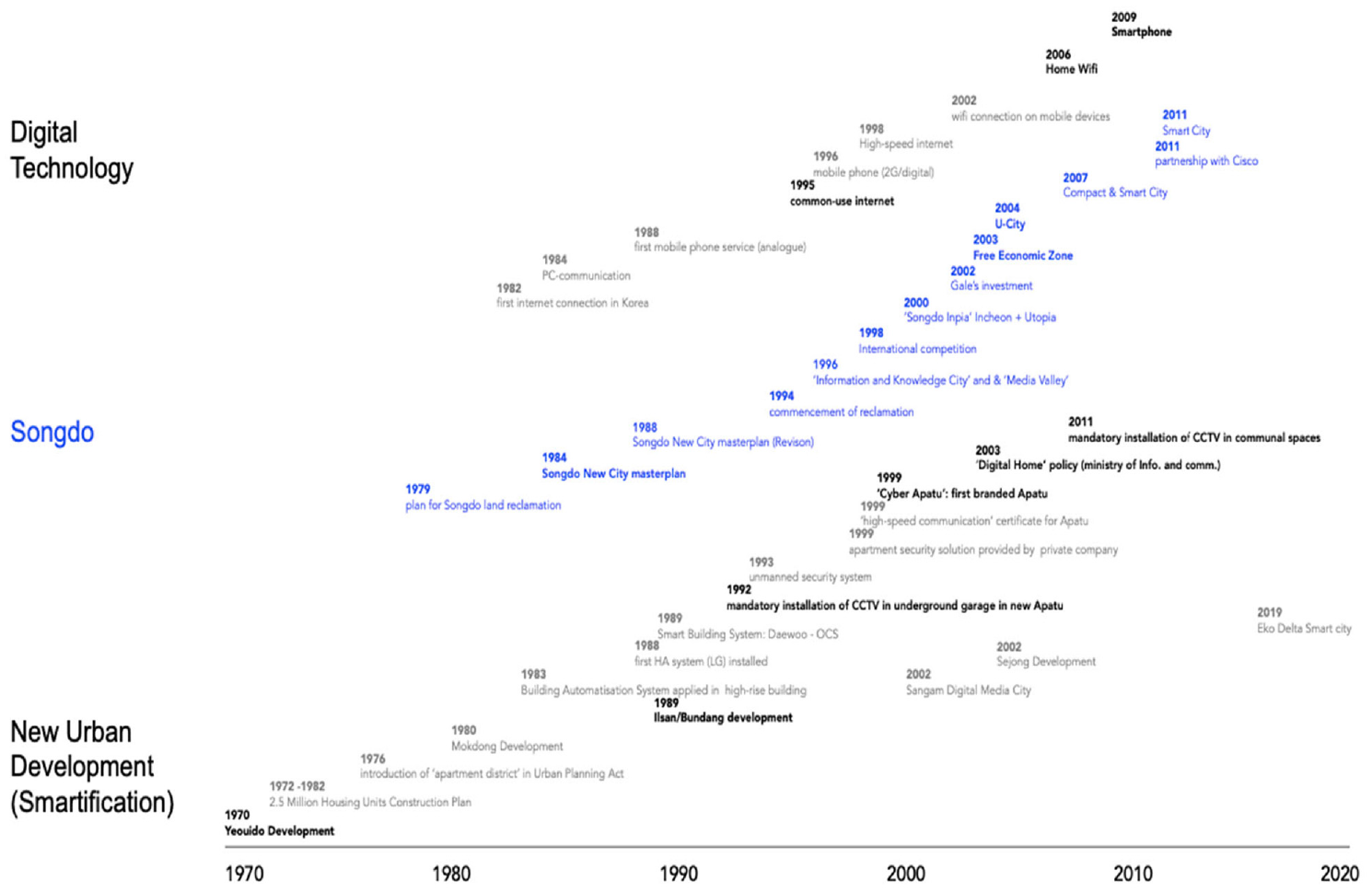
Songdo and larger developments.
This technological corporation-driven shift has been accompanied by the legal changes. As early as 1992, South Korea introduced a law requiring every apartment complex with more than 30 parking spaces to be equipped with a CCTV system in its garage/parking area (see The Enforcement Regulation of the Parking Lot Act of 1992). In 2011 this legal requirement was extended to all communal spaces in every new apartment complex (see  [Regulations on Standards of Housing Construction] of 2011). Making the territorial engagement of the state more extensive required correspondingly more intensive control. The intensification of technological surveillance is related to the influence of powerful domestic chebols, such as Samsung, that not only supply the required technological product but are also involved in providing the material substrate for the construction of apartment complexes. They then assemble and brand them to create symbolic added value within the economic scheme of profit maximisation.
In Songdo, its planning, construction and branding as a new ‘smart city’, especially in the early stages, were carried out to a considerable extent by the international corporations that are the global leaders of ‘smart city’ developments, such as Gale and Cisco (see Sadowski and Bendor, 2019). However, these multinational corporate entities and their technological knowledge systems did not override the entrenched objectives of the fusion between the South Korean state and the chebols. Following the development of the advanced surveillance systems in the 1990s, some of the South Korean apartment complexes started to evince the characteristic of a gated community already at that time (Gelézeau, 2007; Jung, 2017; Kim and Choi, 2012). Simultaneously, the complexes were supposed to ‘have convenience’ (‘ apartment complexes have stood at the core of the material and social transformation of Korean cities: not only did they shape a considerable part of the urban extensions from the 1970s, they also helped shape the values and behaviours of the urban middle class, and especially those of its upper fringe (Gelézeau, 2008: 296–297). /pyonhada’ = convenient, comfor-table, easy and simple). The deceptively simple adjective ‘convenient’ has multiple meanings in Korean, comprising semantic fields of ease, simplicity and comfort. In the context of mass housing, the apatu tanji typology has been deemed ‘comfortable’ in part because the organisation of its managerial duties tends to be the sole responsibility of the expert company that develops and brands it (Park and Park, 2011). ‘Comfortable space’ is a legible, clearly delimited space that is regularly and professionally maintained by a specialised private company. This, in turn, means that it is not the inhabitants’ responsibility to run it and preserve its integrity. The presence of the dedicated in-house service facility that monitors and maintains the orderly daily conduct has been evolving over time but it was at the heart of the concept of apatu tanji from day one. As Valerie Gelezeau emphasises,
Last but not least, in a relatively small country which is geographically peninsular, geopolitically an island and that remains in the perpetual ‘cold war’ with the communist North Korea, questions of space have had a surplus of meaning. For instance, large open green areas in urban contexts have been seen as a relative luxury. Moreover, because financing of contemporary apatus is not based on credit but rather on the pre-sale of apartments, intensive marketing strategies are adopted, including elaborate modelling of standardised apartments organised in special exhibition halls, all of which are typically discarded after the viewing and selling period is over (Cho, 2018, interview with authors). Songdo was not different but it was created in special circumstances. Building a new city on artificial land reclaimed from the sea seemed to have provided uniquely propitious albeit costly conditions for an ostensibly fresh and grandiose start.
Nonetheless, South Korean society had witnessed already in the 1970s how large-scale land reclamation projects formed the new upper middle-class places like Gangnam, an affluent part of Seoul. Tellingly, Songdo came to be called the ‘Second Gangnam’, and this description surfaced in our interviews repeatedly. The Gangnam development in Seoul illustrated with the unprecedented force how such developments formed the new middle-class and its values of convenience, security and distinction (Park, 2013; Son, 2003; Yang, 2018). From the very beginning, the majority of residents in new Gangnam housing complexes were from high income groups (Lee, 2017: 58). And it is through the spatial politics of housing which defined this area of Seoul that the distinctive urban upper middle class began to crystallise and achieve its desire of separating itself from the lower classes (Gelézeau, 2008). Songdo with its flagship apatu tanjis constitutes not only another spatial variation on this urban theme but also an instantiation of the fusion of seeing like a state and seeing like a corporation where legibility, visibility and symbolism assume greater social significance.
‘Seeing like a state’ meets ‘seeing like a corporation’
Despite differentiating factors, modern state powers and corporate powers rely on a key shared principle: ‘to render spaces visible to the network’ (Greenfield, 2017: 33). There is more to it than meets the eye, though. The modern desire to make social spaces ordered and visible according to a particular way of seeing is the desire to make them governable and manageable (Rose, 1996), that is, to categorise, territorialise, regularise and thus normalise subjects (de Beistegui, 2018: 225). The social vision of the South Korean state, at least as expressed in its flagship urban planning from Gangnam to Songdo, was partly predicated on this vision and can thus be seen as a special kind of what Scott (1998) called ‘seeing like a state’, which is declaratively conducive to ‘schemes to improve the human condition’. Scott begins with the observation that as far as social order is concerned ‘legibility is a central problem in statecraft’, and he goes on to explain that all so-called ‘high modernist’ states and their ideologies have been confident about technical progress, seeing it as the provider of scientific ‘solutions’ to social ‘problems’. But in Scott’s view, ‘seeing like a state’ is not just a metaphor, potent as it is. It is also an epistemic and semiotic regime with direct spatial ramifications. It is for this reason that urban planning was one of the key empirical domains in his study that explained why and how modern states focussed on cities as prime materialisations and symbolisations of their social vision. Crucially, they tended to see order in ‘remarkably visual aesthetic terms; for them, an efficient, rationally organised city was a city that looked regimented and orderly in a geometrical sense’ (Scott, 1998: 2–4, emphasis in original). What it often meant in urban planning was a rigid spatial compartmentalisation, standardisation of forms, replicable urban design, ‘striking sculptural properties’ of architecture, simplification and functional separation, and strict correlating of functional order with visual order (Scott, 1998: 104–107). Thus, Scott emphasises that ‘seeing like a state’ is as much an aesthetic and material-territorial regime as it is an ethical and social one that aims to quite literally re-shape space and society to its own bureaucratic image.
As we shall show in greater detail in subsequent parts of the paper, this logic is transposable to corporate urban developmentalism in South Korea, and potentially to many other societies, both authoritarian and democratic. One can analogise it as a regime of ‘seeing like a corporation’ that –mutatis mutandis – can cut across political boundaries. This conceptual adaptation becomes particularly useful in cases such as Songdo where public municipal authorities joined forces with technological corporations such as Cisco to provide science-informed, technology-driven and business-oriented ‘urban solutions’ (Halegoua, 2020: 120). The story of Songdo is significant not because it became a high profile topic but because it indicates that the vision and practice of corporations have not prioritised actually solving problems but rather creating what Scott would call specific forms of visibility, profit-oriented orders of display and spectacular symbolic presentation. ‘Ever-expanding surveillance and sensing capabilities reify the practice of “seeing what you find”, whereby “smart” cities are brimming with the spectacle of endless data methodologies, and little else’ (Halegoua, 2020: 120).
But there is still more to Songdo as a product of ‘seeing like a corporation’, because the design of everyday life performed by external technological companies has been intricately fused with the Korean ‘seeing like a state’ whose performance of re-territorialisation of social control involved domestic chebols. The external international experts employed overt mobilisation of symbols of ‘technological salvation’ for the perpetuation of the ‘existing socio-political systems’ (Sadowski and Bendor, 2019). The domestic construction experts implemented strict functional spatial separation coupled with a relative morphological homogeneity. Each company features slightly different design but it replicates its version of apatu tanji across space contexts. Nearly complete domination of high-rise architecture in Songdo represents standardisation and simplification of forms, while also having what Scott calls striking sculptural effect, one which here is aligned with generic corporate aesthetics. What seems additionally striking is how closely Songdo’s combination of main horizontal and vertical design concepts resembles spacious urban plans of Le Corbusier who, unsurprisingly, is one of the key protagonists in Scott’s discussion of ‘high modernist’ urban planning. If Frank Lloyd Wright ‘citified the countryside’ to oppose the ‘pastoralizing of the city’ attempted by Le Corbusier (Levine, 2016: 178), then Songdo is more subsumable to the latter. To the extent that ‘smart city’ predicated on the securitisation of space is a project of ‘pastoral power’ (Schuilenburg and Peeters, 2018), this planning resemblance is not coincidental.
Yet in the contemporary context what makes Songdo’s design symbolically significant is that it is a version of the global ‘generic sublime’ (Najle, 2016). This architectural form helps endow Songdo with a higher social status and visually expresses the stylistic value of ‘generic individualism’ (Jencks, 2016). There is a tight concatenation of socio-aesthetic values here: the architectural generic sublime visually corresponds with a pronounced cultural trait of South Korean society referred to as ‘individuation without individualism’ (Chang, 2010: 25) which is closely aligned with the everyday design principle of contemporary ‘seeing like a corporation’ that Adam Greenfield calls ‘a distinction without a difference’ (Greenfield, 2017: 286). This adaptation of Scott’s framework also corresponds neatly with another current architectural understanding of Songdo, namely one that proposes that it is neither a full-fledged ‘smart’ utopia, nor a dystopian place for people ‘without qualities’ but rather an urban ‘notopia’ (Glancey, 2016: 1–32). Its relatively uniform visual order manifests the focus on efficiency, while the spatial segregation concretises social hierarchy and strict functional differentiation. Perhaps most importantly, the homogenised and compartmentalised planning produces spatial transparency amenable to efficient supervision. In short, seeing like a state and seeing like a corporation overlap in their common vision of making society legible and thus manageable, whereby systems of control and extraction of profit can be more efficiently consolidated and normalised. This is consistent with Lefebvre’s (2003: 212) observation that ‘the organisation of centralised, concentrated space serves at one and the same time political power and material production, optimising profit’. However, this mode of production of space must also be accompanied by an affectively positive ‘cultural production’ of regimented everyday life (Grant and Rosen, 2009) in order to be effective not only economically but also symbolically and socially. Songdo brings these overlaps and synergies to sharp relief and herein inheres its sociological significance.
The conceptual contraction of ‘seeing like a state’ and ‘seeing like a corporation’ should not be treated as frictionless splicing of social visions, nor can each ‘seeing’ be treated as a static formula. On the one hand, South Korean ‘actors compete with one another for authority over economic development and they have been involved in scalar tensions and have constantly negotiated the scalar divisions of labour among them’ (Shin et al., 2015: 1618). On the other hand, when it comes to ‘smart-from-the-start’ cities like Songdo, the state is said to be dependent on corporate logics of capitalism more than on other aspects of development (Halegoua, 2020: 48). What makes this view plausible in South Korea is the fact that domestic corporations such as Samsung or Posco are internationally influential conglomerates, intensively involved at once in the construction business and in technological services, both in Songdo and elsewhere. The domestic software developers such as Naver and Kakao are in a position to fully control the South Korean market, so that for instance Naver – the local digital search engine – has had far more domestic users than Google. Crucially, the powerful private sector offers increasingly indispensable tools of symbolic legitimisation, both through its technical know-how and through its ‘branded architecture’ that partakes in ‘designing desire’ and inspiring people’s commercial trust (Borges, 2013). Each of these aspects is pronounced in the everyday life of Songdo, supporting deeply entrenched mercantile and technocratic social attitudes (Cho, 2018, interview with authors).
This branded semiotic legitimisation of ‘seeing like a corporation’ is visible also in the fact that Songdo has been explicitly imagined and designed to emulate a US American metropolitan look to resemble the iconic skyline of NYC as well as other global island cities like Hong Kong. At the same time, it was Incheon Metropolitan Government that specifically requested this and insisted that the planning of Songdo be commissioned to a foreign company so that it can appear ‘truly international’ (Lee, 2004). This reveals the agency of ‘seeing like a state’ as well as how it absorbs forms of ‘seeing like a corporation’. The promotional material of Songdo often highlights its Central Park surrounded by residential super towers. In this capacity, Songdo illustrates ‘the migration of the skyscraper from New York to Asia’, whereby the resultant ‘skyline constitutes a bar chart of surplus values and of the ways in which new land can be created in the sky and rented to people who want horizontal proximity’ (Parker, 2014: 267–268). All this indicates that the fusion of ‘seeing like a state’ and ‘seeing like a corporation’ in South Korea is a useful analytic device. It helps us to see how the utilitarian logic of the corporate world ‘colonises’ the logic of the state power which in turn promulgates its vision through tried and tested corporate symbolic templates, especially when it comes to refiguration of space towards increasingly privatised and exclusive urban communities.
Fabricated Island City
Constructed swiftly and from scratch on land reclaimed from the sea, Songdo was presented to the world as a city in its own right. Administratively, however, it is a part of Incheon, connected to it with bridges, one of which goes directly to Seoul International Airport. The insular character of Songdo is underscored also by its status of a ‘zone of exception’ (Bach, 2011; Shin, 2016). As a part of Incheon Free Economic Zone (IFEZ), it was strategically positioned to appear as potential global hub of business – hence the official designation of its centre as an International Business District (IBD). Although the city is an unfinished project with a development horizon in 2050 (Cho, 2018, interview with authors), there was less than a decade between the final approved vision and its execution in space. The highly compressed time of construction was possible, on the one hand, due to highly standardised production process and, on the other hand, the industrial power of the involved companies. Following Korean architect Jo Jinman (2018: 47), we may say that predominantly Songdo was ‘not built but made’, that is, constructed by ‘putting pieces together’ and designed by a ‘simple combination of valid typologies, which are previously verified mainly based on the functionality and convenience of maintenance’. It has been ‘fabricated’ according to the specific kind of ‘seeing’ that favours ‘montage-like representation of space’ (Stierli, 2018) rather than created ‘organically’ and pluralistically over time.
Because Songdo has been built on an artificial island, near South Korea’s biggest airport, it could position itself not only spatially but also socially as an enclave, an internationalised aerotropolis, an exceptional or extraordinary site. This, in turn, safeguarded its potential for a status signalling address, highly coveted by the upwardly and transnationally mobile middle classes. We find that nowadays it is the spatial separateness and social homogeneity rather than its putative ‘smartness’ that set Songdo’s everyday life apart from other residential areas. The enclave-like tabula rasa character of Songdo added a socially crucial layer to its meaning. It created a precondition for it to become a perfectly legible and governable gated community of sorts, a spatially insular and socially uniform island city. Crucially, all incoming traffic is monitored through the CCTV systems installed on the bridges and observed by the control centre located in one of the city’s landmark skyscrapers officially named ‘G-Tower’. The skyscraper’s very name is the key tripartite symbol of Songdo that stands for ‘green, global, growth’. For visitors approaching the city, the height and the facade design render it a distinguished eye-catcher. As such the building acquires an additional ‘public dimension’ (Chen and Shih, 2009). The awareness of this centralised security feature – symbolised by the bridges and the panoptic tower – surfaced in the interviews with the residents who report feeling generally safe, not only because of ubiquitous surveillance inside the city but also because of the spatio-technological filtering at the city’s boundaries. According to the residents this influences the look of the streets. As one of the interviewees states: ‘When you’re outside, you don’t see anyone who’s sort of weird looking. There’s a lot of fancy people on the road. With people like that, it’s unlikely something bad can happen’ (interview 22-a, 2 November 2018, Seoul).
Another key feature of Songdo is the sizable Central Park – its spatially and socially pivotal site. It is an added cultural and ecological value, one closely intertwined in South Korea with the narrative of the smart ‘green growth’. After 2008 South Korea witnessed many large construction projects with a heightened environmental consciousness geared for economic revival (Kim, 2010; Shin, 2016). In fact, in the 2010s the performance of ‘going green’ moved to the centre of what it is nowadays coded as ‘smart’ in South Korea, and is understood as a signifier of ‘collective intelligence’ (Kyongwoon, 2017). Insofar as the green spaces of Songdo were designed to distinguish it socially and culturally (Mullins, 2017), they were possible due to the spatial advantage of an artificial land, largely devoid of prior structures or powerful stake-holders, and which therefore greatly facilitated construction of sizable parks and green areas within residential complexes. This is not a typical feature of inner-city apatu tanjis in Seoul, as one resident stated in the interview: ‘If it was not in Songdo, building such an apatu (i.e. “First World”) would be impossible. There is no space for that’ (interview E10, 29 October 2018, Songdo). In short, spacious parks and an abundance of green squares signify scarce socio-material resources and, by extension, upper class privilege.
Where land is scarce and real estate sells at a premium, spacious green urban planning assumes heightened significance, and so does the densification of housing. Speedy construction time was of essential importance too, especially because it has been envisioned and executed within a corporate-driven business model. Partly for this reason, the residential areas of Songdo are referred to as ‘cookie-cutter urbanism’, whereby apatus are mostly standardised skyscrapers, relatively tight clusters of tall tower collectives neatly separated from one another. But it is not just the domination of residential skyscrapers and their generically sublime verticality that matters here. It is also the reshaping of the horizontal spacing of these areas. In Songdo the replicable tower collectives comprise what we call semi-gated communities that constitute a new ‘cultural production’ of space (Grant and Rosen, 2009). These housing typologies have no walls but feature car gates which filter the interactions with the surrounding street traffic. Although they cannot be directly compared to the enclosed gated communities in South American megacities or residential compounds in the Gulf countries, they share with them the function of a symbolic ‘statement of social status’, one that has more to do with ‘ambiguous barriers of mind’ (Odrowaz-Coates, 2015: 241–242). Producing gates while dispensing with walls prioritises these symbolic functions, and it is more in line with spatial concepts of potential openness cultivated in the region, such as Japanese ‘En’ –  – which is coded in architectural theory as ‘ambiguous boundary lines’ that surround a certain locus and ‘open places up to the outside world’ (Shinohara, 2018: 11). Also, the traditional upper-class Korean home design stipulated that ‘the exteriors blend well with the surrounding environment’ (Koo and Nahm, 2000: 380). First World’s design quotes this as well as other local status-signalling references. They make it distinguished enough to signal its higher status, yet the compound’s overall simple look also makes it blend with its surroundings enough to conceal the difference.
Semi-gated community and remakingof symbolic boundaries
There are indeed neither walls nor fences of any kind guarding First World or other apatus in Songdo. It is a wide porous block integrated to adjacent public areas through open pathways which create a sense of permeable boundary. This kind of landscaping has been used elsewhere as the demarcation tool. For example, the research of Schaber and Stollmann (2001) on a gated community in the desert of Arizona documented such strategies in a non-urban context. In South Korean cities this form finds a more pronounced expression, with a few high-profile precedents in Seoul. Symptomatically, it was The Tower Palace in Gangnam constructed in 2004 and originally planned in 1998 that created a pattern to follow for luxurious mixed-use complexes for the rich, replete with the street level upscale boutiques, cafes, restaurants and green courtyards (Lee, 2017: 62). Located in a dense part of Seoul, it exhibited a new ‘smart’ way of providing exclusive space by juxtaposing the partially open boundary with the tight but lush green interior. This created a possibility of drawing a subtle yet dualistic distinction between the inhabitants as a community and others (Cho, 2007). First World emulates some of the key features of Tower Palace. But while it is less opulent, it is considerably more spacious (greater distance between towers), more family oriented (sizable playground), and gives a greater sense of being seamlessly integrated to the surroundings, avoiding overly contrastive differences between the public streetscape and private community premises. It is adjacent to a large park on its eastern side, and to Central Park at its south-west corner. One could view it as a residential archipelago positioned between two large pools of greenery. The ‘archipelago’ metaphor is useful because it emphasises the block’s character as a separate yet open system of buildings that absorbs urban flows through its porous boundaries.
The gates filter only car traffic, whereas pedestrians are largely free to walk through (see Figure 2). As one of the residents of First World put it: ‘It is such a huge block and everybody can enter, so we have no idea what is happening here. People were just saying, “we have CCTV for that”. Well, we have 400 CCTVs in our block’ (interview E10, 29 October 2018, Songdo). This symptomatic excerpt encapsulates one set of our findings about Songdo’s apatu archipelagos. These residential spaces appear at the same time inclusive and exclusive, featuring the permeable demarcation between stylistically defined ‘interior’ and various typologies of the ‘exterior’. Securitised by the ubiquitous digital tools of centralised surveillance, First World dispenses with hard borders and rests instead on a concept of ‘soft’ gatedness (Odrowaz-Coates (2015: 242) and a landscape design that helps conceal differences with the surroundings.
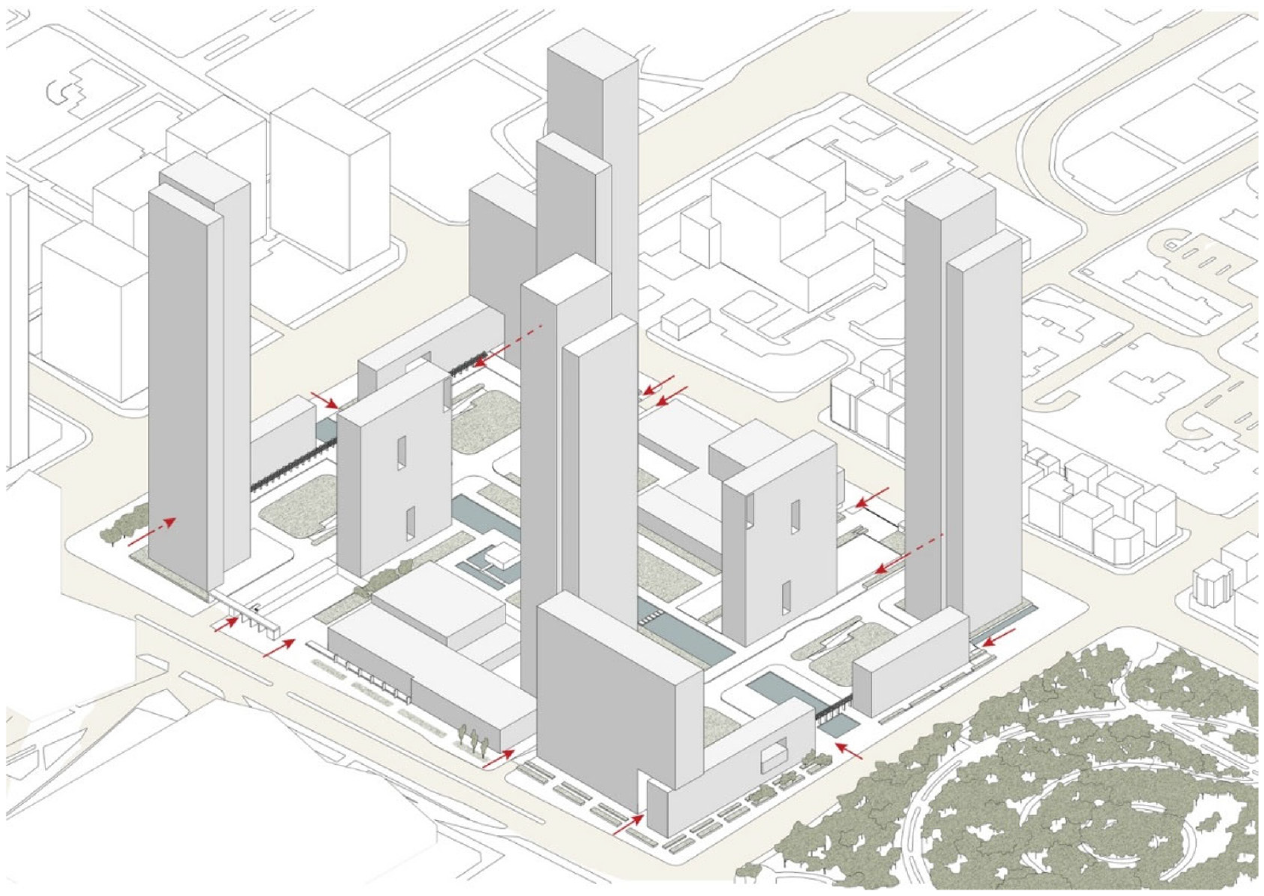
First World’s porous border: arrows indicate entrances.
The provision of safety is shifted entirely to the apatu’s privately run central security office and the main lobbies of buildings that one cannot enter unannounced. Without the community’s own facility of this kind, the sheer presence of CCTV might be insufficient for a subjective sense of safety and objectively demanding data management. Taken together, the ubiquitous cameras and the control centre enable the dissolution of the physical ‘hard’ borders and the cultivation of permeable ‘soft’ boundaries with re-distributed markers of distinction. Residents feel ‘comfortable’ because their bodily movements are not confined by any ‘hard’ wall, nor are they coordinated by specific security checkpoints like in Tower Palace. This aspect of Songdo’s design makes it closer to a Huxleyan ‘brave new world’ than an Orwellian dystopia. Because this understanding of ‘convenience’ is the recurrent trope in the interviews with inhabitants, we treat it as one of the prime examples of what de Certeau calls ‘enunciative focalisations’ that define the organisation of everyday spaces there.
All this is achieved through a combination of two kinds of visibility, each of which materialises the fusion of key desires of seeing like a state and seeing like a corporation: (1) digitally mediated and privately run supervision directed to space that reassures the order sanctioned by the state, and (2) corporate branded, symbolically marked visibility of space that normalises spatial segregation and social hierarchy by creating distinction without too much difference (Greenfield, 2017: 286). Moreover, in the context of pandemic prevention, the securitisation model based on spatial transparency and digital traceability gains yet another valence of ‘convenience’ and ‘smartness’ to South Koreans who tend to prefer it to any coercive lockdown model. This holds true not only for extraordinary crisis times, but also for everyday tools such as a digital notification that the First World apartments receive the moment a family member drives into the complex, which in turn instantly calls the elevator to the appropriate spot in the underground parking. In short, these semi-gated fenceless communities may seem to be faceless, but their inhabitants see them more commonly as ‘notopias’ optimising the flow of information and bodies. They are also capable of incorporating the next generations of digital safety tools, such as face recognition, promoted by state and corporations alike as efficient solutions to contemporary challenges.
But convenience and security are not the only valued aspects of everyday life in First World. Just like the skyscraper is a symbolic ‘cathedral’ of modernity, not only a business-oriented necessary densification machine (Koolhaas, 1994: 87), the architectural design is always a symbol (Jinman, 2018: 45) and South Koreans see their high rise apatu tanjis as key signs of modernity (Cho, 2018, interview with authors). The social distinction of living in a branded, spacious, state of the art, centrally located yet green apatu is not to be underestimated. There is a symbolic ambiguity here to be resolved, though: how to convey exclusivity in an apparently inclusive area, how to project higher status without ostentation? From the residents’ perspective the housing company should not construct something too different and deliver an unfamiliar product – what is desirable is standard and recognisable; something that has worked out so far, both for the producers/investors and the buyers/consumers (Park and Park, 2011).
For the social class distinction to be signalled in a clear yet acceptable manner, additional remaking of semiotic markers within the area needs to complement the vertical symbolism of the compound. While one may enter this semi-gated community from outside freely almost without noticing any border, once inside a sense of spatial distinction can be detected. A children’s playground, which is the standard feature of all Songdo apatus, is ensconced here in the manicured minimalist landscaping including a long rectangular central pond as well as special facilities conspicuously placed on opposite sides. One is the multifunctional building that includes the control centre and another is the Tea House which is the prime marker of symbolic distinction in this space. Located within an adjacent pool, it symbolises ‘the prevalent theme’ of traditional upper class houses which was ‘simple and serene beauty’, often conveyed by ‘stone water ponds’ (Koo and Nahm, 2000: 383). Moreover, in the contemporary cultural context of South Korea, drinking tea signifies a more noble, ritualised and calmer activity vis-à-vis the much more mundane and omnipresent coffee consumption. The Tea House is a kind of library/reading room, ostensibly designed to inspire a sense of community in the complexes that for all their safety and density are also felt by people to be individualistic. In practice, however, it seems as much a community enabler as a vehicle of symbolic delimitation and a concretisation of a sense of belonging to this complex. Consider this interview excerpt: It is very individualistic here. There are not so many opportunities for the residents to get together. That was the idea of the Tea House… to have a community. Something to enjoy together. Something exclusive to us. We need more of those, so we can tell other people, ‘we have this thing, but you don’t, right?’ … (interview E10, 29 October 2018, Songdo, emphasis ours).
The practices of everyday life that the Tea House affords – like newspaper reading, tea drinking, chatting with neighbours in a shaded space – invite the communal rituals (Isozaki and Asada, 2010), signalling the existence of a symbolic boundary between the fast utilitarian world of the ‘outside’ and the decelerated world of the ‘inside’. The fact that during our daytime observations the Tea House was mostly frequented by females with children hints also at its role of a ‘gendered institution’ that helps legitimise the traditional boundary between domestically working wives and outside working husbands. In her analysis of the gated community as gendered institution Odrowaz-Coates (2015: 243–244) points out that it may ‘turn residents into willing cooperators of the internal system’. This dovetails with the fact that middle class South Koreans ‘have led highly family centered lives’ (Chang, 2010: 25) characteristic of ‘familialistic individualization’ (Ochiai, 2014: 214). In this context, the spatially and semiotically reframed amenities of First World belong to the set of markers that refigure the constitutive symbolic boundaries such as exclusive/inclusive, private/public, female/male, inside/outside, ritual/utilitarian, open/closed, etc. It is the new visibility of these boundary objects and spaces that show how the fusion of ‘seeing like a state’ and ‘seeing like a corporation’ gets materialised on the ground. And it is in the spatial patterns of mixing the global with the local, the generic with the distinguished, and the individual/familial with the communal/collective that we can discern how the ‘cultural production’ of new gated communities accompanies refiguration of space (Grant and Rosen, 2009) and that ‘no matter how standardised, separated, accelerated and compressed time and space become, local actors continually reshape their meanings’ (Jijon, 2013: 385).
Conclusion
The paper reinterprets the design of smart city Songdo as a fabrication of space enabled by the fusion of ‘seeing like a state’ (Scott, 1998) and what we by analogy call ‘seeing like a corporation’. This fusion hybridises the exercise of power and blurs the symbolic boundaries between public and private. Within its national context Songdo extends rather than upends the prevalent urban developmentalism, and – a fortiori – it reproduces rather than reduces the power of the existing South Korean entrepreneurial urbanism long since predicated on hybridisation of ‘seeing like a state’ and ‘seeing like a corporation’. Indeed, what the city achieved in this respect, among other things, is a normalisation of comprehensive centralised supervision and uniform regimentation of space, one associated with safety and convenience (for the inhabitants) and another with panopticon-like legibility (for the state). Originally hailed as a unique ‘smart city’, it has been productive of the ‘normalised’ surveilled machines for living rather than ‘extraordinary’ living machines.
Songdo also provides evidence for extension of the classic argument of Lefebvre that social classes stake a claim to the regimented organisation of space, ‘disguise themselves in it, in the hierarchy of occupied spaces’ and that new modes of production appropriate patterns that had been previously formed (Lefebvre, 2003: 212). We call the presented South Korean mode of production of space fabrication. The analysed aspects of everyday life in Songdo illustrate the polysemic adequacy of the notion of ‘fabrication of space’. Not only standardised and replicable ‘making of something’, it also means an instant construction enabled by industrial corporate implementation of pre-coded structures (Jinman, 2018). Here it matches the definitional element of Lefebvre’s conception of the modernist (re)production of space. But fabrication also means ‘making up’ – creating a montage-like symbolic representation of something that is not quite there, possibly concealing another reality, or promising in advance more than could be delivered. To the extent that Songdo nowadays represents an ordinary South Korean urban developmentalism rather than an extraordinary ‘smartification’, it is a ‘fabricated space’ in all those senses. On the one hand, it resembles a Lefebvrian ‘spatial product’ which matches what Scott dubbed ‘high modernist seeing like a state’, one that Le Corbusier would have relished. On the other hand, it hybridises it with the late modern preference for iconic high-rise architecture and ‘the culture ideology of consumerism’ (Sklair, 2010). First World, the housing compound we analysed, is at once a large-scale branded commodity and a small-scale ‘imagined community’, each of which is part of the digital era social spectacle of ‘progress’ that can be seen as a symptom of neoliberal state-backed ‘seeing like a corporation’. This fusion of social imaginaries and infrastructures is complex and ambiguous but regardless of evaluation it is clear that it engenders a significant, if subtle, refiguration of spaces for living. In Songdo we see a hybridised mode of fabrication of space understood as a montage and enhancement of the extant patterns (Lefebvre, 2003: 212) that refigure them in the process. This refiguration articulates itself strongly in socio-spatial dimension and illustrates that ‘smart city ventures such as IBD in Songdo quickly forget the value of plural and reflexive intelligence, as the flows of raw and worked data between smart monitoring systems thicken into a form of self-referencing technological intelligence’ (Amin and Thrift, 2017: 24).
Nonetheless, the ambiguities implied in the design and practices of everyday life of Songdo suggest that investigators pay attention to a variety of spatial effects and emplaced subjective affects. Insofar as the hybridised state/corporate fabrication of space is concerned, a Foucauldian ‘normalisation’ of rigidly controlled spaces for ‘ideal’ docile citizens appears to be a warranted critical interpretation. Moreover, it suggests that we conceptualise not only urban ramifications of power/knowledge but also sociological implications of ‘power/space’. Likewise, Rose’s notion of the refiguration of neoliberal governmentality through non-linear processes of ‘novel territorialisations’ is equally salient (Rose 1996: 327, 356). The traditional critique of state surveillance and the reproduction of inequalities points to one aspect of the problem, namely how the middle-class status anxieties and desires for safety become exploitable by the now interconnected panoptic ‘seeing’ of the South Korean state and corporate powers. The present study expands these discourses but it also suggests a pressing need for a new social critique, one that could understand better the seemingly paradoxical spatial effects and subjective affects associated with the increasingly dominant hybridised ways of seeing. Such a perspective could enable researchers to avoid purely deductive theorising and chart a new course between the Scylla of dystopian critiques and the Charybdis of the ‘smart’ utopianism (Rugkhapan and Murray, 2019).
We find this plea worthwhile because a sizable portion of Western academic accounts of smart cities like Songdo seem to invite an Orwellian portrayal. For instance, take again the description of Sennett (2018: 158–163) who concluded that homogenised spaces of Songdo are indicative of a ‘prescriptive hermetic’ design instead of an emancipatory ‘hermeneutic ethics for the city’. This binary does fit the surveillance heavy housing concept we observed in Songdo and corresponds with our analysis of entrepreneurial fabrication of space that is capable of reproduction of inequalities. However, it seems also the case that the sharp binary coding employed by Sennett does not exhaust the topic and fails to grasp ambiguities and everyday tensions of its spacing. One of the ambiguities inheres in the observation that in addition to disciplinary effects one detects also aspirational affects in Songdo. While perceptive about the latter, Sennett’s interpretation does not explain how both aspects condition each other. This is partly the case because his is a critique made from a distinctly US American vantage point, one informed by the multigenerational discourse of individual liberty which, until recently, has questioned its own conditions of possibility only partially. We have tried to show that in the South Korean contexts, certain path-dependencies and contemporary middle-class desires may in practice override the ostensible Western definitions of such values as participation or privacy and be appropriated by the hybridised symbolic order of the state and the corporation. When it came to what de Certeau dubbed the ‘indications of the body within discourse’, the written-in-stone affordances of bodily comforts and safety appear more imperative than unwritten narratives of personal liberties. In this sense our findings would support Rose’s (2017) observation that the key contemporary social desire is not so much freedom but security, at least with regard to certain middle-class ideals of living. At the same time, we indicated that the everyday design of security and its new spatio-symbolic forms are understandable as deeper refigurations of space that are not only capable of penetrating and rearticulating symbolic boundaries of communities but also political and ideological borders of states.
Footnotes
Declaration of conflicting interests
The author(s) declared no potential conflicts of interest with respect to the research, authorship, and/or publication of this article.
Funding
The research has been conducted within the framework of the Interdisciplinary Research Center (SFB 1265) at Technical University of Berlin, funded by the DFG (German Research Foundation), project number 290045248, in years 2018-2021.

References
of