




Abstract
Recent research on embeddedness in global production networks (GPNs) has begun to move beyond the dominant perspective on how lead firms embed into host countries to investigate how non-lead firms embed across multiple scales in a GPN. This paper builds on such work by examining both processes of how, and the extent to which, different Southern suppliers embed into GPNs, detailing the contestation, struggles, and synergies faced. Empirical evidence is provided through a case study of Kenyan horticulture. Using a mixed-method approach of interviews and surveys, the paper finds that Kenyan farmers and Kenyan export firms (KEFs) have varied ways in which they embed, with farmers more embedded (highly dependent on network relationships and participation in a GPN) and KEFs simultaneously less embedded (having a low degree of commitment towards farmers) in GPNs. Overarchingly, the results demonstrate the need to account for the complex ways in which non-lead firm actors like Southern suppliers embed in GPNs.
Introduction
Embeddedness is one of the three principal elements, along with value and power, in global production network (GPN) analysis of economic development (Henderson et al., 2002). Building on pioneering contributions to the social sciences (Granovetter, 1985; Polanyi, 1944), the concept has been articulated in GPN research in relation to how lead firms anchor in localities as well as in terms of how network relationships are produced and re-constituted (Hess, 2004). Three key dimensions of embeddedness have been identified, namely societal, network and territorial. While various contributions have engaged with the concept (e.g. Alford, 2016; Barrientos, 2019; Murphy, 2012), their predominant focus is either (a) on how GPN lead firms – still often assumed to be from the global North (e.g. Neilson et al., 2018: 1–2) – embed in territories or (b) on the contested processes of (dis)articulations between the commercial drivers of global Northern buyers and southern societal actors (e.g. farmers, exporters) (e.g. Alford et al., 2017). Considering their previous neglect, this paper asks: How and to what extent do non-lead firm actors embed in GPNs?
The paper draws on economic geography and economic sociology (including social network research) to systematically unpack different forms of network and territorial embeddedness from non-lead firm actor perspectives, accounting for heterogeneity both within and across non-lead firm actors. A novel measure for mapping the different ‘extent or degrees’ of embeddedness of these actors enables understanding of synergistic (occurring smoothly without contestations) or sub-optimal (either over-dependent on relationships and places or under-committed to relationships and places) embeddedness in GPNs.
A case study of Kenya's fresh fruit and vegetable (FFV) sector illustrates the embeddedness of non-lead firm actors in GPNs. As a consequence of contested relationships with each other and UK supermarkets, the results show Kenyan farmers are over-embedded while Kenyan export firms (KEFs) are under-embedded in GPNs.
The paper proceeds as follows: ‘Embeddedness in GPNs: conceptual underpinnings and limitations’ section outlines the conceptual underpinnings of embeddedness in GPNs and its lead firm centricity. ‘Unpacking network and territorial embeddedness analysis in GPNs: Non-lead firm perspectives’ section elaborates embeddedness – network and territorial, as well as the degree – from the viewpoint of non-lead firm actors. ‘Case context and research methods’ section introduces the Kenyan case context and research methods. ‘Embeddedness of farmers and KEFs in Kenya-UK horticulture GPNs’ section presents empirical findings of how farmers and KEFs embed into GPNs. ‘Degree of embeddedness in GPNs: Farmers and KEFs’ section then explicates the degrees of embeddedness across these actors and, finally, ‘Conclusion and future directions’ section concludes.
Embeddedness in GPNs: Conceptual underpinnings and limitations
The concept of embeddedness dates to Polanyi's (1944) pioneering ‘The Great Transformation’. With the rise of markets, rather than the economy being embedded in social relations, he argued that social actions are embedded in the economic system (Polanyi, 1944). While his concept of embeddedness focused on more abstract relationships between economies and societies, Granovetter (1985) shifted the scale to actors and networks to further the concept in the context of ongoing social relations. In a similar vein, within new institutional economics, Williamson (2000) argued that the economic behaviour of firms is embedded in networks of relations.
Within the original GPN framework, the concept of embeddedness is explained as the social relationships between both firm and non-firm actors (e.g. states) across multiple interrelated geographic scales, with the emphasis on how lead firms embed in networks and regions (Henderson et al., 2002). In essence, the social, political, economic and spatial arrangements in which lead firms embed are recognised to influence the strategic choices of these firms and wider institutional dynamics of regions in which they are embedded (Coe et al., 2004; Hess and Coe, 2006). Initially, two key types of embeddedness – network and territorial – were identified as relevant in GPN analysis (Henderson et al., 2002).
Network embeddedness is explained as the ‘degree of connectivity within a GPN’ (Henderson et al., 2002: 452). This type focuses on the architecture and durability of inter-firm relations, as well as the broader institutional network structure which includes horizontal actors (e.g. non-firm actors). Network embeddedness is a product of a process of trust building between network agents that engender stable relationships (Henderson et al., 2002).
As explicated in the original GPN framework, territorial embeddedness refers to the extent to which firms are ‘anchored’ in specific territories by absorbing pre-existent social dynamics of a place, which in turn engenders making decisions to invest, reinvest or divest and regional development (Henderson et al., 2002). The way actors anchor shows the degree of actor commitment, observed through firms’ asset-specific and strategic investments, so that particular exchange transactions can recur (Coe et al., 2008).
A third type, societal embeddedness, was introduced soon after and described as the ‘genetic code’ of an actor by Hess (2004: 176), building on the work of Polanyi. This category focused on cultural and broader historical relations. Societal embeddedness can be depicted in the form of beliefs and norms that prescribe strategies for self-interested action (Zukin and DiMaggio, 1990), which in turn create informal rules that impact the ability and legitimacy of how actors can engage. Cultural aspects also take the form of heritage (and institutional baggage of home bases) of global actors (such as lead firms), which shape and re-shape actions of individuals and collective actors in local contexts, within and beyond their respective societies (Hess, 2004). 1
Within GPN research, embeddedness has been predominantly understood from the viewpoint of how lead firms embed into (or dis-embed from) existing networks, territories and societies and how they re-shape (and are re-constituted by) the economic, social and political arrangements of the places firms inhabit (Hess and Coe, 2006). With such lead firm centricity, non-lead firm perspectives of ‘who’ embeds in ‘what’ and ‘how’ in a GPN have not been sufficiently accounted for.
Some studies do, however, provide some useful building blocks for seeking to understand experiences of, and variations within, how southern suppliers embed into GPNs. Work on Suzhou's Information Communication Technology industry demonstrated the relative lack of sourcing and technological linkages of local firms to foreign trans national corporations (Wei and Liao, 2013). In an example from the cocoa industry, the entry of lead firms (carrying their own institutional baggage) into territories has led to suppliers dis-embedding from previous relations to embed into newly formed relations with lead firms (Krauss and Barrientos, 2021). Through work on South African fruit, the concept of multi-scalar embeddedness (Alford, 2016; Alford et al., 2017) has been advanced to show how Southern suppliers embed into new relations at global, national and local scales and the implications for labour agency. However, none of this work has sufficiently defined what they mean by territorial and network/societal embeddedness nor how they interact.
Furthermore, a few previous contributions have mentioned, but have insufficiently elaborated the prevalence of different degrees of embeddedness (e.g. Hess and Coe, 2006; Mozumdar et al., 2019). Further attention is therefore needed to shed light on the contestations that arise due to the complex processes, and variation in degrees, of territorial and network embeddedness of suppliers in GPNs.
Unpacking network and territorial embeddedness analysis in GPNs: Non-lead firm perspectives
This section draws on economic geography and economic sociology (including social network analysis) to deepen understandings of embeddedness in GPNs beyond lead firms. Network embeddedness is examined first, before territorial and then, finally, the degrees of embeddedness of non-lead firm actors.
Network embeddedness: Non-lead firm actors
To understand embeddedness from a non-lead firm perspective, conceptualisations of network embeddedness must be extended to account for how relational and structural dynamics change when embedding into GPNs. Drawing on Granovetter, relational embeddedness is the nature of (dyadic) relations (history of interactions, interdependent utility of actors involved, and norms/interests) that actors have with each other, and which have direct effects on an actor's economic action (Granovetter, 2017). Structural embeddedness, the broader structure of the network that actors are positioned in (Granovetter, 1985), has implications for relational embeddedness. The behaviour of individuals conditions the access and quality of information available when decisions are made (Granovetter, 2017).
Network architecture
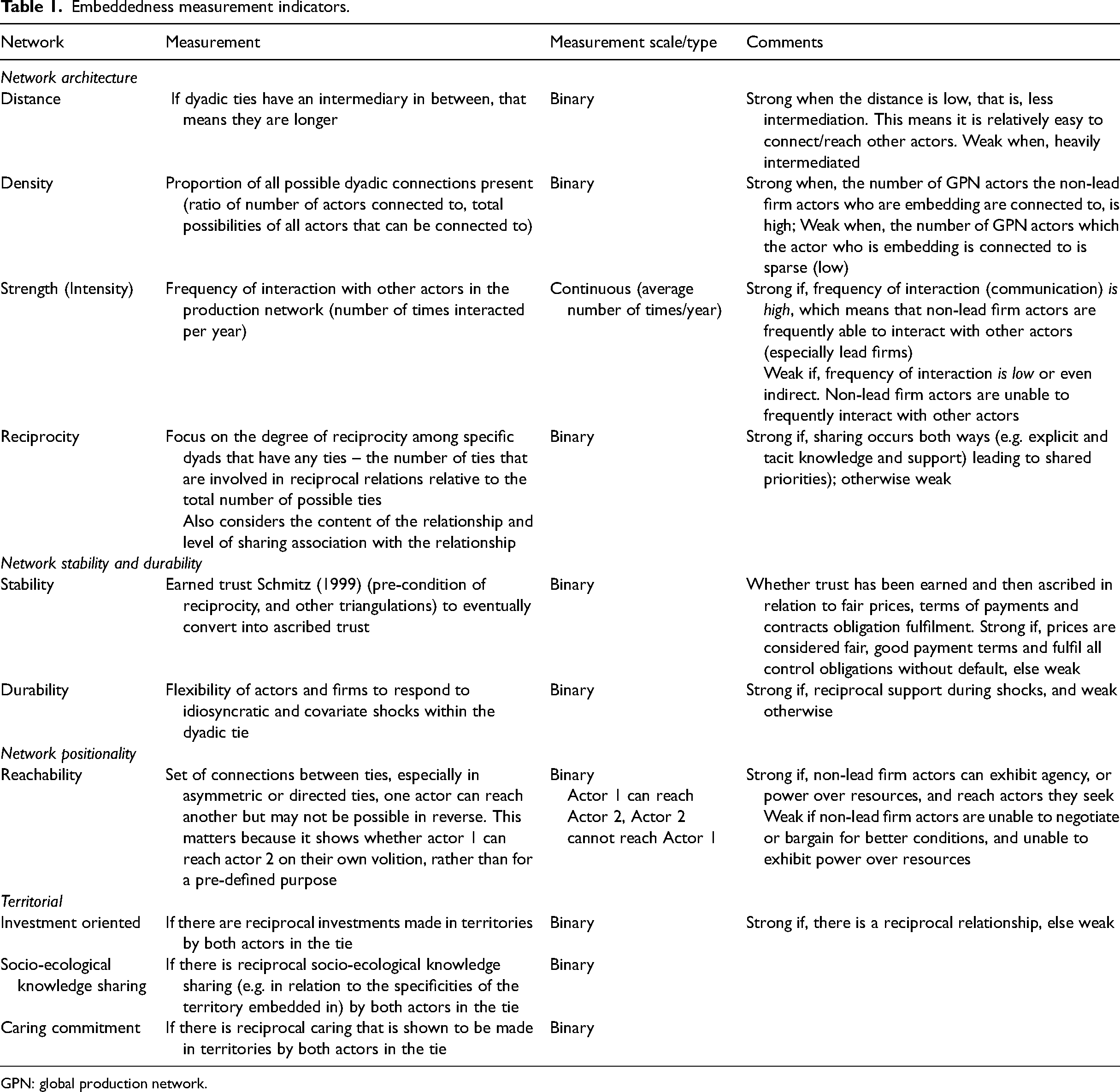
Drawing on relational embeddedness, network architecture captures the nature of the relations between the dyads non-lead firm actors are connected to in a network. Four aspects are involved – distance, and density, strength (intensity) and reciprocity (drawing on definitions by Hanneman and Riddle, 2005; Knoke and Yang, 2019).
Distance and density are central to Coe et al.'s (2004) explanation of network embeddedness. Distance is understood as ties which are directed (from a source actor towards a target actor). The higher the distance, that is, more intermediaries between the source and target actor, the longer the time taken for information to diffuse (Table 1)
Embeddedness measurement indicators.
GPN: global production network.
Along with distance and density, the strength and reciprocity of relations between various non-lead actors, as well as with lead firms, helps understand the level of cohesiveness and co-operation between actors (Uzzi, 1996). For instance, in directed ties, reciprocity can be conditioned on a combination of the mutual confiding and quality of knowledge shared between non-lead firm actors and other GPN actors (e.g. especially lead firms) (Barrientos, 2019; Zukin and DiMaggio, 1990) which reduces asymmetry between ties.
Network stability and durability
The original GPN framework points to stability in a network occurring when lead firms through trust creation attempt to develop a co-operative culture between themselves and local actors (Henderson et al., 2002). Meanwhile, understandings of durability are expressed in terms of the relationship of lead firm actors with local actors over time.
Understandings of trust within relational embeddedness can be drawn on to extend the concept of stability in networks from a perspective on non-lead firms. Network stability can be understood through dyadic trust building or shrinking between non-lead firms. Within economic sociology, trust is understood to reduce transaction costs and create strong ties (Koniordos, 2017), as well as minimise opportunism (Williamson, 2000). Within economic geography, Schmitz (1999), distinguished between ascribed or earned trust, which has significant implications when accounting for non-lead firm actors. Ascribed trust is implicit and derived from being part of a group or society or emanating organically through mutually beneficial and reciprocal relationships. Earned trust develops through commercial interactions, from personal experience or by collective expectations of what actors associate as trustworthy (e.g. through reputation, appearance) (Schmitz, 1999). Stability in a network can be seen as arising from trust building processes when non-lead firm actors embed into GPNs. Thus, when embedding, non-lead firm actors may earn or ascribe trust to/from other actors in new networks.
Another factor that has remained unelaborated in GPN research is network durability, which refers to the adaptability and flexibility of non-lead firm actors to respond to shocks or changes within the dyadic tie (Pasquali et al., 2021). Increased trust and positive shared experiences aid in building the institutional thickness of places (e.g. Nadvi, 1999), facilitating suppliers’ ability to respond to changes be they in requirements of other non-lead firm actors or lead firms, and improving relationships over time (Dallas, 2015).
Network positionality
Network architecture, stability and durability do not occur in isolation, but are dependent on experiences of social interactions and responses to structural conditions that create decision-making imbalances amongst actors linked in networks (Murphy, 2012). Network positionality of non-lead firm actors is conditioned by their structural embeddedness within the network, which can be comprehended through the concept of reachability 2 (where one actor has asymmetric access to another actor – see Table 1). Non-lead firm actors which are easier to reach could be in less powerful positions vis-à-vis other actors. Furthermore, positionality within a network can influence the creation of structural holes (Burt, 2002), wherein non-lead firm actors with ties into multiple networks can carve strategic advantages, especially when they are the main route for information flow. In such situations, non-lead firm actors can almost act like gatekeepers or brokers (Granovetter, 2017).
Overall, drawing on relational and structural embeddedness helps extend the conceptualisation of network embeddedness within GPNs to account for how non-lead firm actors embed (and experience being embedded) in new networks.
Territorial embeddedness of non-lead firm actors
GPN understandings of territorial embeddedness have focused on the socio-economic processes of how lead firms anchor in territories. Such research has implicitly accounted for anchoring based on ease of coupling and the level of commitment (or investment) to socio-economically embed in places (Yeung and Coe, 2015). For instance, the cases of Samsung-Tesco in South Korea (Coe and Lee, 2006) and foreign-owned firms in Lesotho's apparel industry (Morris and Staritz, 2017) point to the importance of anchoring by lead firms investment in host locations; as well as promoting shared investment.
However, when accounting for non-lead firm actors, anchoring needs to not only be understood as shared investments made in regions, but also knowledge transfer and caring commitment (e.g. Craviotti, 2016). Knowledge transfer occurs when there is transfer of technology and reciprocal sharing of explicit, as well as intangible or tacit information (e.g. sharing experiences) (e.g. De Marchi et al., 2019). Reciprocal caring commitment is shown for non-economic reasons through investing in social infrastructure (e.g. school building, paying fees of employee's children) by non-lead firm actors as well as lead firms.
Another important aspect of territorial embeddedness that is insufficiently discussed in GPN research is the access to, and use of, the host country's’ natural environment. This is critical to unpack as non-lead firm actors (e.g. southern suppliers) are frequently fixed in specific territories, which have been selected by lead firms for potential access to, and control environmental resources (Havice and Campling, 2013). In this case more powerful actors like lead firms are able to appropriate environmental resources (physical, chemical and biological nature), limiting the environment's carrying capacity and leading to environmental degradation (Baglioni et al., 2017). Thus, creating (reciprocal) socio-ecological relations between network actors and the environment (Bridge, 2008). Often, non-lead firm actors have to absorb and internalise the socio-ecological dynamics of lead firm anchoring processes, 3 which may have repercussions for the (re)generative and carrying capacity of their local natural resources – and ultimately affect production within, as well as the expansion and structure of, GPNs (Bridge, 2008; Ponte, 2019).
The socio-ecological relations which emerge as a consequence of embedding into GPNs are experienced differently across non-lead firm actors. For instance, many suppliers that are ‘fixed to certain territories’ (e.g. farmers) are dependent on natural resources to participate in GPNs. In order to preserve the quality of their environment, they may vary in the level of access and control they are willing to commit to lead firms (De Marchi et al., 2019). Consequently, some non-lead firm actors (e.g. farmers, small enterprises) may not just want to increase incomes derived from their environments, but act in a way to limit appropriation of their environment by more powerful actors. Limiting appropriation occurs for various reasons, for example when territorially fixed suppliers wish to demonstrate stewardship or when the environment has cultural symbolism), or when there is attachment to, or bequeathing of, land to kin. The varied socio-ecological relations of actors in a GPN can lead to contestation. For example, tension may arise between non-lead firm actors (or with lead firms) due to the nature of sticky, tacit ecological knowledge of specific places (Craviotti, 2016).
In sum, territorial embeddedness of non-lead firm actors involves processes of how they experience embeddedness into regions, be it through reciprocal investment orientation, knowledge transfer or caring commitment, on one hand. While on the other hand, it relates to the socio-ecological relationships which re-shape the socio-economic arrangements of the places (of non-lead firm actors).
Finally, territorial embeddedness overlaps with, and re-shapes, network embeddedness. Thus, the embeddedness of actors must be understood in terms of the nexus of network and territorial aspects.
Degree of embeddedness of non-lead firm actors
The degree or extent to which different non-lead firm actors embed into GPNs may vary and is understood in relative terms, that is, how one non-lead firm actor embeds in relation to another actor. Some actors may be ‘more’ embedded in newly formed networks and modified territories vis-à-vis other actors (lead/non-lead firm) in GPNs. In such cases, an actor having strong networks (less distance, more strength, reciprocal relationships, that are stable and durable) and territorial (reciprocal investments, caring commitment and socio-ecological relationships) embeddedness, in the GPN. Non-lead firm actors may also be ‘less’ embedded in relation to other actors. This is when the embedding actor in question shows reduced overall commitment to other actors/territories within the GPN, be it due to their own choices or because of unfavourable terms of participation dictated to said actors. This means weak ties, lower trust, contested values and unequitable socio-ecological relationships with skewed access to resources in favour of more powerful actors. Thus, when studying (dyadic) ties within a GPN one actor may be ‘more’ embedded while another actor ‘less embedded’ simultaneously.
Being ‘more’ or ‘less’ embedded is dynamic, as these are shaped and re-shaped by the evolution of the network and territorial relationships between the actors involved. For instance, being ‘more embedded’ may not always lead to positive outcomes, as the actor who is ‘more embedded’ may be over-dependant on certain network relationships and socio-ecological relations, while the less embedded actor is less committed. In such a case embeddedness is skewed for all actors involved and has the potential to cause negative outcomes (e.g. profits) to some non-lead firms actors while positive for others (Hagedoorn and Frankort, 2008) and potential expulsion from the GPN. It is possible for actors to move from being more embedded to less embedded vis-a-vis other actors depending on these evolutionary dynamics.
Overarchingly, as indicated above, achieving ideal or synergistic embeddedness, that leads to mutually beneficial outcomes across actors, is challenging. The degree of embeddedness in GPNs can be synergistic when it involves a contestation free process with strong, dense and reciprocal ties, symmetric knowledge exchange, along with higher trust and cooperative culture engendering shared outcomes across different non-lead firm actors (and lead firm) as they embed into new GPN networks and; territorially, this would involve creating equitable socio-ecological relationships of shared access over natural resources. In sum, if all actors within a tie simultaneously synergistically embed into the GPN (move away from being more or less embedded in the GPN), then upgrading can emerge across all actors. For instance, Barrientos (2019) shows that in the Kenyan flower value chain both Kenyan flower exporters and workers developed shared values that engendered economic and social upgrading for both. 4
The distinction between synergistic and more/less embeddedness provides a heuristic classification to comprehend the dynamic processes of how different actors embed into new networks and modified territories in relation to each other. Synergistic and more/less embedded in GPNs are not two mutually exclusive degrees of embeddedness, but rather should be viewed as a continuum. Unpacking this allows conceptual space for varied perspectives of how embedding into a GPN occurs, and the extent to which it occurs between a similar category of actors (i.e. within farmers) and across actors in a GPN.
The next section turns to the case study in order to demonstrate the insights from this elaborated understanding of network and territorial embeddedness from a non-lead firm perspective, along with the greater consideration of the degree of embeddedness.
Case context and research methods
The two types of non-lead firm actors studied in the case study here are farmers and large/medium size KEFs in Kenya's horticulture sector, one of the country's foremost foreign exchange earners. The key fruits and vegetables exported are green beans, snow peas, garden peas, avocados and mangoes. In 2019–2020, the UK imported over 55% of Kenya's FFV exports (ITC, 2020).
Kenyan-UK horticultural GPNs are primarily buyer-driven, with governance influenced by multiple standards like GlobalGAP, organic and private codes of conduct of Northern supermarkets (Dolan and Humphrey, 2000). Small-medium scale farmers sell produce through groups (or cooperatives), either directly to KEFs or through intermediaries (such as brokers) (Krishnan, 2018). They source inputs from a range of suppliers who sell standard-compliant products. The postproduction ‘sorting’ and grading of produce ultimately determines if it ‘makes the grade’ (i.e. complies with standards) to be sold in GPNs. To improve traceability of products and comply with standards, the Horticultural Crops Directorate (HCD) – the nodal government agency for horticulture in Kenya – requires KEFs to be vetted by providing details of each farmer from whom they procure commodities. The HCD is supported by sub-national governments to improve traceability efforts. Before products are freighted, KEFs and quasi-governmental organisations such as the Kenya Plant Health Inspectorate Service (KePHIS) test the pesticide residue levels of products to ensure compliance with standards. Thus, the key actors (and ties emerging) in the FFV value chain are: farmers (and farmer groups/cooperatives), KEFs, brokers (intermediaries), sub-national governments, national government (HCD), horticulture associations (Fresh Producers Export Association of Kenya, FPEAK), inputs suppliers (seed, agro-chemicals, finance), donors (e.g. United States Agency for International Development), quasi-governmental bodies (Pest Control Products Board (PCPB), KePHIS) and lead firms (UK supermarkets for GPN farmers).
The paper uses a mixed-method approach (Creswell et al., 2007), combining quantitative and qualitative modes of inquiry. The former is based on survey research of 579 horticultural farmers (the first group of non-lead firm actors) conducted in 2015–2016. A total of 246 farmers were identified as GPN farmers and 333 as local farmers. The latter are not embedded into GPNs and are used as a control group to understand how the paths of embedding into GPNs have varied from what farmers were doing before participating in GPNs. For local farmers, sale of horticulture products includes similar processes to GPN farmers, without the need to adhere to specific standards. Local farmers sell commodities either to intermediaries such as brokers who take a cut of commission, or directly to wholesalers/local vendors. Thus, the key actors involved are very similar to GPNs, with the only difference being lead firms in this case are wholesalers/local vendors; and there are no KEFs involved.
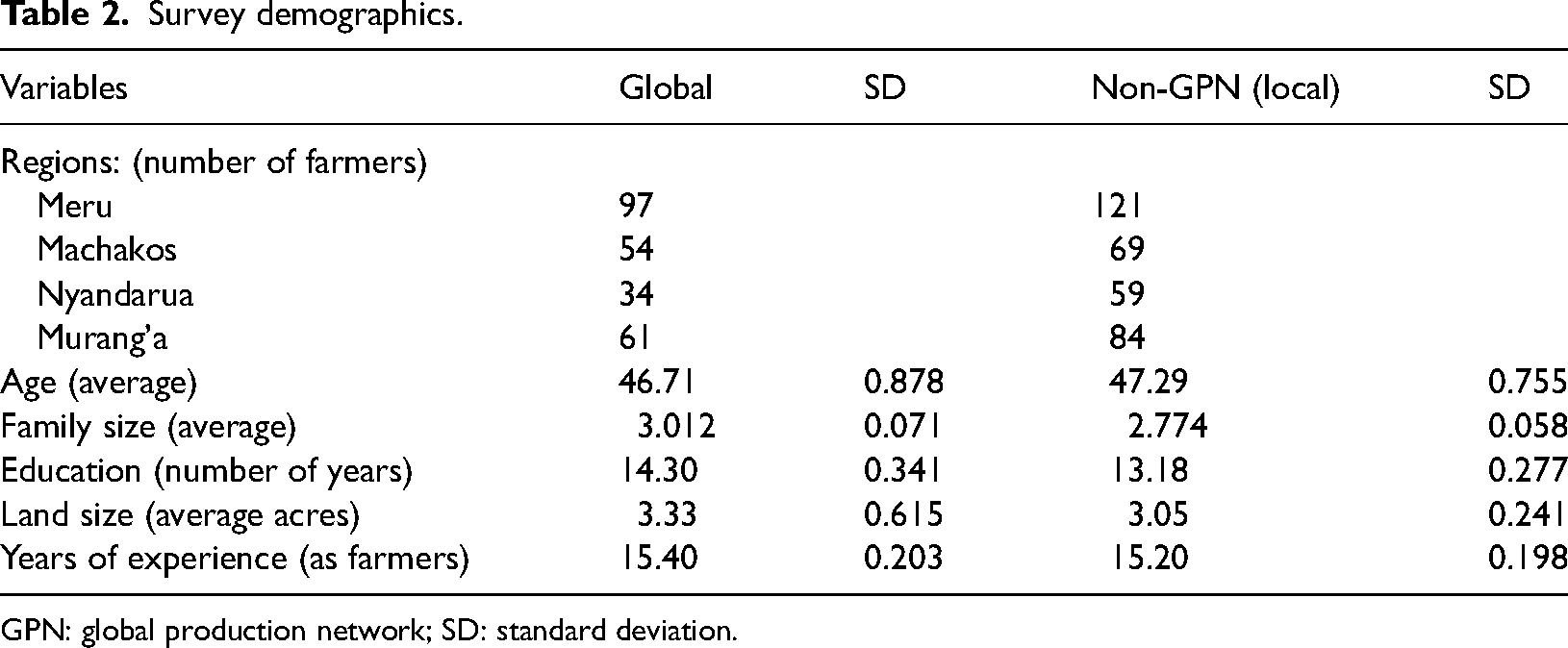
The survey was conducted in the four largest horticulture growing counties in Kenya – Meru, Machakos, Nyandarua and Murang’a (Table 2). Between GPN and local farmers, no significant differences were found in the average age, family size, years of education, land size or the years of experience of being a farmer (Table 2). Thus, the local farmers are a good control group to the case of GPN farmers.
Survey demographics.
GPN: global production network; SD: standard deviation.
The qualitative data emerges from a total of 46 semi-structured interviews, comprised of 11 farmers (selling into global and local markets), 5 representatives of county governments, 3 HCD officials, 12 KEF managers, and 11 representatives of Kenyan horticulture business associations, universities, donors and non-governmental organisations (NGOs). The interviews were conducted between 2014 and 2017 (see Supplemental Appendix 1).
A multi-stage sampling procedure was conducted in the selected counties to collect data on farmers. At the outset, a sampling universe was developed by collating data across multiple sources for global (e.g. HCD traceability lists, KEF lists) and local (e.g. county government officials, area officers, snowball sampling through community members) farmers. From the universe, the data was stratified by county to identify hotspots of farmer density. From each of the county lists, farmers were picked at random (without replacement). This process enabled data triangulation and improved internal validity, ensuring that the results are close to representative.
To determine whether farmers participated in GPNs or not, the survey recorded all the end markets farmers supplied to. If they sold more than half (50.01% or more) of their crop to a specific KEF (who sold to Northern markets) either directly or through a broker, they were classified as a GPN farmer, otherwise as a local farmer/non-GPN farmer.
Furthermore, a total of 116 KEFs, the second group of non-lead firm actors, were surveyed in 2017. In the case of sampling of KEFs, a master list of firms was compiled using 2015 data from the Kenya Revenue Authority, which records export transactions. A total of 566 firms were identified. Transactions for each firm were aggregated to select the top 116 firms, who accounted for over 88% of Kenya's total value of FFV exports in 2015. The remaining 450 firms were removed to reduce data noise (as each firm contributed very small amounts to exports). Of the 116 KEFs, approximately 73% of the firms operated across all 4 counties (Nyandarua, Murang’a, Meru and Machakos), 13% operated in 2 or 3 of the regions, and the remaining 14% operated only in 1 region. Furthermore, about 75% were owned and operated by Kenyans, 15% foreign-owned, but Kenyan-operated, and 10% foreign-owned and operated. On average, KEFs had been participating in GPNs for 7 years and had a yearly turnover of US$ 1.5 million in 2015.
Measurement indicators and analysis
Drawing on ‘Unpacking network and territorial embeddedness analysis in GPNs: Non-lead firm perspectives’ section, various social network analysis measurements are conducted to gain a deeper understanding of the degrees of embeddedness of non-lead firm actors. Table 1 summarises network and territorial embeddedness of non-lead firm actors in GPNs and provides key measurement indicators for each (these categories should be viewed as relative).
Various work has touched on some aspects of network and territorial embeddedness. Barrientos (2019) shows that not fulfilling contractual obligations due to poor quality of produce decreased stability (trust) in farmer-lead firm relationships and pushed farmers off preferred supplier lists in horticulture. Alford (2016) showed that distrust and lack of support (investment, wage increases) from South African government, impinged on farmer relationships leading to violent protests.
To study embeddedness, qualitative interviews were first coded in NVivo, with themes created based on the types of embeddedness discussed as per Table 1. The quantitative data gathered from the survey was analysed using the aforementioned indicators, along with descriptive statistics, parametric and non-parametric significant tests to compare across farmers and KEFs.
Furthermore, to quantitatively measure the degree of embeddedness for each actor, network and territorial embeddedness indexes were used. An index reduces the number of dimensions in data to provide a dimensionless value that carries all the information in the variables, facilitating comparison across various actors (e.g. Branisa et al., 2009). This means the index of a farmer, can be compared to that of a KEF or lead firm, etc. The paper uses polychoric and tetrachoric principal component analysis (PCA), following Kolenikov and Angeles (2009), to develop network and territorial embeddedness indexes. As commonly done, the index uses equal weights for indicators. Robustness tests were run using a simple PCA. The values of network and territorial embeddedness in GPNs are scaled between 0 and 100.
Values close to 100 suggests an actor (e.g. farmer or KEF) is synergistically embedded, while values closer to 0 indicate relationships are strained. If both farmers and KEFs values of network and territorial embeddedness are very close to 100, then they are synergistically embedded into GPNs. However, if the values of the index for farmers and KEFs differ (and are further away from 100), it suggests that each actor is either more or less embedded relative to each other in the GPN. In such cases, embeddedness is a contested process.
Embeddedness of farmers and KEFs in Kenya-UK horticulture GPNs
‘Network embeddedness of farmers’ and ‘Territorial embeddedness of farmers’ sections discuss how farmers have dis-embedded, whether partially or completely, from indigenous social relations and localised markets to recast and form new social relations by embedding into GPNs. To sell to KEFs and UK supermarkets, farmers have replaced indigenous crops and begun to grow what they call ‘alien crops’ (Interviews: #1kcgov, #2kgov), such as snow peas, new varieties of garden peas, avocados and mangoes, which were first introduced to Kenya by Europeans in the late 1970s. 62% of all GPN farmers surveyed had discontinued growing staple crops of maize and potato, and indigenous vegetables such as kale and paw-paw, to plant export variety crops by the early 2010s. The HCD, county governments, associations such as FPEAK and KEFs have all advocated the higher renumeration potential of such crops.
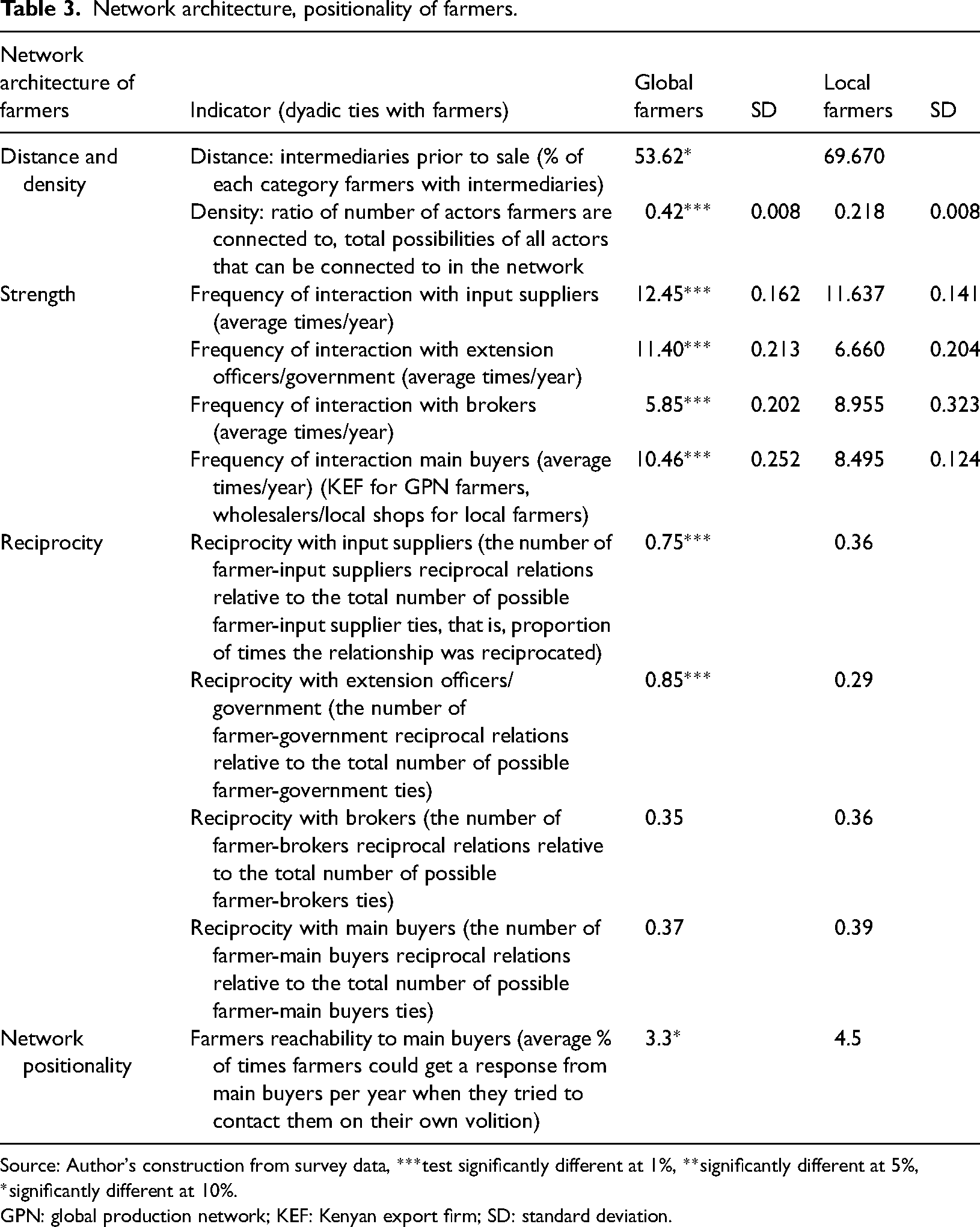
Farmers’ relationships changed before and after participation in GPNs (for most farmers surveyed, this was in the early 2010s). Most farmers previously had arms-length interactions with intermediaries (brokers) for sale of multiple crops in informal local markets (almost 70%) or for subsistence. However, by the time of the survey, GPN farmers sold 47% of their produce to KEFs, producing specific volumes of crops at pre-defined seasonal intervals (see Table 3). This reduced ‘distance’ between farmers and their main buyers.
Network architecture, positionality of farmers.
Source: Author's construction from survey data, ***test significantly different at 1%, **significantly different at 5%, *significantly different at 10%.
GPN: global production network; KEF: Kenyan export firm; SD: standard deviation.
Furthermore, massive institutional changes were implemented within Kenya as GPN participation grew. GPN farmers had to follow strict requirements (often as part of standards such as GlobalGAP) regarding pesticide use, a challenge augmented by a 2009 change to the European Union's maximum allowed residue level (MRL) and consequent ban and adjustment period for Kenyan FFV (Interview: #2kgov, #1kKePhis). To expedite the adjustment process, the PCPB was given increased autonomy to purchase and test pesticides for efficacy (Interview: #1korg). Additionally, KePHIS initiated random checks to test products for residue (Interview: #1kKePhs, #2kKePhs).
Embedding into GPNs led to re-configurations not only of farmers’ livelihoods, but also community level changes. GPN farmers replaced village elders and leaders as both knowledge providers and arbitrators for local disputes (Interview: #3kGPN). Thus, participation in GPNs not only changed institutional arrangements, but also altered norms regarding ‘who’ is important in local society.
On the other hand, KEFs are in a unique position, having needed to create new relationships both with farmers in Meru, Murang’a, Nyandarua and Machakos counties, as well as build linkages with UK supermarkets. Prior to participating in the horticulture GPN, approximately 25% of the 116 KEFs surveyed used to export furniture, other small manufacturing items and re-exported electronics. About 40% were involved in agriculture and agro-processing for local and regional (within Africa) markets, while the remaining (35%) were established to opportunistically participate in horticulture GPNs. Thus, all KEFs had to embed into completely new networks within Kenya, as well as to create relationships with UK supermarkets.
Network embeddedness of farmers
Network architecture of farmers
GPN farmers have more direct relationships (less intermediaries) with their final buyers (KEFs) compared to local farmers (who sell to their final buyers – local convenience shops, wholesalers or restaurants), as indicated by the distance measure in Table 3. Since embedding into GPNs, farmers have a denser network, that is, they are connected directly to significantly more actors, than if they were supplying to local markets. Besides KEFs, the new actors in GPN farmers’ networks include specialised horticulture export government extension officers and quasi-governmental organisations such as PCPB and KePHIS. The role of these actors was particularly crucial in providing support to adhere to different control points (e.g. land management, crop management) within GlobalGAP.
In terms of strength, local farmers reported relatively few interactions with both their main buyers (mostly local brokers/wholesalers), and extension officers, meeting them an average of nine and six times a year, respectively (Table 3). Local farmers complained that brokers frequently switch between farmers, take a commission of over 10% and provide no support services (Interviews: #17kLPN, 18kGPN). Meanwhile, the extension officers reported difficulty in providing training to local farmers as they are not organised in groups (interviews: #25kLPN, #27kLPN, see also Dannenberg and Nduru, 2013; Okello and Swinton, 2007).
On the other hand, GPN farmers were found to have stronger ties (friendly and supportive relations) with extension officers (Table 3). These officers aimed to help GPN farmers increase productivity, crop quality and comply with certification (Interview: #1Kba). Sharing of information with GPN farmers on new practices is indicated by training and personal communication regarding irrigation and spray schedules, soil management practices and application of agro-chemicals. Extension officers were found to consider feedback shared by GPN farmers, enabling improved delivery of trainings, suggesting relatively reciprocal relationships.
However, dis-embedding from indigenous markets and embedding into GPNs was wrought with tension and contestation because of the differences in practices involved (especially GlobalGAP). For example, one GPN farmer explained:
‘The pesticides they [KEFs] told me to use were expensive and did not prevent root rot [a disease], so I applied the ones I used to apply before I started selling to them [KEFs]. I knew this would be better for the crops and my soil … but they [KEFs] blacklisted me …’ (Farmer: #22kGPN)
Furthermore, farmers reported that information relating to compliance with GlobalGAP was discussed when they met with KEFs. However, they were not given a voice in the implementation of practices, impinging on the reciprocity of the relationship. Data in Table 3 suggests that GPN farmers had almost similar levels of reciprocity in relationships with buyers (meeting about 10 times/year) to local farmers (meeting about 8 times/year), that is, less than once a month. Farmers frequently struggled to cope with complex standards requirements. Those who defaulted frequently were marginalised. However, some farmers tried to cooperate and reduce contention to continue participating in the GPN. For the latter, the pursuit of commercial gains outweighed local norms, even if farmers believed that new practices were not always beneficial for them (Interviews: #2kGPN, #1kGPN, #23kGPN). Such findings have been verified by others (e.g. Dannenberg and Nduru, 2013; Ouma, 2010) who show that farmers’ generally attempt to adhere to GlobalGAP, but also use ‘backdoor’ processes through clandestine activities or leveraging informal connections (e.g. intermediaries)to sell without using GlobalGAP.
Overall, even though GPN farmers have on an average relatively less distance, higher density, and relatively stronger ties (compared to local farmers), there was limited reciprocity of relationships, which often led to contestation. GPN farmers have almost no ability to bargain for ‘better deals’, due to both their natural resource constraints (e.g. small land sizes, quality of soil/water) and their dependence on KEFs to pay for and provide training that facilitates adhering to GlobalGAP. Compounded by their ‘low reachability’ to KEFs or UK supermarkets (Table 4), GPN farmers are in a weak position within the network. Not aligning their priorities (e.g. indigenous growing practices) with that of buyers threatens their ability to continue to participate in the GPN.
Network stability and durability of farmers.
Source: Author's construction from survey data, ***test significantly different at 1%, **significantly different at 5%, *significantly different at 10%.
GPN: global production network.
Network stability and durability of farmers
As discussed in ‘Unpacking network and territorial embeddedness analysis in GPNs: Non-lead firm perspectives’ section, trust is central to network stability. Interviews suggested that most relationships between farmers and other GPN actors were based on earned rather than ascribed trust. GPN farmers explained that extension officers and KEFs earned their trust by helping gain access to good quality inputs like seeds and pesticides. However, altering indigenous practices and complex standard requirements fuelled dis-trust, suggest that even relatively strong ties may not carry the appropriate types of information (causing cultural conflicts).
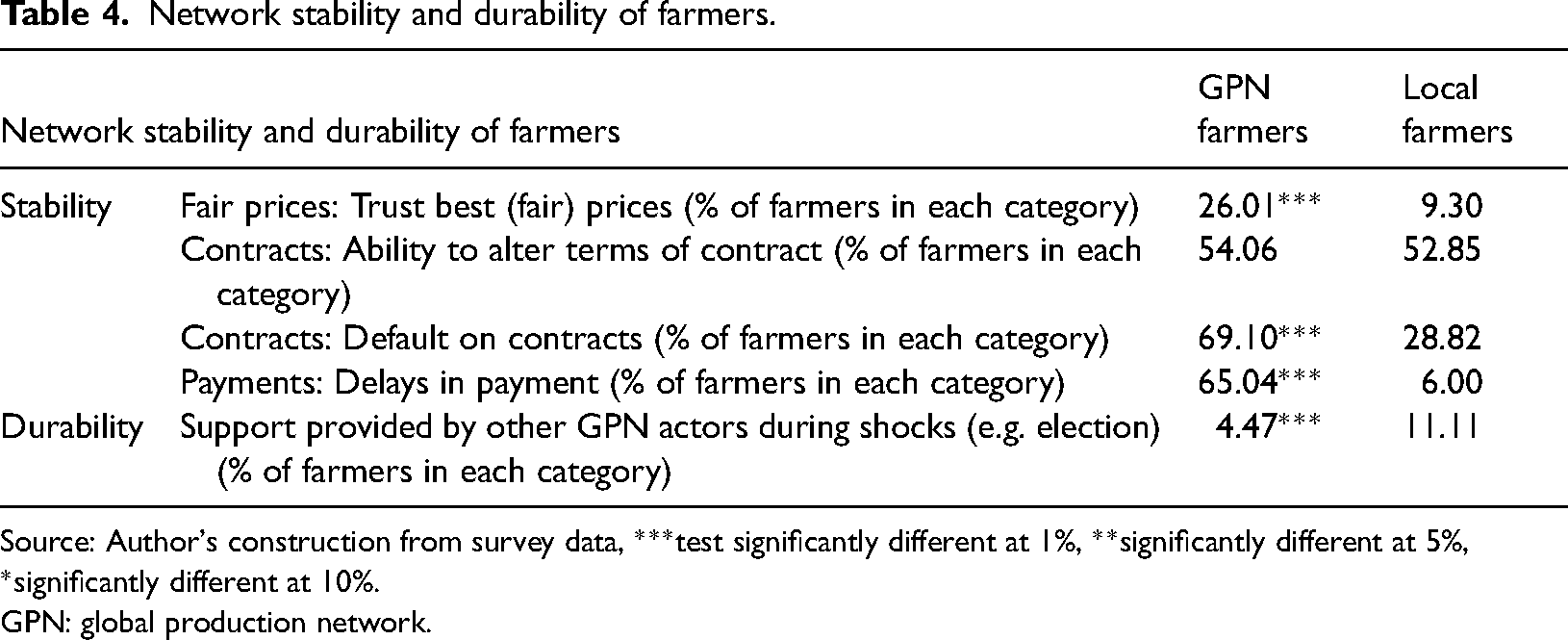
Earned trust is a complex and contested process. As shown in Table 4, only 12% of GPN farmers trusted that KEFs gave them a fair price, with many citing lack of transparency in payment. With a time-lag of 2 to 4 weeks between farmers selling their crop and the receipt of money, farmers reported struggling to live out of pocket (Interview: #1Kba, #2Ndonor, #2kedu). If returned, produce is over-ripe and cannot be re-sold in local markets. Distrust is exacerbated because KEFs reject a high percentage of produce (on an average 9% of the total sale volume) for ‘flimsy reasons’, such as mild discolouration.
GPN farmers fared badly in terms of ability to alter the terms of contracts. Even though they suggested they were ‘heard’ when attempts were made to negotiate for better contract terms (e.g. prices, volume of delivery, grading and weighing process), most had short-term contracts, and negotiations were rarely successful. The demands of KEFs usually prevailed. Despite relatively strong ties, GPN farmers did not have flexibility in terms of selling non-contracted crops to KEFs, because of lack of interest by KEFs. However, local farmers (the control group) were also unable to negotiate for better terms. Therefore, all main buyers, whether KEFs, local brokers or lead firms, hold positions of power over farmers – contributing to their weakened positionality and difficulty in smoothly embedding into new networks (similar to findings in Barrientos, 2019; Krishnan and Foster, 2018).
Overall, GPN farmers were unable to exercise agency in their relationships with KEFs, which affected earned trust. Thus, the durability of the relationship between GPN farmers and their networks was threatened. Less than 5% of GPN farmers were provided with any emergency support, be it flexibility of delivery volumes or contracts, when there were local shocks (e.g. pest attacks, frost, drought or violence) that caused a fall in output (Table 4).
In sum, the results on network stability and durability indicate that the process of embedding into GPNs is contested, with low levels of trust in relation to fair prices, longer delays in payments than local farmers and similarly low levels of bargaining potential for contract terms. Thus, even though network architecture is relatively strong in terms of the distance, density and strength of relationships, farmers have instability and limited durability in their relationships with KEFs.
Territorial embeddedness of farmers
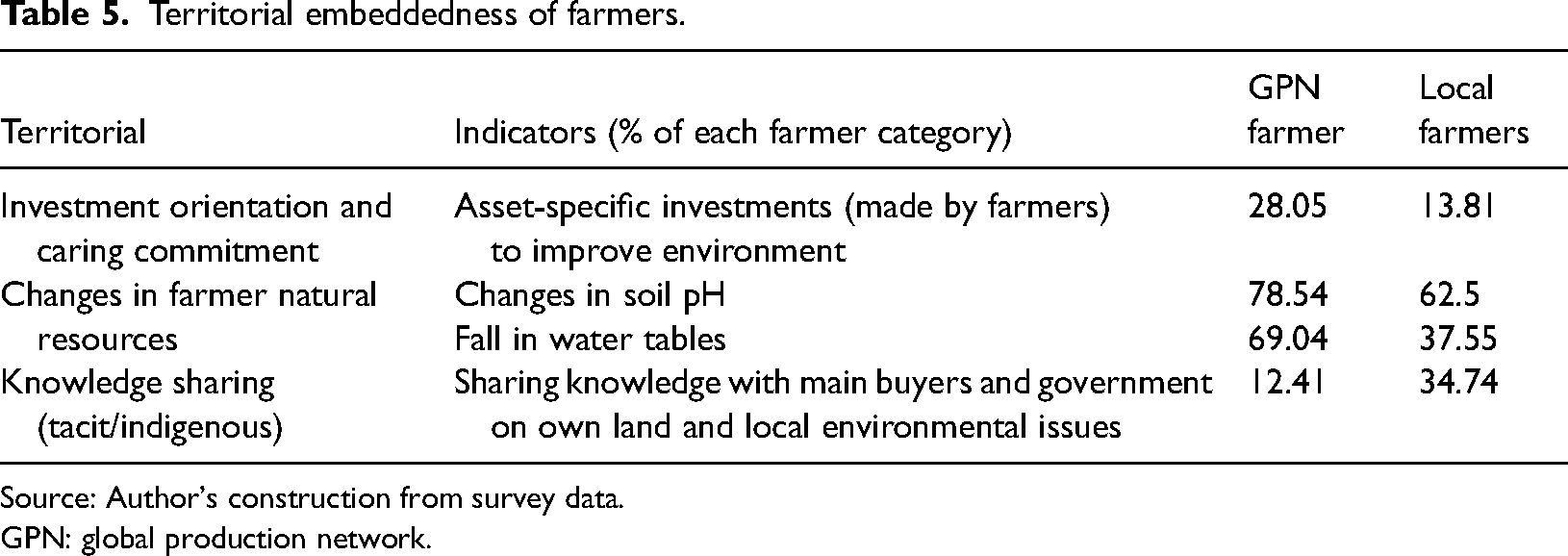
Understanding farmers’ territorial embeddedness involves examining how they embed into (modified) places by virtue of participating in the GPN. When anchoring into host regions, UK supermarkets (lead firms) and KEFs made limited asset-specific investment and/or performed only minimal ‘knowledge transfer’, that is, what was needed to adhere to GlobalGAP (interviews). GPN farmers claimed that KEFs made no investment in farm machinery, irrigation systems or mechanical sprayers, which would have been beneficial for local development. Furthermore, due to a lack of long-term contracts and low levels of trust, most GPN farmers (less than 30%) reciprocated by not wanting to invest in expensive equipment like sprayers, given uncertain returns (row 2 – Table 5).
Territorial embeddedness of farmers.
Source: Author's construction from survey data.
GPN: global production network.
However, anchoring into territories impacted the environment significantly. KEFs chose to anchor in places with high agricultural potential (the selected counties), which have soil, water and climatic conditions conducive to growing export-quality horticulture. As a result, there was an automatic pre-selection based on access, control and use of good-quality natural resources. Farmers owned high-quality stocks of natural resources. Compared to local farmers, and as indicated in Table 5, GPN farmers reported that they experienced significantly worse changes in the quality of natural resources (land) over the three years following joining the GPN. For example, GPN farmers indicated a fall in soil quality and soil pH 5 and water tables (the reported data was verified through physical soil and water data collected by Kenya Agricultural Research and Livestock Organization (KARLO) from a sample of farms in the area).
Continuous degradation of natural resources, compounded with poor network stability, led to deterioration in relationships between farmers and KEFs, creating contestation. The slowing of regenerative capacity and continuous deterioration in quality of resources increased rejection levels of produce and marginalised farmers from continuing to participate in a GPN, that is, creating dis-embedding forces. To minimise environmental degradation, farmers showed caring commitment, by re-investing in their own land. Over 90% of farmers (Table 5) reported they performed some form of investment, from investing in biogas to solar, to drip irrigation systems, often by borrowing funds from friends and farmer cooperatives.
However, GPN farmers complained that UK supermarkets and KEFs showed very limited commitment to improving the quality of farmers’ natural resources. For example, farmers were expected to spend over Ksh 1200 (US$11) to get irrigation water tested to ensure it was up-to-standard. With farmers earning on average less than US$120 per month, this was a huge expense. Furthermore, in times of drought and delayed rainfall, the results indicate that GPN farmers attempted to perform conservation measures such as rainwater harvesting and building furrows. No support was provided either by the county governments or the KEFs. Overall, the deterioration of the environment and low levels of commitment by KEFs and lead firms to improving places inhabited by farmers, created contested relationships, affecting embedding into GPNs.
While KEFs pushed monocropping and growing crops in blocks (to reduce certification costs), farmers found that this depleted soil nutrients and reduced crop yields. Many farmers did not want to perform activities over a ‘perceived threshold’ that they believed to be irreversibly damaging to their land. This was a key source of contestation with KEFs. Along with trying to participate in GPNs for commercial gain, farmers are also motivated by conserving their land, which they ‘care’ about and are ‘attached’ to. Relationships are further strained due to low levels of sharing of socio-environmental knowledge, that is, KEFs would not pay heed to farmers’ issues in relation to environmental degradation (less than 12% of the farmers mentioned they were even given a platform to discuss these issues).
In sum, although farmers have strong ties with KEFs, lead firms and extension actors within GPNs, low levels of trust and lack of durability characterises these relationships. Furthermore, the deterioration of relationships and lack of commitment of KEFs to farmers’ territories further impedes farmers from smoothly embedding into GPNs.
Network embeddedness of KEFs in GPNs
Network architecture and positionality
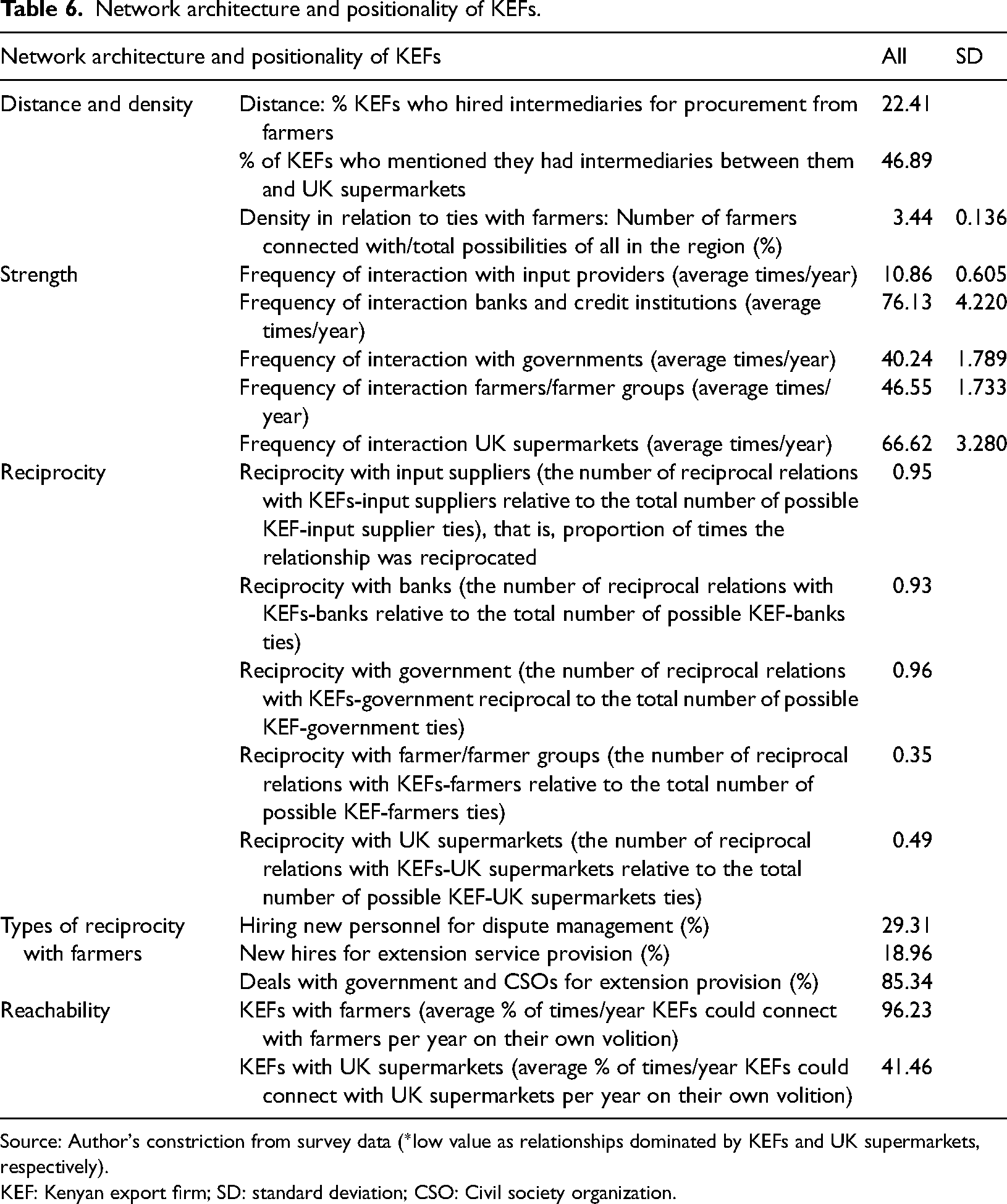
KEFs new relationships with UK supermarkets were difficult. Approximately 40% of the KEFs reported that relationships with UK supermarkets were strained, with most on uncertain rolling contracts and facing sale price pressures. While KEFs frequently interacted with UK supermarkets (Table 6), most of the discussions involved negotiations on pricing and the implementation of standards. Thus, relationships were primarily business-like (strong but not reciprocal – low value for reciprocity), with limited space for support beyond the contract requirements. Furthermore, less than 42% of UK supermarkets were reachable by KEFs, indicating asymmetric ties with UK supermarkets asserting the rules of participation.
Network architecture and positionality of KEFs.
Source: Author's constriction from survey data (*low value as relationships dominated by KEFs and UK supermarkets, respectively).
KEF: Kenyan export firm; SD: standard deviation; CSO: Civil society organization.
With the need to insert into GPNs, KEFs expanded their network of farmers by visiting high potential zones, wherein they formed farmer groups with the help of village leaders or county officials. Group formation was top-down with the aim of reducing the dispersion of farmers and driving down costs for KEFs (Interview: #2kef, #6kef, #1kef, #4kef). However, ‘rifts’ between local and GPN farmers consequently emerged due to the enhanced status of the latter – now considered equivalent or superior to village leaders.
Table 6 shows that KEFs only contracted with, on an average, 3.5% of the total available farmers who could be employed across the selected regions (low density). Interviews with KEFs suggested two reasons for this – first, the sporadic and seasonal nature of demand from UK supermarkets, and second, reducing transaction costs of product wastage and ensuring traceability.
Despite the sparse network density, KEFs reported meeting with farmers about 46 times a year on average (strong ties). However, this was primarily through the extension officers or known brokers, who would provide basic training required for compliance with standards (Table 6). Hiring local extension officers was a key part of many KEFs’ strategy to gain farmer trust and to improve their understanding of norms and cultures in the societies from which they sourced. As indicated in Table 6, about 85% of the KEFs surveyed reported developing training deals with the HCD county offices, NGOs such as Technoserve, CARE, business associations such as FPEAK, and local educational institutions associations (e.g. KARLO). On average, KEFs met HCD officials about 40 times a year. The HCD's key focus has been on food safety and complying with standards such as GlobalGAP. Thus, they have provided KEFs with support, such as longer lead times to file licences and forgiving certain oversights. Furthermore, the HCD has an ISO certified packhouse, which is frequently leased to KEFs at lower costs for packaging products before sale.
To meet GlobalGAP requirements (e.g. using specific varieties of seed and chemicals) for participation in GPNs, KEFs developed new partnerships with established input suppliers like Amiran, Kenya Seed Company and Monsanto. These new partnerships often lent to collusion, wherein prices of inputs were escalated, forcing farmers to pay more (Interviews: #6kef, #9kef).
The reciprocity of the relationship between KEFs and farmers varied. About 30% of KEFs expanded their human resources division to hire dispute management personnel (Table 6). However, interviews with farmers stated that dispute managers almost never arrived, and when they did, they would be accompanied by a village leader. Thus, many farmers were afraid to raise their concerns, which sometimes deepened.
Despite strained relationships with both UK supermarkets and farmers, KEFs were in a unique position, as they were the main gatekeepers between UK supermarkets and farmers or what Burt (2002) calls structural holes. The KEFs in the study participated in multiple GPNs (selling to many countries simultaneously, even though UK markets were more preferred as they were long established) and were able to leverage their position as gatekeepers to expand their sales. This gave KEFs some flexibility to dis-embed from specific networks if relationships were too contested.
In sum, significant variation characterises KEFs’ embeddedness into new networks. While in a position of relatively weak bargaining ability with UK supermarkets, they dictated the terms of the relationship with farmers and leveraged their position as intermediaries.
Network stability and durability of KEFs
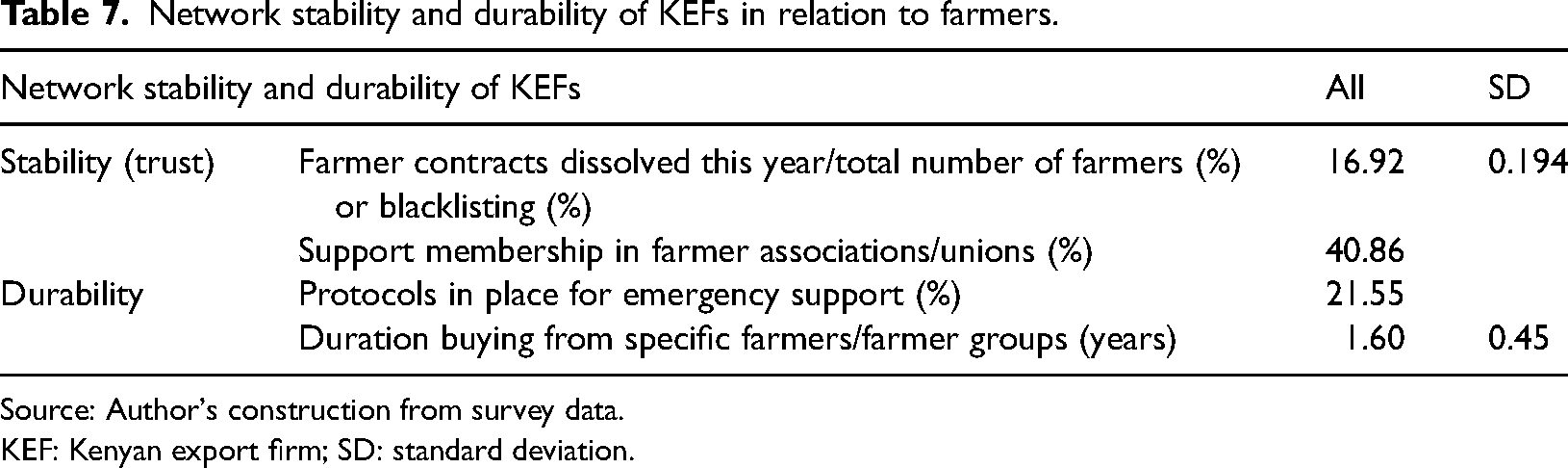
Low levels of earned trust were found between KEFs and farmers. KEFs reported frequent contractual default with opportunistic selling of produce occurring for less than US$0.05/kg. However, farmers complained that high rates of crop rejection, and low non-negotiable prices, forced them to default. Thus, even though relationships were relatively intense, opportunism continued. On an average, KEFs dissolved about 16% of farmer contracts every year, thus excluding them from participation in the GPN (Table 7).
Network stability and durability of KEFs in relation to farmers.
Source: Author's construction from survey data.
KEF: Kenyan export firm; SD: standard deviation.
Interviews with GPN farmers suggested that having a written contract did not provide them with a sense of security or protection. KEFs inserted contract clauses such as ‘the packer reserves the right to make statutory deductions’ and ‘the packer has the right to cancel the order if seen required’. These asymmetric relations weakened farmer positionality and prevented them from bargaining for better contract terms, inhibiting the accumulation of earned trust on both sides. While KEFs encouraged the formation of farmer groups, approximately 60% of KEFs surveyed prevented farmers from gaining membership in unions or other farmers’ associations (threatening to blacklist farmers) – another indicator of KEFs apparent disinterest in farmers’ welfare and commercial growth.
In relation to durability, KEFs were found to buy from farmers for less than two years on average, before switching to new farmers (Table 7). Furthermore, KEFs did not support adaption to unforeseen shocks or risks. For example, the survey showed that less than 22% of the KEFs had any risk management/emergency measures in place when it came to a sudden fall in price or rise in inflation, violence and unrest. 6
Overarchingly, KEFs relationships were marred with low trust and durability, especially vis-à-vis farmers. Thus, the process through which KEFs embedded into GPNs was clearly not synergistic.
Territorial embeddedness of KEFs
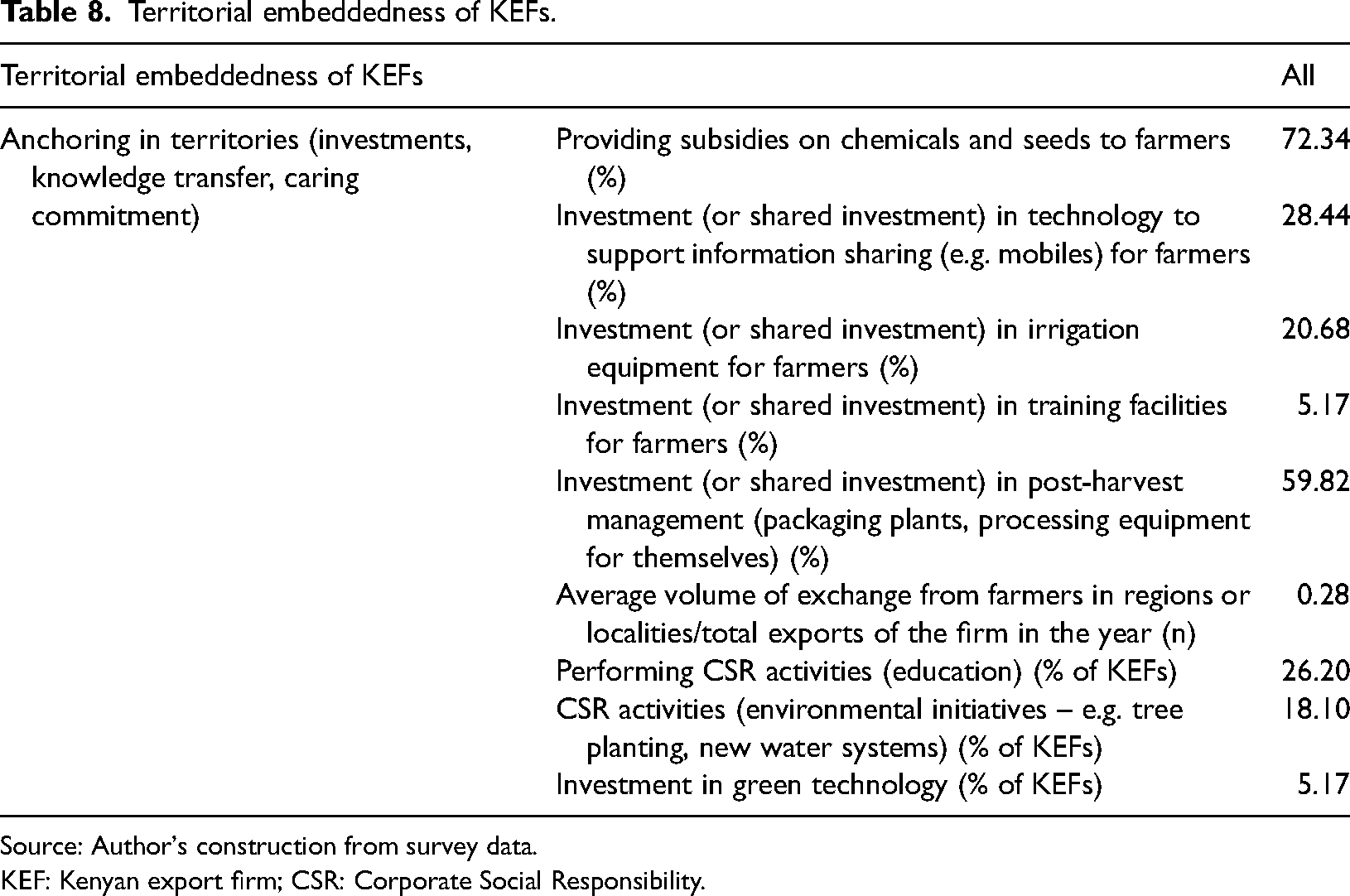
Interviews with farmers found that KEFs made limited asset-specific investments to the regions they sourced from, indicating limited commitment and preventing reciprocity. Only 20% of KEFs surveyed made investments in infrastructure such as drip irrigation systems or new water pipes, while 30% of the KEFs made low-cost investments in knowledge transfer such as buying mobile phones for village officials for support with traceability. Less than 5% set up their own facilities to train farmers in GlobalGAP and other standards (Table 8). Almost 60% of KEFs made investments to increase their own value addition potential, including in cold chain facilities, storage warehouses and processing plants. However, KEFs largely chose not to invest in farmer infrastructure (despite many KEF interviewees indicating little likely resulting impact on their net profits), in order to maintain flexibility in sourcing. KEFs caring commitments were also relatively limited – approximately 26% of KEFs reported to have set up education initiatives, 18% environmental initiatives and less than 5% invested in green technology like solar and biogas plants (Table 8).
Territorial embeddedness of KEFs.
Source: Author's construction from survey data.
KEF: Kenyan export firm; CSR: Corporate Social Responsibility.
In sum, KEFs’ relationships with farmers were poor quality and not reciprocal. Due to opportunistic selling and quick switching between farmers, there was a considerable fall in earned trust between both sets of actors as the relationship evolved, causing contestation. KEFs showed a lack of commitment to investing in irrigation systems or supporting conservation of natural resources, while at the same time invested substantially in certain assets (e.g. cold chain) that were more beneficial to maximising their own ability to add value, rather than showing commitment to places where they attempted to anchor (source from). Overarchingly, KEFs’ main aim was to gain access to, and control of, natural resources with almost no focus on conserving farmers’ environment. Thereby, negative environmental externalities on farmers’ land were created, causing contestation and affecting embedding into the GPN.
Degree of embeddedness in GPNs: Farmers and KEFs
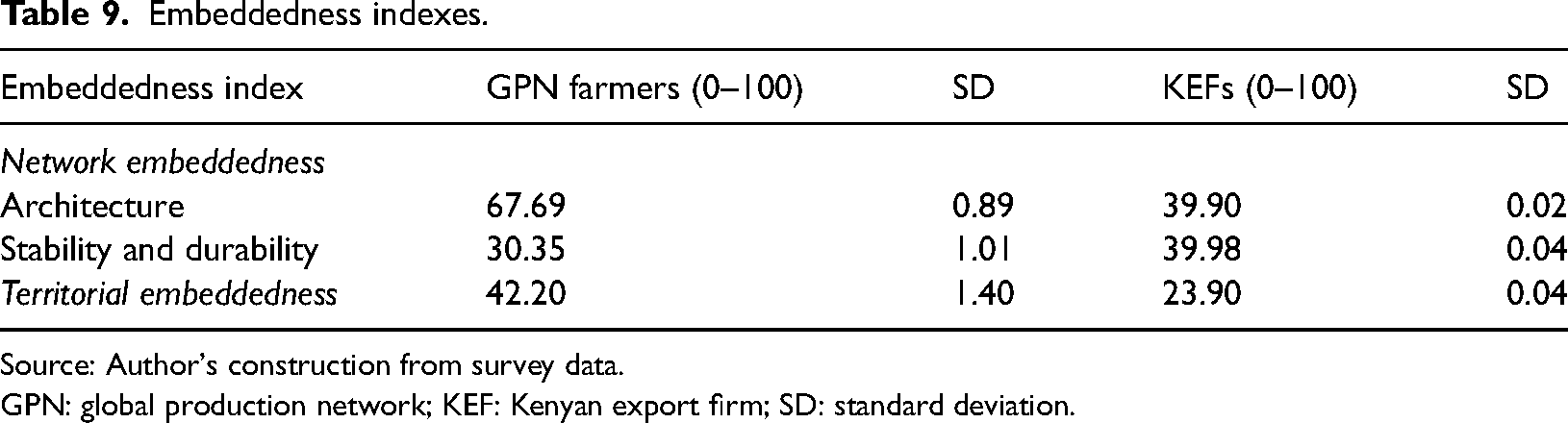
Divergences in how network and territorial embeddedness occur are manifest in differences between farmers and KEFs in the degree (or extent) to which they embed into GPNs. Table 9 presents indicators for the ‘extent’ of network and territorial embeddedness, explained as mean values between 0 and100. As mentioned in ‘Degree of embeddedness of non-lead firm actors’ section, these values are comparable between farmers and KEFs. Values for network embeddedness closer to 0 indicate weak ties, low strength, weak positionality and low network stability and durability (low earned and ascribed trust, low ability to bargain and less durable). This indicates that contestations have occurred between actors in the GPN. Values close to 100 for actors indicate a convergence in the degrees of, or synergistic, embeddedness, with cooperative and equitable commitment by different actors. Similarly, values close to 0 for territorial embeddedness suggest relatively difficult anchoring into regions, while both values closer to 100 indicate such processes are synergistic.
Embeddedness indexes.
Source: Author's construction from survey data.
GPN: global production network; KEF: Kenyan export firm; SD: standard deviation.
The results above broadly indicate that farmers are more embedded in the GPN, while KEFs are less embedded, as seen in the values of network architecture and territorial embeddedness.
In terms of network embeddedness, despite GPN farmers having a relatively strong network architecture (an index value of 67.7), the relationships did not propagate trust or mutual confiding, which can be seen in the relatively low index value on network stability and density (30.35). Simultaneously, the index values of network architecture and stability ranged around 39 for KEFs, which suggests that they have relatively poor relationships with GPN farmers. Thus, farmers were found to be more embedded in GPNs compared to KEFs, and KEFs less embedded in the GPN compared to GPN farmers.
In terms of territorial embeddedness, the index shows mean values of 42 for GPN farmers and 23 for KEFs. As the values are relatively closer to 0, this suggests that territorially embedding is a contested process for GPN farmers and KEFs. GPN farmers claimed that a significant reduction in quality, and slowing regenerative capacity, of natural resources affected ongoing relations with KEFs. Some farmers experienced strong dis-embedding forces because of environmental degradation, leading to a breakdown in relationships with KEFs. 7 This again meant that farmers were ‘more’ territorially embedded than KEFs in GPNs, yet, due to the simultaneously skewed relationships between them (and the fact none of the actors had any index values close to 100 which would be synergistic) embedding into GPNs did not create shared utility but was contested.
In sum, non-lead firm actors (KEFs and farmers) both co-located in the supplying country have different degrees and complex processes through which they embed into new networks and modified territories.
Conclusion and future directions
This article reveals how, and the extent to which, different types of non-lead firm actors based in host countries dis-embed from previous networks and embed into new networks, reshaping territories to participate in GPNs; and compares the varied paths different actors take to embed into GPNs. The article deepens concepts of network embeddedness (along three dimensions of network architecture, stability and durability, and positionality) and territorial embeddedness (through investment orientation, knowledge transfer and caring commitment to, along with the reciprocal ecological relations between non-lead firm actors and their environment which re-shape territories).
To better understand how non-lead firm actors embed, the paper suggests a need to delve deeper into the degrees of embeddedness, which is understood in relative terms, that is, embedding of one non-lead firm actor in relation to another actor. Actors can simultaneously be more (increased trust, network stability and higher commitment to regions) or less (lower trust, stability and less commitment to regions) embedded in GPNs relative to each other. When the degrees of embeddedness are described in terms of more or less, the possibility of negative outcomes is suggested. In contrast, synergistic embeddedness involves an uncontested process of embedding into GPN for all actors involved that leads to shared positive outcomes. The elaborated understanding of network and territorial embeddedness, and the degrees, in this study can also be extended to other geographic contexts.
Extending the already rich literature on Kenya's horticulture industry through a much more detailed examination of the under-researched dimension of embeddedness, this paper pushes further than previously in this empirical context GPN research's commitment to reveal the dynamics of relationships between actors (distance, intensity, reciprocity) and their connections to place. The deeper comprehension of how networks are structured provides a more robust starting point for future empirical research as well as policy interventions.
The Kenyan case study illustrates that GPN farmers are more embedded in GPNs compared to KEFs (who are less embedded), thus leading to contested relationships between the two. For instance, despite farmers having high network intensity, they had low stability and weak positionality, and exploitative environmental conditions for production. KEFs are in stronger positions, and are less embedded, showing less commitment to farmers and places where they anchor.
Importantly, the degrees of embeddedness in GPNs can have significant implications for upgrading. While this paper elucidates the processes of embeddedness, it also indicates that there exists synergistic embeddedness of different actors in the GPN, which in turn may engender upgrading or downgrading for different actors. For instance, it is possible that actors who are less embedded may achieve better upgrading than those who over-embed, as was seen in the case of KEFs, who continued to stay profitable. Also in this case, over-embeddedness of farmers supported downgrading (in terms of bargaining potential for farmers, incomes and yields). Although not explicitly unpacking the multiple dimensions and extent of network and territorial embeddedness, recent contributions (e.g. Alford, 2016; Alford et al., 2017; Krauss and Barrientos, 2021; Krone et al., 2016) have generally found a concave (inverted U-shaped) relationship between upgrading and embeddedness in GPNs, where economic/social upgrading occurs in the short-term as farmers embed, followed by downgrading. Nevertheless, the relationship between upgrading and embeddedness requires more detailed further examination.
Another critical area of further research is the relationship between embeddedness and governance. Some preliminary work linking the two suggests that embeddedness involves multi-scalar contested interactions across GPN actors, which are intertwined with different forms of power relations of public, private and social governance structures (Alford, 2016). Murphy (2012) argues relational proximity is key to the link between embeddedness and governance, as cognitive, socio-cultural factors, and power asymmetries shape interactions between buyers–suppliers. Such work indicates that embeddedness is critical for understanding governance yet has not had the benefit of the more rigorous understanding of network and territorial embeddedness outlined here. The paper lays the groundwork for a dialectic understanding of how governance structures may be shaped and re-shaped by embeddedness.
While embeddedness has long been recognised as a key element in GPN research, it is hoped that much more systematic attention is now devoted to the concept given its centrality to an improved understanding of the dynamics and consequences participating in GPNs.
Supplemental Material
sj-docx-1-epn-10.1177_0308518X231170194 - Supplemental material for Embeddedness beyond the lead firm in global production networks: Insights from Kenyan horticulture
Supplemental material, sj-docx-1-epn-10.1177_0308518X231170194 for Embeddedness beyond the lead firm in global production networks: Insights from Kenyan horticulture by Aarti Krishnan in Environment and Planning A: Economy and Space
Footnotes
Declaration of conflicting interests
The authors declared no potential conflicts of interest with respect to the research, authorship, and/or publication of this article.
Funding
The author(s) disclosed receipt of the following financial support for the research, authorship and/or publication of this article: The author received research funding from the Hallsworth Fellowship at the University of Manchester.
Supplemental material
Supplemental material for this article is available online.
Notes
References
Supplementary Material
Please find the following supplemental material available below.
For Open Access articles published under a Creative Commons License, all supplemental material carries the same license as the article it is associated with.
For non-Open Access articles published, all supplemental material carries a non-exclusive license, and permission requests for re-use of supplemental material or any part of supplemental material shall be sent directly to the copyright owner as specified in the copyright notice associated with the article.
