



Abstract
Until the so-called GPN 2.0 approach placed it on the research agenda, risk had played a subordinate role in the literature on global production networks (GPN). In GPN 2.0, Knight's economic notion of risk is applied and defined as rationally calculable, in contrast to uncertainties. However, this still dominant conceptualization of risk falls short of an actor-centered focus, which is a focal point of the GPN 2.0 approach. Therefore, we advocate for a stronger conceptual integration of a social constructivist premise with a spatio-relational understanding of risk to enhance the explanatory power of GPN risk. This article highlights that GPN risk needs to be framed as becoming causally significant in the perception and expectations of organizational decision-makers. We argue that the organization-environment interaction causes the production and constitution of risk. In pursuit of an integrative research design, we develop a multi-scalar framework based on a performative risk narrative perspective.
Introduction
Climate change, the coronavirus disease 2019 (COVID-19) pandemic, the energy crisis, disruptive technologies, wars, and trade disputes, among other global dynamics, are putting global production networks (GPN) 1 under great pressure. These dynamics are also exposing all actors within the interconnected global economy to various forms of risk. Although risk, inherent to the intricate, interconnected globalized economy, has become an emerging topic in the media and politics, only a few scholars have dealt with risk in GPN 2.0 thinking (e.g., Billing and Bryson, 2019; Bryson and Vanchan, 2020; Franz et al., 2018; Lanari et al., 2021; Schwabe, 2020; Yeung and Coe, 2015). This research emphasizes that ‘[u]nderstanding the dynamics of GPN[!] includes exploring the ways in which firm and non-firm actors manage risk’ (Billing and Bryson, 2019: 424). Dealing with risks influences firms’ strategic decisions on locations, sourcing, and the subsequent spatial anchoring of global production networks.
Coe and Yeung (2015) developed an enhanced GPN theory (GPN 2.0), which shifted the debate from describing a spatial process of economic activities within a network architecture to causally explaining the dynamics of the evolution of production networks and firm behavior (Billing and Bryson, 2019; Neilson et al., 2018). The GPN 2.0 approach emphasizes the firm-level drivers to focus on the actors’ behavior and their decision-making environments (Coe and Yeung, 2019). However, the deductive nature of the GPN 2.0 model and the theoretical logic of these causal processes ‘remains somewhat crude’ (Neilson et al., 2018: 5).
Especially in the GPN 2.0 debate on risk, there is still a dominance of an objective economic notion based on Knight's (1921) dichotomy of risk and uncertainty, as well as risk-or-reward-thinking (e.g., Blažek, 2016; Bryson and Vanchan, 2020; Yeung, 2021; Yeung and Coe, 2015). ‘[O]nce […] unknown outcomes can be predictable subject to probability distributions, they are no longer uncertain conditions […] they can be measured as risk, and management strategies can be developed accordingly’ (Coe and Yeung, 2015: 110).
We contest the employed Knightian risk definition of actor practices based on probability distributions (cf. Holton, 2004). Instead, we see evidence that does not support an objective interpretation of risk probabilities independent from subjective perception and interpretation of risk (cf. Christiansen, 2021; Holton, 2004; Slovic, 2000; Taylor-Gooby and Zinn, 2006).
Our proposal is grounded in the premise that risk is socially constructed and is shaped by subjective perception and interpretation processes by relationally connected individuals (e.g., a singular manager of a small enterprise) or a collective (e.g., a board of management of a multinational enterprise (MNE)) of organizational decision-makers. Even though Coe (2021) argues that the smallest entity of GPN analysis is the firm's decision-making process, it is a fact that ‘[…] firms [or other organizations] do not make decisions, as decisions are made by individuals employed by’ (Bryson, 2022: 230) these organizations. Arguably, the heart of GPN actor-specific decision-making lies in the inductive reasoning of human decision-making (cf. Martin and Sunley, 2007). Therefore, we argue that the role of risk perception is crucial for understanding organizational behavior. Organizational decision-makers are building ‘communities of practice’ (Gertler, 2003: 86) or a ‘coalition of individuals’ (Pred, 1967: 54) pursuing a common cause that is framed by subjective organizationally bound causal cognitive narratives (cf. Fuller, 2022; Lanari et al., 2021).
We aim to stimulate the debate on GPN risk by revisiting its conceptualization. As it is our intention to contribute a social constructivist view on risk to the GPN 2.0 model, we base our arguments on literature synthesizing the current GPN debate and a broader literature reading. A social constructivist view informs our account of risk, reflected using economic, social, and cultural geography discussions, and blended with insights from sociology, psychology, and international business. However, we are aware of other disciplinary debates on risk, for example, in operational, accountancy, and supply chain management literature. The starting point of our discussion is based on a relational socio-spatial stance to explain and identify the causal processes of social structures and empirical outcomes contingent upon context conditions (cf. Bathelt and Glückler, 2003; Gong and Hassink, 2019; Yeung, 2019). In doing so, we aim to add to the explanatory toolkit of GPN 2.0 by deepening the theoretical foundation and increasing the capacity of the analytic lens of risk. Thereby, we partially address the critique by Neilson et al. (2018: 22), who state that ‘the wider theoretical claims of the approach remain problematic’, focusing on the independent variable risk. We also heed Fuller's (2021a) warning against the pitfalls of viewing organizational decision-making in GPN studies as decontextualized, purely rational, and linearly conceived. Based on a social constructivist premise and a relational understanding of risk, we suggest a performative risk narrative (PRN) perspective to explore where risk is produced and how risk perceptions and expectations of organizational decision-makers are becoming causally relevant in global production networks.
Acknowledging the cognitive process of subjective perception and intersubjective meaning-creation, risk is constituted as a causal result of an interpretive logic and sense-making of the decision-makers’ environments. This process is influenced by the decision-makers’ embeddedness in relational socio-spatial context-environment interactions (cf. Clark, 2010; McDermott and Taylor, 1982; Strauss, 2009). The PRN perspective explores the causative process from subjectively perceived network dynamics to collective meaning-creation resolution in organizationally shared risk expectations (cf. Christiansen, 2021; Taarup-Esbensen, 2022). These risk expectations subsequently become performative, and thus causally effective, in the sense of global-production-network-wide risk narratives of strategic relevance for organizational decision-makers employed by GPN actors (e.g., firms, NGOs, labor unions). This PRN perspective aims to include all relevant GPN actors to comprehensively analyze the causal importance of risk for the evolution of a global production network (cf. Christiansen, 2021; Lanari et al., 2021; Strauss, 2008).
To address this refinement of the risk concept analytically within the explanatory model of GPN 2.0, we develop a multi-scalar framework based on the PRN perspective. This multi-scalar framework connects to the three-layered multi-level GPN 2.0 lens (intra-firm, inter-firm and extra-firm) and mirrors the interrelated contextual decision-making environments (intra-organizational, inter-organizational and extra-network) (cf. Bryson and Vanchan, 2020; Coe, 2021; Coe and Yeung, 2015). Thereby, we are incorporating the GPN 1.0 emphasis on embeddedness and the relational understanding of spatiality – which influence actors’ practices and risk perceptions – more inclusively into the causal explanations of risk as a driver of firm behavior (cf. Neilson et al., 2018). Yet, we argue that the perception and interpretation of risk environments by organizational decision-making individuals or collectives cannot plausibly be disentangled from the situative decision-making environment and spatio-relational context in which they are embedded (cf. McDermott and Taylor, 1982; Pred, 1967; Rodrigue et al., 2011).
The article proceeds as follows: The next section reflects on the GPN 2.0 debates on risk and identifies the need for strengthening the social constructivist view on risk. After that, we introduce a constructivist understanding of risk and the role of subjective risk perception and collectively shared risk expectations. In the subsequent section, we present the impact of embeddedness on risk perception and highlight the significance of a spatial relational understanding of risk. The penultimate section refers to our proposed conceptual reframing of the risk concept within the GPN 2.0 research agenda based on a PRN perspective. Finally, we state our claim, stress the significance of our contribution, and sketch avenues for future GPN research.
Risk conceptualization in the GPN literature
According to Coe and Yeung (2015), a global production network serves as an organizational platform for economic actors to determine how to mitigate different kinds of risk stemming from the three competitive dynamics (cost-capability ratio, market imperative, and financialization) inherent in production networks. Thereby, risk as a causal driver on the structural level is characterized by five types of risk (economic, regulatory, environmental, product, and labor) (Coe and Yeung, 2015).
Coe and Yeung (2015) note that although all five types of risk have existed even in the age of vertically integrated mass production, the quality of risk and the interrelationship of its effects in a global production network has different character. This type of interconnected cross-border risk is therefore called GPN risk. In this, the creation of risk is understood as a collective dynamic that goes beyond an individual GPN actor. Coe and Yeung (2015) argue that the analysis of risk in global production networks needs to consider both the actor and the structural level. A more holistic consideration of these two levels of analysis focusing on the organization-environment interaction promises to unlock the explanatory potential of GPN risk from an intra-organizational perspective as a causal driver for strategic choice (cf. McDermott and Taylor, 1982; Pred, 1967).
Concerning GPN risk, four aspects must be highlighted. Firstly, risk can be transmitted and amplified across actors and geographies through the global production network itself (Coe, 2021; Franz, 2010; Gibson and Warren, 2016). Bryson and Vanchan (2020) analyze the impact of COVID-19 on 91 American, European, and Asian transnational connected firms. The authors plead for a more interconnected understanding of risk by suggesting a distinction between direct and indirect risks and propose a conceptual rethinking of ‘intra-, inter- and extra-network risks and [the] multiple values associated’ (Bryson and Vanchan, 2020: 7).
Secondly, the nature of risk (e.g., economic or environmental) may need a coordinated approach of all GPN actors to manage or contain it (Coe, 2021; Geenen, 2018). In the case of meat production in Northern Germany, Franz et al. (2018) argue that the risk exposure of all network actors ought to be analyzed.
Thirdly, the management of GPN risk mirrors the power relations within a network, for instance, when lead firms pass on the risk to other network actors (Blažek, 2016; Coe, 2021). Lanari et al. (2021) analyze the case of water risk in the fruit production network of South Africa. In so doing, they uncover asymmetric power relations and highlight the role of dominant risk narratives in understanding GPN actors’ risk mitigation strategies. Mitigating risk is not necessarily a ‘zero-sum process’ (Coe and Yeung, 2015: 112) and often affects some actors in a global production network more than others. Geenen (2018) supplies one of the few examples in the current GPN 2.0 literature that deviates from an application of a purely economic notion of risk, using the case study of gold production in the Democratic Republic of Congo. She finds that risk is socially constructed and produced by powerful actors. Kubo et al. (2021), in their study of Myanmar's heavily Chinese-oriented melon production network, find an uneven regional distribution of perceived risk exposure due to asymmetrical power relations. The differing perception of risk also refers to the varying interpretations of risk depending on the degree of actors’ embeddedness (cf. Mayes, 2015; Rodrigue et al., 2011; Schwabe, 2020). Thus, it is possible that the same circumstance is perceived as an environmental risk by one GPN actor, and as an economic risk by another, even though they are exposed to this circumstance in a similar way (Baur and Wenzel, 2015; Franz et al., 2018; Geenen, 2018).
Fourthly, particular risk manifestations can be seen as being specific to certain industries (Coe, 2021; Haraguchi et al., 2023). Using the example of the German automotive industry, Schwabe (2020) indicates how the network position of firms affects an actor's individual judgment of risk exposure and, thus, different actor-specific strategic (non-)responses. Billing and Bryson (2019) studied the role of heritage within the UK-based satellite manufacturing sector, highlighting the industry-specific significance of trust-based relationships as a firm's reputational assets for managing risks (cf. also Mayes, 2015). In this vein, Barratt and Ellem (2019), studying the iron ore sector in Western Australia, argue for not only an industry-specific but also a time- and space-sensitive notion of risk in terms of its generation and distribution among GPN actors.
Thus, the management and mitigation of risk exposure ‘becomes a profound shaper of all aspects of lead firm strategies’ (Coe, 2021: 33). This results, for example, in the decoupling of a local actor from a global production network (cf. Lund and Steen, 2020). On behalf of the firm's strategies, it is essential to consider the firms’ varying countries of origin, their corporate cultures, and individual ownership architectures (Coe, 2021; Coe and Yeung, 2019). Neilson et al. (2018) empirically test the deductive capabilities of GPN 2.0 on the Indonesian cocoa-chocolate industry. They plead for a more relational, context-sensitive understanding and explanation of actor practices. This can happen, for example, by including livelihood-related – rather than mere economic-driven – factors within the context of capitalistic dynamics to grasp the complexity in the actor-based agency of decision-making.
In Coe's (2021) and Yeung's (2022) work, the causal explanatory logic of risk as a driver for organizational behavior remains relatively schematic. Therefore, we propose taking a step back and asking how and where risk is produced, what makes risk causally effective for organizational strategies, and the (re-)configuration of a global production network in the first place.
In this context, it is necessary to question the assumption of a rational economic decision-maker, whose leitmotif is profit maximization – as ‘value in GPN 2.0 is not just about profit’ (Yeung, 2021: 5). The underlying premise notion of risk applied in the GPN 2.0 framework, dates to Knight's (1921) dichotomy of uncertainty and economic risk. What distinguishes risk from uncertainty is that risks can be assigned to a measurable probability of occurrence, which can be used as a basis for strategic decisions and managerial actions (Coe and Yeung, 2015). The dominant Knightian understanding of risk understates the decision-maker-based sense-making of reality and the strategic decision-making processes based on risk beyond the rational of cost (risk) and benefit (reward) under conditions of rational choice (cf. Bryson and Vanchan, 2020; Geenen, 2018; Neilson et al., 2018). As the GPN 2.0 heuristic includes the analysis of economic and non-economic actors, this rationale is insufficient to capture the realities of the plurality of GPN actors (cf. Fuller, 2021a, 2022; Neilson et al., 2018).
Re-reading the criticism of Neilson et al. (2018) and Fuller (2021a) on missing reflections of spatial relationality with an eye on risk as a driver of organizational-level decision-making, there is a tendency to objectify risk within the GPN 2.0 model. This conceptualization underemphasizes the relational understanding of risk bound to the perception and interpretation process of an individual or a collective of organizational decision-makers, which is influenced by the context-environment within which they are embedded (cf. Fuller, 2022; McDermott and Taylor, 1982; Rodrigue et al., 2011). A refined GPN 2.0 concept of risk must catch up with the dynamics of business environments within a complex mesh of an interconnected global production network operating in different organizational and territorial settings. Thus, the explanatory power of risk is rendered limited within a concept of a monocausal cause-effect relationship of a static nature (cf. Renn et al., 2020).
These deficiencies indicate that the objective interpretation of risk probabilities should be challenged: ‘If we embrace a subjectivist interpretation of probability, Knight's definition of risk becomes empty’ (Holton, 2004: 20). From an actor-oriented stance, risk can instead be considered a subjective phenomenon that is socially constructed (cf. Fuller and Phelps, 2018; Rafiqui, 2009; Rodrigue et al., 2011). By this understanding, we also want to contest the fundamental premise that ‘risk is generally produced beyond an individual actor’ (Coe and Yeung, 2015: 110).
Zooming into the microfoundation of an organization itself, Fuller (2021a) criticizes intra-organizational decision-making as being undertheorized within the GPN approach. It hardly reflects the ‘complex intra-organisational[!] and spatially relational decision-making and deliberations within corporations that respond to, and produce, the economic and social context through which they act’ (Fuller, 2021a: 320). In the same vein, Neilson et al. (2018) argue that in causally explaining the dynamic drivers and actor strategies within the evolution process of production networks, GPN 2.0 downplays the aspect of embeddedness and relational thinking much more than GPN 1.0.
At the same time, adopting a decentralized view beyond the lead firm focus is critical. To better understand the risk-driven reconfiguration strategies within a global production network, it is essential to scope up this narrow focus and to include the strategic formation of all relevant network actors concerned (cf. Franz et al., 2018; Fuller, 2021a; Geenen, 2018; Grumiller, 2021; Lanari et al., 2021). This is particularly the case in times of increasing uncertainties and aggravating risk expectations. The goal of network resilience and adaptation strategies in sourcing, production, and value activities calls for integrating all network actors beyond the significance of lead firms (cf. Haraguchi et al., 2023; Yeung, 2022).
The social construction of risk
Authors informed by behavioural economics and sociology are emphasizing the human-driven, fictionality aspects of risk (cf. Christiansen, 2021; Clark, 2022; Geenen, 2018). In a broader sense, Beckert (2013) termed these fictional expectations, referring to cognitive or narrative frames used to interpret real-world phenomena and provide guidance for action to navigate the uncertainty of the future (cf. Clark, 2022; Fuller, 2023). Arguably, risk is a matter of future expectations and ‘configures worldviews and structures action’ (Green, 2000: 78). Christiansen (2021) echoes this debate by referring – in the context of risk – to the performativity of subjective risk perceptions. These perceptions build the framework for a collective process of group-related meaning-creation (cf. Christiansen, 2021; Taarup-Esbensen, 2022). This process results in collectively shared risk expectations and subsequently future-oriented risk narratives to legitimize strategic actions in the present (cf. Lanari et al., 2021). Lupton (2013) stated that the nature of risk is transitory; it is not an already existing phenomenon but an ever-evolving future potential that has not yet been realized. Consequently, risk as a future-oriented cognitive concept produces certain socially constructed realities of subjective perceptions and collectively shared expectations that do have real strategic and geographical consequences as they inform the agency of decision-makers (cf. Christiansen, 2021; Fuller, 2022; Geenen, 2018). Risk arises as soon as the value of something seems to be at stake in the perception of an individual or a collective of decision-makers (cf. Bryson and Vanchan, 2020; Vicol et al., 2019; Yeung, 2021); for instance, if the value capture trajectory of a global production network is likely to change, posing risk for certain network actors (cf. Green, 2000; Müller-Mahn et al., 2018; van Asselt and Renn, 2011). Aven and Renn (2010: 3) argue that ‘[r]isk refers to uncertainty about and severity of the consequences (or outcomes) of an activity with respect to something that humans value’. Such value attributions are cultural categories that are not fixed and are susceptible to constant reinterpretations and reframing. This means that the perception and production of risk are not unbiased from beliefs and values embedded in socio-cultural contexts (Boholm and Corvellec, 2011; Bryson and Vanchan, 2020; Schweizer, 2019). ‘[R]isk does not exist 'out there,' independent of our minds and cultures, waiting to be measured’ (Slovic, 2000: 392). It is a phenomenon of subjective perception.
These risk perceptions and shared expectations are influenced by socio-spatial context factors of the decision-making environment and by the cognition of individual key organizational decision-makers (cf. Fuller, 2022; Holton, 2004; Strauss, 2008). Risk perceptions are subjective interpretations of the severity and tolerability of a specific risk (Aven and Renn, 2010; Christiansen, 2021; Pred, 1967) – being ‘interpretations of the world, based on experiences and/or beliefs […] embedded in the norms, value systems, and cultural idiosyncrasies of societies’ (Rohrmann, 2008: 2). The social constructivist nature of risk is, for instance, reflected in the fact that decision-makers orient their strategic actions according to whether other actors also perceive being exposed to a risk and how they react to or ignore it (Douglas and Wildavsky, 1983; Kasperson et al., 1988; Lanari et al., 2021; Renn and Rohrmann, 2000).
Thus, risk is woven into strategic decision-making situations and is causally linked to the subjective perception, cognition, and interpretation of organizational decision-makers and their decision-making environment (Fuller, 2022; McDermott and Taylor, 1982; Pred, 1967). The cognitive frames of subjective risk perceptions are relational in scope and produced at the interface of the context of the decision-making environment and decision-makers’ sense-making process of reality. These interpretations of reality by decision-makers are spatio-relational (Fuller, 2022; November, 2008; Strauss, 2009).
Based on subjective risk perceptions, a collective of organizational decision-makers constructs a shared organizational risk expectation for the future, which is affected by the situative socio-spatial context and decision-making environment (Beckert, 2013; Christiansen, 2021; Fuller, 2023). The context-environment within which the collective of individual decision-makers is embedded can be aligned to specific temporalities and certain relational spatialities (Barratt and Ellem, 2019; Fuller, 2022; November, 2008). These future-oriented and collectively shared organizational risk expectations – based on intersubjective risk perceptions – form a causal logic of PRNs. The PNRs then legitimize and inform organization-specific strategic decisions (e.g., (dis-)investment choices) of multiple embedded GPN actors. The collectively shared expectations and the subsequent risk narratives, in turn, initiate a feedback effect and affect the cognition and subjective perception of risk of organizational decision-makers (cf. Christiansen, 2021; Lanari et al., 2021; Strauss, 2009) (cf. Figure 1).
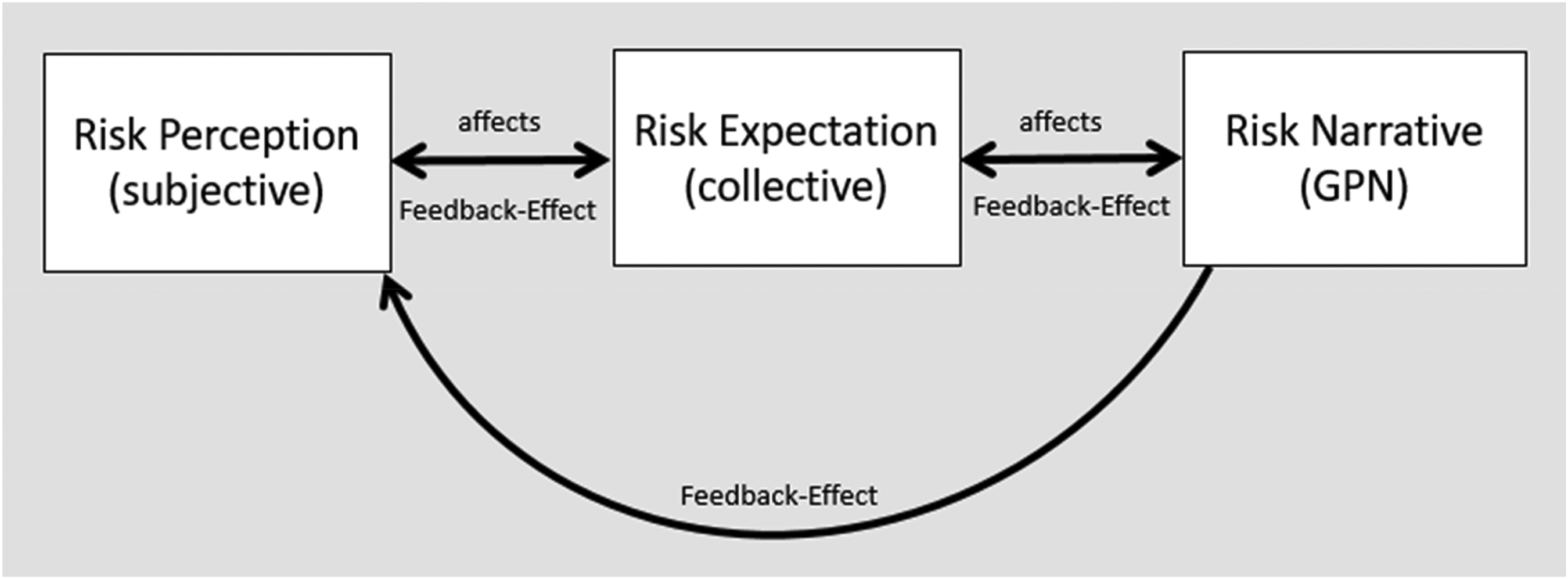
Schematic illustration of the interactive process of subjective risk perception affecting collectively shared risk expectations and subsequent performative risk narratives (PRNs). Source: Own design.
Individual or a collective of organizational decision-makers embedded in a global production network are processing information from their relational context environment by getting cognitive cues about expected risk phenomena (e.g., potentially harmful events) (cf. Fuller, 2022; Strauss, 2008; Taarup-Esbensen, 2019). Context-sensitive perception processes render the risk amenable to management strategies. This relational perception and sense-making process is geographical in a relational nature, just as the interlinked processes of value creation, enhancement, and capturing (cf. Fuller and Phelps, 2018; Mayes, 2015; Rafiqui, 2009). Even though dynamics labeled as risks may affect all network actors, perception thereof and future-oriented expectation of the severity of and exposure to risk is biased by the causal interpretive narrative of organizational decision-makers and the relational context environment within which they are embedded (cf. Clark, 2022; Fuller, 2022; Strauss, 2008).
Impact of embeddedness on risk perception of organizational decision-makers
Geographical-oriented research already emphasizes the role of decision-makers’ embeddedness in socio-spatial contexts for the subjective perception and causal interpretation of risk (cf. Fuller, 2022; Müller-Mahn et al., 2018; Steigenberger and Lübcke, 2022). Considering this research, we suggest that reflecting on how risk emerges and affects the actor-based strategic formation of global production networks is necessary. This can result in ambiguous actor-specific expectations of the severity and tolerability of risk (cf. Aven and Renn, 2010; Geenen, 2018; Schwabe, 2020). Looking at subjective risk perception and collectively shared risk expectation from a social constructivist view enables researchers to capture the specific construction and causal interpretive risk narratives of organizational decision-makers – if risk becomes causally important for actor-specific responses or if it is neglected and does not have any effect on organizational behavior (cf. Giambona et al., 2017; Lanari et al., 2021; Müller-Mahn et al., 2018).
The interpretation process and construction of risk follows a causal context-environment-agency logic (cf. Fuller, 2022; Strauss, 2008). The subsequent rationale is produced within the nexus of the situative decision-making environment, the relational spatial-contextual factors – for example, by socio-economic relations to other GPN actors in different locations – and the strategic agency bound to the organizational decision-makers’ cognition (e.g., past experiences, learnings). What constitutes a risk is sensitive to spatial, cognitive, and socio-economic context factors. The subjective risk perceptions and collectively shared risk expectations of organizational decision-makers are formed by contextual-environment factors, such as spatio-social belief systems, norms, and values. These perceptions and expectations are derived from the nexus of cognition and context-environment. Within this nexus, the logical frames of risk perceptions, expectations, narratives, and subsequent actor-specific strategic choices are constructed (cf. Christiansen, 2021; Fuller, 2022; Strauss, 2008; Taarup-Esbensen, 2019). This means, in our view, risk is produced at the organizational level within the interaction between the organization and its spatio-relational environment. However, the organization-environment interaction needs to be understood in a spatio-relational sense, as the decision-making environment is shaped by the global production network architecture that encompasses different actors and locations (cf. McDermott and Taylor, 1982; Pidgeon and Beattie, 1998; Renn and Rohrmann, 2000). Thus, the perception and interpretation of risk can be subject to social amplification (Kasperson et al., 1988). In this way, Pidgeon and Beattie (1998: 289) point out, ‘social processes (such as the influence of the mass media) serve to amplify certain risks while seeming to neglect others’. This, in turn, highlights the ambiguous narrative frames of organizational decision-makers produced by subjective risk perception and collectively shared expectations. These narratives can lead to actions that again lead to situations where new PRNs emerge – like a cascade effect or, in terms of Coe and Yeung (2015: 112), a “bullwhip effect” (cf. Boholm and Corvellec, 2011; Geenen, 2018; Luhmann, 1993).
The heterogeneity of subjective perceptions, expectations, and subsequent PRNs is causally connected to the embeddedness of decision-makers and the spatio-relational organizational-environment interaction (Fuller and Phelps, 2018; Rodrigue et al., 2011; Strauss, 2008). Global production networks’ territorial coupling and socio-economic network relations go hand-in-hand with place-specific socio-spatial relations of organizations and localities. This fact cognitively binds organizational decision-makers to context-environment-specific risk perceptions and expectations, and their causal cognitive process of making sense of the uncertainties of reality (cf. Christiansen, 2021; Fuller, 2022; Steigenberger and Lübcke, 2022).
Therefore, we argue that the analytical dimension of embeddedness (societal, territorial, and network) already integrated into the GPN 1.0 approach should be more consistently incorporated into the GPN 2.0 concept of risk. In so doing, we emphasize the spatial relationality of subjective risk perceptions and corresponding collectively shared risk expectations. Hess’ (2004) notion of embeddedness highlights the dynamic web of social relations that creates a socio-institutional environment through which actors’ (economic) behavior is influenced. Other authors have further developed the embeddedness concept, emphasizing its dynamic process and adaptive nature (e.g., Salder and Bryson, 2019; Wigren-Kristoferson et al., 2022). However, we argue that Hess’ (2004) concept is still useful to flesh out and disentangle the geographical scope and scale of structural network dynamics and the organization-environment context within which decision-makers, who are employed by GPN actors (i.e., firms, state agencies, NGOs), are embedded. Hence, to introduce a multi-scalar GPN 2.0 perspective on the organization-environment interaction, we build on Hess’ (2004) threefold notion of embeddedness.
We argue that societal embeddedness – which refers to the importance of what cultural, social, and political background an individual comes from – of organizational decision-makers strongly influences how risk is perceived and interpreted. Arguably, the societal embeddedness of decision-makers constitutes the organizational culture (cf. Coe, 2021; Coe and Yeung, 2019; Fuller and Phelps, 2018) or the societal imprint of an organization (cf. Barrientos, 2013; Hess, 2020). Moreover, the organizational-specific capabilities to which organization decision-makers are bound (e.g., prior experiences and learnings, routines) co-determine the risk perception in the sense of a normative judgment on and interpretation of the (potential) severity or tolerability of a risk (Billing and Bryson, 2019; Buckley et al., 2020; Oh et al., 2021). For example, Oh et al. (2021) demonstrate in the case of 625 Fortune Global 500 MNEs invested in 117 countries – from 1999 to 2008 – that foreign direct investment location decisions of MNEs depend on their prior experience and learning when it comes to their responses to non-market risks (e.g., natural disasters, armed conflicts). They show that the history of an organization or the societal embeddedness, respectively, affect the perception and response of GPN actors differently. Accordingly, the societal embeddedness of a GPN actor produces its self-referential organizational-bound cognitive context frame, which then informs the expectations–based on subjective risk perception–and the agency of decision-makers. Research shows differences in risk perception between decision-makers, for example, in different countries (see Rohrmann and Chen, 1999) and between different societal groups within a country (Buckley et al., 2020; Everts and Müller, 2020). For instance, managers who are socialized in a relatively dynamic local socio-institutional environment, compared to those socialized in a more predictable one, develop a more tolerant risk perception towards changes in their business environment (cf. Völlers et al., 2021). The socio-spatial setting in which organizational decision-makers are embedded fosters biased cognitive risk perception and related risk expectation, for example, through collectively formed thought patterns, norms, values, social scripts, and inter-individual trust relationships (cf. Zinn, 2008). This results in a construction of risk expectations based on decision-makers’ perception, which is affected by their societal embeddedness (cf. Bathelt and Henn, 2021; Fuller, 2022; Völlers et al., 2021).
Likewise, the territorial embeddedness, or the extent to which individual or collective organizational decision-makers are ‘“anchored” in particular territories or places’ (Hess, 2004: 177), is also important for the perception and constitution of risk expectations. The place-specific social context and relationships formed by formal and informal institutions influence organizational decision-maker's production of risk expectations (cf. Gertler, 2003; Rafiqui, 2009; Völlers et al., 2021). As organizational decision-makers are embedded in a certain place with its specific institutions, communities, and ways of doing business, territorial embeddedness may convey a place-specific ‘frame of mind, which shapes decision-making concerning risk issues’ (Schweizer, 2019: 7). Hence, territorial embeddedness connects the organizational decision-makers to place-specific risk environments in which s/he or a collective lives and operates (cf. Fuller, 2022; Fuller and Phelps, 2018; Korsgaard et al., 2022). Arias et al. (2017), investigating the risk perception of coastal residents in Chile, indicate that the more directly a decision-maker is territorially exposed to a potentially harmful phenomenon (i.e., floods, virus variants) that represents a risk, the more severe the risk is perceived to be. Regarding environmental risks, such as flooding, MNEs and their local subsidiaries tend to perceive the risk to their business to be more serious than domestic firms, even though the latter often have more experience with the impact of natural disasters and suffer greater economic consequences (Haraguchi and Lall, 2015; Leitold et al., 2021; Neise et al., 2018).
Additionally, we state that the risk perception of organizational decision-makers is related to the social relationship structure in which they are embedded and can be aligned with the concept of network embeddedness (Hess, 2004). This type of embeddedness sheds light on the inter-individual, social ties and relationships between organizational decision-makers and the level of trust between people when gaining knowledge and information about network dynamics (cf. Bathelt and Henn, 2021; Billing and Bryson, 2019; Vertzberger, 1998). Collectives of organizational decision-makers, connected through inter-organizational relationships, are subject to cognitive bias in their risk expectations of network dynamics due to their network embeddedness. These dynamic network processes can be causally linked to the production of certain risk expectations shared among GPN actors. The resulting expectations represent the collectively shared interpretation of organizational decision-makers, which are also shaped within the context of inter-organizational relationships (cf. Christiansen, 2021; Lanari et al., 2021).
However, subjective risk perceptions and, thus, risk expectations are fluid processes of meaning creation, interpretation, and labeling of particular dynamic processes, which are influenced by the embeddedness of organizational decision-makers (cf. Fuller, 2022; Oinas, 1999; Taarup-Esbensen, 2019). Arguably, the ambiguity of risk perceptions of organizational decision-makers may trigger different risk expectations and narratives as well as the subsequent actor-related strategic choices in response to the same risk phenomenon within a global production network (cf. Boholm and Corvellec, 2011; Gibson and Warren, 2016; Schwabe, 2020). This has been highlighted, for instance, by Geenen (2018), showing how the risk mitigation strategy of firms in the Congolese gold production network becomes a risk to the livelihood of workers, and their responses, in turn, become a new risk to the firms (cf. Barratt & Ellem, 2019; Everts & Müller, 2020). Due to the different levels of embeddedness, different perceptions of risk occur, even between managerial decision-makers within the same organization (cf. Bollhorn and Franz, 2015; Oinas, 1999; Schwabe, 2020). At the same time, the isomorphism of particular decision-making environments can produce similar expectations based on subjective risk perceptions that lead to PRNs legitimizing maintaining the status quo. Lanari et al. (2021) illustrate this with the example of GPN actors’ risk mitigation strategies in the fruit industry in South Africa (cf. Christiansen, 2021; DiMaggio & Powell, 1983).
To summarize, risk in global production networks should be seen as a driver of organizational behavior, which is socially constructed. The perception and interpretation of risk, for instance, referring to expected outcomes for particular value activities, is processed by organizational decision-makers who are socio-spatially (societal, territorial, and network) embedded within a relational web of social relations, place-specific contexts, and decision-making environments (cf. Afewerki, 2019; Geenen, 2018; Schweizer, 2019; Strauss, 2008).
From risk perception to a spatio-relational understanding of risk in the GPN approach
The socio-spatial context in which individual or a collective of organizational decision-makers are embedded societally, territorially, and network-wise affects the perception and interpretation of risk (cf. McDermott and Taylor, 1982; Pred, 1967; Rodrigue et al., 2011). Accordingly, we introduce a PRN perspective to analyze the causal consequences of subjectively perceived risk or collectively shared risk expectations. The PRN perspective addresses organizational decision-makers’ risk perceptions, bound to their societal, territorial, and network embeddedness, as a performative phenomenon (cf. Christiansen, 2021; Fuller, 2021a; November, 2008). This makes it a valuable analytical lens at the intersection of micro-perspective (organizational decision-makers) and structural level (context-environment nexus).
These insights may help causally explain the interpretive narratives and expectations of individual and collective risk perceptions, which drive the strategic choice of organizational decision-makers. That means risk can be constructed and perceived at the individual level of key organizational decision-makers (e.g., firm managers of a family-owned small MNE) and in parallel within a collective of organizational decision-makers (e.g., a consortium of CEOs and shareholders of a listed large MNE). Thus, a ‘coalition of individuals’ (Pred, 1967: 54) is formed in an act of collective strategic agenda-setting based on a cognitive framework of sense-making for the causal constitution of risk. Within an organizational setting, these collectives create a specific narrative of future expectations and acknowledge, or agree on, the same intersubjective risk perception (cf. Beckert, 2013; Christiansen, 2021; Lanari et al., 2021). For example, this is the case for processes of value capturing, creation, and enhancement of large MNEs or securing a rural household's livelihood (cf. Billing and Bryson, 2019; Vicol et al., 2019). However, it must be highlighted that a collective of decision-makers within organizations decide and align their agency to subjective risk perceptions and interpretations, reduce uncertainties, and render perceived risks relevant (Bryson, 2022; Christiansen, 2021; Geenen, 2018). Arguably, these risk perceptions differ across time and space, cognition, and decision-making environment (cf. Barratt and Ellem, 2019; Fuller, 2021b; Fuller and Phelps, 2018; Kubo et al., 2021).
We urge acknowledgment of the context-sensitivity of risk as a driver for actor-specific strategies in terms of its causal implications, which are contingent on subjective perception and interpretation of societally, territorially, and network-wise embedded organizational decision-makers. Consequently, GPN risk is a matter of organizational decision-makers’ narratives that are framed within the cognition-environment nexus and linked to the uncertainties of future outcomes (Clark, 2010; Rafiqui, 2009; Strauss, 2008).
From this perspective, a more sophisticated investigation of societal, territorial, and network relations is necessary to explain why some organizational decision-makers may be able and willing to be involved in collective responses to risk while others are not (cf. Neise et al., 2018; Schwabe, 2020). The subjective risk perception of organizational decision-makers is continually adjusted, modified, and transformed by anticipated contemporary dynamics over time (cf. Fuller, 2021b). For instance, Everts and Müller (2020) show an example of the reframing of a risk interpretation in the case of the coal mining industry in Germany through the engagement of local resistance practices by various actor groups. In this process, risk perceptions can be amplified by socio-cultural dynamics framed by the particular socio-cultural context.
Consequently, we argue that the causality of dynamic network processes does not solely affect the configuration of a production network. They also (re)configure the causal contextual perceptions and sense-making processes of these dynamics by individual or a collective of organizational decision-makers (cf. Coe and Lee, 2013; Gertler, 2003; Völlers et al., 2021). The behavior of a GPN actor and the production of risk ‘are socially constructed, embedded’ (Gertler, 2003: 91). Therefore, we argue from a social constructivist view that risk in a global production network is not out there, and it's not constituted beyond but rather by individual GPN actors (cf. Coe and Yeung, 2015; Slovic, 2000).
The decision-making process in large MNEs, for instance, integrates the benefits of the analytic capabilities of artificial intelligence, supreme algorithms, and the (in part) delegation of decisions to these tools. However, in the final analysis, decisions are made in the context of social relationships, constraints, and accountability of organizational decision-makers to act (risk mitigation) or react (crisis management) on the dynamics of the global economy. Thus, the emphasis on the significance of managing risks masks the fact that, despite the existence of diverse management approaches, actively addressing risks is by no means obligatory, especially for small and medium enterprises (SMEs). Waters (2007: 15) even calls ignoring risks an ‘almost […] traditional approach’. This disregard stems from managers aligning their behavior ‘on normal conditions’ (Waters, 2007: 15). Ingirige et al. (2008) also find a glaring lack of planning and foresight in the way SMEs deal with potential disruptions. However, many SMEs view risk management primarily as an additional cost factor from which no direct benefit can be derived (Wittenbrink, 2016; Elahi, 2013). This is because SMEs or similar GPN actors with limited managerial capacities often have short-term strategic horizons and focus on day-to-day business (Averchenkova et al., 2016; Kwak et al., 2018; Neise et al., 2018; Vicol et al., 2019). We are aware of business practice that leads to the application of tools aimed at managing both quantitative and qualitative business risks to overcome the vagueness arising from subjective assessments (Pettit et al., 2019). However, this does not apply to all actors with their diverse capabilities and capacities to manage risk within a global production network (cf. Gibson and Warren, 2016).
Considering the above, we claim that within the context of dynamic drivers of global production network (re-)configurations, risks do not become causally important independently of those organizational decision-makers (from a CEO-consortium to a farmer's household) who ‘choose to be concerned with some risks while ignoring others’ (Aven and Renn, 2010: 4). In this vein, we argue for introducing the PRN perspective into the heuristic of the GPN 2.0 model.
Introducing a performative risk narrative perspective to GPN risk
To enable a more actor-specific identification of how and where risk is produced, we suggest a multi-scalar framework for analyzing GPN risk based on a PRN perspective using a spatio-relational understanding of embeddedness. Within a territorially embedded and transnational connected organizational setting of networked organizational decision-makers, certain performative risk expectations are produced and may transcend the nodes of a global production network (cf. Franz, 2010; Geenen, 2018). The causal link between relationally connected organizational decision-makers and their embeddedness functions in two ways: (a) Organizational decision-makers on-site constitute a territorial-specific construction of risk within a dynamic interconnected mesh of coupled territorial contexts via translocal network ties, (b) These socio-economic relational ties provide the heuristic channels through which location-specific risk perceptions and shared expectations propagate across GPN actors and coupled localities. This transgression of risk expectations depends on the institutional context (e.g., a small MNE equipped with a certain degree of managerial capacities) and the decision-making environment in which organizational decision-makers are relational and socio-spatially embedded. Subsequent subjective risk perception and shared risk expectations may lead to causally effective risk narratives, PRNs, triggering dynamic processes that can gain global-production-network-wide implications for the strategic choices of GPN actors (cf. Christiansen, 2021; Lanari et al., 2021; Taarup-Esbensen, 2022).
In this vein, we are re-reading what was first proposed by Bryson and Vanchan (2020: 11) to widen the analytical lenses on endogenous and exogenous dynamic processes that unfold within multi-scalar interactions of ‘intra-, inter- and extra-network risks’. Sympathizing with the authors’ idea for adding systematic scales to the analytical approach on risk and including structural interdependencies of the specific interaction environments, we incorporated these scales into our proposed framework. However, rather than using a triad of risk categories, we build on the idea of cognitive context levels. These context levels represent the decision-making environments that embody cognitive frames and sense-making logics affecting the construction of risk by organizational decision-makers. Thus, organizational decision-makers make sense of, for instance, competitive, business, or natural environment-related changes (e.g., institutional or political change, market crisis, natural and man-made disasters) which may constitute a source of perceived uncertainty about a value (activity) at stake (e.g., a farmer's livelihood or a value capturing trajectory of an MNE) (cf. Vicol et al., 2019). To render these changes manageable, the organizational decision-makers (collectively) create meaning via the construction of risk in a certain decision-making context-environment (cf. Aven and Renn, 2010; Christiansen, 2021; Green, 2000). To analyze and trace the relational nature and genesis of GPN risk from a PRN perspective, we incorporate a spatio-social perspective based on the intra-, inter-, and extra-organization modes of global production network relationships: internal (intra-organizational), network (inter-organizational), external (extra-network) context of decision-making environment (Figure 2).
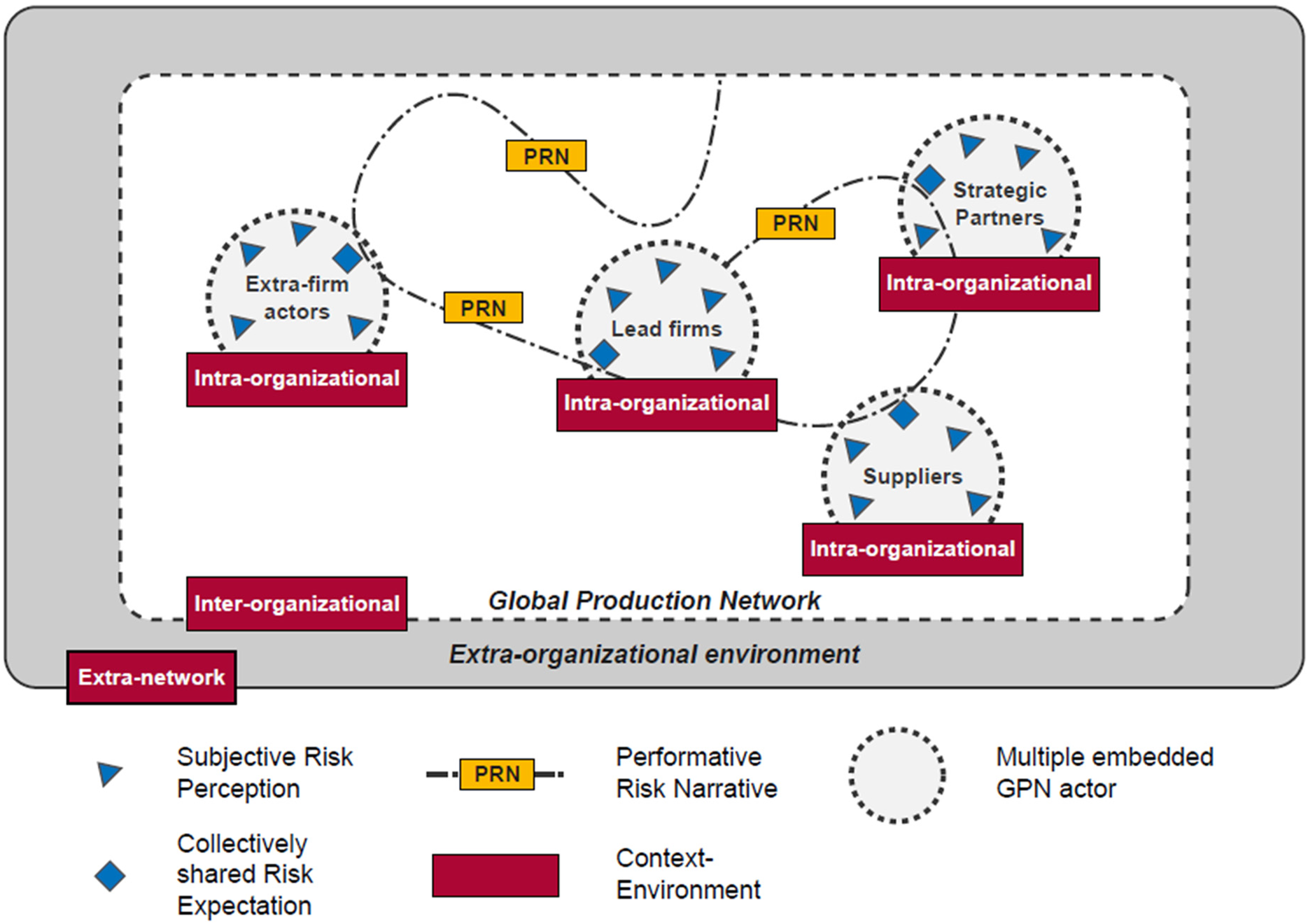
A multi-scalar framework to analyze GPN risk based on a PRN perspective: A conceptual schema. Source: Own design. GPN: global production network; PRN: performative risk narrative.
To explain the intra-organizational production context of risk expectations, an analytical focus on the intra-organizational context-environment is needed. This actor-centric perspective emphasizes the risk perception and shared expectation framed by the societal embeddedness within an organization. Within this analytical layer, we propose to analyze the societal imprint, history, and organizational culture (social norms, values, scripts, and belief systems) of GPN actors, as this influences the subjective risk perceptions of organizational decision-makers (cf. Afewerki, 2019; Barrientos, 2013; Fuller, 2022). The analytical unit of the intra-organizational context-environment gives rise to the collective processes of meaning-creation (sense-making) of what constitutes a risk for a specific organization. This process results in a collectively shared risk expectation of a GPN actor.
However, here it must be considered that individual decision-makers may be associated with different departments within an organization. For instance, work council decision-makers within a firm may prompt certain subjective risk perceptions according to the causal reasoning bound to the logics of labor rights. In terms of the heterogeneity of subjective risk perceptions, it is necessary to identify and consider the spatio-temporality of collectively shared risk expectations of those decision-makers who decide on the strategic choice of an organization (e.g., lead firm, labor unit or NGO) (cf. Barratt and Ellem, 2019; Gibson and Warren, 2016; Kahn et al., 2018).
The analytical layer of the inter-organizational context-environment focuses on the emergence of actor-specific risk expectations within the context-environment of socio-spatial relational network ties between GPN actors (network embeddedness). This layer enables determining the causal effects between translocal network relationships of GPN actors and the collective sense-making process of organizational decision-makers (e.g., within certain sectors, industries, and regions). These actor-specific risk expectations may develop into a PRN and become of cross-network importance and crucial to a global production network's spatial and organizational architecture (cf. Geenen, 2018; Schwabe, 2020). For instance, a collective risk expectation of a group of employees may become a PRN and influence the organizational strategic decision-making of a lead firm (labour risk). This can happen, for example, by means of resistance of works councils, trade unions, or both (e.g., strike). (cf. Alford et al., 2017; Bollhorn and Franz, 2015).
The extra-network context-environment incorporates the emergence of risk expectations within the exogenous context-environment into the analytical framework. This analytical level underscores the importance of the socio-cultural and political context in which organizational decision-makers are embedded (territorial embeddedness) – creating certain risk expectations of a specific GPN actor or a PRN of a global production network. Thus, risk expectations causally determined by and related to the extra-network context-environment are incorporated into a global production network through its ability to trigger a PRN. A generated PRN, in turn, legitimizes the strategic actions of multiple GPN actors and trigger a global-production-network-wide reconfiguration process. For instance, the phase-out of coal and nuclear power in some countries can be seen as a result of intersubjectively shared risk perception (risk expectation) among government decision-makers, resulting in legislative changes. This risk expectation may initiate a PRN (regulatory risk) that transmits and amplifies across a related global production network and context-environments of decision-making (cf. Alford et al., 2017; Coe, 2021; Everts and Müller, 2020). A lead firm, for instance, may make sense of this perceived change as an expected risk and strategically align its (global) production network to a causally subsequent PRN. This alignment, in turn, may also feed back on intra- and inter-organizational decision-making context-environments and lead to new actor-specific risk expectations. The PRN legitimizes reconfiguring production processes, investment destinations, and value capture trajectories.
At all three layers of analysis (intra-organizational, inter-organizational, extra-network context-environments), different subjective risk perceptions and expectations can arise among organizational decision-makers in their corresponding decision-making context-environment. Nevertheless, these perceptions and intersubjectively shared risk expectations can propagate and diffuse into other decision-making context-environments (cf. Coe, 2021). Subsequently, the cognition of individual or a collective of organizational decision-makers may be influenced by a feedback process (cf. Kasperson et al., 1988). For example, when considering the supply chain disruptions during the COVID-19 pandemic. This phenomenon leads to greater consideration of value-creation processes and network resilience by GPN actors (e.g., re-/near-shoring decisions). For instance, this is especially the case in terms of shortages of intermediate and final products (cf. Bryson and Vanchan, 2020; Haraguchi et al., 2023; Yeung, 2022). Therefore, identifying the PRNs within a global production network can give rise to the question in what sense risk perceptions and expectations of organizational decision-makers are a GPN problem (cf. Lanari et al., 2021; Yeung, 2021).
This multi-scalar framework based on a PRN perspective should enrich the theoretical debate on how GPN risk causally matters. This can be done by emphasizing an understanding of the multi-level contextualization and relational understanding of subjective risk perceptions and collectively shared risk expectations of organizational decision-makers in different socio-spatial decision-making environments.
Conclusions
Despite an emerging debate on risk within the GPN 2.0 literature, the mainstream conceptualization is dominated by an objectified economic notion of risk. This notion considers risk to be created beyond individual GPN actors within the sphere of dichotomies such as risk or uncertainty and risk or reward (e.g., Blažek, 2016; Bryson and Vanchan, 2020; Coe and Yeung, 2015; Yeung, 2021). In this paper, we question the rather orthodox premise of a mere objective assessment of risk probabilities, which is, in our view, not sufficient to causally explain GPN actors’ behavior (cf. Christiansen, 2021; Holton, 2004; Schweizer, 2019). With the aim of contributing to the risk debate in the GPN 2.0 literature, we synthesize current accounts by GPN authors and add suitable imports from a broader geographical literature reading on risk and debates in already GPN-related disciplines (sociology, international business, and psychology). We see an added analytical value in incorporating a social constructivist view on risk into the analytical register of the GPN 2.0 model to enhance the causal explanation of risk as a dynamic driver for the evolution of global production networks.
From a social-constructivist view, GPN risk is a matter of perception of organizational decision-makers and is spatial-relational in nature (cf. Beckert, 2013; Fuller and Phelps, 2018; Müller-Mahn et al., 2018; November, 2008). However, the conceptualization of GPN risk should be sensitive to subjective perception and the collective process of creating meaning at the organizational level (risk expectations). We argue that the interpretation of risk is affected by the subjective perceptions of organizational decision-makers employed by GPN actors (e.g., lead firms, NGOs, and labor unions) (Bryson, 2022). Context-environment factors influence the causal cognitive logics of sense-making of societal, territorial, and network-embedded (collectives of) organizational decision-makers: It's a call for ‘integration of mental responses and social interactions for both understanding and managing […] risks’ (Renn et al., 2020: 15). In turn, the subjective risk perception and collectively shared risk expectations of decision-makers are cognitively bound to the socio-spatial contextual conditions and the situative decision-making environment (McDermott and Taylor, 1982; Pred, 1967; Strauss, 2009). Within this context-environment nexus, the causal cognitive logics of societally, territorially, and network-wise embedded (collectives of) organizational decision-makers are constructed, and risk narratives are produced (cf. Clark, 2010; Fuller, 2022; Strauss, 2008).
Therefore, we assert that risk in global production networks is not out there; it's not produced beyond but rather by GPN actors (cf. Bryson, 2022; Coe and Yeung, 2015; Slovic, 2000). From this standpoint, all participating organizational decision-makers (from large MNE management boards to farmers’ livelihood contexts) have to be acknowledged to unleash the causal explanatory power of the dynamic driver risk for shaping actor-specific strategies (cf. Franz et al., 2018; Geenen, 2018; Haraguchi et al., 2023; Lanari et al., 2021; Vicol et al., 2019). We propose to add a more inclusive research agenda to the conceptualization of risk applied in the GPN 2.0 approach – based on those responsible for making strategic decisions within organizations (cf. Bryson, 2022). The PRN perspective thus provides a causal link between individual and/or global-production-network-wide organizational strategic formations and the causal link between subjective risk perceptions, expectations, and subsequent PRNs of multiple embedded organizational decision-makers. From a PRN perspective, risk emerges at the level of societally, territorially and network-wise embedded organizational decision-makers. Mirroring the interdependencies, risk expectations transcend nodes (organizations) of a global production network, and lead to ambiguous risk expectations by different GPN actors. A dominant risk expectation may transform into a PRN with global-production-network-wide geographical and organizational implications (cf. Lanari et al., 2021).
Hence, we argue for a multi-scalar analytical framework based on a PRN perspective when analyzing the causal effects of risk on organizational behavior. Three layers of spatial relational decision-making environments (intra-organizational, inter-organizational, extra-network) must be considered. Risk perceptions of organizational decision-makers have their own dynamics of spatio-temporal adjustment, modification and transformation. By organizational decision-maker's perception of anticipated or contemporary processes, the construction of risk and causal significant PRNs changes – similar to dynamics of value capture trajectory within GPN 2.0-thinking (cf. Fuller, 2021a; Strauss, 2008; Taarup-Esbensen, 2019).
Exploring actor-specific risk management strategies within this context should pave the way for unblack-box the intersection of organizational decision-making and network dynamics within GPN 2.0 analysis (cf. Kleibert, 2021; Yeung, 2022). Therefore, the analytical step of deconstructing PRNs is required to understand the rationale and causality behind organizational responses to network dynamics at the meso-level (cf. Yeung, 2021). These stimuli advocate for an increased sensitivity among researchers to the fact that individuals or a collective of organizational decision-makers are closely integrated into non-market related socio-spatial interactions–beyond mere profit-maximizing reasoning and capitalistic imperatives (cf. Neilson et al., 2018; Yeung, 2021). This will provide improved access to research that contributes to the examination of empirical phenomena and may lead to a better understanding and causal explanation of PRN as a driver for spatial (re-)configuration processes and uneven regional development.
Spatio-relational contextualization and the subjective character of risk as a matter of perception are paramount to understanding the causal mechanisms of risk dynamics for geographical and organizational outcomes (cf. Fuller and Phelps, 2018; Mayes, 2015; Rafiqui, 2009). Research should be based primarily on qualitative designs to gather the diversity of PRNs and related actor-specific strategic reactions within global production networks. As such, it is necessary to go beyond a pure lead firm focus by including relevant non-business and non-firm actors across different spatial scales (cf. Billing and Bryson, 2019; Bryson and Vanchan, 2020; Franz et al., 2018).
Further research is needed to examine what types of risk mitigation strategies are pursued and how they induce spatial reconfigurations of a global production network. It is also important to investigate how different types and characteristics of risks, in their spatio-temporally different materialization, are perceived and interpreted by organizational decision-makers (e.g., environmental risks: with a slow-burn character such as climate change in contrast to hazardous events such as earthquakes or floods). Additionally, it can be analyzed how and whose risk perceptions and expectations and subsequent PRNs come to matter for a global production network to disclose underlying power relations. Furthermore, the study on the influence of power relations between GPN actors from a PRN perspective offers a promising area of research to analyze the processes of constructing and agenda-setting in terms of risk mitigation strategies. These examples are a promising research avenue to better identify the causal impact of GPN risk and to understand in what or in whose sense some risks become relevant in global production networks.
Footnotes
Acknowledgment
The authors want to acknowledge the constructive comments from the handling editor Henry W.-C. Yeung and the three anonymous reviewers, which significantly improved this paper. We also thank our colleague Carsten Felgentreff for his valuable support in the early stages of the research.
Declaration of conflicting interests
The author(s) declared no potential conflicts of interest with respect to the research, authorship, and/or publication of this article.
Funding
The author(s) disclosed receipt of the following financial support for the research, authorship, and/or publication of this article: This work was supported by the Ministry for Science and Culture of Lower Saxony (MWK) (Germany) with financial aid from the ‘Niedersächsischen Vorab’ [grant number 76202-14-6/17].
