




Abstract
Spectacle, once a key term for critical theories, has had limited theoretical development in recent decades. To make sure the concept remains relevant today, this paper turns to actor-network theory (ANT) and assemblage theories to reconceptualize what the spectacle is and how it operates today. Working with a case study of a controversial urban spectacle in southern Chile – a new shopping mall, the “Mall Paseo Chiloé” – this paper explores a set of findings that illustrate what these approaches have to offer. First, in viewing the spectacle as a hybrid entity, we uncover vital forces inside what might at first appear to be irrelevant features of the building's architectural design. At the same time, this approach includes the forces of ambivalent desire and fluidity that reveal the dynamics of resistance inside that same design. As such, this paper focuses on a specific aspect of this building that makes it a unique form of counter-spectacle.
Keywords
Introduction
Müller (2015) describes the engagement between economic geography and actor-network theory (ANT) as a “half-hearted romance” because scholars have yet to achieve the full rethinking of what economic actors are according to ANT. Instead of moving away from theories of power or from categories of “social actors” (p. 66), ANT forces a (sometimes uncomfortable) consideration of how these come into existence in the first place. Importantly, this requires paying attention to material things through which they are instantiated and come alive. Entities like markets, firms, global production networks, food, and commodities (Müller 2015, p. 66) are not automatically given in the world but must be constantly (re)articulated through technologies, practices, and other interventions. McFarlane (2011) launches a similar set of concerns for “critical urban theory” and opts for the language of “assemblage urbanism”, like that of ANT, as a corrective (also see Farías 2010 and Müller and Schurr 2016). “Big” concepts like capitalism, inequality, and political economy are not ignored in this approach, nor are they simply taken for granted. For ANT and assemblage approaches, these are what must be explained in research (Latour 2005, p. 8), with Müller (2015) and McFarlane (2011) arguing that we get a better understanding of power this way because we are forced to run it through existing and “real world” instantiations. As such, “big” concepts are understood not as unstoppable, juggernaut forces but as fragile and always in the making, often through the intervention of non-human forces that deserve greater recognition.
This paper borrows from ANT and assemblage theories to rethink another “big idea” relevant to economic geography and urban studies: spectacle. In general, spectacle often refers to capitalist consumer culture and its large entertainment events and performances, but also the creation of cities for a certain kind of consumer experience (Pinder 2009; Koch 2018). Guy Debord's (1995 [1967]) The Society of the Spectacle became a touchstone for critical theories for years to come, providing a criticism of how the ideology of commodity fetishism becomes hegemonic through the infrastructures of consumer culture. Once a key concept for radical theory, spectacle has had limited theoretical development in geographical and urban thinking in the last two decades. Part of the reason for this is that by the 2000s scholars had steered away from the term because it was considered too “big”, or in other words, too deterministic and reductionist (Goss 2006; Degen et al. 2008). This paper insists on the importance of spectacle as originally conceived by Debord (and others) and provides a new way of conceptualizing its power today. ANT and assemblage theories are especially helpful for this task, as their ethical orientations work to make concepts more accountable to the worlds they describe. In other words, spectacle still matters, but that does not mean we must always assume commodity fetishism to be automatically installed everywhere the infrastructures of spectacle are set-up. With ANT and assemblage theories, we can better explain how the possibility for spectacle comes into existence in specific and perhaps unlikely places. When spectacle is seen in this way, we can be sure to remain open to the possibilities of anti- and counter-spectacle (Pinder 2000; Woodworth 2015; cf. Samara et al. 2013; Centner 2013) as well as rethink the very concept of spectacle itself as a hybrid formation that relies on non-humans.
Reviewing findings from a case study of a controversial urban spectacle in southern Chile – the Mall Paseo Chiloé in the city of Castro (Figure 1) – this paper focuses on a specific element of urban architecture to illustrate what it means to conceptualize the spectacle this way. As a country, Chile has been at the forefront of urban spectacle, as the post-dictatorship period proved conducive to the aggressive expansion of shopping centres, malls, and other corporate retail environments (De Simone 2015; Salcedo and De Simone 2013; Moulian 1997, 2014). From 1973 to 1990, Chile was ruled by a brutal military dictatorship willing to commit human rights abuses in order to impose an extreme version of a neoliberal economy and society, the legacies of which remain enshrined in the 1980 Constitution and, as this paper will illustrate, continue to influence the production of urban space (Huneeus 2007; Draper 2012). There are now major efforts to this Constitution, but it remains a daunting challenge. In September 2022, the first major plebiscite to do so failed. Still, in previous years in southern Chile at the archipelago of Chiloé, 700 miles south of the nation's capital, mall developers ran into trouble when building what would be the archipelago's first shopping mall. Some observers and residents of Castro were horrified by the new building towering over what was the previous and undisputed centre of the town: the San Francisco Church, a UNESCO World Heritage site since 2000. A passionate debate broke out as civil society organizations mobilized against what they saw as a monstrosity of spectacle, while the developers and some local authorities insisted on having widespread support of the population. In my ethnographic methodological approach, I sought to understand what everyday life is like at Chiloé through participant observation of everyday life and interviews with residents. I also interviewed many of the stakeholders and civic leaders involved in the controversy, allowing me to ask them for further elaboration on specific topics that I read about in the online archives of La Estrella (2012–2015), the local newspaper that had been covering the story closely, and in other sources.
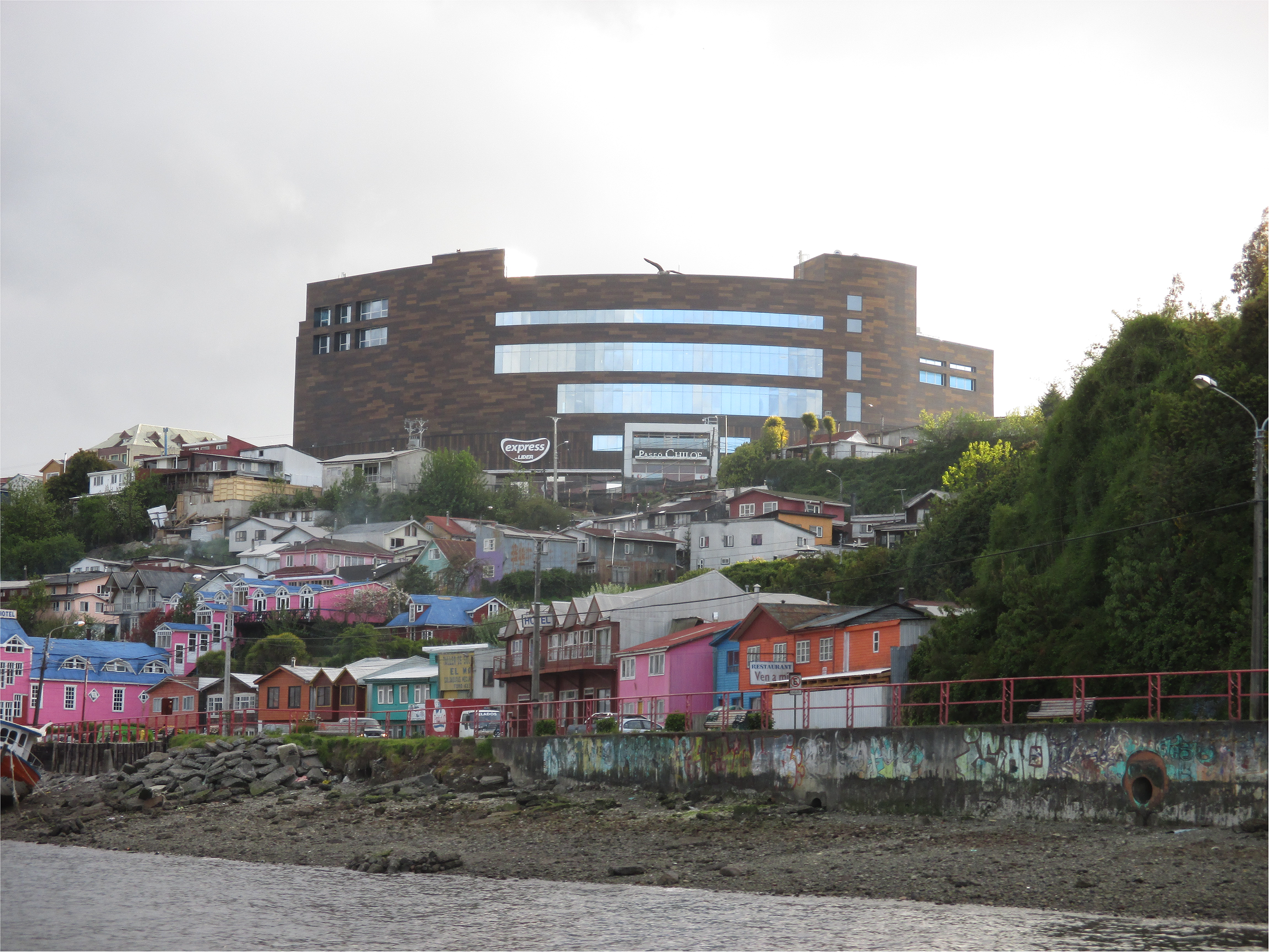
Mall Paseo Chiloé in Castro, Chile (photo taken by author, originally published in author, year; creative commons by 4.0).
The next section further defines spectacle, ANT, and assemblage theories. A context and methodology section then introduces the research site and approach before proceeding to a final section that includes key findings illustrating how ANT and assemblage theories are helpful in reconceptualizing spectacle as a key term for radical theories, economic geography, and urban studies.
Spectacle, ANT, and assemblage theories
First, what exactly is spectacle? For Guy Debord (1995 [1967]), it refers to a social relationship that involves the ideological hegemony of capitalism insofar as life increasingly revolves around the circulation and fetishization of commodities. Hetherington (2008) is clear that Debord was tracking a new phase of what had been previously described by Lukacs, Benjamin, and others who extended Karl Marx's original theory of commodity fetishism. Where earlier forms of spectacle were apparent in the commercial arcades, department stores, world exhibitions, and phantasmagorias, by Debord's time society was increasingly orientated around everyday practices and ways of being that accept commodity circulation as natural or unproblematic. Life itself begins to mimic entertainment, as a kind of model for capitalist living is perpetuated through mass media and urban design. Hetherington (2008) is clear: it is less about a visual event and more about a way of life, including “the effects of capitalism on social space” (p. 40). Moreover, Hetherington (2008) argues that the totalizing scope of the society of the spectacle is a key defining feature for Debord: “In a word, Debord wanted a total critique of what he saw as a totalizing society that aimed at the complete colonization of all areas of autonomous human life by the commodity form and he wasn't prepared to allow anyone to introduce any deviation from that (Debord and Sanguinetti 1990). It is in such a context that his arguments need to be understood. The theme of totality is key” (p. 35).
By the 1980s and 1990s, geographers had much to offer this view of the world as shopping malls spread across the globe amid the widespread privatization of public space (Shields 1989; Davis 1992; Sorkin 1992; cf. Miller and Laketa 2019). Goss (1993), for example, details all the manipulative features of the “retail built environment” of spectacle, for instance, while also acknowledging its colonizing reach. The power of spectacle, though, flows only through these mechanisms, leaving them vulnerable to subversion and other unintended influences. By the end of the 1990s research on retail and consumption had taken a more ethnographic turn as scholars turned toward less spectacular and more mundane forms of consumption, along with other topics like commodity chain analysis (see Gregson and Crewe 1997; Crewe 2000; Goss 2006; Mansvelt 2010). The theoretical development of spectacle has, therefore, been limited in recent years: interest in the spectacle waned precisely when ANT and assemblage theories were taking off (amongst others) (see Woodward et al. 2009).
Before shifting to the intervention ANT and assemblage theories seek to make, we should be careful to not make a caricature of Debord's theory (1995 [1967]). As Hetherington (2008) makes clear, the The Society of the Spectacle (1967) was about a totalizing capitalist logic; as such, it required a totalizing theory (also see Smith 1996). Yet stopping there would be misleading. Debord's position was “humanist” and posed itself against the destructive powers of capitalism in the socio-cultural sphere (Hetherington 2008, p. 32). More importantly, Debord's collaboration with the Situationist Internationale (1957–1972) focuses on creating alternatives through the production of “situations”, even as the spectacle is always closing in (see Pyyry 2019; also see McFarlane 2011, page 210). This awareness, situating Debord's society of the spectacle within the broader goals of Situationist praxis, allows Hetherington (2008) to remain interested in the spectacle but without simply replicating its totality: “I want to acknowledge but also problematize the concept of spectacle, I want to provide something that is more than a cursory reference to Debord's work and I want to argue that his theory is open to all sorts of questions that do not allow it to be treated like some kind of established fact” (p. 34).
Perhaps in this spirit, others have emphasized how spectacle is best thought of as a potential site of contestation rather than an automatic expression of ideological hegemony. Counter- and anti-spectacle are also now part of today's geographical and urban imagination around this technology of power (Pinder 2000; Gotham 2005; Chu and Sanyal 2015). While it is difficult to find a neat definition of counter- and anti-spectacle, Woodworth (2015) suggests that counter-spectacle names the rising awareness that “spectacle is shot through with contestations and negotiations” (Woodworth 2015) and even goes as far to suggest that spectacle and counter-spectacle may be “two sides of the same coin”, adding that “the impossibility of a resolution between the two generates an impasse, one that sustains a multiplicity of possible readings and thwarts closure” (p. 415). What is interesting about this and Hetherington’s (2008) approach is that they hold on to the spectacle as a concept to be further understood, not something to be only opposed or debunked. As spectacle itself transforms in the digital era (Briziarelli and Armano 2017), we need to be more attentive to how exactly spectacle works in current circumstances if we want it to remain a relevant concept (also see Wark 2013; Bulut and Bal 2017; Koch 2018; Miller 2020).
Needless to say, this is a major challenge. If “totality is key” for defining spectacle (Hetherington 2008), how can we also pry it open as something more than an “established fact” (p. 34)? It is toward these frontiers that ANT and assemblage theories can help refine theories of spectacle. In pushing further towards the multiplicities of contestation identified by scholars above, ANT and assemblage approaches help us further substantiate what spectacle is by highlighting its non-human composition, a previously underdeveloped area of investigation. The prospects for this reconstruction are promising, as Müller (2015) is clear that he thinks ANT is capable of advancing theories of power, even if it seems to question some of the certainty found in previous social science and other theoretical approaches (cf. Brenner et al. 2011; also see Kinkaid 2020).
So, what is ANT? Müller (2015) lists sociologists Bruno Latour, Michel Callon, and John Law as the originating figures of this theory and reviews work in economic geography that has engaged with it. This is a positive move in his view because of the way ANT reworks our understanding of what “big” concepts, such as “social actors”, refer to by attending to their hybridity. Social actors never precede the networks they are situated in. In fact, following ANT, they are constituted by them. As Müller (2015) puts it, the key proposition of ANT “is that action arises from the association of humans and materials in a network – the actor-network” (p. 65). Müller (2015) goes on to point out how ANT engages in a relentless critique of the dividing lines between the “social and the material world” (p. 67), as these always obscure the co-emergence between them. They cannot be separated: “First, ANT's key contention is that the social sciences draw an artificial dividing line between the social and the material world, privileging the former over the latter. In contrast, it argues that action is always an outcome of sociomaterial actor-networks – associations between human and non-human actants. In principle, humans and non-humans are equally able to contribute to action. This is what ANT calls the principle of generalized symmetry” (Müller 2015, p. 67).
In this view, power and social actors are not ignored. Instead, they are instantiated in a radical way by exploring the way they are co-produced by a broader material world with many other actors (Müller 2015, 72-3; McFarlane 2011). In this way, symmetry is achieved between the human and non-human world because neither is subordinated to the other; they are co-constitutive. As such, social actors are seen as always hybrid, insofar as they always rely on and emerge from pre-existing networks that involve non-humans. When a thing is identified as making a difference for a broader set of relations, ANT refers to it as an “actant”, as a figure that “does something” (Latour 2005, p. 128) rather than existing merely as a prop or lifeless force. Not all things are actants; only those that cause other action to occur. For example, Müller (2015) asserts that “markets, the key argument goes, do not just emerge out of thin air, but require an elaborate sociomaterial apparatus to be brought into being” (p. 72). It is a short step to suggest the same for spectacle.
What would it look like to examine the hybridity of spectacle? Before moving on, there are some minor differences to point out between ANT and assemblage theories. Müller and Schur (2016) detail these in a way that encourages their co-development in future research. The main difference hinges around how we imagine complex systems becoming “stable”, while also exhibiting fluidity and sometimes radical change. ANT has been sometimes more associated with the former tendency, and assemblage with the later, insofar as disruptive forces of “affect” and “desire”, in particular, are generated amply in Deleuze and Guattari's version of assemblage (Müller and Schurr 2016). This paper is inspired by Müller and Schurr's (2016) reassurance that future research might borrow the strengths from both, an insight that this paper argues is especially helpful for reconceptualizing the spectacle: we must attend both to its totalizing potential while also remaining open to the material world involved in its reproduction and contestation. Furthermore, we must also admit the complex feelings such spectacular infrastructures can generate for diverse publics, feelings that may complicate the model of spectacle in its totality (Koch 2018).
There have been some moves toward re-thinking the spectacle and consumer spaces with these insights in recent years (Thrift 2008; Degen et al. 2010; Rose et al. 2010; Lee 2015; Miller 2020). As we will see below, ANT and assemblage approaches toward spectacle can help reveal further elements that Müller (2015) identifies as worthy of more attention: hybridity in urban economic processes, and the dynamics of desire that, in this case, shape the domain of spectacle as a contested zone of fluidity and multiplicity.
Context and methodology
In the last 50 years, Chile has been wrapped up in an acceleration of capitalist expansion, from the growth of extractive industries to the urban infrastructures of corporate retail and consumer culture. As one of Chile's leading “commodity regions” (Bustos-Gallardo 2022), the archipelago of Chiloé in southern Chile has primarily focused on salmon aquaculture, as new flows of capital have transformed the landscape, spurred on by the neoliberal economic framework imposed by the military dictatorship (1973–1990). One result that impacted the urban environments of Chile was the rapid spread of shopping centres, malls, and other consumerist technological infrastructures (De Simone 2015; Salcedo and De Simone 2013; Van Bavel and Sell-Trujillo 2003). “Liberalization of markets” facilitated the growth of these retail and other spaces (such as gated communities; see Sabatini 2000; Sabatini and Salcedo 2007), perhaps aided by the arrival of new consumer finance and credit options that made shopping widely accessible and sometimes predatory (Ossandón 2014; Han 2012; Cáceres et al. 2006). Debordian theories of spectacle, as part of an expanding global capitalist economy, could very easily be recognized in these new consumer landscapes (especially see Moulian 1997, 2014). Yet others like Stillerman (2006) document other kinds of consumer practices that do not fit easily in that framework, while Stillerman and Salcedo (2012) even find evidence of everyday resistance inside the new shopping malls (also see Stillerman 2004). Muñoz (2017) similarly acknowledges the resistance of retail workers and their unlikely successes against corporate giant Wal-Mart in Chile.
At the archipelago of Chiloé, these realities of post-dictatorship, neoliberal modernity (Tomic et al. 2006) have been slow to arrive. Once known for its agrarian and sea-faring way of life underpinned by communal social relations, life at Chiloé today is increasingly shaped by the rhythms of wage-labour, consumer credit, and a more individualist and urban identity. These changes did not take place over night and are gradual, but these shifts are impossible to ignore and have been well documented (Bustos-Gallardo and Román 2019; Barton and Román 2016; Daughters 2019; Bacchiddu 2017; Blanco et al. 2015). Today, Chiloé still remains geographically isolated from the continent – there is no bridge connection, only air, ferry or other sea vessel – but it increasingly resembles other parts of Chile and the wider world. In recent years, a big-box retailer has arrived in Castro (Sodimac HomeCenter), along with a casino and up-scale hotel, both located on the outskirts of town. A commercial airport now also brings in more tourists, eager to consume Chiloé's rich cultural heritage and scenic beauty. The shopping mall would be the first of its kind at the archipelago, an amenity that some were allegedly in favour of, as it circumvents the long and expensive journey to the regional capital, Puerto Montt, the nearest city on the continental “mainland”. The mall promised better variety of goods by way of major corporate retailers, along with a movie theatre and a gym. Yet its location in the “historic” city centre potentially disrupts Chiloé's previous tourist and heritage geography, one that has its own logics of spectacle (see Miller 2022).
Having visited Chiloé once as a tourist in 2006, I returned there as a researcher in 2013. As an outsider, I wanted to get a feel for what the building and its surroundings were like, and what people there told me about its complicated existence. This led to a longer visit in 2015 (March–November) and a follow-up visit in 2019 (3 weeks in January). In 2015, my time was spent mostly in and around Castro, as my aim was to conduct ethnographic research that involved participant observation of everyday life while also interviewing residents and the stakeholders involved in the struggle over the building. I occasionally visited other parts of the archipelago to get a sense of what rural life is like there, and the significance of Castro as an urban centre. During 2015, I conducted 72 interviews with randomly chosen participants who I met in public places around Castro (in the town plaza, outside the mall, and occasionally inside the mall). I asked everyone a core set of questions about how they felt about the mall and recorded them with a handheld device. Building on Miller (2015), I later transcribed the interviews and analyzed their emotional and affective responses, which I interpreted on a gradient on how intensely they were “for” or “against” the mall; I also included an “ambivalent category” for those who were clearly torn. I also found some participants to be ambivalent but leaning more “for” or “against”.
Out of these randomly chosen participants, the findings somewhat supported the claims that there was significant public support for the mall, but with important caveats. First, 25 participants were strongly “for” the mall and only five were strongly “against”. The more important finding is that most were ambivalent in some way: nine fell directly in the middle as “ambivalent”; 24 were ambivalent but leaning “for” the mall; and nine were ambivalent but leaning “against”. The second major caveat is that the interviews conducted with stakeholders (32 interviews with 38 participants, as some were interviewed multiple times) also included residents of Chiloé who were clearly against the mall. If these were to be added to the overall table of results, the number of those firmly “against” the mall would rise. I chose not to include them in the table because they were not chosen randomly, and because the interview typically focused on other more technical aspects of the controversy.
Further analysis of the qualitative findings can be found in Miller (2018a, 2018b, 2019, 2022), particularly around the complexity of ambivalence, and the other emerging spaces of tourist spectacle that draw many visitors each year. The findings below centre on a specific piece of architecture that, at first, does not appear important. On further reflection, informed by ANT and assemblage thinking, its crucial importance became clear. As the significance of this architecture only became clear in the theoretically-informed analysis, reflections on it specifically during the interviews are limited. In 2019, however, I did have a chance to follow-up with several key respondents to verify the thesis put forward here.
The Mall Paseo Chiloé and the assemblages of (counter) spectacle
Considering the recent history of Chile, it may be tempting to classify the Mall Paseo Chiloé as just the latest in a predictable series of neoliberal spectacles. Yet an ANT approach urges caution against such an “easy” explanation. How did this unusual situation come to pass, one that compromises other features of the landscape that produce value in other circuits of consumption, namely in tourism? This expansion of mega-retail is not guaranteed, even under conditions of severe political repression and its afterlives (Huneeus 2007; Draper 2012). The findings below, then, illustrate what urban spectacle might look when infused with ANT and assemblage theories. This paper builds on previous work that considered the Mall Paseo Chiloé as an assemblage, one constituted by the geographies of the salmon industry that has transformed Chiloé in recent decades (Miller 2018a). Spectacle as a theory, however, was not considered. This paper, then, aims at that task while also adding an urban component to the mall as assemblage that was not considered in previous work. Furthermore, this paper pursues what Müller (2015) points to as promising areas for future thinking: hybridity, desire, and fluidity. Each of these is identified in the case study, revolving around a specific piece of urban architecture that contains multiple and contradictory forces that have given shape to the building.
The hybridity of spectacular architecture
547 San Martin Avenue, Castro, Chiloé, southern Chile: This is the official, legal address of the Mall Paseo Chiloé, opened in 2015. Figure 2 shows what the structure there looked like from across the street as it was being completed, and Figure 3 shows what it looks like complete and on a normal and busy business day. How is it possible that these doors are locked shut? While this is the official address, it is not an entrance. Everyone knows the entrances for pedestrians and automobiles, including cargo deliveries, are on the opposite side of the block, facing the smaller streets of Ramírez and Serrano. At 547 San Martin Avenue we find a strange, boxy structure that resembles the mall and seems like emergency exit route out the backside of the building. In fact, the building consciously faces away from the Avenue, offering a stunning view towards the inland seafront in the opposite direction. A spectacular view, in fact, made dramatic by the rising escalators that run up the centre of the building and deposit the visitor on the top floor facing seaward (described in Miller 2019). Back at 547 Avenida San Martin, there is no spectacle. Only the design materials, simulating wood in shades of dark brown, link the structure with the mall aesthetically. Other than that, this is at first a puzzling structure, one that perhaps does not deserve much attention at all.
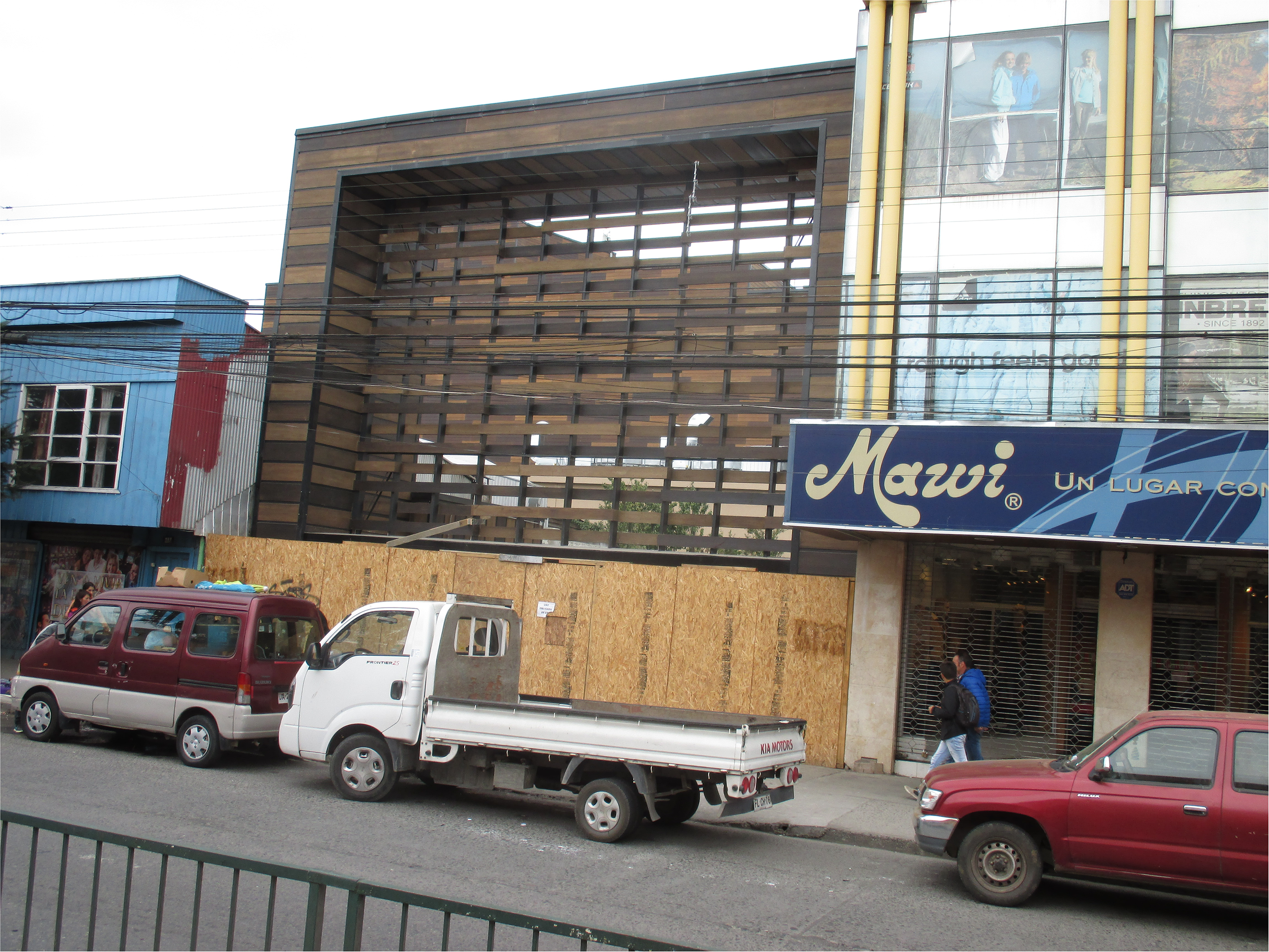
San Martín passage, still in construction (photo by author).
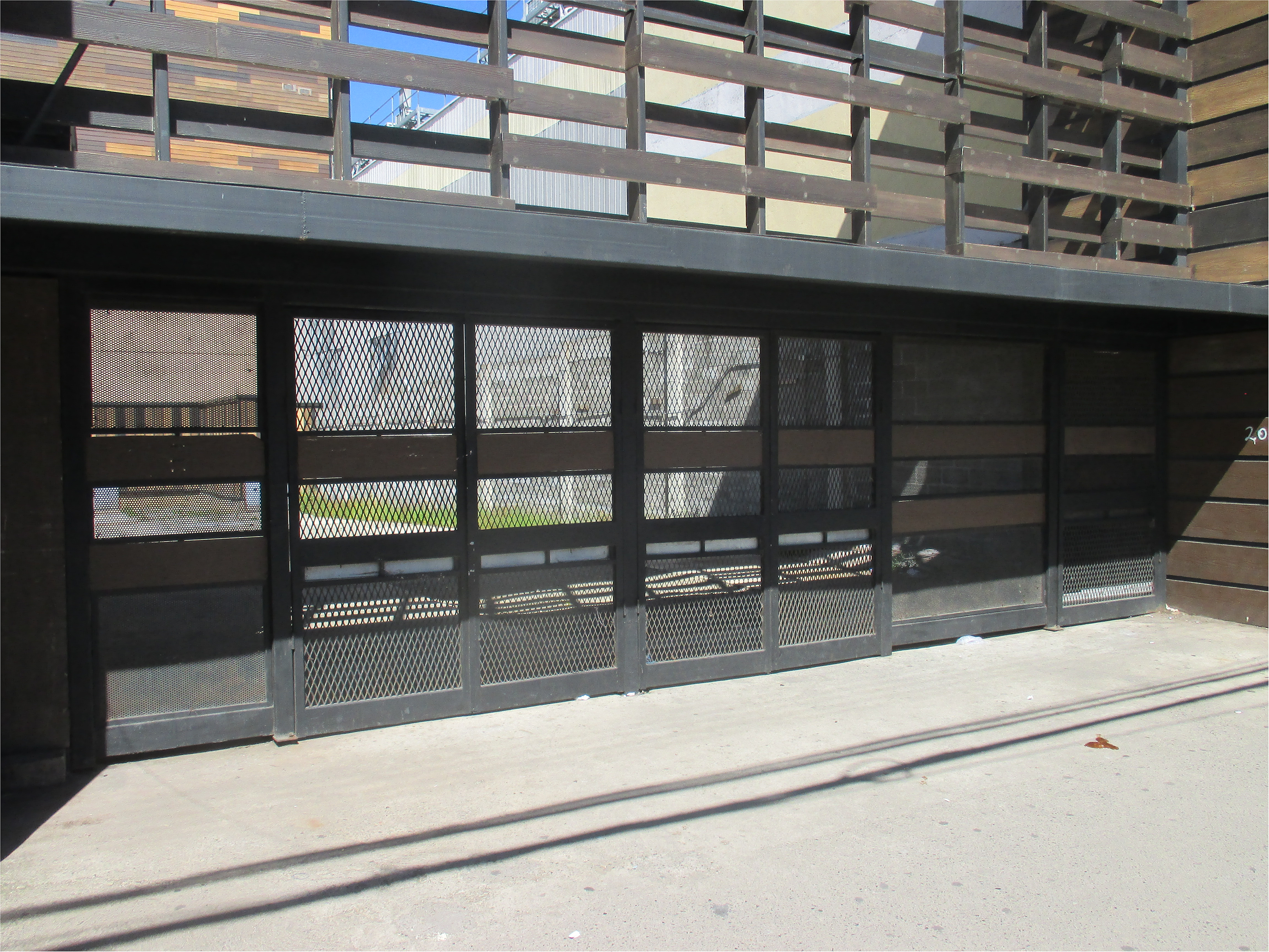
Welcome to the mall? (photo by author).
Why, then, does it exist and why does the mall have this address? The Mall Paseo Chiloé, for all its potential powers of spectacle, was nearly derailed in the development and construction process due to multiple legal challenges to its size, location, and overall composition relative to its surroundings. As we will see, this structure on San Martin Avenue was crucial for the legal “normalization” of the building after it had come under scrutiny from civil society and other professional organizations. While it at first appears perhaps unimportant – it pales in comparison to the main building, brimming with spectacular potential – this architectural structure was, in fact, a crucial linchpin in the struggle over the production of spectacular space in Castro. Without it, there is no Mall Paseo Chiloé and no possibility for the spectacle to continue its work, expanding into new territories.
With respect to the national urban planning code (Ordenanza General de Urbanismo y Construcción), the building was originally classified as “equipamiento menor”, based on two municipal permits for a building of around 24,000 square meters. Architects Jorge Espinosa and Juan Fernando Yáñez shared with me – and in their public interventions, affiliated with the Architecture Association (Colegio de Arquitectos), Chile's main professional association for architects – their concerns that the original plan was unusual and perhaps should never had that classification. “I have the plans”, Juan Fernando told me in 2015, continuing that “…the building is strange, you can't understand them” (interview, November 18, 2015, Castro). He went on to explain a series of technical details around the number of parking spaces that were usual, in his assessment, as well as the classification of different areas of the structure itself that had to do with their intended usage, which was also suspicious to him. According to him, these details were contrived in order to justify the building's legal and geographic existence. In other words, the building was pretending to be something on paper that it was not in material reality.
In any case, according to him and others, what was built turned out to be significantly different and larger than what these first two permits allowed for, leading to outrage and legal challenges brought by the Architecture Association and other stakeholders, including neighborhood groups (Juntas de Vecinos). As construction stalled and the court cases played out, municipal planning authorities scrambled to find a solution. What was ultimately unveiled was the granting of a third building permit that would correspond more closely to the existing building's materiality, a permit that would somehow supersede the first two. In this third permit (#434), the building was now authorized to be over 29,000 m2 and would now be classified as ‘equipamiento mediano’, one higher in the classification scheme.
However, there was a catch. In the planning code, equipamiento mediano are not permitted to be on the kind of streets where the mall is actually located – Ramírez and Serrano – due to a lack of adequate transport access for such large buildings. The solution, then, required two additional components. The developers would acquire an additional property that today links the existing building to San Martin Avenue, the city's main thoroughfare, while the Avenue's classification would also be modified to make it compliant with the planning code (a claim made by both architects Jorge and Juan Fernando in interviews). The developers succeeded in acquiring the property and built the San Martin Passage, built in the same architectural aesthetic as the mall itself. The municipal authorities and the developers hoped that this new arrangement of urban space, in its materiality and its legal geography, would “solve” the problem.
The Architecture Association and others did not agree and brought new legal challenges. During my time there in 2015, all were anxiously waiting the verdict of the Supreme Court over the legality of this planning maneuver. The municipal legal advisor explained to me how their interpretation of the law was that “only part of the property has to face it [San Martin Avenue]”, he said, “not the building itself” (interview, Castro, August 4, 2015). The architects find this laughable and absurdist, considering that the actual flow of traffic will concentrate not on San Martin Avenue, but on the smaller Ramírez and Serrano Streets. Figure 4 below was used in the Supreme Court proceedings by a lawyer based in Santiago who helped with the case. He also provided me personal documents used during the trial that included the map they used to help visualize for the Court the unusual shape of the property and what they saw as the legal shortcomings of such a strategy. In November 2015, after the mall's grand opening earlier that year, the Court ruled 3–2 in favor of the permit, putting an end to one of the most promising lawsuits to challenge the Mall Paseo Chiloé.
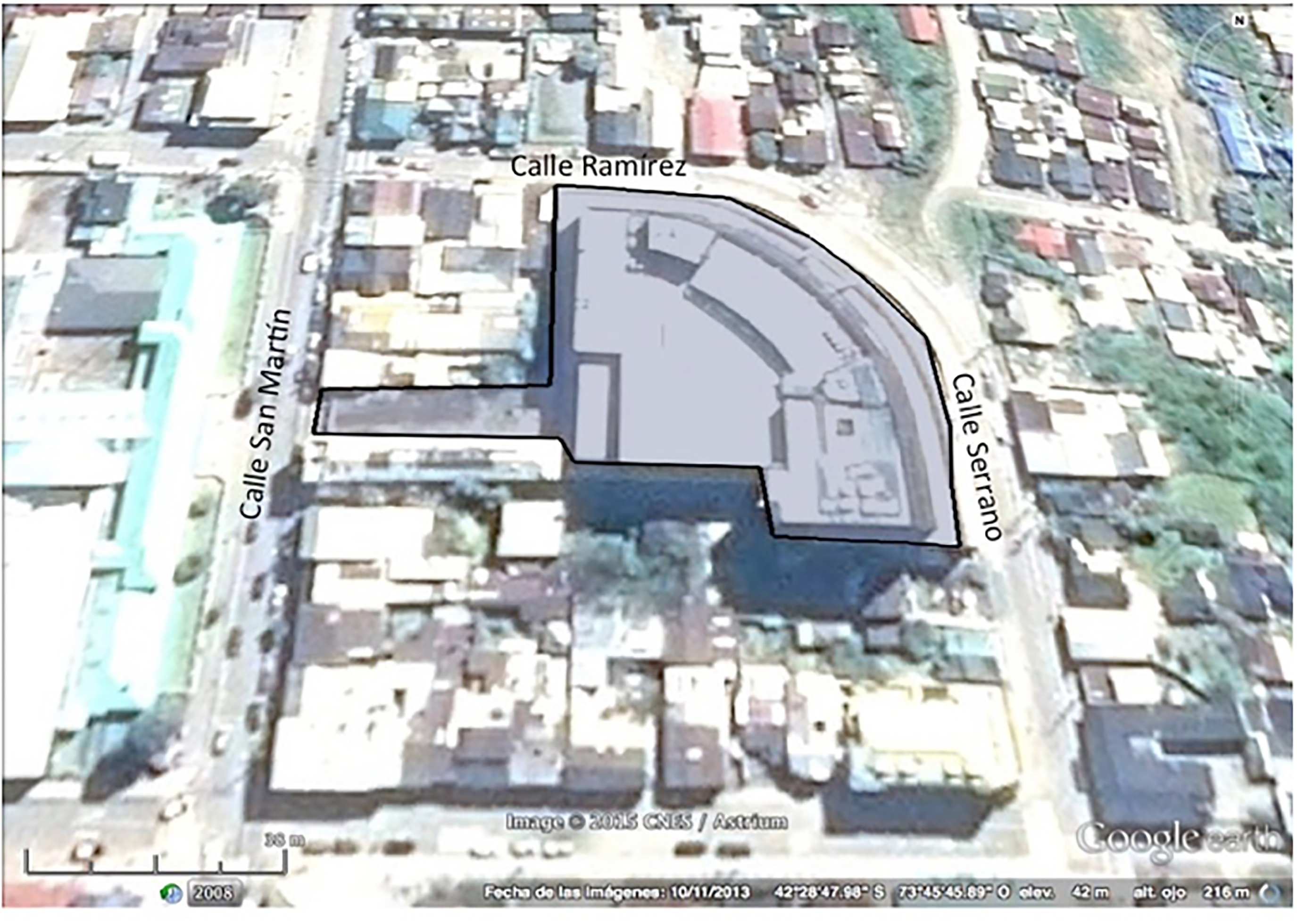
Map used in Supreme Court case (source: participant, interview in Santiago, November 25, 2015).
In terms of ANT, the San Martin Passage exemplifies what Müller (2015) refers to as “hybridity”, or the principle of symmetry: non-humans are required as co-constitutive features of any human or “social actor”. Both humans and non-humans are admitted a kind of agency, thereby lending a symmetry that has lacked in previous social science methodologies. More than gratuitous description, Müller and Schurr (2016) suggest that we can arrive at better explanation through description. This paper does not describe the San Martin Passage in and for itself. Instead, with ANT, it is seen to “do something” (Latour 2005, p. 128): it makes the potential action of spectacle possible, that action being the formation of particular kinds of social relations and subjectivity (Hetherington 2008). The action of consumption – and for the possibility of spectacular relations to take shape – emerges only through this actor-network that included not only the political ecologies of industrial development that prepared the population for mass consumerism (argued originally in Miller 2018a; also see Irarrázaval and Bustos-Gallardo, 2019), but also the complex negotiations in the world of urbanism and its legal, administrative, and political dimensions. For spectacle, this means that instead of it being an entirely human-orientated equation – between producers and consumers, as it has generally been theorized – it also relies on a world beyond humans, but one that becomes fully entangled with it, as a hybrid formation: “Hybridity – the enmeshing of humans and nonhumans – in constitutive of the economic. This does not mean equating humans and non-humans, but conceding that materiality is constitutive for the production of action. The first translation proposed here thus seeks to move away from the privileging of social actors to recognize the hybridity of actor-networks and the manifold ways in which things and technologies become entangled with humans” (Müller 2015 p. 75; emphasis added).
This methodology, then, moves away from relying on the concept of spectacle as a “social actor” and instead seeks out the “things and technologies” that co-constitute it. The San Martin Passage offers a case in which to consider architecture as part of this confluence of things and technologies that carry out this essential work that spectacle relies on behind the scenes. The point, in short, is not to assert that the architecture of the Mall Paseo Chiloé produces ideal consumer subjects, fully formed, and universally distributed by the totalizing spectacle. Instead, it is to consider how specific features of the architecture are especially important as a material device that holds the building together legally and makes the conditions of possibility for spectacle. For spectacle to try out its “magic” (see Thrift 2010, cited in Müller 2015), these human and non-human relations must first be assembled.
Architectural fluidity, desire, and counter-spectacle
Instead of merely attaching a non-human component to traditional notions of spectacle, this account aims at reconceptualizing it as co-constituted by these materials. Spectacle needs these materials to “do something” (Latour 2005, p. 128), or else it cannot be installed. This takes us closer to another aspect of conceptualizing spectacle with ANT and assemblage thinking: the role of fluidity and desire. Moving closer toward those possibilities opens-up additional analysis of how spectacle can be co-constituted also by counter-spectacle. The San Martin Passage does not only signal a kind of “stabilizing” element of spectacle's actor-network (Müller and Schurr 2016, p. 226); it also contains evidence of resistance and the destabilizing effects of counter-spectacle.
In short, it is crucial to acknowledge that the San Martin Passage was not in the original plan and would not exist had it not been for the resistance of some local inhabitants, including professional architects, lawyers, and others. In 2013, I met civic leaders energized and enraged by what had happened in their city. They were leading the opposition and ran a website detailing the controversy from their perspective, highlighting what they saw as non-compliance with planning procedures and other irregularities. A network of organizations had emerged to challenge the project, including the NGO “Defendamos la Ciudad (We Defend the City)”, the Chilean Architecture Association and several neighbourhood groups in Castro (Juntas de Vecinos) including local business-owners. After receiving reports about the Mall Paseo Chiloé in 2012, UNESCO, together with ICOMOS (International Council on Monuments and Sites), sent a “reactive monitoring mission” to investigate in December 2013. In their report, they cite the mall as damaging the “Outstanding Universal Value” of the church, one of the criteria for consideration of “World Heritage”. Their report made recommendations to the Chilean state for how to mitigate this impact and protect the remaining churches, measures that, if not put into place, would result in the Churches of Chiloé being put on the “List of World Heritage in Danger” (UNESCO and ICOMOS 2013, page 6). When I visited in the middle of 2013, this impending visit was a hot topic, as it lent legitimacy to their opposition and showed the gravity of error on the part of the developer and municipal authority. As mentioned above, a multi-facetted legal battle began around specific elements of the project.
While the struggle against the mall failed in the end, the evidence suggests that the San Martin Passage is not only a key to the project's (contested) legality but is also the product of resistance. Its awkward materiality on the Avenue may be easily overlooked, but this is a testament to the struggle over the production of urban space, or the “right to the city”. In fact, there is a clear geopolitics to this struggle, as some of the mall's opponents explained how their activities were constrained by the legacies of the military dictatorship that imposed neoliberalism and its deregulatory tendencies (Sabatini 2000; Navarrete-Hernandez and Toro 2019). Jorge explained exactly what the liberalization of the production of urban space refers to in the professional practice of architecture and urban planning: “The Architecture Association is a professional association that, before 1973 when the dictator Pinochet changed the registry law of professional associations, protected the ethics of architecture and urbanism in Chile. All professionals in all professions were once required to be part of a professional association. What Pinochet did was install a free-market system that eliminated that. Now membership of the Association of Architects, or Engineers or Doctors or whatever is voluntary. It is voluntary. So, what did the dictatorship take away? They took away ethical protection from the mission of the professional organizations. Today, therefore, the Architecture Association since the Pinochet dictatorship is a voluntary professional organization that adheres to certain values. But we don't have any weight in society. Because we don't have the power to sanction. It means nothing” (Jorge Espinosa, interview in Castro, April 1, 2015).
This testimony is a glimpse of what a macro-process – “liberalization” – refers to in practice. In the interview, Jorge goes on criticizing the “free-market system”. When I asked what the role of the architect in society is today, he responded with a sense of disgust, “Just to make money. It doesn't matter if it is by designing a house or a hot-dog stand. It's all the same. The important thing is to make money. That is the free-market system” (interview in Castro, April 1, 2015). Importantly, he vented frustration around the debilitation of the professional association's power to shape how urban space is produced in more civic and non-commercial ways. This institutional change imposed by the dictatorship was well-known among the architects I spoke with and was also corroborated by a lawyer involved in one of the cases against the mall, who told me that the change was enshrined in the 1980 Constitution (interview in Santiago, November 25, 2015).
Nevertheless, I met several members of the Architecture Association who shared with me a sense of civic vocation and a critical perspective on the Mall Paseo Chiloé. Perhaps more optimistically, architect Juan Fernando spoke about the civic role that urban planners and architects play in society today, despite the limitations: “you know, when you get sick, you go to the doctor; and when you have a legal problem, you go to a lawyer; and when you have a problem with the city, you should come to us [urban planners and architects]!” (interview, January 21, 2019). While he was also frustrated with the politics of the mall and other ongoing projects in the city, both he and Jorge remain active and engaged in the ongoing practice of architecture and urbanism. Today local leaders are scrambling to provide some level of protection to other heritage assets that may come under similar threat as urban growth continues, particularly in the historic centre of Castro (source: fieldnotes and interviews, 2019).
To summarize, a closer examination of the San Martin Passage reveals several features that make it a complicated actant, one that does not only reaffirm the “stability” of the actor-network that sustains the possibility for spectacle to flourish. Müller and Schurr (2016), again, suggest that ANT and assemblage theories can flourish together, as each has strengths for making sense of a complex world. It may be important to recognize the San Martin Passage as an “actant” of spectacle, but it would also be incomplete. The findings also force us to consider the San Martin Passage as a monument to resistance. Here, the sensibilities of assemblage thinking may help complicate the structure more than an ANT approach has so far. As Müller (2015) and Müller and Schurr (2016) put it, we must also account for fluidity and desire as constituents that often complicate the stability that actor-networks are capable of generating. Or, at the least, they can change “without rupture” (Müller and Schurr 2016, p. 226), thereby showing how “adaptive” they can become (Müller 2015, p. 68). A significant population of people opposed the Mall Paseo Chiloé, thereby complicating the imaginaries of spectacle from the beginning.
The point here is that the Mall Paseo Chiloé as an assemblage or actor-network includes more than simply the material expression of hegemony. The San Martin Passage would not exist if it were not for the opposition. Creating this piece of architecture was not their intention, but their resistance resulted in retail capital having to adapt its material form. In this way, the spectacle itself assumes an additional dimension that makes it even more hybrid than previously suggested. Instead of merely requiring a particular material (architectural and urban) composition (thereby co-constituting the spectacle), it also adapts to resistance and engulfs it within its architectural form. In this way, it is a kind of counter-spectacle immanent to the architectural form of spectacle itself. As Müller (2015) puts, “what looks stable and ordered from the outside harbours multiple fluidities on the inside that might, however, converge into a single reality for a while” (p. 80). The San Martin Passage, as much as it is a legal actant for retail capital (as described in the first sub-section above), is also an unwitting monument to resistance.
Conclusion
This paper agrees with Chu and Sanyal (2015) who suggest “it is possible to engage with a critical approach to urban spectacles by seeing them as existing on a contested terrain rather than as being part of a one-sided capitalist juggernaut” (Chu and Sanyal 2015, p. 401). To push that project further, this paper has drawn on ANT and assemblage theories, as they are designed not to debunk theories of capitalist “juggernauts” but to potentially plumb their depths in new and unexpected ways. Müller (2015) and Müller and Schurr (2016) are among those who have deployed ANT and assemblage in these ways. However, few have attempted to rethink the theory of spectacle in its specificity with such analytics.
Concurrent with the two main sub-sections above are two final conclusions. First, hybridity is not always emancipatory. The San Martin Passage acts as a legal actant for spectacle and the capital that relies on it. The principle of symmetry is often introduced as a necessarily subversive move, one that reveals previously unknown dimensions of the world and its relations. To really explain what this means, however, such a principle must also reveal when we know the non-human world is making its impact, or if a material “does something” (Latour 2005, p. 128). The San Martin Passage, as a material space in a precise location, is the actant that spectacle required. In moving toward the spectacle as a “social actor”, what exactly would it mean to suggest that this materiality co-constitutes the conditions of possibility for the spectacle to thrive, or to fail, in subsequent events inside the mall? At the least, we can say that as a hybrid formation, the urban spectacle in this case is made possible by this material confluence of forces, which include not only material, existing architecture, but law, urban planning instruments, multiple authorities, investors, and civil society. In other words, spectacle also might function as an actor-network or assemblage, meaning that it can be “flexible and responsive” (Müller 2015, p. 68), but in its own devious way.
But that is only part of the story. The second conclusion is that immanent to that very same architectural form is the countervailing force of resistance. The San Martin Passage was not part of the original design. It only exists as the unintended result of resistance on the part of local inhabitants and relevant stakeholders, such as the Architecture Association. They may have failed in bringing the mall to account, but the resulting architectural form is a testament to their struggle for the right to the city. The San Martin Passage is not only an actant for the spectacle but also an unwitting monument to resistance. This feature, as well as the final exterior materials, are material, existing features of an architecture of spectacle that was highly contested. As detailed in Miller (2019), during the high point of the controversy the developers unveiled a new exterior shell, one that they claimed would help “mitigate” the alleged visual impact the mall may have on its surroundings. These outcomes were not what the architects intended, but they are evidence of their struggle, now embedded in the architectural form of the spectacle itself. As such, it is a particularly complex form of architectural counter-spectacle.
This struggle, though, is complicated. While I sympathized with the critics of the mall, I also listened to those who argued for it, and I found evidence of desire for greater access to spectacular infrastructures as well. Equally, even the architects had to sometimes concede that they were not against the mall itself, but its poor location. The other mega-sites of spectacle at Chiloé that preceded the mall – the Sodimac Homecenter mega-store and the upscale hotel and casino – are located at the edges of Castro and neither caused such controversy. There are plans for a by-pass highway around Castro, a project that may help redirect these kinds of large investments away from the historic city centre, currently where the main highway passes as the only link between the northern and southern parts of the main island of the archipelago. With a view to the critical heritage studies literature, this research is also weary of relying too heavily on “expert” opinions that overshadow other concerns that may exhibit a different relationship to so-called heritage assets (Gordillo 2014) – the UNESCO World Heritage church, in this case. Yet it seemed like this distrust of experts was also already being deployed in the controversy itself, as a pro-mall discourse emerged that accused the critics of being “outsiders” and not “real” Chilotes (see Miller 2018a, 2019). This previous research asks, to what extent does the “right to the city” of the mall critics in this case infringe on another formation, that being the “right to city” for those arguing for a more basic “right to consume” (see Miller and Stovall 2019)?
In final conclusion, then, ANT and assemblage theories are prime for investigating complex landscapes such as Chiloé's, landscapes that without a doubt include the mark of spectacle as an expanding feature of global capitalism. Theorizing spectacle in this way, though, presents a challenge, as it introduces a non-human element into what was previously a theory centred on the social relations of capitalist hegemony, following Debord. Yet with Hetherington (2008), Müller (2015) and Müller and Schurr (2016) as guides, this paper has moved to show such approaches are not antagonistic to the core concerns of traditional theories of spectacle as a “social” politics (cf. Brenner et al. 2011). The San Martin Passage is presented as an architectural form with multiplicities running throughout it. As a hybrid entity, it is at once a legal actant for spectacle, making it a possible to begin with, but not a foregone conclusion. It also encapsulates oppositional desire as a complex site of counter-spectacle, insofar as it only exists because of resistance. Urban spectacle as an assemblage or actor-network, then, is somewhere between the stabilities that are produced through specific arrangements and the outside forces that it rubs up against. What other surprises might we find in the urban landscape if we take such an approach, one at the edges of ANT, assemblage and critical urban theories including, but not limited to, spectacle?
Footnotes
Acknowledgements
I thank everyone who participated in the research for sharing their time and experiences with me. I thank the funding agencies, the Center for Latin American Studies and the School of Geography and Development at the University of Arizona for their support. I especially thank Beatriz Bustos-Gallardo and the Facultad de Arquitectura y Urbanismo at the Universidad de Chile, and the late Rodrigo Salcedo and the Universidad Católica del Maule for sponsoring my Fulbright Fellowship. I also thank those at the University of Arizona who provided feedback and other support, including J. P. Jones, Sallie Marston, Miranda Joseph, Carl Bauer, Vin del Casino, and others. Also thank you Manuel Prieto, Liliana De Simone, Giovanna Bacchiddu, Anton Daughters, Esther Echenique, David Tecklin, Matías Guiloff, Ricardo Rivas, and Javier Mayorga, who also offered support, among many others. Thank you, Peter Forman, Sarah Hughes, Kathryn Cassidy, Aditi Das, Paul Griffin and Majed Akhter for providing feedback on earlier drafts.
Declaration of conflicting interests
The author(s) declared no potential conflicts of interest with respect to the research, authorship, and/or publication of this article.
Funding
The author(s) disclosed receipt of the following financial support for the research, authorship, and/or publication of this article: This work was supported by the Social and Behavioral Sciences Research Institute, University of Arizona, Institute of the Environment, University of Arizona, Fulbright Commission, Tinker Foundation, (grant number U.S. Students Program).
