




Abstract
Living in “the most sustainable urban district of the Netherlands” will be a sensory experience: for the (re)development project Bajeskwartier in Amsterdam, the senses form the core of the urban imaginary produced in the publicly available material. Part of the larger discourse of “sustainable cities,” contemporary architectural projects are frequently infused, merged, and saturated with the multi-sensory qualities of nature. In doing so, urban planning is increasingly paying attention to presenting, promising, and constructing very specific sensory experiences. How does tuning in to the sensory appeal of architecture in different states of becoming shape our shared imagination of more livable, more sustainable cities? “Sensing” the future, here, follows a recent line of sensory interventions in architectural theory and practice interested in “listening” to buildings and “touching” design in exploring architectural soundscapes, sensescapes, and smellscapes. The “becoming present” of sensory experiences and their resonance in/through architectural media is understood as a both conceptual and methodological challenge connected to existing approaches to mapping the senses and feeling the urban. In pointing to these challenges, I aim to highlight the senses as a productive lens to explore the entanglement between nature and architecture in the literal and figurative construction of “green” urban futures. Tracing sensory experiences—and particularly “sustainable” sensoriality—as part of (urban) image building through the conceptual framings of presence, absence, and resonance points to the processual understanding of architecture, as well as a larger understanding of the urban as a complex affective assemblage in a constant state of becoming.
Introduction
Living in “the most sustainable urban district of the Netherlands” is a sensory experience: you can hear the slow hum of insects attracted by the lush, climate-resilient flora, and the chirping of birds nesting close by. You can feel the light breeze creating soft ripples on the water plazas, as much as the cooling shade thrown by the arched walkways. You can see the exuberance of the plants and trees and flowers around you, and dig your hands into the soil to garden yourself. All of these descriptions are more than poetic—they form the core of the urban imaginary produced through and visualized in the publicly available material on the (re)development project Bajeskwartier. Crucially, the construction of the site is still in process—and the sensory experience central in these descriptions still a promise. At this intersection between present and future, process and promise, this article focuses on atmosphere(s) as constructed through and in between architectural media and architectural sites. In this understanding, atmosphere(s), and particularly the sensorially charged atmosphere of living in and with nature, become something simultaneously experienced in the now and to be experienced in the future. If “futures inhabit our everyday present” (Pink, 2021: 193), the physical and mediated construction of architecture can be understood as a key site to trace the negotiation of urban future(s). As images and imaginaries are layered onto each other throughout the architectural process, the Bajeswkartier, and its positioning as “sustainable,” functions as an exemplary case study to explore the connection between image building and building images, architectural visions and visualizations.
Connecting rental, owned, and social housing as well as commercial spaces, the development is situated in a “problematic” part of the city—a large area of land formerly occupied by a prison complex. Opened in 1978 and closed in 2016, the site has a storied history as the Netherlands’ first “humane” prison, then as temporary accommodation for asylum seekers and student housing. Situated in a larger area of the city undergoing a transformation from a largely industrial area towards a “neighborhood and park along the water” (Amsterdam, n.d.), the Bajeskwartier is simultaneously positioned as “new” and “historical” (see Kopitz, 2025). For a discussion of the sensory resonance of architectural media, Bajeskwartier functions as a productive case study precisely because it is a redevelopment, tasked with overwriting the existing physical space as much as the existing image of what the neighborhood looks and feels like. The development”s description as an “exuberantly green hotspot for genuine urbanites” (Bajeskwartier Amsterdam, n.d.b) can, in this context, also be linked to larger concerns of green gentrification (see Pearsall, 2018). Part of the larger discourse of “sustainable cities,” contemporary architectural projects in Amsterdam and beyond are frequently infused, merged, and saturated with the multi-sensory qualities of nature as central to a particular—and desirable—atmosphere. In doing so, urban plans and propositions are increasingly paying attention to presenting, promising, and constructing very specific sensory experiences. The embodied experience of urban living, particularly in the context of sustainability, appears to move back into the center: in an “architecture of the senses” (Pallasmaa, 1996: 48), the body is emplaced rather than displaced (see Sennet, 1994). While building on the existing literature highlighting the connection between the senses and the past across cultural histories (see Classen, 2023; Reinarz, 2014), this article functions as a provocation to think about the sensory as a mode of representing the future.
If the senses play a role in both “forming and shaping experience of the city” (Adams and Guy, 2007: 133), the emphasis on the sight, sound, touch, smell, and taste of nature arguably functions as a way to form and shape expectations of urban future(s) as well. Rather than understanding architecture as a finished product, the focus on architecture as a mediated process highlights how the built environment is constructed both literally and figuratively. Tracing the multisensory conceptualization of place (see Feld, 2005: 182) in architectural media, and more specifically mediations of a deeply socio-political (re)development project like the Bajeskwartier, points to an atmospheric shift in urban planning and design. Building on the “sensory turn in studies of the city” (Adams and Guy, 2007: 136), the attention to image building in and through the senses frames sensoriality as both imagined and experienced, and experienced through imagination. Following Degen and Rose’s (2012: 3273) proposition that “sensory perception is mediated by different and shifting spatial and temporal practices,” this article approaches architectural projects in their becoming as sensorially charged. Rather than rejecting the claim that sensory experience is lived (see Pink, 2015), mapping the sensoriality in and of architectural media frames experience as unfolding across time and space. In doing so, the focus of sensorial engagements with and of urban spaces shifts from tracing the embodied experience in the physical space to exploring how urban futures are imagined, designed, and produced to allow for—or restrict—particular sensory experiences. How does tuning in to the sensory appeal of architecture in different states of becoming shape our shared imagination of more livable, more sustainable cities? “Sensing” the future, here, follows a recent line of sensory interventions in architectural theory and practice interested in “listening” to buildings (Littlefield and Lewis, 2007) and “touching” design (Williams, 2019), in exploring architectural soundscapes, sensescapes, and smellscapes. This article expands on the discussions of the “unfolding” of the city in space and time by proposing that the production of “green” urban futures through architectural media engages the body and the senses between imagination and realization.
This understanding points to both conceptual and methodological challenges in existing approaches to mapping the senses and feeling the urban. Analyzing the built environment in different stages of construction, and their continuous mediation, I argue, allows for an exploration of the “becoming present” of sensory experiences. As the (supposedly) “most sustainable neighborhood of the Netherlands” (Bajeskwartier Amsterdam, n.d.a) is being built, the architectural media of the Bajeskwartier are charged with constructing the future atmosphere of living in and with urban nature in the now. In the first section, the visual presence of nature functions as a starting point to map how all of the senses are engaged in building this vision. Narrowing down on the sense of smell in particular, the second section engages with both an absence of smell in discourses of the built environment and urban futures, and the construction of sensory absence as desirable in the urban vision of the Bajeskwartier. Taken together, these two sections underline that sensory experiences are increasingly operationalized in the imagination of built environments as “sustainable” —which in turn points to the layering of visions and experiences between “now” and “then.” As the development progresses, this negotiation between presence and absence extends across time and space. The final section suggests understanding the construction site itself, particularly of a long-term development project like the one discussed here, as part of the mediation of the sensoriality of architecture. As the construction site is opened to prospective residents and interested publics, the urban vision of a green and sustainable future of the neighborhood resonates in the present, further complicating sensoriality between imagination and experience. Across these three sections, this article argues for an interdisciplinary and interconnected methodological and conceptual approach to architectural media as a critical site for the negotiation of urban future(s). Tracing sensory experiences—and particularly “sustainable” sensoriality—as part of (urban) image building through the conceptual framings of presence, absence, and resonance points to the processual unfolding of architecture, as well as a larger understanding of the urban as a complex affective assemblage in a constant state of becoming.
Methodology: Media, space, and the senses
Intersecting future(s) and sense(s) in and through architectural media functions as both a conceptual exploration and a methodological proposition in this article: the “sensory turn” and the critical attention to how “the senses are made, not given” (see Howes, 2022: 45) in media studies and urban studies allows for a productive, interdisciplinary approach to the intersection between media, space, and the senses. As this article argues, it is precisely between imagination and realization, between physical and mediated construction, that the future becomes sensible. To trace how future(s) and sense(s) unfold throughout the construction process, I am bringing together textual analysis and sensory ethnography as a starting point for analysis and methodological proposition for interdisciplinary research. The first two sections focus on the publicly available visualizations available via the official website of the Bajeskwartier: In addition to 11 rendered images of the individual buildings and two rendered images of the connecting garden(s), the development is drawing on eight short virtual animations to imagine the future of the neighborhood. In the official “brand movie” of the development, featured dominantly both as a whole and in smaller segments on the website, these animations are brought together with other audiovisual materials—with a varying degree of specificity in regards to the filmed locations. Approaching these materials as multisensory sites—beyond the “vision” of nature—underlines the potential contribution of textual analysis to understanding the “becoming present” of sensorial experiences.
Turning to embodied methodologies in the final section of this article allows for an exploration of the sensorial resonance of architecture across different media, from virtual renderings to the construction site itself. In doing so, I aim to highlight the senses as a productive lens to explore the entanglement between nature and architecture in the literal and figurative construction of “green” urban future(s). Expanding on Pink’s (2015: xii) understanding of sensory ethnography as committed to “concepts of place, memory, imagination, improvisation and intervention,” the production of nature(s) discussed here is simultaneously informed by the past and the future—while experienced in the present. Particularly for “sustainable” (re)developments like the Bajeskwartier, multisensory memories of a more natural, more green, more authentic past arguably function as a prism to project an imagined future onto the now. As part of my research process, I attended “open days” at the Bajeskwartier on two different occasions, with a specific attention to the atmosphere of the site between imagination and realization. The attention to architectural media, as a process of mediation extending throughout the entire construction, underlines the layering of images and imaginaries, of possibilities and realities.
As an exemplary—although crucially not exceptional—case study, the Bajeskwartier is a site in transformation: currently and continuously under construction (until the planned completion in 2028), the multiphase redevelopment is faced with the recurring challenge to reposition and reframe the past, present, and future of the site. Following the mandate of “sustainable” design, the building materials of the Bijlmerbajes are “recycled” in the construction of the Bajeskwartier—but notably in a different context and with a different connotation. For instance, the former cell doors function as the base materials for bridges in the shared open space (see Bajeskwartier Amsterdam, n.d.a), shifting their use from a spatial separation to a spatial connection. Transforming the site, then, is also a transformation of its history. As Degen (2014) argues, “the first step of a regeneration scheme is to rearrange the spatial and sensory order of space within particular aesthetic parameters.” In this context, architectural media can be understood as charged with rearranging and reordering space—and its sensoriality. The framing of the Bajeskwartier as a “sustainable” development, amidst the larger positioning of Amsterdam as a “sustainable” city, implies not only a practical and professional concern in the design and construction of the building but, maybe more importantly, an orientation towards the future—and a sustainability that can be felt, can be experienced.
Bringing together textual analysis and sensory ethnography not only corresponds to the shifting materials available throughout the architectural process but also contributes to an emerging tradition exploring interdisciplinary and multimethod approaches as “new ways of making sense of the city” (Guy, 2007: 251). Following the construction of future(s) and sense(s) throughout the redevelopment of the Bajeskwartier also allows for an acknowledgment of instabilities and insecurities—and the potential tensions between the future(s) being imagined and the future(s) being built. Pink (2021: 196) draws an explicit connection between sensuous futures and questions of trust, arguing that “trust is a feeling of knowing that is continually emergent, which simultaneously accommodates an inevitable element of not-knowing, or of the uncertainty of immediate futures.” The construction of the Bajeskwartier in and through the senses, then, could also be understood as part of a strategic move against uncertainty—particularly when connected back to the “familiar” imaginary of urban nature(s) noticeable across the promotional materials. Importantly, I understand these materials, ranging from “brand movies” to virtual renderings and public events, as promotional—but at the same time urge to take them seriously as part of the larger negotiation of urban transformations. In this understanding, image building and building images are interwoven through their construction of a future that can be—and already is—experienced through the senses.
Writing presence: Mapping the senses in architectural media
One of the frequently repeated taglines of the Bajeskwartier, “Happy Healthy Living,” plays with the multiple meanings of “living” as noun, verb, and adjective—and opens up to an understanding of the neighborhood as an organism shaped by both its human and more-than-human inhabitants. The brochures for the first three buildings of the neighborhood center green and growth in the headlines and descriptions but also in the colored images part of the visual representation of the development (see Bajeskwartier Amsterdam, 2021, 2022a, 2022b). Architectural media are predominantly discussed as visual media, as visualizations representing urban realities or rendering urban futures. Weaving together maps situating the construction site within the larger context of the city, animations of the individual buildings and the shared spaces connecting them as part of the neighborhood, and photographs documenting the progress of the construction process, the visualizations of the Bajeskwartier function as an alternative and addition to the more technical drawings, projections, and plans created by and for architectural professionals. Following Degen and Rose’s (2012: 3273, emphasis in original) call to “attend how the city is experienced through multiple sensory modalities, not just the visual,” this section expands on existing discussions of the role of media in imagining urban futures by highlighting the sensoriality of architectural media.
Mapping the senses, McLean (2017: 67) suggests, raises the potential to “challenge the myth of map as a fixed and static truth.” In this context, built environments and their mediation become a multisensory domain to explore environmental discourses between imagination and realization. At the same time, the sensory atmosphere of the urban as constantly shifting and changing, influenced by human and more-than-human bodies as much as by traffic and the weather, poses a challenge for mediated representation—a tension between dynamic and designed. Beyond the geographical reference, the idea of the “map” here foregrounds that architectural media simultaneously chart and construct the sensory dimensions of sustainable urbanity. In the physical and metaphorical construction of the Bajeskwartier as a sustainable neighborhood in and through architectural media, the presence of nature—imagined as present rather than potential—takes on a particular role. Transferring ideas about the rural idyll to the urban, the specific accentuation of “natural” materials and designs calls for an attention to all senses in tracing the construction of urban futures as happy, healthy, living. More than just visually (re)presenting the current present and planned future, I argue that the visual emphasis on the presence of nature functions as a way to charge both the architectural media and their imagined future(s) with sensoriality. In doing so, centering the senses in architectural media—particularly for “sustainable” redevelopments like the Bajeskwartier—can be understood as a counter against critiques of commercialized urban “blandscapes,” “aseptic places, created by the modernist drive towards deodorization, that are so empty that they lead to an alienating sense of placelessness” (Drobnick, 2002: 34). In emphasizing the presence of nature, the visual material not only counters this “blandness” but also reinforces a discourse of the “benefits” of nature frequently discussed in psychological and medical research (see Franco et al., 2017; Spence, 2020).
One of the key visuals for the Bajeskwartier is the official “brand movie,” weaving together the virtual renderings of the individual buildings in brief animations with close-up videos of urban scenes and sceneries. In their juxtaposition, the virtual renderings and the videos appear to correspond to each other: a virtual rendering of a shared green space between the buildings is followed by a video of a boy climbing in the crown of a tree; a virtual rendering centered on the public basketball court is followed by a close-up video of a basketball being dribbled. By continuing movement, linking space and expanding time, the urban future of the virtual renderings is presented as already (if partially) existing in the present. In doing so, the sensoriality of the virtual environment, natural and built, is repeated, extended, grounded in the close-up videos. Importantly, the “brand movie” does not always follow the same logic of first presenting a virtual rendering to then transition to a filmed scene, but also switches up the order, increasingly blurring rendered and real, future and present. Another extended scene begins with a video of a young girl skateboarding: while the sound of the wheel rolling over the concrete path is not audible over the music used as background for the entire “brand movie,” the close-up of the feet pushing the board still conjures the sense of the sound. The focus on skateboarding, as an “outdoor urban leisure that specifically engages with the grey materialities of concrete, steel, asphalt, granite, grime and detritus of urban built environments” (O’Connor et al., 2023: 898), takes on further significance here. Filmed from a low upward angle, the skateboard’s movement on the concrete is framed by healthy, green grass in the foreground and background of the frame, quite literally framing the concrete path as a minor exception in and through urban nature. In doing so, the “grey spaces” of skateboarding—and other urban leisures—are folded back into an urban imaginary centered on “green space.” In another seamless transition, the movement of the skateboarding girl in the video is taken up by a skateboarding boy in a virtual rendering—now visualizing the concrete path as part of the larger neighborhood (see Figure 1). Rather than “just” being framed by grass, the concrete path is framed by a meadow with blossoming trees on one side, and an artificially created pond on the other, presenting a perfect balance between grey, green, and blue spaces in the emerging neighborhood. In this virtual rendering, the concrete path is notably not the only material surface with a rewritten affective charge: the former walls of the prison complex have been turned into a playful urban bouldering site, with a rendered inhabitant scaling the wall via yellow handholds above a group lounging in the grass. Returning to the history of the site—and the presumed insurmountability of its walls—makes bouldering as a form of playful leisure particularly striking. The contrast between past and future, and between undesirable and desirable ways to experience the space then and now, could also be connected to larger socio-political questions: the literal and figurative openness of the Bajeskwartier as made visible and sensible in the “brand movie” stands in tension with the limitations posed by the cost of the apartments. As a point of reference, the two- to five-bedroom apartments of The Emerald, the building next to the visualized bouldering wall, are currently selling at a price between €550,000 and €1,330,000 (see Bajeskwartier Amsterdam, n.d.d)—which in turn implies a particular possible and desirable resident of the building.
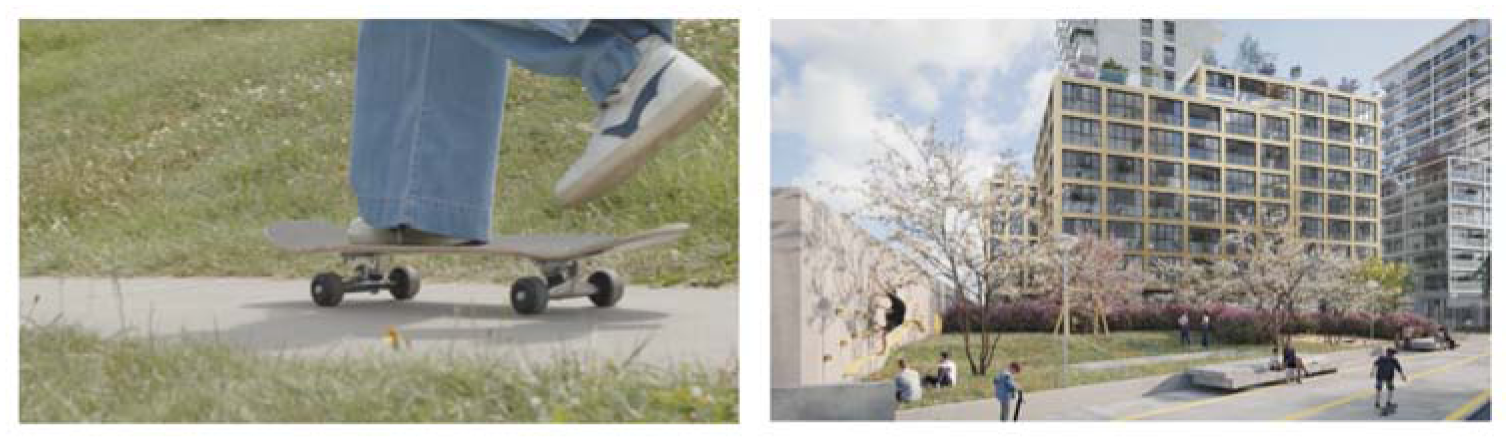
The “brand movie” seamlessly interweaves videos and virtual renderings, thereby further emphasizing the sensoriality of the represented scenes and sceneries.
More than just the materialities themselves, it is their larger assemblages that take on an affective, sensory charge: across the promotional materials for the Bajeskwartier, nature forms the foreground, with the built environment functioning as the—almost secondary—background. Most of the virtual renderings are either created from a slight downward tilt, focusing on grass and flowers as much as planted gardens, or begin at the ground level, shifting from the ever-green space towards the ever-blue sky. Rather than highlighting the buildings’ height, the architectural media appear to emphasize their groundedness—and the urban nature literally growing around and through them. Presence, here, takes on a dual meaning: the trees and flowers, ponds and soil, growth and bloom, are represented as simply this—present. If architecture is “always concerned with the future” (Fitz and Krasny, 2019: 12), the interwoven use of virtual animations and videos in the larger framing of the Bajeskwartier presents the urban future as already and inevitably charged with the sensoriality of nature. In the accompanying brochures for the first available buildings of the development, the landscape design is discussed as “an abundance of gardens” (see Bajeskwartier Amsterdam, 2022a: 36). This framing also continues through the architectural media discussed here: the smell of blossoming trees and the taste of home-grown fruits is as much written into these images—imaginations—as is the soft feel of the grass that functions as a shared space to sit, lie, and play on throughout the materials. The close connections drawn between nature and leisure, green and calm, connect back to an understanding of nature experiences as “beneficial” for the body and mind (see Franco et al., 2017)—and resonate in the emphasis on healthy urban living in the “sustainable” district.
Drawing on an understanding that “specific forms of built environment afford specific forms of sensory experience” (Degen and Rose, 2012: 3283), I argue that, in turn, sensory experiences increasingly become part of imagining built environments before and throughout their physical construction. In another sequence of scenes (and sceneries) in the official “brand movie,” a virtual rendering of the terraced urban garden, with rendered inhabitants gardening as a peaceful community, is followed in a flowing sequence by a close-up video of a woman carrying a reusable shopping bag with fresh vegetables, a close-up of a shovel digging into the soil, and a young girl in dungarees running playfully through the lush, overgrown rows of a wild garden. In the quick succession of these momentary snapshots, the sensory sensations—olfactory, haptic, gustatory—of life with and in urban nature(s) are conjured. The inherent promise in the images, renderings, and videos available as part of the larger public positioning of the Bajeskwartier is that the future of the development will feel as imagined. Mapping the senses, touch, sound, vision, and smell, in their embodied interconnection in and through different architectural media, becomes a way of writing the future in the present as well.
Smelling absence: Tracing the physical in the virtual
In line with Cathcart Frödén’s (2023) critique against “the dominance of the visual, in relation not only to the design of the built environment but also to discourses of future imaginaries,” the attention to the multisensoriality of architectural media and the urban future(s) imagined in/through them points to the limits of existing registers of representation. While vision—through references to lushness and greenery—and sound—through the presence of birds and the highlighting of spaces for peace and quiet—are referenced explicitly in the (audio)visual representations of the Bajeskwartier as a sustainable neighborhood, the sensory experiences of touch, smell, and taste are more difficult to visualize and to objectively measure. And yet, as I suggest throughout this article, the senses form an integral part not only of experiencing existing but also imagining future spaces. Expanding on the discussion of the visual presence of urban nature and/as sensory experience in the previous section, here I am shifting to discuss how an urban atmosphere is constructed through sensory absence as well. In other words, in imagining a green(er) urban future, it might be as important what is not there. Focusing on smell particularly functions as an entry point to trace sensory experiences beyond—or maybe because of—the absence of visual markers in the negotiation of the larger urban vision. Critical of the referentiality of Porteous’ (1985) concept of “smellscapes” to “landscapes,” Rodaway (1994: 64) emphasizes the ephemeral quality of smells as “present or not present, in varying degrees of intensity” rather than experienced as clearly and objectively ordered. Whereas non-visual experiences can be and frequently are translated into visualizations, from bars measuring noise levels to close-ups materializing haptic textures, smell frequently remains discarded as individual or irrelevant, as difficult to capture and control (see Henshaw, 2013). Paying attention to smell in the urban, Diaconu (2011: 223) argues, converts space “into a medium of life, a qualitative atmosphere, and an intertwinement of forces.” As “‘the affective sense’ par excellence” (Howes, 2024: 1), smell forms part of the larger sensory assemblage of sustainable urbanity—or, in the words of Porteous (2019: 25), “smells environ.” In the architectural media of the Bajeskwartier, a sense of smell is conjured through a complex visual dialectic between desirable and undesirable, natural and unnatural sensations. In doing so, tracing the sensory experience of the imagined urban future(s) becomes a triangulation of oppositions.
The clearest olfactory description within the development project is “clean air”—which in turn is highlighted through an absence of smell, an idea of odorlessness: “We know that people live healthier and happier lives when they are surrounded by nature, with clean air and plenty of space in which to move and relax” (Bajeskwartier Amsterdam, n.d.c). In the visualizations of the shared spaces between the individual (and individually sold) buildings, the vision of urban life seems not only centered around but almost overtaken by nature (see Figure 2). Integral to “rural living, in the heart of the city” (Bajeskwartier Amsterdam, n.d.c), the plants, grass, and trees are predominantly presented as an atmospheric landscape, perfect for leisurely strolls and active explorations—and detached from any form of labor necessary to plant, maintain, or harvest. In the imagination of the urban as more livable, more natural, and more sustainable, shifting away from the “pollution” of the city also draws on the connotations of the “naturalness” of the rural. Bacci and Melcher’s (2011: 3) emphasis on the role of intention in smelling functions as a starting point here to explore an intentionality in not visualizing, not writing, not emphasizing smell—particularly in contrast to other sensory experiences. Beyond the blue (and suspiciously non-cloudy) sky dominating all virtual renderings published on the publicly accessible website of the Bajeskwartier, the cleanness of air as something to be breathed and smelled is also constructed through the absence of exhaust. With the use of solar panels and other renewable energy sources being one of the key sustainability features of the development, the visual emphasis on clean skies, and with that clean air, is further constructed through the absence of furnaces, chimneys, and—maybe most prominently—cars. The previously discussed centrality of leisurely ways of moving through the neighborhood, walking, cycling, or skating, returns here as an environmental promise as well. Even in mediations situating the development in the broader context of the surrounding city, the visualized streets are notably empty of cars, trucks, and even trains, despite the proximity of the construction site to both an intercity highway and a much-frequented train and metro line. In this comparison, both the disconnection between imaginary and reality and the aspirational promise of a more sustainable future shine through. Playing with the dual meaning of absence—as both non-existent and distant—the architectural media discussed here appear to construct the idea that not smelling is desirable.
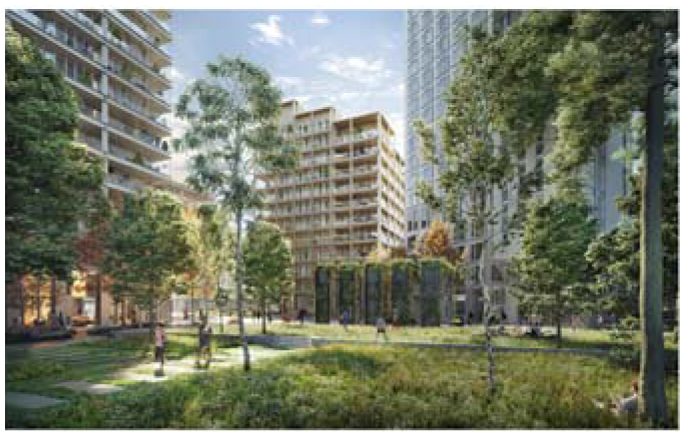
The visualizations of the shared spaces merge urban built environments with a seemingly “wild”–yet controlled–natural environment.
Pushing this even further, descriptions like the one quoted above bring together an auditory absence—silence to relax—with an olfactory absence—clean air to breathe. Rather than an appeal to the senses, not appealing to the senses becomes the ideal. Again, the underlying hierarchical logic of smells—and what even registers as “a” smell—should be emphasized here. In the conception of “rural living” proposed by the Bajeskwartier, other rural smells—from animals to agriculture—are equally discarded. Expanding discussions on the representation of smells, I suggest that the desirable olfactory landscape of “Happy Healthy Living” is conjured precisely through the absence of visual markers of undesirable smells frequently linked to the urban. At the same time, both the predominantly implicit references to desired smells and the strategically constructed absence of undesired smells are part of the imagination and realization of the continuous sensory appeal and embodied experience of urban nature(s). Bringing together an understanding of “odors passing through time as well as space” (Rodaway, 1994: 71) with the conceptualizations of virtual renderings as uniquely positioned in and beyond temporality and spatiality (see Kopitz, 2023) expands the spatial dimensions of smell as well. Following Rodaway’s (1994: 64) understanding of olfaction as “an adaptive sensitivity, which is excited by novelty but dulled by familiarity, or habituation,” the sensorial landscape mapped in and through architectural media of the Bajeskwartier appears to have already become ordinary. The multisensory experience of being in the “greenest new district in Amsterdam” (Bajeskwartier Amsterdam, n.d.b), then, is marked by moderate—rather than intense—olfaction. The shared space between the buildings draws on the sensory appeal of carefully controlled greenery, not venturing too far into either the damp, earthy scent of a forest or the vibrant fragrance of an orchard. Pointing to the tension between presence and absence also underlines that envisioning and visualizing sensorial experiences is an interconnected process in constructing the “sustainable” atmosphere of the Bajeskwartier. While the absence of undesirable, “unnatural” smells needs to be made explicit to highlight the contrast to the current urban environment of potential residents, the presence of desirable, “natural” smells can remain implicit precisely because of their construction as ordinary in the imagined future of the sustainable neighborhood—once “city living reinvented” (Bajeskwartier Amsterdam, n.d.b) has become a reality.
Sensing resonance: Feeling in/through construction sites
As the first buildings as well as the larger residential infrastructure of the Bajeskwartier are being constructed, the promise of a “green oasis in the heart of the city” (Bajeskwartier Amsterdam, n.d.c) written into the visualizations arguably needs to hold up to the reality of the emerging neighborhood. While recent research in urban studies has (re)emphasized the role of the past in mediating the present of urban places (see Degen and Lewis, 2020), I suggest to further complicate the temporality of both sensory imaginations and experiences through their resonance across media. Tracing architecture in its becoming allows for a further exploration of how the built environment resonates, echoes, and amplifies the visual, auditory, tactile, gustatory, and olfactory dimensions conjured in and through earlier phases of the development. This processual understanding of architectural media opens up another temporal dimension of “feeling” the urban: as the Bajeskwartier develops, so does the potential to explore how the imagination and realization of “sustainable” neighborhoods appeals to our senses and entangles our bodies. How does the atmospheric summer constructed in the virtual renderings shift in the absence of golden light and fragrant oranges? How does breathing the dust of a construction site underline the desirability of clean air? How does feeling the present change the imagination of the future? Through the concept of resonance, this section discusses the sensoriality of architectural media in the present at the intersection between memories of the past and visualizations of the future. In their research on the urban regeneration and reinvention of the district “Culture Mile” in London, Degen and Lewis (2020: 523) suggest thinking about “the temporal modalities of atmospheres”—which is further extended here to include the atmospheric imagination of a space, before and throughout its physical construction as well. The affective atmosphere not only “exists” in the moment but also unfolds across the different modalities and mediations of architecture, between the immaterial and the material, between “image” and “building.” In other words: while we might not be able to “sense” the urban future before its physical production, its sensory atmosphere is nonetheless conjured, made present, resonates in and through media. Turning to embodied methodologies to feel in/through construction sites makes this parallelity even more noticeable by bringing urban images into a direct relation with the physical space.
Over the past years, the Bajeskwartier has offered individual “open days” for the larger public, inviting potential buyers, prospective investors, as well as interested neighbors to explore the neighborhood in its current state of becoming. The recurring format of these public events is relevant to an understanding of the layering of architectural media—of what changes, and what remains the same. If “the senses mediate the relationship between self and society, mind and body, idea and object” (Bull et al., 2006: 5), triangulating the sensory imagination and experience of the architectural media and the construction site highlights the role of the senses in making sense of urban visions. At these “open days,” there is a very literal, physical resonance of the architectural renderings noticeable: the rendered images are displayed on the construction site, both marking the different buildings—somewhat unrecognizable in their abstract shapes in the current phase of construction—and underlining the sensory future promised through their becoming. For instance, the entrance of The Starling, a building to be completed by 2025, is marked with a poster featuring the building’s name and brief summary as well as four virtual renderings—three of the building’s exterior, one of the interior—with the tagline “Green at heart” (see Figure 3). The attention to the temporalities of sense-making and place-making, as imagined and constructed in and through architectural media, draws a connection between memories and materialities, or, as Degen and Rose (2012: 3278) phrase it, the “material affordances of the built environment.” Rather than simply comparing and contrasting the affordances of the virtual rendering and the physical construction, I aim to highlight how sensory imaginations and experiences function as a connecting thread between them. The virtual renderings of The Starling not only imagine the building in a different stage of development but also visualize various different angles and perspectives—including seemingly from a neighboring building. In doing so, my own position, on the ground and in the present, becomes increasingly interwoven and layered with other visions. The humid air of the “open day,” an overcast morning following a rainy night as is not uncommon for June in the Netherlands, makes the blue skies and warm glow of the virtual renderings, caught in a seemingly suspended state of summer, even more striking. My path through the construction site, on slightly muddy ground, is marked by wooden planks and improvised barriers—and supervised by representatives of the development team. Beyond their availability for practical guidance through the site, the explanations offered by these representatives also function as an interpretative frame for how to read, how to imagine, the future of the site. If “sensory experiences are intimately intertwined with perceptual memories that mediate the present moment of experience in various ways: by multiplying, judging and dulling the sensory encounter” (Degen and Rose, 2012: 3271), the suspended temporality of architectural media further complicates sensory experiences between the past, the present, and the future. At the same time, the sensory experiences of the physical space are arguably not necessarily “new” despite the novelty of the construction—but always already mediated.
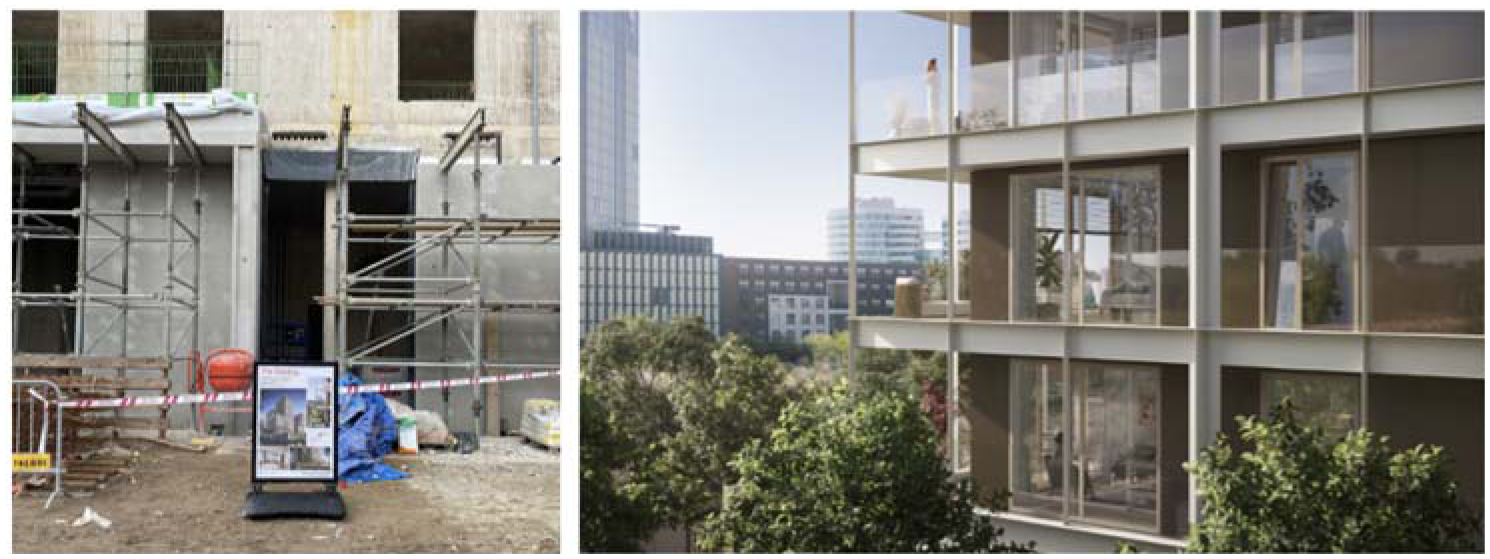
A photograph (left) of The Starling with the building’s entrance marked with a poster featuring the building’s name, a short description, and four virtual renderings (three exterior, one interior). One of the virtual renderings (right) displayed on the poster, with the tagline “Green at heart.”
My visits to the Bajeskwartier were predominantly documented visually, through photographs taken on my phone together with short videos and written reflections on my sensory experiences. Returning to these visuals in the writing of this article, then, also points me to the complex ways that atmospheres are captured and written into images. While the photographs taken for documentation offer a direct visual comparison between virtual rendering and physical construction, my written notes stress that, even in the moment, noticing and noting sensory experiences is often entangled with other mediations of the space. Reading research materials “as evocative of the research encounter through which they were produced, and of the embodied knowing this involved” (Pink, 2015: 144) folds my documentation back into the larger assemblage of urban images and imaginations. Here, the layering of architectural media throughout the construction process—as outlined above—takes on a spatial dimension as well: encountering the virtual rendering of the site’s promised future on the site and in the present simultaneously creates a connection between the image and the building, and a disconnection between the present and the future.
Thinking about urban ambiances as “created and experienced as a product of different, sometimes unique, blends of sights, sounds, smells, textures, tastes and thermal conditions” (Bruce et al., 2017; see also Thibaud, 2011) becomes particularly fascinating on an active construction site between the dusty particles of cement, aromas of freshly brewed coffee, improvised footpaths, and echoing building fragments. At this stage of the construction, the few spots of “green” visible on my visits are weeds growing along walls and edges that still need to be (re)moved or (re)done, particularly on parts of buildings remaining of the former prison complex. While undeniably representative of—maybe a more authentic—urban nature, the contrast with the multisensorial lushness of the imagined future, of “outdoor living in the city” (Bajeskwartier Amsterdam, 2022b), is striking. And yet, the constant back and forth between virtual and real across the mediations of the Bajeskwartier—and arguably other similar sustainable development projects—charges the construction site, even in its raw state, with sensory potential.
At the same time, the conceptual framing of resonance, of feeling in/through construction sites, proposed here as a methodological intervention, will form the everyday reality of the neighborhood’s first residents for the next few years: the larger (re)development is planned to progress throughout 2028. The past of the site, which “stories are still to be found in the con-crete” (Bajeskwartier Amsterdam, 2021: 4), resonates in the present as much as the sustainable, living, sensory vision of its future. As the architectural process shifts from virtual renderings and digital media to the physical construction, the engagement of the senses simultaneously shifts from an imagined to an experiential one—only to be looped back into the larger process of sensing and making sense. What I have called resonance here could also be understood as, at times, dissonant: as the “in-situ” analysis of virtual renderings underlines, the atmosphere imagined and the atmosphere experienced do not always, do not by default, overlap. This is precisely what makes architectural media a critical site for the negotiation of the site’s present and future in a larger socio-political context of urban (re)development. The sensorial promise of the Bajeskwartier, and similar “sustainable” architectural projects within and beyond the urban context of Amsterdam, is part of a larger framing of which environments—and environmental practices—are desirable. If “there is no escaping the political life of sensation,” as Howes (2024: 50) suggests, the construction of urban future(s) through sensory appeals also points to more complex questions of belonging. In both the fairly individualistic “open days,” which are centered around the presumed interests and needs of prospective buyers—affluent individuals, couples, and small families—moving in small units through the information center and across the site, and throughout the processual move-in of the first residents, the sense of shared, communal, rural living so central to the mediation of the Bajeskwartier resonates as a distant, aspirational promise on the physical site. A similar tension between “individual” and “collective” ways of living can be traced in other architectural developments as well, highlighting a larger shift in the framing of urban living. Rather than proposing an understanding of urban neighborhoods as developing over time—and potentially against the grain of public planning and control—the mediations construct an idea of the urban future as already existing “as designed.” In doing so, the architectural media (re)presenting the Bajeskwartier inscribe desired ways of engaging not only with the built and the natural environment but also with each other.
Conclusion
If the “perceptual is cultural and political,” as Bull et al. (2006: 5, emphasis in original) argue, paying attention to sensoriality highlights how architectural media play an increasingly important role not only in shaping cities spatially but also in shaping our shared understanding of sustainable futures. How, then, can we tune in to nature through all our senses—and how are imaginaries of urban nature(s) mediated through the visual, auditory, tactile, and olfactory in turn? As the representation of the Bajeskwartier as a “happy, healthy, living” neighborhood seamlessly shifts from virtual renderings to audiovisual media—both filmed on the specific site and representing generic locations—and back to virtual renderings, the visual presence of nature and the sensory absence of urbanity form part of an affective atmosphere. As this underlines, both presence and absence are central to the construction of atmosphere(s) in and through architectural media. Beyond blurring the boundaries between virtual and real in technological terms, the mediation of the neighborhood as “green” is suspended between imagination and experience, between present and potential. Tracing the resonance of the senses in and through architectural media opens up to explore whether we can encounter places, and their affective atmospheres, before they physically come into being. Through a discussion of the role of nature in imagining, rendering, and producing the Bajeskwartier as a sustainable neighborhood, this article corresponds to what Howes (2003: xii) has called a “sensorial turn” in cultural research as well as a renewed emphasis on sensory design in architecture (see Malnar and Vodvarka, 2004). Triangulating textual analysis and sensory ethnography, this article has argued that expanding the attention to the sensoriality of the city to include architectural media opens up towards an interplay of the senses not just in experiencing the urban present but also in imagining its future. Drawing on the temporal and spatial entanglement between media and the senses, the methodological and conceptual exploration of writing presence, smelling absence, and sensing resonance follows the attention to bodies and embodied spaces in architecture, and connects to interdisciplinary research on affect and a renewed interest not primarily in practices but in sensibilities in their connection to meaning-making (see Ahmed, 2014; Stewart, 2011). In line with Degen and Lewis’ (2020: 509) suggestion that “studies of urban atmospheres need to pay more attention to the manifold bodily capacities, personal and social histories which mediate and position in diverse ways how places are experienced,” this article pays attention to the sensorial appeal of architectural media in different forms and through different methodologies. A (re)orientation to the senses—and their presence, absence, and resonance—requires an interdisciplinary approach that brings together both conceptual and methodological considerations from and beyond media studies and urban studies.
This article aims to function as a starting point for this, and a proposition to think about the senses as constructed through and in between architectural media and architectural sites. An understanding of “the sense both as a relationship to a world and the senses as themselves a kind of structuring of space and defining of place” (Rodaway, 1994: 4) links back to the overarching exploration of processes of both place-making and meaning-making through architectural media. Foregrounding “sensory ways of knowing” (Pink, 2015: 13) in an interdependence with the built environment also opens up the discussion of different power dynamics at work in the imagination, design, and realization of “sustainable” cities. If the key interest of future studies, as an interdisciplinary endeavor in itself, is “making the invisible visible and tangible” (Candy and Kornet, 2019: 5), architectural media become a particularly productive object of analysis. Tracing the senses in architectural media simultaneously highlights the spatial and temporal dimensions of architecture as a mediated and mediatized process: as the design moves from mediation to mediation, so does the sensory imagination and experience conjured and captured in and through these mediations—actively contributing in its presence, absence, and resonance to the imagination of Bajeskwartier as being and becoming synonymous with urban nature(s). After all, “nowhere else in the heart of Amsterdam will you live so healthily and sustainably” (Bajeskwartier Amsterdam, n.d.c), as the development promises. Notably, throughout the materials discussed here, the Bajeskwartier appears to be largely independent and isolated from the surrounding city: beyond the comparative undertone embedded in the aspiration to become “the most sustainable urban district of the Netherlands” with a way of life possible “nowhere else,” the vision and visualization of the development’s future lacks a sense of interconnectedness that is, arguably, crucial to addressing the complexities of environmental crises in the present.
Footnotes

Funding
The author received no financial support for the research, authorship, and/or publication of this article.
Declaration of conflicting interests
The author declared no potential conflicts of interest with respect to the research, authorship, and/or publication of this article.