




Abstract
This paper uncovers the local state's complex intersections with the market and its multifaceted relations with the public through an in-depth qualitative case study of municipal housing privatization and urban renewal in one of the heartlands of the Swedish welfare state project, Rosengård in Malmö, Sweden. Drawing on the political-economic literature, I argue that housing privatization is entangled with complex interrelations among the (municipal) local state, the market, and the public and that an exploration of these relations reveals contemporary features of the local state. Hence, this investigation highlights the local state's motivation for privatization, the remaking of a market in a place where the market is believed to have failed, and the powers the local state retains. Additionally, the paper elucidates how the function of public assets changes due to privatization and considers tenants’ and residents’ worries, criticism, and concerns about municipal interventions. Subsequently, by grounding these findings in the historical function of municipalities in Sweden, the study contributes new knowledge on the local state in a deepened neoliberalized and financialized urban landscape.
Introduction
Housing privatization has in Sweden, as in other European countries, been a prominent feature in the regulatory shift from Keynesian statecraft to more neoliberal forms of economic development (Jessop, 2012). Starting in the UK in the 1980s, the Right to Buy-scheme inspired governments across Europe, as well as in Sweden, to roll out privatization schemes. In Sweden, privatizations in the form of sales of municipally owned housing to private rental owners, e.g., during the 1980s (Elander, 1991; Gustafsson, 2021), were accompanied by tenure conversions from municipal housing to market-based cooperative ownership during the 1990s and 2000s (Andersson and Magnusson Turner, 2014). However, since 2011, municipalities’ property transactions to private rental owners have been dominant (Grander and Westerdahl, unpublished), of which some examples have gained prominence in the media following protests of tenants and citizens (Fastighetsvärlden, 2016).
These processes of privatization have entailed an ideological regrouping of the state, where both the national government and the municipalities have actively discharged their ownership of housing. In 1992, the conservative national government allowed tenure conversions; however, local governments’ political leadership affected the divergent trajectories of municipal housing companies (MHCs) between municipalities (e.g. Andersson, 2014; Turner, 1997; Wimark et al., 2020). 1 While previous studies acknowledge the state's active role in privatization processes and the effect of privatization on the function of the Swedish state and its national politics, in terms of a shift within Sweden's housing system, this has been implicitly interpreted as a shrinking of state power and influence.
However, by turning to the case of municipal housing privatization and urban renewal in the context of Rosengård in Malmö, a complex and contingent political-economic narrative about local municipal state intervention and market (re)making appears. The paper addresses this issue through a case study of the renewal project Culture Casbah, in the area Rosengård, which the municipal housing company presented in 2010 and began to implement in 2016 by selling parts of its housing stock. Qualitative material includes documents and interviews conducted with municipal actors, tenants living in affected properties, and residents in Rosengård from 2017 to 2019. Analysis of these materials exposes the logics of and responses to urban renewal and housing privatization.
Drawing on this case, the paper offers the following three contributions. First, the paper contributes to the urban studies literature that argues that Malmö is an archetype for neoliberalization of urban space (Listerborn, 2017) in which the focus mainly has been on the redevelopment of urban land into high-end residential areas attracting wealthy citizens (Baeten, 2012; Holgersen, 2014; Holgersen and Baeten, 2017). Hence, while we find Pries (2020) work on the overall planning policy (1990–2005) and a particular planning program aiming towards deprived areas, this paper moves further in offering a grounded case study (covering the development from 2010 to 2019) to uncover how neoliberal urban governance unfolds in the disadvantaged area of Rosengård, while understanding this area as a physical manifestation of the welfare project's heydays rather than as a peripheral anomaly. Here, I understand urban governance as an operationalization of market logics through the cooperation of state and private stakeholders in pursuit for economic growth, which is intertwined with an uneven geographical development (Goodwin and Painter, 1996).
Second, the paper contributes to the body of housing literature (referenced above) concerned with housing privatization in Sweden that has taken the form of tenure conversions into tenant cooperatives, by highlighting the privatization of public housing into private rentals and the effect of this on the local state and municipal governance. Third, addressing the salient political-economic writings on the local state (see e.g. Ormerod, 2017; Penny, 2021; Peck and Whiteside, 2016), the paper contributes with conceptual development of the interrelation of local state and market, as an expression of urban governance, by emphasizing the need for a parallel engagement with the local state's relations with the public as these relations are intimately bound with political-economic changes. Hence, inspired by Ormerod's (2017) emphasis on the political effects on the public in her work on housing and the local state, I engage with the function of public assets and with tenants’ and residents’ perceptions of privatization and urban renewal. Through these contributions, the paper suggests that housing privatization in Sweden provides an important lens through which to understand the relationship between municipal restructuring and rental market change. Hence, the paper argues that the function and political effects of the local state need to be addressed through its interrelations with the market and the public.
I develop this argument by conceptualizing Sweden's municipalities as ‘local states’, while the ‘market’ is empirically delimited to the residential, rental property market. ‘The public’, on the other hand, addresses the social sphere, including tenants and residents, as well as the function of public assets, such as housing and land, for the public. The paper's focus on the nexus of these relations is motivated by Sweden's unique history, as municipalities and their establishment of MHCs aimed to counterbalance market forces and speculation and to secure the public's political, civil and social rights (cf. Ekström von Essen, 2003). The formation of municipalities and the extension of their socio-political responsibilities, including housing provision, entailed specific relations with the market and the public, that is, municipal residents. With this unique historical setting as a point of departure, this paper aims to provide a spatially grounded investigation of local state power in light of housing privatization and urban renewal.
This paper proceeds as follows. First, it briefly presents the background on the issue of housing privatization and introduces previous political-economic engagements with state-market relations, and it motivates a relational understanding of the state and market in the Swedish setting, particularly in response to previous studies on neoliberalization in Sweden. It then explains the usefulness of the local state-theoretical perspective in addressing the conflictual nature of municipal governance. Next, the paper presents the case study before moving on to uncover which relations among the local state, the market, and the public appear in the event of housing privatization. The paper concludes with a discussion of the implications of these relations for the function of the local state.
Housing privatization and political-economic departure points
The privatization of public and social housing has been a prominent part of the variegated economic restructuring of Western countries (cf. Peck and Theodore, 2007); however, its features have shifted across contexts (see e.g. Lundqvist (1992); Clapham and Kintrea (1996) and Murie (2013)). In Sweden, while the national trend has remained somewhat stable, with the municipally owned housing stock amounting to approximately 20 to 25% from the 1970s to the 2000s (Bengtsson, 2013, 122–123), recent decades have witnessed a further decrease to approximately 17% (Statistics Sweden, 2019). Yet, regional variations reflect how policies supporting tenure conversions into tenant cooperatives (bostadsrätter) have affected the tenure landscapes differently across Sweden (see Wimark et al., 2020), with the inner city of Stockholm representing an extreme case, as its municipal housing sector decreased from 19 to 7% (Andersson and Magnusson Turner, 2014). As mentioned above, however, since 2011 sales of municipal housing to private rental actors have been dominant (Boverket, 2017; Grander and Westerdahl, unpublished). These sales can be linked to the reform of the municipal housing sector in 2011. The new law (Allbolagen) following this reform postulates that municipal housing providers need to act business like and, hence, it encourages municipal housing companies to sell their assets to finance housing refurbishment and production (Grander, 2017, 2018).
Comparative housing studies have explained public housing privatization as an effect of welfare state retrenchment. Often combined with theories on welfare (Esping-Andersen and Korpi, 1986), housing scholars understand housing privatization foremost in the context of housing regime classifications, where Sweden exemplifies a social-democratic welfare regime (Kemeny, 2006) challenged by rounds of state deregulation and an economic and ideological perspective privileging homeownership (e.g. Turner and Whitehead, 2002). However, Blessing (2012) challenges these conceptualizations’ immanent dualistic view of the state/market and argues for a more complex understanding of how nonprofit housing providers succumb to and integrate marketized logics. Blessing's note on hybridity has since been applied to the Swedish setting, in which the combination of regulation and deregulation, as argued by Christophers (2013), forms a monstrous hybridity.
Extending the abovementioned work, I turn to the political-economic literature, which highlights how the state (on all levels) is an active agent in market restructuring and public retrenchment. In particular, this scholarship illustrates the state's active role in relation to private property and land markets (e.g. Christophers, 2018; Whiteside, 2017). Here, scholars describe the “mobilisation and reconfiguration of state powers” (Ashton et al., 2016, 1385) as key for the privatization and financialization of infrastructure, emphasizing the dialectical relationship between state restructuring and changing ownership structures (Adisson, 2018).
These studies span a variety of geographies, as they, for instance, highlight how the Canadian state actively devalues its assets using various techniques (Whiteside, 2017) or how the local municipal state in the case of Gateshead, England deconstructs and reconstructs the housing market (Ormerod, 2017) in a self-reinforcing process of the redistribution of state assets to the private market, which is also evident at a national scale across the UK (Christophers, 2018). In the U.S. context, Peck and Whiteside (2016), among others, address the deep ties between local public bodies and (financial) markets (see e.g. Weber, 2021). Moreover, Belotti and Arbaci (2020) explicate how social housing providers in Italy undertake financial innovations, and Deruytter and Bassens (2021) highlight how Flemish municipal cooperatives internalize debt, while extending local statecraft. We also find literature on the state's active market remaking in Nordic countries. Hyötalainen and Haila (2018) explore entrepreneurial housing governance in Helsinki, Finland where the city government sells land assets for private development. In the Swedish case, Olsson (2018) elucidates the municipality's dual role as landowner and developer and how this role is used to promote private investments, which signals a break with the traditional planning function held by municipalities.
These political-economic writings provide a relational understanding of the state and market, explained more in detail below. Against this backdrop, the paper approaches the ‘market’, particularly the rental market, as an open domain that is being undone and redone through various marketization processes (Berndt et al., 2020). Entwined with these processes is the simultaneously complex sphere of the state, or urban governance, as “[t]he boundaries of the state in the urban policy sphere are not simply being rolled back. Rather, the ideological context of state action is being redefined, policy objectives are being recast and the interface of the public and private sector restructured” (Peck, 1995, 35).
Drawing from this stream of literature, this paper conceives of neoliberalization and financialization as variegated and multiscalar processes. While neoliberalization processes unfold through uneven and contingent “market-oriented regulatory restructuring” (Brenner et al., 2010, 109), of which privatization is a key element (Christophers, 2018, 17), financialization entails how former nonfinancial actors internalize financialized logics and practices, as well as how the previously nonfinancial domain becomes embedded in financial circuits (Aalbers, 2016; van der Zwan, 2014). Departing from these conceptualizations, this paper sets out to unpack the relations among the local state, the market, and the public, as these appear in the selected case study.
As mentioned, such an investigation is particularly interesting in the Swedish context due the historical function of municipalities. Municipalities were established as units “for local self-government” in 1862 (Sellers et al., 2020, 190), and following the Second World War, they came to manifest the people's home ideology (folkhemsideologin) when the national state gave municipalities the main responsibility for securing social rights, including the right to housing (Ekström von Essen, 2003). Central to this responsibility was the aim for the municipal ownership of housing to counterbalance speculative landlordism (Bengtsson, 2001; Lundqvist, 1992). Thus, when investigating the local state in Sweden, the historically political aspiration of municipalities, that is, bringing democracy closer to the public while securing certain social rights, necessitates engagement with how this function has developed. However, such an inquiry needs to be sensitive to the internal conflicts of local state formation, for instance, along gendered and racialized hierarchies (Hirdman, 2018; Molina, 1997).
While previous research focusing on the Swedish setting have highlighted issues such as, state-led gentrification through the establishment of public-private partnerships (Baeten and Listerborn, 2015), the increased marketization of the municipal housing sector (Grander, 2017, 2018), and the influence of public-private business improvement districts (BIDs) on urban injustices (Valli and Hammami, 2020), this paper specifically investigates housing privatization and how it expresses both local state/market and state/public relations. Furthermore, previous studies have explained how Malmö has undergone a city marketing narrating the transition from an industrial crisis into a post-industrial knowledge city (Mukhtar-Landgren, 2008). These studies have described the city's neoliberal project as aiming to refurbish the demographic base through the construction of residential areas and urban space (Baeten, 2012; Holgersen, 2014; Holgersen and Baeten, 2017), aspiring to attract the creative class (Listerborn, 2017), with the parallel remoulding of the low-skilled workforce through entrepreneurial logics (Pries, 2020). However, in this paper, I highlight how the area of Rosengård continues being a place for local welfare state restructuring as the municipality mobilizes, discharges and maintains its powers to engage with private actors and in market creation.
The local state within financialized urban governance
Recent writings on local state power (of which some are referenced above) situate the urban politics of late entrepreneurialism within variegated geographies (e.g. Beswick and Penny, 2018; Ormerod and MacLeod, 2018; Penny, 2021; Weber, 2021). This body of work emphasizes how local governmental bodies and actors are embedded in the wider political economy, internalizing social conflicts and contradictions while simultaneously pushing for certain place-bound interventions. Moreover, these writings situate contemporary state-market relations within financialized urban governance in which “a municipal debt regime” (cf. Deruytter and Bassens, 2021; Peck and Whiteside, 2016, 238) is “increasingly realized through financially mediated means and in conjunction with credit market actors, agencies, and intermediaries” (Peck and Whiteside, 2016, 239).
Rooted in regulation theory, authors have used the concept of the local state to investigate the restructuring of state power during the post-Fordist era (Goodwin and Painter, 1996); however, urban governance became the conceptual framework through which to read urban political change and its salient networks of state and market relations (e.g. Brenner, 2004; Harvey, 1989). Nevertheless, the ‘local state’ concept has returned as an analytical concept (cf. Ormerod, 2017, 64). Tying into this rejuvenation, in this paper, the notion of the local state retains its focus on the socioeconomic and political functions of the municipality, regarding its agency within the context of entrepreneurial housing and urban governance (cf. Deruytter and Bassens, 2021; Ormerod and MacLeod, 2018).
A seminal reference occurring in the recent literature on the local state is a paper by Leitner from 1990. She highlights how the pressures witnessed by the local state derive from various scales and that they result in conflicting demands, such as economic development and welfare provision (Leitner, 1990). This conflict surfaces in several of the more recent contributions to the political economy of local governments (e.g. Ormerod, 2017; Peck & Whiteside, 2016). For instance, Penny (2021: 13) argues that London's emergent local housing companies represent a “local state rentierism”, as their operation includes a “mobilisation of monopoly power over a scarce resource, in this case public land, for the speculative pursuit of fiscal rents and the provision of social infrastructure”. However, this assumes that public bodies prioritize ensuing asset values “over concerns to satisfy social need” (Penny, 2021: 15). Additionally, Weber (2020) highlights the conflict between financial and public values in the case of U.S. local governments’ tax subsidies for private redevelopment.
Moreover, rather than reifying the local scale, the mentioned work sees the local state and the emerging forms of urban governance as formed through multiscalar and historical processes that shape the local state's strategic actions (Leitner, 1990; Macleod and Goodwin, 1999;). Crucially, as Olsson (2018) points out, rather than the state and market being two opposing forces or objects, they are relationally entwined. Furthermore, Ashton et al. (2016, 1393) highlight a dangerous pitfall, that the “binary opposition between market and state power obscures the local economic and political changes promoted by financialisation”. Hence, these writings on interventionist “municipal state craft” (Penny, 2021: 2; cf. Lauermann, 2016) suggest “a drafting of business into the state” (Ormerod, 2017, 67). As mentioned, the Nordic experience of these tendencies entails how urban governments internalize financial logic in land development (Hyötyläinen & Haila, 2018).
In the abovementioned literature, two central and interrelated problematics emerge. First, the complex relations between the state and the market entail multifaceted relations between the state and residents. For instance, Ormerod (2017) illustrates how residents are displaced and how they voice concern in response to the local state's planned housing demolition and renewal, which resonates with recent research on tenants’ experiences of displacement following renovation in Sweden (Pull and Richard, 2019). Additionally, Beswick and Penny state in the case of council-owned housing in London that although a financially empowered local state increases its “capacity and control”, “any such gains must be set against longer-term financial, democratic and political risk that ultimately will be borne by residents” (2018, 613).
The second concern is the function of public ownership. As Haila (2016, 70–71) writes, “land can be private, common, public, collective, state, municipal and shared. Different arrangements have different consequences”. However, these consequences should not be taken for granted; we cannot assume that public ownership by default means that land, or landed property, such as housing, develops in line with public interests. However, as Christophers (2018, 57) states, a democratically elected state “does at least preserve the possibility of the public having some kind of say over use of land. If public land is sold off to the private sector, that possibility is gone” (emphasis in the original). However, in the Swedish context, this becomes more complicated when considering that municipalities have a so-called planning monopoly, meaning that they control the use of land, including the prospect for housing construction, regardless of whether they own the land or not. Nevertheless, many have suggested that this control is circumscribed and that municipalities use their tools, such as the planning monopoly, for redistributive purposes only to a small degree, as argued by Olsson (2018). Hence, the ownership of land, or other assets, brings with it more possibilities than the lack of ownership.
Consequently, the possibility of public interests being represented in the use of land and housing becomes constrained in the present but also in the future as the privatization or internalization of marketized or financialized logics open up the possibility of exposure to external pressures and volatility (Ashton et al., 2016; Beswick and Penny, 2018; Penny, 2021). Subsequently, while the new municipal housing legislation from 2011 reinforced the marketization of the municipal housing sector, this paper's perspective is that municipal housing ownership still matters, partly because of the social responsibility still ascribed to the sector but also because of the possibilities tied to this ownership.
Using these two implications as a stepping stone, this paper reveals the function of the local state by focusing on its relations with an actually existing market (Berndt et al., 2020), as well as on its relations with the public, a likewise shifting and complex domain. Importantly, these relations comprise of several contradictions, through which entrepreunerial municipal statecraft is formed (cf. Penny, 2021).
Presentation of the case study
This paper investigates housing privatization through a case study of the renewal project Culture Casbah, located in Rosengård in Malmö, Sweden's third largest city. I selected this case since it develops context-bound knowledge about the local state in light of its relations to the market and the public, as these relations crystallize in the event of housing privatization. Therefore, the case responds to recent calls for grounded single-city studies to use, test and expand on the knowledge of urban restructuring (Peck, 2016, 2017). My motivation for choosing the city of Malmö for this investigation is that it offers an example of the ongoing trend in Sweden to sell municipal housing to private rental owners. Since Malmö and Rosengård embed various social relations, which themselves are connected to various scales, the chosen case goes beyond describing a particularity to elucidating some geographically wider processes (Massey, 1991), such as local state restructuring, neoliberalization and financialization. Therefore, the case represents a paradigmatic case study (Flyvbjerg, 2006) as it exposes how more general, although variegated, processes unfold through a specific case of privatization.
The case study, which I carried out between 2017 and 2019, includes interviews with 44 interviewees representing the following categories: the municipality, political parties, and activists (16 representatives), the municipal housing companies (six) and private landlords (five), tenants and municipal residents (15), and the Swedish Union of Tenants (one). Additionally, I carried out short observational interviews with seven more tenants. I have anonymized a majority of the interviews and the names are pseudonyms. I have, when possible, recorded and transcribed the interviews.
Moreover, I have analysed documents, including for example, annual reports, credit ratings, and planning documents, from municipal and private actors involved in the case. The observations (ten in total) involve walking observations to gain an embodied experience (Pierce and Lawhon, 2015) of the privatization and renewal processes, together with attendance at tenants’ meetings in response to the announcement of the sale, shareholder meetings, and the opening of a new train station.
I analysed interview-transcriptions and notes, documents, meeting minutes and fieldnotes through the identification of descriptive and analytical themes and codes (Cope, 2016) (e.g. the role of municipally owned housing, private investments, and worries) using the NVivo software. I extracted the presented citations to reflect recurring narratives regarding these themes.
The renewal project and housing sale
Malmö city's municipal housing company, MKB, launched plans for a larger renewal of the area of Rosengård in Malmö in 2010, as the company saw a need to revitalize the neighbourhood (Malmö municipality, 2013). Subsequently, MKB announced an architectural competition in which the Danish firm Lundgaard & Tranberg Arkitekter won with their Algerian-inspired project named Culture Casbah. The renewal project focused on a tower building including both residential and retail space, which exemplified an attempt to break the purported segregation of Rosengård. In 2013, the Culture Casbah-idea won the title ‘Best Futura Project’ at the international property conference MIPIM (MKB, 2016: 5). In subsequent years, the project was linked to other redevelopment in the area, especially to the new Rosengård railway station, which the municipality sees as key in the region's infrastructural and labour market development (MKB, 2016; Orange, 2019).
The Rosengård area was constructed as part of the welfare state's extensive housing production scheme during the 1960s and 1970s and went along with an expansion of the municipal ownership of housing and land in Malmö. Currently, Rosengård has a population of approximately 24,000 residents, of whom approximately 3000 live in Törnrosen and approximately 5000 live in Örtagården (Stadskontoret, 2018), the areas of Rosengård mostly affected by the renewal project. 2 Photo 1 shows the areas’ courtyards.
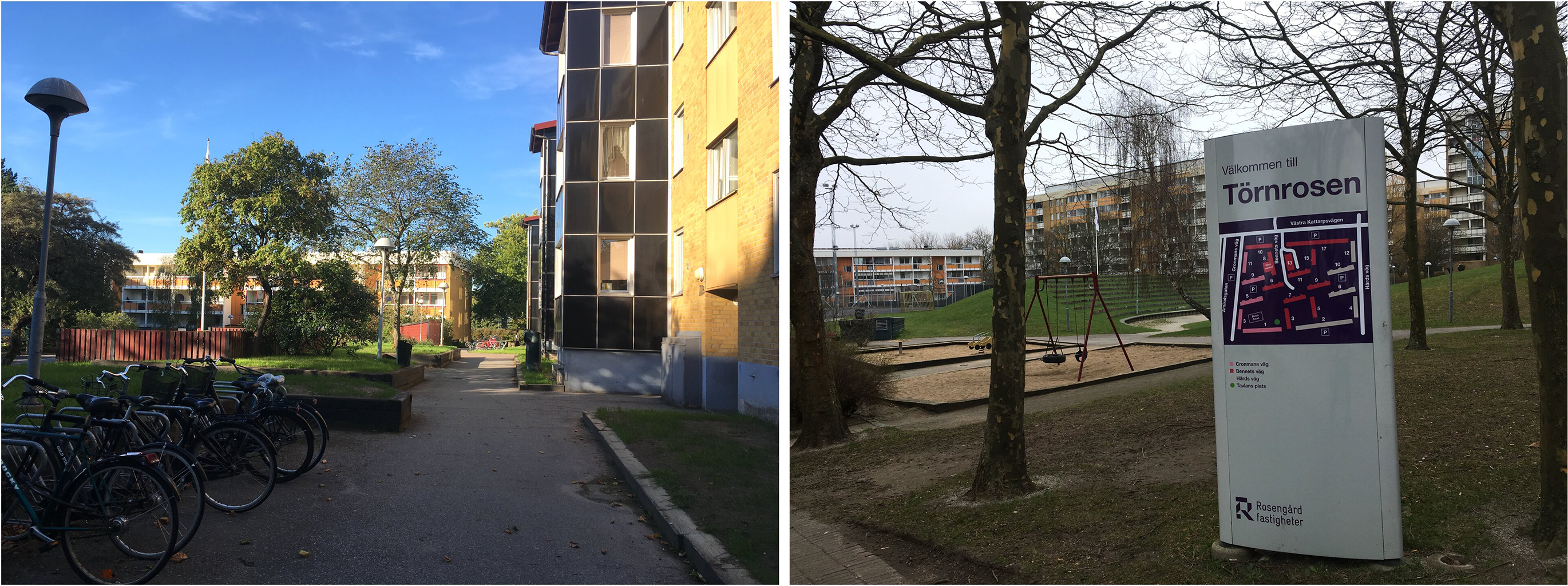
Örtagården and Törnrosen courtyards. Photos taken by the author.
Rosengård has witnessed waves of symbolic and material devaluation since its construction. The symbolic devaluation includes the media's negative representations of the area, which often mismatch with the experiences of living there (Ristilammi, 1994), not uncommon for housing areas built during this time period. Material devaluation involves the more than five decades-old properties' need for refurbishment and the sometimes turbulent ownership switches that leave estates poorly maintained (Hallin et al., 2010), providing a basis for possible value increments. These devaluations help legitimatize certain interventions, in this case the privatization of housing and urban regeneration (cf. Kallin and Slater, 2014). However, I stress the significance of Rosengård as a socio-spatial product of the welfare state ideology, suggesting that we can trace changes of the welfare state to this area. For instance, according to Grundström and Molina (2016), areas such as Rosengård manifest the effect of residential segregation deriving from the deregulation of Sweden's housing system, yet, as I illustrate below, the local state's regulatory power persists in contradictory forms.
The launch of the renewal plans was followed by a few years of silence, but in 2016, the MHC again raised the Culture Casbah project in the city council, with the additional need for the planned tower to be financed through the creation of a new housing company formed as a public-private partnership consisting of the MHC and three private rental companies: Balder, Heimstaden, and Victoria Park. The agreement between these actors, presented by the MHC to the city council, stated that the construction of the symbolic tower was a minimum requirement for the collaboration to be valid (MKB, 2016). To provide the new housing company with an economic base, the MHC applied for the transfer of 1650 apartments, including the land, to the new company, representing 7% of the municipality's housing stock. The city council approved the plan, but it was discussed and criticized by the public. Criticism was especially directed towards the cooperation between the MHC and private actors and towards the sale of municipal housing. Additionally, a transfer of 300 building rights (byggrätter) was associated with the sale, which placed future housing production in the area in the hands of the new rental housing company (MKB 2016). In 2019, the renewal project took a new turn when the new public-private company, Rosengårds Fastigheter, announced that the municipality had approved the planning processes for new buildings with various residential, retail, office, and cultural purposes (Rosengårds Fastigheter, 2019), however, the tower had been excluded from the plans.
Currently, Rosengårds Fastigheter is the largest landlord in Rosengård and its establishment reflects the tendencies of the rental market in Sweden. In particular, Victoria Park, one of the three private actors, is rooted in Malmö's business elite and has, since 2016, become more deeply joined with the European property-finance nexus. The company, founded in 2007 and entering the multifamily property market in 2012, was bought by German real estate owner Vonovia in 2018. After that, Vonovia expanded in the Swedish market by acquiring the private rental company Hembla, previously owned by the global investor Blackstone (cf. Beswick et al., 2016). This turned Vonovia into Sweden's largest landlord. Furthermore, Vonovia's ownership is interlinked to an increased financialization of private rental housing in Sweden and beyond, where private rental owners use renovations and subsequent rent rises to boost market and shareholder values (e.g. Fields and Uffer, 2016). Hence, what began in 2010 as a municipally initiated renewal, privatization, and public-private partnership, ended up in the swirl of international financial capital eight years later.
Uncovering housing privatization
Motivating privatization, creating markets, and maintaining local state powers
This paper centres on housing privatization as a pivotal moment in which to understand local state-market relations, especially as these relations mirror the process of state and market (re)making (e.g. Berndt et al., 2020). The studied privatization reflects the process explained by Weber (2021, 504) as follows: “to catalyze property value appreciation, the local state enters into transactions with real estate developers and their financial backers, who seek assurance that future returns will be sufficient to make investments in today's built environment”. Hence, in the following section, the paper emphasizes how municipal actors motivate the implementation of housing privatization and public-private partnerships in Rosengård. Municipal actors include the municipal housing company (MKB), the planning department, and the social-democratic leadership. These actors’ motivations exemplify the municipality's strategic actions (cf. Hyötyläinen & Haila, 2018: 140). Furthermore, the analysis highlights how these actors perceive how the market functions (or not) in Rosengård and, likewise, ideas about how private and local state investments revitalize the market and the urban fabric.
A central motivation for the municipality's sale of its housing is the renewal project's inherent risk. Municipal representatives and sources recurrently referred to the discrepancy between the expected investment costs and the assessed value of the planned properties. The cost of the tower and planned densification were estimated to be 710 million Swedish crowns (SEK), while the assessed value was 420–500 million SEK (MKB, 2013).
3
This discrepancy alluded to the need for new ownership structures. For instance, an early project description addressed the possibility of including private stakeholders and mixed tenure types: The project [Culture Casbah] should from its start be planned for different tenure types and, if possible, also include more investors other than the MHC and the city's administrations. Certain parts of the project should be able to be sold to the residents themselves as well as to other housing companies to spread the risks, broaden the customer base and make the area more attractive and dynamic. (MKB, 2013)
4
Additionally, following the announcement of the new housing company in a partnership between the three private rental landlords and the MHC, the former urban director expressed that “Malmö takes a smaller risk, that's part of the plan, to share the risk; [the MHC] would otherwise have taken the whole risk itself, while now, the business world takes 75% of the risk” (Interview, Jan., 2018). How the projects’ economic insecurity frames the actions of municipal actors exemplifies how the “volatility and uncertainty of property values […] create a need to coordinate modes of action across public and private spheres” (Weber, 2021, 516–517). However, the renewal project also entailed how the municipal actors sought to increase a rent gap through coordinated moves and, hence, resonating with what Weber (2021, 517) describes as a “co-rent seeking”. Municipal actors explained that the engagement of private rental companies, facilitated by housing privatization, signalled that the project had potential, including a ‘promise’ for future investment in the area: … I think that the signal to the market shouldn’t be belittled either, that if three publicly listed companies enter together, then it's, I mean if a MHC and Malmö Municipality believe in this project, that is not curious, but if there are three commercial actors saying that ‘we believe in this’, then it has a real potential… (Interview, representatives the MHC, Jan., 2018).
Subsequently, by selling its assets, the local state managed to facilitate investment flows and ignite expectations of future value development in Rosengård. Additionally, a political secretary addressed the municipality's coordinated and co-rent seeking moves as: “for [Culture Casbah] to become a successful project, [it's important] that it's not only the MHC that invests in Rosengård, but that it's private money that also invests in areas like Rosengård, sending a signal” (Interview, political secretary, Social Democratic Party, Nov., 2017). In the long run, this could increase the attractiveness of the area and, thus, according to the MHC, tenants’ willingness to pay, leading to elevated rent-revenues “by one to two percent per year over a ten-year time period would have an effect on the area's real estate values, appreciated to 250–500 million SEK, which would offset the projects initial underperformance” (MKB, 2013: 6).
Importantly, to generate this value formation and realize its potential, a functioning housing market needs to be in place. In Rosengård, the sale of municipal housing intersected with the revitalization of a market in a place where municipal actors perceived it to be failing. Municipal actors linked this failure to Rosengård's infamous reputation and acknowledged the need to connect the Rosengård area to the whole city of Malmö (MKB, 2016). While the municipality has targeted other areas in Malmö (such as the former industrial harbour) for extensive urban renewal schemes, Rosengård, as actors asserted, has remained outside the reach of new investments in the built environment; however, “now it's Rosengård's turn”, as the mayor phrased it when presenting the privatization and the renewal project (Stjernfeldt Jammeh and Cars, 2016). This recurring narrative was also expressed by an interviewee, noting how the Culture Casbah project represents an example of the city doing something in an area the market has not found: … when we talk about both social and physical efforts [from the municipality], then it's not only about contributing to where the market thinks it's self-evident but also to where the market […] hasn’t looked for many, many years, and we finally have an example of that actually happening when we talk about Culture Casbah … (Interview, political secretary, Social Democratic Party, Nov., 2017)
Accordingly, interviewees expressed that the municipality's active role would be useful in boosting a disrupted market. Generally, rather than seeing the municipality as a passive institutional arrangement, the actors emphasized how the municipality's functions should be used proactively (Interview, former urban director, Jan., 2018).
Last, the renewal project, although the privatization and revitalization of the rental market are key for its implementation, entails that the municipality remains a central actor and key investor in the area. The market value of the municipal housing stock sold in 2016 was estimated to be 1100 million Swedish crowns (MKB, 2016: 9) and the MHC gained 600 million SEK, which it planned to use for acquisitions (400 MSEK), urban renewal in Rosengård (100 MSEK), and social operations (100 MSEK) (MKB, 2017). Furthermore, the MHC stands as a guarantee to cover eventual losses due to the housing production part of the renewal project, up to 50 million SEK. Hence, in addition to actively steering private investments in the area through the establishment of Rosengårds Fastigheter, to which the municipality sold some of its properties, the MHC continued investing in the area using the capital gained from the sale. Additionally, the MHC used the profits from the sale to strengthen its relationship with another private actor, the housing company Trianon, which owns the local shopping mall at Rosengård, forming a public foundation that was to address social issues in Malmö (MKB, 2019).
Moreover, since the privatization of municipal housing is part of the wider renewal of the area, including the adjacent new train station, the role of the local state as an active investor also appears here. The municipality invested 184 million SEK in the new stations along the train-line and neighbouring public space, and it subsidized the infrastructure project with 105 million SEK (Malmö Municipality, 2019: 95, 109). Furthermore, the municipality was required to financially cover the economic deficit of passenger traffic (Malmö Municipality and County Administrative Board Skåne Län, 2018).
In sum, the relations between the local state, in particular its planning and housing bodies, and the residential rental market unfolded along three main lines. First, municipal actors mobilized the privatization of public assets, carried out through the public-private partnership, to share the renewal project's high risk. Second, the municipality regarded it to be essential to steer investments to an area with market flaws to “heal” the city's socioeconomic rifts (MKB, 2016), while emphasizing the municipality's active role in this market revitalization. Third, following privatization and the formation of the public-private partnership, the municipality remained a key actor and investor, maintaining its political and economic presence. Taken together, these instances mirror the remaking and maintaining of an actually existing rental market (Berndt et al., 2020) and the local state's role as a planner and housing provider.
The municipality's market remaking entails social motivations, for instance, being presented as an integration project, which could be read as a “push back against the urban neoliberal doxa” (Penny 2021: 5), in that the municipality seeks to combine “economic and social values” (Penny 2021:6). This ambition, however, also includes how municipal agencies revalue tenants’ homes, constituting these as a quasi-financial asset (cf. Penny 2021: 14). The local state thus appears to be drifting astray from its historical mission to dampen speculation on the housing market. In contrast, the municipality has taken actions that ultimately place its former assets and the urban space where these assets are located in the care of other, more financially embedded, real estate actors. Hence, I turn to state-public relations to discuss the implications of housing privatization.
Revaluing homes and public responses
The local state-market relations, discussed above, are reflected in parallel local state-public relations, in which two aspects are central. The first is how the event of privatization is embedded in a logic that gives rise to a specific function of housing in that it re-values municipal housing according to its exchange value instead of its use value (cf. Harvey, 2006). This logic gives prominence to the housing stock's function as an economic asset, rather than as a home, that can be used to reconstruct the market and spur investments in a ‘devalued’ area. Second, in the event of the sale of municipal housing, tenants living in the sold estates and residents in Rosengård express concerns about displacement, criticism about the lack of democracy surrounding the project, and feelings of disconnection from the planned regeneration.
The first aspect is central in the initial plans for the renewal project, as the MHC proposes that the potential future value of the existing housing stock in Rosengård compensates the (aforementioned) under-return of the renewal project, estimated to be 210–290 million SEK: Separate objects must not in themselves give a market return, but the effect of the whole project needs to be economically defensible. Underperformance in one part needs to be compensated for and motivated by increased revenue in other parts. In that sense, [the MHC's] vast property in the neighbourhood (almost 4000 apartments) is a strong fund to build from. (MKB, 2013: 2)
In this quote, ‘other parts’ of the housing stock are pointed out as possible bearers of future costs, and thus, tenants and their homes are repositioned as having an economic function and, specifically, as a basis to make the project economically viable. The MHC reinforces this emphasis on the housing's exchange value by introducing diversification as a key route to market returns: “Different scenarios for rent setting are needed (demand, rent levels, customer base, standards, etc.). This is a critical factor in the calculation” (MKB, 2013: 2). While the MHC drew up these assessments at a stage prior to the launch of privatization in 2016, they continued to legitimate the privatization and public-private partnership. Municipal actors’ perceptions concerning market revitalization and private investments, discussed in the previous section, are embedded in these calculations and expectations for amplified property values. In other words, a local state-public relation appears in which tenants’ homes are revalued according to financial logics; that is, they are repositioned as economic assets, which signals a break with the prior function of municipal ownership that tries to hamper the dominance of market logics within housing provision.
Housing privatization, renewal plans, and their implications are reflected in tenants’ and residents’ attitudes, as they identify the possibility of gentrification and rising rent levels. One resident expresses a concern about the change of who will live in Rosengård: … what I feel is that when you have a growing middle class, then you need this space for the middle class, and you want to get rid of the lower class, that's why I’m highlighting it, because for me it's obvious that they want to get rid of the lower class… (Interview, Omar, resident, Nov., 2017)
Furthermore, Hafida, a tenant, conveys a fear that it will become more expensive, that the new apartments will be expensive and that surrounding apartments will be affected 5 (Fieldnotes Dec., 2017). Other tenants talk about who it is who will live in the tower, that it is not the residents in Rosengård, that the rents will be too high, who will live there? (Interview notes, Warda and Halima, tenants Nov., 2017).
Moreover, tenants and residents reflect on the lack of information about the sale. The news about the planned privatization reached the media less than two months before the city council approved the sale, giving little time for the public to react to the plans (Pedersen, 2016). Even so, tenants and residents mobilized by going from door to door, debating in the local newspaper, and organizing protests and speeches at a local meeting place. When Warda, a tenant, recounted a demonstration against the sale, she said that “… they had already sold, they had already agreed to sell a few months ago, they had the decision …” (Interview, Nov., 2017). While the municipality had not sold the housing, the tenants still felt that they could not influence the decision. Additionally, Saif, an activist contesting the privatization, explained how the tenants and residents felt unable to react within the limited time period before the city council would consider the inquiry “…it all went very fast; we felt a lot of time pressure when we got to know about this very close to the voting…” (Interview, Dec., 2017).
Tenants also linked the unavailability of information to the absence of democracy, Hafida stated that they, the municipality and [the MHC], hid the decision about the sale; it is a question of democracy and a question about safety first of all, to ask first, but they did not do that, they did not tell – that creates worry (Fieldnotes, Dec., 2017).
In addition, tenants and residents voiced concern about not being the target group for the renewal project. Such reflections resonate with how Rosengård has been exhausted by integration and social projects over the years, for example, for the creation of work opportunities. The renewal project Culture Casbah echoed these previous ambitions by being presented as a social investment aiming to, physically and socially, connect Rosengård with the rest of the city. Tenants and residents recognized these ambitions as they reflected about what the project and the sale could bring to the area. For example, Hafida wondered: Who will work in the tower? If they create job opportunities in Rosengård, they need to be for those living here, not for people living outside just coming here for work, that would be unfair (Fieldnotes Dec., 2017). Yasmina expressed a similar concern: … it's like Catrin, [the mayor], is saying, [Culture Casbah] will create jobs, […] but for whom is the employment created for, it's not for the residents here, the jobs are created for those who contract them, […], there are not jobs created for us here in Rosengård … (Interview, Yasmina, tenant, Jan., 2018).
Tenants’ and residents’ experiences of the municipality's actions in the neighbourhood, for instance, concerns about displacement, critique about a lack of democracy, and feelings of disconnection from the renewal plan, reflect a disruption from the local state's historical political aspiration. These narratives contradict the local state's imaginaries of the need for market intervention and investments. The rapid organization following the announcement of sales in 2016 also shows how tenants and residents could mobilize across social networks within a short time period. Such actions present alternative expectations towards the municipality, which in turn resonate with the immanent conflictual nature of the local state (cf. Leitner, 1990). Consequently, the local state's democratic inclusionary element conflicts with imaginaries about the need for privatization and market recreation.
Concluding discussion
Privatization is a key process within the regulatory shift from Keynesian statecraft to more neoliberal forms of economic development, including neoliberal housing policies. By providing an empirically grounded case study of the renewal project Culture Casbah in the emblematic place for the culmination of welfare state intervention; Rosengård in Malmö, this paper has explored how the function of the local state and its ownership of housing appears within the processes of housing privatization in Sweden. This paper proposed that housing privatization needs to be understood through an analysis of the local state's relations with both the market and the public. I have, hence, addressed the interrelations among municipal housing and urban governance, residential rental property markets, and the function of public assets for tenants and residents, including their experiences of interventions in this function. Subsequently, I have argued that an investigation of these relations sheds light on the contemporary function of the local state.
The findings present three main dimensions of the local state-market relations. First, municipal actors actively motivated privatization through notions about financial risk-taking. Second, the municipality and its functions, as agued by municipal actors, were to be used to recreate the market in an area where it was perceived to have failed. Hence, market (re)making was intertwined with specific place-bound notions, for instance, about segregation and obsolescence. Third, the municipality remained an important investor; for example, the MHC reinvested profits from the sale into the renewal site, and the municipality was an important financier and creditor for infrastructure development in the area. Together, these instances illustrated how the local state motivated its dismantling and recreated the property market while maintaining its power and financial responsibilities. This, consequently, contrasts with the historical function of the local state in Sweden, which included an ambition to hamper speculation by expanding the state ownership of both land and housing. Importantly, these instances of state-market relations also illustrate the multifaceted ways of contemporary municipal governance.
Additionally, this paper focused on how the local state is intrinsically formed through its conflicting relations with the public. This entails how the local state internalizes social conflicts and opposing demands in its management. The empirical material illustrated how privatization repositioned the social and political use of municipal housing, that is, the function of municipal ownership for the public. The municipality put the municipal housing stock in Rosengård under scrutiny to legitimatize the renewal projects’ under-return and, accordingly, not only privatization but also value-incrementing changes to the remaining housing positioned the housing stock as an economic asset. Concomitantly, tenants and residents expressed concern and critique regarding the effects of the renewal project and how the MHC and municipality carried out the sale. Together, these examples reflect a distancing from the historical political aspiration of municipalities, including the aspect of democracy and social rights (Ekström von Essen, 2003).
Last, these issues are tied with deeper changes occurring in the rental housing market in Sweden. The private actors involved in the public-private partnership, including Vonovia who represent the recent frontier of financial and international residential real estate management in Sweden, operate investment strategies in their housing stocks to amplify property values and enhance the financial position of the companies (cf. Fields and Uffer, 2016). Hence, the materialization of the local state interlocks with such financialization processes, in which the sold municipal housing stock risks becoming a financial asset.
It should be noted that this study has been primarily concerned with housing privatization, while a wider focus on the privatization of other sectors, such as infrastructure and education, would further reveal the processes of local state restructuring. Looking ahead, the research horizon for comparisons between cases, as well as across sectors, would give further insights into how the foundations, and possibilities, of state power are shifting in Sweden and beyond.
Footnotes
Declaration of conflicting interests
The author(s) declared no potential conflicts of interest with respect to the research, authorship, and/or publication of this article.
Funding
The author(s) received no financial support for the research, authorship and/or publication of this article.
