



Abstract
Central-local dynamics are crucial to understand the implementation of China's reform policies and regional economic development. Until recently, the research has focused on either end of the political spectrum, celebrating the top-down channeling of neoliberal-like reforms led by the central government or detailing the bottom-up process of policy innovation and entrepreneurism centred on local states. Knowledge is not substantial about how the central state interacts with local authorities in the localization of central public policies and, to a lesser extent, why some policies are properly implemented at the local level but others not. Through investigating the implementation of major national low-income housing policies in Chengdu and Shanghai, we interrogate three proposed theoretical constructs: political conformity, entrepreneurial governance and local contingency. Results show that institutional conformity manifests in cross-scale consistency in policy goals, political obligation of local states to conform to the central authority, and balance between local incentives and central state sanctions. In the process of balancing local and central interests, the local development priorities are framed along the line of local state entrepreneurism favoring fiscal responsibility, economic efficiency, and economic growth. Finally, locally contingent factors often interact with and mediate external forces and have a significant impact on localizing public policies in China.
Keywords
Introduction
The political discourse on China's “economic miracle” over the past four decades boils down to two contrasting narratives. Some celebrate the decisive role played by a highly centralized, powerful and determined central government (Shirk, 1993). Others are convinced that such a critical ideological breakthrough is impossible in a gigantic and indecisive central state in which the factional balance triumphs over anything else. Instead, it is argued that the unshackling of China's economic vitality results from the continuing policy innovation and entrepreneurism of China's local states (He et al., 2018; Teets and Hurst, 2014). In fact, these two ostensibly contradictory views could be expositions of separate periods in China's economic reforms. The former illustrates the fact that the central government was the architect and executor of emerging-market institutions in the early years of economic reforms from 1978 to 1994. The latter reveals neoliberal-like rescaling processes and mechanisms of decentralization of administrative power and the rise of local states marked by the 1994 Tax Reform, the 1998 Housing Reform, and the 2002 Land Reform. However, both theories have been challenged, if not completely outdated, by the co-evolution of central authoritarianism and local autonomy in China's politics over the last decade (Xia, 2017). In other words, these two streams of theories, each focusing on one extreme end of political spectrum of states, are insufficient to understand the increasingly diverse and complex reality. More recently, researchers departed from the top-down or bottom-up dichotomy and instead take a multi-scalar approach to examine the actions, relations, and implications of different agents amidst various state rescaling processes (Chien and Zhao, 2015; He et al., 2018; Song et al., 2019; Xu, 2020). As Harding and Sidel (2015) indicate, the important task is not to examine the operational mechanism of any particular political institutions, but to understand how the central-subnational-local dynamic functions and how multiple agents across scales react amidst the forces of globalization and the authoritarian state.
To this end, this paper advances the debates over how central-local dynamics, amidst the co-evolution of central authoritarianism and local autonomy, have played out in China and how the cross-scale dynamics shape the local implementation of low-income housing policy. In so doing, this research examines localization processes of China's low-income housing policy in two major cities: Shanghai and Chengdu. After 20 years of neoliberal-like reform, market-based transactions have become a dominant instrument in housing markets. Housing and land reforms from the late 1990s to the early 2000s have been recognized as the major causes initiating the neoliberal-like decentralization process in the last two decades (Wu, 2010). The localization process of low-income housing policy provides an excellent window to understand how the central housing policies are downscaled and how the locals respond to policy implementation challenges through local policy experimentations in public housing provision. Chinese housing policy is both a means for promoting national and regional economic growth and for maintaining financial and social stability. By dissecting the implementation process of housing policy, we can enhance our understanding of how the state agencies balance and compromise between different, sometimes contradictory, policy goals and societal needs.
In the following section, we review related theories and empirical studies on central-local dynamics and central policy localization processes with the goal to develop a series of theoretical propositions that underpin our understanding of the policy localization process. The empirical approaches are then outlined. The section “Localization of national low-income housing policy” is the main part of this paper. It will extensively review and synthesize three cases of the localization of low-income housing policies. In each case, we start with an introduction of the national policy scheme, and then proceed to demonstrate how it has been localized in Shanghai and Chengdu. The section “Discussion and conclusion” summarizes the empirical findings and discusses the implications of this research.
Central-local dynamics in China: A theoretical framework
China's “loose hugs” with global neoliberalism (Harvey, 2005; He and Wu, 2009; He et al., 2018; Liew, 2005) have surely subjected its dynamics of central-local relation to the tendencies of state rescaling observed widely in Western capitalist economies where state rule regimes are being rearticulated from the Keynesian Welfare Regime to the Schumpeterian Workfare Post-national Regime (Brenner, 2009a; Jessop, 1999; Peck, 2002). The theory of state rescaling argues that neoliberalism coupled with globalization has demanded a new scalar relation to facilitate global capital accumulation. The traditional state is “hollowing out” (Jessop, 1999). The global scale economic integration produces the new international division of labor and dominates global capital accumulation, a scale that transnational corporations transcend the state regulation regimes in knitting pieces of global production networks together (Coe et al., 2004; Peck, 2002). Local states on the other hand are becoming magic scalar sites optimal to compete for global capital and adapt to global market fluctuations (Brenner, 2009a; He et al., 2018; Peck, 2002; Swyngedouw, 1997). As a result, the state power and authority are reshuffled upward to the global and downward to the local, the parallel processes of state rescaling coined as glocalization under the contemporary neoliberalism (Jessop, 1999; Peck, 2002; Robertson, 2018; Swyngedouw, 1997). It is pointed out, however, that state rescaling is not unidirectionally confined (Peck, 2002; Storper, 1997). State powers can be decentralized and recentralized over time. The hollowing out of the state or destatization in the process of political decentralization may be met by a process of political recentralization through which the state regains its power and authority in public policy making and state governance (Li et al., 2014). One prominent feature of Chinese reforms involves the reshuffling of political power and authority as well as social responsibilities between the central and local governments. China's centralized authoritarianism dictates that local governments often have very limited autonomy (Oi, 1995). But it is also true that a series of reforms (e.g. land reform) during the past few decades have led to power decentralization, endowing local governments with more authority and autonomy (Su and Tao, 2017). Some scholars believe that state power decentralization and market expansion have dominated the state rescaling process during China's reform period, and are responsible for its remarkable economic success (Wei, 2001). Others argue that China's state rescaling witnesses the co-existence of political decentralization and recentralization (He et al., 2018; Li, 2015; Li et al., 2014). Both decentralization featured by an excessive market expansion, and recentralization, easily observable in rule-making processes and regional governance projects, are essential features throughout China's economic development processes (Li, 2015; Li et al., 2014). Because scale is socially constructed and hence fluid, it is “both the result and the outcome of social struggle for power and control” (Swyngedouw, 1997: 140). The inter-scalar struggle for power and control is particularly imperative to how state rescaling is unfolded (Peck, 2002). It is fundamental to understanding the dynamics of the central-local relation that penetrates the process of state rescaling in China. Rather than develop an explanation on how state rescaling is unfolded in China, the following discussion contributes to the political economic theorizing on the mechanisms governing the inter-scalar dynamics of the central-local relation that is so prominent in the implementation and localization of low income housing policies in China, a story to be told in the empirical part of this paper.
It is widely believed that the formation of central public policies is tightly embedded in local policy implementation and localization processes (Pressman and Wildavsky, 1984; Sabatier, 1986). Heilmann (2008b) attributes the norms of decentralization and localization of China's policy-making to the cycle of administrative centralization and decentralization, a pattern of experimental policymaking toggling between bottom-up and top-down processes, in addition to the revolutionary history institutionalized into China's administration and international theory of pragmatic policymaking (Heilmann, 2008a). Therefore, the cross-scale dynamics of bottom-up and top-down policy process provide a critical lens to explore how public policies in China influence regional development. In particular, how central policies are localized represents an imperative angle to the linkage of central policies and local development.
In explaining the cross-scale interaction between the central and local state arising in the process of policy formation and implementation, two distinct approaches have emerged to tackle the cycle of these two policymaking processes, reflecting contradicting views about the roles of the state in market-oriented economic reforms. According to the top-down school, it is thought that China's economic reform has thoroughly followed a rigorous script delicately composed by the central state (Sachs and Woo, 1994). Under such a structure, a local state is simply an extension of the central government, functioning in a local context with a strong central supervision. It will always prioritize the will of the central state in its jurisdiction with a minimum level of ad hoc local adjustment. This approach has been used to explain the State-owned Enterprise Reform (Lo, 1996) and the Tax-sharing Reform (Wong, 2000).
When explaining the predominant decentralization and localization process in China's policymaking of last three decades, Heilmanm proposes a theory of “experimentation under hierarchy” (Heilmann and Perry, 2011). The theory explains how central policy-makers encourage local states to innovate in response to governance challenges and then halt undesired local experiments and re-integrate optimal local experiences back into the national policy scheme, such that “national policymakers wishing to change central policies often use the local experimentation to overcome opposition from defenders of the old policies in the central state” (Teets and Hurst, 2015: 3). Accordingly, the localization of central policies has been abstracted to a “centrally-designed, purposeful and coordinated activity geared to producing novel policy options that are injected into local context, and then replicated on a large scale, or even formally incorporated into national law” (Heilmann, 2008a: 12).
The top down cross-scale theory of “experimentation under hierarchy” offers illuminating insights into several significant local housing policy experimentations such as sharing-ownership housing policy in Huaian. However, it provides little help to understand most of the local policy innovations or alterations that do not diffuse upwards to the center but remain in subnational levels such as land ticket policy in Chongqing and its variation in Chengdu (see Zhang and Wu, 2017). It also fails to explain the localization process rooted in informal settings, which could yield suboptimal outcomes. In fact, Mei and Pearson (2014) find that these kinds of local innovations often are remarkably resistant to the central sanction.
The market transition theory criticizes the top-down approach, arguing that it exaggerates the role of the central government in economic transformation. In turn, it emphasizes the market mechanisms that lead to power struggles between the central and local states and argues a constantly diminishing role of the state along with the marketization process (Nee, 1989). The theory stresses the increasingly important roles of local developers, financial institutions, entrepreneurs and other economic actors in shaping the policy localization process. However, many scholars argue the roles of both central and local states have not diminished during the course of market transition in China (Li, 2015; Li et al., 2014; Shen and Xu, 2017). On the contrary, their involvements as both macro-regulators and micro-intervenors have dramatically increased (He et al., 2018; Li et al., 2014). Local states, in particular, have been motivated and enabled by gaining unprecedented authority and financial power (Lin, 1999; Oi, 1995; Xu, 2020).
In order to understand the role of local states in China's transition to a market-oriented economy, Walder (1995) proposes an alternative market transition theory of “local state corporatism.” The theory holds that the success of China's economic reform is rooted in the fact that fiscal decentralization provides sufficient impetus for local governments to manage and revitalize local state-owned enterprises. It is argued that economic and political incentives for local governments play a decisive role in promoting local development. While Walder's notion of local state corporatism is largely limited due to its sole focus on state-owned-enterprises, Oi (1999) extends the idea further to explain rural development in China, arguing that village cadres form a coalition with peasant entrepreneurs that accelerates rural industrialization.
Theories of economic transition focus on local actors and bottom-up approaches as the narrative to examine the central-local cross-scale dynamics that shape the trajectory of public policies and regional development. Similar arguments can also be seen in discussions of China as a developmental state in the literature. Ostensibly at least, China's economic reform and development resembles some of the key characteristics found in the developmental states in East Asia, in which “the state itself led the industrialization drive, that is, it took on developmental functions” (Johnson, 1982: 12). Developmental states regard economic development, productivity, and regional competitiveness as paramount objectives. In addition to their traditional functions of management and regulation, developmental states tend also to be deeply involved in the establishment and cultivation of market institutions and will do everything within their power to promote local economies (Woo-Cumings, 1999). Some recent studies argue that “China's local state is a developmental state of its own kind” (Nee et al., 2007). There is substantial evidence demonstrating that local states in China are no longer a simple extension of the central government at the local level. Rather, they are fully responsible for the prosperity of the local economy. Accordingly, they have been empowered by unprecedented authority and capacity to promote local economic growth and regional development. This has led to a shift from subservient local states to autonomous ones. With the ultimate goal of maximizing local revenue and the determination to exploit all possible means, local states have all the characteristics of a developmental state, that is, a local developmental state (Zhu, 2004). Critically, local developmental state theorists argue that the effectiveness, with which a local state and its agents seek and deliver development goals, is largely determined by its endowment of authority, autonomy and discretion to act in the institutions within which local players interact based on their own interests and constraints (Liu et al., 2012; Oi, 1995; Xia, 2017; Xu and Tan, 2001; Zhu, 2004). The local developmental state theory enlightens that local states act to achieve local developmental goals by considering the wider array of means (both formal and informal) that are available to them. As a result, China's local states become an economic entity with independent political agendas in interacting with central policies and central governmental agencies (Su and Tao, 2017; Xu, 2020).
Theories like state corporatism and the developmental state are based upon an assumption that local economic growth and maximization of local revenue are the ultimate determinants of local policy agenda and execution. Such assumption has been challenged recently in the literature. For example, Ding (2009) finds that main factors shaping the policy localization process are persistent local problems linked to political promotion criteria, central consensus and dominant factional support. Kennedy and Chen (2014) examine a case in Buyun, Sichuan and argue that political factors are central and economic growth goals play a secondary role in the willingness of local officials to adopt new policy innovations. Therefore, the policy localization process is much more strongly rooted in common governance problems and complex relations among various local actors than anything else, largely because the cadre promotion system links these problems to the success of individual local government cadres. Additionally, the literature on fragmented authoritarianism indicates that power struggles among government agencies at the local level might also play a role in local policymaking and innovation (Mertha, 2009). For instance, some studies suggest that economic considerations are no longer the sole concern of local officials. Rather, cadre promotion systems and complex local networks play an increasingly important role in local policy formation and implementation. It can be argued that distinct policy preferences and political authority at the local level fundamentally shape the localization process of central policies. China's local states have become independent interest groups with their own political and thus policy agendas.
The existing literature on the China's cross-scale governmental interconnectedness whether following a top-down or bottom-up reasoning logic all recognizes that since the late 1970s, the institutional arrangements, once congruent at the national level, have been destabilized, dispersed, and rescaled into a multi-level structure highlighted by international regimes, nations, and cities (Heilmann, 2008a; Huang, 1996; Lin, 1999). However, the existing understanding on why and how public policy localization in China unfolds in such intricate cross-scale dynamics still lacks theoretical clarity and consensus. The majority of early studies on this topic focus on fiscal relations and tax policies (Huang, 1996; Wong, 1991). We have no intention to belittle the fundamental impact of the 1994 tax sharing reform on China's central-local dynamics. However, mounting evidence suggests that cross-scale dynamics and rescaling processes are no longer constrained by a singular social function but are results of diverse social-political-economical processes (see Brenner, 2009b). On a more sensitive matter, these early studies based on fiscal relations had a strong assumption that the local responsibility and obedience to central state is axiomatic and absolute (Wong, 1991). Such a notion has been increasingly challenged in recent studies. It is argued that economic development needs, governance barriers, and institutional networks are all parts of the local-scale specificity (Xu, 2020). These place-embedded factors will induce local states to develop diverse political agendas which will often be implemented in an informal setting and eventually lead to “institutional inconformity” (Liu et al., 2012; Wedeman, 2001). Based on these debates, we argue that institutional conformity between the local state and the central authority and regulation reflected by the cross-scale consistency in policy goals as well as local-central political obligation is essential in understanding the localization of central policies. We propose that institutional conformity acts as a changing filter that decides the rooms for central policy manipulation at the local level. The level of institutional conformity depends largely upon the consistency of local development priorities with central policy goals, political obligation/pressure and incentive for local states to comply with the central state.
In the discussions of China's local states dynamism, policy innovation is often at the center of the debates. Heilmann (2008a: 29) attributes it as the origin of the “distinctive process of central-local interaction in policy generation” and is one of China's core strengths in its stunningly successful economic reform, a notion echoed by many. However, debates remain on why local states or local officials initiate these policy innovations when the outcomes are uncertain and risky. From a top-down perspective, Heilmann (2008a) argues that the central state designs and dictates these innovations through the “experimentation under hierarchy.” The bottom-up school contends that factors like local political needs for governability (Fewsmith, 2013) and concerns about party-state reputation and legitimacy (Chen and Yang, 2009) drive these policy innovation behaviors. We believe that, in addition to institutional conformity theorized above, local state entrepreneurism and local contingency are the key to understand these critical questions.
The idea of state entrepreneurism focuses on government investment behaviors and describes a role where state participates in the market system as a sagacious investor that follow the rules of market economy (Kao et al., 2002). This narrow definition is revisited in recent political discourse to incorporate a wider array of state activities in which the government participates or initiates a series of market-driven actions to “maximize the return of investments and to guarantee the interests of investors” (Templin, 2009: 54). The officials who peruse state entrepreneurism are incentivized by the future return that “might come to them in the form of policies of which they approve … or even personal aggrandizement in the form of job security or career promotion” (Kingdon, 1984: 123). In investigating local state entrepreneurism, Li (2010: 180) recognizes “development efficiency” and “career advancement” as critical incentives for local officials in shaping the central-local dynamic in China. While institutional conformity regulates overall political behaviors and actions of local states, variegated local state entrepreneurism differentiates local policy innovations and development paths among local states. For examples: Zhu (2013) investigates housing policy localization in Guizhou and argues that by “reshuffling” the central “housing cards,” Guizhou successfully developed a so-called “Guizhou model.” He attributes the success of such a local policy model to the vital role played by one key policy entrepreneur: Guo Shuqing, the vice governor of Guizhou in charge of housing reform at that time. He concludes that local policy entrepreneurs (local officials) serve as agents of change in central policy plan by generating local ideas, designing workable program and legislating the local implementation. In this study, we propose that local development priorities are configured along the line of local state entrepreneurism favouring fiscal responsibility, economic efficiency, and economic growth. The actual policy alteration and implementation is shaped by local cadres’ capacity to act, administrative transparency and bureaucratic structure of the local state.
Another category of mechanisms that determine the rescaling process embedded in the central-local dynamism are contextual and locally contingent factors. It is well recognized that locally contingent factors such as “urban economic base, social structure, political organization, tax and other regulations, institutions and competing interest groups exert a powerful influence on urban change” (Pacione, 2013: 11). In studying China's urban and regional development, mounting evidence suggests that the cross-scale policy localization is very much context-based and geographically contingent (Chen, 2009; He et al., 2018; Liu et al., 2012; Zhu, 2013). For example, the incipience of rural reforms was first experimented in places with severe rural poverty (see Lin, 1987). A lack of political and physical resources triggers the emergence of private-owned enterprises in Wenzhou (Zhang and Li, 1990). The existence of personal connections with overseas investors proofs to be instrumental to the growth of urbanism in the Pearl Delta (Lin, 2018). These local contingent factors are not only critical to the local policy innovation and implementation, but also contextualize how institutional conformity and local state entrepreneurism are played out locally. Therefore, we propose that place-based factors are imperative in deciding policy localization processes and outcomes. In particular, the political positionality of a place may decide political obligation of a local state to the central state. The severity of housing problems and the availability of financial and other resources at a locale can alter local development priorities and social and political obligations of the local states and in turn create unique localization processes and outcomes of central low-income housing policy. Based on this proposed theoretical framework, the empirical case study will interrogate the central-local relation by investigating localization processes and outcomes of three low-income housing programs in China in the post-1998 housing reforms era.
Methodology
To test the validity of the proposed theoretical constructs, a case study approach is adopted to investigate the localization processes of three national low-income housing polices: Economic Comfortable Housing (ECH), Low-Rent Housing (LRH), and Public-Rent Housing (PRH). Chengdu and Shanghai are selected as the study sites because of their critical differences in institutional arrangements with the central state, local state entrepreneurship, and local housing conditions. Chengdu is one of the regional centers in southwestern China. As the capital city of Sichuan province, Chengdu reports directly to Sichuan provincial government. Shanghai is a national gateway city and an important landmark on the globalization horizon. As one of four state designated municipalities, it is subject to direct central supervision. As shown in Table 1, Shanghai's urban population and economy are almost twice as large as Chengdu's. The comparison of housing-related indicators shows that there is a huge difference in the scale of real estate industry between two cities. In Chengdu, more than half of total investment was resulted from private sectors as of 2017. A strong private economy may imply a strong local state-industry connection that may influence significantly the formation of local political agenda (Breslin, 2012). In contrast, Shanghai as a global city requires a much more open and transparent regulation regime with a levelling play field. Officials in Shanghai are two or three ranks above their counterparts in Chengdu in political ladder. In China's political context, this means that the administrative ability and authority of Shanghai officials are significantly greater than those of Chengdu officials. Further, indicated by the huge difference in the fiscal revenue, Shanghai and Chengdu are associated with different levels of economic development and prosperity. These differences between two selected cities will allow us to understand how the localization processes of central state housing policies are shaped by intuitional conformity, entrepreneurial governance, and local contingent factors.
Major differences between Chengdu and Shanghai, 2017.
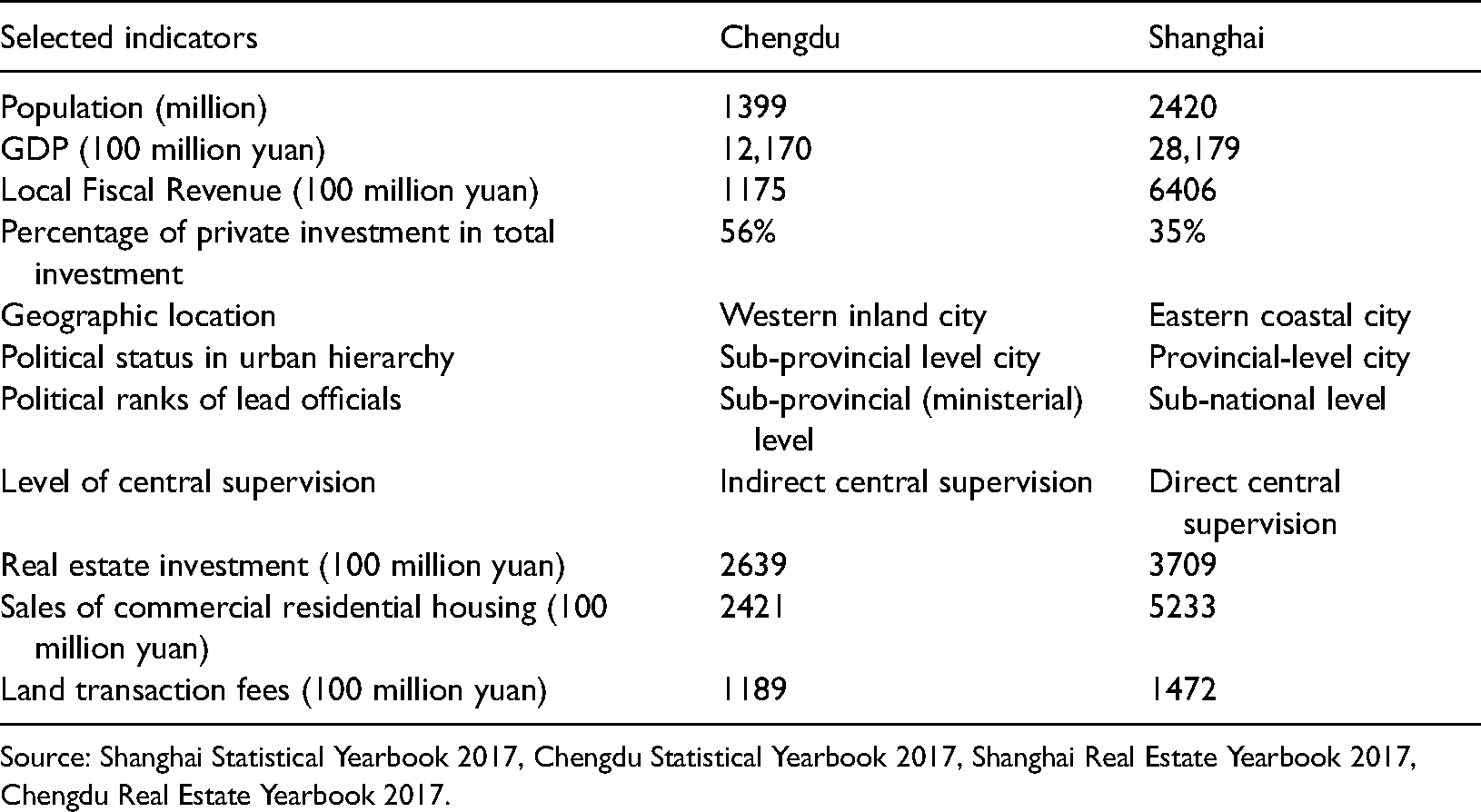
Source: Shanghai Statistical Yearbook 2017, Chengdu Statistical Yearbook 2017, Shanghai Real Estate Yearbook 2017, Chengdu Real Estate Yearbook 2017.
The first principle for case study data collection proposed by Yin (2009) is to use multiple sources of evidence, primarily for the purpose of data triangulation (see Patton, 1980). In this research, we employed three types of data sources to address the validity and reliability issues of case study, including government documentations, news archives and interviews. In total, 15 major low-income housing policy documentations of the central government and 42 local policy documentations including 12 state conference memos have been reviewed and analyzed. In addition, we also collected a large number of media reports related to the issues of low-income housing. After screening, 13 media reports from reliable sources were analyzed in depth and included in this study as an important supplement to the policy review and interview data.
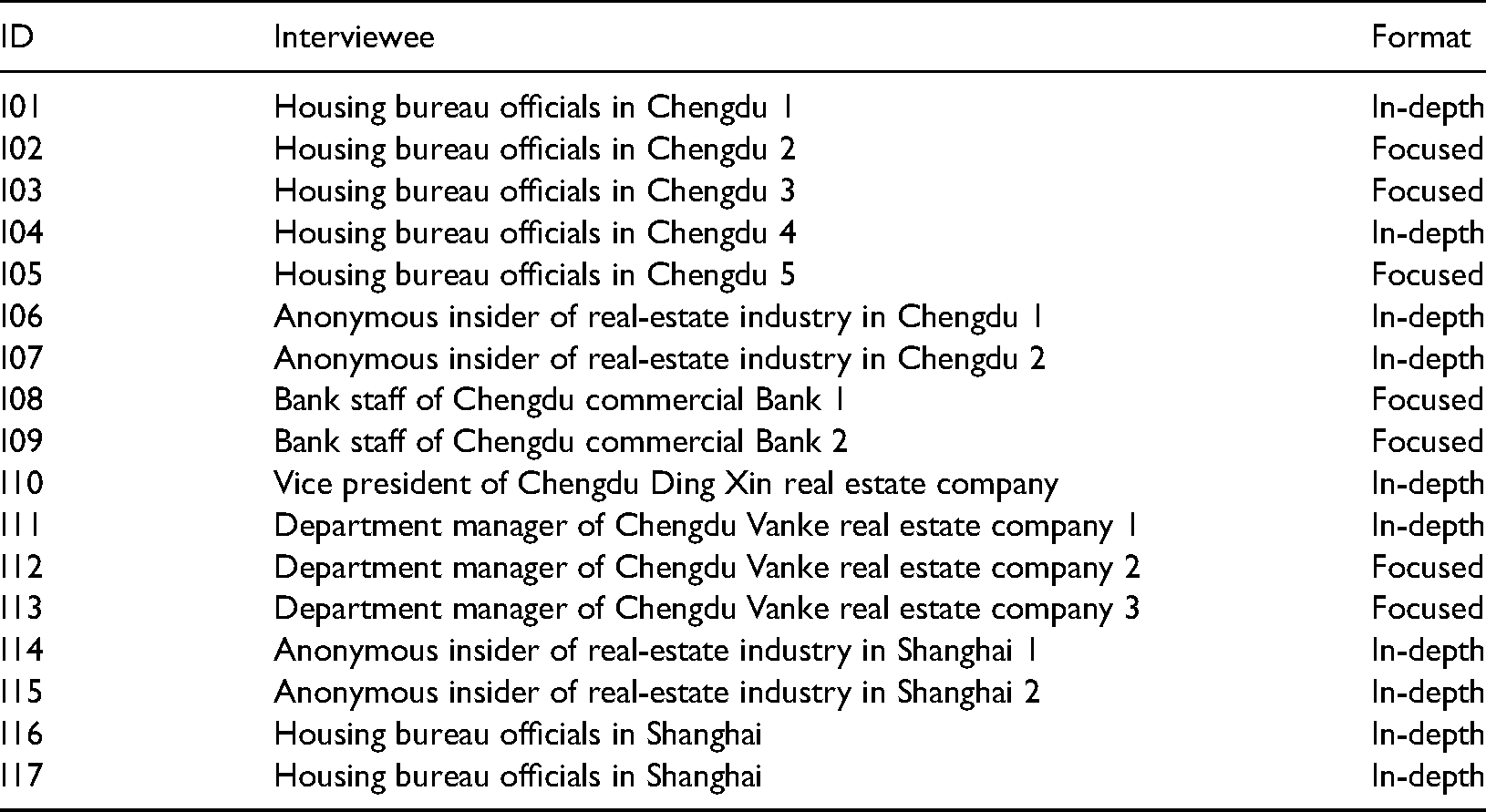
The interview is one of the most important sources of data in case study research (Whitehead, 2003). We interviewed three groups of people closely related to China's low-income housing sector: housing bureau officials, real estate industry insiders, and bank staffs. The interviews took place in Shanghai and Chengdu in the summer of 2016 by a project team led by the authors. Both in-depth and focused interviews were conducted. In-depth interviews were mostly conducted in a semi-structured way, and in some cases, open-ended questions were also adopted. We asked our respondents about their experiences and views about the detailed process of localizing low-income housing policies. Following a snowball sampling method, interviewees were also asked to recommend other suitable persons for our interviews. An in-depth interview normally lasted for 2–6 h and was usually completed in multiple sittings. We utilized the in-depth interview as our main data source. The snowball sampling method is the optimal choice given the limited resources allowed in this project. It should be noted that this sampling technique may introduce possible selection bias: some views with different perspectives may be excluded; some inaccurate information is difficult to verify and may even be reinforced. To address these issues, three measures were taken. First, the focused interview was conducted in a structured manner for a short period of time, normally between half to 1 h. The main goal was to corroborate the theories or stories that have been established in the previous interviews. It was a form of data triangulation (see Patton, 1980) to increase the validity of findings in this research. The other two forms of data triangulation adapted in this research are: cross-groups validation and second-hand data validation. We asked the respondents in different groups the same questions throughout the interview process and followed up on some of the key information. The last measure is to verify the authenticity and accuracy of the key information and cases by comparing them with secondary sources. Eventually, a total of 17 interviews were conducted (see Table 2).
A list of interviews.
Following the standard procedure of case study research (Hartley, 2004; Yin, 2009), we transcribed all interviews into text in Chinese, and then applied three common techniques in studying the data of three policy cases in two cities (see Yin, 2009: ch 5). First, we adopted the pattern matching logic to identify patterns between the proposed theoretical constructs and policy localization outcomes. Second, we employed the explanation building technique to find elements from narratives of interviewees that can explain, justify or disapprove the patterns identified in the previous stage. By doing so, the “patterns” become “models” which enable us to unravel the detailed mechanisms behind policy localizations. Third, we utilized cross-case synthesis technique by comparing and cross-referencing the models we identified in each case between two cities in order to build explanations towards differentiations and synthesize the similarities. The final goal was to generalize theoretical models that validate the research propositions, and eventually to provide a unique interpretation of the mechanisms of the central housing policy localization in China.
Localization of national low-income housing policy
This section examines the localization processes of three major low-income housing programs that the central government has introduced to improve housing affordability for low-middle income urban households in China: the ECH program, the LRH program, and the PRH program. While many other low-income housing projects have been proposed by the central government over the past three decades, none of them are comparable to these three policies in terms of geographic coverage and social impact (Huang, 2013).
Local depoliticization of low-income housing programs
The ECH project was first introduced in 1998 as an ownership-based program to encourage low-middle income households to own homes in cities. The 2004 Measures on the Administration of Affordable Housing stipulates the ECH program as the primary source of public housing supply. In 2007, seven central state departments jointly issued its revised version as New Measures for the ECH program, which significantly lifted the income eligibility criterion for applying the ECH housing. Consequently, the share of the ECH housing in the national public housing provision has declined. Today, it is no longer regarded as the primary venue of public housing provision.
A close examination of government documents and interview materials lead us to conclude that the localization process of the ECH program is first shaped by the consistency in policy goals between the central and local states. At the national level, the policy aims at providing an option for low-income households who cannot afford commercialized urban housing (State Council, 1998). The long-term policy goal is to promote the acceptance of “housing ownership” by all urban residents, cultivating the consumptive purchase habits of low to middle income groups, and further stimulating urban housing marketization (Song et al., 2005). For local states, these housing development goals are not fully consistent with local development interests. For years, local governments are heavily incentivized to pursue economic growth and become a de facto “entrepreneurial state” (Nee et al., 2007). The growth in local GDP has long been an essential criterion of local officials’ performance appraisal (Saich, 2010).
Right from the beginning of the ECH program implementation, the ECH program goals are in conflict with local economic development goals. When the ECH policy is enacted, local governments are required to take full responsibility for the allocation of urban land and the provision of the ECH development funds (State Council, 2003, 2004). As a social housing program, the local governments are not provided with any positive financial incentive for its implementation. “We [local governments] are asked to provide land for the ECH programs. In the meantime, we are also required to set a price cap on the ECH unit in the market and regulate its sales” (I03). This means local governments need to allocate the land below the market price for ECH projects that could be sold for a significantly higher price in the secondary land market; and the administrative order of the price cap of the ECH unit further prevents local governments from benefitting from the fast-growing real estate market. Further, the ECH housing units cannot enter the commercial housing market for resale within five years of the initial purchase transaction (State Council, 2007). As one of the informants from Shanghai states that “the fact is we cannot afford to prioritize the ECH project and everyone tries to protect the local real estate market because the land revenue was crucial to us” (I16). Essentially, the ECH housing was imposed upon local states as a political task.
A lack of economic incentive means that local states must implement, while unwillingly, the ECH program due to political obligation. This political economic contradiction is considered as a primary reason for local policy alteration (Florini et al., 2012). For the entrepreneurial local states, the political task of delivering the ECH program has to be manageable economically (Chen and Yang, 2009). The exact nature of policy localization will however depend on the rooms for policy manipulation and the capability of local governments. In the case of the ECH program, “it was set to be monitored and supervised by the provincial-government. There is no direct responsibility link between the central state where the policy is made and local municipalities where the policy is executed” (I07). This means the political obligation to implement the ECH is tied merely to the provincial government. However, “the provincial government often depends on the regional leading-cities [such as Chengdu] to help complete its planned economic growth targets and quotas; so, as you can imagine, the provincial government will not embarrass the local government for the ‘thankless’ matter of public housing” (I07). A source from Shanghai offers a similar remark: “The central government has delegated great autonomy to local ECH projects. Many provisions including source of the land and duration of the project are all subject to local discretion” (I14). This implies that officials of local governments will not be subject to any substantial political penalties for unsatisfactory implementation of the ECH project. This loosened political obligation provides substantial rooms for manipulation in implementing the ECH project at the local level.
The actual alteration of the central state policy varies across localities depending upon entrepreneurial zeal of local states in their pursuit of urban economic development as well as local conditions (Teets, 2015; Zhu, 2013). In Shanghai, to direct local implementation, the central state has assigned a compulsory quota of ECH unit construction for local implementation (Ministry of Construction, 2004). However, “the two [ECH] documents
1
are vague on issues such as land allocation, financing and approval criteria of the ECH program,” (I07) according to one interviewee. The Shanghai municipal government apparently took full advantage of the autonomy of the ECH policy regarding the preparatory phase of the project. As one informant revealed, “Shanghai did not officially launch the ECH project until the end of 2009, which is the latest among the major cities in the nation. Their (local government) rationale is nothing new, such as the complexity of the situation in Shanghai, the strict land management and the time needed for policy perfection” (I15). It is also possible for local states to take advantage of the ECH land development quota for commercial housing projects because of the dis-jointed supervision and monitoring system. One insider from a real estate company of Chengdu indicates, “[t]hey [local governments] often listed those irrelevant projects, such as old town renovation projects as part of the ECH project, and it is easy to meet the quotas required from above” (I07). He further pointed out that Chengdu listed its urban renovation mega-projects as the solution to meet the EHC quota requirement using this reporting tactic: Funan River Renovation Project is one of the biggest urban renovation programs. It is designated as a national project, so they could bypass the provincial government, and obtain demolition and land development quota directly from the central government. In this project, there were three huge old run-down neighbourhoods to be renovated into brand new commercial-residential districts. All of them have been reported to the central state as the ECH projects. (I07)
Later, we managed to verify his story. All three neighborhoods he mentioned are indeed ECH projects according to Chengdu Urban and Rural Real Estate Bureau's official website, two of which are ranked the 2nd and the 5th (area-wise) in the top ten ECH projects in Chengdu as of 2017 (CURREAB, 2017).
The local states tend to exploit any available opportunity for economic gain when implementing the ECH program. Before 2007, the central state did not provide a universal standard for the ECH applicant. Instead, the local governments were authorized to set up their own standard (Ministry of Construction, 2004). This surely left ample room for the local governments to manipulate standards to suit their own economic growth needs. One informant from Chengdu indicates that the local state would deliberately loosen the selection criteria for the ECH applicants: “They surely loosen the criteria [for ECH applicants] […] if you want to apply for an ECH unit, all you need is to claim your income and submit a so-called proof of earnings which can be easily faked. They say they will verify it, but they never did” (I09). After 2007, however, there was a change in the selection process for the ECH applicants in Chengdu when the “New Measure” was issued (State Council, 2007). “We took the ECH application procedure much more seriously than before,” said a housing bureau official of Chengdu. “We assign the responsibility of filtering applicant to street residents’ committee 2 . It proves to be much more effective than the old ways” (I09). This innovation in policy implementation apparently overcomes the limited administrative capability problem mentioned above. The above cases illustrate the nature of entrepreneurial behavior of the local state and the strengthened central regulation can significantly affect the process of policy localization.
On examining the process of the ECH policy localization, it is found that local development need, economic development model and administrative capacity also matter. The central policy stipulates that each ECH unit must not exceed 60 square meters with a limited standard for housing facility (Ministry of Construction, 2004). The local response to such requirement varies. “[A unit of] 60 m2 looks pretty on paper, but in reality, low-income households still cannot afford it, and middle-income families won't consider it because it is too small. By increasing the standard, even only a little bit, more people would like to consider [buying] these ECH housing units,” explained by one Chengdu housing bureau official. “We need to recoup our ECH program investment, and we also need to guarantee the interest of our developers” (I03). In Shanghai, we heard an opposite story from the housing bureau officials: “[A floor area of] 60 m2 is the red-line we wouldn't cross. The ECH project units you can find in our district (Changning District) are mostly smaller than that.” We later learn that “the floor area per person for low to middle households is smaller in Shanghai in comparison to the national average. Even the ECH unit with around 40 m2 is still attractive to ECH program applicants” (I17). More importantly, local state officials in Shanghai are unwilling to violate the central state requirements according to our interviews: “Land quota for the ECH construction is strictly controlled by the higher-level governments. If we go beyond 60 m2 for one apartment unit, the number of units qualified for the ECH project will decline. Then, we will not be able to meet the annual requirement for the ECH program” (I17). In this case, in the face of the same central regulation, Shanghai and Chengdu show two contrasting attitudes and responses in implementing the ECH program. It is the pressing housing shortage, expensive housing price and land value, and a large displaced population from urban renewal projects in Shanghai that shape the local implementation of the ECH projects. As a provincial level city, Shanghai, unlike other municipalities with a lower position in China's political hierarchy, is under much tighter political control and stricter political conformity with the central state.
The implementation of the ECH program demonstrates that the localization process of the central public policy is very much shaped by institutional conformity and local state entrepreneurism. Local government goals and needs, and the extent to which they deviate from central policy goals, determine whether and to what extent the central policy will be altered. Political obligation and conformity requirement on other hand will decide how the loopholes in the central policy, like the ECH land development quota, will be exploited. Institutional conformity only serves as a starting point for local alteration of the central public policy. The entrepreneurial appetite of the local states actualizes the direction and magnitude of central policy alteration. Prioritizing revenue generation, blending market mechanisms, and pursuing economic efficiency can all effectively convert the social housing program into a moneymaking machine. However, both institutional conformity and local state entrepreneurism are contingent upon local conditions. Local economic conditions such as social housing needs, housing prices, political distance in terms of the central supervision vary significantly and differentiate the implementation process of the central low-income housing policy.
The combination of these factors produces some unexpected outcomes of the ECH program: the ECH unit is often far beyond the reach of its target population, a situation also observed elsewhere in the literature. The ECH program “benefits upper-income households rather than low-income ones” (Zou, 2014: 9). Many middle-to-high income families seek to purchase the affordable housing for the pervasive speculation in the ownership-oriented affordable housing program. “Most of them [middle to high income families] bought those ECH units, not for self-dwelling, but for re-selling in the market after the five-year ban expires,” indicated by one interviewee in Chengdu (I06).
To curb these speculative activities, the Chengdu Municipal Government has undertaken two measures (Chengdu Municipal Government, 2010). First, after the five-year ban expires, the government will have a priority to buyback the ECH units at a below market price, and second, a special ECH tax will be applied due to the market appreciation of the ECH units. It should be noted that these two measures are not unique to Chengdu. They are the local implementations of “2010 Guidance” stipulated by the central governments. The policy has had some positive effects on curbing speculation in the affordable housing market, but some scholars have criticized this policy for depriving the ECH unit owners from gaining benefits from housing value appreciation, leading to new kind of social injustice (see Zou, 2014).
To balance the suppression of speculation with the interests of the ECH owners, the Shanghai government has applied a more innovative approach to overcome the drawbacks of Chengdu's approach. In Shanghai, the local government and the ECH homeowners can jointly own the ECH unit, with a 30–70% or 40–60% ownership arrangement. Households can buy a greater ownership share from the government over time. They can also sell their property rights back to the state. The price is based on the current market value (Shanghai Municipal Government, 2008). In this case, the governing capacity of the local states, especially their policy innovation capability, significantly effects the outcomes of local policy. In the meantime, the central state also learns from the local implementation of low-income housing policy, as evidenced by the introduction of the “New Measures” and “2010 Guidance.” Given the difficulties of implementing the ECH program, the central government gradually shifts the focus from the ownership-based housing programs to the rental-based programs to meet the needs of low-income people in Chinese cities.
“No poverty! No market?”: The fall of the LRH policy
Launched by the central government in 1998, the LRH policy is a rental-based low-income housing program. As a poverty reduction program, it was designed to address the problems of the urban poor whose urban housing access is heavily jeopardized during the course of housing commodification process (Ministry of Construction, 1999).
Similar to the ECH program, the local governments are required to allocate the land and to finance the LRH construction. The policy stipulates that the rent for LRH units is set by local governments based on maintenance and management fees and the LRH unit must meet a series of construction codes set by the central state (Ministry of Construction, 1999). The central government requests public financial institutions to make the financial loans required by the local states to develop the LRH projects readily available. The land transfer fees for the LRH project are waived (Ministry of Construction, 1999). While the goals of the LRH program contradict local economic development goals, the development of the LRH program represents an important part of social responsibility and political obligation of the local states (Ministry of Construction, 2003).
The implementation of the LRH is very much in the hands of the local states. Similar to the ECH program implementation, the central state did not provide a clear policy implementation protocol nor a functional accountability system for supervising and monitoring the program implementation (Zou, 2014). However, it indicated the local states should set aside 10% of the land sale revenue for the LRH program implementation. Unlike the ECH program, the constructed LRH housing cannot be sold on the market (Ministry of Construction, 1999, 2003). As part of the anti-poverty campaign, local governments must charge ECH tenants the rent at a rate well below the market, or even waive it completely (Ministry of Construction, 1999). The economic cost to the tenants enrolled in an LRH program unit is almost negligible compared to the construct cost of an ECH unit. If local governments and developers invest in developing the LRH units, it will take a long time for rent collection to recoup their initial investments (Shi et al., 2016). Consequently, an LRH project can be a huge financial burden for any developers involved. For example, in 2010, Chengdu Ding Xin was entrusted by the Chengdu municipal government to develop an LRH project. The total project cost was 20.6 million yuan. However, the annual gross profit from the project is only about 50,000 yuan. “[The LRH project] was faced with huge deficit,” said one informant from Ding Xin Industrial. One of the major developers for low-income housing programs in Sichuan admitted, “so far, we have not been able to find a way to make a sustainable profit from public housing projects, and often it is difficult even to recoup costs” (I10).
Because of the possible financial drain, any large-scale implementation of the LRH would surely create a formidable financial burden given the policy stipulation by the central state. With little room of blending market incentives into the program, the only choice left for the entrepreneurial local states that prioritize economic growth and land sale revenue is to limit the scale and scope of the LRH program (Fan and Yang, 2018). One way to achieve this is to set extremely stringent eligibility criteria for an LRH applicant. In 2001, the LRH program in Shanghai was confined to the registered local households whose individual monthly income was below 280 yuan (monthly disposable income per person of Shanghai was 1073 yuan in 2001) and had received government supplemental income for 6 months and lived in a room with a floor area below 5 m2 per person (Zhang, 2001). The criteria were relaxed a bit over time. In 2011, a year before merging the LRH program into the PRH program, the bar of monthly income was increased to 1600 yuan (monthly disposable income per person of Shanghai in 2011 was 3019 yuan). However, the criterion for floor space per person remained to be as small as 7 m2 in 2011 (Zhang, 2011). The candidate selection criteria are conditioned by the local context. In Chengdu, the eligible LRH applicants of 2011 were those who earned less than 775 a month and lived in a room with floor area below 16 m2 per person (CURREAB, 2011). The difference in criteria is because the income level in Chengdu is significantly lower than in Shanghai, but its housing congestion is much less severe. Despite the regional difference, the LRH program in both cities targets the most vulnerable urban population. Because of the stringent eligibility criteria, the implementation scale of the LRH program was very limited and application procedures were tightly controlled. From 2001 to 2006, cumulatively, there were only 22,397 households eligible for the LRH program in Shanghai (Shanghai Municipal Government, 2007).
Providing urban land for the LRH program represents another major challenge to the budget conscious local states because the construction land is limited and is a major source of local extrabudgetary revenue (Cai, 2017). Accordingly, local governments are reluctant to allocate land to the LRH programs. One official explains, “85% of the taxes go to the central state. We rely on the land transfer fee from housing development to pay for the local services” (I04). The situation is even more critical in Shanghai. An informant in Shanghai notes that “Shanghai's land management has always been the tightest For a long time, Shanghai's LRH projects have mainly relied on the conversion of existing housing sources, because there are no new residential land quotas allocated for new projects” (I17). Apparently, instead of building new LRH units, local states identify and collect existing housing units throughout the city and convert them into the LRH units. In practice, the LRH project has a wide variety of housing sources, including old public housing and allocation housing (pèi jiàn fáng). The majority of LRH units are sporadic, dilapidated houses, with extremely low commercial value and high maintenance costs, and are often detrimental to the surrounding communities (Chang and Tipple, 2009).
Since 1999, in both Chengdu and Shanghai, the local governments assigned the least commercially attractive land for those constructed LRH projects (Liu and Zhu, 2014; Shun, 2012). As a result, the early LRH projects are all in remote suburbs where public services are inaccessible and often lack necessary infrastructure such as public transport, hospitals, and schools (Chang and Tipple, 2009). As one official puts it, “[the LRH] is just a new form of ‘urban village’ within the city boundary” (I04). Evidently, local governments have neither enough motivation nor the capability to bypass the central restrictions to improve the quality of the LRH units through a feasible “localized” approach.
The concerns over the long-term fiscal viability combined with the scarcity of urban land make the local states hesitate to promote the construction of the actual LRH units. To comply with the central LRH policy, the local states create a particular coping mechanism to address the needs of eligible LRH candidates. First, a cap of LRH floor area per person is identified. Then the area differential between the capped LRH floor area and applicant's existent living floor area is calculated. The rental to cover the area differential is estimated according to the rental market price. A majority of the eligible households are given cash subsidies to cover the rental differentials. Between 2002 and 2006, out of 22,397 eligible LRH households in Shanghai, 89% of them only received cash payments instead of actual LRH units. A mere 374 households were given chance to move into the designated LRH units (Shanghai Municipal Government, 2007). In Chengdu, the localized LRH policy stipulates that the eligible households with a housing floor area of 16–24 m2 per person can apply for monetary subsidies for low-rent rentals, while only those households with a housing floor area less than 16 m2 will be assigned to an actual LRH unit (CURREAB, 2011). In practice, even such stringent policy is not fully implemented. One informant told us that “those who are eligible for a physical LRH unit are denied due to the limited supply of LRH units” (I07).
Under the institutional arrangement of the LRH program, local officials would not be held accountable even when the LRH project was poorly implemented: “There's nothing for us to worry about [implementing it]. Even the central government doesn't have a clear map for the LRH program” (I05). The situation was not different in Shanghai. “Shanghai is one of the first cities in the country to implement LRH policy, and many details of the policy were unclear, so there was no way to hold people accountable. The improvement of this policy relies on us pioneers exploring it bit by bit” (I16). The policy framework rejects any form of “market behavior” and absolutely detaches itself from blending into local economic development projects. We believe that the anti-market tendency, the absence of an effective accountability system, and a viable and coherent financial and land arrangement scheme is responsible for the ineffective implementation, if not failure, of the LRH program as a national public housing policy. At the end of 2012, the Ministry of Housing along with other two ministries issued a policy to merge the LPH program with the PRH program. In other words, due to unsatisfactory local implementation, LRH as a standalone policy was terminated by the central state. At this point, the LRH program officially withdrew from the national stage.
Central re-politicization of low-income housing program
The PRH program was released in June 2010. It aims to solve the housing problems for middle and lower-middle income urban families who are not eligible for the LRH program but are unable to solve their housing problems through the commercial housing market (MHURC, 2010). After it was merged with the LRH program in 2012, the PRH extends its coverage to the entire low- and middle-income urban population and has gradually become the primary form of low-income housing provision in urban China.
Learning from various low-income housing programs experimented since 1998 when the housing commodification started, the central state attempts to make the PRH program a locally executable and adaptable policy (Chen et al., 2013). Before 2007, the central government was extremely cautious about any forms of “localization” of low-income housing policies. Many experiments initiated by local governments to introduce market elements into the system were halted because they “crossed the red line” (Liu and He, 2005; Min, 2003). The situation changed in 2007 and the phrase “depending on local circumstances” has begun to appear in low-income housing policy (State Council, 2007). After 2012, wordings such as “local policy innovation (běn dì zhèng cè chuàng xīn)” and “adaptation to local condition (yīn dì zhì yí)” were frequently seen in the central policy papers on housing regulation (see Ministry of Land and Resources, 2015; State Council, 2013). In 2016, the central government work report officially established “Policy Adaptation to City Conditions (yīn chéng shī cè)” as the national guideline for housing regulation (State Council, 2016). After rounds of policy iterations, many areas of policy innovation were enacted in the PRH program based on the previous experience in implementing ECH and LRH programs. For the first time, the central government changes the previous one-size-fits-all policy framework and delegates authority over matters such as land allocation, housing sources, and building standards to local governments.
To ensure the proper implementation of the PRH program, the central state issued an accountability mechanism pressuring the compliance of local states to the requirement of the PRH program. According to the PRH scheme, the provincial government is asked to sign the agreement with the central state in which the “indispensable and demanding work requirement (yìng rèn wù)” is assigned to the corresponding provincial level bureau (MHURC, 2010). Each province will allocate appropriate PRH unit quotas to the local governments in the province. This rigorous chain of command eventually creates a system in which the delivery of the PRH housing is directly linked to the appraisal and promotion of local cadres (Chen et al., 2013). While the construction of the PRH projects is not in the best interest of entrepreneurial local governments, these policy measures enforce the political conformity between the central and local states, leaving little room for local manipulation in implementing the PRH program.
It is well recognized that local states prioritize revenue generation over the provision of public housing (see Zhu, 2004). To facilitate the implementation of the PRH program, the central government indicates that the central state budget will directly support the implementation of the PRH projects in some districts (MFSAT, 2010). However, such a top-down fiscal scheme has never been the main solution for the PRH projects, because the state budgetary funds “have never been guaranteed and often come with very harsh restrictions” (I01). Apparently, the central state has recognized the magnitude of this issue. One of the major components of the “indispensable and demanding work requirement (yìng yèn wù)” is how to finance the PRH projects. The corresponding local bureau is required to sign the implementation agreement to ensure that local governments will provide significant funds for the PRH program. The central government also encourages local governments to adapt and carry out policy innovation according to local conditions (MHURC, 2012).
The mounting political pressure and obligation coupled with a clear accountability system forces local states to implement the PRH program swiftly and innovatively. Local governments are pressured to explore their own ways to carry out these central state mandates. As indicated in one of the interviews: “We have to be creative [on financing the PRH program] or be ready to be fired” (I03). In Chengdu, where the local government has long established a strong tie to local housing industries, it seeks entrepreneurial solutions by cooperating with real estate developers. One of the solutions is to use land sale for commercial housing to compensate for the PRH projects: “We have set a cap on the land auction price, and once that the cap is reached, developers can no longer increase tender prices in monetary terms; what they can do is to continue to bid with the add-on promises to build units of public housing,” said one local official (I02).
In another case, a real estate developer even directly invested in a PRH project in Chengdu. Vanke, one of the country's leading real estate developers, launched the Corporate and Social Responsibility Fund in 12 cities across the country. The foundation is led by Vanke. Local developers can participate in the investment, and all the funds raised are used to support the construction of local public housing. One insider from Chengdu Vanke explains, the Responsibility Fund can help Vanke break the deadlock and promote relations with local governments” (I06). In another word, the motive behind these “selfless” acts of private enterprises is to establish closer political and industrial relations with local governments. In Chengdu, such an attempt clearly sees some benefits. A strong local state-industry tie, in turn, enables the land auction policy innovations that help the local government to identify lands and funds for the PRH program, alleviating the financial burden of the local government.
The local contingency factors are important in channelling solutions for solving the problems of low-income housing delivery. The “Chengdu model,” with a strong local political and industrial tie at its core, becomes less desirable solution in Shanghai in implementing the PRH program. Because of its top position in Chinese urban hierarchy, Shanghai municipal government is subject to tighter political control by the central government (Chen, 2009). The expensive land price can generate abundant extrabudgetary revenue, making the construction finance of the PRH program lesser a concern in Shanghai. In late 2010, Shanghai municipal government announced that part of the annual local bond revenue would be allocated to public housing projects (Si, 2010). Shanghai's special position in China's urban hierarchy also enables it to adopt unique and often experimental measure to address the public housing issue. Under China's current land law, the use of land by rural collectives for commercial real estate development is strictly forbidden. However, owners of such land often ignore the ban and secretly sell or lease housing built on the land. These houses, which have no legal title, are called “small property-rights housing” (xiǎo chǎn quán fáng). In late 2011, confronting the mounting pressure of insufficient public housing supply, the central state started to explore the possibility of using collectively-owned land for the PRH programs (State Council, 2011). However, this experiment may cause the legalization of existing “small property-rights housing,” which in turn leads to massive loss of collective land. To control this risk, the central state decided that only Shanghai and Beijing could pilot test such an experimental policy (the policy later expanded to 13 cities in 2017, and 18 cities in 2019) (Meng, 2019). In this case, Shanghai's special position in China's urban hierarchy acts as a key enabler of successful policy innovation.
The above examples demonstrate that the central government's gradual acknowledgement and acceptance of local state innovation and entrepreneurial governance in the public housing domain. It is this official and formal recognition that provides political security and prospects for ongoing local policy innovation in the process of PRH policy localization and stimulate the implementation of the PRH program. In the meantime, under the rule of “administrative accountability to the person in charge,” regional leaders are required to bear the direct political consequences of the unsatisfactory local-implementation of the low-income housing policy. This key change has forced local officials to consider the potential political risks associated with the “ostensible conformity” (normally informal) of central policy, and eventually to provide an endogenous incentive for local officials to genuinely conform with central policy. As a result, the completion of the PRH project quota has been impressive. In Chengdu, more than eight million square meters of the PRH housing have been delivered in the first year (2012) of the project alone. One official in Chengdu stated, “the scale of the PRH program is unprecedented […] It exceeds any prior low-income housing programs” (I04). Likewise, one housing official in Shanghai commented, “The PRH programs in Shanghai will be speeded up, and the coverage of the program will be higher than the national level” (I16).
Discussion and conclusion
This paper investigates the localization of the central state policy by exploring the implementation of three low-income housing policies in Shanghai and Chengdu. This is by no means a comprehensive analysis nor a historical review of China's low-income housing policies. What is nevertheless surfaced is that local policy implementation paths and outcomes are vastly different from what is expected in the original central policy and the influencing mechanisms of local policy implementation differ across localities. Importantly, the empirical results show that the localization of low-income housing policy is neither a top-down process nor a completely spontaneous from-below model. It is the constant central-local interaction that characterizes the central-local dynamics and influences the policy localization process. The empirical investigation validates the proposed theoretical framework that stresses the imperatives of institutional conformity, local state entrepreneurism and local contingence and their interactions in explaining the local implementation processes and outcomes of the centrally initiated low-income housing policy in China (Figure 1).
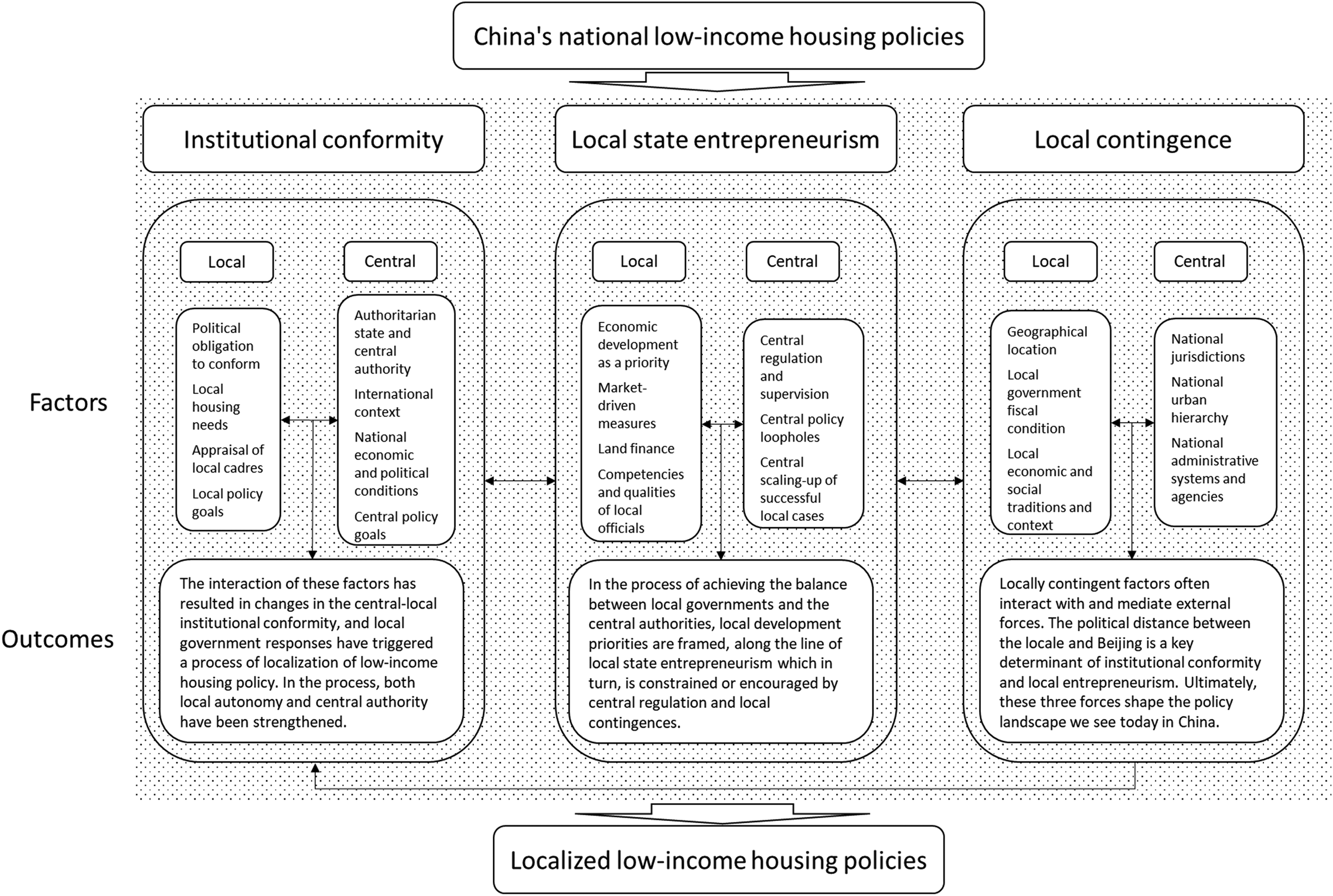
Localization process of China's national low-income housing policies.
In the context of low-income housing policy, the institutional conformity manifests in cross-scale consistency in policy goals, political obligation of local states to conform to the central, and balance between local incentives and central state sanctions. Top-down theorists portray China's local governments act as an extended hand of the central state (Sachs and Woo, 1994; Shirk, 1993). Our study refutes such claim. In contrast, in the process of exploiting loopholes in central policies, or “probing policy red lines” as indicated by one of our informants, local states show a strong sense of local will and determination towards local economic development, characterizing an emerging local developmental state. The goal of the central low-income housing policy has often undergone down-scale alteration in the process. The original single-scale (national), single-dimensional (social security) policy is transformed into multi-scale (provincial-municipal), multidimensional (social security and local development) policy tools which are utilized by local states to achieve their developmental goals and economic needs. However, acknowledging increasing local autonomy and discretion does not mean that China's local governments are developing into this fully self-motivated and independent political entity as some recent literature on the local developmental state would imply (Xia, 2017). In fact, we find that the political obligation of the local state to conform to the central authority has been strengthened over time. Notably, Beijing has adopted two measures to facilitate this trend. First, to eliminate local ostensible conformity by installing a strict accountability system. Second, to formalize and integrate the fragmented policy localization practices into a national policy protocol by acknowledging, encouraging, and codifying local policy innovations. Under such a framework, it is neither the central will that is stressed in top-down theory (Sachs and Woo, 1994; Shirk, 1993) nor the local dynamism praised in the bottom-up literature (Liu et al., 2012), but the balance between local incentives and central state sanctions that ultimately determine rooms and forms of central policy manipulation and alteration at the local level.
In the process of achieving the balance between local governments and the central authorities, we find that the local development priorities are framed, as we state in the second proposition, along the line of local state entrepreneurism favoring fiscal responsibility, economic efficiency, and economic growth. The “local state corporatism” portraits local governments as a sizable independent corporation and local officials as the owners. Local states promote private firms in their jurisdiction and become a stakeholder with local enterprises (Oi, 1995). The theory further identifies Chinese local state as a developer and highlights its determination to be directly involved in the operation of the market in order to promote local economic growth (Zhu, 2004). In a similar vein, the “fragmented authoritarianism” focusing on the decentralization of administrative power holds that local states in China become authoritarian governors in their jurisdiction. They are competing with each other and are entangled in the constant power struggles within China's political hierarchy (Mertha, 2009). In this study, we find that local governments in two cities are a compound body of those roles. With the entrepreneurism at its core, they are willing to break any existing boundary of local governance and pragmatically switch roles. Such a local dynamism has been widely praised by “bottom-up” school as the motor of China's impressive economic growth (Oi, 1995). However, we find it can produce both optimal and negative policy outcomes. Under the pressure of central regulation and local problem, local governments have innovatively adapted market-driven approaches to overcome the obstacles in promoting low-income housing programs. In those cases, wealth maximization is arguably achieved. However, we also demonstrate that local states treat public housing as a market strategy and would prioritize the return of their investments over the interest of low-income households, which leads to an ineffective distribution of public housing. A similar observation has been made by Qian (2015) in the study of Hangzhou's land policy guided by the idea of “managerial city” in which the central land policy gives way to the city's pursuit of short-term high return on investment. The cases of Chengdu and Shanghai further reveal that cadre capability, administrative transparency and bureaucratic structure of local states determine whether the local state entrepreneurism generate optimal or negative outcomes. Noteworthy, in the above discussion, we indeed observe a strong state entrepreneurial trend in both case cities and linked them to the local implementation of central policy. However, we also demonstrate in the earlier discussion that the local political agenda is formed upon much wider social and political fabrics which go beyond simple revenue maximization. Thus, we reject the notion that all Chinese local states are entrepreneurial in nature and acting as revenue maximisers. We argue that the role of the local government will constantly change along with the local development, the cross-scale dynamics and the horizontal competences.
Furthermore, we find that locally contingent factors often interact with and mediate external forces and have a significant impact on localizing low-income housing policies. Under China's current bureaucratic structure, the position in political hierarchy often determines the capability and authority of local cadres deployed by the central government that directly link to local policy implementation. Shanghai's unique policy solutions on the ECH and PRH programs are a solid testament to this mechanism. This finding seems to echo Heilmanm's notion of “state-led hierarchical development” where various resources, including human resources, are deployed by the central government both vertically and horizontally to maximize national welfare. In this process, due to the various mechanisms like scale effect and path dependence, increasing regional gap will further exacerbate (Heilmann and Perry, 2011). However, a critical process was overlooked by Heilmanm's model: the political positionality of a place also decides the political obligation of a local state to the central state, and the level of central sanction from the central to the local. As a result, the city receiving superior resources like Shanghai in this study also subjects to higher level of central regulation and political obligation. The city ranking lower in urban hierarchy, while receiving fewer resources, also enjoys greater political freedom. The local authority may grow stronger and embed more with local networks, shaping the emergence of a form of fragmented authoritarianism that battles against the central will. These practices often go beyond the economic-centric “top-down and bottom-up debate” and are related to concepts such as informal politics, social capital, nepotism, clientelism and corruption (Fei, 1992). These two compensating processes are found to be co-existed across space and hold the key to understand the geographical differentiation of policy localization.
As we discussed above, the central-local dynamics and policy localization are products of three theoretical constructs: institutional conformity, local state entrepreneurism, and local contingency. These three mechanisms connect to and are intertwined with each other. For most of the time, local autonomy allowed within the central policy framework provides a prerequisite for local state entrepreneurism, which is in turn a critical driving force for the formation of local political scheme. On the other hand, local cadres’ capability and authority, vital variables to local state entrepreneurism, are largely subject to its position in urban hierarchy. Meanwhile, the political distance between the locale and Beijing often determine the level of institutional conformity. Ultimately, these three forces shape the policy landscape we see today in China. Accordingly, we argue that the increasingly complex central-local dynamics calls for a more sensible and subtle approach that goes beyond economic and structural determinism and focuses on the motivation, action and interaction of agents in the context of institutions and places. Only through close attention to these specific processes can we advance our understanding of Chinese central-local enigma.
It is necessary to emphasize that the three theoretical constructs presented in this paper are both the outcome of political economic theorizing on the mechanisms of central-local dynamics and are supported by the empirical findings of localization practice of low-income housing policies. They are crucial for understanding the state rescaling process experimented in post-reform China. However, these mechanisms do not exhaust all possible central-local interactions and relations. More future research is needed to reveal central-local dynamics in different policy settings under which different state rescaling logics might surface. Due to the constraints of funding and time, there is an imbalance in the allocation of the interview samples between Shanghai and Chengdu. Attempts made to compensate for this imbalance by using government documents, news reports and other sources of information. The effect of imbalanced interview cases between two cities may remain. In future studies, a more balanced-structured interview and even larger scale quantitative analysis are all possible ways to advance our understanding on the ever-changing central-local dynamics in China.
Footnotes
This research was partially supported by Mitacs Globalink Research Award. We thank staff from Chengdu Urban and Rural Real Estate Administration Bureau, Shanghai Housing and Urban and Rural Construction Management Committee, Chengdu Commercial Bank and Chengdu Vanke Real Estate Development Group who provided insight and expertise that greatly assisted the research. However, the authors are responsible for all of the interpretations presented in this paper. We thank Professor Ian MacLachlan, Department of Geography, University of Lethbridge for constructive comments and Diane Clark for editorial revisions that greatly improved the manuscript.
Declaration of conflicting interests
The authors declared no potential conflicts of interest with respect to the research, authorship, and/or publication of this article.
Funding
The authors disclosed receipt of the following financial support for the research, authorship, and/or publication of this article: This work was supported by the Mitacs (grant number IT05671).
