




Abstract
We argue here for a more political concept of the home as the space that distinctively enables people to participate in public life by promoting civic orientations we call “resistance” and “yearning.” Because the political potential of home is most keenly experienced in cities, with their complex interplay of private and public spaces on very different scales (house, neighborhood, city), we present the urban home as a model for such politics. Our critical approach is in four parts. First, we reveal three patterns of thought in urban studies that lead scholars to examine housing while rendering the home an apolitical space. Second, we diagram how literary texts fruitfully challenge these patterns of thought in urban studies with their lavish attention to such specific home experiences. These literary descriptions suggest a fundamental politics of the urban home that we elaborate with the help of feminist recuperations of the home by Iris Marion Young, bell hooks, Doreen Massey and others. Third, we offer a more detailed empirical analysis of select texts associated with the “Great Migration” in the U.S. to illuminate this politics, particularly its fundamental orientations of resistance and yearning. To conclude, we propose an interdisciplinary agenda in urban studies that evades conceptual traps to politicize an otherwise neglected space: the urban home.
Introduction
The concept of home is one of the most considered, and contested, subjects in modern society. A “rich territory for understanding the social and the spatial,” (Domosh, 1998: 281), “home” continues to harbor immense “political potency” (Nowicki, 2021: 851) over widely different scales: dwelling, neighborhood, nation, world (Blunt and Dowling, 2022; Blunt and Sheringham, 2019). Investigations of housing in relation to commodification (Aalbers, 2017; Harvey, 1985), racialization (Anacker, 2024; Hirsch, 1995; Nethercote, 2022; Taylor, 2019), migration (Guevara, 2022; Shamma et al., 2022), and even security (Bloch, 2022; Kaplan, 2003) are just a few indicators of how potent the politics of home really are.
However, despite these and many other valuable analyses, we believe one politics of the home, and a very fundamental politics at that, has been neglected, which is how the home distinctively and normatively empowers people to participate in public life. And because modern cities have indisputably become the places where people in the west are best able to pursue public concerns—“emancipated” as they are “from imperatives of national sovereignty and homogeneity” (Bauböck, 2003: 157)—we believe the best place to study this fundamental politics is in the urban home. The urban home enables the autonomy necessary for democratic participation in the public sphere, an observation we wish to relate to the concept of “urban citizenship” (Brodie, 2000; Gerhard, 2007; Isin, 2002; McCann, 2002). Despite the widely-observed shift of power to the transnational, it remains the case that the local, particularly the urban local, is the place to revive democratic citizenship. In this paper we refine this fundamental argument for urban citizenship with attention to the urban home’s special abilities to counter those forces most threatening to civic life including, as Brodie has summarized them, decentralization (or globalization), privatization, and individualization (Brodie, 2000: 6).
We recognize that to return to this fundamental politics of the home in some ways hearkens back to those influential, sacralizing postwar descriptions of the home as “our corner of the world” (Bachelard, 1958: 4) where “dwelling [characterizes] the basic character of being” (Heidegger, 1951: 362). Such philosophies have been rightly critiqued by feminists for fetishizing a private sphere defined in fact by patriarchal violence (Brickell, 2012; Martin and Mohanty, 1986). Other critical scholars have also rightly demonstrated how neoliberalism’s weaponization of private property rights have precipitated for decades massive urban evictions, displacements and homelessness (Aalbers, 2017; Elliott-Cooper et al., 2020; Harvey, 2013; Madden and Marcuse, 2016; Nowicki, 2021; Soederberg, 2021). Not only do we not dispute these two critiques; we unhesitatingly endorse them.
However, there remains, we believe, a privacy in the home that is, normatively, indispensable to the cultivation of autonomy. Miscellaneous recent developments—such as the precariousness of home experienced during recent COVID lockdown protocols (Muñoz et al., 2023), the tension between home’s mobile and sedentarist aspects for migrants (Boccagni and Miranda Nieto, 2022; Ralph and Staeheli, 2011), the “slow violence of waiting” in the unmaking of public housing (Keller, 2024), or the violation of something like a “right to remain” in new houseless encampment policies (Przybylinski, 2022; Speer, 2017)—seem very much to have reminded scholars of the importance of such “corners of the world” to all human beings. We wish here in our arguments to be more explicit about the urban home’s provision of this space, especially how it enables the practice of urban citizenship, and in our methodology to reaffirm what others have insisted upon: that urban studies should incorporate a wider array of sources, including especially literary and linguistic analysis (Brosseau, 1994; Handel, 2019; Nowicki, 2021).
Our critical approach entails four steps. In the first part, we delineate how three patterns of scholarship in urban studies have inhibited the theorization of the urban home as a political space. With the help of an important lineage of feminists dedicated to recuperating the home (hooks, 1990; Massey, 1992; Young, 1997) as well as some recent scholarship on the urban dimension of trust in housing development (Gerhard et al., 2021; Gerhard and Keller, 2023), we conclude that one way to break out of these patterns is to include analysis of literary texts in the role of home spaces in urban society. In the second part, to bolster this point, we share a diagram that plots representative writings about the home to show how many humanist and social scientific scholars unfortunately approach the home somewhat abstractly as a public good. Such abstraction does enable scholars to make important claims about the home, of course, but there is a cost: such scholarship inevitably undervalues the home’s political potential as a private but privileged space of resistance (hooks, 1990) and of dreams (Bachelard, 1958, 1994) or yearning. In contrast, our analysis shows how literary texts instead lavish attention upon precisely these kinds of home experiences; such texts deserve closer attention for the study of urban society.
Our third part analyzes a singular period in U.S. history, known as “the Great Migration,” when millions of Black people fled the rural south’s system of legal segregation known as “Jim Crow” (1877-1964) for various cities in the north and west. While some have subsequently returned to the south (Stack, 1996), the Great Migration nonetheless circumscribes an incredibly significant period in urban history when cities were transformed from mostly white towns into segregated but multicultural industrial metropoles. This extraordinary urban transformation found powerful expression in an equally extraordinary literature (Rodgers, 1997) especially including Black authors as important as Richard Wright, Gwendolyn Brooks, and Lorraine Hansberry (speaking of Chicago alone). Diverse and wide ranging in its concerns, of course, this literature still was supremely focused on both the promise as well as the peril of the city as a new home. Using illustrative vignettes, especially from Hansberry (1959) play A Raisin in the Sun and (as an important heir to the earlier period) Danez Smith (2014) poem “Dinosaurs in the Hood,” we show how the urban home—from the apartment to the neighborhood—has been distinctively imagined in literary texts as a progressive, urban force of resistance and of yearning. Finally, in the fourth part, we endorse this engaged vision of the urban home as an important resource for the study of politics and space in urban society. We specifically encourage future research that combines the social sciences with literary criticism to produce scholarship about the normative, politicized urban home that avoids what we call the traps of “porosity” (Enright and Olmsted, 2023; Wolfrum, 2018) and “ontological security” (Madden and Marcuse, 2016).
Our method is interdisciplinary, an integration of urban geographic analysis, literary criticism, and social and political theory. With this move beyond long-established and highly rewarding qualitative and quantitative research methods, we propose expanding available data on housing in cities to include a body of literary writing that provides special insight into the political challenges as well as potentials of cities. We thus understand our critical approach as a complement to existing methods. And, while our analysis is limited to studies of U.S. cities and Western theories, we hope to model here how such an expanded range of texts for analysis might be valuably pursued in other regional and cultural contexts.
Three patterns of neglect
In urban society the modern city has long been conceived, and celebrated, as a public good ideally open to all. Other scholars have rightly denounced the privatization of such spaces by city governments as much as by private investors and institutions and pointed at the more relational or fluid nature of public and private spaces (Gerhard, 1998; Mitchell, 1995). Yet, Habermas’s concept of an aspatial public sphere has long animated the urban geographical imagination (Habermas, 1990). That vision of the open city was perhaps most powerfully articulated by Henri Lefebvre in 1968 as a “right to the city.” In Lefebvre’s formulation this all-encompassing right should include access to just about everything a city has to offer: its green spaces, of course, but also any and all of those urban institutions dedicated to individualization, socialization, and habitation (Lefebvre, 1996: 158-59). Thanks to Lefebvre’s transformative formulation, the right to not only the city in general but housing in particular has thrived conceptually in urban studies, so much so that this right is for many urban theorists the most uncontestable right of them all, enshrined even in the Universal Declaration of Human Rights (United Nations, 2009).
But is there room in this city of open places for “a place called home”? This was Doreen Massey's important question in 1992, doubly so if understood within the larger reconsideration of “rights talk” then taking place. Just the year prior, legal scholar Mary Ann Glendon had asked if our increased and abstracted talk of rights might be in fact obscuring the actual conditions people require to flourish (Glendon, 1991, 2008: xi). Massey asked this question more specifically of the city. Pointing to the increasingly globalized and anonymized celebrations of modern urban life, Massey exposed how men as the “dominant definers” of the city's public goods and rights had systematically eliminated home with its distinctive privacies from consideration (Massey, 1992: 11). In the city, then, such “rights talk” has a way of talking past the home, and Massey urged more talk about specific “places,” which are “always formed by the juxtaposition and co-presence…of particular sets of social interrelations” (14).
Massey rightly bemoaned the exclusion of specific places like the home from our big formulations of the city, but she herself also ended up saying much more about urban places generally than homes particularly. It is this subtle hesitancy in social sciences to engage the privateness of the urban home that we find the most telling. On the one hand, considered independently of cities, “home,” as we noted in our introduction, is probably one of the most often discussed and contested subjects in modern scholarship, or at least in our two representative disciplines, urban geography and American literary studies. On the other hand, though, when the home is considered in the city specifically, it nearly always vanishes, translated instead into something scholars deem more worthy of attention, such as a “right to housing” or what we will call a “quasi-public good.” In modern scholarship, then, we consequently have many important discussions of building and commodification of and displacement or eviction from housing; however, we have far fewer examinations of the experiences of and feelings about the meaning of home within the always-transforming city.
In urban research, we thus see three patterns of thought that have inhibited the theorization of the home, and we will use these patterns ourselves to organize our critique. The first pattern, and the most obvious, has been neglect: a field defined by its enthusiasm for open, public places, urban studies is notably indifferent to the place most traditionally associated with privacy, the home (see Blunt and Dowling, 2022). Instead, homes, a second and complementary pattern of thought entails, are properly studied outside of the city in the country (in older analyses) or the suburbs. Finally, and most importantly in our view, there is a more subtle third pattern, implicit in the field’s otherwise laudable declarations of “a right to housing.” In such formulations, reiterated in so many recent studies of urban development, we see a bias toward housing: as if considerations of where people live in privacy are only acceptable sites for analysis once they’ve been transfigured into the quasi-public good designated as “housing.”
These three patterns have shaped a broader range of academic work over the last century, and, in lieu of a comprehensive analysis, we offer here a few illustrative examples of each pattern. Consider a few classic examples of the first pattern where cities are praised exclusively as spaces open to the public, their many homes otherwise forgotten. In The Arcades Project, Walter Benjamin excitedly concluded that, where “[t]he nineteenth century was addicted to dwelling [and] conceiv[ed] the residence as a receptacle for the person[,t]he twentieth century, with its porosity and transparency, its tendency towards the well-lit and airy, has put an end to dwelling in the old sense” (Benjamin, 1982, 1999: 220-21). Or consider Lefebvre’s triumphant turn from Heidegger’s country huts toward the city as the locus of value. Deeply influenced by the controversial German philosopher, Lefebvre understood housing to be fundamental to dwelling in the city (Lefebvre, 1996: 159); still, as his translators note, for Lefebvre “it was not the home, but the city, which expressed and symbolized a person’s being and consciousness” (Kofman and Lebas, 1996: 7-8). Or, consider, finally, the classic writings by Chicago School urban theorists Lewis Mumford (1937) and Louis Wirth (1938), the former zeroing in not on individual homes but rather on the entire city as the true “theater of social action” and psychological development, the latter announcing our new public-oriented urbanity “as a way of life” that truly shapes individuality (Mumford, 1937: 94; Wirth, 1938: 1). Such foundational works of urban sociology show how tempting it has been to effectively erase homes from the city so as to lavish praise on the purely public spaces of the modern city. This basic bias continues in the otherwise immensely various contemporary scholarship about city literature, too, all of which overlooks the presence and the meaning of homes in cities (e.g., Tambling, 2016; McNamara, 2021; Salmela et al., 2021).
When it comes to wrestling with what it means to dwell privately together, scholars invariably have looked anywhere but the city. This second pattern is quite prominent across the academic disciplines, especially among humanist scholars, including those most dedicated to interrogating the home: feminists. It is notable, for instance, that even as the home’s valuation has soared (in the work, say, of the nineteenth-century ideologue of domesticity, Catherine Beecher) or plummeted (in the work of postwar feminists into the 1980s), the home in these analyses is usually figured outside of the city in the countryside or the suburban and exurban peripheries. We engage this feminist lineage below, so consider here instead some representative endorsements of the country home by men. In addition to Heidegger’s conviction that not building but dwelling is best experienced in the woods, there is Bachelard’s striking suggestion that he could only understood his Parisian apartment as a home by imagining it high above “the city ocean” below (Bachelard, 1958, 1994: 29). Bachelard reaches the same conclusion as the Irish poet W.B. Yeats in his famous 1890 poem, “The Lake Isle of Innisfree,” which fantasizes about a remote island cabin with “lake water lapping with low sounds by the shore,” far from “the pavements gray” (Yeats, 1890). Both Bachelard (Bachelard, 1958, 1994: 11, 32) and Yeats (Yeats, 1999: 139) incidentally took inspiration from perhaps the most famous modern advocate of the country home, Henry David Thoreau, the nineteenth-century American writer whose literary but also literal excavation of home in Walden (1854) taught him that the true manifestation of this space must be far from our built environments, deep in the earth, even, “a sort of porch at the entrance of a burrow” (Malachuk, 2016; Thoreau, 1854). This dream of a home beyond the city, initially theorized generously as a “collective effort to live a private life” (Mumford, 1938: 215), culminates of course in the modern one-family home of suburban America, certainly an iconic narrative thread of American life (Rosenblum, 2016: 44; Teaford, 2008) but one associated with all of the toxicity of the private sphere in its patriarchy (Blunt and Dowling, 2022) and racism (“white flight”).
The third pattern, though, is perhaps the most compelling proof of many scholars’ reluctance to reckon with the urban home. That pattern, again, entails ostensibly dealing with the home but effectively translating it into a quasi-public good, be it, as “public housing” (Madden and Marcuse, 2016), a generic “place” in the city (Massey, 1992), or “transcend[ing] binary distinctions” between private and public spheres (Blunt and Dowling, 2022: 160). What gets lost in this process is the urban home. To illustrate, consider here an example of how this third pattern has flummoxed dedicated champions of the urban home. In the decades following the end of Second World War, Alexander Mitscherlich, one of Germany’s leading postwar psychoanalysts, pointed to this neglect of the urban home as evidence that cities were becoming increasingly inhumane (Mitscherlich, 1965). Much as Jane Jacobs had done in her famous book a few years earlier (Jacobs, 1961), Mitscherlich in a 1965 pamphlet “The Inhospitality of Our Cities” criticized the monotone private one-family homes in monofunctional cities for forsaking their “urban dignity and city-bourgeoise obligation” (Mitscherlich, 1965: 12, own translation). Our homes and our cities, he wrote, are always “the products of imaginations as well as the lack of it, the generosity as well as the narrow obstinacy” (Mitscherlich, 1965: 9, own translation; see also Gerhard and Warnke, 2011). He himself generously imagined a new kind of urban community comprised of private homes that were not turned away from the streets but instead “communicated” with them through dense urban settings. Admirably achieving this balance of consideration of homes and public spaces, Mitscherlich, however, after a few years serving on an urban planning committee in the German town of Heidelberg, felt compelled to resign, dismayed (as he wrote in a private note) at “how all those features of human habitation in Emmertsgrund [a neighborhood in Heidelberg] that we have struggled to design are falling victim to the hands of rationalizing engineers” (Mitscherlich, 1970).
It is not only engineers but also cultural studies scholars who frequently seem to contemplate what it means to dwell in the city only to then blatantly disregard the importance of actual homes in cities, too. Very briefly, take the figure of the flâneur, for example, the emblematic archetype of 19th century, experiencing the modern city by walking the city. Conspicuously exercising his right to the city, the flâneur is far from an emblem of private and public in the city, for he dwells entirely in public, never going home. But, perhaps it is the bohemian, another favored urban figure in cultural studies, who best exemplifies this third pattern, according to which being at home in the city means never really being in a home: for the bohemian is defined in fact by the fact that he has (in the words of one literary scholar) “neither hearth nor home” (Cottom, 2013: 186).
A triangular conception for studying the urban home
Another way to illustrate this persistent neglect of the urban home in the humanities and social sciences is by slightly altering our analytical framework to illuminate more precisely the actual practice of the third pattern: i.e., how we render the urban home as a quasi-public good by means of abstracting it into an ideational or material project. As our diagram shows, both humanist as well as social scientific assessments of the home drift in these extreme directions. In contrast, our survey of a variety of literary texts indicates how they notably resist such abstraction and could serve in urban studies scholarship as rich sources for theorizing the urban home. We demonstrate this with one body of literature in the section that follows. In addition to recognizing that our sources represent only Western and especially Anglophone literary and scholarly traditions, we also understand that no interpretation of these texts—especially the literary texts but also the scholarly ones—is final. The globular quality of the assigned locations hopefully conveys that these interpretations are somewhat fluid (Figure 1). Mapping Different Meanings & Approaches for the Study of Home.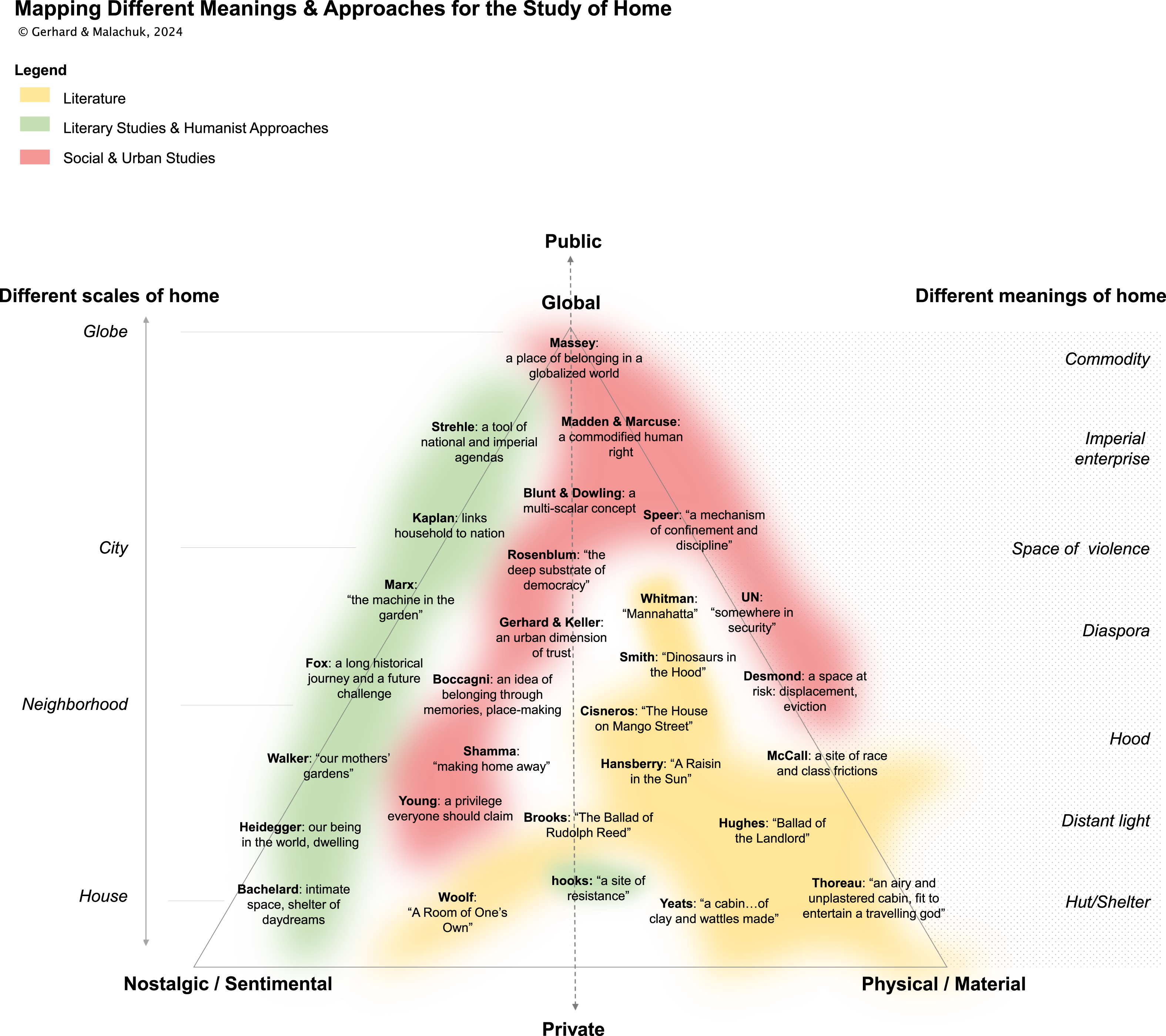
In our diagram the home as an individual experience constitutes the baseline of our triangle, stretching from the most ideational conceptions of home on the left to the most material on the right. At the left base angle there is the richly nostalgic portrait of home in Bachelard’s literary essay (the house as the shelter of our “daydreams” (Bachelard, 1958, 1994: 6). At the right base angle, there is the other extreme, Thoreau’s Walden. A nonfiction literary masterpiece exploring how community is practiced through specific relationships in specific environmental contexts (Malachuk, 2016), Walden for our purposes here is also an extraordinarily materialistic account of his pond-side cabin, right down to the boards, brick, lime, and nails with which he built it (Thoreau, 1854). From both these base angles we imagine our triangle’s remaining two sides rising to a vertex where home is an abstracted common and global good. The left side rises through more and more symbolic renderings of what it means to be “at home”: from Heidegger’s home as our “being in the world” (Heidegger, 1951, 1993) to Massey’s assessment of home as a place in a global context (Massey, 1992). Ascending the right side are, similarly, the material home in increasingly abstract terms, through a few more literary examples slightly less detailed than Thoreau’s hut, to the United Nations' “somewhere” (i.e., “the right to live somewhere in security, peace and dignity”) (United Nations, 2009: 3), and up to Madden and Marcuse’s home as real estate or commodified good.
While this diagram displays only a small portion of writings about the home and its different meanings, it does reveal a distinctive quality of literary texts. Yes, these texts are loaded with sentimental meanings: e.g., Brooks's home “[w]here every room…will be full of room” to grow (Brooks, 1963), the urban district as a community's “hood” (Smith, 2014), or a place of rich intersectional frictions (McCall, 2007). But these texts also render these feelings in much more concrete terms than the academic work dominating the upper half of the triangle: e.g., the macro-level perspectives on home as “a journey” (Fox, 2016), “mechanisms of confinement and discipline” (Speer, 2018: 160), or “the homeland” in contemporary geopolitics (Kaplan, 2003). We see in the upper right specifically how social scientists predominantly assess homes at a variety of scales, from a single house in studies of eviction (Desmond, 2016) to a neighborhood (Rosenblum, 2016) to the globe (Massey, 1992). Here, housing guarantees what Anthony Giddens described as “ontological security”: a sense that the stability of the world can be taken for granted (Madden and Marcuse, 2016: 67f). Only with such housing security can citizens fully enjoy their rights. The same holds true for migration contexts where home is rendered less as a place than a process as described in Paolo Boccagni's examination of migrant communities practicing “homing,” in their daily neighborhood routines (Boccagni, 2022) or “making home away” (Shamma et al., 2022). Likewise, the literally material nature of home in literature gives way (as we ascend) to more abstractly “materialistic” accounts of the city as “real estate states” (Wilson and Wily, 2022, not in the diagram) where houses (as “commodified good” (Madden and Marcuse, 2016) produce surplus value (Harvey, 1985).
Our triangular visualization thus serves two purposes. It illuminates how in the academic imaginations of humanists and social scientists the home is often publicized by means of abstraction and globalization while literary portraits of the home, clustered in the triangle’s lower half, emphasize in realistic detail what the privacy of home looks like. But the diagram is also a guide to foster a more critical theory of home by developing a comprehensive scholarship about the home in general and the urban home in particular. In what follows we will use our critical approach to demonstrate this expanded range of analysis with a few literary vignettes meant to show how the urban home yields two political principles.
Great Migration literature and the politics of the urban home
In 1908, contemplating the risky choice made by thousands of Black families to flee the known horrors of Southern segregation for the unknown ones in Northern cities, the sociologist W.E.B. Du Bois concluded that this massive relocation of people was motivated by a search for home. In his The Negro American Family, the nation’s foremost Black intellectual described the many new dangers posed by urban environments to country folk but contended that, nonetheless, outweighing this peril, there was the promise of autonomy-enabling homes. “Whatever our views of the influx of Negroes into cities may be,” he wrote, “it is clear that there alone can we find a class of Negro homes fully equal to the homes of the whites. This is significant” (Du Bois, 1908: 64, emphasis added).
The literature that followed on the heels of this Great Migration–short stories, novels, poems, and plays–affirmed Du Bois’s general assessment of Northern cities as places of peril and promise, an observation made by many literary scholars (e.g., Reich, 2009: 125). Perhaps the most concise is James Hurt's that this literature centers upon the “dream deferred” trope (Hurt, 2000: 33). Hurt alludes to the Black poet Langston Hughes's famous 1951 poem, “Harlem,” which pointedly begins “What happens to a dream deferred?” That is, what happens, we might paraphrase, if, perilously prejudiced cities, again and again defer the realization of good urban homes? Will that domestic vision subsequently “dry up / like a raisin in the sun” (Hughes, 1951)?
Hughes’s question about deferred dreams—a question about how to resist the city’s perils and pursue its promises—led the Black writer Lorraine Hansberry to title her 1959 play A Raisin in the Sun after his poem. On the one hand, this is a play about how the protagonist Lena Younger and her family use their home to resist the discrimination they face in their South Side neighborhood and Chicago overall. For example, an important pattern in the play involves the family welcoming into the privacy of their apartment guests who then fundamentally threaten the home as an autonomy-enabling space. A self-hating Black neighbor, Mrs. Johnson, mocks the Younger family’s aspiration to “move on up a little higher” (Hansberry, 1959: 99); an assimilationist Black boyfriend, George Murchison, insists the daughter Beneatha ought to be “simple [and] not a poet” (96); most of all, a representative from the all-white neighborhood to which the Younger family hopes to move, Karl Lindner, argues his white neighbors have “the right to want to have the neighborhood…in a certain kind of way” (117), meaning segregated: all of these guests, as soon as they threaten the autonomy of any or all members of the Younger family, are resisted, in fact expelled from the home. Deeply influenced by Hansberry’s play, bell hooks emphasizes exactly this quality of the home in the title of her important essay, “Homeplace: A Site of Resistance.” Reflecting on what she saw as a Black girl growing up in the Jim Crow South, hooks explains that while her mother and other Black women cleaning white people’s homes were exploited all day, these Black women made sure that their own homes were spaces, as hooks puts it, “where all black people could strive to be subjects, not objects” (42).
On the other hand, Raisin in the Sun is also a play about yearning. The mother of the Younger family, Lena, hooks observes, retains her “old world values” from the South and fosters in her children a yearning for their continuation in the North. For example, Lena imparts these values to her son Walter, who determines ultimately not to start a liquor store in the community but instead to yearn for a life of loving relationships. hooks puts it this way: Lena “reminds her family that black people survived the holocaust of slavery because they had oppositional ways of thinking.” (hooks, 1990: 1-2). hooks makes explicit what Hansberry’s play implies: home is where one can yearn for a better world.
Du Bois, Hughes, and Hansberry were certainly not alone in recognizing in northern cities both peril and promise for Blacks, and Hansberry was certainly not the only one to recognize the home as the ideal site for both resistance to that peril and yearning for that promise. For example, the poet and fellow Chicagoan Gwendolyn Brooks hoped in her 1945 “kitchenette building” that “a dream” might nonetheless thrive in compromised spaces Blacks could rent within redlined districts. Her 1963 poem, “The Ballad of Rudolph Reed,” much more explicitly emphasizes that peril—the murderous violence the Reeds face when attempting, like the Youngers, to integrate a neighborhood—while still stressing this new home is a place “Where every room of many rooms / Will be full of room,” full of possibility (Brooks, 1963). These and other texts from the literature of the Great Migration compel audiences to value both the resistance of injustice and to yearn for an integrated society of equals (Malachuk, 2024). Often, as with Hansberry and Brooks, they situate both these civic orientations in the home.
The legal dismantling of segregation in the 1960s hardly ended urban racism, and so a more extensive account of Great Migration literature should also include texts written since the mid-1960s that have continued to pursue a nuanced assessment of the city’s housing perils—i.e., the “housing crisis”—as well as its promises for those who call it home. Gentrification fiction—set even in southern US cities such as Nathan McCall’s 2007 Them in an Atlanta neighborhood, or in cities like Berlin as discussed by Wolting (2021)—might also be productively read by scholars in urban studies as affiliated to this Great Migration literature and its normative home of resistance and yearning.
More closely affiliated to the Great Migration literature would be the Black poet and spoken word artist Danez Smith who also describes acts of resistance and yearning, though in quite a different way. Focused on a neighborhood or “hood” in an unidentified city, the poem, titled “Dinosaurs in the Hood,” (Smith, 2014) helpfully illustrates how our approach to the urban home operates at different scales, from the “parochial” (Tomaney, 2013) to the global (Blunt and Dowling, 2022). The neighborhood thus expresses that type of the community according to Toennis (1887) held together by spatial proximity, instead of kinship (that is: blood relationships) or spirit. Smith’s poem likewise emphasizes the neighborhood as home.
First, though, the title of Smith’s poem certainly requires some explanation. In 1959, the predominantly Black inner-city neighborhood was such terra incognita to Hansberry’s white audience that she made sure her play about Chicago’s South Side included details about shared bathrooms and huge rats (Hansberry, 1959). In contrast, Smith’s audience, thanks to a steady cultural diet of stereotypical representations of “the hood” for the last fifty-plus years, needs to approach this subject through an entirely different genre. “Let’s make a movie called Dinosaurs in the Hood,” his poem begins. In immediately proposing such an unlikely film, Smith encourages us to see his protagonist—a young Black boy playing with a toy dinosaur on the bus—the same way we would see any of the white children starring in adventure movies like Jurassic Park: i.e., innocent of wrong-doing and deserving to flourish like any other human being. Shifting the film genre this way also prohibits us from lazily interpreting the boy and his allies’ acts of resistance–for this “neighborhood of royal folks [must] sav[e] their town from real-ass dinosaurs”—as in any way kin to the standard nihilistic violence insidiously reiterated by hood-genre films like those of the Oscar-winning American director Quentin Tarantino. Don’t let Tarantino direct this. In his version, the boy plays with a gun, the metaphor: black boys toy with their own lives, the foreshadow to his end, the spitting image of his father. Fuck that, the kid has a plastic Brontosaurus or Triceratops & this is his proof of magic or God or Santa. (Smith, 2014)
In the poem we slowly begin to realize that the “dinosaurs” threatening these neighborhoods are metaphorically these stubbornly enduring stereotypes about “the hood.” Such “conventional wisdom” has it that there are no real homes in cities, just “public housing” eminently worthy (thanks to enduring myths like the one about St Louis’s Pruitt-Igoe public housing complex (Bristol, 1991)) of demolition. But, Smith suggests it is not urban neighborhoods that deserve to be demolished, but rather these poisonous myths about such neighborhoods propagated by Hollywood.
In their new chapter on homes in the city, Blunt and Dowling helpfully showcase other cultural projects illuminating how people make their homes in the city such as Andrea Luka Zimmerman’s Estate, A Reverie (2015) (Blunt and Dowling, 2022: 153). Zimmerman’s “reverie” recalls that key component of home as theorized by Bachelard and retheorized by hooks as “yearning.” It is significant that Smith’s poem similarly describes not only the multifarious and subtle acts of resistance pursued by these neighbors but also the daydreaming that starts it all. Smith’s hero, in the opening lines, “is playing / with a toy dinosaur on the bus, then looks out the window / & sees the T. Rex.” Smith’s poem teaches us how the urban neighborhood home should cultivate not only resistance but yearning, too. It’s fitting, then, that he concludes his poem with the word that launched so much of the Great Migration literature, “dream”: Besides the only reason I want to make this [movie] is for that first scene anyway: the little black boy on the bus with a toy dinosaur, his eyes wide & endless his dreams possible, pulsing, & right there. (Smith, 2014)
Enabling resistance and yearning: towards a more political conception of the urban home
Several patterns in urban studies scholarship, we argued, have led to the neglect of the urban home: the assumption either that cities have no homes, which are instead located in nonurban spaces, or that they have housing, a framework that has many advantages of course but that has inadvertently dissuaded scholars from thinking about special civic orientations enabled by the home classically understood as a private space. We diagrammed how literary texts fruitfully challenge this scholarly tendency to abstract urban dwelling (into a public good) by relentlessly lavishing attention on specific home experiences that, normatively, describe a politics of the urban home, mainly in their portraits of resistance and yearning. As examples we showed how such experiences have often been the central concern of literary texts associated with the Great Migration in the U.S.
Of course, Great Migration literary texts are not the only ones that can teach us about the political importance of the urban home. There will be many different literatures and studies from the United States as well as other parts of the world that have lots more to teach us about the politics of the home in the city. A similar caveat applies to our method of analysis. In fact, while we have tried in our triangle diagram to show how combining disciplinary approaches can help us to politicize the urban homes, our diagram is also meant to suggest that all the zones are valuable in this regard. In other words, there are different scholarly emphases to choose from here. For example, one might focus even more on home apartments (as we did with the Hansberry play) or more on home neighborhoods (as we did with the Smith poem). Likewise, in addition to these scalar choices, one might focus more on texts with ideational or with material concerns; here again our Great Migration texts were meant only to suggest certain possibilities. More than we could convey, Hansberry’s play is extremely attentive to the material bases of home while Smith’s poem is (as we argued) quite explicitly about ideas of home. Adjusting any of these emphases may very well lead not only to different insights into the specific civic practices of resistance and yearning but even to different practices altogether that are still to be discerned.
That said, we do believe that our specific focus on resistance and yearning helps to illuminate two major “traps” that may arise when studying the politics of the urban home, and it is to these that we turn in conclusion.
Escaping “the porosity trap”: urban homes as sites of resistance
Since Walter Benjamin introduced the word “porous” (Wolfrum, 2018), there has been in urban studies the enthusiastic (and tenacious) conviction that home and city must share a permeable boundary to realize fully the “ethic for the open city” (Sennett, 2018). However, as Enright and Olmsted have noted recently in EPD, porosity is in fact “conceptually malleable and normatively ambiguous” (2023: 295), and often functions as just another iteration of the “right to the city” critiqued above.
As our brief survey of the home in Great Migration literature suggests, inside spaces matter as much as outside spaces. While recognizing the importance of exposing how, say, segregated housing practices often contaminate what happens inside the home, there are also things that happen inside the home, such as the fostering of resistance, that ought to be promoted. Acknowledging such exterior forces as redlining, our literary analysis has also revealed that these spaces are nonetheless regarded as homes. They are not just “housing,” in other words, to be made available to the urban poor, but instead—thanks to their not entirely permeable spaces—hold for those who dwell in them certain important feelings. Most of all, as hooks argues so convincingly and we tried to illustrate with our analysis, homes enable the feelings that foster resistance by offering shelter from the many inequalities prevalent outside of the home. In this regard, our normative urban home is in line with new approaches in urban studies that urge greater rights for tenants, evicted person, and houseless people (e.g., Nowicki, 2021; Przybylinski, 2022; Speer, 2017). At base, this scholarship is about protecting the autonomy of individuals by affording them homes. Recent scholarship on care work in and around homes, for example, shows how these spaces singularly enable inhabitants to live their own lives (Thompson, 2023; Muñoz, 2018; Muñoz et al., 2023) and thus, as Hansberry and hooks especially emphasize, to become capable of resisting the injustices they face in the world outside.
Less-porous homes enable not only resistance to outside injustice but also neighborly relationships, such as the “neighborhood of royal folks” that Danez Smith imagines in his poem. In her study of neighbors, Nancy Rosenblum (2016) argues that egalitarian neighborhoods are built upon three things: reciprocity, speaking out, and living and letting live. Notably, all three of these virtues require homes that keep the outside world at bay, homes where the autonomy of the people within is respected (the essence of living and letting live) but whose inhabitants are reticent but nonetheless ready to “speak out” against (or resist) real injustices they see in the world. This combination of reticence and resistance amounts to reciprocity among neighbors, a notably thicker relationship than the kind usually celebrated by scholars committed only to porosity, such as “the encounter” (Fincher, 2019). In contrast, neighborhoods full of reciprocating citizens will become “spaces of trust” as Gerhard and Keller argue (2023: 5), and these in turn become (in their words) “building block[s]” (2023: 4) for urban citizenship, or (in Rosenblum’s) “the deep substrate of democracy in America” (Rosenblum, 2016: 8).
Escaping “the ontological security trap”: urban homes as sites of yearning
Other scholars of the urban home have rightly insisted that “ontological security” (Giddens, 1991) must be the baseline guarantee of housing: regardless of its material and economic condition, people must feel fundamentally safe and secure in their homes (e.g. Easthope, 2014; Speer, 2017). As every student of urban studies is painfully aware though, such safe spaces have rarely existed and remain out of reach for many. Worldwide, the capitalist dominance of the housing stock, galloping housing markets, and the relentless privatization of public spaces have made cities immensely “secure”—and profitable—for only a small elite. Many others—people who are unable to pay their rent, who commute long hours from distant suburbs, and who even lack any shelter and must sleep in their cars, in tents or under bridges—utterly lack ontological security.
Still, ontological security should be the beginning, not the end, of our politics for the urban home. We thus—with the help of literary recuperations of the urban home—introduced yearning as a political concept and normative ideal to indicate how important these spaces are to living in the city. Just as Lena, in Hansberry’s play, encourages her children to bring her “old world values” out into Chicago so too does the nameless boy in Danez Smith’s poem “Dinosaurs in the hood”, steeled by his “dreams possible, pulsing, & right there”. Only homes, not houses, cultivate such yearning. Ontological security, therefore, is only the beginning of what a home must provide, and our interdisciplinary analysis is meant to prod us all to investigate the civic aspirations that such security should make possible: e.g., “a confirmation of one’s agency, cultural identity, individuality, and creative powers” (Madden and Marcuse, 2016: 12).
Without attention to the higher aims that security should cultivate in people, we scholars in urban studies committed only to ontological security risk amplifying the popular obsession today with security as the ultimate criterion of the good urban life. The increasing spread of surveillance technologies inside and outside of private homes is just one example of where this preoccupation with security may lead us: i.e., the reduction of the home—the incubator of Bachelard’s “daydreams”—into a factory of fear. As recent studies especially about the increasing proliferation of neighborhood apps, such as Nextdoor, have revealed, “aversive racism” (Bloch, 2022) and “digitally gated communities” (Kurwa, 2019) are increasingly the norm in everyday life of many city residents. To fall into the ontological security trap thus means pursuing security without also pursuing something better than the home as a fortress.
Politicizing the urban home
As we have shown with this analysis, home is not confined to a house; it is a space of belonging which provides the foundation for such civic orientations as resistance and yearning. At the same time, resistance and yearning are not solely the products of the home. They ripen in public parks, streets and other places—urban and not—as well. However, as cities have become the spaces where the politics of globalization most pointedly occur, we hoped to have shown with our analysis that the urban home is a repeatedly overlooked but crucial element of this politicization. We have accentuated the important body of scholarship over the last decade that has analyzed empirically how the home is at once implicated in reproducing racist and capitalist ideologies while nonetheless hatching alternative political possibilities (e.g., Brickell, 2012; Easthope, 2014; Handel, 2019; Nowicki, 2021; Speer, 2017). The question we ask is, how do we build good cities where people are safe enough not just to survive, but to resist, and, in resisting, yearn for even better cities? Bearing in mind the lessons of both those feminists critical of the home as well as those—stressed here—nonetheless urging the home’s recuperation, we propose that answers to these questions lie within the political meaning of the urban home. Here, we’ve especially emphasized the relatively untapped political potential of literary texts to help us with this work. And while we have focused on one literary tradition—that associated with the Great Migration in the U.S.—we are confident that other literatures from around the world, researched by interdisciplinary scholars in the field of urban studies, will help to further politicize these multi-scalar, normative ideals for the urban home in many other ways.
Footnotes
Acknowledgements
We are grateful for the important comments made by the two anonymous reviewers and the editor. Our special thanks goes to David Wilson, Solange Muñoz, Judith Keller and Hamid Abud Russell and many other colleagues for fruitful discussions on the paper throughout the entire writing process.
Declaration of conflicting interests
The author(s) declared no potential conflicts of interest with respect to the research, authorship, and/or publication of this article.
Funding
The author(s) received no financial support for the research, authorship, and/or publication of this article.
