



Abstract
This paper draws on data collected from a multimethod ethnographic study to contribute to debates on the production of territorial stigmatisation through the analysis of Shirebrook, UK: a small post-industrial mining town in Derbyshire, which now houses the distribution centre and warehouse of Sports Direct, recently the subject of high-profile scrutiny in the UK over working conditions. Combining semi-structured interviews, participant observation and the analysis of documentary sources, I argue that the territorial stigmatisation of Shirebrook does not emanate from a single source. Rather, multiple institutions and agents converge in the co-production of stigma. The analysis draws attention to local antagonisms and hierarchies in the production of stigma, demonstrating how relatively powerful actors ‘below’ do not simply resist or deflect stigma onto less powerful others, but influence the way that territorial stigma operates, problematising Wacquant's top-down conceptualisation.
Introduction
Territorial stigmatisation was developed by Wacquant (2007, 2008; et al., 2014) from the theoretical insights of Pierre Bourdieu and Erving Goffman, to better understand the taint of living in a discredited neighbourhood in the age of advanced marginality. Territorial stigma has since been adopted as a theoretical tool by urban scholars across a variety of social science disciplines. This paper draws on data collected from a multimethod place-based ethnographic study conducted between 2015 and 2017 to examine how territorial stigma is produced in Shirebrook, Derbyshire – a post-industrial colliery town in the East Midlands of England. As a part of the regeneration work intended to offset the impact of the colliery's closure, the retailer Sports Direct relocated their headquarters, warehouse and main distribution centre to its former site. Since a high-profile exposé on working conditions at the warehouse by national broadsheet newspaper, the Guardian and Unite the Union in 2015, Sports Direct, which rely disproportionately on migrant labour, have become synonymous with low-paid and insecure work in the UK. This led to significant negative attention from a variety of institutions on what is a relatively small and otherwise mundane town.
The majority of scholarly work on territorial stigma focuses on the negotiation of territorial stigma ‘from below’ in gentrifying districts of cities (Kudla and Courey, 2019; Slater, 2017). This paper responds to Slater's (2017: 6) call for studies to take ‘up the challenge of tracing the production of territorial stigmatisation’ while rethinking the composition of ‘below’ and the connections between ‘above’ and ‘below’ in stigma production. Through two concurrent analytical case studies in place and time: Shirebrook as a signifier of ‘broken Britain’, antisocial behaviour and the implementation of a Public Spaces Protection Order (PSPO); and the media reporting on Sports Direct, its working conditions and its workers; this paper demonstrates that the production of territorial stigma in Shirebrook cannot be located as emanating from a single source. Instead, multiple institutions and agents converge and interact in the co-production of stigma. Additionally, this paper examines the relative power available to residents and their roles in the production of territorial stigma. This complicates Wacquant et al.’s (2014: 1275) top-down conceptualisation and the suggestion that territorial stigma ‘percolates down and diffuses across the social and spatial structures of the city’. Finally, the analysis offered here extends understandings beyond the inner city to a much smaller, seemingly ordinary former coal mining town in England of the type usually absent from debates concerning territorial stigma (Nayak, 2019). Former colliery towns are a distinctive socio-spatial location for the analysis of territorial stigmatisation and have re-emerged in popular and political debates about post-industrial towns and the rise of right-wing populism (Rhodes et al., 2019).
The (co)production of territorial stigmatisation
The concept of territorial stigmatisation was developed by Wacquant (2007, 2008; et al., 2014) to make sense of the consequences of living in a symbolically discredited place, drawing on Goffman’s (1963) sociology of stigma and Bourdieu’s (1991) theory of symbolic power. Goffman (1963: 14) contended that an individual in possession of one of three foundations of stigma is denied full social acceptance: ‘abominations of the body’, for example, disability; ‘blemishes of character’, such as addiction or unemployment; and the stigma of ‘race, nation and religion’. Wacquant (2007) notes that it is remarkable that Goffman does not include residence in a discredited neighbourhood as a source of social marginalisation, despite this carrying similar properties and effects. Symbolic power is the power to define, categorise and classify phenomenon, groups, places and people and so refers to the power to impose a particular definition of the social world: ‘Symbolic power is a power of constructing reality’ (Bourdieu, 1991: 166). The power to produce a consensus on social reality also enables power to influence ‘action on the world … an almost magical power which enables one to obtain the equivalent of what is obtained though force’ (Bourdieu, 1991: 170). Symbolic power operates through unequal relations that enable some people to exercise power while others succumb to it.
The work of these two theorists is complementary in that Goffman works from below to better understand how stigma is negotiated by those implicated, while Bourdieu works from above to elucidate how and why particular symbolic representations are produced (Slater, 2017).
They can thus be wedded to advance our grasp of the ways in which noxious representations of space are produced, diffused, and harnessed in the field of power, by bureaucratic and commercial agencies, as well as in everyday life in ways that alter social identity, strategy and structure (Wacquant et al., 2014: 1273).
Research on territorial stigma tends to mirror the dichotomy in the concept's theorisation in that there is usually a focus on either the production of stigma from ‘above’ or the negotiation of stigma from ‘below’. However, Slater (2017) notes that analysis is skewed towards the accounts of the consequences of territorial stigma rather than its production. There are exceptions, and a growing body of scholarship addresses this (e.g. Butler-Warke, 2020a, 2020b; Schultz Larsen, 2014). Nevertheless, this article seeks to meet Slater's challenge and contribute to the literature on the production of territorial stigma.
Deindustrialisation is central to the context of territorial stigma in what Wacquant (2008) describes as the age of advanced marginality, characterised by increasing labour precariousness, welfare state retrenchment and its replacement with punitive welfare regimes. These issues are central to research on territorial stigma that has paid particular attention to inner city areas categorised as generators of poverty, worklessness, welfare dependency and lawlessness, and – in the UK context – are related to broader discourses about ‘broken Britain’ (Gray and Mooney, 2011; Hancock and Mooney, 2013; Slater, 2018). From the mid-2000s, reports by the Conservative Party think-tank, the Centre for Social Justice, featured the ‘broken Britain’ narrative. It was then adopted in the policies of the 2010 coalition government, featured heavily in the national media and then intensified in the wake of the 2011 riots in several English cities (Hancock and Mooney, 2013). The narrative focused significantly on ‘problem’ neighbourhoods where the alleged behavioural deficiencies of individuals and families were said to be a blight on working-class communities. The framing of places as generators of social problems obscures the extent to which these problems are driven by structural inequalities, and so work to manufacture consent for the withdrawal of redistributive policies (Rhodes, 2012; Slater, 2017; Tissot, 2018). There is little known about how territorial stigma operates in ‘post-industrial peripheries and rust-belt regions’ (Nayak, 2019: 928), which is surprising when we consider that ‘broken Britain’ discourses are frequently applied to them. The former coalfields in particular are imagined as ‘pathologically “workless” communities’ (Bright, 2012: 315), associated with high levels of deprivation, poverty and dependency (Bright, 2011; Emery, 2019). Indeed, post-industrial communities were disproportionately affected by the austerity that territorially stigmatising ‘broken Britain’ discourses worked to legitimate.
Schultz Larsen and Delica (2019) provide a thorough review of the extant literature on the production of territorial stigma, through which they identify six broad areas of research: (a) Structural level, which relates to the labour market, education and housing; (b) physical space, which encompasses the standard and quality of housing, connections between objects, materials and practices with negative place representations, and historical place identities; (c) residents and outsiders, which refer to the ways that discredited social categories (e.g. class, ethnicity or race) are associated with a locality, the relationships among residents and the relationships between residents and outsiders; (d) service provision and interventions, which is concerned with public and private service operators that may, for example, provide low quality or even no provision at all in a stigmatised territory, and local attempts to intervene and counter urban marginality (e.g. regeneration, gentrification or abandonment); (e) specialists in symbolic production, which has received a significant amount of scholarly attention and refers to the role of academics, journalists, politicians and policymakers in the production of stigma; and (f) politics, policies and bureaucracy, which refers to national level politics and policies, and juridical and bureaucratic categorisations of people and places, and how they influence the production of stigma.
Much of the research on territorial stigma production is primarily concerned with one of these areas, often drawing data from a single source and focussing on the role of a single stigma producing institution. For example, Kearns et al.’ (2013) study of two social housing estates in Glasgow, Scotland, examines the role of newspapers in establishing reputations through predominantly negative coverage. Similarly, Butler-Warke’s (2020a) research on Toxteth in Liverpool looks at the historical foundations of place-based stigma through a critical discourse analysis of representations in the British press. Other research has focussed on the role of the state- and national-level politics in the production of territorial stigma activated to legitimise punitive interventions and policy reform (Gray and Mooney, 2011; Hancock and Mooney, 2013; Schultz Larsen, 2014; Slater, 2018). While others have focussed on local public and private interventions that have produced and activated stigma to pave the way for regeneration and new forms capital accumulation (Kallin and Slater, 2014; Paton, 2018). Schultz Larsen and Delica (2019) note the ways in which these different areas of research and modalities overlap, yet there is limited research that pays attention to the ways these multiple modalities converge and interact with one another to produce territorial stigmatisation. Bourdieu (1999: 123) observes how the reputation of a ‘problem suburb’ is stimulated by the tabloid press, political propaganda and rumour, which suggests a complex and multifaceted process. As such, it is surprising that this interaction and the co-production of stigma has received little attention to date. This article aims to fill that gap by examining the role of different institutions and actors, and how they interact and converge to co-produce territorial stigma in a single locality.
Bourdieu’s (1999) contention above also suggests that institutions and actors operate at multiple scales in the production of place-based reputations. However, readings of territorial stigmatisation frequently imply a direct top-down process, where stigma is produced as ‘violence from above’ (Wacquant, 2008: 24), which is negotiated from below. Kudla and Courey (2019) trouble the above-below dichotomy by demonstrating the role of actors working from the ‘middle’. Their analysis focuses on business improvement areas broadly understood as street-level bureaucrats, but importantly draws our attention to the hierarchical positions of actors, which they organise into three scales. Their description of the hierarchy as a ‘continuum’ (Kudla and Courey, 2019: 353) implies stratification in relative power, not only between scales, but also within them. Analysis from ‘below’ tends to focus on ground-level negotiation of stigma, which is characterised as falling either side of a submission/resistance dualism (Wacquant et al., 2014). Research that focuses on resistance demonstrates the agency of residents of a stigmatised territory, often through the defence of their neighbourhood, directly challenging the stigma or by positively claiming and inverting the stigmatised identity (e.g. Nayak, 2019; Paton et al., 2017; Pereira and Queirós, 2014; Slater and Anderson, 2012). On the contrary, there is an implied passivity and acceptance that stigma is valid among those who submit, unless deflecting stigma onto others through mutual distancing and lateral denigration (Wacquant, 2007; Wacquant et al., 2014). Wacquant's suggestion that denigration is lateral works to flatten social inequalities within the local population, conceal the stratification in relative power, and raise questions regarding the potential for actors to engage in the co-production of territorial stigma from ‘below’.
Case study and methods
Shirebrook sits in Derbyshire's Bolsover district five miles north of nearest large town, Mansfield, and 17 miles from nearest large cities, Sheffield and Nottingham, in the East Midlands of England. Mining was the dominant industry in Shirebrook and in the wider region along with manufacturing and textiles. Widespread deindustrialisation by the 1980s created increasing uncertainty in the coalfields. In mining, 13,700 jobs were lost between 1981 and 2004 in Derbyshire alone (Beatty et al., 2007). In the 1984–1985 miners’ strike, Shirebrook saw some of the most intense conflicts anywhere in the country due to its proximity to the Nottinghamshire border where miners continued to work (Bright, 2011). The strike marked a change in fortunes for mining communities and a decline in status from an imagined vanguard of proletarian class consciousness to ‘the enemy within’ (Bright, 2011, 2012). Shirebrook colliery finally closed in 1993 with the immediate loss of approximately 1000 jobs, although the colliery had employed 2000 at its peak. The mono-industrial character of towns like Shirebrook contributes to the deep and long-lasting impact of deindustrialisation, compounded by the simultaneous loss of the textiles industry. The coalfields have subsequently been associated with persistent economic and social problems (Beatty et al., 2007; Phillips, 2018).
The regeneration of the Shirebrook colliery site was run by the East Midlands Development Agency (EMDA) and overseen by the National Coalfields Programme (NCP) between 2001 and 2003 at a cost of £36 million. In 2004, a large percentage of the newly developed business park was sold to Sports World International (now Sports Direct) to build its 120,000 square metre warehouse and distribution centre (EMDA 2005, 2011). Sports Direct is a sportswear and equipment retailer operating online and in physical stores, primarily in the UK, but also expanding across Europe. They focus on providing a wide range of products, high levels of stock and cheap pricing, and have expanded through the acquisition of struggling sports brands and retailers. Operations began on the site in 2005 and were extended in 2011. By 2016, Sports Direct employed approximately 200 permanent staff and 3000 temporary agency workers at their Shirebrook site (BIS Committee, 2016a). Much of the job growth in post-industrial towns has been in insecure low-waged work that relies disproportionately on the young and migrant labour (Ball et al., 2017; Beatty and Fothergill, 2017) – Sports Direct is a prime example for this. The working conditions in its warehouse were the subject of a high-profile media exposé led by The Guardian newspaper (Goodley and Ashby, 2015) and Unite the Union in December 2015, culminating in a parliamentary select committee investigation in the summer of 2016 (BIS Committee, 2016a). The inquiry criticised Sports Direct for a range of issues including paying agency workers below minimum wage, serious health and safety breaches, and operating a punitive ‘strike system’ for arbitrary infractions including toilet breaks and taking sick leave (BIS Committee, 2016a).
Shirebrook's population was estimated at 12,009 in 2018 (ONS, 2020a), and at the time of the 2011 census was predominantly white and British, with only 5.2% of the population from other ethnic groups compared to 20.2% nationally (Derbyshire Observatory, 2019). In the East Midlands, 6% of the population are born in an EU country outside the UK, the majority being Polish making up 16% of all foreign-born residents (Migration Observatory, 2017). The 2018 area profile for the Shirebrook and Pleasley electoral division indicated an unemployment rate of just 1.7%, but only 63.7% of residents were in work, one of the lowest rates in Derbyshire (Derbyshire Observatory, 2020). These seemingly contradictory figures relate to the ‘hidden’ unemployment in many former industrial areas, where the unemployed are diverted onto disability benefits and economic inactivity (Beatty et al., 2007). The types of employment available in Bolsover are predominantly in care, services and elementary occupations, with considerably fewer professional and skilled jobs than the national average (ONS, 2020b). Temporary workers account for 8% of the workforce in the East Midlands – the highest concentration found anywhere in the UK (Ball et al., 2017). In 2020, average hourly pay in Bolsover is £12.81 compared to £15.18 nationally (ONS, 2020b). Shirebrook is the most deprived area in Derbyshire with high levels of child poverty, adults with no qualifications, and low life expectancy (Derbyshire Observatory, 2020).
The data used for analysis was collected through an ethnographic study conducted between October 2016 and December 2017 and a small pilot study was conducted in the summer of 2015. I adopted a multimethod approach, which included participant observation, interviews and documentary analysis. Participant observation was carried out in various social settings in Shirebrook, including the marketplace, cafes, pubs and clubs, library, council and community group meetings, in particular meetings of a community group under the pseudonym ‘Stand-Up for Shirebrook’. They were established in the summer of 2015 in response to concerns of some residents over the presence of migrant workers. They initially gained support from some of the local community, which sparked demonstrations in Shirebrook marketplace and a heated meeting of approximately 300 people held at Shirebrook Miners’ Welfare in July 2015, which I attended as a part of the pilot study. These activities led to Bolsover District Council inviting the group to join a council-led multiagency partnership, incorporating them into local governance structures. When fieldwork began proper in 2016, I regularly attended Stand-Up for Shirebrook's monthly meetings, by which time they were still represented in the council-led partnership, yet their own numbers had dwindled to five active members with occasionally up to 16 people attending meetings. I draw on data from semi-structured interviews with 27 participants. The interview samples were aged 22–74, including 15 men and 12 women; 17 were born in the UK, and 10 were Polish. Participants were recruited directly from the field during the main period of fieldwork. Finally, I draw on data from documentary sources, including national and local newspaper featuring Shirebrook, minutes of council meetings and policy documents collected during fieldwork or found online produced by the local authority, central government and EMDA. I also draw on documents relating to a PSPO applied to Shirebrook. The conditions leading to the PSPO and its role in the production of territorial stigma will be discussed in more detail in the following section.
‘Broken Britain’: Worklessness and antisocial behaviour
The production of territorial stigma in Shirebrook cannot be located as emerging from a single event or institution working in isolation or in a unidirectional way. Rather, multiple sources and institutions interact to co-produce stigma. In recent years, Shirebrook has found itself at the centre of attention from multiple powerful institutions that converge and overlap in the production and activation of a ‘socially noxious’ form of territorial stigma (Wacquant, 2008: 239). The power to categorise places in ways that are then accepted as reality is central to the production of territorial stigma, regardless of how limited or factual that categorisation might be (Wacquant, 2007). The present section examines the role of ‘broken Britain’ discourse in the production of territorial stigma in Shirebrook. First, the themes of worklessness, poverty and dependency play a central role in the production of stigma in coalfields regeneration policy, which are reproduced by residents. The following subsection then focuses on anxieties concerning antisocial behaviour in public space and how this leads to a territorially stigmatising PSPO. The analysis will demonstrate that stigma is not necessarily a detached bureaucratic production from a single source above. Rather, stigma is co-produced by multiple actors above, which is legitimised and redirected by agents below, not simply resisted or submitted to.
The regeneration of the colliery site was framed as necessary to ‘address the culture of worklessness within families and neighbourhoods’ and a lack of employment aspiration in Shirebrook (EMDA, 2011: 29); a framing of post-industrial coalfields noted elsewhere (Bright, 2011, 2012). In Shirebrook, the Coalfield Regeneration Trust produced and activated territorial stigma that ushered in insecure low-waged employment at Sports Direct as a part of the regeneration of the colliery site (EMDA, 2011). This was mediated by the government-funded employment and welfare agency, Jobcentre Plus – a street-level bureaucracy operating from the ‘middle’ according to Kudla and Courey’s (2019) categorisation in that they mediate and deliver stigmatising policies from ‘above’ to actors ‘below’. First, the Jobcentre Plus approach to tackling worklessness was to focus on the training and ‘employability’ of local people (Communities and Local Government, 2011; EMDA, 2011; EMRC, 2009). As such, the focus is on the supposed ‘characteristics and failings of workless people rather than the characteristics of the labour market or the lack of available work’ (Shildrick et al., 2012: 62). This reproduces the territorially stigmatising characterisation of Shirebrook and its residents as pathologically workless and signifiers of ‘broken Britain’. Second, Jobcentre Plus pushes people into accepting poor-quality work at Sports Direct. This process was demonstrated by Josh – 22, IT worker and lifelong resident of Shirebrook – who, while claiming unemployment benefits, was told by the Jobcentre to attend an interview with an employment agency operating at Sports Direct: ‘I turned up to the job centre, and they went, yeah there's a bloke from Sports World in t’back, you’ll be … having an interview wi’im for a job up there’. This is enforced through the punitive threat of benefit sanctions (Ball et al., 2017; Jeffery et al., 2018), demonstrating the ‘intensive surveillance and aggressive tactics’ characteristic of street-level bureaucracies (Wacquant et al., 2014: 1275).
In the context of national-level ‘broken Britain’ discourses and the understanding that poor areas are populated by ‘scroungers’ perpetuated locally through coalfield regeneration and JobCentre Plus, the notion that Shirebrook is characterised by welfare dependency was frequently reproduced and therefore legitimised by residents. For example, Stand-Up for Shirebrook meetings often attributed local problems to those that supposedly choose to live off welfare benefits. At the first meeting I attended there was a lengthy discussion about the presumed ease with which people can claim benefits, supported with reference to ‘poverty porn’ television programmes such as Benefits Street. It was argued that there were ‘too many in Shirebrook on benefits who should take jobs at Sports Direct instead of migrant workers’ (adapted from fieldnotes). Veronica – 56, a further education worker who had lived in Shirebrook for 20 years – argued during an interview that it was members of Stand-Up for Shirebrook that chose to live off welfare benefits: there was all these erm, rallies down on the marketplace about the Polish taking our jobs … Do you know what I stood there and I thought, I don't know what you lot are moaning about, because none of you, I’ve known you all my life and I know all these people have never had a job … They can't get off their arse and go and get a job … I don't know if it's indicative of Shirebrook itself, but it's that sense of entitlement by these people that I need to have everything … but I don't have to work for it
Similarly, Craig – 47, who works in the building trade and a lifelong Shirebrook resident – commented that there are ‘too many people in Shirebrook that don't want t’work’ and that ‘families in the community with the non-working ethic are outbreeding families with the working ethic’.
Shirebrook as a signifier of ‘broken Britain’ was often articulated with reference to young people. Julie – 59, a nurse and lifelong resident of Shirebrook – said that the presence of young people in the marketplace made her feel unsafe, which she compares to the Bronx: a place noted by Wacquant (2007: 67) as an ‘eponym’ of territorial stigma: Shirebrook market of an evening … I feel very vulnerable cos there's [pause] they’re not kids, they’re people with cars, so they’re young adults, and it's like the Bronx and they’ve got bass blaring out and they’re in massive gangs. I just don't feel safe.
The marketplace was the site where many of the anxieties associated with unruliness and threatening others coalesced. Grzegorz – 30, self-employed and moved to Shirebrook from Poland 10 years previously – worked in view of the marketplace: you still get some troublemakers, you get them everywhere, it doesn't matter what nationality it is, but er, you have some drinkers on the market, you know … some people who wants to fight when they are drunk … remember last year? The guy was stabbed on the market.
The association of Shirebrook with problematic behaviour was not new but can be traced back to the industrialisation of the town when Shirebrook gained a reputation for heavy drinking, violence and lawlessness (Skirrey, 1967; Williams, 1962). Butler-Warke (2020a) demonstrates how place-based stigma was a feature of the industrialising city, and how this foundational stigma helps facilitate territorial stigma in the contemporary post-industrial moment. The longevity of Shirebrook's reputation came up repeatedly during fieldwork. For example, I asked Marie – 53 and a lifelong resident of Shirebrook – what outsiders think about Shirebrook: ‘they think we’re rough … They say … I wouldn't fight the lasses in Shirebrook, never mind the lads!…In the older days, they did used to fight … pit communities did that’. This hints at the longevity of territorial stigma in Shirebrook, but in the context of broader national anxieties associated with ‘broken Britain’ is renewed and settles on new targets. Anxieties over antisocial behaviour in Shirebrook came to a head in the summer of 2015 when the newly formed Stand-Up for Shirebrook organised demonstrations in the marketplace, leading to the implementation of a PSPO by the local authority.
Stigma, public space and antisocial behaviour: ‘The whole of Shirebrook got put on an ASBO’
The present subsection will examine anxieties over antisocial behaviour in public space leading to a territorially stigmatising PSPO, demonstrating how the activities of relatively powerful actors transform and redirect the stigma onto less powerful residents. Several writers have demonstrated how territorial stigma is produced in the context of ‘broken Britain’ to signify the need for specific forms of political intervention, legitimising welfare reform, austerity and regeneration (Gray and Mooney, 2011; Hancock and Mooney, 2013; Slater, 2018). In the case of Shirebrook, the intervention was a PSPO implemented from November 2015 lasting an initial three years, since extended until 2022. A PSPO is a measure enabling local authorities to place restrictions on the use of public space introduced in England and Wales as a part of the Anti-Social Behaviour, Crime and Policing Act 2014. PSPOs are intended to restrict persistent activities deemed to have a detrimental impact on the quality of life for the local community. Shirebrook's PSPO restricts five activities: alcohol consumption, possession of unsealed vessels containing alcohol in the marketplace, urinating, littering and congregating in groups of two or more in alleyways leading to the marketplace. Wacquant et al. (2014: 1275) note that a consequence of place-based denigration is the implementation of ‘intensive surveillance’ from the police and other street-level bureaucrats. However, increased surveillance is not only an outcome of territorial stigmatisation, it is also an active producer of it.
Antisocial behaviour legislation's role is primarily symbolic in that its purpose is to reassure the general population that something is being done in response to their concerns (Crawford, 2008). We can extend that understanding to argue that the implementation of special measures to restrict ‘problematic behaviour’ also signifies a symbolic message about that place. This is demonstrated by the map on the PSPO leaflets (Figure 1) distributed in the area, which show Shirebrook encircled by a red border to indicate the area covered by the Order. The significance of this was captured in an interview with Sheila – 54, voluntary worker, who had lived in Shirebrook most of her life: ‘yer’ve never been in trouble in yer whole life [pause] … you’re on an ASBO [Anti-Social Behaviour Order], the whole of Shirebrook got put on an ASBO!’ The PSPO explicitly marks Shirebrook as ‘on an ABSO’ and so attaches everything that signifies about social and moral degradation, stigmatising the town and those within.
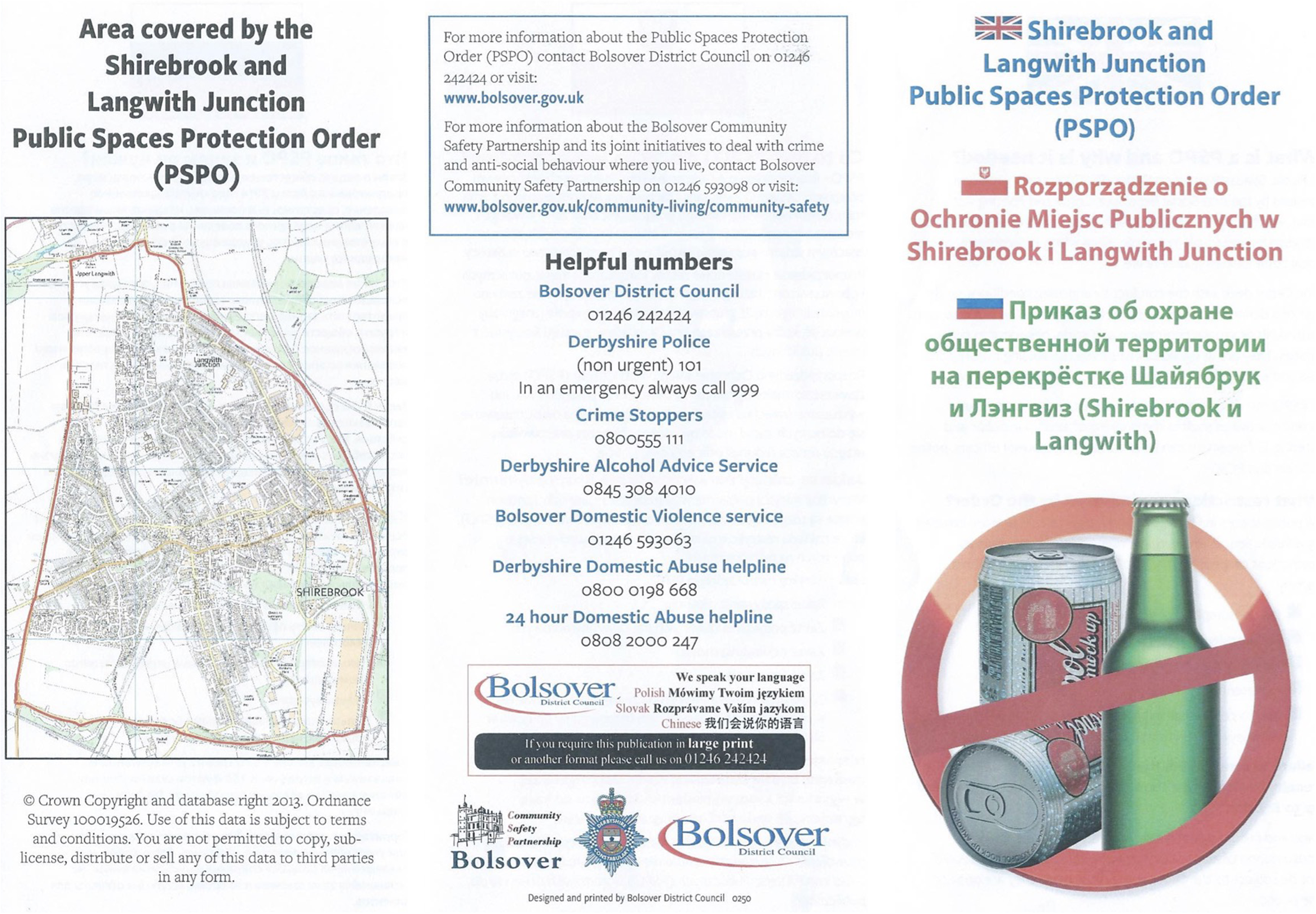
Public Spaces Protection Order (PSPO) leaflet.
The processes leading to the implementation of Shirebrook's PSPO are complex and illustrate interaction between a variety of agents in stigma production, complicating Wacquant's top-down conceptualisation. Bolsover District Council (2014: 371–373) reported that since January 2013 there were growing concerns over antisocial behaviour in Shirebrook, also indicated in the previous section. This included ‘under reporting of crime, domestic violence, littering, noise, young people in groups and more serious incidents regarding violence and public order’. The council also raised concerns over ‘assaults from the indigenous population of Shirebrook towards the newer Polish population’. These concerns led to a Dispersal Order from April to October 2014 in response to ‘local youths targeting Eastern Europeans’. From May 2014, there was a Designated Public Place Order (DPPO) introduced in Shirebrook, which allows local authorities to designate specific places where the prohibition of public drinking can be enforced by the police. In November 2014 ‘police dispersal powers were authorised to address issues of youths gathering in Shirebrook’. At this point, escalating the DPPO to a PSPO was first mooted by Bolsover District Council, which would prohibit more activities and can be enforced by the police and authorised council officials by fixed penalty notice (Brown, 2020). In the summer of 2015, complaints centred primarily on street-drinking but also over two more serious instances of violence allegedly involving migrants prompted the council to begin the process of escalating the DPPO to a PSPO, also triggering Stand-Up for Shirebrook's formation and their organised anti-immigrant demonstrations. The PSPO requires the police to provide supporting evidence, and there is also a requirement for a public consultation. In Shirebrook, this was executed through the council website, visits to the businesses around the marketplace and via questionnaires handed out at public meetings – including the fractious meeting organised by Stand-Up for Shirebrook in the summer of 2015.
At that point, Stand-Up for Shirebrook were not yet incorporated into local governance structures but did occupy a relatively powerful position vis-à-vis Shirebrook's migrant population and so were able to influence the direction and interpretation of the territorially stigmatising PSPO. Samaluk (2016: 458) notes that Polish migrants to the UK occupy a subordinated position ‘marked by their accents and names that signify cultural inferiority’. Whereas Stand-Up for Shirebrook's local belonging and status are not questioned, enabling them to position themselves as guardians of Shirebrook, emphasising their relatively powerful position above migrants. From my regular observations at their meetings, it was clear that immigration was high on their agenda. Although other local issues were discussed, much of their meetings involved the circulation of rumours about dysfunctional behaviours attributed to Eastern European migrants. The initial concerns over alleged antisocial behaviour leading to the introduction of the PSPO appeared to be primarily generic but did also include concerns of local youths assaulting migrants. Stand-Up for Shirebrook's relatively high-profile activities then coincide with the beginning of the consultation period, which at least in part took place through their organised meeting. This process then influences the interpretation of the PSPO as an order to tackle the antisocial behaviour of migrants, redirecting the stigma onto a less powerful group. Additionally, Stand-Up for Shirebrook trade on that stigma to secure and elevate their relatively powerful position when they are later incorporated into local governance structures as a means of appeasement.
The consultation period adds another layer of complexity because it suggests community members operating from ‘below’ are involved in the production of the territorially stigmatising PSPO. This legitimises the Order by making its implementation appear democratic. The significance of relative power among residents in this process is illustrated by Brown (2020: 587), who demonstrates how PSPO consultations fail to capture the diversity of users of the public space in question, and the users likely to be targeted by the Order, such as ethnic minorities, ‘are hard to reach groups when it comes to consultations’. The consultation involved speaking directly to business owners, and the public via a questionnaire written in English, which received only 13 responses (Bolsover District Council, 2015). Non-English speakers are excluded from the consultation, but once the PSPO was activated the prominent signs displayed in Shirebrook's public spaces and leaflets listing the prohibited activities were written in English, Polish and Russian (see Figure 1), identifying migrants as the problem population. That the PSPO targets migrants was reproduced on multiple levels, from individual participants right up to the Parliamentary Select Committee Inquiry, where it was claimed the Order was to prevent ‘antisocial behaviour in the town square by workers from Sports Direct’ – a signifier of migrant labour (BIS Committee, 2016b: Q202). This targeting was also felt by Polish participants. Grzegorz commented that: They did something like safety zone, yeah? Where you can't drink … you can't meet in the group more than 2 or 3 people…But you could always find the English kids, you know, sitting on the wall near the Job Centre, which is you know, 15, 20 or 10 every night and it's not a problem, you know. It's a problem if there are 2 or 3 or 4 Polish lads standing somewhere you know. That was the problem so that was not right.
This demonstrates the inequality in relative power among actors ‘below’ and how the processes involved in the production of territorial stigma effectively sets these groups against one another. In a sense, blaming migrants for social problems is what Wacquant (2007: 68) describes as deflecting ‘the stigma onto a faceless, demonised other’. However, the operation of territorial stigma is influenced and (re)produced through the PSPO, demonstrating a more complex process than Wacquant proposes. It would be a step too far to refute outright territorial stigma as a top-down process, and it is undoubtedly weighted in that direction. However, there is at least some influence emanating from ‘below’ where the stigma is recirculated, provided some legitimacy and its operation effected.
Additionally, the involvement through consultation of even those relatively powerful actors ‘below’ is limited and more likely to lead to the perpetuation of stigma rather than resistance. First, simply including the activities the Order intends to restrict in the consultation means the reader is likely to interpret them as problematic (Brown, 2020). Particularly so when in localised collective mythologies these activities are associated with racialised and classed bodies. These activities are based on public perception so are subjective and context specific; therefore, behaviour that might be considered a nuisance but is not actually harmful, or in another context not considered a nuisance at all, is criminalised (Barker, 2017). This has the potential to alienate and antagonise groups based on fears of what they might do, rather than anything that they have done (Crawford, 2008). Second, the consultation provides no structural context that can help explain why these activities occur and which could encourage a more sympathetic reading. This criticism relates to broader problems with antisocial behaviour legislation and its focus on the management of individual behaviour while ignoring structural inequalities – a key function of territorial stigma (Wacquant, 2008; Wacquant et al., 2014).
These complexities are not captured in the consultation, so the reader is unlikely to interpret the activities as anything but problematic. The local authority offers no alternatives, so the consultation presents a dichotomy that either the PSPO is agreed to, or nothing is done (Bolsover District Council, 2015). Therefore, resistance is unlikely and so stigma production is primarily weighted from above. The production of territorial stigma escalated when these issues caught the attention of the national media in the wake of the Sports Direct working conditions exposé.
‘The village of the damned’: The media and Sports Direct
The final section illustrates the role played by the media in the co-production of stigma in Shirebrook via their reporting on Sports Direct, its working conditions and its workers. The analysis again draws attention to local antagonisms and hierarchies, demonstrating how relatively more powerful actors redirect stigma towards those with less power, but also how this is contested. When the main period of data collection began in October 2016, the amount of attention Shirebrook had received locally and nationally was remarkable for a town of its size, and the impact of this was palpable as I entered the field. The attention first stemmed from the Sports Direct exposé, then intensified in the context of the EU referendum and Brexit through the town's association with Eastern European migrants.
The stigmatising effect Sports Direct's negative press had on Shirebrook was illustrated by several participants. I asked Agata (31) and Paveł (33) – a Polish couple, now living in Shirebrook – what outsiders think of the town: ‘they only speak about the Sports Direct. Because we have friends from the other cities and they always [say] “oh, you live where there is the Auschwitz?”’ ‘A lot of the people only have the bad opinion for Shirebrook because here is the Sports Direct. Most of the people connect you with Sports Direct … this is a very bad warehouse’
The way negative news stories contribute to a place's reputation is well-established in the literature (Butler-Warke, 2020a; Kearns et al., 2013). While much of the existing literature makes the connection between precarious work and territorial stigma, this is usually associated with the insecurity, low-wages and poverty driven by labour precarity, and so is arguably about context (Wacquant, 2008). However, the negative media coverage of Sports Direct's working conditions and the associated precarity is also further contributing to the production of territorial stigma in Shirebrook. Agata demonstrates this by drawing a hyperbolic analogy between Sports Direct's reputation for harsh working conditions and the World War II internment camp, Auschwitz – a practice similarly adopted by the Guardian newspaper and their likening of Sports Direct's Shirebrook site to a ‘gulag’ (Goodley and Ashby, 2015). Additionally, a key characteristic of Wacquant et al.’s (2014) account is that neighbourhood taint becomes known on a national level. Agata and Paveł's account illustrates the way that the localised stigma of Shirebrook has escalated to a much larger geographical scale through the coverage of Sports Direct.
The links between the media attention, Sports Direct and the production of territorial stigma were striking in the following interview extract with Peter – 50, an education worker and a lifelong resident of Shirebrook: we haven't got a crooked spire [Chesterfield], we haven't got a castle [Bolsover] … we’ve got this big white building [Sports Direct] that has had just totally negative press. Yer know, the people watching the news’ll be going ‘oh well, that's what Shirebrook people deserve, that's the type of living conditions, working conditions that they quite accept’.
The stigmatising effect of the negative press that Sports Direct and, by default, Shirebrook have received is demonstrated in Peter's account through comparisons with positive tourist attractions in neighbouring towns. His account also demonstrates the symbolic violence of territorial stigma that sees inequality accepted as valid (Bourdieu, 2000). Pre-existing stigma in Shirebrook provides the anchor for a truly potent form of contemporary stigma to operate (Butler-Warke, 2020b) and the necessary conditions for accepting low-quality work as ‘what Shirebrook people deserve’.
The media coverage of Shirebrook also extended from Sports Direct's working conditions to negative stories about migrant workers. Several national and local newspapers and BBC East Midlands television all ran stories about immigration focusing on Shirebrook. These news stories focused on the supposed dysfunctional behaviour of ‘gangs’ of Eastern European men, including drinking, drug-taking, openly urinating and defecating, littering, violence and intimidation, which were attributed to Polish culture (e.g. Hughes, 2016; Newton, 2015; see also Moore and Ramsay, 2017). Again, participants drew on media attention Shirebrook received, recognising the impact of stigmatisation. For example, Eddie – 74, retired military, moved to Shirebrook 10 years previously – commented that ‘the bad press hasn't helped us, people who don't know Shirebrook are given the wrong impression … it's the ones that have read the bad press. Oh crikey, look at that, all this drinking and urinating in public, stabbings, yer know?’ Eddie's suggestion that people are given the ‘wrong impression’ about Shirebrook endorses Bourdieu’s (1999: 123) contention that categorising a particular place as a problem does not summon ‘realities’ but produces a particular version of reality based on public anxieties stimulated by the tabloid press, political debate and rumour.
The role of the media in the production of territorial stigma in Shirebrook was also discussed by Shaun – 55, a retired railway worker and lifelong Shirebrook resident – but he implies that Stand-Up for Shirebrook was also responsible: It's always had, locally, a bit of a reputation and I think it's been made worse the last few years. I mean, the “Village of the Damned” headlines, Brexit, it really harmed us because all of these Brexiteers were using Shirebrook as an example. Yer know, of a negative point on the open borders sort of thing. And they basically used … [Stand-Up for Shirebrook] who painted a black picture.
The ‘Village of the Damned’ refers to a headline from an article in a national tabloid newspaper. The story, also picked up by several other newspapers, told how a criminal conviction secured in the home country of a Polish man living in Shirebrook came to light ‘when he was arrested for anti-social behaviour with gangs of beer-swilling Eastern Europeans thronging the centre of the troubled Derbyshire village of Shirebrook’ (Parker et al., 2016: 18). The articles report that the police took measures to hide the man's identity so as to defuse ‘tensions’ between Polish and British communities. Like other participants’ accounts, Shaun suggests that Shirebrook's pre-existing reputation was amplified by the national media, effectively setting the stage for the political activation of territorial stigma, this time by ‘Brexiteers’.
The parallels between the discourses of the right-wing tabloid press and the Brexiteer party, UKIP, are noted by Mondon and Winter (2020). Negative news stories about migrants tripled in the lead up to the referendum who were blamed for a range of economic and social problems in the UK (Moore and Ramsay, 2017). It is also significant that the articles refer to ‘tensions’ as this is an attempt to legitimise concerns about immigration by invoking fear of a racist backlash if nothing is done about immigration and EU membership (Gillborn, 2010). The activation of territorial stigma in pursuit of political traction is not unusual and was demonstrated in the previous section. However, now, the stigmatisation of Shirebrook is (re)activated to legitimise Britain's withdrawal from the EU and the closing of borders.
The reference to Stand-Up for Shirebrook in Shaun's account again illustrates the role of relatively powerful actors in the production, legitimation and redirection of territorial stigma. Some participants were critical of Stand-Up for Shirebrook for contributing to Shirebrook's negative reputation through their engagement with the media. For example, Marie said that they are ‘a nasty group of people. I think they’re making Shirebrook badder than what it is, they’re giving this programme what wa’on tele, they’ve fed’em what they want’. Sheila also commented on Stand-Up for Shirebrook's role in a BBC East Midlands news television programme about immigration: ‘it didn't look very good did it? He projected Shirebrook like yokel racists. I’m like, God man, what are you doing?!’.
The production of territorial stigma in Shirebrook does not occur in a vacuum and so must be understood in the context of broader debates on immigration that intensified leading up to the EU referendum (Moore and Ramsay, 2017). The media and other powerful actors possess the symbolic power to define the foremost social problems in a particular locality, and as such set the political agenda (Bourdieu, 1999; Mondon and Winter, 2020; Tissot, 2018). Nevertheless, territorial stigma is more complex than the direct top-down process outlined in Wacquant's account. As the quotes above indicate, Stand-Up for Shirebrook do not necessarily represent the views of the majority of Shirebrook's residents. However, their relatively powerful position meant they came to represent the concerns of Shirebrook as a whole but in a limited way. This process worked to legitimise and give authority to territorial stigma and the framing of social issues in Shirebrook because they are presented as originating from residents ‘below’.
Conclusion
A key contribution of this paper is the demonstration that the production of territorial stigma is a complex process that cannot be located as emanating from a single source. Rather, multiple institutions and actors working from a range of scales converge in the co-production of stigma. I argue that this complicates Wacquant’s et al. (2014: 1275) top-down conceptualisation where territorial stigma ‘percolates down and diffuses across the social and spatial structures of the city’. The weight of stigma production undoubtedly bares down from ‘above’ but is also reproduced, redirected and legitimised by relatively powerful actors from ‘below’. In Shirebrook, the production of stigma from ‘above’ emanates from the bureaucratic and journalistic fields. The Coalfield Regeneration Trust draws on state-sanctioned discourses of pathological worklessness and benefit dependency, stigmatising the town and ushering in poor quality work at Sports Direct. These themes are associated with ‘broken Britain’ discourse and antisocial behaviour legislation: the inspiration behind the territorially stigmatising PSPO sanctioned by the local authority from ‘above’. Residents ‘below’ also influence how stigma operates, its reproduction and its targets, so rather than just resistance or submission, there is at least some flow back towards the top contributing to territorial stigma's co-production.
How stigma is recirculated and influenced from ‘below’ is dependent on the relative power of the actors involved. Whether the target of the stigma is the unemployed, the young or migrants, it is reproduced at the ground level by relatively more powerful agents, which does not merely deflect the stigma but legitimises and further entrenches it. This process is not lateral as Wacquant (2007) and Wacquant et al. (2014) suggest but is mediated by power and effects how the stigma operates. Stand-Up for Shirebrook were particularly influential in stigma production, but they also traded in stigma to further secure and elevate their relatively powerful position through incorporation into local governance structures. Their activities identified Sports Direct's migrant workforce as a problem population, influencing the operation and interpretation of the PSPO and the media reporting. Both of which target less powerful groups but in effect stigmatise the whole town. However, the view of social problems provided by Stand-Up for Shirebrook was partial, and its accuracy was challenged from other actors ‘below’. Yet, it was their version of social problems mobilised by the tabloid press because they provided the legitimacy necessary to activate territorial stigma against the EU and open borders. That the stigma can switch between different categories of people, yet it is the town that is imagined as the ‘village of the damned’ and, ‘on an ASBO’, is a central feature of territorial stigma. It is the place the stigma affixes to and ‘symbolic boundaries between the different social categories of those living there become blurred or partially merge, and in practice forms of territorial stigma are rarely associated with one social category but with an overlapping number of these’ (Schultz Larsen and Delica, 2019: 551; Wacquant, 2008).
An advantage of examining the production of territorial stigma through place-based multimethod ethnography, rather than studying stigma emanating from a single event (Butler-Warke, 2020b), is that it reveals how it is co-produced, renewed and politically activated to suit different interests. The complexity is demonstrated through two concurrent analytical case studies in place and time: Shirebrook as a signifier of ‘broken Britain’, antisocial behaviour and the implementation of a PSPO; and the media reporting on Sports Direct, its working conditions and its workers. These two analytical cases are inherently connected through the processes of deindustrialisation, post-industrial economies and migration. Deindustrialisation and the reframing of coalfield communities as sites of pathological worklessness and dependency pave the way for post-industrial job growth in low-paid and insecure work. This also provides the context for the ‘intensive surveillance’ (Wacquant et al., 2014: 1275) of antisocial behaviour legislation, which (re)produces territorial stigma through the PSPO. Post-industrial economies rely disproportionately on the young and migrants, and so, in a town with an ageing population, migrants are drawn in and are made the targets for a renewed territorial stigma, mobilised this time in the interests of Brexit.
As a final point, what the various processes involved in the co-production of territorial stigma have in common is that they present problems in Shirebrook as individual failings. This is so, regardless of who is targeted by the stigma at any particular time, whether it be those that supposedly choose a life of welfare dependency, or migrants and their supposedly incompatible and inferior culture. Wacquant (2007, 2008) argues that this is a key objective for territorial stigma: to obscure the impact of broader inequalities and reposition the place and the people that live there as the problem. This has major implications for the fate of people that live in stigmatised territories and creates a perception that they create, rather than face social problems (Tissot, 2018). This leads to the legitimisation of welfare retrenchment, intensive surveillance and the locally focussed policies of regeneration and gentrification, at the expense of broader structural policies of redistribution.
Footnotes
Author's Note
ASBO is an acronym and slang term for an Anti-Social Behaviour Order.
Acknowledgements
The author would like to thank the anonymous reviewers for their careful readings and valuable suggestions. Also, thanks to James Rhodes and Jay Emery for their valuable comments on drafts of this paper.
Declaration of conflicting interests
The author(s) declared no potential conflicts of interest with respect to the research, authorship and/or publication of this article.
Funding
The author(s) disclosed receipt of the following financial support for the research, authorship and/or publication of this article: This work was supported by the Economic and Social Research Council (Grant No. ES/J500100/1, ES/V007149/1).
