




Abstract
Gentrification and territorial stigma are understood to be closely linked, yet the workings of the governance networks which underlay this relationship have seldom been explored in depth. This paper seeks to develop understandings of this relationship by showing how the interactions which occur in decision-making processes at the local level culminate in particular strategies for regeneration. It draws on interviews and document analysis to map out and examine networks of governance in Middlehaven, a territorially stigmatised area of Middlesbrough, UK, which has been targeted for regeneration, and indicates the methodology used for tracing the emergence of regeneration strategies in order to reveal how gentrification emerges as a policy response to territorial stigma. In doing so, this paper highlights the relationship between institutional arrangements, governance networks, and approaches to urban change in the context of a territorially stigmatised space in a post-industrial town, and indicates how neoliberal governance occurs in practice at the local level. By highlighting how particular strategies of gentrification which gain traction are embedded in local governance configurations, the paper challenges policy approaches to territorially stigmatised spaces which frame gentrification as an inevitable outcome.
Introduction
In the process of gentrification, wherein working-class populations are displaced by a middle-class transformation of their neighbourhoods (Schaffer and Smith, 1986), the role of the state is increasingly decisive, particularly in ‘hard-to-reach’ marginal urban spaces (Watt, 2009). Local-state-led gentrification sees local authorities ear-marking sites for redevelopment, and often compulsorily purchasing property to pave the way for ushering in private capital (see Porter and Barber, 2006). This paper takes as its focus the local-state-led gentrification of Middlehaven – which is a territorially stigmatised neighbourhood of Middlesbrough, a post-industrial town in North-East England (Warren, 2018) – and reveals how the precise workings of local neoliberal urban governance lead to specific regeneration approaches.
There is an abundance of literature on territorial stigmatisation and marginality which outlines the consequences of these urban conditions for the spaces and people affected, including responses to them (see Kallin and Slater, 2014; Uitermark, 2014; Wacquant, 2008). It is recognised within the literature that local policy often naturalises the relationship between territorial stigma and gentrification, painting the latter as an inevitable outcome of the former (Gray and Porter, 2015). Yet it is clear that local-state-orchestrated gentrification is not inevitable, but is the outcome of a particular set of decisions, and of institutional values, which coalesce to set the wheels of urban change in motion and drive the trajectory of an urban space in a particular direction. However, there is currently a lack of literature which addresses in detail the dynamics of power and governance relationships which converge in specific locally contingent ways to lead to particular gentrifying outcomes in territorially stigmatised spaces.
This paper therefore contributes to the body of literature on territorial stigma, and builds upon it through a close analysis of local processes of neoliberal governance in order to develop an understanding of how responses to marginality emerge from localised dynamics of power, using a methodological approach for understanding the evolution of local policy responses to stigma which could be applied elsewhere. It does so by mapping out and tracing relationships in local governance networks in order to draw out the specific points at which gentrification becomes mobilised as a policy response to territorial stigma. Given the displacement of working-class people from their homes which all-too-often accompanies state-led gentrification, tracing the precise ways in which such outcomes emerge from the operation of governance networks as part of efforts to tackle territorial stigma is clearly of importance for questions of urban inequality and injustice, not only for the case elucidated here, but for understanding policy responses to territorial stigma more broadly. This paper therefore shows both how gentrification emerges as a policy response to territorial stigmatisation, and how interactions in local governance networks shape the strategy of gentrification which emerges. It highlights how the specific trajectory of urban change within a territorially stigmatised neighbourhood is rooted in the nuances of the operation of local urban power, and how these local interactions themselves fit into a broader nexus of power. Revealing the ways in which networks of governance shape processes of gentrification strengthens understandings of such processes, and works to challenge instances where gentrification is presented in policy discourse as inevitable.
Much of the theoretical and empirical work on urban territorial stigma is rooted in studies of large cities, while the body of literature on manifestations of the phenomenon in smaller towns is less expansive. By contributing to the literature on small cities and towns which have often been marginalised in mainstream urban theory, this paper aims to advance understandings of territorial stigma at the neighbourhood level in a way which appreciates how local specificities shape responses to marginality.
Of course, local regeneration policy cannot be abstracted from the conditions engendered by wider neoliberal shifts in governance. That the prominence of local state-led gentrification has emerged amidst the widespread neoliberalisation of urban governance is no mere coincidence (Lees et al., 2008): Manufacturing conditions amenable to gentrification through a range of policy decisions and incentives appears to be part and parcel of local approaches to regeneration which aim to craft economically competitive spaces which are primed for investment. In a context where neoliberal ideology views individualism as in the interests of some common good, and perpetuates the notion that ‘the market knows best’ (Smith, quoted in Lees et al., 2008: 164), neoliberal urban governance positions state-led gentrification as a process which can distinguish the area as economically competitive on an interurban scale. Far from being a retraction of state involvement, neoliberal urban governance sees local policy shift from welfare-orientated to market-orientated (Keil, 2009; Leitner et al., 2007), whereby serving business interests and facilitating market-led urban transformations through entrepreneurial approaches are seen as essential for the maintenance of an urban jurisdiction's economic prowess (Harvey, 1989).
A combination of reduction in funding for local government and increased interurban competition since the 1980s (Colenutt, 1999) has meant that local authorities have often felt compelled to orientate their policies towards securing private investment throughout decades of changes to national policy on urban development. The broader landscape of urban financialisation, which has swept the UK in recent decades as cash-strapped local authorities have sought to cope with budget cuts and continue to deliver local services, represents an important backdrop against which local regeneration policy emerges. For places like Middlesbrough in which rental values, rates of business-rate increase, and demand from potential investors are low, local authorities are in weaker positions for capturing value through Tax Increment Financing (Strickland, 2013) and Business Rate Retention (Muldoon-Smith and Greenhalgh, 2015) than in areas with different local economic circumstances. Studying the regeneration of Middlehaven therefore presents an opportunity to examine the precise ways in which local governance networks shape outcomes for spaces targeted for regeneration in practice in towns and small cities which are seldom the basis of urban theory, embedded within this broader context in which attracting private investment is increasingly seen as crucial not only to economic growth, but to the standard maintenance of local welfare and services.
First, the paper discusses the relationship between territorial stigma, gentrification, and governance, and introduces the field site. This is followed by an outline of the methods used in this study, before networks of governance are illustrated and analysed.
Territorial stigma, governance, and ‘demarginalisation’
Wacquant (1996) uses the term ‘advanced marginality’ to describe conditions which emerge in ‘territories of exclusion’ (p.122) within polarized cities. Territorial stigma is a key aspect of spaces of advanced marginality, as such spaces become “isolated and bounded territories increasingly perceived by both outsiders and insiders as social purgatories” (Wacquant, 2008: 237). The stigmatising discourses which afflict such spaces are often the very same ones which stigmatise the working-class; those which are reinforced by the media in television programmes which present social housing estates as the domain of some despised ‘underclass’ (Arthurson et al., 2014); and those which often lead to punitive responses in policies designed to address perceived urban ills (Wacquant, 2008). When this stigma is embedded in particular territories, the implications are manifold: they can include post-code discrimination (McKenzie, 2015), a break-down in community cohesion (Wacquant, 2008), and sometimes may lead to regeneration (often entailing displacement of those affected by the stigma) due to the space being labelled as in ‘need’ of intervention of this sort (Slater, 2014).
Middlehaven – which is often referred to locally as ‘Over the Border’, which positions it as being on the ‘wrong side’ of the railway line and road that separate the regeneration site from the town centre, and which casts negative aspersions about residents of the area's now-demolished St Hilda's housing estate (Amin et al., 2002) – joins a long list of symbolically denigrated neighbourhoods which have been singled out for regeneration in cities across the world. Indeed, it is a stigmatised area of an already widely disparaged town and broader region: Teesside has been consistently subjected to negative portrayals in national media (Nayak, 2019). Parallels can be drawn with Sangerhousen, a town in East Germany, which faced rapid decline in its copper mining industry in the late 1980s, and has since become territorially stigmatised (Bürk, 2013). Bürk (2013) argues that the stigmatising narratives surrounding Sangerhousen position it simultaneously as emblematic of the broader East Germany region, which is often portrayed in a negative light, and as a specific ‘capital of the unemployed’ within that region (p.175).
Existing literature makes clear how territorial stigma is often mobilised as a justification for gentrification: Kallin and Slater (2014) show that the local state played a decisive role in perpetuating the stigma associated with public housing estates at Craigmillar, Edinburgh, which then led to their demolition. It is in this sense that they argue that stigmatisation and gentrification are “two sides of the same policy coin” (ibid., p.1351). Or, as Wilson (2004) puts it, stigmatisation carries out the symbolic work which “primes sites and people for neoliberal redoing” (p.773). Those living in areas of advanced marginality are often subjected to morally-loaded labelling and stereotyping which sees them blamed and held responsible for the very injustices they endure amid growing urban inequality (Uitermark, 2014).
Subsequently, regeneration projects which involve displacement of perceived ‘problem residents’ become framed as a fix for marginality, despite not addressing its causes (Hastings and Dean, 2003). This misplaced apportioning of blame onto those who bear the brunt of stigma is not new. Crump (2002) highlights how in the 1990s, policy makers drew associations between urban problems and ‘concentrated poverty’, leading to demolition of working-class housing and displacement of low-income residents. Importantly, the way in which the issue is framed implicitly indicates what should be done to tackle it, such that framing stigmatised housing estates as ‘dysfunctional’ works to justify demolition and displacement of communities (Goetz, 2013). In a study of the stigmatised Regent Park area of Toronto, Canada, August (2014) shows that a breakdown in community cohesion and the associated blaming of neighbours by other residents in the stigmatised space - which are often understood to be a key feature of territorially stigmatised neighbourhoods (see Wacquant, 2008) - are not inevitable. August highlights that residents of Regent Park often felt a connection to their neighbours and attachment to their neighbourhood. However, it is important to note that gentrification did nonetheless occur in Regent Park, as the area had undergone symbolic devalorisation, which ultimately served as justification for regeneration (August, 2014).
The symbolic violence of stigmatisation and the subsequent emergence of regeneration as a proposed solution is embedded in trends in urban governance. Since the 1970s, a shift to entrepreneurial governance has increasingly seen a capitalist agenda rework urban landscapes (Harvey, 1989). Place-promotion, or boosterism, has long been a key part of entrepreneurial strategies to attract inward investment. Therefore, where processes of territorial stigmatisation may be seen to create an unfavourable image for affected spaces, the relationship between governance strategies aligned to a neoliberal agenda and ‘demarginalisation’ is of importance. Leitner (1990) suggests that local policies emerge from a convergence of structural forces (which result in the uptake of neoliberal approaches by local government of various political leanings) and the specific contexts of local politics (taking into account local organisation of power, class, state interests, and economic factors). As such, while widespread political and economic influences are important in shaping local policy, the specificities of local governance arrangements in the approaches taken towards attracting investment as part of attempts to tackle territorial stigma cannot be overlooked.
Yet studies of small cities and towns have often been outside the mainstream of critical urban theory (Bell and Jayne, 2009). Broadening theoretical understandings by drawing insights from spaces which are often overlooked is necessary to develop a fuller recognition of how urban processes operate on different scales (McCann, 2004), and thereby to ensure that urban policy takes account of how local specificities shape opportunities for achieving urban justice (Bell and Jayne, 2009). Researching small towns and cities can usefully furnish understandings of urban governance. Indeed, in a study of four small towns in the USA – all of which are located a long distance from large cities, and which are experiencing deindustrialisation – Bliss (2018) shows how different local governance configurations, including different extents of devolution, and variations in regional institutions and in the strength of local leadership, influence the different policy approaches pursued in each of these towns. Importantly, Bliss highlights that small towns often face among the highest levels of competition, economic difficulties, and pressures on local government budgets, and they therefore represent important arenas for research on urban governance, both in the USA and elsewhere.
Within the debate on urban territorial stigma and gentrification, there is a body of literature which challenges the dominance of studies from large cities in the theory, by focusing on towns and cities which are either small in terms of population, lack the influence of major cities, or which are peripheral in urban theory more broadly. Indeed, stigma is a phenomenon which pervades many small towns and cities. In a study of Teesside, Bush et al. (2001) show that in spaces which have experienced industrial decline, a stigma linked with social deprivation can be compounded by an environmental stigma. They demonstrate that a perceived ‘uncleanliness’ in Teesside's air associated with its former heavy industries did not tally with scientific measurements of air quality, yet was nonetheless thought by residents and medical professionals to be linked to poor local health outcomes. Meanwhile, Cairns (2018) shows how Camden, New Jersey, which like Middlesbrough has a history of industrial decline, is framed as a ‘city of ruins’ (p.1224), and one in which crime, violence and poverty abound. Rather than simply internalising the stigma of their city in the way that Wacquant (2008) observed in his studies, Cairns finds that young people in Camden challenge stigmatising narratives, rejecting them as ‘partial truths’ (p.1231), and seeking solace in Camden's more affluent past by imagining a similarly affluent future.
Similarly, in Hull, UK, Tommarchi and Bianchini (2022) found that heritage was used to challenge an externally-imposed stigma associated with the city. Hull, which following a decline in key industries has been framed as a ‘left-behind’ city and consistently subject to negative media coverage, hosted the UK City of Culture event in 2017, which ‘spectacularised’ its heritage, particularly with relation to its maritime history (ibid.). Interestingly, there are concerns that the events and investment in Hull's culture have been focused in the city centre, and that this might open ‘a reputational gap’ between the centre and the periphery of Hull (ibid.). Notably, this indicates that in small cities which are stigmatised as a whole, schemes designed to boost the image of a particular area risk not destigmatising the entire city, but instead reinforcing the stigma elsewhere in the city. There is therefore a need to examine territorial stigma at the neighbourhood level within small cities which have been stigmatised. This study contributes to and advances this literature by taking a smaller-scale focus, examining a stigmatised area of a town which is itself already widely stigmatised.
Middlehaven, Middlesbrough
In Middlesbrough, which is one of many northern towns in the UK which has been affected by industrial decline since the 1970s (Hudson and Williams, 1989), the steel and iron industries which traditionally formed the foundation of the local economy have shrunk away from the town's former industrial heartland, and have given way to a territorial stigma. While the St Hilda's area of Middlesbrough (now called Middlehaven) has long been the subject of negative perceptions locally, it has not always faced the same levels of marginalisation: In 1948, Ruth Glass observed that despite being ‘cut off’ from the rest of the town by the railway line, and regardless of high levels of social deprivation, the area was at the time well serviced, with ample access to social amenities (Glass, 1948). Later, industrial decline changed the story in Middlehaven.
Teesside's industries were bolstered by national political and institutional support for regional industries in the late 1920s-early 1930s and in the years immediately after WWII (see Martin et al., 2016). However, much of the UK's manufacturing growth from 1945 to 1970 was located in the South East, and the economy of Teesside hinged on a few large companies in the chemical and steel industries as a result of policies which deliberately discouraged other industries from setting up on Teesside to avoid labour shortages in Teesside's key industries in the 1940s and 50 s (Beynon et al., 1989). From the late 1970s onwards, the steel industry in Teesside declined rapidly. During this period, national economic policy was focused on the UK's buoyant financial sector, while many industries were privatised in the name of efficiency and ‘market freedom’, and regional public spending was highly uneven, with the South prioritised over the North (Beynon et al., 1994; Martin et al., 2016). And while there are still some industries on Teesside, local government considers diversification of the local economy as essential to compete on the interurban scale, and to cope with local spending cuts. It is in this context that the regeneration of Middlehaven – the area adjacent to Middlesbrough town centre which was once the centre of Teesside's steel-making ambitions – attempts to demarginalize the site, or improve its public image with the aim of overcoming the territorial stigma, in order to manufacture a space which is conducive to private investment.
The regeneration site has been the focus of a decades-long, multi-million-pound programme of redevelopment efforts. The current phase of regeneration draws inspiration from a masterplan for Middlehaven, produced by architect Will Alsop in 2004, which sought to transform it from a territorially stigmatised area into a ‘Designer Playground’ complete with a hotel built in the shape of champagne flutes, and high-rise buildings made to look like ‘Prada skirts’ (Alsop, 2004). While such details have not been delivered, the creative ethos championed by the masterplan pervades current plans. Since then, the regeneration of Middlehaven has seen the demolition of the St Hilda's estate which was framed as an obstacle to redevelopment, entailing the eviction and displacement of its residents. The adjacent area saw the construction of the ‘Boho Zone’, an office and live-work development intended to attract digital and creative industries.
In this paper, I use the term ‘demarginalisation’ to refer to the local council's goal of shedding Middlehaven's territorial stigma. It just so happens that because of the way the stigma is understood within the town, the processes which have been activated as part of the council's demarginalisation efforts ultimately amount to gentrification. This aim of demarginalisation is epitomised in the Middlehaven Development Framework, which outlines Middlesbrough Council's vision for the area. The Framework argues that Middlehaven, and in particular the St Hilda's area, is “stigmatised by its history as a notorious estate”, and as such, indicates that “to be successful, regeneration must… promote a new vision for Middlehaven, both through branding and marketing and also through development on the ground that changes the image and perception of the area.” (Middlesbrough Council and HCA, 2012: 29). This paper therefore unpacks the governance regime of Middlehaven to explain how the trajectories of the regeneration project towards the aim of demarginalisation have been shaped, and how the operation of power within the town has led to gentrification occurring to this end.
Methodology
To examine local governance networks involved in regeneration – and therefore to reveal relationships between configurations of power and policy – it is necessary to identify and make visible the various actors and organizations involved. As Magnusson (2011) asserts, in urban politics, “the privileged points of intervention can only be discovered in practice: they cannot be anticipated in advance” (p.4). This paper therefore identifies nodes of power in Middlehaven's governance networks by drawing on data from interviews and document analysis in order to ensure that the connections identified are in fact those which are important in practice.
Between 2016 and 2019, 20 people took part in semi-structured interviews for the research project of which this paper forms a part. Those interviewed included residents of accommodation built as part of Middlehaven's regeneration, council officers and elected councillors, and representatives from key local businesses and institutions. The interviews sought to generate data on participants’ views on the area, the territorial stigma, decision-making processes, and the process of regeneration (including governance relationships). All interview participants have been anonymised. Additionally, 31 documents pertaining to the approach taken to regeneration in Middlehaven (including local planning documents, newspaper articles, etc.) were analysed. Each document was read closely and analysis was grounded in existing conceptual frameworks of gentrification, marginality and territorial stigma. As Lowe (2004) indicates, the language used in policy documents can legitimise some ideas while foreclosing others, and as such, the document analysis employed here considered how certain issues became established on the local agenda, and how approaches to local redevelopment/gentrification are discursively developed and maintained.
The analysis was used to compile two diagrams of local governance networks by drawing out the governance relationships which became apparent in interviews and document analysis. The versions of these diagrams presented here are simplified in order to highlight key relationships which shape local policy responses to territorial stigma, and to ease the transference of this approach to the analysis of other cases: Figure 1 highlights the relationships between actors and organisations involved in the governance of Middlehaven, while Figure 2 sets out the formal structures of local government which shape responses to marginality in the area. Mapping these relationships of power is useful for capturing the complexities of the governance networks involved in the regeneration project, as it enables an in-depth understanding of the relationships between points in the network to be visualised in an accessible and manageable format (Scott, 2015), and as such provides opportunities to analyse the organisation of power in the town.

This diagram illustrates complex governance relationships which shape policy responses to territorial stigma in Middlehaven. The diagram includes the most significant organisations and actors involved in the governance of Middlehaven, and their complex relationships are highlighted by the arrows connecting various organisations and groups to one another. The layout of the diagram (from top to bottom and left to right) does not illustrate any particular hierarchy in the governance structure. The direction of the arrows illustrates flows of governance between the various organisations and groups shown. For instance, the Combined Authority (TVCA) is connected to the LEP by, indicating that the TVCA is directly involved in the governance of the LEP, but that the LEP is not directly involved in the governance of the TVCA. Organisations which are involved in some way in each other's decision making are connected by , while organisations and individuals which can be categorised as part of another group shown on the diagram, but for purposes of clarity have been given their own category, are connected with a dotted line.
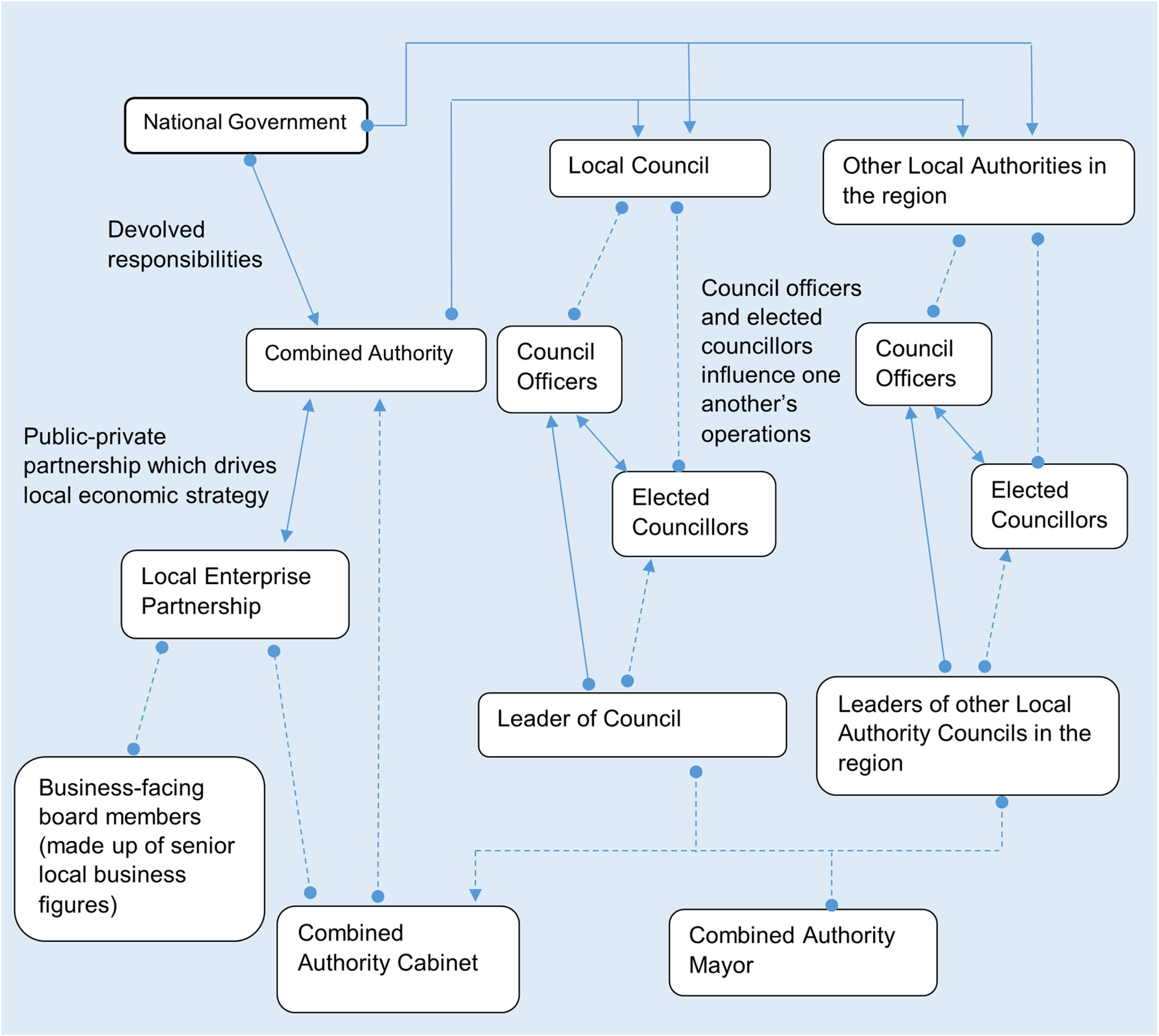
This diagram shows the formal structures of local government based on that observed in Middlehaven (at the time of writing). See Figure 1 for an explanation of the kinds of arrows used to connect the actors shown. The structures illustrated are simplified in order to highlight the key relationships.
While some relationships may not be exposed for analysis using this qualitative approach, and while the networks indicated are of course themselves embedded in broader networks, the diagrams produced do nonetheless enable visualisation of a fine-grained representation of the localised workings of governance, and thereby make it possible to draw out for analysis the relationship between power, circulations of discourse, and policy-making with respect to responses to territorial stigma. In doing so, the policy and processes of gentrification can be illuminated, and set in the context of the dynamics of local urban politics. This analysis is presented in the sections to follow.
Governance network diagrams
Local organisational structures in practice
The decision-making behind the planned development of an ill-fated snow centre proposed for Middlehaven's dockside provides insight into the nature of local urban governance in practice. Speculative in nature, the project was characteristic of an entrepreneurial mode of governance (Harvey, 1989). In addition, entrepreneurial governance often entails an emphasis on dislocating space and place, such that a project is intended to improve the image of the area beyond its immediate vicinity, thus enabling boosterism of the surrounding area (Wood, 1998). Boosterism of this sort is itself part of an entrepreneurial means to continue operating in an entrepreneurial fashion, as it enables local authorities to present themselves as entrepreneurial, and ‘business-friendly’, with the intention of securing further private local investment (Jessop, 1998; Ward, 2003). And so while the snow centre was not delivered – and irrespective of whether it was ever really expected to happen – it nonetheless represents an attempt to create interest in the area, and to project a new image (distinct from the stigmatising ‘Over the Border’ imaginary) for Middlehaven and for the town more broadly with the aim of producing the area as competitive, and generating economic growth. Consideration of how plans for this development gained traction highlights how strategies for regeneration in Middlehaven are carried forward within the interactions between various actors in the governance network, and indicates how institutional values are embedded in the decisions brought forward in this context.
A quote from a council officer indicates that Middlesbrough Council's hierarchical organisation has been of significance in shaping the local authority's broader priorities, and in gaining institutional support for the planned snow centre development: “The [former] Labour leadership would have been championing it as part of the aspirations and driving force behind what they’re trying to achieve for the town. So it's something which just flowed through everyone.” – Council officer
The notion that support for the plans began with the Mayor and then ‘flowed through everyone’ suggests that those lower down the institutional hierarchy were not forced to support the decision endorsed by the Mayor, but that power operated here in a more subtle manner, as others in the organisation were convinced of some need to see the project come to fruition in order to meet aspirations, thereby supporting the council's institutional values.
A Middlesbrough Council (2017) report which discusses issues relating to the planned height of the £30 m private development on the dockside states that the development framework “is not overly prescriptive in terms of heights around the Dock to allow flexibility for market-led responses” (p.6), and “modern, niche leisure developments such as snow centres have the ability to act as a major driving force for urban development” (p.7). Evidently, the institutional values which are reflected here, and which are embedded in the council's aspirations for the town which led to support for the snow centre, are typically neoliberal values which herald market-led development as a requisite of success. This is matched by the simultaneous absorption of risk by the local state (including the council and TVCA) with a view to enhancing the area's economic competitiveness: 2018 saw the development of a £10 m publicly-funded bridge over the dock to ‘unlock’ the site intended for the construction of the snow centre by a private developer (Middlesbrough Council, 2020). The operation of power within the council, which works through championing causes rather than through coercive techniques, threat or force, therefore makes sense here. As Peck (2017) asserts, the hegemony of neoliberalism must be understood “not as a unilateral or top-down imposition” (p.14), but as a continuous and ever-contested process of normalisation. It is this normalisation of a neoliberal rationale which enables alternatives to a form of governance orientated to economic growth to be positioned as “unviable and barely even thinkable” (Peck, 2017: 15).
As such, while support for the snow centre within the council points towards a non-coercive operation of power within the governance of Middlehaven, the apparent compulsion to make decisions geared toward economic growth demands attention here. As Jessop et al. (1999) argue, heightened inter-urban competition acts “as an “external coercive power” over individual cities… [bringing] them closer into line with the discipline and the logic of capitalist development” (Harvey, quoted in Jessop et al., 1999: 141). Discourses of urban competition, and the notion that remaining competitive is integral to the maintenance of the urban jurisdiction, are critical in gaining consent for projects which reinforce the hegemonic power of neoliberalism (Perkins, 2013). As Davies (2014) asserts, economic compulsion is a pervasive form of urban coercive power, and so while those working on the development of the snow centre within the council may not have perceived threat or force from higher up the organisational hierarchy, they nonetheless perceived a compulsion to make decisions which position Middlehaven as economically competitive.
The business of gentrification
Business interests have long been influential in public policy in the UK (Peck, 1995). Indeed, Teesside's business community has formal involvement in local governance via the LEP (Figure 2). Seemingly, at the heart of the relationship between business and Middlesbrough Council is a shared interest in economic growth, and given that local authorities often appear to face a choice between appealing to business interests or losing out to more competitive areas (Leitner, 1990), the council ensures that businesses are able to directly contribute to local policy direction. The following quote from a property developer illustrates how far business leaders have been able to shape the approach to regeneration: “We worked closely with Ray Mallon, the then Mayor, and he ultimately assisted in having the remaining properties – residential properties – ‘Over the Border’ demolished… We saw a potential for the future, but until those houses were demolished, nothing really happened… I think it pushed it up the agenda and it made it happen more quickly. Because what we were saying to Ray was ‘we cannot regenerate [our building], and spend a million quid on it, if you’ve got this derelict property, vandalism, crime right opposite’.” – Property developer
This account suggests that business interest in plans for the area was instrumental not only in the Council's decision to demolish housing, but also in the timing of that decision. This prioritisation of business interests at the expense of individuals with relatively few capital assets – in this case, the working-class residents of the area – is commonplace in governance regimes which take an entrepreneurial approach, in which the focus of local authority efforts shifts from welfare to economic competition (Brenner, 2004). This prioritisation of economic growth goes some way to explaining the non-consultative way in which the council reportedly went about the demolition, which is epitomised by the then-Mayor's following comment: “There will now be a consultation period and no doubt numerous people will have their say… However, I am convinced that at the conclusion of the consultation period housing in St Hilda's will still be razed to the ground” – Ray Mallon, Gazette (2004).
These comments were made ahead of the consultation period. A report compiled at the start of this process indicates that demolition was not officially predetermined. It highlighted that it would “deal sensitively with the implications for residents and businesses of the potential eventuality of clearance” (Middlesbrough Council, 2004, emphasis added). Business interests appear to have had greater influence on the decision to demolish housing than consultation with residents, such that the outcome of consultation was portrayed by Mallon as a foregone conclusion. The apparent predetermination of this decision – and tacit lack of meaningful consideration of residents’ views – is striking. However, returning to the way in which neoliberal normative reasoning constructs economic competition as the highest tenet of governmental prudence, this should come as little surprise. Indeed, the construction of working-class residents as disposable, and subsequent accumulation by dispossession (see Harvey, 2003) is consistent with trends in urban governance which have emerged alongside neoliberal capitalism (Lees, 2014).
Notably, Figure 1 highlights the role of the Police in the governance of Middlehaven. Aside from the presence of a Police Station in the Boho Zone, the role of the police is important to consider given that prior to his tenure as Mayor, Ray Mallon was Cleveland Police Chief. Indeed, like countless other territorially stigmatised urban districts, the now-demolished St Hilda's estate was disparaged as a criminal hotspot. This criminalising – and morally-loaded – discourse saw residents blamed for the stigma, as epitomised in the following quote from a resident in a building constructed as part of Middlehaven's regeneration: “This was the rough area. This was where all the houses were. That had all the nasty families in, so yeah, again, it wasn't a place that you’d come across really, because it had a bad name” – New-build resident
Where blame for the stigma is attached to residents, demolition and displacement emerge as perceived solutions to the stigma, particularly where fear of crime is viewed to be stifling opportunities for investment. Ray Mallon held the view that “a villain will get up in the morning, steal a newspaper and a pint of milk from a doorstep, snatch someone's bicycle and go on a shop-lifting spree… By lunchtime he will have committed a dozen crimes” (Mallon, quoted in Smith, 2001: 68). Indeed, in his role with the Police, Mallon gained the nickname ‘Robocop’ as a result of the zero-tolerance policing strategies he brought to Middlesbrough, taking inspiration from New York's Rudy Giuliani (Smith, 1998). Revanchist approaches to urban governance, including the ‘sanitization’ of New York City which was implemented under Giuliani, have sprung up in cities around the world as they attempt to ‘reclaim’ space to attract the middle and upper classes as a means of competing for investment (see Swanson, 2007). As Smith (1996) makes clear, revanchism and gentrification are closely linked, and so the connection between Middlesbrough's Council personnel and zero-tolerance policing are important to bear in mind in a consideration of the decision to demolish a historic working-class estate as part of regeneration. The professional connections of individuals ‘at the top’ are therefore of importance in shaping the path towards demarginalisation in Middlehaven, as are the broader economic circumstances and policy trends which shape local politics.
Roots of Middlesbrough's creative industry
While a neoliberal agenda leads to business interests often taking priority in urban governance, and therefore in approaches to regeneration, this prioritisation of business interests is not applied indiscriminately. In Middlehaven, emphasis is placed on attracting businesses involved in the creative and digital industries as a means of diversifying Middlesbrough's traditionally industrial economy. This replacement of traditional industry with creative industry has been heralded as an economic necessity: “[Redevelopment was needed because of] social and economic deterioration in the area. There was a lot of poverty over there. A lot of opportunity as well, in terms of these industries, many of the businesses over there, and industries that had located over there, had come to the end of their life in terms of the economic cycle… So the time was right to actually fundamentally change the type of activity that was there.” – Council officer
Despite the suggestion that industrial diversification was necessary ‘over there’ because the industrial businesses had ‘reached the end of their life’, at the time of writing, some are in fact still operating in the area, and are experiencing implications of the perceived threat of displacement: “We’re not thrilled about how, in order for the redevelopment to happen, at any stage they can go into your business, or in businesses further down past here towards the Transporter Bridge, and go ‘we’re gonna move you’. So, I know that with the [family business] and things like that, it stops businesses redoing walls, or putting up new fencing, because if they are going to be moved anyway, what's the point? So that is a total drawback for those businesses.”– Business owner
It appears, then, that not all of these ‘turn of the century’ industries had reached the end of their lifespans. The governance structures which feed into this focus on digital and creative industries within the council therefore demand further attention. Teesside University, which runs a range of digital and creative courses, has an important role in the governance of Middlesbrough (Figure 1). Such is the case that a council officer believes that: “Teesside University is… probably the most important partner that we have in Middlesbrough bar none at the moment. They’re at the forefront of many of the investments and regeneration initiatives…We have digital and creative businesses in the Boho cluster, and I would argue that 80–90% of them come from Teesside University.” – Council officer
Evidently, the Council considers Teesside University to be a valuable asset, and an important partner in the regeneration of Middlehaven. Prior to a change in board membership of the LEP in 2017, four business-facing board members were linked in some way to Teesside University. Given that one role of the LEP is “working with Government to set out key investment priorities, including transport infrastructure and supporting or coordinating project delivery” (HM Government, 2010), it makes sense that Teesside University has some input in determining investment priorities in Middlehaven.
Through its Digital City initiative, which provides businesses with digital services in the Boho Zone, Teesside University is a key player in the endeavour to attract investment and construct the area as a digital hub. Additionally, parts of some council-owned Boho Zone buildings are designed as ‘incubation’ space for new start-up businesses in the digital sector. As such, it seems that the focus on the digital industry and creativity within Middlesbrough's strategy for Middlehaven – which is reflected in Alsop’s (2004) masterplan and in the Middlehaven Development Framework (2012) which set out aims to craft an image of the space as a creative hub as part of efforts to manage the territorial stigma – is rooted in the governance networks of the town.
External networks of power
While this paper is focused on how local governance networks shape regeneration trajectories, it must be noted that the geography of local power relations extends beyond the vicinity of Middlesbrough itself. The business leaders identified in Figure 1 may or may not be based locally, and the governance of Middlehaven incorporates actors which are spread across the globe. As Allen and Cochrane (2014) argue, the global geography of actors involved in regeneration point to “a politics of connectivity; one that registers its presence through the intersection of relationships drawn from far and wide, yet which combine and settle in cities in very specific ways” (p.1615). While the importation of zero-tolerance policing has already been intoned, policy transfer is not the only aspect of Middlehaven's governance in which global relationships can be identified.
Focusing on urban governance relationships reveals that urban politics is both embedded within city territory, and at the same time “can be seen to reach out beyond the city, to fold in agendas, as it were, in an attempt to shape events within” (Allen and Cochrane, 2014: 1620). Exploration of how different, and sometimes conflicting, agendas are folded (or not) into the governance of Middlehaven reveals further how trajectories of regeneration have been shaped. While the neoliberal project of creating a space amenable to investment is framed as an economic necessity, different actors and institutions with an economic growth agenda pursue different routes toward this goal. Indeed, while business interests appear to be prioritised in Middlesbrough, the council maintains autonomy in balancing its interests with those of investors.
Middlesbrough's dealings with Emaar, a UAE-based property developer, are illustrative here. While the town hosted representatives from Emaar on a trip to Teesside with a view to encouraging investment in the area, Emaar withdrew its interest in Middlehaven due to disagreements over the proposed use of the site. Mallon reportedly made clear that the council would not accept proposals which would likely threaten Middlesbrough's high street retail offering (Gazette, 2005). Evidently, while on a global scale, Middlesbrough Council is far less powerful than Emaar – which appears on Forbes’ Global 2000 list – the council's influence is comparatively stronger than that of the developer within its own territorial jurisdictive boundaries, enabling it to resist the ‘folding-in’ of an agenda which would reshape the course of regeneration.
However, despite the lack of investment, there is nonetheless a sense that the fleeting relationship with Emaar was critical in “drumming up interest”, as one interviewed councillor puts it, and was therefore important in the trajectory of regeneration. Indeed, attaching the name of a globally renowned property developer to Middlehaven is considered powerful enough to act as a form of boosterism in itself, and highlights that it is not only injections of capital translating as direct economic growth which are key to attempts to fulfil a neoliberal growth agenda. Also notable here is the fact that Middlesbrough Council has actively sought investment from developers based outside of the town. This approach is itself rooted in the stigma of the area; both of the town itself, and of the Middlehaven area as a stigmatised zone of the town. There is a perception that it is easier to attract external investment than internal investment, as external actors are largely unaware of the stigma: “People from outside of the area, who are unaware of the stigma, are much more receptive to the potential of the area than locals who’ve had the historical context” – Council officer
While Wacquant (2007) points out that territorial stigma is produced and maintained by outsiders and internalised by those experiencing it, this attempt to attract external developers who are ignorant to the local stigma is indicative of the importance of scale in considerations of who or where constitutes the ‘outside’ from which stigma is imposed. Indeed, Middlehaven is relatively unknown outside of Middlesbrough itself, so external developers are unlikely to be aware of local perceptions. There is also a question of relationality here: Wacquant (2008) notes that some territorially stigmatised neighbourhoods become viewed as repositories for the ills of an entire region or even nation, and so while Middlehaven is stigmatised in this way on the local scale, it does not appear to serve this function on a national or regional scale. Relative to other denigrated spaces, including those vilified for entertainment in national media, Middlehaven is not viewed as a place hostile to investment, and attracting external investors has therefore emerged as a seemingly logical strategy for regeneration. The above quote highlights that local policy-makers are aware that external investors are less likely to have prior knowledge of the stigma, and they are therefore assumed to be potentially more receptive to local authority efforts to attract investment. While stigma has been mobilised in Middlehaven, and used as a justification by the local authority in pursuing a gentrification strategy, this strategy itself attempts to bypass some of the effects of the very territorial stigma which it draws upon by targeting external investment.
Conclusions
The key contribution of this paper has been to trace the governance networks involved in the gentrification of Middlehaven, Middlesbrough, to reveal in detail how governance configurations shape responses to territorial stigma, leading to gentrification. Following Wacquant, Slater and Pereira (2014), the approach to tracing the relationship between governance configurations and strategies of ‘demarginalisation’ demonstrated in this paper provides an opportunity to empirically “link the transformations roiling the lower boroughs of the metropolis firmly to strategies and struggles traversing circles of power” (p.1271) in a localised manner. Importantly, close examination of governance networks enables identification of points of influence, and circulations of power, ideas, and agendas. It highlights how particular ideas get carried forward (such as demolition), while others do not, and reveals how those at the bottom of the power structure within urban space can become overlooked or targeted for removal to make way for projects which fit the dominant agenda of the urban governance regime. Indeed, it unpacks in detail how the ongoing construction of neoliberal hegemony which occurs within interactions in the governance network creates the impression that such projects (which often occur at the expense of those already most marginalised) are a necessary response to territorial stigma. By revealing the ways in which local strategies for gentrification emerge, the paper shows that the way in which territorial stigma is treated in local policy is embedded in configurations of local governance networks, and in doing so, challenges this framing of gentrification as necessary or inevitable. Tracing the roots of policy responses to territorial stigma in local governance networks also contributes to understandings of how gentrification occurs in practice, and how specific local contexts shape how this widespread process manifests at the local level.
By tracing logics in decision-making surrounding the regeneration of Middlehaven, this paper demonstrates that while business interests are increasingly incorporated into urban agendas the world over, the type of business favoured by the local authority for the regeneration area is rooted in local governance configurations. The paper has shown that business interests were influential in the demolition of housing at St Hilda's, and that this was framed as an inevitable response to the stigma. This perspective appears to view the territorial stigma as caused by the stigmatisation of the place's residents rather than vice versa. I argue here, then, that the notion that demolition of homes on stigmatised estates will serve to shed the stigma from that space is based on the widespread blaming of marginalised populations for territorial stigma (see Paton et al., 2016), leading to a misdiagnosis of what Wacquant (2007) calls a blemish of place as a blemish on place. Understandings of territorial stigma of those involved in governance and policy-making therefore have serious implications for approaches to dealing with stigma, and tracing governance networks enables the ways in which such approaches to tackling stigma emerge to be unpacked.
It is important to note that the ‘redevelopment’ of Middlehaven has not been unopposed. Residents spoke out about the planned demolitions when they were announced in the early 2000s, and a candle-lit vigil was arranged in protest against inadequate services, and attended by residents as well as a councillor and a candidate who was standing in local council elections at the time (Teesside Live, 2006). In the context of the tendency towards consensus around a neoliberal common good which is widespread in urban decision-making (Allmendinger and Haughton, 2012), this opposition was met with assertions from the then Mayor that “Middlesbrough as a whole is more important than one community” (Gazette, 2013), thus implying that opposition to demolition plans in that community was not in the interests of the town. And while there is not room within this paper to examine resistance to gentrification in Middlehaven in depth, this is an important area demanding further research.
Notably, through focusing on governance networks in a territorially stigmatised area of a small town (itself widely disparaged), this paper highlights the need to consider and to research further how this phenomenon operates on different scales. Indeed, efforts to attract external investment to Middlehaven – which is seen as imperative for facilitating economic growth and delivering services in the context of sustained budget cuts and in light of changes to local funding mechanisms – are magnified by the perceived need to compensate for a lack of local receptiveness to possibilities for a reimagined space. As such, the paper makes a key contribution to the literature by highlighting that the scales at which stigma is recognised, and thus produced and maintained externally (see Wacquant, 2007), are of significance for shaping the forms which regeneration projects in stigmatised spaces take.
This paper has drawn attention to approaches to territorial stigma in an often overlooked town, as territorial stigma here is no less harmful, nor less pertinent to study, than it is in the large cities which have been the focus of some of the most powerful studies informing theory on gentrification and territorial stigma (such as New York City (Smith, 1996), Paris, or Chicago (Wacquant, 2008)). Examining how decision-making over spaces affected by territorial stigma is shaped through configurations of local governance, and the way in which such decisions are based on particular understandings of stigma which emerge from these configurations, is essential in seeking to reveal how territorial stigma and responses to it are embedded in contextually-specific geographies of governance, and systems of valuation. And given that Wacquant (2008) argues that urban marginality (and territorial stigma as a key facet of this condition) is manifested differently in different places, and that unveiling the underlying mechanisms requires that attention be paid to “the historical matrix of class, state and space characteristic of each society at a given epoch” (p.2) it is valuable to trace in this vein the specific local governance networks which coalesce at a particular point in time to set the course of approaches to tackling territorial stigma.
Footnotes
Acknowledgements
This paper draws from my PhD thesis, which was completed at Durham University. I would like to thank Gordon MacLeod and Niall Cunningham for supervising the research, and for their helpful comments on a draft of this paper.
Declaration of conflicting interests
The author(s) declared no potential conflicts of interest with respect to the research, authorship, and/or publication of this article.
Funding
The author(s) received no financial support for the research, authorship, and/or publication of this article.
