




Abstract
Loїc Wacquant's concept of territorial stigmatisation has resonated widely across the social sciences and is increasingly called upon in analyses and critiques of contemporary modes of governing marginality. It forms a key part of his broader theorisation of the polarised city and urban scholars have responded to his call for comparative analyses of neoliberal state-crafting in applying it to other urban contexts. This paper focuses on non-urban deindustrialised and peripheral spaces in discussing the ways in which the shifting interdependencies, differing historical trajectories, geographies (including terrain), and social relations of such spaces mark them out as outliers within, but not necessarily incompatible with, Wacquant's schema. It focuses on the former coalfield communities of the Welsh Valleys in the UK as one such example of a peripheral, deindustrialised ‘area of relegation’ distinct from urban locales. We bring together a rich body of UK scholarship that articulates the coalfields as ‘laboratories of deindustrialisation’ with Wacquant's framework. In doing so, we offer a critique of Wacquant's integration of social, physical and symbolic space. We argue that terrain and landscape are weakly incorporated within Wacquant's theorising, and those influenced by his writings, and discuss the potential of the theory of affordances as a useful complement in more fully integrating physical space in accounts of territorial stigmatisation.
Keywords
Introduction
Loїc Wacquant's concept of territorial stigmatisation (Wacquant, 2007; Wacquant et al., 2014) has been widely mobilised in contemporary critiques of governing marginality. It forms a key pillar of the wider concept of advanced marginality (Wacquant, 2008a) and is central to his ongoing project of ‘…disentangl[ing] the triangular nexus of class fragmentation, ethnic division and state-crafting in the polarising city’ (Wacquant, 2019: 24). Wacquant's concept is indeed a theory of the neoliberal city that has underpinned comparisons of contemporary state-craft internationally (see Larsen and Delica, 2019 for a comprehensive review).
The starting point for this paper is somewhat different, however. Rather than providing another commentary charting experiences of urban marginality, our contribution is to critique and extend Wacquant's concept to what might be considered non-urban, isolated and deindustrialised spaces. In doing so, we seek to respond to recent calls to apply Wacquant's concept in consideration of more ‘mundane’ post-industrial peripheries (Nayak 2019). At the same time, we also recognise that place stigmatisation serves to reproduce processes of peripheralisation where ‘…territorial stigma is both a consequence of uneven development and a cause of advanced marginalisation of peripheral areas’ (Rudolph and Kirkgaard, 2019: 648). As Rudolph and Kirkgaard (2019) note, however, territorial stigma is typically associated with urban contexts. With few exceptions (e.g. Butler et al. 2018; Pelek, 2022), territorial stigmatisation and its role in explaining deleterious economic and social processes are rarely found to feature in narratives of rural or peripheral marginalisation (see also Kallin and Slater, 2014).
In bringing Wacquant's analytical framework into dialogue with notions of deindustrialised ruination, we also emphasise the limited attention afforded to physical space in Wacquant's theorising of territorial stigmatisation (see also Watt, 2020). Like others, we contend that physical landscapes – or as we suggest later, ‘terrains’ – are ‘…real and physical rather than simply cognised or imagined or represented’ where their physicality ‘…profoundly affects the way we think, feel, move and act’ (Tilley, 2010: 26). In adopting this position, we recognise that physical properties can provide visible symbols for deepening the stigmatisation of a place and its people (Castán Broto et al., 2007; Larsen and Delica, 2019: 548) whilst simultaneously providing scope for narratives of stigma to be resisted (Nayak, 2019; Sisson, 2021). Against this context, we discuss the potential offered by a relational conceptualisation of affordances (Chemero, 2003) as a complement to habitus formation in more fully integrating physical space within conceptualisations of territorial stigmatisation.
The analytical focus of the paper falls on the coalfield communities of the Welsh Valleys (henceforth ‘the Valleys’) in the UK as one such example of a peripheral, deindustrialised ‘area of relegation’ (Bennett et al., 2000). The Valleys (see Figure 1) are an example of a landscape that has been transformed through human intervention in direct response to changing energy needs from the early 19th century stemming from the intensification of coal and mineral exploitation (Llewellyn et al., 2019). With the rapid decline of UK coal mining in the latter half of the 20th century, social deprivation in the Valleys deepened, exacerbated by the geographical isolation and dependency of many Valley communities on a single industry and in many cases, a single employer (Bennett et al., 2000). Our contention is that the differing historical trajectories, challenging terrains, isolated geographies, ruptured social relations and internal organisation of places such as the Valleys mark them out as distinct outliers within Wacquant's schema (see Wacquant et al., 2014). The Valleys have been characterised as an ‘…important tract wedged in the no-man's land between “rural” and “big city”: the depressed, post-industrial, peri-urban, small town and semi-rural areas’ (Bevan, 2015, quoted in Llewellyn et al., 2019: 805).
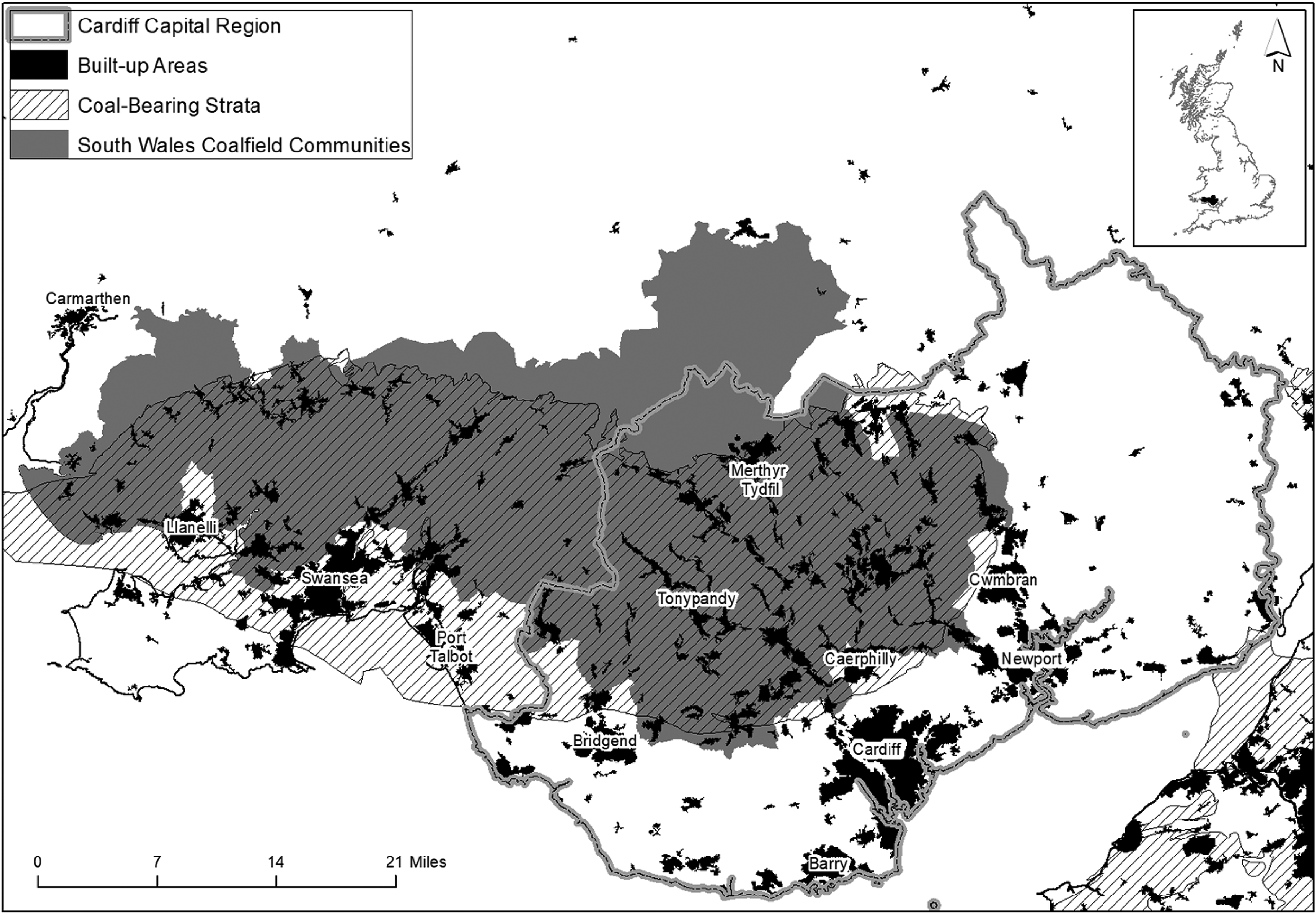
South Wales coalfield communities.
In focusing on the Valleys, we seek to make a conceptual contribution to debates on territorial stigmatisation in more fully integrating isolation and the physical landscape into Wacquant's interdependent triad of physical, social and symbolic space and articulating the relationship to habitus formation, intergenerational effects and the wider power relations in which Valleys coalfields are situated over time. In doing so, the paper also contributes to the literature on coalfields as ‘post-industrial laboratories’ (Strangleman, 2018). This body of work has advanced a historically informed understanding of deindustrialisation as an ongoing and long-term process. However, it has tended to centre on the internal conditions and relations of coalfield communities, which have exposed the significance of contemporary ‘social hauntings’, collective ‘trauma’ and industrial ruination for subsequent generations (Bright, 2016; Emery, 2019). Where the role of territorial stigmatisation and the relational (re-)making of place are relatively neglected within understandings of the enduring legacy of coal mining, 1 we bring historical accounts of the South Wales coalfields into dialogue with the concepts of territorial stigmatisation and landscapes of industrial ruination. This focus highlights three key interrelated potential areas of inquiry for both furthering understandings of contemporary coalfields and advancing the concept of territorial stigmatisation in the context of more ‘mundane’ post-industrial peripheries (Nayak 2019).
The first is in tracing long-term shifts and fluctuations in power balances in the (re-)positioning of coalfields within national and international space. Existing accounts of territorial stigmatisation have tended to centre on urban locales of relegation that can pragmatically be understood in Wacquant's schema as ‘ghettos’, ‘hyperghettos’ or ‘anti-ghettos’: anti-ghettos refer to very diverse, porous and transient neighbourhoods; while ghettos and hyperghettos are devices for the spatial confinement and seclusion of racialised groups (see Wacquant 2004b, 2008a, 2008b, 2009, 2012). The Welsh Valleys defy classification along these lines and are more readily associated with the Welsh white working class (Table 1). The unique terrain, relative isolation and lack of diversity, vis-a-vis urban locations, mark the Valleys out as a particularly insightful case in nuancing and understanding the longer-term production of territorial stigmatisation for spaces beyond the urban (see Bevan, 2015). Conversely, territorial stigmatisation as a theoretical lens can address the relative lack of attention to the external stigmatisation of the South Wales coalfield and its longer run effects (though see Byrne et al., 2015, 2016; Elliott et al., 2020 for innovative accounts of stigma and resistance in Merthyr Tydfil).
Context indicators – South Wales coalfield communities.
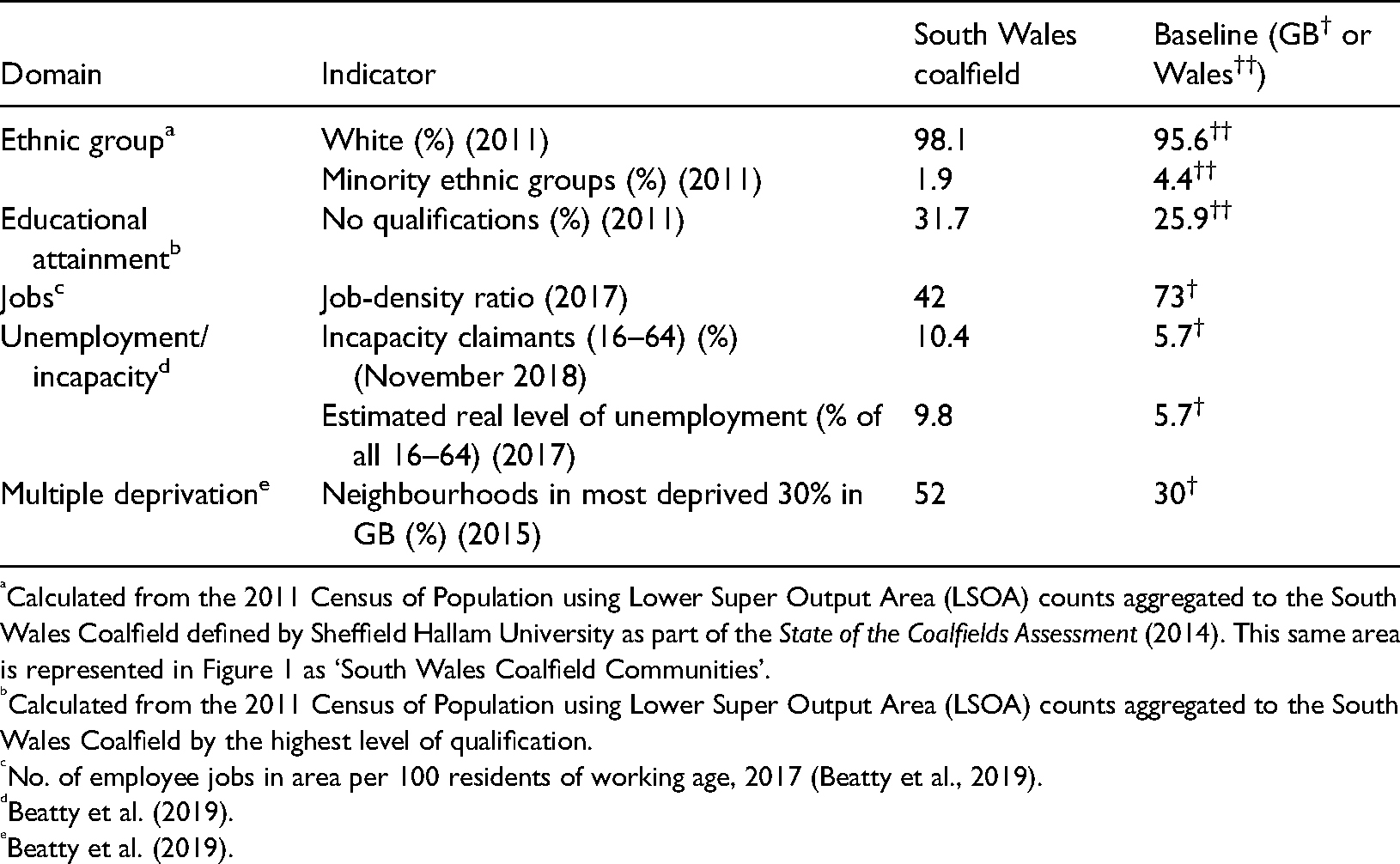
Calculated from the 2011 Census of Population using Lower Super Output Area (LSOA) counts aggregated to the South Wales Coalfield defined by Sheffield Hallam University as part of the State of the Coalfields Assessment (2014). This same area is represented in Figure 1 as ‘South Wales Coalfield Communities’.
Calculated from the 2011 Census of Population using Lower Super Output Area (LSOA) counts aggregated to the South Wales Coalfield by the highest level of qualification.
No. of employee jobs in area per 100 residents of working age, 2017 (Beatty et al., 2019).
Second, recent research demonstrates the existence of more nuanced orientations and behavioural responses in calling for ‘a more explicit micro inclusion of habitus’ (Blokland, 2019). We add to recent debates on contemporary habitus formation that has explored the fragmented habitus, from a Bourdieusian perspective (see Silva, 2016; Friedman, 2016), by introducing Elias’s (2001) conceptualisation of the lagged habitus into these debates. This allows for the integration of intergenerational shifts in habitus, which represent a sociological break in generations (Abrams, 1982). The concept of lagged habitus therefore provides a valuable contribution to recent research on UK coalfields, which has concentrated on affect, loss and trauma in describing the emotional implications of industrial ruination for subsequent generations (Bright, 2016; Mah, 2012; Emery, 2019, 2020a, 2020b). The notion of a lagged habitus foregrounds collective histories, the possibility of entanglements in affinities of the past, and the potential for dislocation between psychic and social processes tied to symbolic denigration and collective trauma.
The third is in interrogating the intersection of the physical landscape, industrial ruination and affordances in the integration of social, physical and symbolic space as part of a wider conceptual understanding of territorial stigmatisation. Recent literature on territorial stigmatisation has tended to focus on the ‘production and attribution of urban stigma’ (Nayak, 2019) centred on the symbolic aspect of Wacquant's schema, and the specialists in symbolic production (Larsen and Delica, 2019). Urban scholars show a tendency to abstract territorial stigmatisation from Wacquant's wider, totalising framework (Delica and Hansen, 2016). While territorial stigmatisation is indeed a symbolic logic, it latches onto space with material and social consequences (Wacquant, 2008a). A key distinguishing aspect of Wacquant's approach is the analytical unification of physical, social and symbolic space, which has been neglected within accounts that have extended territorial stigmatisation to new urban contexts. Following Delica and Hansen (2016), we therefore critique the tendency to read Wacquant in ‘bits and pieces’, which can potentially obfuscate the more radical, totalising nature of his theorising (Flint and Powell, 2019). In complementing advancements in understanding the symbolic logics of territorial stigmatisation, we seek to foreground the importance of historical context and the inscription of class and historical struggle within the coalfields landscape in its production. In short, we bring Wacquant's work into dialogue with a sociological understanding of affordances in rearticulating the longer-term dynamics related to the co-constitution of social, symbolic and physical space in the coalfields communities of the Welsh Valleys.
The remainder of the paper is divided into three parts. The next section sets out Wacquant's approach alongside the ways in which the Valleys coalfield diverges from and potentially advances existing accounts of territorial stigmatisation. It also highlights the value of the coalfields as a ‘post-industrial’ laboratory; and the Valleys in particular where the specific terrain and isolation make for a unique and fruitful geographical context to study social and economic change (Strangleman, 2018). Section two presents our analysis, which centres on the three key, interrelated and mutually reinforcing areas of divergence in advancing territorial stigmatisation in application to the South Wales coalfield: shifting social and economic interdependencies with the outside alongside deindustrialisation; lagged habitus and intergenerational change internally; and challenging terrain and relative isolation discussed in relation to affordances. The final section concludes with some reflections on how our analysis can aid the refinement and extension of Wacquant's theorising, contribute to the rich sociology of coalfield communities, and how the approach adopted might be advanced theoretically and methodologically.
Wacquant in the Valleys: Extending territorial stigmatisation
Wacquant's concept is a totalising framework of (urban) marginality (see Bourdieu and Wacquant, 1992; Delica and Hansen, 2016) where, drawing on Bourdieu, he develops an interpretation of territorial stigmatisation framed around the concepts of symbolic power, bureaucratic field, social space and habitus (see Wacquant et al., 2014 for a full account). It is this framework that provides the starting point for our understanding of territorial stigmatisation as it relates to the Valleys.
First, symbolic power captures how the diverse logics, policies and tactics employed by different state and non-state actors contribute to the making of urban marginality through processes and actions that classify and categorise in ways that impinge upon the urban denizens of areas of relegation. Symbolic power is understood as ‘the power to constitute the given by enunciating it, to make people see and believe, to confirm or transform the vision of the world, and thereby action upon the world, and thus the world itself’ (Bourdieu, 1990: 170). In our case, the frequent conflation of the ‘Valleys’ into a single spatial entity has been shown to erode geographical, as well as socio-economic, differences within and between constituent communities (Morgan, 2008; Waite, 2015: 24). Likewise, the labelling and categorisation of the Valleys as ‘coalfields’ also serves to condition the sentiments, judgements and actions of state officials, street-level bureaucrats, the media, academics, firms, residents, and those on the outside in how they perceive and engage with ‘coalfield’ communities (see Winkler, 2009). South Wales has been central to a long-run discursive shift in the representation of coal miners and coal mining communities in cultural and political narratives, exemplified by Arnold’s (2016) exposition of the ‘death of sympathy’ for miners and mining communities in the UK. Arnold's analysis traces the transformation of risks attached to miners within public and political discourses to reveal how this narrative has proceeded from an ethics of care and concern over the workplace hazards to which miners were exposed, to the danger coalfields represented with their organised labour, through to the climate risks associated with fossil fuels and their extraction (also see Parkhill et al., 2014).
Second, bureaucratic field captures the range of administrative and regulatory activities of the state made possible by its relative monopoly on taxation and punitive sanctioning. The outcome of struggles within the bureaucratic field (e.g. the tussle over social policy as ameliorative or disciplinary, classificatory struggles) determine the perceived nature of, and approach to, social challenges affecting areas such as the coalfields; and by implication the distribution of goods and resources within and between different parts of it (see May et al., 2020). Here it has long been recognised that regeneration interventions in the South Wales coalfields have delivered mixed results (Beatty et al., 2019; Hincks and Robson, 2010). But the onset of a punitive welfare regime of conditionality and sanctions further exposed the South Wales coalfields to ever-deepening insecurities and malaise (Beatty and Fothergill, 2017; May et al., 2020). Depending on the perspective taken, this deleterious context of insecurity has been compounded by the zero-sum gains delivered to the Valleys by their relegated position in the Cardiff Capital Region (CCR), or by the lack of local political acknowledgement of the increasing entanglement of the Valleys with Cardiff and other urban centres as the economic centre of South Wales shifted over time from the coalfields to the coast (see Morgan, 2014).
Third, social space is the complex multidimensional arrangement and structure of social positioning as reflected in their ‘…mutual externality, relative distance (close or far) and rank ordering (above, below, between), which is conditioned by the volume and composition of capital held by individual “agents”’ (Bourdieu, 1994: 20–22). As Wacquant et al. (2014: 1699) remind us, through its relationality, social space is where resources are identified and distributed in ways that ‘determine life chances’ and reveal points of coincidence and disjuncture ‘between symbolic, social and physical structures [of the city]’. Operationalising social space in the case of the South Wales coalfields allows for an appreciation of the dynamic interdependencies between coal, deindustrialisation, historic dependence on resources, the range of opportunities for becoming, and the declining position of the Valleys relative to other places in the UK and beyond in a restructured global economy (Jones, 1992).
Finally, habitus, as interpreted by Bourdieu, mediates between the ‘internalisation of the externality and the externalisation of the internality’ (Wacquant, 2016: 66), where the social and symbolic structures of society are taken on by individuals through their bodily dispositions, sentiments and orientations in ways that condition action and expression (Wacquant, 2019: 38 − 39). Here institutions and social conventions become naturalised in the habitus (Weik, 2010: 494) where the credibility of actions and decisions gain acceptance, even if these may lead to harm (e.g. Stanley, 2014). In the case of the coalfields, the concept of habitus provides a crucial complement to the work of geographers centred on the suffering, hauntings and trauma of landscapes of industrial ruination (Mah, 2012), where austerity and welfare reform agendas have been overlaid with a City-Deal 2 for the CCR that includes some but not all parts of the South Wales coalfields. Devolution deals, such as that negotiated for the CCR (e.g. see Haughton et al., 2016; Hoole and Hincks, 2020), have been promoted during a period of austerity that is said to have exposed ‘chosen’ localities to increased financial risk (Lowndes and Gardner, 2016) and to have deepened the neoliberal tendencies of the state towards a ‘dramatic redistribution of wealth and income in favour of the rich’ (Callinicos, 2012: 67). This intersection of circumstances has raised concerns over the extent to which coalfield communities will continue to lose out, much as they have done since the late-1970s, irrespective of their position ‘inside’ or ‘outside’ of the CCR (see Waite and Morgan, 2019: 391–2).
Against this backdrop, territorial stigmatisation – built from fusing Goffman's notion of the management of ‘spoiled identity’ with Bourdieu's bureaucratic field and symbolic power – reveals ‘…how, through the mediation of cognitive mechanisms operating at multiple enmeshed levels, the spatial denigration of neighbourhoods of relegation affects the subjectivity and the social ties of their residents as well as the state policies that mould them’ (Wacquant, 2019: 40). It manifests as a ‘blemish of place’ – perpetuated at a range of discursive levels from everyday to media and policy – that latches onto specific spaces and informs perceptions of that space from the outside, impacts experiences on the inside, and contributes to the relative positioning of spaces within the space of positions (regional, national and international).
Here it is important to recognise that Wacquant developed the concept of territorial stigmatisation in the contexts of the Black American Chicago ghetto and the ethnically diverse Parisian banlieues, hence the centrality of race within his triad of class, state and ethnicity in the making of urban marginality (Wacquant, 2019). The Valleys provide a very different, non-urban context, however, which retains some of the characteristics of the ghetto concept, but also key divergences that provide opportunities to extend Wacquant's framework. Like urban zones of dereliction, the South Wales coalfield shares: deindustrialisation; state retrenchment; institutional desertification; an expansive mesh of discipline, surveillance and responsibilisation; and growing inequality between those on the inside and those beyond (see May et al., 2020). Yet unlike Wacquant’s (2008b) ‘ghettos’ or ‘anti-ghettos’, the Valley coalfields are not contained within the city but are separated from it – isolated, both spatially and symbolically (see Jones et al., 2020), from the urban drivers of global capital and ‘opportunity’ – and ‘safe’ from sustained gentrification and globalised real estate investment characteristic of the financialised housing markets of many urban locales (Aalbers, 2016; Watt, 2021).
Territorial stigmatisation and ‘advanced marginality tend to be understood as concentrated in isolated and bounded territories increasingly perceived by both insiders and outsiders as social purgatories, leprous Badlands at the heart of the postindustrial metropolis’ (Wacquant, 2008a: 237 – our emphasis). Yet the physical terrain and expansive extent of the Welsh Valleys also mark them out here as ‘isolated and bounded territories’ par excellence (Bennett et al., 2000; Parry, 2003). Our starting point in this context is to recognise ‘terrain’ as a constitutive dimension of territory – an often under-theorised aspect of territorial stigmatisation (Sisson, 2021) – alongside land and power (Elden, 2010), where territory ‘…is enacted as a bundle of political technologies for measuring land and controlling terrain’ (Sisson, 2021: 666). For Elden (2017: 199), terrain is where ‘…the geopolitical and the geophysical meet’, where terrain helps in understanding the materiality of territory. As Elden (2017) notes, the materiality of the territory is typically understood in reference to the built landscape – fences, walls and infrastructures – that state and non-state actors continually make and remake. Yet territory also has a (geo-)physical dimension, where physical features of the landscape play a role in processes of ‘boundary-making’ (Elden, 2017: 208). This gives rise to the notion of terrain as ‘volumetric’, reflecting ‘…the mechanisms of calculating, measuring, surveying, managing, controlling and ordering (the metric) that constitute the political technology of territory’ (Elden, 2017: 219). 3 Terrain, in this sense, contributes to representations of territory, inscribed through cartographic, diagrammatic and statistical techniques, that help to give meaning to a territory through ‘…the everyday practices and lived experiences that take place within and beyond it”’ (Brenner and Elden, 2009: 366).
Set against this context, it is recognised that techniques of measurement and control of terrain (and land) serve to anchor narratives that help to naturalise state-spatial and territorial interventions that are implicated in the active production of stigma and marginality (Sisson, 2021). The physical terrain of the Welsh Valleys features prominently in discussions of inequality and disadvantage, including in relation to sub-national boundary-making and in representations of the physical isolation of the Valleys (see Jones et al., 2013, 2020). Yet at the same time, the Valleys are also differentiated on socio-economic, symbolic and political lines from the city of Cardiff and the nascent city-regional imaginary underpinning the CCR (Waite, 2015; Jones et al., 2020). Neither are they ethnically diverse nor characterised by racialised, internal division such as banlieues in France or diverse inner-city locations in other parts of Western Europe (Wacquant, 2008a). On the contrary, they are relatively socially and ethnically homogeneous and dedifferentiated in comparison with the urban contexts usually studied by others (see Flint and Powell, 2019; Kirkness and Tijé-Dra, 2017; Larsen and Delica, 2019).
The case of the Valleys therefore addresses a key gap in the existing territorial stigmatisation literature in terms of the relative absence of non-urban, peripheral landscapes of ‘industrial ruination’ (see Emery, 2019, 2020b). The focus on the Welsh Valleys is particularly enlightening where the raison d’etre for the establishment of many ‘pit village’ communities was the extraction of coal with social life and organisation built around the industry and a local ‘parallel institutionalism’ (Parry, 2003; Wacquant, 2004a, 2008b). It spotlights the way in which coal mining was central to communal life with unionisation and class struggle ‘an integral feature of Valleys society’ (Curtis, 2013: 17), meaning the ongoing effects of deindustrialisation are far more profound in terms of class fragmentation, institutional desertification and longer-term intergenerational implications (May et al., 2020)
These spaces are representative of specific, time-stamped disconnected areas of relegation. Places where relative isolation, challenging terrain, the scale and shock of (ongoing) deindustrialisation, state retrenchment, the concentration of the white working class, and the accompanying (and at times unwitting) ‘taint of place’ (Winkler, 2009) are seen to have weakened the social interdependencies between inhabitants and those on the outside at a range of spatial scales, but also undermined internal collectivities.
Territorial stigmatisation and deindustrialisation in the Welsh coalfields
This section draws upon a rich and multidisciplinary body of scholarship on the UK coalfields and specific historical accounts of South Wales mining communities. It foregrounds the deep interrelationship between deindustrialisation (as an ongoing process), habitus formation and territorial stigmatisation and demonstrates how the intermeshing of these dynamic processes shows a particular character in the Valleys distinctive from that in urban zones of denigration.
A historical lens emphasizes the longer-term significance of transformations in social interdependencies and the de-densification of relations that accompany deindustrialisation, while also exposing the intergenerational disruptions to the rhythms and institutions of sociability and habitus formation. Valley coalfield communities emerge here as a particularly useful empirical context through which to explore and articulate the interplay between shifting social interdependencies (a demotion in the hierarchy), industrial ruination, habitus formation and affordances. Carrying these concepts together – in dynamic interdependence – helps avoid overly deterministic renderings (of habitus or environmental determinisms for example) of territorial stigmatisation and its effects, but it also hopefully shows the potential value of a unified analytical frame that takes terrain and physical space seriously and helps better integrate it with social and symbolic processes.
Shifting social interdependencies and spaces of positions
We use the term ‘social interdependencies’ here to refer to the range of webs and networks of relations that constitute social life (within the social space of the Valleys). In Bourdieu's terms, the relational positioning of the Valleys in national and international contexts has been weakened through deindustrialisation in ways that have altered the physical and symbolic space of the Valleys and undermined internal solidarity and identification (Bourdieu, 2018; Wacquant, 2008a). Be they framed economically, politically, institutionally, culturally or technologically, relations and associations are always powerfully social in nature (Degnen, 2016). To this end, the power balances within the figurations (or fields) in which the Valleys coalfield communities are interlocked inherently fluctuate alongside wider societal changes. To cite just a few here, the turbulent dynamics of Empire, world wars, the coal economy, the coalminer's union movement, coal nationalisation and privatisation, shifting national and international economic structures, regeneration logics, and welfare revamping all wrought shifts in the social positioning, self-perception and relative collective power of coalfield communities (see Jones, 1992).
Focusing on the changing social interdependencies of the Welsh Valleys over time allows for the acknowledgement of the dynamic relations of individuals, groups and places that have become tied to a reconfigured imaginary of industrial ruination invoking loss and decline (see Emery, 2020a). This perception of ruination and decline – while critically considered in urban contexts elsewhere (e.g. Fraser, 2018) – has centred on a dualising process of relative disconnection from global, national and city-regional economies on the one hand, and the symbolic denigration of Valley inhabitants on the other hand. Both are reinforced by the inscription of class and coal heritage on, and within, the landscape (Dicks, 2000).
As once central to the engine of the colonial expansion of the British Empire, employment in the South Wales coalfield peaked in 1920 at just over 270,000 jobs (Curtis, 2013). Coal flowed from South Wales and its labour on coal-fuelled trains bound for far-flung places that tied the Valleys into a national and global circulation of capital (Morgan, 2014). Mining, miners and coalfield communities were lynchpins of industrial development, prompting George Orwell's famous statement that ‘our civilisation is founded on coal’ (cited in Arnold, 2016: 92). The General Strike of 1926, and the Great Depression that followed soon after, contributed to a rapid decline in mining employment, which had more than halved from its peak by 1936 (126,000). The relative integration of the Welsh Valleys within the context of an international coal industry in the 19th and early 20th centuries had been undone, with those interdependencies with the outside severely weakened and reconfigured over time (Jones, 1992: 349). For example, for most men in the pit villages of the Valleys in the early 1920s a life down the mine, or in an occupation related to coal extraction, represented a fairly straightforward and often predetermined (and much shorter) transition from school to work by contemporary standards. 4 It would be wrong to romanticise the dangerous working conditions of many miners (see Arnold, 2016), or to deny the continuous presence of class struggle and fluctuations in coalmining employment throughout the 20th century, but the point is that access to well-paid, secure employment was a relative given. The Second World War played a major role in the nationalisation of the coal industry in 1947 where the period up to the late 1950s is said to have marked a more positive and harmonious one for coalfield communities in contrast to periods of heightened militancy and class struggle that came before and subsequently later (Curtis, 2013).
This period was relatively short-lived, however, and the fortunes of the South Wales pit villages contrast sharply with the dominant perception of the post-war period up to the late-1970s as the ‘golden era’ of social progress. Indeed, the decline of the coal industry accelerated in the 1960s alongside changes in the international coal market and the discovery of North Sea gas, which meant that the Valleys coal industry came to serve a mainly domestic market (Curtis, 2013). The industrial production of the Valleys was by now disconnected from global flows, which resulted in a shrinkage of the coal sector and those employed within it, but was still central to the national economy. By 1970, just 52 collieries employing only 40,000 people remained in South Wales (Curtis, 2013: 78). However, those national interdependencies (i.e. a national dependence on coal) also unravelled through the 1970s and 1980s as the bitter and protracted battle over socialised wage labour – culminating in the symbolic miners’ strike of 1984 and their subsequent defeat – further diminished the importance of the Valleys (and other industrial areas) in the national space of positions (Hoole and Hincks, 2020; Mah, 2010; Morgan, 2014).
The subsequent and often brutal shift to a financialised and services-led model of economic growth since the 1980s (Sassen, 2014) has meant that places like the Valleys have experienced a rapid slide down the hierarchy of social positions. In our case, this is reinforced by challenging terrain, relative isolation and weak job creation (see Winkler, 2017), which contrasts with the pervasive logic and promotion of economic boosterism, agglomeration and commodification that have come to dominate urban growth agendas (Aalbers, 2016; Haughton et al., 2016). As Beatty et al. (2019: 21) note, The former coalfields are part of complex networks of commuting…But a low job density can also be a symptom of a weak local economy. This is perhaps clearest in the case of the South Wales coalfield, where there are just 42 jobs for every 100 residents of working age. The South Wales coalfield, in the Valleys, is a major area in its own right and although there are substantial commuting flows to Cardiff, Swansea and Newport on the coast it is hard to escape the conclusion that one of the reasons so many people travel out of the area for work is that there are so few jobs in the Valleys themselves.
The labour market detachment and decline in economic activity in the Welsh Valleys since the late 1960s onwards was mitigated (see Table 1), at least to some degree, by the welfare state. This too, however, has been unravelling in the context of COVID-19 (Halliday, 2021) and, since 2010, austerity with continuing cuts to social assistance nationally, impacting particularly hard on deindustrialised areas where the overall effect on the local economy is more pronounced (Beatty and Fothergill, 2014, 2018; May et al., 2020).
Territorial stigmatisation and landscapes of post-industrial ruination
There can be few places in the UK where the effects of the fragmentation and de-socialisation of waged labour have been as profound as that of former one-industry locales, such as coalfields, steel towns or shipbuilding communities. The isolated ‘pit villages’ of the Welsh Valleys were indelibly shaped by their relationship to the extraction of coal and the strong relations and solidarities produced by a bounded, one-industry community with social life monopolised by the institutions connected to that industry. Here Kerr and Siegel (1954, cited in Curtis, 2013) characterised mining communities as: …isolated masses, almost a ‘race apart’. They live in their own separate communities [with]…their own codes, myths, heroes, and social standards…the union becomes a kind of working-class party or even government for these employees, rather than just another association among many (Curtis, 2013: 18)
The extraction of coal also drove the social organisation of pit villages with the South Wales National Union of Miners (and the South Wales Mining Federation before it) ‘…a central institution in the day-to-day lives of its members’ (Curtis, 2013: 12) leading the welfare movement but also fostering, perpetuating and maintaining local traditions through recreation, culture and education centred on Miners’ Welfare Halls (or Institutes). Furthermore, recurrent class conflicts with coal mine owners, both private and nationalised, reinforced collective identifications and solidarities – South Wales being arguably the most militant of coalfield union movements. 5
The dominance of coal in the landscape and the organisation and unionisation of the community produced a distinct ‘institutional parallelism’ (Wacquant, 2004a) reflective of local pride, tradition and collective class consciousness, but also influenced by international political events, not least Marxism (Curtis, 2013). The Miners’ Welfare Halls were key sites and institutions of socialisation, education and interaction that reinforced strong group identifications of labour, proximity and place. They were the ‘…organisational and geographic centre of an infrastructure of industrial welfare, and a space where sociality across genders and generations took place’ (Emery, 2020b: 3). Here Emery details how the decline of such social institutions remains inscribed in the post-industrial landscape as sites of ruination. The Maerdy Welfare Hall, 6 at the head of the Rhondda Fach Valley, is a case in point. Once celebrated as a top performance venue that hosted famous acts such as Billy Fury and Tom Jones, an educational hub and an anchor in the civic and cultural life of Maerdy village, the Hall ran into disrepair as deindustrialisation deepened. In 2002, the decision was taken to demolish the building given the £6 m of repair and restoration work required. Councillor Kevin Williams, Vice-Chair of Maerdy Communities First Partnership, is reported in the Maerdy newsletter as stating: ‘The Hall has played an important and historic role in the life of this community. Sadly though, it has now come to signify decline and dereliction’ 7 (our emphasis). It was demolished in 2009. A symbolic, material, cultural and collective signifier of industrial ruination.
These deindustrialising transformations to the social fabric, driven by the erosion of sites of socialisation where collective identifications are forged and perpetuated through the generations, disrupt the pattern and rhythm of gatherings and sociability. This not only impinges upon social life and internal solidarity within the Valleys but industrial ruination is also central to a reconfigured imaginary of the relation of the Valleys to the globalised, national and (city-)regional economies. The physical isolation, deindustrialisation and perceived dilapidation of the coalfield do not mean the complete absence of capital flows and extraction. The relational positioning of the Valleys has altered, tied to a reconfiguration of economic relations: the Miners Welfare Halls, pubs, cafes and local shops that fostered vibrant sociability and collective identity are replaced by cash converters, charity shops, betting shops and payday lenders, which attest to the continued extraction of economic value from the Valleys despite welfare revamping and concentrated poverty (Flint and Powell, 2021).
Similarly, value is also extracted from the Valleys in the symbolic sense (Skeggs, 2004). TV shows like Valleys Cops and the MTV programme The Valleys capitalise on stereotypes and clichés (see Elliott et al., 2020) but reinforce and perpetuate them to the extent that there is no need to visit the Valleys and see for oneself, as it is assumed we already know what goes on in these ‘uninhabitable’ spaces (Simone, 2016). The Valleys also reinforce the idea of the cognitive distance between the cosmopolitan capital city of Cardiff and the deindustrialised Valleys (the programme, now axed, involved young people from the latter moving to the former to ‘live out their dreams’). Representations invariably entail excessive alcohol consumption and behavioural transgressions that reproduce the ‘folk concepts’, clichés and stereotypes prominent in the symbolic denigration of Valleys residents. Social agents, but also things as they are appropriated by agents and thus constituted as properties, are situated in a location in social space that can be characterised by its position relative to other locations (as standing above, below or in-between them) and by the distance that separates them (Bourdieu, 2018: 106)
This social space of positions is also dependent on the symbolic representation, in turn, informed by the physical space, landscape, infrastructure and the built environment. The interdependence between social, physical and symbolic space is encapsulated in Figure 2. Here the train routes of South Wales are represented alongside travel information provided by Arriva Trains Wales. 8 The bottom right informs of a targeted alcohol ban policy along the different Valleys routes: from Pontypridd to Treherbert, Aberdare and Merthyr; and from Caerphilly to Rhymney. The map stands as a physical and digital artefact of territorial stigmatisation that captures the translation of the symbolic denigration of the Upper Valley communities into material actions and codified regulations. Residents living along those routes are assumed problematic and lacking self-restraint. As Bev Skeggs neatly puts it: ‘The representations of excess and waste point to bodies that cannot be normalised or disciplined…by representing the working class as excess and waste, their incorporation cannot be guaranteed: they are positioned as that which both represents and resists moral governance’ (Skeggs, 2004: 104).

Codifying stigma of the valleys.
This shifting position of the Valleys alongside a landscape of industrial ruination informs external expectations on conduct and the blemish of place attached to inhabitants – the symbolic logics of territorial stigmatisation – but it also impinges upon subjectivities, internal solidarities and habitus formation. A longer-term sensibility is therefore imperative in grasping how everyday sociability was inherently shaped by the industrial order (Emery, 2018), and how its relatively sudden collapse constituted a generational break in the sociological sense (Abrams, 1982). It is difficult to over-emphasise the shock of this process and its ongoing impacts (see Beatty and Fothergill, 2017; May et al., 2020).
Lagged habitus, collective identifications and intergenerational transfer
The preceding discussion sketched out some of the complex relations and interdependencies that have determined the changing position of the Valleys within different figurations of local, regional, national and international space. Yet such complex processes, trends, counter-trends and the changing power relations that shape them are often reduced to a notion of structural change (focused narrowly on economic shifts), which then often leads to questions of human agency. Drawing on a dynamic conceptualisation of habitus enables the sidestepping of this longstanding agency/structure impasse and the avoidance of the reification of social structures. This redirects attention toward the question of how social habitus adapts (or not) in order to meet the specific physical and social needs within changing social, cultural and historical conditions (Baur and Ernst, 2011).
The undermining of the social fabric wrought by the collapse of coal, and the institutional abandonment of coalfield communities, precipitated a trauma of industrial ruination related to a ‘lagged habitus’ (Elias, 2001), in turn, reinforced by a landscape of dilapidation and decline (see Emery, 2018). In this sense ‘social space is inscribed both in the objectivity of spatial structures and in the subjectivity of mental structures, which are in part the product of the embodiment of these objectified structures’ (Bourdieu, 2018: 108). As Degnen (2016: 1663) notes ‘one's history and those of others become bound up in place and the embodied spatiality’. However, the longer run effects of deindustrialised shock and trauma on habitus formation have received very little attention to date (for exceptions see Bright, 2016; Charlesworth, 2000; Emery, 2018; Walkerdine, 2010).
Just as upward social mobility can produce a fragmented habitus that can be difficult to reconcile for individuals seemingly caught betwixt and between (Hoggart, 1957; Friedman, 2016), so too can a (fairly rapid) decline in social status – individual, collective and locational – that manifests gradually and differently from one generation to the next. Habitus becomes sedimented within subsequent generations, many of whom have no direct experience of the coal industry. As Curtis (2013: 10 – emphasis added) puts it, ‘The harsh experiences of the late 1920s and 1930s inculcated in the South Wales miners a defiant resilience, which moulded the consciousness of successive generations’. At that time younger generations were also faced with a more limited array of possibilities for personal becoming, given the dominance of coal in the economic and social life of coalfield communities – where ‘successive biological generations constitute a single sociological generation’ (Abrams, 1982: 255). In the context of the isolated pit villages of the Valleys, intergenerational transmission and socialisation within such tightly bounded spatial contexts ensured the perpetuation of one generation into the next. Furthermore, the communities of the Valleys were connected to other coalfields through cultural and recreational practices, such as sporting competitions, choirs, and brass bands for example that bolstered a sense of coalfield solidarity. This is said to help explain the strong ‘we-image’ of coalfield communities, produced in opposition to other places, and a discernible collective habitus (Dicks, 2000).
Yet deindustrialisation in the Valleys in the 1980s marked a generational break in the sociological sense. Changes in habitus formation take place gradually, in contrast to often sharp shocks of deindustrialisation: there is a ‘lag between changing social conditions and the social habitus required to be in tune with these changes’ (Connolly, 2019: 167). The drag effects of habitus (Elias, 2001) have an impact on social reproduction and can manifest in emotional problems affecting the psychic life of individuals (Friedman, 2016). Subsequent generations not only have to contend with their relegated position in social space relative to other locales, but also relative to previous generations and a romanticised nostalgia for past security and solidarity juxtaposed to contemporary precarity and social malaise (Elliott et al., 2020). A dynamic concept of habitus-in-figurations demands the analytical unification of (i) the shifting social and material position of the Valleys and its residents; (ii) their symbolic denigration, devaluation and haunting by the spectre of judgement (Skeggs, 2009); and (iii) the changing affordances and industrial ruination of the physical and built environment. It is the latter that is neglected in the take up of Wacquant's schema (Watt, 2020) and to which we turn next, as a complement to habitus formation and the possibilities a relational conception of affordances offers in more fully integrating physical space in conceptualisations of territorial stigmatisation.
Affordances: Integrating landscapes of industrial ruination
The concept of affordances was proposed by the ecological psychologist James Gibson (1979) as a means of articulating the way in which action and perception are constitutive of relations between organisms and their environments. From the starting point that affordances are environmental attributes that carry meaning, the debate has raged in ecological psychology as to ‘…what qualities shared between animals and environments constitute affordances and whether they can be considered to exist in the absence of animals’ (Gillings, 2012: 605). One view is that affordances are ‘out there’ in the environment and available for animals to exploit. In this sense, affordances do not depend on animals being present in order to exist. The opposing view is that affordances are only brought into being when certain conditions permit, reflecting how properties in the same environment are only revealed in the presence of an animal (Gillings, 2012: 605). In seeking to navigate a path to connect these seemingly contradictory positions, Chemero (2003) contended that affordances are only constituted through the relations that exist between the abilities (i.e. skills) of animals to practically engage with their surroundings. As Gillings (2012: 606) notes, Chemero's approach differs from those outlined above ‘…in its insistence that affordances not be considered as properties…of either animals or environments in any formal sense, but instead relations between the two’ (emphasis in the original). In assuming this position, Chemero contends that affordances are features that are not properties of environments but are connected to ‘features of whole situations’ of which animals and environmental attributes are essential components held within a set of mutually constitutive relations. Here the perception of some form of affordance offered by an environment is in fact tied to perceptions of relations where changes in affordances may emerge from changes to environmental circumstances and/or the abilities of animals (Gillings, 2012: 606).
Taking a relational view of affordances opens up the possibility of recognising the rich ‘landscape of affordances’ on offer to humans in a given context (Rietveld and Kiverstein, 2014). For Rietveld and Kiverstein (2014), an individual affordance is constituted within a complex and multi-layered mosaic of affordances that are embedded in a network of interrelated socio-cultural practices and communal norms – what Rietveld and Kiverstein term a ‘form of life’. Adopting such a relational view provides a means of connecting affordances to habitus where the latter is also rooted in a rejection of dichotomous thinking and demands a relational understanding of the way in which human orientations are shaped (Bourdieu and Wacquant 1992). For Fayard and Weeks (2014: 238), the ‘concept of affordances allows us to understand how the social and physical construction of technology and the material environment shape practice. On the other hand, the concept of habitus allows us to understand how social and symbolic structures shape practice’. Here Tilley's conception of physical landscapes as ‘…relationally constituted as embedded sets of space-time relations’ (Tilley, 2010: 39) offers an entry point for the remainder of this section. In what follows, we contend that territorial stigmatisation, as applied to the Welsh Valleys, provides an analytical focus with which to bring the concepts of habitus and affordances together and contribute to debates on deindustrialisation as an ongoing relational process.
Against the framing offered above, we understand affordances as a relational construct (Chemero, 2003) but recognise that where affordances are social, they are also potentially contested, reflecting struggles over power and knowledge (Heras-Escribano and De Pinedo-Garcia, 2018). In doing so, we acknowledge that changes in human knowledge and power relations can bring about shifts in affordances that may well be understood as an opportunity or constraint for different human figurations dependent upon their relative position. Here Dokumachi (2020) articulates a more ‘sociologised’ view of affordances in detailing the improvised ‘micro-activist affordances’ (Dokumachi, 2019) of people with disabilities in the negotiation and subversion of their ableist environments leading to the notion of ‘people as affordances’, but also as barriers to affordances (Dokumachi, 2020). Whether as barrier, chronic illness or pain, or debilitation or lack of access to resources due to structural inequalities, disability, I propose, can be defined ecologically as a shrinking of the environment and its available affordances (Dokumachi 2020: 99 – emphasis added).
This work is valuable in offering a sociological move in the understanding of affordances and a shift from individualised readings to social interdependencies and collectives.
In the case of the Valleys, coal remains within the subterranean landscape of the pits, but the social constraints on past affordances tied to scientific knowledge and environmental developments, as well as socio-political relations, prevent (or at least limit) its extraction. The relative physical isolation and terrain of the Valleys, which reinforces internal solidarity and collective identifications, also represent an external constraint (barrier to affordances) accentuated by longstanding deficiencies in infrastructure and investment (see Scully, 2017; Winkler, 2017). The affordances of the landscape are impinged upon by changes within social space and the space of positions. The key point is that what is transmitted through ecological inheritance, the material consequences, are not just the structures (buildings, tools, or non-culturally informed environmental elements), but also the social functions of those structures together with the behavioural strategies that help us deal with them, and affordances are key for explaining those strategies. These behavioural strategies are inherited through social mediation, in which the community or social environment teaches its members what to do or what to attend to. This is why the function of the structure is maintained within and between generations (Heras-Escribano and De Pinedo-Garcia, 2018: 11)
The ‘social functions of those structures’ in the Valleys became obsolete and dilapidated in some cases, symbolised in the industrial ruination of the miners’ welfare halls (Emery, 2020b). The ‘behavioural strategies that help us deal with them’ are disrupted by the shock of rapid deindustrialisation meaning an ill-equipped habitus that moves slower than changes in social conditions tending towards emotional problems that manifest as nostalgia, shame and trauma. ‘Affordances are key for explaining those strategies’ to the extent that the isolation and terrain combine with territorial stigmatisation in curtailing them. These strategies ‘inherited by social mediation’ are also ruptured by the abandonment, institutional desertification, and erosion of key sites of socialisation tied to coal. In this sense ‘the function of the structure’ within the Valleys is not maintained within and between generations. A sharp sociological break in generations is apparent and is still felt today. A decline in status and relegation in the hierarchy of social positions expressed spatially, materialised in the physical and aesthetic conditions of a landscape of industrial ruination, and rearticulated and re-imagined by the symbolic production and re-working of stereotypes and cliché informing territorial stigmatisation.
Deindustrialisation in the Valleys involves economic, social, material and physical detachments as a defining characteristic in terms of a decrease and de-densification of webs of interdependence manifest in the social, physical and symbolic spaces of the Valleys coalfields. Following Dokumachi (2020) these ruptures can be defined not only as a shrinking and shortening of webs of interdependencies and materialities, but also of available affordances. Coal is the epitome of a relational affordance that shaped Valley landscapes and communities, tied them to each other and to other places and became the emblem of discourses of struggle over workers’ rights, economic restructuring and climate futures. Here this in turn ruptures habitus, such that an intergenerational break in the sociological sense is discernible, tied to the shifting affordances marked by a landscape of industrial ruination and its social, economic and environmental effects.
In our view, bringing habitus into conversation with affordances opens up the potential for providing for a fuller register of Wacquant's triad of social, symbolic and physical space in foregrounding the neglected significance of place and physical landscape in understandings of territorial stigmatisation.
Conclusions
The preoccupation with the symbolic within accounts of territorial stigmatisation (Watt, 2020) has meant a preference for specific methodological approaches that expose misrepresentations of working-class communities, trace the attribution of stigma related to stereotypes and clichés, and seek to connect discourses and perceptions to ill-informed urban policy (Larsen and Delica, 2019; Nayak, 2019). This body of literature has made a valuable contribution to our understanding of the relational making of urban marginality within the polarised metropolises of the 21st century. But there has been a relative neglect of non-urban environments as well as the longue duree. Accounts tend to centre on the urban present and often fail to adequately situate analyses and stigmatised communities within their longer-term context and intergenerational trajectories. The relatively isolated coalfields of the Welsh Valleys suggest the need to more fully integrate symbolic analyses with an investigation of the role of physical space (i.e. including the role of terrain) and with the dynamic positioning of people and places within social space (i.e. class fragmentation and the relational spaces of positions). Clearly, in articulating a focus on the physical and especially terrain, there is the risk of over-extending any reading of the influence of the physical landscape in contributing to territorial stigmatisation. Nevertheless, while we are very mindful of the risk of environmental determinism here, we follow Elden (2017: 224) in asserting that this concern should not lead to the physical and material environment being ignored in analyses of territorial stigmatisation. Indeed, we contend that more effectively incorporating physical space alongside the social and symbolic would provide for a fuller register of the constant (re-)making of marginality and territorial stigmatisation over time and beyond the city: an analytical move beyond individuals and interactions towards shifting interdependencies, collectives and their relational affordances. Our analysis contributes here to foregrounding historical processes and attending to the intergenerational effects of a long-term stigmatised fate within a deindustrialised, bounded, isolated and non-urban locale.
The trajectory of the Valleys supports the notion of the fragmentation of wage labour as a ‘master trend’ (Wacquant 2019), but it also shows how these traumas are written into the landscape and built environment and impinge upon subsequent generations (Emery, 2020b; Mah, 2012). We have made the case for more attention to the integration of the physical and material in understanding these shifts. This can nuance our understanding of the process of territorial stigmatisation and contribute to a more precise re-articulation of its dynamics in non-urban, deindustrialised spaces characterised by landscapes of industrial ruination. Doing so may also open up opportunities for further theoretical and methodological critique in more fully integrating landscape, emotional and physical detachment, distance, time and terrain into understandings of territorial stigmatisation, within and beyond the city.
Footnotes
Acknowledgements
We are very grateful to Jay Emery and John Flint for their insightful and helpful comments on earlier versions of this paper. Thanks also to Jay for sharing his historical knowledge of the UK coalfields and for bringing some key literature to our attention. Finally, thanks to the two anonymous referees and the Editor for their helpful comments in improving the article. The usual disclaimers apply.
Declaration of conflicting interests
The authors declared no potential conflicts of interest with respect to the research, authorship, and/or publication of this article.
Funding
The authors received no financial support for the research, authorship, and/or publication of this article.