



Abstract
Recent studies highlight the emergence of standards, including multi-stakeholder initiatives developed and applied within the global South where supplier firms are usually based. This trend has created a complex ethical terrain whereby transnational standards flow through global production networks and intersect with domestic initiatives at places of production. The paper complements global production network analysis with the concepts of ‘space of flows’ and ‘space of places’ and insights from relational economic geography, to examine how some multi-stakeholder initiatives in the global South can shape the broader governance of labour standards in global production networks. The following questions are addressed: How is the governance of labour standards in global production networks shaped by dynamic spatial interactions between actors? What role have diverse Southern multi-stakeholder initiatives played in influencing the governance of South African fruit and wine? We draw on research conducted over seven years into two standards in South Africa, the Wine and Agriculture Ethical Trade Association and Sustainability Initiative of South Africa. Our analysis shows that these two Southern-based multi-stakeholder initiatives contributed to shaping the broader governance of labour standards through dynamic non-linear waves of interaction over time, involving both collaborative and contested exchanges between actors across space of flows and places. We further argue that despite the development of multi-stakeholder initiatives by Southern actors, commercial power asymmetries in global production networks limit their ability to promote significant improvements for producers and workers.
Introduction
Global production network (GPN) analysis provides a useful framework to examine spatially dispersed networks of private, state and civil society actors involved in the governance of labour (Alford, 2016; Bartley, 2018; Hughes et al., 2007). A key focus has been the way in which transnational lead firms in the global North wield power or ‘govern’ GPNs by coordinating sourcing, setting the commercial conditions and standards for their suppliers based in the global South (Nadvi, 2008).
Yet, there is strong evidence that the setting of transnational labour standards is sometimes contested and converted by actors at domestic sites of production reflecting their own agendas (Alford, 2020; Amengual, 2010; Bartley, 2018; Locke, 2013). This is facilitated by the emergence of multi-stakeholder initiatives (MSIs), developed and applied within the global South where supplier firms are usually based (Hospes, 2014; Hughes et al., 2013; Langford, 2019; Schouten and van Bitzer, 2015), providing greater opportunities for Southern actors to set standards. This process has created a complex ethical terrain whereby transnational standards flow through GPNs, intersecting with domestic regulation by states, along with agendas of civil society organisations (CSOs), collectives of producers and workers at production sites. This shift in the governance of labour standards towards more input by producers and workers from the global South reinforces arguments that exercise of power in GPNs is multipolar, but also contested. This suggests that Southern MSIs might therefore have some power to challenge the governance of lead firms.
This paper explores this assumption both analytically and empirically by examining the evolution of two standards applied within South Africa: the Wine and Agricultural Ethical Trade Association (WIETA) and the Sustainability Initiative of South Africa (SIZA). These South African MSIs comprise diverse combinations of private organisations (firm and industry), civil society (trade union and NGOs) and state actors. They have evolved over 25 years through interactions with transnational actors and initiatives based in the global North, and now play increasingly significant roles in the respective governance of labour standards in wine and fruit. While recent studies highlight the increasing significance of standards developed and applied in the global South, this paper sheds light on their genesis, structure and evolution through dynamic collaborative or often contested interactions with GPNs. The aim is to illuminate the extent to which Southern actors can convert original mechanisms put in place by lead firms governing GPNs to enhance gains for suppliers and workers, and also examine why they are relatively constrained in doing so. The paper addresses the following questions: How is the governance of labour standards in GPNs shaped by dynamic spatial interactions between actors? What role have diverse Southern MSIs played in influencing changes in the governance of South African fruit and wine?
Analytically, we contribute to the burgeoning literature on the governance of labour standards in GPNs by highlighting the dynamic and shifting roles Southern actors can also play in the process through collaboration and/or contestation. To achieve this, we complement the GPN concept of embeddedness with analysis of transnational ‘space of flows’ and domestic ‘space of places’ and the tensions between the two (Bair, 2017; Bartley, 2018; Castells, 1989, 1999), 1 while accounting for the increasing significance of MSIs that emerge in these places (Hospes, 2014; Hughes et al., 2013; Schouten and van Bitzer, 2015). ‘Space of flows’ refers here to the transnational field in which various actors engage, debate and strategise around the private rules that are pushed through GPNs by lead firms. ‘Space of places’ refers to domestic governance arrangements at sites of production, primarily in the global South, where social standards are implemented (Bartley, 2018). We reinforce this framing with insights from relational economic geography (Amin, 2002; Hughes et al., 2007; Yeung, 2005) to understand the evolution of Southern-based MSIs as occurring through dynamic non-linear waves of interaction involving collaborative and contested exchanges between actors. This contributes to the conceptual analysis of embeddedness in GPNs by highlighting a conflictual dimension that can drive change as an uneven process across space of flows and places over time. We use this framing to emphasise the ways in which asymmetric commercial power within GPNs is mediated through collaboration and contestation by MSIs in the global South, shaping the broader governance of labour standards in GPNs, but also explaining the limits of Southern-based MSIs based on underlying power asymmetries.
This paper draws on three interconnected phases of research undertaken by the authors in the South African fruit and wine sectors between 2010 and 2017. Research over this extended period provides unique insights into waves of interaction between transnational and domestic governance, which would have been difficult in a shorter time frame.
Phase one, undertaken in 2010–2012 as part of concurrent [programme name inserted post review] and postgraduate research programmes, examined the evolution of standards in the context of agricultural production networks in South Africa. This involved an extensive review of academic literature and 43 key informant interviews with board members and standard representatives, civil society and state actors, enabling identification of two standards, WIETA and SIZA, which exist respectively in wine and fruit production. Phase two research provided key insights into two crises, which occurred in the fruit (2012–2013) and wine (2013) sectors. These events reflect how transnational standards, commercial practices and domestic governance interweave to shape the ability of Southern MSIs to set standards to improve working conditions in production. Altogether 41 interviews were conducted with worker, employer and government representatives involved in these crises.
Phase three, undertaken in 2017, draws on 16 semi-structured interviews with the following stakeholders: two management personnel of WIETA and SIZA; two board members of WIETA; representatives from seven trade unions; three NGOs promoting labour conditions and worker representation on farms; a documentary maker who made exposes of poor working conditions in supply chains regulated by private social standards (including WIETA); and a representative of a Swedish non-governmental organisation (NGO). This was supplemented by an extensive desktop review; an analysis of the WIETA and SIZA standards; background information about their formation and composition; standard operating procedures for conducting audits; and complaints procedures. Activity in phase three helped to triangulate and build upon findings obtained in the previous research phases.
The paper proceeds as follows. Section ‘GPNs and the governance of labour standards’ outlines debates surrounding the governance of labour standards in GPNs. It complements GPN analysis with concepts of transnational ‘space of flows’ and domestic ‘space of places’, reinforced by insights from relational economic geography. This helps to locate Southern-based MSIs in the broader terrain of labour governance, which we conceive as dynamic, non-linear waves of interaction that play out across space of flows and places. Section ‘The emergence of MSIs in the global South: WIETA and SIZA’ examines the evolution of WIETA and SIZA. It reveals how transnational standards and practices flow through GPNs and are mediated by the agendas of a range of actors related to production, with different trajectories across the two sectors. Section ‘Governance of labour standards through waves of interaction in GPNs’ draws out the broader analytical implications of our research for understanding the governance of labour standards in GPNs as occurring through waves of interaction, underpinned by collaborative and contested exchanges between actors that unfold across space of flows and places. It argues commercial power asymmetries in GPNs limit the scope of domestic governance and Southern-based MSIs’ ability to promote significant improvements for producers and workers. Section ‘Concluding remarks’ concludes.
GPNs and the governance of labour standards
A variety of frameworks have sought to conceptualise the commercial dynamics and governance of global production systems spanning national boundaries (Coe et al., 2008; Coe and Yeung, 2015; Dicken et al., 2001; Gereffi et al., 2005; Henderson et al., 2002). This paper draws upon the global production network (GPN) framework to understand and explore the governance of labour standards by networks of spatially dispersed actors (Alford, 2016; Hughes et al., 2008). The GPN approach builds on global value chain (GVC) analysis, which focuses mainly on inter-firm dynamics and understanding the governance strategies of lead firms. This distinguished between buyer and producer-driven chains to elucidate differential power relations and bargaining asymmetries between lead firms and suppliers across different sectors (Gereffi, 1994). GVC analysis allows for variations of power-sharing between firms, arguing that suppliers have different levels of bargaining power depending on the type of governance relationship with their buyers: market, modular, relational, captive or hierarchical (Gereffi et al., 2005). While insightful, GVC analysis has received criticism for its ‘top-down’ preoccupation with lead firms (Phillips, 2011; Yeung and Coe, 2015), paying limited attention to the broader institutional environment in which firms operate (Bair, 2005; Neilson and Pritchard, 2010), and undertheorising the concept of power in GVCs (Dallas et al., 2019).
GPN analysis expands the analytical scope beyond inter-firm linkages to include wider networks of civil society and state actors positioned to shape commercial relations and governance outcomes (Coe et al., 2008; Coe and Yeung, 2015; Dicken et al., 2001; Henderson et al., 2002). It privileges the network concept over the chain metaphor to encapsulate more complex configurations of actors that constitute GPNs. GPN analysis highlights power asymmetries within production networks where lead firms dominate over fragmented suppliers (Barrientos et al., 2016; Coe et al., 2008; Nathan and Kalpana, 2007). Also, GPN concepts of societal and territorial embeddedness highlight how these commercial inter-firm linkages become embedded in diverse social and institutional contexts (Alford, 2016; Hess 2004; Hughes et al., 2008, 2013). ‘Societal embeddedness’ refers to how the ‘genetic code’ of firm and non-firm actors is shaped by societal contexts in which they originate or are based, which also influences their actions and motivations in GPNs (Hess, 2004:176). Territorial embeddedness concerns the ‘anchoring’ of GPN firms in different places, from nation-state to local level, affecting the developmental potential of those locations (Henderson et al., 2002: 452).
Concepts of societal and territorial embeddedness help to deepen understanding of how labour standards are governed in GPNs (Alford, 2016; Barrientos, 2013; Hughes et al., 2013). Whereas early GVC studies focused on ‘top-down’ governance strategies of lead firms (Gereffi, 1994; Gereffi et al., 2005), a recent strand of GPN literature has highlighted how transnational standards and commercial practices within GPNs become embedded in domestic governance 2 arrangements at sites of production, primarily in the global South, where social standards are implemented (Alford, 2016; Barrientos, 2013; Hughes et al., 2008, 2013). This work draws useful attention to how global labour standards become enmeshed in national regulatory frameworks, civil society activities and enforcement mechanisms at production sites, with crucial implications for labour governance and worker outcomes (Alford, 2016). Recent studies also highlight the increasing influence of Southern MSI in shaping domestic governance of labour at places of production linked to GPNs (Hospes, 2014; Hughes et al., 2013; Langford, 2019; Schouten and van Bitzer, 2015). Yet, while concepts of embeddedness shed useful light on the interaction between GPNs and the societies and territories with which they intersect, insufficient attention has been paid to the dynamic nature of this interaction, and how collaboration and contestation can drive variable changes locally over time.
In his seminal reconceptualisation of embeddedness, Hess (2004:178) states that the ongoing interaction between GPNs, societies and territories must consider ‘developments over time and changes in the spatial configuration of networks on different scales’. However, there is little mention of conflict and tensions that underpin this interaction (Barrientos, 2019; Levy, 2008), which remain underplayed in much GPN and GVC research into the governance of labour standards. This is problematic, given labour standards governance is often characterised by diverging agendas and interests within and between private firms, state, civil society actors, employers and workers across spatial scales (see Alford 2016, 2020; Bair and Palpacuer 2015; Barrientos 2013). Moreover, in reality, much GVC and GPN research has insufficiently theorised or explained dynamic changes in production systems over time. Rather, the broad majority of GVC and GPN studies ‘represents an amalgam of “snapshot” analyses of particular industries and products at moments in time’ [own emphasis] (Grabs and Ponte, 2019: 803–804, citing Oro and Pritchard, 2011: 711–712). Hence GVC and GPN analysis of the governance of labour involving corporate, governmental and civil society actors is largely ‘static and secure’ (Alford, 2020:47), with insufficient appreciation of how tensions and contestations within and between diverse governance actors and interventions evolve.
To address these issues, we complement GPN analysis of embeddedness with the influential concepts of ‘space of flows’ and ‘space of places’, introduced by Castells (1989, 1999, 2016) as a means to theorise rapidly changing networked societies. 3 Given our particular focus on GPNs, Bartley’s (2018) analysis of transformations in the governance of labour standards in global production provides a useful adaptation of Castells’ ‘flows’ and ‘places’ approaches. Bartley adopts the concept of a transnational field to explain that private standards do not flow unidirectionally from lead firms to their suppliers, but can be met by counterforces or corroboration. He refers to this transnational field as the ‘space of flows’, which he treats as a space separate from the production network. The ‘space of flows’ arises when a range of different actors – themselves embedded in different domestic governance contexts (or ‘space of places’) – becomes enmeshed through the process of debating, challenging or collaborating around the rules and the rule-making process of lead firms (Bartley, 2018: 47). Bartley's application of ‘space of places’ relates to the fact that systems of global production are not embedded in voids, but often enter ‘crowded spaces’ of domestic governance which include ‘national and sub-national legal orders, the local organisation of companies, workers, and citizens, and the de facto power of different actors’ (Bartley, 2018: 47). Importantly, analysis of the governance of labour standards in GPNs requires attending to both the ‘spaces of flows’ and ‘spaces of places’, and the ‘growing tension and articulation’ between them that occur over time (Bartley, 2018: 47, citing Castells, 2016:50). 4 While closely related, it is important to note that Bartley's analysis of labour standards in global production is not specifically focused on GPNs, or grounded in GPN analysis.
We find significant conceptual value in complementing GPN analysis of embeddedness with the concepts of ‘space of flows’ and ‘space of places’, to deepen understanding of the governance of labour standards in GPNs. There are clear parallels between ‘space of places’ (Castells, 1999) and GPN theorists’ concepts of societal and territorial embeddedness (Hess, 2004). Both seek to emphasise that transnational ‘flows’ are always and everywhere grounded in particular societies and territories – or ‘places’ – with which they interact (Castells, 1999; Hess, 2004). Drawing on notions of ‘flows’ and ‘places’, we posit, helps to complement the territorial and societal embeddedness concepts, by accentuating the conflict and tensions that occur across transnational and domestic governance regimes in GPNs.
Yet, while existing literature acknowledges the governance of labour standards in GPNs is underpinned by spatial and contested interactions between ‘flows’ and ‘places’ (Alford, 2020; Bair 2017; Bartley, 2018), there is insufficient understanding of how this process plays out over time. This is a significant issue, given that governance processes are intrinsically subject to momentum and change. To address this, we propose the notion of waves of interaction, to conceptualise and explore dynamic, non-linear processes involving ebbs and flows of collaborative and contested exchanges between actors that play out across space of flows and places over time, shaping the governance of labour standards in GPNs.
Analysis of waves of interaction between spaces of flows and places is reinforced by insights from relational economic geography linked to GPN analysis (Amin, 2002, 2004; Coe et al., 2008; Dicken, 2004, 2007; Hughes et al., 2007; Yeung, 2005). This suggests that expansion of GPNs has created a new hybrid and decentred modes of governance that ‘transect geographies of regulation based on territorial jurisdiction and scalar reach’ (Amin, 2002, 2004: 226; Hughes et al., 2007; Yeung, 2005). This aligns with the argument that transnational standards flow through GPNs and intersect with domestic initiatives at places of production, which can influence the governance of labour standards in GPNs. More importantly, taking a relational approach acknowledges that power relationships between GPN actors are neither structurally determined nor unidirectional (Coe et al., 2008: 288). GVC analysts argue the commercial dominance of lead firms in ‘buyer-driven’ production networks allows them to exert the power to govern and control their operations across production locations (Dicken, 2007; Gereffi, 1994; Nathan and Kalpana, 2007). However, GPN analysis acknowledges that private, state and civil society actors are ‘imbued in an ever-changing mixture’ of both collaboration and contestation, through which power relations play out within the wider commercial context of GPNs (Barrientos, 2013; Coe et al., 2008: 288; Dicken, 2004). According to Coe et al. (2008), such apparently contradictory behaviour should warn us against assuming relationships between actors are always of one type.
Conceptualising power relations between GPN actors as dynamic, variable and subject to change over time informs our analysis of South African MSIs. It recognises that while the development of labour codes and MSIs are sometimes the product of adversarial civil society campaigns contesting lead firms commercial purchasing practices (Alford et al., 2017; Bair and Palpacuer, 2015; Franz, 2010; Riisgaard, 2009), the same actors sometimes collaborate to gain influence and steer the outcomes of such MSIs (Barrientos, 2013; Lund-Thomsen and Lindgreen, 2014). While CSOs have collaborated with lead firms in the form of MSIs, the agendas of these different actors are not always compatible and subject to change (Coe et al., 2008: 288; Dallas et al., 2019).
In sum, the aim of this paper is to examine the evolution and increasing significance of MSIs in places of production within the global South drawing on GPN analysis of embeddedness complemented by the concepts of space of flows and places. This facilitates analysis of waves of interaction, underpinned by collaboration and contestation between actors that play out over time across sectors and countries. Our comparative and longitudinal case study of WIETA and SIZA provides empirical evidence over an extended period, enabling us to interrogate how these waves unfold, respectively, in South African wine and fruit GPNs, and their wider implications for the governance of labour standards.
The emergence of MSIs in the global South: WIETA and SIZA
The cases of WIETA and SIZA illustrate how the interaction between commercial practices (space of flows) and domestic governance (space of places) have shaped the genesis of these two initiatives and the evolution of standards. While previous case studies explore interactions between transnational flows and domestic governance at particular moments and places (Amengual, 2010; Bartley, 2018; Locke, 2013), this is often conceptualised as a linear and unidirectional flow of transnational standards from lead firms to domestic governance arrangements. In contrast, analysis of the evolution of WIETA and SIZA advances a more interactive and dynamic conceptualisation of how these complex interactions occur over time, involving different firm and non-firm actors with both divergent and convergent agendas.
The case study thus illustrates how South African MSIs have been formed through transnational flows of commercial practices and standards intersecting with domestic governance arrangements embedded in places of production. Thinking relationally further illustrates the interweaving of spaces of flows and places as active and dynamic, and emphasises the collaborative and contested ways in which MSIs in the global South evolve to shape the governance of labour standards within complex and ever-changing GPN landscapes. The above analysis can also provide insights into the continued inability of MSIs to challenge deeper commercial power asymmetries.
Origins of WIETA and SIZA
Both the pre- and post-apartheid national regulatory context of South Africa frame the emergence of transnational private standards in fruit and wine. Following the transition to democracy in 1994, the African National Congress government adopted a dual approach of agricultural deregulation and trade liberalisation, alongside extensive labour regulations to overturn exploitative working conditions (Ewert and Du Toit, 2005). This shift exposed fruit and wine farmers, who were previously compelled to export their produce through state-controlled marketing boards, directly to economically powerful and concentrated European supermarket buyers (Kritzinger et al., 2004; Mather and Greenberg, 2003).
Trade liberalisation allowed UK supermarkets to become a major export destination of South African wine, comprising 21% of all packaged and 24% of all bulk exports from 2016 to 2017 (wine industry representative communication, 2017). However, since 2006, the South African wine industry has taken steps to reduce reliance on UK supermarkets, resulting in increased exports to Scandinavian countries such as Sweden and Denmark (wine industry representative communication, 2017). In the fruit sector, the UK and continental Europe remain primary export destinations, though recent studies indicate producers are increasingly diversifying supply to sub-Saharan Africa, the Middle East and East Asia (Barrientos et al., 2016).
Aiming to overturn exploitative labour practices regulated by the apartheid regime, the post-apartheid government extended labour regulations to agricultural workers operating in places of production linked to GPNs (Du Toit, 2004a). 5 In post-apartheid South Africa, labour regulation is robust, but weak state enforcement has perpetuated poor labour relations on farms and reputational risk from a retailer standpoint. A rich body of empirical research into working conditions in the fruit and wine export sector has shown the principal beneficiaries of legislation to be permanent as opposed to increasing numbers of precarious farmworkers, employed on fixed-term, insecure contracts (Du |Toit, 2004a, 2004b; Du Toit and Ally, 2003). Inspection and Enforcement Services, under the Department of Labour and Employment (DoEL), is responsible for enforcing regulation, but has a severe lack of capacity (Alford, 2016; Visser and Ferrer, 2015). Concerns are raised that inspections are not rigorous enough and fail to provide sufficient guarantee of compliance with labour standards for overseas buyers (Alford, 2016; Visser and Ferrer, 2015). Despite the inclusion of the agriculture sector within post-apartheid labour regulation, poor enforcement means that many farmworkers do not enjoy the protection of their rights enshrined in law. This has created a ‘governance deficit’ that has prompted international retailers to develop transnational social standards to manage their reputational risk.
WIETA and SIZA were primarily created as South African MSIs to simultaneously protect (and rehabilitate) the fragile reputations of producers and assuage Northern buyers of their ethical practices in the fruit and wine production networks (Du Toit et al., 2008; Ponte and Ewert, 2009). The analysis below and in Table 1 examines how the evolution of WIETA and SIZA occurred through waves of interaction between domestic governance arrangements and transnational flows of social standards and commercial practices in GPNs. The waves described in Table 1 are not intended to represent particular moments, but rather illustrate dynamic processes in the development of hybrid systems of labour governance. Analysing these waves shows how the evolution of South African MSIs has involved an ‘ever-changing mixture’ of both collaboration and contestation between private, state and civil society actors (Coe et al., 2008: 288; Dicken, 2004; Hughes et al., 2007). Our case study analysis highlights tensions within and between these various stakeholders at places of production linked to fruit and wine GPNs. However, it also shows that the emergence of South African MSIs and moves towards stricter, compliance-based approaches across both sectors, have failed to address deeper commercial power asymmetries in GPNs.
Mapping the evolution of standards in fruit and wine GPNs.
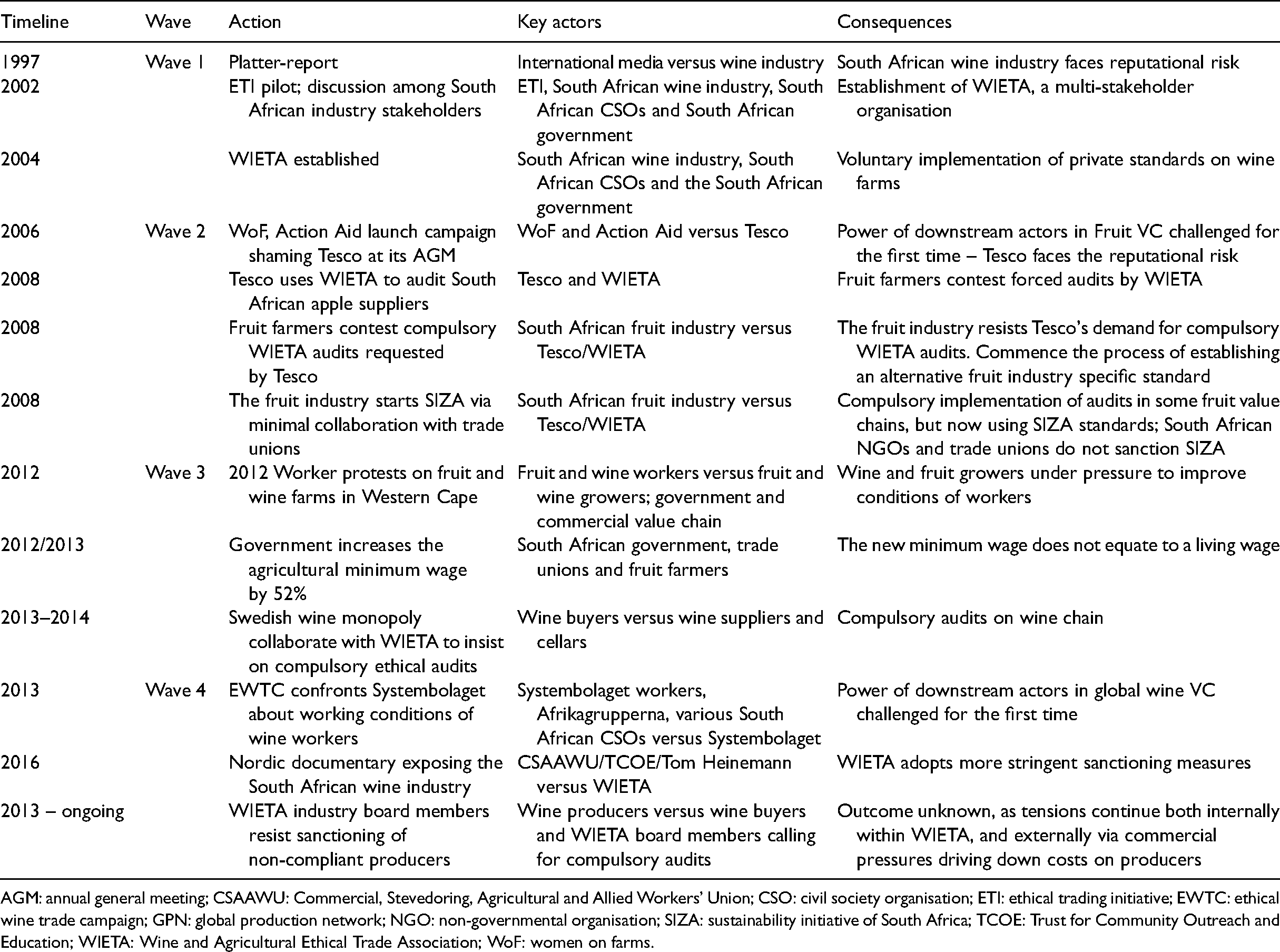
AGM: annual general meeting; CSAAWU: Commercial, Stevedoring, Agricultural and Allied Workers’ Union; CSO: civil society organisation; ETI: ethical trading initiative; EWTC: ethical wine trade campaign; GPN: global production network; NGO: non-governmental organisation; SIZA: sustainability initiative of South Africa; TCOE: Trust for Community Outreach and Education; WIETA: Wine and Agricultural Ethical Trade Association; WoF: women on farms.
Wave one: Transnational flows and the emergence of WIETA
An initial spark that prompted the creation of WIETA was an expose of poor working conditions on wine export farms in the international media in 1997 (row 1). Three years after South Africa's democratic transition, the British Broadcasting Corporation interviewed John Platter, a well-known connoisseur of South African wine, and his spouse, who exposed poor labour conditions in the South African wine industry. The interview received wide press coverage, prompting a call in the international media to boycott South African wine. 6 The wine industry scrambled to limit reputational damage, resulting in numerous producers accepting a timely proposal by the UK Ethical Trading Initiative (ETI) to launch a South African wine pilot (row 2). The pilot aimed to test whether wine and fruit farmers could meet the ETI base code standards, which would vouch for acceptable labour conditions on farms. 7 Some South African wine and fruit producers were already familiar with the ETI base code, as several UK retailers had begun enforcing it in their supply chains in the late 1990s.
Following the pilot, the ETI collaborated with the South African wine industry, trade unions, NGOs and government to create WIETA (row 3). These stakeholders jointly formulated the WIETA code, which drew heavily on the UK ETI base code (ETI 2005), while incorporating important variations to address national legislation and particular place-based labour challenges faced by the wine sector. WIETA can therefore be classified as a South African MSI formed through a combination of adversarial civil society campaigns contesting international retailers’ sourcing practices and collaboration between Northern and Southern interest groups united behind the mission to improve labour standards on farms.
WIETA is embedded in a place of production shaped by Southern actors. It provides an important platform for enabling diverse stakeholders to communicate and collaborate based on mutual understanding of diverging perspectives (Du Toit et al., 2008; McEwan and Bek, 2009). Its board comprises 10 members: five nominated by producer organisations, three by trade unions and two by civil society (CSO interview, 2017).
In 2004, WIETA began conducting voluntary audits on member wine farms, focusing on compliance with national labour legislation, but also some higher standards. Transnational linkages shaping the formation of WIETA are also significant: UK retailer members of ETI were directly involved in WIETA’s creation through ETI involvement in its establishment. The formation of WIETA thus reflects both the interweaving of transnational flows and domestic places of production, and the ‘ever-changing mixture’ of collaboration and contestation underpinning these dynamic interactions.
Wave two: Transnational flows and the emergence of SIZA
SIZA also stemmed, initially, from adversarial campaigning in the UK targeting poor working conditions on South African fruit farms due to a lack of state enforcement of labour regulations. The societal and territorial embeddedness of the fruit sector in the global North and South, and links between GPN actors across these different spaces, facilitated the generation of a transnational field in which creation and development of standards were contested and collaborated over time. In 2006, the South African NGO women on farms (WoF) collaborated with the international NGO action aid to launch a British media campaign exposing poor working conditions on South African fruit farms (row 4). 8 The campaign targeted the reputation of Tesco, a prominent UK-based retailer sourcing fruit from South African growers, and the adverse effects of their purchasing practices on suppliers and workers (Barrientos, 2013). The NGOs bought a single share in Tesco for a female South African farmworker. She was flown to Britain for Tesco's annual shareholder meeting where she confronted the chairperson about poor working conditions on Tesco's supplier farms. In 2007, WoF invited the actress Emma Thompson to South Africa who condemned, via the media, poor working conditions on South African farms supplying UK supermarkets. 9 These adversarial strategies generated further negative publicity for the South African fruit sector (Barrientos, 2013).
In 2008, Tesco responded by reviewing its social auditing procedures and collaborating with WIETA to monitor compliance with its code on supplier farms (row 5). Tesco’s suppliers, unhappy that audits were being ‘forced’ upon them, challenged this process (row 6) through Fruit SA, the umbrella organisation representing various South African fruit industry groupings. It was also uncomfortable with WIETA simultaneously being ‘player and referee’ by setting standards, contracting in auditors (effectively under its control) and making certification decisions (fruit industry interviewee, 2017). A member of WIETA claimed that representatives of the fruit industry also mistrusted the ‘radicalness of organisations sitting on the WIETA board and influencing WIETA strategy’ (CSO interviewee, 2017).
Fruit SA embarked on an adversarial campaign against WIETA. Tesco's South African suppliers refused further audits by WIETA (one CSO and one fruit industry interviewee, 2017). Fruit SA began to develop SIZA as its own ethical trade organisation (row 7). 10 It aimed to develop a standard in consultation with stakeholders that would be acceptable to fruit farmers and retailers. Officially, the fruit industry started a new South African code because it wanted to avoid audit duplication by individual retailers, each with its own in-house standard. Yet, the SIZA code was in fact a weaker version of the WIETA code, allowing it to take control over standard-making and monitoring in the fruit sector to prevent the creation of higher entry barriers to the UK market.
South African NGOs and trade unions – except for one union that had low levels of fruit worker representation – chose not to engage with SIZA. One reason is that it was seen to be undermining of and in contestation with WIETA, where unions enjoyed board representation (trade union interviewee, 2017). SIZA's board therefore contains no independent labour organisation representatives. Some CSOs criticised it for being a defensive mechanism for producers to claim ethicality, maintain supermarket contracts and deny more transformative improvements in working conditions and enabling rights (2 CSO interviewees, 2017). Instead of aiming to influence SIZA standards by participating in its governance structure, South African CSOs opted to challenge SIZA's credibility, with a limited effect so far.
The establishment of SIZA, such as WIETA, also stems from the interweaving of transnational flows of standards and commercial practices with domestic actors, rules and agendas at places of production linked to GPNs. Fruit producers sought to resist the ethical demands of transnational lead firms, who were already imposing considerable commercial pressure for consistent supplies of high quality, low-cost fruit. Hence, an important impetus for the formation of SIZA was to contest power asymmetries between suppliers and lead firms, whereby the latter leverage their oligopolistic position relative to their globally fragmented supply bases to extract economic rents (Coe et al., 2008; Nathan and Kalpana, 2007). Such leveraging by lead firms has seen them accrue disproportionate value relative to South African suppliers, constraining the latters’ ability to significantly improve working conditions (Barrientos and Visser, 2012). However, SIZA also stemmed from pre-existing tensions between local producers and civil society linked to GPNs, causing the fruit industry to distance itself from affiliation with WIETA. This aspect of SIZA's formation emphasises the significance of relations between various actors that exist in particular places of production linked to GPNs, resulting in divergent ethical initiatives across the wine and fruit sectors. Thus SIZA’s formation reflects the active and dynamic interplay of power relations involving contestation and collaboration between diverse stakeholders playing out across spatial scales. Despite the emergence of South African MSIs linked to GPNs, neither WIETA nor SIZA has provided sufficient protection for precarious workers, nor regulated commercial relations between lead firms and suppliers that adversely impact labour relations on farms (Ponte and Ewert, 2009). Consequently, neither code warded off an emerging labour crisis that resulted from poor working conditions in fruit and wine GPNs.
Wave three: 2012/13 labour crisis and evolution of WIETA and SIZA
In November 2012, shortly before the harvesting season, a major farmworker strike erupted in De Doorns, the hub of the Western Cape's table grape production (row 8). It was led mainly by precarious workers on flexible contracts demanding a living wage. Initially, protestors’ demands were targeted at their employers. This action soon scaled up to the national level, with the assistance of trade union and NGO leaders, challenging the DoEL to raise the minimum agricultural wage from R69 to R150 per day. Protestors disrupted commercial operations and prevented transportation of workers to farms by blocking arterial routes. The violent unrest received extensive media coverage, damaging the ethical reputation of South African farmers and threatening market access (Alford et al., 2017).
Following consultation with private industry and worker representatives during the DoEL's review of the sectoral minimum wage, the latter was increased to R105 per day (row 9). Significantly, the wage review process acknowledged that the new wage remained insufficient to meet basic living costs (BFAP 2012). But the review acknowledged that a greater increase would create major challenges for fruit producers, potentially resulting in farm closures and retrenchment.
Contestation started in the fruit sector, but the subsequent global response was more intense for the wine sector. One possible reason is that wine is a branded product and therefore more susceptible to reputational risk than fruit, which is mainly sold as a generic product. Another factor is that the main international response to the crisis came from Sweden. Here wine sales are tightly controlled by the Swedish government-controlled liquor monopoly, Systembolaget, which is subjected to greater scrutiny from civil society than individual commercial buyers. Following protests, Systembolaget issued a ‘red flag status’ to the South African wine industry. This indicated Systembolaget was considering stopping the purchase of South African wine, giving the wine industry until 2014 to improve farm conditions. Systembolaget's standpoint was taken seriously by the wine industry given Sweden's importance as an importer of packaged South African wine (wine industry interviewee, 2013). Major South African liquor companies, such as KWV and Distell, informed their bulk wine suppliers that they would have to collaborate with WIETA and undergo an audit or be excluded from exporting to Sweden.
In 2014, Systembolaget collaborated with WIETA by demanding that farmers supplying the Scandinavian market comply with the WIETA code (row 10). These various developments led to an increase in the number of farms receiving WIETA audits from 20 to 100 farms per month (Visser and Ferrer, 2015). By July 2013, 575 wine producers had signed up with WIETA – over double those registered the previous year. By the end of 2014, 60% of South Africa’s winegrowers were WIETA accredited and by 2017, WIETA had 1453 members.
Consequently, 10 years after being established, WIETA’s voluntary approach to ‘ethically certified’ wine was challenged as a result of the ‘fruit crisis’. WIETA was pressured to undertake enforced audits and upscale its auditing apparatus to meet rising demand. To reward compliant producers, WIETA launched an ethical certification seal that producers could use for marketing purposes, graphically displaying their compliance with the standard. This seal subsequently became a convenient target for contestation by activists (Visser and Godfrey, 2017).
At the same time, the fruit industry was suffering from reputational damage and commercial disruption caused by the 2012/2013 labour unrest Fruit SA was ready to launch the SIZA code during this period, which was already being developed. This came at an important time, following the opening phase of violent labour unrest in the Western Cape: In light of the demonstrations that have taken place in the past two weeks, the need for a program like SIZA has become actually even more apparent…. To get everybody buying into one standard, one code, one vision. In a strange way it's sort of highlighted the need for SIZA
Following the labour crisis, SIZA's agenda was to substantially increase their fruit producer membership, third-party social auditing and compliance procedures (SIZA interviewee, 2017). Increased exporter demand for compliance with South African certification bodies in the aftermath of the unrest resulted in SIZA membership growing rapidly, with 1550 members enrolled by 2017 (SIZA 2017).
Analysis of this third wave has shown the 2012/2013 labour crisis to be a fluid, dynamic and significant phase of development in the evolution of SIZA, WIETA and the broader governance of labour standards in fruit and wine GPNs. The fact that worker contestation began at localised places of production, evoking a response from transnational buyers to collaborate with WIETA and demand compulsory certification of their code, illustrates that power relations between GPN actors are not structurally determined and problematises the notion that transnational standards flow unidirectionally through GPNs (Coe et al., 2008). It demonstrates the ‘ever-changing mixture’ of both collaboration and contestation between private, state and civil society actors that ‘transect geographies of regulation based on territorial jurisdiction and scalar reach’ (Amin, 2004: 226) and shapes the broader ethical terrain of GPNs. However, as elaborated in the next section, the resulting shifts by South African MSIs towards stricter, compliance-based approaches in wine and fruit, have not sufficiently dealt with underlying commercial power asymmetries inherent in GPNs.
Wave four: Contestation in South African wine and implications for WIETA
Following the 2012-unrest, workers continued challenging what they perceived to be inadequate working conditions and/or access to collective bargaining, this time targeting wine GPNs. Once WIETA audits became largely compulsory for export, industry representatives on WIETA's board lobbied for more leniency towards suppliers during the auditing and certification process to prevent non-compliant suppliers from losing market access. This pressure was resisted by workers. In 2013, the Ethical Wine Trade Campaign (EWTC) was established following collaboration between workers of the Swedish wine monopoly Systembolaget; Afrikagrupperna, 11 a Swedish NGO with a branch in Johannesburg; and NGOs and unions representing workers of Systembolaget's Southern wine suppliers (row 11). EWTC is an international network demanding better working conditions on wine farms internationally. At that stage, many South African trade unions – Commercial, Stevedoring, Agricultural and Allied Workers’ Union (CSAAWU), Sikhula Sonke and BAWSI Agricultural Workers Union of South Africa – were part of EWTC. The latter wrote to Systembolaget informing them of alleged worker rights violations on South African wine farms. This transnational collaboration received substantial coverage in the Swedish media, piquing the interest of a Danish documentary maker, Tom Heinemann 2016 (Visser and Godfrey, 2017).
Heinemann made a documentary exposing poor working and housing conditions on farms supplying Robertson Winery, a Systembolaget supplier and WIETA member, but also a cellar where the trade union CSAAWU represented workers. It also contested Systembolaget's purchasing and monitoring strategy, designed to ensure their wine is ethically sourced. The documentary provided an opportunity for CSAAWU and South African NGOs to air their grievances about working conditions in the agricultural sector and lament entrenched power asymmetries between suppliers and their workers (row 12). By providing an international platform to South African worker representatives, the documentary facilitated transnational collaboration involving a combination of activists and unions based in Sweden working with South African trade unions and NGOs.
While industry sources dismissed the documentary as biased, it had serious repercussions, particularly in Scandinavian countries. The Danish supermarket chain, Dagrofa, temporarily withdrew Robertson Winery bottles from its shelves. The Norwegian state monopoly wine buyer, Vinmonopolet, conducted an inspection tour of South African wine farms. In addition, Systembolaget received criticism for sourcing unethically produced wine prompting them to engage an additional audit company to verify conditions on Robertson Winery's supplier farms. It was feared the documentary could lead to a boycott of all South African wine by Scandinavian countries (Visser and Godfrey, 2017).
These internal tensions can be ascribed to WIETA's transition from an organisation promoting voluntary ethical trade practices, which helped progressive wineries to position themselves in a niche market for ethically produced wine and use ethical production practices as a source of rent, to one where ethical production processes became an entry barrier, at least to the lucrative Scandinavian market. To prevent such barriers from being raised too high, industry bodies tried to ‘capture’ WIETA to ensure the appropriate level of standard-setting.
Following Heinemann's expose, WIETA attempted to counter charges of producer capture through more collaborative inclusion of workers’ voices in its policy debates, recruiting a dedicated staff member to organise regular weekend sessions where farmworkers could voice grievances. In late 2016, WIETA invited trade unions and NGOs to various meetings and workshops to discuss its policy on freedom of association; record grievances of union members; share information with ordinary workers about WIETA’s code and audit process; and allow unions the opportunity to canvas and mobilise workers.
Hence, the strategy adopted by Systembolaget's workers assisted South African trade union contestation of Systembolaget and escalated their grievances to the public domain of Northern end-markets. It also enabled South African trade unions to contest the legitimacy and credibility of WIETA as a Southern beacon of ethical collaboration, arguing it had been captured by producer interests.
Examination of this fourth wave underlines that power relations between GPN actors involved in the governance of labour standards are dynamic and subject to change over time. A significant repercussion of the 2012/2013 labour crisis was the formation of the EWTC, a collaborative network of spatially dispersed civil society actors and worker representatives based in Sweden and South Africa. Grievances raised by these actors and channelled through global media outlets prompted a significant ethical response by transnational buyers based in Sweden, Denmark and Norway. The fallout of this reputational crisis for the South African wine industry highlights the complex webs of collaborative relationships between private and civil society actors engaged in WIETA. Internal tensions following WIETA's response to the unfolding crisis, show that while South African CSOs have formed collaborations with wine suppliers and industry actors, their diverse agendas are often far from compatible (Coe et al., 2008; Dallas et al., 2019). Rather, and in line with a relational approach linked to GPN analysis (Amin, 2002, 2004; Dicken, 2004; Hughes et al., 2007; Yeung, 2005) this fourth wave demonstrates that relationships between different GPN actors involved in the governance of labour are neither linear nor predetermined, but involve waves of both collaboration and contestation that play out over time and space.
Governance of labour standards through waves of interaction in GPNs
In contrast to other recent studies highlighting the increasing significance of standards developed and applied in the global South, this research sheds important light on their genesis, structure and evolution through dynamic interactions with GPNs that ebb and flow over time. Complementing GPN analysis of embeddedness with the concepts of ‘space of flows’ and ‘space of places’ helps to unpack how MSIs can shape the governance of labour standards in GPNs through waves of interaction, involving collaborative and contested exchanges between diverse actors. Our analysis of waves one and two showed that standards, driven by transnational retailers based in the UK under pressure from Northern civil society campaigns, helped facilitate the formation of WIETA and SIZA. However, a comparison of the two MSIs indicates that, while both standards evolved within a similar national context (‘space of places’), they followed divergent trajectories due to different configurations of actors enmeshed in the ‘space of flows’ enveloping GPNs. This is reflected in varying multi-scalar interactions between suppliers with trade unions and NGOs, different supplier responses to buyer pressure on standards, and also the absence or presence of collaboration with Northern-based civil society, leading to the separate formation of WIETA and SIZA.
This analysis problematises the notion that transnational standards and ethical practices are determined solely by lead firms and flow in one direction through GPNs. In line with a relational approach, it highlights that power relations and interactions between GPN actors involved in the governance of labour standards are neither structurally determined nor unidirectional (Amin, 2002; Coe et al., 2008; Dicken, 2004, 2007). This is illustrated by the emergence of South African codes and MSIs, which proved insufficient in protecting precarious workers in face of contestation not only between workers/civil society and suppliers, but also suppliers and lead buyers in the GPN. These unresolved tensions contributed to the 2012/2013 labour crisis. Worker contestation erupted on fruit farms in the Western Cape, prompting Northern buyers to collaborate with South African civil society and industry stakeholders, resulting in more stringent compliance mechanisms and auditing of the WIETA codes. But this failed to address underlying commercial pressures applied by lead firms on their suppliers. Continued shifts by WIETA towards a compulsory audit and compliance-based approach in wave four revealed internal tensions between producers and civil society actors linked to wine GPNs, demonstrating that power relations between different actors engaged in MSIs can be incompatible, dynamic and subject to change over time (Coe et al., 2008).
Analytically, complementing GPN analysis with concepts of ‘flows’ and ‘places’ enables us to conceptualise and explore waves of interaction that occur between and within transnational and domestic governance regimes (Castells, 1999) in relation to global production. Our study clearly shows that transnational rules ‘flow’ through GPNs and intersect with embedded social, political and institutional contexts found in ‘places’ of implementation, wherein Southern MSIs are increasingly influential. Deploying concepts of flows/places can thus complement territorial and societal embeddedness concepts in GPN research, by drawing closer attention to the conflict and tensions that occur across transnational and domestic governance regimes in GPNs (Bartley, 2018; Castells, 2016). Our analysis of Southern-based MSIs provides insights that contribute to this literature. In sum, the concept of waves of interaction has enabled us to capture the dynamic, non-linear waves of collaboration and contestation occurring between actors across space of flows and places, helping to shape the governance of labour standards in GPNs.
However, exploring how these waves of interaction play out in the broader context of GPNs shows that, despite the emergence and evolution of Southern MSIs, they have not sufficiently addressed deeper, commercial power asymmetries that flow through GPNs. This was most starkly evident during the third wave (2012/2013 labour crisis) during which the key underlying issue of securing a living wage was unable to be resolved due to commercial pressures applied by Northern retailers to their suppliers, leading to increased use of low-wage seasonal workers subject to poor terms and conditions (Barrientos and Visser, 2012; Ponte and Ewert, 2009). While we observed progressive moves by WIETA towards more frequent and stringent localised compliance arrangements, the status quo of asymmetrical commercial power relations underpinning GPN governance remains in place (Alford, 2020; Bair and Palpacuer, 2015; Barrientos, 2013; Dicken, 2007; Nathan and Kalpana, 2007; Ponte and Ewert, 2009). These limitations to WIETA's progressive aims and SIZA's reluctance to impose standards any higher than the sectoral legal minima can be understood by considering their embeddedness in commercial GPNs.
In the particular context of South African fruit and wine, stakeholders from WIETA and SIZA are becoming increasingly cognisant of the global forces that impact their governance. In 2011, members of Fruit SA engaged with the ETI on the issue of purchasing practices (Hughes et al., 2013) and the WIETA board are alive to the significance of power asymmetries between lead firms and producers (WIETA interviewee, 2017). Yet, despite producer input, neither the WIETA nor SIZA code make any attempt to address unfair trading practices between suppliers and buyers. This is not due to a lack of producer knowledge or structural oversight, but a reflection of their inability to contest asymmetrical power relations without jeopardizing their commercial relationship with core buyers. The two attempts made to directly challenge such power asymmetry have been made by South African NGOs and unions, in collaboration with international NGOs, who have less to lose. It therefore seems there is some scope for collaboration between South African worker organisations and producers on the grounds of common interests to collectively contest asymmetrical power relations in their respective production networks. However, thus far historical adversarial relationships between these groupings undermine such collaboration.
Concluding remarks
The emergence of standards covering workers’ rights and employment conditions developed and applied within the global South where supplier firms are usually based has created a highly complex and contested ethical terrain. This paper has explored this by asking two questions. First analytically, how is the governance of labour standards in GPNs shaped by dynamic spatial interactions between actors? We argue that the GPN concept of embeddedness provides important insights into a bottom-up (rather than top-down) understanding of the governance of labour standards. Yet, it pays insufficient attention to the often contested processes of change that ebb and flow over time. The contribution of this study is to complement GPN analysis of embeddedness with the concepts of flows of space and place, to highlight a dynamic and often conflictual process involving exchanges between and within transnational and local actors. We capture this non-linear dynamic through the concept of waves of interaction to identify an underlying logic (driven by collaboration and contestation) to processes of change in embeddedness that can shape the governance of labour standards over time. Second, empirically we asked: What role have diverse Southern MSIs played in influencing the governance of South African fruit and wine? Our study is unique in GPN research on the role of Southern MSIs in the governance of labour standards, given it provides a comparative study of WIETA and SIZA over an extended time period. This illustrates that far from the governance of labour standards being a linear top-down process, the interweaving of transnational and domestic initiatives plays out through waves of interaction involving collaborative and contested exchanges between actors within and between space of flows and places. It is through such dynamic processes that Southern-based MSIs evolve to shape the broader governance of labour standards, manifesting differently depending on the particular configurations between GPN actors working across spatial scales.
Our analysis also highlights the deeper commercial power asymmetries constraining the ability of Southern-based MSIs to protect the most precarious workers. This points to an urgent need to further interrogate the potential for Southern actors to strategically intervene to address tensions in the commercial and ethical dynamics of GPN governance. While active contestation about the nature of standards that regulate suppliers has happened in the ‘space of flows’, challenges to lead firm commercial practices relating to suppliers have been limited in this space. In the particular context of South African fruit and wine GPNs, positive outcomes might be achievable if civil society actors and suppliers in places of production are able to overcome competing agendas to collaborate on a shared goal of challenging lead-firm bargaining power. However, as our case study has also revealed, achieving systemic change in commercial GPNs will require strategies in this transnational field (the ‘space of flows’) involving various actors operating across spatial scales at sites of production, retail and consumption. It is inevitable that such strategies involving private, state and civil society actors will involve an ‘ever-changing mixture’ of collaboration and contestation over labour standards through future waves of interaction, manifesting differently across contexts. What is clear, however, is that until lead-firm buyers adapt their purchasing practices either through means of collaboration or, in response to contestation, sustainable social improvements for the most vulnerable workers remains an elusive goal.
Footnotes
Acknowledgements
The authors would like to thank all participants who gave up their precious time during fieldwork.
Declaration of conflicting interests
The authors declared no potential conflicts of interest with respect to the research, authorship and/or publication of this article.
Funding
The authors received no financial support for the research, authorship and/or publication of this article.
