




Abstract
While studies have shown that Business Improvement Areas (BIAs) manage and control their physical urban spaces to generate local economic growth, little work has examined how these organizations lobby for their market interests during key decision-making processes. Drawing from the pragmatic sociology of critique, this paper develops a theoretical framework to explain how political-economic power is socio-culturally encoded during local government decision-making processes. Socio-cultural power is defined through two interrelated processes: (1) interactional settings where social actors practice their critical capacity by drawing upon socio-historically created moral orders and (2) the extent to which institutional experts limit laypersons' critical capacity and successfully construct local realities to advance their agendas. This framework is applied to London, Ontario's Old East Village to show how the local BIA influenced two separate affordable housing development plans. Based on interviews, participant observation, and document analysis, the findings show that the Old East Village BIA strategically framed and co-opted community critiques of these developments in a way that justified their own market interests (more feet on the street) over the community's civic interests (the provision of affordable housing). This paper extends the BIA literature by demonstrating BIA influence over affordable housing development, local matters that are outside the purview of their commercial jurisdiction.
Keywords
Introduction
Municipal governments are increasingly relying on Business Improvement Areas (BIAs) – or Business Improvement Districts (BIDs) in the U.S – to revitalize urban spaces and generate local economic growth. In the simplest terms, BIAs are organizations comprised of business/property owners within a designated geographical area who agree to pay an annual levy to provide supplemental services to their commercial district such as security, street cleaning, and marketing (Ward, 2007). BIAs also engage in advocacy and government lobbying. Since BIAs often gain privileged access to local government decision-making processes (see Michel and Stein, 2014), these organizations not only exercise power over their physical urban space, they also have the power to persuade local governments to enact business-backed interests to local urban plans.
This paper argues that any understanding of BIAs' power over urban space must be attuned to the socio-cultural power enacted during decision-making interactions with local governments. If the proliferation of the BIA model means that “businesses have bought the right to say what should and should not happen on public streets” (Mallet, 1994: 281), then there needs to be a better understanding of the extent to which BIAs successfully justify “what should and should not happen” and whose interests their agendas ultimately serve. Drawing on participant observation, interviews, and document analysis from London, Ontario's Old East Village BIA (OEVBIA), this paper asks two questions: (1) how does the OEVBIA attempt to justify “what should and should not happen” during the residential planning process? (2) To what extent does the OEVBIA successfully legitimize their market interests into residential plans?
The first section of this paper explores the existing literature on BIA lobbying practices which, I argue, has underexplored BIAs' lobbying practices during the urban revitalization process. The second section explains how existing studies have conceptualized BIAs as a product of a neoliberal political-economic logic and, more recently, as part of a dispersed and fragmented assemblage of social actors. This section argues that BIAs' political-economic power cannot be divorced from their socio-cultural power enacted during key decision-making processes where a wider assemblage of actors discuss, debate, and contest the merits of an urban plan. The third section outlines the pragmatic sociology of critique as a useful theoretical framework to understand socio-cultural power during interactional settings. The fourth section describes the qualitative methodology used in this study before presenting the findings from two separate residential development plans in the Old East Village. In short, this study finds that the OEVBIA legitimized their market interests by framing and co-opting community critiques of these developments.
BIA lobbying practices
While some work has documented how the BIA model is legitimized and successfully transferred across the globe (Cook and Ward, 2012; Peyroux, 2012; Richner and Olesen, 2019), the legitimization of BIA neighbourhood revitalization strategies has been underexplored. A few existing studies, however, provide some insight on how BIAs strategically advance their business interests. There are two general themes within this literature. First, a few Canadian studies have found that, while claiming to represent the “community voice”, BIAs exclude dissenting viewpoints from local longtime residents (Catungal and Leslie, 2009; Rankin and McLean, 2015). BIAs often claim that they represent the voice of the entire community, thereby equating the business voice with the wider community voice (Kudla and Courey, 2019; Ranasinghe, 2013). While this work importantly highlights that BIAs legitimize their role as the guardian of the community by claiming to represent the “community voice”, it is unclear how BIAs construct this voice and how (if at all) their interests are ultimately justified during local government decision-making.
Second, studies have shown that BIAs use various lobbying strategies to enact stricter measures against homelessness and panhandling. As Zukin’s (1995) classic work explained, BIAs construct symbolic boundaries around “who belongs” in urban space (see also Bookman and Woolford, 2013; Kudla, 2019). This is often done through variants of broken windows policing (Wilson and Kelling, 1982) – commonly packaged as “zero tolerance”, “order maintenance”, “quality-of-life policing”, or “stop and frisk” – that seek to purify the commercial corridor of visible poverty (see D’Souza, 2020; Eick, 2012; Huey et al., 2005). Some BIAs use descriptive and hyperbolic language about the homeless to justify the enactment of these social control strategies (Gibson, 2005; Ranasinghe, 2013). This work, however, has exclusively examined BIA lobbying against visible poverty and have underexplored their influence over other local issues such as residential development.
This paper therefore examines the largely unexplored relationship between BIAs and local residential development. Since BIAs are comprised of businesspersons who focus on enhancing the marketability of the commercial corridor, residential development would appear to be outside of their purview. That said, BIAs acknowledge that a thriving residential community offers a consistent customer base for nearby businesses (Hackworth and Rekers, 2005). For example, BIAs have convinced municipal governments to revise zoning by-laws to accommodate loft conversions (Birch, 2002) and to develop high-rent buildings to gentrify the area with an educated, high-income population (Lewis, 2010). In other words, developing residential properties and attracting affluent residents is certainly a part of the commercial revitalization strategy for BIAs. But little is known about how BIAs work with and successfully lobby municipal governments to effectively gentrify the area.
BIAs, political-economic power, and the urban assemblage
BIAs have been conceptualized within the context of various indicators of neoliberalism, including “urban entrepreneurialism” (Harvey, 1989), “rolled back” welfare policies and “rolled out” nongovernmental actors (Peck and Tickell, 2002), and “growth machines” (Logan and Molotch, 1987) (Catungal and Leslie, 2009; Cook, 2009; Eick, 2012; Mallet, 1994; Richner and Olesen, 2019). Variously described as public-private partnerships, quasi-governments, parallel states, and private governments (see Morçöl, 2006), the underlying belief is that business leaders, rather than municipal governments, are best qualified to develop policies and programs for the well-being of their communities. BIAs effectively encapsulate the “neoliberalization of the city” (Ward, 2006: 55) insofar as they are mechanisms through which local business elite can intensity capital accumulation by dividing the city into discrete and governable “micro-spaces”.
Using the urban assemblage perspective (see Anderson and McFarlane, 2011; Farías and Bender, 2010), more recent conceptualizations of BIAs describe a nuanced political-economic form of power (McCann and Ward, 2012; Rankin and Delaney, 2011). These studies argue that BIAs' power to produce urban space is negotiated between various local and non-local actors rather than a single, monolithic business elite (see Kudla and Courey, 2019). On the one hand, BIA spaces are produced by global circuits of knowledge perpetuated by expert “transfer agents” and “BIA gurus” (e.g. consultancies, intergovernmental agencies, and think tanks) who discursively frame the “best practices” of economically successful BIAs around the world (Cook and Ward, 2012; Peyroux, et al., 2012). On the other hand, BIA spaces are produced by various local actors such as commercial property owners, residents, city councilors and administrators, and non-profit organizations who make tangible changes in the area (Cook, 2009; Rankin and Delaney, 2011). Rather than being produced by a coalition of business elite with neoliberal agendas, the urban assemblage perspective views BIA spaces as produced by a dispersed, decentered, and fragmented urban governance arrangement comprised of various social actors.
The urban assemblage perspective, however, does not sufficiently explain the content of the heterogeneous, multiple, and contingent relationships that hold assemblages in place. While the perspective highlights the lateral connections between humans and objects in the shaping of urban space, some urban scholars argue that it fails to explain how humans legitimize the “anchoring” of objects in particular locations, times, and circumstances (Allen, 2011; Storper and Scott, 2016). If BIAs are part of a tangle of interactions – between the local, regional, and global, private and public, expert practitioners and local citizens – then how and why do certain ideas, visions, and plans become legitimized as the best solution to local urban problems? Moreover, to what extent are the relationships within the assemblage driven by market logic (Davies and Spicer, 2015) and, using Flyvbjerg’s (2002) terms, who ultimately “gains and loses” during the urban planning process? Reflecting a wider “normative turn” in human geography (see Barnett, 2014), the following section uses the pragmatic sociology of critique to develop a theoretical framework to understand the socio-cultural power of lobbying.
The pragmatic sociology of critique and socio-cultural power
The pragmatic sociology of critique (hereafter PSC) provides a useful theoretical framework to understand socio-cultural power given its emphasis on normative debate, social actors' critical capacity, the institutionalized context in which normative debates take place, and the role of institutional urban “experts” in the framing of reality and critique. PSC is an emerging subfield of sociology that takes seriously the ways social actors categorize and evaluate social life along various moral orders (see Fourcade and Healy, 2007; Lamont, 2012). It gives primacy to the “study of action” given that its ultimate task is to describe social actors' situated activities which are always in need of interpretation. PSC recognizes that people practice their critical, moral, and judgmental capacities to determine what is right and wrong, good or bad, or legitimate and illegitimate during any given situation. The empirical focus is on particular situations where people determine the “appropriateness” of one's actions. It is during the course of situations – or “reality tests” – where social actors embed themselves in various moral orders that permits them to recognize that their ideals are more or less realistic in a given situation.
PSC provides a detailed description of the normative orders people draw upon and critique throughout the course of a normative debate. The justification of human action is based on a plurality of socio-historically created moral orders; that is, deeply held and shared representations of the social world, or “common goods”, which create meaning for human action and appear natural unless someone challenges their underlying logics. Social actors draw upon a plurality of normative orders, or “grammars of worth”, throughout the course of a reality test; each worth has its own principles, internal structures, and common goods that exist in societies that are complex, differentiated, and with liberal-democratic political cultures. Table 1 outlines the particular characteristics of each worth. These grammars of worth do not represent an inherent value or characteristic attached to persons, institutions, or social structures in a fixed way. Rather, it represents a plurality of common goods any social actor can employ according to the situation (Boltanski and Thévenot, 2006: 19).
A summary of the grammars of worth.
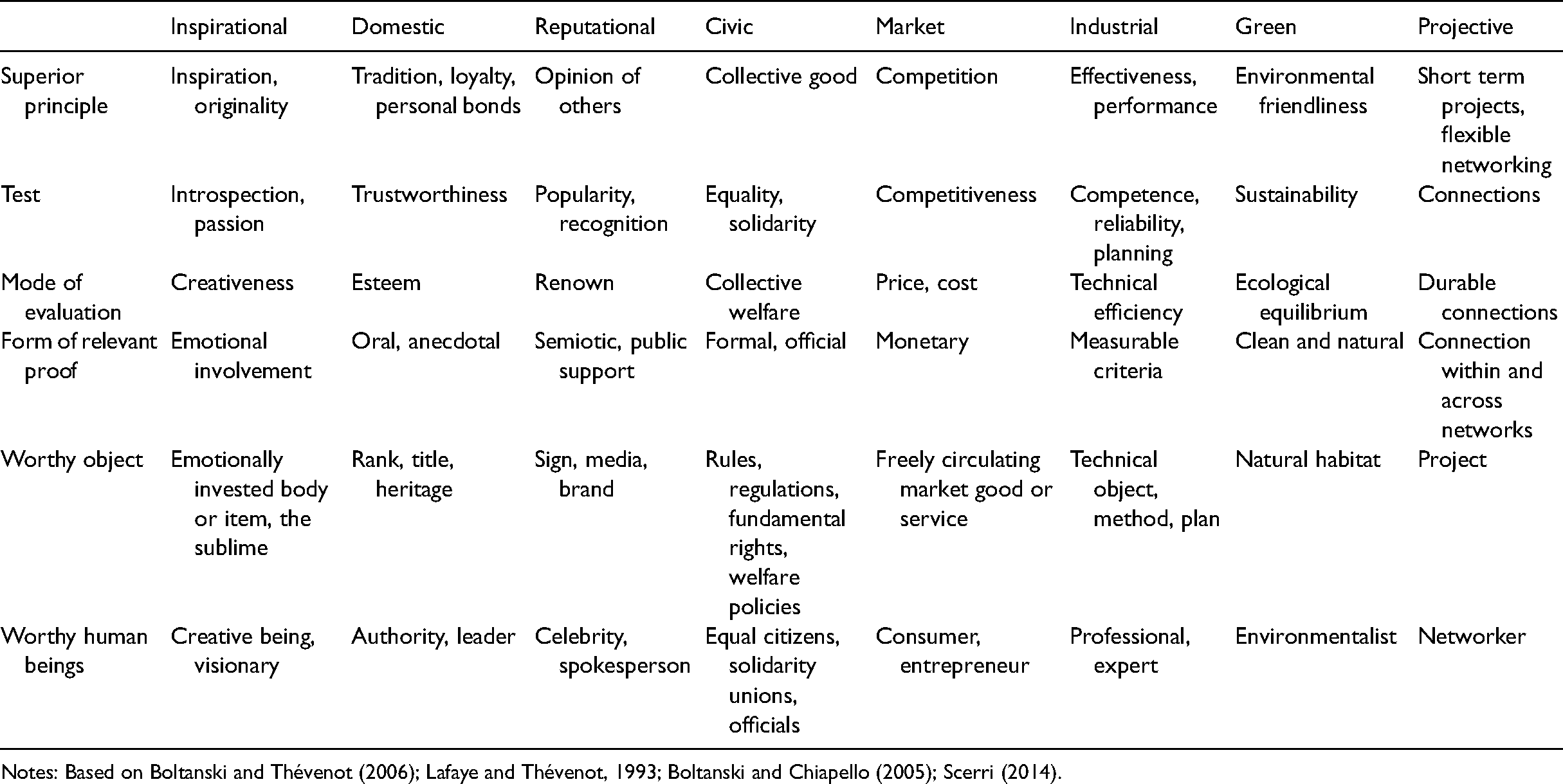
When one draws upon an object or being to a corresponding worth, it is subject to tension and uncertainty as others can challenge the appropriateness of the worth in question. A seemingly legitimate agreement can be questioned at any moment in the name of another legitimate principle. Although the social world is comprised of a multitude of disputes and critiques, social actors work hard to produce consensus despite a plurality of interpretations of social reality. For example, tensions between civic and market justifications are common in many urban planning debates. Private economic actors, on the one hand, tend to justify urban revitalization plans using market values (e.g. pro-growth, individual responsibility, competition, etc.), while, on the other hand, anti-development groups voice their counterarguments by advocating for civic values (e.g. the reduction of social polarization, enhancing public services, etc.) (see Fuller, 2012; Scerri, 2014). In some cases, local residents successfully refute and achieve compromises with developers during the planning process (Holden and Scerri, 2015; Kurnicki and Sternberg, 2016).
This is not to suggest that social actors have equal access to debate because critical capacity is unequally distributed and constrained by institutions. In fact, Boltanski and Thévenot’s (2006) justification framework has been criticized for being “too amorphous” and for neglecting the institutionalized context within which debates are located, thus leaving the impression that any grammar of worth can be evoked at any point by anyone (Honneth, 2010: 388). Boltanski (2011) addresses this criticism by explaining the role institutions play in establishing the parameters around reality tests, justification, and critique. This is certainly the case with urban policy debates dominated by privileged social actors (e.g. experts, managers, political representatives) who set and follow institutionalized rules. Institutional experts, specialists, and managers – who Boltanski (2011) argues are the dominant spokespersons in contemporary institutions – have a non-coercive power of legitimacy that constructs reality, limits critique, and sets the parameters around reality tests. This is especially important to consider during the urban planning process given that, as Flyvbjerg (2002) argues, private actors attempt to define physical, economic, social, and environmental realties in order to influence urban plans.
Boltanski (2011) argues that institutions are normatively oriented social arrangements that attempt to fix meanings and values, define and categorize human behaviour, and confirm “what matters” as well as prescribing “what must be done”. While claiming to engage in open-ended debate, experts often control the framing of critiques through a “complex and managerial form of domination” (Boltanski, 2011: 127); where meaningful conversations and critiques are constrained by claiming there are no alternatives to expert-established rules, technical directives, and benchmarking. Government leaders claim they have no option but to listen to the advice of experts, thereby offloading responsibility to experts for defining and testing reality. For example, Fuller (2017) explains how institutional experts, specifically city senior and mid-level municipal managers and councillors, successfully justified austerity measures in England. He argues these experts formed “discursive institutions” that constructed austerity measures (i.e. reducing the role of the state and imposing financial constraints) as a realistic and practical solution to solving the national debt crisis. Oppositional voices failed to challenge the industrial and market principles of austerity because institutional experts situated themselves as the only ones who understand the complex trends of the market. Critique failed because social actors did not highlight the actual impacts of austerity on vulnerable communities in particular places. In other words, rather than assuming social actors have equal access to practice their critical capacity within specific situations, Boltanski (2011) supplements the PSC framework by providing key insights on how institutions set the parameters for social actors' performative operations.
Despite their attempts, institutional experts are never able to fully impose reality because they are subject to “the contingency and uncertainty inherent in situations” (Boltanski, 2011: 91). Within a liberal democracy, it is impossible to exercise complete control over all contexts and social actions because laypersons can contest normative legitimacy and identify injustice arising from the symbolic violence of institutions. This is the crux of what Boltanski (2011: 84) calls the “hermeneutic contradiction”; institutionally constructed reality is fragile and unstable because it must cope with a plurality of interpretations of the social world. While institutions desire to speak with authority to solidify reality and restrain alternate standpoints, there is continual tension between institutional authority, on the one hand, and the plurality of different points of view, on the other.
In sum, PSC argues that people have power insofar as they have the critical capacity to justify and contest social action by appealing to various moral orders throughout the course of “reality tests”. That said, critical capacity is unequally distributed because institutional experts have become dominant spokespersons in contemporary society. They have the ability to construct reality, limit critique, and set the parameters around reality tests. Institutions, however, do not have the unilateral power to legitimize all social actions because laypersons have a plurality of interpretations that can change or form compromises with institutionally-created realities. In the context of the current study, emphasis is placed on how various social actors justified and contested residential development plans and the extent to which critique was enhanced or restricted during institutionally-created reality tests. Particular attention was placed on how the OEVBIA attempted to construct the reality of the neighbourhood and affirm “what matters” and “what must be done” with the residential development plans and whether this aligned with the wider community's interpretation.
Methodology
This study's empirical focus is on socially constructed “proofs” that are presented during institutionally-created reality tests which includes city council meetings (including council deliberations and public participation) and community consultation meetings. City council meetings include council deliberations where city councillors discuss and debate a particular motion that has been put forth for councillors to vote on as well as public participation meetings (which occur after council deliberations but before the vote) which allows the general public to provide their input on the proposed motion. Community consultation meetings take place sometime before city council meetings (often a month prior) and allows community members to provide input on a proposed community plan. The input is then analyzed and presented during city council meetings in a report to city councillors and attached to the meeting minutes.
Throughout the course of these interactions, social actors use proofs to justify their actions and defend against alternative viewpoints. Social actors attempt to establish “truth” during a reality test by attempting to convince others that their interpretation of reality is “correct”. Each grammar of worth has its own unique set of proofs social actors draw upon during a reality test. It is the task of the PSC researcher to be attentive to the unfolding of these proofs, tie them to their respective grammar of worth, and see how social actors form disagreements, agreements, and compromises during a dispute (Jagd, 2011). In addition to understanding the content of social actors' proofs during a reality test, it is important to assess the arrangement of institutionally-created reality tests to unmask oppression, exploitation, and domination by institutional experts (Boltanski, 2011).
On a more practical methodological level, this study's findings are drawn from participant observation, interviews, and document analysis that took place between 2015–2018. First, most of the data came from participant observation which took place at city council deliberations, public participation meetings, and community consultations regarding residential development in the Old East Village. This included five city council committee meetings (the Planning and Environment Committee on March 2nd, 2015; the Strategic Priorities and Policy Committee on September 26th, 2016; the Planning and Environment Committee on April 3rd, 2018; the Planning and Environment Committee on June 18th, 2018; and the Planning and Environment Committee on November 12th, 2018) and two community consultation meetings (meeting about 1039–1047 Dundas St. on January 31st, 2018 and meeting about 809 Dundas St. on March 29th, 2018). These are institutionally-created reality tests where social actors have the opportunity to justify and critique development plans. Second, reality tests were created among OEVBIA members by conducting one-on-one interviews with eight participants (six board members and two staff members). Participants were promised that pseudonyms along with a general description of their role would be used when referring to their interviews throughout this study (e.g. John Smith [alias name], business owner). Third, a document analysis of BIA-related reports were examined because these are deliberately constructed materials that attempt to justify the merits of a future plan (City of London Planning Division, 2005; Planning and City Planner, 2018a, 2018b).
Residential development in the old east village
The Old East Village is located in a mid-sized Canadian city (London, Ontario) with a population of 383, 822 (Statistics Canada, 2017). The neighbourhood experienced deindustrialization in the post-WWII era, making it into the city's stigmatized post-industrial ghetto marked by a heavy concentration of drug trafficking, prostitution, and social services (Kudla and Courey, 2019). In the early 2000s, the City of London gave the OEVBIA the task of overseeing the Community Improvement Plan (CIP) which gave them the authority to speak on behalf of the community on local revitalization plans (City of London Planning Division, 2005). During the course of this study, the OEVBIA had 14 members on the board of management, including ten business owners, a director of a local entertainment district, the president of a local theatre, one local outreach worker, and the local city councilor representing the ward where the OEVBIA is located. There were also three paid staff members, including the OEVBIA Manager (Jennifer Pastorius) who speaks on behalf of the organization.
Compared to the larger and more affluent downtown “corporate” BIAs typically discussed in the academic literature, the OEVBIA is a small “main street” BIA (see Gross, 2005) with a limited budget, minimal staff, small geographic boundary, and ageing infrastructure. Since the early 2010s, the organization focuses almost exclusively on attracting residential development to the neighborhood in an effort to bring more “feet on the street” on their commercial corridor. During the course of this study (2015–2018), the OEVBIA was involved in the planning process of two residential developments: a twin 24-storey high-rise development proposed by a private developer and a five-storey affordable housing development proposed by a non-profit organization. As an OEVBIA member explained, residential development meant there would be more desirable consumers in their commercial corridor:
It's not getting rid of or moving people, but about bringing in more people in who aren't necessarily addicted to drugs, selling drugs, or doing crime. (Alexandra, OEVBIA board member)
Given their limited financial capital, OEVBIA members spend their time liaising between the community, the City, and private developers. As Jason, an OEVBIA board member, explained, they are “agents of the city” who help business/property owners and private developers navigate the City's application process and facilitate provincially mandated community consultation meetings which are required for any application process.
Private residential high-rise development
Framing community critique
Paramount Development Inc., a local private property developer, proposed a twin 24-storey residential high-rise development with 480 units on 809 Dundas Street (see Figure 1). The developer needed an amendment to the municipal “Zoning By-law” because their proposed 24-storeys and 710 units per hectare exceeded the by-law limit of 15-storeys with 250 units per hectare. Exceeding these limits required several “bonusing” conditions to be met which originally required the developer to have an “enhanced urban design” and construct underground parking (Planning and City Planner, 2018a). There were several community consultation and public participation meetings prior to councillors' final decision on the proposed development.
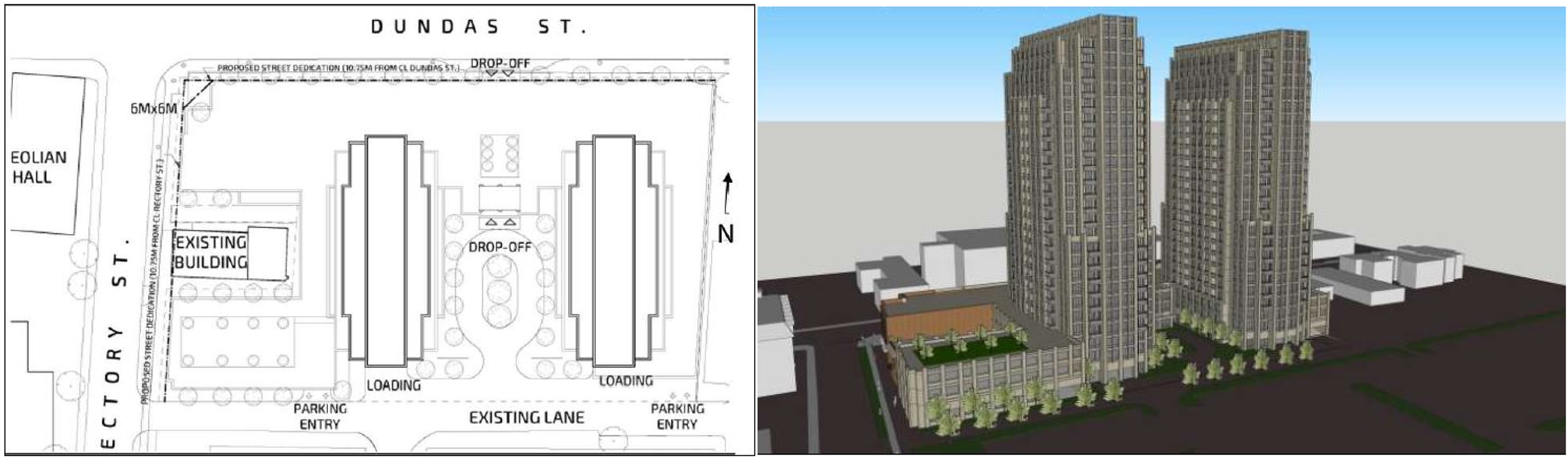
Renderings of the twin-high rise development.
As an “agent of the state”, the municipal government tasked the OEVBIA with advertising and hosting a community consultation meeting on March 29th, 2018 as well as collecting and analyzing the community feedback. Thus, critiques of the proposed development were submitted to and vetted by the OEVBIA prior to presenting them to city council. In total, 29 people attended the meeting with 16 comment cards submitted (Planning and City Planner, 2018a).
The community's feedback was summarized into seven categories (Planning and City Planner, 2018a): (1) lack of affordable housing (civic critique); (2) shadowing on a nearby building with solar panels (green critique); (3) poor building design elements such as unattractive exterior walls and lacking consistent façade with the business corridor (inspirational and domestic critique, respectively); (4) excessive height of the building makes it stick out in the neighbourhood (inspirational critique); (5) lack of connectivity with public transportation (industrial critique); (6) lack of parking (industrial critique); (7) and negative impacts of construction on local businesses (market critique). A City planning staff member presented these critiques to the Planning and Environment Committee on June 18, 2018 which was followed by a brief presentation of the proposed development by Paramount Developer's consultant and a public participation meeting.
The community's concern about the lack of affordable housing was apparent in the feedback. Based on the verbatim quotations in the OEVBIA's analysis of the community feedback, it was clear people were disappointed the development had no requirement for affordable housing units: 1
Can the inclusion of some affordable housing be contemplated as a condition of exceeding the present standards in terms of both height and density?
I am involved @ lifespin @ Ontario and Dundas site. We work with families at or near the poverty line. I would like to see more of the units used as affordable housing for people. We are a community that care about our neighbours. What a good opportunity for this development to consider and act upon.
Despite the apparent community concerns about the lack of affordable housing, the OEVBIA and consultant spent much of the Planning and Environment Committee meeting (June 18th, 2018) focusing on less contentious issues around the buildings' design:
The blank wall facing the dental building (east elevation) can be a canvas for wall art similar to the east wall of the London Clay Arts Centre. This would create a wall art theme in [the] OEV.
It is really important that the commitment to design storefront facades using materials that replicate the variety of storefront facades on the corridor is followed through.
In other words, there were concerns about an unappealing wall design (an inspirational critique) and the design being inconsistent with the architecture of the neighbourhood (a domestic critique). During the committee's public participation meeting, the OEVBIA Manager argued the developer had appropriately addressed these concerns:
The thematic analysis showed majority of the comments focused on the design of the façade, the portion of the buildings on Rectory [Street] and the podium between the two towers… The comments submitted at the community consultation regarding those specific design elements had been noted and utilized in the new renderings. This was a clear sign that the developers were listening and integrating local feedback into the project.
The consultant later responded by thanking the OEVBIA for raising the community's concerns:
We appreciate the comments that were presented by the Old East Village BIA. They are an important neighbour. They have a vested interest in this community and we look forward to working with them on this project. Their comments have been presented in terms of the design of the building and the site design, we believe we have addressed.
Despite the community's concern about the lack of affordable housing, neither the OEVBIA Manager nor the developer's consultant mentioned this issue during the public participation meeting. Instead, the OEVBIA Manager argued that the key concerns from their analysis of the community feedback was the design of the building. As she explained, the developer “listened” and “integrated” the community's feedback and have since changed the design. Although the OEVBIA argued this demonstrated the developers' collaborative efforts, they only collaborated with the community on uncontentious aesthetic and design issues. That is, the OEVBIA emphasized inspirational and domestic critiques rather than the more contentious civic critique about the lack of affordable housing. This was an attempt to portray the developer as “collaborative” on design elements while ignoring the issue of affordable housing.
Discussions about the provision of affordable housing did not arise until the executive director of LIFE*SPIN (Jacqueline Thompson), a local non-profit organization that serves low-income citizens in London, spoke about affordable housing during the committee's public participation meeting. As she explained:
For many Londoners, paying market rents comes at a cost of grocery budgets and too many people are thrown back on such expedients as “couch surfing”. The Planning Committee should make the inclusion of affordable units a requirement for all major residential developments as per the bonusing provision… There is no good reason that a number of affordable units could not be included in the 480 units proposed.
Her civic concern was addressed by city councillors who requested the City's planning staff to collaborate with London's Housing Development Corporation (HDC) and the developer to negotiate an appropriate number of affordable housing units. The committee's motion was revised to include affordable housing as a condition for the bonus zoning (the number of units was to be negotiated at a later date).
Although it is unsurprising that a business organization was unconcerned about the provision of affordable housing, it is noteworthy that the OEVBIA selectively highlighted a less contentious critique (façade and design) that made the developer appear collaborative while ignoring ongoing concerns about the lack of affordable housing. It was clear the OEVBIA attempted to control the framing of critique throughout the City's decision-making process to avoid contentious discussions about the provision of affordable housing.
A negotiation between experts
Councillors tasked City planning staff, Paramount Developers Inc., and the Housing Development Corporation (HDC) to negotiate the provision of affordable housing units over the summer and early fall of 2018. This process took place behind closed doors and did not involve the OEVBIA or community representatives. The details of the bonusing conditions were outlined in the City's report and discussed at the Planning and Environment Committee on November 12, 2018 (Planning and City Planner, 2018b).
The Housing Development Corporation (hereafter HDC) played a significant role during the negotiation process insofar as they produced the report summarizing the details of the bonusing condition. The HDC is a “wholly-owned subsidiary” created by the City of London in 2015 to advance and create new affordable housing in London. 2 Their task during the affordable housing discussions was to be “a third party to support information, facilitate negotiation, and assist in the provision of a fair recommendation” (Planning and City Planner, 2018b: n.p), thereby signifying their role as a projective organization acting as an arbitrator in the negotiation process.
Their report recommended that, in exchange for allowing the developer to exceed the height and density limits, the developer should have 25 single (one bedroom) units at 95% average market rate for a 25-year period. This meant just 5% of the total 480 units of the proposed development would be affordable housing units where residents would pay 5% less the average market rate. It is unclear how this recommendation was negotiated given the discussions took place behind closed doors. The only explanation was that the final recommendation met various rental market and housing analytics and market data. In this sense, the civic test of the good (i.e. the provision of affordable housing) was evaluated by industrial criteria as the municipal government deferred to housing “experts” to test the “fairness” of implementing affordable housing units.
The HDC's recommendation was criticized during the public participation meeting (November 12th, 2018). Locals argued the recommendation had a limited number of affordable units at an unaffordable 95% market rate. For example:
I appreciate the effort, but that is minimal. Considering our affordable housing crisis we are finding ourselves in as time goes on, this isn't really a step to address that. It's really just bypassing it. (Mel Shean, London resident)
It is laudable that Paramount Development agreed to work with City staff to address affordability as part of negotiating for many extra floors. However, in this report, it is not clear who is benefiting. But it is not London's low-income families. It's not a fair trade for our neighbourhood. (Jacqueline Thompson, Executive Director of LIFE*SPIN)
Both speakers criticized the final decision for failing to meet the civic test because, while the developer's participation in these discussions was laudable, the 95% market rate was deemed unaffordable to marginalized families.
Despite the public's criticisms, the HDC's recommendation was eventually passed by the Planning and Environment Committee. It became clear that councillors deemed the recommendation appropriate not because it met the civic test of the good; rather, because the recommendation was “a step in the right direction” given this was just the second time the City established a requirement for affordable housing units under a bonusing condition. Councillors and planning staff argued this was a good compromise at these early stages and could set the foundation for the provision of affordable housing units moving forward.
The planning process for the twin residential high-rise development demonstrates how the OEVBIA attempted to frame critique as well as how a civic critique (provision of affordable housing) was successfully incorporated in the final plan. The OEVBIA was the main gatekeeper of critique insofar as they facilitated community consultations and collected and analyzed community feedback. In this sense, a business organization was tasked with representing the voice of the entire community. Rather than acknowledging the community's salient demand for the provision of affordable housing, the OEVBIA spoke only to less contentious urban design and aesthetic concerns which, according to the OEVBIA, the developer had sufficiently addressed. This was an attempt to portray the developer as collaborative and mindful of the community's requests.
Non-profit mid-rise affordable housing development
Protecting tenants
The London Affordable Housing Foundation (LAHF), a local non-profit/faith-based organization, proposed a five-storey residential apartment geared entirely for affordable housing (41 one-bedroom units at 80% average market rent) on vacant land between 1039 and 1047 Dundas Street. The Planning and Environment Committee met on April 3rd, 2018 to discuss the proposed plan. As I explain, the OEVBIA played a key role justifying Crime Prevention Through Environmental Design (CPTED) strategies and ground-floor commercial units in the building's design.
A community consultation meeting took place on January 31st, 2018 to allow the public to provide input. Although the OEVBIA said little about the affordable housing units of the proposed twin high-rise development, they were more direct about their stance on the mid-rise development insofar as they cited crime as a key concern. There were only eight comment cards submitted during the community consultation meeting (Planning and City Planner, 2018b). Half of these were from OEVBIA-related members, including the board vice chair, a board member, a local business owner, and a family member of the two board members. Two of the respondents argued the building would attract undesirable groups:
Make sure residents are properly screened. [I'm] Concerned with low income residents being taken advantage by drug dealers in area. How to protect them? Even with cameras will they be monitored live? [Make it] as aesthetically pleasing as possible. Fencing may make it look like a jail? Also[,] areas where drug dealers could thrive between fence and building should be addressed. Tunnel area should be monitored for drug activity. (Marcel Hajik, OEVBIA member, 665 Dundas St)
As long as it charges reasonable rent and checks applicants' background and income, it might work ok. It will [be] better to have commercials on the floor though. (Satomi Chandler, unknown affiliation)
The suggestion was that low-income residents were risks to the neighbourhood and should be screened before allowing them to rent a unit. Marcel added that low-income residents should be protected because they may be easily manipulated by local drug activity. He therefore suggested various Crime Prevention Through Environmental Design (CPTED) strategies to deter criminal activity such as cameras and fencing. Although the mid-rise development was much smaller and had just 16 more affordable housing units than the twin high-rise developments, OEVBIA members nevertheless constructed safety as a key issue of the mid-rise affordable housing development.
The other two respondents argued that rezoning the area to allow residential development was a poor decision:
I don't think rezoning for this project is good. Dundas's commercial corridor is improving and new developments should focus on commercial development. This kind of large residential development should happen on a residential street. The city should not approve this change. (Aaron Chandler, local business owner, 1036 King St)
I don't think [the] Main Street corridor should be used for social housing. It is short sighted to change it from commercial zoning. (Dave Chandler, OEVBIA board vice chair, 610 Dundas St)
Both respondents implied commercial units (market worth) were sacred while affordable housing (civic worth) was profane.
During the committee public participation meeting (April 3rd, 2018), the OEVBIA Manager continued to reference the OEVBIA's safety concerns on the proposed development. In fact, the OEVBIA attached a two-page letter to the City's report which summarized community responses from a “Community Open House Feedback” meeting which took place on March 9, 2018 (Planning and City Planner, 2018b). It appeared that this supposed “Open House” meeting was exclusively for OEVBIA members given that it was not publicly advertised and no comment cards or thematic analysis was included in the report. The only explanation of this meeting was that six OEVBIA members and the manager were in attendance with two additional board members submitting feedback via email. In total, criticisms of the proposed mid-rise affordable housing development were dominated by OEVBIA members; four out of eight community responses, two email responses from OEVBIA members, and a letter from a closed-door meeting among seven OEVBIA members.
The OEVBIA's two-page letter expressed their members' concerns about attracting undesirable groups and suggested a mixed-used approach instead:
Much of the commerce in the area is positive and supportive of local entrepreneurs. However, there still exist notable daily illegal activities just to the east and west of the proposed development…. Comments expressed significant support for a generous mix of at-market and affordable rents to ensure a varied tenant population. (Planning and City Planner, 2018c)
The OEVBIA Manager also emphasized a similar point during the committee's public participation meeting:
We are supportive of a mixed housing approach. We have a large concentration of different kinds of services including affordable housing. I'm not saying that we don't need more, but we would love to be able to see mixed housing complex which allows for all different folks to live in the same building together.
These statements by the OEVBIA implied that a building dedicated to affordable housing would negatively impact the “positive” local commerce because low-income tenants attract and are vulnerable to criminal activity. A better solution, according to the OEVBIA, was for the mid-rise development to be mixed use rather than entirely affordable housing. Low-income residents were portrayed as a homogenous “other” in contrast to a diversity of people who would contribute to the “positive” local commerce.
Due to the local drug activity, the OEVBIA recommended that the building should have an “on-site property manager” to mitigate anti-social behaviour. This made the OEVBIA appear compassionate towards low-income residents by suggesting security strategies to protect them from being victimized. However, rather than discussing a mixed-tenant approach or an on-site building manager, the committee discussion revolved around enhancing Crime Prevention Through Environmental Design (CPTED) strategies on the site. As the report explained:
Both interior side yards create narrow, dark spaces between the proposed building and and [sic] future fencing on the site. It is recommended that these issues be considered through the Site Plan Approvals process to consider some form of fencing, lighting or alternative site design to ensure these spaces are protected from the public being able to access them for inappropriate uses.
The OEVBIA ultimately convinced the planning department to implement CPTED strategies to “protect” the site from local criminal behaviour. Figure 2 shows the contrast between the original design and new design renderings. Compared to the original design (on the left side), the new design (on the right side) addressed “safety concerns” by enhancing natural surveillance; specifically by installing larger windows, moving the interior meeting space to the front of the property, and changing the wing wall to several pillars to improve “sight lines”.
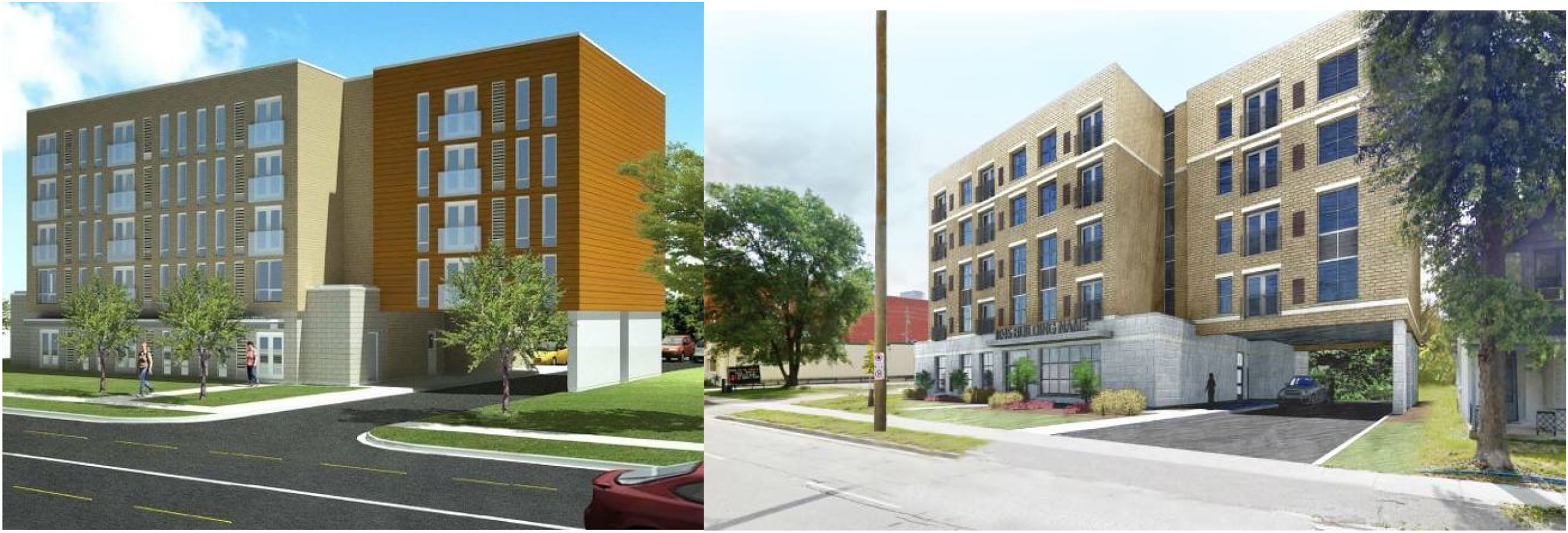
Mid-rise affordable housing building renderings.
Commercializing the ground floor
In addition to implementing CPTED strategies, the OEVBIA wanted to ensure that the building had ground-floor commercial units. As they explained in the attached letter in the City's report, the OEVBIA welcomed the affordable housing development because “more residential units bring more customers to our existing businesses” (Planning and City Planner, 2018b: n.p). This reflected a compromise between civic and market worth insofar as low-income residents were welcome on the condition that they shopped in the local business corridor. As explained earlier, OEVBIA members requested for the area to be geared to commercial rather than residential development. Interestingly, the OEVBIA framed it as the “community's” concern. As the OEVBIA explained in the report:
Business owners shared that commercial activity is vitally important to any business district and residential buildings provide the feet on the street to shop in the retail sector… Property owners and residents stated that commercial spaces will be important assets as the corridor develops over the coming years and will create more walkable neighbourhoods and connectivity to the existing business community [emphasis added].
While OEVBIA members were the only ones to demand commercial units during the community consultation process, the OEVBIA Manager framed this as a concern for both “property owners and residents”.
However, according to the Community Improvement Plan (CIP), that particular area of the Old East Village was not planned to support commercial activity because it was not considered a “pedestrian-oriented” space (City of London Planning Division, 2005). During the public participation meeting, the OEVBIA Manager argued the area had since “surpassed the expectations as it is now a thriving commercial and pedestrian corridor”. Without any specific evidence to support this claim, the OEVBIA argued the eastern-most section of the corridor should be zoned for commercial development. Councillors and planning staff agreed the affordable housing development would fill a much-needed “gap” in the neighbourhood's “isolated pockets of street-level commercial”. In this way, the lack of ground-floor commercial space on the proposed affordable housing development sparked the OEVBIA to request changes to the Community Improvement Plan which would require commercial spaces in future developments in the area. These changes were enacted only because the OEVBIA wanted to capitalize on new customers from the mid-rise development. In this sense, the OEVBIA played a key role in commercializing the affordable housing building. They viewed low-income residents as “feet on the street” who would contribute to the local economy.
By dominating the community consultation process, the OEVBIA successfully negotiated CPTED strategies and future ground-floor commercial use for the affordable housing development. They played a key role transforming a civic issue (provision of affordable housing) into a market issue (attracting criminal activity in an emerging commercial area). In contrast to the planning process of the twin high-rise development, the OEVBIA framed crime as a central concern for the mid-rise affordable housing development despite having just 16 more affordable housing units. Their recommendations were rooted in stereotypes about low-income people's “vulnerability” to criminal activity and need to be protected. This resulted in the justification of various CPTED strategies and commercial units in the building's design. Simply put, the OEVBIA was able to change the final plan to align with their “feet on the street” logic.
Discussion
This paper showed how London, Ontario's OEVBIA established themselves as the guardians of the community voice by facilitating community consultations, collecting and analyzing community feedback, presenting it to city council, and strategically framing and co-opting community critiques. In other words, the OEVBIA was in charge of structuring the reality test of local residential development plans and emphasizing certain critiques over others during city council meetings. Rather than excluding the viewpoints of local residents throughout the planning process (see Catungal and Leslie, 2009; Rankin and McLean, 2015), the OEVBIA strategically framed and co-opted community critiques to justify their “feet on the street” logic. Instead of supporting the wider community's salient concerns about the provision of affordable housing, they advocated for their market interests while claiming to represent the voice of the wider community. In the first case, it was clear that the OEVBIA worked closely with the residential developer insofar as they attempted to portray the developer as collaborative despite completely ignoring the community's civic concerns. In the second case, the OEVBIA successfully imposed their economic interests to an affordable housing development by creating the possibility for future ground-floor commercial units. Although claiming to represent the voice of the community, the OEVBIA's words and actions during the planning process showed that they had their economic interests in mind.
Throughout the planning process, the OEVBIA effectively constructed boundaries around who should and should not belong in their commercial corridor. Since tenants of affordable housing units are not the same as the homeless and panhandlers – groups that BIAs often seek to punish and exclude (see D’Souza, 2020; Eick, 2012; Huey et al., 2005) – these tenants were subject to different forms of stigma perpetuated by the OEVBIA. Rather than advancing anti-poor narratives to justify displacing low-income groups (see Gibson, 2005; Ranasinghe, 2013), the OEVBIA claimed that they wanted to protect affordable housing tenants from a nearby existing culture of crime and drug trafficking. This subsequently justified the incorporation of various CPTED principles into the residential plans. The OEVBIA therefore situates itself not only as a guardian of the community voice, but as “protectors” of homogenous vulnerable groups of tenants who are assumed to be easily enticed by crime and drug use.
The OEVBIA's socio-cultural power, however, was not unilateral insofar as local residents successfully advanced their civic concerns to force city council to rethink the provision of affordable housing units. While the OEVBIA attempted to control the framing of the community's critiques by emphasizing design and aesthetic critiques of the twin high-rise development, local residents advanced civic concerns during the committees' public participation meetings. However, the actual discussions about the provision of affordable housing did not involve community representatives as the discussions were only between housing experts who negotiated the number of affordable housing units along industrial metrics. While this may not be an inspiring subversion of market interests, this case demonstrates small fissures where community representatives can successfully impose their civic ideals (affordable housing) into a market-based project (private residential development). Similar to Holden and Scerri (2015), local community members were able to form a compromise (albeit a minor one) with private actors during the planning process of a residential development insofar as they persuaded city councillors to negotiate the provision of affordable housing to a residential development that seeks to make profits from tenant rents. That said, the institutional arrangement of reality tests (i.e. committee meetings, public participation meetings, and community consultations) did not provide equal opportunities for social actors to engage in normative debate. While the public actually had the opportunity to voice their concerns about residential development by submitting their feedback during community consultation meetings and by speaking at public participation meetings during committee deliberations, the decision-making process ultimately resembled what Boltanski (2011: 127) calls a “complex and managerial form of domination” because, while claiming to engage in open-ended debate, the OEVBIA framed and co-opted community critiques. Ultimately, the OEVBIA were the gatekeepers of the community's critiques as they had the institutional authority to facilitate community consultations, analyze the feedback, and speak on behalf of the wider community during public participation meetings. The community's critiques failed not because, as Fuller (2017) describes, ordinary actors failed to advance a convincing counterargument; rather, because their voices were strategically framed by a private organization.
Conclusion
The purpose of this paper was to understand how the OEVBIA justified “what should and should not happen” during the residential planning process and to what extent their market interests were legitimized into residential plans. This paper showed how the BIA established themselves as the main gatekeeper of community critique and, as a result, successfully imposed their market interests onto two affordable housing developments by strategically framing and co-opting community critiques. Since most BIA lobbying studies focus on their influence over anti-panhandling legislation, this study provides a different example of how BIAs plan and organize contemporary urban spaces on issues that appear to be outside the purview of their commercial jurisdiction. Scholars should be attentive to the power BIAs hold during the residential planning process.
While these are just the findings from one particular BIA in a mid-sized Canadian city, this paper demonstrates that the pragmatic sociology of critique provides a useful theoretical framework to understand how political-economic power is socio-culturally encoded during key moments of debate and decision-making. It helps demonstrate how the “assembling” of cities is contingent on communicative processes during key government decision-making moments. This entails an understanding of how an assemblage of different social actors use their critical capacity to justify and contest social actions and the extent to which institutional experts limit critique and successfully construct local realities. On the one hand, it can help uncover how the goals and values of particular urban project can be transposed by privileged experts with alternative interests. On the other hand, it can show how laypersons can successfully impose their civic values onto a market-oriented urban project. Researchers should be more attentive to how privileged social actors attempt to control the wider community's interests and perspectives during the urban planning process. This requires a methodological approach that highlights the “more fluid, interactively and discursively constructed forces that actors mobilize in public disputes” (Holden and Scerri, 2015: 362). As urban studies rooted in PSC continues to grow, scholars need to develop more specific and robust methods to study lobbying practices, the justification process, and socio-cultural power. This paper provided both a theoretical and methodological framework to help develop a systematic way to study these social processes.
As BIAs continue to form across the world, they will continue to be a powerful local actor that attempt to persuade governments to enact their market interests at the expense of the wider community's interests. This is unsurprising given that BIAs represent the interests of business/property owners who simply want to attract customers to their stores. However, local governments must create better opportunities for community representatives to voice their concerns on neighbourhood revitalization projects without any institutional barriers or distortion from private interests. Municipal governments must also be cautious when BIA leaders speak about the community's problems and solutions insofar as, despite BIAs' claims, these may not reflect the interests of the wider community. While this study explored just one small BIA in a mid-sized Canadian city, future research should be attentive to the way these organizations are able to shape the wider community voice and influence local governments to enact business-backed interests.
Footnotes
Acknowledgements
I would like to thank my doctoral supervisors (Dr Patrick Parnaby and Dr Mervyn Horgan) for their mentorship and advice on this project.
Declaration of conflicting interests
The author(s) declared no potential conflicts of interest with respect to the research, authorship, and/or publication of this article.
Funding
The author(s) disclosed receipt of the following financial support for the research, authorship, and/or publication of this article: This research was supported by the Ontario Graduate Scholarship (OGS).