




Abstract
Policy mobility literature invites us to consider the power-laden processes of how urban policies are exported, mimicked, and transformed in different urban contexts. However, recent critique has highlighted the need for a fuller understanding of urban policy context to understand where and when policies come to be implemented in new settings and how they are transformed. The purpose of this study is to explore understandings of urban policy context in a comparative study of policy mobility, and specifically relations between internationally packaged concepts, local pilot projects and national level actors. We develop a framework for understanding these relations in policy mobility based on case studies of BID policy development in Sweden and Denmark drawing on both Policy Mobility literature and a Multiple Streams Approach. The main finding is that local pilots play a key role in translating packaged policy concepts but also serve as ‘proof of concept’ for further institutionalization. The way these pilots are discursively situated in relation to ‘problems’ is therefore of central importance for further implementation. Furthermore, the study highlights the role of policy entrepreneurs that connect local pilots (and discursive problems) with national level actors, and political opportunities.
Introduction
Many countries around the world have since the 1970s introduced legislations enabling the construction of Business Improvement Districts (BIDs). There are many local variations, but at its core, a BID is a local association of property-owners or businesses that taxes its members in a particular urban area and deploys this revenue to further its goals, typically related to upkeep of public spaces, security measures, communication, and lobbying. In countries that have a national BID legislation, the BID levy is usually compulsory for all the property owners (and in some countries, businesses) located in the areas where BIDs are formed. First formed in North America in the 1970s, and after travelling across the Atlantic into the UK, as well as to South Africa, Ghana, New Zealand, and Japan since the 1990s (Hoyt, 2008; Kaye-Essien, 2020; Ward and Cook, 2017), the BID model has recently gained traction also in Northern Europe. National governments in Sweden and Denmark are today, almost simultaneously, evaluating the possible adoption of legislation to explicitly enable BIDs. The Danish Government has proposed that the BID-model becomes part of municipal experiments to develop more vibrant and active town centres (Danish Housing and Planning Agency, 2022). The Swedish Government is currently ‘reviewing obstacles to introduce national BID legislation’, allowing formal local partnerships, heavily inspired by BIDs abroad, as a means to uplift socio-economically challenged neighbourhoods (Swedish Government, 2020).
Given the many historical and institutional similarities in the two neighbouring countries, there is scope for a comparative outlook onto the simultaneous opening of policy windows for BIDs. Such comparative perspective invites different questions about the relation between policy mobility and neoliberal trends in contexts with strong welfare state legacies. Indeed, BIDs have consistently been recognized as a neoliberal policy instrument (Marquardt and Füller, 2012; McCann and Ward, 2014). Critical urban research has underscored how BIDs support the privatization and commodification of public space and further marginalizes vulnerable populations in the quest for economic growth (Eick, 2012; Morçöl et al., 2008). The spread of BIDs around the globe has been identified as one of the key indicators of a neoliberalization of urban planning and policymaking (Peck and Tickell, 2002) to the point that, as Ward (2006: 68) puts it: “BIDs would appear to be neoliberalism personified”. In line with this research, we understand BIDs as an elastic and resilient policy concept or idea (Michel and Stein, 2015), which contains a series of generic, predominantly neoliberal features, that are – “‘microfitted’ to suit local conditions and needs” (Steel and Symes, 2005: 325) and is in fact ”dependent on highly supportive local regimes and discourses” (Michel and Stein, 2015: 98). In this light, what does the recent push for the adoption of BID legislation in Sweden and Denmark say about the respective “local regimes and discourses”, and more specifically on the shifting urban politics in the two countries? Only 10 years ago in Sweden there was an explicit reluctance to introducing BIDs as they were seen as too neoliberal (Cook and Ward, 2012).
Policy mobility (PM) literature invites us to consider the power-laden processes of how urban policies are exported, mimicked, and transformed in different urban contexts. There is a rich literature in this vein studying the international and hierarchical packaging and dissemination of policy ‘best-practices’ as well as local urban implementation (Baker et al., 2016; McCann and Ward, 2011; Peck, 2011). Still, a critique of PM research has pointed out an overdue focus on international pipelines of knowledge transfer and that the research overlooks ways in which policies are adopted and translated in different national contexts after they have been imported from elsewhere (Robinson, 2015). A full adoption of a policy (for instance through its institutionalization at the national legislation level) is not straightforward. Indeed, local context is pivotal in determining the conditions through which policy mobility takes place, by mutating policy concepts, making them succeed (fully or partially), or fail (Lovell, 2019; Stein et al., 2017; Temenos and Lauermann, 2020; Varró and Bunders, 2020). There is therefore a push for policy mobility literature to develop a fuller understanding of urban policy context, and ways of interrelating different scales, that would allow a better understanding of where and when policies come to be implemented in new settings and how they are transformed.
To explore and unpack contextual aspects of policy mobility, we investigate the contrasting manners in which BIDs are translated into policy in Sweden and Denmark using a theoretical framework that combines policy mobility (PM) research and the Multiple Streams Approach (MSA) originally developed by political scientist John Kingdon (1993). In conjoining these perspectives, we seek to draw on an understanding of policy context from the MSA and combine this with deeper a geographical understanding from the PM literature. In doing this, we build on work by Heather Lovell (2016, 2017a, 2017b), who proposed this theoretical conjunction as valuable to understand aspects of policy context and particularly issues of when policies become actualized. If early PM literature based on explanations of neoliberalism tend to emphasize the role of localities (intended as the municipal and neighborhood levels) over the one of nation states and national politics (Peck and Tickell, 2002), Lovell’s work, drawing on the MSA, brings back the state as a fundamental institutional framework for policy mobility. In comparing the Swedish and Danish cases we seek to unpack the interplay of different geographical scales and the agency of so-called ‘policy entrepreneurs’ in shaping how BID policy is adopted.
The article is structured as follows. First, we develop a conceptual framework based on PM literature and the MSA approach and its three streams: the policy stream, the problem stream, and the politics stream. Second, we introduce the methods applied for generating data on these three streams in the two contexts. Third, we analyze the processes of translating BIDs into Sweden and Denmark, respectively. Finally, we highlight the main findings and discuss the article’s empirical and methodological contributions.
Policy mobility, translation, context, and a multiple streams approach
In this section, we build a conceptual framework for understanding how policy concepts are translated into local political contexts, combining literature on policy mobility with the MSA.
Policy mobility and translation
The PM literature has researched the spread of BIDs, most noticeably through the work of Ward (2006, 2007). Here, the BID model has been theorized as an example of “mobile urbanism” and the “fast policy transfer” associated with neoliberalization (Baker et al., 2016; McCann and Ward, 2011; Peck and Tickell, 2002). In this view, the spread of policy concepts like BIDs can be understood as a result of an increasingly competitive urban environment, where policymakers are under increasing pressure to keep up with the latest trends and ideas (McCann and Ward, 2011). This acute need for updated “off the shelf” policies has led to the development of a whole industry of consultants or “transfer agents” (Stone, 2004), who move knowledge and policy concepts around the world through conferences, study trips, and reports. Cook and Ward (2012) provide an elegant example of how transfer agents were seeking to make “Sweden BID ready” during a 2-day conference in 2009.
A key idea in the PM literature is that policy concepts mutate when they move. As McCann (2011a: 115) argues, policy concepts “are not moved around like gifts at a birthday party or like jars on shelves, where the mobilization does not change the character and content of the mobilized objects”. Instead, policy concepts “are reworked, streamlined, adapted, and often function in fundamentally different ways in their re-embedding in places elsewhere” (Cook, 2018: 344). This process of movement and mutation may perhaps fruitfully be called one of “translation”, if we bear in mind that this is a rich process and a multistranded activity which entails active construction. To translate something, in this sense, is to create something anew (Ward, 2018).
The process of dis-embedding a policy and making it into a model relies on a cadre of experts ready to interpret, package and propound a policy. Legitimacy of a certain policy concept often rests on reference to “successful” examples in cities that others feel worthy of being emulated (Cook and Ward, 2012). In the process of re-embedding there are important relations and power dynamics played out locally (Robinson, 2015). Importantly, there must also be local proponents willing to do the extensive work of creating local linkages and relevancy, while at the same time denying authorship and pointing to the prominent example. Peck (2011), drawing on Offe (1996), elaborates the point that imitation is valuable precisely in order to deny authorship so that intentionality and novelty are disguised, thus avoiding contention. The issues at hand in translation thereby become seemingly technical, rather than being situated and political.
Whilst the literature on policy mobility tends to focus primarily on cases of “successful” translation, there has recently been more attention dedicated to less successful cases and cases of translation failure (Temenos and Lauermann, 2020). Stein et al. (2017) provide an example of how the BID model has been contested in Germany and argue that this can be interpreted as a case of policy mobility failure. They highlight that one of the main reasons why the translation of the BID model failed was that the BID advocates were unable to present the BID model as a solution to a problem. This points to a greater need to understand how problems are constructed and policy concepts such as BID are legitimized locally (Kudla, 2021, 2022; Michel and Stein, 2015). Becoming especially evident in the case of translation failures, it is critical to recognize that “policies do not move fully formed from place to place, some parts move while other prove less mobile and remain fixed in place” (McCann and Ward, 2015: 829).
Hence, the literature on policy mobility often stresses the importance of context, acknowledging that policy concepts are “purposive assemblages of parts of here and elsewhere” (McCann, 2011b: 145), yet it misses “a clear framework for evaluating how and when context matters” (Lovell, 2017b: 100). It has been a recurring issue in policy mobility research that there is a tension between the focus on international channels of packaging and transfer of policy and the study of how policies are subsequently taken up and translated to different contexts (Robinson, 2015; Weller, 2017). While context is not fixed, but depends on the issue at hand, it can be thought of as “the interrelated assortment of specific parameters in a local setting that may lead a particular process to produce importantly different outcomes from those theoretically expected” (Maloutas, 2018: 251). When dealing with international policy mobility, moreover, those “specific parameters” defining the process cannot be limited to local urban settings, but they need to be considered relationally across different geographical scales. How to understand then, the contextual determinant imbricated in policy mobility, in a way that encapsulates the multi-scalar dimension of context?
Lovell (2016, 2017b) has suggested that one way to resolve the issue, while recognizing the importance of different ends of the translation process, is to combine the policy mobility perspective with MSA, originally developed by Kingdon (2003). Lovell (2017b) argues that the policy mobility literature tends to focus only on the policy proposal, which in the MSA only constitutes one of three streams that contribute to policy change, the other two being a public perception of a problem and political opportunity. Combining a policy mobility approach with the MSA expands the scope of study with respect to context. This expanded approach allows a fuller discussion with respect to when and why policies mutate and travel in the specific local (or national) contexts.
The multiple streams approach
In his analysis of political agenda-setting in US national politics, Kingdon (2003) develops a view of three broad communities relevant to policy creation and adaption: a public sphere in which specific problem formulations become crystallized, a community of policy developers and proponents, and a political configuration. Kingdon (2003) argues that the shifting flow of problems, policies and political configurations can be thought of as streams. It is useful to initially view these streams separately, as they take place in somewhat different communities, however, it is in the confluence of these streams that a policy window opens and an item rises on the policy agenda. Figure 1. Our diagram of the MSA, based on Kingdon (2003).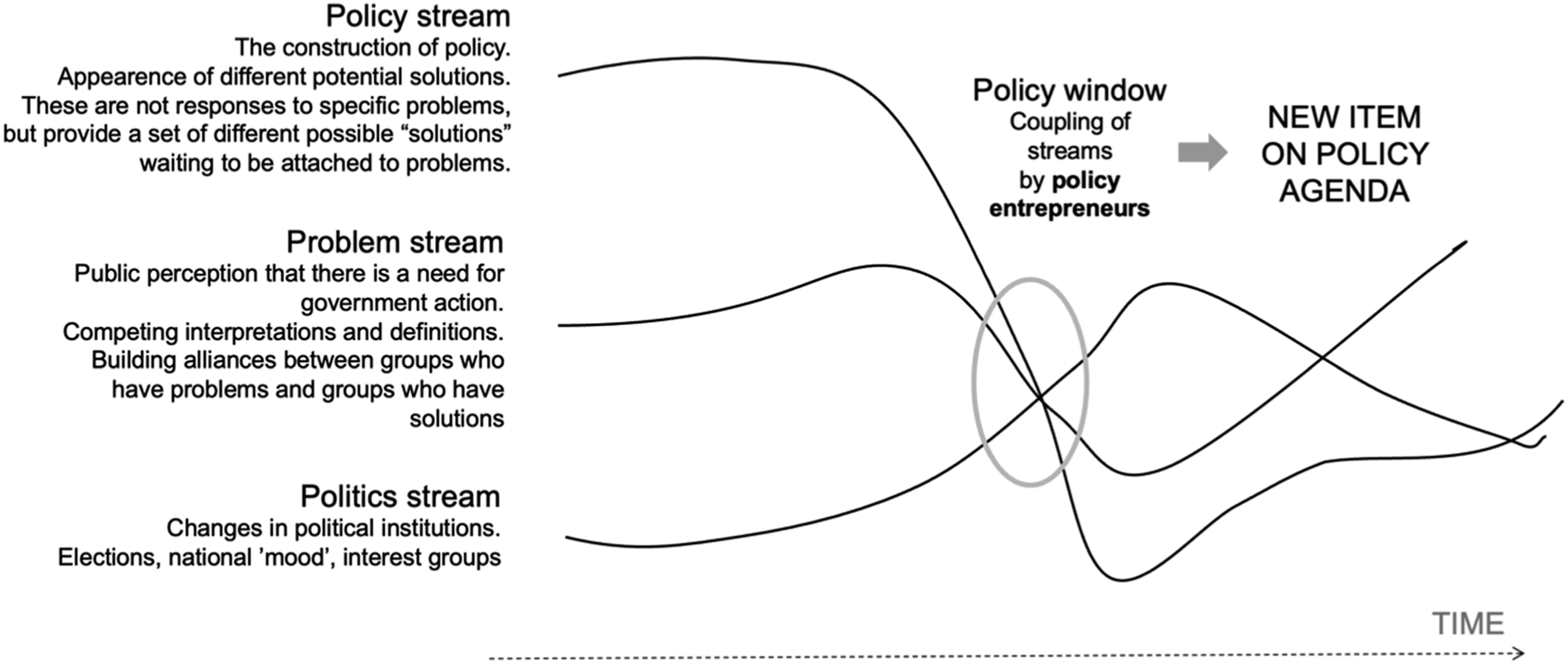
The first stream of problem formulation is about public perception that there is a need for government action. Media plays a central role in the problem stream, as may unexpected events, but clearly it is the case that different actors try to impose interpretations of events that suit their interests. Problem definition takes place through language, symbols, knowledge production and, as argued by Stone (1989: 282), “image making, where the images have to do fundamentally with attributing cause, blame, and responsibility”. Causal argument (i.e. what and who the causes of a certain problem are, and who the victim is) is thus central to problem definition and brings agency to the fore, as political actors “compose stories that describe harms and difficulties, attribute them to actions of other individuals or organizations, and thereby claim the right to invoke government power to stop the harm” (Stone, 1989: 298). Moreover, problem formulation via causal stories functions as device … for building alliances between groups who have problems and groups who have solutions … Like the famous six characters in search of an author, people with pet solutions often march around looking for problems that need their solutions. Causal stories then become mechanisms for linking a desired program to a problem … (Stone, 1989: 298).
Producing narratives that shift responsibility on a causal chain stimulates alliances between groups, and at the same time, points at which groups of stakeholders should be entrusted with providing solutions.
The second stream in the MSA, the policy stream, refers to the construction of policy. This is understood as an activity that largely takes place within expert communities. Although Kingdon (2003), writing about US politics, largely saw a national context of these expert communities, it is clear that there can be an important international aspect, and policy mobility research has shown that there may be a significant inter-urban component (Peck and Theodore, 2015). Policy proposals often draw on “successful” examples from abroad, or other contexts, as basis for legitimacy. In the MSA the construction of policy is thus about providing potential solutions. Policies are constantly being formulated and developed to serve different interests. These policies are not, as such, responses to particular problems, but provide a set of different possible “solutions” waiting to be attached to problems and potentially accepted in some political configuration.
The final stream in the MSA, the political stream, refers to changes in political institutions. A novel constellation of actors, such as an incoming government, creates an openness and need of new policy that both seems bold and yet, at the same time, tried and tested. This enforces the comprehensibility of government action.
While these three streams in MSA take place in different communities, they are not independent, and it is the potential interconnection between them that signals a policy window, an opportunity for policy change. For Kingdon (1993), policy change may happen when a policy window opens, i.e. “when simultaneously a problem is recognized, a solution is available, and the political climate is positive for change” (Guldbrandsson and Fossum, 2009). Although the confluence of the three streams of the MSA may seem to have an element of randomness to it, the MSA approach recognizes the critical significance of policy entrepreneurs (Béland and Howlett, 2016). A key point of the MSA is that the perceived links between problems, solutions and political configurations are the result of extensive work by policy entrepreneurs. This work requires preparing the ground and “softening up” policy communities by recurringly floating a proposal, promoting particular problem descriptions and attempting to influence political actors (Kingdon, 2003).
In sum, the MSA can be understood to complement PM analysis by casting light onto components of policy making, including institutions and construction of problems (Lovell, 2016, 2017b). The MSA also provides inroads to understanding issues of timing. A PM perspective brings, however, greater attention to the international systems of policy development and a greater focus on local processes of implementation.
Methods and comparisons
Our approach to exploring processes of translating and actualizing BID legislation in the two countries follows broadly what Montero and Baiocchi (2021) recently called a posteriori comparison. This entails several things. First, that research into the processes of introducing BIDs in Sweden and Denmark had been conducted previously by the different authors. Bringing this research together invited novel perspectives as well as mutual checks on generalization (Nijman, 2007). Second, the research is focused on revisiting mid-range explanations. There is no assumption at the outset that the cases are embedded in an overarching independent process. Rather, we are exploring how different relations come together to produce a peak in the relevance of BID policy in the two countries to contribute to understanding policy mobility more generally (Hart, 2018; Nijman, 2007).
Our initial questions were concerned with understanding why BID policy was being proposed, and why the proposals seem to gain traction at this particular time. Consequently, there is a certain focus on national urban policy in this research, but this is set in relation to broader policy mobility as well as connections to domestic BID-like initiatives. To understand the opening of a policy window in the two countries also required going back and understanding something of the unfolding urban context and urban policies of the two welfare states. This emerged from discussion of the two cases, where proposals for BIDs were framed in ways that pointed back to earlier changes in urban policy. This broader historical contextualization of policy mobility could be understood as integral part of conjunctural research (Hart, 2018) and has been found significant particularly in the literature on policy failure (Baker and McCann, 2020; Temenos and Lauermann, 2020).
In exploring the Swedish and Danish cases somewhat different materials have been used. This mostly reflects differences in the historic processes. In the Swedish case (which has a longer history of BID-like initiatives), materials comprise more than 20 interviews with BID managers, consultants, local politicians, and urban planners, while materials from Denmark include three interviews, but more emphasis is on the analysis of published documents. Some of this research has been previously published (Kusevski et al., 2022; Richner and Olesen, 2018; Valli and Hammami, 2020). Finally, materials from press conferences, political statements and policy initiatives related to BIDs are used to understand the political configuration that make endorsing of BID policy seem feasible.
Pilots, problems, and political opportunities: Opening policy windows for BIDs in Sweden and Denmark
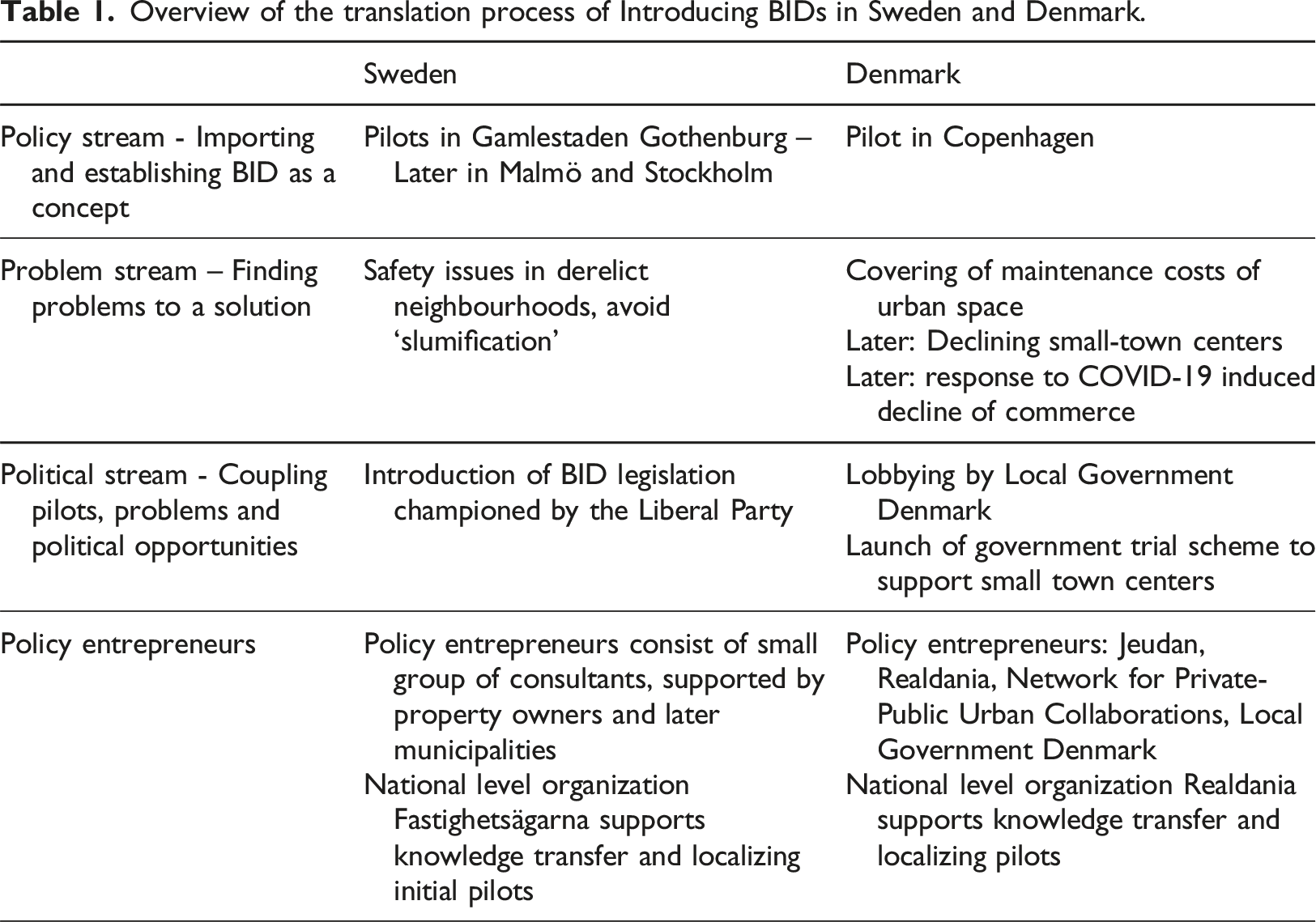
Overview of the translation process of Introducing BIDs in Sweden and Denmark.
Policy stream - Importing and establishing BID as a concept through pilots
The policy stream is about policy construction, i.e. about the proposal of a number of solutions based on “successful” examples from elsewhere as basis for legitimacy. In this section we illustrate how BIDs were first imported into the Swedish and Danish contexts, how they initially were implanted through pilot initiatives, and who the main “policy entrepreneurs” were, sustaining and pushing forward the BID-model in the policy stream. Echoing Lovell (2017b), we highlight the role of the contextual national scale by outlining how BIDs have been translated into Sweden and Denmark in quite different ways, but also that the goal in both cases has been the introduction of national BID legislation.
The process of translating BIDs into Sweden, i.e. “of getting Sweden ‘BID-ready’” (Cook and Ward, 2012), has been rather long, and concretized in several pilot BID-inspired experiences over the course of 20 years. The key policy entrepreneurs promulgating the model have been a small group of dedicated and resourceful consultants, who have provided the necessary BID-inspired “solutions” and problem formulations. A fertile ground for the emergence of the BID phenomenon can be attributed to two structural processes of transformation: the de-centralization of crime-prevention (Sahlin, 2010) and the marketization of municipal housing companies, which have in the past 20 years enlarged their role from housing providers to local development actors (Gustafsson, 2022; Parker and Madureira, 2016).
The initiative of starting the first BID-inspired partnership came in 2001 from a municipal housing company (Poseidon AB) in the Gamlestaden neighborhood in Gothenburg. 1 A survey conducted in Poseidon AB’s estates had shone high crime rates, security problems, an overrepresentation of tenants relying on social services and a derelict physical environment (Malm, 2001), and as a response the housing company took the initiative to start a partnership with other property owners (originally “Fastighetsägare i Gamlestaden” or “Property owners in Gamlestaden”). Although the name “BID” was not explicitly used, the at-the-time local manager of Poseidon AB acknowledged that the idea of starting the association was “copied from New York” and directly inspired by the BID in Bryant Park (Interview, 2018).
In the following years, BID-inspired pilots were also initiated in Stockholm and Malmö. In Malmö the initiative was taken by a municipal employee coordinator for an area-based policy in Sofielund. He developed the idea originally to cope with the presence of “slumlords”, by teaming up with an already existing property owner association. They developed the Sofielund BID in close dialogue with BID managers in Gothenburg and Stockholm, as well as with the involvement of Fastighetsägarna – the national association of real estate owners. This time BID stood for Boende, Integration och Dialog (Housing, Integration, and Dialogue). This departure from the “business” language arguably signals an awareness of the politically contentious nature of BIDs, and a willingness to depart from the international critiques of the model. 2
In 2018 the property owner association in Gamlestaden, which had changed its name to BID Gamlestaden, signed an official agreement of collaboration between the association and the municipality, the first one in the country. The BID-inspired work felt at that moment “mature enough” to constitute a model of a successful story of what BIDs could look like in Sweden (interview with BID Gamlestaden manager, 2018). 3 Some voices in the policy community formed around BIDs started to advance the idea of introducing BID-legislation in Sweden, although opinions on the matter remain split (Boverket, 2021; Holmberg, 2016).
The process of introducing BIDs in Denmark is a more recent phenomenon. Early debates were linked to a BID-like pilot project in central Copenhagen and the interest of the philanthropic organization Realdania in promoting the BID-model 4 (Richner and Olesen, 2018). The project in question involved the conversion of the pier Kvæsthusmolen in central Copenhagen in 2011-2016 into a high-quality urban space intended for sports and cultural events, and included an underground car park (Realdania, 2016). In addition, the nearby square Sankt Annæ Plads was upgraded. The redevelopment project was carried out as a public private partnership consisting of Realdania’s subsidiary company Kvæsthusselskabet A/S, the property company Jeudan and the Royal Danish Playhouse, which is part of the Ministry of Culture. Today, the area is managed by the BID-like construction Ofelia Plads. 5 In this project, the BID-model has primarily been seen as a model for covering the maintenance costs of urban space. Here, like in Sweden, the BID in Bryant Park in New York has been mentioned as inspiration (Realdania, 2014).
The idea of forming a BID came originally from Jeudan, who presented the BID concept to Realdania as a model for how the subsequent maintenance costs of the two urban spaces could be covered. Subsequently, Realdania became a strong proponent for introducing BIDs in Denmark and the organization has published several reports on the potentials of introducing BIDs in Denmark (Realdania, 2014, 2015), as well as being the initiator of a Danish conference on BIDs in 2015. Realdania’s promotion of the BID model sparked the interest of several municipalities. In 2017 the Network for Private-Public Urban Collaborations was established, thereby formalizing a community of policy entrepreneurs interested in paving the way for BIDs in Denmark. The network existed until the end of 2019 and has engaged in the typical translation activities such as organization of conferences and publication of policy reports (Realdania; Local Goverment Denmark and Danish Transport; Construction and Housing Authority, 2019, Realdania; Local Goverment Denmark and Danish Transport; Construction and Housing Authority, 2020). 6 As part of this work, Local Government Denmark has become a strong advocate for introducing BID-legislation.
One of the challenges for the network has been to prove that BIDs actually “work”. In its final report, the network concludes that there is a strong potential for introducing BIDs and other forms of PPPs in Denmark, whilst at the same time acknowledging that “there are no scientific studies on the effect of these urban collaborations” (Realdania; Local Goverment Denmark and Danish Transport; Construction and Housing Authority, 2020: 14). Nevertheless, it is argued that “the viability and continued dissemination of the model can reasonably be taken as evidence of that it is working and is creating value” (ibid.). This assumption can be questioned, given the fact that the meaning of the BID-model is rather thin, as it has been translated into different contexts quite differently (Peyroux et al., 2012a).
Problem stream - Finding problems to a solution
The problem stream unfolds through language, image-making, knowledge production, and it is about creating connections between possible problem formulations and chosen solutions. Credibly attaching imported solutions to local problem formulations is arguably one of the most critical challenges of PM, as explained by Stein et al. (2017). Here, we analyze how the policy entrepreneurs in Sweden and Denmark have coupled the BID-model to local problems in the problem stream (Kingdon, 2003). In our analysis, especially if contextualized within other international studies on BIDs (cf. Hoyt, 2008; Kudla, 2022), it becomes apparent that the same BID label is used as a fix to a variety of localized problems. The problem-solution causal relation is in this way turned on its head: fitting imported solutions to local contexts becomes the main goal of PM, rather than developing site-specific solutions to local problems. This raises questions about the necessity of such a policy in the first place.
In Sweden reports and webpages have consistently highlighted that the aim of introducing a BID is to make areas more “safe, liveable and attractive” (Holmberg, 2009). The formation of BIDs is sustained by two underlying arguments. The first one is that previous national- and municipal-based area development policies and projects have substantially failed in lifting the areas’ status due to a short-term model addressing individual residents rather than the physical environment. The strategy pursued by BIDs is instead to raise property values by improving the built environment and the social composition (e.g. by decreasing the concentration of social contracts, see Valli and Hammami 2020).
The second argument, more or less explicitly formulated in the documents, is that the gentrification promoted by BIDs is allegedly the only alternative to “slumification” (3 interviews with BID managers, 2018, 2020, 2020). Such “false choice urbanism”, as described by Slater (2014), justifies reinvestment and local economic growth as a desirable ends-in-itself by shifting the gentrification question from a political dimension (circulation of capital in an uneven land market) to a moral dimension of “prosperity vs blight”, “attractiveness vs stigma”. This problem formulation frames social issues as localized rather than as wider societal issues of housing segregation, structural inequality, and shrinking public resources. The problem description therefore justifies and legitimizes local solutions (Holmberg, 2009, 2012, 2016).
Especially the issue of safety is emphasized in public discourse. As we saw, the establishment of BID pilots begin with preliminary investigations entrusted to safety consultancy companies. Investigations and problem inventories are claimed to provide the conditions for developing appropriate strategies and plans as well as carrying out follow-up evaluations. As one of the key BID consultants stated: the most important role of the initial survey report is “to produce and make public the balanced image of the district that all concerned parties can agree upon” (Holmberg, 2009: 27). In this way, a survey plays an important role in “finding the problem picture that everyone can agree upon” (Holmberg, 2009: 28).
Arguably, security is predominantly a legitimation strategy, a unifying value that is difficult to question. Security, however, also might serve as a smokescreen for more controversial BID motivations and goals, namely, raising property values. In fact, gentrification is a relatively known and criticized issue in Sweden (or at least it is an issue that divides opinions). Raising property values and the removal of lower-income residents have therefore not been used as primary arguments in the legitimation narrative of BIDs. Linking BIDs with security and livability is, in other words, a safer and a unifying problem formulation that everybody, including public opinion and not only property owners, can agree upon.
Whilst the first BID pilot project in Denmark mainly was linked to the issue of covering maintenance costs of a new public space, the BID-model has in later iterations of the translation processes predominantly been linked to the economic challenges of the retail sector and the declining vibrancy of small-town centers. Retail planning has traditionally been regulated strictly in Denmark with a ban on out-of-town shopping centers and supermarkets since 1997. However, since 2011 this regulation has continuously been relaxed, most substantially in 2017, which has put small town shopping environments under considerable economic pressure (Olesen and Carter, 2018). In the problem stream, BIDs have been presented as a model for increasing town centers’ competitiveness against new threats derived from deregulation and internet shopping.
This problem framing has been central for the translation activities in the Network for Private-Public Urban Collaborations. The challenge for the network has, however, been to identify and justify the problem(s) that the BID-model would be able to solve in the Danish context. The problem for the network, has been that the BID model is too similar to existing governance models for business collaboration. The BID-model resembles the Danish tradition of downtown businesses organizing in associations of businesses (handelstandsforeninger or cityforeninger), which traditionally have managed tasks that normally would lie in the BID model, such as putting up Christmas decorations. According to the network, there is, however, one main difference: the BID levy (Realdania; Local Goverment Denmark and Danish Transport; Construction and Housing Authority, 2020). Whilst a membership of the association of businesses is voluntary, the BID levy is not. In this way, the BID model has been presented as a solution to the classic “free-rider problem” often discussed in the BID literature (Hoyt and Gopal-Agge, 2007).
Political stream - The slippery task of coupling pilots, problems and political configurations
Here, we draw attention to what Kingdon (2003) has called the process of opening “policy windows”. We illustrate how policy entrepreneurs have managed to get the introduction of BID legislations on to the national agenda in the political stream, and how this process of “softening up” the policy community in turn is linked to the translation process of setting up pilot projects and constructing appropriate problem framings, but also the national political climate at a certain time (Kingdon, 2003).
The political endorsement of the idea of local collaboration for security in Sweden can be traced back to the liberal-right government of 1991-1994. This was then not considered an interesting option on the national level in the following social democratic governments (1994-2006), although collaborations between the police, local politicians and real estate investors have been key in urban restructuring at the city level (Despotović and Thörn, 2016). In recent years, however, BID managers and policy entrepreneurs have actively worked on establishing tighter connections to national politics, for instance through several meetings with the former Minister for Justice Morgan Johansson 7 of the Social Democratic Party and more recently with the former housing minister Märta Stenevi from the Green Party. 8 It was only with recent shifts in the political landscape, which forced a collaboration between the liberal-center parties and the social democratic party, that the lobbying for local collaboration for security was taken up anew. Arguably, the uneasy alliance of these different parties, since then disbanded, entailed a need for clear signaling of policies, to demonstrate to different voters’ groups a clear message of political initiative. The Liberal party in particular endorsed the idea of BIDs. In fact, some key policy entrepreneurs of BIDs are linked with the Liberal party, and BIDs have become a main point in the Liberals proposals program for vulnerable areas development (Liberalerna, 2020). In the budget proposal for 2021 the government, based on an agreement between the governing parties, the Center Party and the Liberals commissioned the National Board of Housing, Building and Planning to “review any obstacles to using the Business Improvement District Investigation (BID) method in Sweden based on international models” (Swedish Government, 2020).
In this work of pushing for BID legislation, it is interesting to note how policy entrepreneurs and politicians yet again seem to return to the well-known international BID examples, rather than drawing on the contextualized lessons learned from the domestic BID pilot projects and the problems they are envisioned to solve in the Swedish context. The Swedish BID pilot projects only seem to provide the necessary political legitimacy of establishing the relevance of the BID-model in the Swedish context, whilst international examples primarily are used to highlight the merits of the (generic) BID-model (See Boverket, 2021).
In Denmark, Local Government Denmark has recently become the most ardent promoter of introducing BID legislation. In August 2020, Local Government Denmark published its proposal for Restarting the Trading Towns after the first lockdown of Denmark due to the COVID-19 pandemic (Local Goverment Denmark, 2020). In the proposal, Local Government Denmark stressed the urgency of introducing a national BID legislation to restart the economy of town centers. Earlier in 2020, the social-democratic government elected in 2019 had created a partnership with the task of outlining recommendations for strengthening the vibrancy of small-town centers. The partnership, which consisted of a range of different public, private and philanthropic actors, published its first report in May 2021 (Partnership for vibrant town centres, 2021). In the beginning of 2022, the Danish Government announced a trial scheme, in which 10 municipalities would be set free of existing legislation to test measures, such as but not exclusively BIDs, that would promote more vibrant and active town centers in smaller Danish towns (4000-20,000 inhabitants) (Danish Housing and Planning Agency, 2022). Whilst this trial scheme can be understood as a response to Local Government Denmark’s lobbying for BID-legislation, it must also be understood as part of the social-democratic government’s ambitions of promoting decentralized urban governance.
In the Danish case, it is interesting to note how the understandings of what a BID is, and which problems BIDs are intended to solve have evolved quite substantially from the first pilot project in Copenhagen. The policy entrepreneurs seem to be on a continuous search to find the appropriate problems and geographies, in which the introduction of BIDs would find support. Local Government Denmark’s interest in the BID-model should in this context be understood as part of a decentralization agenda, in which municipalities are eager to be set free from national planning legislation to strengthen their competitiveness. In this way, the BID model fits perfectly into a political climate, which has become more neoliberal in recent decades, and in which planning legislation increasingly is perceived as “a barrier for growth” (Olesen and Carter, 2018). In this context, the BID model represents a neoliberal and political legitimate solution to problems derived from increased internet shopping and earlier rounds of deregulation. In other words, the BID model represents “a neoliberal fix to a neoliberal problem” (Richner and Olesen, 2018: 160).
Discussion
One finding from our comparison is that context shapes translation signficantly, to the point that the content of policy comes across as quite malleable and thin. A comparative approach has been useful in that it serves to deflate and relativize policy concepts like BIDs. A BID in central Copenhagen to support redesign of public space is something quite different from a BID in a derelict but central residential area in Malmö – and both are again significantly different from Bryant Park in New York from which both cases are claimed to be inspired. This malleability can also be observed in relation with other international cases, where BIDs are used as tools spanning from creative placemaking (Schaller et al., 2023), to security and social control (Marquardt and Füller, 2012; Peyroux, 2008), influencing housing developments (Kudla, 2021), or improving high streets and urban freight (Brettmo and Browne, 2020). Nonetheless, the BID concept is not wholly devoid of meaning. Very broadly both the Danish and Swedish cases illustrate a confluence of interests for private and public actors in introducing BIDs which hinges on increasing property values and legitimizing urban governance based on private-public partnership. To this end different problems are put in focus, but the actors’ proposed solutions are the same.
Looking at the Swedish and Danish cases together allows us to formulate some learning points regarding policy mobility and translation processes. First, in agreement with previous research in policy mobility, the accounts from Sweden and Denmark have illustrated the significance of internationally packaged policy solutions disseminated through networks of consultants (Lippert and Sleiman, 2012; Peyroux et al., 2012a). This packaging of solutions from attractive “elsewhere” has provided an important resource for local actors. In the Swedish and Danish cases, the BID concept has been taken up locally by different constellations of actors - public, private and philanthropic, who have conducted extensive work of domesticating BIDs while strategically obscuring their own authorship. This process of local adaption has been complex and ambiguous, and it has not only influenced when a policy may be adopted, but also where and how it is implemented.
Second, our empirical studies show an intertwining of different scales of policy relevance in a process of introducing BIDs. In both cases an internationally packaged concept is first adopted locally through collaborations of local urban actors and national level organizations acting in specific urban settings, and the next step is a long process of creating local urban instantiations of policy in close cooperation with municipalities. These local instantiations are then subsequently used as proof-of-concept (Baker et al., 2020) in a push toward national level institutionalization. It is evident in the Swedish and Danish cases that this national level institutionalization has been considered of paramount importance by the policy’s proponents. This movement from international to local and to the national indicates something of an additional role for the national level than described for instance by Lovell (2017c) and Varró and Bunders (2020). In short, the national level not only shapes policy mobility but is also a critical resource in institutionalizing experimental policy moves based on local examples.
Third, in understanding the movement from the international to the local urban examples and to the national it becomes apparent how a small number of policy entrepreneurs seek to attach a given policy solution, in our case BIDs, to salient problems. We can see that there is extensive work in constructing a problem representation by BID policy entrepreneurs and in connecting the problem representation with political opportunities. The MSA approach thereby provides a focus on practices of policy mobility which lines up with but expands upon the role of middling technocrat as developed previously in PM research (Baker et al., 2020; Peck and Theodore, 2010; Roy, 2012).
Fourth, the comparison between Sweden and Denmark with respect to implementation of BIDs also strongly suggests that local examples exert an important influence in setting the policy in relation to a particular conception of a societal problem which can be substantially different as in the case of BIDs in Sweden and Denmark. Failures to establish a good connection with discursive problem formulations is highlighted in the literature on policy mobility failures (Michel and Stein, 2015; Stein et al., 2017) and seems to play an important role in the Danish process, where BIDs are suggested by proponents to remedy several different problems but without a salient Danish exemplar.
Finally, the extensive work of policy entrepreneurs in domesticating a policy, attaching it to a problem, highlighting its success and seeking political opportunity helps to explain something of the temporalities of policy mobility (Lovell, 2017a, 2017c; Wood, 2015). While the knowledge transfer described by Cook and Ward (2012) in making Sweden BID-ready is clearly an important component, it is also in itself insufficient as the process of introducing BIDs to Sweden is still going on more than a decade later.
Conclusion
The comparative study about the introduction of BIDs in Sweden and Denmark was, on one hand, trying to understand how the same policy – BID, was adopted as an appropriate solution to very different sets of problems. However, we also sought to understand how a policy that was previously considered unthinkable and written off as too neoliberal for the Nordic context, has now evolved into a political legitimate policy concept (Cook and Ward, 2012). If the international BID model was substantially unchanged, what were the local contextual changes that made its present introduction feasible? And where, when, and by whom was the translation work made? To unpack and trace back the role of “context” in policy mobility, we have relied on the MSA to provide a framework for understanding and explored aspects of problem representations on both local and national scales as well as political opportunities for policy change.
The main findings point to the complexity and to the intertwining of different scales of policy relevance in processes of international policy mobility. We showed that local pilots play a key role in translating packaged policy concepts but also serve as 'proof of concept' for further institutionalization. The way these pilots are discursively situated in relation to 'problems' is therefore of central importance for further implementation. It is the relentless work of policy entrepreneurs that connect local pilots (and discursive problems) with national level actors, and political opportunities.
Finally, exploring the particular ways in which the BID concept has been translated and made politically salient in the two cases illustrates the degree of variability and unpredictability of neoliberalization processes. The process of translating and actualizing BID policy in Sweden and Denmark is contingent and influenced by aspects of both local and national urban policy context. An implication of this study is to suggest a greater focus on local pilots not only as instances of an international policy but as critical junctures in determining when and how policies are implemented. The differences between how BIDs are translated into Sweden and Denmark, respectively, do not only come down to national, path-dependent differences, which could be read and explained as variegated forms of neoliberalization. Instead, we see in both contexts how networks of consultants and policy entrepreneurs seek to exploit the national political shifts we might associate with neoliberalization, and link solutions with problems accordingly. In this respect, neoliberalization seems to be a process which is just as much shaped by the local and national context, as the result of imported globalized ideas.
Footnotes
Declaration of conflicting interests
The author(s) declared no potential conflicts of interest with respect to the research, authorship, and/or publication of this article.
Funding
The author(s) received no financial support for the research, authorship, and/or publication of this article.
