




Abstract
This paper provides new conceptual and empirical insights into the role city-regions play as part of a geopolitical strategy deployed by the nation state to enact its own interests, in conversation with local considerations. Emphasis falls on the performative roles of economic models and spatial-economic imaginaries in consolidating and legitimising region-building efforts and the strategies and tactics employed by advocates to gain credibility and traction for their chosen imaginaries. We focus on the Sheffield City Region and Doncaster within it (South Yorkshire, England) drawing on 56 in-depth interviews with local policymakers, civic institutions and private sector stakeholders conducted between 2015 and 2018. In doing so, we identify three overlapping phases in the building of the Sheffield City Region: a period of initial case-making to build momentum behind the Sheffield City Region imaginary; a second of concerted challenge from alternative imaginaries; and a third where the Sheffield City Region was co-constituted alongside the dominant alternative One Yorkshire imaginary. Our work suggests that the city-region imaginary has gained traction and sustained momentum as national interests have closed down local resistance to the Sheffield City Region. This has momentarily locked local authorities into a preferred model of city-regional devolution but, in playing its hand, central government has exposed city-region building as a precarious fix where alternative imaginaries simply constitute a ‘deferred problem’ for central government going forward.
Introduction
In the UK, city-regions have emerged as the preferred scalar fix in a local state framework aimed at bolstering the economic productivity and competitiveness of underperforming provincial cities while sustaining the economic fortunes of strategically dominant places such as London (Deas, 2014; Etherington and Jones, 2009: 248). Underpinning this framework is the belief that unlocking latent potential for subnational economic growth is dependent on the performance of larger and larger urban agglomerations supported through the targeting of public and private sector resources and investment towards already dynamic local economies (Haughton et al., 2014, 2016). However, rather than seeing the current city-centric perspective in spatial policymaking as part of a process of ‘hollowing out’ of the nation state, we follow Jonas and Moisio (2018) in seeing it as a geopolitical strategy actively deployed by the nation state to serve its own interests, in conversation with local considerations. In doing so, our contribution is to bring Jonas and Moisio’s framework into dialogue with recent work on the performative role of economic models and spatial-economic imaginaries in consolidating and legitimising region-building efforts (Haughton et al., 2016; Hincks et al., 2017). Through this perspective, we emphasise how specific imaginaries gain credibility and traction through the claim-making of actors that involves justifying, lobbying and bolstering support for a dominant vision while attempting to close down or limit the influence of alternatives (Haughton et al., 2013).
This focus offers scope for examining empirically the extent to which spatial-economic imaginaries open up discussions of alternative spatial futures, especially where disruptive possibilities are pitted against the city-regional imaginary and its associated policy architecture that has been defined and shaped through the interests of the nation state. Using a nested case study approach, our empirical lens falls on the Sheffield City Region (SCR) and the town of Doncaster – located in the SCR – as a means of providing a situated account of local responses to new city-regional policy and institutional innovations introduced in England from 2010. The specific emphasis on Doncaster within the SCR is deliberate for two reasons. First, it allows for an appreciation of a marginalised partner perspective in English devolution debates typically dominated by ‘big city’ narratives (Beel et al., 2016; Harrison, 2006). Second, the SCR is located in the historic county of Yorkshire, which has seen the emergence of a counter-devolution movement towards a ‘One Yorkshire’ vision of which Doncaster has been a vocal advocate. As the story in this paper unfolds, so it will become clear how Doncaster and the SCR diverge in their views on devolution, visions of the future and ambitions to challenge or sustain the currently dominant city-regional fix. This is against the context of a turbulent period of national-local relations where Brexit is shaping local strategies of region-building and intensifying already fractured local opinions over devolution and established territorial arrangements. 1
Conceptualising city-region-building: Geopolitical processes, performed imaginaries and the search for legitimacy
The starting point for our framework is to recognise city-region-building as part of a geopolitical strategy deployed by the nation state in response to territorial-political dilemmas within and beyond its national borders (Jonas and Moisio, 2018: 366). Following Jonas and Moisio (2018: 358), three principles underpin the framework. The first is to recognise the territorialising processes that connect city-regionalism with the political, cultural and economic visions of the nation state. The second is in unravelling the material arrangements and architectures that underpin the alignment of national and city-regional interests. The third involves considering the political and economic actors – alongside their capacity to act – who formulate and enact political strategies and experiments through which national and city-regional interests conjoin.
From our perspective, understanding the alignment of national and city-regional interests involves treating city-regionalism ‘as a contested product of discourses (talk), territorial relationships (territory) and technologies (both material and of power)’ (Addie and Keil, 2015: 409) involving a ‘ … diverse set of territorial-political processes through which national state interests are orchestrated’ (Jonas and Moisio, 2018: 366). As new modes of governance and political engagement are made and re-made around city-regions, these inevitably attract powers away from the nation state, but only insofar as the strategic and selective provision of social and physical infrastructure to city-regions forms part of the state’s management of its own self-interests (Jonas, 2013: 288–289).
In the UK, it was around 2004 that political appetite for city-regional governance intensified, especially in England, under a Labour-led government (see Harrison, 2012). From 2010, further innovations in subnational governance and policy were introduced under Conservative-led governments in part as a response to the question of Scottish devolution and later independence that helped support calls for further decentralisation to English cities (Jonas and Moisio, 2018: 359). These later interventions at the city-regional scale included the formation of private sector-led Local Enterprise Partnerships (LEPs) designed to bolster economic growth and City Deals aimed at facilitating local involvement in financial planning, regeneration, transport and labour market interventions (HM Government, 2011). More recently, a suite of Combined Authorities (ten by April 2020) – with provision for ‘metro mayors’ – have been introduced alongside a series of asymmetric devolution deals that ‘pool local government resources and responsibilities and assume from central government a range of delegated transport, economic development and regeneration functions’ (Deas, 2014: 2286).
Underpinning the appetite for city-regions in England has been the (questionable) intellectual argument that as functional economic geographies, city-regions represent an ideal scale for drawing-down the benefits of agglomeration in an effort to spatially rebalance internal economic productivity while improving the competitiveness of cities in relation to their international counterparts (HM Treasury, 2006: 1). Focusing on questions of internal (re-)distribution, Harrison (2014: 2318) notes how the English economy has long been characterised by persistent and deepening gaps in growth rates between regions, reflected in the overheating of London and the south-east and the underperformance of the economies of the north of England. With populations in England’s major urban centres also increasing during the latter half of the 20th-century (Harrison, 2014), pressure on land, housing, transport, environmental resources and social infrastructure has intensified, raising questions over the redistributive potential of agglomeration (Haughton et al., 2014). At the same time, previous attempts to devolve resources and responsibilities to subnational institutions in England 2 – as part of ongoing efforts to ‘modernise’ local government, tackle electoral apathy and address concerns over the weakening of local democratic accountability and transparency (Newman, 2014) – stalled, leaving England highly centralised, especially compared with Scotland and Wales.
Against this backdrop, in 2014 the then Chancellor George Osborne launched the ‘Northern Powerhouse’, an ill-defined spatial construct 3 but one mooted to be about improving productivity across northern England through urban agglomeration and improved connectivity around the economies of major city-regions (Hincks et al., 2017). In the UK, city-regions contribute 26% of the UK’s economic output and 20% of its trade and exports, but continue to lag behind international counterparts in productivity terms (Core Cities, 2018). As a pan-northern ‘coalition’ of city-regions, the Northern Powerhouse was earmarked to drive the international competiveness of the north in areas encompassing advanced manufacturing, energy, health innovation and digital 4 but only insofar that this did not compromise London’s competitiveness as a global city within the international circulation of capital (Haughton et al., 2016). Identifying something of an opportunity to reposition the UK’s second-tier city-regions in a post-Brexit landscape, the Core Cities Group – a lobby consisting of Bristol, Birmingham, Leeds, Newcastle, Liverpool, Manchester, Nottingham and Sheffield – (self-)defined the core city-regions as ‘global hubs with unrealised potential’ (Core Cities, 2018: 9). In doing so, they present a vision for 2030 where the core city-regions are trusted with greater freedoms and control; have seen investment in infrastructure – including High Speed 2 5 – extended (see also HM Government, 2017); are tackling long-standing skills-gaps; and are benefiting from increased levels of international investment (Core Cities, 2018). While clearly aspirational, it is notable how the lobby of the Core Cities Group is working to draw down, rather than bypass, state infrastructural and fiscal capacities in an effort to reposition city-regions (inter-)nationally after Brexit.
Together these processes and tactics around deepening the city-regional agenda in England have created a complex and uneven landscape of (partially) decentralised powers and resources in which the nation state has employed strategies of spatial and temporal selectiveness as to where and when it engages in city-region ‘deal-making’. In a speech delivered at the launch of the second wave of city-deals in 2012, the former Financial Secretary to the Treasury, Greg Clark, pointed to the need to unlock growth in the right places – read cities – beyond what he called the ‘abstract’, national level 6 (see HM Government, 2011). For some the current emphasis on deal-making is a positive innovation, promoting growth that is locally sensitive and potentially transformative (Centre for Cities, 2013). For others, the asymmetric and experimental nature of English city-regional deal-making is problematic in deepening territorial inequalities and pitting places against one another (Haughton et al., 2014, 2016; O’Brien and Pike, 2019). That devolution deals were promoted during a period of austerity has also been met with pointed criticism for exposing ‘chosen’ localities to increased financial risk at a time of fiscal retrenchment (Lowndes and Gardner, 2016) and for deepening the neoliberal tendencies of the state towards a ‘dramatic redistribution of wealth and income in favour of the rich’ (Callinicos, 2012: 67). Set against these competing viewpoints, what is clear is that city-region deal-making in England represents a radical shift in central–local relations where nationally ratified deals have ensured city-regional actors continue to operate within established ‘rules of the game’ where city-regions and their policy architectures constitute the ‘only game in town’ (Beel et al., 2016).
Against this context, we recognise that the territorialising processes and material arrangements that help align national and city-regional interests (Jonas and Moisio, 2018: 358) are conditioned by – if not reducible to – the ‘ … overall constraints imposed by the discipline of a neoliberal policy environment’ where ‘contestations about radically different futures’ often linger below the surface (Addie and Keil, 2015: 409). That the ‘neoliberal policy environment’ exists alongside other state and social formations ensures contextualised hybrids of ‘actually existing neoliberalism’ that counter ‘pure’ neoliberal ideologies in which natural markets are assumed to exist ‘out there’ and operate through ‘immutable laws no matter where they are unleashed’ (Peck et al., 2009: 49). For Karl Polanyi (1944), economies were always embedded in society, not constituted as some external arena separate from societal rules and institutional arrangements (Block and Somers, 2014). Consequently, for Polanyi, pure markets or states never existed, for both markets and states are constituted through cultural, social, institutional and political relations and situated as dynamic and variegated hybrids of multiple modes of coordination, resources, power and interventions involving competition, exchange, redistribution and reciprocity (Haughton et al., 2016: 357).
For Haughton et al. (2016), the currently pervasive agglomeration-centrism of city-region policy in the UK has been underpinned by political and policy actors producing and consuming de-contextualised readings of economic theory based on abstract laws. The effect has been to smooth away the complexity of actually existing economies ‘not least given the evidence that economic growth rates are higher in many of the smaller cities of the UK and elsewhere in Europe’ (Haughton et al., 2016: 356). In situated economies, abstract laws are deposed as actors engage in the realpolitik acts needed to balance modes of competition, growth, cooperation and redistribution (Jones and MacLeod, 2004). For Haughton et al. (2016), the exuberance with which the principles of agglomeration have been consumed within policy circles in the UK and elsewhere is testament to the performative work of economic models (Callon, 1998) – alongside professional economists and think tanks – in legitimising certain forms of knowledge while circumventing others (Christophers, 2014; Mackenzie, 2006). How economic devices are defined shapes interpretations of how economies and markets work: competing conceptions of both can be mobilised selectively to legitimise discrete forms of statecraft and material interventions that serve specific interests at the expense of others (Haughton et al., 2016; Newman, 2014; Peck et al., 2009).
While acknowledging that city-regions are neither normative ideational constructs nor a set of predictable practices (Addie and Keil, 2015: 409), we are mindful here of the performative roles played by economic and spatial imaginaries in influencing public and political opinion ‘about how future economic growth can best be nurtured and its benefits distributed’ (Haughton et al., 2016: 358). Here spatial and economic imaginaries constitute selective readings of highly complex realities – incorporating certain semiotic and extra-semiotic characteristics at the expense of others – that allow individual actors or groups to make sense of the world around them (Jessop, 2012). This selectivity helps to define the shared logic underpinning an imaginary and provides anchor points around which buy-in to a particular worldview is mobilised. The imprecision and flexibility of spatial imaginaries enables policymakers to construct and lobby for particular readings of a situation (Hincks et al., 2017: 645) that leads to a distribution of features, functions and meanings that define what is ‘appropriate’ and ‘possible’ in any given context (see Jones and Jessop, 2010).
The effect is to create a market for ideas in which particular ways of seeing the world (e.g. pro-agglomeration or pro-inclusive growth) are supported or challenged by actors working towards or against a common agenda, and in doing so mobilising particular ‘devices’ (e.g. economic models, policy documents, maps) to support their own viewpoints (Muniesa et al., 2007). Research has shown that for a particular imaginary to gain traction and potentially assume hegemonic status – however temporary or fleeting that might be (Jessop, 2012) – it needs a clear and convincing logic; to resonate at multiple sites and scales; and to outcompete existing and newly articulated imaginaries (Hincks et al., 2017). The consequence of this search for legitimacy is a process of creation and destruction in which contemporary territorial configurations are contingent on complex legacies of past region-building efforts that cannot be ignored or ‘considered obsolete and dismissed as merely of historical interest’ (Hincks et al., 2017: 646). The implication here is that the consideration of what is ‘appropriate’ or ‘possible’ is historically as well as socially and culturally contingent (Jones and Jessop, 2010).
To understand why certain imaginaries gain traction over others, we draw here on insights from work on ‘soft spaces’ of planning – the informal, ‘in-between’ spaces of governance that exist beyond defined territorial boundaries, such as those of local government (Haughton et al., 2010). As Haughton et al. (2013) demonstrate, certain soft spaces, superficially at least, allow for the involvement of a diversity of actors in the governance of spatial development and for particular demands to be voiced openly. Yet it has been shown that involvement in these spaces is typically contingent on actor interests aligning with the dominant (market) orientation of hegemonic spatial development agendas at the expense of alternatives (Haughton et al., 2013). Against this background then, while different ‘city-regions’ will be constituted by multiple and competing visions (Hincks et al., 2017), in each context a dominant imaginary will have worked to close down or limit the scope for other possibilities to gain sufficient traction to assume hegemonic status (Haughton et al., 2013: 222). Here the extent to which alternative spatial imaginaries are able to open-up discussions of alternative spatial futures is worthy of further investigation, especially where disruptive possibilities are pitted against the established city-regional imaginary and its associated logics.
Building the Sheffield City Region
In the following section, we employ this framework in the context of the Sheffield City Region (SCR) and Doncaster within it (Figure 1(a)). We draw on 56 in-depth interviews, conducted between 2015 and 2018, with actors holding strategic roles in the SCR Combined Authority, the SCR Local Enterprise Partnership, chambers of commerce, local authorities, local businesses and local civic organisations. While the majority of interviews were conducted in Doncaster, interviewees were also recruited from the broader SCR area to provide different viewpoints on intra-city regional dynamics and relationships. In doing so, we explore how advocates promote city-regionalism on behalf of the state and how other actors mobilise to challenge the hegemony of city-regionalism. We consider the diverse logics and tactics employed by different actors to build momentum and secure legitimacy for their activities and chosen imaginary at the expense of alternatives (Hincks et al., 2017; Jonas and Moisio, 2018) over the course of three overlapping phases in building the SCR.
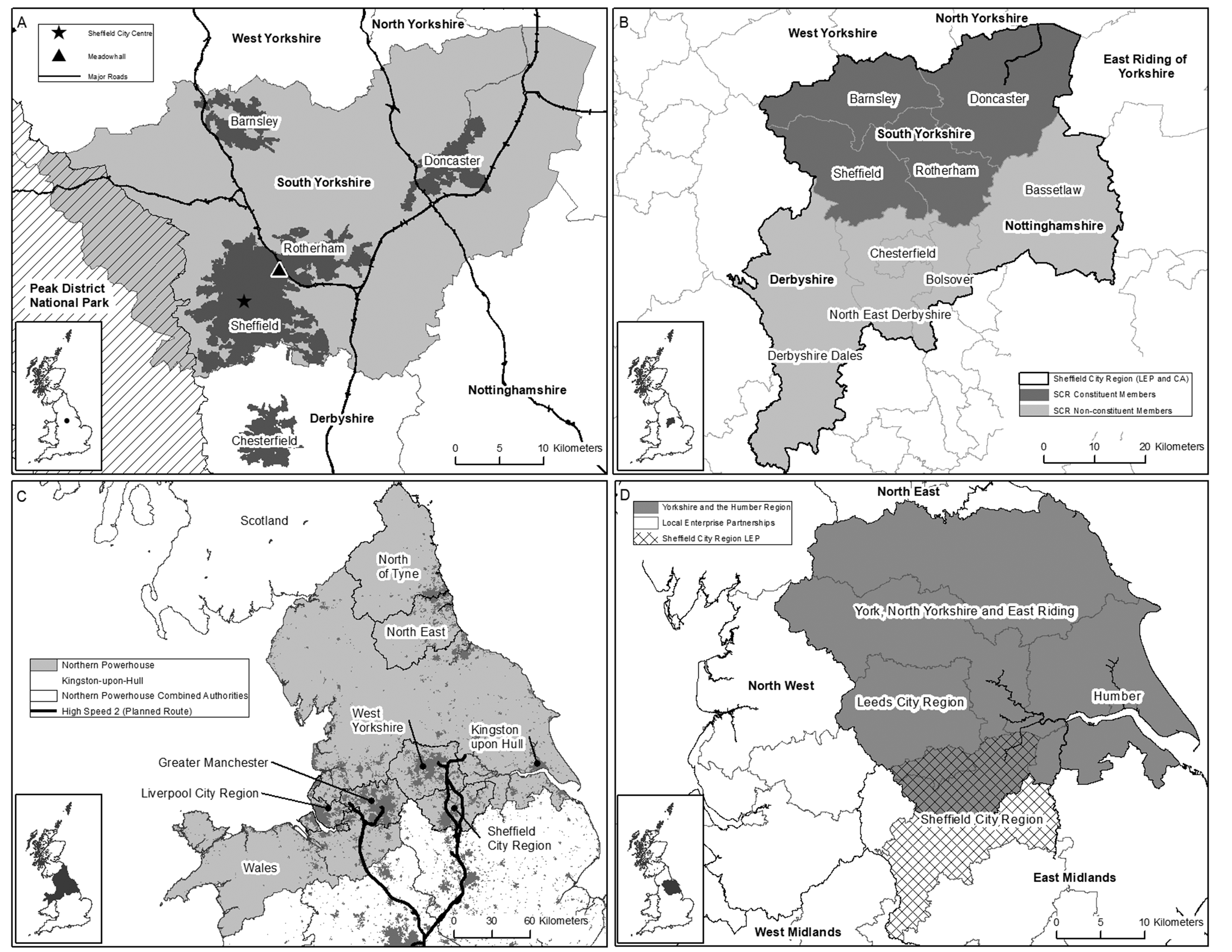
The study context (a) situating South Yorkshire; (b) the Sheffield City Region, Combined Authority and LEP; (c) the Northern Powerhouse; (d) Yorkshire and the Humber Region, LEPs and the Sheffield City Region compared.
Phase 1: Building momentum around a Sheffield City Region imaginary
The historic development of the City of Sheffield and South Yorkshire more broadly owes much to the availability of the waterpower and charcoal that came to underpin the growth of steel and coal production in the area during the 19th century. With the onset of economic restructuring and the rollout of market-orientated local economic development agendas from the late-1970s, coal and steel production went into decline across South Yorkshire. Unemployment in Sheffield rose from 4% in 1978 to 16% in 1984 (Lane et al., 2016) while pockets of unemployment hit more than 40% in parts of Doncaster (Thorleifsson, 2016). At the same time, the closure of mines, union militancy and the leadership, from within Sheffield, of two miners’ strikes in the 1980s 7 strained local labour relations and fostered deep hostilities between South Yorkshire and central government (Winkler, 2007).
As the neoliberal policies of Thatcher’s Conservative Government were rolled out nationally, Sheffield City Council – backed by South Yorkshire County Council – took a ‘radical’ approach in seeking strong local government intervention in a city that had considered itself ‘abandoned by the private sector’ (Winkler, 2007: 14). In pitting its own government-led approach against the state’s market-orientated ideology, Sheffield failed to benefit fully from major government funding for regeneration and local economic development throughout much of the 1980s. In plotting a path to economic recovery, Sheffield’s leaders subsequently accepted government terms in 1988 on the creation of a new Urban Development Corporation to help attract inward investment, especially into disadvantaged areas of the city.
By the early 1990s, South Yorkshire was drawing down European Objective Two funding and later, in 1999, became eligible for European Objective One funds (Winkler, 2007). At the same time, a raft of new area-based initiatives, rolled out by the New Labour Government, provided additional sources of funding for Sheffield and the wider city-region. Yet Doncaster continued to struggle into the 2000s as economic decline accelerated, labour market insecurity persisted and relative deprivation deepened (Thorleifsson, 2016).
It was against this backdrop that the SCR was formally established in 2004 as one of eight city-regions defined under New Labour’s Northern Way agenda, a partnership between the then three regional development agencies in the north of England that was intended to strengthen the northern economy (ODPM, 2004). However, it was not until the demise of Yorkshire Forward 8 in 2012 that the SCR assumed prominence in local political and policy debates following the election in 2010 of a new Conservative-led Coalition Government with an ‘anti-regional’ and ‘new localist’ agenda (Shaw and Tewdwr-Jones, 2017). To support the SCR, the Sheffield City Region Local Enterprise Partnership (SCRLEP) and the Sheffield City Region Combined Authority (SCRCA) were established in 2010 and 2014, respectively. The SCRLEP is based on a travel-to-work geography that maps onto nine local authorities across South Yorkshire, North Derbyshire and North Nottinghamshire. The SCRCA covers this same geography, although constituent membership is restricted to the local authorities of Sheffield, Doncaster, Rotherham and Barnsley in the metropolitan county of South Yorkshire (Figure 1(b) and (d)).
For Doncaster, there was pragmatic support initially for the SCR as a means of ‘accessing resources’ (Local Officer A) following decades of industrial decline, under-investment, high unemployment and two episodes of central government intervention between 2000–2002 and 2010–2014. 9 With the support of Doncaster, the SCR City Deal and Growth Deal were agreed in 2012 and 2014, respectively. These were followed in 2015 by the agreement of a more extensive deal led by the Combined Authority after which the SCR became the second city-region after Greater Manchester to reach a devolution agreement with central government. Approved in principle, the deal was set to give the SCRCA increased responsibility over strategic planning and transport budgets and an additional £30m a year over 30 years to invest in growth and skills (Etherington and Jones, 2018). As a condition of the deal, the SCRCA agreed to elect a metro mayor by May 2017. However, for reasons outlined below, this election took place in May 2018, much later than planned, when the former Labour politician, Dan Jarvis, was elected on a platform of mutualism and cooperative principles (Jarvis, 2018) leading to the establishment of a ‘Co-operative Advisory Panel’ and a Youth Combined Authority (SCR, 2019).
Yet, the mutualism and cooperative principles championed by the mayor and his team faced a battle to be heard over the din of the agglomeration and ‘globalising’ competitiveness logics that underpin the current spatial and economic imaginaries of the SCR (SCR, 2014a). The SCR Growth Deal makes the case – using economic projections developed by Oxford Economics – that the SCR is an area of national economic significance and a global brand, contributing ‘over £25.7bn for the UK economy’ and having the potential to ‘deliver an extra 68,000 jobs and GVA [gross value added] of over £29.7bn by 2022’ (SCR, 2014a). The principles of agglomeration and competitive growth are writ large in the SCR as it seeks to ‘maximise the agglomeration benefits of high-speed rail’ (SCR, 2014b: 48) and transition the economic base ‘dominated by coal and steel to a competitive 21st century, high value manufacturing, knowledge and service-led, economy’ (SCR, 2014b: 20). At the same time that the ‘Devo Sheffield’ deal was agreed, George Osborne, the then Chancellor, was in the early stages of mobilising support for the Northern Powerhouse project by virtue of promoting, among other initiatives, HS2 (Department for Transport et al., 2015) (Figure 1(c)). The SCR’s ambition – and the City of Sheffield’s especially – to ensure HS2 passed through the city(-region) resulted in a convenient alignment of central government interests with those of the city(-region). In reflecting on the ‘Devo Sheffield’ agreement, George Osborne commented that: Manchester is not a one-off – far from it. In becoming the second great northern city to sign up to managing its own affairs with this ambitious agreement, Sheffield City Region is playing a vital part in helping to build the Northern Powerhouse (HM Treasury et al., 2015, emphasis added). our role is to do our part to release that growth and that potential so that Sheffield City Region can prosper … so we’re not seeing ourselves … as just Doncaster, but … as part of a city region … (Local Officer B).
Here a number of interviewees reflected on the alignment of central and local interests in establishing the SCR imaginary as ‘a convenient one’ (Local Officer C) but one that was not without its challenges. Austerity featured prominently here with interviewee testimony pointing to a considerable degree of early discontent with central governments’ ‘radical devolution’ approach (HM Treasury et al., 2015). Questions were raised over what new powers and resources were actually gained through devolution given that between 2010 and 2014, the SCR budget was cut by £1109m set against the £900m that was being offered in 2015 through a 30-year devolution agreement (Etherington and Jones, 2018: 66–67).
For these reasons, there was a prevailing sense that through cuts to welfare and local authority funding, the government had ‘taken with one hand and given with the other’ (Local Officer C). This was seen to have placed considerable pressures on the most disadvantaged in the city-region as Devo Sheffield required the city-region to ‘do much more with much less’ (Local Officer D). Yet for some, the deal was considered the only practical way of clawing back resources following a decade of austerity. As one interviewee commented, with austerity, we’ve got less capital, we’ve got less reserves, we’ve got less revenue, we’ve got more pressures out there around, particularly social care … it [Devo Sheffield] doesn’t plug the gap [in lost funding] but we need to get the deal done to get back whatever we can [from central government] (Local Officer D). we’ve learnt that doing the deal is not the end of the journey. It’s a passport to the next phase of negotiation (SCRCA Officer A).
Phase 2: Challenging the Sheffield City Region imaginary
The fate of the SCR began to change in late-2015 with the onset of a major dispute over the location of the SCR HS2 station. The original plan proposed by central government was to locate the station at the Meadowhall retail complex (three miles north-east of Sheffield city centre, close to the Sheffield-Rotherham border). However, the City of Sheffield strongly opposed the plan and lobbied instead to locate the station in the centre of Sheffield (Figure 1(a)), much to the indignation of Doncaster and Barnsley (Burn, 2017). Then, in December 2016, there was a legal challenge launched over the SCRCA’s geographical makeup when the High Court ruled as unlawful a consultation to include Chesterfield local authority in the SCRCA (Clarke, 2017). These events publicly exposed antagonistic relations, the perseverance of local politics and diverging interests within the SCR, leading to a delay in the signing of the devolution deal and the election of a SCR mayor in May 2017.
In contrast to Greater Manchester, which has long-projected an image of cohesive civic relations and collaborative working (Haughton et al., 2016), SCR relations were described as lacking the ‘maturity and trust to overcome parochialism’ (Civic Organisation A) leading to publicly aired clashes between the council leaders of South Yorkshire, with one interviewee bemoaning how: four people’s disagreement can have such a serious [potential] disadvantage to hundreds of thousands of other people in terms of lost finances (SCRCA Officer B).
The tension between national interests that centre on pressing ahead with the SCR deal and local interests – viewed here mainly through the lens of Doncaster – are palpable. A notable point of discontent was around the assumptions of the ‘big city’ model that were seen to underpin the economic logic of the SCR. Where the SCR Growth Deal estimated a productivity dividend of city-regional devolution of over £29.7bn by 2022, the City of Sheffield economic strategy notes how ‘Sheffield is not fulfilling its economic potential. A prosperity gap of £1.6billion persists in comparison to the national average’ (SCC, 2019: 3). For some interviewees, being tied to a ‘core city’ that was deemed, by its own admission, to not be ‘punching its weight’ (Chamber of Commerce A) was seen to bring little benefit to Doncaster. 10
While initially supporting the model of city-region devolution in the hope of securing increased autonomy and funding, from late-2015 local actors in Doncaster began resisting the SCR over concerns that Doncaster’s interests risked being marginalised. Discontent with the SCR model intensified with the perception that English city-regional devolution had stagnated as the UK government ‘took their eye off the ball’ to prepare for and engage in Brexit negotiations with the EU (Civic Organisation C). In an effort to bolster support for the city-deal, a consortium of anchor institutions from across the city-region authored A Better Future Together (SCR Vision, 2017), a vision of the SCR premised on a high-skills and knowledge-intensive economy. However, the ‘prospectus’ has been described elsewhere as ‘the epitome of a consensual depoliticized call-to-arms vision for the Sheffiffield City Region’ that normalises neoliberalism by branding elected representation as ‘partisanship that must be cast aside for the common good’; smoothing away questions of distribution, inequality and poverty; and limiting resident involvement in the visioning process (Etherington and Jones, 2018: 61). Set within this strained context, Doncaster began to explore an alternative devolution arrangement in direct opposition to the dominant core-city model.
In September 2017, Doncaster, with Barnsley, announced its intention to pursue Yorkshire-wide devolution alongside 16 other local authorities while Sheffield and Rotherham stood firm on securing the SCR deal. The formers’ intent was bolstered by the election of Dan Jarvis as SCR Mayor, who was sympathetic to Yorkshire-wide devolution. Beyond the SCR, support for a Yorkshire deal also intensified following an initial failed bid to establish the West Yorkshire Combined Authority, 11 as well as the exclusion of Hull and the East Riding from the government’s priority areas for devolution (Figure 1(c)).
In order to strengthen their claim for Yorkshire devolution (Figure 1(d)), a period of case-making was embarked on by Doncaster and others to build momentum and develop a clear and convincing logic for a Yorkshire deal. First, in an attempt to add democratic legitimacy to their proposal, Doncaster and Barnsley conducted, in December 2017, ‘community polls’ to gauge public opinion on the prospect of devolution at the scale of the SCR or Yorkshire. Of those that voted in Doncaster (20.1% of the electorate), 85.0% were in favour of Yorkshire-wide devolution, delivering what advocates insisted was a ‘local mandate’ to challenge government and lobby for a Yorkshire deal. Then, in the summer of 2018, Steer Economic Development – an arm of Steer Consulting – was commissioned jointly by the 18 supporting local authorities to produce an economic assessment of the ‘One Yorkshire’ geography. The consultants argued that: Yorkshire (and Humber) is a coherent and interconnected economic area [that] includes several functional economic areas, which have strong interconnections, and similar/shared issues, priorities and networks (Steer Economic Development, 2018: i). There are so many opportunities on the East Coast [of Yorkshire]. We have a growing green energy offer, the Humber [and the port of Hull] has received multi-million pound investments … and there are opportunities for us [Doncaster] to access global markets, especially China, through the East Coast ports (Local Officer E). by the very nature of what you call them [city-regions]; they’re going to exclude big chunks of the community, the public (Civic Organisation C).
Phase 3: Co-constituting the Sheffield City Region imaginary
In February 2019, the Yorkshire-wide devolution proposal was rejected by central government because it did not meet the required ‘devolution criteria’ (Parsons, 2019). That no details were given as to the ‘criteria’ the proposal failed to meet underpinned the dismay that a number of interviewees conveyed about central government’s approach to deal-making as one ‘lacking prescription’ and riddled with ‘mixed messages’ (Local Officer A) – only articulated through their staunch commitment to the SCR. In an attempt to break the impasse, in March 2019 Doncaster came together with the other SCRCA members to agree the SCR deal, which was signed-off by central government in May 2019.
The negative perceptions of the deal-making process reflect a devolution agenda being rolled out across the UK, and especially England, where secret deals are brokered between political and business elites ‘from a menu of policies approved by HM Treasury’ (Tomaney, 2016: 550). Here interviewees reflected on how central government had consistently closed down discussions of alternatives to the SCR on ‘‘rational’ economic grounds’ and through the employment of technocratic, ‘computer says no’ (Local Officer G) approaches to decision-making. To this end, one interviewee presented the devolution process – formalised through the SCR deal – as something akin to a technocratic accountancy exercise that was: not [about] genuine choice; it’s just a case of us administering the money we’re given, within the [strict] rules we’re set (Local Officer G). … a Yorkshire mayor who will probably be a Labour appointed mayor … So I imagine they’re [Conservative-led central government] not in a rush to support One Yorkshire (Chamber of Commerce A). as a local authority you are over a barrel to put it crudely … you can’t say we’re not playing because then you’re not going to get anything (Local Officer A).
Across interviewee testimonies, the SCR and One Yorkshire imaginaries were both presented as ‘sensible’ models of devolution, premised on variably complementary (e.g. the benefits of city-regional/regional agglomeration) and competing (e.g. identity and belonging versus economic functionality) logics. These logics have themselves evolved alongside temporal framings of the SCR imaginary as ‘one for the moment’ and One Yorkshire as ‘one for tomorrow’, as one interviewee notes: There is almost like an interim approach of supporting the Sheffield City Region devolution model with a view to moving towards the One Yorkshire agenda further down the line (Local Officer G).
Yet both imaginaries are presented as ‘coherent’ economic geographies where devolution is projected to deliver significant economic dividends. That the veracity of such claims is highly contested is reflected in the counterclaims made by the detractors of the SCR and Yorkshire-wide models. For SCR advocates, the One Yorkshire imaginary serves as a distraction from what is the ‘real’ focus of local policymaking, the SCR. By contrast, One Yorkshire supporters branded opposition to Yorkshire-wide devolution as fear of the unknown, where competition and collaboration is externalised beyond the ‘insular’ boundaries of the city-region. Yet there remained, on both sides of the debate, a sense that pragmatism and compromise – though not necessarily consensus – could be achieved by recognising the virtues of both imaginaries. A number of interviewees pointed to the limits of a ‘binary conversation between doing a South Yorkshire deal or doing a Yorkshire deal’ (SCRCA Officer A) or the understanding of there being ‘nothing exclusive to say you’ve joined one club and therefore you can’t join other clubs’ (SCRCA Officer A). Across the spectrum, there are a variety of credibility claims being made about the benefits and drawbacks of the two imaginaries, underpinned by the work of powerful actors with vested interests in maintaining or reframing how and where to devolve powers and allocate resources (Hincks et al., 2017). Here, in a moment of apparent compromise, Whitehall stated on the signing of the SCR deal, that they ‘welcomed the commitment’ to city-regional devolution and agreed to the terms set out by the SCR that allowed constituent local authorities to break from the city-region in 2022 should they choose to continue pursuing Yorkshire-wide devolution. Given the current national political commitment to the SCR and the long-standing support for Yorkshire-wide devolution, it is clear that both imaginaries live on in competing and complementary ways.
Discussion and conclusion
This paper provides new conceptual and empirical insights into the role city-regions play as part of a geopolitical strategy deployed by the nation state in response to ongoing territorial-political dilemmas (Jonas and Moisio, 2018: 366). Here we aligned Jonas and Moisio’s framework with work on the performative role of economic models and spatial-economic imaginaries in consolidating and legitimising region-building efforts (Haughton et al., 2016; Hincks et al., 2017). We emphasised how specific imaginaries gain credibility and traction through the claim-making of actors that involves justifying, lobbying and bolstering support for a dominant vision while working to limit the influence of alternatives (Haughton et al., 2013). Against this conceptual context, three overlapping phases were identified in the building of the SCR: a period of initial case-making to build momentum behind the imaginary; a second of concerted challenge from alternative imaginaries; and a third where the SCR and One Yorkshire imaginary can be seen to be co-constituted.
Our work demonstrated how, in this first phase, the SCR imaginary was ‘consolidated’ through various deals that aligned the interests of the SCR with those of the state in a context where city-regions have come to constitute the ‘only game in town’ (Beel et al., 2016). To build momentum the SCR was held up as a ‘functional economic geography’ that offered the potential to capture international capital and exploit a ‘global brand’. The projection of certainty and robustness in focusing on functional geographies was effective in building credibility around the SCR concept and the underpinning economic logics rooted in agglomeration and competitive (inter-)national growth. One of the interesting ‘contradictions’ here was how the SCR deal was contingent on the SCRCA agreeing to elect a mayor who stood on a platform of mutualism and cooperative principles when the logic of competitiveness is seen typically to win out. From our point of view, this apparent contradiction is reflective of the nature of situated economies (Polanyi, 1944) where spatial imaginaries are constituted through and positioned within dynamic and variegated hybrids of multiple modes of coordination of resources, power and interventions involving competition, exchange, redistribution and reciprocity (Haughton et al., 2016: 357).
Yet that many interviewees saw the alignment of central and local interests as only convenient ‘for the moment’ was testament to early discontent with central governments’ ‘radical devolution’ approach, especially in the face of ongoing austerity measures. This discontent fuelled momentum behind the dominant alternative spatial imaginary based on devolution for the historic county of Yorkshire that challenged the SCR in the minds of early advocates and bolstered the claims of detractors that the SCR was not ‘fit for purpose’. The location of the SCR HS2 station was the focus of a major dispute that exposed antagonistic relations and the perseverance of local politics and diverging interests within the SCR. The lack of ‘strategic maturity’ among actors engaged in the process was bemoaned while the government’s labelling of the City of Sheffield as ‘core’ was seen as problematic in marking out other places in the SCR as ‘peripheral’ or ‘other’. Here the challenge to the SCR came from detractors of the ‘big city’ model while the Brexit vote and the so-called ‘left-behind’ were used to evidence claims that identity and attachment were being undermined by the SCR to the detriment of Yorkshire as a whole. Through the use of ‘community polls’ and independent consultants, supporters of One Yorkshire aimed to build momentum behind the alternative imaginary and secure legitimacy ‘from below’. Interestingly, this claim-making also co-opted economic logics – agglomeration, (international) competitiveness and the assumption of ‘bigger being better’ – typically employed by city-regional advocates, illustrating how spatial imaginaries can be co-constituted through their spatial as well as discursive orientations.
It was against this context of the co-constitution of the two imaginaries that central government interests were seen to close down discussions of alternatives to the SCR through the mobilisation of technocratic mechanisms of governance. What emerged were clear indications of central governments’ initial unwillingness to entertain alternatives to the SCR, alongside credibility building by local actors that ‘forced’ the adoption of pragmatic engagement with the SCR. Yet interestingly, this did not manifest in meaningful consensus, with both the SCR and One Yorkshire imaginaries held up in different coalitions as ‘sensible’ models of devolution. That the Yorkshire-wide model remained stubbornly lodged in debates about devolution in South Yorkshire is testament to the durability of spatial imaginaries, especially those rooted in identity, memory and historic attachment (Hincks et al., 2017).
While the signing of the SCR deal and the government’s agreement to allow local authorities to break away from the city-region in 2022 to continue pursuing Yorkshire devolution could suggest a moment of misalignment between local and national interests, we see this in a different way. Rather than constituting a climb-down by central government, we see the tactic as further illustration of city-regionalism being mobilised by the state to deliver national interests. First, the time between the signing of the deal and 2022 will provide a bedding-in period for devolution in the SCR – that includes delivering on the commitments and funding allocations that were agreed. Second, there has been to date no firm public commitment from central government that Yorkshire-wide devolution will ever be on the negotiating table. Third, the terms of the agreement reached between pro-South Yorkshire and pro-Yorkshire-wide councils mean that Doncaster and Barnsley will only be permitted to split from the SCR if Sheffield and Rotherham are not set to lose like-for-like funding (Torr, 2019).
In short, the city-regional imaginary has gained traction locally with national interests closing down pockets of local resistance to the SCR, establishing – at least in the short-term – a (singular) dominant order in space (Haughton et al., 2013: 222). Local resistance initially delayed the signing of the SCR deal but by displacing Yorkshire-wide devolution the government has, momentarily at least, locked South Yorkshire into its preferred model of devolution. In conceptual terms, while alternative spatial imaginaries, such as One Yorkshire, exist and often open up discussions of different spatial futures, this does not necessarily guarantee scope for ‘radical’ alternatives to emerge (Haughton et al., 2013). What we found is that even as history and identity featured prominently in the making of the One Yorkshire imaginary, claims to the credibility of this alternative imaginary were underpinned by a predominant focus on neoliberal economic case-making that did not disrupt but rather co-opted logics of agglomeration, competitiveness and market-led agendas.
Yet central government also exposed city-region building as a precarious fix, one characterised by others as reflecting a ‘spatially-articulated metagovernance failure, where different and multiple spatial frameworks appear to be operating at the same time and evoking a crisis of crisis-management’ (Etherington and Jones, 2016: 387). In our view, it is this crisis of crisis-management, expressed through the continued co-constitution of the SCR and Yorkshire-wide imaginaries, that provides advocates of One Yorkshire with scope to lobby and build credibility around the currently marginalised imaginary going forward. The building of a future One Yorkshire imaginary, capable of destabilising the SCR, could be bolstered ‘by virtue of the simplification of the conditions of action, [that] so often lead to the “revenge” of problems that get ignored, marginalized, displaced, or deferred’ (Etherington and Jones, 2016: 385; Jessop, 2011: 117). Here One Yorkshire may well have failed to dislodge the currently dominant city-regional imaginary, but our work suggests that One Yorkshire is simply a ‘deferred problem’ for central government. In short, watch this space.
Footnotes
Acknowledgments
The authors would like to thank the Economic and Social Research Council for funding the research on which this paper draws. Thank you also to the interview participants who gave up their time to take part in the study. The paper also benefited from wider discussions with Graham Haughton and Iain Deas and feedback from participants at the 2019 Regional Studies Association Annual Conference where the paper was initially presented. Finally, thank you to Ryan Powell for his comments on an earlier draft of this paper and to the three anonymous referees and the Editor for their helpful comments in improving the article. The usual disclaimers apply.
Declaration of conflicting interests
The author(s) declared no potential conflicts of interest with respect to the research, authorship, and/or publication of this article.
Funding
The author(s) disclosed receipt of the following financial support for the research, authorship, and/or publication of this article: This work was supported by the Economic and Social Research Council (ES/S010122/1).
