




Abstract
This article grapples with issues of urban wastewater sanitation in one of Mexico's most polluted river basins, through an analysis of a river restoration project centered on the construction of municipal wastewater treatment plants (WWTPs). Taking an ethnographic approach to the study of infrastructure, the main argument is that, beyond their possible contribution to reducing pollutant loads, in this context municipal WWTPs can best be understood through the concept of “duplication,” whereby the infrastructure works serve as a vehicle for the transfer of public resources to the private sector, through construction and operation contracts. At the same time, these plants also fulfill objectives related to their symbolic value, in this case as indicators of a commitment to resolving one of the state's main socio-environmental conflicts, while studiously avoiding its root causes, including industrial pollution sources. From an urban political ecology perspective, the paper also examines how investment in wastewater treatment infrastructure in the basin continues to reinforce social and environmental inequities, particularly for peri-urban communities along the Santiago River.
On 7 December 2018, the Governor of the state of Jalisco in Western Mexico, Enrique Alfaro Ramírez (2018–2024), held an event to announce the Comprehensive Sanitation Strategy for the Santiago River. In company of members of his cabinet and local activists, he led the presentation of an agenda consisting of 54 actions drawn up without consulting riverside communities or experts. Municipal wastewater treatment plants (WWTPs) were at the center of this strategy. “This doesn’t require band-aids. It doesn’t require actions taken for the photo-op,” the Governor insisted when announcing the investment in sanitation works, “because what has happened in the past is that, because these are infrastructure projects that politicians can’t flaunt […] these are collector sewers [and] treatment plants, they are pipes, they aren’t visible, they don’t generate applause, but it is the only thing that will allow us to make [river cleanup] viable in the future.” Later rechristened “Revive the Santiago River,” municipal WWTPs and collector sewers continue to be a focus for investments as part of the state strategy, which has evolved little since its announcement, despite the deployment of “governance” actions, sectoral consultations purportedly seeking to spark dialog on the river strategy.
Increasing surface water pollution is a global challenge and one that has received less attention than issues of quantity and access to water (Damania et al., 2019; Unesco, 2012). Faced with this persistent challenge, classified in a 2019 World Bank (WB) report as a “wicked problem” with no optimal solution, a clear Kuznets curve is not observed, where pollution rates are reduced with the level of development or economic growth (Damania et al., 2019: 94). 1 Further, WWTPs do not always fulfill their goal of improving downstream conditions. While globally it is estimated that 80% of wastewater lacks treatment, 2 the authors of the WB report question the effectiveness of investments in municipal WWTPs, although without clearly elucidating the management problems that lead to the meager results achieved (Damania et al., 2019: 102–103).
In Jalisco, the Governor's announcement was made at an event staged above the Salto de Juanacatlán waterfall on the Santiago River, and ended ironically, where moments after contending that “what will no longer exist is simulation,” Alfaro and other officials clambered onto a dredge to remove thick swaths of water hyacinth from the green surface of the river, in a symbolic commencement of river cleanup. The manual removal of water hyacinth does little to address the causes of the explosive growth of this aquatic plant, a sign of the eutrophication of the river's waters. Similarly, the commitment to the construction of WWTPs follows a familiar path in evading the most entrenched causes of the pollution of the Santiago River and the socio-ecological conflict which the resulting health problems have triggered (McCulligh, 2020).
With several years of evolution, the main investments made in the framework of the state government's strategy have been to construct, rehabilitate and/or expand the capacity of 13 WWTPs and to expand sewer trunk mains in the Guadalajara Metropolitan Area (GMA) and several smaller towns, with a reported total investment of US$64.4 million. 3 These actions aimed to increase wastewater treatment capacity in Jalisco by 797 liters per second (L/s) (in addition to the 7764 L/s treated as of December 2018), thus increasing the proportion receiving treatment from 64% to 71% (Gobierno de Jalisco, 2020). Compared with the other actions taken, with numerous road works, refurbishing of health clinics and rural development programs now repackaged as part of this strategy, the investment in sewerage and WWTPs represents more than double the total amount committed for all other actions. 4
What are the aims and objectives of the Santiago River strategy focused on the construction of WWTPs? What is the prospect of these plants contributing to the announced goals of river restoration and the mitigation of the health impacts of exposure to pollution of riverside communities? Answering these questions requires not only analyzing the infrastructure works projected and executed within the framework of this strategy, but also examining more broadly the most persistent challenges in the country around the handling of municipal sewage, with a starting point in ethnographic approaches to infrastructure to examine the state of wastewater treatment in Jalisco (Appel et al., 2018; Larkin, 2013; Star, 1999), as well as the way in which municipal WWTPs have served as the preferred (non-)response to socio-environmental conflicts around water pollution in Mexico. In this sense, my main argument is that, beyond their possible contribution to reducing pollutant loads, in this context municipal WWTPs can best be understood through the concept of the “duplication” of infrastructure (Larkin, 2013, 2018; Mbembe, 2001; Mbembe and Roitman, 1995), whereby the infrastructure works serve as a vehicle for the transfer of public resources to the private sector, through construction and operation contracts, while also fulfilling objectives related to their “sign value” (Larkin, 2018: 176), in this case as indicators of a commitment to resolving one of the state's main socio-environmental conflicts, while studiously avoiding its root causes.
The state government's strategy prioritizes a region covering 18 municipalities of the Upper Santiago River Basin, including those of Mexico's third-largest urban area, the GMA. This region is home to 5.8 million people as well as the majority of Jalisco's manufacturing facilities (INEGI, 2020). From an urban political ecology (UPE) perspective, I understand this basin as a hydrosocial territory (Boelens et al., 2016) where urbanization processes have impacts beyond the city, and urban–rural interactions and peri-urban dynamics are key to understanding social and environmental inequities (Hommes et al., 2019). In this vein, a strategy centered on wastewater treatment infrastructure in the basin reinforces inequities for peri-urban communities along the Santiago River to the south of the GMA, by failing to address all pollution sources that degrade environmental health. This analysis requires looking beyond investments in sewers and treatment plants to apprehend infrastructure as a process and follow the WWTPs from the planning stages and past the ribbon-cutting to examine the life and death of these plants, understanding infrastructure as a field of power and contestation as well as an “articulation of materialities with institutional actors, legal regimes, policies, and knowledge practices that is constantly in formation across space and time” (Appel et al., 2018: 12).
While communities have been denouncing the pollution of the Santiago River—one of the most contaminated in the country—since at least 2001, the response of federal and state authorities has invariably revolved around the construction of more WWTPs, principally in the GMA (McCulligh, 2020). In 2008, for example, the National Human Rights Commission (CNDH) dismissed a complaint filed by the organization Un Salto de Vida (Leap of Life) regarding the condition of the Santiago River, alleging that projected treatment plants would provide an “exhaustive” solution to the problem (cited in Torres, 2008). The implausibility of this assertion will be made clear throughout this article. It is not a unique incident in this sense either. Where an important recommendation from the CNDH did materialize in 2017 was for human rights violations due to the pollution of the Atoyac and Xochiac rivers in the states of Tlaxcala and Puebla in Central Mexico (CNDH, 2017). Here, communities and non-governmental organizations have denounced that sanitation plans from 2005 and 2011 entailed the “disbursement of millions of pesos destined to the construction of false WWTPs that in the vast majority of cases functioned only partially and temporarily” (Coordinadora por un Atoyac con Vida, 2017: 13). Given this trend, these collectives warn of the possibility that the CNDH recommendation could lead to “embarking on a simulation of remediation that, if repeated for the third time, will cost many more lives” (Coordinadora por un Atoyac con Vida, 2017). In the conflict over pollution of the Atoyac River, where industrial pollution is a major source of river degradation as in the Santiago River Basin, community actors identify strategies focused on municipal WWTPs as a simulation of restoration.
Field work for this research was undertaken between 2017 and 2021. The objective was to determine the actors or practices that contribute to or impede wastewater sanitation and contemplated cases of plants run by municipalities, by the State Water Commission (CEA) or through private contracts, looking at both abandoned as well as operational plants in cities of different sizes. My research strategy based on institutional ethnography (Devault, 2006; Smith, 2005) took WWTPs as a starting point to interrogate the institutional practices that have led to poor results in urban sanitation. This paper draws from visits to 22 WWTPs in 15 municipalities of Jalisco (see Map 1), from 32 semi-structured interviews, mainly with the directors of municipal water services (15), operating personnel at treatment plants (9), officials from the CEA and the National Water Commission (CONAGUA) (6), and expert consultants (2), as well as from participation in various “governance” meetings within the framework of the state strategy. Institutional ethnography stresses the “organizing power” of texts in coordinating local practices and activities “extralocally,” and I sought to also examine the issue of sanitation through data garnered from requests for government records regarding the status of WWTPs, as well as policy documents and regional sanitation plans (Devault, 2006: 295).
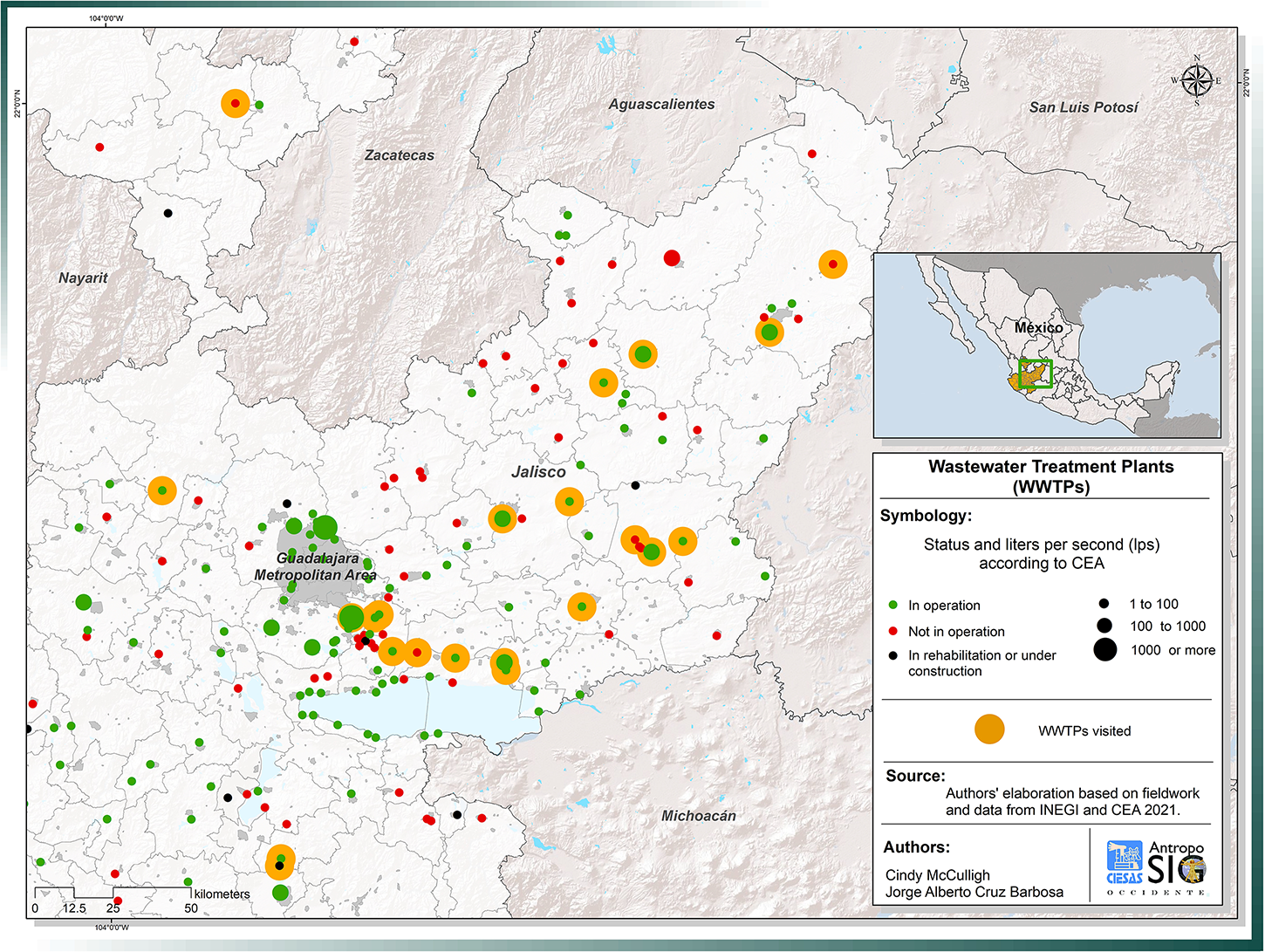
Wastewater treatment plants visited and status.
To analyze the various roles that WWTPs play in this context, this text is divided into five sections. In the first, I argue for the relevance of ethnographic approaches to infrastructure and UPE to examine issues of urban wastewater management. From there, I review the implications of the decentralization of municipal water and sanitation services in Mexico to contextualize the challenges of WWTP operation. The following sections address the three central trends that emerged through my analysis of interviews, site visits, and documentary evidence as key to poor outcomes in urban wastewater sanitation in the state: planning and execution failures; the role of private non-domestic discharges in the poor performance of public WWTPs; and, finally, the slow death of many treatment plants, or how operation and maintenance issues lead to their steady decline. The chapter closes with reflections on the winners and losers of sanitation strategies centered on the construction of municipal WWTPs, on who is accountable for their continuing failure, and on possible paths out of what seems to be a “vicious circle” for riverside communities.
WWTPs as processes of urban metabolism
Wastewater and its treatment have been the focus of scant attention from the social sciences (Casiano Flores and de Boer, 2015; Casiano Flores et al., 2017, 2019; Pacheco-Vega, 2015a). Likewise, analyses of water pollution or wastewater as part of the socio-natural metabolism of urban processes have been the focus of few studies from a UPE perspective (Karpouzoglou and Zimmer, 2016; Karpouzoglou et al., 2018). In Mexico, Casiano Flores et al. have examined the context of wastewater governance, focusing on the interaction between actors at different levels of government (Casiano Flores and de Boer, 2015; Casiano Flores et al., 2017, 2019). In a similar vein, Pacheco-Vega and Basurto (2008) investigated the institutional arrangements and the formal and informal rules that influence sanitation in the Lerma-Chapala Basin, with emphasis on the role of the basin council. Examining the influence of the private sector in a case of municipal services under concession to a Veolia subsidiary, Pacheco-Vega (2015b: 339) has also analyzed regulatory capture in the governance of wastewater in the city of Aguascalientes.
Although there are elements of common interest and conclusions shared with these analyses, the anthropological approach to infrastructure adopted here allows for an examination of more granular aspects of the day-to-day (non-)functioning of WWTPs, with an emphasis on operation and maintenance practices, while at the same time underscoring the multiple meanings that are inscribed in this infrastructure and the material and symbolic roles that it fulfills. On the other hand, I turn to UPE to question how the socio-ecological configurations of the current metabolism of urban wastewater in Jalisco generate winners and losers, reinforcing social and environmental inequities.
Approaches to infrastructure and its politics from anthropology, geography, and science and technology studies in recent decades have broadened understandings of infrastructure as a site to apprehend relations of power and inequity. At the same time, these studies highlight the necessity of conceptualizing infrastructure as more of a process than as an object and, therefore, emphasize its constant transformations, the inherent risk of abandonment or decomposition, as well as infrastructure's existence as projections of a future habitually conveyed in terms of modernization and progress (Anand, 2015; Appel et al., 2018; Barry, 2020, Larkin, 2013; Star, 1999). Appendices at the site where sewer networks rise to the surface, whether they consist of lagoon systems, concrete tanks or constructed wetlands, in their various manifestations WWTPs link urban water flows with surrounding ecosystems and bodies of water, and host a metabolic process that aims to reduce the impact of the liquid waste of homes and business through their digestion and sedimentation. Often located on urban fringes and next to waterways, WWTPs tend to invisibility whether in operation or abandoned (Star, 1999), particularly where different sources of contamination converge and their contribution to surface water quality decline may be difficult to discern. In the Mexican context, the moments of “visibility” of WWTPs tend to be during the stage of investment promotion, where they feature in regional sanitation projects.
In ethnographic studies of infrastructure, sanitation, sewerage systems and toilets have been the object of reflection. Arefin (2019a: 1058), for example, observes how the sediments of colonial history and major development projects subsist as accretions (see Anand, 2015) in Cairo's sewerage system, and examines the role of waste (in sewers and garbage) in shaping urban policy. Both Von Schnitzler (2018) and McFarlane and Silver (2016) analyze the politicization of toilets and sanitation in South Africa. Von Schnitzler takes “poo wars” and infrastructure as sites to interrogate the “transition” to post-apartheid democracy in the country. Beyond questions of capacity or corruption in the provision of services, McFarlane and Silver (2016) highlight how the politicization of human waste calls attention to racial and political-economic inequities in the urban space.
While these authors focus on conflicts around sanitation in order to analyze (urban) politics more broadly (see also Arefin, 2019b), in this text my intention is to examine the configuration of power relations that contribute to the failure of sanitation and river cleanup policies and initiatives in Mexico. Key to the explanation I wish to posit is the notion of “duplication” (Mbembe, 2001; Mbembe and Roitman, 1995; Larkin, 2013). While Mbembe and Roitman (1995: 335) observe the “physicality” of the crisis in Cameroon made palpable in abandoned projects and inscribed in urban landscapes, they maintain that this “architectural text” also reveals a “political subtext” where public contracts function as means of political exchange and “modes of appropriating public goods.” With forms of allocating state resources that respond to a logic of private appropriation, Mbembe (2001: 46, emphasis in original) asserts, “economic things were converted into social and political things,” to forge alliances and clientelist networks. Thus, infrastructure not only serves a technical purpose, but has its “doubles” both in the funds channeled to private actors and in its symbolic value as a form of “aesthetic address” (Larkin, 2018: 175) which can serve to communicate the state's commitment to modernization and development processes or, as in this case, to green and sustainable policies and projects (Larkin, 2013).
This is part of the “promise of infrastructure” which derives from the close links between notions of modernity and infrastructure as a marker of linear “stages” in teleological views of history, from theories of economic modernization (Rostow, 1960) to evolutionist and neo-evolutionist anthropological theories (Appel et al., 2018). Despite the rejection of such “stagiest” theories, Appel (2018: 46) remarks how they persist ethnographically: “People around the world talk in terms of developmental time, progress and relapse, of being behind and needing to catch up.” This is part of the symbolic attraction of infrastructure projects for governments, which project futures of progress and, in the case under study, of resolving problems of environmental degradation. The “infrastructure engineer should be understood as the creator of fictions,” affirms Barry (2020: 98), and municipal WWTPs in Jalisco are key elements of the fictitious claim to “revive” a fragmented river which receives a myriad of polluting effluents, including many of industrial origin that are discharged directly into the river or its tributaries and which will not be treated in any municipal plant.
This speaks to the strategies of the state, specifically of the government of Jalisco, in leveraging an environmental crisis. Reflecting on approaches to the state in political ecology, Robbins (2008: 213) calls attention to the state as a producer of environmental narratives, citing the role of political ecology research in “debunking” crisis narratives propagated by state agencies, often to justify budgets or gain access to international aid. On the one hand, while this particular narrative of “crisis” is not in my estimation exaggerated, given the severe degradation of the river basin, its deployment was crucial to justifying the state's incurring of debt in the context of shrinking federal investment in water and sanitation (see below). On the other hand, the second facet of duplication, or the symbolic value of infrastructure, is bolstered by the crisis narrative surrounding the Santiago River, with the solution crafted in simplified terms centered on WWTP construction (Scott, 1998).
The uneven, contested, and ambiguous nature of state power has been analyzed through the study of water and sanitation infrastructure (Harris, 2017), and this case brings to the fore the tensions in the role of the state in maintaining the conditions for social reproduction versus generating a “business-friendly” environment for capital. Ioris (2015) notes the “internally fractured and contradictory” nature of the state as an environmental actor, where the primary role of environmental laws and policies is to “systematize the access and ownership of parts of socionature that have economic or political relevance,” which includes access to water bodies as sites of disposal. These fractures are evident in a river restoration strategy that evades control of industrial effluents while centering the discourse and investment on public infrastructure.
This fictitious strategy to “revive” a river via a handful of WWTPs, therefore, does little to change the dynamics of current urban-industrial metabolism or to alter power relations. Studies from UPE, which examine the “historical-geographical process of the urbanization of nature” (Swyngedouw and Heynen, 2003: 900), provide tools to analyze how specific socio-ecological configurations serve the interests of elites to the detriment of marginalized populations (Heynen et al., 2006). Many studies based in UPE have focused on the sociotechnical infrastructure of urban water, from the sites of extraction to uneven water flows in the urban environment, the discursive construction of “crises” and socio-temporal fixes in the form of the dispossession of common resources (Delgado Ramos, 2015; Kaika, 2006; Loftus, 2006). Scant attention has been paid to the externalities of urban-industrial metabolism, however, with few studies analyzing pollution, in general, or wastewater in particular (Karpouzoglou and Zimmer, 2016; Karpouzoglou et al., 2018; Verón, 2006). Central to my analysis of the failure of sanitation and river cleanup policies and initiatives, this text seeks to highlight how investments in sanitation infrastructure reinforce power relations that favor the private sector, with winners among contractors and actors who discharge with impunity into sewerage systems or bodies of water, while the communities on the banks of the Santiago River continue to denounce the severe health impacts of living in a degraded environment.
(De)centralized wastewater management
Decentralization of water and sanitation services to municipalities in Mexico began with a presidential agreement in November 1980, leading to the handover from federal authorities to state governments and city councils of 1161 drinking water and sewerage systems (Rodríguez-Briceño, 2008). Subsequently, reforms to article 115 of the Constitution in 1983 established municipalities as the authorities responsible for the provision of these services. Various complex problems afflict many of these municipal systems, from the fact that only 68% of homes in Mexico receive water daily, 5 to low tariffs, a lack of qualified personnel, contamination of water sources and insufficient purification processes (Herrera, 2014; McCulligh et al., 2020).
Exacerbating the dearth of technical personnel is the high turnover in particular of the managers of water services who, according to a president of the National Association of Water and Sanitation Companies (ANEAS), remain in their positions for an average of just 18 months. 6 This is usually the case even with nominally autonomous utilities (organismos operadores), which have greater financial and administrative independence from municipal administrations, and which have been promoted to improve water services. As Furlong (2012) shows for the province of Ontario in Canada, however, the emphasis on alternative service delivery models at the municipal level does not guarantee they are exempt from political influence, and neither does it ensure efficient financial management or improved environmental performance. In Mexico, political influence persists in determining water tariffs, which, in most cases, require the approval of state congresses (Casiano Flores and de Boer, 2015; Casiano Flores et al., 2017; Colmex and Aneas, 2019). In 2014, electricity constituted 39.5% of the cost of goods and services for municipal water services. This cost has shot up more recently as a result of the energy sector reforms of 2013. These reforms led to the Federal Electricity Commission (CFE) recategorizing public water services in 2017, eliminating the preferential rate they enjoyed (tariff 6), and aggravating the financial problems of water service providers throughout the country (Colmex and Aneas, 2019).
With regard to sanitation works, as well as investments in infrastructure in general, the persistent centralization of water management in the National Water Commission (CONAGUA) is evident. This is manifest in the continuing dependence on federal funds for major investments, as well as the tendency to relegate municipal authorities in the planning, bidding and construction stages. For 2019, for example, investments in various drinking water and sanitation programs were 81% of federal origin—from CONAGUA—with 11% coming from the state level and 8% municipal (CONAGUA, 2021). At the same time, the level of federal investment in water and sanitation infrastructure has dropped significantly, from an average of US$1.8 billion per year between 2010 and 2016 to US$492million/year between 2017 and 2019, a reduction of 73%. Specifically, sanitation works investment fell 86%, from an annual average of US$366 million from 2010 to 2016 to only US$50.8 million/year in the 2017–2019 period (CONAGUA, 2021).
At the national level, CONAGUA reported 2642 municipal WWTPs in the country as of 2019, with a design capacity of 194.7 cubic meters per second (m3/s) and a treated flow of 141.5 m3/s, equivalent to 65.7% of the wastewater captured in sewerage systems (CONAGUA, 2019). Secondary treatment predominates, as the technology applied to 96.3% of treated wastewater, with 49% of the total being in activated sludge plants (CONAGUA, 2021). The official information available, however, does not provide elements to determine whether the flow treated in effect complies with the corresponding discharge regulations (NOM-001-SEMARNAT-1996).
A report commissioned by CONAGUA in 2013 helps fill that information gap. The report, carried out by researchers from the National Autonomous University of Mexico, analyzed the operation of WWTPs at the national level (CONAGUA, 2013). Based on site visits to 471 WWTPs, they found that only 54% of the plants with a treatment capacity of less than 100 L/s were operating, and of these only 50% were functioning adequately; for plants with capacity greater than 100 L/s, 82% were operating but only 41% were working well. Faced with a panorama of abandoned or poorly operating WWTPs, they highlighted among the causes the improper dimensioning of plants, linked to the “lack of planning in the allocation of public funds, which leads to hasty decision-making”; poor quality equipment; “faulty” construction; inappropriate siting of WWTPs (including within riverbeds); and the lack of resources to operate the plants (Ibid.). In 2013, official statistics reported that 50% of municipal wastewater was treated, however, the study leader, Juan Manuel Morgan, indicates that “we came to the conclusion that in reality […] about 30 percent of municipal wastewater nationally was being treated.” The difference versus the official number, Morgan explains, is due to the fact that CONAGUA “makes the big assumption that all infrastructure is working properly.” 7 The reality in the field is quite different.
Of the 228 WWTPs reported in Jalisco in early 2021, 77 were out of operation and 33 were either under construction or in the process of expansion and/or rehabilitation. 8 Of the 117 plants in operation, only 63 (53.8%) were reported as in compliance with discharge regulations. 9 Given the financial weakness of many municipalities, CONAGUA has had incentive programs to subsidize the operation of WWTPs, from the “Competitive Fund Program for Wastewater Treatment” in 2010 to the Wastewater Treatment Program (PROTAR) and the Wastewater Sanitation Program (PROSANEAR). However, as Sandoval-Minero (2019: 125) notes, this type of subsidy—as with other federal programs—have tended to be “regressive” given that program requirements favor municipal water service providers with greater administrative capacity and stronger finances.
In the specific case of subsidies for the operation of WWTPs, support has also waned, with CONAGUA officials indicating such subsidy programs have not received financing since 2015 and that, when funds were previously assigned, the main beneficiary in Jalisco was the CEA which oversees 20 WWTPs on the shores of Lake Chapala and in the Upper Santiago River Basin. For this reason, one director of municipal water services considers that these subsidies are, “a utopia, because they say, ‘Oh, use the CONAGUA programs.’ Then CONAGUA always says they have no money. So, what is the reality? That there is no money, there are programs on paper only.” With this brief sketch of the problems of municipal treatment plants and service providers, I will proceed to analyze what emerge as three of the major problems affecting WWTPs in Jalisco.
Planning and execution failures
One need not look far to find flaws in the planning of treatment systems in Jalisco. Clear examples are to be found in the two so-called “macro-plants” of the GMA—the largest in the state—overseen by the CEA and promoted from their inception as solutions to the pollution of the Santiago River. The first of the two plants to be built was El Ahogado, located in the sub-basin of the same name and the most polluted of the Upper Santiago. The bid was tendered in 2008 and the 20-year service provision contract was awarded to Aguas Tratadas de Guadalajara, S.A. de C.V., an association of two subsidiaries of the Japanese company Mitsui & Co. (Atlatec and Servicios de Agua Trident). During the inaugural event in March 2012, President Felipe Calderón (2006–2012) referred to the El Ahogado plant as evidence of his administration's “firm and unbreakable commitment” to the environment, while CONAGUA director José Luis Luege Tamargo stressed that its main importance lay in the fact that it “guarantees zero polluting discharges to the Santiago River” (Ferrer, 2012). The latter would have been truly a feat, given that the plant is located in one of the main industrial regions of the state, with many factories discharging directly into the same waterway as the new WWTP.
Thus, in this inaugural ceremony, the authorities did not display the reticence observed in government actors by Harvey (2018: 94), in the cases of the road projects she analyzes in Peru where comments in such ceremonies were circumscribed to the resources invested, kilometers covered and jobs created, taking care not to generate an “overidentification with specific future outcomes.” In this particular “public ritual” of inauguration (Ibid.), the promises of transformation of the river basin were abundant and clearly hyperbolic. However, in addition to the exaggeration, the promises were also based on faulty calculations.
The El Ahogado treatment plant has a design capacity of 2250 L/s and is based on a biological process with nutrient removal and biogas recovery for energy generation. The plant was commemorated in a full-color book published in June 2012, which cites the population of the El Ahogado sub-basin at that time as 820,000 inhabitants, and indicates that: “For the year 2018, the discharge of the population that inhabits this basin is calculated at 2500 L/s. From these data, the plant's capacity was fixed at 2250 L/s average flow” (Gobierno de Jalisco, 2012: 70). This calculation envisages the plant's capacity being exceeded within a few years of construction, and it is thus unsurprising that the plant has in fact operated at 100% of its capacity since 2013 (see Figure 1). This is the case even though at least 20% of the sewer collector system was yet to be completed, 10 works that were not tendered until 2019.
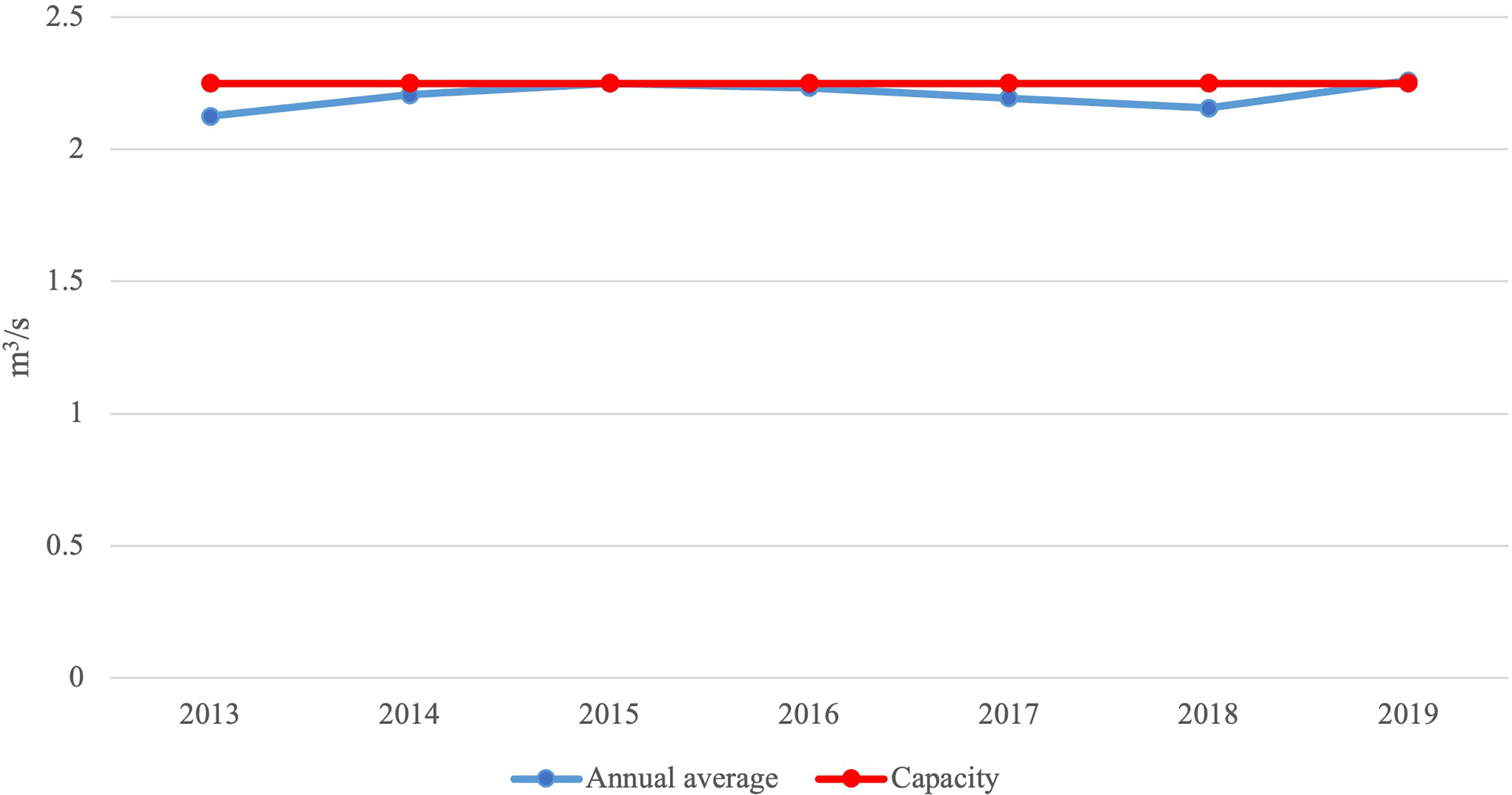
Average flow of treated wastewater at the El Ahogado WWTP, 2013–2019. 31 Source: author's elaboration based on data from CEA (INFOMEX Jalisco 07913120).
A Master Plan for Sanitation of the Upper Santiago River Basin, commissioned by CEA in 2016, alerted the need to expand this WWTP and presented a budget for the 60.9 km of missing sewer collectors (AICISA, 2016). That same year, CEA prepared a technical, legal and financial proposal outlining the expansion of the plant to 3000 L/s, an increase of 750 L/s. This background makes evident that, contrary to the views of several informants, this plant's insufficient capacity was not the result of the impossibility of anticipating the rapid population growth in the El Ahogado basin, stemming from a plethora of social housing and other real estate projects approved by municipal authorities.
Population growth has been high in recent decades in the two main municipalities of the El Ahogado sub-basin; the population of Tlajomulco de Zúñiga went from 123,619 in 2000 to 727,750 in 2020 and in El Salto it grew from 83,453 in 2000 to 232,852 inhabitants in 2020 (INEGI, 2020). Even so, an official from the Lerma-Santiago-Pacific Basin Agency of CONAGUA, who was responsible for water and sanitation infrastructure support programs, asserts in relation to the El Ahogado WWTP that “something went wrong with the dimensioning of the plant.” Even taking population growth into account, he considers that “it is also combined with not very adequate planning […] basically what we’re talking about is its capacity being exceeded during the construction period.” 11 Currently, new collector sewers contemplated in the framework of the “Revive the Santiago River” strategy will channel a further 1000 L/s of untreated sewage to the already overloaded WWTP and in August 2022 the state government launched a tender to expand the plant capacity to 3250 L/s. 12
While plant capacity has always been insufficient in the case of El Ahogado, the other metropolitan WWTP has operated at about half its capacity since its inauguration in July 2014. The Agua Prieta plant has a capacity of 8500 L/s and was promoted as the third largest treatment plant in Latin America. The build-operate-transfer (BOT) contract was granted to Renova Atlatec, an association of subsidiaries of Mitsui & Co. and a subsidiary of the Mexican firm ICA (Controladora de Operaciones de Infraestructura, SA de CV). The plant cost US$245m 13 and is based on a secondary treatment of activated sludge with anaerobic digestion of sludge and energy cogeneration from biogas (GIZ México, 2018). The unused capacity of this WWTP—and the sub-basins to the east of the GMA that continue to discharge raw sewage into the Santiago River—is explained by the history of its promotion in conjunction with a failed dam project. The Arcediano dam, canceled in 2009, was planned for construction on the Santiago River to supply “potable” water to the GMA. To avoid direct discharges upriver of the dam's curtain, it was proposed to carry 2.2 m3/s of wastewater from several sub-basins via a 10-km “interceptor tunnel” to the planned Agua Prieta WWTP. Researchers from the University of Guadalajara questioned the feasibility of this tunnel, in particular its ability to conduct stormwater in the rainy season. Despite its cancellation, the dam left its mark in the form of a still incomplete sewer system, where the proposed 3.5 m-diameter tunnel has not been tendered or built; in 2016 its cost was estimated at US$70.1m, 14 in addition to the required sewer mains (AICISA, 2016). This explains the low levels of wastewater treated at the Agua Prieta plant (see Figure 2), which has averaged 51% of plant capacity during the 2015–2020 period, trending downward in 2019 and 2020.
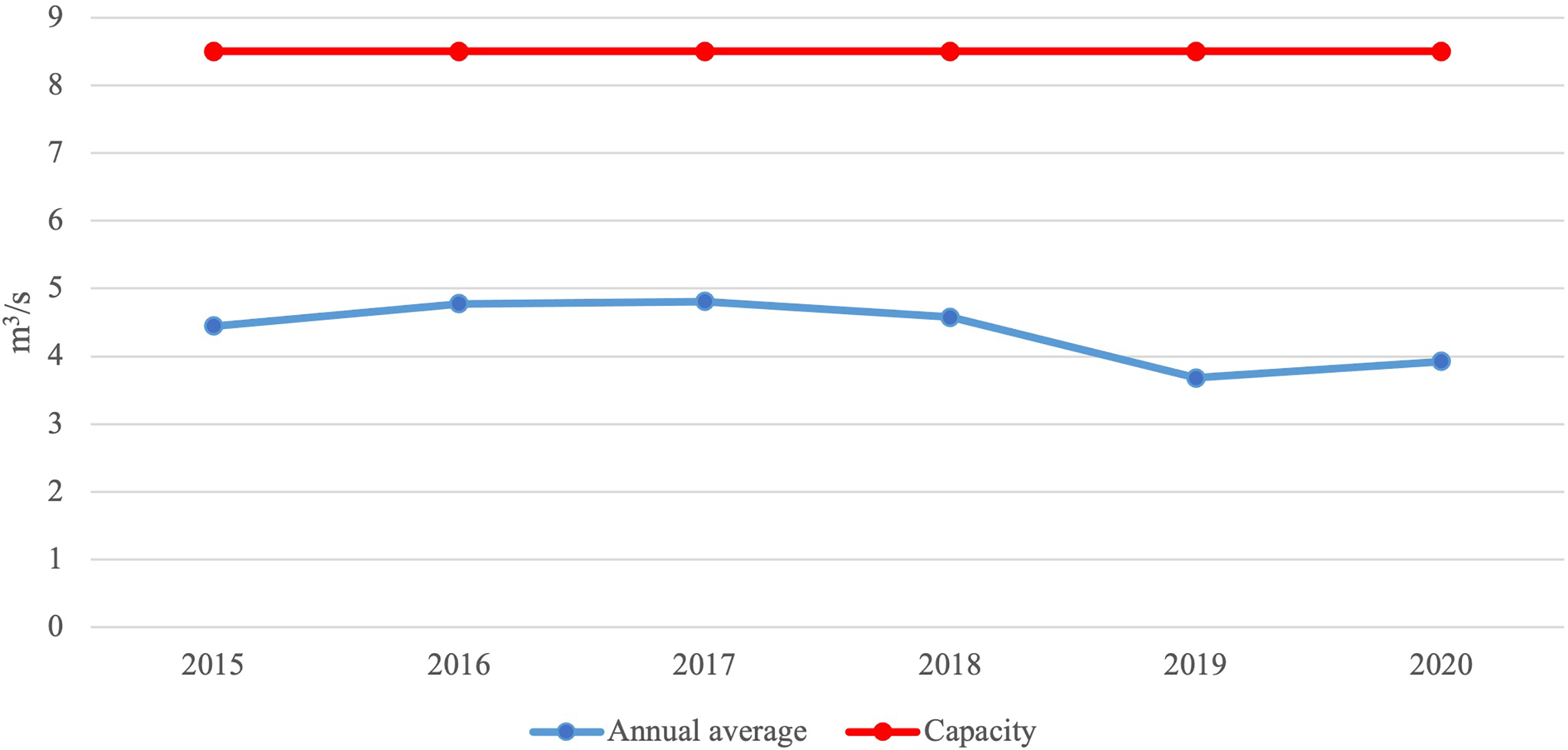
Average flow of treated wastewater at the Agua Prieta WWTP, 2015–2020. 32 Source: author's elaboration based on data from CEA (INFOMEX Jalisco 07913120) and SIAPA (2020).
While the paucity of accurate data on the country's WWTPs impedes comparisons with other plants, the operating costs of Agua Prieta are interesting to note as they differ significantly from what has been publicly reported. When Agua Prieta was inaugurated in 2014, it was stated that it would have a cost of MX$0.98/m3 “one of the lowest in the country.” 15 In fact, costs have varied from MX$4.89/m3 in 2015 to MX$6.61/m3 in 2020. 16 These costs have also not been fully assumed by the GMA's water service provider, SIAPA, which pays for only 46.3% of operating costs, the rest being covered by the state government. Given the putative advantages of the privatization of services, in this case, via a BOT contract, we see that while the contract ensures continued plant operation, it is only accomplished through a substantial “subsidy” from the state government to defray the costs.
Outside of the GMA, a further case exemplifies problems related to the marginal role of municipalities in the planning and execution of sanitation works. In 2010, the municipality of San Juan de los Lagos (pop. 72,230) refused to officially receive from CEA a new 200 L/s WWTP, built at a cost of US$2.8m. 17 With the backing of the State College of Civil Engineers, the municipal government alleged that there were structural failures and leaks in concrete tanks—attributable both to errors by the construction company Insamex and to inadequate supervision by CEA (Informador, 2010). Nonetheless, CEA conducted an official handover of the plant in absence of municipal officials in May 2010. A consultant who has supervised works subcontracted by CEA, affirms that the haste to disburse funds and the dual role of CEA in tendering and supervising infrastructure projects implies that when such failures occur, CEA “does not have any basis to complain to [the construction company], when they themselves are supposed to have been supervising the execution and development of the projects.” 18
Given these conflicts, it is not surprising that as early as 2013 CEA records indicate that the San Juan de los Lagos plant was treating only 68 L/s and that “a large part of the electromechanical equipment […] is damaged, and the plant requires rehabilitation, as it is currently not treating all raw sewage.” 19 The following year, the plant was reported as out of operation. In 2018, the mayor stated that the previous administration had abandoned the plant and initiated a legal claim against the state government. 20 Once abandoned, the plant was vandalized, with “cables, controllers, motors, [and] compressors” being taken. The abandoned and vandalized plant made it into the portfolio of works to be revamped, with a rehabilitation projected to cost US$3.7m. 21
Private effluents and public treatment plants
Urban infrastructure supplies a range of uses, from residential to commercial, hospitals and schools, as well as a diversity of manufacturing facilities. Those who receive continuous and quality services, including water supply, reflects power relations in the urban environment. In the case of wastewater discharges, these relations are manifest not only in terms of who has unfettered access to discharge pollutants to public sewers but, as in diverse cases observed in Jalisco, in effluents from private activities that can impair or lower the efficiency of the treatment infrastructure for entire communities.
Water pollution control and prevention in Mexico is patently deficient, as I have studied in the case of effluent discharge to waterbodies for which the competent authorities are the National Water Commission and the Federal Office of Environmental Protection (PROFEPA) (McCulligh, 2020). The National Water Law empowers municipalities to control discharges to sewerage networks, with the assistance of states (Article 88). The regulation that sets the limits of pollutants in such discharges is NOM-002-SEMARNAT-1996. In many municipalities in Jalisco, however, the authorities are incapable or unwilling to control effluents discharged into their networks—even in cases where the companies or agro-industrial activities are easily identifiable—and the effects are clearly reflected in their treatment plants.
In the municipality of Jalostotitlán (pop. 32,678) wastewater from dairy producers has the greatest impact on the main WWTP. This 50 L/s plant was built in 1995, although the original tanks for the biofilters leaked and new tanks had to be built, delaying the initiation of plant operations until 2003. In 2018, the plant treated less than half the town's sewage and pumps were turned on only twelve hours a day, both due to maintenance issues and to save on electricity costs. In addition to slaughterhouse effluents, municipal staff complained about two dairy companies and declared their lack of capacity to control their discharges into sewers. The director of the municipality's ecology department asserted that one of the companies, a milk processor, “has already ruined the drainage network” with effluents laced with the caustic soda it uses to clean equipment. He affirmed that “there are very important interests” involved, where despite actions against the company by state environmental authorities the company is unaffected and has taken no action. At the WWTP, private power prevails over public service, dairy effluents affect filters and pumps and, according to the director, they “impair the process that we are trying to more or less maintain here—they are killing all the bacteria.” 22
Uncontrolled discharges from manufacturing processes to public networks also have implications beyond the possible damage to municipal WWTPs. Although the El Ahogado macro-plant ostensibly complies with discharge regulations, a study carried out by Greenpeace Mexico in 2016 drew attention to pollutants of industrial origin even in treated wastewater. In a sample of the treated effluent from the El Ahogado plant, they found 101 semi-volatile substances, of which they identified 56, among them “nonylphenol, phthalates, octylphenol and bisphenol, chemical products used in industries such as detergents, flame retardants and plastic manufacturing among others” (2016: 19). The toxic substances identified included carcinogens, endocrine disruptors and substances known to cause harm to the reproductive system; although they are not regulated in Mexico, many are subject to regulations in other jurisdictions, such as the European Union (Ibid.). If the objective is river restoration and reducing community exposure to toxic substances, therefore, WWTPs—even functional ones—are insufficient in the absence of control of industrial effluents.
Other than SIAPA in the GMA, the only municipal operator detected with a program to control discharges to its sewage networks was Water and Sanitation of the Municipality of Tepatitlán (ASTEPA). In Tepatitlán (pop. 150,190), the sanitation manager and his team have compiled a registry of about 100 companies where they carry out inspection visits and require compliance with effluent regulations. After several years of implementing the program, they have seen improvements both in the payment of tariffs for discharges and in the reduction of the pollutant load that reaches the municipality's WWTPs. However, the sanitation manager affirms that implementing this program has involved “putting up with threats […] putting up with bribery [attempts],” because, “in Mexico, the first thing they try to do is buy you off.” Although they have been able to persevere in Tepatitlán, where an environmental engineer is in charge of the program, they note that in other cases “the municipal [staff] often doesn’t know what to require of companies, indeed, [they] are often unaware they have jurisdiction over discharges to the sewer network.” 23 Whether the result of such ignorance, a lack of personnel or a lack of volition, public infrastructure suffers the ravages of uncontrolled private discharges.
The slow death of municipal treatment plants
“If the endurance or stability of infrastructure cannot be assumed,” asserts Barry (2020: 94), “then the question of how infrastructure endures, or fails to endure, comes to the fore.” In many cases, municipal treatment plants do not endure as functional infrastructure, whether due to decisions to suspend operations or to the cumulative effects of neglect. During the construction stage—with all the flaws during planning and execution that may be incurred—the role of municipalities is generally limited to covering part of the cost of the plant (around 20%), often in the form of procuring the land which may or may not be the ideal site for a WWTP. Once built, the biggest challenge for the municipalities begins, as one of the interviewees recounted: “as a municipality, they hand over the plant and then, ‘You’re going to operate it, you figure it out.’ So, if it is an expensive plant, then it's a burden for the municipality; that's why many plants don’t operate.” 24 Financially strapped given low tariffs and high levels of nonpayment, interviewees in various municipalities stated it is often a choice between maintaining water supply to the population or operating their treatment plant (see also Casiano Flores et al., 2017).
The category of “in operation,” however, must also be opened up in order to understand why many plants do not contribute to pollution reduction goals, as maintenance problems worsen over time. Equating the situation to giving a taxi driver a Lamborghini, for municipalities without qualified technical personnel, a sanitation manager with twenty years of experience in the sector comments, [In] a municipality where maybe a single person is in charge water services, [someone] who has never worked in a treatment plant, you give them the treatment plant, the most likely scenario is that correct equipment maintenance won’t happen. As long as the equipment is new, as long as it works, up to that point it will function well, but once it's time to do the oil changes, they often don’t know how to detect noises [indicating problems], they’ve never heard one.
25
Limited training for municipal staff on WWTP operation exacerbates the problem. A couple of examples serve to illustrate the slow death of treatment plants and Table 1 summarizes the main issues detected in my field work both at the planning and construction stages and once plants are entrusted to local authorities for their operation and maintenance.
Common problems detected with WWTPs at the planning, construction, and operation stages.
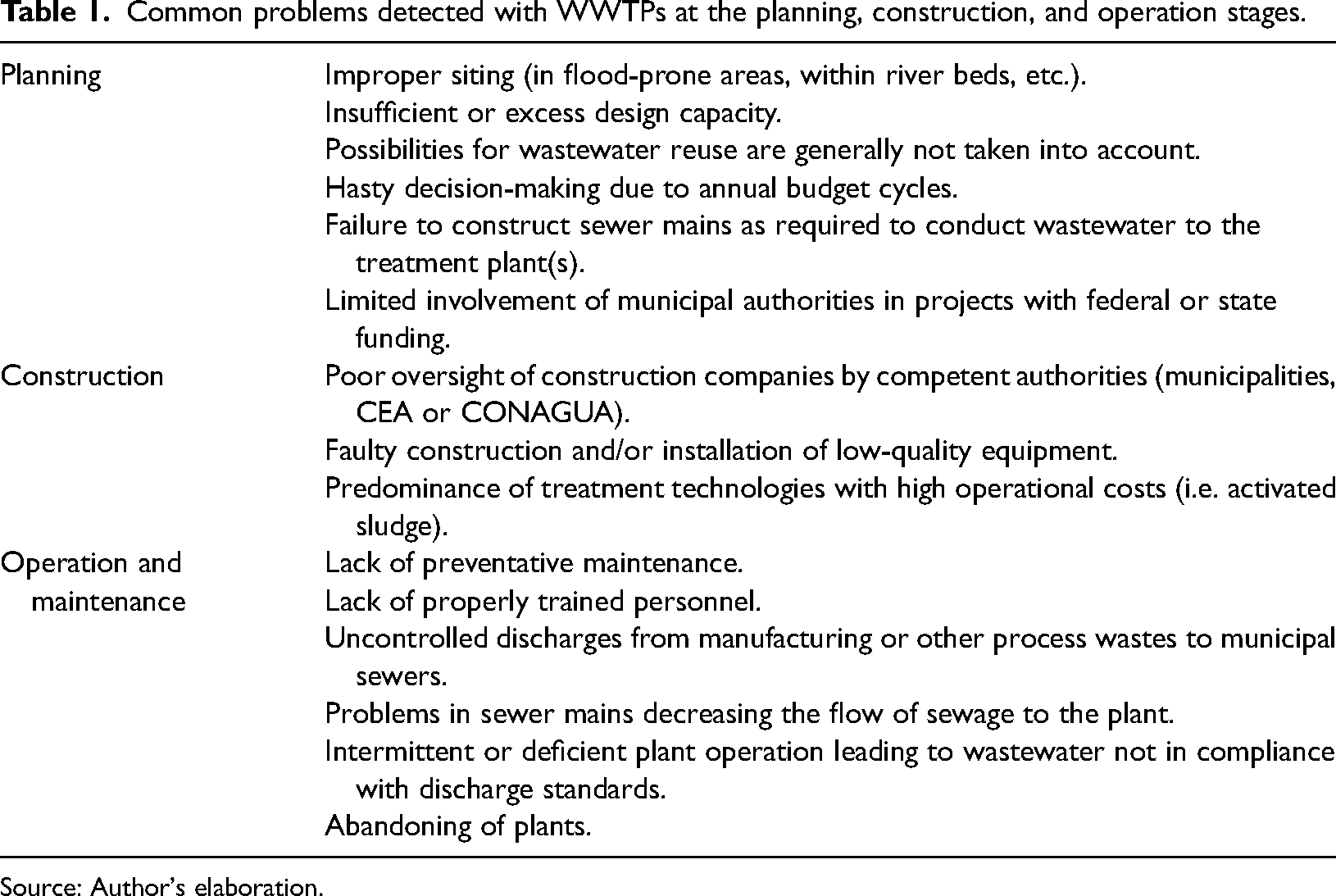
Source: Author's elaboration.
One of the plants rehabilitated within the framework of the Santiago River strategy is in the municipality of Arandas (population 80,609), scaled up to a capacity of 170 L/s with an investment of US$6.8m. 26 At the beginning of 2019, before the intervention, the activated sludge plant built in 2003 with a capacity of 150 L/s only received a flow of 15 L/s and was in a general state of disrepair. An operator who worked at the plant since shortly after the municipality took possession describes a gradual process of deterioration. “[T]here started to be failures and the failures have never been corrected,” he states, recounting how the chlorine gas valve broke down and was never fixed; an impeller from a sludge pump stopped working and when it was taken for repair it never came back. Somewhere between 2005 and 2006, they stopped using the belt filter press for sludge dewatering; problems later began with the plant's power grid, other pumps failed and after “each failure that has occurred, there have been few who have tried to get [the plant] working.” Preventive maintenance was absent and successive directors of municipal water services by and large showed little interest: “they haven’t known how it works, what it's for, why it does this, why it does that.” 27
There is another element to the poor running of this plant. The siting of the plant meant that a significant part of the city's wastewater—approximately 70 L/s—had to be pumped to the WWTP via a lift station. According to the plant operator, the construction company completed the lift station, leaving the municipal authorities to sign the contract with the Federal Electricity Commission (CFE). However, the lift station was never used by the municipality, and once abandoned was vandalized. This implied that the plant never received that important portion of the city's sewage. Due to subsequent works that affected sewer collectors, the flow received by the plant continued to decrease and, during the 2019 visit, staff mentioned that for at least the previous four years the WWTP only received between 15 and 20 L/s.
Due to the collapse of a sewer collector, the main treatment plant in Lagos de Moreno (population 172,403), an activated sludge plant with a capacity of 285 L/s, was not operating during my visit in 2019. According to CEA records, it was operating in 2017 and 2018 but did not comply with discharge regulations. This is explained by the condition of the plant where, according to several operators, only one of three wastewater aerators was working; the chlorine gas regulator had not worked for several years; and they had not used the belt filter press for eight years, due to equipment breakdown. The director of water services for Lagos de Moreno, after just a few months in the position and without information on the plant's operating costs, asserted that his management capacity is limited to “putting out fires,” because, “in reality, we aren’t doing prior maintenance to avoid all of this.” 28 As at other plants visited, here the resources were so limited that operators were not provided with footwear or other personal protective equipment, and lacked basic work tools and lawn mowers to maintain the property where they cut the grass with hand tools.
Conclusions
The cases cited to exemplify the trends identified are representative of a panorama characterized by deficient planning and poorly operated or abandoned municipal WWTPs. Given this scenario, however, the explanations emanating from officials at the state and federal levels elude acknowledging the structural financial and technical limitations of municipal water service providers. Instead, the problem is portrayed in terms of values. Thus, the head of wastewater treatment at CEA, under whose supervision visits are made to all the state's WWTPs, affirmed that, “If the mayor is convinced and committed to ecological issues, he is going to invest in the plant, and if not, the plant is the last of his concerns within the municipality.”
29
In a similar vein, from the CONAGUA Basin Agency, the head of support programs for municipalities maintained that there exists a type of […] justification. […] We assume that the municipalities don’t have the capacity […] that it is something very onerous, that it is something very expensive, and then they end up abandoning [the treatment plant] because they have other priorities. So, if they have other priorities, then it has more to do with a question of values.
30
In these conventional explanations of municipal wastewater treatment, a recurring problem in the country is represented in terms of the values of individual actors.
Diverse studies that address the limitations of municipal governments in the provision of water and sanitation services propose that the decentralization process be reconsidered (Casiano Flores et al., 2017, 2019; CONAGUA, 2013; Herrera, 2014). Noting that the decentralization of water and sanitation services was part of “a broader neoliberal reform package that failed to consider the unique constraints of local government,” Herrera (2014: 25) suggests a higher level of support from state and federal entities, the creation of inter-municipal service providers or, as in the states of Nuevo León and Querétaro, service provision by state-level agencies. Casiano Flores et al. (2017, 2019) also argue for strengthening the role of state governments, citing the regionalization strategy of the Tlaxcala government, which has assumed the operation of treatment plants.
Strengthening the role of the state government in providing these services has also been proposed by important political actors in Jalisco. There is no “magic bullet” for urban wastewater policy, however, as Pacheco-Vega notes (2015a: 102). Given the history of the CEA in Jalisco, and the planning failures it has overseen, it is not surprising that various municipal authorities expressed their misgivings regarding the ability of the CEA to assume that role, advocating instead for a robust system of incentives and subsidies to strengthen municipal agencies and foster the accountability of municipal systems. Entrusting state authorities with treatment plants would also not address polluting discharges to sewerage networks or network maintenance. In any configuration, an increase in accountability or “checks and balances” is key to avoiding the problems described in this text and which lead to what Casiano Flores and de Boer (2015: 19) aptly termed the “symbolic implementation” of wastewater treatment.
The study commissioned by CONAGUA in 2013 proposes the creation of a state or federal entity to assist in the operation of WWTPs, but not only that. It incorporates proposals that address several of the systematic deficiencies detected, such as the generation of a national training program for the operation of WWTPs, a national inventory detailing WWTP status, and the integration of watershed management programs that prioritize the reuse of treated wastewater. The report also touches on an essential aspect: the selection of technology. We have seen that operating costs as well as maintenance issues contribute to the abandonment or poor operation of WWTPs. Hence, the report authors recommend that the federal government establish technical guidelines to promote domestic technologies and systems with low operation and maintenance costs. This may help reduce the phenomenon noted by De Anda and Shear (2016) of the predominance of technologies such as activated sludge systems and the lack of experience and trained personnel in Mexico to design and operate alternative systems. These recommendations also highlight the need to address not only the institutional configurations, or the level of government in charge of the systems, but also the process of planning, technology selection, operation and maintenance—and ideally the reuse of treated wastewater—so that the plants can fulfill their function in the medium term.
A close look at the day-to-day problems faced by plant operators, as well as the dilemmas and limitations of municipal water service providers, facilitated by the ethnographic approach to infrastructure I adopted, brings to light issues of both institutional and sociotechnical configurations that influence poor outcomes. Delving into the discourse around WWTPs in Jalisco, as well as policies and institutional practices, helps to clarify the “doubles” of WWTPs or the political and economic incentives for the persistence of current configurations, even given the poor results. Capitalizing on an environmental crisis, the state government has captured “symbolic value” from its recent investment in WWTPs presented publicly as reviving the Santiago River. A further key incentive is, of course, the access to public debt for investment in private contracts for plant construction and short-term operation.
In the case of the WWTPs built and/or rehabilitated in the context of the Revive the Santiago River strategy, several of the projects have contemplated the installation of solar panels to generate part of the required electricity and thus reduce operating costs. The state government also committed to paying the construction companies for the first year of operation and extended that for a further year in 2022. Managers in two municipalities with plants undergoing rehabilitation reported in October 2020 that they had no knowledge of the operating costs for the new plants that their successors would inherit. This despite the fact that water services in both municipalities were operating in the red—requiring the injection of other municipal funds—and this without assuming the cost of operating a wastewater treatment plant.
Wishful thinking regarding the contribution of these plants to sanitation goals aside, therefore, the future of the new WWTPs is uncertain. Their adequate operation—beyond the period financed by the state government—is not guaranteed given the weakness of the municipalities and in absence of technical and financial support, as well as a regulatory environment that encourages compliance and accountability. If they become “white elephants,” abandoned or poorly operated plants, the municipalities are readily apparent as the default culprits.
Nevertheless, this does not mean that this has been a strategy without winners. The companies charged with building and temporarily operating the plants are clear winners. Companies discharging polluting effluents to public sewers with impunity are others. Likewise, the central focus of this strategy on municipal wastewater has served to direct attention away from larger industrial polluters who discharge directly into waterways. Accordingly, in strategy documents and events, municipal sewage together with pesticides and hog production feature as the main causes of river degradation (Gobierno de Jalisco, 2020). Despite the documented pollution of industrial origin of the Santiago River (McCulligh, 2020), the strategy contemplates no concrete actions to curb industrial effluents beyond a proposed voluntary certification program, a so-called “Santiago Certificate,” which would contribute little in absence of an authority capable of exercising a minimal level of enforcement (Gobierno de Jalisco, 2020). Here we see the parallels with the case of the Atoyac River in Tlaxcala, where Velasco Santos (2017: 243) qualifies treatment plants as “technical palliatives that serve as smoke screens to avoid addressing the underlying causes [and also constitute] the way in which the government once again prioritizes the interests of the few over the common good, in that infrastructure works are great business opportunities for certain business elites.” These are the “doubles” of the WWTPs in these cases of severe pollution, where the externalities of manufacturing activities have direct impacts for the health of residents of communities along these rivers.
Presented in the language of rescuing a devastated river, the state strategy of infrastructure investment seeks to capitalize on the symbolic power of both the “promise of infrastructure” and environmental protection without disrupting the current urban-industrial metabolism in the basin. The river strategy, which skillfully evades confronting the dominant power relations that have turned riverside communities into sacrifice zones, reinforces existing social and environmental inequalities and will contribute little to improving living conditions in these communities. Behind the “smokescreen” of the strategy's WWTPs, local organizations such as Un Salto de Vida in El Salto continue to denounce the real estate and industrial expansion that is causing havoc for the basin and, together with a network of allies, continue to build an alternative vision of the restoration of the territory of the Santiago River.
Highlights
In the context of an analysis of a river restoration strategy for the highly polluted Santiago River in Western Mexico, which centers on the construction of municipal WWTPs, this paper argues that:
The WWTPs not only serve a technical purpose but have their “doubles” in the funds channeled to private actors. The WWTPs also have symbolic value to communicate the state's commitment to sustainable policies and projects. This type of initiative does little to change the dynamics of current urban-industrial metabolism or to alter power relations. Analyzing wastewater infrastructure as a process and field of power relations brings to light the structural limitations of current sanitation and decentralization strategies.
Footnotes
Funding
The author disclosed receipt of the following financial support for the research, authorship, and/or publication of this article. This work was supported by the Consejo Nacional de Ciencia y Tecnología (grant number A1-S-21674).