



Abstract
This article explores ethnographically how digital nomads reconcile their commitment to ‘freedom’ with their relationships to state institutions. It analyses the ways these ‘global citizens’ attempt to weaken ties with nation-states and challenge state–citizen relations in areas of work, citizenship, and mobility. On the surface, digital nomads appear to break the ‘social contract’ via borderless subjectivities, or via the creation of transnational businesses. Yet in practice they remain entangled in multiple state institutions, both directly and via corporate entities, to get closer to their hotly desired ‘freedom’. This article explores digital nomads’ attempts to ‘opt-out’ or ‘re-draw’ the social contract, and illustrates the tension between the imagined social contract and how actual state–citizen relations develop over time and are experienced through the filters of global corporations, free markets, and entrepreneurial thinking.
If you’re an American, there are already countless tax laws that make being a US ex-pat more difficult than it should be. When that’s the case, I don’t believe you’re under any obligation to pay homage to the country where you just so happened to evacuate a birth canal. (Henderson, 2017) Where you were born is like a statistical error. (Karoli Hindriks, in Plumia, 2022a)
Fabian, a German man dressed in camo cargo shorts and a black T-shirt paced across a spotlit stage. He was delivering the keynote speech at a digital nomad conference in Bangkok. An international audience of twentysomethings listened to Fabian describe how he had blended an untethered and borderless life with running a business. A PowerPoint slide behind him, 25 feet wide, parodied the ‘Ascent of Man’ (Figure 1). It depicted human evolution from an ape to a digitally liberated human taking flight, presenting digital nomadism as a future trajectory for humanity. Fabian presenting the ‘digital nomad path to freedom’. Source: Photo by the author.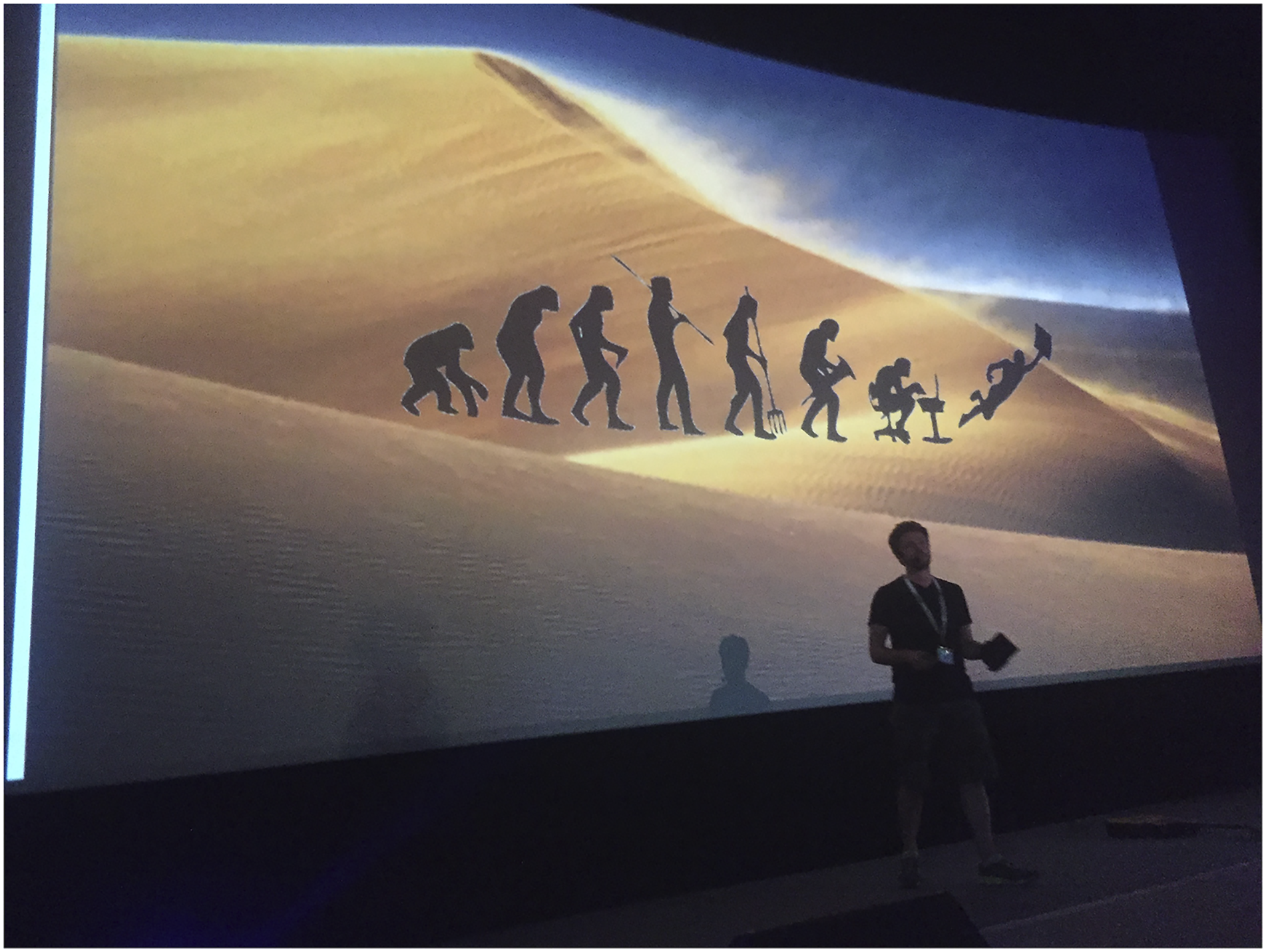
Fabian clicked to the next slide which showed two globes, the first covered with national flags, headed ‘What people think I am’, the second without flags, titled ‘What I really am’ (Figure 2). He explained that his personal identity had nothing to do with his nationality. His performance made me think of Diogenes’ proclamation, ‘I am a citizen of the world.’ The audience erupted into applause. ‘What I really am’. Source: Photo by the author.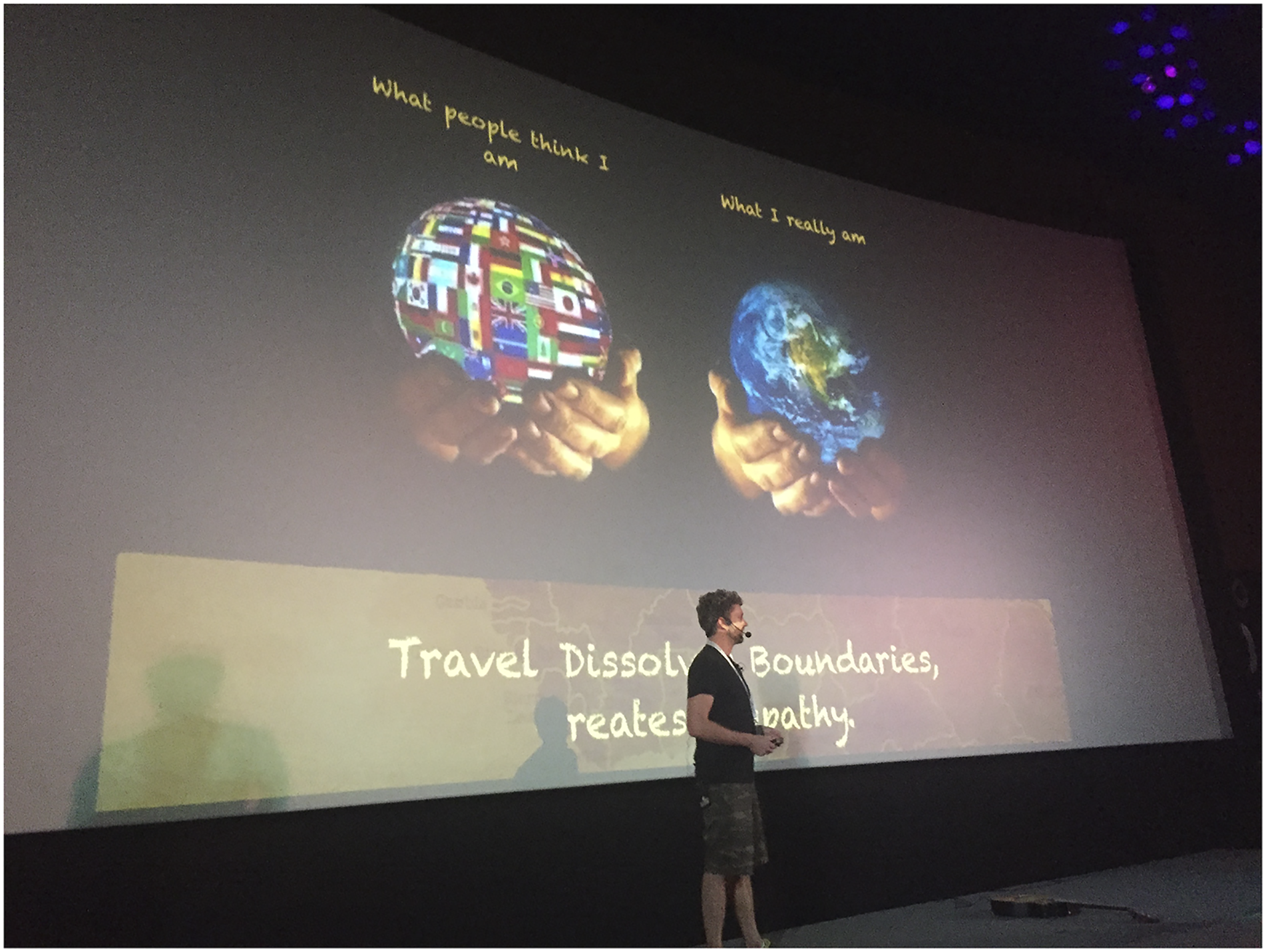
Digital nomads have become known as individuals who utilise digital technologies to blend work, leisure, and travel. The lifestyle gained prominence in the 2010s. The pre-pandemic digital nomad stereotype was a millennial who had escaped the daily grind to travel the world and work on a laptop on far-flung beaches. Nomadic workers often have freelance jobs in e-commerce, copywriting or design. Many aspiring digital nomads dream of becoming entrepreneurs, like Fabian, with a mobile, global, scalable business operating internationally, beyond borders.
This article analyses the digital nomad imaginary’s challenge to the idea of national citizenship and examines the nuts-and-bolts practicalities of navigating state bureaucracies when trying to be a nomadic worker. It explores three examples of tensions between digital nomads, national citizenship, and state bureaucracies: (1) how the borderless and free digital nomad imaginary is formed in spaces like the aforementioned conference; (2) the practical processes and struggles of becoming an experienced digital nomad through the lens of tax, citizenship, and visa regulations; (3) a group of digital nomad entrepreneurs called ‘dropshippers’ 1 who run borderless, transnational businesses on ecommerce platforms such as Amazon, eBay or Shopify and find themselves battling state bureaucracies. This ethnography shows how digital nomads view the bonds between citizens and states as unnecessary annoyances; restrictions to be negotiated, hacked, or broken. Journalist Danny Crichton (2018) has even argued: ‘The nation state has survived wars, plagues, and upheaval, but it won’t survive digital nomads.’ This article explores the potential implications for the social contract provoked by digital nomads.
Previous research has presented digital nomad subjectivities as demonising the office, the nine-to-five, being location-dependent, while celebrating individualism, autonomy, self-reliance, and a form of freedom that is borderless and untethered (Cook, 2020a; Green, 2020; Müller, 2016; Reichenberger, 2018). These subjectivities often pathologise nation-states and citizenship (Cook, 2020b). The expansion of remote working since the Covid-19-pandemic has made remote work practices, and terms such as ‘work from anywhere’ (WFA) more visible and ubiquitous (Cook, 2020c; Newbold et al., 2021), raising the question of whether digital nomadism is becoming mainstream (Lufkin, 2022). In 2020 when lockdowns required people to work from home, digital nomads were less able to travel. Yet the imaginary of the borderless remote worker accelerated, fed by narratives about untethered productivity, and news that countries were launching remote work and digital nomad visas (Cook, 2020b). As Rob, 2 a freelance marketing consultant and one of my interlocutors, explained: ‘I may be stuck in a horrible studio flat (in the UK) climbing walls, but I’m working on my next business venture. Every time a country launches a digital nomad visa, I’m reading the small print and planning where I’m going to travel when all this is over.’
In 1997 Japanese technologist Tsugio Makimoto, often credited with having coined the term ‘digital nomadism’, prophesised that the rise of remote working would upend the social contract by forcing nation-states, ‘to compete for citizens’ (Makimoto and Manners, 1997: 23). Furthermore, he argued that digital nomadism would prompt ‘declines in materialism and nationalism’(1997: 196), weakening the notion of social contracts between nation-states and citizens. The introduction of ‘digital nomad visas’ prompted many of my interlocutors to amplify the idea that nations might need to compete for citizens, an idea picked up as a policy recommendation by the Tony Blair Institute for Global Change (Razavi, 2021). Yet digital nomads often end up in practical and unglamorous negotiations with state bureaucracies, undermining this ideal of freedom from the social contract, and the notion that there exists a contract in the first place which can be ripped up. Paradoxically, to live an untethered, borderless life, digital nomads must negotiate tax systems, residency rules, and understand how states conceptualise and enforce worker protections, often managing these negotiations across multiple states. However, the ability to easily move across borders is only possible for those holding a ‘strong passport’ (Thompson, 2018), that is, from the global North. Most of my interlocutors were from the USA, Europe, the UK, Australia and South Korea. Without these privileges, nomadic work, resisting citizenship and the pursuit of an untethered, frictionless life, would be impossible.
Historical iterations of the social contract theorise that the relationship between an individual and the state is premised on a trade-off: the individual gives up some personal freedoms in return for securities and protections (e.g. Hobbes, 1998 [1651]). John Locke (1988 [1689]) saw the social contract as optional. If an individual did not like rules of a society, they could leave, thereby withdrawing consent. Other contractarian philosophers objected. Hume (1741: 97–107), for example, argued that most people do not have the real possibility to depart. Digital nomads believe they can make a Lockean departure from their state of birth, but over time find themselves making multiple complex trade-offs and new relationships with states: they are less ‘free’ than they initially imagined. Digital nomads who become dropshippers have additional issues: while dropshipping fuels the digital nomad imaginary of borderless, frictionless mobility and free trade, in practice, Amazon requires that digital nomad entrepreneurs engage with national and regional laws that are embedded within the Amazon ecosystem. This poses questions about whether states alone mediate supposed social contracts. In some cases, digital nomads spend as much time and energy learning about how to hack and negotiate with Amazon’s technical systems and processes as they do trying to negotiate and navigate regulations imposed by the American, British, or Thai states. Analysing digital nomads’ negotiations with states and transnational corporations contributes to an anthropology of the social contract by showing how the idea of a social contract today cannot be contained by the frame of state–citizen relations. Ultimately these myriad negotiations repeatedly result in fantasies of breaking the social contract being acted out via a series of imaginative rejections, and practical reengagements.
Self-managing exiles: A specific type of untethered person
I conducted ethnographic fieldwork over seven years in Thailand, mainly in the digital nomad ‘hotspot’ Chiang Mai, attending conferences and specialist industry events such as dropshipping meet-ups. I complemented participant observation with 98 in-person and remote interviews. The longitudinal nature of this research means that the data was bisected by historical events which brought the state–citizen relationship into sharp focus, including the Brexit vote to leave the European Union (EU) in the United Kingdom, and the election of Donald Trump in the US, both in 2016. I wondered how British and American digital nomads in Thailand would react to these issues happening ‘back home’. The subject was mostly met with eye-rolling, sighs, or comments such as: ‘I’m glad I’m here,’ or ‘I’m well out of it.’ Because I had newly arrived from the UK, I was seen as a ‘back home’ person, raising such tiresome issues. These nomads saw people from their home countries as ‘typically obsessed’, or ‘one of those poor sods back home stuck in the middle of it all’. For digital nomads, the Brexit distinction of Leave/Remain, or Republican/Democrat in the US, were uninteresting. Many told me they were on ‘news diets’ and therefore did not know what was happening, patiently explaining to me, as someone ‘who was only temporarily overseas’, that they were entirely ‘outside the debate’. Many nomads were too busy setting up or trying to run borderless businesses that could earn them money while they travelled. Although a frictionless, global flavour of freedom is the ultimate goal, it was when talking about the practical nuts and bolts of travelling and working, and the possibilities of setting up a transnational business, that digital nomads became most animated and engaged. Discussions such as these frequently blend mobility strategies, tax arrangements, business activities and visa regulations into specific, often unique, versions of ‘freedom’.
Anthony D’Andrea (2006) named the countercultural global nomads he studied ‘expressive expatriates’, because they acted out their identities and mobilities in elaborate, colourful, playful, creative, spiritual and expressive ways via the visual and material language of trance music, organic food, fashion, psychedelic art and wellness practices. In contrast, digital nomads’ subjectivities place importance on hypermobility, productivity, minimalism and fast Wi-Fi, with expertise in navigating state bureaucracies. So, if D’Andrea’s global nomads were described as ‘expressive expatriates’, digital nomads could be described as ‘self-managing exiles’.
The traces of this self-managing, bureaucracy-savvy effort can be found in abundance in travel blogs, presented as bucket lists of visited locations (Willment, 2020), checklists or ‘listicles’ 3 detailing the perfect packing list of luggage and travel accessories (Hunt, 2017), the right productivity practices (Travel Lemming, 2020) tax strategies (Henderson, 2017) or how to set up a borderless dropshipping business (Digital Nomad Soul, 2022). Directories such as nomadlist.com (2022) catalogue the best locations to work remotely and can be filtered by cost of living, internet speed, weather, fun and safety. In short, digital nomads might talk in romantic terms about escape and freedom, but theirs is also a life imagined, planned, and sketched out in lists and careful preparation. These behaviours and practices build on a set of subjectivities which anthropologists have described as neoliberal. Digital nomads share qualities with Gershon’s self-branded, social media-mediated jobseekers who find that ‘under neoliberal capitalism, one owns oneself as though one is a business, a collection of skills, assets … that must be continually maintained and enhanced’ (Gershon, 2014: 288). Bröckling’s characterisation of the neoliberal entrepreneurial self as a plan or project prone to success or failure (Brockling and Black, 2016) is also a visible facet of digital nomads’ identity. Digital nomads also invoke Rose’s (2017) depiction of a free self-regulating individual, and Harvey’s portrait of neoliberal personhood, in which individuals exercise their ‘entrepreneurial freedoms and skills within an institutional framework characterized by … free markets, and free trade’ (Harvey, 2007: 2). Digital nomads are not, however, homogeneous; they blend these subjectivities in different ways. While many present themselves as businesses or projects, others place more emphasis on rejecting the office, commuting or traditional modes of salaried employment (Cook, 2018). Among dropshippers, transnational entrepreneurial identities sometimes morph into individuals presenting themselves as budding transnational entities. One nomad confided he was trying to buy an island in Brazil and declare independence. Digital nomads often claim to be apolitical, while at the same time expecting the multiple nation-states, they engage with to support free trade, flexibile labour laws, border controls and visa regulations. As Thompson (2018) put it, digital nomadism ‘is more of an adaptation to neoliberal impacts than a challenge to the system’.
Enemy of the state? Imagining the digital nomad self
To understand how digital nomads pathologise the nation-state, it is helpful to explore the mechanisms of becoming a digital nomad. Many nomads I met had read books like Tim Ferriss’s (2011) 4-hour Workweek. Some had started their ‘becoming’ journeys through reading digital nomad blogs. Others had been inspired by digital nomad conferences, such as DNX 1 or Dynamite Circle, and I now explore one of these.
I heard about the DNX conference in one of my earliest conversations about digital nomads in Koh Pag Ngan, with Thom, a seasoned German traveller. Thom was neither ex-pat nor tourist, and rarely seemed to return home. We were discussing how people survived while constantly travelling. He said, ‘You’re talking about “digital nomads”!’ ‘What on earth is a “digital nomad”?’ I enquired. He laughed and said, ‘I can’t believe you’ve never heard of them. It’s someone a bit like me but who thinks the bottom layer of Maslow’s hierarchy of needs is fast Wi-Fi instead of shelter. There’s a digital nomad conference happening in Bangkok in a few months.’
Two months later I was in Bangkok on a humid morning, looking for the DNX conference. Just off the plane and struggling with jetlag, I visited a coffee shop and overheard two German men discussing the conference. I approached them and we started talking. One was Fabian, described earlier, who told me he would be delivering the keynote and would share his experiences driving across Africa playing guitar for charity, and setting up a borderless tech start-up while travelling across South America. I continued to the conference venue, through crowds of people checking-in using Eventbrite apps. Lanyards with the slogan ‘I CHOOSE FREEDOM’ (Figure 3) were handed out. DNX lanyard: I CHOOSE FREEDOM. Source: Photo by the author.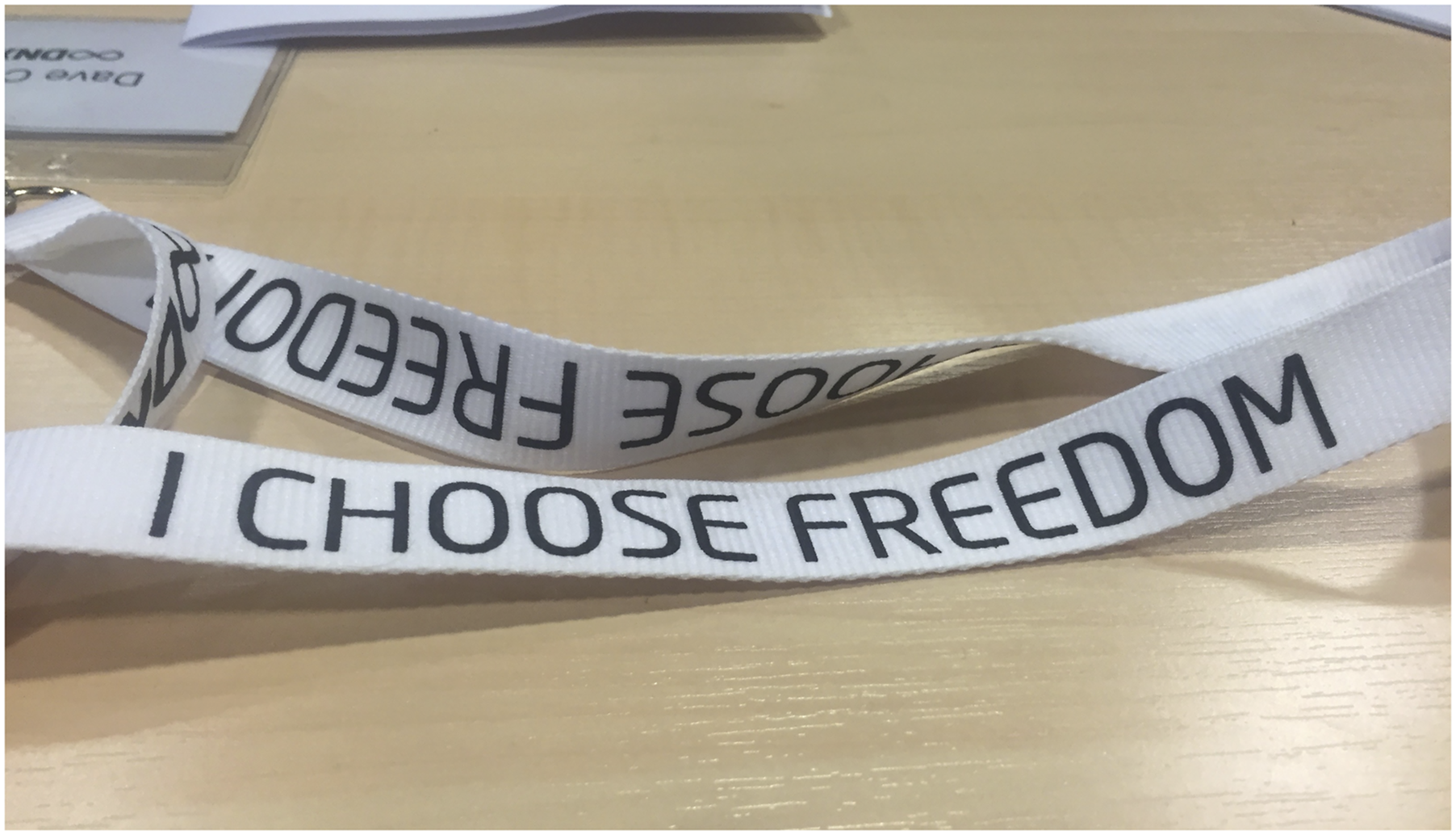
Most attendees were casually dressed men from the global North in their twenties and thirties – although no one looked like a backpacker. Digital nomads differentiate themselves from hippies, although these two ‘tribes’ sometimes collide in locations like Koh Pag Ngan or Chiang Mai. The men were in shorts, and navy or khaki polo shirts. The minority of women were wearing sundresses in neutral colours.
Recurring themes across the conference included the freedom to live and work anywhere, escaping the rat race, taking personal responsibility ‘for your life and destiny’, productivity tools and ‘hacks’ enabling nomadic businesses to function efficiently, the role of coworking spaces and inspirational travelogues. In the conference introduction by DNX founders Marcus Meurer and Feli Hargarten, a YouTube video titled The Rise of Lowsumerism was played (Box 1824, 2015). The video offered a brief history of work and leisure since the Industrial Revolution and claimed that out-of-date advertising-led consumerism was being replaced by the superior sharing economy within which experiences, such as travel and adventure, were more valuable than material consumer products. Despite the video’s critique of ‘mindless consumerism’, it used a visual style that could have been selling luxury apartments. Herein lies a particular contradiction evident in the practices and identities of digital nomads, where consumption is simultaneously critiqued and celebrated. Thus, the neoliberal logic of the free market becomes entangled with adapted free market forms such as the sharing economy, mobility, and the spirit of entrepreneurialism. The occasional mention of collective social responsibility hybridised with personal responsibility gave this neoliberal subjectivity another subtle twist. The video ended with the phrase ‘Earth is not a giant shopping centre.’ The conference was hosted in a mall.
The talks revealed key elements in the utopian digital nomad imaginary (Figure 4). Natalie Sissons, whose personal brand was The Suitcase Entrepreneur, presented first. She explained her digital productivity strategies, including a digital calendar app, Calendarly, which automatically translated time zone differences. Natalie’s app-mediated version of time discipline (Thompson, 1967) flattened time zones into a global, bookable set of productive meeting slots and projects, dispensing with national borders, physical geographies and office-based clock-time (Cook, 2020a: 361). DNX Conference agenda shown on a laptop. Source: Photo by the author.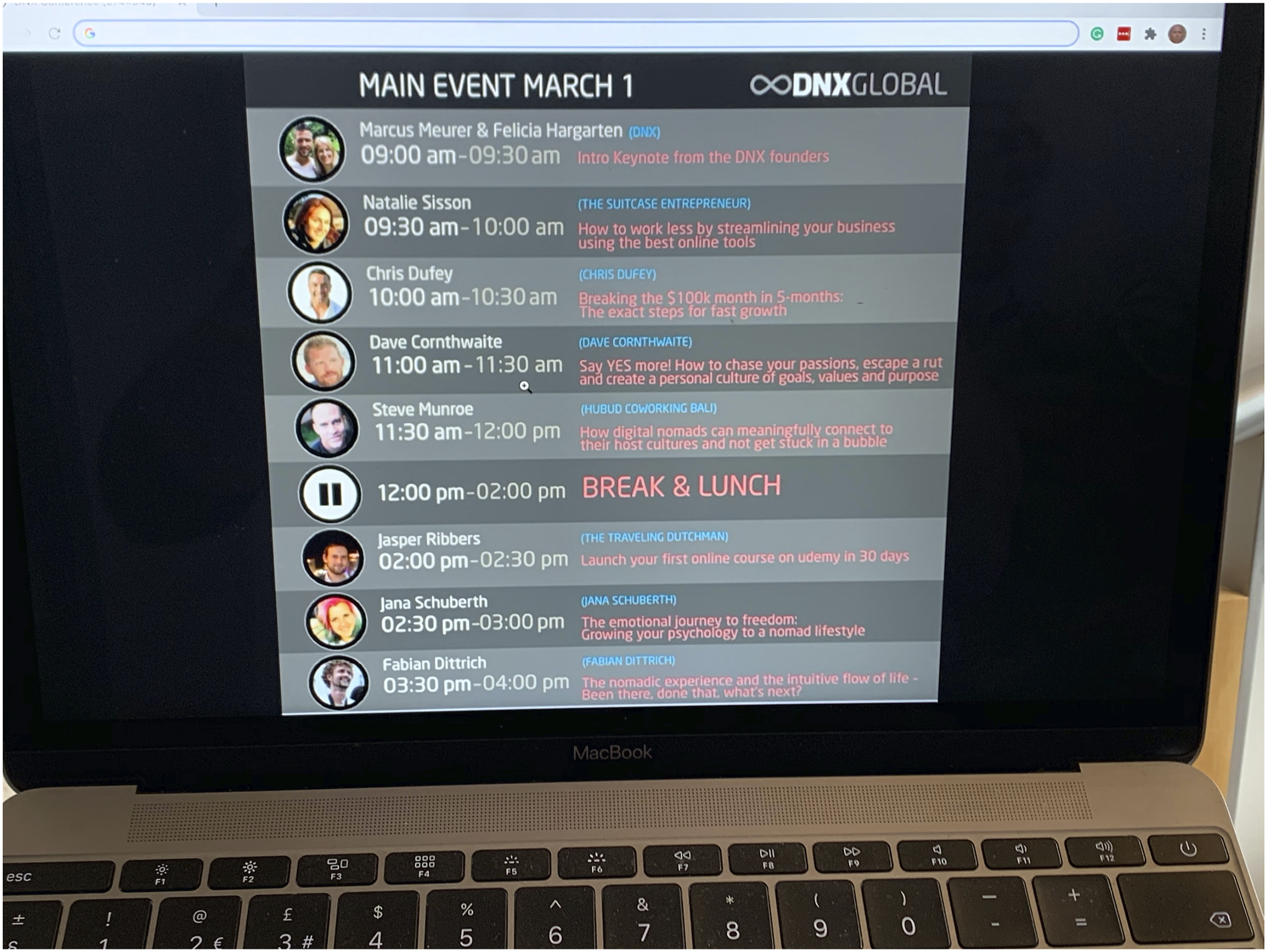
Fabian, in his keynote, recounted how his school careers adviser told him he needed to ‘fit in like an adjusted citizen’, yet he ‘rejected the system and a well-paid job in London’ because ‘it was a workstyle, not a lifestyle’. ‘Travel’ and ‘connecting to the world’ woke him from the drudgery of his former existence. He linked his dissatisfaction with the drudgery of office life to his rejection of national identity. Both he and Natalie shared a logic which pathologised the office and the nation-state as threats to untethered freedom.
Tax and residency as frictions
The practicalities of an entrepreneurial transnational existence require skill, tenacity, experience, and the privilege of a ‘strong’ passport. As one journalist and digital nomad tweeted: A passport is no longer a physical document, but a set of rights and inequalities programmed into a computer. To me, that means this is the moment where this has to change. In a world of remote work, this makes no sense whatsoever. (Lauren Razavi, in Plumia, 2022b)
Yet digital nomads must negotiate multiple bureaucracies. Tax is described as a struggle and obstacle that digital nomads must manage. Yet tax is perceived as dull and technocratic, and thus rarely features in inspirational digital nomad ‘becoming’ stories. The same is true for visa and residency bureaucracies. Digital nomads hate being called tourists, yet often travel on tourist visas; and labour protection laws and taxes gradually emerge as frictions over time. As travelling freelancers and business owners, many initially believe they are exempt from local labour laws. Yet nomads quickly learn they are not free from these rules and regulations.
I met Ben in a Thai coworking space. He was fresh-faced and idealistic, but also stressed, strapped for cash. Ben left the UK as a backpacker, worked in Australia under the working holiday visa programme, on a sheep farm in the outback. Bored, with nothing to do in the evenings, he stumbled on a digital nomad blog, promising a life of travel, work and freedom, and taught himself how to design WordPress websites by watching YouTube videos. When Ben left the farm to backpack with friends, his mind kept returning to that blog which said, ‘earn a passive income whilst travelling the world’. He told me: All my friends wanted to do was get drunk in the next hostel. They knew they’d run out of money and have to go home. I realised I could continue travelling whilst working, instead of going home broke and having to look for a job.
He headed to a coworking space in Thailand and taught himself website design. The Australian government was pursuing him for unpaid taxes because he had overstayed his visa. Faced with the dilemma of paying them or risking not being able to travel back to Australia, he turned to website design to earn money. He befriended the owners of a Thai guesthouse and told them he could create a website for them cheaply. The owners were delighted, but the manager of the Thai coworking space found out and told Ben it was illegal for someone on a tourist visa to work directly with Thai clients. If the coworking space was found to be hosting illegal workers, they could be prosecuted and shut down. I later encountered similar rookie mistakes and transgressions, illustrative of nomads’ failures to negotiate state bureaucracies.
To become successfully ‘free’, digital nomads must reconcile multiple, often conflicting state bureaucracies, some of which create deeper complexities. Thailand seemed like a great digital nomad location due to its Instagram-worthy beaches, fast internet and low cost of living. Yet visa rules and worker protections were strict, albeit not always rigorously enforced. In 2018 the Thai state became acutely aware and suspicious of digital nomads. In answer to the question: can digital nomads work in Thailand without a work permit, a Thai legal firm website (presenting itself as ‘Thai Embassy’) stated: ‘In order to work in the kingdom, a foreigner needs to: be on an appropriate visa, obtain a work permit, and pay taxes’ (Thai Embassy, 2020). The website even pondered a question about the meaning of work: But what is work? A digital nomad working on his laptop in a co-working space, is that considered work? A businessman sitting in his hotel room preparing for a seminar? When does the Work Permit office consider this to be work? This is a hard question to answer with a straightforward yes or no. (Thai Embassy, 2020)
Here, the idea of a contract between the Thai state and what they define as a digital nomad, and the interplay between the worlds of work and technology, are up for negotiation. The website continues that the Work Permit office considers a digital nomad working ‘on his online shop in a coworking space’ to be a ‘concern’. It states that the practice of a foreigner sitting in his apartment and teaching a language via Skype is considered to be work, and therefore illegal. But as of September 2020, the website claimed that these types of work were ‘not the main concern’ for the Work Permit office.
Thus, individuals try to depart, escape, and achieve freedom, yet such ‘freedom’ is bound by unevenly enforced bureaucracies. Even those who leverage their class, passport and economic privilege to ‘leave’ never entirely manage to escape the duties and responsibilities of their ‘home’ states or the states they pass through. This paradox recalls the critique of Locke’s (1988 [1689]) assertion that consent to the social contract can be ‘opted-out’ of by leaving a state. In the case of digital nomads and Thailand, nomads are contravening the supposed contract between themselves and the Thai state by travelling on tourist visas while working. In a literal sense, their entering Thailand on a tourist visa is fraud. The dilemma that the Thai state must wrestle with is whether they want this type of visitor, and what to do when individual transgressions are brought to their attention? These subtle dances provide further instantiations of what Burnyeat and Sheild Johansson (2022, this issue) call ‘contractarian thinking’: the way that people conceptualise their relationship to nation-states in terms of contracts that can be entered into and broken. In the tension between the digital nomad utopia and the many bureaucracies they negotiate, the limits of this contractarian thinking are exposed.
Negotiating the contract
Tourist visas are often short, so nomads travelling on them need to change location regularly, sometimes as frequently as every two weeks. Some do visa runs or apply for longer-term visitor visas. In Thailand most global North citizens get a 30-day visa on arrival, and this is how most digital nomads enter Thailand. If someone is a UK, US, or EU citizen, 60-day and 90-day tourist visas are sometimes available if applied for in advance. Applying for longer-term residency invites debate about whether someone is a digital nomad or an ex-pat. As Figure 5 suggests, a work-focus and high-mobility are central to digital nomad identity. Self-described digital nomads were asked to mark where they positioned themselves on the axes. Note: This is a visualisation of this data. Source: Diagram by Dave Cook and Tony Simonovsky.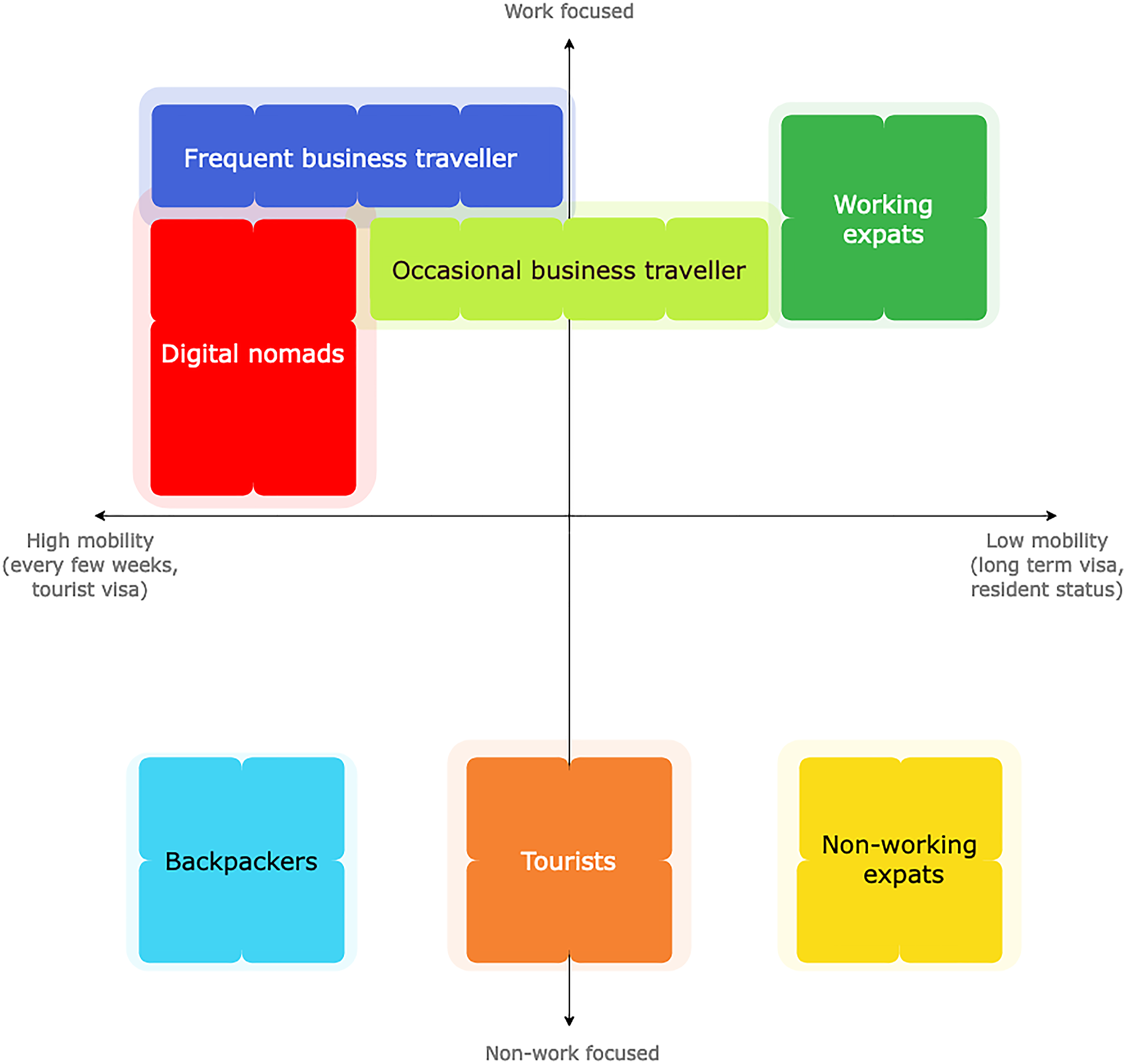
Experienced nomads negotiate the bureaucracies of multiple states, and imagine themselves drawing a new social contract, or a series of self-chosen contracts, to live a life that is neither tourist nor ex-pat. Established nomads often explain how they have learned from past mistakes, refining their tax arrangements as they have developed their businesses: this is essential to work and travel without constantly worrying about whether laws are being broken. Mark, an experienced British digital nomad I met in Chiang Mai, had written blogs about how great it was to work as a nomad there. He ran several entrepreneurial side gigs, and designed websites while travelling and working across South-East Asia. He laughingly described himself as ‘being very anal about tax’. He told me he was different from most of his friends in the UK, who started businesses in their early twenties and avoided dealing with tax until they had to. He said: I have a UK accountant; all my businesses are registered in the UK. I know some nomads have offshore companies, but the UK is one of the only countries in the world that publishes their non-tax resident status requirements in black and white. So, if digital nomads are from the UK and not doing tax properly, I don’t have much sympathy for them.
Mark’s attitudes to tax were linked to his feelings about British citizenship. Despite having no intention of permanently living in the UK, he chatted about being British and a proud Londoner. His conversations about tax, credit ratings, and family networks were happily interwoven. In contrast, for Ben, who hadn’t yet engaged with tax arrangements, the topic of nationality was a thorny, almost taboo, topic. Ben told me: ‘I’m not going to talk about where I’m from, my nationality or any of that bullshit, because it has nothing to do with who I am.’ Ben was anxious about, and angry with tax systems and notions of citizenship, whereas Mark engaged in the bureaucracies and accepted the contradictions between the digital nomad utopia and his tax arrangements. It is the practical engagements with state bureaucracies that determine how this utopia transforms into lived realities. Ben and Mark shared idealistic concepts of self-reliance, individualism and personal branding within a global free market imaginary. Yet Mark’s attempts to maintain flexibility with multiple states increased the more he learned and engaged with the intricacies of the British tax system and with Thai visa regulations.
While Ben and Mark primarily engage in freelance work, following a simple consulting model of a contractor and client trading services, digital nomads who create transnational businesses encounter greater complexity, as I show next.
Digital nomad entrepreneurs and the dropshipping dream
Dropshipping is an e-commerce fulfilment method, where people sell products they have never seen, produced in countries they may never go to, to customers anywhere. The e-commerce fulfilment site Shopify defines the practice thus: Dropshipping is a fulfilment method where a store doesn’t keep the products it sells in stock. Instead, the store purchases the item from a third-party supplier, and has it shipped directly to the customer. As a result, the seller doesn’t have to handle the product directly. (Ferreira, 2022)
Typically, dropshippers promote their products on social media and sell them via Amazon, eBay, or create their own online stores using software such as Shopify.
Dropshipping features highly in the digital nomad imaginary, because it appears to be borderless and offers the promise of ‘passive income’, which one nomad described as ‘earning money while you sleep’. In practice, dropshipping is complex, requiring adherence to transnational tax regimes, import restrictions, state-specific health and safety regulations, and different national business and corporate cultures. Such frictions might put most aspiring digital nomads off, yet dropshipping is one of the first business models digital nomads are drawn to.
Some dropshippers claim to have a passion for the product they are selling. I met Beth at the DNX conference. Beth had a lifelong interest in tarot cards and made a comfortable living selling special edition tarot card packs. She showed me her lovingly created website with unique tarot products. Yet other nomads had little interest in the actual product, but were ‘amped up’ as one put it, by ‘earning money in their sleep’. Nomads often spent hours researching ‘gaps in the market’. As one dropshipping guru explained, ‘it helps to have a passion for your product category – but it’s not essential.’
If you typed ‘dropshipping digital nomad’ into Google in 2018, you would have seen hundreds of results with how-to blogs, and videos on how to set up borderless dropshipping businesses. You would also have seen dozens of results and Reddit threads complaining that dropshipping is unethical or a scam (Reddit, 2017). Dropshipping was the most popular money-making topic in Chiang Mai between 2016 and 2018, until one nomad grumbled in 2019 that ‘cryptocurrency stole the limelight’. The same nomad complained that dropshipping was ‘the snake oil that greased the wheels of a thousand start-ups in Chiang Mai’.
Ava, a 31-year-old Taiwanese woman I met in Chiang Mai, guided me through the pitfalls of dropshipping. She taught English via Skype. Despite having a steady income from teaching, she thought about setting up a dropshipping business. She told me: When I first came to Chiang Mai all the nomads were trying to become online English teachers. When that didn’t work out, they all wanted to become Amazon sellers, by sourcing their own product line – and sell them from China. They get product samples sent to Chiang Mai, market them via social media and sell via Amazon. I met a few people who told me how successful they were – but finding out how they actually do it is harder. In the beginning I loved the idea of having a passive income, with minimum work. I started going to weekly Amazon meet-ups, but the really successful dropshippers often don’t show up because they are scared rival sellers will steal their ideas. It’s taboo to ask what you are selling on Amazon.
Ava realised the time and effort involved in becoming a successful Amazon reseller and decided to stick to her day-job. Although digital businesses can appear untethered and borderless as they can be conducted online, the practicalities of forming trusted relationships with suppliers and clients are difficult to do remotely. Many successful dropshippers establish their businesses in their home country. Some digital nomads proudly referred to a ‘home base’, often meaning the country where they were born or grew up. Others set up a home base in Singapore for tax reasons and for geographical proximity to Southeast Asia. The term ‘home base’ implied autonomy, whereas citizenship felt imposed. As Ava explained, ‘My home base is somewhere I’ve chosen.’
Ava’s description reveals the need to ‘do business’ in Thailand, work with suppliers in China, and sell in Western countries. This transnational model poses three significant challenges: creating trusted relationships with Chinese manufacturers, physically conducting business operations within Thailand (where the legality of doing so is unclear) and marketing and selling the product in Western economies. What starts off as a dream of creating a passive income becomes a growing list of business skills, knowledge of multiple local laws, business cultures, and bureaucracies. Dropshippers in Chiang Mai normally engage with at least three states.
Joe, another aspiring dropshipper, got further than Ava, yet was bruised in the process. Joe was a backpacker from Leeds and was inspired by a Norwegian woman called Maja whom he met in a bar on the Thai island of Koh Samui. Maja sold designer ceramics on ecommerce platforms to US customers, and told Joe she was ‘making money in her sleep’ while she lived nomadically. Not yet ready to go back to Leeds, Joe attempted to become a digital nomad dropshipper. His business idea was simple: his parents were cat breeders and occasionally ‘sold cat toys and related accessories as a side gig.’ Joe did not love cats but figured that ‘people everywhere spent money on them’. He set up a cat accessory-related Instagram profile. His online course told him he would have a ‘viable customer base’ if his cat-themed Instagram account reached 60,000 followers. The course also details the process of trying to become dropshipper and then, in his words, ‘source cheap and easy-to-photograph cat accessories from China’.
In Chiang Mai, news courses and meet-ups teaching nomads how to set up ‘successful’ dropshipping businesses were popular. The marketing hook was about making money on the move, yet avoided focusing on the technical practicalities and skills of running a dropshipping business. Dropshipping is sometimes characterised as a speculative, ethically questionable vehicle for selling low-quality products (Maheshwari and Fu, 2016). Many nomads told me that courses and blogs mentioned the mechanics of sourcing products in China and placing Facebook ads, yet mostly glossed over the effort required to create a legitimate business and simplified the practicalities of sourcing products in China. Digital nomads had to learn about Chinese business practices and cultures, often related to Chinese state-sponsored entrepreneurial programmes, through trial and error.
Importing product samples from China into Thailand was Joe’s first hurdle. Ordering product samples from Chinese suppliers when you are a British national travelling around Thailand is complex. Import tariffs can be levied and many suppliers do not ship to Thailand if the billing address is in Europe or the US. Joe had spoken to other nomads who attended trade expos in China such as the Canton Trade Fair, which connected potential Amazon Marketplace sellers with Chinese manufacturers. He was excited when he heard about these trade fairs but told me that negotiating production and shipping contracts with Chinese manufacturers when he did not speak the language was difficult. Because Joe was on a Thai tourist visa, he needed frequent visa runs to the border. Receiving product samples via post when he was always on the move became increasingly problematic. He asked the manager of one coworking space if they would accept deliveries in his name while he was absent, but the answer was no.
Experienced dropshippers told Joe that managing high-volume business relationships with Chinese suppliers was a nuanced cultural skill, and that novices needed to ‘get their heads round Guanxi’. Guanxi is a term that describes how subtle power networks influence Chinese business conduct, often influenced by kinship, cultural rituals and transnational power relations (Siriphon, 2019). After Joe googled Guanxi, he said, ‘I might look at another business idea.’ Joe never made it as a dropshipper, but spent thousands of pounds over six months trying.
While many digital nomads abandoned dropshipping or went online and denounced it as a ‘scam’, I did meet a few nomadic dropshippers who showed me spreadsheets displaying over US $5000 a month of passive income, ‘order sheets’, and ‘transaction histories’. The few that succeed at dropshipping did so by mastering a complex web of transnational and local bureaucracies, further evidencing the link between untethered nomadic life and bureaucratic work.
Expert dropshipping and the social contract: An Amazon reseller meet-up
Amazon was a popular platform for dropshippers as people did not have to build their own store and could tap into a global customer base. However, later an Amazon spokesperson told me they do not allow dropshipping. 4 At an unofficial Amazon reselling meet-up in a Chiang Mai coworking space in 2018, 15 experienced dropshippers from the US, UK, Australia, Germany, Spain, Taiwan, Portugal, South Korea, India, and Italy, got together to share knowledge and experiences. One attendee, Ted, described the Amazon.com marketplace as ‘a technical and bureaucratic nightmare with all-seeing algorithms’. The dropshippers viewed the system and algorithms of the Amazon platform with as much fear and respect as state borders and immigration processes.
Getting set up as a verified Amazon reseller was hard. Staying on Amazon Marketplace and being competitive while still adhering to Amazon’s rules was equally difficult. Conversations in such meet-ups often turned to hacking the review system, which was difficult because, according to Larry, an ex-Marine who manufactured his own ‘top secret’ product in China, ‘Amazon processes and algorithms seem to know everything’, including, as Ted, another dropshipper, said, ‘knowing if your cousin gives your product a five-star review’. Everyone nodded vigorously. Two men confided to the group that their Amazon seller accounts had been suspended after they had been accused of encouraging the posting of suspicious reviews. Getting set up on Amazon, in Ted’s words, was ‘harder than applying for a one-year Thai non-immigrant visa’.
Discussions turned to Amazon.com, the US domain of the online store. Everyone in the group complained that Amazon.com did not behave like a US-wide national store, and that specific state regulations were ‘a pain in the ass’. Every dropshipper selling on Amazon.com complained about ‘Proposition 65’, a list of toxic chemicals regulated in California, widely used in Chinese plastic manufacturing. Some had entire product categories, or their whole ‘seller listing’, deleted in California. They saw Amazon.com as an overzealous customs inspector and looked for ways to hack Amazon’s compliance with California state laws. These expert digital nomad dropshippers became skilled in avoiding the disciplining powers of national and regional states, and were adept at ‘hacking’ any institution, organisation or business that threatened their mobility or their entrepreneurial freedom. Although Amazon.com’s processes and California state regulations were both viewed as bothersome, Amazon’s systems and algorithms were viewed with more fear and respect than US laws.
Hire an MBA to manage your social media influencing for $250 a month
If frictions around US health and safety regulations and attempts to ‘hack’ them were common, so were ‘hacks’ about finding cheap, talented, and productive virtual assistants from the global South, often from the Philippines. Zena, who sold home decor to a ‘design-savvy clientele back in the US’, marketed her goods on social media. She explained ‘Instagram was her killer sales funnel’ (to Amazon) and where she generated most of her sales. Zena explained that her social media channels, the fulfilments, and Instagram updates were managed by her ‘VA’ (virtual assistant), who lived on the outskirts of Manila in the Philippines. I asked how long it took to train her VA. Zena explained ‘Quite quickly, a month to get her fully up to speed – she has an MBA, her English is great. The time investment was totally worth it, I get everything done better than I could do it myself.’ Zena would not divulge how much she paid her VA, in case someone tried to poach her. Two male dropshippers chipped in. ‘They all have MBAs bro’, one laughed. The other added ‘some accept less than $500 a month, I’ve heard as a low as $250, but that’s too low even for me’. Aspiring nomads started out ‘lifestyle or geo-hacking’ by searching for locations with the lowest cost of living and experienced entrepreneurial nomads like Zena ‘lifestyle hacked’ by extending this logic. VAs were used by Western entrepreneurs in Chiang Mai because it allowed them to run untethered location-independent business. As Zena explained, evoking the ‘self-managing exile’ logic, ‘once you start to travel and work globally, you don’t think twice about hiring workers from different countries.’
Some nomadic dropshippers turned these forms of rational, borderless, free market thinking and action onto themselves. FATCA (the Foreign Account Tax Compliance Act) is a 2010 US federal law that, in 2019, required US nationals to pay taxes on their worldwide earnings, wherever they lived. US-national digital nomads often brought up FATCA when discussing US citizenship, which many considered renouncing altogether. Most US digital nomads did not go through with this as it restricted how many days each year they could visit the US and spend time with family. Another alternative was the FEIE (Foreign Earned Income Exclusion), which allowed US expats to avoid tax but was difficult to manage and administer. It required expats to stay outside the US for more than 330 days a year. Overstaying for one day meant all avoided tax is liable. As Larry explained when discussions turned to FATCA and FEIE, ‘I got wasted on a road trip, lost track of time, and missed the deadline, it cost me tens of thousands of dollars, you live and learn!’ Tense decisions around FACTA and FEIE show how citizenship, rather than evoking sentimental appeal, was viewed as a rational matter of options and logistics. Certainly, the value of citizenship was outweighed by the ability to act and trade freely and was often framed as anti-entrepreneurial. Thus, analysing digital nomads’ negotiations with states and transnational corporations contributes to an anthropology of the social contract by showing how the idea of the social contract today cannot be contained by the frame of state–citizen relations. These negotiations also show how fantasies of breaking the social contract are acted out via a recursive series of imaginative rejections and practical (re-)engagements.
Conclusion
For some digital nomads, the death of the office and the end of national borders are foregone conclusions. In practice, digital nomads go to reimagined offices (coworking spaces), rely on strong passports, and can only experience borderless freedom by becoming experts in labour laws, tax arrangements and visa rules. Novice nomads had to become savvy in tax matters to realise their fantasies of borderless living. Experienced dropshipping nomads became embroiled in national bureaucracies when they took their eye off the ball. Digital nomad life thus illuminates contractarian thinking as a travelling idea that produces different practices in the search of the untethered ideal.
One result is the tension between entrepreneurial individualism and the state. In the case of Amazon dropshippers we see how free trade entrepreneurialism is often entangled in corporately mediated state regulations, built into the Amazon ‘ecosystem’, suggesting that the boundary between state and corporation is blurry. To date, the figure of the digital nomad as a ‘citizen of the world’ has often been idealised as a heroic entrepreneurial individual who resists interference by nation-states. Yet the lived reality is more complex. Digital nomads discover that the bureaucracies of both states and corporations are unavoidable and, paradoxically, they engage with them to a greater degree as they continually strive to ‘hack’ them.
Another associated flavour of untethered digital nomad freedom is the battle between imaginative escapes and practical bureaucratic engagements. This produces a distinct set of actions, practices and subjectivities which problematise the notion of the social contract. Digital nomadism appears romantic, yet as Mancinelli (2020) observes, ‘digital nomadism is an opportunistic adaptation to neoliberal impacts’. We see these opportunistic adaptations in conferences, and through entrepreneurial entanglements with free trade and tax rules. These practical engagements almost always invoke key neoliberal facets of personhood: autonomy, self-reliance, self-management, resilience, the self as a project and free market thinking. Dropshipping nomads with an entrepreneurial worldview blend neoliberal subjectivities and specific forms of ‘contractarian thinking’ in ways that simultaneously fantasise breaking the social contract while engaging in it. Digital nomads are thus shaped by the very state bureaucratic processes they seek to resist.
Footnotes
Acknowledgements
Thanks to the generous research informants, many of whom have let me document their personal journeys for more than half a decade. Thanks to Gwen Burnyeat and Miranda Sheild Johansson for support and feedback on multiple edits.
Declaration of conflicting interests
The author(s) declared no potential conflicts of interest with respect to the research, authorship, and/or publication of this article.

Funding
The author(s) received no financial support for the research, authorship, and/or publication of this article.