




Abstract
Introduction
Although many countries have diverse populations and bilingual students, most handwriting research focused on monolingual students, and the issue of cross-linguistic transfer gained less attention. Moreover, research on the effect of socio-linguistic factors on cross-linguistic transfer of handwriting is scarce. This study compared handwriting performance of fourth-grade students attending bilingual schools, who wrote in their primary (L1) to second (L2) languages, and the effect of socio-linguistic factors on the transfer of handwriting performance.
Method
Ninety-five typically developing fourth-grade students were recruited from three bilingual (Hebrew-Arabic) schools in Israel
Results
Transfer effect was not uniform and was stronger among the Arabic-speaking group. Reading speed and handwriting automaticity in L2 and handwriting speed in L1 predicted 70% of the variance in L2 handwriting speed.
Conclusion
These findings may be explained by the complexity of Arabic orthography, as well as the low level of exposure of the Hebrew-speaking students to Arabic, which is a minority language. These results can guide occupational therapists in addressing factors affecting handwriting difficulties, and in considering socio-linguistic factors necessary for mastering handwriting in teaching a second language.
Introduction
Writing is one of the main means used for various academic purposes, especially in elementary schools, and is considered essential for academic achievement (Graham and Perin, 2007). Most students successfully master the handwriting skill, yet between 5% and 44% of the student-population may encounter handwriting difficulties (Feng et al., 2017). Handwriting difficulties are among the most common reasons for referral to school-based occupational therapists (OTs; Hoy, et al., 2011). Therefore, it is important that OTs have a deep understanding of the handwriting activity, and the various factors affecting students’ handwriting performance.
Over the years, numerous studies have examined handwriting from different perspectives. Most, focused on a specific aspect such as, body functions underlying handwriting performance or personal factors (e.g. gender or age differences; Feder and Majnemer, 2007; Feng et al., 2017). These studies provided many important insights of the handwriting activity, yet were limited in their scope. Congruent with the bio-psychosocial approach, as emphasized in the International Classification of Functioning Disability and Health (ICF; World Health Organization; WHO, 2007), it is also important to consider additional contextual factors, which contribute to a person’s performance and participation. One such factor is students' language. With the increase in globalization – on the one hand – and the growing number of refugees around the world – on the other hand – various countries have culturally and linguistically diverse populations, and many students are bilingual. Yet, to date, most handwriting research focused on monolingual students or on students attending monolingual schools (Graham and Sandmel, 2011), and the knowledge concerning the handwriting performance of bilingual students or those attending bilingual schools is lacking.
Underlying functions related to handwriting
Handwriting is a complex activity that involves the integration of body functions, including linguistic and motor (Rodriguez, and Villarroel, 2016). From a linguistic perspective, handwriting is one of four functional language systems (i.e. hearing, speaking, reading and handwriting) that are interconnected, yet independent from one another (Abbott et al., 2010), both within the same language and across languages (Berninger et al., 2010). Therefore, it is not surprising that reading speed was found to be related to handwriting speed, especially when using a handwriting copying tasks that also entails reading (Bosga-Stork et al., 2016; Salameh-Matar et al., 2018). In addition, orthographic-motor integration, often operationalized as writing the alphabet letters from memory, which is considered a measure of handwriting automaticity (Medwell and Wray, 2014), has been reported to predict handwriting speed across orthographies (Genesee, 2015; Salameh-Matar et al., 2018). Yet, the relationship between handwriting automaticity (as measured by the Alphabet task) and legibility was equivocal (Weintraub and Graham, 2000). Additionally, motor functions (e.g. motor coordination) were found to be related to handwriting performance (Prunty and Barnett, 2017). However, as stated above, body functions are only one aspect that may affect handwriting performance. Therefore, it is necessary to consider additional aspects such as language-related contextual factors.
Contextual factors related to handwriting
There are various language-related contextual factors that may influence handwriting performance, such as the schools' educational model (e.g. mono-or bilingual), the countries’ dominant language (henceforth, language dominance) and the orthographic characteristics of the written language. As stated above, bilingual educational programs, in general, and specifically in Israel, are expanding. These educational programs may vary in the means and amount of students' exposure to the primary language (L1) and second language (L2) as well as to other languages (Hurajová, 2015). As in many programs, in the bilingual educational programs in Israel, students are equally exposed to two both L1 and L2 (i.e. Arabic and Hebrew). Both languages serve as a medium for instruction, co-taught by Hebrew and Arabic speaking teachers, with the intent of developing bilingual students.
Bilingualism is viewed as a process in which the two languages to which a person is exposed develop interdependently rather than independent from each other (Koda, 2007). One of the underlying assumptions relating to bilingualism is that there is a cross-linguistic transfer, namely, that basic linguistic skills in L1 provide certain foundations while learning the second language (Cummins, 1979), and that there is a continuing interaction between the two languages (Koda, 2007), especially when the educational environment allows access to both languages (Cummins, 2000).
Research relating to bilingual academic skills has mostly addressed cross-linguistic transfer in reading and reading-related skills (Barac et al., 2014). In contrast, there is limited knowledge concerning cross-linguistic transfer in writing skills (Gonca, 2016). The few studies that exist have suggested that bilingual students are able to develop written expression skills comparable to those reached by their monolingual peers (Harrison et al., 2016). Yet, to the best of our knowledge, there is only one study (Salameh-Matar et al., 2019) that examined the impact of linguistic transfer on handwriting performance by comparing elementary-school students attending monolingual and bilingual school. The results of this study showed that after controlling for reading speed, handwriting automaticity and motor control, the monolingual students outperformed their bilingual peers in handwriting speed, but not in legibility. The authors suggested that the bilingual educational setting had a negative affect on students’ handwriting speed in their L1. However, this study did not compare students’ handwriting performance in both L1 and L2, which is the topic of the current study.
The cross-linguistic transfer effect of handwriting performance from L1 to L2 may be related to various factors such as language dominance and the similarity of L1 and L2. In many countries, there is more than one official language; one of them is often, de-facto, a majority language. Therefore, the level of students’ exposure to L2, and consequently the transfer effect, may depend on whether their L1 is the majority or the minority language (Schwartz et al., 2016). In Israel, both Hebrew (the majority language) and Arabic (the minority language) are common languages, but Hebrew is the dominant language. The native Arab minority comprises 23.5% of the population. Thus, there is a possibility that in Israel, the L1-to-L2 transfer effect may vary according to whether the students’ primary language is Hebrew or Arabic (Schwartz et al., 2016).
An additional factor that may affect linguistic transfer is the similarity or difference between L1 and L2. Studies have shown that when L1 and L2 share structural properties, such as the alphabetic script, grapheme-to-phoneme mapping, or lexical roots, there is a stronger association of the skills across languages (Koda, 2007), which positively affects the cross-linguistic transfer. Furthermore, orthographic complexity may also affect students' performance in different linguistic functions. The Arabic orthography is considered more complex than that of Hebrew (Ibrahim et al., 2013). The letter-form groups are distinguished only by the number and location of the diacritic signs (e.g. ب, ت, ث), whereas the graphemes in Hebrew have different forms. Another source of visual complexity is letter connectivity. Letters in Hebrew are unconnected, as opposed to the Arabic script which both connected and unconnected. These features may increase the perceptual load and place more visual-spatial organization demands on the Arabic writer than on the Hebrew writer (Ibrahim et al., 2013). These findings demonstrate the need to consider the contextual functions when studying bilingual handwriting performance.
The present study
The purpose of this study was to examine handwriting performance (speed and legibility) while considering the contextual factors (primary language, language complexity and language dominance) and their impact on the cross-linguistic effect on handwriting performance of students learning in bilingual schools. Specifically, we examined the between- and within-group differences in handwriting performance of students writing in L1 and L2, while controlling for reading speed, handwriting automaticity and motor coordination, which have been found to be related to handwriting performance (Bosga-Stork et al., 2016; Genesee, 2015; Salameh-Matar et al., 2018). Based on reading studies (e.g. Ibrahim et al., 2013), we hypothesized that the handwriting performance in L2 (while writing in Hebrew) will be the same or better than in L1 among students whose primary language is Arabic, because Hebrew has a less complex orthography and is also the dominant language. For these reasons, we expected to find that among the Hebrew-speaking students, handwriting performance in L1 will be better than in L2 (Arabic).
Methods
Study design and participants
This study was cross-sectional, and followed a comparative and correlative design. The sample consisted of 95 typically developing fourth-grade students recruited from three bilinguals (Hebrew-Arabic) schools in Israel. The sample encompassed two groups: 64 native Arabic speakers (henceforth, the Arabic group; M age = 9.47, SD = 0.42), of whom 25 (39.1%) were boys and 55 (85.9%) were right handed; and 31 native Hebrew speakers (henceforth, the Hebrew group; M age = 9.56, SD = 0.53), of whom 16 (51.6%) were boys and 26 (83.9%) were right handed. There were no significant differences between the groups (p > 0.05) in age, gender or hand dominance. Students were included in the study if they: (a) had attended school in Israel from the first grade; (b) had no known neurodevelopmental disability; and (c) had not been receiving special education services. Students were excluded if they scored in the 10 th percentile or less on the Cognitive Progressive Matrix test (CPM; Raven et al., 1998). Consequently, one student, whose score was lower than the 10th percentile, was excluded.
Measures
Academic Performance Teachers' Questionnaire (APT; Parush et al., 2001). The APT was used to obtain teachers' evaluations of the students' classroom performance in basic elementary-school learning skills, including reading, oral and written expression, handwriting and mathematics. Each item scored on a scale from low (1) to high (10) performance. Content validity of the APT was established by having 10 teachers ascertain that its items reflect the main basic skills required from students in elementary school. Additionally, internal consistency of the APT in the current study was high (α = 0.948).
Cognitive Progressive Matrix test (CPM; Raven et al., 1998). The CPM was used to verify that students’ non-verbal intelligence (NVI) was within the normal range. The CPM has been found to have high internal consistency (α = 0.80–0.94) as well as high test-retest reliability (r = 0.82, p < 0.01).
Diagnostic Reading Texts in Arabic for Elementary-Schools Students (Taha, 2009) and the Aleph-Taph (Shany et al., 2006). These reading tests were developed for elementary-school students. Students read aloud a vowelized text that consists of 100 words for elementary school. Performance is evaluated based on speed (the number of words read per minute) and accuracy (percent of words read accurately). In this study, only the speed measure was used. The content validity of the Arabic test was established based on teachers' evaluation of the texts' suitability for this age group in terms of content and complexity (Taha, 2009). The Alep-Taph was found to have high internal consistency (α = 0.88) and has been shown to reflect developmental trends of reading ability (i.e. significant differences in reading speed and accuracy from first to sixth grades; Shany et al., 2006).
Alphabet Task in Arabic (Salameh-Matar et al., 2010) and the Alphabet task in Hebrew (Weintraub and Avichai, 2016). These tests are based on the task developed by Berninger and colleagues (Abbott et al., 2010) and are presumed to tap handwriting automaticity. Students were instructed to write the alphabet letters from memory, in their basic form and correct order, as quickly as possible. The final score was calculated as the number of correctly written letters (correct order and form) in 15 s.
Visual-Motor Speed (VMS) Task from the Development Test of Visual Perceptions (DTVP-2; Hammill et al., 1993). In the original VMS task, students are asked to draw two parallel lines in the large circles (but not in the small circles) and an ‘X’ in the small squares (but not in the large ones), as quickly and accurately as possible for 1 min. Thus, beyond examining motor control it also requires working memory. We modified the task to reduce the working memory demand by asking students to draw two parallel lines in the large and small circles and an X in both squares. The raw score was calculated as the number of accurate marks the students drew in 1 min. Inter-rater reliability (using Intra-class Correlation Coefficient [ICC]) was found to be high: 0.95 (95% confidence interval, 0.89–0.98).
Handwriting Assessment in Arabic for Elementary-School (A-HAT; Salameh-Matar et al., 2010) and the Hebrew Handwriting Performance Test (HHPeT; Weintraub and Avichai, 2016). These handwriting tests are norm-referenced, and measure handwriting performance using two tasks: a 3-min copying a paragraph task and a 3-min writing to dictation task. In this study, we focused only on the copying task. Performance was scored for legibility (the percent of legible words) and speed (the number of characters per minute). The A-HAT has medium-high inter-rater reliability for legibility and speed (r = 0.72, and r = 0.99; p < 0.001, respectively), as well as high test-retest reliability (r = 0.85, p < 0.01) and medium convergent validity (i.e. correlation between scores in the copying and dictation tasks) for speed, r = 0.73, p < 0.001 and legibility, r = 0.44, p < 0.001 et al., 2010). The HHPeT has high inter-rater reliability for legibility (ICC = 0.978, p < 0.001) and medium convergent validity for speed, r = 0.74, p < 0.01 and legibility, r = 0.67, p < 0.01.
Procedures
After receiving ethical approval from the Ministry of Education, from the general director of the bilingual schools’ organization in Israel, and the school administrators, we obtained consent from the parents and oral assent from the children. The test battery was individually administered by experienced pediatric occupational therapy practitioners during two sessions (30–45 min each). In the first session, we administered the handwriting tests, in students’ L1 followed by their L2. In the second session, we administered the other tests, in randomized order. Finally, the teachers filled out the APT questionnaire with regard to each of their participating students.
Data Analysis
First, we tested the data for normality using the One-Sample Kolmogorov-Smirnov test. Results showed that, other than academic performance and handwriting legibility, the data followed a normal distribution. Descriptive statistics (measures of central tendency) were used for all scores and demographic variables. Independent t-tests or Mann-Whitney U tests were performed to compare the study groups on possible confounding variables as well as handwriting performance. Pearson or Spearman correlations were carried out to examine the relationships among the independent variables, and between them and Arabic/Hebrew handwriting speed and legibility (dependent variables). One-way analyses of covariance (ANCOVA) was performed in order to compare the study groups in handwriting speed, while controlling for possible confounding variables. Separate paired t-tests were conducted to compare within-group handwriting speeds in L1 and L2. A repeated measure ANCOVA was performed to compare within and between groups while controlling for possible confounding variables. Wilcoxon Signed Ranks were used to compare within-group handwriting legibility in their L1 and L2. Finally, hierarchical regression analyses were performed to examine if handwriting speed in L1 predicted handwriting speed in L2 while controlling for possible confounding variables.
Results
Sample description and possible confounding factors
Descriptive statistics and comparison of possible confounding factors by study groups.
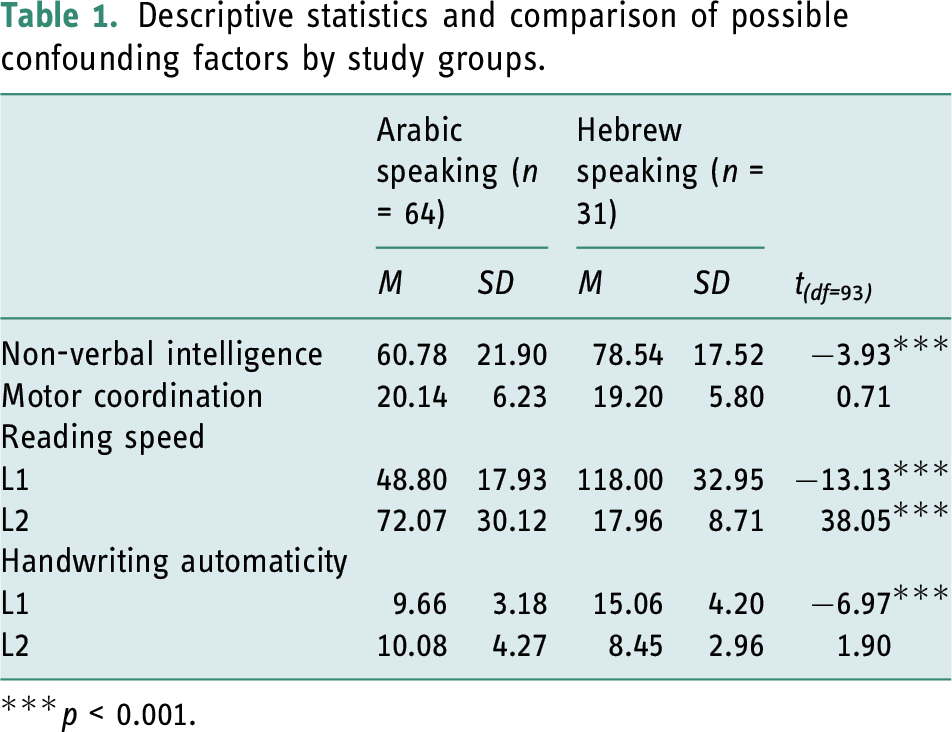
***p < 0.001.
Differences between Arabic and Hebrew groups in handwriting performance in L1 and L2
Comparison of handwriting speed of study groups in L1 and L2.
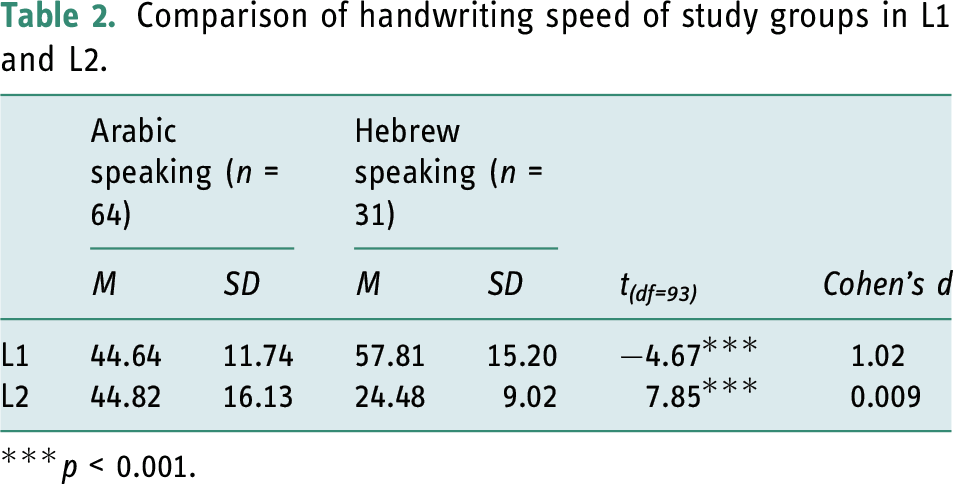
***p < 0.001.
Comparison of handwriting legibility of study groups in L1 and L2.
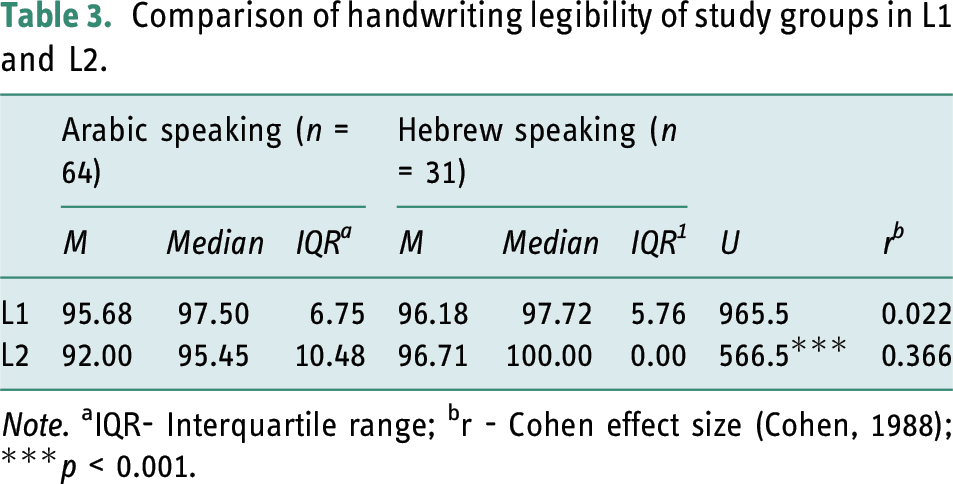
Note. aIQR- Interquartile range; br - Cohen effect size (Cohen, 1988); ***p < 0.001.
Due to the fact that legibility did not follow a normal distribution, we compared the handwriting legibility of the two study groups using Mann-Whitney U test. As can be seen in Table 3, results showed no significant difference (U = 965.5, p > 0.05) in handwriting legibility when each group wrote in their L1. In contrast, we did find a significant difference, with a moderate effect size (U = 566.5, p < 0.001, Cohen’s r = 0.366), between the groups’ handwriting legibility in L2. The Hebrew group wrote more legibly in Arabic than the Arab group, who wrote in Hebrew.
Comparing handwriting speed within primary-language groups
For the purpose of examining the cross language effect on handwriting speed, we compared handwriting speed within the language groups, using repeated measures ANOVA for each study group (See Table 2 for Means and SD). In the Arabic group, the results showed no significant difference (p > 0.05) in students’ handwriting speeds when they wrote in their L1 compared to L2. Similar results were found when controlling for the students' reading speed and handwriting automaticity in L2 (p > 0.05). In contrast, the Hebrew group wrote significantly faster in L1compared to their writing speed in L2, F (1,30) = 240.65, p < 0.001, η p 2 = 0.889). Similar results were noted after controlling for their reading speed in L2, F (1,28) = 10.03, p < 0.01, η p 2 = 0.264). Hence, it appears that the transfer effect of handwriting speed was not uniform, but rather language-dependent.
Hierarchical regression analyses for predicting L2 handwriting speed (N = 93).
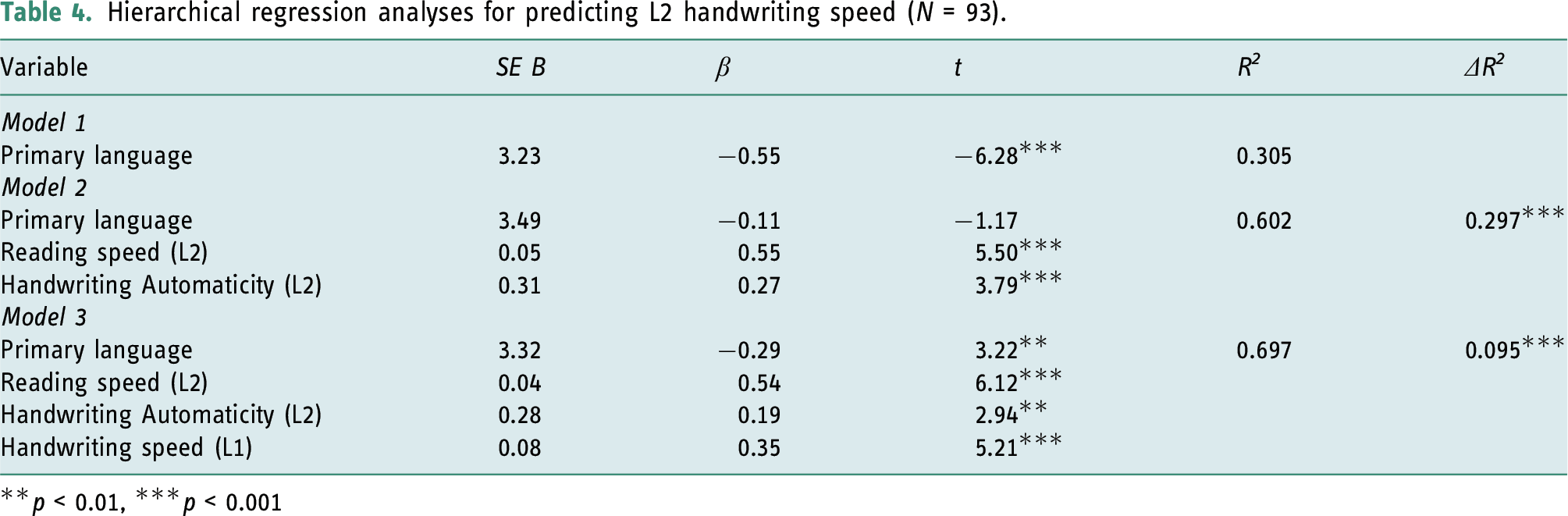
**p < 0.01, ***p < 0.001
Finally, we performed separate Wilcoxon Signed Ranks tests to compare within-group handwriting legibility (See Table 3 for Means and SD). Results indicated that in the Arabic group, students wrote in their L1 (Arabic) significantly more legibly than in their L2 (Z = −3.23, p < 0.001). In contrast, there was no significant difference (p > 0.05) within the Hebrew group in handwriting legibility in both languages.
Discussion
Although many countries have culturally and linguistically diverse populations, most research on handwriting focused on monolingual students, while the impact of cross-linguistic transfer on handwriting performance among students attending bilingual schools gained less attention. Moreover, most research that attempted to understand handwriting performance focused on students' body functions, and rarely addressed contextual factors such as language dominance (minority vs majority), or orthographic complexity. The present study examined the handwriting performance of fourth-grade students whose primary language was Arabic compared to Hebrew, both studying at bilingual schools. Comparisons were examined both with respect to L1 and to L2.
Effect of orthographic complexity-group differences
The effect of orthographic complexity on handwriting performance was examined by comparing the two study groups, each in their primary language (L1). We found that the Hebrew group wrote faster than the Arabic group. For the purpose of understanding these results, we compared the groups in terms of possible confounding variables. We noted that the groups were similar with respect to their motor coordination. Yet in the two linguistic skills, we found that the Hebrew group wrote the Alphabet from memory significantly faster than the Arabic group (i.e. showed better automaticity) and read a Hebrew text faster than their Arabic-speaking peers who read in Arabic. It should be noted, however, that the groups did not differ in handwriting legibility. In other words, the Hebrew group were able to achieve high level legibility while writing fast, whereas, the Arabic group attained this high legibility while writing slower.
A possible hypothesis for these findings is that the Arabic group had lower linguistic skills leading to lower handwriting and reading speed. However, the Arabic wrote and read significantly faster in L2 (Hebrew) than the Hebrew group who wrote in Arabic. These findings may be explained by the complexity of the Arabic orthography compared to other languages, including Hebrew (Ibraihm et al., 2013). This complexity involves not only the processing of the language, but also executing the motor programs and considering the spatial organization factors which handwriting entail (Graham et al., 2006), which is more complex in the Arabic orthography.
Cross-linguistic transfer
The transfer effect was examined by within-group comparisons. Our results indicated that in L2, the Arabic group showed no difference in their handwriting speeds in Arabic and in Hebrew; that is, their Arabic handwriting skills transferred, serving as the foundation for acquiring Hebrew handwriting (Cummins, 1979), and specifically writing speed. In contrast, students in the Hebrew group wrote significantly faster (more than double the speed) in their L1 compared to Arabic handwriting; for them, the transfer effect was very small. Hence, it appears that the transfer effect of handwriting speed, as in reading (Ibrahim et al., 2013), is not uniform, but is rather language-dependent. These findings are congruent with previous studies, suggesting that cross-linguistic transfer is more likely to occur from a more complex to a simpler language (Durğunoglu and Öney, 1999); thus, it may have been easier for the Arabic group to acquire Hebrew handwriting than vice-versa.
Following these results, we sought to examine the contribution of handwriting speed in L1, together with reading speed and handwriting automaticity in L2 (which were found to be related to handwriting speed; Bosga-Stork et al., 2016; Rodriguez and Villarroel, 2016), in predicting handwriting speed in L2, beyond the effect of students primary language. Results showed that these functions, explained approximately 70% of the variance in L2 handwriting speed. However, we also noticed that beyond the effect of reading speed and handwriting automaticity, handwriting speed in L1 had a unique significant contribution in predicting handwriting speed in L2. In other words, students' L1 handwriting speed is in itself an important factor in the transfer of handwriting skills to L2. Given that, to the best of our knowledge, there are not previous studies examining transfer effect in handwriting, we could not compare our results to previous studies. However, our results are consistent with those of Montanari et al. (2016) who showed a transfer effect between English and Italian among elementary-school students attending an immersion school in the United Stated, in writing skills, including content, organization, vocabulary and grammar.
Finally, from a socio-linguistic perspective, the asymmetry in cross-linguistic transfer effect in handwriting and reading among the Arabic and Hebrew bilingual students may also be attributed to the relatively higher levels of exposure of Arabic-speaking students to Hebrew, which is the majority language in Israel, compared to the exposure of Hebrew-speaking students to Arabic. It is likely that the difference in exposure to the two languages affects both the students' motivation to learn L2 and their basic level of linguistic competence in L2, two factors that have been found to be related to L2 acquisition (Cummins, 1979; Montanari et al., 2016).
Although the results of this study provide new evidence on cross-linguistic transfer with regard to handwriting and reading, due to the fact that these are only initial results, further research needs to be conducted to substantiate this hypothesis. Moreover, it should be noted that the linguistic skills we examined were limited. Future studies should expand this area of research (e.g. phonemic-graphic conversion and phonological awareness). Second, the handwriting task employed in this study was copying, which heavily depends on reading skills. Therefore, cross-linguistic transfer with respect to handwriting should be further studied using additional tasks such as dictation. Finally, this study focused on fourth-grade students, who were supposed to be at their initial stages of handwriting automaticity (Kandel and Perret, 2015). It would be interesting to replicate this study among older students.
Conclusion and clinical implications
To the best of our knowledge, this study was the first to examine the effect of cross-linguistic transfer from L1 to L2 on handwriting performance of Arabic- and Hebrew-speaking students learning in bilingual schools. Results showed that transfer occurred in both groups of students. However, the transfer was not uniform and was affected by students' reading speed and handwriting automaticity (but not motor skills). Moreover, the transfer also appears to be related to the orthographic complexity of the language as well as the country’s majority-language status.
These results suggest that occupational therapists should be mindful of the impact of bilingualism on students' academic performance. Specifically, when supporting students with handwriting difficulties in various settings, occupational therapists need to consider their socio-linguistic background. Hence, in addition to the usual data collected for the purpose of understanding students' occupational profile, it is important to note if the students are writing in their primary or secondary languages; whether their primary language is the dominant or minority language in the country; what is the students' reading level in L1 and L2 (if relevant). Furthermore, if the main language at school is the students' L2, it is also important to understand the orthographic structure of this L2, and whether the students have experience writing in L2. This information may assist both in better understanding students' handwriting performance and while developing an intervention program.
Footnotes
Acknowledgements
We are grateful to the principals, teachers and students for their time and cooperation. We also thank Ms. Haya Fogel-Grinvald for her statistical consultation.
Statement of contribution
This study was part of the first author’s Ph.D thesis. The other authors were her advisors. The first and last authors equally contributed in developing the study idea and design, as well as in the writing. The second author contributed in interpreting the study’s findings and conclusions.
Declaration of conflicting interests
The author(s) declared no potential conflicts of interest with respect to the research, authorship, and/or publication of this article.
Funding
The author(s) received no financial support for the research, authorship, and/or publication of this article.
Research ethics
This study was approved by the Israel Ministry of Education, #7790, RO 1003, October, 2013.
Patient and public involvement
During the development, progress, and reporting of the submitted research, Patient and Public Involvement in the research was not included at any stage of the research.
