




Abstract
Introduction
Children with developmental coordination disorder have significant difficulties with handwriting. Factors such as hand grip strength and pen pressure are often assumed by clinicians to play a role, although empirical evidence is lacking. The aim of this study was to measure grip strength and pen pressure to examine their relationships with handwriting performance in children with developmental coordination disorder.
Method
Sixteen 8–14-year-old children with developmental coordination disorder were compared with 20 typically developing age- and gender-matched controls. Palmar, pinch and tripod grip strength were measured using hand dynamometers. The mean pressure exerted on a writing tablet by the pen was obtained during a handwriting task. Group comparisons were made and correlations conducted between grip strength and pen pressure and a range of handwriting product and process measures.
Results
There were no group differences on the three measures of grip strength. However, the developmental coordination disorder group exerted less pressure on the writing surface compared to typically developing peers. There were no significant correlations between grip strength or pen pressure and handwriting performance in children with developmental coordination disorder.
Conclusion
Clinicians should be cautious when using measures of grip strength or pen pressure to inform them about aspects of handwriting skill in children with developmental coordination disorder.
Introduction and literature review
Handwriting is a key skill in school aged children as it facilitates academic progression, promotes participation and may help build self-esteem (Cunningham, 1992; Engel-Yeger et al., 2009). It is an important skill for academic success (Graham et al., 1998), with deficits often resulting in academic underachievement measured through writing tasks (Graham et al., 1997, 2000). One population known for a high incidence of handwriting difficulties is children with developmental coordination disorder (DCD) (Prunty et al., 2013; Prunty et al., 2014; Rosenblum and Livneh-Zirinski, 2008). DCD is the term used to refer to children who present with motor coordination difficulties unexplained by a general medical condition, intellectual disability or neurological impairment (APA, 2013). According to Missiuna et al. (2008), 86% of children with DCD have difficulties with handwriting, which is reflected in its inclusion in the diagnostic criteria for the disorder (APA, 2013).
In the last 10 years an increased use of digitising writing tablets has enabled researchers to examine the online process of handwriting as well as the written product (Prunty et al., 2013, 2014; Rosenblum and Livneh-Zirinski, 2008). Studies of the handwriting product have found that children with DCD produce fewer words per minute and a higher percentage of illegible words compared to typically developing (TD) peers (Rosenblum and Livneh-Zirinski, 2008). This slowness in production and inaccuracy in letter formation has been linked to the handwriting process, where excessive ‘pausing’ during writing has been described in the literature (Prunty et al., 2013, 2014; Rosenblum and Livneh-Zirinski, 2008). In a detailed examination, Prunty et al. (2014) found that children with DCD have a tendency to pause for long periods of time and more frequently within words compared to typically developing peers. However, despite detailed descriptions of their handwriting difficulties, the underlying mechanisms remain poorly understood. This has implications for occupational therapists, who take many referrals for the assessment and remediation of handwriting difficulties (Dunford et al., 2004; Miller et al., 2001; Missiuna et al., 2012). Without a robust evidence base to inform practice, clinicians are left to make their own assumptions about what might underlie the handwriting difficulties.
Handwriting requires the ability to manipulate the pen between the thumb and fingers using precise control of dynamic forces on the pen shaft to form letter shapes and prevent the pen from slipping in the hand. At the same time, appropriate force must be applied downwards onto the page to mark the paper (Smits-Engelsman et al., 2008). It is perhaps not surprising, therefore, that one area of focus in working with children with handwriting difficulties in clinical practice relates to force control while writing. This has included particular attention to the strength of the grip on the pen and the amount of pressure exerted on the page while writing (Cermak and Larkin, 2002; Jenkinson et al., 2008). Common observations in clinical practice are that children with DCD hold the pen/pencil tightly when writing and exert excessive pressure on the page, resulting in fatigue (Cermak and Larkin, 2002). This is often assumed to be related to a lack of strength and endurance, where reduced strength in the hand and shoulder impact on the ability to produce appropriate levels of force to produce legible handwriting (Blyth, 2015). Although the relationship between strength/force control and handwriting difficulties has not been properly examined, specific interventions aimed at improving strength and force control are recommended to clinicians to address handwriting difficulties in children (Cermak and Larkin, 2002). For example, occupational therapy interventions have involved the use of hand-strengthening activities to address handwriting difficulties for quite some time (Cermak and Larkin, 2002). This may involve activities such as manipulating Play-Doh or Theraputty to increase hand strength (Cermak and Larkin, 2002). Other interventions include specific handwriting programmes such as ‘Speed Up’ and ‘Write from the Start’, advocated by Addy and colleagues (Addy, 2014; Teodorescu and Addy, 2015), where the child’s ability to regulate force in the upper limb is targeted. These include freeing up a potentially stiff arm and hand and/or increasing stamina and stability in the shoulder girdle (Addy, 2014). In addition, another approach involves the provision of adaptive equipment in the form of an angled board, whereby the inclined surface is thought to promote pressure control (Addy, 2014; Jenkinson et al., 2008; Teodorescu and Addy, 2015).
Although these approaches are common in clinical practice, actually there has been little systematic examination of these aspects of performance. However, there is some evidence from research to suggest that children with movement difficulties do have problems with strength and the control of force. For example, Raynor (2001) and van der Hoek et al. (2012) found that children with DCD had reduced strength in the vastus lateralis and biceps femoris muscles of the legs. Similar findings were also reported in elbow flexion (van der Hoek et al., 2012). However, Hands and Larkin (2006) did not observe the same pattern in their study on grip strength, which is arguably the most relevant measure when considering handwriting. It has also been found that children with DCD exert excessive force when lifting and manipulating small objects (Jucaite et al., 2003; Pereira et al., 2001; Wilson et al., 2013) and coordinating grip force when objects are in motion (Hill and Wing, 1999).
In several studies on DCD, digitising tablets have been used to record axial pen pressure on the tablet during a variety of drawing and writing tasks. The majority of studies have focused on drawing (Smits-Engelsman et al., 2001) or the repetition of single characters (Di Brina et al., 2008). In both of these tasks, children with DCD were found to exert more pressure onto the page compared to TD peers. However, Rosenblum and colleagues examined pen pressure within handwriting tasks (copying and alphabet tasks) and found that contrary to assumptions held in practice, the children with DCD exerted less pressure onto the page compared to typically developing peers (Rosenblum and Livneh-Zirinski, 2008; Rosenblum et al., 2013). It should be noted that Rosenblum and colleagues used the Hebrew (Rosenblum and Livneh-Zirinski, 2008) and Arabic writing systems (Rosenblum et al., 2013) to examine pen pressure, where distinct biomechanical differences are required compared to the Latin-based alphabet. While the Hebrew and Arabic languages involve writing from right to left using a pushing movement across the page, the English language requires a pulling motion from left to right in right-handed writers. In order to account for biomechanical differences across languages and to understand the role of pressure on the page in explaining handwriting difficulties in children with DCD, research on pen pressure in the English language is also required.
Despite an emphasis in clinical practice on the link between strength and pen pressure, there is a distinct lack of research in this particular area. While Rosenblum and Livneh-Zirinski (2008) proposed a lack of strength and endurance as a possible explanation for reduced pen pressure, no study has examined this. Furthermore, it is unclear what role either strength or pen pressure plays in handwriting difficulties in children with DCD. Therefore, there is a need to examine this in order to inform and support decisions made in practice.
Given the literature described above, the aim of this study was to examine grip strength and pen pressure in children with DCD and their relationship with measures of handwriting. To do so, palmar, pinch and tripod grip strength and the pressure exerted on the page while writing were measured in children with and without DCD. The group performances on these measures were used to ascertain the relationship between these measures and performance on the handwriting product (speed, legibility) and process (execution speed, pausing during writing).
In line with clinical assumptions, our hypotheses were as follows.
Grip strength is poorer in children with DCD compared to TD children. Pressure exerted on the page while writing in English is greater in children with DCD compared to TD children. There is a significant and positive relationship between grip strength and pressure on the page. There is a significant relationship between (a) grip strength and (b) pressure on the page while writing with both the product and process measures of handwriting.
Methods
Research design
The study was approved by the College of Health and Life Sciences University Research Ethics Committee (Registration No: 2922-MHR-Jun/2016- 3184-2). Written informed consent to participate in this study was obtained from the parents of the participants.
Participants
DCD group
Children for the DCD group were recruited through the community, including parent support groups, schools and our research group (www.brunel.ac.uk/kidspace) website. All children were assessed in line with European guidelines (Blank et al., 2012) by the first author (an occupational therapist) and met the DSM-5 diagnostic criteria for DCD (APA, 2013). To confirm Criterion A the children had to have significant motor difficulties, with performance below the 5th percentile when assessed on the test component of the Movement Assessment Battery for Children 2nd edition (MABC-2) (Henderson et al., 2007). This examines three components of motor competency: manual dexterity, aiming and catching, and balance. For Criterion B the motor difficulties had to have a significant impact on the children’s activities of daily living, as reported by their parents during a parent interview with the first author and evident on the MABC-2 checklist (Henderson et al., 2007), which the parent completed. To confirm Criteria C and D developmental, educational and medical histories were taken by the first author from parents, which confirmed that there was no history of neurological or intellectual impairment and no medical condition that might explain the motor deficit. For Criterion D, the British Picture Vocabulary Scale 2nd edition (BPVS-2) (Dunn et al., 1997) was implemented with each participant to give a measure of receptive vocabulary, which correlates highly with verbal IQ (Glenn and Cunningham, 2005). This was at least in the average range for all children, confirming the absence of general intellectual impairment.
TD control group
The control group was recruited through local primary and secondary schools in West London, England. Teachers were asked to use their professional judgement to identify children without any motor, intellectual or reading/spelling difficulties. To ensure the children identified were free of motor impairment they were individually tested on the MABC-2 test (Henderson et al., 2007) manual dexterity component. Children were included in the control group if they scored at least at the level expected for their age (above 15th percentile).
Children with a diagnosis of dyslexia, attention deficit hyperactivity disorder (ADHD) and/or those who had English as a second language were excluded from the study based on the role of language and attention as confounding factors when researching handwriting skill in children (Connelly et al., 2012; Sumner et al., 2014). Children who had a reported physical, sensory or neurological impairment were also excluded. This was to ensure that handwriting difficulty could not be attributed to other disorders. See Table 1 for performance profiles of both groups.
Mean (SD) of selection measures for both groups.
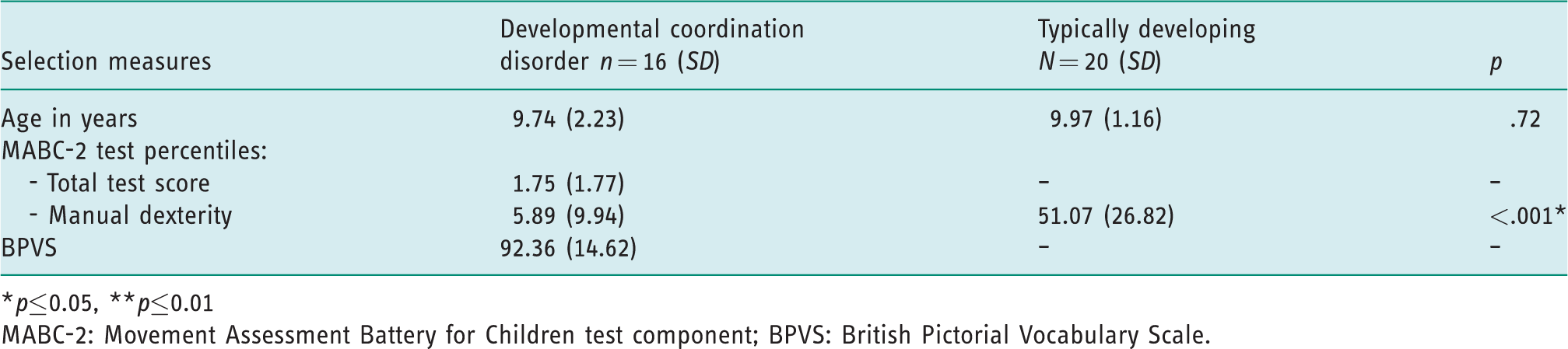
*p≤0.05, **p≤0.01
MABC-2: Movement Assessment Battery for Children test component; BPVS: British Pictorial Vocabulary Scale.
Measures
The handwriting product.
Handwriting speed
The Copy Fast task from the Detailed Assessment of Speed of Handwriting (DASH) (Barnett et al., 2007) was used to examine the handwriting product. The DASH was chosen as it is the only standardised handwriting speed test with United Kingdom (UK) norms for 9–16-year-olds. The child copied the sentence ‘The quick brown fox jumps over the lazy dog’ as quickly as possible for 2 minutes. Totally illegible words, the final word (if incomplete) and punctuation marks were excluded from the score. The number of words produced per minute was used as the dependent variable as norms were not available for the 8-year-olds in the study. The number of words per minute is widely used in writing research to denote handwriting speed (Barnett et al., 2007; Connelly et al., 2012; Sumner et al., 2014). The inter-rater reliability for the Copy Fast task is .99, as reported in the test manual.
Handwriting legibility
Although the DASH (Barnett et al., 2007) was developed to measure handwriting speed, in order to do so, all illegible words must be identified. An illegible word (as defined in the test manual) was a word that could not be recognised outside the context of the sentence. Percentage of illegible words produced during the 2-minute Copy Fast task was used as the dependent variable.
The handwriting process
These measures were concerned with the ‘online’ temporal aspects during handwriting performance.
When completing the handwriting task, the participants wrote with an inking pen on paper placed on a Wacom Intuos 4 digitising writing tablet (325.1 mm ×203.2 mm) to record the movement of the pen during handwriting. The writing tablet transmits information about the spatial and temporal data of the pen as it moves across the surface. Eye & Pen version 2 (EP2) software (Alamargot et al., 2006) was used to analyse the text. In this study a wireless inking pen (model KP-130-10) was used with an A4 page lined sheet of paper. The data was sampled at 100 Hz via a Celeron Dual Core CPU T3500 @ 2.10 GHz laptop computer.
The following process measures were extracted using EP2 software (Alamargot et al., 2006).
Execution speed (cm/sec)
Execution speed is the speed of the pen when it is in contact and moving on the page. This does not include when the pen is pausing on or off the page. Execution speed is calculated by EP2 as the distance covered by the pen (cm) divided by the writing time (time between the first time the pen touches the tablet to the last pen lift of the task). While in previous studies no group differences were found on execution speed (Prunty et al., 2013), this measure was used in the current study to examine its relationship with measures of grip strength and pen pressure.
Pausing during writing
Pausing during writing is measured as the percentage of time during the task where the pen was either off the page (in-air pause) or halted on the page (on-paper pause). In previous work, it was reported that the DCD group paused for a higher percentage of the task than typically developing peers (Prunty et al., 2013), which is an indication of lack of automaticity in writing (Prunty et al., 2014; Kandel et al., 2006). The percentage of pausing was used in the current study to examine its relationship with grip strength and pen pressure.
Grip strength
Three measures of grip strength were taken, including palmar, pinch and tripod.
Palmar grip strength was measured to ascertain the level of strength in the extrinsic muscles of the hand located in the forearm (Winkelstein, 2012). Palmer strength was measured using a North Coast (manufacturer) Jamar hand dynamometer. In line with current American Society of Hand Therapists (ASHT) (2015) guidelines, each participant was instructed to hold the dynamometer using a palmar grasp, with their elbow flexed to approximately 90 degrees, shoulder abducted slightly with medial rotation of the forearm (in a similar position to handwriting). The dynamometer was placed in the dominant (writing) hand first and the participants were instructed to squeeze as hard as they could following a 3-second count down. The dynamometer was squeezed for up to 3 seconds to make sure the child had the opportunity to recruit as much muscle force as possible. The non-dominant hand was then tested in the same manner. Each hand was tested three times. The Jamar dynamometer is a reliable method of measuring grip strength (0.85–0.98) and is recommended for use in clinical practice (Peolsson et al., 2001).
Pinch (thumb and index finger) and tripod (thumb, index and middle finger) strength was measured using a similar protocol as these fingers are used in pencil grasps during handwriting (Summers, 2001). A pinch gauge was presented to the participant and they were requested to grip the gauge with the thumb underneath and the index (pinch) or index and middle finger (tripod) placed on the dial side. The instructions were the same as those used in the palmer grip measure above. A practice trial was carried out by the participant for each grip performed. The mean strength (measured in kilograms) across the three attempts was calculated as the dependent variable for each grip.
Pressure on the writing tablet
Eye & Pen version 2 (EP2) software (Alamargot et al., 2006) was used to analyse the mean amount of pen pressure exerted on the writing tablet during the handwriting tasks as measured in Newtons. Formal investigations of writing tablet pressure in terms of reliability are not reported in the literature. However, it has been shown in some studies that the pressure sensitivity of writing tablets can vary based on the manufacturer. The same manufacturer (Wacom) as that used in Chang and Yu (2010) and Rosenblum and Livneh-Zirinski (2008) was used in the current study.
Data collection
The measures of grip strength were implemented first, followed by the handwriting assessment, over one 60-minute session. The children with DCD were tested at the Brunel University London by a research assistant (member of the British Psychological Society), who received training, from the first author, in the electronic data collection processes to ensure consistency and accuracy, and an experienced occupational therapist (hand therapist). The typically developing group were tested by two master’s students (occupational therapy), who received extensive training from the hand therapist on the standardised application and collection procedures, adhering to the ASHT (2015) guidelines when using the Jamar hand and pinch dynamometers and goniometers. Training in the assessment process and tool applications formed part of the master’s programme curriculum, with additional specific small group training and practice to ensure consistency, totalling in excess of 7 hours. This study was part of a broader research programme and involved more extensive testing than reported here.
Data analysis
For comparisons between the DCD group and TD group, tests of normality were conducted initially and descriptive statistics for the dependent variables examined. Differences in the mean values between the groups for all normally distributed measures were examined using t-tests. Those measures that did not meet the normal distribution assumptions were compared using the nonparametric Mann–Whitney U test. Significance levels for both tests were set at p<.05.
Bivariate partial correlations controlling for age were conducted to examine the relationship between grip strength and pen pressure, and also between both measures and the handwriting product (words per minute, percentage of illegible words) and process measures (execution speed and percentage of pausing). Age was controlled for in correlational analyses as it is a known confounder in relation to handwriting speed (Barnett et al., 2007) but is also closely associated with the development of grip strength (Cohen et al., 2010). All correlations were calculated with the DCD and TD groups separately and with both groups combined. When combined, partial bivariate correlations were conducted again with age as the covariate. Variables that were significantly related to either handwriting speed or legibility in each group were entered into a step-wise regression analysis to ascertain whether they had a predictive relationship with handwriting performance.
Results
Sixteen children with DCD (13 boys, 3 girls) and 20 age- (within 4 months) and gender-matched TD controls were included in the study. The children ranged from 8 to 14 years of age and were in mainstream schools. No participants withdrew from the study.
The handwriting product
Handwriting speed
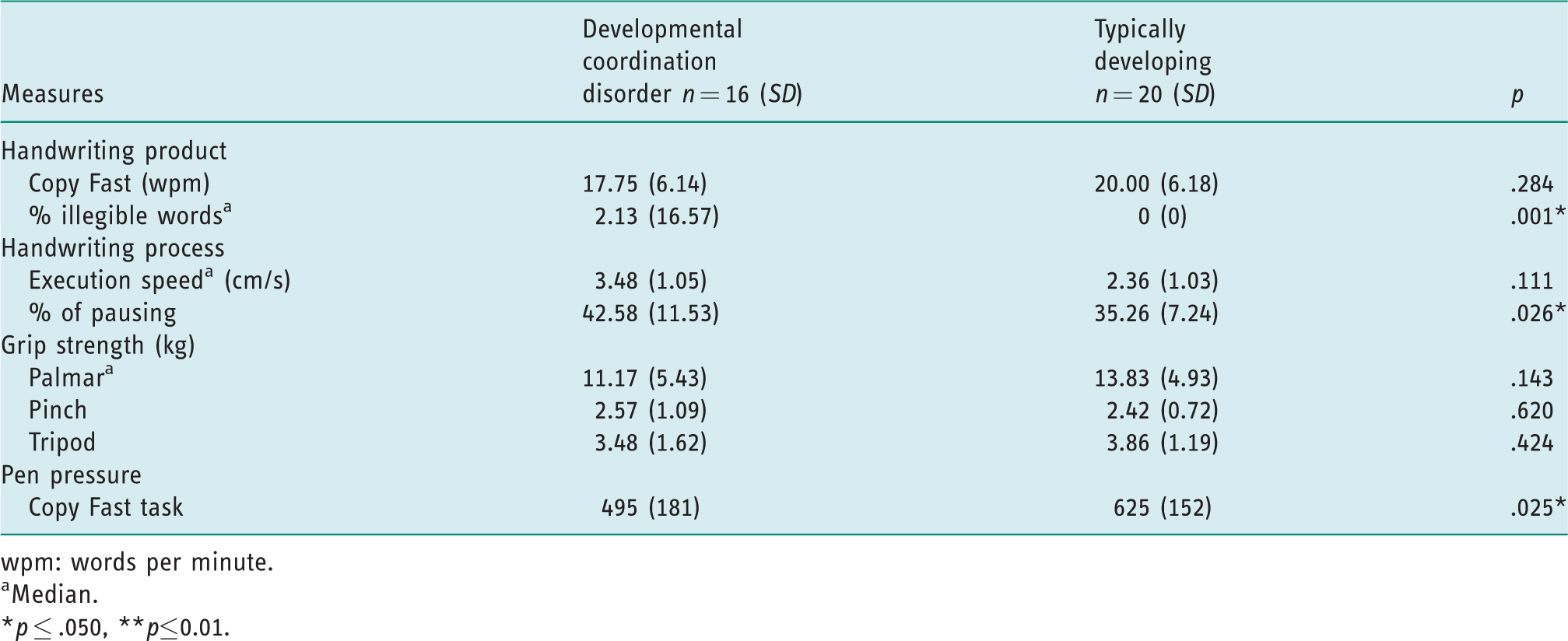
There was no significant effect of group for the number of words per minute (t (34) =–1.089, p = .284, d = 0.36, 95% CI [–6.45, 1.95]), as the DCD group performed similarly to the TD group (see Table 2).
A comparison of the handwriting performance, grip strength and pen pressure measures (mean (SD) or median) for both groups.
wpm: words per minute.
aMedian.
*p ≤ .050, **p≤0.01.
Handwriting legibility
There was a significant effect of group for the percentage of illegible words (U = 80.00, p = .001, r2 = 0.33), as the DCD group had a higher percentage of illegible words than TD peers.
The handwriting process.
Execution speed (cm/sec)
There was no significant effect of group for execution speed (U = 110, p = .111, r2 = 0.07), as the DCD group demonstrated a similar execution speed to TD peers.
Pausing during writing
There was a significant effect of group for the percentage of pausing (t (34) = 2.32, p = .026, d = 0.76, 95% CI [.9328, 13.71]), as the DCD group paused for a greater percentage of the task compared to TD peers.
Table 2 provides a summary of performance in both groups.
Grip strength
Hypothesis 1: grip strength is poorer in children with DCD compared to TD children.
There was no significant effect of group for any of the grip strength measures, including palmar (U = 114, p = .143, r2 = 0.05), pinch (t (34) = 0.5, p = .62, d = 0.16, 95% CI [–.462, .764]) and tripod (t (34) = –0.81, p = .424, d = 0.26, 95% CI [–1.33, .573]). See Table 2 for mean grip strength performance for both groups.
Pressure on the writing tablet
Hypothesis 2: pressure exerted on the page while writing in English is greater in children with DCD compared to TD children.
There was a significant effect of group for pen pressure (t (34) = –2.34, p = .025, d = 0.77, 95% CI [–242.44, –17.02]) as the TD group exerted more pressure (M = 624.8, SD = 152.2) on the writing surface compared to the DCD group (M = 495.1, SD = 180.6) (Table 2 provides a summary).
Correlations between grip strength and pen pressure
Hypothesis 3: there is a significant and positive relationship between grip strength and pressure on the page.
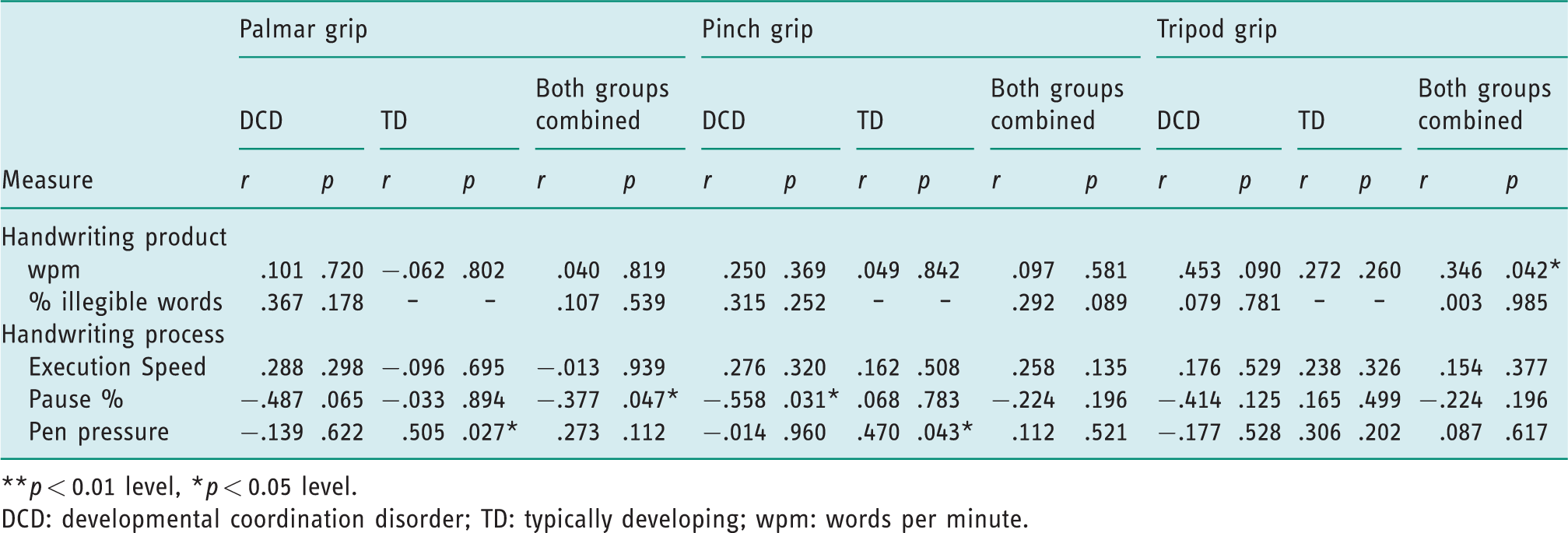
Bivariate partial correlational analyses (controlling for age) were examined between the grip strength measures for the writing hand, and the amount of pressure exerted on the page for the Copy Fast task. Both groups were analysed separately and together. Significant correlations were found in the TD group only for palmar grip (r (17) = .505, p = .027) and pinch grip (r (17) = .470, p = .043). No significant correlations were found in the DCD group or when both groups were combined (See Table 3).
Grip strength correlations with measures of the handwriting product and process.
**p < 0.01 level, *p < 0.05 level.
DCD: developmental coordination disorder; TD: typically developing; wpm: words per minute.
Correlations between grip strength and handwriting performance
Hypothesis 4a: there is a significant relationship between grip strength with both the product and process measures of handwriting.
Palmar grip
When both groups were analysed separately and together (controlling for age), no significant correlations were found with any of the handwriting measures and palmar grip strength (see Table 3).
Pinch grip
One significant correlation was found in the DCD group only when both groups were analysed separately (controlling for age). This was in relation to the percentage of pausing (r (13) = –.558, p = .031), where a moderate negative correlation was found (see Table 3).
Tripod grip
One significant correlation was found when both groups were analysed together (controlling for age). This was in relation to the number of words per minute (r (33) = .346, p = .042), where a moderate small positive correlation was found (see Table 3). No other significant relationships were found (together or separate) with any of the handwriting measures and tripod grip strength (see Table 3).
Correlations between pen pressure and handwriting performance
Hypothesis 4b: there is a significant relationship between the pressure on the page while writing and both the product and process measures of handwriting.
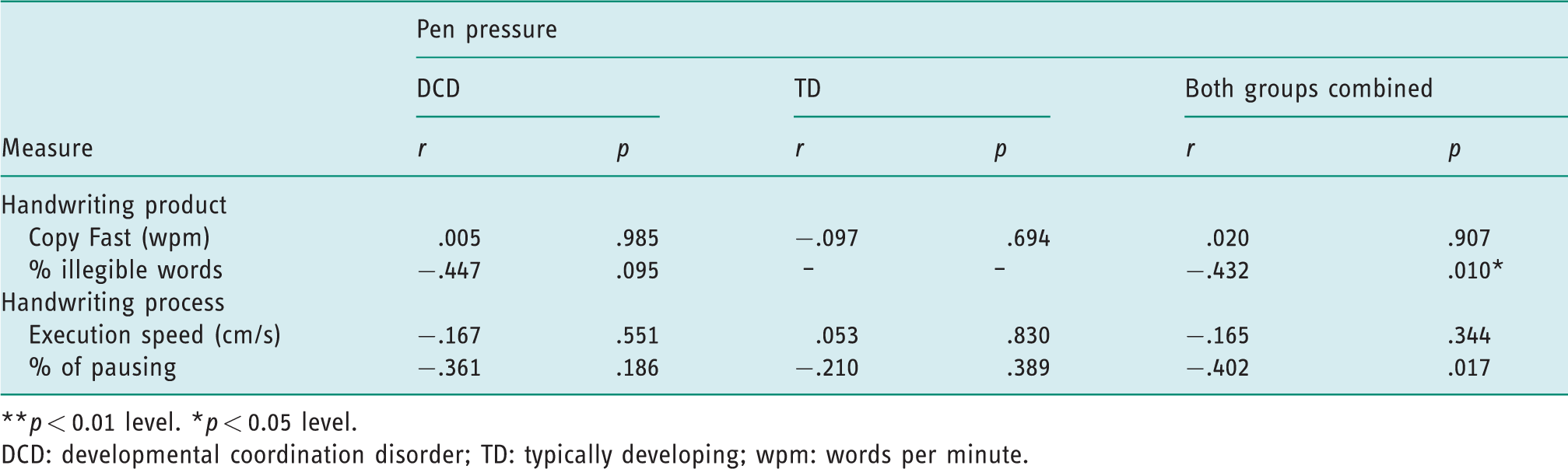
When both groups were analysed separately, no significant correlations emerged for either group. When controlling for group membership and considering the two groups together, there was a significant negative relationship between pressure on the page and the percentage of illegible words (r (36) = –.409, p = .013) as well as with the percentage of time spent pausing (r (36) = –.415, p = .012) (see Table 4). It seems that an increase in pen pressure was associated with a lower percentage of illegible words and less time spent pausing. There were no other significant relationships found.
Correlations between pen pressure and the handwriting product and process.
**p < 0.01 level. *p < 0.05 level.
DCD: developmental coordination disorder; TD: typically developing; wpm: words per minute.
Discussion
Over the last 10 years, studies have provided a better description of handwriting difficulties in children with DCD. With the use of writing tablets there is now clear evidence of deficits both in the handwriting product and the handwriting process (Prunty et al., 2013, 2014; Rosenblum and Livneh-Zirinski, 2008). However, while progress has been made, the underlying mechanisms require further investigation. For clinicians this is particularly important as an evidence base is required in order to inform best practice. In this study we examined four hypotheses in order to understand the relationship between grip strength and pen pressure and their role in handwriting difficulties in children with DCD.
The first question focused on grip strength, and our prediction (Hypothesis 1) was that it would be poorer in children with DCD compared to TD peers. Our findings did not support this as there were no group effects for either palmar, pinch or tripod grips. It seems the DCD group were just as strong as the TD group on the three hand-strength measures. While our findings are supported to some extent by van der Hoek et al. (2012), overall they went against our own hypothesis but also against previous findings across a range of strength-related studies (Aertssen et al., 2016; Ferguson et al., 2014; Raynor et al., 2001). However, the issue with comparing the findings of this study to others in the literature is the variety of ways in which muscle strength has been measured. Few studies on children with DCD have focused specifically on the strength of the hand. Perhaps the most closely aligned is Ferguson et al. (2014), who measured ‘3 point strength’ similar to our pinch strength measure. However, no study (that we are aware of) has examined palmar, pinch and tripod grips using guidelines from hand therapy (ASHT, 2015).
From a clinical perspective, the more pertinent question in this study in relation to grip strength was its relationship with handwriting performance. This question was driven by approaches used in occupational therapy practice where hand-strengthening exercises are often used to address handwriting difficulties (Cermak and Larkin, 2002). Our hypothesis (Hypothesis 4a) on this issue was that there would be a relationship between strength and the handwriting product and process in children with DCD. However, this was not the case for most of the handwriting measures across the three hand grips. The only grip that was associated (moderate to low) with handwriting in the DCD group was the relationship between pinch grip and the percentage of pausing. According to our analysis, a stronger pinch grip in the DCD group resulted in less pausing during the Copy Fast task. However, this did not seem to impact on the handwriting product in this group as there were no significant correlations found between any of the grip strength measures and measures of the handwriting product and process. This is important as previous studies on handwriting performance in children with DCD have reported links between the percentage of pausing and difficulties with legibility (Prunty and Barnett, 2017) and speed (the number of words produced per minute) (Prunty et al., 2013). If pinch strength was impacting on legibility and speed then there would have been a relationship between these variables. Given that this was not the case, there appears to be limited evidence that reduced grip strength impacts on handwriting performance on a functional level in children with DCD.
The second major focus of this study was surrounding pen pressure, which was of interest based on compensatory approaches used in occupational therapy practice such as the use of slope boards to counteract a decrease in pen pressure or the use of handwriting programmes (Addy, 2014; Teodorescu and Addy, 2015) to regulate force in the upper limb. In the first instance, we predicted (Hypothesis 2) that the children with DCD would exert greater pressure on the page while writing. However, our findings did not support this as, although we found a significant group effect, the DCD group exerted less pressure than the TD group. This is in line with findings reported in Israel (Rosenblum and Livneh-Zirinski, 2008), despite the directional and biomechanical differences between the Hebrew- and Latin-based writing systems. Interestingly, Smits-Engelsman et al. (2001) reported an increase in pressure in children with DCD during a tracing task. It seems the demands of a precision task such as tracing would be different to the demands of handwriting, where language and other cognitive motor processes constrain the movement of the pen (Kandel, 2006; Van Galen, 1991). We did follow-up analyses based on a suggestion by Rosenblum and Livneh-Zirinski (2008), where a lack of strength was proposed as an underlying mechanism for reduced pen pressure. Our prediction (Hypothesis 3) was that there would be a relationship between grip strength and the amount of pen pressure exerted during writing. However, we found no evidence of this in the DCD group. This suggests that, at least in the DCD group, grip strength and pen pressure appear to be independent of each other.
Our final analyses (Hypothesis 4b) examined the relationship between pen pressure and performance on a range of handwriting product and process measures. The correlational analyses revealed no relationship between pen pressure and any of the handwriting measures in either group when analysed separately. There was a moderately positive relationship between pen pressure and legibility when both groups were combined (more pressure indicated a higher percentage of illegible words), but there was no evidence of this association in the individual groups. This was an interesting finding from a clinical perspective as, according to Blyth (2015), a lack of strength in the hand and shoulder may impact on the ability to produce appropriate levels of force to produce legible handwriting. However, our findings did not support this. It is important to note, however, that this study focused on the mean pressure exerted over the course of the handwriting task. It must be recognised that controlling the pen during a writing task is complex and children with DCD may well have difficulties with regulating force while writing. Indeed, studies have found that children with DCD have difficulties controlling force when manipulating small objects (Jucaite et al., 2003; Pereira et al., 2001; Wilson et al., 2013) and coordinating grip force when objects are in motion (Hill and Wing, 1999). Therefore, while they may not have exerted more pressure overall, they may have experienced subtle difficulties from letter to letter.
Future research
Future research could examine more closely the differences in pen pressure associated with different letters. Indeed, this would be worth examining in more detail in the future as a lack of force control may be a factor in within-word pausing in children with DCD where they have a tendency to pause in between letters (Prunty et al., 2014; Prunty and Barnett, 2017). While this within-word pausing is likely to be attributed to incorrect letter formation (Prunty and Barnett, 2017), it may also be driven by difficulties coordinating the movements to manipulate the pen.
Also worthy of further consideration is the fluency and accuracy of in-hand manipulation of the pen through examining pen pressure and velocity of movement from letter to letter. From a clinical perspective, however, there appears to be limited evidence from this study that pen pressure is directly associated with handwriting difficulties in children with DCD. As such, clinicians need to consider alternative factors that may be influencing their performance.
Recent studies have provided evidence that cognitive processes, rather than physical components, are impacting on handwriting production in children with DCD. For example, in two studies (Prunty and Barnett et al., 2017; Prunty and Barnett, in press) we found that children with DCD produced a higher percentage of errors in components of letter formation including incorrect direction of strokes, too few strokes and incorrect starting positions. These errors in letter formation impact on fluency of movement, which links to the within-word pausing described in the literature (Prunty and Barnett, 2017). Issues surrounding how to execute a letter could be addressed using task-orientated approaches to intervention where the production of correct letter formation/sequencing of movements would be the focus of intervention rather than underlying impairments such as grip strength. This would align with the international guidelines for DCD, where the use of task-orientated approaches to intervention are advocated by Blank et al. (2019).
Limitations of this study
While the findings of this study challenge some assumptions made in practice, it is important to note that a limitation of this study was the sample size, which may have impacted on power. Ferguson et al. (2014) found a significant effect of group for grip strength using a sample size of 70 participants with DCD. However, while this study had fewer participants, it was the first to systematically examine hand strength and its relationship with the task of handwriting in children with DCD, and as such it provides some evidence to inform practice.
Key findings
The development coordination disorder (DCD) group were just as strong as the control group on the three measures of hand grip strength. The DCD group exerted less pressure on the page while writing compared to the control group. There were no relationships between grip strength or pen pressure and any of the handwriting measures in the DCD group.
What the study has added
This study is the first to systematically examine hand grip strength and pen pressure in children with DCD. Contrary to assumptions often held in practice, the DCD group were just as strong as the TD group and their hand strength across the three grips did not have an impact on their handwriting performance. This study provides some evidence for clinicians to exercise caution when considering factors that may be contributing to handwriting difficulties in children with DCD.
Footnotes
Acknowledgements
We would like to thank all of the participants who took part in this study and their families.
Research ethics
Ethics approval was obtained from The College of Health & Life Sciences University Research Ethics Committee at Brunel University London Registration No: 2922-MHR-Jun/2016- 3184-2.
Consent
All participants provided written and verbal consent to take part in the study.
Declaration of Conflicting Interests
The authors declared no potential conflicts of interest with respect to the research, authorship and/or publication of this article.
Funding
The authors disclosed receipt of the following financial support for the research, authorship, and/or publication of this article: This research was funded by the UK Occupational Therapy Research Foundation (UKOTRF) Research Development Grant (2016).
Contributorship
Mellissa Prunty led the funded project, supervised the research assistant and wrote the manuscript for the study.
Anna Pratt led on the hand measurements and collected the data for the DCD group. She helped prepare the manuscript for publication.
Evren Raman was the research assistant on the grant, co-ordinated recruitment to the study and collected the writing table data. Evren prepared the results for the manuscript.
Laura Simmons was an MSc occupational therapy student and gathered data from typically developing children for the group comparisons.
Fahyma Steele-Bobat was an MSc occupational therapy student and gathered data from typically developing children for the group comparisons.
