




Abstract
The article contributes new data for Egyptian–Levantine relations during the Egyptian 6th Dynasty drawing on a petrographic study of Levantine Combed Ware jars found at Abydos. This is the largest group of Combed Ware Jars from the provinces and the only Old Kingdom group from outside the Memphite area to be studied using this method. The article confirms that the Egyptian–Levantine trade for liquids throughout the Old Kingdom using Combed Ware Jars was principally with a limited area of coastal Lebanon and was probably organised at the Levantine end by the port of Byblos.

Introduction
In recent years, new textual and archaeological data has revealed the complexity of Old Kingdom Egyptian trade relations with the eastern Mediterranean during the Early Bronze III–IV. Data has included new insights on the Ebla texts and the source of commodities, and a more nuanced understanding of the role of Byblos as a central trade node on the Levantine coast, alongside that of regional intermediaries and supra-regional networks. This article contributes to our understanding of Egyptian–Levantine relations through a new petrographic analysis of imported Combed Ware Jars (CWJ) found in 6th Dynasty contexts at Abydos in Egypt. The corpus from the tomb of Weni the Elder and his family network is the largest group of 6th Dynasty CWJ and the only corpus outside the Memphis capital zone hitherto studied using this method. By considering the petrography together with technical considerations, stylistic features, and ‘pot marks’, the study provides new information on the geographic focus of the trade and how the supply of pottery for maritime trade was organised.
The Combed Ware Jar is a distinctive Levantine pottery type used locally for interregional commerce and for exporting liquid substances. 1 The vessels have a distinctive appearance that over time and could have been considered a ‘brand’: they are large, flat-based, with two vertical loop handles and a combed outer surface. 2 In Egypt, the earliest occurrences of CWJ were in Dynasties 0–2, when it was one of a number of container types used to import foreign substances. 3 During the 4th Dynasty, CWJ became the principal imported transport jar found in Egypt and by the 6th Dynasty, the sole type, perhaps reflecting the specialisation and increased specificity of the liquids trade over time. In total, the corpus of CWJ in Egypt encompasses around 100 complete examples and additional sherd material. 4 Until recently, the majority of CWJ in Egypt dated to the 4th Dynasty, reflecting the focus of systematic early excavations at Giza. New excavations reveal the continued importation of such jars in high volumes until the end of the 6th Dynasty. 5 There is a concentration of CWJ in tombs in the Memphite area (Giza, Saqqara, Abusir, Dashur, Abu Rawash), but CWJ also occur in settlements (Giza, Elephantine, Buto) as well as in provincial cemeteries (Abydos, Edfu, Matmar, Ballas). 6 In Egyptian cemetery contexts CWJ are found almost exclusively in the tombs of elite male officials. As foreign trade was a royal monopoly in Old Kingdom Egypt, the substances transported in CWJ may have been gifts to loyal officials: as recorded in the 6th Dynasty biography of Djau of Deir el-Gebrawi, he received textiles and sft-oil imported from the Levant, for his burial from the double treasury. 7 As an exotic product, the jars themselves may have been gifted. 8
Determining the provenance of Levantine CWJ in Egypt is complicated owing to the preservation of many intact vessels from tombs, whereas the Levantine material consists primarily of sherds from settlements. As vessels with a combed surface were found over a wide area of the Early Bronze Levant, narrowing down production zones of the CWJ found in Egypt was difficult. 9 The subjective nature of comparative work, different definitions of CWJ, and the state of excavation and publication for some important sites were further problems. 10 Thus, provenance studies using macroscopic techniques, such as vessel morphology, seal impressions, and surface treatment were inconclusive, identifying different origins for the same materials, including different regions of the Levant and Egypt (fig. 1). 11 Recently, significant progress has been made utilising scientific approaches on fabrics and clays, identifying a production zone in coastal Lebanon. 12 Yet the majority of petrographically studied CWJ in Egypt are from the Memphite area and date to either the 4th Dynasty or the end of the 6th Dynasty.
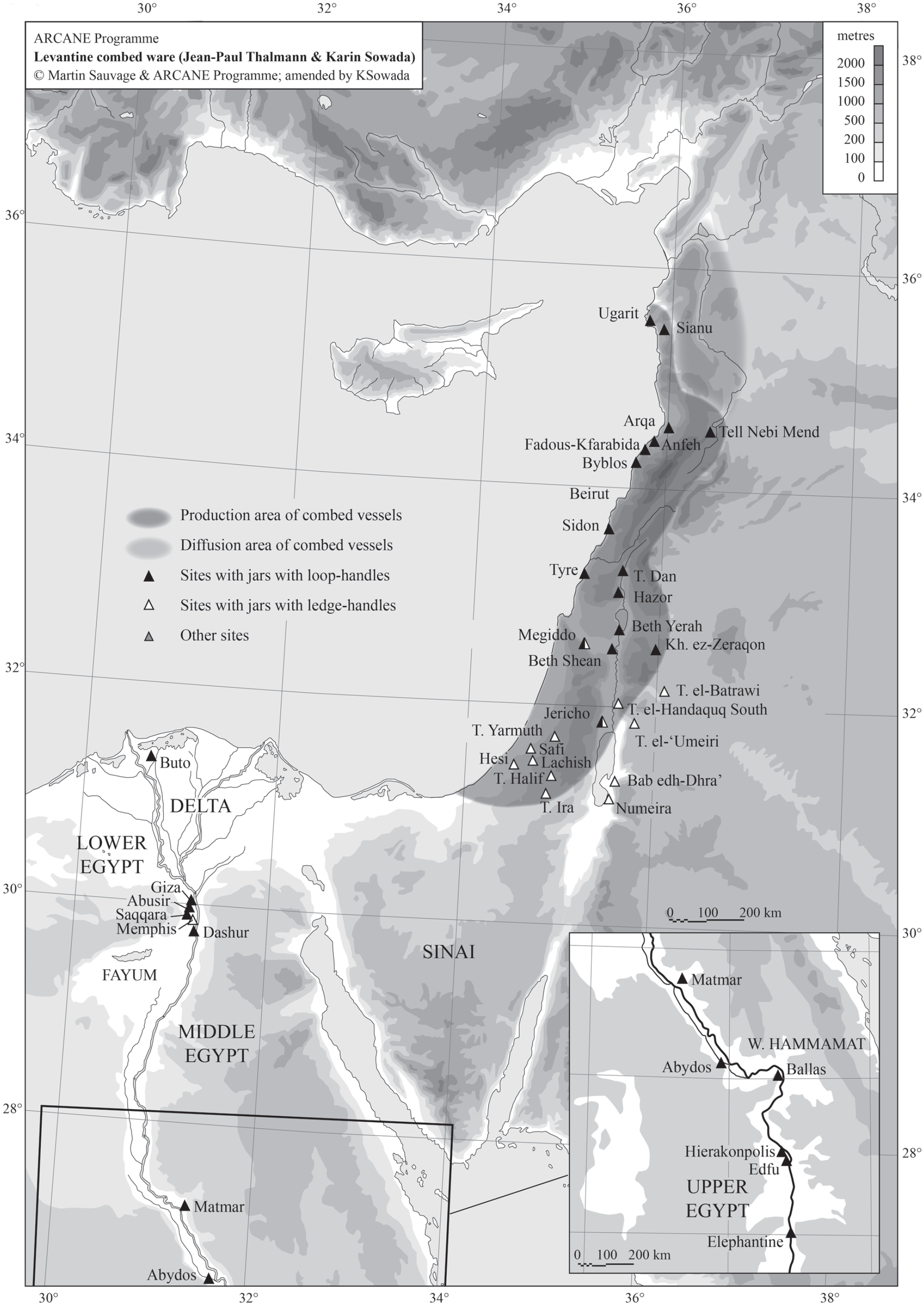
Levantine Combed Ware Jars in the Levant and Egypt (plan: Martin Sauvage/ARCANE, amended by K. Sowada and C. Knoblauch. Used with permission).
The current study aims to correct this imbalance with a more representative dataset through the petrographic study of twelve CWJ from Abydos in Upper Egypt, where a large corpus of vessels was found in 6th Dynasty contexts dating to the reigns of Pepi I, Merenre, and Pepi II. The study provides new data for defining the geographical scope, chronological trajectory, and organisation of Levantine–Egyptian trade from the early to late 6th Dynasty.
Combed Ware at Abydos
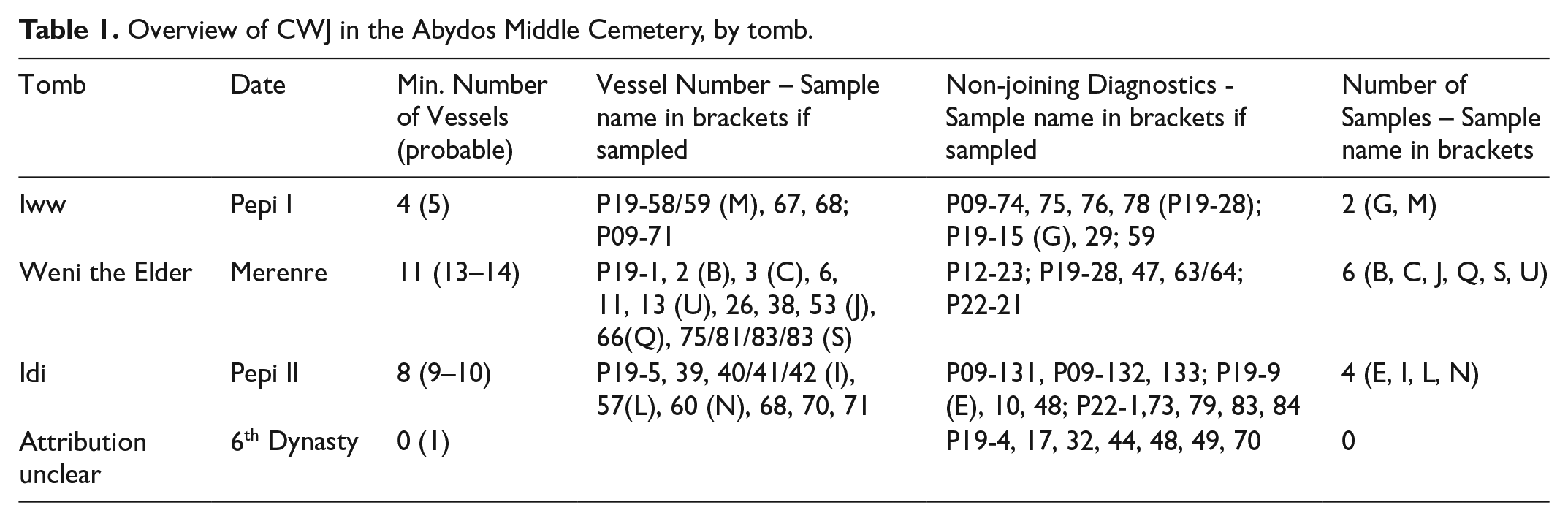
Abydos is located in Sohag province, 400 km upstream of Cairo. The CWJ in this article were excavated by the University of Michigan from 1999 to 2022 in the ‘Middle Cemetery’ (AMC) (fig. 2). 13 The area was used in the 6th Dynasty by national elites aligned with the royal court at Memphis. 14 The vessels come from three tombs belonging to successive generations of one family: Iww, a vizier who served Pepi I; his eldest son, Weni the Elder, the famous Old Kingdom official who served Teti, Pepi I, and Merenre; and Idi, a vizier and overseer of Egypt who lived into the first half of the reign of Pepi II and whose complex was probably connected to a niece of Weni’s. 15 The tombs span three generations in the late 24th to mid-23rd centuries BCE and are contemporary with the EB IV or the Early Central Levant (ECL) 5–6, Early Northern Levant (ENL) 5 period as defined in the ARCANE chronology. 16 A minimum of 23 CWJ were recorded but taking non-joining diagnostic rims into consideration, the number was closer to 25 (table 1). 17 Although none were found complete or in undisturbed contexts, the distribution of the sherds and physical distances between tombs mean attribution of vessels to tombs is unproblematic. Sherds were found in the main shafts and burial chambers; probably all vessels were grave goods placed on the floor of the burial chamber. 18 Some vessels contained contents – oils/resins (e.g. fig. 14b).
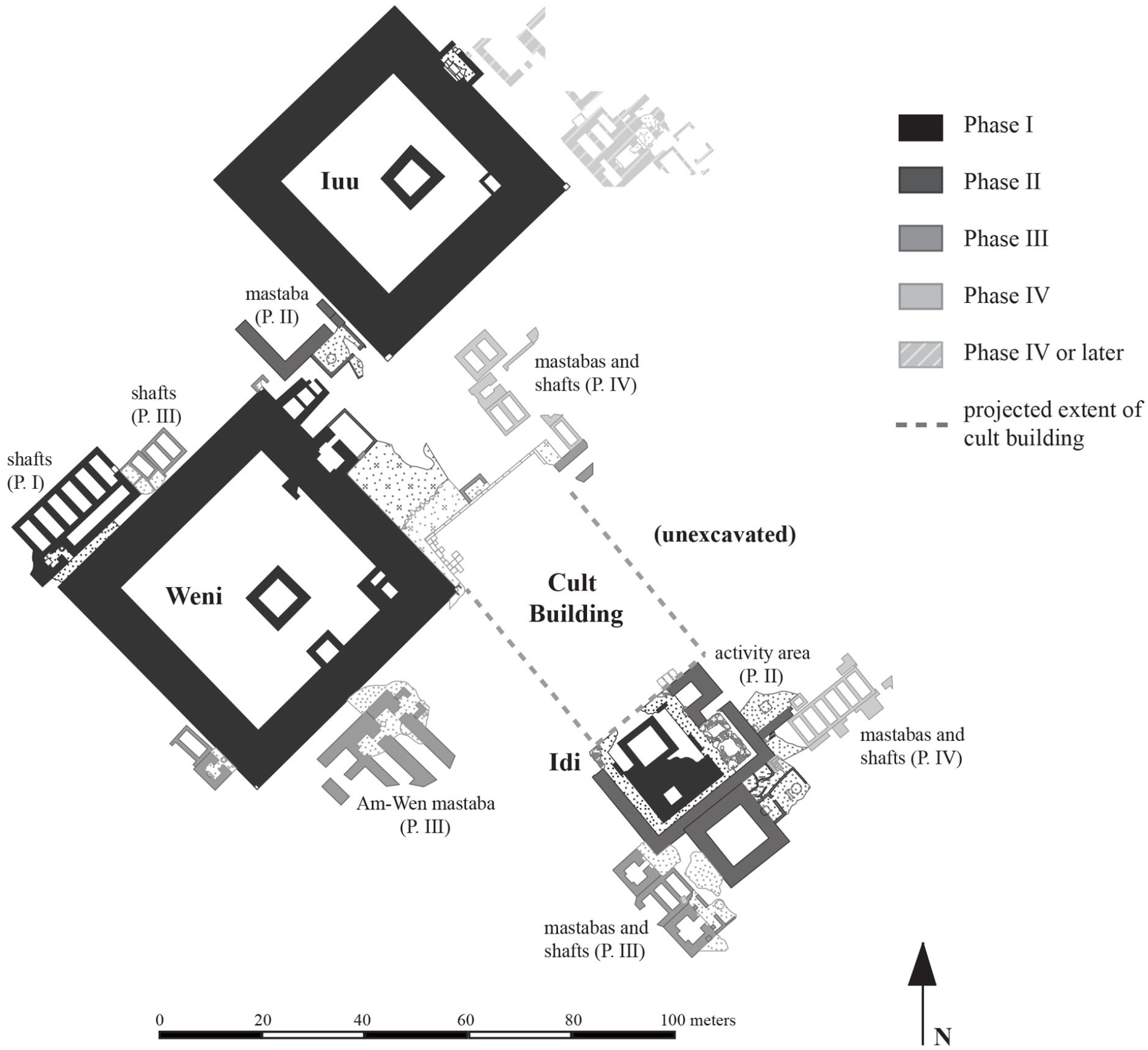
Plan of the Abydos Middle Cemetery (AMC), state of excavation 2022 (drawing: Geoffrey Compton, University of Michigan (UM) AMC Project).
Overview of CWJ in the Abydos Middle Cemetery, by tomb.
The CWJ sherds belong to large jars 40–45 cm in height with flat bases and two vertical looped handles. Macroscopically using a 10x hand lens, the different fabrics were classified as deriving from one common non-Egyptian clay distinguished by limestone, brown to grey sub-rounded quartz sand, angular geode quartz, angular red-brown to light brown chert, and iron ooliths in a red-brown or pink groundmass. 19 The vessels were fired hard and show a spectrum of surface colours, including grey, orange, pink, red, and brown. The vessel body was produced using coils joined by pinching. A turning device was used for the rim, neck and the combing. The base may have been made with a mould. The vessel interior was smoothed with a tool without wheel assistance. Two morphological groups can be discerned: shouldered vessels with a maximum diameter in the upper third of the vessel; and ovoid vessels with a point of maximum diameter near the middle of the vessel. The vessels have everted, folded rims.
A range of combing patterns were executed with different tools and gestures. Lighter horizontal combing, with or without irregular, thin horizontal bands of light vertical or oblique combing, is more common for the two youngest tombs and the most common surface treatment overall. The tomb of Iww shows more variety – it contained one example each of: horizontal combing with larger patches of superimposed oblique combing (fig. 9), cross combing (fig. 8), and long vertical strokes divided by horizontal lines (fig. 13). The latter occurs on a vessel with herringbone incisions on the shoulder and a raised collar around the neck. Three other vessels have a band of impressed faux-cord decoration around the neck (fig. 7). The corpus also includes 20 pot marks and most vessels were marked, on the vessel body or on the top of the handle and, in some cases, both. While the vessels show variation, a group of eight vessels from the tomb of Weni are noticeably more like one another – the so-called ‘Weni Group’ with similar red-brown fabric, rim and body morphology, traces of manufacture, surface treatment, and surface colour. 20 Four of these vessels also have the same potter’s mark (figs 6, 14, and below).
Petrographic Method and Sample List
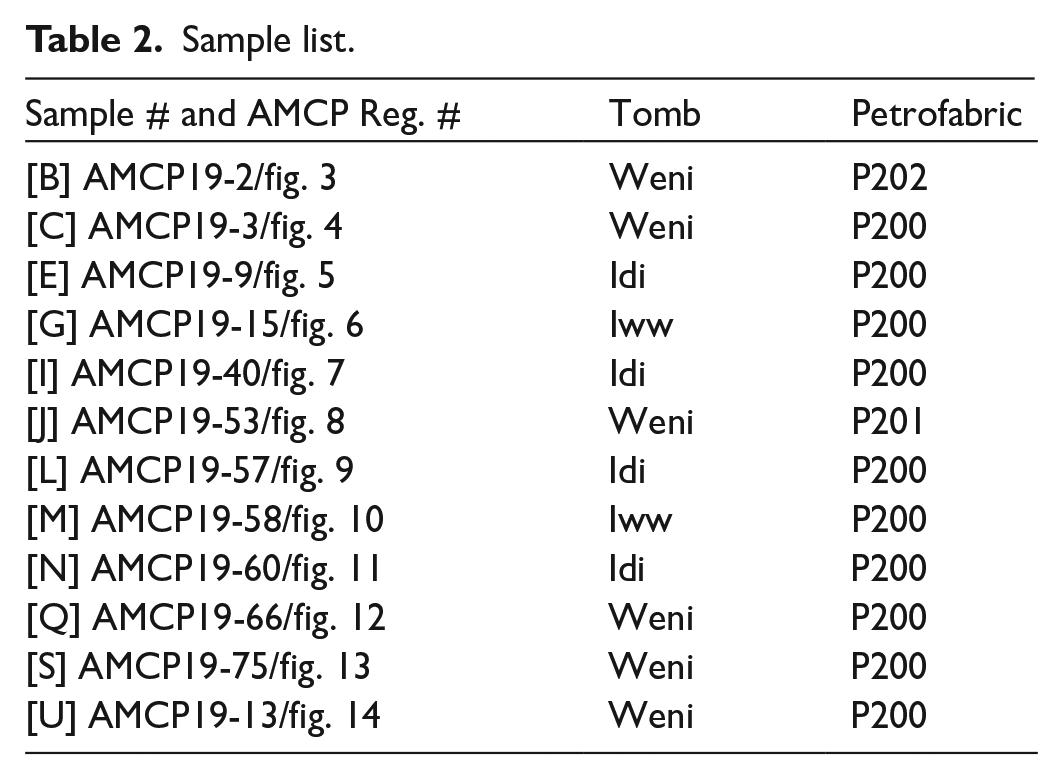
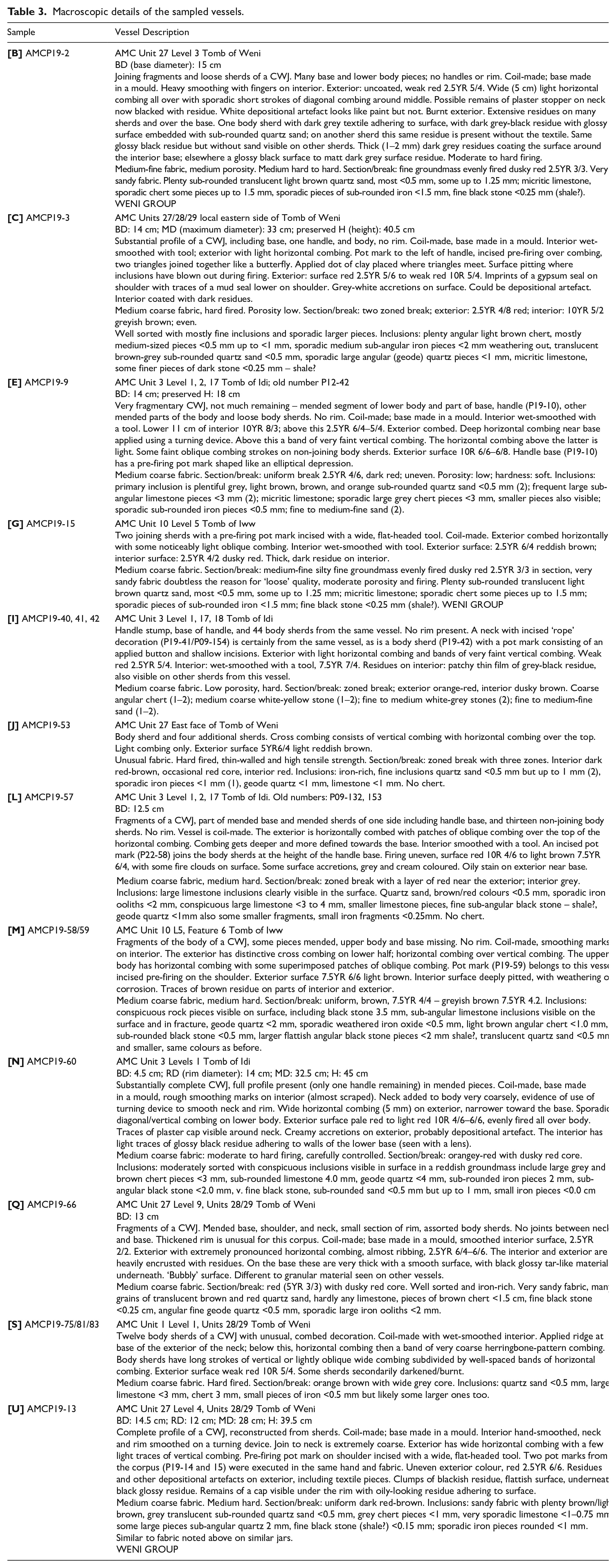
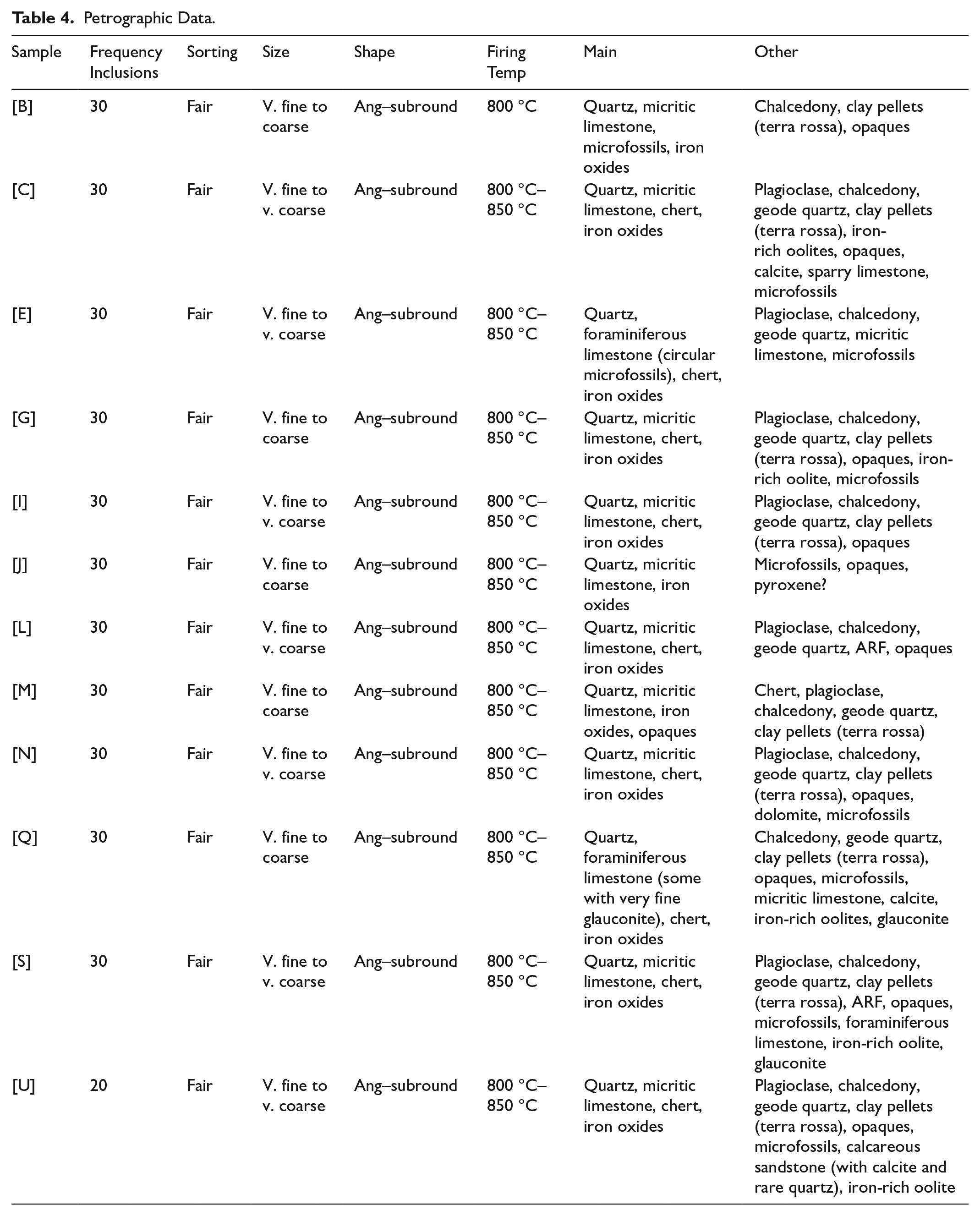
Twelve vessels were chosen for thin-section petrography from across the corpus (Table 2, figs 3–14; full details of each vessel are in Table 3; petrographic descriptions are in Table 4). The samples were selected as representative of the corpus within the resources available, and to investigate conformity and variation in the macroscopic appearance of fabrics, surface treatment, morphology, and pot marks. The twelve thin sections were made on-site at Abydos from 22 to 24 September 2022. The methods employed are those described in Ownby 2010. 21 The in-field analysis with a petrographic microscope at 100x magnification followed standard procedures. 22 For each section its colour in plane (PPL) and cross polarised (XPL) light was noted, an estimate was made for the frequency of inclusions relative to the clay matrix, and sorting of the inclusions was specified. The minerals identified were listed by those that represent the main inclusions, and those that are less common. For the inclusions, both their general shape and size range were noted. Finally, comments were made on the relationship between samples, technology of production, and potential provenance. All of the provenance assignments are postulated as the thin sections were not compared to ceramic raw materials or kiln material from known sites. Geological maps and some soil maps were consulted to arrive at the postulated provenance. 23
Sample list.
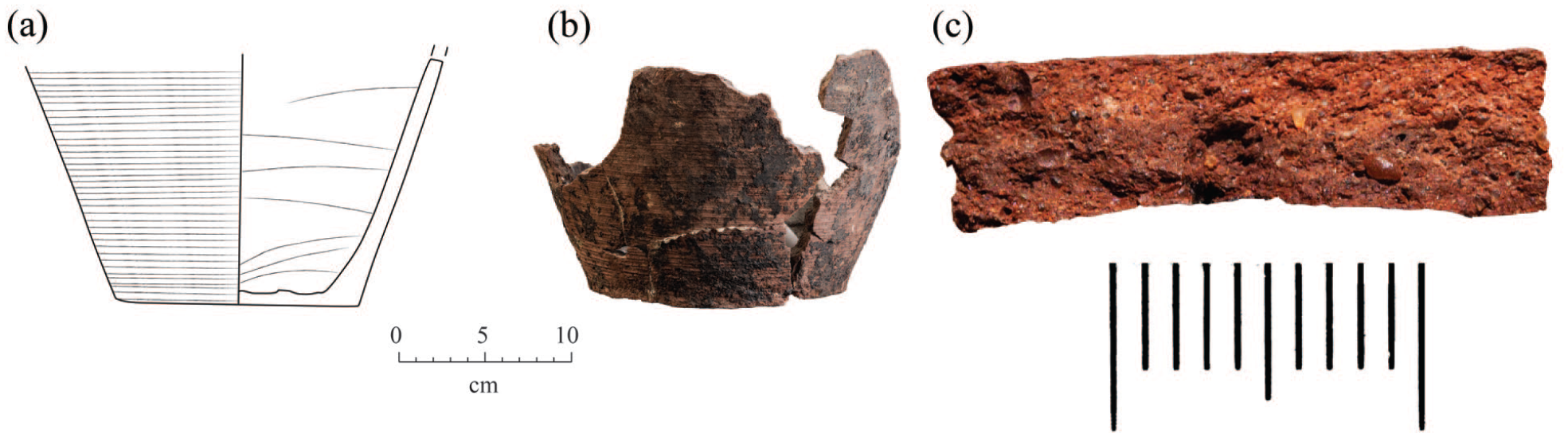
a) AMCP19-2 Sample B (drawing: Christian Knoblauch, UM AMC Project); b) AMCP19-2 (photo: Ayman Damarany); c) AMCP19-2 sherd fracture (photo: Karin Sowada and Ayman Damarany).
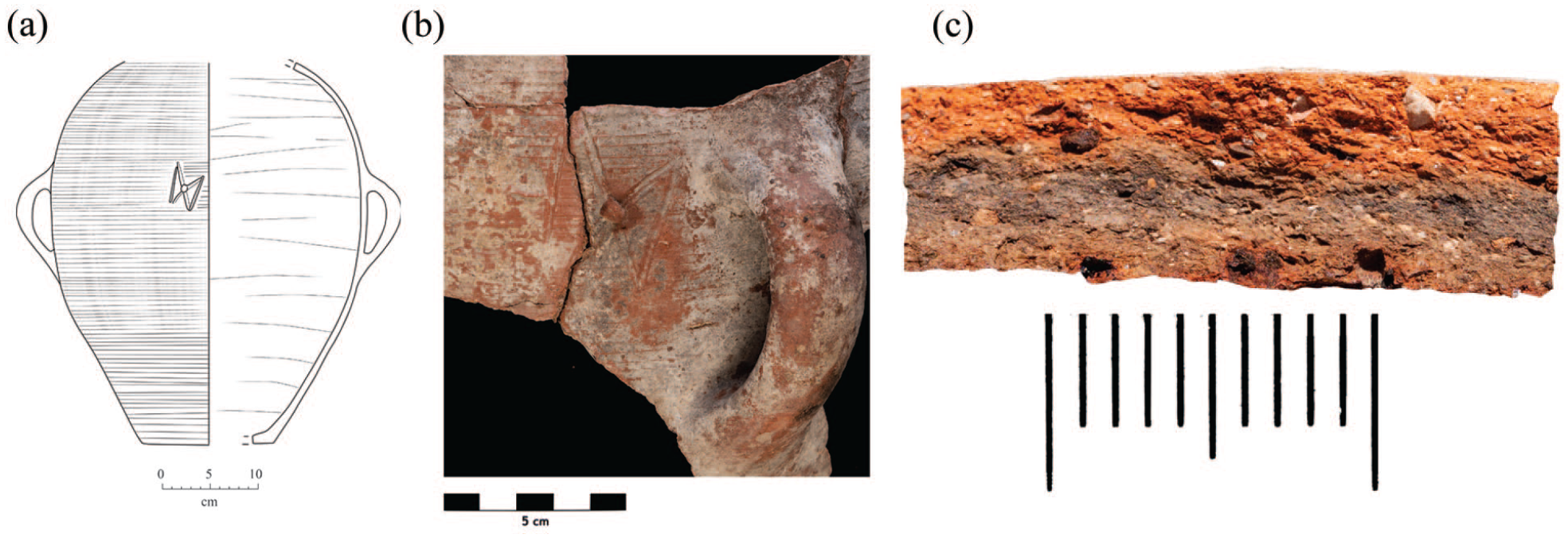
a) AMCP19-3 Sample C (drawing: Christian Knoblauch); b) AMCP19-3 pot mark (photo: Ayman Damarany); c) AMCP19-3 sherd fracture (photo: Karin Sowada and Ayman Damarany).
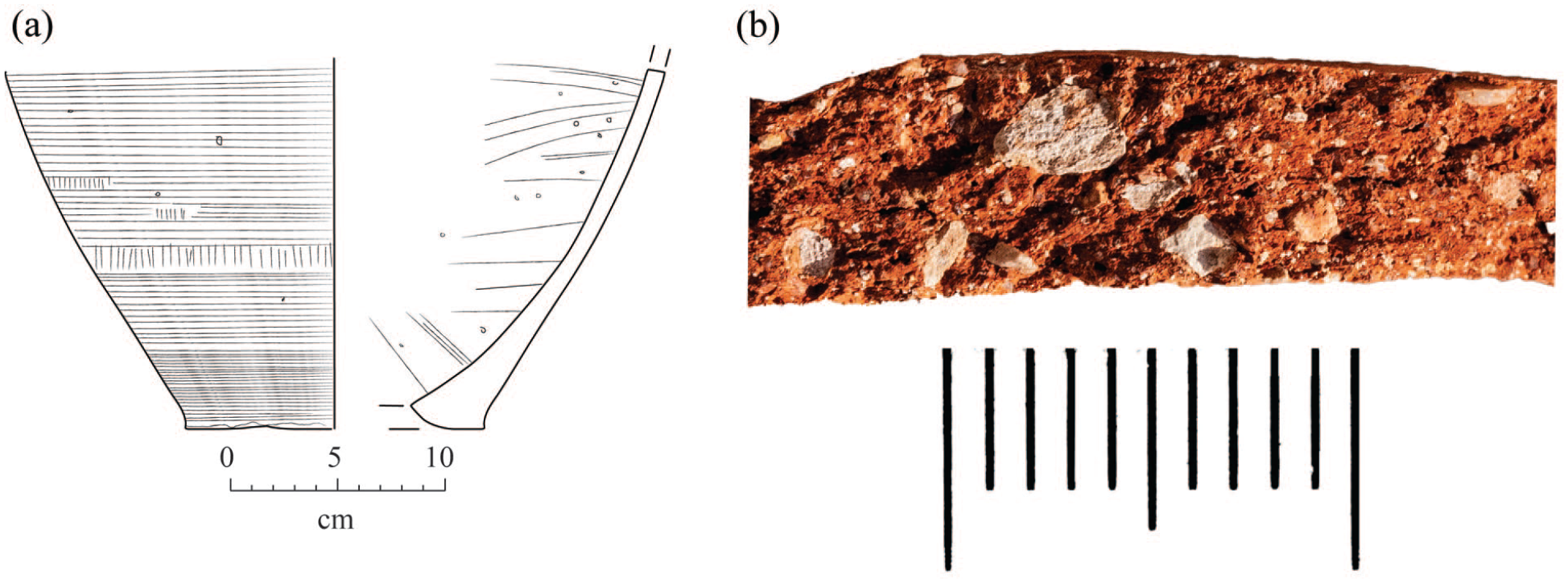
a) AMCP19-9 Sample E (drawing: Christian Knoblauch); b) AMCP19-9 sherd fracture (photo: Karin Sowada).
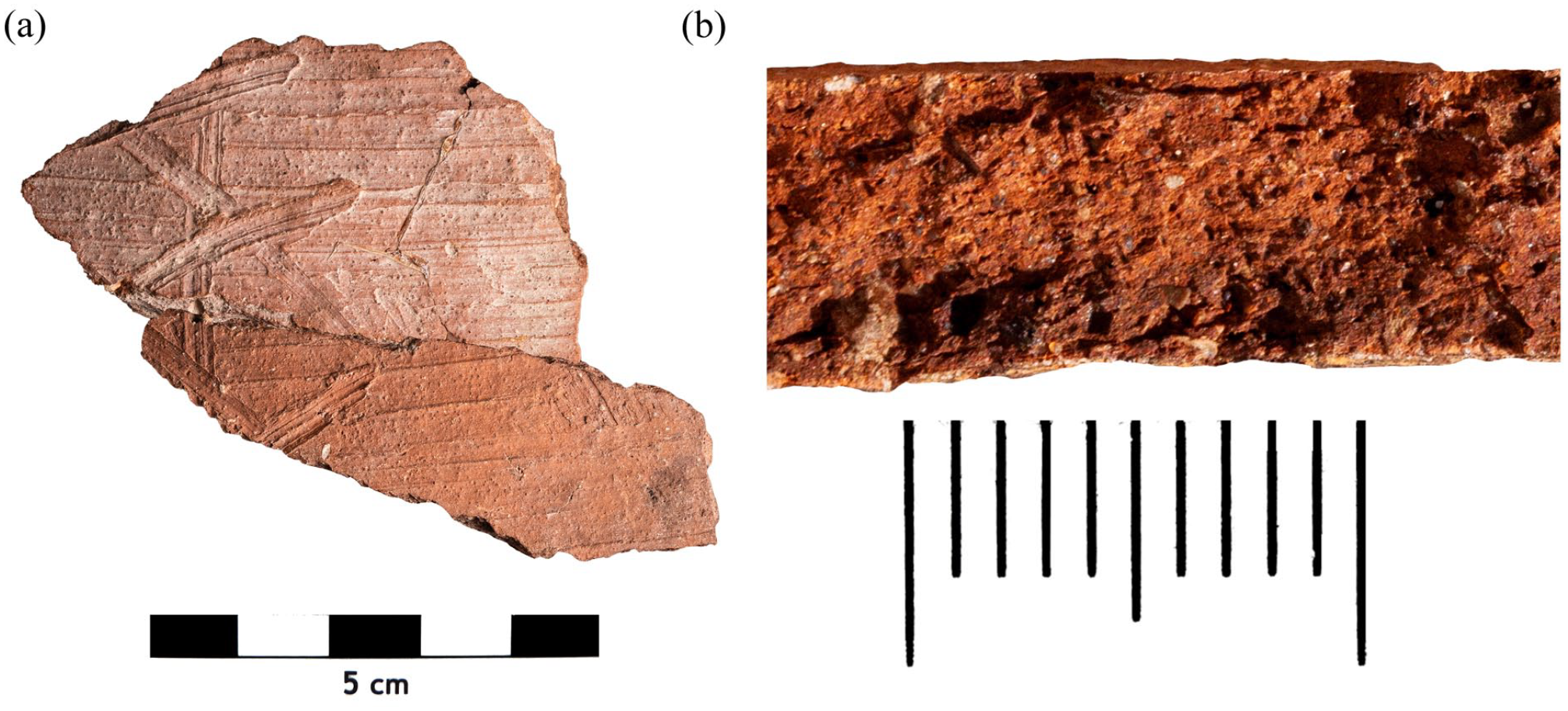
a) AMCP19-15 Sample G (photo: Ayman Damarany); b) AMCP19-15 sherd fracture (photo: Karin Sowada).
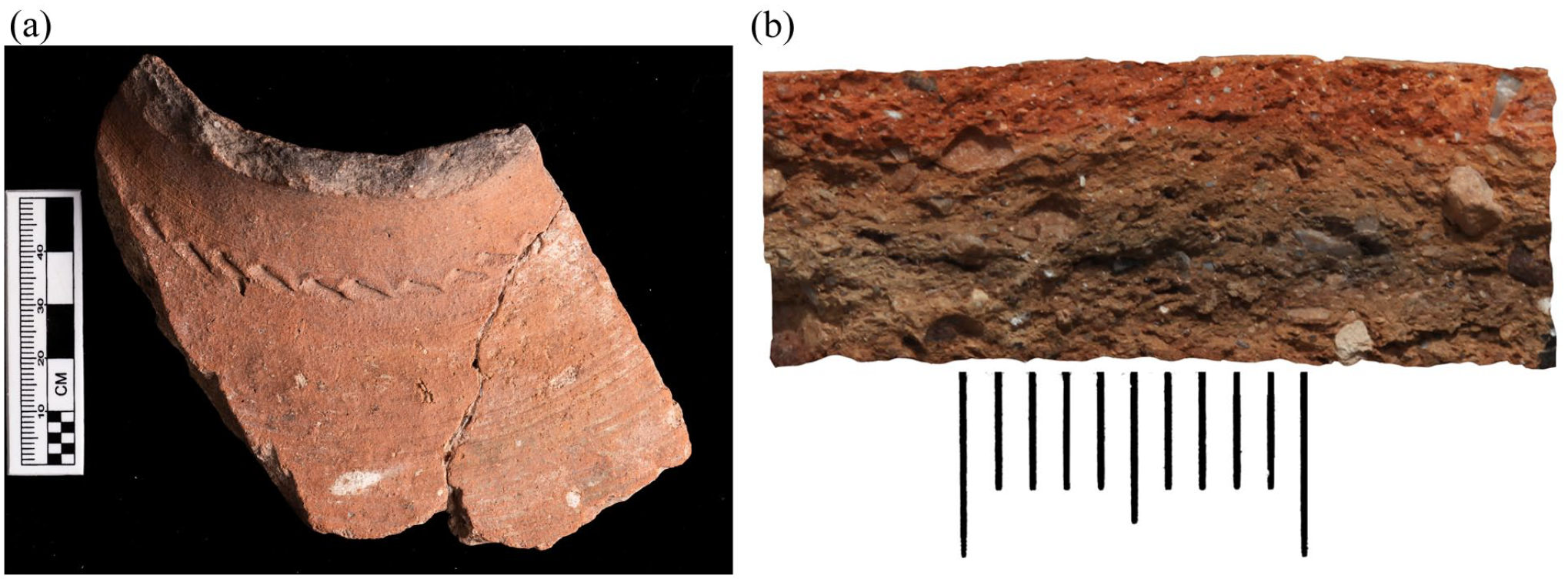
a) AMCP19-40 Sample I (photo: Ayman Damarany); b) AMCP19-40 (photo: Karin Sowada).
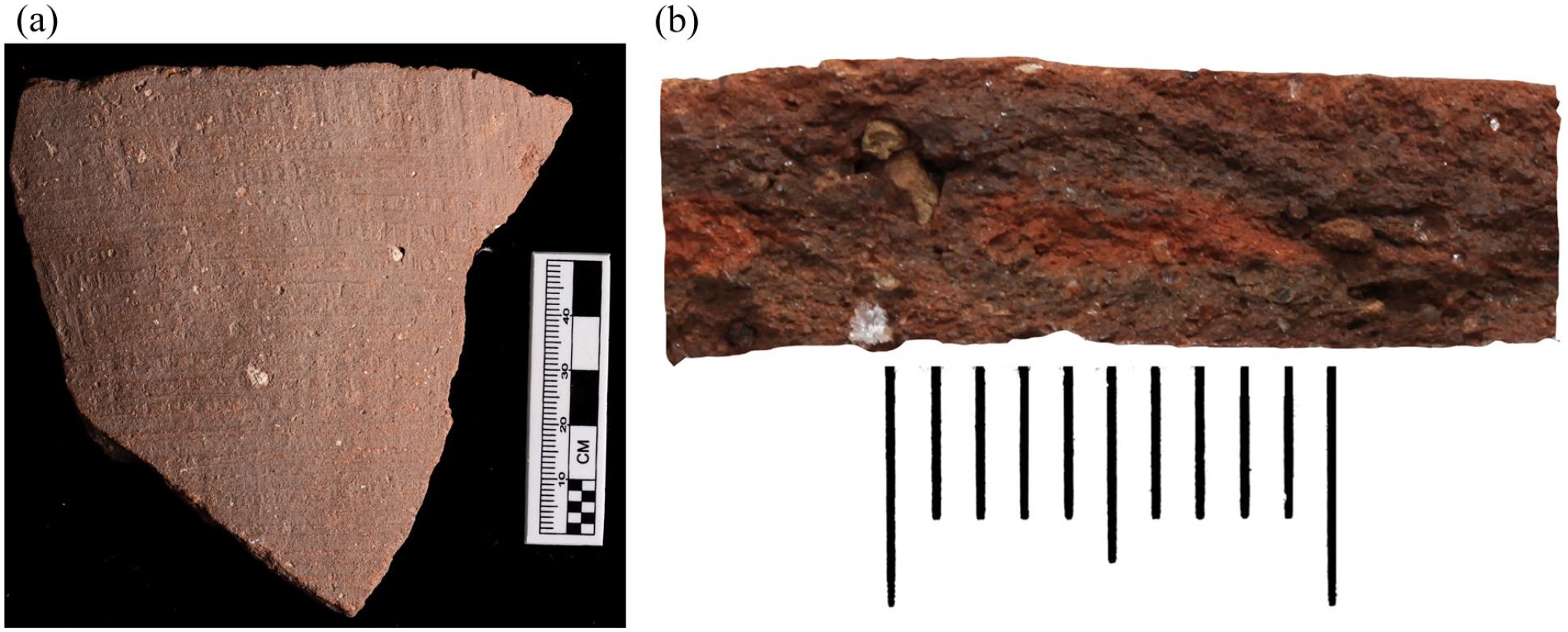
a) AMCP19-53 Sample J (photo: Ayman Damarany); b) AMCP19-53 (photo: Karin Sowada).
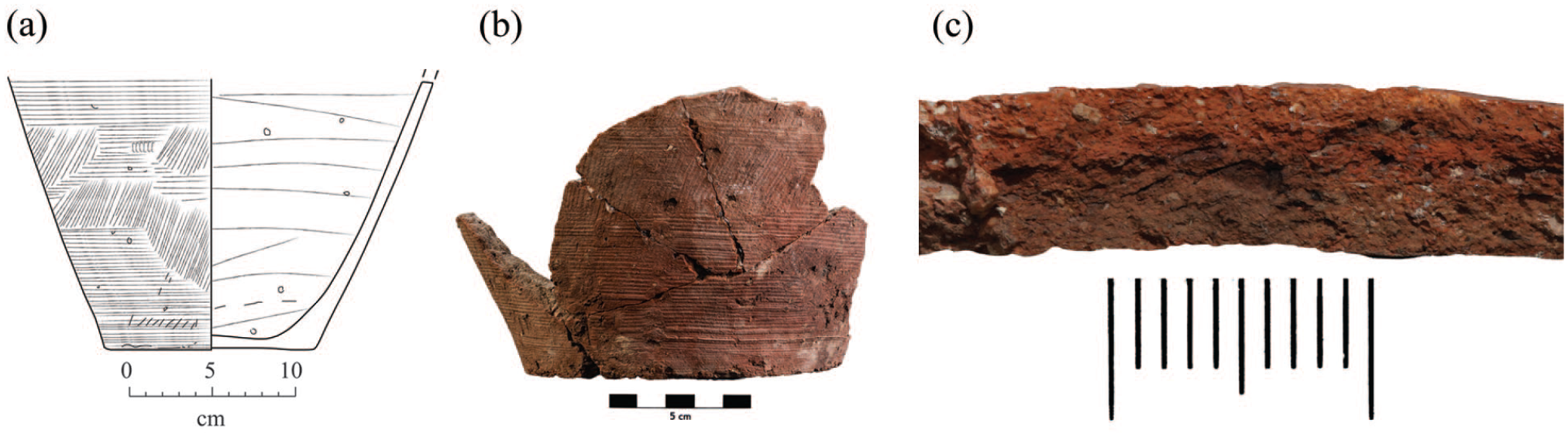
a) AMCP19-57 Sample L (drawing: Christian Knoblauch); b) AMCP19-57 (photo: Ayman Damarany); c) AMCP19-57 sherd fracture (photo: Karin Sowada).
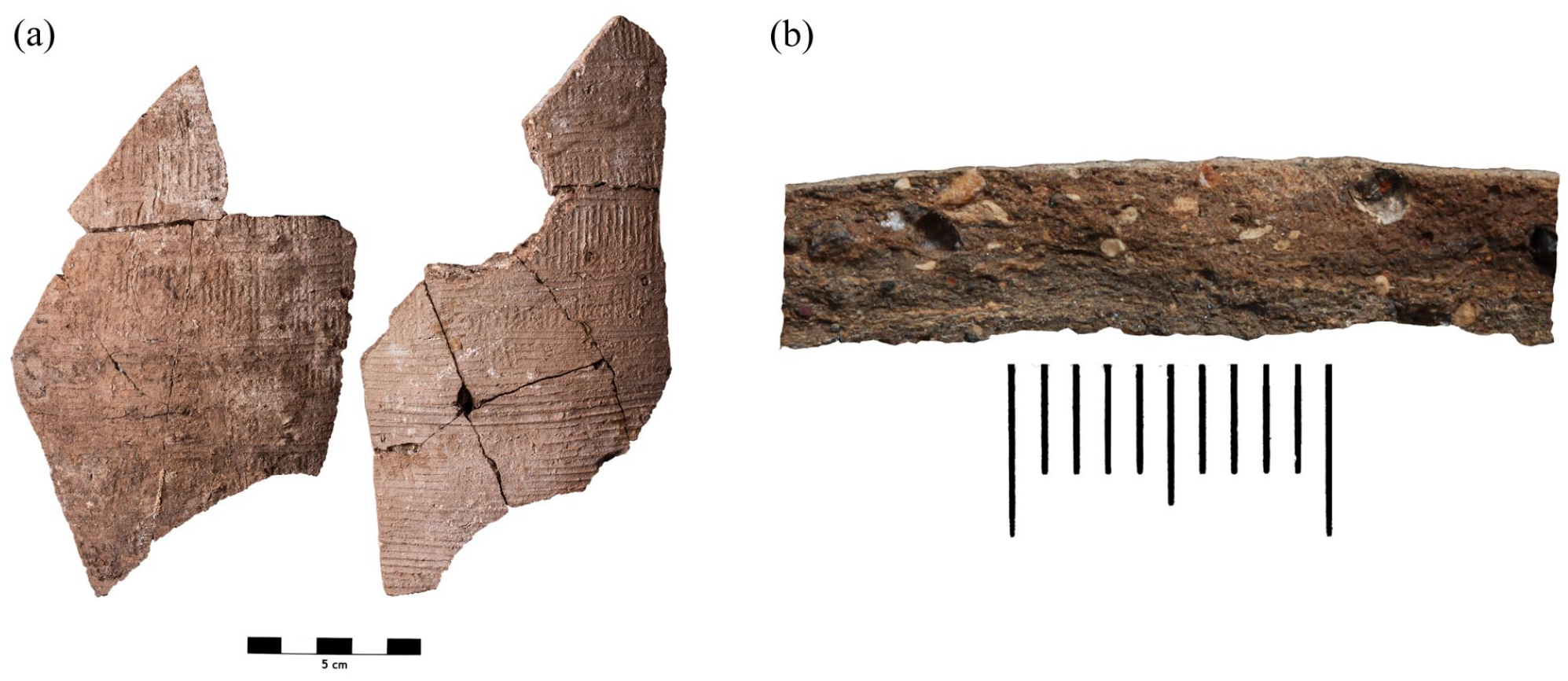
a) AMCP19-58 Sample M (photo: Ayman Damarany); b) AMCP19-58 sherd fracture (photo: Karin Sowada).
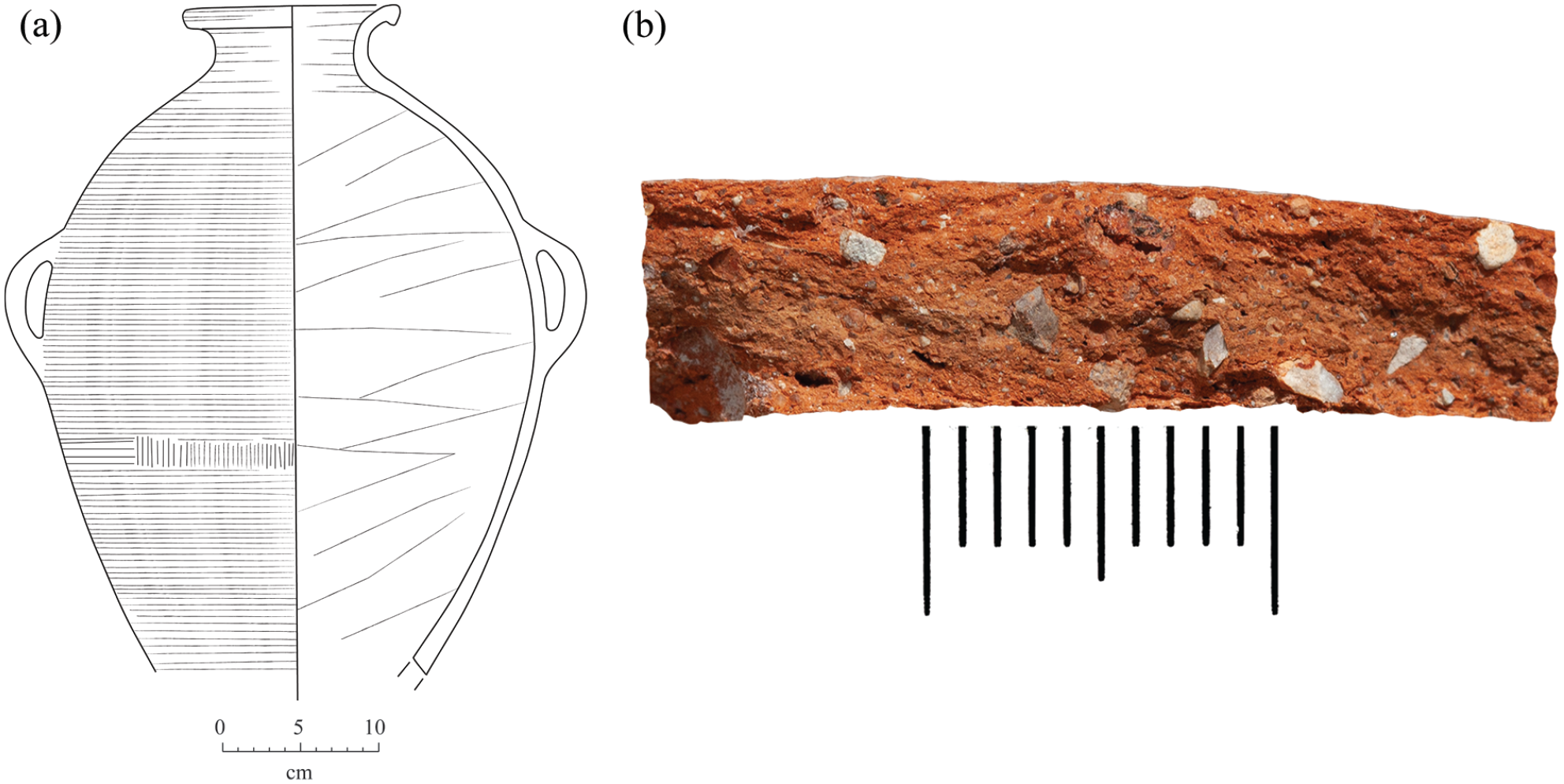
a) AMCP19-60 Sample N (drawing: Christian Knoblauch); b) AMCP19-60 sherd fracture (photo: Karin Sowada and Ayman Damarany).
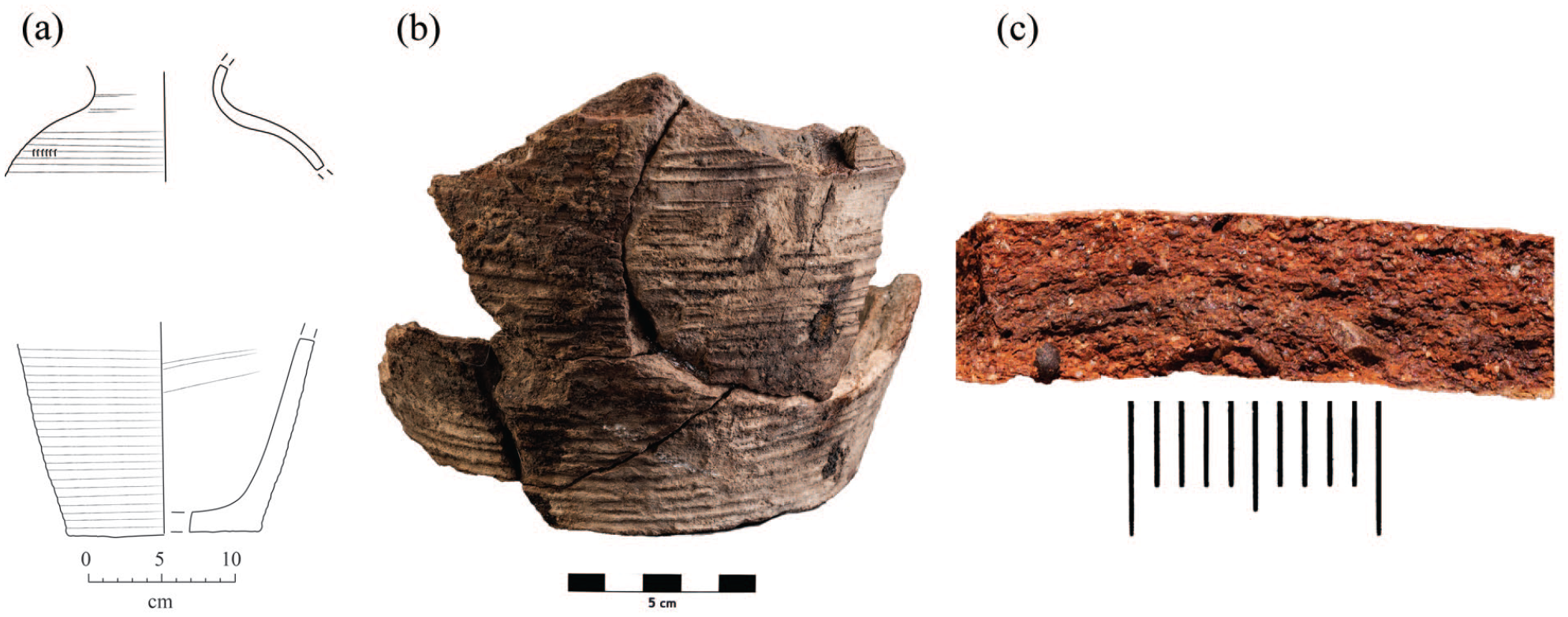
a) AMCP19-66 Sample Q (drawing: Christian Knoblauch); b) AMCP19-66 (photo: Ayman Damarany); c) AMCP19-66 sherd fracture (photo: Karin Sowada).
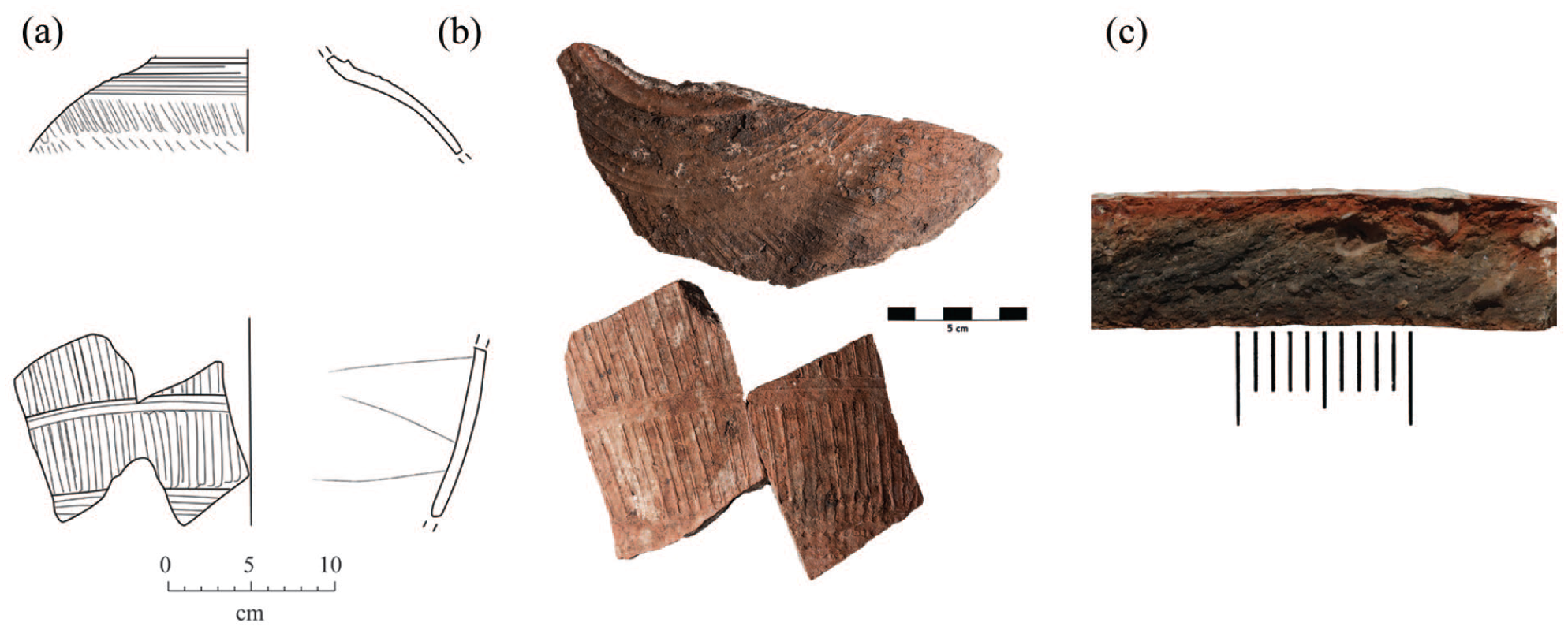
a) AMCP19-75 Sample S (drawing: Christian Knoblauch); b) AMCP19-75 (photo: Ayman Damarany); c) AMCP19-75 sherd fracture (photo: Karin Sowada).
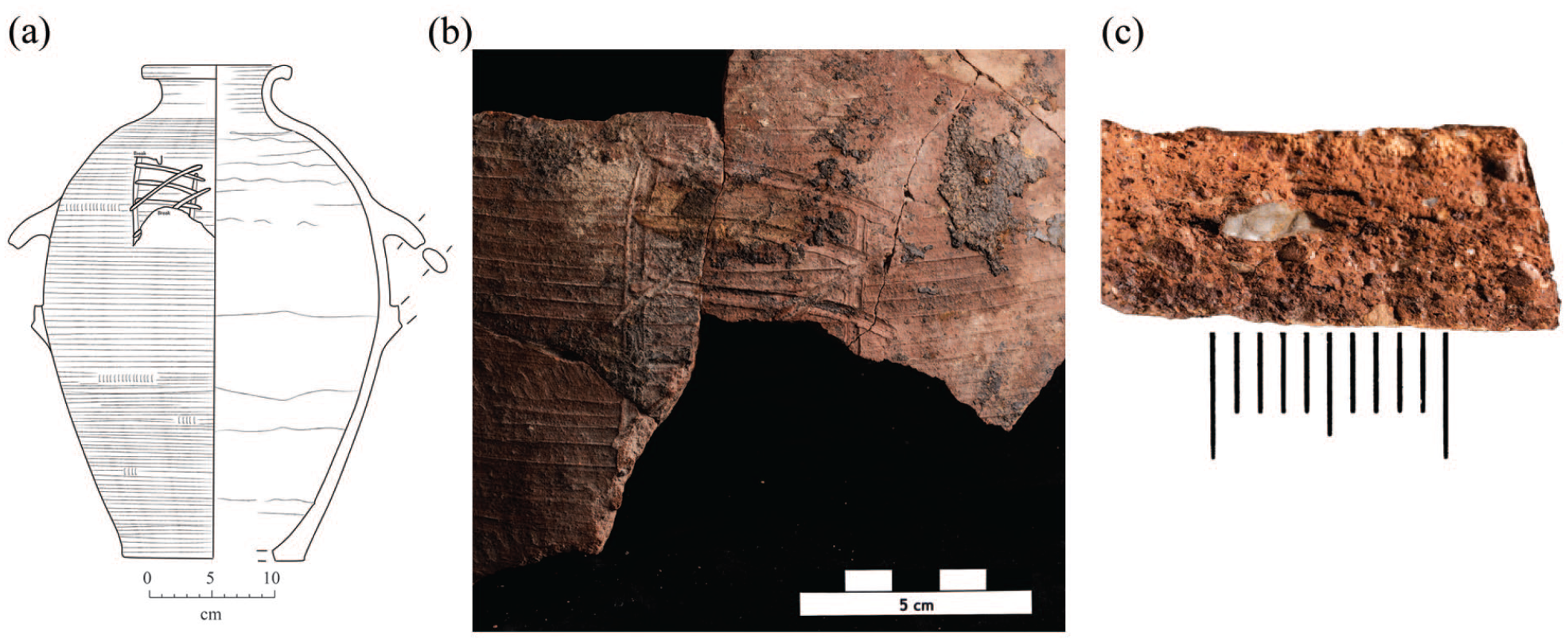
a) AMCP19-13 Sample U (drawing: Christian Knoblauch); b) AMCP19-13 pot mark (photo: Ayman Damarany); c) AMCP19-13 sherd fracture (photo: Karin Sowada).
Macroscopic details of the sampled vessels.
Petrographic Data.
Results
The petrographic analysis revealed that all twelve samples were produced with a related set of raw materials. As they were comparable to the CWJ imported fabrics identified at Giza, those petrographic groups are employed here to classify the samples. 24 It was not possible to take images of the Abydos thin sections, but they are comparable to published photos from the Giza corpus, which can be linked through the petrofabric groups.
The largest number of samples, ten, belonged to the iron-rich and calcareous Chert Petrofabric P200. The clay could be rendzina, a soil developed in the Levant on limestone formations. 25 Inclusions of quartz, micritic limestone, and chert are common, while chalcedony, geode quartz, dolomite, and pellets of terra rossa (an iron-rich soil) are rare. These inclusions may represent sand temper, but it is difficult to know how the secondary clay deposits from the erosion of limestone, iron-rich deposits, and sandstone could form. A few notable inclusions provide more detail on the geological formations that were the source of the raw materials. For example, Sample C has a few iron-rich oolites with very fine quartz inclusions that are characteristic of the Lower Cretaceous Chouf Sandstone deposit. 26 Sample E has foraminiferous limestone inclusions with microfossils that may be Orbulina sp. or Orbulinoides sp. Similar inclusions are in Sample Q, but some of the foraminiferous limestone also contains fine-sized glauconite. The latter are also frequent in the paste and up to medium in size. Sample U has a single fragment of calcareous sandstone comprised mostly of fine-sized calcite and a few fine-sized quartz grains. One sherd, Sample M, within this group has mostly fine-sized grains, suggesting temper was not added.
Two samples did not belong to this group. Sample J has a paste that is more similar to Petrofabric P201, iron-rich, less calcareous, with no chert. The clay contains rare microfossils and common quartz, some up to sand size that could suggest temper. These larger inclusions make the sample distinct from the Giza sherds in Petrofabric P201, relating it more closely to the other Abydos P200 fabric samples. Sample B has common microfossils that make it closer in appearance to Petrofabric P202, calcareous, less iron-rich, with foraminifera. Quartz sand and micritic limestone are also in the paste but chert is absent. The overall appearance is similar to Petrofabric P200 with the common quartz sand (possibly added), but the lack of chert and frequent microfossils (possibly Orbulina sp., Globigerinidae sp., and Globorotalia sp.) make this sample distinct. The presence of sand indicates the sherd is not identical to the Giza P202 samples.
Discussion
Origin of the Abydos jars
The petrographic analysis of twelve samples from 6th Dynasty tombs at Abydos connects this material to earlier imported combed jars found in Egypt. The majority were of a similar iron-rich and calcareous fabric previously identified at Giza for ECL 4/EBA IIIB CWJ imported in the 4th Dynasty. The two samples not of this fabric were also similar to those at Giza and clearly part of the same raw material source utilised for all of the CWJ from Abydos and Giza 27 and 6th Dynasty Abusir. 28 The latter six CWJ were all assigned to the P200 Petrofabric. Slight differences among this material probably represent the natural variability of the clay deposit exploited for these CWJ over the centuries. Alternatively, they may indicate some new clay resources that were utilised but still within the general geological origin of the previous clay deposits.
As noted for those studies, the features of the paste and inclusions suggest the raw materials were acquired from outcrops of Lower Cretaceous and Upper Cretaceous formations. The former are more iron-rich and sandy, while the latter are more calcareous and can contain chert, chalcedony, and geode quartz. 29 Although these formations are prevalent throughout the Levantine area, they crop out most clearly in association along the Lebanese coast, particularly between Beirut and Tripoli. 30 Rendzina soil produced from the erosion of these formations is common in the general region. 31 The paste appearance of the main group of CWJ sherds analysed here is also similar to some of the petrofabrics for such vessels at sites along the Lebanese coast including Byblos, Fadous Kfarabida, and Koubba. 32 Chemical data indicates that Byblos in particular may be a source for the Giza jars, and the petrographic similarities with the Abydos material could indicate that area was a source as well.
The petrography results are supported by analysis of vessel morphology and surface treatment, although much of the Lebanese evidence is from the ECL3-4/EBIII and not the ECL 5-6/EBIV, which until now has been represented by only a few excavated sites like Tell Arqa. 33 Pottery vessels with a combed surface were produced over a wide area of the southern, central, and northern Levant during the late fourth and third millennia BCE, but the production of slender loop-handled CWJ of the shape studied here was typical for the central and northern Levant. 34 The core production area in the ECL 3-4/EB III was the southern Lebanese coast (Tyre, Sidon, Nahr Damour), central coastal Lebanon (Beirut, Byblos, Fadous Kfarabida, Koubba, Anfeh), the Akkar plain in northern Lebanon (Tell Arqa), the Lebanese mountains, and the Bekaa valley (see fig. 1). The northernmost sites with locally produced CWJ are coastal Syria (Ras Shamra/Ugarit and Sianu). The southernmost were produced in upper Galilee (Tell Dan) and the northern Transjordanian plateau (Khirbet Zaraqon), 35 but the production of CWJ at these southern sites did not continue into the later ECL3-4/EBIII or ECL4-6/EBIV, the period contemporary with the later Old Kingdom. Based on the petrography, sites on the central Lebanese coast are likely sources, and of these Byblos is the only one with clear archaeological evidence for ECL 5/EBIV(a) occupation.
Thus, the CWJ from the three Abydos tombs, covering the reigns of Pepi I, Merenre, and Pepi II, provide further support for the hypothesis that commerce for commodities contained in such jars was almost exclusively with a limited area in Lebanon lying between Beirut and Tripoli. The 4th Dynasty Giza jars were identified as deriving from Lebanon as well. In fact, all these CWJ samples continue an earlier tradition of imported vessels from Lebanon produced of Lower Cretaceous material that goes back to Tomb U-j at Abydos, 1st Dynasty jugs from Abu Rawash, and jugs from 2nd Dynasty Helwan. 36
Production and supply
As noted above, eight vessels from the tomb of Weni are similar in terms of paste, morphology, and surface treatment, as well as surface colour (the so-called ‘Weni Group’). The three vessels of this group subjected to petrographic analysis were all Petrofabric P200 (B, Q, U) and were probably produced in a single workshop, possibly at the same time. One sampled Weni Group vessel (U) also had a complex pot mark incised on the shoulder. The same mark occurs on three other Weni Group vessels. 37 This pot mark is also found on a vessel from the tomb of Iww (Pepi I) and a vessel from Saqqara dating to the reign of Pepi II. 38 Although a recent study of pot marks on CWJ found in Egypt concluded their function was unclear and possibly decorative, 39 the prevalence of the one pot mark in Egypt but across three generations and on multiple, similar vessels from a single tomb is suggestive. We propose that the mark was used in a single workshop to distinguish specific pottery batches with certain properties produced on demand to fill an order for Egyptian trade. This interpretation supports claims that the production of CWJ for export to Egypt was a specialised product of specialised workshops. 40
However, two-thirds of the Weni pottery did not have this mark and although each vessel was probably marked, the remainder of the marks occur only once. Moreover, while there is a basic similarity in the vessel shape and size of the CWJ, the remainder of the Abydos corpus does not belong to the Weni Group and similarity should not be confused with standardisation. There is variation in the preparation of the pastes, and the morphology of the body and aperture, the style of combing, and the tools used to execute them also show variation. 41 As combing was related to the manufacturing process and not simply a decorative device, 42 this strongly suggests that the Abydos CWJ exhibit a number of different work processes indicative of production by related but distinct communities of practice, presumably organised along workshop lines. That these differences do not necessarily relate to geographical differences is clear from a recent survey that found no evidence for spatial clustering of different combing motifs during ECL 3–4/EBIII. 43 These workshops might all have been at Byblos, which was the only large urban centre in the geological area and was large enough to support more than one workshop. Equally, workshops may have been located near smaller sites in coastal Lebanon, thus far superficially explored (i.e. Beirut, Koubba II, Anfeh). Earlier ECL3–4/EBIII Fadous Kfarabida is one such site, 44 where processing and intermediary storage of produce (probably olive oil) for eventual delivery to Byblos is attested. 45
Some of the observed petrographic and stylistic differences are of chronological importance. The fabric variant P201 occurs only once for a vessel (fig. 8) with cross-combed surface, a surface treatment that appears to have largely disappeared in ECL 4–5/EBIV, at least at Tell Arqa, where reliable quantification of stratified layers according to decoration took place. 46 As such, it is plausible that older vessels already in circulation were procured to meet the requirements or shortfalls of specific orders, leading to the mixture of old and new vessels observed in some cases. 47 Whether different fabrics, vessel types, and sizes relate to the identity of the contents is hitherto unknown but will be examined in a future scientific study.
Egypt and Lebanon in the late Old Kingdom
That the Abusir and, now, Abydos CWJ are confirmed genuine imports means that there was no proven Egyptian production of CWJ during the 6th Dynasty as previously believed. 48 Petrographic, and ideally chemical, testing is required before accepting ‘imitations’ at face value. More importantly, the results here enable a re-evaluation of the model for the intensity and scale of Old Kingdom–Levantine trade, insofar as this is based on the quantification of CWJ in Egypt. Previously, the majority of CWJ in Egypt dated to the 4th and 5th Dynasties, followed by a decline in quantity in the 6th Dynasty. 49 However, with the addition of the Abusir and now the Abydos assemblages, the 6th Dynasty corpus 50 is greater than both the 4th and 5th Dynasties individually, which combined have a total only marginally in excess of the 6th Dynasty total. Trade expeditions to Lebanon must have been a regular occurrence throughout the 6th Dynasty, judging by the chronological distribution of Egyptian tombs containing imported pottery, even allowing for a delay from the date of import to their final deposition.
This picture of intensive and frequent foreign trade in the 6th Dynasty is demonstrated by the biographical inscription of the seal-bearer of the god Iny, 51 who claims to have visited ḫnty-š (i.e. Lebanon) 52 five times during the reigns of Pepi I and Pepi II, and Byblos (kbn) in the reign of Merenre, returning from Byblos with Byblos ships, lapis-lazuli, lead or tin, silver, and sfṯ, one of the ‘seven sacred oils’ used in mummification, here determined with a two-handled jar. 53 The character and scale of the liquids trade in the 6th Dynasty indicated by the petrographic study of the Abydos CWJ is therefore fully supported by contemporary textual evidence. In the same direction, there is an increase in the number of Egyptian artefacts at Byblos in the later Old Kingdom, including some bearing the names of 6th Dynasty kings that were royal donations to the temple of Ba’alat Gebal, a goddess identified by the Egyptians with Hathor Mistress of Byblos, and a place where Egyptian and Byblite religious interests merged during this period. 54 The concentration of Egyptian objects in this temple and its neighbourhood marks it as a focal point for Egyptian–Byblite interaction and, arguably, the temple played an important mediating role in diplomatic and commercial relations between Egypt and the different groups who provided products, and benefited from Egyptian trade. 55
Conclusion
The petrographic data from three generations of Abydos tombs support the argument that the oils and liquids trade that supplied the Egyptian court throughout the Old Kingdom (ECL 3–6/EBIII–IV) was principally with the Lebanese coast, with the majority, if not all, probably originating in the vicinity of Byblos and its hinterland. Combined analysis demonstrates that a more narrow and specific set of raw materials were selected to produce CWJ over time and we identified a group of petrographically similar vessels produced in a single workshop, presumably for the Egyptian trade. This evidence for increased specialisation in CWJ production attests to the importance of foreign trade to local economies, social organisation, and social hierarchies. It belongs to a longer-term process of bringing pottery production underpinning foreign and interregional trade under the centralised control of coastal polities such as Byblos. It is certainly possible, as argued elsewhere, that Egyptian negotiation also played a significant role in the emergence of the CWJ export ‘brand’.
The remainder of the Abydos CWJ showed some variation that needs further investigation, both in Lebanon and with residue analysis in Egypt. Preliminarily, we suggest that there were both fixed and flexible strategies for filling trade orders, including specialised production across different workshops directly or indirectly under the influence of Byblos and the procurement of older vessels already in circulation. As such, there was no effort to completely standardise CWJ, as one might expect if a single authority or institution tried to systemise trade. 56 This might point to different networks at Byblos and its hinterland responsible for organising the supply of jars and their contents that were ultimately channelled through the port at Byblos to Egypt. Such networks are visible in the Ebla texts. This now presents an alternative scenario to one that treats Byblos as a single entity when considering its role in EBA interregional trade and relations. 57 Finally, the confirmation that large quantities of ECL 4–5/EBIV CWJ in a provincial cemetery in Upper Egypt are genuine imports also provides strong archaeological evidence for the claim that Egyptian foreign expeditions for liquids, and presumably other materials such as silver, lapis, and wood, must have been relatively frequent throughout the early to mid-6th Dynasty, continuing into the first half of the long reign of Pepi II.
Combined with other contemporary evidence for interactions from both Egypt and Byblos, it appears that the 6th Dynasty could be described as a period of intensive Egyptian–Byblite contact and trade volume. 58 Indeed, the period of the second half of the third millennium witnessed the broad intensification of exchange networks across western Asia. Yet it must be remembered that relations with the Levant during the third millennium were probably an unfolding story. The paucity of written evidence for Egyptian–Levantine trade relations between the early Old Kingdom and the late Old Kingdom – such as biographies – must be acknowledged. In addition, the emergence of Hathor as a ‘patron’ of expeditions and her veneration by Pepi I probably saw an increase in offerings at the Byblos Ba’alat Gebal temple, reflecting a shifting relationship with Byblos and its elites, rather than solely an increase in expeditionary activity. What can be said of the Abydos Middle Cemetery and imports found in Upper Egypt during the late Old Kingdom is that regional elites had access to the products of royal expeditions, and, as with the career of Weni himself, may have exerted more control over the rewards.
Footnotes
Funding
The University of Michigan AMC Project operates with the kind permission of the Ministry of Tourism and Antiquities, Egypt. Support for this research has included the University of Michigan, the National Geographic Society, the American Research Center in Egypt Antiquities Endowment Fund, the Shelby White and Leon Levy Program for Archaeological Publications, and Marjorie M. Fisher. The contribution of Karin Sowada and Mary Ownby was supported by Australian Research Council Future Fellowship FT170100288 ‘Pyramids, power and the dynamics of states in crisis’.
1.
Sowada, et al. 2023. Identifying the original contents of the jars is problematic, because many were probably re-used more than once on arrival in Egypt. For CWJ, Hennessy 1967; Helck 1971: 28–37; Esse and Hopke 1986; Sowada 2009: 154–182; Thalmann and Sowada 2014: 369;  : 61, 63–64.
3.
Sowada, Ownby, and Wodzinska 2020: Fig. 2c from Abydos tomb U-y, dated to early Naqada IIIB; Petrie 1902: pl. 8:6; imports of the Early Dynastic Period are discussed in Sowada, et al. 2021; Hartung, et al. 2015; ; Hartung, Ownby, and Sowada 2022.
4.
Thalmann and Sowada 2014: 371, .
6.
Thalmann and Sowada 2014: 370–371; Sowada 2009: 154–180; Köhler 1998: pl. 68:9, 73:12; Sowada, et al. 2021. CWJ sherds were recently identified by Sowada at Dendera in the late Old Kingdom cemetery: Sowada pers. comm. 17 May 2024.
7.
Davies 1902: 13, pl. XIII; Kanawati, et al. 2013. For the identification of sft, Kemna 2018. On importing sft-oil, : 576, 582, 601–602.
9.
11.
Morphology: Reisner and Smith 1955: 75; Hennessy 1967: 83–84; Stager 1992: 38; seal impressions: Mazzoni 1985; surface treatment: Sowada 2009: 154–155; Hennessy 1967: 84; Esse 1991: 109–114; Eliyahu-Behar, et al. 2016.
12.
Badreshany, et al. 2019; Badreshany, et al. 2022; Sowada, et al. 2020; Sowada, Ownby, and Bárta 2021. A neutron activation analysis (NAA) grouped CWJ samples from Giza with material from the southern Levant as well as Byblos; however, the data and methods precluded certainty; Esse and Hopke 1986; : 173–175; de Miroschedji 2021: 63. A PIXE-PIGME study by Peter Grave in Sowada 2009 examined Giza material alongside CWJ sherds from Byblos and the southern Levant. The results identified clear trace element differences between these regions, and two fabric groups from the Byblos area, now understood as Fabric P200, and P201–P202.
13.
Janet Richards, Director. The CWJ corpus was examined from 2012 to 2021 with petrographic analysis by Mary Ownby in 2022. Intense cataloguing in 2018 to 2022 was by Christian Knoblauch and Karin Sowada. Detailed observations were made about the total number of vessels, manufacturing techniques, surface finish (including combing type), firing, pot marks, and morphology. The fabrics of each vessel were examined on a fresh break under a 10x hand lens, noting the hardness, porosity, and colour (with Munsell readings). Detailed descriptions of the fabric for each identified vessel were completed, noting groundmass colour, nature, frequency, and nature and size of inclusions (e.g. ). Fresh sections of sherds were photographed.
15.
Knoblauch in press; for the family of Iww, see .
16.
For EBA synchronisms between Egypt and the Levant, see Sowada, Ownby, Smythe, et al. 2021; see Lebeau and de Miroschedji 2014 for the ARCANE chronologies of early third millennium BCE Western Asia.
17.
The confirmed number of vessels is the absolute minimum number of vessels determined by counting the number of well-preserved bodies.
18.
Bárta 2009: 243, 261; Sowada, et al. 2023.
19.
Different pastes were identified based on the quantity and size of the quartz, and the fineness of the fabric and the presence or absence of white veins in the break (Fabrics 1, 2, 3a, 3b, 4, 5).
20.
Vessels AMCP19-2; AMCP19-3; AMCP19-6; AMCP19-11; AMCP19-13; AMCP19-14/P12-23; AMCP19-16/P12-39; P19-66.
21.
Ownby in Kemp, et al. 2010: 24.
23.
24.
Sowada, et al. 2020. The ‘P’ designation for the fabrics belongs to the Vienna System and was determined following discussions with David Aston, Barbara Aston, and Carla Gallorini.
27.
Sowada et al. 2020. See also .
30.
32.
34.
Greenberg and Porat 1996; de Miroschedji 2021: 63; : 260.
35.
Tumolo and Badreshany 2023: fig. 5: Kc. Further south, Pierre de Miroschedji has demonstrated that combed jars, while related to the wider region, belong to a separate and distinct ceramic repertoire of the southern Levant: .
37.
AMCP19-14/P12-23; AMCP19-1.
40.
Sowada, et al. 2023: 291. The hand-coiling technique also sets the CWJ industry apart from contemporary production. The belief that EBIV CWJ from Arqa was wheel-coiled contradicts the final site report – i.e. Thalmann 2006: 125. For the chaîne opératoire of EBIV at Arqa, see Roux 2013; Thalmann and Roux 2016; : 368–369.
41.
E.g. Fabric P202, which occurs only once with a very large vessel with unusual profile and pot mark. It is clearly not from the Weni Group workshop.
45.
Genz, et al. 2009: 162–163; .
46.
47.
I.e. Sowada, et al. 2021; Sowada, et al. 2022; Sowada, et al. 2023.
48.
See Sowada, Ownby, and Bárta 2021 revising the earlier study; Ballas jar published in Sowada 2011, now also revised as a genuine import in the above-mentioned publication. For a lone Egyptian copy of a CWJ, see .
49.
Sowada 2009; Helck 1971; . The quantitative preponderance of CWJ in the earlier Old Kingdom was probably due to the intensive and well-documented excavations in the Memphite region relative to the provinces where many elites were buried in the later Old Kingdom.
50.
Abydos (n=21+), Abusir (n=10), Giza (n=10), Saqqara (n=2), and Elephantine (sherds).
53.
Most recently Rageot, et al. 2023: 292 and literature cited there.
55.
Diego Espinel 2012: 12; Marcolin and Diego Espinel 2011; : 120.
57.
Biga and Steinkeller 2021; see also : 113–114, n. 44.
58.
This model of a close relationship between Byblos and Egypt during the 6th Dynasty fits the relationship of DUlu and Dugurasu in the Ebla archive and supports the identification of these toponyms with Byblos and Egypt; see Biga and Steinkeller 2021; .