




Abstract
Group statuettes, which are a relatively common type of Middle Kingdom artefact, have traditionally been interpreted as family groups. This article uses statuette AN1913.411 in the Ashmolean Museum (Oxford) to explore this object type and question the extent to which modern preconceptions about family groups permeate interpretations of Egyptian monuments. This statuette features a woman and two men, whose relationships to one another are difficult to clarify. After a detailed presentation of the object, this article examines how far conventions of production and conventions of consumption have played a role in the interpretation of this object. The relationships between the people depicted in this statuette are impossible to establish with certainty, but the object can be inserted within the monumental vocabulary of the celebration of relatedness that was prevalent in the late Middle Kingdom.
Keywords

Introduction
Understanding the composition and functioning of kin groups in ancient Egypt remains an intellectual challenge for researchers. Not only are the sources that refer to kin groups elusive, but diverging conceptions of what it means to be related make it difficult to interpret the nature of ancient kinship and marriage from an emic perspective. 1 Egyptian sources, both written and visual, communicate messages about ancient society in ways that may not be entirely self-evident. Modern biases can sometimes lead to misinterpretations of those primary sources to make them fit into our preconceived ideas of what the ancient social fabric may have been like.
In this article, I take the group statuette Ashmolean Museum AN1913.411 (henceforth ‘Ashmolean AN1913.411’) as a case study to explore some of the difficulties inherent in analysing the monumental representation of kin in ancient Egypt. The late Twelfth Dynasty statuette, which was found at Abydos, shows a woman and two men, one of whom is shrouded, standing without touching each other. This statuette has been interpreted as a so-called family group, a type of object that was relatively well-known during the Middle Kingdom. These groups often feature three individuals, although examples with up to seven are known. While they have been understood as representing nuclear family groups, 2 their implications for the study of social dynamics are actually unclear. On closer analysis, it seems that many of the individuals depicted in such groups may have not been related genealogically. One should therefore ask, first, why those people chose to be represented together in the same object and, second, why modern audiences tend to assume that a nuclear family link is the most plausible explanation for such groups.
Where possible, monumental display should not be studied in the abstract, but through a careful and detailed archaeological contextualisation of the objects in question. Statuettes like this one were not set up in isolation; in this case, a stela found close to this statuette provides complementary information that may aid in its interpretation, as on the stela the woman is shown as belonging to a much larger kin group. Moreover, placing these objects in the context of the ritual landscape of Abydos may open the way to a more nuanced understanding of how people materialised and displayed social relationships.
This article presents some theoretical considerations regarding the study of ‘family portraits’, challenging the universal validity of this category. This is followed by a description of Ashmolean AN1913.411, discussing its findspot as well as some associated objects that may shed some light on its interpretation. I then compare Ashmolean AN1913.411 with other Middle Kingdom group statuettes to determine whether it was typical or exceptional within its genre. On this basis, I offer suggestions about who the people depicted on this statuette were and how they were related to each other—if at all. The label of ‘family group’ to refer to this specific type of group statuettes may be ultimately misleading.
Family Portraiture: The Construction of a Visual Genre
Visual representations of groups are a powerful means to communicate a variety of messages about social fabric, but the modes of representation employed need to be decoded to understand those messages. In order to establish a framework of reference, it may be useful to look at a body of material from a context that is better known than Middle Kingdom Egypt. In his book Picturing Empire, James Ryan studies the use of photography in the construction of collective identity in the British Empire. 3 He discusses different photographic genres, the roles they played in practices of domination and control, and to what extent they reflect the historical contexts of those who were commissioning and taking the pictures. For example, the racist practice of photographing ‘types’, which contributed to the creation, appropriation, and objectification of peoples across the Empire, provides a self-portrait of British Victorian society itself, in which external appearance was regarded as indicative of the moral standing of an individual. 4 In this same context, Ryan argues that family portraits provide a ‘powerful starting point for wider investigations of how the everyday narratives we construct for them are shaped by currents of culture, ideology and history’. 5 Thus, those portraits reflect sociocultural concerns and expectations of the time when they were taken, but the stories that we devise around a photograph we come across will also be contingent upon our own cultural biases.
Ryan’s argument serves as a point of departure for Mary Bouquet’s investigation of the uses of family portraiture in the construction of kinship, both at the time when the portraits were created and in modern reinterpretations of those images. 6 Taking inspiration from the work of art historian J. L. Locher, 7 Bouquet interprets family photography as a form of folk art that is involved in constructing, among other things, perceptions of kinship through an apparently coherent visual narrative of social relationships. The use of the term ‘folk’ draws attention to the indigenous nature of this art as a form of cultural production that should be understood in terms that take the historical circumstances of that culture into account.
Defining conventions of this style of photography include the presence of people of different generations, a triangular composition, or ostensible gestures of affection. These conventions make this visual genre easy to identify and classify, and it is in this sense that Bouquet defines family portraiture as associative, persuasive, and rhetorical. 8 In addition to those conventions of form and production, there will also be conventions of consumption that determine the uses to which those images are put, be it public display or private marking of a personal milestone.
This discussion of photographs and the power they have to create and perpetuate social relationships offers an illuminating parallel for ancient Egypt. Egyptians had other comparable means of expressing and commemorating their individual and communal identity. For example, their memorial stelae displayed, created, and contributed to perpetuating a variety of social groupings. 9 Statues, tomb wall decoration, and offering tables are also among the many ways in which Egyptians would visually present themselves as belonging to a social group. Many of these sources are monumental in nature and essentially meant to be displayed, but they need to be understood within the parameters of the culture that produced them: similar to family photography, they were governed by socially sanctioned conventions of production and consumption that we need to decode. In this article, I take Ashmolean AN1913.411 as a case study to demonstrate how this framework may help analyse Egyptian visual vocabulary for social group display.
Description of Ashmolean AN1913.411
Statuette Ashmolean AN1913.411 (see fig. 1) is currently on display at the Ashmolean Museum (Oxford) in a case centred on funerary objects, next to some wooden tomb models and a ‘soul house’. This display context will have an impact on the audience, who will immediately identify this statuette as an element that may have pertained to a burial chamber. I return to this idea below.
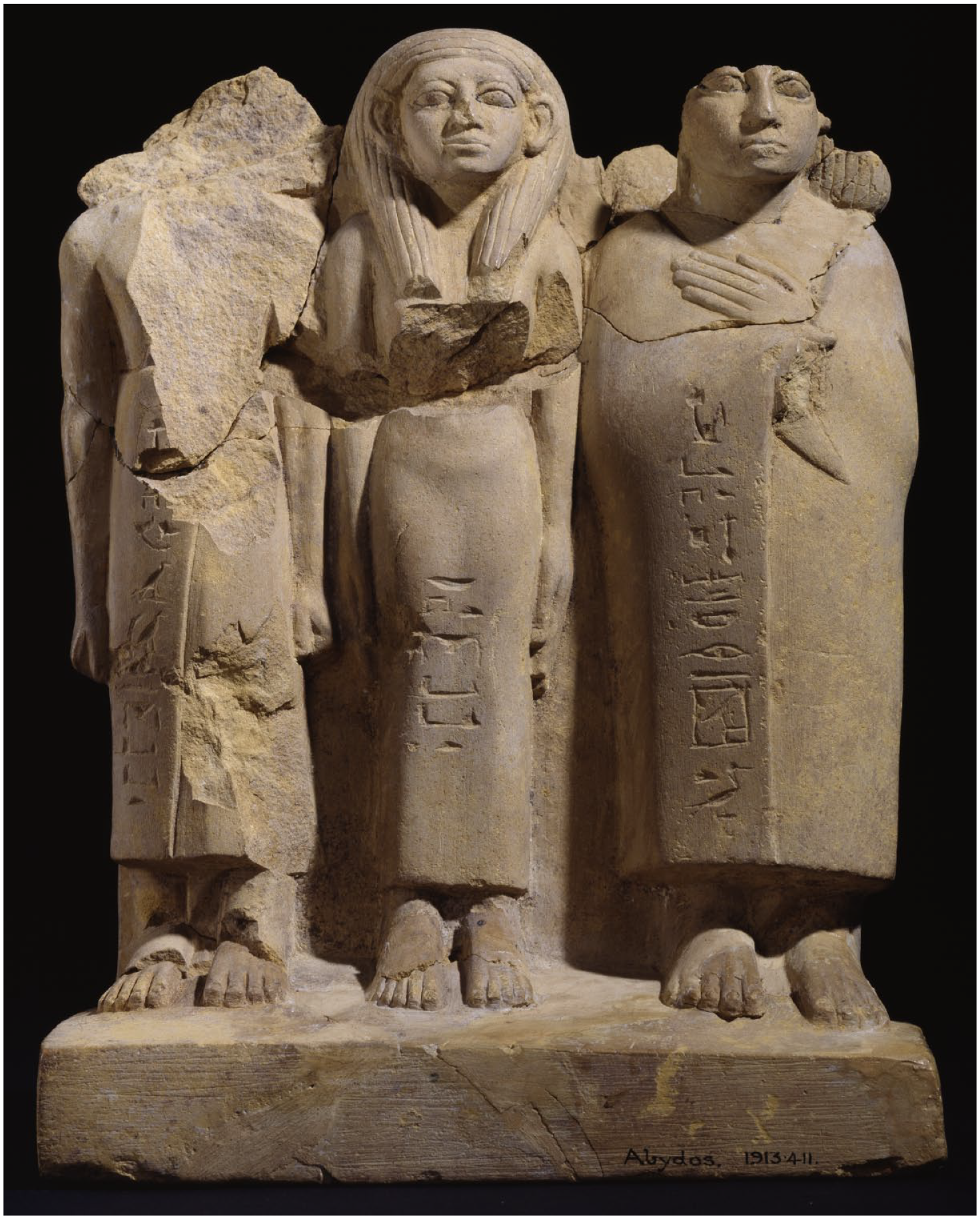
AN1913.411 group statuette of three figurines (photo: © Ashmolean Museum, University of Oxford).
Ashmolean AN1913.411 is made of yellow sandstone and measures 18.6 cm × 14 cm × 6.5 cm. 10 It bears some traces of red, white and black paint, mainly in the area of the faces and wigs (see fig. 2). The statuette features three figures, a woman in the middle and a man flanking her on either side. The object was reassembled from fragments and remains incomplete. The woman was depicted wearing a close-fitting dress reaching her ankles and a large straight tripartite pleated wig. 11 The man to her right was sculpted in a long kilt and, 12 while most of his head is missing, there are the remains of a pleated wig, mainly visible from behind. The man to her left is cloaked and was shown wearing a pleated wig, of which some fragments remain at shoulder level.
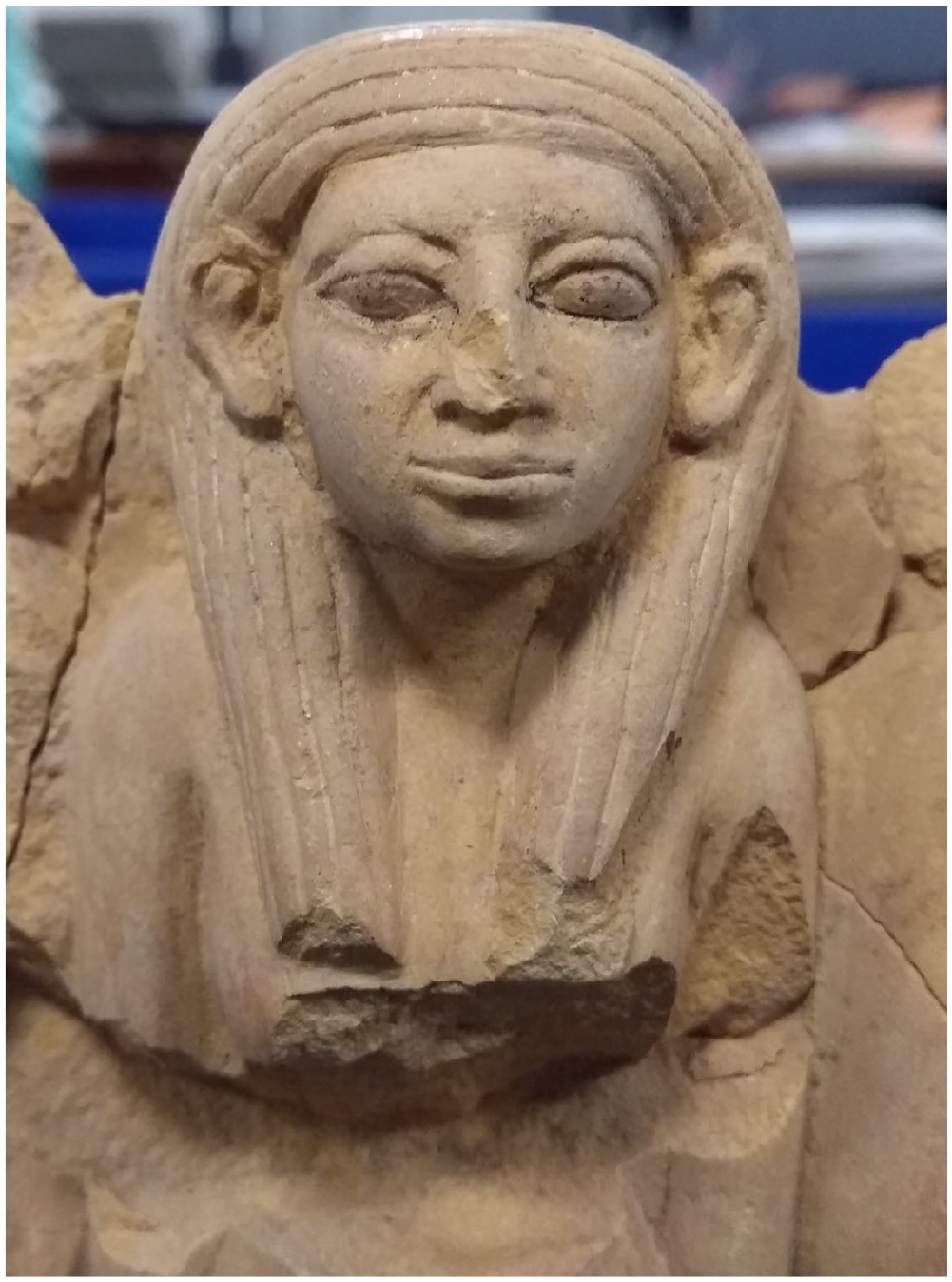
Close-up of Ashmolean AN1913.411 (photo: L. Olabarria, reproduced with permission of the Ashmolean Museum).
These three figures stand rigidly on a rectangular base that rises to form an uninscribed and slightly damaged rectangular black slab for them (see fig. 3). The upper parts of the heads protrude above the back slab and, although the tops of the heads are missing, the men may have been slightly taller than the woman based on the height of the shoulders. The woman and one man have their arms stretched down at their sides, while the cloaked figure holds the garment around his body, with his left hand flat against his upper chest. 13 Cloaked figures, both standing and seated, were common during the Middle Kingdom. 14 It is worth noting that these three figures do not interact with each other physically, a fact that has implications when this statuette is compared with others of a similar typology below.
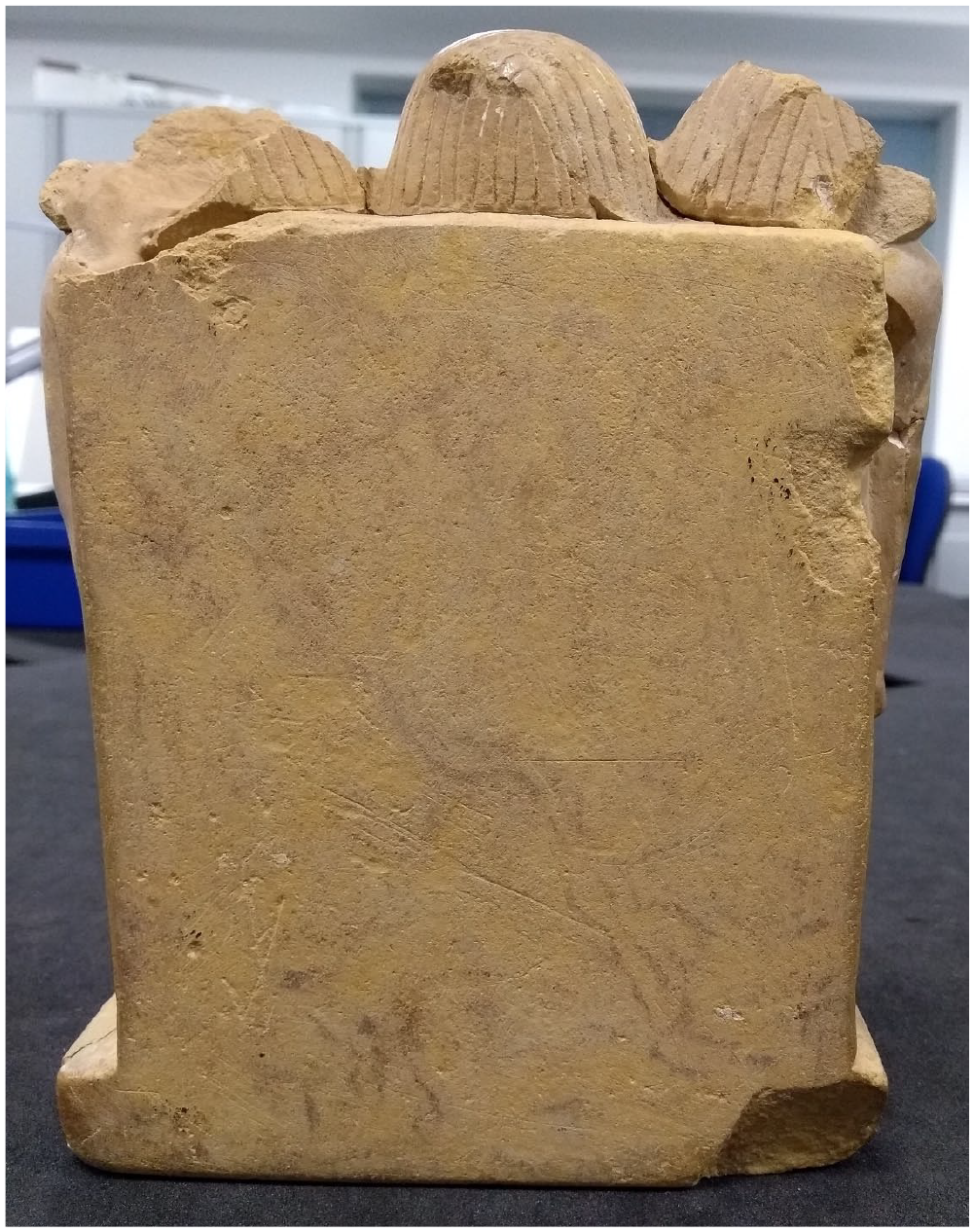
Back of Ashmolean AN1913.411 (photo: L. Olabarria, reproduced with permission of the Ashmolean Museum).
The cemetery where this statuette was found was dated to the reign of Amenemhet III by the original excavators on the basis of the discovery of a cartouche of this king on an amulet in one of the tombs. 15 Simon Connor has confirmed this dating for the statuette on stylistic grounds including the shape of the long kilt, the wig types, the facial contours, the treatment of the eyes, the heavy eyelids, the mouth, and the carefully modelled musculature. 16 This statuette seems to share some features with royal sculpture of the time, 17 but the modelling is less subtle, the dimensions are smaller, and the quality of the material is inferior to that of royal sculpture.
The Inscriptions on Ashmolean AN1913.411
The three individuals depicted are identified through captions that are carved on the figures’ bodies (see fig. 4). These captions do not provide enough prosopographic data to make any definite links between these people, so that a relationship among them can only be suggested tentatively.
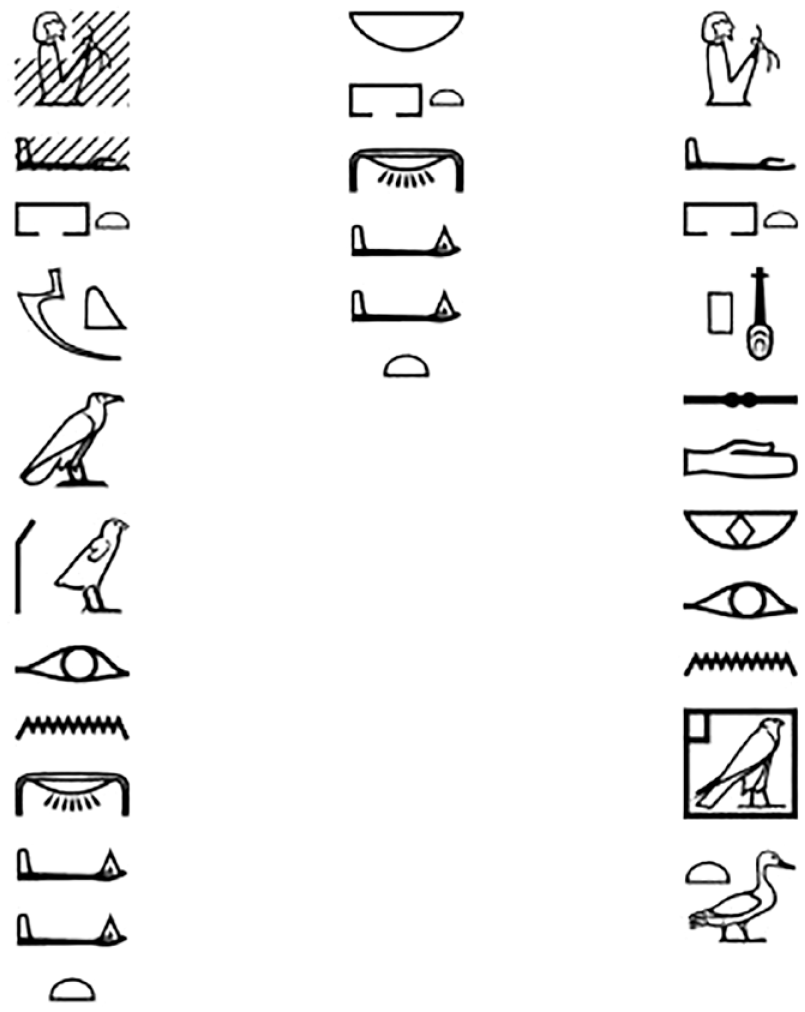
Inscriptions on Ashmolean AN1913.411.
The woman is nbt pr ddt-nbw, ‘the lady of the house Dedetnebu’. The names of her parents are unknown, as her filiation is not given. Her name is very common in the Middle Kingdom, 18 making it impossible to specify her identity further on the basis of this inscription alone. It is worth noting, however, that the structure of the name, a theophoric preceded by ddt, could denote an Upper Egyptian origin. 19 In addition, nbw (‘the Golden one’) is a common epithet of Hathor, a goddess whose connections with a number of southern sites including Dendera and the Theban necropolis are well known, 20 and nbw often features in names of Upper Egyptian origin as well. 21
The man on her right who wears the long kilt is ỉr[y ʿ]t ḳmȝw ỉr.n ddt-nbw, ‘the kee[per of the cham]ber Qemau, born of Dedetnebu’. 22 This filiation suggests that he is presented as her son. Qemau is another popular name of the Middle Kingdom, 23 so it is difficult to relate this individual to specific contemporary monuments. In his prosopographic study, Franke suggested that the Qemau depicted in this triad could be the same as one appearing in stela Vienna ÄS 143 and stela Bonn 4. 24 However, the man in these two stelae has another title (ỉry ʿt wdpw) and a different spelling of his name (kmȝw and ʿȝmw rather than ḳmȝw) in both instances. In addition, he does not have a filiation, and none of the people mentioned on those two stelae are also featured on the statuette, so there is no sufficient evidence to prove this identification.
Finally, the man in the cloak is ỉry ʿt nfr-psḏ(n) ỉr.n sȝt-ḥwtḥr, ‘the keeper of the chamber Neferpesedjen, born of Sathathor’. His unusual name probably alludes to the New Moon festival (i.e., psḏntỉw), 25 as its basket determinative at the end can be read as the ḥȝb-sign for a festival. A variant writing of this name, with nine strokes representing the word psḏ(n) as in ‘Ennead’, is attested in the Middle Kingdom, 26 but the name itself remains rare. This man has the same common title as Qemau, and his mother’s name, given in his filiation, is ubiquitous in the Middle Kingdom. 27
The nature of the relationship among these three people has been a matter of discussion. Peet and Loat thought that the statuette represented Dedetnebu with her two sons, 28 but the inscriptions seem to indicate otherwise. Another common interpretation is that Neferpesedjen could be the husband of Dedetnebu (see below). In any case, scholars generally assume a nuclear family link among people who share a monument, an assumption that I challenge in this article.
An issue perhaps related to the uncertainty of the figures’ relationship is the problem of to whom this statuette belongs, or, perhaps better phrased, to whom it is dedicated. Because this cannot be determined on the basis of the inscriptions, the gender of the people depicted has played a role in interpretations of this monument. For example, the statuette is mentioned in PM V, 62 as belonging to Neferpesedjen, despite the fact that he is not in a central position as would perhaps be expected for the main dedicatee of a monument, and the inscription remains neutral on this point. The woman Dedetnebu is in the central position, 29 which invites a recognition of her as the main person and focal point of commemorative practices elicited by the object, but some publications nonetheless make her subordinate to the men.
Mastabas, Shafts, and Amulets: Peet’s Cemetery D at Abydos
Thus far, my analysis has centred on the statuette itself, but it is essential to situate it in its site and specific archaeological context to clarify its potential function as well as the identity of the individuals depicted on it. Ashmolean AN1913.411 was found in fragments in the chamber of a wrecked mastaba in Peet’s Cemetery D at Abydos. 30 Excavators have divided Abydos differently according to their needs, purposes, and their perceived ‘horizontal stratigraphy’ of the site. 31 The result is a complicated archaeological mosaic of overlapping zones, especially in the much studied area of the North Cemetery. 32 Peet’s Cemetery D, as indicated on figure 5, is the northernmost excavated cemetery of the site. Areas in North Abydos, including Peet’s Cemetery D, are currently being re-excavated by the North Abydos Expedition of New York University’s Institute of Fine Art and Princeton University (see below). 33
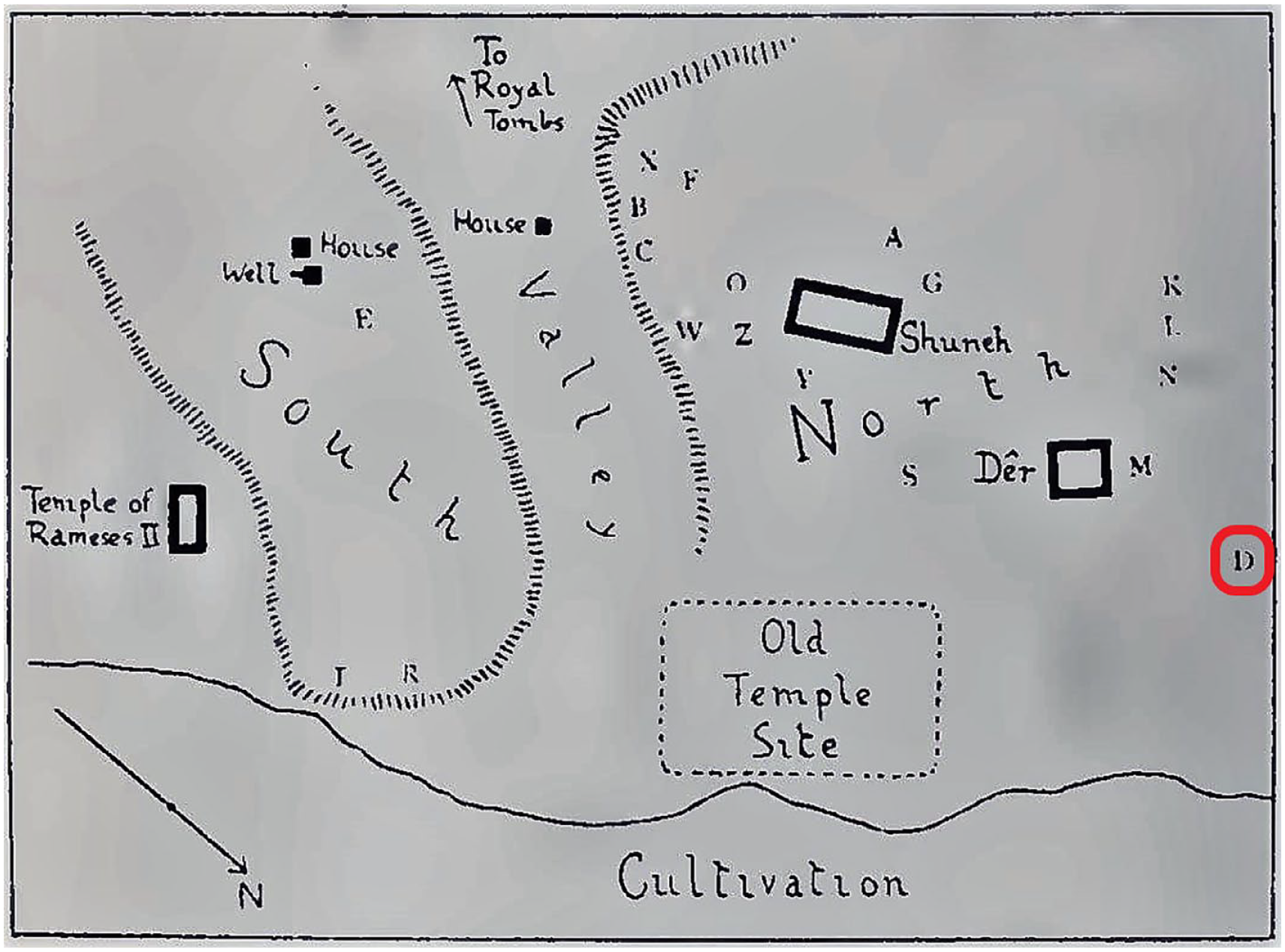
Map indicating the location of Peet’s Cemetery D (adapted from Peet, The Cemeteries of Abydos II, xiv, fig. 1).
Cemetery D was excavated in two seasons, in 1911–12 and in 1912–13, when it was one of the main foci of archaeological work at Abydos. In 1911–12 the excavations were directed by E. Naville and T. E. Peet. The following season was directed by E. Naville, T. E. Peet and W. L. S. Loat. The excavation of Cemetery D was mainly directed by Peet himself. The results of these seasons were published in two volumes, namely The Cemeteries of Abydos II and The Cemeteries of Abydos III. 34
Cemetery D, which was mostly disturbed, consists of mainly Third and Fourth Dynasty tombs, including a few mastabas, around which there is a Middle Kingdom cemetery. The dating of some shafts in this cemetery to the Middle Kingdom is mainly based on tomb architecture and stratigraphy and is confirmed by a green glaze amulet bearing a cartouche with the name of Amenemhet III that was found in tomb D101. 35
The excavation report includes a plan of the Old Kingdom mastabas in the area, 36 but not of the many shaft tombs that surrounded them; significantly, these seem not to have encroached into earlier architecture. 37 Instead of recording every single excavated shaft, the excavators produced a list of the ‘most important’ ones, outlining the contents of each but not the dimensions of the graves. Peet justified this omission in the spirit of economy with the following words: ‘as most of them have been disturbed, and yielded nothing beyond a few large spherical blue glaze beads, to describe them all would serve no useful purpose’. 38 This is one of the reasons why the re-excavation of this area will be crucial in providing a more detailed spatial understanding of the site.
According to the brief general description in the volume, these Middle Kingdom graves are rectangular shafts running local north to south (i.e., true NNW to SSE). 39 The shafts are dug in the ground with an upper part lined in mudbrick, but most of the surface architecture had completely disappeared by the time of excavation. The shafts are around five metres deep, usually with two chambers that open off the bottom to either side. Sometimes there is a third chamber at a higher level and occasionally also a fourth chamber. The bodies in the burial chambers were positioned with their heads pointing north, either fully extended or with their legs slightly bent. The bodies lay on their back or on their left side, with only a few cases of supine position with the head turned to the left, hence facing east towards the rising sun. The bodies often had their arms straight down to their sides, sometimes with one or both arms bent across the body. In all excavated shafts (except for D203 and D241), there was an almost completely disintegrated wooden coffin, but there were no signs of mummification or any other obvious attempts at the preservation of the bodies.
This typology of burials is in line with what is found in many other cemeteries of the First Intermediate Period and Middle Kingdom throughout Egypt. Dendera is an excellent example. There, the shafts surrounding Old Kingdom mastabas were also overlooked in the original excavation report, 40 as well as in later publications that focused mainly on inscribed material from the site. 41 The shafts received little attention until they were analysed by Slater in her unpublished doctoral dissertation. 42 Dayr al-Barsha is another archaeological site that closely parallels Cemetery D at Abydos. At Dayr al-Barsha, shafts of the exact same typology have recently been excavated in the area known by the locals as al-Tud. 43 These do not seem to have been associated with earlier mastabas.
For the purposes of this article, I am concerned with shafts D109–11 and their associated mastaba, where the fragments of Ashmolean AN1913.411 were found. These graves are to the south of a ruined large mudbrick mastaba. Despite extensive damage, the excavators proposed that the mastaba was similar in type and date (i.e., the Middle Kingdom) to those preserved in Cemetery S. 44 They assumed that it had an almost square exterior with slight batter to the walls. It would have featured an entrance from the local east leading to a single small room filling the greater part of the structure. In the local western wall, just opposite the doorway, there would have been a niche where a stela could have stood, possibly the one that I discuss in the following section. Ashmolean AN1913.411 was found in fragments in the sand filling of the chamber of this unnumbered mastaba, 45 which suggests that it may originally have been placed in this chamber. According to a tomb card kept in the EES archive, 46 this mastaba was noted as belonging to a certain Nub-didit, who must be our Dedetnebu. This attribution of the destroyed mastaba to her does not, however, appear in the final publication, which states only that fragments of the triad were found in the fill.
The excavators thought that the location of the three shafts mentioned above, namely D109–11, showed that they must have belonged to the mastaba, as the chambers of the shafts lie directly underneath this structure. 47 The publications did not however provide a clear description of where they were located within Cemetery D. In 2020, the excavations of the North Abydos Expedition team focused on this mastaba, which they were able to identify on the ground. They also found three additional shafts that had not been recognised by Peet. 48 This discovery will surely clarify the description of the architecture of these shafts and their associated mastaba. 49
Shafts D109–11 had only two chambers each, one to the north and one to the south, with the exception of D111, which had an additional chamber to the north. All the burial chambers had been plundered, with only a few scattered artefacts remaining in them. 50 In addition to the succinct descriptions in the excavation report, invaluable complementary information can be gained from the tomb cards of the excavation in the Lucy Gura archive of the Egypt Exploration Society, which has made them available online. 51 From those tomb cards, we learn that these shafts were excavated by Sirhan between 11 January and 14 January 1913.
The plundered north chamber of D109 retained some pieces of funerary equipment, including a copper mirror, 52 a fragment of a copper bracelet with two loop-knots, and beads of several types. Four dark blue spherical glass beads featuring three ‘eyes’ round the sides with a white background and yellow centres were also found; these are believed to be of a later date, which is why the tomb card for this shaft suggests that it featured a ‘possible intrusive burial’. Alternatively, these beads could have ended up in the tomb accidentally during later plundering. There is a record that some contents of this north burial chamber were distributed to the National Museum of Science and Art in Dublin. 53 In the south chamber of D109 there were two bodies, one of them still apparently undisturbed. This body was extended on its left side with the head pointing north and it had been buried with a plain black slab of stone and a grinder; 54 a small glazed vessel behind the head had been completely destroyed by damp. This body was noted in the tomb cards as being that of a man, but this identification is not mentioned in the final publication. The grinder and the mirror found in D109 were sent to the Cincinnati Museums Association in Ohio. 55
The inventory of D110 included light green glass beads (probably a way to describe faience or frit) and a piece of gold foil in the north chamber and some more light green beads in the south chamber. Some additional artefacts were found in the shaft itself, including a blue glass fly amulet, a teardrop pendant, and beads of several shapes.
Finally, D111 had four large jars and some small vases in the shaft itself; line drawings of the latter appear in the final publication. 56 The north burial chamber contained large spherical beads, a white stone eye (perhaps an inlay), and some gold foil. The south chamber had some faience and carnelian beads. Some of these artefacts in the shaft were sent to Wellesley College, Massachusetts. 57
Overall, the archaeological material from D109–11, with associated shafts and a range of burial equipment comprising pottery vessels, beads, a mirror and a grinder, constitutes a typical funerary cluster of the Middle Kingdom that is in keeping with the material culture of the period. 58
The Stela of Sainheret and Inheretnakht
A key source for achieving an enhanced understanding of Ashmolean AN1913.411 was found very close to the badly damaged Middle Kingdom mastaba. The excavation report states that a stela was uncovered face down under three metres of sand north of the mastaba, to which it presumably belonged. 59 It may have stood in the niche on the western wall of the tomb, although there is no evidence to support this connection apart from physical proximity.
This rectangular limestone stela with cavetto cornice is 95 cm high (see fig. 6). The whole stela was badly damaged with salt build-ups and disintegrated into small flakes after being picked up from the ground. 60 Indeed, the distribution lists for artefacts from this archaeological season do not mention this object. 61 The original publication includes a black and white photograph of this stela. 62 According to the excavators, the cavetto cornice was painted in alternating stripes of red and blue. While a transcription and a translation of the stela’s inscription were provided by Alan H. Gardiner in the volume, some names and words were illegible, and these can no longer be checked. A noteworthy detail is that this stela includes the name of the woman in the statuette, Dedetnebu, thus adding an attestation to our limited prosopographic repertoire on this person. My transliteration and translation are based on Gardiner’s notes.
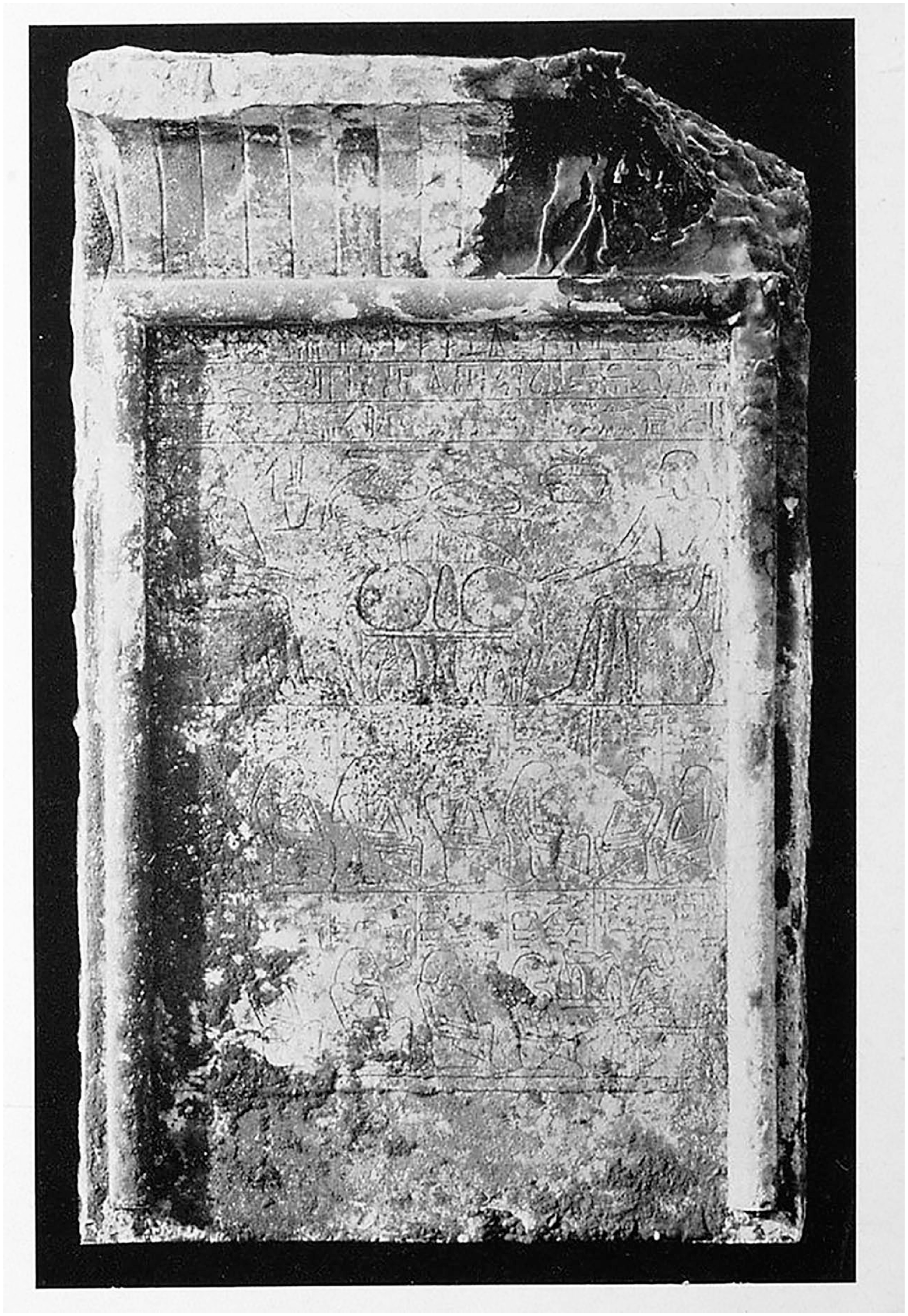
Stela of Sainheret and Inheretnakht (from Peet and Loat, The Cemeteries of Abydos III, pl. xiii, fig. 2).
ḥtp-dỉ-nsw wsỉr ḫntỉ-ỉmntỉw nṯr ʿȝ nb ȝbḏw dỉ=f prt-ḫrw t ḥnḳt ỉḥw ȝpdw snṯr mrḥt n kȝ n ỉmy-rȝ ḫbsw sȝ-ỉnḥrt ỉr.n ddt-sbk
‘An offering that the king gives and Osiris, foremost of the westerners, the great god, lord of Abydos that he may give a voice offering of bread and beer, oxen and fowl, incense and ointment for the ka of the overseer of ploughlands Sainheret, born of Dedetsobek’. 63
ḥtp-dỉ-nsw wp-wȝwt nb tȝ ḳsrt dỉ=f prt-ḫrw t ḥnqt ỉḥw ȝpdw Ss mnḥt ḥtpt ḏfȝw n kȝ n ỉmy-rȝ pr n ȝḫ(y)t ỉnḥrt-nḥt ỉr.n ddt-sbk mȝʿ-ḫrw
‘An offering that the king gives and Wepwawet, lord of the sacred land that he may give a voice offering of bread and beer, oxen and fowl, alabaster and linen, offerings and provisions for the ka of the overseer of the still-room Inheretnakht, born of Dedetsobek, justified’. 64
ỉt=f sbk-ḥtp ỉr.n nfrt-r-rḥwt, ‘his father Sobekhotep, born of Nefereterrehewet’.
mwt=f ddt-sbk ỉr.n dỉ-tʿ, ‘his mother Dedetsobek, born of Dita’.
sȝt=s […]t ỉt.n ddt-sbk, ‘her daughter […], born of Dedetsobek’.
sȝt=s […], ‘her daughter […]’.
sȝt=s […] dỉ-tʿ, ‘her daughter […] Dita’.
sȝt=s […] ỉrt.n dỉ-tʿ, ‘her daughter […] born of Dita’.
ỉmy-ḫt sȝw-prw sȝ-ỉmn ỉr.n sȝt-ỉmn mȝa-ḫrw, ‘the security official of estate guards Saamun, born of Satamun, justified’. 65
sȝ=f ỉmy-rȝ w sbk-m-ḥȝt ỉr.n ddt-nbw, ‘his son the overseer of a district Sobekemhat, born of Dedetnebu’. 66
sȝ=f sȝ-pr s-n-wsrt ỉr.n ddt-nbw, ‘his son the estate guard Senusret, born of Dedetnebu’.
sȝ=f sȝ-ỉmn ỉr.n ddt-nbw, ‘his son Saamun, born of Dedetnebu’.
sȝ=f sȝ-ỉmn šrỉ ỉr.n ddt-nbw, ‘his son Saamun the younger, son of Dedetnebu’.
sȝ=f […], ‘his son […]’.
This object has two distinct parts based on the groups that it commemorates. The stela seems to be dedicated to the brothers Sainheret and Inheretnakht, both born of Dedetsobek, who are presented on the top register seated to either side of a table laden with offerings. The reference to the god Inheret in both their names may suggest an Abydene origin. 67 The register directly beneath shows the squatting figures of their parents, Sobekhotep and Dedetsobek, facing some female members of their extended family whose names cannot be read with certainty. In this upper part of the stela, only Sainheret and Inheretnakht bear titles. These are relatively uncommon, but seem to be mid-ranking titles linked to the control and management of agricultural produce (e.g., ‘overseer of the ploughlands’) and provisions (e.g., ‘overseer of the still-room’).
The bottom part of the stela features another group that is apparently unrelated to Sainheret and Inheretnakht. The third register shows Saamun seated on a chair opposite a row of five men whose filiations seem to make them Dedetnebu’s children. I have noted above how Dedetnebu could perhaps be seen as a name of Theban origin, and her connection to a man called Saamun seems to support this provenance. 68 Saamun’s title, also widespread in Thebes, and those of two of his sons reveal that they are security officials. 69 Four sons of Dedetnebu are named on the stela, namely Sobekemhat, Senusret, Saamun and Saamun the younger. The man captioned on the statuette as Dedetnebu’s son, Qemau, is not mentioned on the stela. If the Dedetnebu who is presented on both objects is the same person, Saamun’s fifth son on the stela, whose name is not legible, could perhaps be Qemau.
The relationship between the two groups depicted on this stela is not clear. They could all be members of the same kin group. For example, Kevin Cahail suggests that the statuette, together with the stela and a lost offering table, may have formed a commemorative assemblage for a family in their tomb. 70 Alternatively, two distinct kin groups could have been depicted on the same object. This may be more likely, especially if we take the group on the upper part of the stela as probably coming from the Abydos area, while the group on the bottom part could be of Theban origin. It is not unique for different kin groups to share a stela; 71 such occurrences may indicate a desire to be commemorated together and hence usually indicate an association that should be perpetuated by display (see next section). In our case, the uncertainty of the relationship between these groups of people makes it difficult to elucidate the role of Dedetnebu and her children, as well as the tentative connection of this stela with Ashmolean AN1913.411.
The Role of Dedetnebu and Conventions of Production
Since Dedetnebu is the only person who is named on both the stela and Ashmolean AN1913.411, her presence seems to be key to understanding what types of groups were commemorated in this assemblage. The evidence is fairly limited because none of the individuals depicted on these artefacts are known from any other sources. Following the analytical framework outlined above for family portraits, I propose we rely on our knowledge of the conventions of production of monumental objects in ancient Egypt, namely their representational conventions, to suggest what types of social relationships they portray.
First, we need to consider whether the women depicted on the stela and on the statuette are different people. This may explain why Qemau, the son of Dedetnebu featured on the statuette, does not seem to appear on the stela—unless he is the man whose name is illegible. If both artefacts were interpreted separately, the role of the three people in the statuette would still remain to be explained. Perhaps in this case, it could be assumed that Neferpesedjen was her husband, so that this statuette would represent a nuclear family group. However, we need to be careful with this type of assumption, which derives to some extent from modern preconceptions of what a family should look like in the monumental record.
Even if these two attestations of Dedetnebu were to be interpreted as referring to different women, both objects are reported to have been found in the same archaeological context. Although Dedetnebu is a common personal name in the Middle Kingdom (see above), it would not be unreasonable to expect a connection between the two women. Names tend to be repeated within kin groups, 72 so that even if these monuments did not feature the same woman, they could have been members of an extended family, such as mother and daughter, or collateral relatives. The exact nature of any such a relationship cannot be suggested in this case.
Second, the names of Dedetnebu on these two objects could refer to the same woman. I have mentioned that this identification would raise problems because the presence of Qemau on the stela can only be assumed, while her husband Saamun is not mentioned on the statuette. A possible explanation is that she was first married to Neferpesedjen, by whom she had one son named Qemau; then, after her first husband died, she could have married Saamun, with whom she had five children. This explanation too is based on the assumption that a woman would be displayed with her husband on the monumental record. Perhaps Dedetnebu was the wife of Saamun, as stated on the stela, and she was represented with Neferpesedjen on the statuette by virtue of another kind of relationship that was not simply mediated by marriage. 73
Ashmolean AN1913.411 and the stela of Sainheret and Inheretnakht raise important questions about the display of social groups in the late Middle Kingdom that go beyond a straightforward identification and classification of kin types. These two objects could show complementary groups that together give shape to Dedetnebu’s social environment. If we look more broadly at conventions of production in relation to the presentation of social groups, it is possible to venture some alternative interpretations. For example, Neferpesedjen could be Dedetnebu’s father. Other instances of triads include depictions of the dedicatee’s mother, as demonstrated by means of maternal filiations in the captions. 74 In the case of Ashmolean AN1913.411, a lineal relationship could also be the focus.
Another possibility is that Neferpesedjen and Dedetnebu could be presented as collaterals instead. While the central position of Dedetnebu in the statuette is not unique, it is distinctive enough to merit some attention. Only four other statuettes in which a woman is in a central position flanked by a man to either side of her are known to me, namely Bolton 2006.152, Bordeaux 8956, Leiden AST 47 and Petrie Museum UC16650. 75 All these statuettes have been dated to the Thirteenth Dynasty or the Second Intermediate Period on stylistic grounds, 76 making them slightly later than Ashmolean AN1913.411. Their inscriptions are difficult to read, but Petrie Museum UC16650 could have been dedicated by a man to his parents, thus highlighting a lineal relation. Interestingly, Leiden AST 47 shows a woman flanked by her two sons, and the statuette itself is said to have been dedicated by her sn (i.e., collateral, possibly brother). Bolton 2006.152 also features a dedication by a collateral.
An emphasis on collaterality would also fit with the conventions of production of the time when this statuette was fashioned, as collaterals were often depicted and celebrated in commemorative monuments. 77 In the late Middle Kingdom it was common to have stelae dedicated by members of the extended family, but also by other colleagues or dependants that were often captioned as snw. In the process, many types of relationships were constructed and reconstructed creatively in stone. While identifications of ancient Egyptian relationships tend to be mediated by modern ideas of a nuclear family, it is perhaps better to see them more broadly as ‘relatedness’. 78 Concepts of family are indeed culturally constructed and need to be understood in emic terms. In Egypt, to be represented together in a monument was one way of enacting relatedness: 79 the stela of Sainheret and Inheretnakht commemorates two groups that do not appear at first glance to be related genealogically, but their sharing of this monument conveys a sense of relatedness. The statuette could be participating in a similar representational convention that highlights lineality and/or collaterality as key aspects of relatedness. Even if the specific nature of the relationship of Dedetnebu, Neferpesedjen and Qemau cannot be discerned, the conventions of production of the period showed that these people were indeed related.
Family Groups and Conventions of Consumption
While conventions of production focus on how an image is created and what visual vocabulary is deployed to transmit a particular message, the notion of conventions of consumption refers to the uses that are attributed to an artistic product. Since the archaeological context of this statuette is in connection with a mastaba with associated shafts at the site of Abydos, the object can be interpreted as a means of commemoration of a group in a funerary setting.
Conventions of consumption that are relevant to understanding an ancient Egyptian object are not only those of the ancient Egyptians but also those of modern viewing audiences. The long biographies of ancient Egyptian objects need to be acknowledged when assessing their attributed uses and purposes. 80 An example of these conventions of consumption is the display context of this statuette, referred to above, in a case of funerary artefacts in the Ashmolean Museum. Modes of display of ancient objects have an impact on their perception by modern audiences, 81 but so do any assumptions or preconceptions of both audience and researchers.
A relevant case study is that of portraiture, introduced above through the parallel of family photographs. How far do uses of photography in general, and portraits in particular, influence what we see and what we encourage others to see? Exploring how Meyer Fortes used plate negatives in his discussion of kinship among the Tallensi of northern Ghana, Bouquet urges her readers to pay special attention to framing and captioning, because they may determine that we see what we expect to see. 82 For example, Fortes includes in his monograph an image of four individuals, which he captions as follows: ‘Kinship patterns are not specific in public etiquette or domestic intercourse. An unposed group having a rest in the middle of the day. From left to right, Kpana Tey, his daughter-in-law, his grandson, and his youngest child’. 83 Looking at the photograph, it would be difficult to argue that the shot was not staged; yet Fortes used the caption to present it as an ordinary (and hence conventional) scene that would demonstrate his point on kinship patterns. The photograph, however, is silent, and only Fortes’ caption illustrates its alleged significance for a discussion on kinship. Bouquet claims that the ways in which photographs are framed and captioned are aimed at turning an image into evidence. 84 If we apply a similar lens to an item of material culture such as Ashmolean AN1913.411, the way it is displayed—its framing—and labelled both in the museum and in publications—its captioning—construct and guide modern conventions of consumption of ancient artefacts.
Possibly influenced by the modern category of family portraiture, group statuettes of the Middle Kingdom have often been termed as ‘family groups’. 85 This object type, which served a commemorative purpose, could include up to five figures standing or squatting in line, and is generally thought to represent close-knit family groups, often consisting of a few members of a nuclear family, including wives and husbands, parents and children. Ashmolean AN1913.411, with two men and one woman in line, falls into this visual category but, as seen above, there is no evidence to determine what type of relationship joined the people represented in it. Indeed, for many of the statuettes that have been considered as ‘family groups’, a relationship mediated by the concept of nuclear family can rarely be demonstrated.
For example, National Museums Scotland A.1965.6 presents a triad of two women flanking a man. The statuette’s find context is unknown, but it can be dated to the late Thirteenth Dynasty on stylistic grounds. 86 Even though this statuette is uninscribed, Bourriau and Quirke suggest that the two women were probably wife and mother of the man depicted in the middle because their hands on his shoulders denote that ‘the two women stand in an affectionate relationship to the man’. 87
While the affectionate posture in the case of NMS A.1965.6 is used as a diagnostic feature of this statuette depicting a family, statuettes that show the figures in apparent isolation from each other and without physical contact have also been interpreted as family groups, including Ashmolean AN1913.411. 88 A similar example is Walters Art Museum in Baltimore 22.311, which Connor dates to the Thirteenth Dynasty on stylistic grounds. 89 This statuette comprises figures of two men and two women. The object is termed ‘family group of four’ in the museum’s online catalogue, but it is uninscribed, so that this identification is unsupported. 90 Statuette MMA 66.99.9 in the Metropolitan Museum of Art New York, also dated to the Thirteenth Dynasty on stylistic grounds, similarly presents two men and one woman standing without touching each other, and hence it is very similar in nature to WAM 22.311. 91 The back slab bears three names with their filiation but no titles, and the inscription does not point towards any type of genealogical relationship. This statuette has also occasionally been interpreted as a family group. 92
In his study of late Middle Kingdom and Second Intermediate Period statuary, Connor discusses ‘family groups’ as one of his typologies of statuary. 93 He identifies around 120 statues of this type, which constitute 13% of his corpus of non-royal statuary, and observes that they are generally small (77.5% of them are less than 30 cm high) and do not show a high level of craftsmanship. Together with the fact that very few of these groups are known for high officials, he concludes that they were mainly created for officials of lower status. 94 One among several exceptions is the statuette of the provincial governor Ukhhotep II of Meir (Boston MFA 1973.87), which shows him together with two women and a child. 95 The two women are captioned as his wives, but there is no evidence for whether this is a case of polygamy or consecutive marriage. 96 In any case, this example shows that these ‘family groups’ were also dedicated among the high elite.
When the archaeological context for these statuettes is known, it is mainly funerary. For example, Fitzwilliam E.3.1914, which is a statuette of a woman and child, was found in Engelbach’s excavation of tomb 162 of Cemetery A at Haraga. 97 On the basis of this mainly funerary provenance, Connor claims that the statuettes could be seen as substitutes for the ‘family stelae’ of the period. 98 Such family stelae, however, are not just funerary, but also commemorative, 99 and the same range of possible functions can also be suggested for these statuettes. Indeed, statuettes of this type have also been found in chapels with no associated burial, 100 which shows that the boundaries between commemorative and funerary uses are probably blurred.
Some of those statuettes may indeed depict nuclear family groups consisting of a man, his wife, and children, as a few inscriptions confirm, but the dynamics of dedication and commemoration—their conventions of consumption—also need to be factored into this analysis. For instance, I have mentioned Petrie Museum UC16650 above, in which a man dedicates a statuette to his parents; the focus here is more on the lineal relationship of a son and his parents rather than on that between husband and wife. Another excellent example is sandstone statuette MMA 56.136, which was dedicated by a certain Ptahwer to his father, the overseer of stonemasons, Senbebu. 101 The statuette shows Senbebu flanked by two women, Abetit and Peryt. The inscription gives no further information about their relationship, but their kin connection can be supported from other sources, such as stela Cairo CG 20731. 102 This stela was dedicated to a ‘fashioner of stone’ Ptahwer, whose mother’s name is Abetit, making it likely that the statuette represents Ptahwer’s parents, although the identity of the second woman is not known. Fischer suggested that they could both have been wives of Senbebu, 103 but there is no evidence to prove this. In fact, Peryt is born of a woman called Henut, as was Abetit, so those two women could have been sisters. This relationship cannot be ascertained, especially since Henut is a common name, but the affinal relation of Senbebu and Abetit is not in the centre of this object. Instead, it is more likely to be celebrating lineality and collaterality. Thus, even though some affinal relationships may be confirmed among people represented in these group statuettes, affinity might not necessarily be the focus of commemoration.
The examples discussed above present a preliminary analysis of Middle Kingdom group statuettes that shows that few of them can be unequivocally identified with what is generally taken to be a nuclear family because prosopographic information is either insufficient or completely absent. The main reason why they tend to be seen as representing family groups is due to modern conventions of consumption, which frame them and caption them according to expectations of what families should look like.
A Family Set in Stone?
Ashmolean AN1913.411 offers a case study to illustrate the challenges of reading monumental representations of social groups in ancient Egypt. This statuette features a woman flanked by two men. The figures have previously been interpreted as a nuclear family, but there is no evidence to confirm the nature of their relationship.
This and similar statuettes have been regarded as possibly representing family groups. Are we indeed in front of a family set in stone? Elsewhere I have explored the encompassing nature of kinship in ancient Egypt and the problems that the idea of family poses in this context. In Middle Egyptian, there exist more than twelve different terms that have been translated as ‘family’, but all of them present nuances. 104 The generalised rendering ‘family’ deceptively unifies a variety of ancient emic concepts into something that fits into an etic framework based on western expectations, which is why I tend to use the term ‘relatedness’ instead. Since it is difficult to determine what a family is, it is preferable to term objects of this type ‘group statuettes’ in order to avoid imposing preconceptions of what a family should look like.
I propose the theoretical framework of conventions of production and conventions of consumption as a convenient way of interpreting this statuette and comparable objects that fit within an ancient context of visual representation and display. On the one hand, conventions of production of the period when this statuette was fashioned indicate that it belonged within a rhetoric that revalorised social networks around the individual in a context of monumental commemoration. The statuette fits with an attention to the display of extended groups in the late Middle Kingdom in which the specific nature of relationships mattered less than the existence of a large group. On the other hand, conventions of consumption remind us that this statuette was made to foster commemoration in the ritual landscape of Abydos, a setting that was desired due to its proximity to the processions in honour of the god Osiris. Nowadays, however, this statuette is subject to different conventions of consumption, where its framing in a display case of funerary objects, and its captioning as a nuclear family in scholarship conform to modern expectations of what such an object could have meant.
Thus, this statuette exemplifies dichotomies between ancient and modern uses of objects and reminds us that western preconceptions inevitably affect how we experience and understand ancient artefacts. In this perspective, we need to attempt to peel off layers of Eurocentric interpretation imposed (perhaps unwittingly) on ancient Egyptian artefacts. Recognising that knowledge production is situated and contingent is essential to acknowledge our own biases explicitly and to attempt an approach to the ancient Egyptian social fabric from an emic perspective.
Footnotes
Acknowledgements
I am grateful to Prof John Baines for his feedback on a draft of this article. I also want to thank the anonymous reviewers for their suggestions and comments.
Funding
The author did not receive funding for this project.
1.
D. Franke, Altägyptische Verwandtschaftsbezeichnungen im Mittleren Reich (HÄS 3; Hamburg, 1983) remains a seminal work for the study ancient Egyptian kinship terminology, providing an insight into emic conceptualisations of kin types and kin groups.
2.
A nuclear family is typically defined in anthropology of kinship as ‘a family unit consisting of parents and their dependent children’, R. M. Keesing, Kin Groups and Social Structure (New York, 1975), 150; see also e.g., R. Parkin, Kinship: An Introduction to the Basic Concepts (Oxford, 1997), 28. Ethnography shows that the nuclear family is neither the universal building block of kinship, nor exclusive to western societies (e.g., L. Holy, Anthropological Perspectives on Kinship (London, 1996), 29–39; J. M. Goody, The Oriental, the Ancient and the Primitive: Systems of Marriage and the Family in the Pre-Industrial Societies of Eurasia (Cambridge, 1990), 482–7).
3.
J. R. Ryan, Picturing Empire: Photography and the Visualization of the British Empire (London, 1997).
4.
Ryan, Picturing Empire, 140–82.
5.
Ryan, Picturing Empire, 225.
6.
M. R. Bouquet, ‘The family photographic condition’, Visual Anthropology Review 16:1 (2000), 1–19; M. R. Bouquet, ‘Making kinship, with an old reproductive technology’, in S. Franklin and S. McKinnon (eds), Relative Values: Reconfiguring Kinship Studies (Durham, N.C., 2001), 85–115.
7.
Locher notes that family photographs appeared in the nineteenth century, at a time when artists—painters in particular—started to be more concerned with interpreting reality rather than with rendering it in a naturalistic manner. Against this background, family portraits were regarded as an allegedly objective way to perpetuate reality, in opposition to contemporary artistic trends. This idea of family photographs as an unbiased representation of a social group may have influenced modern perceptions of portraiture. See Bouquet, Visual Anthropology Review 16:1, 9.
8.
Bouquet, in Franklin and McKinnon (eds), Relative Values, 86–7.
9.
L. Olabarria, Kinship and Family in Ancient Egypt: Archaeology and Anthropology in Dialogue (Cambridge, 2020), 80–2.
10.
H. Whitehouse, Ancient Egypt and Nubia in the Ashmolean Museum (Oxford, 2009), 67–8. Andrew Shortland has raised doubts as to what material Ashmolean AN1913.411 is made of, proposing that it could be limestone instead of yellow sandstone. Tests will need to be undertaken to confirm this suggestion. I am grateful to Liam McNamara and Andrew Shortland for bringing this issue to my attention.
11.
On this type of wig, see J. Vandier, Manuel d’archeologie égyptienne : Tome III. Les grandes époques. La statuaire (Paris, 1958), 254; and S. Connor, Être et paraître : Statues royales et privées de la fin du Moyen Empire et de la Deuxième Période intermédiaire (1850–1550 av. J.–C.) (MKS 10; London, 2020), 240. On wigs as a chronological marker and an indication of status, see A. Tooley, ‘Notes on type 1 truncated figurines: Part 2. Hairstyles and the conceptual development of braided forms’, SAK 49 (2020), 243–74.
12.
Orientation in this description is that of the figures, not that of the viewer.
13.
This type of cloak is a common garment, worn by individuals with titles of diverse rankings, from vizier to wab-priest. This enveloping cloak is not attested before the mid-Twelfth Dynasty in private statuary; see Vandier, Manuel d’archeologie égyptienne III, 256. Malaise corroborates that it appears on two-dimensional representations from Amenemhet II onwards; see M. Malaise, ‘Le costume civil au Moyen Empire : Une contribution à la datation des documents privés’, in F. Geus and F. Thill (eds), Mélanges offerts à Jean Vercoutter (Paris, 1985), 220. Connor argues that this cloak granted a dignified stance, perhaps due to a link with the royal heb-sed garment; see Connor, Être et paraître, 237–8. Another option is that this cloak would be reminiscent of mummiform figures, thus emphasising an Osirian dimension of this object.
14.
Examples include Brooklyn 41.83: R. A. Fazzini, R. S. Bianchi, J. F. Romano, and D. B. Spanel (eds), Ancient Egyptian Art in the Brooklyn Museum (New York, 1989), no. 23; New York MMA 30.8.73: W. C. Hayes, The Scepter of Egypt: A Background for the Study of the Egyptian Antiquities in the Metropolitan Museum of Art, I. From the Earliest Times to the End of the Middle Kingdom (New York, 1953), 209; Durham EG 609: F. Gomaà, ‘Die Statue Durham Nr. 501’, SAK 11 (1984), 107–12; British Museum EA 1237: E. R. Russmann, Eternal Egypt: Masterworks of Ancient Art from the British Museum (London, 2001), 100–1, no. 28; B. Fay, ‘London BM EA 288 (1237): A cloaked individual’, in G. Miniaci and W. Grajetzki (eds), The World of Middle Kingdom Egypt (2000–1550 BC): Contributions on Archaeology, Art, Religion, and Written Sources (MKS 1; London, 2015), 85–8.
15.
T. E. Peet and W. L. S. Loat, The Cemeteries of Abydos III: 1912–1913 (MEEF 35; London, 1913), 23.
16.
Connor, Être et paraître, 42–4; see also 449, table 2.5.
17.
S. Connor, ‘The statue of the steward Nemtyhotep (Berlin ÄM 15700) and some considerations about royal and private portrait under Amenemhet III’, in G. Miniaci and W. Grajetzki (eds), The World of Middle Kingdom Egypt (2000–1550 BC): Contributions on Archaeology, Art, Religion, and Written Sources (MKS 1; London, 2015), 64–6. For a detailed study of the royal statuary of Amenemhet III, see L. Saladino Haney, Visualizing Coregency: An Exploration of the Link between Royal Image and Co-rule during the Reign of Senwosret III and Amenemhet III (HES 8; Leiden, 2020), 232–94.
18.
19.
Ilin-Tomich, ‘Theban administration in the late Middle Kingdom’, ZÄS 142:2 (2015), 120–1, 130; A. Ilin-Tomich, From Workshop to Sanctuary: The Production of Late Middle Kingdom Memorial Stelae (MKS 6; London, 2017), 43–4.
20.
G. Pinch, Votive Offerings to Hathor (Oxford, 1993), 4, 8.
21.
Ilin-Tomich, From Workshop to Sanctuary, 44–7, including a convincing argument that the theonym nbw(t) should be rendered ‘the Golden one’ rather than simply ‘the Gold’.
22.
For this very common title, see W. A. Ward, Index of Egyptian Administrative and Religious Titles of the Middle Kingdom with a Glossary of Words and Phrases Used (Beirut, 1982), no. 452. See also O. Berlev, Общественные отношения в Египте эпохи Среднего царства. Социальный слой „царских ḥmww“ (Moscow, 1978), 251, no. 332. On the use and phraseology of filiation formulae during the Middle Kingdom, see Olabarria, Kinship and Family in Ancient Egypt, 130–4.
23.
24.
D. Franke, Personendaten aus dem Mittleren Reich (20.–16. Jahrhundert v. Chr.): Dossiers 1–796 (ÄA 41; Wiesbaden, 1984), no. 704. For stela Vienna ÄS 143, see W. K. Simpson, The Terrace of the Great God at Abydos: The Offering Chapels of Dynasties 12 and 13 (PPYEE 5; New Haven, 1974), pl. 68 (ANOC 50.3); and I. Hein and H. Satzinger, Stelen des Mittleren Reiches einschliesslich der I. und II. Zwischenzeit. Teil I (CAA 4 Kunsthistorisches Museum Wien Ägyptisch-orientalische Sammlung; Mainz, 1989), 4,68–4,74. For stela Bonn 4, see A. Wiedemann and B. Pörtner, Aegyptische Grabsteine und Denksteine aus verschiedenen Sammlungen III: Bonn, Darmstadt, Frankfurt a. M., Genf, Neuchâtel (Strassbourg, 1906), 8, no. 4; pl. iii.
25.
L. Depuydt, ‘The hieroglyphic representation of the moon’s absence (psDntjw)’, in L. H. Lesko (ed.), Ancient Egyptian and Mediterranean Studies in Memory of William A Ward (Providence, 1998), 71–89.
26.
27.
28.
Peet and Loat, Cemeteries of Abydos III, 24.
29.
Only four other statuettes with this configuration are known to me, and I discuss them below in the section on conventions of production.
30.
31.
S. Snape, Ancient Egyptian Tombs: The Cultures of Life and Death (Chichester, 2011), 134.
32.
Olabarria, Kinship and Family in Ancient Egypt, esp. 31–6.
34.
Respectively, T. E. Peet, The Cemeteries of Abydos II: 1911–1912 (MEEF 34; London, 1914); Peet and Loat, Cemeteries of Abydos III.
35.
Peet and Loat, Cemeteries of Abydos III, 23.
36.
Peet and Loat, Cemeteries of Abydos III, pl. xv.
37.
J. E. Richards, Society and Death in Ancient Egypt: Mortuary Landscapes of the Middle Kingdom (Cambridge, 2005), 147.
38.
Peet, Cemeteries of Abydos II, 48.
39.
Peet and Loat, Cemeteries of Abydos III, 23.
40.
W. M. F. Petrie and F. L. Griffith, Dendereh 1898 (MEEF 17; London, 1900).
41.
H. G. Fischer, Dendera in the Third Millennium B.C. Down to the Theban Domination of Upper Egypt (New York, 1968).
42.
R. A. Slater, The Archaeology of Dendereh in the First Intermediate Period (PhD Thesis, University of Pennsylvania; Philadelphia, 1974). This necropolis is currently being reexcavated: P. Zignani, et. al., ‘Dendara métropole’, Bulletin archéologique des Écoles françaises à l’étranger (2020) < > accessed 18.12.2020.
43.
Olabarria, Kinship and Family in Ancient Egypt, 88–90.
44.
Peet, Cemeteries of Abydos II, 85.
45.
Peet and Loat, Cemeteries of Abydos III, 24.
47.
Peet and Loat, Cemeteries of Abydos III, 38.
48.
49.
I am grateful to Prof. D. Vischak, co-director of the North Abydos Expedition, for a helpful discussion on their recent archaeological work at Abydos.
50.
Peet and Loat, Cemeteries of Abydos III, 24.
51.
For tomb cards of the 1912–13 season, see <https://www.flickr.com/photos/egyptexplorationsociety/albums/72157658835395913> accessed 18.12.2020. For scanned negatives of the season, see <> accessed 18.12.2020.
52.
Peet and Loat, Cemeteries of Abydos III, pl. viii, fig. 15.
53.
54.
Peet and Loat, Cemeteries of Abydos III, pl. viii, fig. 15.
55.
Peet and Loat, Cemeteries of Abydos III, 50.
56.
Peet and Loat, Cemeteries of Abydos III, pl. v, figs 28–30.
57.
Peet and Loat, Cemeteries of Abydos III, 50.
58.
On the relative homogeneity of the burial goods in the tombs of North Abydos, see K. M. Cahail, In the Shadow of Osiris: Non-Royal Mortuary Landscapes at South Abydos During the Late Middle and New Kingdoms (PhD Thesis, University of Pennsylvania; Philadelphia, 2014), 159. See also S. J. Seidlmayer, Gräberfelder aus dem Übergang vom Alten zum Mittleren Reich: Studien zur Archäologie der Ersten Zwischenzeit (SAGA 1; Heidelberg, 1990), esp. 352–4.
59.
Peet and Loat, Cemeteries of Abydos III, 35–6.
60.
Peet and Loat, Cemeteries of Abydos III, 35–6. See also Cahail, In the Shadow of Osiris, 126–7.
62.
63.
For the title, see Ward, Index of Egyptian Administrative and Religious Titles, no. 294. See also S. Quirke, Titles and Bureaux of Egypt 1850–1700 BC (London, 2004), 62–3, where he classifies this title as mid-ranking. In my translation of the offering formulae on these stelae, I follow D. Franke, ‘The Middle Kingdom offering formulas: A challenge’, JEA 89 (2003), 39–57.
64.
In Peet and Loat, Cemeteries of Abydos III, 35 n. 1, Gardiner reads this man’s title ‘steward of the horizon’, where ‘horizon’ refers to the palace. In a later publication, Gardiner notes that ȝḫyt is a chamber where meat was kept or prepared, citing examples related to Amarna or the Palace of Amenhotep III in Thebes; see A. H. Gardiner, ‘Minuscula lexica’, in O. Firchow (ed.), Ägyptologische Studien (Berlin, 1955), 1. In my translation I follow Ward’s interpretation, who thought it unlikely that these apparently minor officials would be linked to the palace; see Ward, Index of Egyptian Administrative and Religious Titles, nos 134 and 87. Quirke notes the difference between ȝḫt (‘slaughter house’) and ȝḫ(y)t (‘granary’); the former would have a much higher status than the latter; see Quirke, Titles and Bureaux, 67.
65.
For the title, see J. Yoyotte, ‘Un corps de police de l’Égypte pharaonique’, RdE 9 (1952), 139–51; Ward, Index of Egyptian Administrative and Religious Titles, no. 431; Quirke, Titles and Bureaux, 109. Ilin-Tomich argues that this is a widespread security title of Theban origin; see Ilin-Tomich, ZÄS 142:2 (2015), 130.
66.
Ward claimed that this title referred to a kind of police official; see Ward, Index of Egyptian Administrative and Religious Titles, no. 307. Fischer proposes that this title should be read ỉmy-rȝ w, and that it is identical with Ward, Index of Egyptian Administrative and Religious Titles, no. 94; see H. G. Fischer, Egyptian Titles of the Middle Kingdom: A Supplement to Wm. Ward’s Index (2nd edn; New York, 1997), 47–8. Quirke also reads the title as ỉmy-rȝ w and suggests that this official would have been responsible for security in the production area; see Quirke, Titles and Bureaux, 108–9.
67.
Ilin-Tomich, From Workshop to Sanctuary, 49.
68.
Ilin-Tomich, From Workshop to Sanctuary, 41.
69.
Ilin-Tomich, ZÄS 142:2 (2015), 130. See also footnotes 65 and 66 above.
70.
Vandier and Cahail, possibly following Peet and Loat, identify the two men on the statuette as children of Dedetnebu; see respectively Vandier, Manuel d’archeologie égyptienne III, 243; Cahail, In the Shadow of Osiris, 126–7; Peet and Loat, Cemeteries of Abydos III, 24. I have established above that this is unlikely because the filiation of Neferpesedjen reveals that his mother’s name is Sathathor.
71.
E.g. CG 20160: H. O. Lange and H. Schäfer, Grab- und Denksteine des Mittleren Reichs im Museum von Kairo I (No. 20001–20399) (CCG 51; Berlin, 1902), 187–9; H. O. Lange and H. Schäfer, Grab- und Denksteine des Mittleren Reichs im Museum von Kairo IV (No. 20001–20780) (CCG 54; Berlin, 1902), pl. xiv; CG 20399: Lange and Schäfer, Grab- und Denksteine I, 349–52; Lange and Schäfer, Grab- und Denksteine IV, pl. xxviii. See also Olabarria, Kinship and Family in Ancient Egypt, 129, 172.
72.
K. Scheele-Schweitzer, Die Personennamen des Alten Reiches: Altägyptische Onomastik unter lexikographischen und sozio-kulturellen Aspekten (Philippika 28; Wiesbaden, 2014), 19–52; L. Olabarria, ‘A question of substance: Interpreting kinship and relatedness in ancient Egypt’, Journal of Ancient Egyptian Interconnections 17 (2018), 96–7.
73.
It is worth noting that I am using the term ‘marriage’ as a shorthand for affinal relations in this paragraph.
74.
E.g., British Museum EA 2305 (on loan to Glasgow, Kelvingrove Art Gallery and Museum): Connor, Être et paraître, 314; Turin Museo Egizio Cat. 3082: S. Connor, Le statue del Museo Egizio (Modena, 2016), 92–3, fig. 96.
75.
Bolton 2006.152: M. Serpico and H. Abd el Gawad, Beyond Beauty: Transforming the Body in Ancient Egypt (London, 2016), 25, fig. 10; Bordeaux 8956: C. Orgogozo and M.-H. Rutchowscaya, Égypte et Méditerranée : Objets antiques du musée d’Aquitaine, Bordeaux (Bordeaux, 1992), 28; Leiden AST 47: H. D. Schneider and M. J. Raven, De Egyptische Oudheid: Een inleiding aan de hand van de Egyptische verzameling in het Rijksmuseum van Oudheden te Leiden (The Hague, 1981), 67, no. 48; Petrie Museum UC16650: A. Page, Egyptian Sculpture: Archaic to Saite, from the Petrie Collection (London, 1976), 21–2, no. 23.
76.
See Connor, Être et paraître, 276, 338, 350.
77.
Olabarria, Kinship and Family in Ancient Egypt, 54–6.
78.
For the concept of ‘relatedness’ applied to ancient Egyptian material, see Olabarria, Kinship and Family in Ancient Egypt, 7–14.
79.
Olabarria, Kinship and Family in Ancient Egypt, 80–2.
80.
81.
E.g., M. Baxandall, ‘Exhibiting intention: Some preconditions of the visual display of culturally purposeful objects’, in I. Karp and S. D. Lavine (eds), Exhibiting Cultures: The Poetics and Politics of Museum Display (Washington, 1991), 33–41; S. Moser, ‘The devil is in the detail: Museum displays and the creation of knowledge’, Museum Anthropology 33:1 (2010), 22–32.
82.
Bouquet, in Franklin and McKinnon (eds), Relative Values, 100.
83.
M. Fortes, The Web of Kinship among the Tallensi: The Second Part of an Analysis of the Social Structure of a Trans-Volta Tribe (London, 1949), 192, plate 10a.
84.
Bouquet, in Franklin and McKinnon (eds), Relative Values, 102. For a critical interpretation of the concept ‘photograph-as-evidence’ applied to archaeology in Egypt, see C. Riggs, Photographing Tutankhamun: Archaeology, Ancient Egypt, and the Archive (London, 2019).
85.
E.g., Connor, Être et paraître, 233–4; Whitehouse, Ancient Egypt and Nubia in the Ashmolean Museum, 67. It should be noted that the display case label for Ashmolean AN1913.411 remains neutral on this point and does not refer to the artefact as a depiction of family.
86.
For dating, see Connor, Être et paraître, 307.
87.
NMS A.1965.6: J. Bourriau and S. Quirke, Pharaohs and Mortals: Egyptian Art in the Middle Kingdom; Exhibition Organised by the Fitzwilliam Museum, Cambridge 19 April to 26 June, Liverpool 18 July to 4 September 1988 (Cambridge, 1988), 70–1, no 56. Physical contact was not a requirement for statues representing husband and wife. For example, displayed just next to Ashmolean AN1913.411 is the Eleventh Dynasty statue of Montuhotep and Nefermesut from Dendera (Ashmolean Museum E.1971), which represents a couple seated with hands on their thighs, but the inscription shows that they were husband and wife; see Bourriau and Quirke, Pharaohs and Mortals, 20–1.
88.
Whitehouse, Ancient Egypt and Nubia in the Ashmolean Museum, 67–8; Connor, Être et paraître, 233–4.
89.
WAM 22.311: Connor, Être et paraître, 270.
90.
For the entry on the Walters Arts Museum online database, see <> accessed 18.12.2020. Another statuette in the same museum features a man flanked by two women, and it has been dated to the late Twelfth Dynasty on stylistic grounds; WAM 22.349: R. Schulz and M. Seidel, Egyptian Art: The Walters Art Museum (London, 2009), 48–9, no. 16; for the dating, see Connor, Être et paraître, 270. This statuette is labelled as a family group of three, with the two women tentatively identified as wives in the catalogue.
91.
MMA 66.99.9: S. Connor, ‘Développement stylistique et “ateliers” : La sculpture du Moyen Empire tardif’, in L. Hudáková, P. Jánosi, and A. Kahlbacher (eds), Change and Innovation in Middle Kingdom Art: Proceedings of the MeKeTRE Study Day held at the Kunsthistorisches Museum, Vienna (3rd May 2013) (MKS 4; London, 2016), 4–8; see also Connor, Être et paraître, 364.
92.
G. Robins, Egyptian Statues (Shire Egyptology 26; Princes Risborough, 2001), 27. It is worth noting that the Metropolitan Museum online catalogue does not mention that this statuette should be regarded as a family group.
93.
Connor, Être et paraître, 233–4.
94.
Connor, in Miniaci and Grajetzki (eds), The World of Middle Kingdom Egypt, 65.
95.
MFA 1973.87: A. Oppenheim, Do. Arnold, Di. Arnold, and K. Yamamoto (eds), Ancient Egypt Transformed: The Middle Kingdom (New Haven, 2015), 193–5. See also Connor, Être et paraître, 281–2.
96.
W. K. Simpson, ‘Polygamy in Egypt in the Middle Kingdom?’, JEA 50 (1974), 100–5.
97.
R. Engelbach and B. G. Gunn, Harageh (BSAE 28; London, 1923), 13, pl. 25; see also Oppenheim, et al. (eds), Ancient Egypt Transformed, 196–7.
98.
Connor, Être et paraître, 234.
99.
L. Olabarria, ‘Coming to terms with stelae: A performative approach to memorial stelae and chapels of Abydos in the Middle Kingdom’, SAK 49 (2020), 117–77.
100.
Richards, Society and Death in Ancient Egypt, 42–4.
101.
MMA 56.136: Oppenheim, et al. (eds), Ancient Egypt Transformed, 155–6. See also Connor, Être et paraître, 363.
102.
CG 20731: H. O. Lange and H. Schäfer, Grab- und Denksteine des Mittleren Reichs im Museum von Kairo II (No. 20400–20780) (CCG 52; Berlin, 1908), 361; Lange and Schäfer, Grab- und Denksteine IV, pl. lv. See also H. G. Fischer, ‘A foreman of stoneworkers and his family’, BMMA 17:6 (1959), 152.
103.
Fischer, BMMA 17:6, 146.
104.
Olabarria, Kinship and Family in Ancient Egypt, 67–72, which includes a discussion on the inclusion of ancestors in Egyptian undertandings of relatedness.