




Abstract
Four funerary stelae of the eighth century AD now in the British Museum have previously been assigned to Abydos on the basis that they are all connected to the monastery of the local saint, Apa Moses. This article questions this assumption. A text edition and study of the common features of the stelae suggest that, although they probably do come from the same cemetery, its location is uncertain, and the provenance of Abydos cannot be proven.
Keywords

Introduction
Between 1905 and 1931, the well-known antiquities dealer, Mohammed Mohassib, 1 sold 24 Coptic funerary stelae to the British Museum. These are now kept in the Department of Egypt and Sudan. Seven of these were bought on the same day in 1919 and were said to be of unknown provenance. 2 Four of these, which are the subject of this article, form a distinct group based on formal and textual similarities: two (nos 1 and 2 in this article) mention an Apa Moses and two others (nos 3 and 4) are stylistically related. The latter stelae date to 754 and 728 AD respectively, which enables us to give an approximate eighth century AD date to the rest of the group. The aim of this article is the publication of these four stelae.
Sofia Schaten had previously described and studied these four stelae as well as five others kept in different museums, pointing out the similarities between them in an article published in 1993. 3
The stelae are all bilingual and Schaten highlighted the following common stylistic features that they share: (a) each contains between eleven and thirteen lines of text; (b) they are written on sandstone stelae of approximately the same size (H 30‒33 cm, W 25‒27 cm); and (c) there are only very slight variations in the formulae used: 
 ‘Grace of God, Jesus Christ. The day of remembrance of our blessed brother’. As some of the texts refer to Apa Moses’ monastery, she concluded that their provenance was possibly Abydos, where his monastery is documented. This, however, raises a series of questions.
Stelae belonging to the ‘Apa Moses’ group
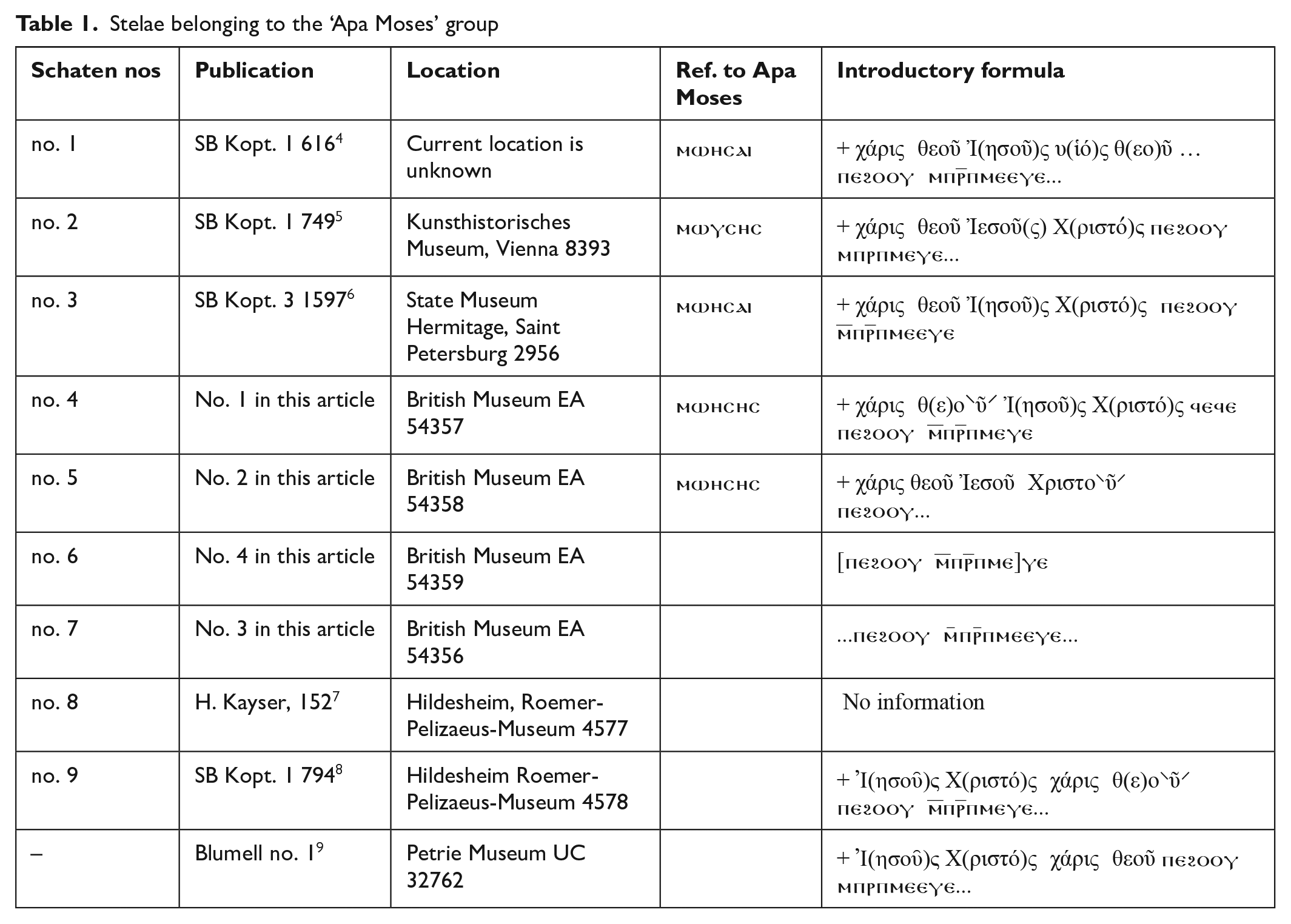
The four texts published here all contain the above-mentioned formula ( ). Formulaic inscriptions similar to this are known from Upper Egypt and Nubia, especially from Aswan.
10
The closest parallels are from Aswan, where approximately 200 gravestones were found in excavations in the nineteenth and twentieth centuries in the cemeteries and the church of Dayr Anba Hadra.
11
The funerary inscriptions of these begin either with the line
). Formulaic inscriptions similar to this are known from Upper Egypt and Nubia, especially from Aswan.
10
The closest parallels are from Aswan, where approximately 200 gravestones were found in excavations in the nineteenth and twentieth centuries in the cemeteries and the church of Dayr Anba Hadra.
11
The funerary inscriptions of these begin either with the line  …, or
…, or 
 …, ‘the day of remembrance’ or ‘Jesus Christ, the day of remembrance’. This means they have the identical formula of our stelae, but without the Greek introductory,
  , which is present in our texts. This combination of the two parts of the formula, on the one hand, makes our group distinctive but, on the other hand, also suggests a connection to the Aswan stelae. It should therefore be considered whether the gravestones with the formula
  might come from the vicinity of Aswan, as already suggested by Tudor, or close to it, rather than from Abydos.
12
However, in the Aswan stelae there is no mention of an Apa Moses.
might come from the vicinity of Aswan, as already suggested by Tudor, or close to it, rather than from Abydos.
12
However, in the Aswan stelae there is no mention of an Apa Moses.
Of the funerary inscriptions with the  formula, no. 1 and no. 2 in this article mention an Apa Moses (no. 1 lines 5–6:
  ; no. 2 lines 4–6:
  ), as do the texts on the stelae SB Kopt. 3 1597 (State Museum Hermitage, Saint Petersburg 2956), SB Kopt. 1 749 (Kunsthistorisches Museum, Vienna 8393) and SB Kopt. 1 616.
13
If we suppose that these all come from the same monastery as they contain the above formula, as well as the reference to Apa Moses, the question must be asked whether the stelae with this formula but without the reference to Apa Moses can have the same provenance.
14
These are stelae no. 3 (BM EA 54356), no. 4 (BM EA 54359) and CIEN 5, 59 (Petrie Museum UC 32762), as well as SB Kopt. 1 794 (Hildesheim, Roemer-Pelizaeus-Museum 4578).
), as do the texts on the stelae SB Kopt. 3 1597 (State Museum Hermitage, Saint Petersburg 2956), SB Kopt. 1 749 (Kunsthistorisches Museum, Vienna 8393) and SB Kopt. 1 616.
13
If we suppose that these all come from the same monastery as they contain the above formula, as well as the reference to Apa Moses, the question must be asked whether the stelae with this formula but without the reference to Apa Moses can have the same provenance.
14
These are stelae no. 3 (BM EA 54356), no. 4 (BM EA 54359) and CIEN 5, 59 (Petrie Museum UC 32762), as well as SB Kopt. 1 794 (Hildesheim, Roemer-Pelizaeus-Museum 4578).
We can turn now to the question of who the Apa Moses mentioned on these gravestones was and if his monastery was possibly situated in Abydos. The most famous Apa Moses was the local saint of Abydos. He is well-known from the Coptic literary tradition as the head of the monastery of Abydos in the late fifth and early sixth century, although the exact location of this monastery has not yet been identified.
15
His monastic foundation stayed active long after his death and archaeological evidence mentioning his name has been found in the area.
16
However, Moses of Abydos was not the only father with this name and there is also evidence of a monastery of Apa Moses ( ) in the proximity of Djeme,
17
as well as possibly other unidentified monasteries.
18
This means that we have to question whether it is to the Apa Moses of Abydos that these funerary stelae do actually refer.
) in the proximity of Djeme,
17
as well as possibly other unidentified monasteries.
18
This means that we have to question whether it is to the Apa Moses of Abydos that these funerary stelae do actually refer.
There is another point that makes us cautious about their provenance. There are four stelae that have a confirmed archaeological context and seven others assigned to Abydos, but none of these contain the formula of our group. 19 In addition, our stelae are of sandstone, and this is unexpected in the context of Abydos. Of the sixth–eighth century stelae of known provenance, all are limestone and, indeed, sandstone stelae from any period are rare at Abydos. 20 Sandstone quarries are only found south of el-Kab in Upper Egypt. 21 This means that, even if there was certainly a monastery founded by Apa Moses in Abydos, there is no comparative archaeological material known to date that would support the Abydene provenance of our funerary stelae.
The four gravestones collected here – irrespective of whether they come from the monastery of Apa Moses in Abydos or not – are related on the basis of the material, formula, date and other features, and they seem to be part of a corpus coming from a cemetery, the location of which is not yet identified.
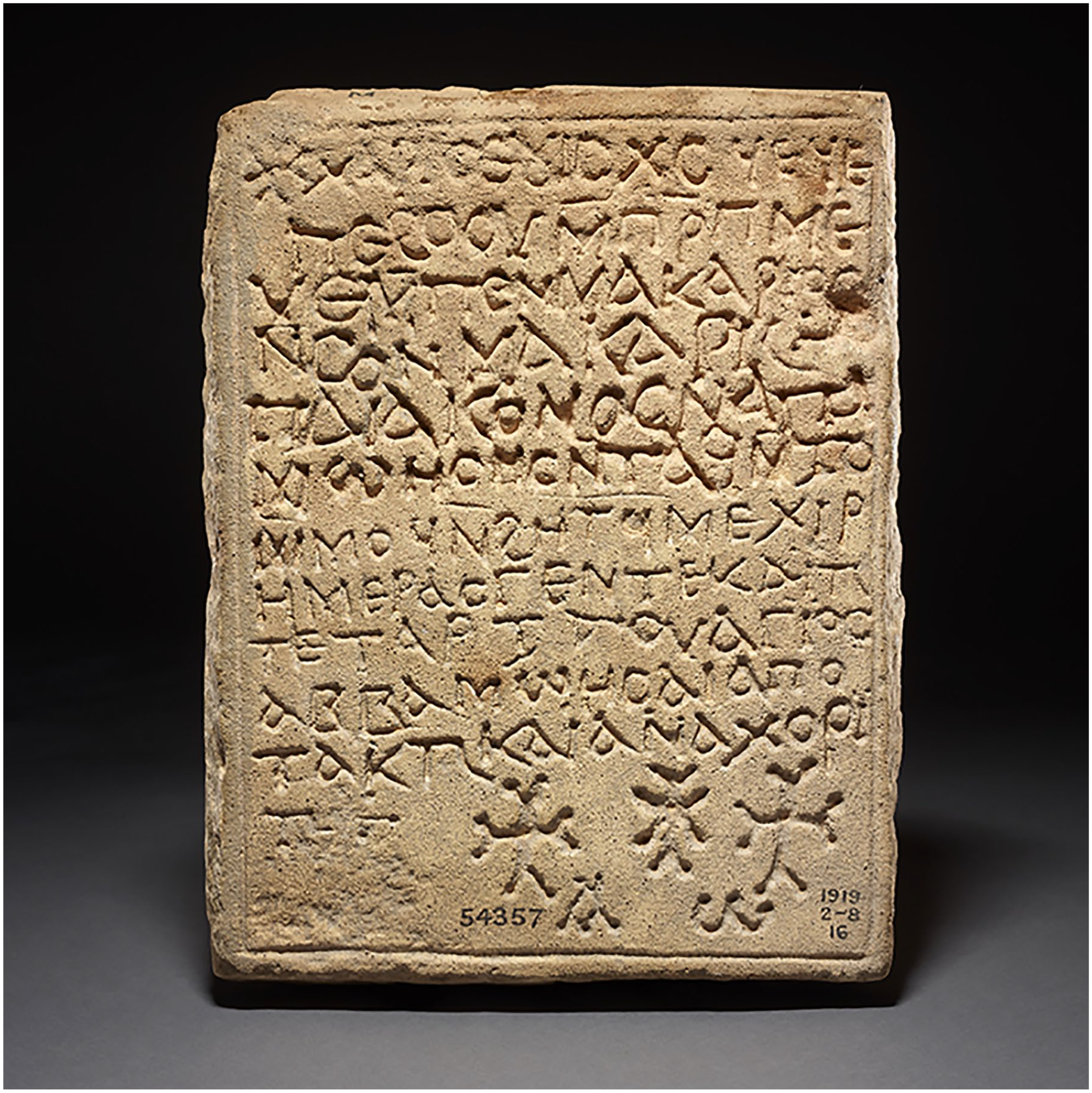
BM EA 54357 (photo: Kevin Lovelock, courtesy of the Trustees of the British Museum).
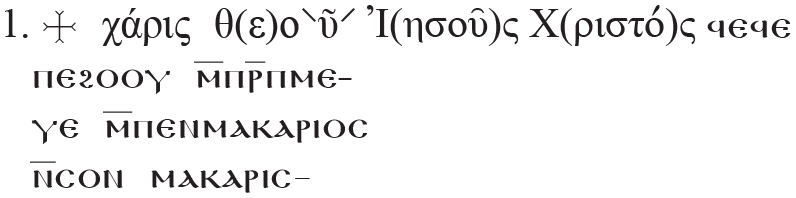
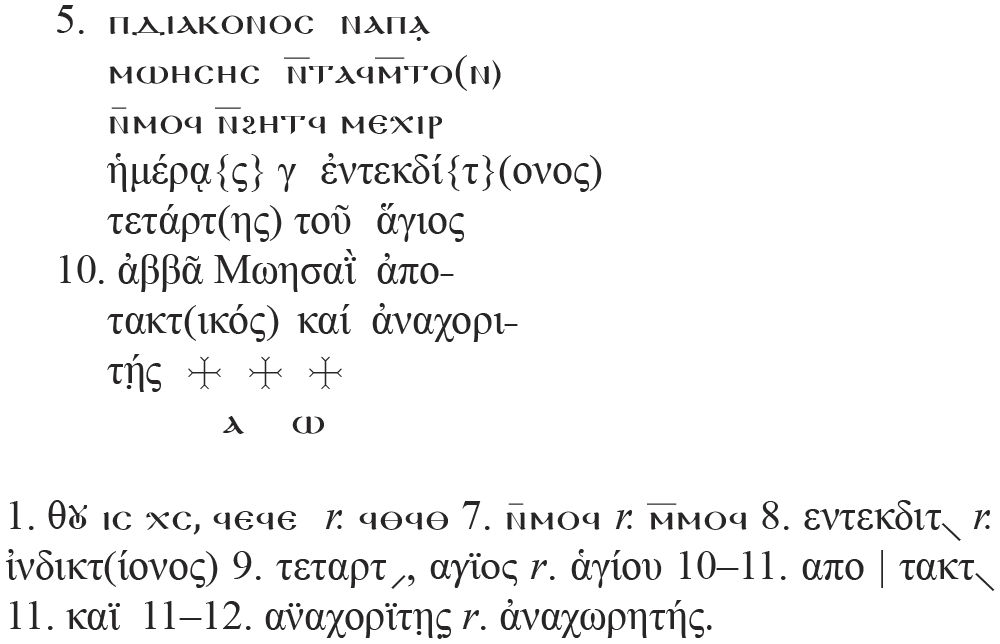 .
.
Translation:
(1)  Grace of God, Jesus Christ, (Amen) (Amen). The day of remembrance of our blessed brother Makaris, (5) the deacon of father Moses, on which he went to rest (is) Mechir, day 3 of the fourth indiction (year) of the holy (10) father Moses apotaktikos and anchorite.
  alpha-omega.
Notes:
L. 1:  clearly meant to be
  , the isopsepic form of Amen (= 99), but the ⲑ is written erroneously as an ⲉ.
L. 4: There is a small, curved line carved after the name, which might be a decorative element.
L. 5: The second ⲁ letter in ⲁⲡⲁ interferes with the previous letter.
L. 6: The writing ⲙⲱⲏⲥⲏⲥ is similar to that in no. 2 (also see below for the version Μωησαϊ). The ⲙ here, similarly to the first letter in line 7, is written with two crossing strokes inside, which might be the result of a correction.
L. 7: The second half of the text is probably written in a different hand. From line 7 the letters are smaller, the alignment is even, and the hand is more experienced. Most of lines 7‒11 is in Greek.
L. 8: The word εντεκδιτ\ is an abbreviation of ἰνδικτίονος ‘indiction’, although we could not find a parallel from the same period. The –τ ending is unusual; the interchange between letters ε˗ι, δ˗τ, however, is common in Egyptian Greek texts; cf. F. T. Gignac, A Grammar of the Greek Papyri of the Roman and Byzantine Periods, Volume I: Phonology (Milan, 1976), 253–4 and 80−2. A similar example can be read on P. Cair. Isid. 57 l. 28 (ἐνδεκτίωνος) from the fourth century AD.
L. 9: The Greek adjective ἅγιος is written in the nominative even though the Greek definitive article before it is correctly in the genitive.
– The name Moses, Μωησαϊ, has been written in a different form here from that in line 6. It seems to be used as an incorrectly declined Greek genitive, as it stands after the date. The name Μωσῆς is written as Μωησαϊ on two other funerary stelae: SB Kopt. 1 616 and on SB Kopt. 3 1597. It probably also has a genitive function in both cases. SB Kopt. 3 1597 lines 9‒10 has a grammatical mistake at the beginning:  . Coptic ⲟⲩ cannot be interpreted as an indefinite article here and Elanskaya, in Naster, et al. (eds), Miscellanea in Honorem Josephi Vergote, 217, thought it must be intended to be the Greek ὁ. However, we cannot exclude the possibility that this is an error for the grammatically correct Greek genitive τοῦ, even if the ἅγιος and ἀναχωριτής there are in the nominative. In this case we should read
  , which is almost identical with our text here. Both texts (No. 1 and SB Kopt. 3 1597) are of similar size; they are both framed by lines; they start and end with crosses of the same form and show other strikingly stylistic and textual similarities. In addition, they were both written in the fourth indiction year. This all suggests that they were made in the same workshop. However, their provenance is not known. The other stela which uses this form of the name Moses (Μωησαϊ) is the above-mentioned SB Kopt. 1 616. This was seen in the antiquities market in Aswan and its text starts with a Greek formula very similar to that of our text (
 χάρις θεοῦ Ἰ(ησοῦ)ς υ(ἱό)ς θ(εο)ῦ ‘Grace of God Jesus son of God’). This formula is not attested in other funerary stelae from Aswan but, as it does not come from an archaeological context, we cannot be certain about its provenance. Here the spelling of indiction, εντεκλιανος (written for εντεκδιανος) is identical with SB Kopt. 3 1597 (εντεκδιανος) and similar to no. 1 (εντεκδιτ\). This suggests that SB Kopt. 1 616 may belong to our group.
L. 10–11: For ἀποτακτ(ικός) interpreted as ‘renunciatory, recluse, hermit’, cf. G. W. H. Lampe, A Patristic Greek Lexicon (Oxford, 1969), 215.
L. 11: There is a superfluous diaeresis above ϊ and ν in the words καϊ and in αναχορϊτη̣ς.
– The alpha written below the three crosses with the omega is a broken˗bar alpha and differs from those found in the rest of the text.
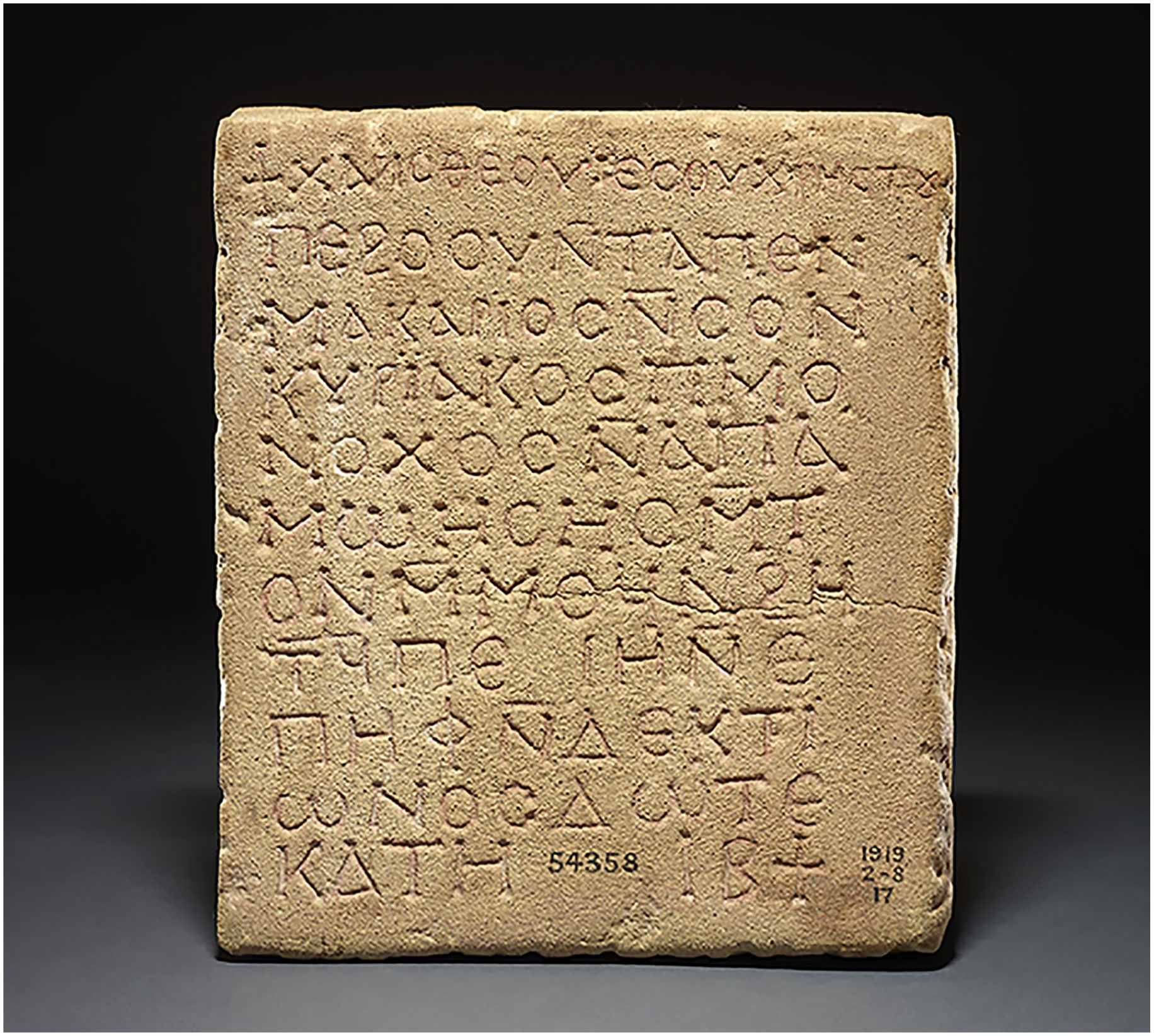
BM EA 54358 (photo: Kevin Lovelock, courtesy of the Trustees of the British Museum).
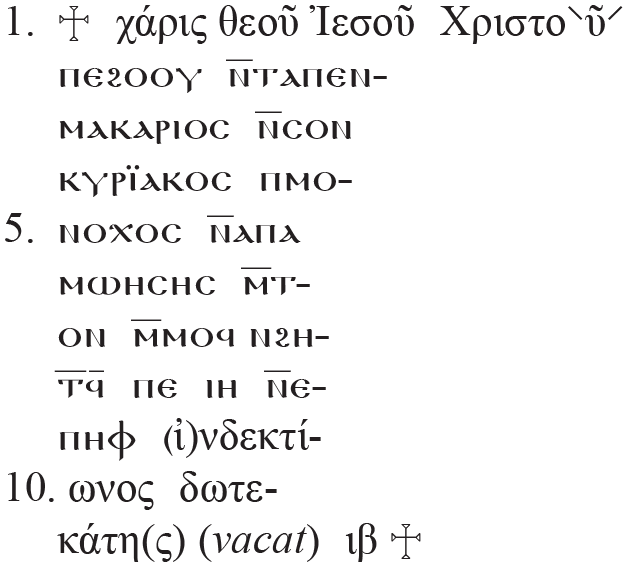

Translation:
(1)  Grace of God, Jesus Christ. The day on which our blessed brother Kyriakos, the (5) monk of father Moses, went to rest is 18 Epeiph of the twelfth (10) indiction (year) 12
Notes:
L. 6: The writing of the name Moses is identical with that on no. 1 line 6.
L. 9: The writing of ‘indiction’ is the same as on no. 4 line 9 below.
L. 11: As on no. 4 lines 10–11, the year is written in Greek and repeated in numerals.
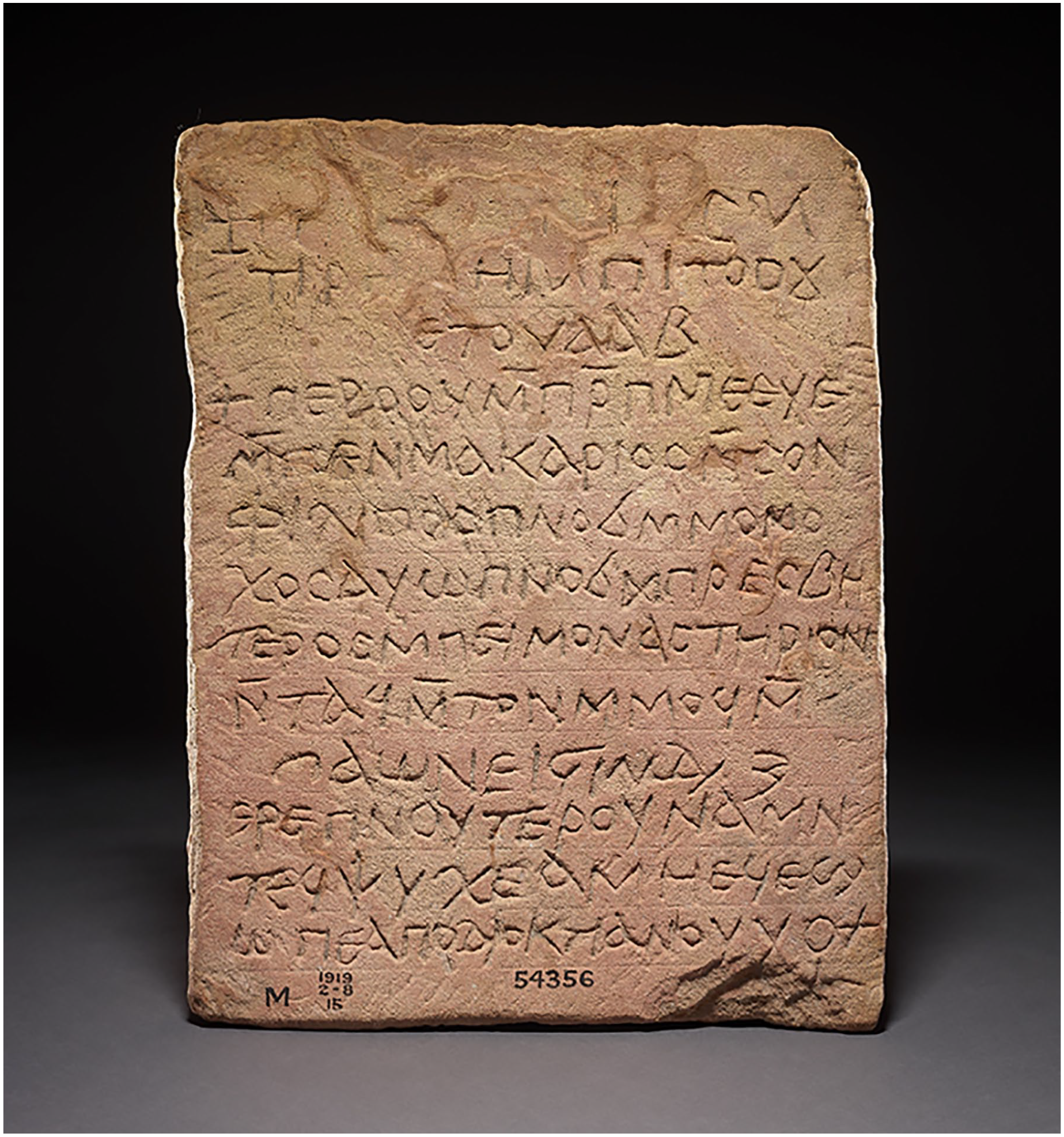
BM EA 54356 (photo: Kevin Lovelock, courtesy of the Trustees of the British Museum).
There are fine horizontal lines drawn between the lines. The letters are thin and not deeply engraved. The text is nicely centred and the lines respect the margins.
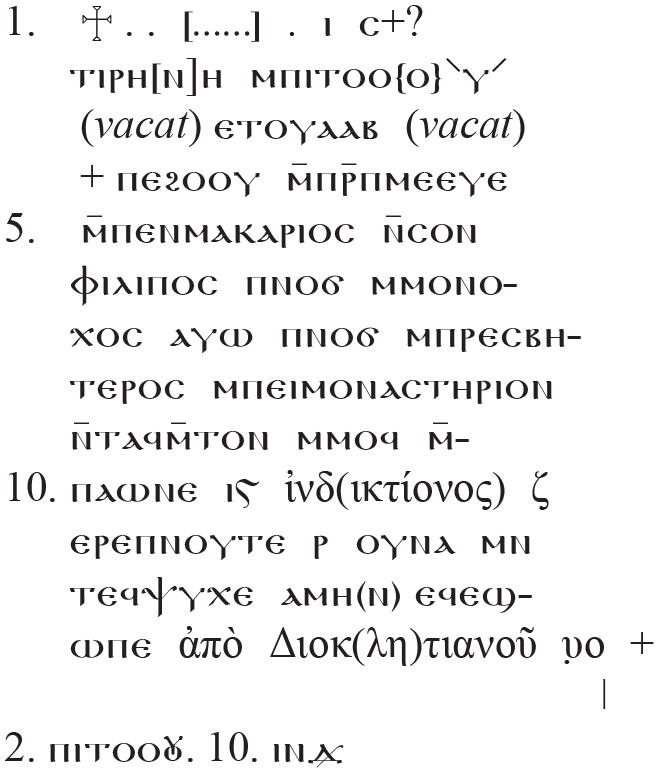
Translation:
(1)  ?. Peace for this holy mountain. + The day of remembrance (5) of our blessed brother Philippos, the great monk and the great priest of this monastery, who went to rest (10) on Payni 16, indiction (year) 7. May God have mercy on his soul. Amen. So be it. From Diocletian 470 +
Notes:
L. 1: The line is very damaged and we cannot identify the formula, which makes its connection to the group uncertain. The end of the line might be the abbreviation of ‘Jesus Christ’(?). The text in lines 2 and 3 can also refer to another formula:  (e.g. SB Kopt. 1 680).
L. 2–3: The writing of the second line is a bit clumsy. There is an unusual gap in the middle of the first word  but the space seems too wide just for the missing ⲛ. The
  in
in  is also clumsily written. The writer probably tried to make the letter larger to use all of the space in order to fill the whole line. This might explain why he positioned the word
  in the middle of line 3.
– The word ⲡⲓⲧⲟⲟⲩ has a superfluous -ⲟ.
L. 6:  is a form of the name
  (NB Copt. 106).
L. 7: The diagonal strokes inside the letter ⲙ at the beginning of the word ⲙⲡⲣⲉⲥⲃⲏⲧⲉⲣⲟⲥ are too long. It seems the letter has been corrected, similarly to no. 1 lines 6 and 7.
L. 10: The word  is abbreviated and the ⲛ is ligatured with the ⲇ.
L. 13: The space between ⲱ and ⲡ in the verb ϣⲱⲡⲉ is a mistake.
– The date is in Greek and correctly declined but Διοκλητιανοῦ is erroneously written as Διοκτιανοῦ. Close examination of the object itself would suggest that the number indicating the year is a υ rather than a χ (the photograph is deceptive). The text is dated to year 470 from the Diocletian era, which would be 754 AD. 22
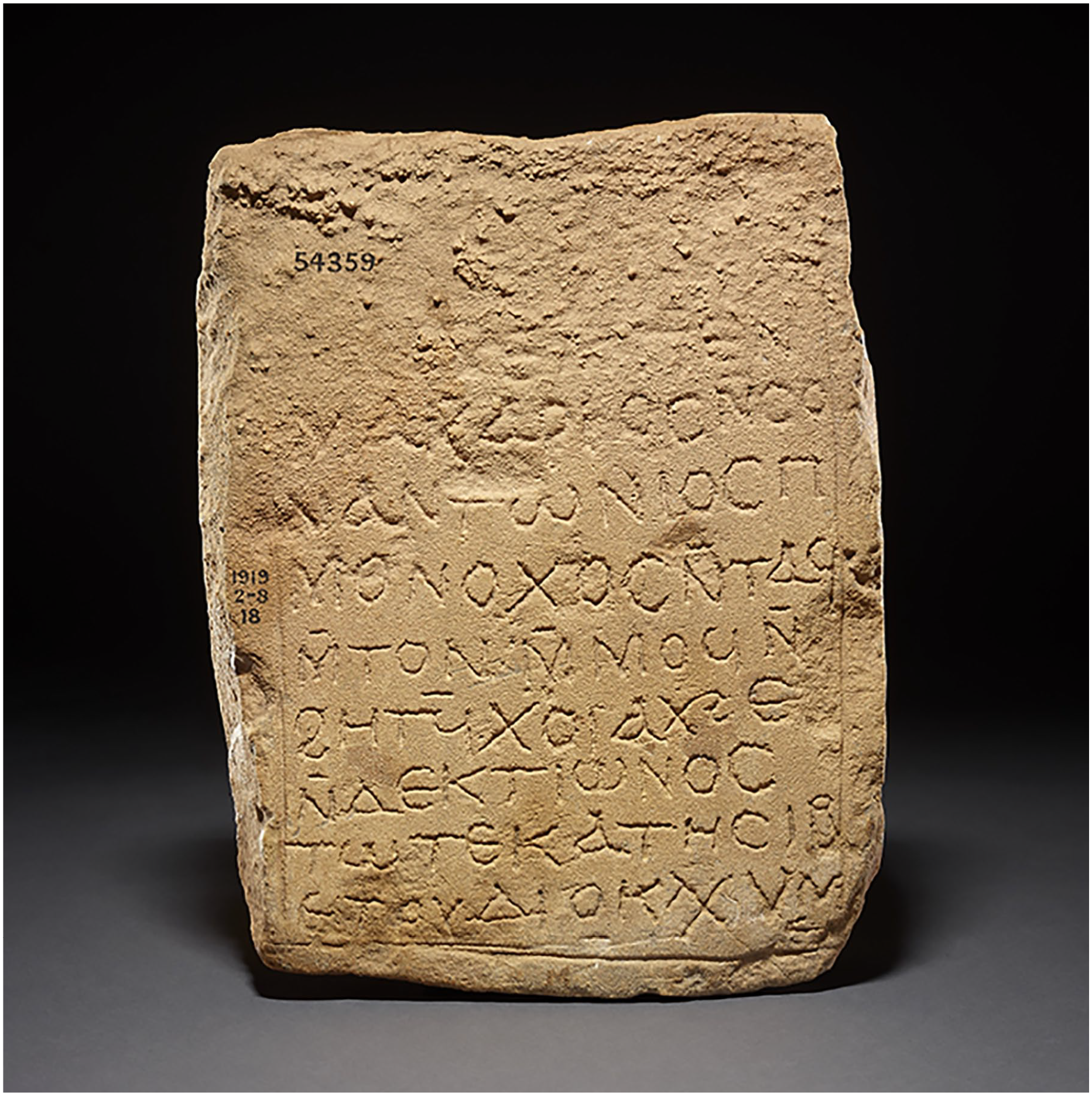
BM EA 54359 (photo: Kevin Lovelock, courtesy of the Trustees of the British Museum).

Translation:
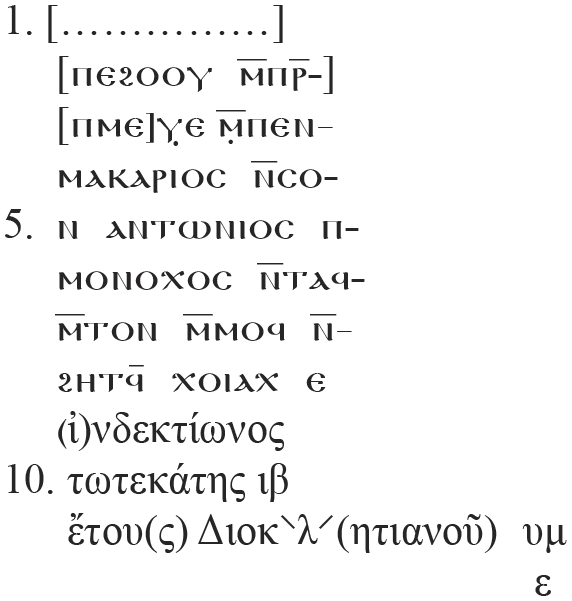
(1) [ …] [the day of remembrance] of our blessed brother (5) Antonios the monk on which he went to rest (is) Choiak 5 of twelfth indiction (year), (10) 12 year of Diocl(etian) 445.
Notes:
L. 1: The first two lines are badly damaged and a full reconstruction of the missing text is not possible.
L. 6: ⲙⲟⲛⲟⲭⲟⲥ is a commonly used Coptic variant of the Greek word μοναχός; cf. H. Förster, Wörterbuch der griechischen Wörter in den koptischen dokumentarischen Texten (Berlin, 2002), 531‒2.
L. 8: There is a curved stroke written after the letter ⲭ that might be interpreted as a sign referring to the division between the month and the following number. This is also found in CIEN 5, 59 (UC 32762) l. 7, 
L. 9: The form of  is the same as that on no. 2. The first sign
  corresponds to the Coptic pronunciation of the syllable ἰν of the Greek word ἰνδικτιών.
L. 10: τωτεκάτης is a version of the classical δωδεκάτης (for the τ-δ interchange, cf. Gignac, Gram., 80‒2).
L. 11: The date in the last two lines is in Greek. There is a small ε written below the numbers indicating the year, which we can interpret as part of the number.
To conclude, we can be confident that the funerary stelae with the formula  , or its variations, belong to the same group and probably come from the same monastery. However, we cannot be certain of their provenance, as there was definitely more than one Apa Moses and probably more than one monastery bearing his name. It seems that the Abydene provenance of the group based on Schaten’s article and followed by other researchers, who noted the similar features of the stelae and connected them automatically to Abydos, must be questioned.
23
Evidence that firmly connects them to Abydos is lacking and other possibilities, in particular a provenance in or near Aswan, must be considered.
, or its variations, belong to the same group and probably come from the same monastery. However, we cannot be certain of their provenance, as there was definitely more than one Apa Moses and probably more than one monastery bearing his name. It seems that the Abydene provenance of the group based on Schaten’s article and followed by other researchers, who noted the similar features of the stelae and connected them automatically to Abydos, must be questioned.
23
Evidence that firmly connects them to Abydos is lacking and other possibilities, in particular a provenance in or near Aswan, must be considered.
Footnotes
Acknowledgements
At the British Museum, I would like to thank Neal Spencer, former Keeper of Nile Valley & Mediterranean Collections, and Elisabeth R. O’Connell, Byzantine World Curator, for permission to publish the material and for their help in preparing this article; BM Conservator Michelle Hercules for treating the stelae and Kevin Lovelock for the production of the photographs. I am grateful to Cary J. Martin for tidying up my English. I am also indebted to Stefanie Schmidt, Freie Universität Berlin, and the anonymous peer-reviewers for their valuable comments.
Funding
The author did not receive funding for this project.

1.
See F. Hagen and K. Ryholt, The Antiquities Trade in Egypt 1880‒1930. The H.O. Lange Papers (Scientia Danica. Series H, Humanistica 4:8; Copenhagen, 2016), 157–9.
2.
British Museum EA 54352, 54354, 54355, 54356, 54357, 54358, 54359.
3.
She collected nine stelae belonging to this group: S. Schaten, ‘Zur Bearbeitung der Grabsteine mit Inschriften: Die Grabsteine des Apa Moyses-Kloster in Abydos’, in T. Orlandi and D. W. Johnson (eds), Acts of the 5th International Congress of Coptic Studies, 12‒15 August 1992, Washington (Rome, 1993), 401‒10.
4.
H. Munier, ‘Les stèles coptes du Monastère de Saint-Siméon à Assouan’, Aegyptus 11:4 (1913), no. 118.
5.
W. C. Till, Die koptischen Grabsteine der ägyptisch-orientalischen Sammlung des Kunsthistorischen Museums in Wien (Wien, 1955) no. 4.
6.
A. J. Elanskaya, ‘Quelques stèles coptes des musées de Léningrad et de Moscou’, in P. Naster, H. De Meulenaere, and J. Quaegebeur (eds), Miscellanea in Honorem Josephi Vergote (OLP 6/7; Leuven, 1975/6), 215‒16.
7.
H. Kayser, Die ägyptischen Altertümer im Roemer-Pelizaeus-Museum in Hildesheim (Wissenschaftliche Veröffentlichung, Pelizaeus-Museum zu Hildesheim 8; Hildesheim, 1973), 152, No. 4577.
8.
H. Kayser, Die ägyptischen Altertümer im Roemer-Pelizaeus-Museum, 152, No. 4578. As this stela is only accessible in translation, it is not included in our textual analysis.
9.
L. H. Blumell, ‘Some unpublished Coptic inscriptions in the Petrie Museum of Egyptian Archaeology’, JCSCS 9 (2017), 67–9. It is also listed as a stela belonging to this group in B. Tudor, Christian Funerary Stelae of the Byzantine and Arab Periods from Egypt (Marburg, 2011), 91 n. 647.
10.
See on Aswan: SB Kopt. 1 498‒675; H. Munier, ‘Les stèles coptes du Monastère de Saint-Siméon à Assouan’, Aegyptus 11:3 (1931), 257–300; H. Munier, ‘Les stèles coptes du Monastère de Saint-Siméon à Assouan’, Aegyptus 11:4 (1913), 433–84. On Nubia: J. van der Vliet, ‘“What is man?”: The Nubian tradition of Coptic funerary inscriptions’, in R. Dekker (ed.), The Christian Epigraphy of Egypt and Nubia (London, 2018), 397–9 and n. 67.
11.
On the archaeological background, see: Tudor, Christian Funerary Stelae, 110–13.
12.
Tudor, Christian Funerary Stelae, 207.
13.
SB Kopt. 3 1597 l. 9–10: ; SB Kopt. 1 749 l. 5–8: ; SB Kopt. 1 616 l. 2–3: .
14.
There are other funerary stelae which refer to a certain Apa Moses, but here this is the name of the deceased and not a father of the monastery. Cf. Roemer-Pelizaeus-Museum, Hildesheim 4577; W. Petrie, Gizeh and Rifeh (London, 1907), pl. 37B, no. 10; State Museum Hermitage, St. Petersburg 2955 (SB Kopt. 3 1598). These are not included in our study.
15.
He is mentioned in the Coptic Synaxarion and his Life has survived in Coptic: M. Moussa, ‘The Coptic literary dossier of Apa Moses of Abydos’, Coptic Church Review 24:3 (2003), 74–90; J. Westerfield, ‘A review of scholarship from the Enlightenment to World War II’, in E. R. O’Connell (ed.), Abydos in the First Millennium AD (BMPES 9; Leuven, 2020), 39‒40.
16.
In the temple of Seti I, where the presence of Coptic graffiti shows that the site was reused in Late Antiquity; cf. J. Westerfield, ‘Monastic graffiti in context: The Temple of Seti I at Abydos’, in M. Choat and M. Giorda (eds), Writing and Communication in Early Egyptian Monasticism: Texts and Studies in Eastern Christianity, vol. 9 (Leiden, 2017), 187–212. Prayers, quotations and invocations often mention Apa Moses; cf. e. g. W. Crum, ‘Coptic graffiti’, in M. Murray (ed.), The Osireion at Abydos (ERA 9; London, 1904), 38–43, nos 31, 25, 36, 19, B4, B11, 44. On archaeological finds related to Apa Moses in Abydos and the discussion of the possible location of his monastery there, see A. M. Damarany and H. S. Abdallah, ‘The South Abydos Marketplace excavations (2009–2010, 2013): The Monastery of Apa Moses?’, in E. R. O’Connell (ed.), Abydos in the First Millennium AD (BMPES 9; Leuven, 2020), 177–94; A. Effland, ‘Apa Moses and his fellow brethren: Christian finds from Umm el-Qa’ab’, in E. R. O’Connell (ed.), Abydos in the First Millennium AD (BMPES 9; Leuven, 2020), 33–55.
17.
In the literary tradition, a Dayr Anba Musas is known in the vicinity of Djeme: S. Timm, Das christlich-koptische Ägypten in arabischer Zeit, vol. 2 (Wiesbaden, 1984), 674.
18.
We know of a Moses of Armant and a Moses of Koptos; cf. S. Timm, Das christlich-koptische Ägypten in arabischer Zeit, vol. 5 (Wiesbaden, 1991), 2143–4.
19.
For the funerary stelae found in Abydos and their classification, see the detailed study of J. van der Vliet, ‘Coptic epitaphs from Abydos’, Journal of Coptic Studies 22 (2020), 205–28.
20.
However, see SB Kopt. 1 745, which is dated to the tenth century and was found in Abydos, but it is of marble.
21.
Cf. R. Klemm and D. D. Klemm, Stones and Quarries in Ancient Egypt (London, 2008), 169–206.
22.
Cf. R.S. Bagnall and K. A. Worp, Chronological Systems of Byzantine Egypt (Leiden, 2004), 63–88.
23.
See Blumell, JCSCS 9, 68: ‘a compelling case can be made that the inscription comes from Abydos’. The textual similarities between this and other stelae supposedly from Abydos, however, are the only argument for the provenance.