



Abstract
Kom el-Khamaseen is a small necropolis located in South Saqqara, 3 km west of the pyramid of Djedkare-Izezi, dating from the end of the Old Kingdom to the First Intermediate Period. In the past few decades, the site has been the victim of several incidences of looting which have destroyed it to a great extent. Between 2019 and 2022, a team from the Universitat Autònoma de Barcelona carried out rescue excavations there. A great number of limestone blocks and block fragments decorated with inscriptions and reliefs were recovered. In a few cases, this decoration suggests reuse and external provenance. Thus, the two blocks presented here – one with a representation of Horus Behdety and the other with an allusion to a royal daughter – must come from the royal cemeteries of South Saqqara. A discussion of this provenance and of the robbery and reuse of materials during the First Intermediate Period is presented.

Kom el-Khamaseen is a small necropolis, located on a hilltop 3 km west of the pyramid of Djedkare-Izezi at Saqqara and dated to the end of the Old Kingdom and the First Intermediate Period. 1 It is placed deep in the desert, far from all the other cemeteries of the Memphite necropolis. The difficulty of keeping it guarded means that it has been repeatedly looted, particularly in the 1990s. The most significant incidence of looting took place in 1999 and largely destroyed the site and its funerary buildings. 2 The team from Universitat Autònoma de Barcelona first came across the site in 1997, when a survey was carried out and it was deduced that the necropolis dated back to the end of the Old Kingdom. While the team was waiting for excavation permits, the looting of 1999 took place and the project had to be abandoned. The current co-director of the mission, Mohammad Youssef, recovered the limestone and granite blocks and block fragments that the looters had not taken from the site and stored them in the El-Mohemat magazine at Saqqara. In 2005 and 2006 the team conducted two epigraphic work seasons to study and preliminarily publish this material. In 2018, Cervelló Autuori and Mohammad Youssef deemed it worthwhile to carry out a salvage excavation at the site to recover all the archaeological, epigraphic, and iconographic material still in situ and document any architectural structures still preserved. In January 2019, the Supreme Council of Antiquities granted the permits and the Spanish-Egyptian Archaeological Mission in South-West Saqqara was established. Four one-and-a-half-month seasons were conducted in the springs of 2019, 2021, and 2022 and the autumn of 2022. Through these, we were able to excavate the site in its entirety, down to the geological levels in all sectors. With the 2022 seasons, our intervention at Kom el-Khamaseen has come to an end.
Of the nearly 160 decorated limestone blocks or block fragments recovered from Kom el-Khamaseen after the looting of 1999 and during the recent excavations, about half come from the tomb of Imephor Impy Nikauptah, Memphite high priest, the best-documented individual in the necropolis. The 200+ granite fragments recovered, about 40 of which are inscribed, may have been part of a sarcophagus and come from his tomb. His names and titles, repeated over and over, appear on wall blocks, on the blocks that formed the gabled roof of his burial chamber, and on the granite fragments. The ‘heterodox’ character of Imephor’s titulary is noteworthy, including both recognised titles of Memphite high priests and others that do not appear in the titularies of any of his predecessors but are common for high officials and even viziers. 3
What is immediately striking about the epigraphic and iconographic material recovered from Kom el-Khamaseen not belonging to Imephor is that none of the other individuals recorded are documented by more than one block. The only other exception is an individual whose name is unknown but who held the title of ỉmy-rȝ ʿ(ȝw), ‘overseer of interpreters/mercenaries/Nubian auxiliaries’, which is documented on two blocks. Since this title is rare in the Memphite necropolis, 4 it seems likely that we are dealing with a single official, whose titulary can be partially reconstructed from the two inscriptions. Imephor is well known to have dated to the First Intermediate Period, perhaps from the very end of the reign of Pepy II. 5 Taking into account the palaeography of the inscriptions and the chronology and uses of the title itself, the most probable chronology of the ỉmy-rȝ ʿ(ȝw) is the second half of the 6th Dynasty. During the 2021 and 2022 archaeological seasons at Kom el-Khamaseen, we proceeded to count and measure all the large architectural limestone blocks scattered on the surface of the site or recovered from the sand as the excavation progressed. The total surface area and volume of this facing material may correspond to at least two funerary buildings in the form of mastabas about 10 m on each side. One of these, which must correspond to Imephor, is now well documented. In fact, in the 2021 field season, the infill of this building was excavated, under which a foundation deposit was found. This can be dated to the First Intermediate Period from the typology of the ceramic pieces, matching the chronology of Imephor. The other is entirely hypothetical, as no archaeological traces of it have been found, nor could the possibility that the blocks correspond to more than one smaller building be ruled out. In any case, a second building may correspond to our 6th Dynasty official.
Thus, from the building material it seems clear that there was not a large number of tombs in Kom el-Khamaseen, at least in the form of important buildings. This contrasts with the number of proper names documented only once and could point to exogenous material, 6 brought here in ancient times – for example by Imephor himself as reused building material – or perhaps in more recent times by looters, who we know had a workshop here to transform decorated limestone blocks into objects suitable for sale on the antiques market. The same is true of some very high-ranking titles that are unlikely to have belonged to people buried here, such as ỉmy-rȝ prwy-ḥḏ, written in large size. This is certainly also the case for the two documents discussed below, two limestone block fragments with reliefs and/or inscriptions recovered at Kom el-Khamaseen. They show royal iconography and epigraphy and must therefore come from the nearby royal necropolises.
The first document (fig. 1) is a fragment of a white limestone block and is in two pieces. The upper piece was recovered during the 2021 season from the large looting trench opened by the robbers with heavy machinery in 1999. It has a maximum height of 29.7 cm, a width of 23.5 cm, and a thickness of 12 cm. The lower piece was already known, having come from the salvage operation carried out by Youssef after the looting in 1999; it has been kept at El-Mohemat since then. 7 It measures 21 cm high by 15 cm wide and 6.3 cm thick.
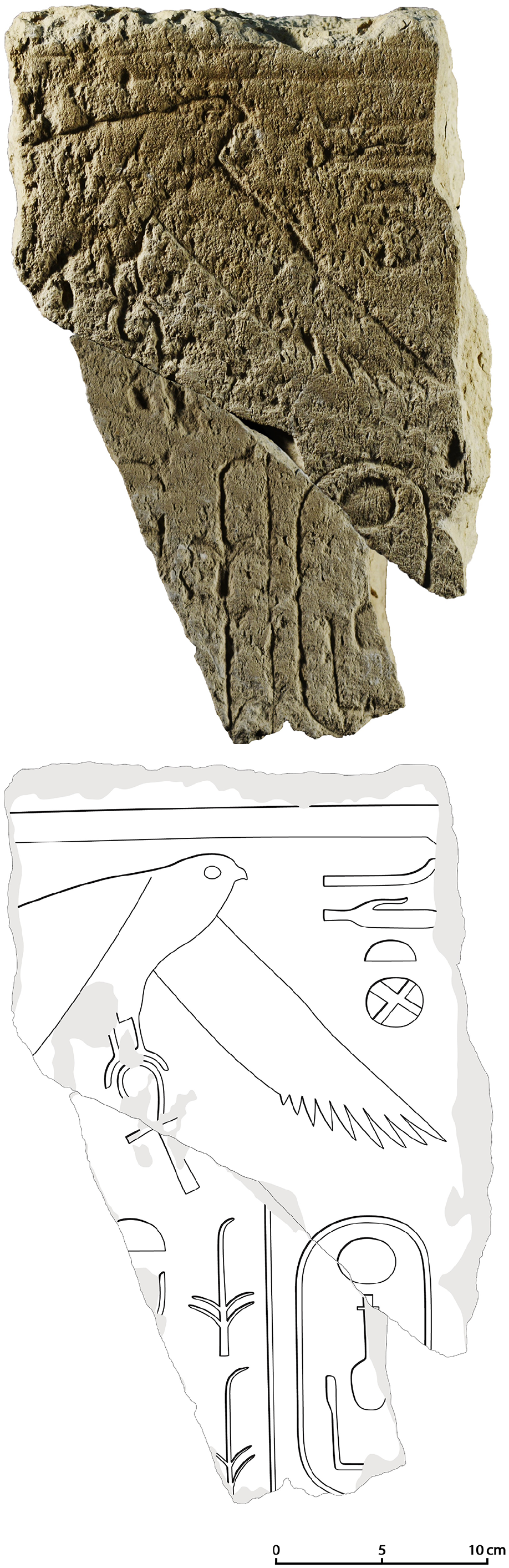
The limestone block fragment KKh21/06+KKh01/48A from Kom el-Khamaseen, stored in the El-Mohemat magazine at Saqqara (photo: Lluís Tudela; drawing: Sara Chen; © Spanish-Egyptian Archaeological Mission in Saqqara (SEAMS)).
The right half of the falcon Behdety can be seen in the upper part of the decorated surface of these pieces, oriented right to left; the head and eye, the right half of the body, and the talons holding the ankh are clearly visible. Only the upper part of the right wing is preserved, and it extends downwards obliquely from right to left, as is usual for this motif. The left wing is preserved in its entirety and also extends downwards obliquely from left to right. Above this wing and in front of the falcon’s head is inscribed its name, Bḥdt(y), written with the four signs arranged in a column. Above the image of the falcon and the name of the god is a representation of the sky. The right-hand end of the latter and the name of the god appear to be in what must have been the upper right-hand corner of the block, which would be almost complete in this part. Below the left wing is the cartouche of a King Nfr-kȝ-Rʿ, who is most likely to be identified with Pepy II or the Neby of the Ramesside lists (see below). To the left of the cartouche, behind a vertical dividing strip, is the very beginning of two lines of text, one above the other, oriented from right to left. On the first, the title ḥmt nswt, ‘royal wife’, can be read. Of the second, only the reed-sign sw of nswt is preserved, probably corresponding to the title mwt nswt or sȝt nswt. The block must therefore have belonged to a queen. Regarding the depiction of Behdety, two positions of the ‘outer’ wing are possible given that the motif begins under Netjerikhet: a completely straight horizontal (the most common) and oblique. 8 Normally when the wing is presented obliquely, it is because there is an inscription above it and in front of the falcon’s head, almost always the name Bḥdt(y). There is no doubt that a block with this decoration and belonging to a queen must have come from a royal necropolis. But which one and to whom can it be specifically linked? Furthermore, what was the original epigraphic context of this fragment of inscription and relief, and what type of monument did these pieces form part of? Let us address what can be determined in this respect.
On monuments of Old Kingdom kings, the inscriptions immediately below the image of Behdety consist of the royal titulary: names (within a serekh or cartouches), titles, and royal epithets. The most complete example is found in a block from a building of King Userkaf but found in the pyramid complex of Amenemhat I at Lisht (fig. 2). Other more fragmentary examples come from the funerary temples of different kings of the 5th and 6th Dynasties (fig. 3), 9 as well as from royal monuments of the same period outside the Memphite necropolis. 10
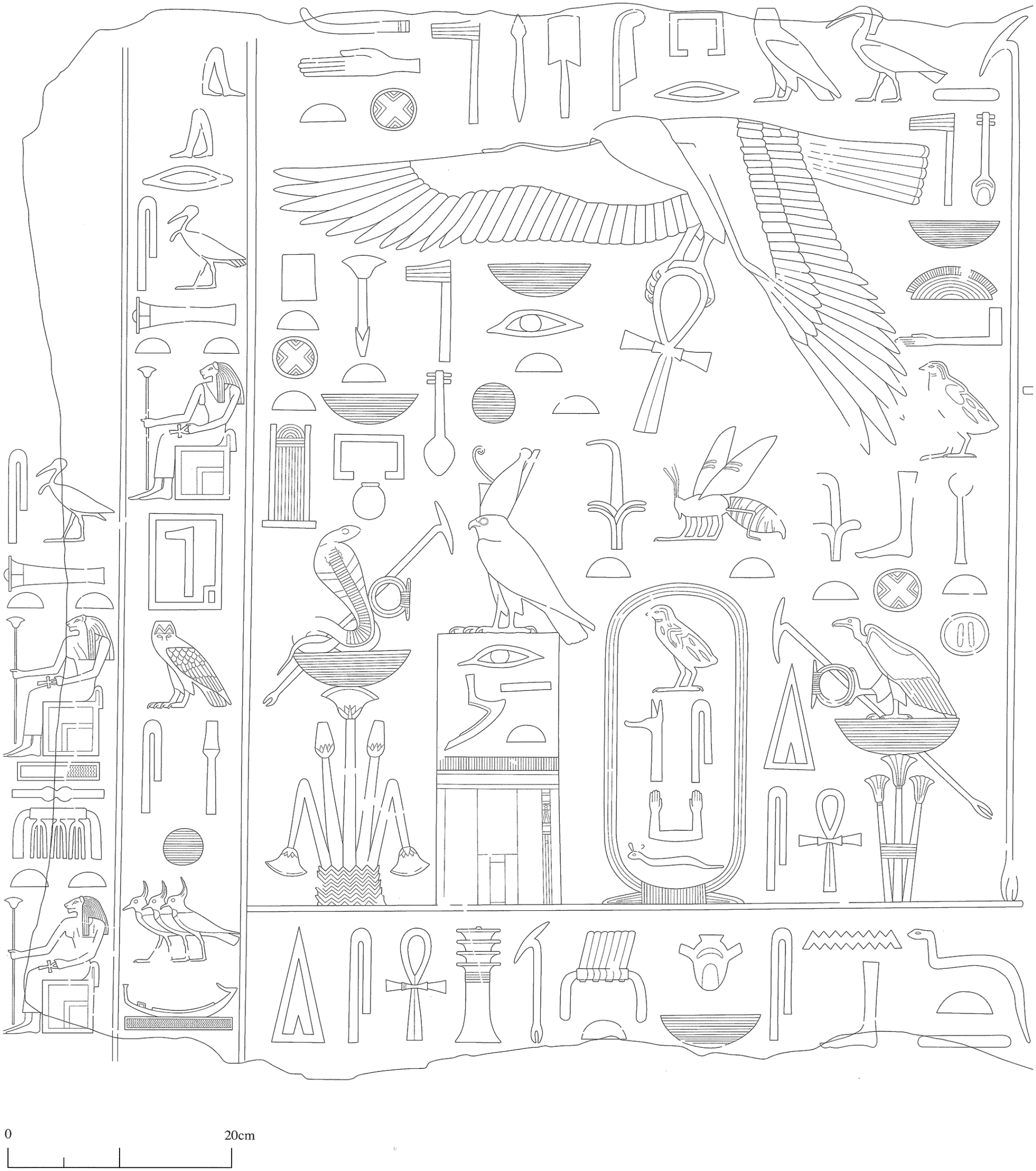
Block/relief fragment from a building of King Userkaf found in the pyramid complex of Amenemhat I at Lisht with the image of the falcon Behdety (drawing: Elisabeth Majerus in Jánosi 2016: pl. 149).
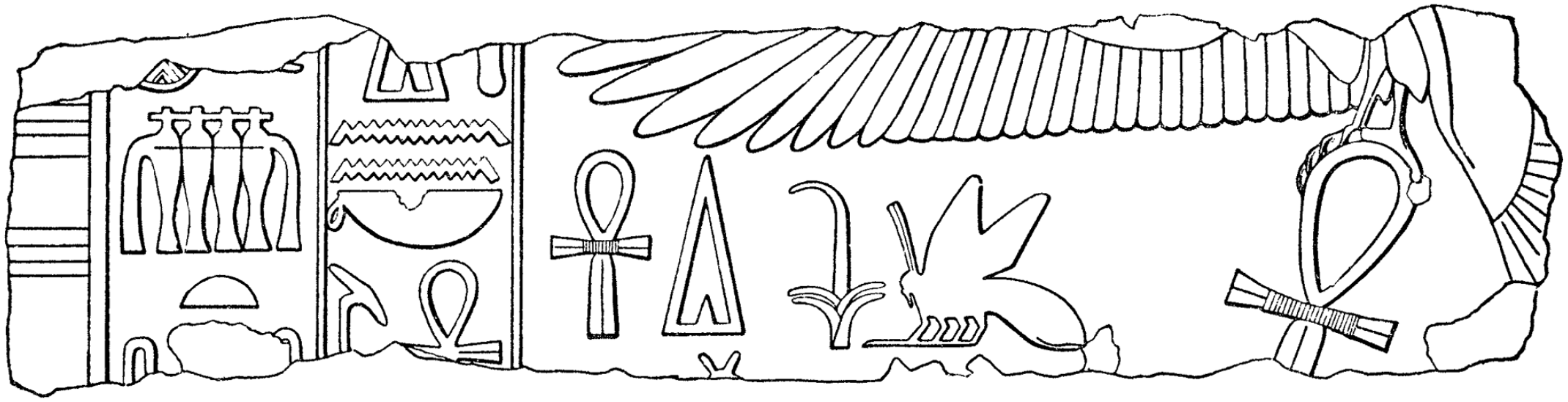
Wall fragment from the funerary temple of Teti with the image of the falcon Behdety or the vulture Nekhbet (drawing: Lauer and Leclant 1972: fig. 34).
In contrast, on monuments of royal women, the inscriptions immediately below the image of Behdety consist of the name of the king’s pyramid, usually accompanied by the titles of the royal woman in question, and sometimes by the titles of the king as well. Some examples come from the pyramid complexes of queen Inenek/Inti (fig. 4) and queen Ankhenespepy II in the Pepy I cemetery (fig. 5).
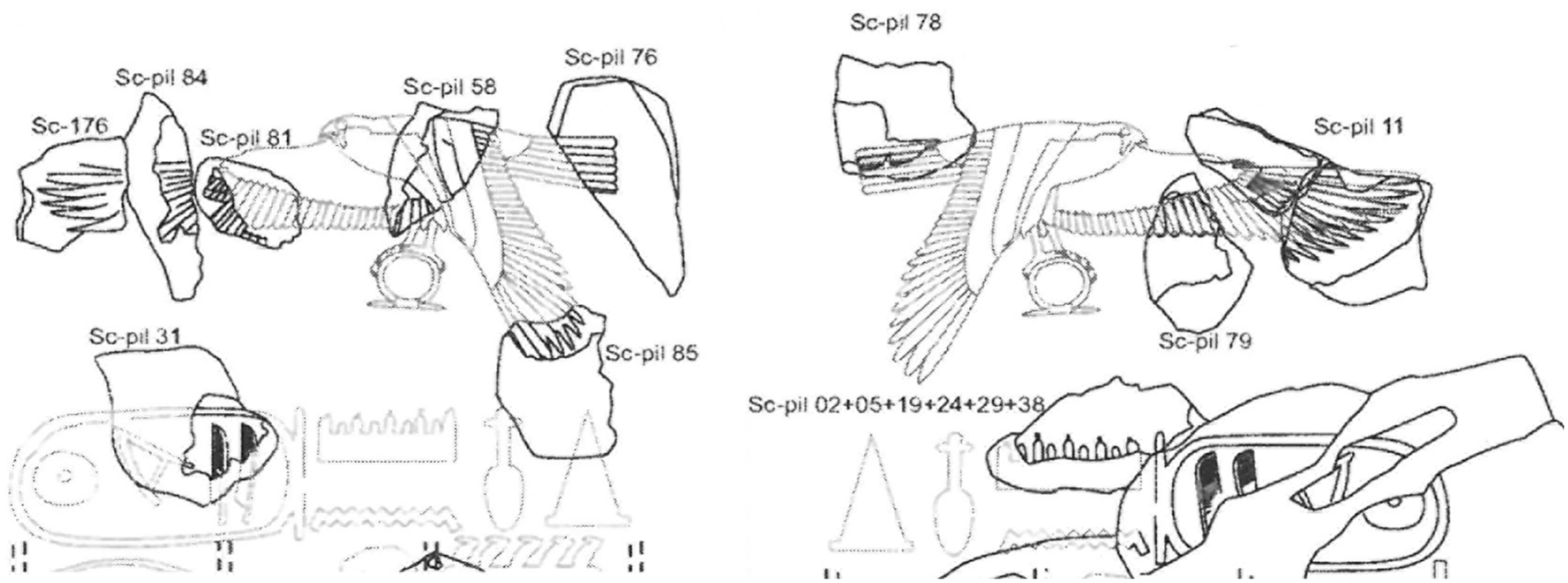
Pillar fragments from the funerary complex of Inenek/Inti in the Pepy I cemetery with two images of the falcon Behdety (drawing: adapted from Payraudeau 2015: fig. 1).
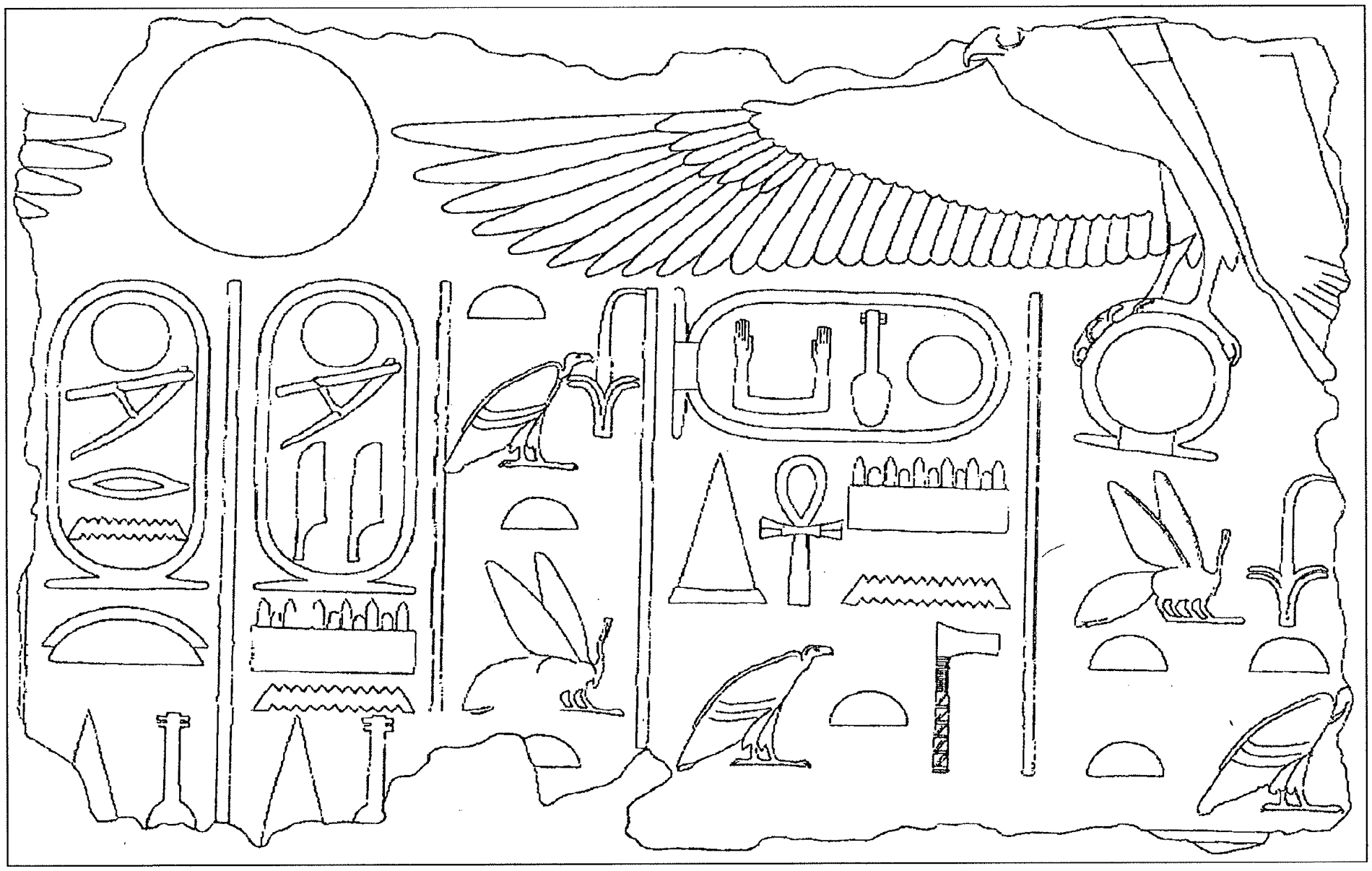
Wall fragment from the funerary complex of Ankhenespepy II in the Pepy I cemetery with the image of the falcon Behdety (drawing: Leclant and Labrousse 2001: fig. 7).
Returning to our block fragment, it can therefore be deduced that the cartouche under Behdety’s image must have been part of the name of a royal pyramid, in honorific transposition. From the epigraphic sources available to us, this pyramid is most likely to be that of Neferkare Pepy II (Men-ankh-Neferkare) or that of Neferkare Neby (Djed-ankh-Neferkare) (see below), although other possibilities cannot be completely ruled out, since, according to the Ramesside royal lists, Neferkare was a very common king’s name in the late Old Kingdom and early First Intermediate Period.
In fact, we have been able to find a very close parallel to our relief belonging to a royal woman, on the east jamb of a doorway from the mortuary complex of queen Nebuwenet in the Pepy I pyramid cemetery (fig. 6). 11 As can be seen, the depictions of the falcons are almost identical in terms of the feathers, the right wing presented obliquely (which is not common), and the sign of the sky above the falcon. Both are carved in poor-quality limestone, are the same size, and share a similar style. It even seems like one is a copy of the other. The Behdety of Nebuwenet does not have its name carved above the left wing, which is uncommon, as discussed above, but in this case the position may be due to the restricted space in which the image is inscribed. By contrast, in both cases, arranged in two columns below the image of the falcon are the name of the king’s pyramid, headed by his cartouche, and the queen’s titles. Therefore, it is possible that our block was part of a monument similar to the one of queen Nebuwenet.
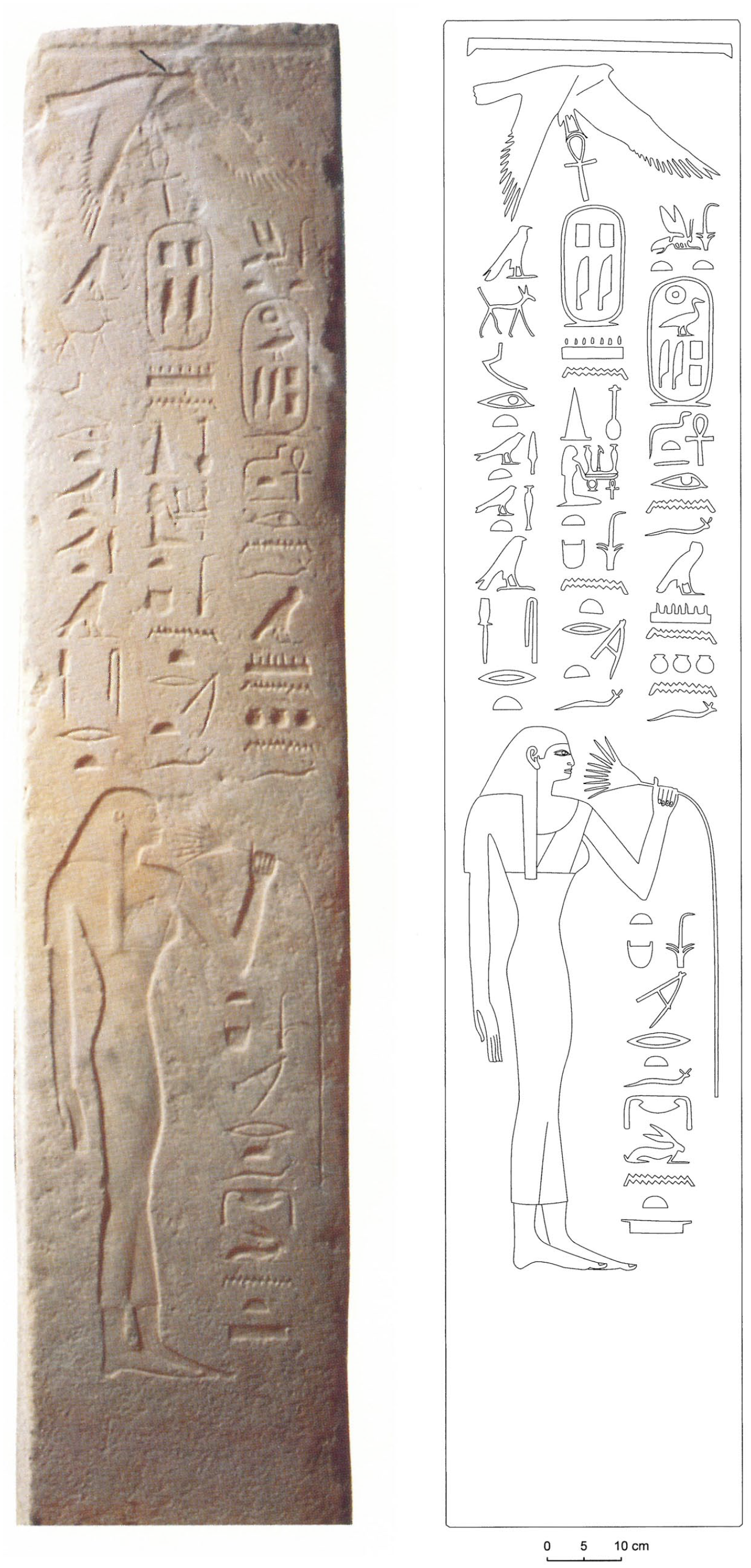
East jamb of a doorway from the funerary complex of Nebuwenet in the Pepy I cemetery with the image of the falcon Behdety (photo: Labrousse 1991: 51; drawing: Isabelle Pierre-Croisiau in Berger-el Naggar and Fraisse 2021: fig. 6).
At this point, we shall introduce a second block fragment, which appeared during the 2022 spring season at Kom el-Khamaseen (fig. 7).
12
This is a fragment of a limestone false door stele, 36 cm high by 27 cm wide and 13 cm thick. It has a text column on either side of a moulding, oriented right to left; the fragment therefore belongs to the left half of the stele. The columns are delimited by dividing strips, which are clearly visible on both sides of the moulding and only partially to the right of the right-hand column. To the right of the latter is a small space that could correspond to a third column of text; if so, the jamb in question – inner or middle – would consist of at least two columns, making the stele of medium or large size. The cartouche with the name Ppy can be seen in the right-hand column. In the left-hand column the sequence …(n)t ẖt=f Ppy… can be read; the feminine indirect genitive nisba indicates that this is a royal daughter (or granddaughter), and the cartouche must be part of her name. As far as we know, the only royal women documented with basilophoric names embedding the name Pepy are several called Ankhenespepy: 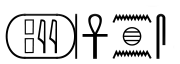 .
13
So far, four have been identified with relative clarity, but it is possible that the documentation actually records more, since it is clear that the name was common in the 6th Dynasty.
14
We can rule out Ankhenespepy I and Ankhenespepy II since they are the very well-documented daughters of Khui, nomarch of Abydos, and the female vizier Nebet.
15
.
13
So far, four have been identified with relative clarity, but it is possible that the documentation actually records more, since it is clear that the name was common in the 6th Dynasty.
14
We can rule out Ankhenespepy I and Ankhenespepy II since they are the very well-documented daughters of Khui, nomarch of Abydos, and the female vizier Nebet.
15
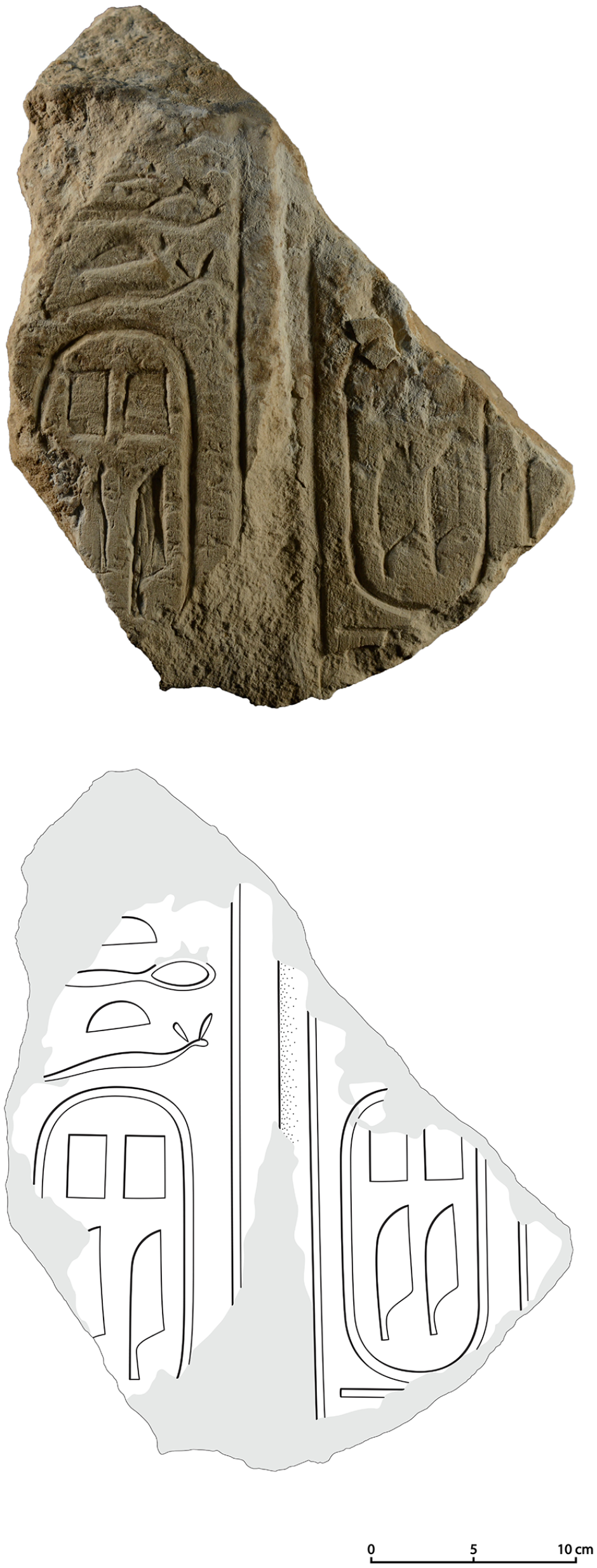
The limestone block fragment KKh22/28 from Kom el-Khamaseen, now stored in the El-Mohemat magazine at Saqqara (photo: Lluís Tudela; drawing: Sara Chen; © SEAMS).
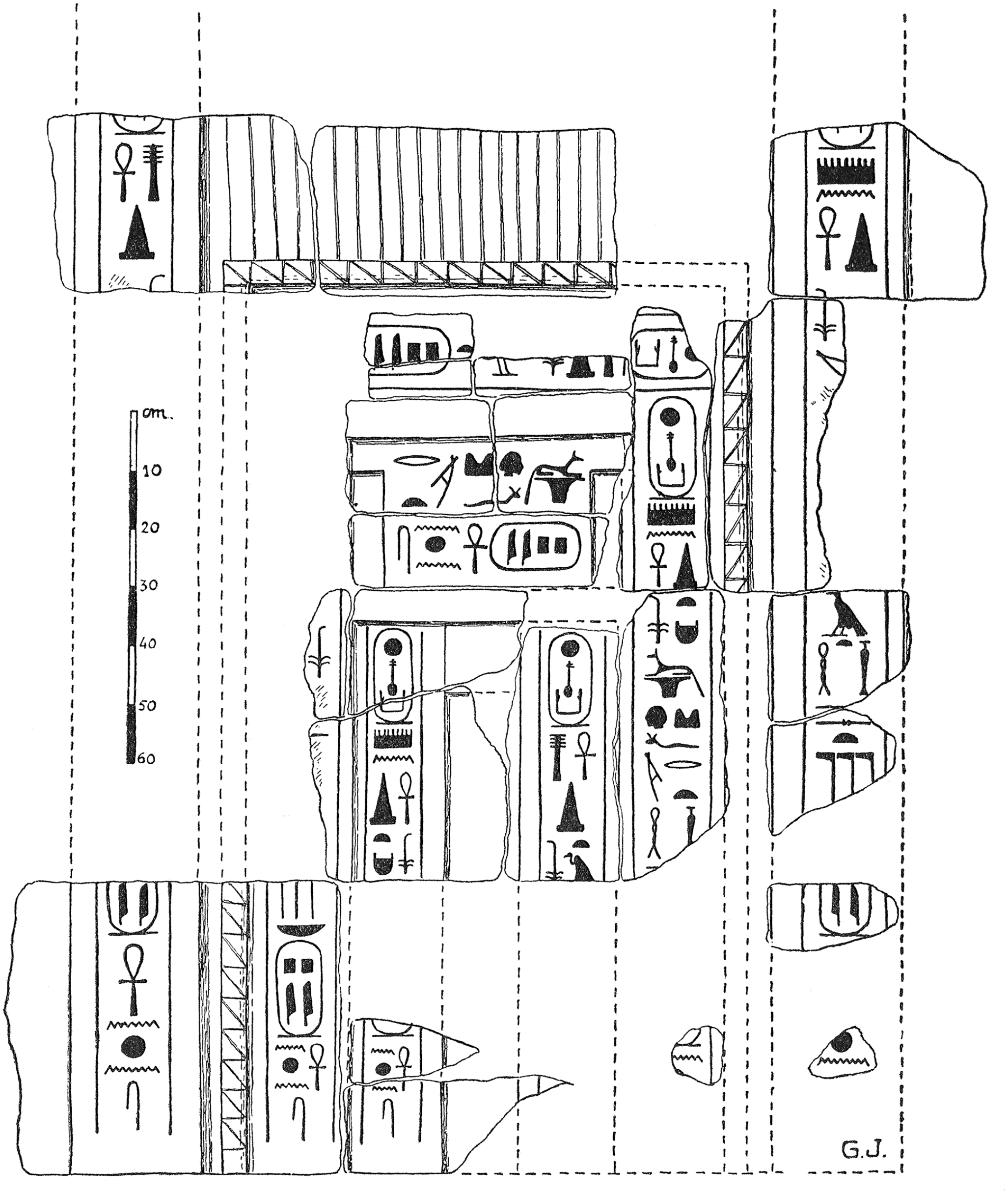
Ankenespepy IV is represented by an incomplete false door stele, preserved in 24 fragments (fig. 8). This stele was discovered by Gustave Jéquier in the makeshift tomb of the queen located within the complex of Queen Iput II in the Pepy II cemetery at South Saqqara. 16 After its discovery, Jéquier had it reassembled and arranged on the wall of a small warehouse he built in the complex of Queen Neith, in the same cemetery. The location of the warehouse was forgotten and the stele was lost until, in 2016, it was rediscovered by the Mission Archéologique Franco-suisse de Saqqâra (MAFS). 17 It is now stored in the magazine of this mission at Saqqara, where we had the opportunity to see it. No new photographs of the stele have yet been published, but good ad hoc photographs were taken at the time of the rediscovery.
False door stele of Ankenespepy IV, found in the funerary complex of Queen Iput II in the Pepy II cemetery (drawing: Jéquier 1933: fig. 31).
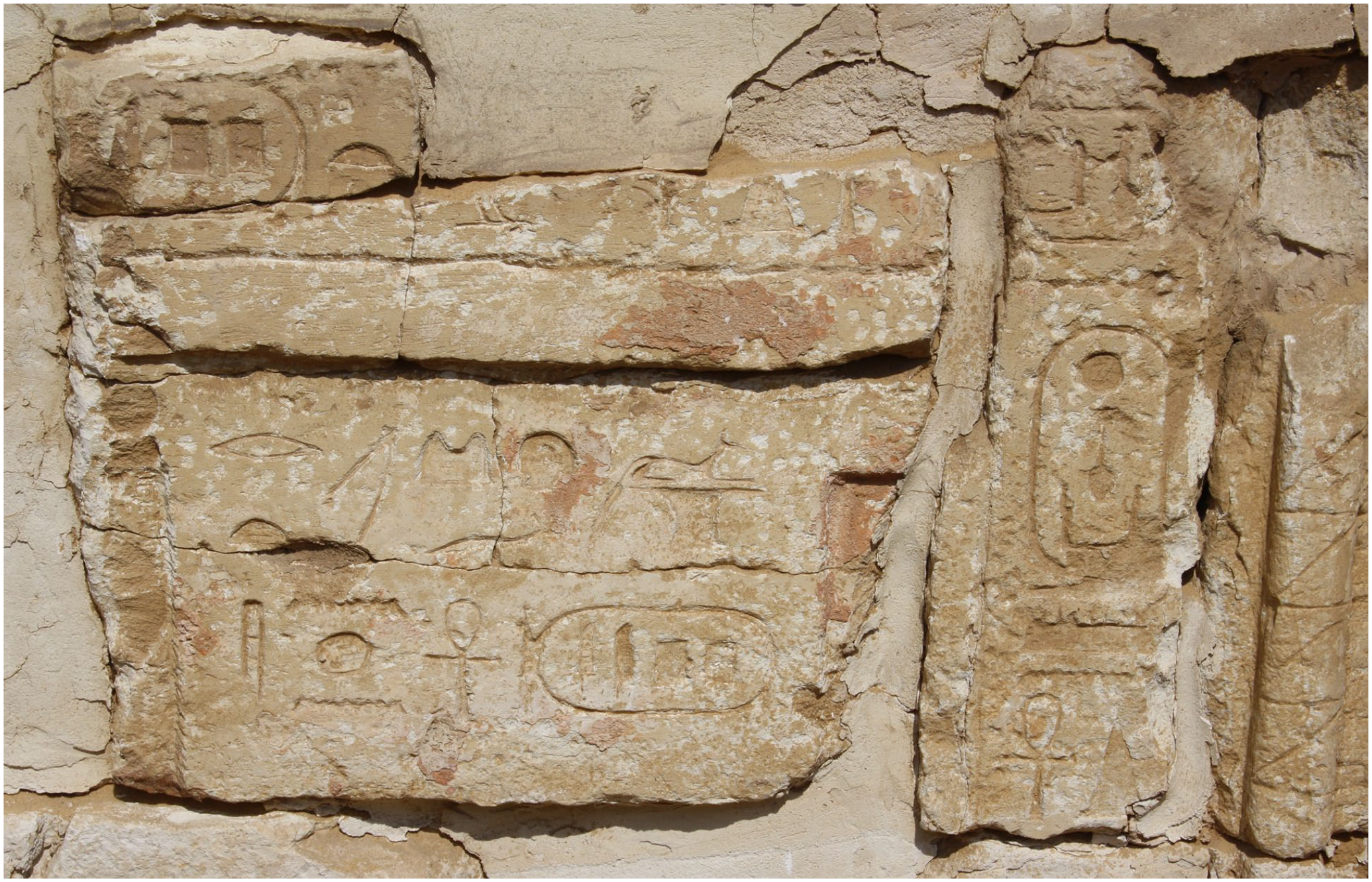
Two female royal titles are recorded on the jambs and vertical side frames of this stele, either in full or incomplete form: those of ḥmt nswt Mn-ʿnḫ-Nfr-kȝ-Rʿ and mwt nswt Ḏd-ʿnḫ-Nfr-kȝ-Rʿ. This means that Ankenespepy IV was the wife of Neferkare Pepy II, to whom the pyramid called Mn-ʿnḫ-Nfr-kȝ-Rʿ belongs (which was already known from other sources), and the mother of another Neferkare, whom Vivienne Gae Callender convincingly proposes may be identified with Neferkare Neby and Neby of the Abydos and Turin royal lists. 18 This identification would make him the son of Pepy II and owner of the unrecovered pyramid called Ḏd-ʿnḫ-Nfr-kȝ-Rʿ. The sȝt nswt title is not clearly documented on any of the queen’s monuments. 19 However, Callender considers the possibility of reading this title on the lintel of the stele. New photographs have shown that Jéquier’s drawing was correct on this point: the lintel text begins with the name of a pyramid introduced by the cartouche of a Nfr-kȝ-Rʿ and continues with a female royal title and the Ppy cartouche of the basilophoric name Ankhenespepy, the end of which is not preserved at the end of the line. The title is written with the sign of a bird, though unfortunately only the lower half has survived, showing only the bird’s parallel legs and the ground on which they rest. The pyramid mentioned is clearly not that of Pepy II, because the cartouche is followed by a vertical sign rather than the signs mn (Y5 + N35). However, if it is the other pyramid mentioned on the stele, behind the cartouche we would expect two vertical signs (R11 + S34) and there seems to be only the lower part of one, which poses an additional problem that is difficult to solve (is it a scribe or carver’s error?). Before the rediscovery of the stele, Callender had considered a possible reconstruction of the title on the lintel as sȝt nswt rather than mwt nswt, arguing that the customary tail of the vulture – always close to the feet of the bird – did not seem to be present in this inscription, according to Jéquier’s drawing. 20 After the recovery of the original monument, Callender appears correct on this point; in the absence of a close examination, the sign of the bird does not appear to be that of the vulture (G14). To the left of the bird’s legs and at the height of their upper part, there seems to be a small, slightly oblique stroke which is not present in Jéquier’s drawing and could correspond to the tip of the tail of a sȝ bird (G39), but hardly to that of the mwt bird (fig. 9). This, however, raises more problems than it solves, given that the pyramid mentioned is not that of any 6th Dynasty king up to Pepy II, so which king’s daughter would we be talking about? At least for the time being, this problem remains unsolved. 21
Detail of the stele of Ankhenespepy IV showing the lintel (photo: Philippe Collombert; © Mission Archéologique Franco-suisse de Saqqâra (MAFS)).
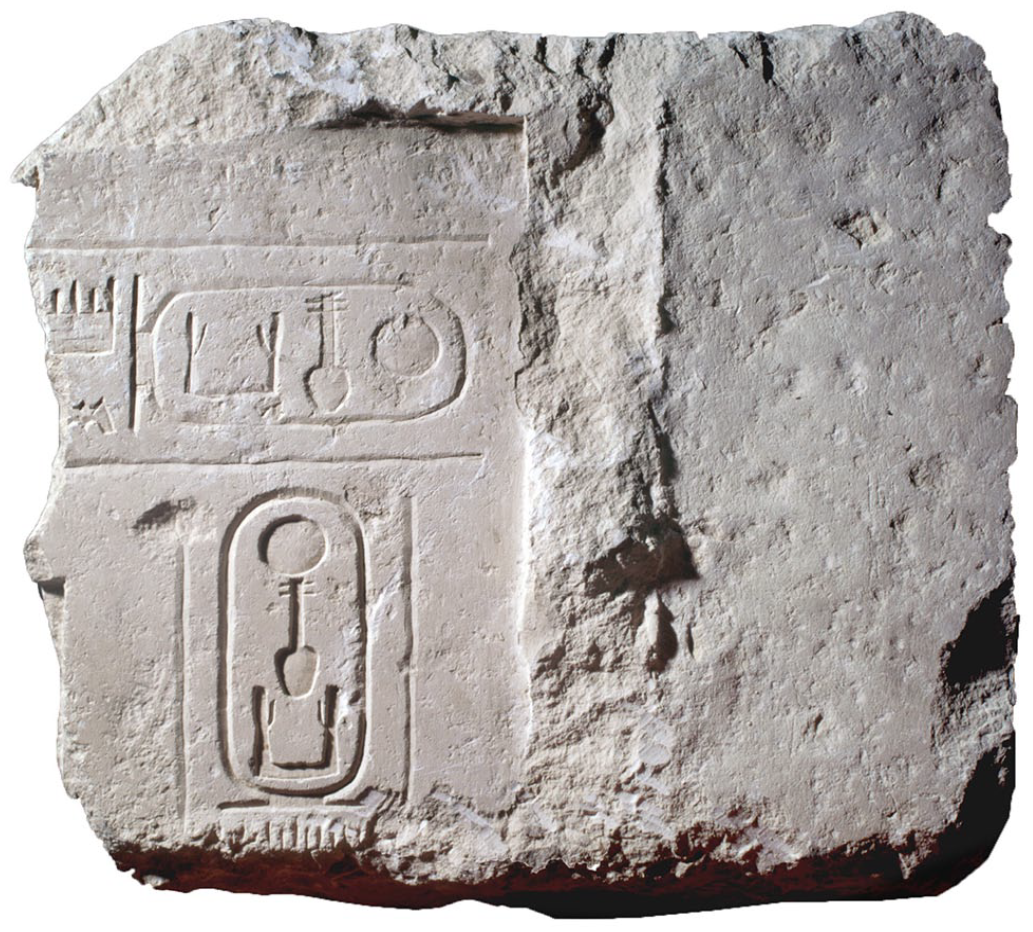
As for Ankhenespepy III, the titles sȝt nswt and sȝt nswt nt ẖt=f (precisely the title on our piece) are attested in her pyramid complex in the Pepy I cemetery, in her burial chamber and on her sarcophagus. 22 The title sȝt nswt smswt associated with an Ankhenespepy from a royal decree recorded at the entrance of this queen’s complex probably also refers to her. 23 21 small fragments of what was once her false door stele come from there, as well (fig. 10), but the aforementioned titles are not documented. 24 These fragments are currently also kept in the magazine of the Franco-Swiss Mission in Saqqara, where we had the opportunity to see a selection of them. However, our fragment does not match them, neither in the size and arrangement of the text columns, dividing strips, and margins, nor in the palaeography, which is much more careful in the Ankhenespepy III fragments than in the Kom el-Khamaseen piece.
Fragment of the false door stele of Ankhenespepy III, from her funerary complex at the Pepy I cemetery (© MAFS).
In conclusion, the two blocks found at Kom el-Khamaseen undoubtedly come from a royal cemetery. It is likely that they were removed during the First Intermediate Period by Imephor Impy Nikauptah himself and reused as his building material. In fact, the cemeteries of the 6th Dynasty kings at South Saqqara are well connected to the distant Kom el-Khamaseen through the Wadi Tafla and its tributaries. Looting and plunder during this period are well documented in other necropolises at Saqqara. 25 And in a forthcoming article, Audran Labrousse discusses the archaeological evidence of attacks, fires, and looting at the funerary temple of Pepy I and the complexes of the queens in his cemetery, including Ankhenespepy III, at the very end of the 6th Dynasty or the beginning of the First Intermediate Period, as well as their subsequent restoration in mud bricks, since the cults remained active to some extent until the beginning of the Middle Kingdom. 26 Labrousse goes so far as to speak of ‘une bande organisée’: would our Imephor have anything to do with it? The hypothesis makes one smile, but with all the evidence at hand, it does not seem so far-fetched either.
The two blocks must have come from the Pepy I or Pepy II cemetery, or – perhaps less likely – one from each. The close resemblance between the relief in our Behdety block and the decoration of the Nebuwenet door jamb suggests this block may come from the Pepy I cemetery. And the data provided by Labrousse make this hypothesis more plausible. The blocks must be sourced specifically from the funerary complex or complexes of one or two queens: that of Behdety again probably from a door jamb and the other from a false door stele located in the sanctuary. 27 From the documentation available, it is not possible to identify which queen or queens she/they may have been. As mentioned, our false door stele block does not match those of the Ankhenespepy III stele in terms of layout, size, and palaeography. Neither does it match those of the Ankhenespepy IV stele, and, in this case, there would be no room for it as it corresponds to the left side of the stele to which it belonged (right-to-left orientation) and there is no space in the Ankhenespepy IV stele left for a fragment with part of the text columns of two jambs. One unlikely possibility would be that one of these two queens had a second false door stele of which there is no trace other than our block. If so, it is more likely that this queen was Ankhenespepy III, given the nature of the tomb of Ankhenespepy IV and her burial equipment. Another possibility, perhaps the more plausible, is that we are dealing with a still unknown Ankhenespepy, maybe the daughter of Pepy II (and wife of Neferkare Neby?). The less careful layout and palaeography of the inscription on our stele fragment may support this late date, perhaps already into the beginning of the First Intermediate Period.
Footnotes
Acknowledgements
We would like to express our sincere thanks to our colleague and friend Francisco Borrego Gallardo from the Universidad Autònoma de Madrid, a specialist in falcon iconography and falconid hieroglyphic signs, for having generously offered us his invaluable advice and time, and to Philippe Collombert, director of the Mission Archéologique Franco-suisse de Saqqâra (MAFS), for inviting us to visit the magazine of the Mission in December 2022 to see the preserved blocks of the false door stelae of Ankhenespepy III and Ankhenespepy IV.
Funding
This paper has been carried out within the framework of the Kom el-Khamaseen Project (Spanish-Egyptian Archaeological Mission in Saqqara, SEAMS) and the R+D+i project ‘Studies on Ancient Egyptian Funerary Epigraphy of the Memphite Region’, funded by the Ministry of Science and Innovation of the Government of Spain (PID2019-105878GB-I00), of which Josep Cervelló Autuori is the Principal Investigator.
